A Daily History of Holes, Dots, Lines, Science, History, Math, Physics, Art, the Unintentional Absurd, Architecture, Maps, Data Visualization, Blank and Missing Things, and so on. |1.6 million words, 7500 images, 4.9 million hits| Press & appearances in The Times, Le Figaro, Mensa, The Economist, The Guardian, Discovery News, Slate, Le Monde, Sci American Blogs, Le Pont, and many other places… 5000+ total posts since 2008.

Category: Technology, History of

  • “The Enemy is Less than Ten Minutes from San Francisco”, 1942

    JF Ptak Science Books  Quick Post

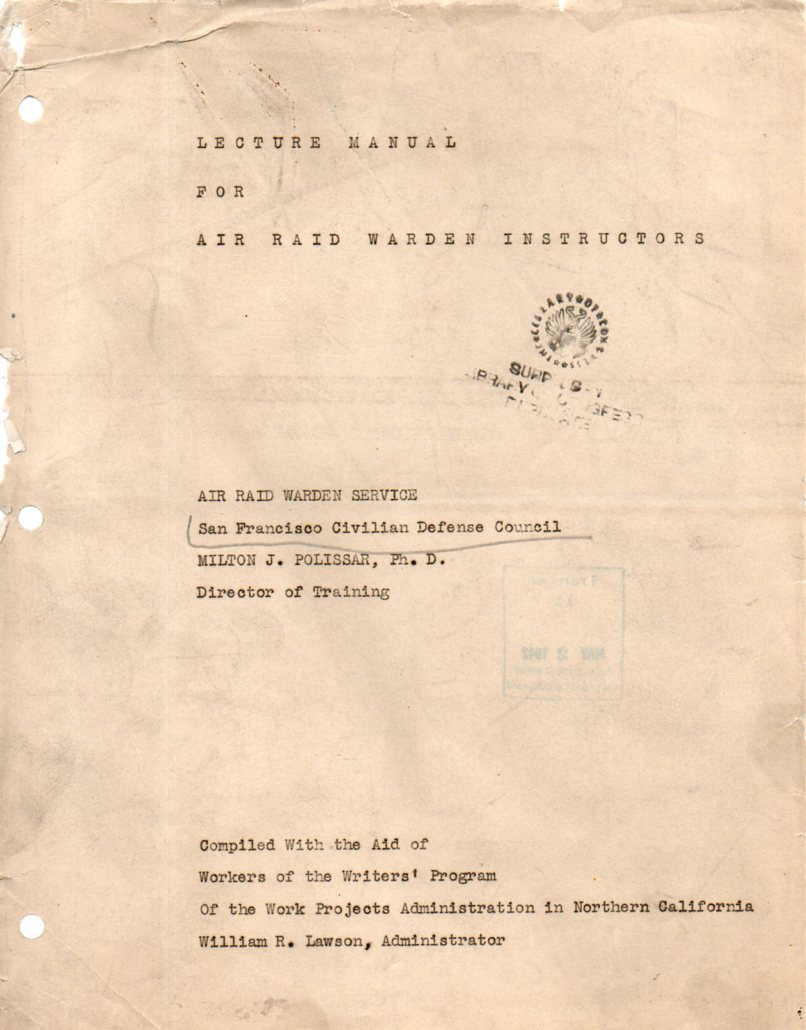
    Air warden478Lecture Manual for Air Raid Warden Instructors is in its way a remarkable document revealing some of the thinking and interpretation on the chances for the invasion of the American west coast just a few months (March 9, 1941) following Pearl Harbor.   Undertaken and published by the Workers of the Writers’ Program (‘of the Works Projects Administration in Northern California”) it was a product of one of the number of the Roosevelt administration’s social engineering programs that had a long lasting effect. 

    The first chapter, “It Can Happen Here” is more about the mechanics of responding to an enemy aerial attack than qu8estioning whether the attack might occur–the writer assumes that such an event was possible, and so precautions and preparations must be made–there is no question mark at the end of the chapter’s heading. 

    Overall I think that this was an excellent organizational effort for at least dealing with controlling the situation on the ground–providing a grid in which actions could be interpreted and responded to.  [The original is available at our blog bookstore.]


  • Addition to Inner City Rooftop Airport Design: Big, Bad, & Ugly; London, 1931

    JF Ptak Science Books    Post 1799

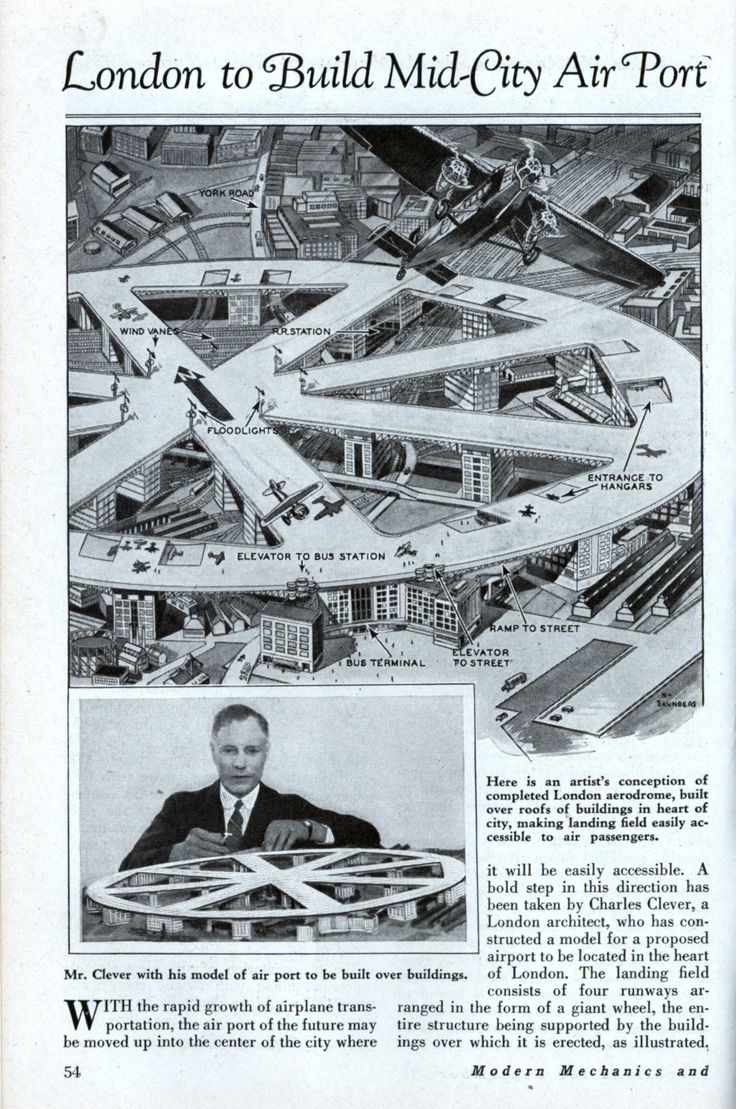
    London airport

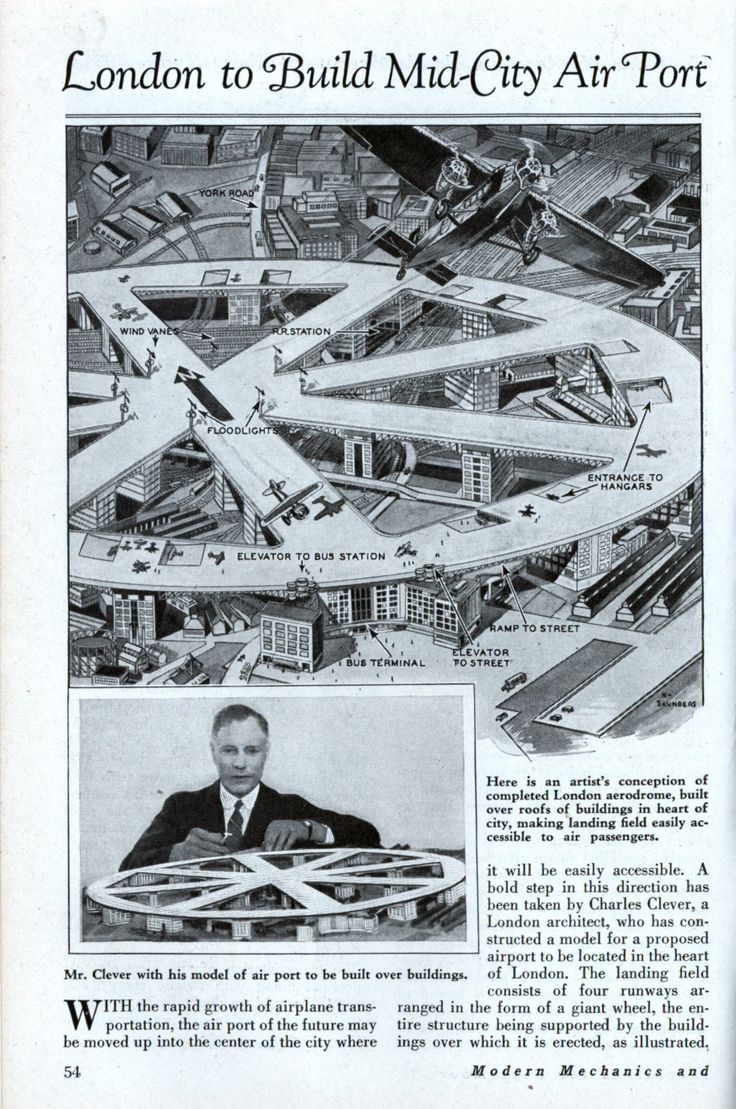
    Airportldn rooftop472[Source: Popular Mechanics, September, 1931.]

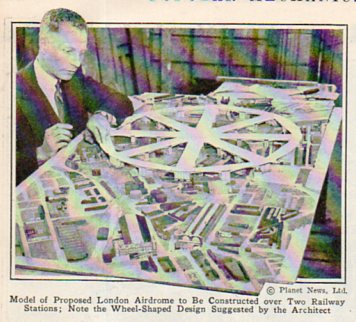
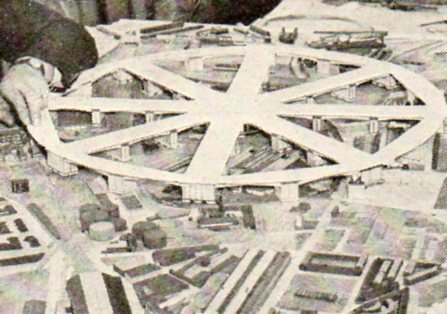
    I am not an architectural historian nor a historian of aviation, but I have looked at a lot of images relating to these fields over the past 30+ years, and so when I find something unusual it makes me pause.  One developing category in this area are rooftop/elevated inner city/downtown airports (I’ve done two earlier posts about this sort of design, including airports designed to be constructed over the Thames and Central Park NYC in Rooftop & Floating Airports -and- Rooftop Airports in a Levitating NYC, 1929  and Elevated, Rooftop Inner City Circular Airports.   I’m not at all certain about what these planners (above) were thinking except that the locations of the airports were central and would save on driving town from the hinterlands to central city–and the “central city” here was London, with the “aerodrome” hosted above King’s Cross and St. Pancras station, and might even have reached Regent’s Park, though I’m not sure.   Evidently there wasn’t much of a concern of the planes missing their runways, or coming in too low, or too fast, or just having an accident–any one of which would wind up in the lap of a busy city rather than in a field somewhere or on a large piece of ground devoid of buildings and a population (where airports are normally situated.  True, there are many airports in this country that are located in urban and suburban sprawls–there was calculated room for error and they were not located right on top of error-proof zones in the middle of a vastly populated areas. So, in the “what were they thinking” department, I clearly do not understand what they were thinking. 

    In addition to being a not-very-good-idea, it was also unwholesomely unpretty. And big.

    Airportldn rooftop473


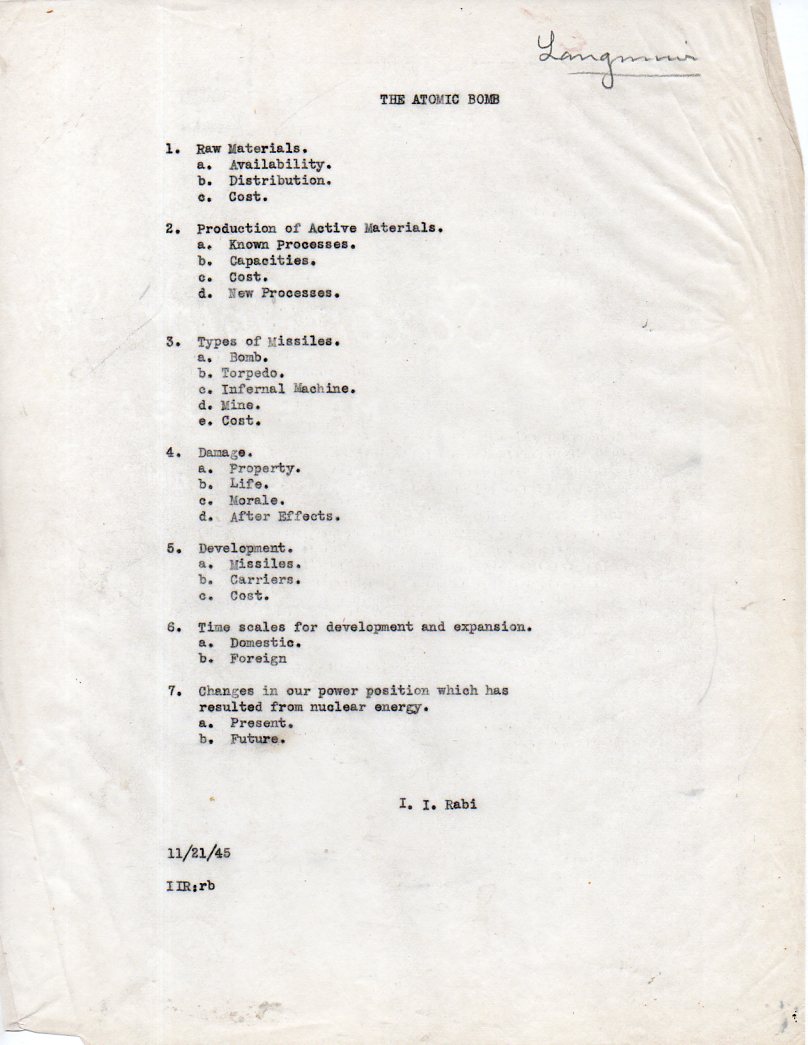
  • Outline for Disucssing the Atomic Bomb–I.I. Rabi, November 1945

    JF Ptak Science Books   Post 1793   Part of a series on development, use and control of atomic and nuclear weapons

    [My apologies for the spacing below–Typepad has refused to allow paragraphs today for some reason.]

    “As yet, if a man has no feeling for art he is considered narrow-minded, but if he has no feeling for science this is considered quite normal. This is a fundamental weakness.”–I.I. Rabi  In Kermit Lansner, Second-Rate Brains: A Factual, Perceptive Report by Top Scientists, Educators, Journalists, and Their Urgent Recommendations (1958).

    The Nobel Prize in Physics 1944 was awarded to Isidor Isaac Rabi “for his resonance method for recording the magnetic properties of atomic nuclei”.–NobelPrize .org

    “Suddenly, there was an enormous flash of light, the brightest light I have ever seen or that I think anyone has ever seen. It blasted; it pounced; it bored its way into you. It was a vision which was seen with more than the eye. It was seen to last forever. You would wish it would stop; altogether it lasted about two seconds.”
    [Witnessing the first atomic bomb test explosion.] — Isidor Isaac Rabi  Science: the Center of Culture (1970).
    “To me, science is an expression of the human spirit, which reaches every sphere of human culture. It gives an aim and meaning to existence as well as a knowledge, understanding, love, and admiration for the world. It gives a deeper meaning to morality and another dimension to esthetics.” 1970
    Rabi470

    I came across this interesting sheet of paper in my files, a neglected part of a larger archive  of background and draft papers and proposals by the Vannevar Bush group working on the question of the control of atomic weapons and the formalization of the American position regarding the use and control of atomic weapons (and dated from October 1945 to February 1946).   (Other contributors to this archive include President Harry Truman, Secretary of State James Byrnes, Dr. Vannevar Bush, (future AEC director) Carroll Wilson, Alger Hiss, I.I. Rabi, William Shockley, Frederick Dunn, Joseph E. Johnson, Leo Pasvolsky, Philip Morrison, Col. Nichols, William McRae, Admiral W.H.P. Blandy, George L. Harrison, and others).  The archive (which I’ve written about elsewhere on this blog) are remarkable for their foresight and logic, and addressed the implications and future of the atomic bomb at the earliest stages of its existence.
    Rabi was a great physicist (being awarded the Nobel for physics in 1944) who was of course deeply involved in the technical/scientific end of fighting World War II.  It was his conviction that his brain was best used  in the development of radar and could not be convinced to spend all of his efforts in the Manhattan Project at Los Alamos, feeling that the further development of radar was more important and more immediately applicable to the winning of the war than the longer-range prospects and use of the atomic bomb.  He worked at the MIT Radiation Laboratory working on radar for the duration–except (and this was a great exception) for being a frequent consultant and visitor to bomb works in the desert. (Access to Los Alamos during this time was extremely tight–there were very few other people among the many thousands who worked there who were able to simply “visit” the facilities as their expertise was needed.)
    And so at the end of the war, Rabi became part of the Bush group that was given the task of trying to figure out what to do about the bomb–its control, its possible use, its proliferation, and so on). At some point, months into this process, it looks as though Rabi created a single-page outline of discussion points on atomic bomb issues.  It is very succinct and crisp, with nothing more than the bare essentials. This is a carbon copy of the original, and evidently was meant for Irving Langmuir.

  • The Dots that Connected the Lines, 1869

    JF Ptak Science Books    Post 1791   [Part of the History of Dots series.]

    Def. 1.1. A point is that which has no part.
    Def. 1.2. A line is a breadthless length.
    Def. 1.3. The extremities of lines are points

    —Euclid, The Elements 

    Please see the associated post on  the History of the West and the History of Lines: Telegraphs, Railraods, Treaties, and Barbed Wire.

    I really don’t mean to tangle this post up in what might be one of the most profoundly significant books ever written, mainly because the I’m talking about “dots” and not “points”, though several points do come into play in the story.

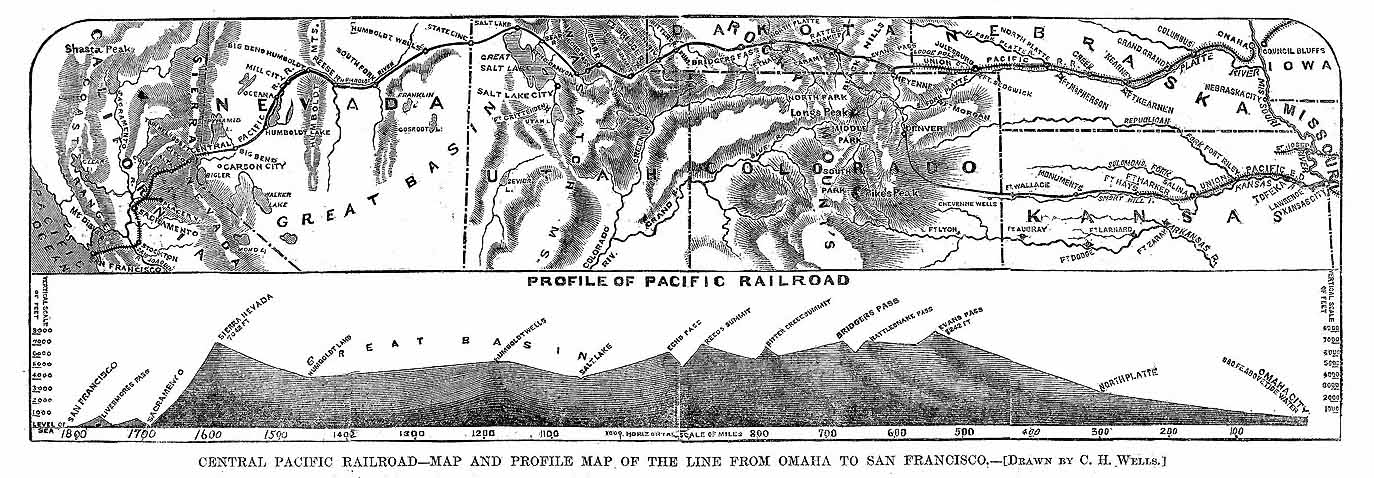
    The dots come into the story with the finishing of the great Overland Route, the Transcontinental Railroad, which was built between 18631 and 1869, and which via massive construction tied together various lines to make the fist continuous connections by rail between the American Atlantic and Pacific coasts. The construction for the vast missing connecting chunks were undertaken by the Central Pacific Railroad of California and the Union Pacific Railroad, building (respectively) their ends extending from Oakland (CA) to Council Bluffs (IA).  (A map of the railroad line can be seen below in a clickable whole and then again in the “continued reading” part of the post in more detailed sections. Interestingly this map shows both a plan and profile of the line, and when you take a closer look at the bottom part of the map it is easy then to see why the Central Pacific had so many delays getting through the Sierra Nevada.)

    Pacific_Railroad_Profile_1867
    The building of the railroad line was notoriously difficult, undertaken by companies desperate to build their ends fast and not using the best materials or doing the best work (with millions needing to be spent on repair of the Central Pacific effort as soon as the line was completed), or treating the largely immigrant workforce (mainly Chinese and Irish) fairly. But the job did get done and it got done relatively quickly, considering too that the first primitive locomotives didn’t appear in the U.S. until 1831–it didn’t take long at all to produce thousands of mile of line as well as the sophisticated machinery to run on them.  The great engineer Oliver Evans waged a little war on the future by allowing himself to see the following:

    “The time will come when people will travel in stages moved by steam engines from one city to another, almost as fast as birds can fly, 15 or 20 miles an hour…. A carriage will start from Washington in the morning, the passengers will breakfast at Baltimore, dine at Philadelphia, and sup in New York the same day…. Engines will drive boats 10 or 12 miles an hour, and there will be hundreds of steamers running on the Mississippi, as predicted years ago.” –Oliver Evans, 1800 [Evans built the first stationary steam engine in 1800, and then in 1804 built the first steam engine powered boat.]

     He wasn’t talking about railroads per se, as the steam locomotive hadn’t been invented yet.  But 30 years later or so there was the first appearance of these machines, and then another thirty years after that they were running across the United States, which was a remarkable turnaround in the economy of transportation. 

    The very end of this story though is told in dots.  When the Central Pacific and the Union Pacific met in the lonely Promontory Summit, Utah, there was an on-site celebration where the two lines were famously tied together using a golden spike. (Actually there were two gold, one silver one blended gold/silver, and one plain spike used int he ceremony.)  The news of the event was carried out to the rest of the country via another new and remarkable medium, the transcontinental telegraph, which had been completed in October 1861 and which allowed nearly simultaneous communication between the two American coasts, with this innovation also taking place about 25 years after the general invention of the telegraph.) 

    It is interesting to note that it was during the Lincoln administration–in the earliest part of Lincoln’s presidency–that these two great unifying elements were established.  The railroad was started in the first year of the Civil War, and the telegraph finished just months into the conflict.  It is ironic that the first communication going west-to-east by Stephen J. Field (on 24 October 1861) to President Lincoln spoke of the medium’s great power in uniting the country, if only East and West:  “will be the means of strengthening the attachment which binds both the East and the West to the Union”.  Which may or may not have been true–communications wouldn’t necessarily unite, as the country was already deeply at war with itself North and South, and there were already ample telegraphs enough existing between the two that did not manage to keep the country firmly within itself.

    Back to Promontory–the proceedings of the celebration were “broadcast” by telegraph, the event being very heavily listened-to news.  There were speeches of course and then toward the end there was a sermon followed by a long entreaty to the almighty.  That finished, the Central Pacific top man, Leland Stanford, was to drive home the final golden spike uniting the lines.  When the spike was driven and finished, the news would be related by the telegraph as so:

    “Dot. Dot. Dot.”

    Three dots would signal the end of the work, and the completion of the railroad.  Stanford reportedly missed on his first swing with his silver hammer, but the news was sent out anyway, saying the work was done.  The signifier relating the connection of thousands of miles of railway track being three simple dots.

    Hart stereoview #355, detail.  Courtesy National Park Service.
    Hart stereoview #355, detail, “The Last Rail – The Invocation. Fixing the Wire, May 10, 1869.”
    Courtesy National Park Service. [Source for image, here.]

    Notes:

    1.  Abraham Lincoln signed the Pacific Railway Act in 1862 which set the stage for the building of the Transcontinental.


  • Flotation Mounting for one of the World’s Largest Telescopes, 1889

    JF Ptak Science Books  Quick Post

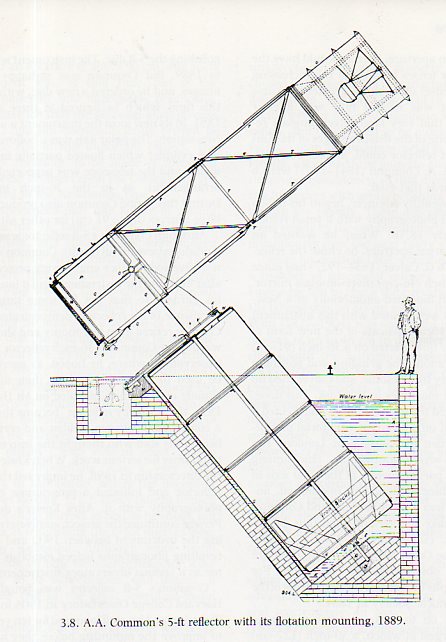
    Telescope floatation456

    I found this illustration browsing Owen Gingrich’s (editor) Astrophysics and twentieth century astronomy (Cambridge 1984) , and found it fascinating. The telescope was designed and built by Andrew Ainslie Common (1841-1903, a wealthy engineer and amateur astronomer), and it was a 155 cm/5-foot reflector, and had a flotation mounting.  This sort of mounting seems at least unusual to me, though one of Common’s earlier telescopes used a mercury flotation system. It was finished in 1889 and replaced a very fine 91cm instrment, both of which were constructed mostly for astrophotographical service. The 155cm didn’t really perform, ever, whereas the earlier and smaller instrument certainly did. (Following its service with Common, the 91cm went on to Edward Crossley in 1885m and was then used by James Keeler in 1893, and then by Charles Perrine.) I found the large-ish reservoir in use for keeping stutter and vibration away from the telescope to be very intriguing. It was purchased by Harvard University around 1905, and was moved and again a flotation mounting was employed. (The article on the telescope’s purchase is located below, taken from the Harvard Crimson of 5 April 1905.)

    ·Posted by :

    ·in:

    —

  • The Death Ray and Cloud Writing–Battlefield to Breakfast in a Few Short Years.

    JF Ptak Science Books  Post 1749  [Part of the Strange Things in the Sky department.]

    The Death Ray is a long-discussed idea, extending back as far to Archimedes at least–discussed, attempted, abandoned and dismissed.  But as a matter of fact, the thing was actually invented, and deployed, though not int he sense of an EM weapon, or LRAD/ultrasonic, or Teller x-ray laser, or even a Wellsian heat ray (below).

    File:Alvim-correa12.jpg

    The “Death Ray” made its appearance in the 1880’s, but not in the normal sense of what we would today think of as a “weapon”–this death ray could locate the enemy hidden miles from the front, or pick out ships at sea far from shore, and so on, removing stealth capacity, making it possible for these elements to be identified as targets, and then possibly removed, though not by the ray itself. 

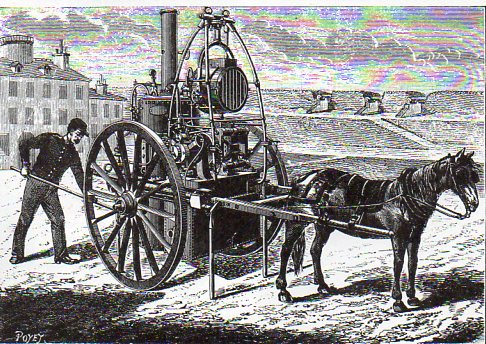
    This “death ray” was the search light.  In the 1880’s when the technology of electric lighting was still in its first practicable decade, the idea of being able to focus a beam of light from a lantern source hauled on a single-mule carriage and powered by an on-board battery, small steam engine  and Gramme dynamo was a spectacular. achievement. 

    Searchlight359
    [This image appeared in the Scientific American in 1886 and features what is probably a one-foot diameter mirror, making it capable of illuminating an object up to about a mile away.  Something with a three-foot diameter could work its magic on object up to four miles away.]

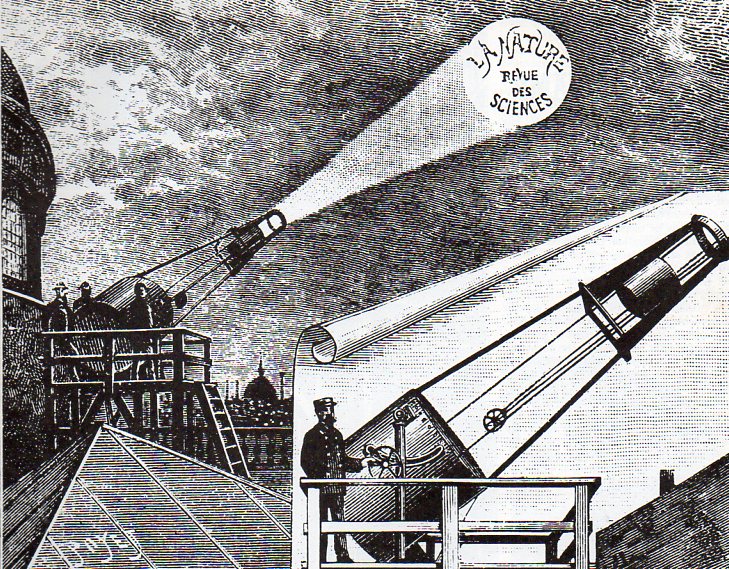
    This defensive/offensive weapon/device was very soon afterwards made into a trickle-down appliance that was placed into commercial use almost immediately.  The standard use of course would be upgrading lighthouses, but one special use was using a large mirror in a device to project an advertisement on the clouds in a city–ads in the sky.

    Searchlight360[Source, La Nature, 1894; also reprinted in Scientific American in the same year.]

    Such a device was used experimentally at the Columbian Exposition in Chicago for the World’s Fair of 1893, flashing the daily attendance on the clouds.  I’m not sure why the greater revenue-generating employment of this technology took another year to develop.  And so “The Death Ray”, from Battlefield to Breakfast Cereal in a few short years. 


  • Visualizing the Normally-Unseen: Roentgen, Marey, Malevich

    JF Ptak Science Books  Post 1775

    Pleasant_1bertha The 1895/1896 issues of Nature magazine are compliantly normal until the first weeks of 1896 when the first of a flood of articles is published about the astonishing discovery of 50-year-old Wilhelm Conrad Röntgen. The English-language popular science journal announcement of his December 28, 1895  “Ueber eine neue Art von Strahlen” (“On a New Type of Ray”), appearing 16 January 1896, began the introduction of a new state of human experience.  His experiments—built upon the work of J. Plucker (1801-1868), J. W. Hittorf (1824-1914), C. F. Varley (1828-1883), E. Goldstein (1850-1931), Sir William Crookes (1832-1919), H. Hertz (1857-1894) and the odious Phil Lenard (1862-1947 and who didn’t die soon enough)—revealed as much to humans as did the experiments and inventions of Hooke and Leeuwenhoek on the invisible worlds revealed by the microscope.  There are more than 150 articles on the Roentgen (and soon to be “X-“) Ray, all published within 12 months of the original announcement, almost all excitedly, trying to comprehend, elucidate, expand, verify, this new world. 
    Blogxraybigads_2 [The news of the discovery is first and most popularly reported in the January 6, 1896 London Standard:  “The noise of war’s alarm should not distract attention from the marvelous triumph of science which is reported from Vienna. It is announced that Professor Routgen (sic) of the Wurzburg University has discovered a light which for the purposeBlogxrayad of photography will penetrate wood, flesh, cloth, and most other organic substances. The Professor has succeeded in photographing metal weights which were in a closed wooden case, also a man’s hand which showed only the bones, the flesh being invisible”. By the end of the month the news was completely absorbed, worldwide.]
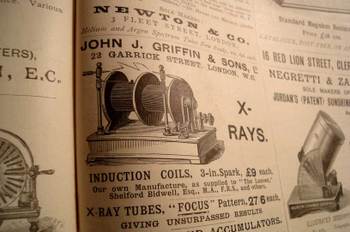
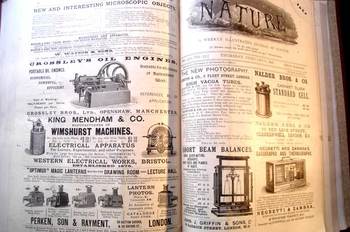
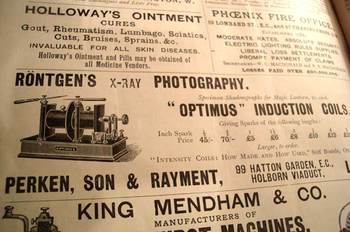
    I looked at the advertising in these issues (my copies of Nature for these decades generally have the original paper wrappers for the weeklies, complete with ad copy), looking for the first time that a Roentgen machine was offered for sale to the general public.  As it turns out, they popped up 12 March 1896 (once), 19 March (twice), and then about once a week for the rest of the year.  A little surprising, I think, a little light to my Monday-morning quarterback’s eye—I expected more; bigger, more, splashier.  But the ads are small and sedate, hardly similar to the discovery they represent. 
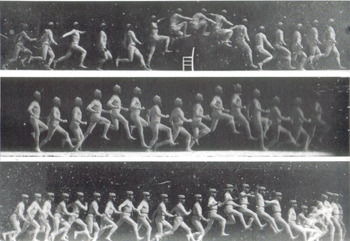
    Blogfeb_22marey The rest of the world, the rest of the advertising world, stayed the same–the Roentgen discovery and the enormous possibilities and promises of his “new photography” lived in their own unique sphere, unencumbered by their sassy new brother.   This mild response seems dimmer still when you compare it to that which greeted other (relatively) simple but still major advancements in the world of photography.  Take for example Etienne Marey, who was a technoid and physician who was able to capture motion of all sorts–he was able to develop a picture so to speak of the movement of blood in the body via his instrument to calculate blood pressure, and he also created a shotgun-style camera that made the Blog_feb_22_nude world’s first high-speed photographs of movement.  And so it cane to pass that in the late 1870’s and early 1880’s people were instantly able to see what a horse looked like when it galloped or what the body did *exactly* when jumping over a chair.  When you couple this with fourth-dimension material one wonders why it took several more decades to bump into these images in the art of 1907+. 
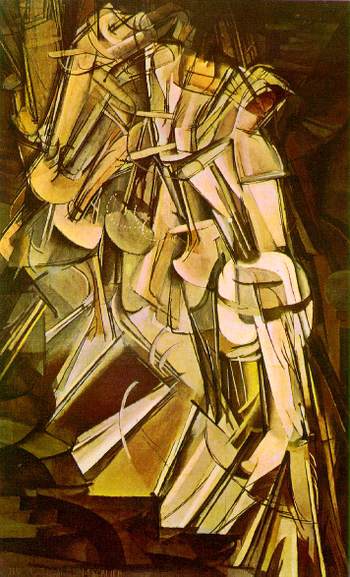
    (Duchamp Nude Descending series, 1915; above, Marey, 1881)

    And what indeed was normal in these pages?  Magic lanterns
    and magi lantern slides appearMagiclantern at all levels; the gorgeous Wimshurst machine gets heavily advertised; the redoubtable Negretti & Zambra advertised all manner of excellent scientific instruments (biographs, thermogrphs.  Nadeer Bros. advertised a pretty standard cell, and the ancient Crossley displayed their “new” oil engines, “suitable for all classes of agricultural work”.  J.H. Stewart was selling their semi-automatic electric arc lamp, while across the page was Newton & Company’s “Newtonian” arc lamps for lanterns (“self feeding and focus keeping”).  Microscopes and prepared slides abound, and Thomas Bolton advertises discretely and effectively for their “living specimens for the microscope”. 
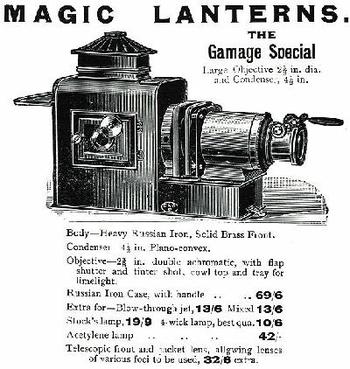
    The Physical Review, the American upstart in the science world advertises that its third volume was available, while its distant cousin, the Psychological Review, advertised its own third volume.  Booksellers seem to take the most space, thank goodness. 
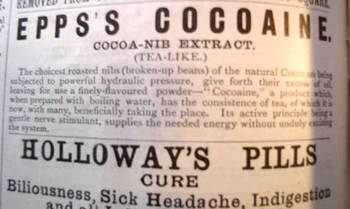
    Blogxrayepps There are a few medical throwbacks:  Epp’s Cocaine takes out occasional tenth-page ads for their “cocoa-nib extract, tea-like” selling its ‘gentile nerve stimulant”.  Right underneath is “Holloway’s Pills”, promising to cure biliousness, sick headache, indigestion, and all (?!) internal complaints.   These are brilliant simple samples of the skeleton of science in world-dominant Great Britain, in a world dominated at that time by H.A, Lorentz, Ernst Mach , Roentgen, Korteweg, de Vries, Bateson, Jean-Baptiste Perrin, Pierre Curie, Zeeman, Becquerel, Joseph Thomson,  Ernest Rutherford, Marconi, Ramsay, Fitzgerald.  And so on. 

    Nothing offered for sale here offered any significant clue to the pregnant world of modernity that was nearlyBlogxray3 there—the world would become ‘modern” almost immediately following Roentgen, with revolutionary, epochal changes in art (in non-representational form more so than Impressionism), theater, literature, music.  Just about everything changed (except politics).  But there is no hint to paradigm shift hidden in the ads, just as they were with the machines selling the promise of Roentgen’s “new photography.  There’s something about the fine glass, superb turning of the screw, and a perfectly oiled gear though that makes this sort of perfection seem so lonely in the world of larger change.  Bertha, Roentgen’s wife, sat for 15 minutes while her husband passed his rays through her hand; she ran from the room once she saw the results, revealing her very bones and no doubt a strong sense of the Blog_feb_22_malevich
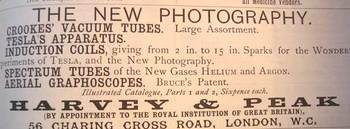
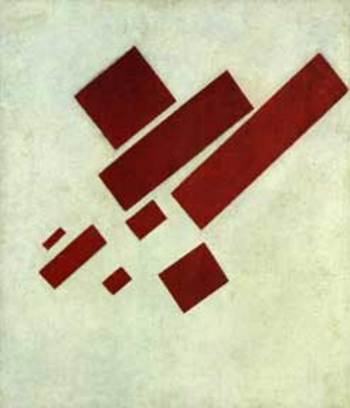
    fragility of life, and the strong presence of death.  Many had the same reaction to the Kandinsky’sBlogxrayad2 shapes and Malevich’s white circles and red rectangles and Ibsen’s drama and Einstein’s dancing dust and the rogue syncopation of jazz.  It is probably a very natural reaction to try and protect established memory—but memory should be more flexible than that, I think, to keep a healthy mind.

  • Drop-Dead Gorgeous Flying Man/Ornithopter Patent Drawings, 1889

    JF Ptak Science Books    Post 1746

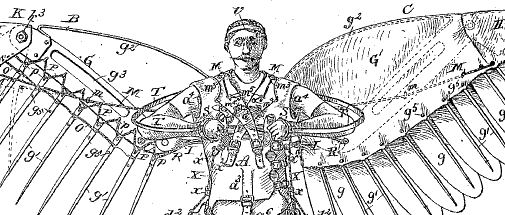
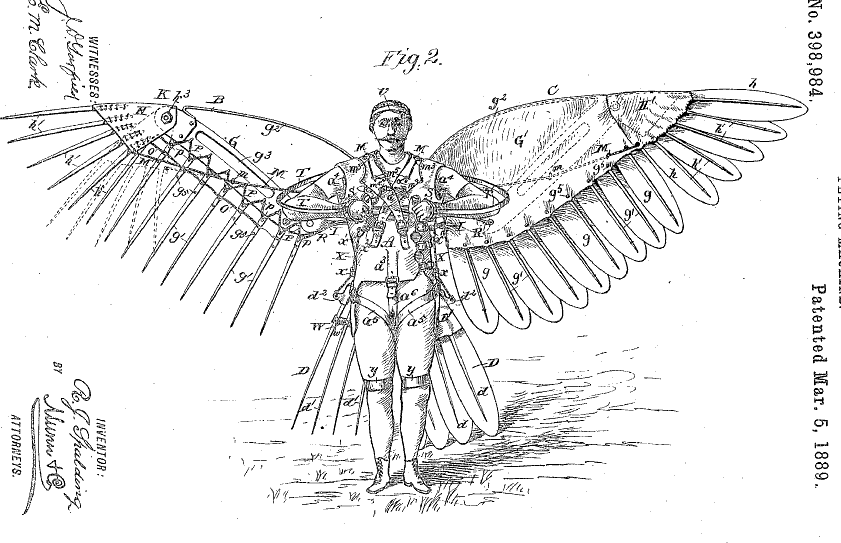
    This is one of the most appealing sets of “flying” or manned aerostation patent drawings that I have seen in the USPTO collection for the 19th century. The machine is a human-powered ornithopter, applying the structure of a human against that of a bird, and outfitting the flyer accordingly to combat their human weaknesses as adapted to bird flight.  Needless to say, and in spite of the beauty of the thought, this arrangement was destined to deep failure.  (The patentee, Reuben Jasper Spaulding, of Rosita (“Little Rose”), Colorado (south of Pueblo), may have been the same Reuben J Spaulding who made the first gold strike on the Blue River on Colorado’s Western Slope in 1859.)  Spaulding’s design is interesting also for the balloon device for getting the aero pioneer off the ground. 

    [Source:  Google Patents (and also for the extensive annotations for the images).]  I note that there was a model constructed for this patent–I’d love to see that.

    Patents--spalding flying_edited-1

    Patents--spalding flying

    And along this same vein of ornithopter-y thought is this, another American solution to the man-bird-mechanical-flight continuum, produced a dozen years earlier–it is similar, though not nearly as glorious (at least in presentation) as the later Spaulding effort: 


    The work really ins’t quite as awesome as Spalding’s beautiful Lazarusian resurrection, and not as detailed, but still quite interesting:


  • Land Mines in the Sky, 1913-1919

    JF Ptak Science Books   Quick Post

    With the beginning of the aviation age in warfare came the anti-aircraft era.  In the first years of WWI opposing forces knew that aircraft would be coming but didn’t quite yet know how to deal with them. Some of the results of thinking about how to stop marauding aircraft can be seen below in a few examples of patents taken from the U.S. Patent and Trademark Office.  All of the following examples employed balloons–balloons that stationary and rigged in one way or another so that a passing plane that snagged this line would cause the explosive device that moored the balloon to swing up and detonate on or near the aircraft.  That means that a great many of these devices were needed to be an effective deterrent against aircraft. (I had written earlier in this blog about barrage balloons proposed for use in/around London in 1938, here.  This mode of anti-aircraft balloon was static, though, and at least in this circumstance the balloons were meant to snag and not necessarily try to blow up anything caught in its cable.)


  • On Words: Fining (and Refining), 1683

    JF Ptak Science Books   Quick Post

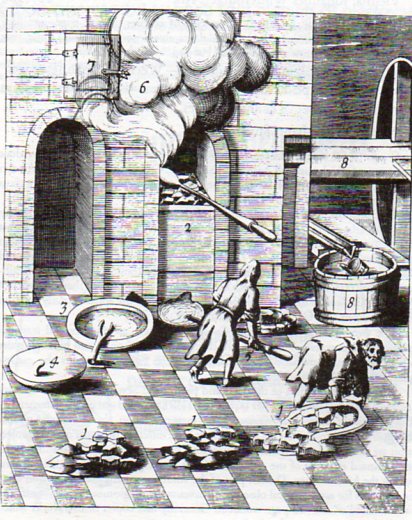
    We hear daily reports referring to refining, but there are very few about fining.. But there the word was, (appropriately) stick in the title of John Petrus’ translation of Lazarus Ercker’s classic work, Fleta minor: the laws of art and nature, in knowing, judging, assaying, fining, refining, and inlarging the bodies of confin’d metals. In two parts / the first contains assays of Lazarus Erckern … in V books : originally written by him in the Teutonick language, and now translated into English ; the second contains essays on metallick words, as a dictionary to many pleasing discourses, by Sir John Pettus … Knight .  (See the Richard Westfall entry at the  Galileo Project on Erker, especially on how he was able to support himself.  The book itself is an engineer’s delight, with applications of practical experience on all aspects of mines, mining and working with mined products.  It turns out that the original work by Ercker was so useful and popular that it was still around more than a century after Ercker’s death.  Oh yes–the original German editions were also among the first technical books to be supplemented by illustrations of the topics.)

    Fining425
    The story of iron is very old in Europe–and much older in China, older by more than another thousand years or so.  In Europe, though, iron from a blast furnace that has a high carbon content and a low melting point is called cast iron, and is quite brittle and cannot be worked by a smithy; fining is the process of cooking that cast iron up to its boiling point and skimming away the carbon, thereby giving the iron a higher melting point and a great capacity to be worked by a smith.  This product is called wrought iron, and it was a major step forward. 

    Which really does have something to do with a more popular definition of “fining”, which for the sake of simplicity would mean just to make something, well, “finer”.  I can imagine an eight-year-old figuring that out when aged six. A good, no-nonsense, perhaps 400-year-old word.