A Daily History of Holes, Dots, Lines, Science, History, Math, Physics, Art, the Unintentional Absurd, Architecture, Maps, Data Visualization, Blank and Missing Things, and so on. |1.6 million words, 7500 images, 4.9 million hits| Press & appearances in The Times, Le Figaro, Mensa, The Economist, The Guardian, Discovery News, Slate, Le Monde, Sci American Blogs, Le Pont, and many other places… 5000+ total posts since 2008.

Category: Technology, History of

  • Electricity as an Added Lethal Measure to Barbed Wire: World War I

    JF Ptak Science Books  Quick Post

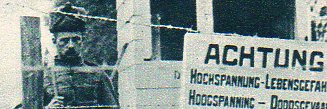
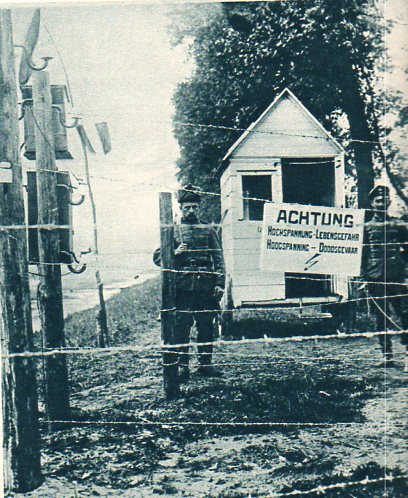
    Barbed wire was one of the most successful and horrifying defensive weapons of World War I.  In 1915 it was made more effective yet by adding high-voltage electricity to the emplacements.  In general the electrical barbed wire fence was employed as only a tiny fraction of all wire fences during the war–as the non-electrified fence was already extremely effective, very cheap to produce and very easily installed–but the possibility of finding an electrified wire somewhere along the lengthy rat’s nests of miles and miles of this thing must’ve had some sort of very major weight in most soldiers’ minds. 

    The following image (and details) from The Illustrated London News for 9 October 1915:

    WWI--e---electric fenc dete extra647

    WWI--e---electric fenc dete646

    WWI--e---electric fence645

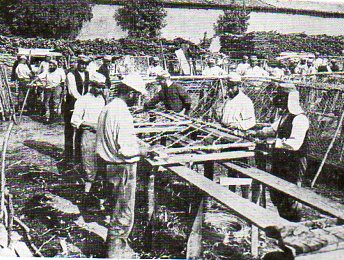
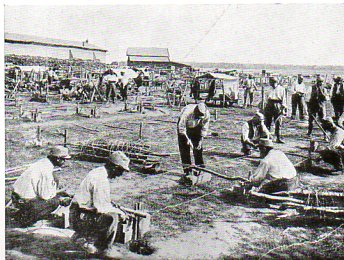
    And the places where the barbed wire was made and packaged, again from The Illustrated London News for 16 October 1915.

    WWI--e--barbed wire making648

    It looks as though the wire was stretched across 3.5 foot poles, with the barbed wire added diagonally, and then rolled up in long sections for easy transport and deployment.

    WWI--e--barbed wire making649


  • Hidden Stories in Prints–Renaissance Ladders in the Brooklyn Bridge, 1876

    JF Ptak Science Books   Post 1904
     blog 18 brooklyn bridge big707I’ve long been interested in the hidden, or the obscure, or the secondary, or the non-essential backgrounds and foreground in prints–more so at times than the subject of the print itself.  This thinking certainly applies for me nowadays when looking at another engraving of Winchester or another view of Rome or another prosaic cityscape–the main focus of the images are of course beautiful, but since I’ve seen this stuff so much my eye started wandering around to the small and inconsequential bits in the scene, and found that this is where odd richness might be.  blog 18 brooklyn bridge ladder708
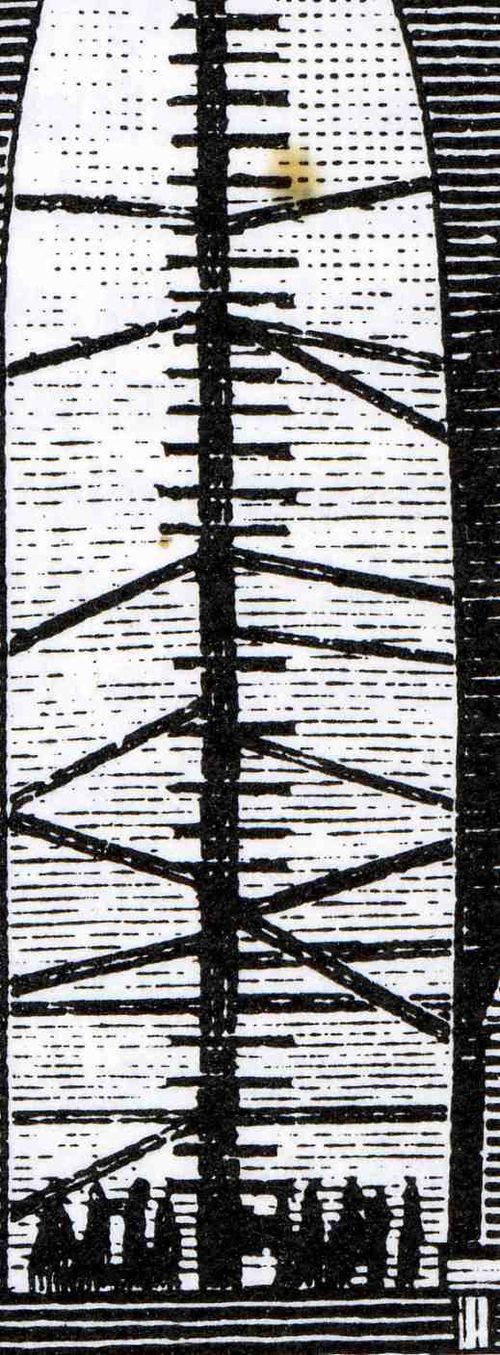
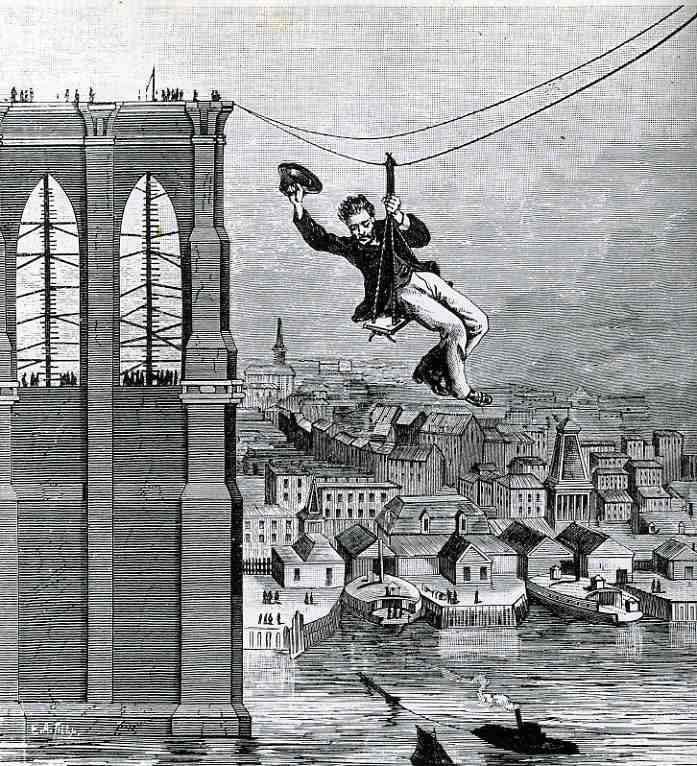
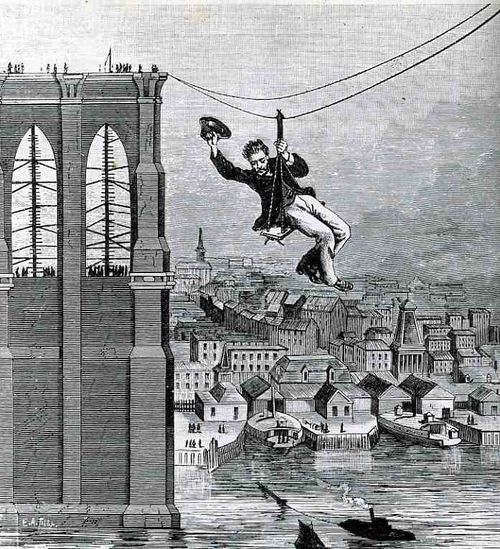
    And so on to what is in my mind, at least, an iconic wood engraving
    of the half-completed* Brooklyn Bridge, showing master mechanic and chief engineer of the project E.F. (Frank) Farrington making his slidy way as the first person to cross between the two spans (on 26 August 1876). 

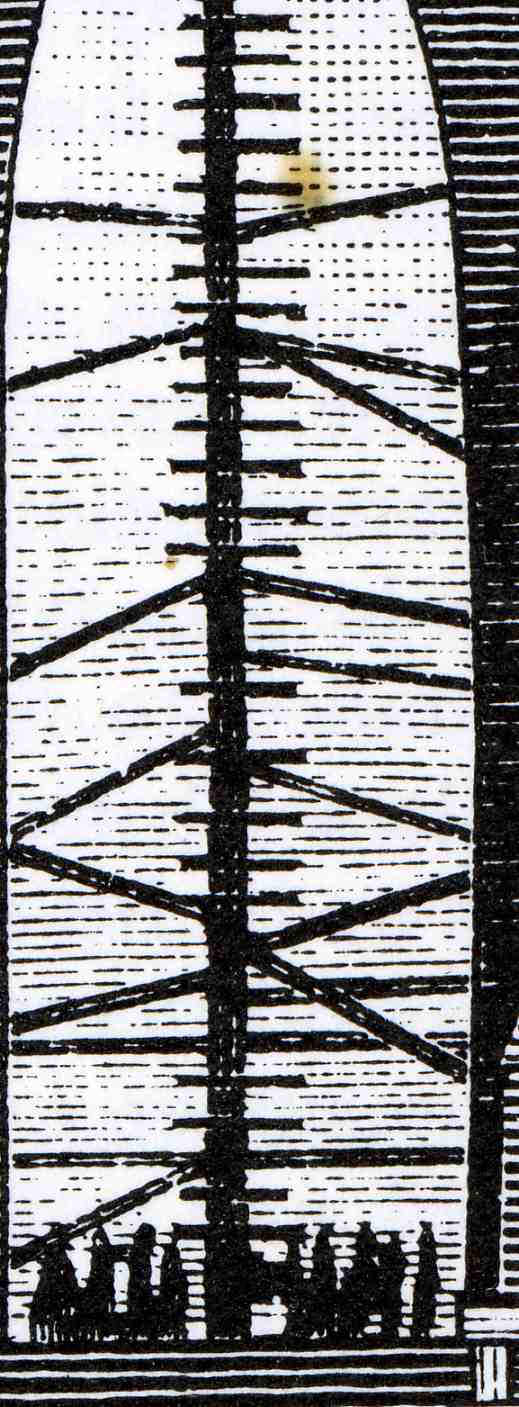
    What we see in the background of this print, on the Brooklyn-side tower, is a group of people watching Farrington, and in their midst, two gigantic, ramshackle ladders, straight out of the Renaissance.  Farrington was supposed to be showing how safe everything thing was for the workers–27 men died in the construction of the bridge, which given the times and difficulties is tragic but actually not too  bad–but I think he simply couldn’t resist the impulse of making the dangerous, wind-swept way across the river to the Manhattan side.  The ladders don’t seem to speak much to security and safety, but I guess that they worked

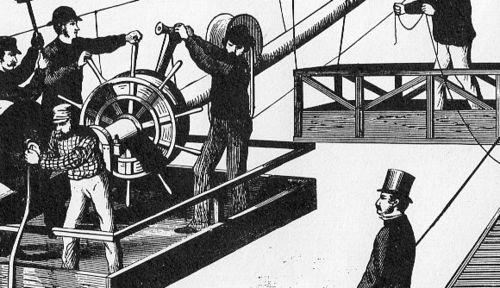
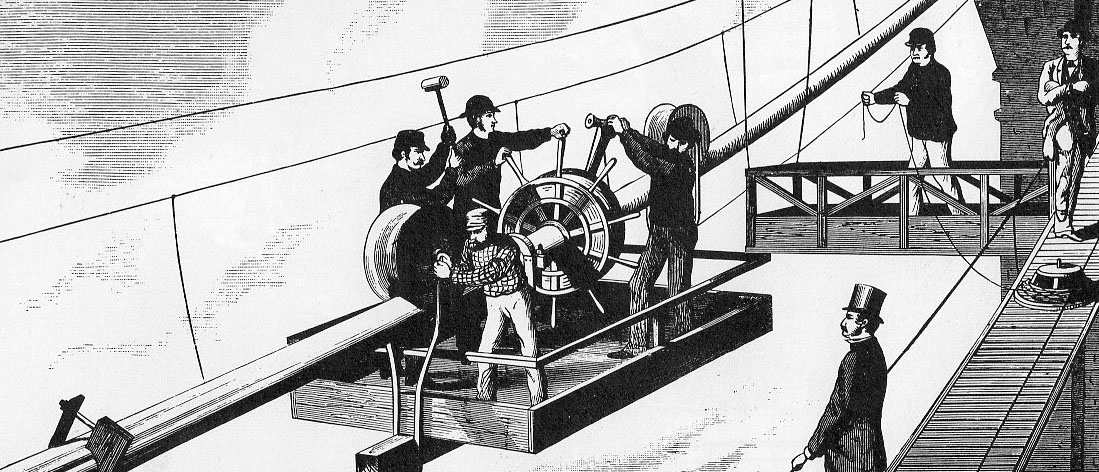
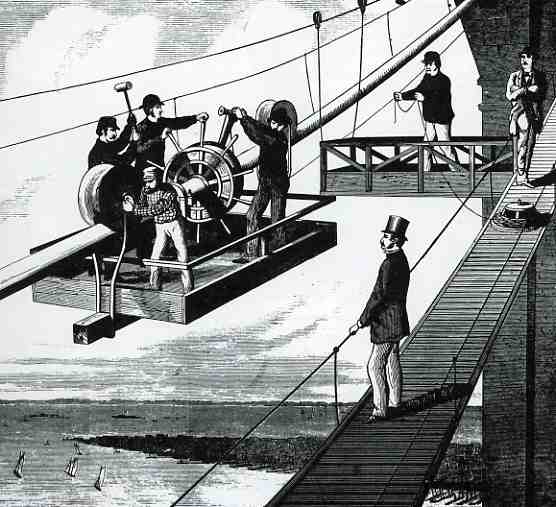
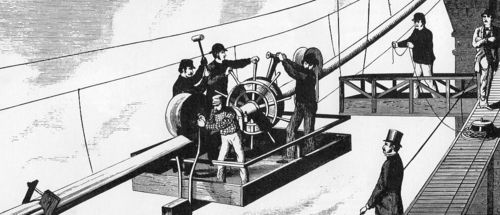
     Another interesting peep into the times is seen in this wood engraving from 1877, showing a crew working on the cables.  As much as eyewitnesses claimed that Farrington performed his stunt to exhibit the safety of the cables, looking closely at this print shows the relative danger faced by the workers.  The railing around the support car here looks more like a hindrance than a help, seemingly making it easier for a worker to trip on it, and fall into the water 300+ feet below.  

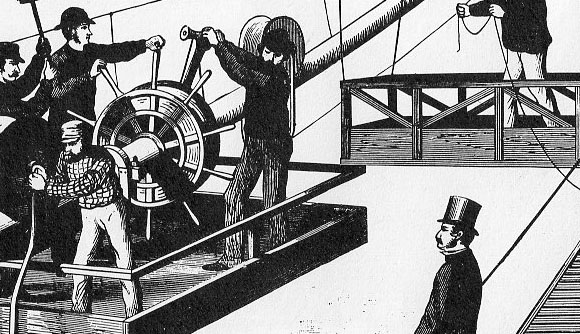
    Below-knee-level barricades surely does not make for a safety fence–it is very probably anti-safety.  That said, if you look closely at the man on the extreme right, he seems to be sitting on the safety cable, leg up, nonchalant, watching the application of the cable. Tempting fate.


    Banner brooklyn const805

    And the detail:

    Banner brooklyn cons editedt805_edited-1

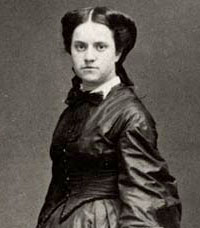
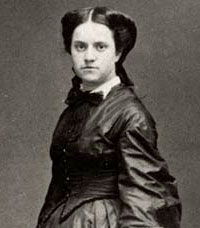
    I guess though that the most hidden aspect of the building of the Brooklyn Bridge was the identity of the chief and overriding builder:  Mrs. Emily Roebling.

    It turns out that the original designer for the bridge, John Roebling, was killed early on in an explosion and was replaced by his son, Washington, who in turn (in 1871) was terrifically incapacitated; Washington was ‘aided” by his wife Emily (1843-1903), who became the most recognizable spokesperson and sub rosa engineer of record.  She was supposed to be assisting Washington, but it was far more so than that.  Probably it was an inappropriate time for society in general to believe that a woman was capable of supervising the construction of the world’s longest suspension bridge.

    “The work which is most likely to become our most durable monument, and
    to convey some knowledge of us to the most remote posterity, is a work
    of bare utility; not a shrine, not a fortress, not a palace, but a
    bridge.” Emily_roebling– Harper’s Weekly (1883) 
    *The bridge was about half-way done, following the construction beginning in 1870 and its opening in 1883.
  • Bus-Punk, 1934

    JF Ptak Science Books     Quick Post   [Also see an earlier post here on Air-Punk & Underwater 19th Century Cyborgs]

    Bus776

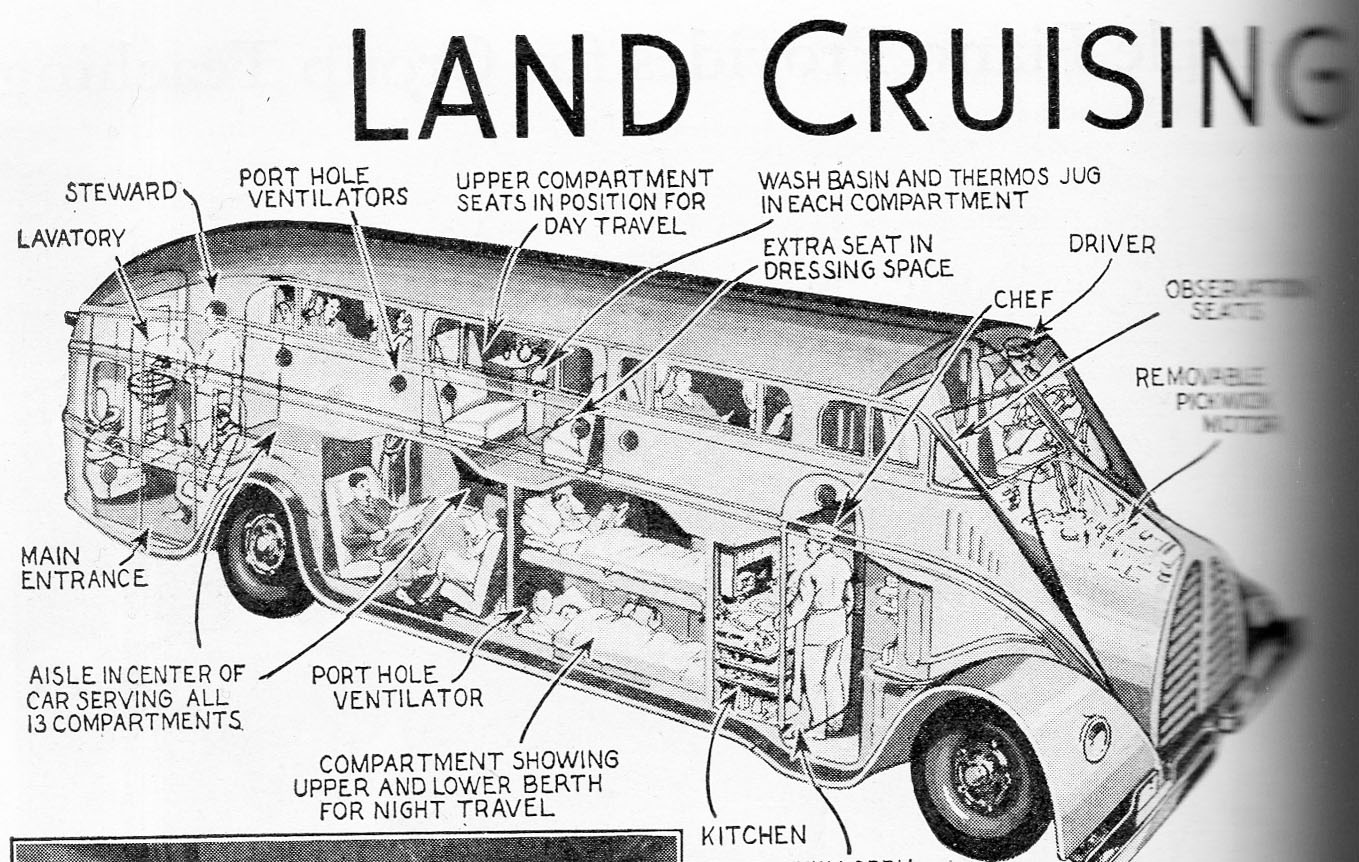
    This land-whale of a vehicle, a bus design for “Land Crusing De Luxe”, is left mostly to our imagination so far as specs and stats go.  It looks as though it would accommodate perhaps 14 people on a long haul.  There were two levels of living space as well as room for two (or four?) in sleeping quarters…perhaps a more luxurious class was seated downstairs.  In any event there were three attendants on the bus for its not-many passengers, including a chef, a seward and a driver. (Elsewhere in the article the driver is referred to as a “pilot”.)  

    I’m sure this would have been a beautiful thing–I picture is red on black, with an ultra-shine.  I’m also sur ethat it would have been a delsight.

    Source: Popular Mechanics, August, 1934.


  • Beautiful Technical Illustration & a Snapshot of Hard Work in 1800

    JF Ptak Science Books   Post 1878 

    There is, buried deep within this engraving, a small but penetrating snapshot of working life in very early 19th century England.  Very working life.  We’ll get to that in a moment, after introductions are made to the brilliant composer of these images.

    Blogtunnel_full239 J.G. Heck wrote and compiled a fascinating and complex work entitled The Iconographic Encyclopedia of Science, Literature and Art, and was published in America for the first time in 1851 following Spencer Baird’s translation from its original German.
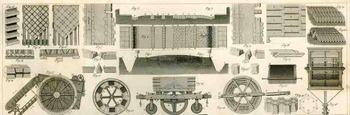

    The key to his work is the amount of data displayed on each of the 500 engraved plates illustrating this work and the way in which it is arranged.  The design and layout of the 30,000 items on these 500 plates was a work of genius, and for my money it is easily the best-presented complex means of the display of data and objects that was published in the 19th century.   

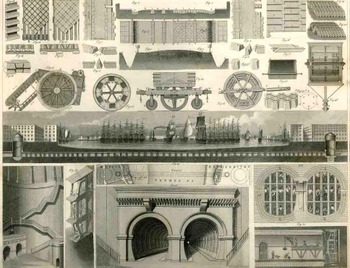
    Take for example this illustration in the technology section (a subdivision of the applied arts which is a sub division of the plastic arts) and, continuing in this complicated scheme, was Plate 1 from Section X Number A1 with a description found in the text on a dozen pages in Section 2 of Volume 2 on section pages 134-150 and overall page numbers 835-851 (!).  The plate contains 35 figures, very finely executed and rendered (many of the other of the 500 plates have 100 or more figures), and is in general related to the construction of roads and tunnels (and further, part of the “communications” section).
    Blogtunnel_top240

    This of course would be a perfect Hypertext candidate.

    The illustration itself contains an enormous amount of information.  The row along the top third or so is dedicated to street construction and paving stone, showing stones in plan and profile, as well as a cross section and ground plan of a “typical” street (including sidewalks).  It is interesting to note the detail of the cross section and the stonework that is placed beneath the horse and wagon section of the street.  There are some other beauties here as well–details of wooden paving blocks, the plan for a Laves of Hanover road, different ways of cutting stone blocks—but we won’t deal with those right now, except to point out that there are several renderings of street cleaners and road rollers (of Shettenmann and another of Schaefer) used to border the street section from the tunnel section. 

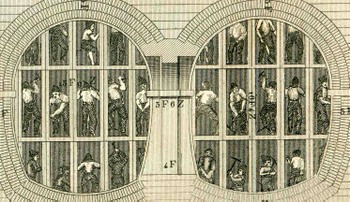
    Blogtunnel_middle241 The middle section of the engraving is of course a cross section of the Thames tunnel of the beautifully-named Isambard Kingdom Brunel (begun in 1825 and completed 1843, the tunnel 35 feet wide (11 m), 20 feet (6 m) high and 1,300 feet (396 m) long, running between Wapping and Rotherhithe at a depth of 75 feet (23 m)).  The representation here is only one inch high and ten inches long but is loaded with just fabulous detail, no the least of which are the (less than) 1mm tall workmen that can still be seen in the tunnel.
    Blogtunnelbig_detailig247  
    The enlarged detail shows a section of the tunnel being built according to Brunel’s new specifications:  a larger, shielded tunnel being constructed around the interior construction of 12 individual tunnels (each about tall enough to allow a (short) man to stand erect. 

    It is unneccessary to say how difficult this work must have been. Cramped, dirty, dark, stale-aired, and dangerous, this was the very definition of a compromised working environment.

    In short, the engraving is a superb example of *correct* design of great artistic  ability, all accomplished while displayed heaps and gobs of interconnected, complex information. 


  • Ancient “Spacecraft”: the Flavor of Moving Very Heavy Things a Long Time Ago

    JF Ptak Science Books    Post 1872

    Obelisk624
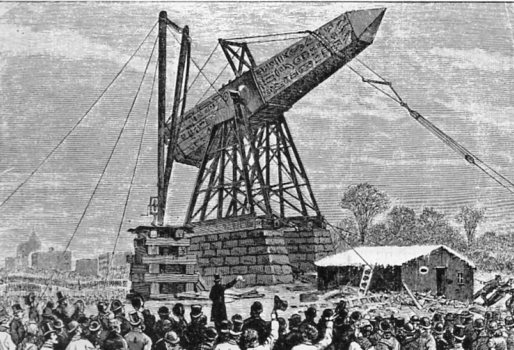
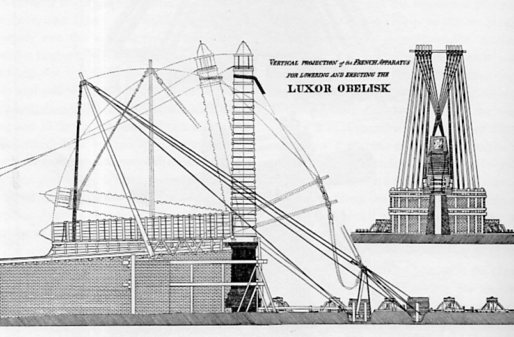
    This of course is not a story of ancient spacecraft, but it is about Very Large Things being manipulated in space in the days of steam and pre-steam engineering. It is hard to escape the “rocketship” interpretation, as some of the images, sculpted slightly out of context and cleansed of any identifying text and viewed with a squint, look as though they might be large booster rockets being readied for flight. They are of course images of some great and famous pieces of engineering–moving massive obelisks, and moving them in the 19th century and before.  And in the case of the Romans, and the original Egyptians, moving them way before our last millennium, moving 200- and 900-ton objects without benefit of very much at all. 

    Obelisk625
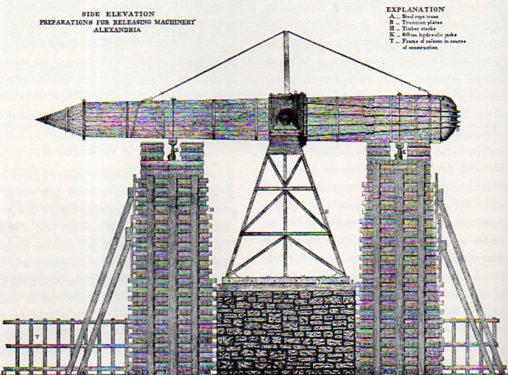
    Two of the great examples are the pair of obelisks that the Romans moved from Heliopolis to Alexandria, where they stood for another 2000 years.  Over time there was only one standing, and that one wasn’t doing so well by the end of the 19th century.  The fallen obelsik was taken to London in 1877; the other, the standing obelisk, was given to the United States by the Khedive of Egypt two years later, in 1879.  The man in charge of this second operation was Lt. Commander Henry H. Gorringe, U.S.N., who had the very tricky job of lowering the monolith, bracing it for transport by sea, fitting it out for a ship, and then transporting it to Central Park and raising it again.  He was able to accomplish this feat with the “fragile” 100-ton object in just a year.

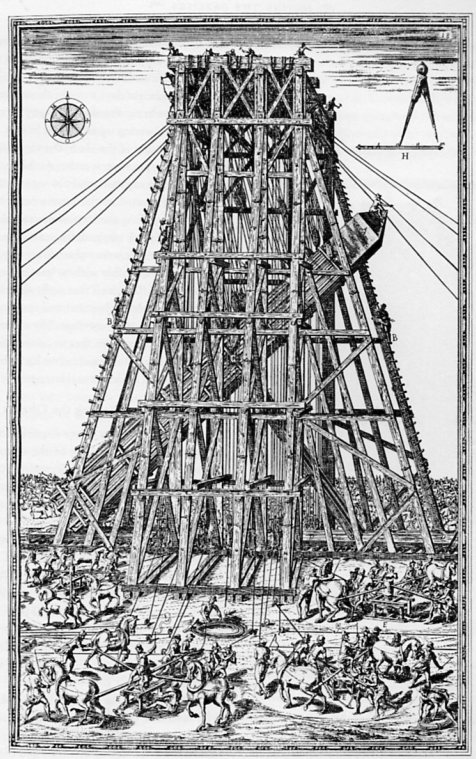
    This next image is more classical and probably iconic, at least in the history of science world, and is found in the superb book by Domenico Fontana, Della Transportatione dell’Obelisco Vaticano (published in Rome in 1590 and again in 1604):

    Obelisk627

    Obelisk626They really do have a certain modern taste for interplanetary access, at least to me.  That aside, it is interesting to consider what this vastly heavy movement must’ve looked like to people long ago, when big machines with enormous powertrains (like this 1,200 ton capacity 300′-tall mobile crane)could be hauled into service to do their end in manipulating highly problematic and very heavy things in space.  To think of moving these very heavy objects with steam (or less) was a daunting task, and to see these images showing the progression of movement of these things must have been enormosuly satisfying.


  • Happy Anniversary! Unsliced Bread–the Best Thing Since Sliced Bread.

    JF Ptak Science Books   Post 1855     Almost on this Day in 1932…

    Bread3

    Thanks to Emma Digh Ptak who gave me a book on the history of bread for Father’s Day!  Thanks, Buddy! 

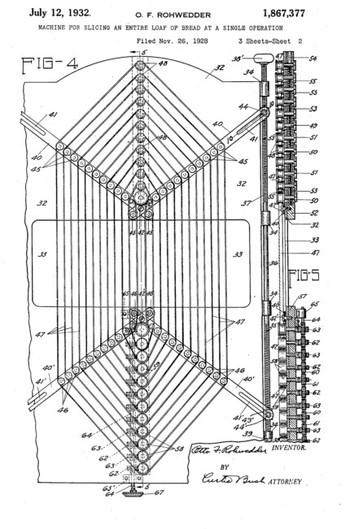
    This expression has a bit of a scent of death, of corporate sameness, about it. Its tale is one of innovation, deceit, deception; of ridding independence and quality, of providing a gross replacement for quality in the name of mechanized progress. The progress came in the form of a continuous loop delivering exactly the same loaf of bread, endlessly, to be cut and bagged and delivered to consumers–brought to us at t he expense of 97% of all of the bakeries that have ever existed in this country.

    The replacement of the small bakery began slowly, around 1850, proceeded with caution to the turn of the century, and was basically completed by 1940. In 1900 the small bakery outnumbered the corporate producers by 80:1. By 1939 the large company absorbed the practice of 95% of all dollars spent on baked goods. It was the continuous-belt bread baker that started of the replacement process in 1850 and 1866, sending the breadBread_patent_2 through long ovens on the endless feed. This was the start–it was in the high speed mixers that made the domination possible, thoroughly dispersing the yeast throughout the dough, making it possible to produce almost the exact same loaf of bread time and time again. It was then that the bread cutters–which had been around for some time but more or less perfected in 1928–could really do their job and finish production. The cutters would work exceptionally well so long as the stuff that they were cutting was the same–this done, multiple loaves could be cut every second, hundreds of times a minute, thanks to the mixer. Efficiency had reached high speed, and the cutters performed their revolutionary task.

    By 1942 the show was over for the small bakery–their non-uniform, hand made, thickish, irregular products replaced by bread clones: white, spongy and terrifically porous, and something that, once squeezed, would return to its original shape.

    Bread2

    The masterwork on the coming of mechanization is by S. Gideon, and is called Mechanization Takes Command, published by Oxford, (New  York), in 1948.  It is a work of great beauty and insight.  


  • Air-Punk: Underwater Cyborg Diving Suit (1797)

    JF Ptak Science Books   Post 1853

    Diving bell horizontal656

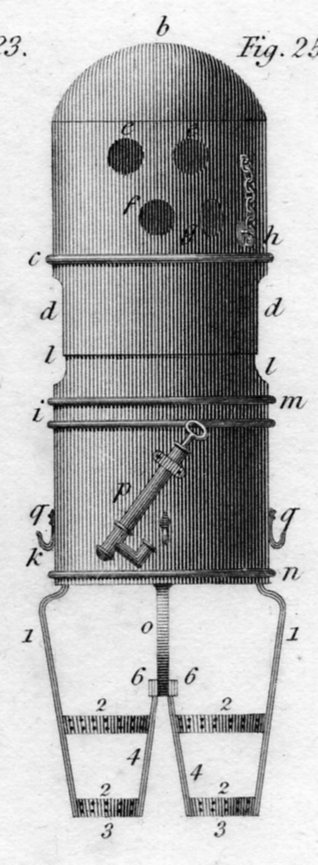
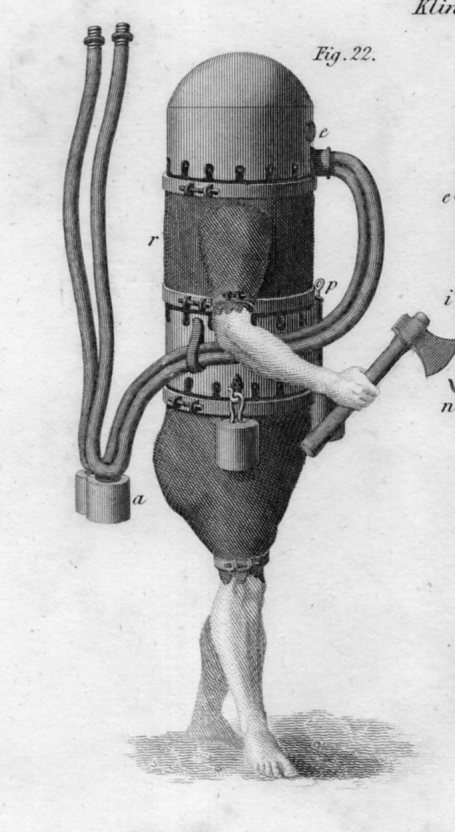
    Well, not really. It is however an early diving suit (and perhaps the earliest apparatus worn on the person and submerged) the creative and comparatively lightweight effort of Karl Heinrich Klingert, who produced it at the very end of the 18th century, in 1797 or thereabouts.  The suit was made of a metal helmet and wide metal girdle, with the vest and pants made of a waterproof leather, and with leather (?) leg straps.  The air would be pumped down to the diver from a turret above (see below, just) and would arrive in the diver’s helmet via weighted air tubes. 

    Here’s a side and occupied view:

    Diving bell horizontal654


  • A History of Blank, Empty and Missing Things: The Skin of Reinforced Concrete

    JF Ptak Science Books   Quick Post    An addition to in the post The History of Blank, Empty and Missing Things:  Stone and Wood.

    Arch  reinforced concrete648
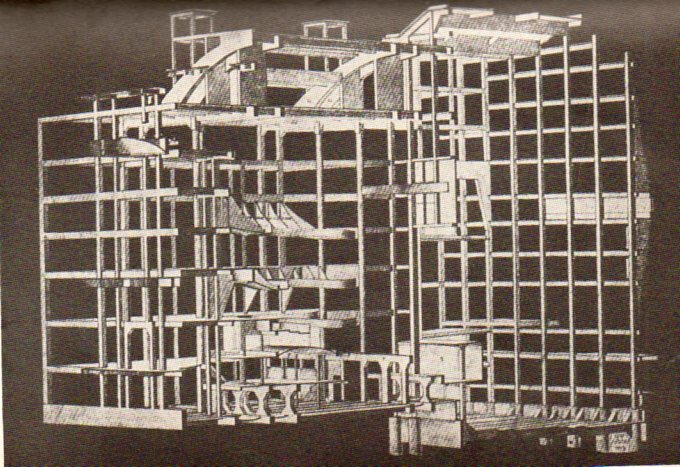
    Auguste Perret, a modern master in the use and adaptation of reinforced concrete, drew this fantastic skeleton representation of his “Theatre des Champs Elysees” (1913)–it was the great stuff that held the building together, minus the walls and everything else that makes a building a building, and a revolutionary approach in modern construction.  It reminds me strongly of this image

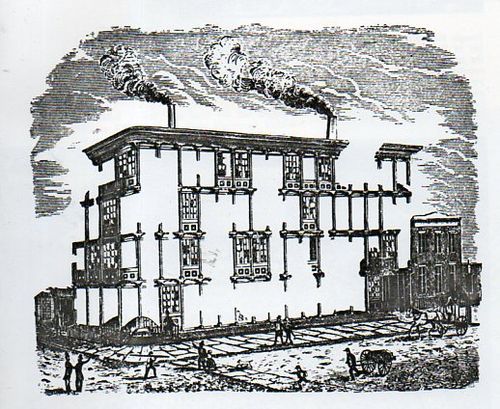
    Ogardus335
    which is a  remarkable illustration of the strength of the new approach to materials in architecture–cast iron–from a 16-page pamphlet by the inventor, architect and cast iron pioneer James Bogardus (1800-1874, Cast Iron Buildings, their Construction and Advantages, 1856 and 1858 second edition).

    The history of concrete in itself is pretty interesting and of tremendous antiquity, dating as a very useful and extraordinarily sound material at least to the Roman times.  The Peter Greenaway love affair (in his film “The Belly of an Architect”) with Agrippa’s Pantheon is one of concrete–the building stands today still of course, made of concrete, its dome still the largest un-reinforced concrete dome in the world. 

    And the Perret, complete:

  • The First Sightings of Great Things: the Telephone, March, 1876

    JF Ptak Science Books   Post 1845

    Bell patent close
    Besides it being the Centennial year, 1876 saw a number of major games in the history of human thinking. Sometimes the announcements or earliest public appearances of these breakthroughs didn’t get all that much attention.  As one of the major means of transferring technical and applied science info to teh general public, it is interesting to see how Scientific American reacted to such innovations.  For the thick, heavy volume for 1876, amid

    Bell patent
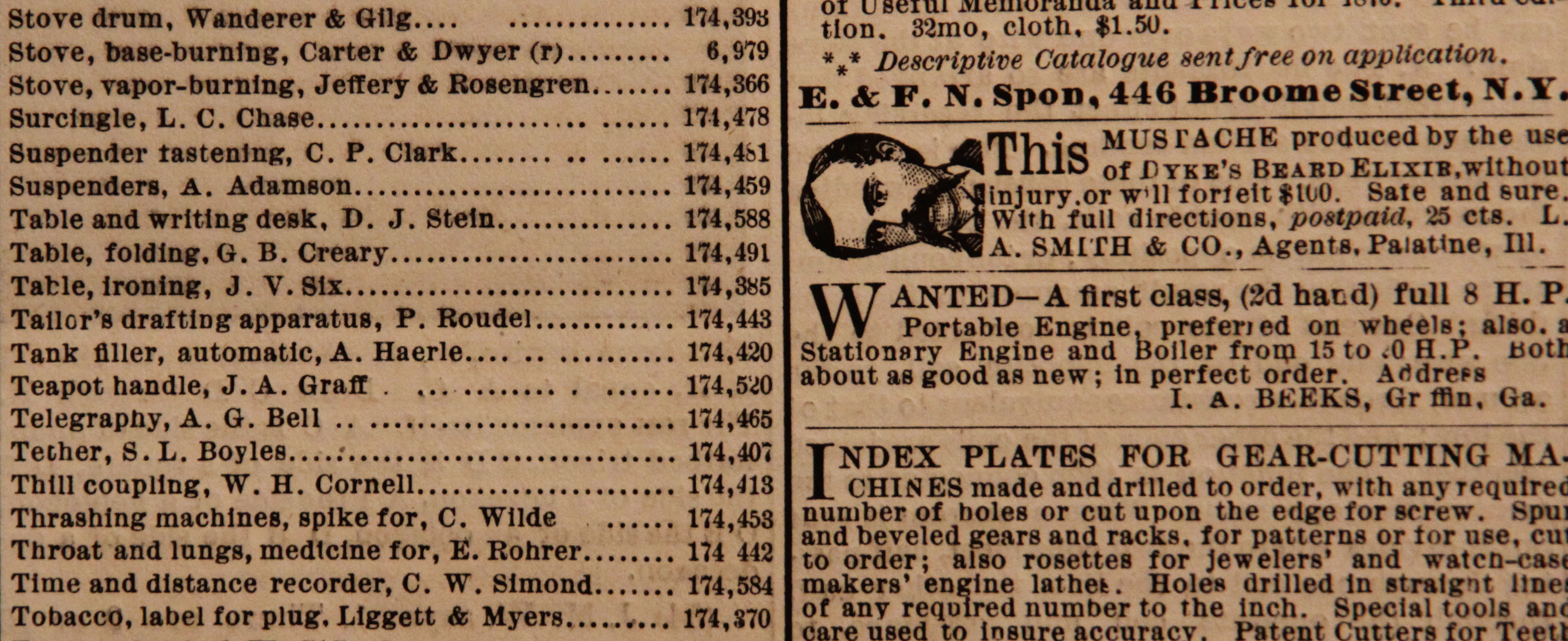
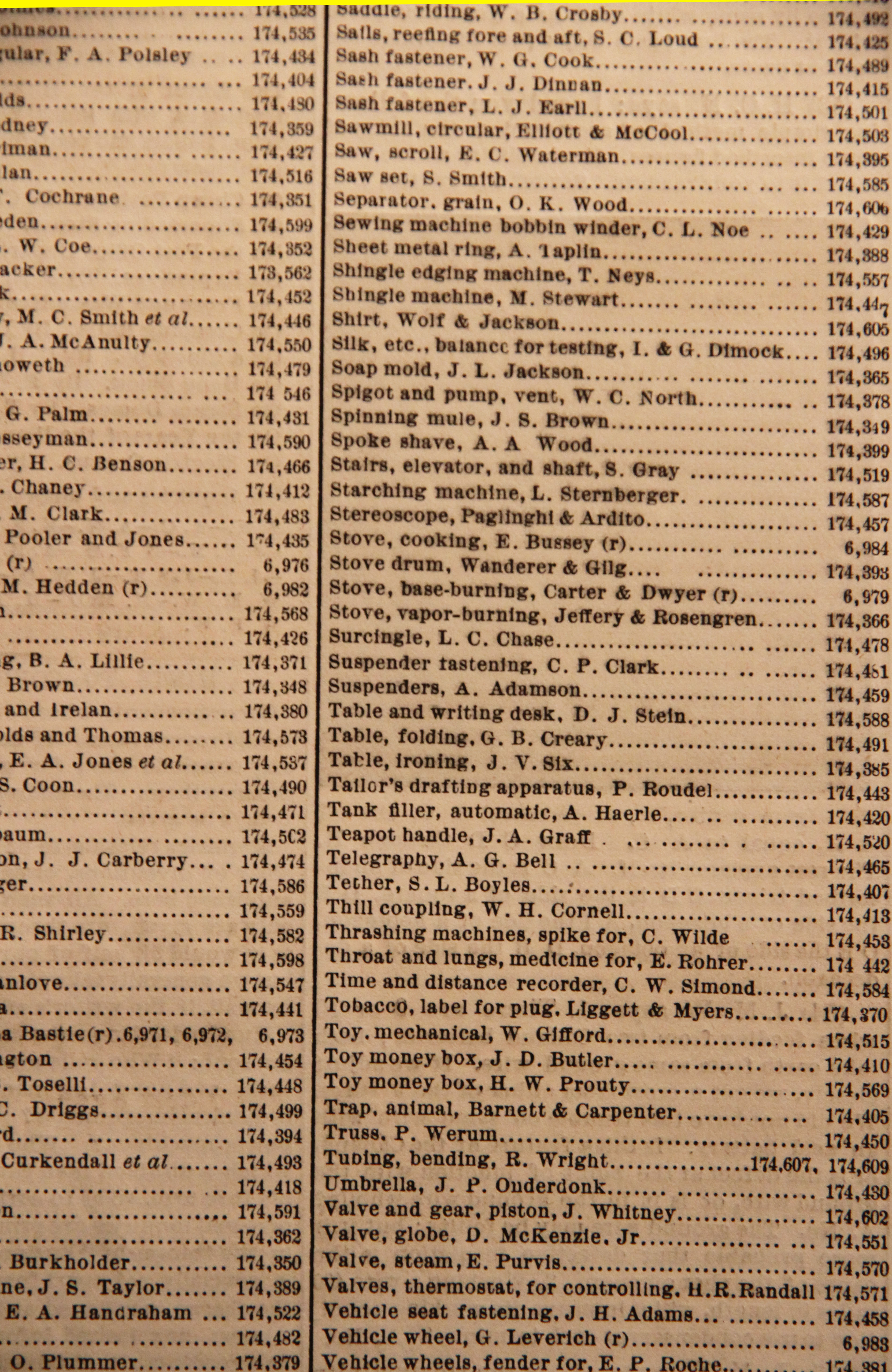
    patent announcements and articles on telegraphic fire alarms, electro-harmonic multiplex telegraphs, recording telegraphs, electro-magnetic telegraph railroad car signals, signal box telegraphs, underground telegraphs, telegraph keys and armature, acoustic telegraphs and the l;ike (though there weren’t that many reported, not really, just on the order of dozens), we find one of the most important of them all, patent # 174,465, by Alexander Graham Bell, appearing 8 April 1876.  It would be a rude resumption of being here in the future of this event to call the coverage short-sighted

     In an earlier article in the 4 March 1876 issue of SA, there appeared “The Invention of the Telephone”, by P.H. Vander Weyde, in which there is yet any mention of Mr. Bell.  There is an illustration of one of his precursors in the field, the Reuss telephone, with ample description. (This was actually Philipp Reiss, and his telephone really wouldn’t work to transmit the human voice, though did so work for music to some degree.)  Bell’s patent  would be at the Patent Office in March, and would appear as a one-line notice (among a hundred others), the patent stating it was “the method of, and apparatus for, transmitting vocal or other sounds telegraphically … by causing electrical undulations, similar in form to the vibrations of the air accompanying the said vocal or other sound”.  (The first image above is a detail; the second image a longer version, which is really only less than half of what the real-life version looks like in the tall listing.)

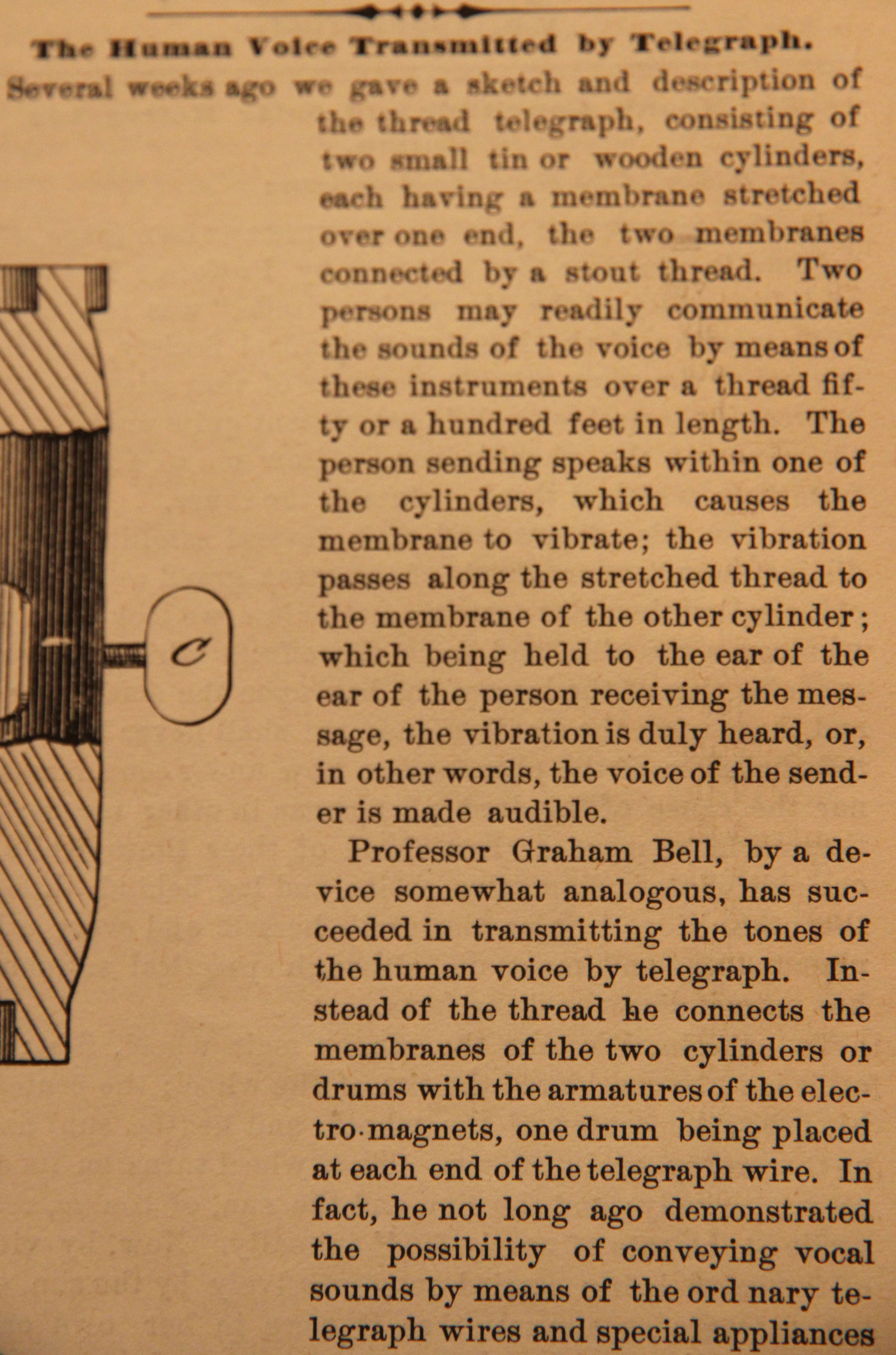
    Weeks later, Elisha Gray‘s (on 13 May) telegraphic telephone patent (175071) appears in the Scientific American, and later, on 9 September, on page 163, there is the article “The Human Voice Transmitted by Telegraph”, on the successful transmission by Graham Bell. 

    Bell human voice

    Admittedly there were a number of developments in the production of the speaking telephone at this time, though in general there seems to have been no great attention paid them in the pages of the Scientific American than pipe cutting machine improvements or improved gravel separators.  Obviously the great impact of the invention was yet to be appreciated, even in any sort of fictional way.

    The original volume of these reports is available for purchase via our blog bookstore, here.

    Some of the earliest speaking telegraph patent illsutrations follow:

    ·Posted by :

    ·in:

    —

  • Daily Dose of Dr. Odd: Blackboard Technology, 1850-1900

    JF Ptak Science Books  Quick Post

    Einstein chalkboard
    What is there not to like in a blackboard?  Doing work on a blackboard is a definite commitment, thinking done out-loud, brain squeezings that you had to stand next to and own, creativity done on the fly with plenty of room for annotations.  And so how would you accommodate an expansion of the display of thought or instruction in the 19th century?  There were evidently plenty of ways around just having a big piece of slate on a  wall, as these U.S. Patent Office application/grant drawings will show.