A Daily History of Holes, Dots, Lines, Science, History, Math, Physics, Art, the Unintentional Absurd, Architecture, Maps, Data Visualization, Blank and Missing Things, and so on. |1.6 million words, 7500 images, 4.9 million hits| Press & appearances in The Times, Le Figaro, Mensa, The Economist, The Guardian, Discovery News, Slate, Le Monde, Sci American Blogs, Le Pont, and many other places… 5000+ total posts since 2008.

Category: Technology, History of

  • Mobile Robot Car Doc, 1930

    JF Ptak Science Books  Quick Post 


    Follow Me on Pinterest 

    Car ambulance012
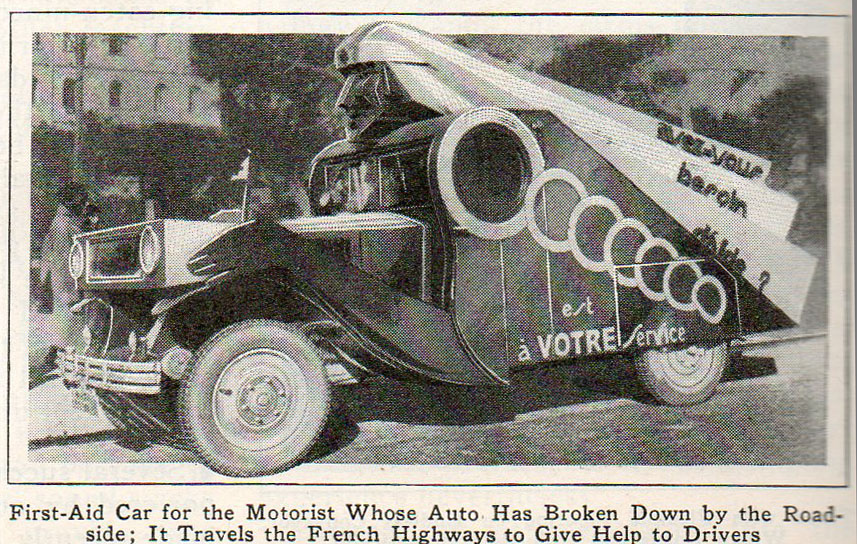
    This small techno-snipet was found in the August 1930 issue of Popular Mechanics and describes what must be a solitary expedition onto the French highways in search of broken autos.  The “ambulance” would troll the roads looking for stranded motorists, and then would stop and employ its mobile garage to set things right. 


  • Writing on the Clouds: a Musical Compositional Recording Machine, 1753

    JF Ptak Science Books    Post 1963

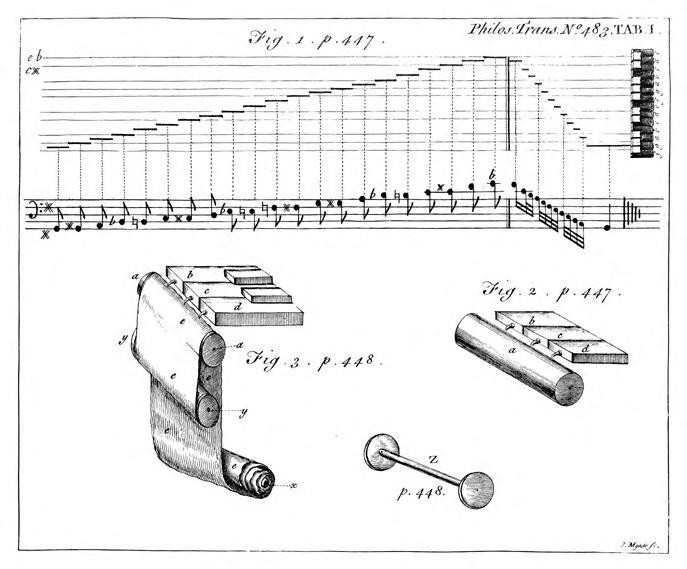
    Here’s a interesting piece of thinking communicated on the construction of  a rapid recorder for musical composition, written by John Freke in 1753 to the Royal Society, and published as  A
    Letter from Mr. John Freke F. R. S. Surgeon to St. Bartholomew’s
    Hospital, to the President of the Royal Society, Inclosing a Paper of
    the Late Rev. Mr. Creed, concerning a Machine to Write Down Extempore
    Voluntaries, or Other Pieces of Music
    ( on January 1, 1753) in the
    Proceedings of the Royal Society of London; Philosophical Transactions
    of the Royal Society,
    volume 44, pp 445-450. (John Freke, 1688-1756, was a prominent and important early surgeon, served at St. Barts from 1729 to 1755 and was a Governor of the hospital from 1736 to 1756, and was perhaps the first ophthalmic surgeon). The device was proposed by the Rev. John Creed, a machine that was supposed to catch the delicacy and greatness of improvisation, of the moments of creation of music that would could normally be lost to memory or inexactitude.  It was not the first of its kind, though it was an early attempt at finding the box of aether.

    Music machine graphic
    It was a very interesting idea, especially given the time 260 years ago. I wonder if this was influenced at all by the construction of mathematical machines?  Blaise Pascal (1623-1662–I don’t have any idea how he did what he did and live to be only 39) constructed his machine that was capable of doing addition and subtraction problems more than 110 years before this machine, and perhaps there was this hopefulness in the mechanically-reasoned approach to saving lost memories of composition.   Perhaps there was the belief that since calculations seemingly so impossible as the Earth’s (periodic 304-day that turned out to be 428-day) wobble (by Leonhard Euler, or the illustrated collection of human knowledge in the vast and controversial Diderot/d’Alembert encyclopedia, or the capturing of nature iin the systematic binomial nomenclature of the Swedish Carl Linnaeus–all taking place in this year or so brought something to bear on this seemingly inescapable problem of recording quick and complicated thought? 


  • SteamPunk Inventions, a Farce from 1853


    JF Ptak Science Books   Quick Post

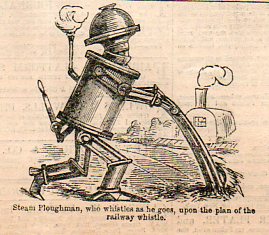
    Steampunk inventions984

    I found these images browsing through The Illustrated London News for April (date obscured) 1853.  In my experience seeing articulated, steam-driven robots in the mid-19th century is pretty unusual. There’s an earlier image (from about 1849) that shows a robot like the one pictured above, though it was actually a man in a robot suit, a person driving a machine–the image above of “the Stream Ploughman”  is clearly a stand-alone robot, as we can see through the thigh area, though it does have human attributes, like a semi-face and the capacity to whistler while it worked.

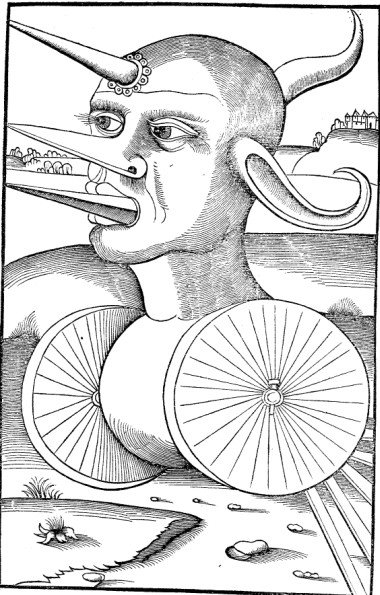
    Other posts on early robots in this blog include: Mall-Mortuary Faces on Patent Drawings of Robots, 1936-1976; The Edenless World, the First Female Robot;  Endless Eve, 1936; Durer’s Beautiful Monsters, for example.

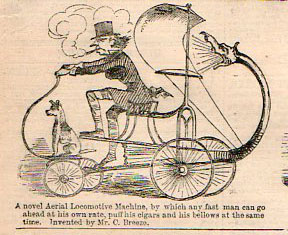
    The caption may idetify this as an airship, but there are no signs here of ho wthis thing would get aloft. And I have no idea what the dog is doing there.

    Steampunk inventions990


  • Roman Military TechnoPunk

    JF Ptak Science Books   Post 1959


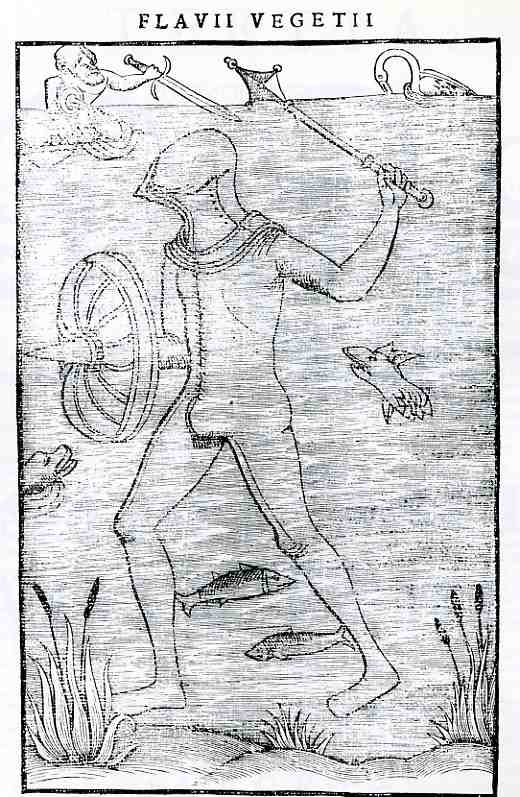
    Blog--vegetius
    The name of Flavius Vegetius is not so much popularly known today, though his influence is felt through the hands of other, more famous, writers and thinkers.  He was seen as the most adept writer on the Roman mind in warfare, and his De re militari libri quator… was his masterpiece.  It was reprinted in 1532 by Christian Wechel from sources reaching back to the original, which was written around 390 ACE, and found a wide readership not only for its authority on all things military/Roman but also for his iconic insights and aphorisms on warfare in general.  It was Machiavelli who came under his spell and who adopted some of Vegetius, who became further disseminated through the military followers of Machiavelli, and so on.

    I came to this work much more simply than all of this – I liked this image of the underwater warrior, who was somehow able to breathe while submerged.  I get the importance of this sort of undercover, guerrilla maneuver, but what I really like was the rarity of seeing a Renaissance illustration of human submarine life, which is pretty uncommon.  Also, the use of the lines to represent the underwater quality of the image—giving the woodcut an overall grey tone—is also very scarce in the history of illustration, at least before 1600.  And very neat!  One of the hallmarks of this printing of Vegetius was the liberal use of white space in many of the (119) woodcut illustrations, though it is clearly not on display in the woodcut that I’m sharing here.

    00-blog-Oct 28 vegetius939


  • Beautiful Sprockets: MetalPunk in Space and the Jetsons.

    JF Ptak Science Books    Post 1958

    The birth year of Rosie the Robot is approaching.

    (This beautiful sprocket nest, for a patent for transmitting power (1874), like all of the following patent images, is located at   Google Patents, here)

    Spacely sprocketsFor some odd reason I was thinking about Spacely’s Sprockets, George Jetson’s (of The Jetsons cartoon in the 1960’s) employer.  I wondered if this was a high irony–the “sprockets” part– and if there would be any sprockets in our space-aged future.  Even by the end of the 60’s, just at the end of this cartoon, I wonder if in the tens of thousands of parts that went into the hardware of the Apollo Project to get us to the Moon if there were any sprockets among them. 

    The sprocket was just such an excellent idea in the history of the transmission of power…but in the 15 or so books that are on hand here on the history of technology there’s nothing in between “spring” and “Sputnik” in their indexes. Patents for sprockets seem to begin in U.S. patent history in the late 1860’s.  Sprockets show up in Gatling/machine guns (1878, with the Leland gun), chain propellers (1875), turn tables for railroads (1874), chain saws (1883), holler for printing machines (1882), stump extractors (1878), wind engine engines (1880), window shutters (1879), safety pulleys (1880), traction engines (1881), feathered paddling wheels (1882), potato differs (1883, with very great tank potential), harvesters (1880), hay elevators (1881), horse treadmills (1884), corn planters (1881), grain elevators (1883), and of course in veliocepedes (a very cumbersome device by Emmit G. Latta in 1880). 

    [Bicycle source here]

    I suspect that there were sprockets in space in 1969, and perhaps they’re in a Space X vehicle–I really don’t know. Its just interesting to think of the coming of the sprocket and what an enormous influence it exerted in the history of power transmission–and the device’s beauty. 

    My sneaking suspicion is that Rosie the Robot, the maid for the Jetson family–who was 45 years old in the  beginning of the 1962 series– was loaded with 1965 sprockets–whether sprockets would exist in the year 2062 or whatever year George Jetson was alive in (certainly many centuries post-2062) is another story. But Rosie–the outdated-model mid-life maid of the future and most reasonable character in the series–surely had them.

    Some beautiful sprockets:


  • The Ineffable Delicacy of the Million-Pound Shithammer

    JF Ptak Science Books   Post 1944
    Follow Me on Pinterest


    The idea of the mastery of nature presents itself at different levels at different times, and the mid-Victorian Brits had a particular and interesting handle on the issue int he mid-late 19th century.

    Mr. Darwin created a new threshold for the deep understanding of Nature and the possibilities of what that knowledge base might mean for generations to come–it was in a sense a time machine of possibility.
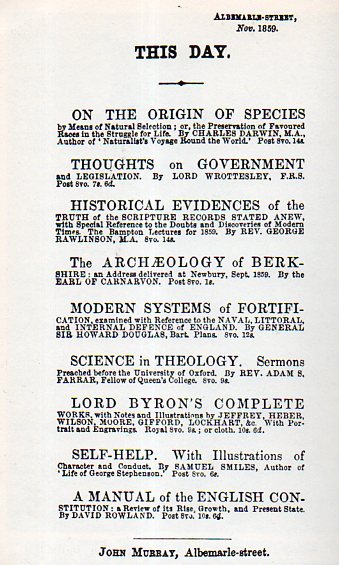
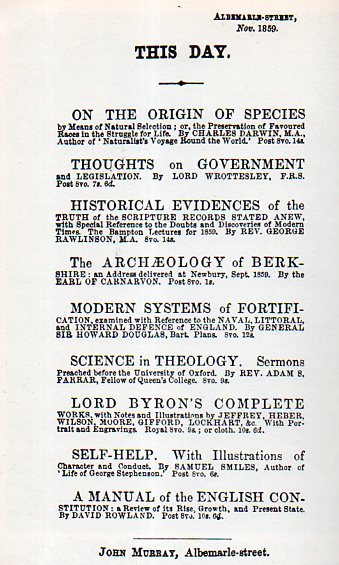
    Darwin Origin announcement931It is thrilling to see this announcement from Darwin’s publisher, John Murray (London), leading off On the Origin of Species in their list of nine new books appearing in their new books list for 26 November 1859 in the journal The Athenaeum..  Most of the other books have slipped into dusty bits, though, remarkably, a few are still around. One of them is coyly significant, and its author is important for yet another reason.  The book is number eight on this list: Samuel Smiles Self-Help1, which was about the first book of its kind, a homily to honest work and insight and mutual benefit–it also outsold the Origin, with 20,000 sales in the first year, a bona fide bestseller.  (The book would sell a quarter of a million copies by the time of Victoria’s death.) So in its way, this book too helped people master another sort of nature–their own.

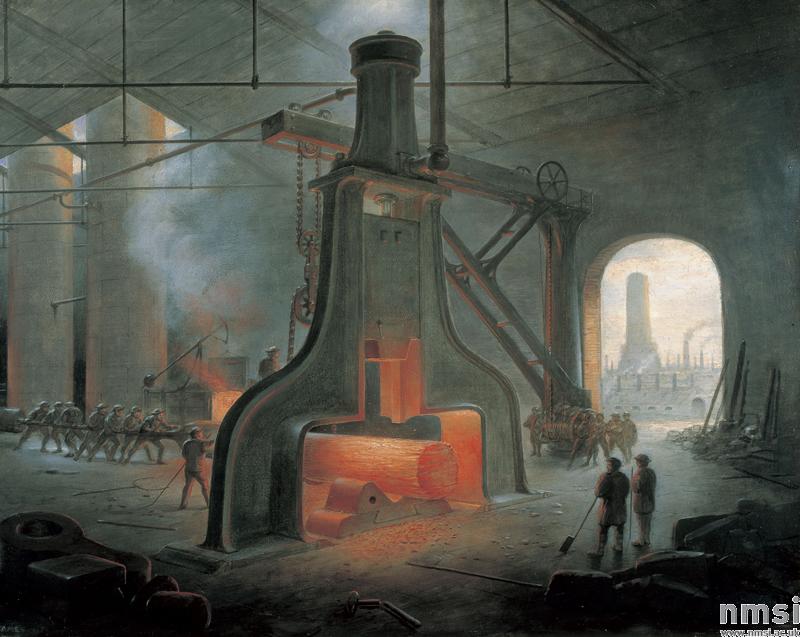
    But that is not why we’re visiting with Mr. Smiles–I’m more interested in his description of an element of British technology that was a wonder of its age:  the powerful industrial hammer of James Nasmyth2. It was a technological achievement of the highest order and something that seems difficult to appreciate today.  Invented in 1839 (the year of the invention of photography and the publication of Darwin’s report from his researches on board the Beagle) a more massively-powerful version was displayed at the Great Exhibition of 1851, and was its star performer. 
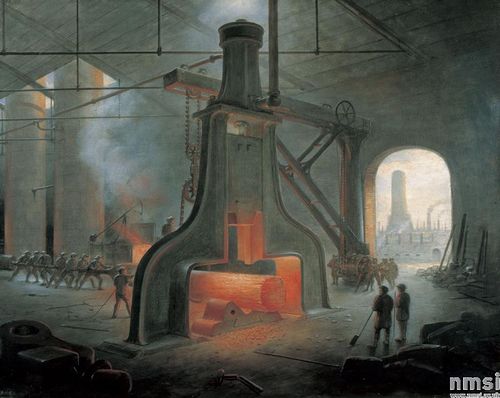
    Nasmyth engine 2[Image source and notes: see Note #4 below]

    Smiles’ made a very interesting observation on the nature of power the machine–rather on its power and the control of its power. The often-told story is that in demonstrating the device Nasmyth would explain and at times demonstrate the capacity of teh hammer to work on large elements going into huge ships; he would also explain that this vast power was also finely tuned and controllable and show this to be the case by having it crack an egg that was in a wine glass without damaging the glass.  This meant that aside from being able to handle metals almost as thick as a person, it could also be relied upon to do extremely delicate work, and that the tens of thousands of pounds of pressure it could exert could be called upon to do even the most delicate task.  This was a fantastic triumph of control, and was a keen insight into the coming nature of the machine and the rest of the developing Industrial Revolution. 

     .
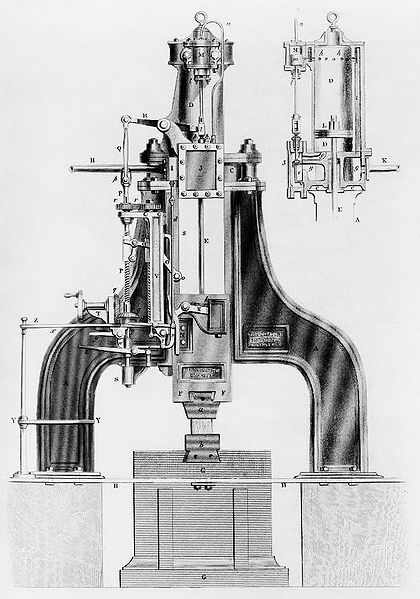
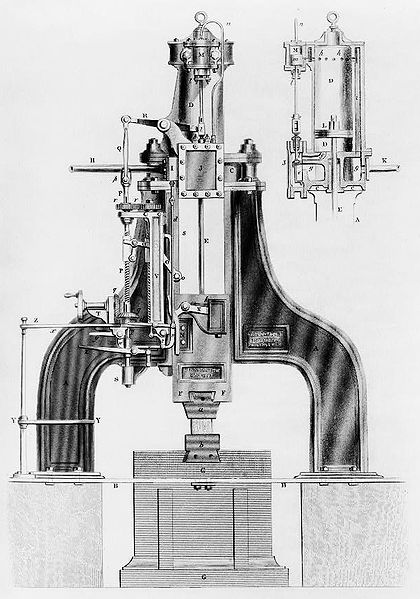
    Nasmyth 1854The post-Exhibition of a smaller variation of the hammer, about 12′ tall, from Cyclopædia of useful arts, mechanical and
    chemical, manufactures, mining, and engineering
    , ed. by Charles
    Tomlinson, London : New York, G. Virtue & co., 1854.

    Notes

    1. The book (the full text available here) is introduced with the following two quotes from Mill and Disraeli:

    “The worth of a State, in the long run, is the worth of the
    individuals composing it.”—J. S. Mill.

    “We put too much faith in systems, and look too little to men.”—B.
    Disraeli.

    Self Help ends with this quote from Francis Drake:

  • Movable Maginot: a Feast of Morbidly Techno-Gigantism

    JF Ptak Science Books LLC   Post 959, extended.     Daily Dose from Dr. Odd
    Follow Me on Pinterest


    Nothing
    quite exceeds like excess said Mr. Wilde (and others) , and he/they could be no
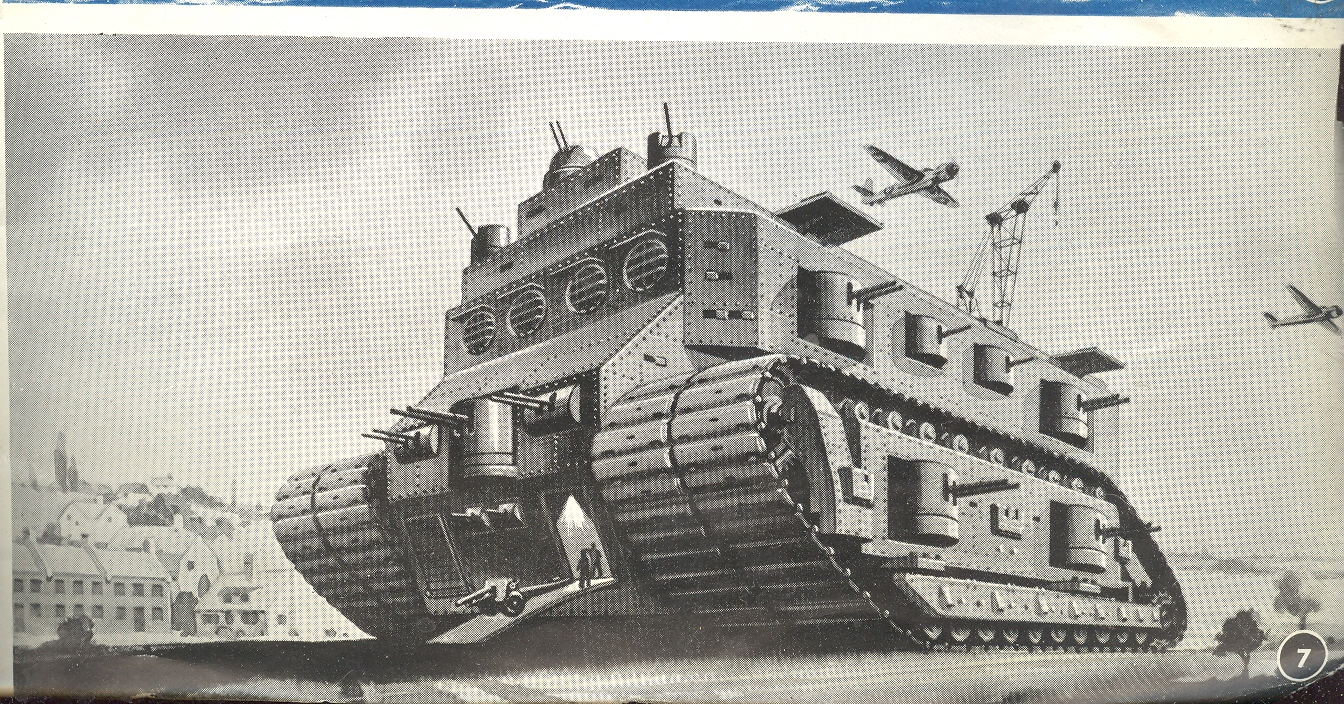
    more correct when looking at this picture of a Movable Maginot Line—it is a
    mobile fort, complete with plane launching capacity, two dozen long canons, a
    crane, and a host of other stuff.  


    000--win--land tank


    It
    looks as though it has ample room for all sorts of materiel though leaving
    little room for, perhaps, an engine.  I
    just can’t see where it might be…perhaps it is near the
    not-room-enough-for-it-either ammunition compartment.  Maybe they were in a smaller armed cart being
    pulled by the mothership?  I reckon that
    this beast was 66 feet high, 100 feet long and 60 feet wide, which is a very
    big, heavy near-cube. Good luck with driving the thing in anything that was
    less than perfect conditions.  A big
    profile like this, filled with guns and canons or not, also makes for a big
    target profile—a tall, broad target with flat/non-inclined sides. ( I should
    also point out that there are two 10’ loudspeakers mounted on the front of the
    fort to instill fear in the people that the thing was approaching with loud
    noise.  The author points out that the
    Nazis used noise against the French with their “screaming dive bombers”, and so
    the fort would use the same tactics against the Nazis in the moveable fort—not
    that the sound of the engines and the attendant noise wouldn’t’ve been enough
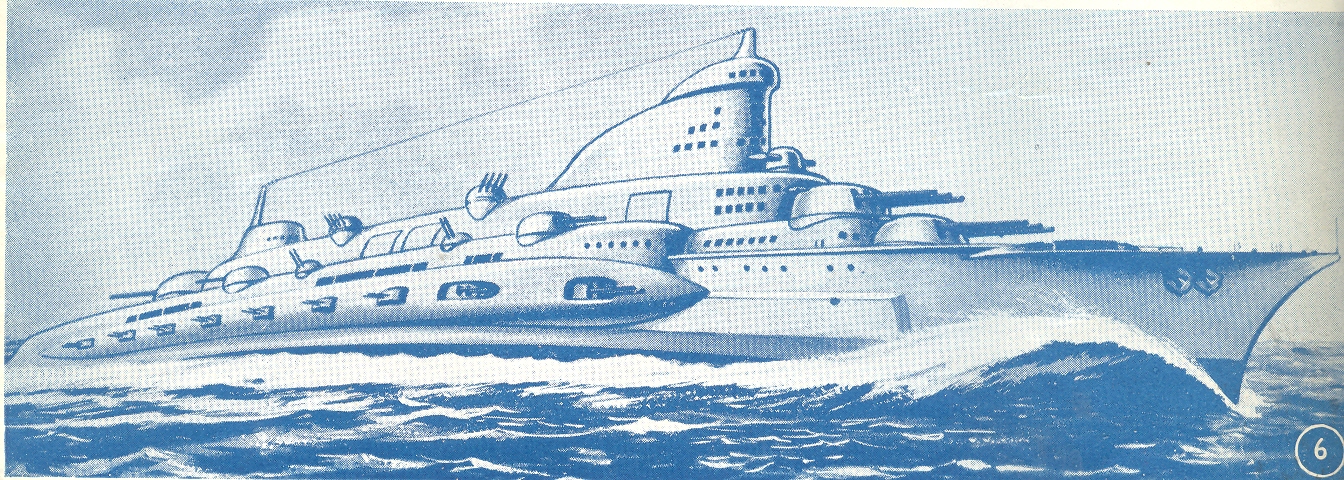
    of a fear factor in themselves…)000--win--tubular ship

    But
    the image of such a monster, sensical or not, was enough for the purposes of
    the pamphlet in which it appeared.  The Brains to Win was a piece of British
    spirit/hope propaganda issued at about the time of the Battle of Britain in
    1940, and it listed the sorts of technological breakthroughs that were going to
    push the nation over the top to victory. 
    Some of the stuff was real, some not—like the moving fort/Howl’s Castle
    above, and the floating fort, below.


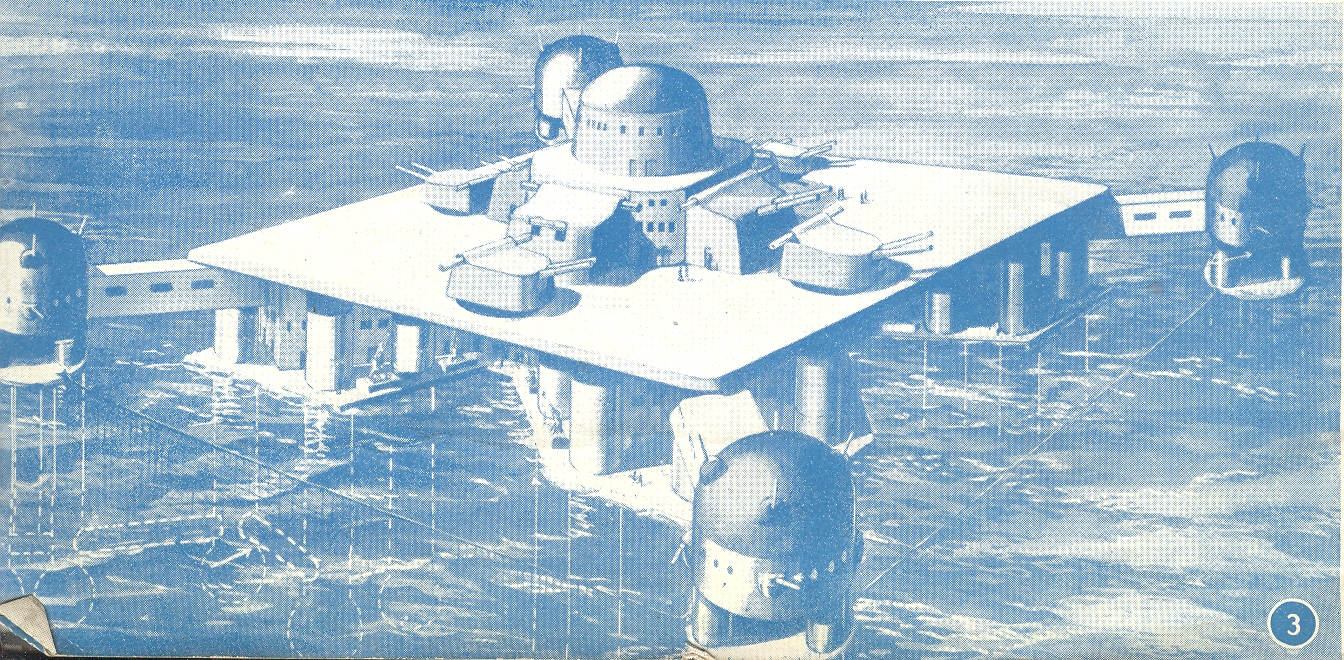
    000--win--floating airport


    I’m
    not sure where a floating fort would make sense, especially one of that size.
    (Iterating the figures on deck into distance, it looks as though the deck on
    the floating platform was 150 or 200’ square. 
    It would’ve looked like a big target from above.) Given the time and
    expense and material  needed for such a
    thing, it seems that it would’ve been cheaper to make a moveable fortress not
    quite so big, with less of a profile, and more mobile—I think that this was
    called a “destroyer” or “battleship”.  

    But
    no matter, I’m just poking fun at some of the future vision that became archaic
    the moment it was drawn, punk retro-future. 
    All the pamphlet was trying to point out in its 32 pages was that
    overall the Brits were smarter than the Germans and that would be the balance
    for victory in the war.  “Hitler will get
    some very unpleasant surprises before this is over” the author very politely
    pointed out, no doubt with one eyebrow raised.  The scientists agreed.

    And
    they were right, which is all that matters.


  • Daily Dose from Dr. Odd: The Geo-Cube Durer Plastic Man of 1942

    JF Ptak Science Books     Daily Dose from Dr. Odd

    Plastic war899
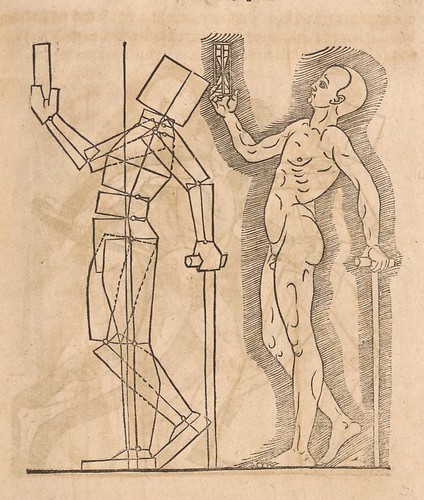
    This puts me in mind of the work of Albrecht Durer’s (1471-1528) revolutionary drawing
    of a geometrical man, compartmentalizing the body into distinct
    chunks–these and other woodcuts appeared in his Symmetria partium…humanorum corporum
    and must have been an amazing, startling site for the new reader to
    such things in 1537.

    . 

    Perspectiva (Lautensack) 1564 e

    To me this looks like visionary thinking in trying
    to understand the motions of living beings with no actual way of
    capturing the image in motion.  There’s also Erhard Schoen who published Unnderweissung der proportzion unnd stellung der possen, liegent und stehent…,which showed that the human form was reducible to connected but discrete Euclidean solids. This must’ve been an intriguing concept in the 16th century, this associate of form and function and the geometry of substance, all wrapped around the still-developing European re-discovery of perspective.  (A post on this subject appeared earlier in this blog here.)

    I really just like the red background of the Plastic Durer Man.

    Blogmissing_peopl_2e077_2


  • Mall-Mortuary Faces on Robot Patent Drawings, 1936-1976

    JF Ptak Science Books   Post 1927

    There is something that I’ve found in my time grazing through U.S.patent drawings–for the most part, if the device has a face, or is being worn/employed by some human with a face, chances are that this face will indeed have some high invasion of “Creep Factor” elements.  It is just so.  I’ve encountered this many times, and I think that it is possible that in these hundreds of samples that I have come across that these inventors (a) could not draw, (b) could not draw well, or (c) chose not to (a) and/or (b). It is too much to expect that these creepy faces are an expression of humor–that would be too much of a conspiratorial element for anyone to absorb.  It is just remarkable that these faces are time after time just so off, and soft-creepy, like a puffed-up rougey death mask found in a mall mortuateria.


    1936

    1938

    1938


  • Acoustic Weapon “Performance Degrader”, 1933

    JF Ptak Science Books  Post 1926

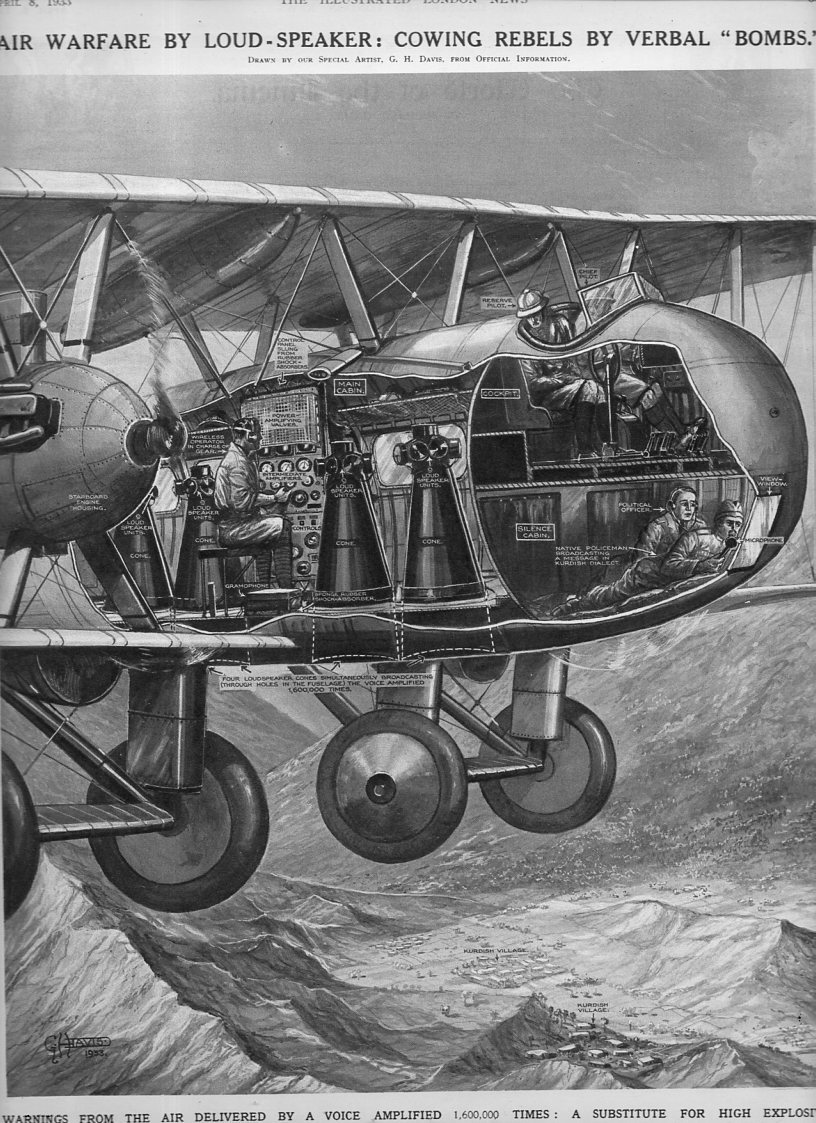
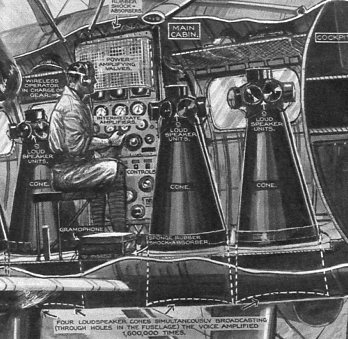
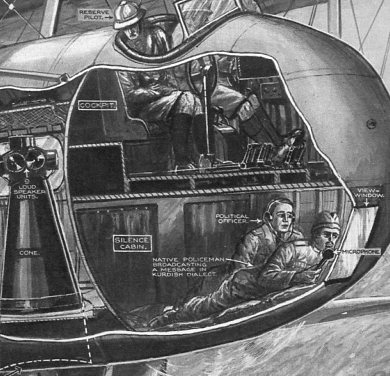
    From the looks of it, this image from an 8 April 1933 issue of the Illustrated London News is not quite a “verbal bomb” as we might think of such a thing today.  The cutaway drawing (by the sensational G.H. Davies, who produced hundreds of these images for the magazine over four decades)shows an acoustic device housed in a Vickers Victoria aircraft. As described in the descriptive text to the image, Sir Philip Sassoon (“speaking in the House of Commons on the Air Estimates last month”) mentioned in May 1933 an attempt to induce forces hostile to the U.K. in Northern Kurdistan by flying over rebel strongholds and threatening an air attack if no surrender was forthcoming.

    Verbal bombs877

    Evidently a translator would address the town at 2-4,000′ elevation through an audio system that amplified the voice”1,600,000 times”. An address was made to the leaders of the tribesmnen to surrender their position, else an air attack would occur after three days. Even though described in the title of the image as a “verbal bomb”, it isn’t anything like the directed energy/sonic/acoustic/infrasonics/pulse weapon performance degraders that are currently available.  What was happening here was simply (or not so) an attempt to get an enemy to relieve their position via tangible threat, sort of an acoustic leaflet bombing prior to the real thing. Of course this was backed up by actual bombing, which was still a relatively new weapon for armies–several nations which possessed this newish facility of war practiced bombing civilian/military targets alike in extra-territorial possessions. (There was a hot debate over what constituted fair use of aerial bombs beginning in earnest in the 1920’s, but much of that soon devolved into debates on what constituted “civilian populations”, and there the definitions were wide and sloppy.)  In any event, the loudspeakers did not emit high-powered sound that would disturb/puncture eardrums or cause dizziness or problems with eyesight by making the eyeballs vibrate–they were just loud conveyers of Bad Things to Come.

    Verbal bombs det 2879
    Verbal bombs det878