A Daily History of Holes, Dots, Lines, Science, History, Math, Physics, Art, the Unintentional Absurd, Architecture, Maps, Data Visualization, Blank and Missing Things, and so on. |1.6 million words, 7500 images, 4.9 million hits| Press & appearances in The Times, Le Figaro, Mensa, The Economist, The Guardian, Discovery News, Slate, Le Monde, Sci American Blogs, Le Pont, and many other places… 5000+ total posts since 2008.

Category: Technology, History of

  • Patent Drawings for Voting Machines, 1873-1971

    JF Ptak Science Books    Quick Post, Election Day

    I’ve just simply collected a representation of  sixteen patent drawings for voting machines for the decades from 1873 to a very early electronic voting apparatus in 1971. Today I simply filled out a paper ballot with a pencil, which was in turn read by the real voting tabulator.

    I  found very few examples for “ballot boxes” or “ballot ____”  or “vote ___” anything prior to 1850; most of  the patent actions seem to take place after 1875 (perhaps ignited by the very problematical “stolen” election of 1876. 

    I don’t know if it is ironic/prophetic/problematic that the first example is by an inventor named “Doolittle”.

    1873


    1875


  • Skyscrapers of the Renaissance-Baroque

    JF Ptak Science Books   Quick Post

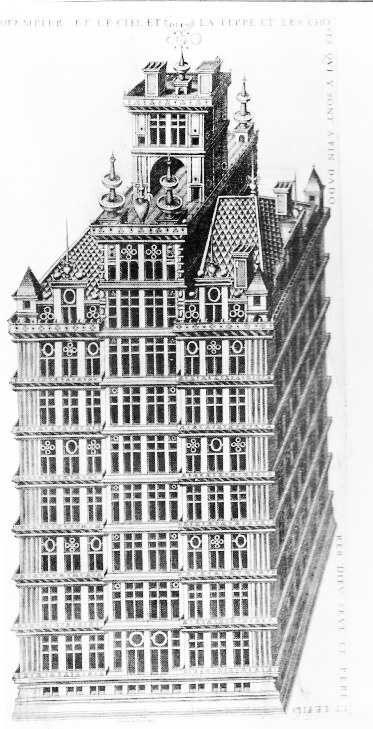
    There seem to be few designs for Very Tall Buildings in the Renaissance that weren’t churches or towers–I mean, structures with storys, and ninth floors, and small glazes, and so on. 

    That is why this design for an eleven story building  by the architect Jacques Perret de Chambery (in his book Architectura et perspectiva des fortifications et artifices, which was printed in Paris in 1601) bursts into the brain as being so remarkable. 

    Arch skyscraper880

    Describing this building and quoting the bookseller site Martayan Lan, Inc. “One extraordinary pavilion would seem to have its
    ultimate source in the fifteenth-century Temple of Virtue and Vice
    designed by Filarete. It is eleven stories in height, with huge expanses
    of glazed openings. Its site plan, the last plate in the publication,
    is a beautiful ornamental geometrical design in the manner of du
    Cerceau, composed of such elements as gardens, moats, and fortifications
    that frame the square, towering pavilion.”

    The “Temple/House of Virtue and Vice” referred to above is the work of Antonio di Pietro Averlino (c. 1400 – c. 1469),  and also known as”Averulino”and  “Filarete” (Greek for “lover of excellence”), a Florentine architect and designer, who produced real and imagined works, a highly-skilled thinker engineer, and who is also remembered for his contributions to the development of urbanism and ideal communities, seen here in his design for the city of Sforzinda, below:

    File:Idealstadt.jpg

    (It is interesting to note that “sforzinda” is awfully close to “sforzado”, a musical term meaning “sudden” or “sharp”, which this design must have seemed to be, back there in the high Renaissance.) [Text and illustrations: Gallica .]  The House of Virtue and Vice was a nine story building to be located in Sforzinda, a structure with the highest floors devoted to learning, and the lowest to a house of prostitution.  Perhaps the floor placement was reversed. 


  • Beautiful Ladders of the Baroque

    JF Ptak Science Books LLC     Post 1921

    Blogzabaggi043web
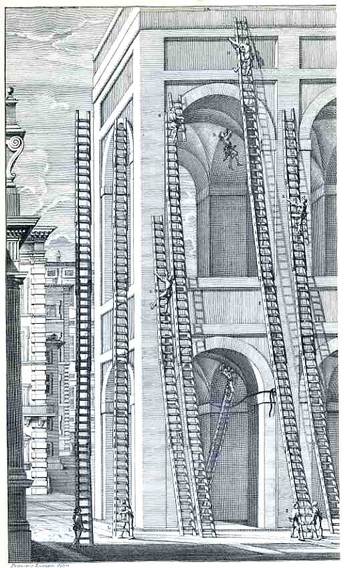
    This gorgeous, near-pre-Dadist image belongs to Niccola Zabaglia, who published the engraving in his book Castelli, e ponti di maestro Niccola Zabaglia con alcune ingegnose practice, e con la descriziojne del trasporto dell’obelsico Vaticano, e di altri del cav. Domenico Fontana, in Rome, in 1743.  This is the literal and absolute height of pre-modern, pre-mechanized building construction in the soaring Roman Baroque, ordained by “maestro”, the master, Zabaglia (1664-1750), a spectacular (and necessary) proponent of practical mechanics as applied to the building trades.  Among the “Castles” and churches and bridges alluded to in the title of his book, Zabaglia was responsible for affecting the maintenance and repair of St. Peter’s (more particularly to the basilica and the vault)—specifically, he had to figure out how to get the workmen and materials into place, and into very difficult and very high places, without damaging or destroying any of the existing decoration, artwork, sculpture, frescoes, and so on.  This was no easy feat to perform back there in the dim, 265+ years-ago pre-electric pre-power past, with enormous technical and operational difficulties, and Zabaglia accomplished this was superior affect, devising complex and elegant moving and stationary scaffolds, hoisting and holding mechanisms for the ladders, and much else.  He did just beautiful work, and he is a patron saint in the history of repair. 

    Ladders and scaffolds were important of course but were among the least of Zabaglia’s numerous accomplishments and inventions—they were so plentiful and useful that two Pope Benedicts ago (Pope Benedict the 14th) ordered their publication with actual teams of artists and engravers performing specific tasks.

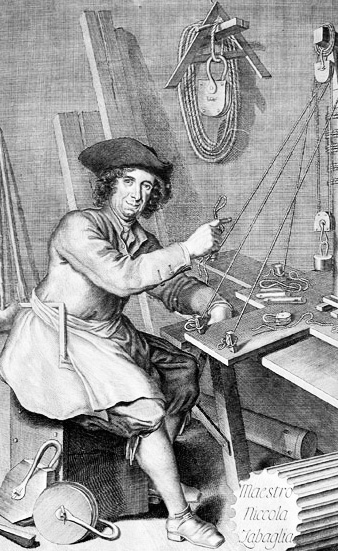
    It cannot be left unsaid that Zabaglia’s portrait as the frontispiece to his work presents almost without a doubt the most approachable, humane and amused representations of a major engineer/artist/artisan published in almost any work of the 18th century–I mean, the man just looks so happy in his work.  There he is, surrounded by the tools of his trade, in work clothing and a scruffy hat, and needing a shave, and just looking as pleased as can be.  No?

    ZabagliaBut to the ladders:  the examples in the engraving above are certainly massive.  The ladder in the middle I would say must be 70′ tall (judging that it has 60-odd rungs and that there are 5 rungs to the men who are stabilizing it at bottom), and since they’re made of a good hardwood (to prevent bowing that must occur in a lesser material), the things must’ve weighed a good amount.  And offhand I’m not exactly sure how they raised them.  I can’t see the tops of the building, but I would assume that there was a pulley up there. I hope.  In any event, the ladders and their found geometries are gorgeous things.  Also, I would guess that in the very long histories of ladders (a ladder appears in a cave painting from 10,000 BCE and also appears in one of the very first photographic experiments) that these must’ve been among the high points in ladder construction. 


  • Isolating ElectroPunk pre-Dadist Illuminated Signs, 1876-1914

    JF Ptak Science Books   Post 1919

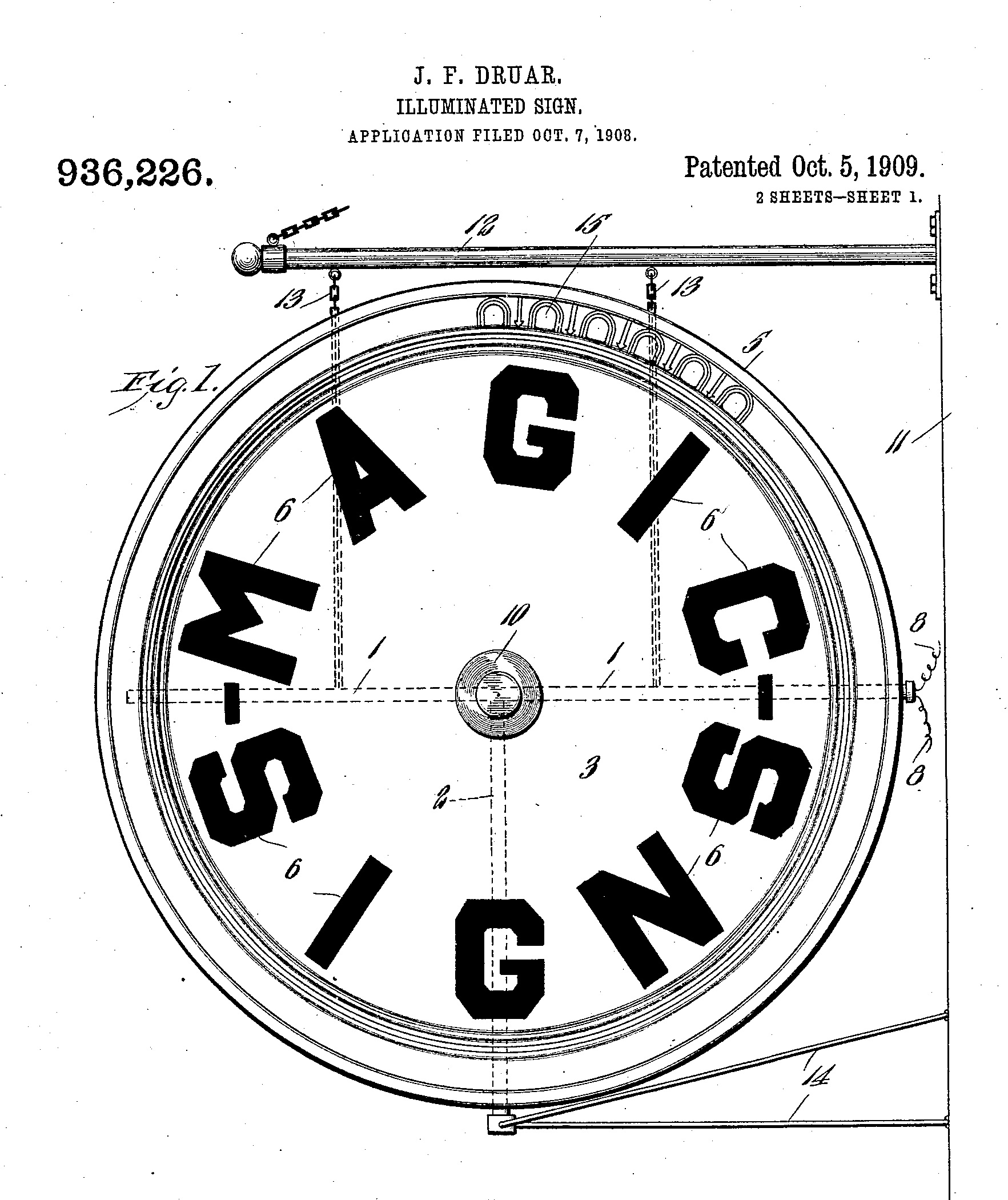
    I am quite certain that entering into a category of ElectoPunk Found Art was the furthest/furtherest thing from the minds of these inventors, mainly because these words didn’t yet exist, and also because these inventors worked on practicable application of the relatively new employment of electricity for advertising. Still, they were serious efforts in pursuing the sale of soap and cigars and “pure food” and other sundries large and small.  But removing them fro their intentions clearly makes these designs into art, some of which is just drop-down gorgeous. 

    DADA FOUND PATENT SIGNSSource:  Google patents:

    http://www.google.com/patents/US936226?dq=illuminated+signs


  • “Damaged Glob” and ElectroLux Found Word Art, 1883-1920

    JF Ptak Science Books  Quick Post

    Not much to say on these images–they’re just terribly neat. There seems to be a sensible amount of proto-Dadist material here, extolling distant observation, attracting and repelling the reader with its distracting possibilities, all ending with an upside-down “Earl”.  At the very least, these images are “pretty”. 

    Walker Evans. Salon, West Virginia, 1935


  • Light as a Weapon, Above and Below (1917)

    JF Ptak Science Books   Quick Post

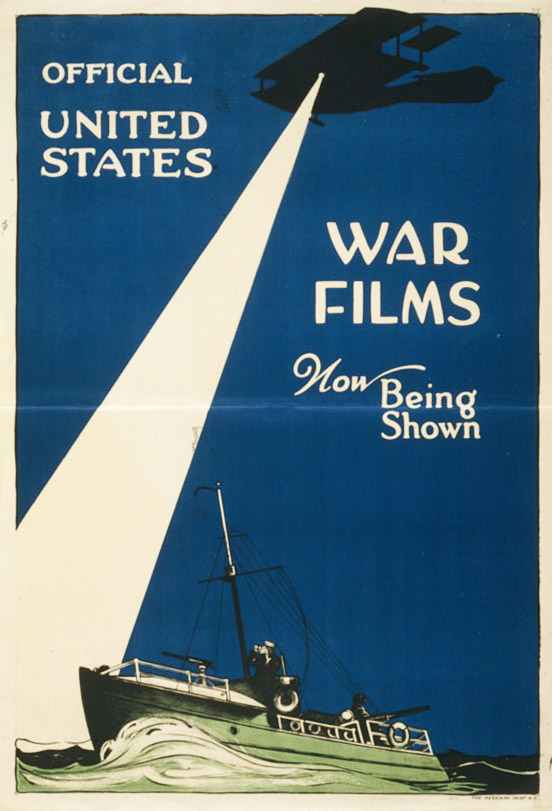
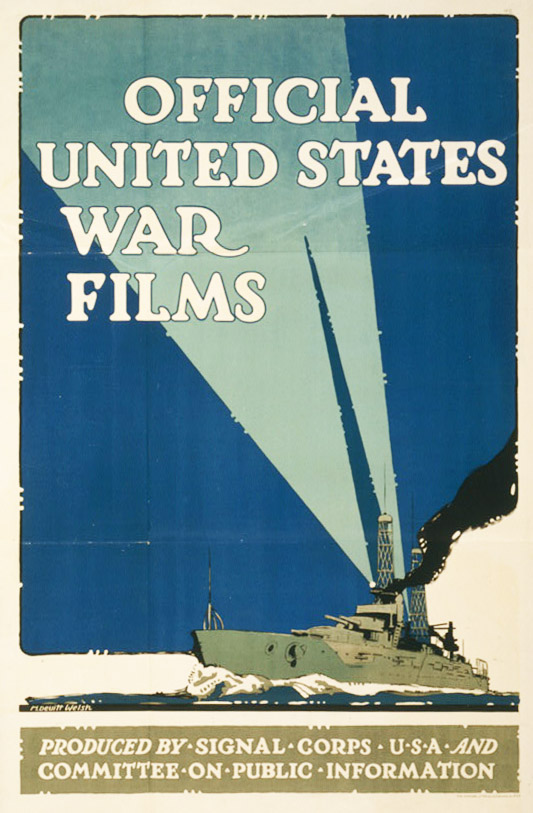
    Although electric lamps/searchlights have been militarily used on land and sea since the 1880’s (at least), it  is still unusual to see light itself displayed as a weapon in a poster.  This is especially true when the light is airborne and in real, in-potential-use applications. An earlier image appears in the Illustrated London News of a giant airship illuminating a battlefield, but it is a rather futuristic view of the employment of light as a weapon, and didn’t quite come about as an effective tool. (As much as the airship would illuminate of the opponent’s night-time position, it also made itself extraordinarily vulnerable–lighting up your enemy’s position just didn’t make for a practical idea, especially when the notions of bombing and night bombing came into being.) 

    In this first image below, there is a strong beam emanating from an aircraft in 1917–how it is generating such light, and whether it was conceivable to have it light enough to be on the aircraft, I don’t know. 

    MAssive american posters 1910-1920

    Conversely, the searchlight coming from the military (battle-)ship could certainly have supported the machinery to produce any number of effort, though it seems again to be counter-productive, establishing itself as a not particularly fast-moving target to anything on the sea or above (or below) it.

    MAssive american posrts seacchlight ship
    On the other hand, this Swedish movie poster seems to have put the idea to good use (source, here):


  • Electricity as an Added Lethal Measure to Barbed Wire: World War I

    JF Ptak Science Books  Quick Post

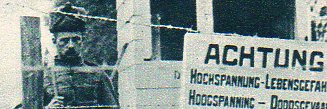
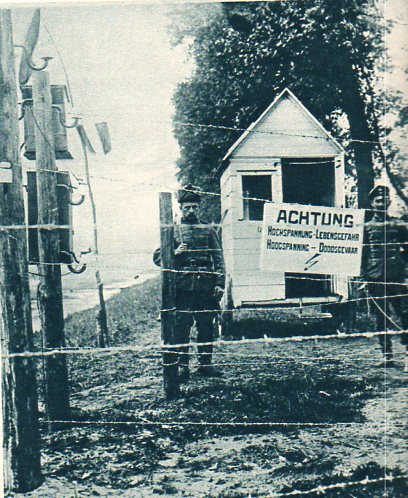
    Barbed wire was one of the most successful and horrifying defensive weapons of World War I.  In 1915 it was made more effective yet by adding high-voltage electricity to the emplacements.  In general the electrical barbed wire fence was employed as only a tiny fraction of all wire fences during the war–as the non-electrified fence was already extremely effective, very cheap to produce and very easily installed–but the possibility of finding an electrified wire somewhere along the lengthy rat’s nests of miles and miles of this thing must’ve had some sort of very major weight in most soldiers’ minds. 

    The following image (and details) from The Illustrated London News for 9 October 1915:

    WWI--e---electric fenc dete extra647

    WWI--e---electric fenc dete646

    WWI--e---electric fence645

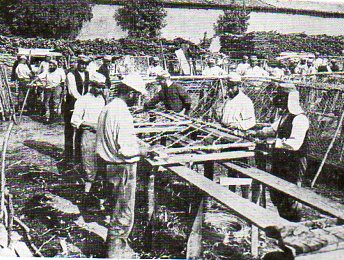
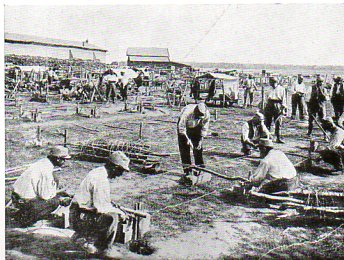
    And the places where the barbed wire was made and packaged, again from The Illustrated London News for 16 October 1915.

    WWI--e--barbed wire making648

    It looks as though the wire was stretched across 3.5 foot poles, with the barbed wire added diagonally, and then rolled up in long sections for easy transport and deployment.

    WWI--e--barbed wire making649


  • On Seeing Things Backwards Series, 1: UNIVAC and the 1952 Election

    JF Ptak Science Books   Post 1917

    Univac-cronkite
    Leonardo wrote backwards and from right to left, Benjamin Button lived backwards at the hands of Scott Fitzgerald, Rene Magritte’s man in the bowler saw the back of his head, Herrimann’s Ignatz the Mouse I am sure saw the back of his head looking around the world with the world’s most powerful telescope, rugby passes are all done backwards, paper images of vue optiques appear backwards, lightning for all intents and purposes starts backwards from the ground up, reverse mathematics are worked from theorems to axioms, and the Chicago River (1900) was engineered to flow backwards for the foreseeable future, while the Mississippi River famously flowed backwards for just a bit in the New Madrid Earthquake of 1812. 

    I can only imagine what audiences must have felt when they saw the first moving pictures played backwards–seeing them played forwards was a novel-enough (and revolutionary) idea, but the simple idea of reversing the direction of the film would have proved to be equally fascinating. 

    Imagine the first time you witnessed a staged train wreck on film, back there in 1897, and imagine being able to see it played over and over again, until you were filled.  I’m not so sure that there were even any still photographs of a train wreck as it occurred to this point, even with advances in film speed and lens, so seeing the even unfold in front of you at leisure must have been overwhelming.  Now imagine these same folks seeing the event and watching the locomotives reconstitute themselves.  It would have been an extraordinary event.  Even observing the Etienne Marey sequences and seeing what actually happens when a person bends over to pick up a pail of water would have revealed almost as much in new detail as when Galileo was in the middle of his earliest observations. 

    Looking at things backwards is a good idea so far as thinking about engineering problems and of course in checking experimental results in the sciences–its not so good an idea though to change the results produced by the scientific method because they’re not a good intuitive fit to expected parameters.

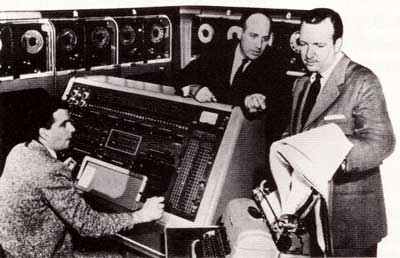
    Such was the cased with the first (and successful) employment of a computer to predict the outcome of a presidential election.  THe computer was the UNIVAC (the world’s first commercial computer and a blazingly fast machine at 10k operations a second, nearly six orders of magnitude lower than “superfast” by contemporary standards), which was brought in by Remington Rand to CBS News to crunch the numbers on the tight race between General Dwight Eisenhower and Gov. Adlai Stevenson (II) on 4 November 1952.  (Stevenson was the son of a former U.S. Vice President and would run again against Eisenhower in 1956.) Pioneers Pres Eckert and John Mauchley, along with Max Woodbury (and programmer Harold Sweeney, who is seated at the UNIVAC’s control panel and who seems never to be mentioned in the iconic photo at top, with Eckert at center and anchorman Walter Cronkite at left).   CBS News Chief Sig Mickelson and Cronkite were not comfortable with the proposal, but ran with it anyway, sensing a moment of the-future-is-now.

    The Eisenhower/Stevenson race was seen by the large majority of pundits to be too close to call, so when the UNIVAC’s results pointed to a landslide for Eisenhower (438 electoral votes and 43 states to Stevenson with 93 electoral votes and 5 states) folks got very sweaty and nervous, not trusting the outcome. As this was still a very early age in human-machine interaction, and the computed results fell far away from perception and expected response, changes were made in the UNIVAC’s programming to determine a more “reasonable” response by the machine, the new results making the race very tight and fitting human expectations and giving Eisenhower a very slim margin of victory.  As poll results started to sweep in an hour or so later indicating that Eisenhower was showing with a huge victory, the UNIVAC was again reprogrammed and at about midnight the announcement was made that the UNIVAC had indeed been correct in the first place.  The final results were 442 electoral votes for Eisenhower and 89 for Stevenson.  In the next presidential election in 1956 the three networks all had computers working for them–with them–and a different perception had been formed on working with computers. 


  • Big Shadows–Industrial Silhouettescapes, 1936

    JF Ptak Science Books    Quick Post

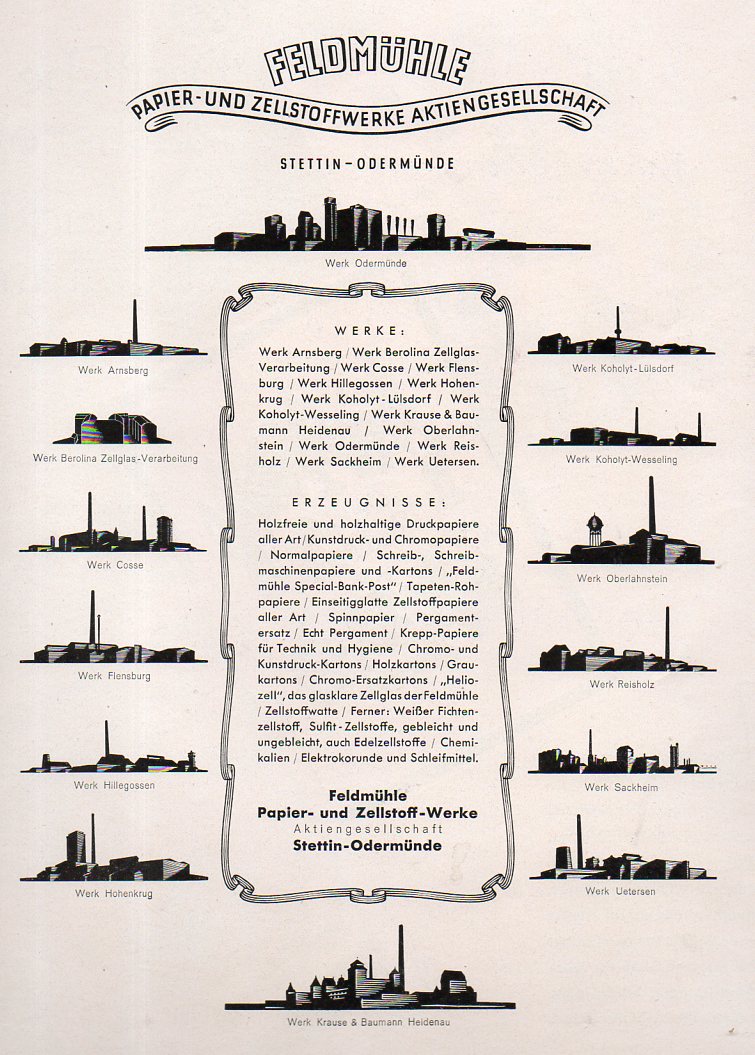
    In my experience with images in silhouette, the technical adaptations are very unusual (at least for things that are not spotter guides for enemy aircraft or ships-at-night)–more uncommon still are industrial buildings rendered in silhouette.  But here’s an example, taken from the Illustrirte Zeitung (Leipzig) for 1936.  These are factories in the Feldmuehle Papier- und Zellstoffwerke company, and are really quite attractive.

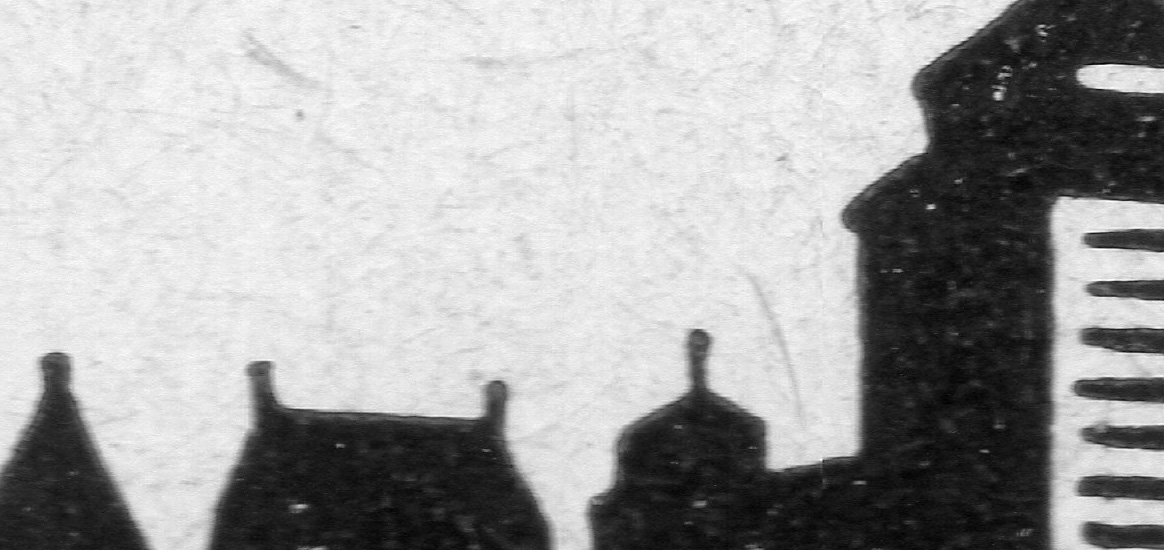
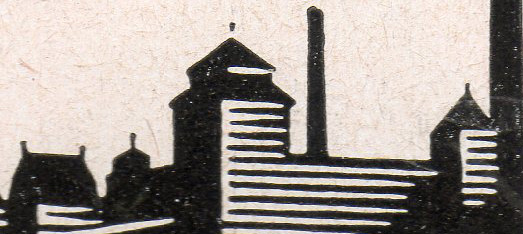
    The following two images are details from the 14th silhouette, at bottom-center:


    Industrial silhouettes874


    Industrial silhouettes873

    And the full-pahe ads looks so:

    Industrial silhouettes872


  • Feeling and Touching Calculated Numbers in the 18th Century: Palpable Mathematical Devices

    JF Ptak Science Books  Revisting/Expanding Post #76 (from 2008)

    Part I:

    Nicholas
    Saunderson (1682-1739)  was an extraordinary mathematical talent—he was
    also blind (from about the age of one), and invented, principally for
    his own uses, what I think is the first mathematical calculator designed
    specifically for the use of the blind.

    Blogblindsaunderson_calc
    He was supremely gifted and creative, and rose to become the fourth Lucasian professor at Cambridge, succeeding the expelled William Whiston, who had in turn succeeded Isaac Newton—Saunderson also held the post for one of the longest periods of time, 1711-1739.  He was friend and associate to Newton, Whiston, Roger Cotes, Halley, De Moivre and others during a particularly rich intellectual period in the history of physics and the maths. 
    Blogblindsaunderson_geo

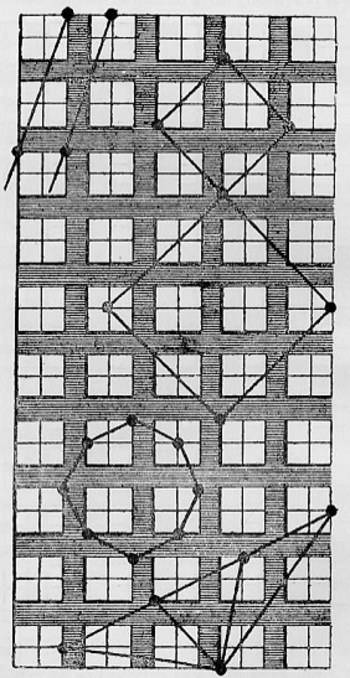
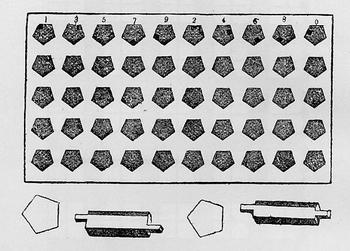
    His calculator was smart and simple, based on a cribbage-board –like device, that was able to perform arithmetical and algebraic functions—it consisted of nine rows and was worked with two pins, the positioning of the pins on the engraved board telling the user their value. (There was another calculator for the blind constructed by Meyer (below, left)  using a sort of reverse principle to the Saunderson model where it was the shape and placement (leaning or not, for example) of the pegs in the hole that annotated value rather than their placement on the board.
    Blogblindparis

    The Saunderson computer was described in his The Elements of Algebra…, published at Cambridge in the first edition just after the author’s death, in 1740.  The device was described in the book by John Colson (who succeeded Saunderson to the Lucasian chair), who commented that it was via the use of the device that
    Saunderson could compose his treatise on algebra. (Above  is another Saunderson-based calculator allowing for the construction and study of geometrical figures).  

    Part II:
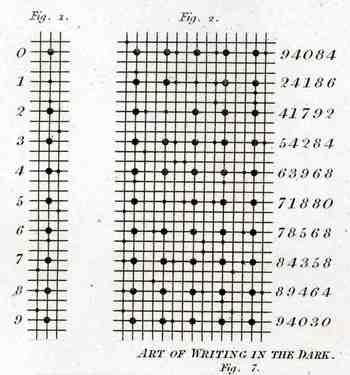
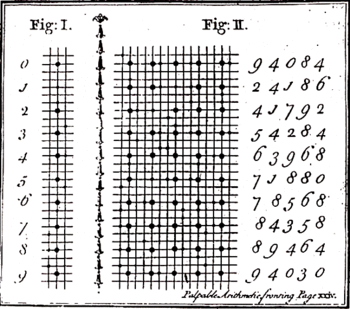
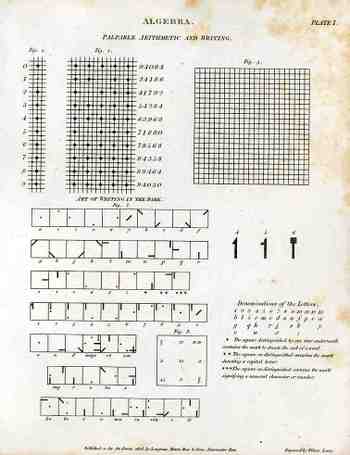
    Blog1sept_6_palpable_det516_2“Palpable Arithmetic”, the sub-heading for the sheet illustrating aspects of algebra for Abraham Rees’ (1743-1825) great if not problematic 45-volume Cyclopedia, is a system that  records and organizes and sometimes calculates using three dimensional objects.

    For example the Egyptians (for one) calculated with pebbles; then there was the ABAX of the Greeks, and the abacus (and also called the mensa Pythagoras) of the Romans (and of the Japanese and earlier still of the Chinese), the scaccarium of the English (via the Norman conquest), and innumerable other systems that performed arithmetic and recording and
    archiving functions via the employment of reeds, notches on a tree or cloth or stick (etc.), reeds, knots, fingers, beans,shells, string, sand, and on and on.  Palpable arithmetic also has a specialized meaning in places as a calculating device in which the numbers are recognized by touch and used by blind mathematicians or other parishioners. (Just for the record, there are a number of eminent blind  mathematicians including, for example,  Leonard Euler (1707–1783, who was blind in the last 17 years of his life), Nicholas Saunderson (who I wrote about in an earlier post), Louis Antoine (1888-1971), Lev Pontryagin (1908-1988.)) 

    An interesting and very large philosophical issue that comes up here with the blind mathemaitican is the concept of image formation and its dependence upon sight for intuition, as with geometry or topology.    Plato for one determined for himself that image formation issues were precognate and the same in sight and non sighted people.  How would you manipulate a geometrical form if you’ve never actually seen one, or how would you extend you spatial imagination of compex forms without a reference? 

    But my main issue here is the image from the hees book.  I’m by the meaning of this particular calculator or recording system–I just can’t tell what it is.  Can you?  If so I’d love to hear from you.

    Note on the Anthropology of Numbers:

    From Levi Leonard Conant’s The Number Concept Its Origin and Development we find these very descriptive definitions of words for numbers, all of which relate to the sort of implement that they were controlling
    their numbers with, or calculating:

    “in Javanese, Malay, and Manadu, the words for 1, which are respectively
    siji, satu, and sabuah, signify 1 seed, 1 pebble, and 1 fruit
    respectively. Words as natural and as much to be expected at the
    beginning of a number scale as any finger name could possibly be. Among
    almost all…the derivation of number words from these sources can constitute no ground
    for surprise. The Marquesan word for 4 is pona, knot, from the practice
    of tying breadfruit in knots of 4. The Maori 10 is tekau, bunch, or
    parcel, from the counting of yams and fish by parcels of 10. The
    Javanese call 25, lawe, a thread, or string; 50, ekat, a skein of
    thread; 400, samas, a bit of gold; 800, domas, 2 bits of gold.The
    Macassar and Butong term for 100 is bilangan, 1 tale or reckoning…”

    The full sheet from the Rees book:
    Blog1sept_6_palpable514_2