A Daily History of Holes, Dots, Lines, Science, History, Math, Physics, Art, the Unintentional Absurd, Architecture, Maps, Data Visualization, Blank and Missing Things, and so on. |1.6 million words, 7500 images, 4.9 million hits| Press & appearances in The Times, Le Figaro, Mensa, The Economist, The Guardian, Discovery News, Slate, Le Monde, Sci American Blogs, Le Pont, and many other places… 5000+ total posts since 2008.

Category: Technology, History of

  • What Happened Underground: Mining, Orwell, Trench Bombers, & Waits

    JF Ptak Science Books 

    Underground working steep102

    Blogjuly_17_work334

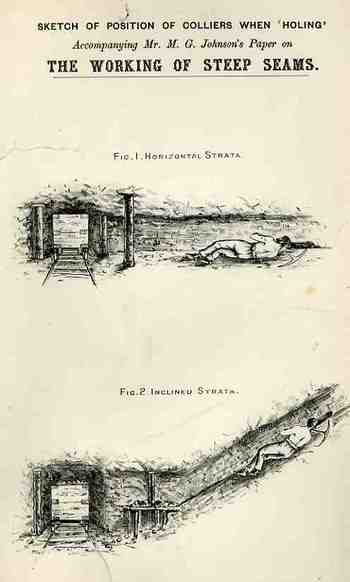
    Looking at these two images of the shirtless miner laying down and working on his side in the semi-dark way underground in what looks to be a tunnel about twice the width of his shoulders makes you wonder about how in the name of great bog could people have done this, day in and day out.  The fact that the appearance of these images were both essential and mundane further tells us—as we sit here in a comfortable chair in the print’s future—that this is, simply, what people did, and what they had to do.

    This was “holing”, as in working in a hole, and served to illustrate a point in Mr. M.G. Johnson’s paper “The Working of Steep Seams”, which I think appeared in a West Australian mining journal around 1900.  So, it seems, the guy, the worker, in the picture would spend his day chunking coal from a hard vein, laying down, scrapping (I think) away at the coal in a too-tight tunnel.  Did he do this for hours?  Days?  Weeks?  I guess the bad answer is that he did this as long as the coal could be followed.   (Also, it looks as though that the major tunnel in which the coal car is located may be 4 or 5 shoulders high—certainly not tall enough to walk in, which means that this guy could’ve crab-walked to this position for a half mile or more, just to get to work.  The tenacity of this worker to do his work and collect his pay to feed his family was just incredible. 

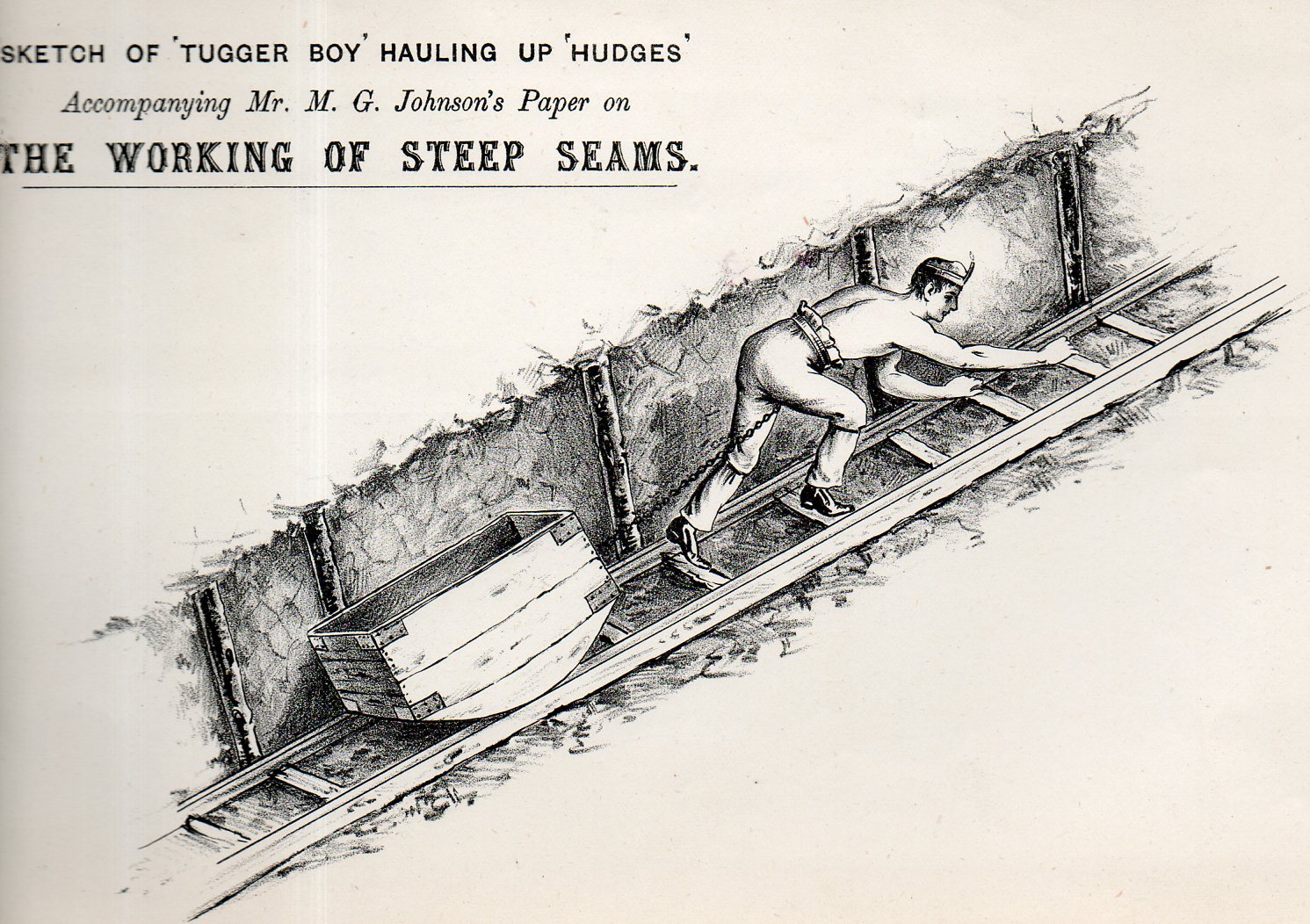
    The first image really doesn’t need much commentary, though calling the worker a “tugger boy” pulling up a “hudge” was probably a bit of sardonic camraderie–except that the doing of the job would distance you from its folksy name. Well, that, or the “tugger boy” really is referring to a boy, as we see in the followlign mining definition: “Tugger boy (Brist). One who draws small tubs or sleds underground by
    means of a tugger. Called Tugger-work. (Gresley), 1883).  The depiction of what seems to be a mature man in the image might be a piece of propaganda. In any event,  the Tugger Boy carries his own flame on the top of his headgear, and the chain that attaches him to the heavy coal bucket runs from his waste down the front of his body and through his legs.  Very hard work needless to say–harder yet done by a child.

    George Orwell wrote perhaps one of the most brilliant descriptions of the mining environment in his superb The Road to Wigan Pier. (It is well worth reading all of Orwell’s books at this point—his insights almost never looked so fresh.)

                                                       
    Blogjuly_18_mining_robinson338

    He  describes the crab-walk from the elevator to the place
    of work, telling how difficult and exhausting the process was of just
    getting to the place where you would then begin your difficult
    workday.  Of the miners he says at one point:  “Watching coal-miners at
    work, you realize momentarily what different universes people inhabit.
    Down there where coal is dug is a sort of world apart which one can
    quite easily go through life without ever hearing about. Probably
    majority of people would even prefer not to hear about it. Yet it is
    the absolutely necessary counterpart of our world above.”  Read more here.

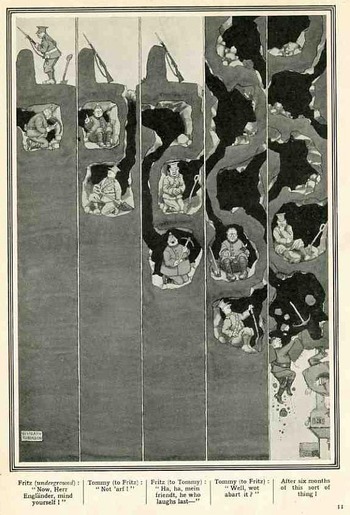
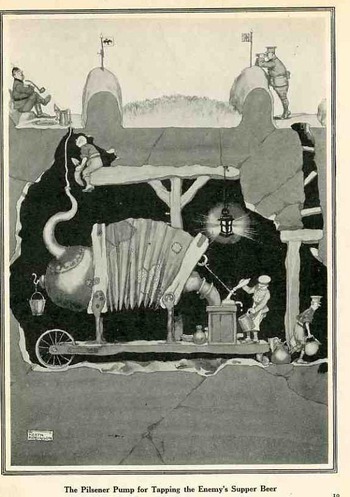
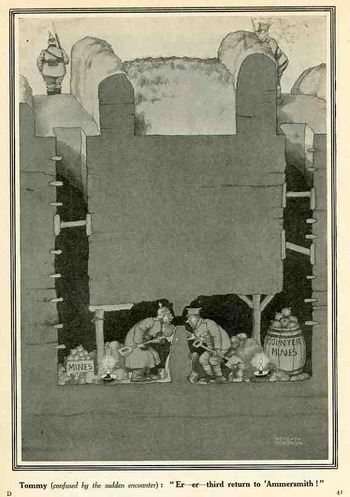
    The next series of images come from the pen of W Heath Robinson
    (1872-1944) who was a lovely, quirky, charming, skewed, dark,
    stiff-bouncing and creative illustrator capable of considerable whimsy
    (light and complex) and deep skepticism.  The images I’ve selected are
    from one of his three WWI books, Hunlikely, published in 1916 (Some “Frightful” War Pictures (1915), and Flypapers (1919),
    were the other two) and depict scenes from the intra-trench tunnel
    wars, which were battles fought in the midst (or, actually, beneath)
    other battles.  This was a savage, grueling, post-adjectival
    affair—exceedingly dangerous, difficult, awful.  And it happened a lot
    during the war, given the experience of stalemates between vast armies
    sunk into mole city trenches, with no one going anywhere for long
    periods because there was nothing in between the two impervious lines
    but a death vacuum.  So one of the solutions was to try and tunnel
    underneath the opposing army’s defenses, fill the far end with high
    explosives, and blow them up.  The other side was doing it too, and in
    the middle of it all was the incorporation of newer/better listening
    devices to detect forces rummaging around underneath your position
    dozens of feet into the ground.  It was a bad business. (One of the
    other means of breaching the trench lines was aerial combat, but
    bombers carrying tons of HE were still yet to be invented; poison gas
    was another.  Most of the time the armies would just meet in the
    middle  in wide plains of nothingness in a sea of hot, expanding metal,  where
    to this day in many of those places nothing can live).

    Blogjuly_18_tunnel_2_robinson340

    Robinson’s illustrations are odd, and oddly funny, the dark humor
    coming at the expense of both sides of the conflict, piercing
    each.   

    This puts me in mind of Tom Waits’ concrete-toothed “There’s A
    World Going On Underground” (1983) song from the Swordfishtrombones album. 

    Rattle big black bones in the danger zone
    There’s a rumblin’ groan down below
    There’s a big dark town, it’s a place I’ve found
    There’s a world going on underground
                
    They’re alive, they’re awake
    While the rest of the world is asleep
    Below the mine shaft roads, it will all unfold
    There’s a world going on underground
                
    All the roots hang down, swing from town to town
    They are marching around down under your boots
    All the trucks unload beyond the gopher holes
    There’s a world going on underground

    Blogjuly_18_tunnel_3_2_robinson341

    ·Posted by :

    ·in:


  • Beginning an Alphabet of Science Fiction -Punkisms

    JF Ptak Science Books  Post 1981
    “The most ignorant person at a reasonable charge, and with little bodily labor, may write books in philosophy, poetry, law, mathematics, and theology, without the least assistance from genius or study.”  Jonathan Swift, in Gulliver’s Travels (Actually, Travels into Several Remote Nations of the World, in Four Parts. By Lemuel Gulliver, First a Surgeon, and then a Captain of several Ships).  1726.

    I’ve produced the beginning of an alphabet of –Punkisms for variations of robot.machine/computer past and futures, science fiction indicators of possibility. Why should we stop at “Steampunk” when there’s FuturePunk and DeadPunk and such to be had?  So, please find folllowing a few possibilities, and accept them in the playful way in which they are offered–also, the very abbreviated descriptions of the science fiction works desscribed are open to interpretation. And please give this a “pass” for the over-abundance of hyphens.

    A

    ActorPunk: Walter Miller, ‘The Darfsteller’ (1954), human actors are replaced by robots on stage, as compared to being replaced by digital figures online. Some steps have been made with great care over the years by “perfecting” the imaging of women in magazine advertisement—in this way even the models who appear in the ad and are modified find it impossible to live up to the expectations of what their ads depict.

    Anti-technologicalPunk-topia: Samuel Butler, Erewhon, (1872).

    AutomatoPunk:  Kurt Vonnegut, Player Piano (1955), like Brazil and 1984, but with machines.

    B

    BiologoPunk:  Philip K. Dick, ‘Autofac’ (1955), machines find that they can reproduce themselves in a ’50’s iron-bio kind of way. 

    BrainPunk: Miles J. Breuer, ‘Paradise and Iron’ (1930).

    C

    ConsciousnessPunk: Philip K. Dick, Vulcan’s Hammer (1960) and the development of computer consciousness.  Also David Gerrold, When Harlie Was One (1972);
    Frank Herbert, Destination Void (1966); Harlan Ellison, ‘I Have no Mouth and I Must Scream’ (1967);  Robert Heinlein, The Moon is a Harsh Mistress (1966), and many others.


  • Missing the Obvious: WWI and Kriegsoptik

    JF Ptak Science Books   Quick Post    Follow Me on Pinterest

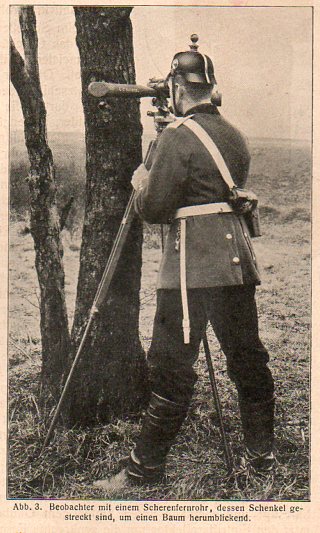
    For some reason this particular defensive utility of the binocular/rangefinder/”scherenfernohr” hadn’t occurred to me before seeing this photograph (in the September 1915 issue of Himmel und Erde).  Of course with the many billions of rounds of ammo that flew across open fields during the war, if it was your job to sight for artillery or what have you it would be better to do that from a trench (as this instrument was also known as a “trench periscope”, as varieties of the binoculars could have vertical tubes) and behind cover, or if in the field to be able to find a defensive position for your work. I hadn’t thought about standing behind a tree with the scope’s optics wide enough to operate beyond the diameter of the trunk–seeing the picture made me think, “of course”. On the other hand, this posture assumes that there’s very little flank to that field…

    Kriegsoptik097

    ·Posted by :

    ·in:

    —

  • The Machine in the Mind, 1919

    JF Ptak Science Books    Post 1979   Follow Me on Pinterest

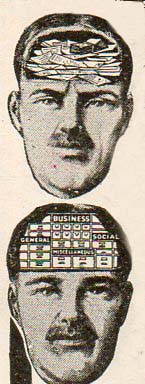
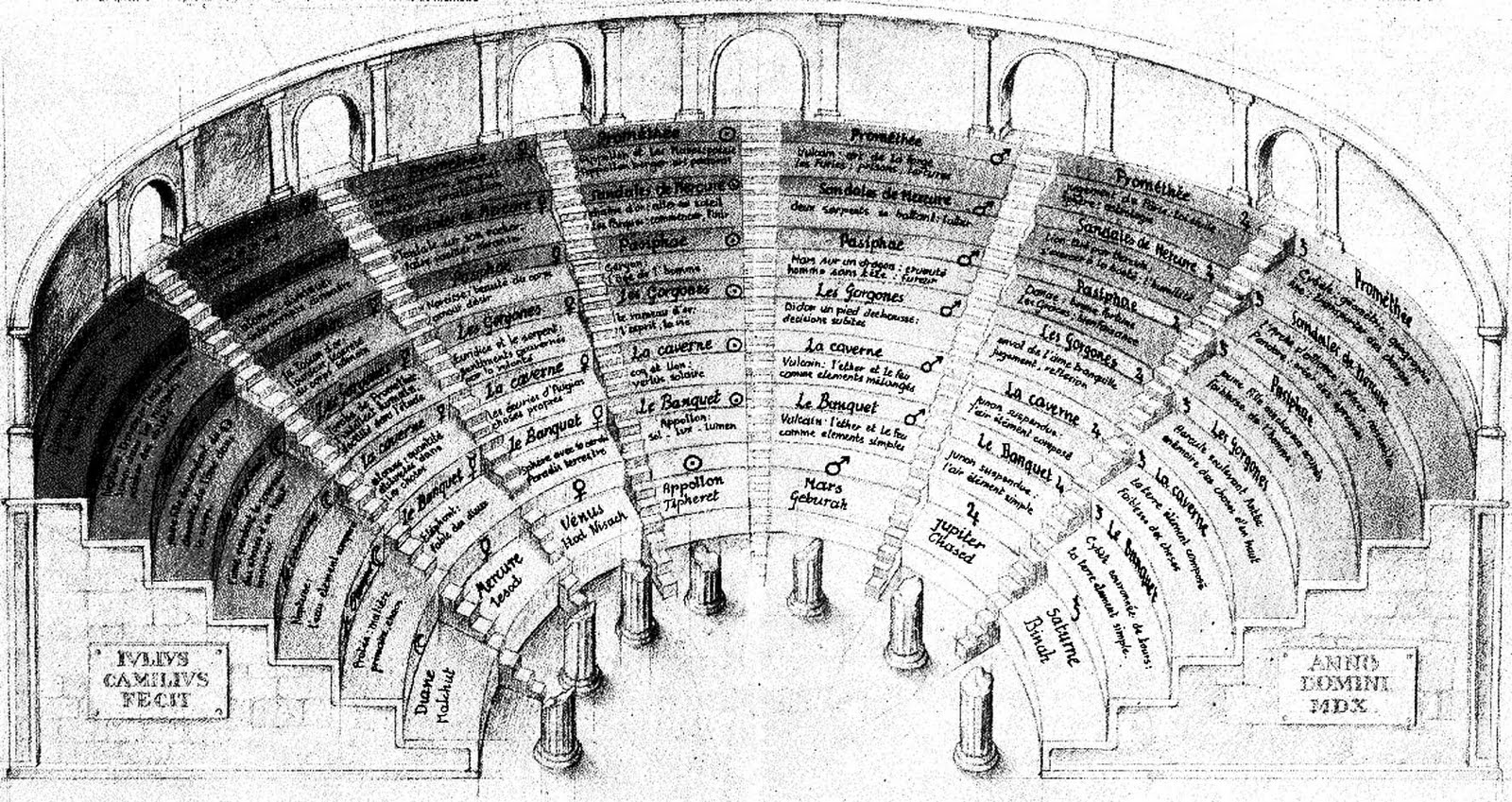
    Computer head089I’m unsure of when the first images appear representing the human mind as a sort of anthropomorphic filing system, utilizing a desk or filing cabinet or (later) a computer. From the early history of human memory-making mnemonic devices and memory palaces there are represnetations of where information in the brain could be stored for rapid access and retrieval, like memories being stored in rows of theater seating, or in the branches of complex trees, or in the buildings of a bird’s eye street map.  But these show where the memory “goes”, and not where this memory set sits in the brain of the individual. 

    Memory palace
    (An example of a memory palace, from Giulio Camillo,  L’idea del Theatro, 1550, from Bourbakisme blog).

    This came to mind seeing this odd little ad in the magazine Illustrated World for July 1919 seeing these fairly high-creep factor faces endowed with different sorts of cerebral applications. The top man is depicted with a messy desk and a hand-cranked calculator; at bottom we see the organized man, with papers sorted in their labeled places. (As it turns out, the image used for a company selling memory-improvement books).

     Perhaps this image was in a small way a pre-historic insight to brain computer interface (the acquired, direct signal processing of the brain to a computer), in the same way, say, as Hans Berger’s 1924 invention of the electroencephologram, where we can actually see electrical activity of the brain displayed on a piece of paper.  Of course, one image is a simple semi-folly to help hawk a mostly-useless huckerter book on memory improvement, while the other is a bona fide medical breakthrough.  But in similar ways they were insights into looking at the activity of the brain in connection to an external resource.

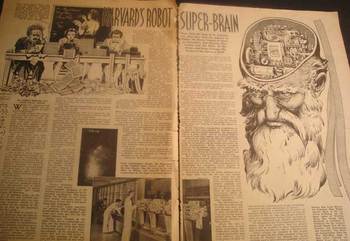
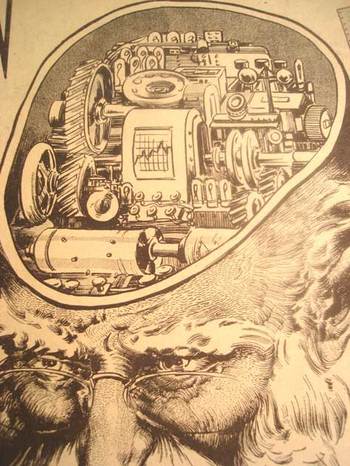
    In 1944 there was something else, something quite different allocated to the Leonardo-like head, something far in advance of the filing system of 1919: the computer.

    Blogharvardbrain
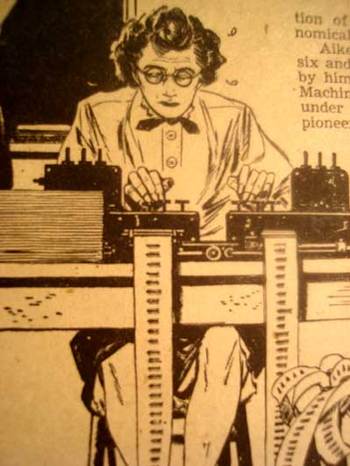
    This may well be the first public, popular, report on the Harvard Automatic Sequence Controlled Calculator (ASCC) (appearing in the American Weekly, 15 October 1944), the first automatic, general-purpose, digital calculator.  Known as the MARK 1, it was the brainchild of Howard Aiken (1900-1973), a graduate student at Harvard, who started it all in 1937 by proposing a series of coordinated Monroe calculators to function as a unified whole  that would cross the threshold of the physically-impossible calculation (though theoretically possible) to the eminently doable.  The project was immeasurably aided by the input of Harvard astronomer Harlow Shapley (who had earlier dealt with the enormously problematic aspects of the scale of the universe) who put Aiken in the hands of IBM at Endicott (NY).  From there the building of the computer came under the supervision of Clair D. Lake, with the engineering and theoretical team of Francis Hamilton, Ben Durfee and Howard Aiken.
    Blogharvardbraindetail

    The machine was basically completed in 1943 and tested in Endicott for the better part of the year before it was shipped of to Harvard in February 1944, where it was put almost instantly to work on ballistic calculations (like its cousin ENIAC at the Moore School at U Penn), as well as naval engineering and design issues. 

    The author of this article, Gordind Bhari Lal (“noted science analyst”), actually does a pretty decent job describing the machine and its (1940’s) possibilities, noting at the end that “it may even unleash for Man’s Use the long-dreamed-of energy of the atom”.  This part did come true, especially post-war, when the machine was put to fair use by the US Atomic Energy Commission. 

    The part I really don’t understand in this article is comparing the speed and function of the ASCC to two women working on calculators and Albert Einstein, working with a pencil, paper and pipe, none of whom look comfortable or happy.  (Actually the dresses on the women look a little hiked-up to me, just a little too high.)  Lal does make a decent comparative point (of uncertain veracity) about four generations of humans (the three above-mentioned calculators?) doing calculations that the ASCC could do in seconds.  Right or wrong, it gave the crowds in 1944 a real something to think about.

    Blogharvardbraingirl

    And so at the end of this post I believe that the representation of the brain as a mechanical device is relatively new, and I wonder if it isn’t a mostly-20th century creation.   Finding images of SteamPunk humans and robots and such roaming their ways through the literature in the 1920’s-1950’s is fairly easy, but showing the stuff inside the head and representations of how the mechanical brain was functioning seems to be a different matter.


  • Standard Corpse, Inc. & Deadpunk: Shaving, Cooling, Lifting, Electroplating, and Diapering the Dead

    JF Ptak Science Books   Post 1975   Follow Me on Pinterest

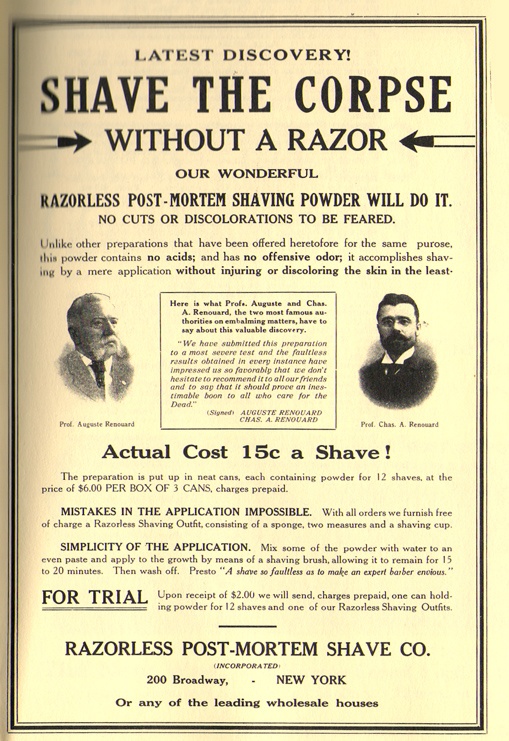
    The idea of creating an economy from a previously dead clientelle–the very after-market dead person–is relatively new. Once a middle class or lower working class with disposable income was created, celebrating the care of the dead was a paying option opened to the millions of families who were not the fastidious and celebratory wealthy.  Once the notion of having other people take care of the dearly departed became a part of the popular ritual of dealing with the dead, an entire new industry was born–spawning other related and associated industries for supplying the dead-care-givers with amenities and notions and necessities of a previously unthunk and unthinkable nature.  For example, the idea of needing to shave a corpse became an issue after it became fashionable to allow several days or more to pass between death and burial.  Beards and hair grow in death, so the people caring for the body and its display now were ordained an issue of economy in nultiple shavings of a corpse.  Now that may or may not have been an issue, but it was certainly presented as a possibility by the incredibly-named “Razorless Post- Mortem Shave Co.”


    Deadpunk shave

    {Many thanks to reader Max W for providing the information for the correct information for the citation of the above image–the magazine is Casket & Sunnyside for January 1912, and there are ample references to it in Charles Addams and Jessica Mitford.] The worry for the consideration of the cost of a shave (15 cents) for a dead person seems quite an inescapable weirdness and luxury. The weirdness of the name of the company nearly obscures it common nature–it isn’t exactly the Acme Corpse Company, but it is close to it, and it addresses just one small bit of minuatiae of deadness in the vast sea of Dead, Inc.

    The sellers of the razorless post-mortem shave equipment didn’t receive a patent for their process–nor did anyone else, for that matter, at least so far as I can determine. 

    Here are some further examples of Dead, Inc/DeadPunk patented death appliances:

    Post-mortem skull examination facilitator:

    Postmortem Underwear for the prevention of dead leakage and deodorization:


  • A Telephone Call From TomorrowLand and the Idea of Weighing Antique Surprise

    JF Ptak Science Books   Post 1973  Follow Me on Pinterest


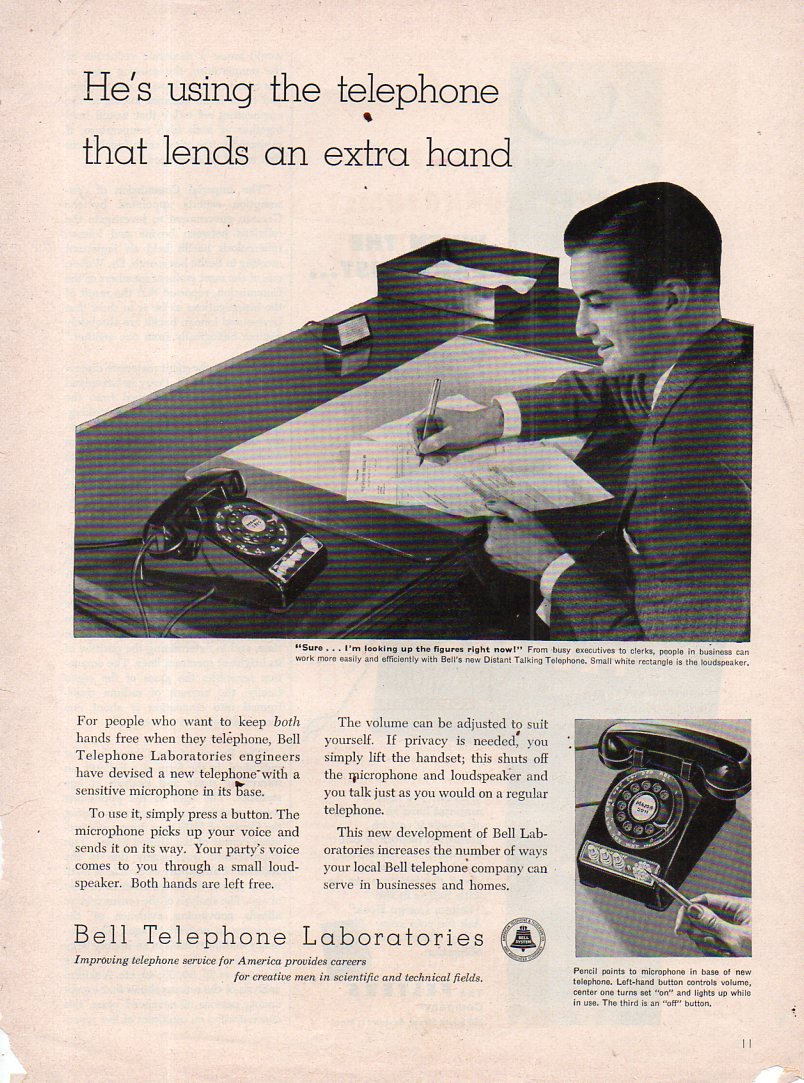
    This ad appeared only 59 years ago–that’s four generations in dog years, two human generations (or one for the more later-in-life crew, which is appealing as I knew a man whose grandfather was born in the 18th century), and 15 generations in managing data and communications. Perhaps more.  It is difficult to imagine the intense surprise that attended this ad showing a practical and popular adaptation of a communications breakthrough. 

    Telephone future064

    The electromagnetic telegraph, which is arguably the first electrically-powered iteration of the internet, was in the works from the 1820’s until it was nailed by Samuel Morse in 1837.  It was 40 years to the development of the Bell telephone (another dramatic example of an invention/technological idea/breakthrough that was “in the wind”, a popular undiagnosed monumental meme, some decades in the making in the hands of Bell anbd Reiss and Meucci and Gray and even Edison). Two more decades (just past the turn of the century) until more-widespread wireless telegraphy, another two decades after that (1920’s) for poular radio, and another two decades after that (post WWII/1950’s) for popular television broadcating. 120 years between the patented invention of the Morse telegraph to 50 million Americans with televisions in 1955. 

    The “telephone” of 2013 is as removed as the telephone of 1955 as the telephone of 1955 was removed from the electromagnetic telegraph–we’re not meeting half-way in the meeting of improbable impossible worlds, of worlds of the future unimagined in the past.  That is what comes to mind when I see this add for the speaking telephone in 1954–the astounding, astonishing, speaking telephone, the phone that allowed you to not have the receiver to the ear, tht allowed you to do free-hand work and communicate at the same time.  It was an ambitious improvement, and as soon as the phone appeared, it became a standard of necessity if that necessity was within budget. 

    It is the weight of surprise that is so abundant looking at pictures like this, giving us the opportunity to imagine the surprise elements of another time. It may well be that the new 1954 user of the speakerphone would have looked at the first telephone systems of 1894 as we look on that 1954 telephone today.  Probably not so, though, probably it was much more imaginable to have forseen the 1954 possibilities in 1894 than for 1954 to have seen in the same amount of time to 2013:  the technological pieces necessary for part of that imagination had not yet been invented, the science ahead of the scifi. 

    The other part of this surprise element is that 1954 is well within living memory, and that this combinaiton of technology and physics and mathematics has grown so incredibly from the speakerphone to the massive changes in 2013–it is as surprising to imagine this as to imagine the same scenario for what ahppened a year before in biology:  it is difficult to grasp the  sweeping changes in that field from the identification of DNA in 1953  and how far those fields have come since. 

    I think that if one could quantify this sort of “surprise” that the greatest amount of “Surprise Integers” (or whatever) ever recorded would have taken place within these past 50 or 60 years. Which makes me wonder–will people 59 years hence see the pictures of our fabulous accomplishments in 2013 as quaint reminders of how much things changed between 2013 and 2072?  Will those “Surprise Integers” be as great for that period of time as the (“our”) preceding period with concomitant revolutions in thought?  My guess is “yes”–its just hard to imagine. 


  • The Crucible of Weight and the Overweighted State of 1920 Geology

    JF Ptak Science Books     Daily Dose from Dr. Odd

    Scales060
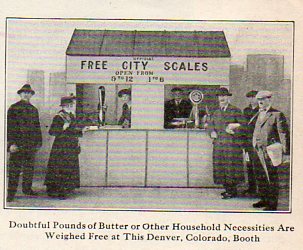
    Grazing the issues for 1920 in the Popular Mechanics-esque popular-techno-magazine, Illustrated World, I found this superb near-Dadaist photograph.  The image is for a free weighing station, where people could come and have their stuff weighed, and weighed for free.  This no doubt came into being to help protect consumers from being under-weighted and over-charged for their weighed goods like butter and whatever, where their good grocer might have had a thumb or more on the scale or even used a crooked/salted scale when selling their goods.  What someone would do at the point of being told that their stuff was overweighed, I don’t know–I mean these are people walking around in the street with things in their pockets or bags….its not exactly “evidence” showing up at the weigh station (staffed by “a woman”) saying that the half-pound blob roll in their hand was sold them as a pound on their word of the purchaser probably wouldn’t stand up in court.  In any event, I like the idea of the story of the world being told from the viewpoint of the person weighing stuff for free, and the people who came to them, and the stuff brought to be weighed.  Maybe there were weighing-in groupies; maybe there were old people who would just kick up a rock or something and take it to the weigh station for a bit of conversation and complaint on the over-weighted state of geology.  Maybe between 12:00 and 1:00 the weighers weighed stuff out-back, sotto voce, for fun.

    If only there was a sign for “no waiting” this photo would be complete.


  • 19th Century Smart Sticks: Calculating Pencils

    JF Ptak Science Books  Quick Post 


    Follow Me on Pinterest

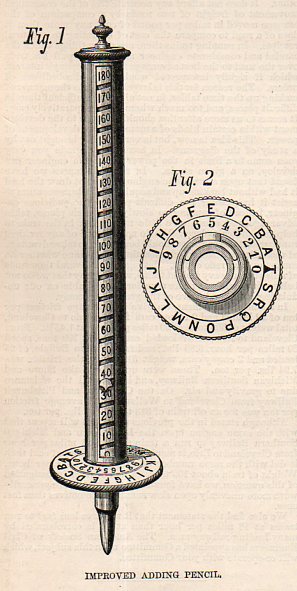
    This thinking stick comes to us via the courtesy of the Scientific American Supplement (19 August 1876, page 542), and shows a lovely Victorian non-SteamPunk answer to on-the-run calculation. It is an almost-elegant device, and seems as though it should work just fine. Its utility as a writing instrument seems a bit limited, as seems the calculator part, but the whole of it seems to be full of possibility–and a very nice piece of dedicated thinking. 

    Pencil052
    [Text describing the invention below.]

    Other nice examples of adding/writing found in the U.S. Patent Office via GooglePatents are seen below:


  • On Stability and Observation in the Earliest Microscopical Worlds

    JF Ptak Science Books  Post 1967  


    Follow Me on Pinterest

    Instrument seller Yarwell[Image source: Science Museum Group http://collectionsonline.nmsi.ac.uk/detail.php?type=related&kv=8015861&t=objects]

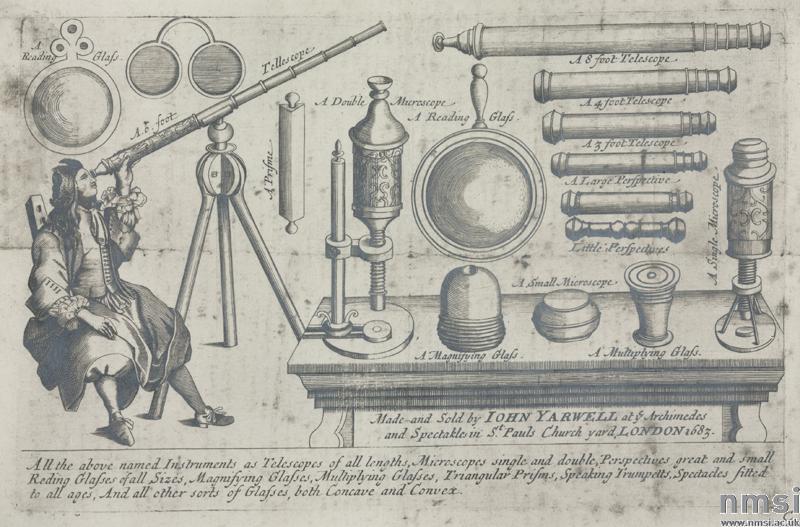
    Instrument seller Yarwell detailI was looking at this trade card for the optical instrumentalist John Yarwell (“Traded at Ye Archimedes & Spectacles in St. Paul’s Church Yard
    (1671-92), North Side of St. Paul’s (1672), St. Paul’s Churchyard
    (1676-96) & Archimedes in Ludgate St.(1697) & Archimedes &
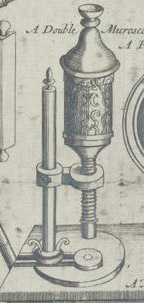
    Crown (1698-1712), all London, England”) and was struck by something a little bit “odd”. For as many times that I have seen early images of compound microscopes I don’t think I’ve ever looked at how the instrument was attached to its stand.  Now that I am seeing it, it is remarkable how efficient and careful the early users were. Basically, the microscope was attached bya hair to its stand–well, not really, but just about. 

    Yarwell features spectacles, looking glasses, microscopes and a variety of telescopes.  Here’s a detail of a compound microscope from the Yarwell image (left), and it is remarkable how potentially unstable the attachment makes the instrument. Just a slight bit of turmoil, or a bump near a table leg could upset the image. 

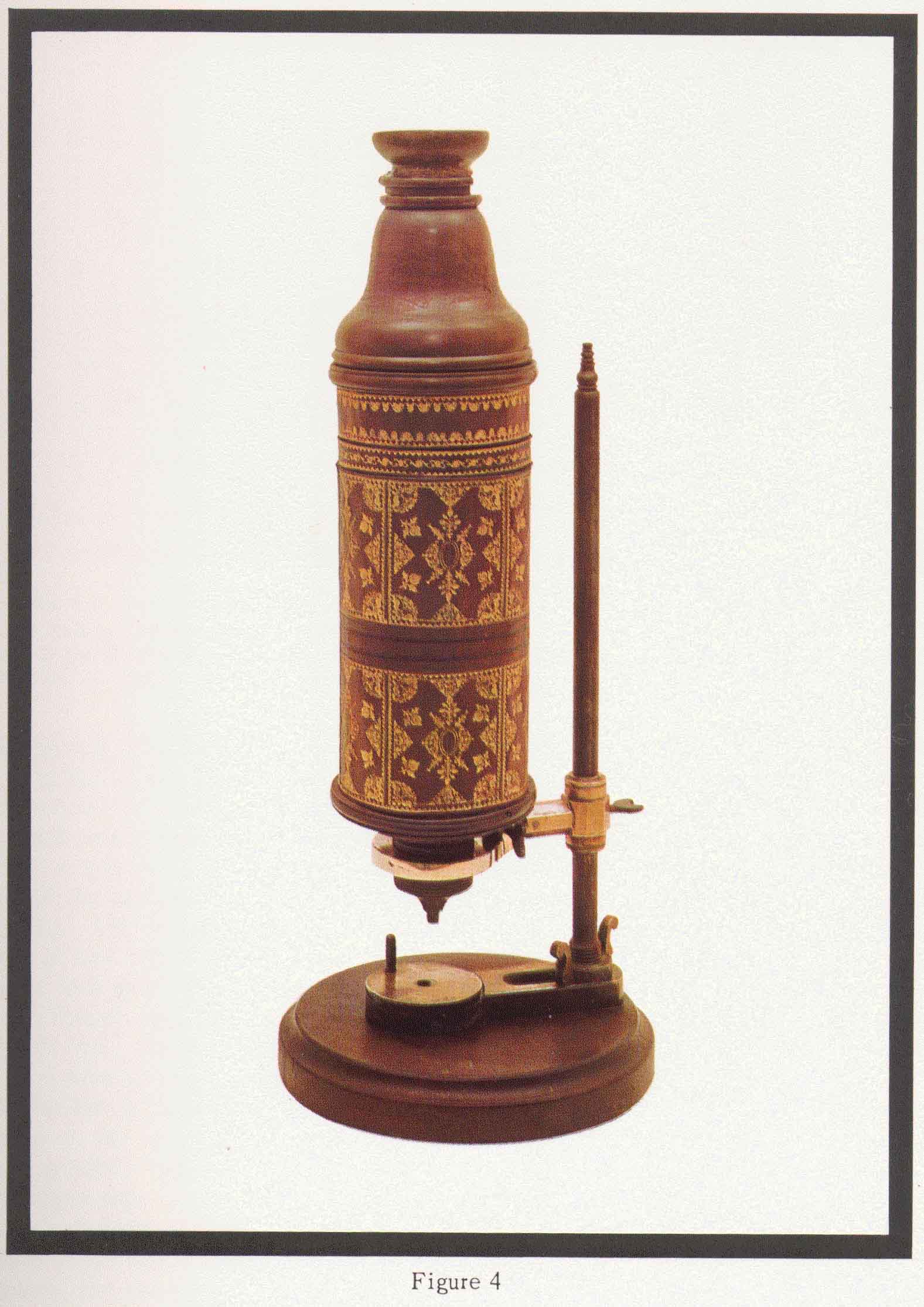
    Take for another example this very famous compound microscope made by Christopher Cock  for the great Robert Hooke (1635-1703):

    Hooke microscope

    [Image of the Hooke microscope via the Billings Collection at the National Museum of Health and Medicine, Armed Forces Institute of Pathology]

    This famous instrument was evidently the one with which Hooke first observed living cells (25 March 1663, nearly 350 years ago) and which he used for the first investigation and of cork and the naming of the “cell” (13 April 1663), and which was the basis for the images gathered for his masterpiece of investigation and exploration, the Micrographia (1665).

    It seems even less stable than the Yarwell instrument.  The astonishing thing about this fish-skin-covered instrument, this gateway to a completely undiscovered miniature world, is that so much of it depended upon such a little bit of engineering…it just seems as though taking the next little step could have been taken for a more basic base, a heavier mount, a more stout connection from stand-to-microscope, just to make the instrument more stable.  But it didn’t happen just then for Hooke, and it evidently didn’t matter.