A Daily History of Holes, Dots, Lines, Science, History, Math, Physics, Art, the Unintentional Absurd, Architecture, Maps, Data Visualization, Blank and Missing Things, and so on. |1.6 million words, 7500 images, 4.9 million hits| Press & appearances in The Times, Le Figaro, Mensa, The Economist, The Guardian, Discovery News, Slate, Le Monde, Sci American Blogs, Le Pont, and many other places… 5000+ total posts since 2008.

Category: Technology, History of

  • A Big Pile of Dirt

    JF Ptak Science Books   Quick Post   

    Follow Me on Pinterest


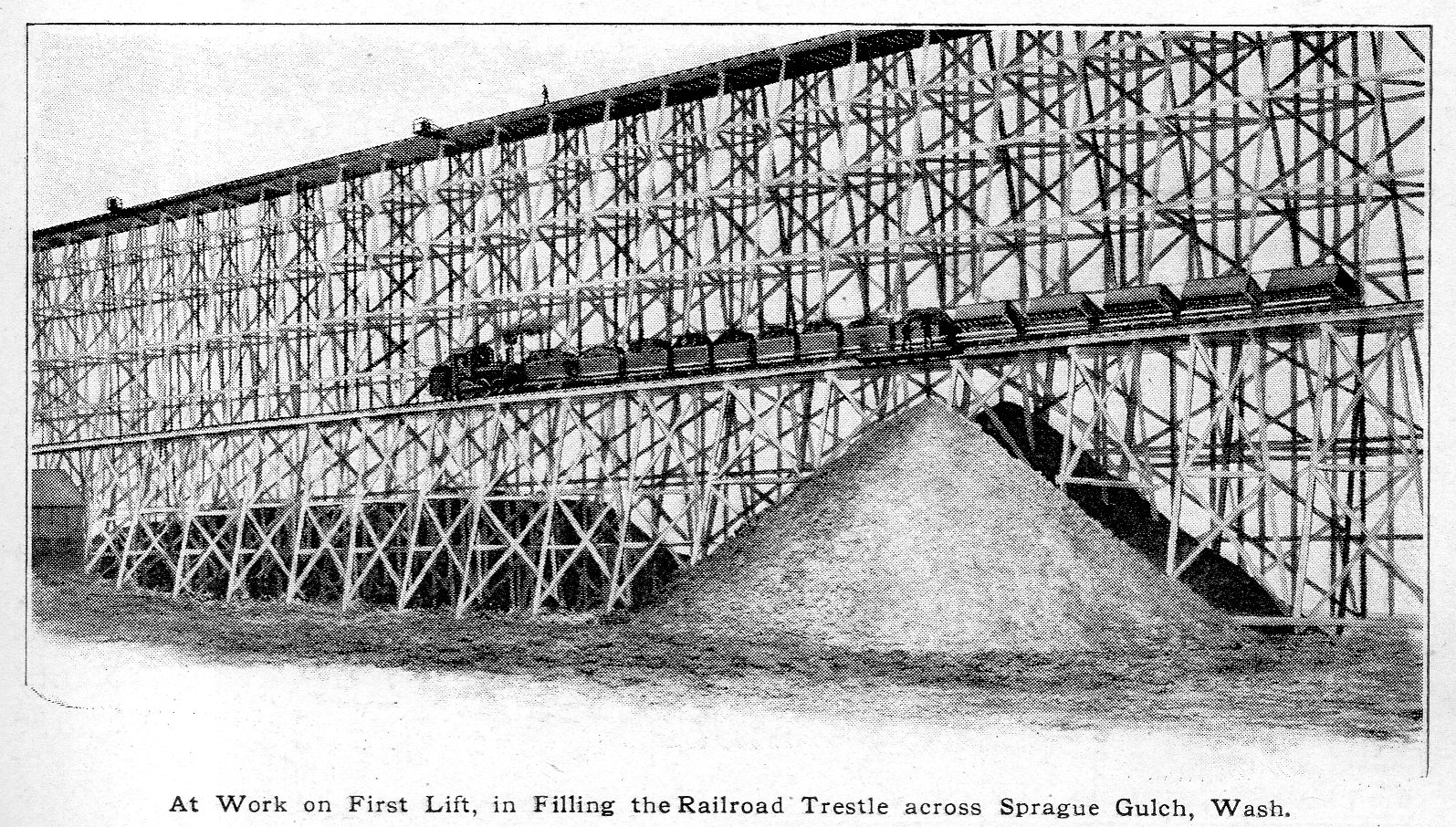
    “Exceptionally Large Trestle Fill” is the rather Engineeringly Prosaic header for this Popular Mechanics article from March 1912. The 4,869′ span was at Sprague Gulch, “near Lamont, Washington” for the Spokane, Portland & Seattle RR,  stood 101′ above the water (at its highest), and the idea was to backfill a foundation for stability–a project that was found to be cheaper than building a steel structure.

    Backfill338
    The trestle was built in 1907 and the backfill begun in 1911–a project that would ultimately move and deposit 2.35 million cubic yards of earth.  The process called for the construction of two temporary trestles at levels approaching the permanent track–the last bit of fill would take place from finished level.  This is just a beautiful project.   

    ·Posted by :

    ·in:


  • A Shining Singularity of 1896–the Glory of Lost Hardware Stores

    JF Ptak Science Books   Post 2032  

    Follow Me on Pinterest


    When I was a kid I liked to go to Reiman’s hardware store on Victory Blvd., Staten Island, New York, where there was everything and everything was in its place, though not every place was in its place.  There was a certain untidiness to the store that made it seem as though everything was a jumble, except it wasn’t.  The order was controlled by a collection of hardware men who seemed to know everything and absolutely knew where everything was.  I would walk in, go to the back, hold up the widget that I needed to the Old Man, and then he’d go to a half-wall filled with tiny boxes filled with tiny things, and find what I needed–or something better. The store was biggish, but very quiet, given all of the surface area of all of those thousands of tiny cardboard boxes.  It was all enveloped with the hardware store equivalent of the old bookstore aroma. 

    These were the thoughts that sprang to mind when I saw a post at the SecretPlans.org site displaying that robot-like figure riding the hardware bike. It is found in what must be the bible of 19th century books on the keeping of a hardware store, appropriately titled The American Hardware Store, written by R.R. Williams in 1896. It is remarkable for its organization and for its lovely presentation.  And of course for its very prominent  display of memory of what was necessary in building and maintenance from a hundred years ago.  There are instructions to the store owner on what and how to exhibit, with images of displays of axe heads, hurricane lamp glass,scythes, plumbs, hatchets, horseshoes, scale beams, belts, pumps, oil cloths, and much more of the stuff that is mostly gone.

    Thanks to this manual I think that when you go back in time and into that hardware store of 1896 you’ll be ready.


  • A First and a Fifth of Firsts, And So On, in the History of Cinematography

    JF Ptak Science Books  Post 2031

    The story of the history of the story of firsts, of the first time something was noticed or acknowledged or invented or composed, is a problematic one.  It isn’t so easy as it might seem to establish priorities–and once the major first of a particular field or interest is established, there may be a long line of minor firsts following the major one. 

    Meiles329
    This is definitely true in photography and cinematography–even the first photograph is an item for discussion depending on how you define “photograph”.  Absent this, there is a long line of other firsts that come into play–the first photograph of a human, the first portrait, the first night-time photograph, and so on, and the same sort of issue is applicable in the history of the cinema–and they fall into a long list of Wittgenstein/Tractatus1 enumeration. 

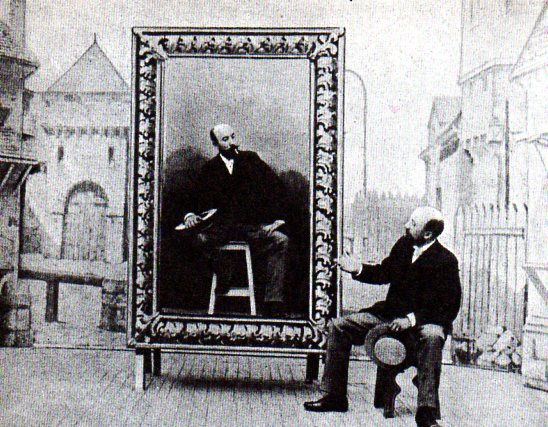
    The subject of this post is an interesting “first” in the history of the cinema is this very interesting still of (the great) Georges Melies (1861-1938), who in 1888 opened his cinema in the Theatre Robert Houdin.  He was extraordinary, and highly gifted, a man of vast creativity (see for example his early A Trip to the Moon, 1902, here) and energy.  And it was here that in the long line of his own firsts that he produced the first cinematic experience of an a person appearing in a moving picture with themselves.  There had been inventive photography that accomplished this minor miracle decades earlier, but this was indeed the first instance of this magic being worked in film. This must have been an enormous moment for the viewer, being able to see a person having a conversation with their duplicate–my guess is that it would have seemed other-worldy, brought to earth by (according to Louis Lumiere) a great cinematician. 


  • Circular Calculators: 19th Century Patent Diagrams

    JF Ptak Science Books   Quick Post 

    Follow Me on Pinterest


    ·Posted by :

    ·in:

    —

  • Daily Dose from Dr. Odd: Landing an Airplane by Backing Up

    JF Ptak Science Books  Quick Post   Daily Dose from Dr. Odd series


    Follow Me on Pinterest

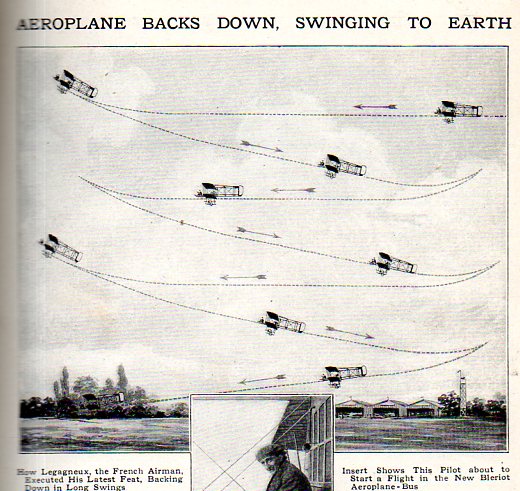
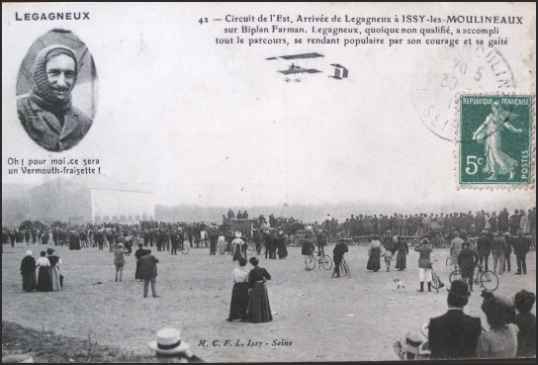
     There is no official “Well, I’ll be Damned Department” on this blog but if there was one this small discovery would certainly be an excellent candidate.  I don’t know enough about the aerodynamics of first-decade powered flight aircraft, but it seems as though this could be an alternative way of landing.  It seems not to be the desired way to bring in your plane, though, looking way more problematic than is necessary.  That said, I’ve never seen flight instructions like this before. 

    Aeroplane backup356
    [Source:  the ever-fascinating Popular Mechanics, February 1912, page 373.]

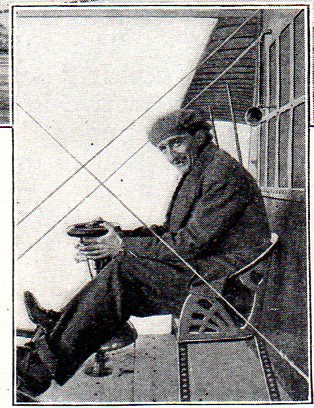
    Aeroplane backup357This is the pilot, Georges Legagneux (1882-1914), happily at the minimal controls.  Another image, courtesy of Early Aviators, of the pilot in action: 

    Aeroplane legagneux
    Legagneux would die pursuing his passion in 1912. 


  • ThinkPunk–Monster Engineering and Ships in Tunnels, on Bridges, and Along Rail Lines

    JF Ptak Science Books    Post 2041

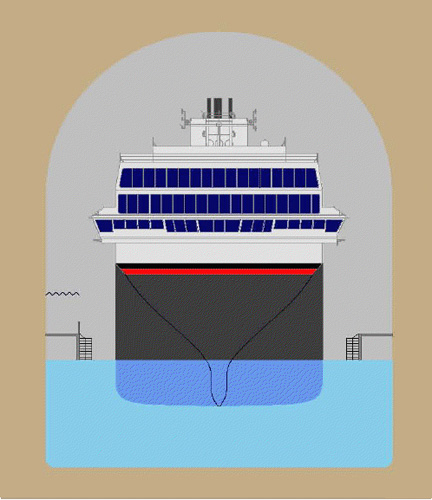
    Full and massive and creative engineering dreams are the stuff of rich possibilities and the created demands of the created future.  Sometimes they lead to the wonderful and essential, and sometimes they don’t–pieces of these ideas may go places and lead full lives, but the overall big picture may have been just a little (or a lot) too big.  The later may be the case for these ideas below–they include outlines for a trans-Atlantic ship tunnel (1927), the Cotherell/Eads 130-mile overland railway transport for transit across the Tehuantepec isthmus in Nicaragua, monumental masonry bridges supporting a car in which a battleship was driven, and others. 

    Ship tunnel

    [Cross-section of the Atlantic Tunnel, found in Luigi Motta, Il tunnel sottomarino, published in Milan in 1927, and found while reading in the magnificent Dictionary of Imaginary Places by Alberto Mangule and Gianni Gudalupi/]

    This is the story of a mostly-submarine adventure, due to the work of  a French engineer named Adrien Geant, who constructed a mostly-floating 4,700 km tunnel connecting Europe to America.  Problems ensue and the tunnel fails, the resulting adventure of the survivors taking them to Atlanteja, which was a lost city constructed by the survivors of the lost city of Atlantis.  Anyway, it is an interesting story of engineering, as the ideas behind the design of the tunnel were pretty good.  The book was written by Luigi Motta (1881-1955), a man of active mind who wrote over 100 adventure/sci-fi stories.


  • History of Lines: Lines of Sight

    JF Ptak Science Books   Quick Post   History of Lines 

    These are particularly fine and relatively early printed images depicting a specific kind of line of sight–this one, a positioning, rather than a line of sight in fire control, or radial velocity, EM radiation or acoustics wave propagation, or targeting…this instrument was used to establish an imaginary line in perceived objects. 

    Sextant 237This is a detail from Andrew Wakley’s  The mariner’s compass rectified : containing tables, shewing the true hour of the day, the sun being upon any point of the compass ; with the true time of the rising and setting of the sun and stars, and the points of the compass upon which they rise and set … With the description and use of those instruments most in use in the art of navigation. Also a table of the latitudes and longitudes of places, published in 1763 and reprinted many times after that. (Full text is available from Google books and also from the Haithi Trust which offers a text version of the book as well.)


  • Constellations of Bomb Craters and Trench Defense, 1917

    JF Ptak Science Books   Post 2028   Follow Me on Pinterest Series on the History of Holes  

    Also see: The Exploding Dots of Falling Dominoes: Dien Bien Phu, 1954


    Holes bomb313
    In the efficacies of categories for this blog I wonder about the placement of holes in the history of digging.  Most acts of digging results in making a hole, and some digging results in holes that are far longer or wider than they are deep, as in the case of trenches, and especially in the case of trenches dug during WWI, when many thousands of miles of them were dug and filled with millions and millions of men, perhaps as many as a million of them dying right there in the trench.

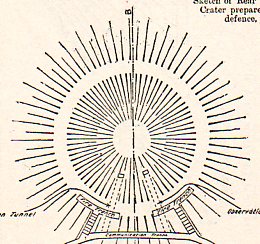
    Digging though is not a necessary condition for making a hole, or supporting a trench for that matter.  There were many millions of shells fired during WWI, and many of the craters produced by their explosions were converted  for use in conjunctions with trenches. 

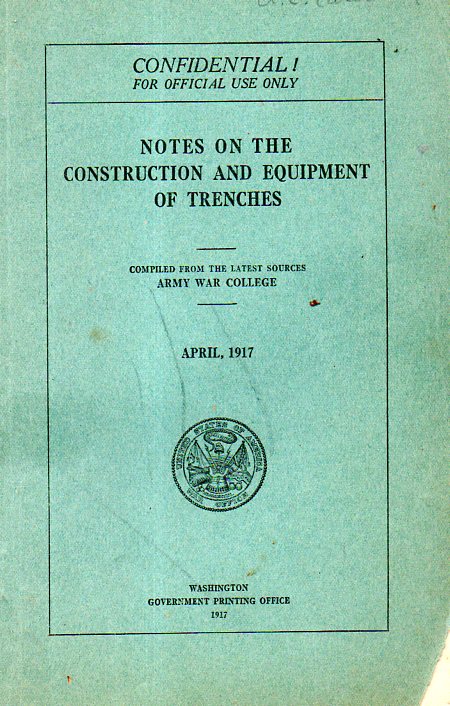
    Holes bomb314There is a lengthy section of the relatively short (104pp) book Notes on the Construction and Equipment of Trenches–published by the Army War College in April 1917– dedicated to the employment of bomb craters in trench warfare. (This was 2.5 years into a war that Woodrow Wilson and most Americans south to avoid–not only to not fight, but to not necessarily take sides, to stay neutral, and it lasted about 900 very bloody days.) And as it turns out, of course, there are many ways to use a big area of scooped-out/blown-away earth in a complex geometry of narrow and interconnected diggings.  The hole could be used as a hole filled with barbed wire as a front line of defense–and here we are told (reminded?) about the scope of the so-called “wiring entanglements”, which should be 20 yards out from the lip of a  crater which should also be 30′ deep (!), the bowl of the hole lined with 3′ high runs of barbed wire that should be irregularly posted . At the rear for anyone who thought of trying to make it through such a hellhole would be a machine or Lewis gun.  (The wooden posts should be strong–“light posts are useless”.) Great numbers of these craters would be used like star points in a complicated astrological sign of want and destruction, and this book would aid in the education of how to bring these changes about.  (Of particular interest is the advisory that entanglement construction should be undertaken in 40/50-yeard chunks, and that the installation of these defensive measures at the very front of a line “should take place at night”.  Ineed. 


  • SteamMegaPunk Flyer, 1868

    JF Ptak Science Books   Post 2025

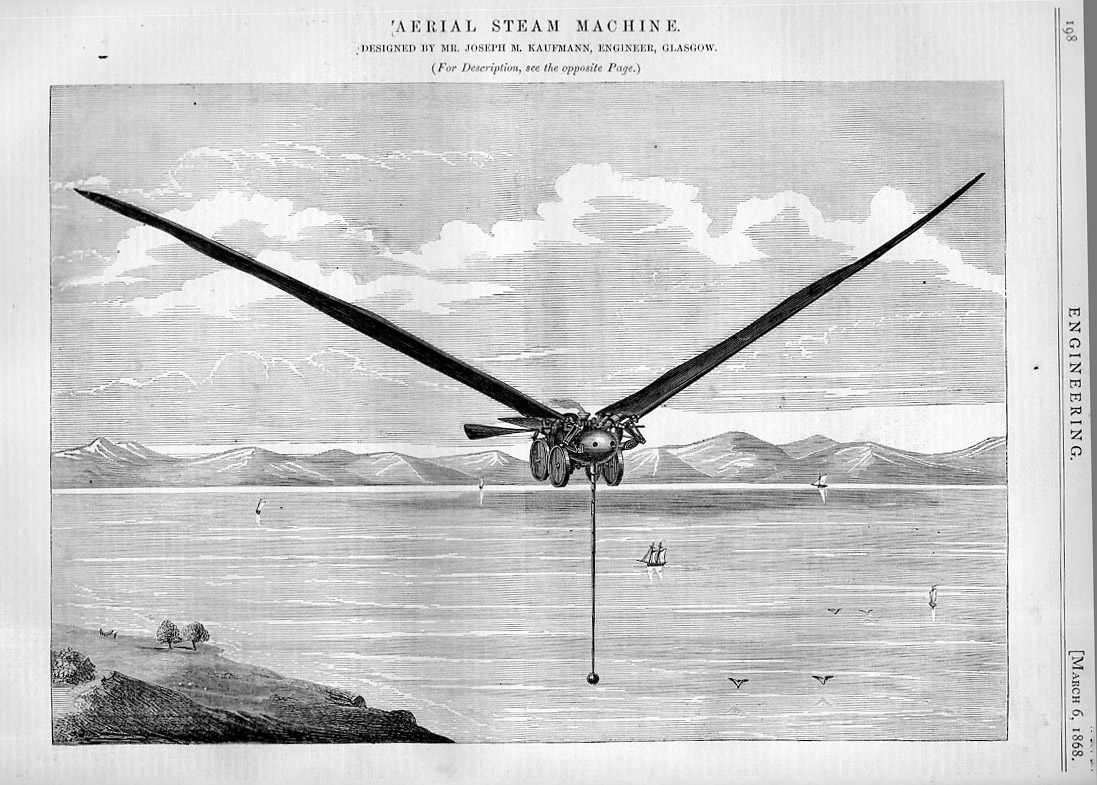
    This magnificent and mega-heavy beast-aeroplane (a “steam aeromotive machine”) appears in the pages of Engineering, and is the creation of Joseph M. Kaufmann of Glagow, and makes a splashy show of itself back there in 1868 when not-too-many airplanes were gracing the pages of technical journals.  But here it is, a very heavy dream of a Scottish engineer, a massive and underpowered vehicle of questionable design and imponderable consequence.  One thing is for sure–it certainly looks pretty.

     
    Aeroplane 1868300

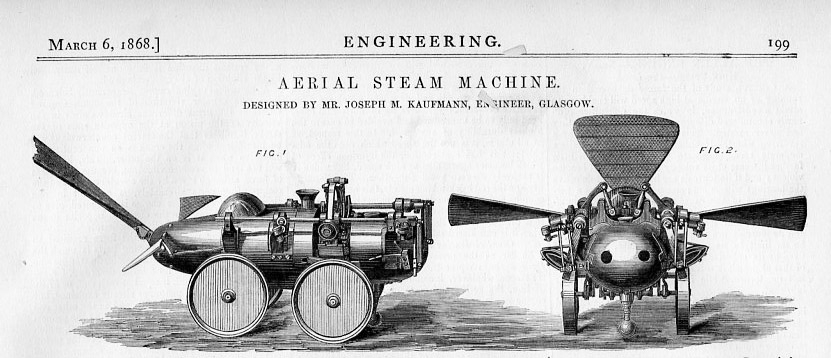
    The plan for the aircraft measured 12′ from stem to stern (plus another few feet including the tail), with the body about 5’x6′, and with wings that spread out 35′–each. The aircraft weighed in at an extraordinary 7,000 pounds and was supposed to be powered by a 40 horsepower steam engine that looked like a locomotive boiler that in theory would keep The Beast afloat at 40 mph for an extraordinary four hours. 

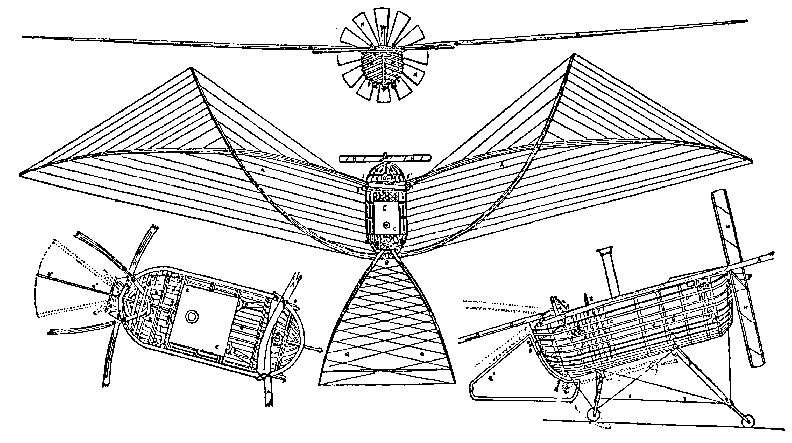
    As surprising as these images look from the modern perspective, perhaps the most unexpected aspect can be seen in the detail under the wing in the drawing on the right (below)–it seems that the motive power was that the wings “flapped”, like a bird’s.  This was asking a lot from those wings.  And that engine.

    Aeroplane 1868b301There was a lot of “flapping” going on in the experimental thinking for flight at this period, though many of these designs were human-powered ornithopters (like those of Bourcart in 1863, Trouve in 1870, and Wenham from 1858), and which in general didn’t last much past the 1870’s.  There was another class of proposed flying vehicle that adopted bird-wing qualities though the wings didn’t flap, like the Le Bris glider of 1868 and the beautiful and graceful patent of the Du Temple monoplane. These designs seemed to last much longer, perhaps most famously in the designs of Otto Lillienthal’s gliders of the 1890’s and the Vuia machine of 1906.

    Airplane du temple
    [The du Temple aeroplane, via Wright Brothers.org.]

    What the Kaufmann aircraft had that these others didn’t was its guiding principle of stability,  a 40-foot cable with an 85-pound weight on the end of it–a “pendule” of motion and stability.

    Aeroplane 1868b301_edited-1
    Mr. Kaufmann built a 42-pound model of the aircraft–things did not go well in the experimental firing, with the boiler failing right away, but not before the wings fell off.


  • TV’s Quest for Illuminated Poetry and a Dirac Non-Equation, 1946

    JF Ptak Science Books    Post 2024

    ‘I don’t see how you can work on physics and write poetry at the same time. In science, you want to say something nobody knew before, in words everyone can understand. In poetry, you are bound to say something that everybody knows already, in words that nobody can understand.’–Paul Dirac (1902-1984, Nobel Prize in Physics for 1933 with Erwin Schrödinger, “for the discovery of new productive forms of atomic theory”), quoted in The Book of Universes by John Barrow.
    Television abomb278

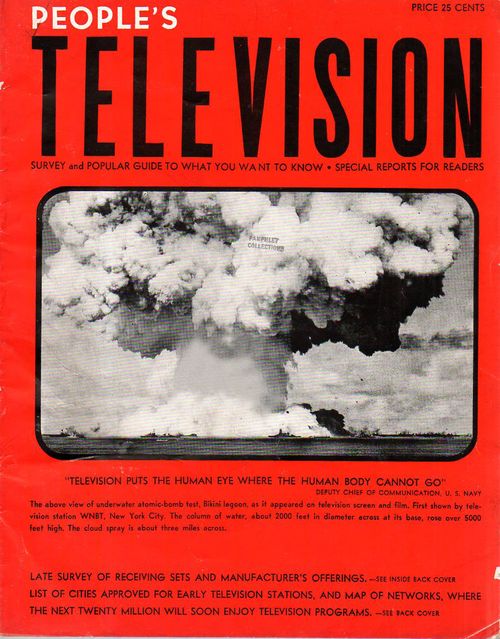
    The opening sentence of this pamphlet breathes a lead: “The story of Television, as well as the smashing of the atom, must be explained in a non-technical manner, now that World War II has ended, so that the public may know the facts…”

    I think that I would have preferred this quote to end a little sooner than it does–that way it might have been a little more poetical, a little on the absurd side:

    the story of Television as well

    asd smashing the atom

    must be explained

    in a non-technical manner,

    now that World War II has ended.

    This short pamphlet was produced in 1946, and at the time it was still possible to believe in the great possible poetry that the new medium could produce.  And it certainly did produce something, even in these early days, though I do not think it was poetry.  It did deliver some measure of truth and accountability, though.  It is difficult to imagine seeing the image of one of the earliest post-war atomic tests delivered to the DuMont Teleset in your living room.  I imagine that the societal reaction to seeing these events broadcast may have been like when photography was brought to bear in the news reporting business.  Harper’s Weekly started to run woodcuts of Civil War battles with the imprimatur “from a photograph” rather than something like “drawn at the scene by our correspondent”, readers were immeasurably more responsive to the drawing after a photography because of the undeniable archivitization that goes on when a photograph is made, as the memory of a photograph is for the most part unimpeachable.  This delivered an instantaneous increase in the belief in the reporting.

    It seems as though seeing events such as an atomic explosion from a cozy home encapsulation may have had the same effect. It was a democratization of truth in a way (the title being People’s Television) similar to that which you could experience seeing newsreels in the movie houses–there, everyone paid the same fee, sat where they wanted (for white people, anyway), and were exposed to the same images at the same time. 

    Its character leaned and leaped further away from reality and truth with each passing moment, finally reaching a point in the early part of national broadcasting where reality and entertainment and commercials all blended into one socio-molding opinion-grinding unit.

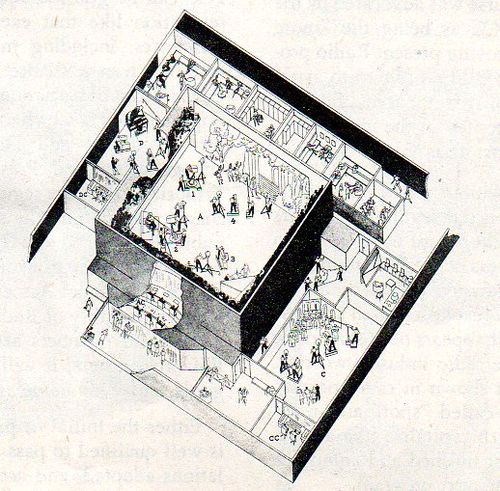
    The dreammaking units responsible for creating the bigness of artificial life were quite modest in 1946, as we can see in the pamphlet’s  wonderful plan of a television studio:


    Television abomb279

    With the description:

    Television abomb280

    The next seven years would toss this pamphlet into the Obsoleteinator; 13 years more would make it seem as though this pamphlet never needed to exist.  The poetry part certainly seems to have disappeared somewhere in these years–not completely and entirely to make poetry in television extinct, but certainly enough to make it an endangered sub-species. 

    ‘Imaginary universes are so much more beautiful than the stupidly constructed ‘real’ one’–G.H. Hardy