A Daily History of Holes, Dots, Lines, Science, History, Math, Physics, Art, the Unintentional Absurd, Architecture, Maps, Data Visualization, Blank and Missing Things, and so on. |1.6 million words, 7500 images, 4.9 million hits| Press & appearances in The Times, Le Figaro, Mensa, The Economist, The Guardian, Discovery News, Slate, Le Monde, Sci American Blogs, Le Pont, and many other places… 5000+ total posts since 2008.

Category: Technology, History of

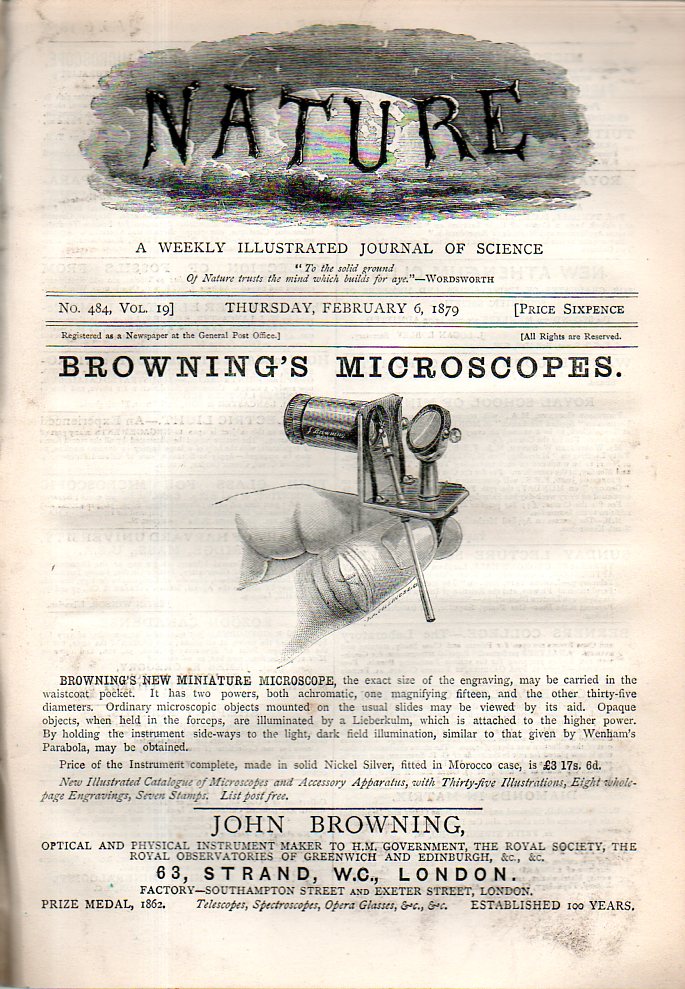
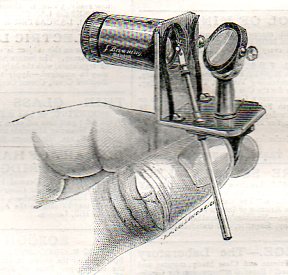
  • A Beautiful Thumb Microscope, 1879

    JF Ptak Science Books   Quick Post


    Microscope brownings468

    [Source: Nature, 6 February 1879]

    This is just so splendid, I had to stop and admire it, publicly.  The design of the front page of Nature is a lovely thing in itself, and the placement, and spacing, it all works so well together. But the big treat of course is the “Browning New Miniature Microscope”, which we are told is in 1:1 scale. It “may also be carried in the waistcoat pocket” if only I could remember where my waistcoat was.  The instrument was good for 15x and 35x, and came prepared with tiny foreceps to hold natural objects, but it was also of course built to accept miniature slides.  Just for the record, 19th century microscope slides are generally things of high beauty–miniature microscope slides from that time are quite simply the bee’s knees. 

    The Browning scope came complete, with fitted case, for three pounds. Nowadays the same instrument in lovely condition  might bring $3000–and worth it. 

    Microscope brownings467

    ·Posted by :

    ·in:


  • The Spine of Society and the Beginning of the Grid, 1878

    JF Ptak Science Books

    Robida

    I’m interested to know what anyone might know about the use of
    metaphors relating large-scale societal techno advances and biological
    functions?  I have no doubt that they go back to modern-ancient times
    (say to William Gilbert (1544-1603)  and his vis electrica)—but I’m
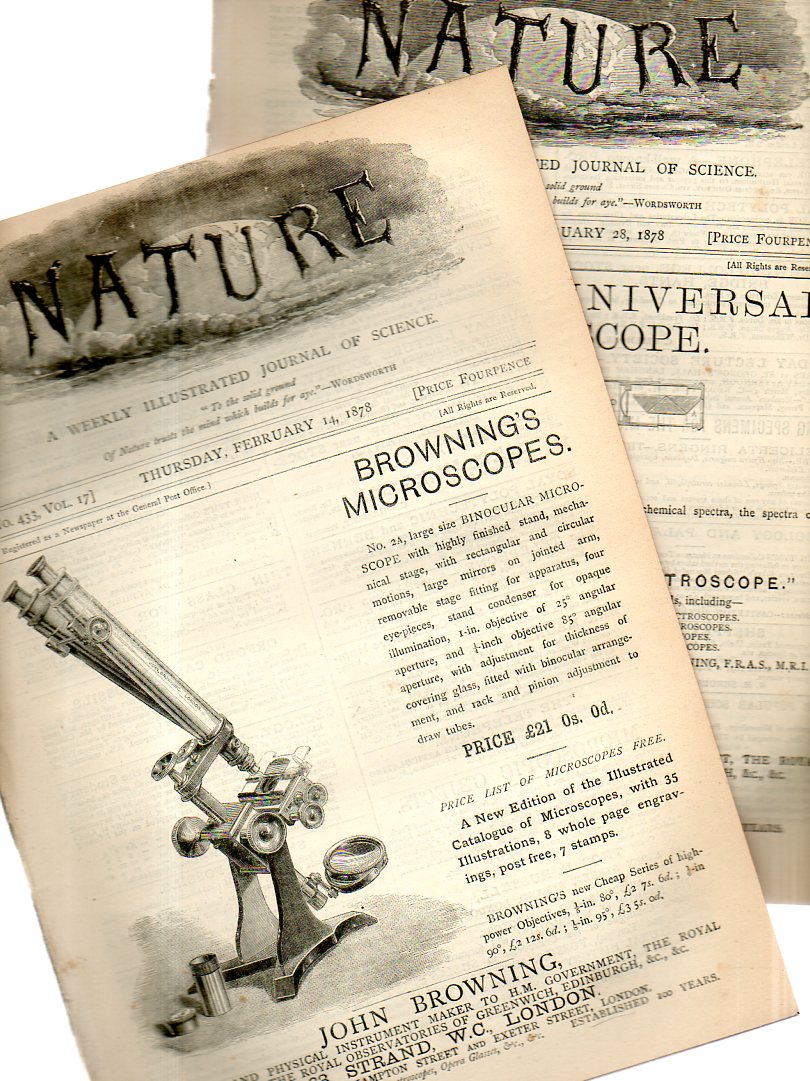
    stopped today by seeing this paper by J. Norman Lockyer called “Social
    Electrical Nerves” (in two issues of  Nature for 14 and 28 February
    1878).  In this paper the great astronomer looks at elements of the
    “grid” as it was and seeing how the new networks of police and fire
    communications via telegraph  interacts with the existing electrical
    systems.  It seems to me an early use of  nervous system/electrical
    grid, in spite of the fact the first “electrical highways” (as Lockyer
    puts it 120 years before our own “information superhighway”) appeared
    in England 32 years earlier though apparently without these biological
    metaphors. 

    • [This article,which appeared in two parts, is available for purchase via our blog bookstore, here.]

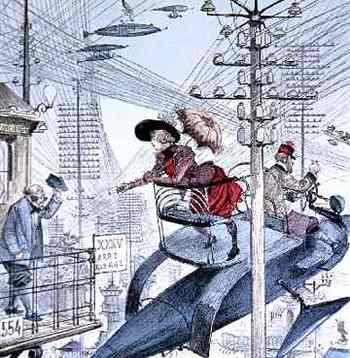
    Robidatelephone_lines
    The work pictured above is the electrically-draped world of the future,
    at least according to the vision of the wonderful Albert Robida, who
    was actually at work on these visions just at the time of the
    publication of the Lockyear paper . (Robida produced at least a trio of
    interesting and lovely and occasionally prescient works:  Le Vingtième
    Siècle
    (1883);  La Guerre au vingtième siècle (1887); and Le Vingtième
    siècle– La vie électrique
    (1890)).   Many of Robida’s visions of
    electrical connectivity seem to me to move beyond the nervous system
    metaphor and become a kind of societal “skin”—which is not terribly far
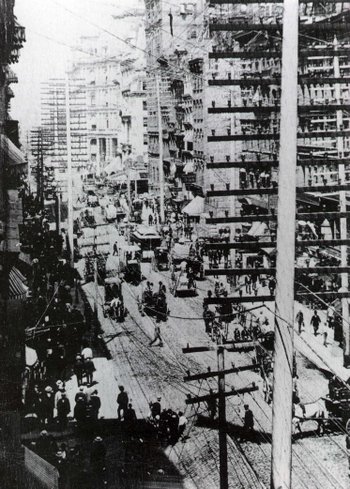
    from the truth, especially when looking at images of congested
    metropolitan centers ca. 1910, when utility poles fairly well sagged
    under 20 (!) horizontal crossbars carrying a dozen lines apiece.   At
    the very least, you knew that something or other was happening (fast
    forward to the massive ductworks of Terry Gilliam’s masterpiece,
    Brazil.) 

    Social electric616

    And now that the wireless age is starting to get ridges in its
    fingernails (the “wireless” age being at least 115 years old,
    beautifully borne by Heinrich Hertz and Marconi), are our bio-electrical  metaphors giving way?

    ·Posted by :

    ·in:


  • Motion Bones

    JF Ptak Science Books  Post 2077  

    Follow Me on Pinterest


    Dance comptes422

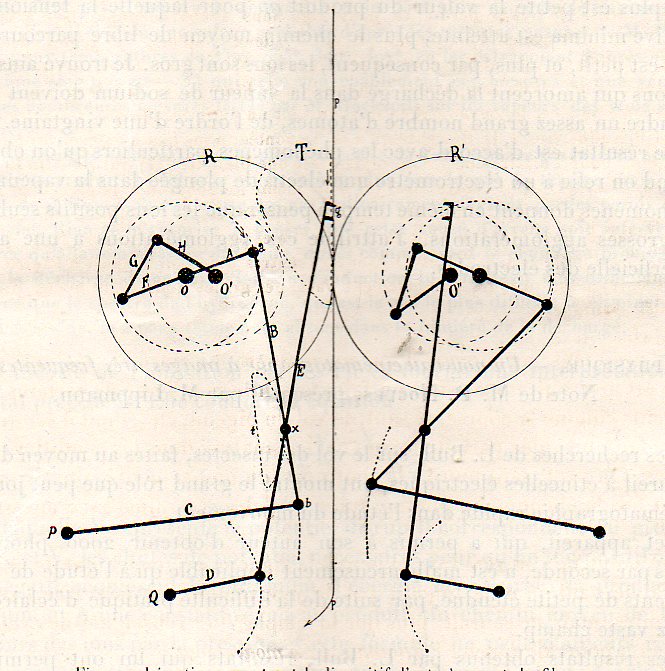
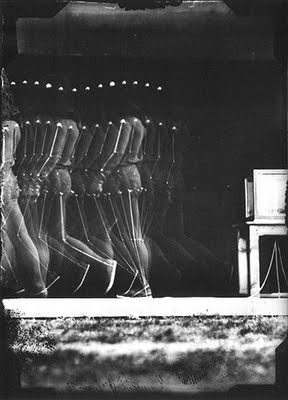
    While looking through an issue of the Comptes Rendus for the announcement of the funeral of the great mathematician and all-around genius Henri Poincare1, I found in the weekly issue (a fraction of an inch comprising the three-inch-thick half-yearly volume of papers published by the French Academy) this wonderful illustration.  It looks a bit like the superstructure to a Cubist dance, and bears a good strong attraction to many of the still images produced by Etienne Marey, maybe even a little like a mirrored representation of a stick figure skeleton of Duchamp’s Nude Descending, which interestingly was finished in this same year. 

    Marey-_Man_walking,_1890–91[Etienne Marey, ca. 1880/1]

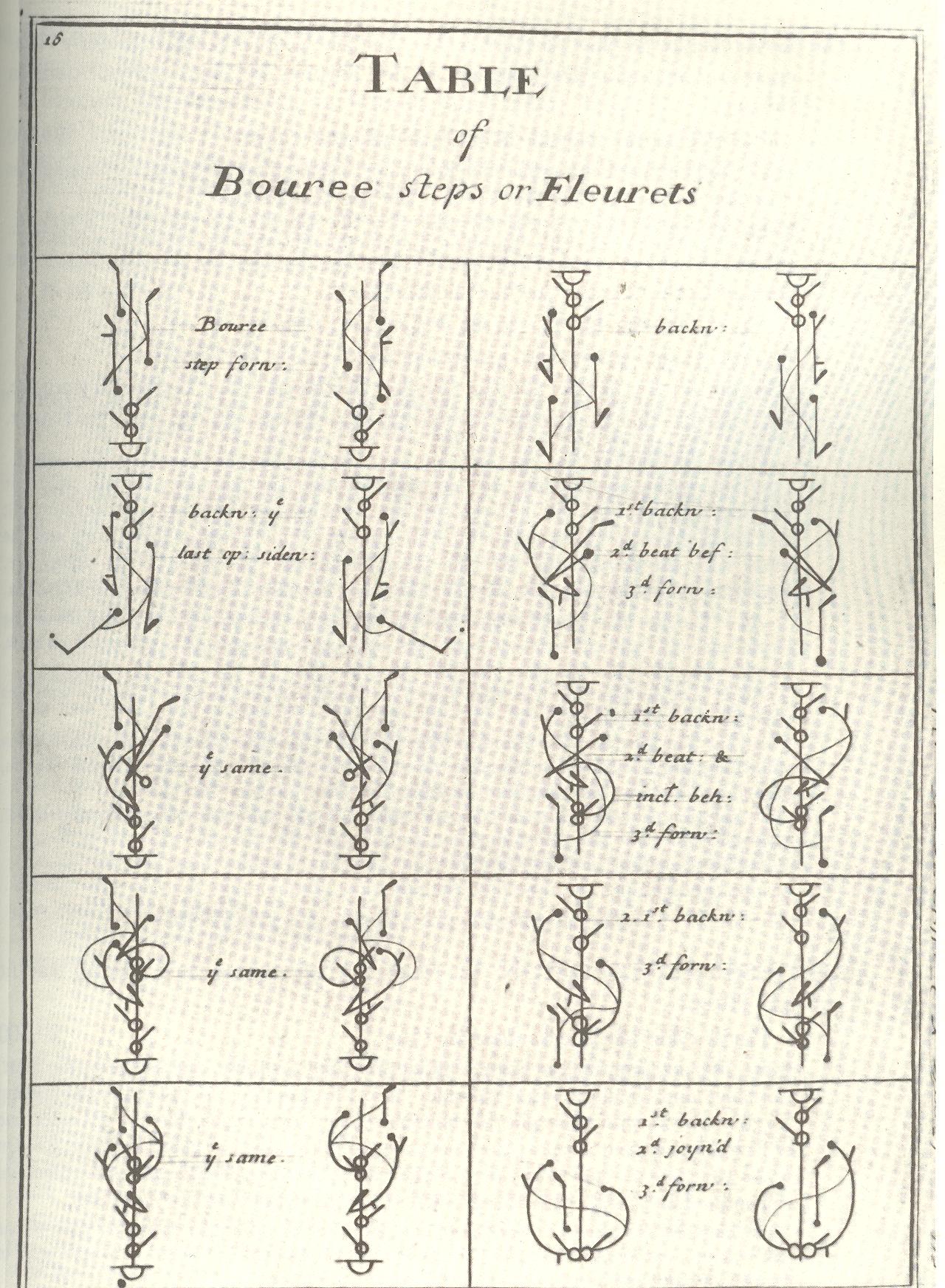
    There’s also a bit of early dance notation that the image reminds me of, particularly Raoul Feuillet’s publication of Pierre Beauchamp’s Orchesography4 ,
    a work published first in 1700  (and then in English in 1706) and
    dedicated to instructing people on the movements of the dance:

    Blog--apr 7 dance

    The image is an illustration for the article “Un nouveau cinematographie a images, tres frequentes”, by P(ierre) Nogues, and was a technical rendering of a device that ran film through a projector at a very high speed.  Nogues (1878-1971) was an assistant and collaborator to Etienne Marey, who was one of the earliest and perhaps the greatest figures in early cinematography and who–like Eadweard Muybridge–successful managed to create articulate optical machines that could capture and record minute and fast motion in people, animals, blood, and so on.  Nogues and his contemporaries lie Georges Demeny, Francois-Franck and Lucian Bull were among the founding encyclopedists of motion.  The drawing above was an outline for a sprocket device that feed flexible film through a camera at very high speed (ultimately reaching some 380 frames per second).  It is a beautiful thing. 

    [M. Duchamp, Nude Descending a Staircase, No. 2 (Nu descendant un escalier n° 2, 1912.  It is interesting to note in passing that this painting was supposedly rejected in the Salon des Indépendants show of 1912 and then caused a massive set-to in the NYC Armory Show of 1913. The infighting and family strife in the Salon in the 1900-1912 period is so big and complex it would make a fine if drippy daytime television romance drama.]

    Notes:

    1. Poincare died 17 July 1912, aged 58; the announcement of the funeral for one of the intellectual kings of the 19th century appeared on page 263 in this issue for 22 July 1912. 


  • Minimalist Steampunk Cathedral, 1872

    JF Ptak Science Books   Quick Post

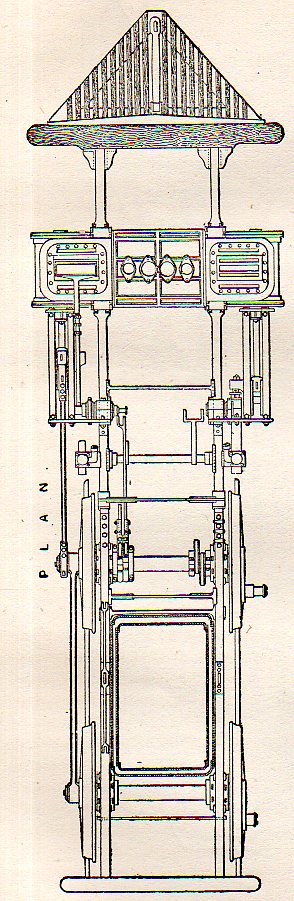
    There is an undeniable element of techno-elegance in design and engineering the Big Heavies the last third of so of the 19th century.  Sometimes the elements of holy technology comes int he form of a beautiful, nearly-overly designed chromatic steam whistle, constructed almost as a gesture to the inexorable march of metal intellect, an enriched piece of engineering as a topping to an even higher achievement.  Sometimes it is in the design of the superstructure for some major piece of machinery, as in the Nasmyth hammer, a device as big as a house and heavier, decorated around its perimeter with lovely flourishes.  And sometimes we are reminded of the search and discovery of the creative spirit in the reproduction of a schematic, presented in a slightly different way, to remind us of the fantastic belief in the developing technology of the Second Industrial Revolution.

    Locmotive plan420

    ·Posted by :

    ·in:


  • Massive Six-Person Tandem Airplane, 1910

    JF Ptak Science Books   Quick Post 
    Follow Me on Pinterest 

    Aeroplane for six416
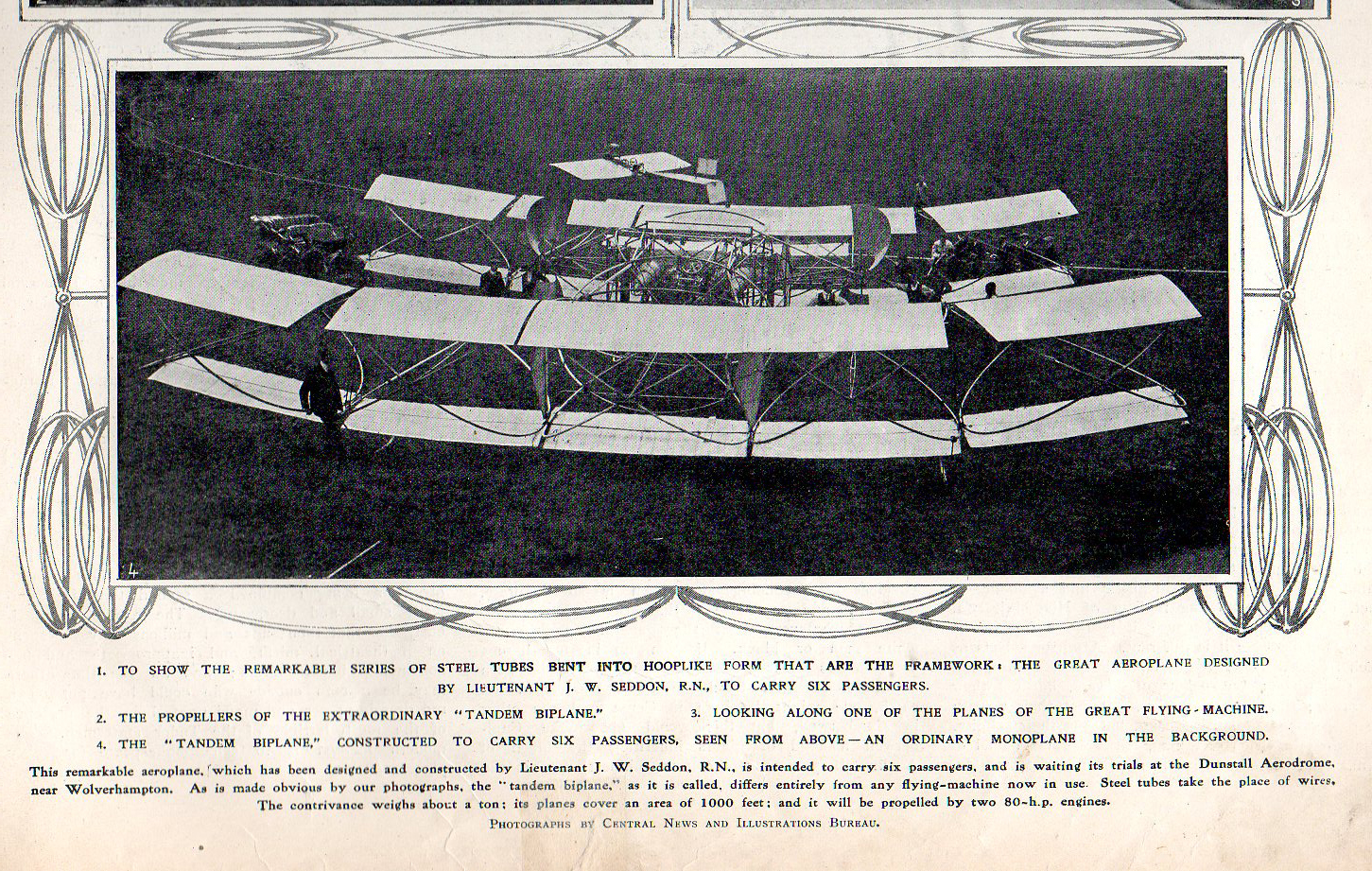
    Lt. J.W. Seddon (R.N.) designed this incredible two-aeroplane aeroplane in 1910, composed of molded steel tubes in the place of wires for its framework.  As the caption states, there wasn’t another plane like it in existence–it was massive for the time,weighed 2000 pounds, had 1000 sqft of wing, and was powered by two 80 hp engines.  And in a number of ways it was a picture of the future. [Source: The Illustrated London News, 10 September 1910.]


  • History of Holes: Holes in the Quickening of Telegraphy, 1859

    JF Ptak Science Books   Post 2075   History of Holes series  Follow Me on Pinterest


    While grazing through the 1859 volumes of the Comptes Rendus1, looking around for anything having anything to do with Mr. Darwin and his Big Book published later in this year (on 24 November), I got a little lost as usual, and was digging around the early months, and came upon the drawing above.  Mostly I was attracted to it for the holes, as there is a longish thread/series on this blog devoted to the History of Holes, and though at first blush that it might actually be a Runic something, or Islander counting stick.  When I actually started to read the article it was none other than the recording strip for telegraphy, devised by Charles Wheatstone (1802-1875), famous for his Wheatstone bridge and for his experimental determination of the speed of electricity2).  Now the recorder part of this was not on the receiving end, but rather on the sending–Wheatstone devised a way of recording the strokes of a telegrapher’s key and translating them into two rows of holes; the message was recorded on the strip of paper and then fed into a machine that would do the keywork, using the punched paper tape to control the transmitter–it turns out to have been a significantly faster method than by simply having messages struck by human operators, which was  abig deal at the time because of the expense of sending telegraphic messages, reaching speeds of 130 wpm early on (and then 300-400 wpm later on a good circuit)3. 


  • The History of Holes: Empty Holes in an Early “PC”

    JF Ptak Science Books   Post 2074   History of Holes series  Follow Me on Pinterest

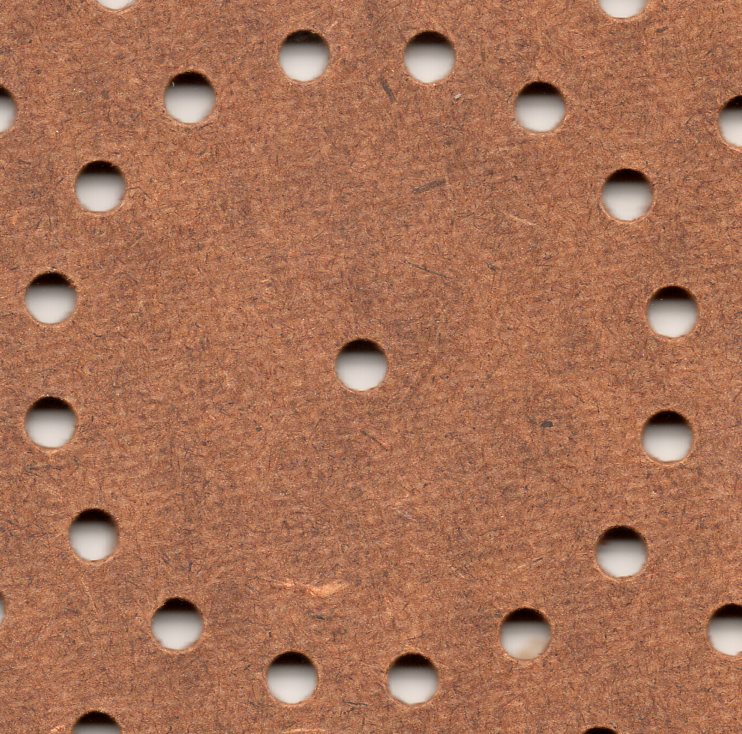
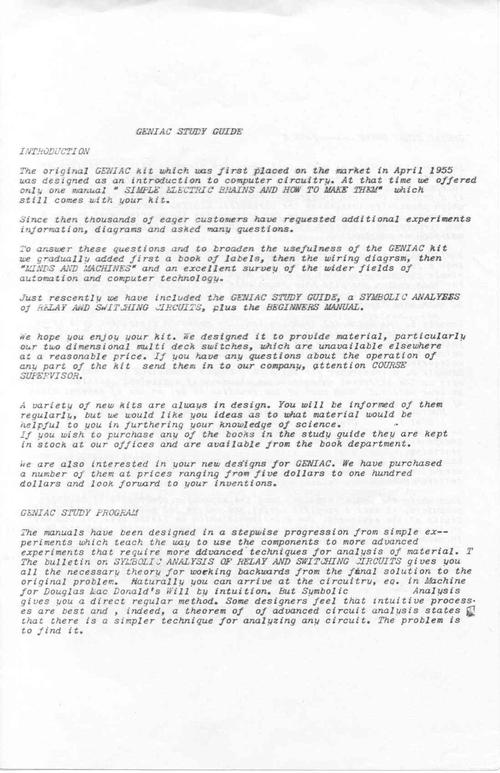
    These are some of the earliest holes in one of the very first personal computers–they were made for ease of wiring and other applications in the Geniac, a 1955 DYI kit from the indomitable Ed Berkeley, a machine well in advance but much of course the inferior of the Mark 8 (1974) and the Altair 8800 (1975), the later of the two seen as being about the very first modern “personal computer”. There weren’t too many empty holes in those two machines.
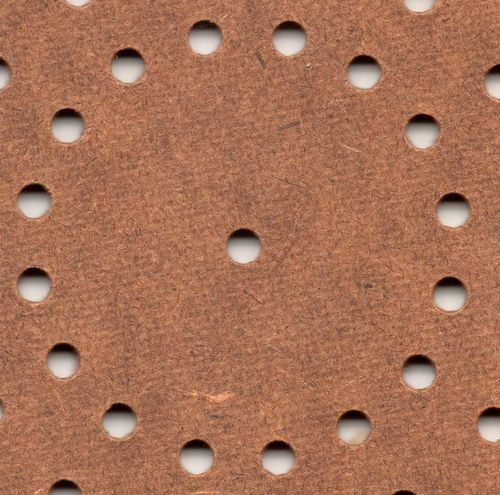

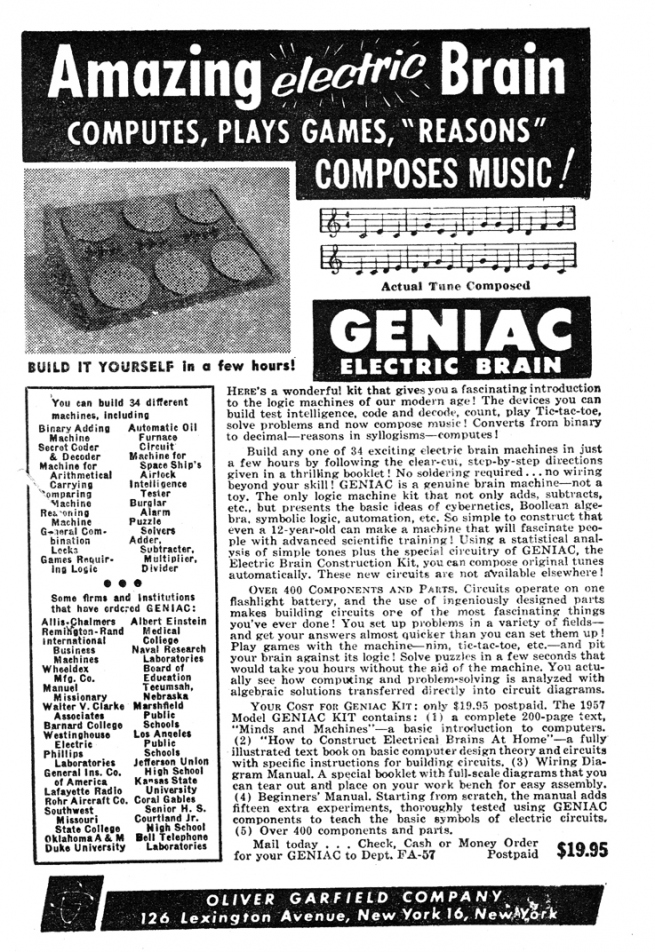
    Geniac415
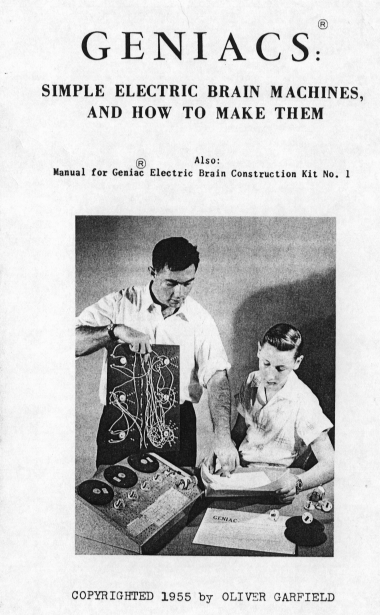
    What had no relays, or transistors, or tubes, and was manually self-sequencing and human bit state switching, the name ending in “-iac”, and made in 1955? The “Geniac”, made and manufactured by the smart and enterprising Edmund Berkeley and Oliver Garfield–the “Genius Almostt Automatic Computer”. It was I think the first in a line of early non-computer-computer-that-really-was-a-computer-according-to-Alan-Turing computers that a person could own and own at home, and it was followed pretty close on heals by the Tinyac, the Weenyac, and the Brainiac. 
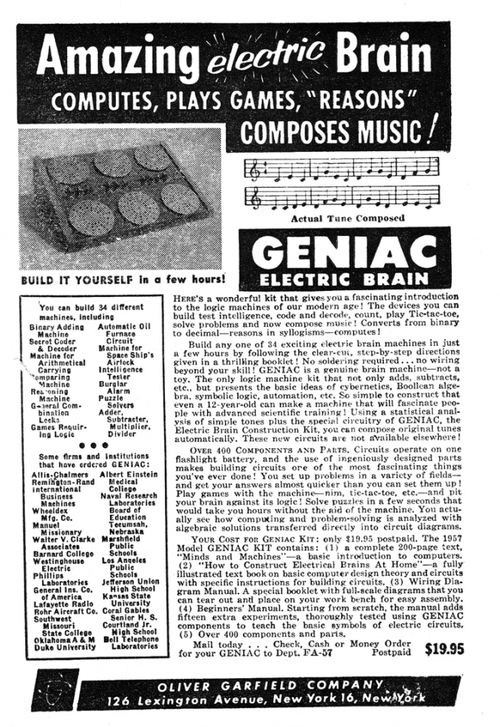
    Geniac[Source: Dr. Gangrene, here.]

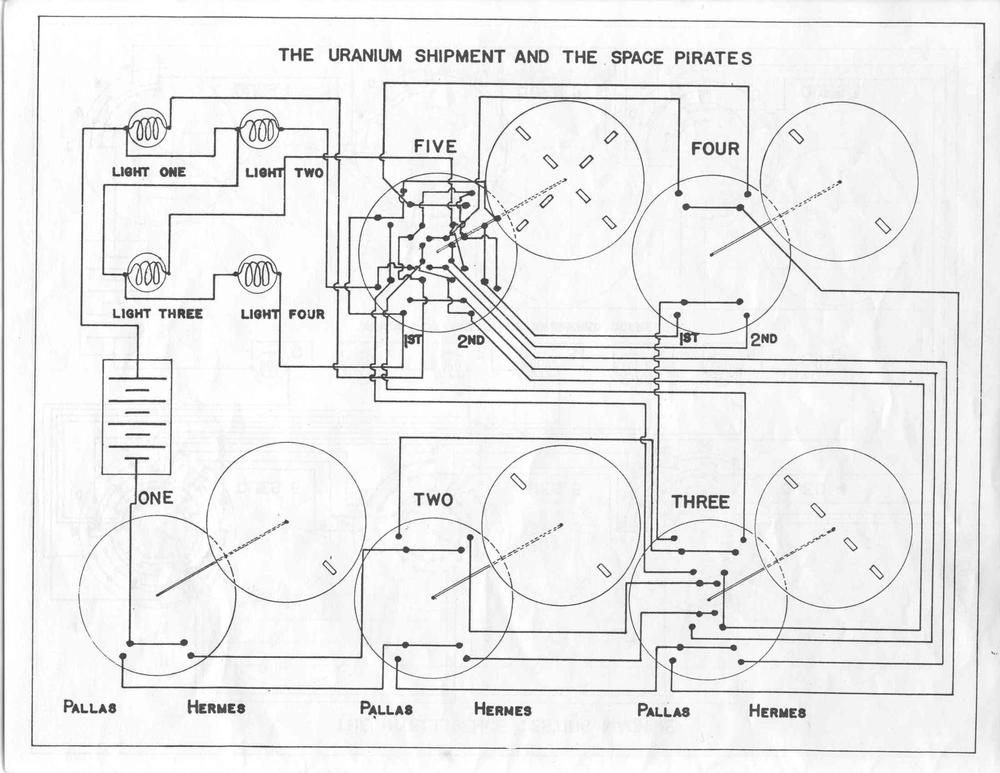
    The Geniac was/is a pretty neat tool–I hesitate to call it a “toy” as others have, mainly because it takes itself pretty seriously and still have fun, and includes diagrams and drawings for interesting sets of problems and tasks, from playing tic-tac-toe, to “testing” I.Q., to determining the male/female-ness of the respondent, to playing a very very mildly interactive game of uranium prospecting and alien hunting.  It was a fine construction, and  introduced the user to Boolean equations and the concepts of a working computer, all with hands-on education and a dry cell power course.  And that’s pretty good. 
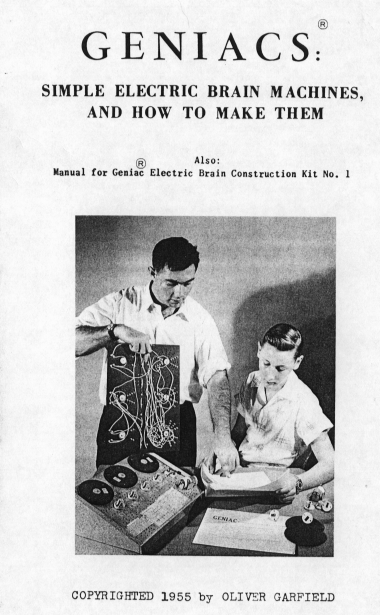
    Geniac cover[Source:  Blinkenlights, here.]

    Geniac Study Guide, via Computercollector.com (for the rest of the document):
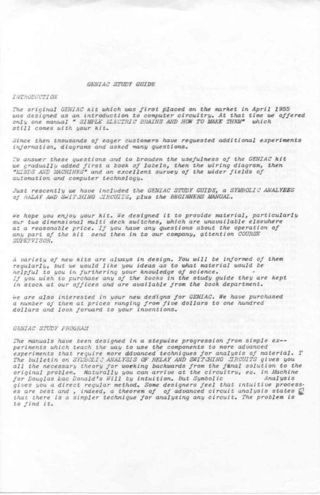
    GEniac study guide
    Wiring diagran for the Uranium Shipment and Space Pirate game, again, via the computercollector.com
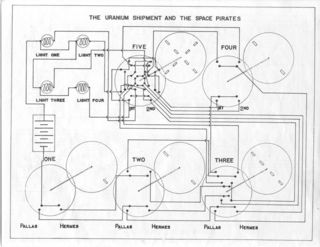
    Geniac  uranium
    See also the GENIAC entry at the Old Computer Museum, here.


  • Things That Almost Were but Weren’t: a Photographic Image (1839) and Radio Television (1928)

    JF Ptak Science Books  Post 2068

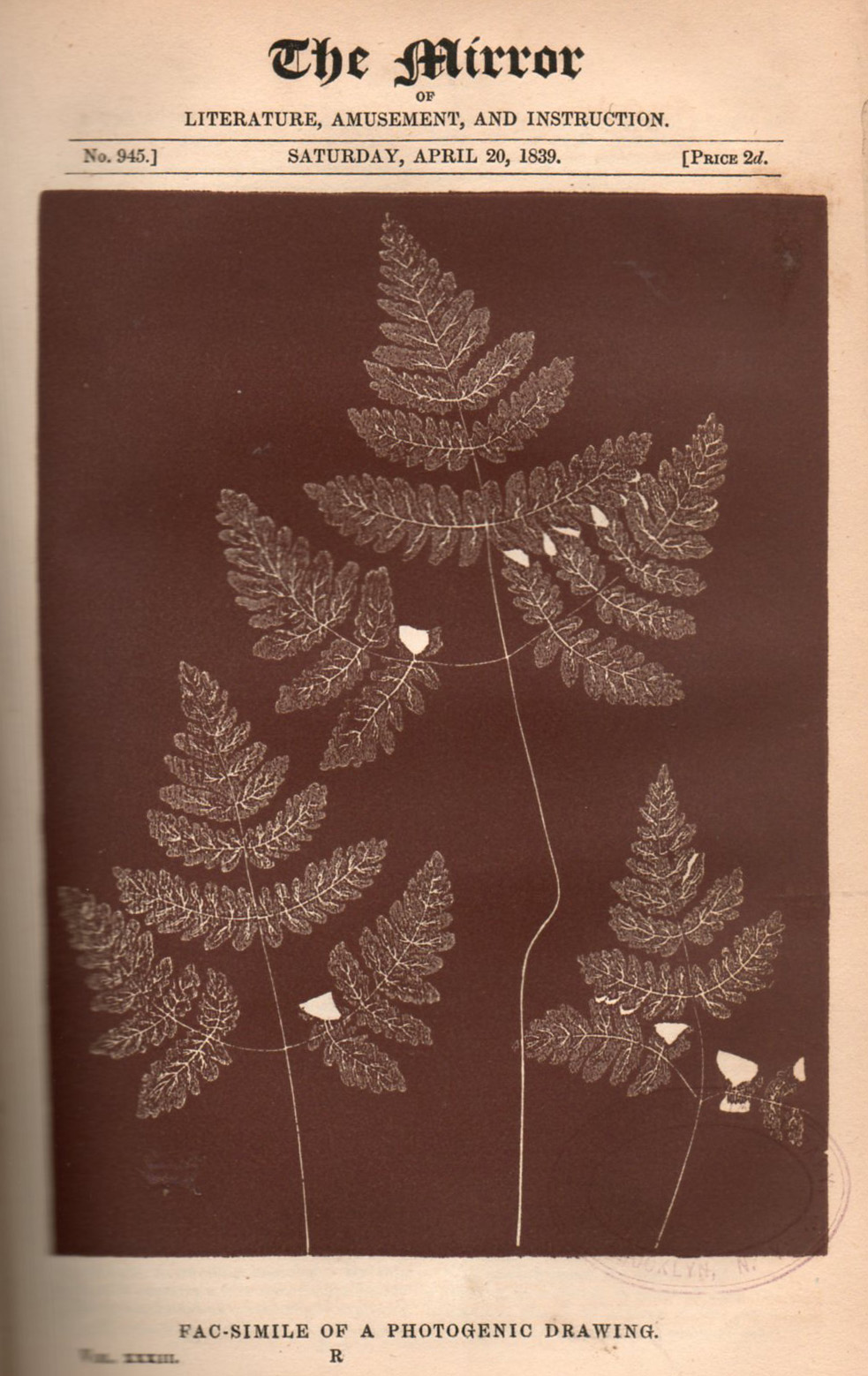
    Here are two examples of Things That Almost Were But Weren’t:  Photography (1839) and Television (1928). The first item contains a woodcut of a heliotype (being the first image of a photograph produced by non-photographic means); the second displays the method for receiving images of radio shows but is not a television. 

    First:  The first published non-photographic image of a non-photograph or “sunpicture”, 1839


    Bird photograph148


  • The Excellent Smokeless City

    JF Ptak Science Books   Quick Post  
     
    Follow Me on Pinterest


    This interesting image appeared in Electrical World in 1894, introducing the concept of the cleaner city, one that is run by electricity:

    December 8, 1894

    ·Posted by :

    ·in:


  • Recipes for the Laboratory by Thomas Taylor, 1865

    JF Ptak Science Books   Post 2053

    Recipes for the Laboratory
    by Thomas Taylor, 1865

    The following are some interesting examples of laboratory nostrums and general roundabout handiperson knowledge taken from Thomas Taylor’s Natural Philosophy (London, 1865).

    SILVERING LOOKING-GLASSES WITH
    QUICKSILVER

    Take a piece of marble or some other substance very smooth, true, and level,
    lay on this the glass you wish to silver, then make a ridge of putty on the
    marble against the edge of the glass all round it, so that you can pour
    quicksilver on the glass until it is all covered over, and will be prevented
    from running off by the ridge of putty; an inch or two, or three outside this
    ridge make another of putty; then cover the quicksilver on the glass all over
    with tin-foil, and press it firmly but cautiously against the glass until you
    have squeezed out all the quicksilver you can. while you press this you may
    remove part of the first ridge of putty to give the quicksilver a chance of
    escape. When it is well pressed against the glass there will be an amalgam
    formed of the tin-foil and the quicksilver that is left, which will firmly
    adhere to the glass. By this means you have a very beautiful and cheap
    looking-glass; the quicksilver that escapes, being saved by the second ridge of
    putty, may be used again.

    ·Posted by :

    ·in: