A Daily History of Holes, Dots, Lines, Science, History, Math, Physics, Art, the Unintentional Absurd, Architecture, Maps, Data Visualization, Blank and Missing Things, and so on. |1.6 million words, 7500 images, 4.9 million hits| Press & appearances in The Times, Le Figaro, Mensa, The Economist, The Guardian, Discovery News, Slate, Le Monde, Sci American Blogs, Le Pont, and many other places… 5000+ total posts since 2008.

Category: Technology, History of

  • Big Science 1886–Moving Big Stuff

    JF Ptak Science Books   Revisiting/expanding an earlier post from 2009
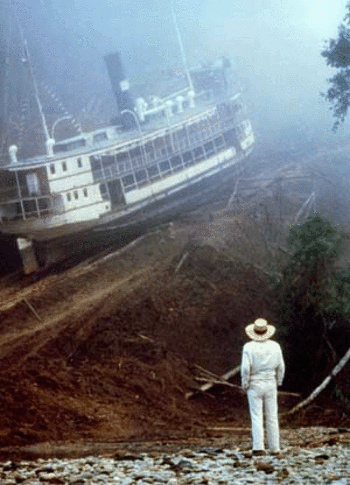
    Blogbig_sciencefitz In 1982 Werner Herzog, in what may have been a weirdly fashioned and irresistible death-wish effort, released a very difficult film that he wrote and directed:  Fitzcarraldo.  It is a spill-over-big, magnificent film about a would-be ice-making rubber baron bringing an opera house into the trans-Andes, trying to make his way into the dense forest in a huge rear-paddle steamboat on the Amazon to stake a claim in exploiting leased lands filled with rubber trees  The problem faced by Fitzcarraldo (played by the probably-insane Klaus Kinski–just see Herzog’s 1972 Agiurre, Wrath of God and you’ll know what I mean) is that his path is blocked by unnavigable rapids–he can however reach his destination by hauling his very large ship up and over a mountain to get to a more pliant river and then to his goal.  Herzog actually does this for the film–no digital anything here–in what is one of the most glorious things I’ve even seen in the movies.  He really does have native people clear a path up and over a mountain, and they DO haul this ship up and over.  It really, truly, is magnificent. 

    The story is partially based upon the adventure of Carlos Fermín Fitzcarrald, who in 1890 attempted a similar feat, though with a much smaller vessel, and who also dismantled the craft (?!) to haul it overland.

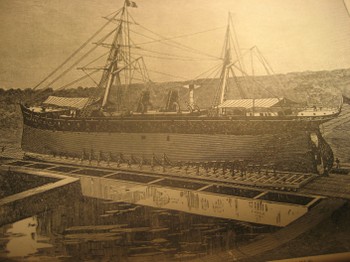
    Blogbig_sciencefitzcarraldo    The bigger and deeper back-story though is the effort–mainly by Elmer Cotherell and James Eads–to build a combination railroad ship canal across the Tehuantepec isthmus in Nicaragua.  The idea of moving across central America rather than taking the enormously long route around the tip of South America and up again is hundreds of years old.  The Cotherell/Eads plan, begun in 1870’s and alive in the early ’80’s, was really the first feasible (and workable) initiative.
    Blog_big_large_ship
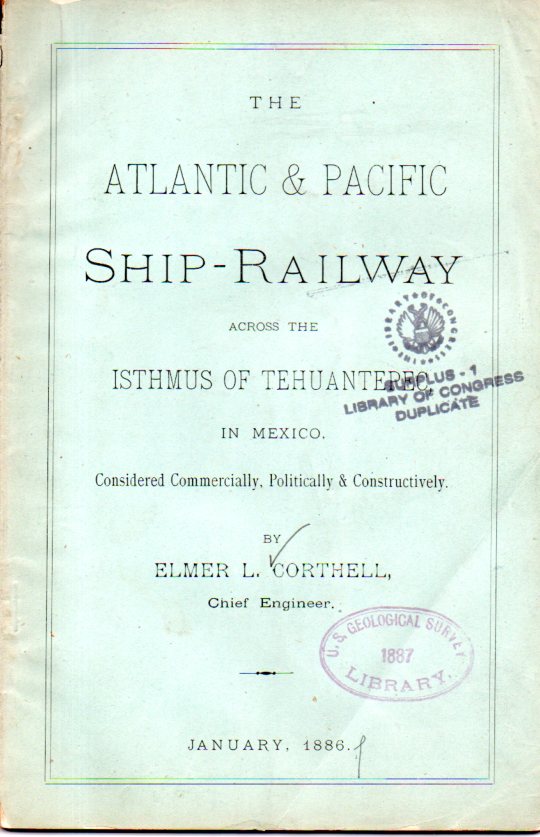
    It would have been a gigantic undertaking, and even though it was much longer (130 miles or so)  than the more-favored Panama location for the canal, it seemed more workable as there would be less digging and no need for a lock/canal system as required at Panama. The plan was outlined in the pamphlet below, and printed in 1886.  (This pamphlet is available for purchase at our blog bookstore.)
    Corthell161

    The French began a doomed attempt at conquering Panama shortly before this.  Ferdinand de Lesseps tried to build a canal in 1880, but the organization and general construction plan was truly inferior; also, the sanitary and medical conditions were irreproachable, with the French losing perhaps 22 thousand men in the failed process to disease (mainly malaria).  (The United States would lose 5,609 workers while building the Panama canal, on land granted as a payback for “helping” Panama release themselves from Columbia.)
    Blog_big_closeup
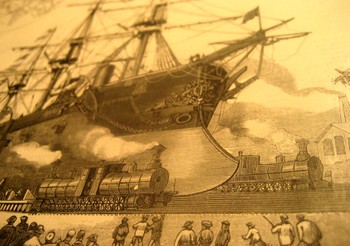
    The Cotherell/Eads (who by the way was a master builder perhaps best known for his inspired masterpiece of a bridge at St. Louis) plan called for hauling the ships up and out of the water in a short canal and placing them on an enormous floating roundabout; the roundabout would then be raised, and the ship place on huge cradles borne upon vastly augmented railway lines.  Once on the cradle, the ship would be pulled and pushed by a team of four large locomotive teams which were in turn composed of two large engines.  Happily aboard, the ship would then be taken on the extended, expanded wide and augmented rail 130 miles overland and dumped into the Pacific.

    It was evidently not a workable deal all the way around, though, as the U.S. decided on the new Panama to works its engineering miracle
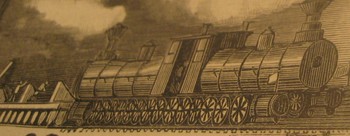
    Blog_big_big_closeup .There is something pleasing though about the Ship Railway, though, something that appeals to the little bit of Mr. Herzog in me.  Perhaps it was the appraisal of the very stiff-lipped Sir Edward Reed–who was the former master engineer for the British navy and consultant to Eads—that makes it all so irresistible.  “It would be best to avoid a very high rate of speed” when hauling the massive ocean-going and heavily laden cargo ships.  Indeed.

  • A Massive and Curious Moving Walkway, Manhattan-to-Brooklyn,1903

    JF Ptak Science Books      Post 2188

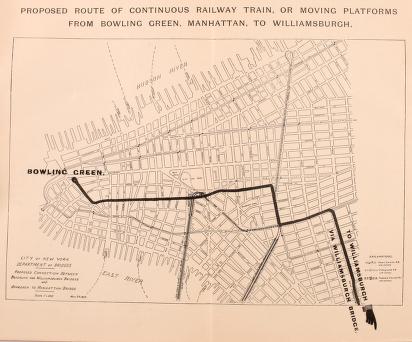
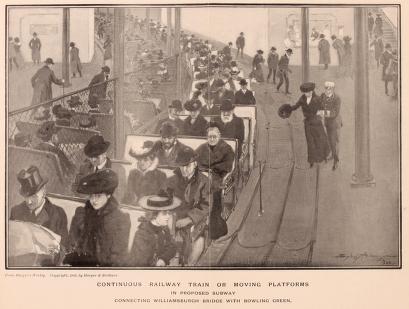
    I was looking through a batch of unusual history of technology material when I came upon an interesting idea in city planning by the Schmidt & Gallatin firm.  The long title (Tranportation of Passengers in Greater New York by Continuous Railway Train, or Moving Platforms.  Argument in favor of equipping the East River Bridges, and connecting subway to Bowling Green, Manhattan, with a continuous railway train or Moving Platforms) pretty much tells the story. This interesting and perhaps 1903-useful idea featured a system of moving sidewalks that allowed for sitting (for longer rides) and standing (for just a quick hop).  The “platform” would move slowly enough to allow it to run continuously and fast enough to make it useful in geting people to their destinations a little faster, or at least get there without working up an Edwardian sweat.   And it was being designed to get folks from Bowling Green at nearly the tip of Manhattan across the river and into Williamsburg in Brooklyn. [This pamphlet is available for actual purchase via our blog bookstore, here, under “city planning”.] 

    That is a lot of continuously-moving surface area: a napkin estimate may be something like 25 acres of sidewalk/salon on-the-go.  Unforntuantely the pamphlet doesn’t have too much to say about powering this beast.  

    This is one version of the moving platform, which didn’t leave much room for standing:

    Sidewalks 3

    From the pamphlet:

    “Moving Platforms for the conveyance of passengers were recommended by Mr. Horace Greeley thirty years ago. They were successfully operated, first, at the World’s Columbian Exposition of 1893, where 2,700,000 people were transported. In 1896 they were installed at the Berlin Exposition, and again at the Paris Exposition of 1900, where they carried over eight million passengers. Few persons know what Moving Platforms are. From the face that sometimes they are called ” Moving Side- walks,” it is believed that they must be some sort of a pavement on rollers, on which it is difficult to step with safety and maintain equilibrium. The Moving Platforms are to all intents a railway, operated like other railways, propelled by electricity, with cars, seats, motors, passenger stations, ticket booths, guards, electric lights — in fact, everything belonging to a first-class railway.” 

    Sidewalks map

    “Where it differs from the ordinary railway is that the cars, or trains, are not running at intervals, but are coupled up continuously, so that there is no interruption of traffic at any time, but a large seating capacity at all times. It differs also in the construction of the cars, which are mere flat cars, provided with seats placed crosswise, and so ar- ranged that all rmssengers face in the direction of motion. Each of these seats may be made wide enough to accommodate one, two or more persons. The most approved plan is to provide seats on one side of the cars only and leave the other for passengers to walk, thus giving them an opportunity to further accelerate their speed if they so desire…”

    It is an interesting idea for the time, but has its own share of problems. In some ways it was basically a slow elevated trains using just the car beds: a slower, cheaper, untunneled subway.  

    ·Posted by :

    ·in:


  • On the Possible Delusion of the Inhumanity of Poison Gas, 1921

    JF Ptak Science Books   Post 2171

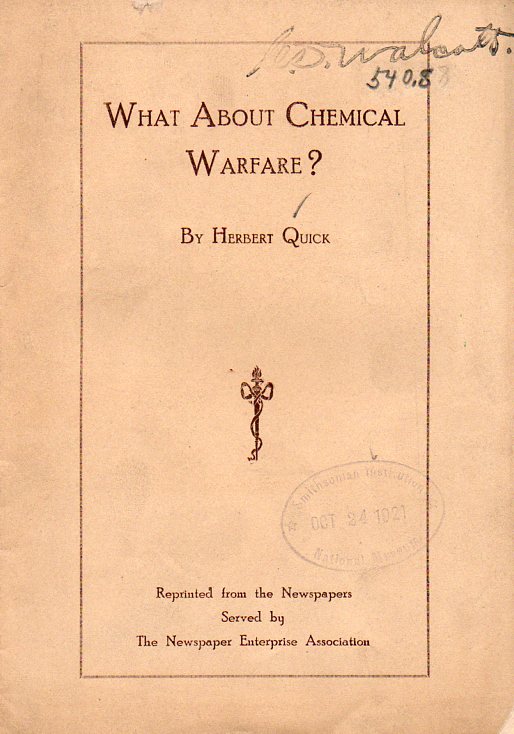
    Herbert Quick did a fair amount of thinking about the military use of poison gas, and it winds up, in the final analysis, thinking that it was tolerable.  What About Chemical Warfare? (published by the Newspaper Enterprises Association in 1921) is certainly a possible title for a Duck-and-Cover A-Bomb or You and Your Hormones kind of film.   But Mr. Quick took the slow boat around his issue, thinking about it a little long and out loud, before coming to his final conclusion in the chapter titled “Gas Warfare Cheapest and Most Effective Arm of Defense”.

    Air raid885

    He points out the enormous impact in the war effort that relatively small chemical corps played in WWI–something on the order of hundreths of one percent of all serving soldiers were employed in the combined chemical corps, saying “how small a body to produce such great results!” Which is true, assuming that by “great” he meant ‘widespread’, though it is unclear exactly what he was talking about.

    Nr. Quick does make a case for poison gas being not so inhuman as presented by most civilized people, pointing out both its high quick-death rate and survivability/recovery rates, which seems to be giving/taking at the same time. No matter:  “But woe to the army or nation that does not keep up with the times.  The Angel of Death will breathe in their faces” he writes. 

    The author also warns that though Germany was “stripped” of her war-making capacities, he thought it was not so of the industries necessary to produce poison gas. He points out that Germany can produce these munitions in secret, and that if any “militaristic nation conquers the world in the future”, it will be through the use of the poison gas it developed in secret. 

    Defense was also important:  “in the absence of efficient defense worked out beforehand, our great cities might be wiped out with gas bombs dropped from aircraft”.  Mr. Quick believes that protecting cities is possible, writing simply “preparation will prevent such a crisis”.  Indeed.  Unfortunately no ideas about this defensive posture were forthcoming, though he did bring himself around to writing about gas as a defensive tool.  Against looters. And rioters. And snipers.  “Gas puts the sniper in the power of his enemy” Quick writes, using the Marine action in Vera Cruz, Mexico, as a good example of where gas (“gas grenades”) would have come in handy.

    The bottom line is of course the bottom line, practically stating that poison gas as a weapon was indisputably more cost-conscious than anything else, by far, each dollar spent on chemical warfare being worth “from three to five hundred for the army”.  Poison gas services Quick says should be pursued, because “gas warfare cannot be stopped until all war is stopped”.

    Gas warfare “gives the educated, intelligent nations the advantages over the people of lower civilizations”.

    “When both sides are prepared it is much less inhumane than war with bullets and high explosives; but it means horrible annihilation to the army which is unprepared.”

    It is an interesting exercise to replace “poison gas” with other types of weapons, just to see how it reads.

    Mr. Quick was up and down in his treatment of poison gas and war, though almost entirely down.  One thing he didn’t see, that no one saw, really, was the use of a particular gas that was used to destroy millions of people, and which was developed quite in the open in Germany for many years, used for killing rats.  The Nazis simply used it instead on people.  No one saw Zyklon-B coming, and no one could have, even when they did.


  • An Aggressive Cover Illustration for Sputnik (1957)

    JF Ptak Science Books  Quick Post

    Sputnik063

    This cover illustration for Alte Welt und Neue Sterne (“Old World / New Star”) really does break through the headlines and into its own space.  It is a DDR publication and although my copy has two outer wrappers for decoration and title it has no title page–the celebration skips the necessaries and gets right into the forward and then the crux of the matter, most of which was a high-principled statement of accomplishment and a low-dark anti-American humor in having “lost” the space race.  (While Eisenhower golfs, the Soviet Union has launches a new moon, losing not only the apce race but prestige as well–one cartoon places a joyous Khrushchev successfully courting a young woman labelled “Lesser Countries” with a beaming gesture to an orbiting Sputnik as Uncle Sam reels on his heels and drops his going-courtin’ flowers in the process. “Wer sonst koennte dir einen Mond schenken” (“Who else can give you a moon?”), proudly offered as commentary that had appeared in the New York Times.

    In any event, I just wanted to share the design, which is pretty strong. (The pamphlet is undated but I suspect it was in print immedaitely following the 4 October 1957 launch.)


  • A Parade of Zeros, 1583: Found-Dadaist Art

    JF Ptak Science Books  Quick Post

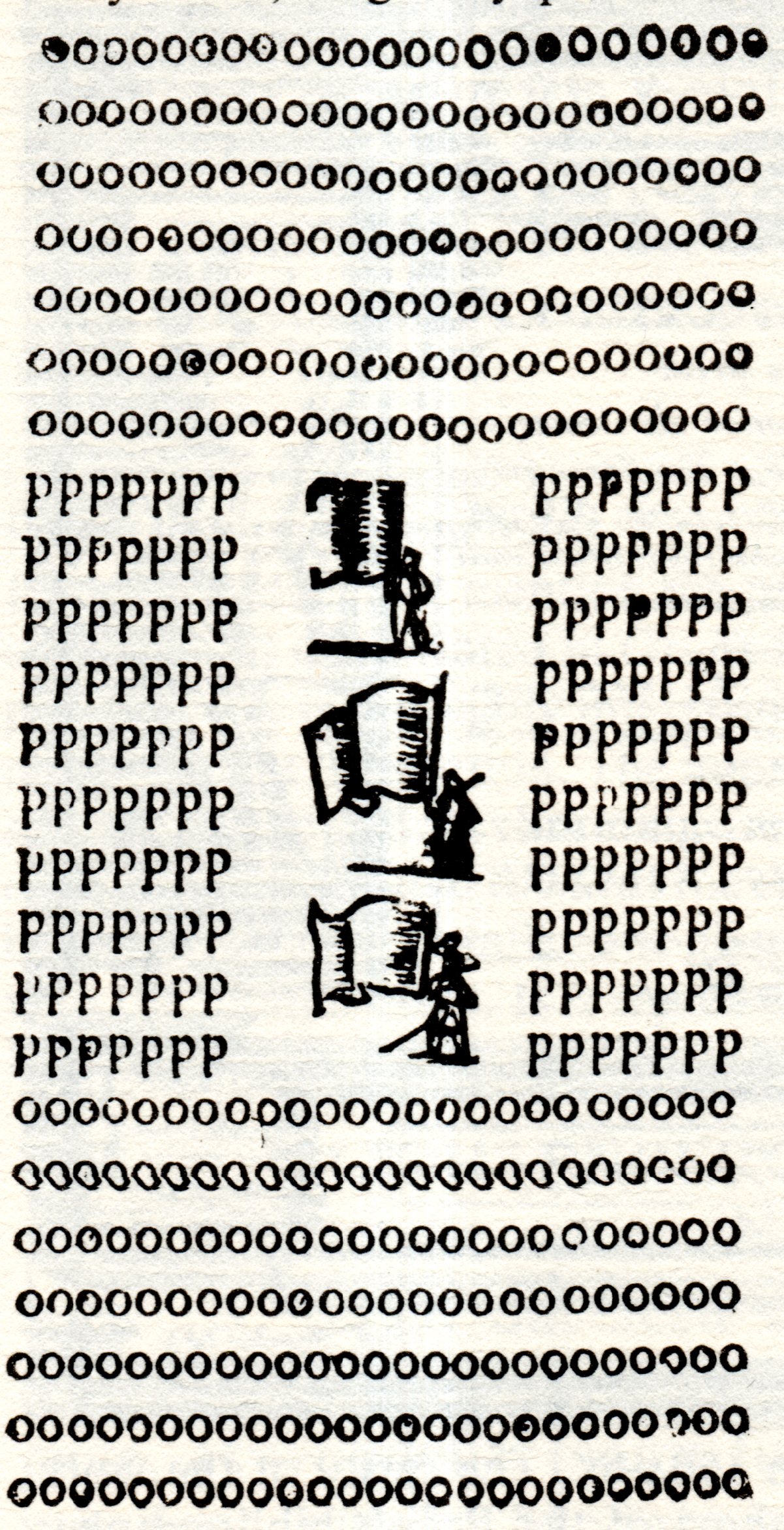
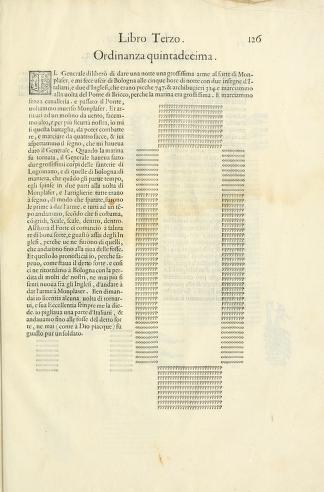
    Interesting bits of unintentional art–in some of these cases, unintentional, or found, Dadaist art–can be found in unexpected places.  Here, in this parade of zeros, we find such a case, and the place it is taken is from Girolamo Maggi’s book on fortification , printed in Venice in 1583. Aside from the crowded images like the Maturation of Zeros, I like the Embigenment of Empty Space approaches as much. 

    Troop detail823[Source]

    These are beautiful images, in spite of their deadly origin. 

    Troop movement7


  • A Note on Graphical Display and a Mechanical Heart, 1876

    JF Ptak Science Books  Post 2138
    Follow Me on Pinterest


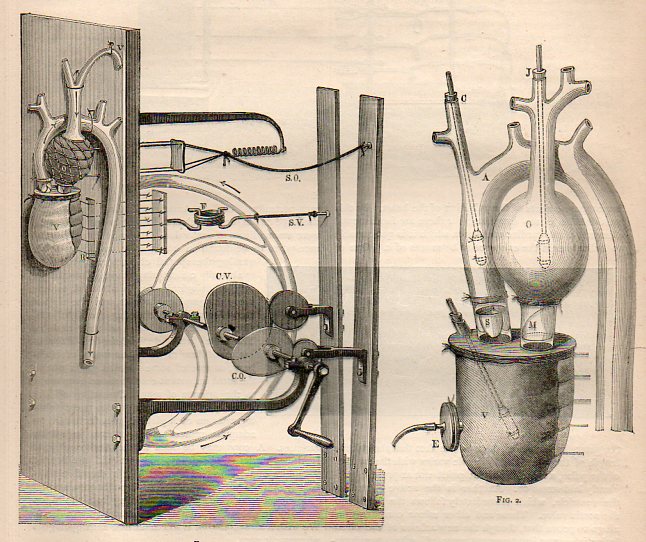
    Marey mechanical heart816

    This quick note comes as the result of a short chase on the detection of the pulse and the ability to determine death–as far back and even before Pliny life was determined by the audible heartbeat, which is where the trouble began, because one can still be very alive with a faint heartbeat. This was a major concern when dealing with folks who were thought to have expired, because in the mid-19th century and before the instruments necessary to make a careful and accurate appraisal of whether the heart was still working were yet finely developed.  Laennec’s stethoscope appeared around 1816, but as much of an improvement as it was this instrument awaited considerable refinements before a truly solid identification of a non-working heart could be established. The gaps in the determination of the arrival of death led to mortuaries where the supposed-dead were left to themselves at room temperature for three days, awaiting the ultimate determination of death which was putrefaction (as in the Munich and Frankfurt Leichenhaus and the Vienna  Zentralfriedhof). Earlier in the history of the determination of death methods were quicker and more brutal (if the patient was still alive) involving bellows-driven tobacco-smoke enema,  as well as tongue pulling and nipple twisting.  (See an earlier post here on the Worst Jobs of the Nineteenth Century for more on this.)

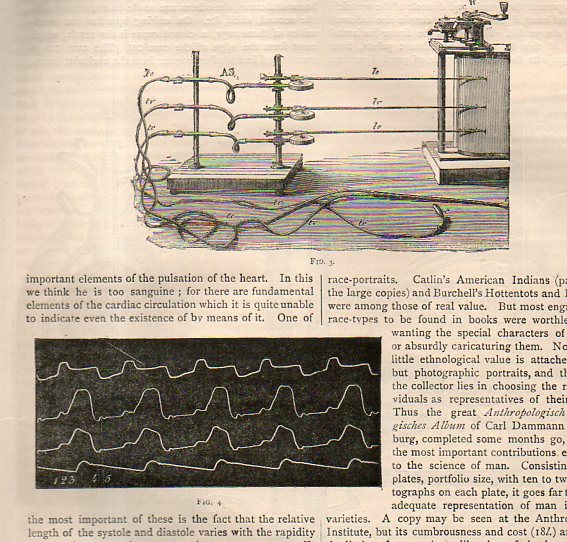
    Marey mechanical heart817

    This led to Etienne Marey (1830-1904), a versatile experimenter and premier instrumentalist who was a scientist, physiologist, and motion-picture/chronographer pioneer, who in the 1880’s created what was essentially the world’s first moving-photographic “slow motion” device. One iteration of Marey’s apparatus was basically a long series of ganged cameras recording a motion for a  simple task at a given time frame and presented on a continuous strip of photographic paper, sort of like a motion picture with the camera speed set at three frames per second. The resulting images were phenomenal and showed people for the first time the exactness of all manners of simple motions–motions that no longer looked so “simple” once all of its aspects could be studied from captured photographic evidence.  Even the act of hopping over a small stool or bending to pick up a bucket of water were enormously revealing in a way like Robert Hooke’s Micrographia displayed the great detail and complexity of the seemingly simple fly.

    Aside fron being one of the founders of cinematography, the other aspect of Marey’s interest in capturing and manipulating time was in medicine, where by the time this article of interest in this post was published in 1876 he had already established himself as one of the greatest cardiovascular physiologists.  What we find in this review in Nature (Thursday, January 6, 1876) of Marey’s Physiologie Experimentale (Paris, 1876) was the editor’s keen interest in the mechanical heart Marey had constructed to show the actions and functions of the heart–the first time, the article notes, that all aspects of the action of the heart were exhibited correctly in one model. 

      Of particular interest was the recording device for the pulse of the heart, which was one in a series of devices such as that improved upon, something Marey himself had done with the first-introduced sphygmograph (“pulse wrtier”) of Karl von Vierdodt in 1854.  The 1875/6 Marey instrument made major advancements in continuous graphical registration in instruments of continuous noninvasive arterial responses.


  • A Tiny Publication of Enormous Longing–a REAL Car, 1932

    JF Ptak Science Books  Quick Post

    Car design detail788

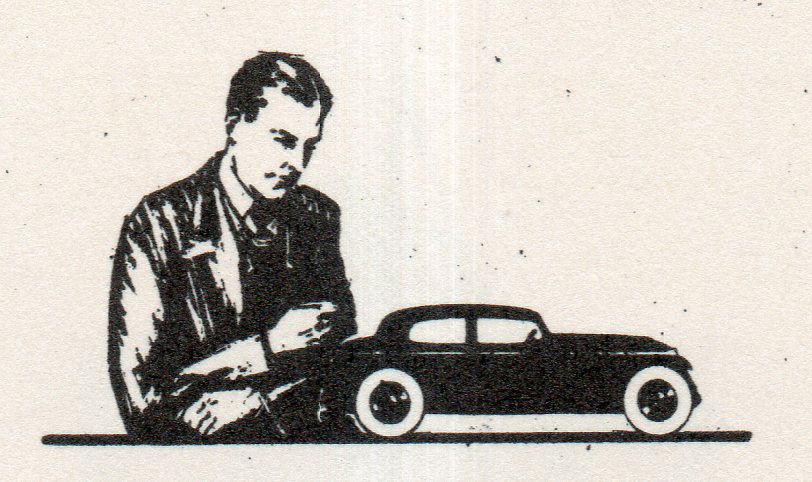
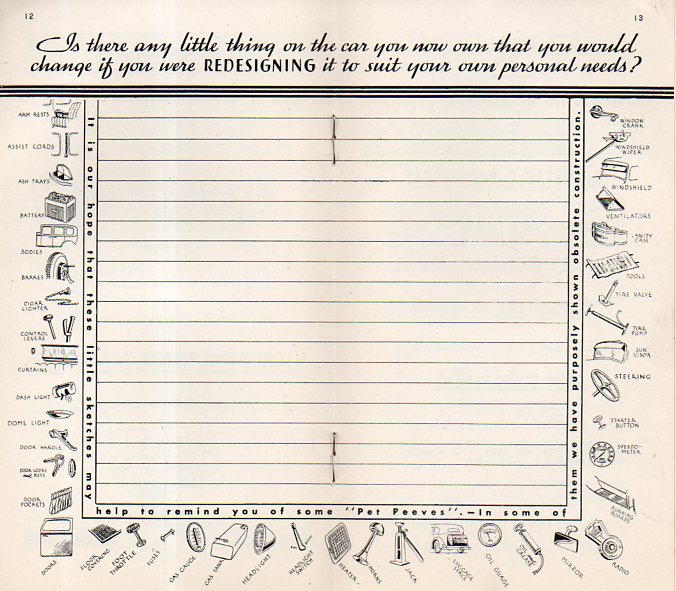
    This pamphlet, Your Car as YOU Would Build It, published by General Motors in 1932, is a partial sales brochure–wish book–planning guide for a variety, bubbled to the top of a box in a series of boxes filled with similar interesting and widely obscure publications.  Its main intent was to increase the interest of the reader in the car designs offered by GM, and it certainly piqued my interest if only in memory and hope–looking at the suggestions and offerings and choices, who in their right mind wouldn’t enjoying making  adecision as the pamphlet offers?

    Car design dbl page fill in785

    For example, the fender skirt, long gone now but just going nice and strong in 1934:

    Car design fender skirt786

    ·Posted by :

    ·in:


  • A Great Photograph of Physics and Tech People, 1921

    JF Ptak Science Books   Quick Post

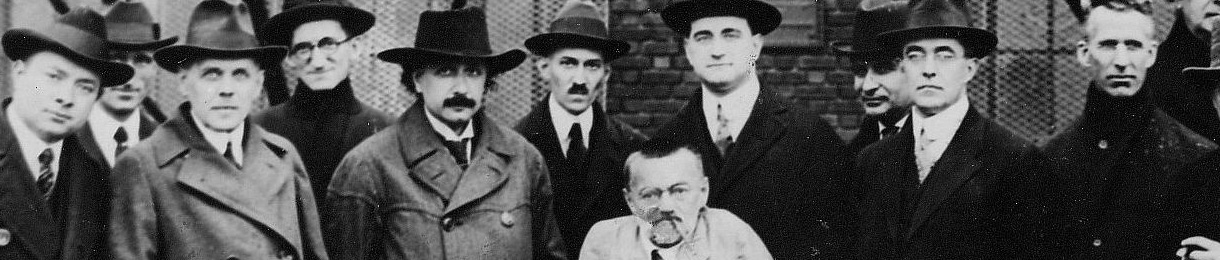
    Famous shoes:

    Einstein steinmet shoes'
    The famous heads associatred with those shoes:

    Einstein steinmet det
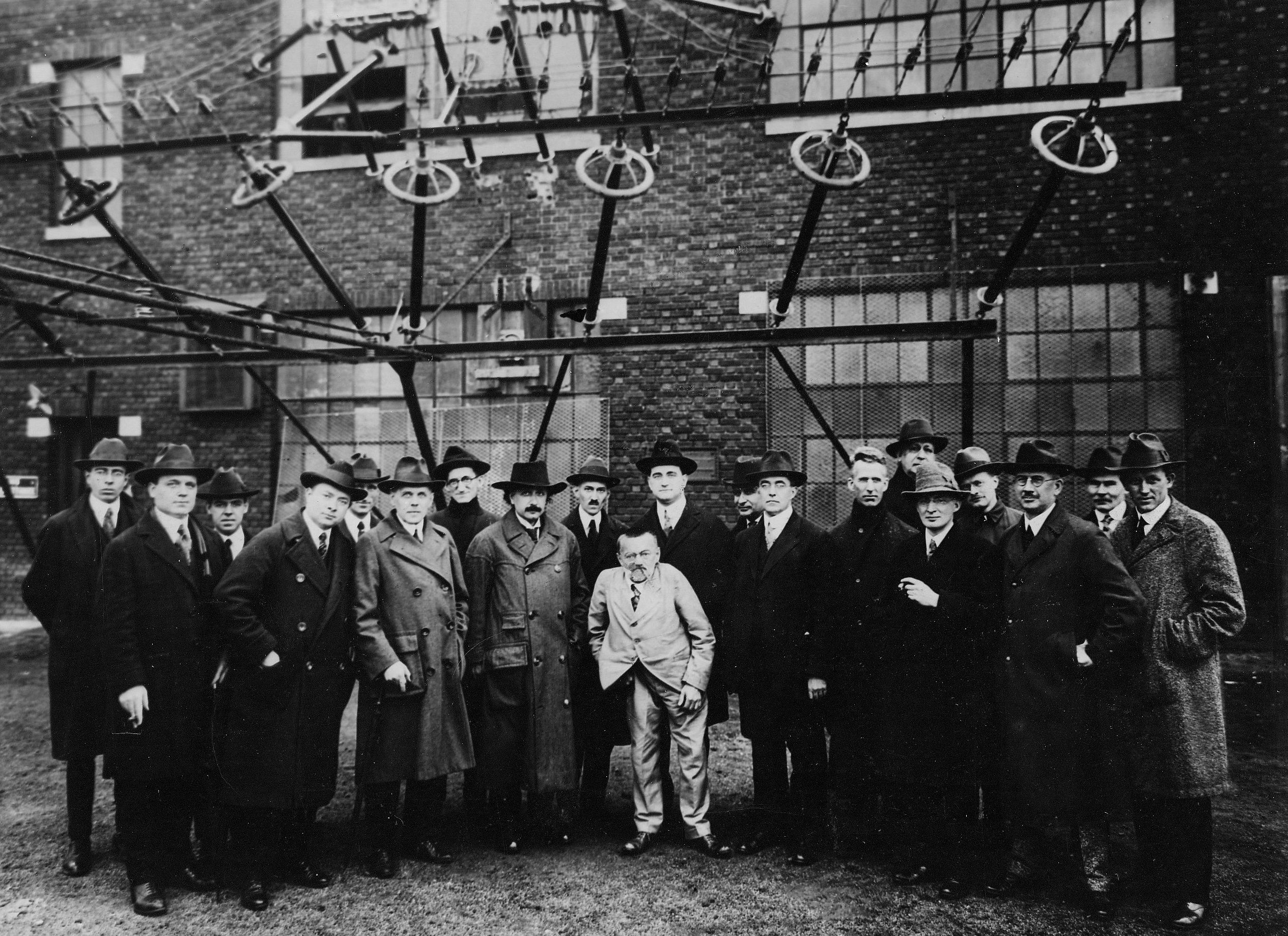
    And the full photograph:

    Einstein steinmet

    World Wide Wireless,  (volume 2/1, 1921) published by Radio Corporation of America  identified the group (reading from left to right) as:

    Mr James Casey special representative of the New York Herald, W. A. Graham, W. A. Winterbottom, David Sarnoff, Thomas J. Hayden of the Radio Corporation, Ernst Julius Berg, S. Benedict of the General Electric Co, Professor Albert Einstein, Mr John Carson of the American Telephone and Telegraph C0, Dr CP Steinmetz (Charles Proteus Steinmetz) of the General Electric Co, Dr A.N. Goldsmith of the Radio Corporation, Mr A. Malsin, Dr Irving Langmuir, Dr Albert W. Hull of the General Electric Co, Mr E.B. Pillsbury of the Radio Corporation, Dr Saul Dushman of the General Electric Co, Mr RH Ranger (Richard Howland Ranger) of Radio Corporation, Dr G.H. Campbell (George Ashley Campbell), of the American Telephone and Telegraph Co, Mr C. H. Taylor, of the Radio Corporation, Dr W. Wilson[5] of the Western Electric Co.”

    The text:

    ·Posted by :

    ·in:


  • An Early Radio-Controlled Car, 1921

    JF Ptak Science Books Quick Post

    Magnificent early development of two ideas:

    ·Posted by :

    ·in:


  • Tree Wagons and Rolling Land Thunder–Early, Interesting Vehicles

    JF Ptak Science Books Post 2122   
    Follow Me on Pinterest

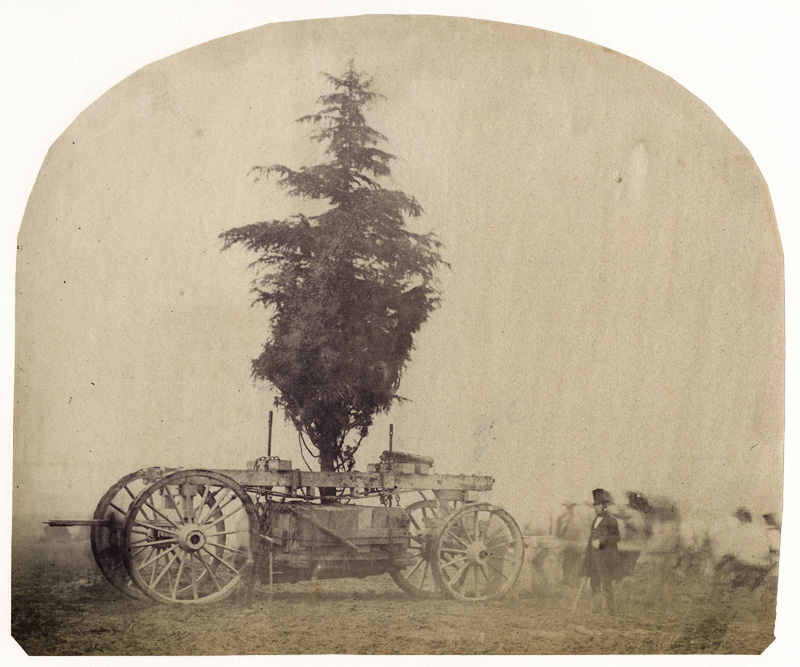
    I imagine that tree wagons had been around for quite some time by the time this Daguerreotype was made ca. 1860–the very unusual aspect of this is that it must be a very very early photograph of the process.  And, actually, it is probably rare among images in general to see the transportation of a mature tree–frankly I think it is a very mature tree in spite of its height (is this the slow-growing American Hemlock?), mainly because the trunk seems to be as thick as the observer at right.  The tree and roots look to be suspended in a wooden container, and the wheels look thick and tall (at least 5′ and probably more)–it no doubt was a very heavy load, and it would be interesting to know what was going to pull it along that open field. 

    Transporting-a-Tree-on-a-WagonImage: http://www.retronaut.com/2013/04/moving-a-tree-on-a-wagon/

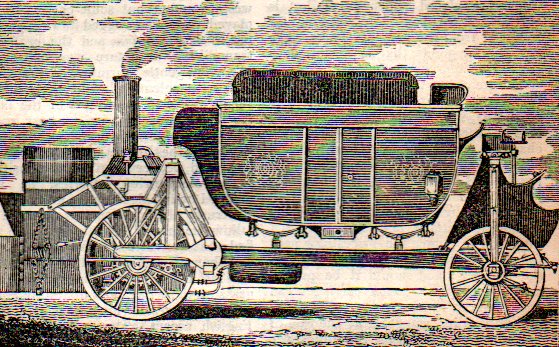
    The tree wagon was animal-powered–the rolling thunder land car was powered by steam. 

    Steam engine Griffith263

    ·Posted by :

    ·in: