A Daily History of Holes, Dots, Lines, Science, History, Math, Physics, Art, the Unintentional Absurd, Architecture, Maps, Data Visualization, Blank and Missing Things, and so on. |1.6 million words, 7500 images, 4.9 million hits| Press & appearances in The Times, Le Figaro, Mensa, The Economist, The Guardian, Discovery News, Slate, Le Monde, Sci American Blogs, Le Pont, and many other places… 5000+ total posts since 2008.

Category: Technology, History of

  • A Beautiful Turbine, 1893

    JF Ptak Science Books    Quick Post

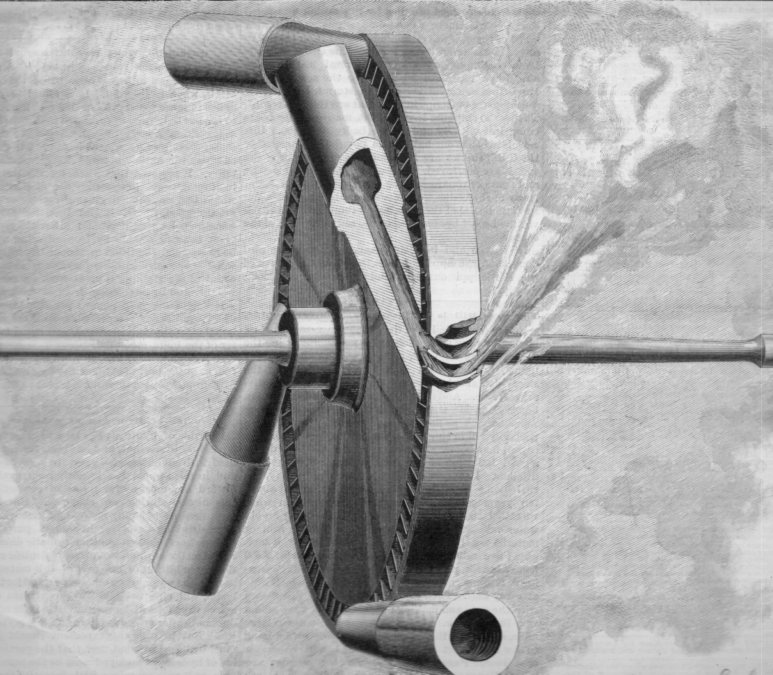
    Dr. Laval’s steam turbine is quite a lovely thing, presented here on the front page of the Scientific American (October 1, 1893), a glorious and beauitiful achievement capable of 20,000 revolutions/minute and developing 20 hp.  

    Revolving steam driven wheel228

    ·Posted by :

    ·in:


  • Red Radio–Found & Manipulated Tech Art

    JF Ptak Science Books   Quick Post

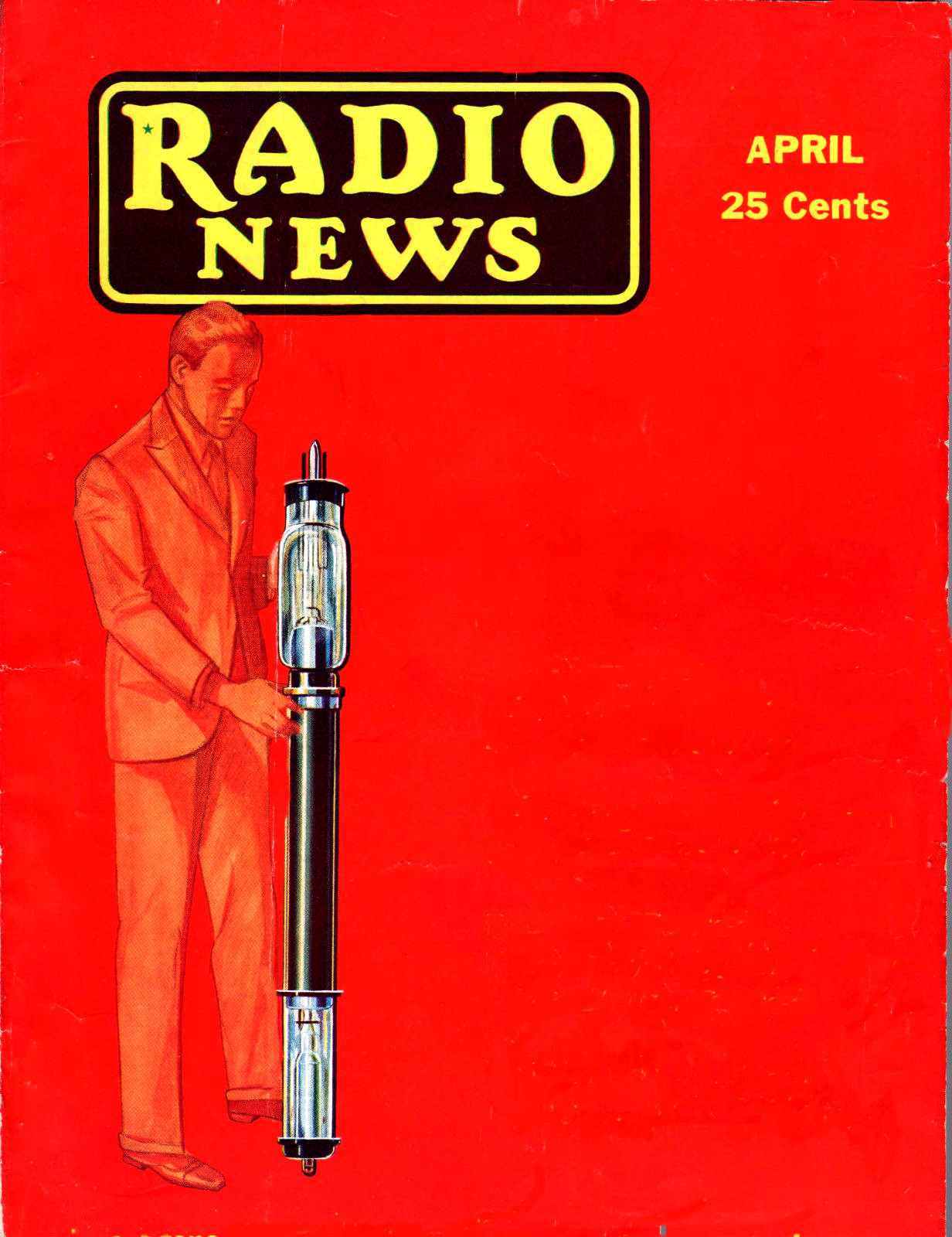
    I just like the cover art for Radio News. For at least the decade that I know about this journal published with very heavily red covers.  This one, for April 1931, was really red and also had some unusual design going on–especially after the cover text was removed. That fellow is standing there with the giant tube that helped the venerable KDKA (Pittsburgh, one of a few contenders for the title of “first commercial radio station” in the U.S.) reach millions of people, with a very powerful 400 kW signal–it basically made the station a local-national. (As it turns out the highest power ever authorized for AM radio was 500 kW to WLW (Cincinnati) in 1934, but which was modified down to 50 KW.)

      Radio News Red[The only manipulation was removing the text from the bottom right that displayed the issue’s contents–everything else is in situ.]


  • A Rare Technical Report on the V-1, 1945, Published in Newly-Liberated Paris

    JF Ptak Science Books   Post 2304

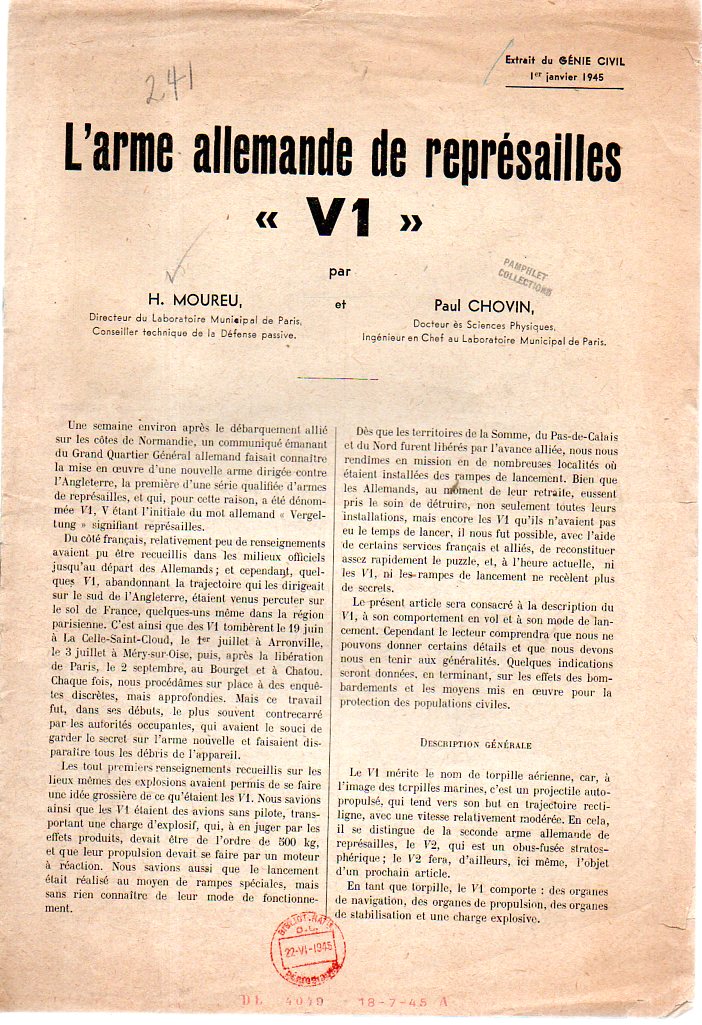
    The eyes of top-ranking Nazis must have popped when they saw this work by Henri Moreau  (1893-1978) and Paul Chovin.  It is a fairly technical paper on the V-1, the progenitor of their supposedly war-ending “secret weapon” the V-2, and to see the data and detail published in a tech journal in the city that was until very recently held in Nazi hands….well, there was very strong irony there.  “L’arme allemande de represailles <<V1>>”, seen here in offprint form, was published in Genie Civil, 1 January 1945–it is eight pages long, and printed in Paris (newly liberated from the German army 25 August 1944) in early 1945.  The offprint itself is a rare thing, with no copies whatsoever located in WorldCat, and nothing floating around on the interwebtubes. I was frankly surprised to find this fairly-well documented piece on the V-1, but no report itself, so I decided to reprint the report in its entirety. Some of the text runs off the side of the scanner, but that is the best I can do in scanning the pamphlet without taking it completely apart. 

    V1519


  • TV Field Trials, the Beginning of Networks, and an Early TV Dinner, 1936

    JF Ptak Science Books  Post 2302

    The first broadcast images in the history of television transmission were revolutionary if not very interesting.  Beginning in 1928 the first experimental Radio Corporation of America (RCA, via the National Broadcasting Company, NBC, its broadcasting division) images were of Felix the Cat, and something that would be received with 60-line clarity on a two-inch display.  For the most part, the daily two-hour broadcasts consisted of Felix or test patterns, broadcast from NYC, until 1931.  

    Tv 1936 set924

    Image quality increased markedly by the 1932 field trials with the use of iconoscope cameras, which allowed for 240-line reception though still with very noticeable flickering. The 1934 trials were improved further to 343 lines and with some less amount of flicker. 


    For the 1936 field test the transmitting station and offices for NBC and RCA were located in the Empire State Builidng (utilzing the mooring mast at the top of the building for the antenna, as well as some of the upper floors for the transmitter and offices on the 52nd floor, while the transmitting studio was located in the RCA building in Rockefeller Center).  The broadcast began on 29 June 1936 from W2XF/W2XK “to an audience of some 75 receivers in the homes of high level RCA staff and a dozen or so sets in a closed circuit viewing room…(in the RCA building)”.1


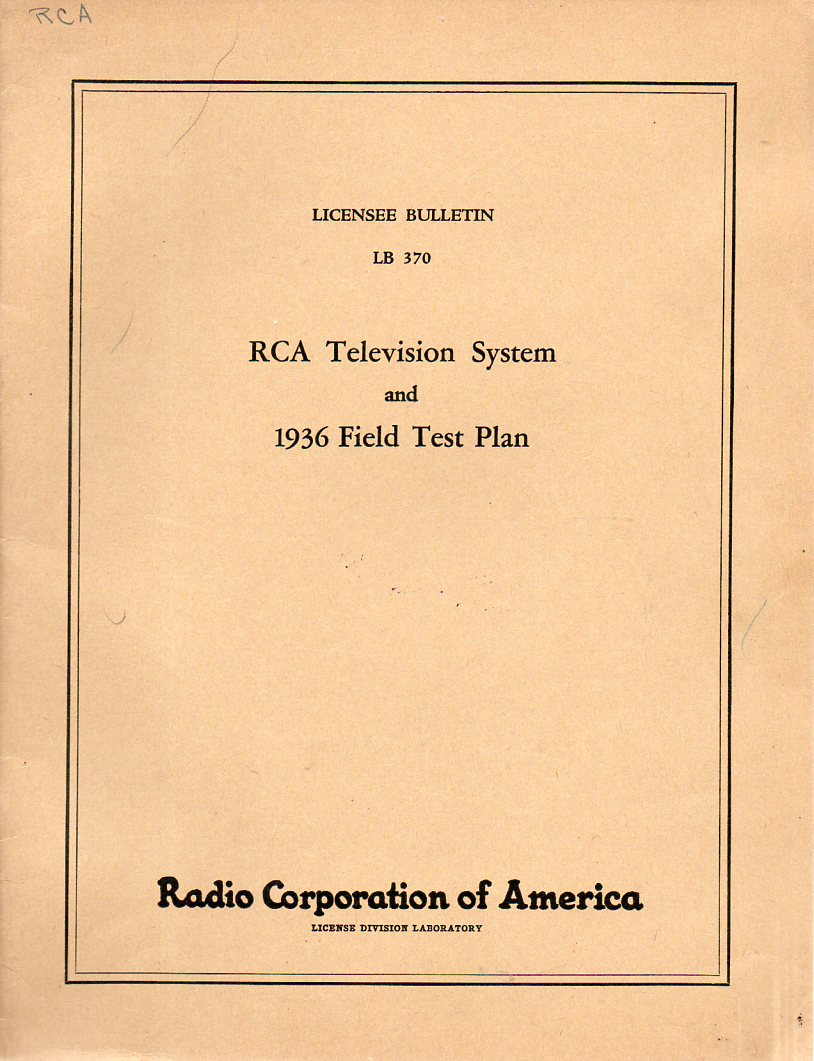
    The rare pamphlet [available for purchase from our blog bookstore, here] that I uncovered in the attic speaks to the first public demonstration. “The first public demonstration of these field trials took place on July 7, 1936 to RCA’s 225 licensees. Major General J. G. Harbord, chairman of the board of RCA announced that there were three sets in operation at the time, the most distant in Harrison, N. J.”2  It addresses the history of the field tests as well as the tech specs for the 1936 test, as well as the need to address the fuller and complicated issues of establishing a network of transmission capabilities:  “Television services required the creation of a system, not merely the commercial development of apparatus.”–July, 1936, RCA Field Test Plan, page 8.

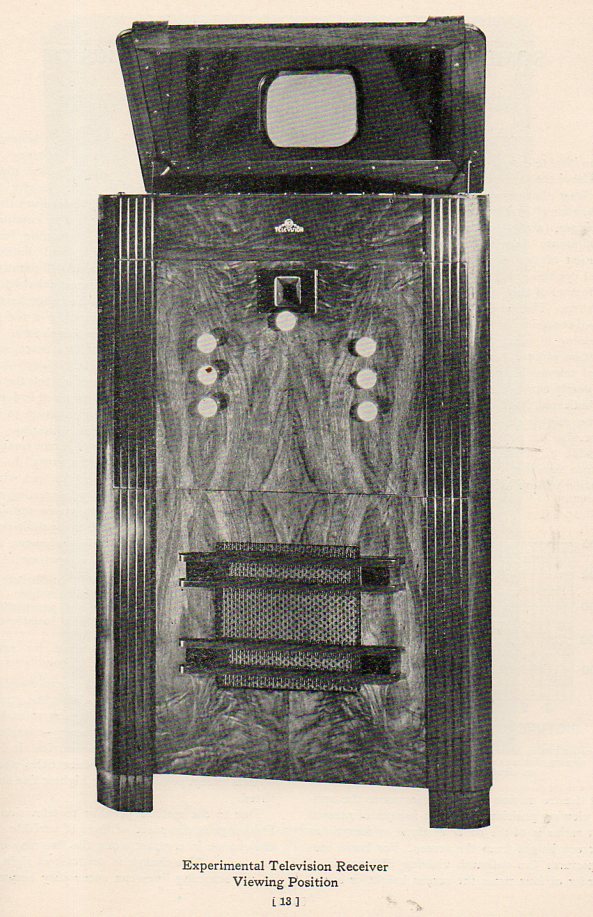
    The set on which the transmission was received was the RCA RR-359 trial set:

    Tv 1936 set922
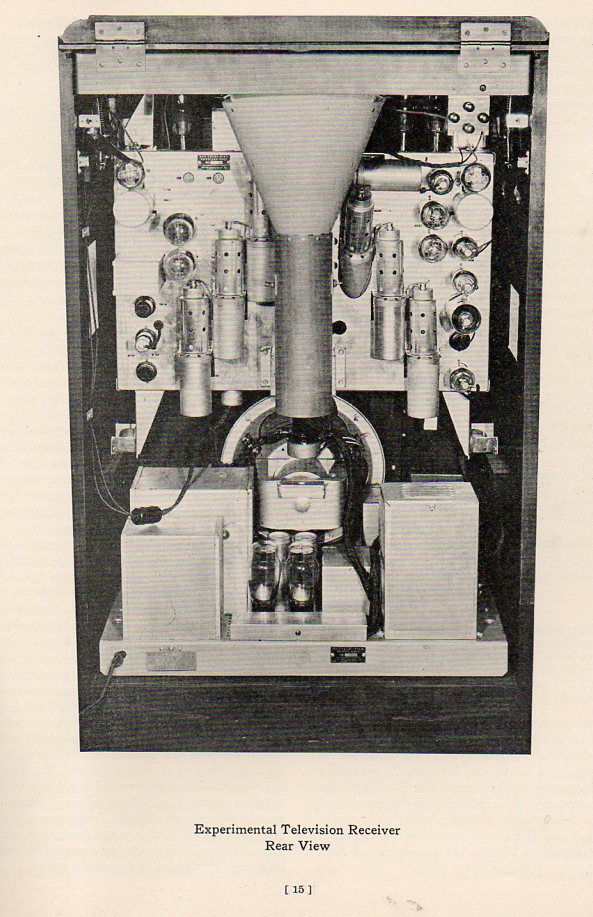
    and the innards:

    Tv 1936 set923

     Notes:

    1.  See The Television Museum, at Earlytelevision.org, here.

    2.  The Early Television Museum, located here.

    ·Posted by :

    ·in:


  • Single-Line Entries of Revolutionary Ideas: the Transistor, (1949)

    JF Ptak Science Books   Post 2298

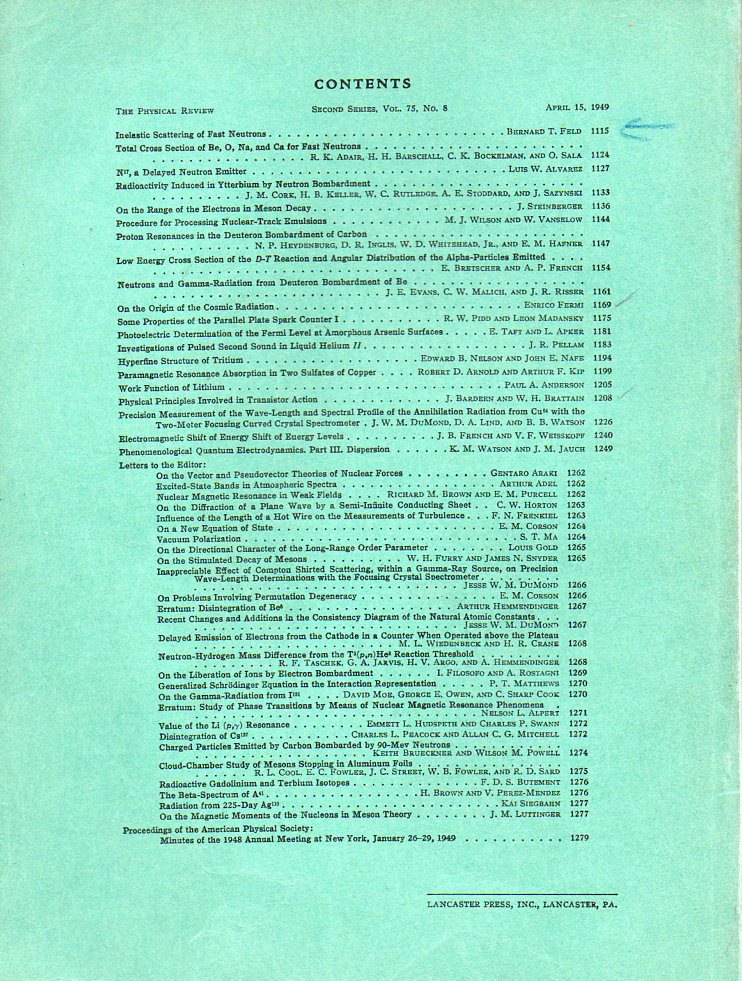
    Transistor 066
    One of the things I love about working my way through old scientific journals is when I find the issue that I’m looking for and scroll down the list of contributors to find the significant article that I want.  Long list, usually; and then, after making my way through 30 or 40 lines of tight type of the index I find it. [This by the way is one of those experiences that is being replaced by the digital library.]   Even though the paper on pp 1208 through 1226  of the 15 April 1949 issue of The Physical Review looks like any other, it is today seen as revolutionary. The entry for “Physical Principles Involved in Transistor Action” by John Bardeen (two-time Nobel in physics) and Walter Brattain (Nobel ’72) shows up about halfway down the index, sandwiched in some very good company (Enrico Fermi’s “Origins of Cosmic Radiation” and a number of others), and does not show up bolded, or highlighted, or with an asterisk.  Such is the nature of publication in the academic journal world, everything delivered with equal weight–the bolding stuff will happen later, in other venues.  But to see it right there in the flesh, so to speak, fresh and new and revolutionary, and looking like everything else, is really thrilling.  [See this entry for a similar report on the most valuable patent in history.]

    Transistor 064

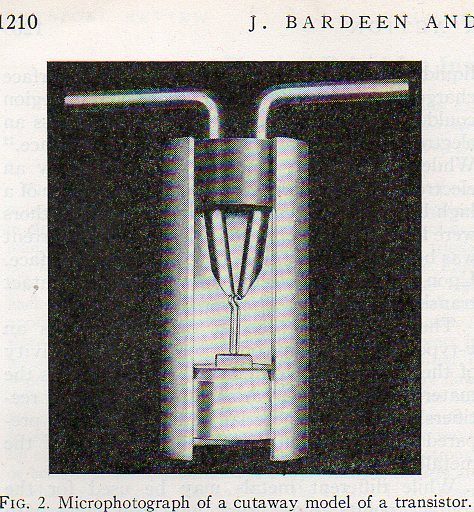
    It makes me wonder though how it would’ve felt to open this journal for the first time back there in mid-April ’49, turning to page 1210 to see the microphotograph of the cutaway of a model of the transistor.  This was the defining technical publication on the transistor1, which was the first massive step towards microminiaturization and the explosive new growth in the computer, allowing far more powerful machines to be designed in far less space, in far less amounts of time, and on and on.  It is one of the first steps in the Information Revolution, moving the computer from massive racks of electronic tubes to more simple, elegant, nimble and by-far faster circuit boards with transistors (and resistors, capacitors, inductors, diodes, etc.) to make an electronic circuit.  This would be the standard for computer construction, only supplemented by Jack Kilby (TI)  and Robert Noyce (Fairchild Camera) in 1958/9 with the integrated circuit, where transistors are made smaller still and produced in groups on circuit boards rather than individually.

    The photo above shows a cutaway of the transistor, and is the first time it was published–the first photo of what was one of the 20th century’s greatest inventions. 

    Transistor 065

    Notes

    1.  The paper was published simultaneously in the Bell System Technical Journal; Bardeen and Brattain were with the Bell Labs.  The Bell journal also contained another revolutionary paper in the same volume, Claude Shannon’s “Communication Theory of Secrecy Systems”, which is one of the most important early papers on electronics and cryptology.

    The full bit: BARDEEN,  John and Walter Brattain:  Physical Principles Involved in Transistor Action;  Lancaster, Pa:  Physical Review,  1949.  1st edition.  The Physical Review, Vol 75, Second Series, No. 8    8vo.


  • Early Robots as Explosive Anthropomorphs

    JF Ptak Science Books   Quick Post

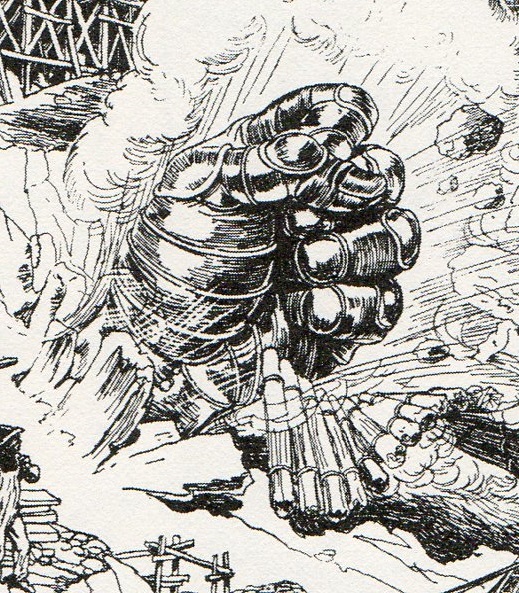
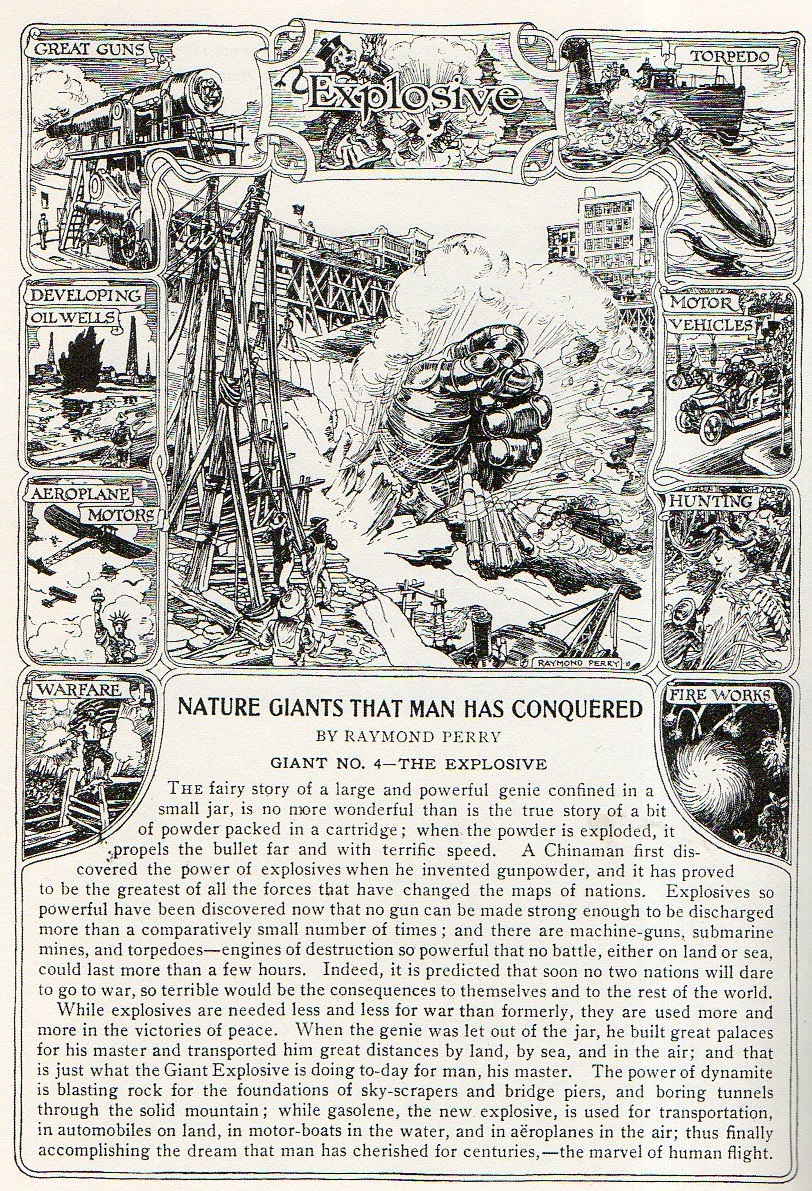
    I have been collecting images of mechanical men/robots pre-singularity antiquarian-quaint displays of advanced technical humans.  This is an unusual one that may or may not fit this, though there is a suggestion of MassiveMan in the gigantic metallic fist, which is supposed to show a successful combat of people over nature via the advancing bliss of explosives.  I’d just like to post this here before I lose it…

    Nature giants262

    Which is a detail from St. Nicholas magazine, 1911:

    Nature giants261


  • “Spirit Writing”: Electric, Script-Writing Telegraph, 1879 (!!)

    JF Ptak Science Books   Post 2295

    Telegraph script

    Telegraph script
    This fine bit of welcome-to-the-future technology appeared in the notice “A Real  Telegraph”, in Nature, 6 February 1879.  It is a quick report on the invention, occupying one scant paragraph of text but was accompanied by a full-page illustration of a sample of the telegraphic writing, which must have seemed in 1879 like a touch of the future–the telegraph was forty years old, but the recording telegraph was relatively new, and the idea that you could read a series of spaces and dots and dashes as though it were handwriting must have seemed like seeing color photographs in 1935.

    The “real” part of the title of the note meant in this case that rather than have a key operator tap out the message in Morse Code, the sender would be writing out the message in long hand, and the receiver would gather up the message so that it appeared in recognizable letters and words rather than dots and dashes.  The inventor’s name was E.A. Cowper, and he brought to the telegraphic art something as “startlingly” as the “marvels” of the telephone, which had been invented just three years earlier.

    The author describes the appearance of the script on the receiving end seeming as though to have been guide by a “spirit hand”, such as the highly unexpected result even to the trained scientific reporter. 

    A somewhat longer article appeared in the New York Times a few weeks later, the full text of which is here.


    According to William Maver jr. American telegraphy and encyclopedia of the telegraph: systems, apparatus … By William Maver (jr.) this was the first successful attempt at producing susch a machine. 


  • The Department of Significant Understatement & the Most Valuable Patent, Ever?

    JF Ptak Science Books   Post 2294
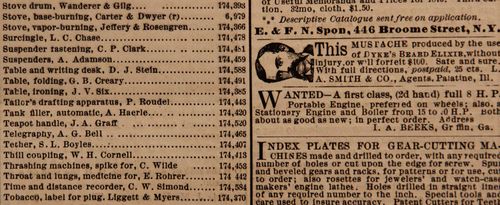
    Bell patent close
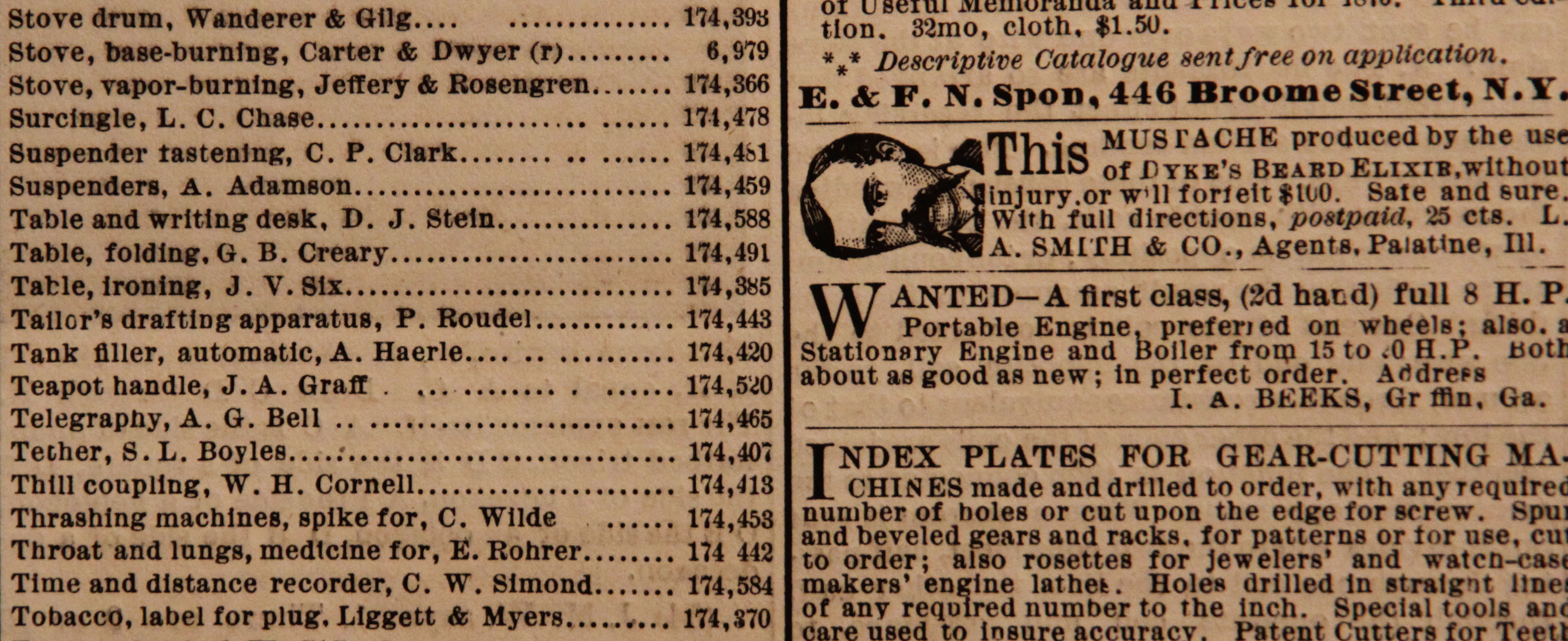
    Besides it being the (U.S.) Centennial year, 1876 saw a number of major gains in the history of human thinking. Sometimes the announcements or earliest public appearances of these breakthroughs didn’t get all that much attention.  As one of the major means of transferring technical and applied science info to the general public, it is interesting to see how Scientific American reacted to such innovations.  For the thick, heavy volume for 1876, amid patent announcements and articles on telegraphic fire alarms, electro-harmonic multiplex telegraphs, recording telegraphs, electro-magnetic telegraph railroad car signals, signal box telegraphs, underground telegraphs, telegraph keys and armature, acoustic telegraphs and the like (though there weren’t that many reported, not really, just on the order of dozens), we find one of the most important of them all, patent # 174,465, by Alexander Graham Bell, appearing 8 April 1876.  It would be a rude resumption of being here in the future of this event to call the coverage short-sighted–this is just the way the patents were reported, with no weighting, just a single line.  

     In an earlier article in the 4 March 1876 issue of SA, there appeared “The Invention of the Telephone”, by P.H. Vander Weyde, in which there is yet any mention of Mr. Bell.  There is an illustration of one of his precursors in the field, the Reuss telephone, with ample description. (This was actually Philipp Reiss, and his telephone really wouldn’t work to transmit the human voice, though did so work for music to some degree.)  Bell’s patent  would be at the Patent Office in March, and would appear as a one-line notice (among a hundred others), the patent stating it was “the method of, and apparatus for, transmitting vocal or other sounds telegraphically … by causing electrical undulations, similar in form to the vibrations of the air accompanying the said vocal or other sound”.  (The first image above is a detail; the second image a longer version, which is really only less than half of what the real-life version looks like in the tall listing.)

    Weeks later, Elisha Gray‘s (on 13 May) telegraphic telephone patent (175071) appears in the Scientific American, and later, on 9 September, on page 163, there is the article “The Human Voice Transmitted by Telegraph”, on the successful transmission by Graham Bell. 

    Admittedly there were a number of developments in the production of the speaking telephone at this time, though in general there seems to have been no great attention paid them in the pages of the Scientific American than pipe cutting machine improvements or improved gravel separators.  Obviously the great impact of the invention was yet to be appreciated, even in any sort of fictional way.
  • Illuminated Night-time Aerial Bombing (1918)

    JF Ptak Science Books  Post 2282

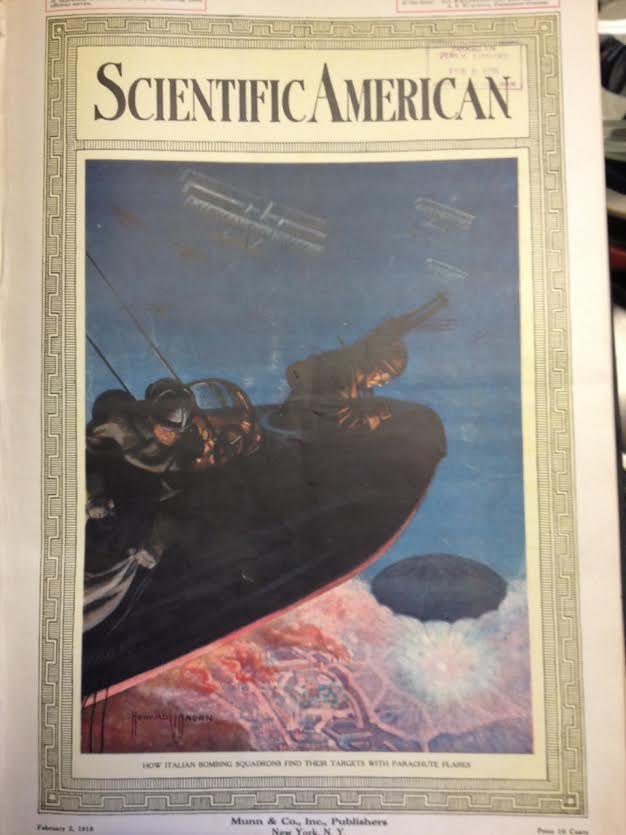
    WWI airwar Italian night bombing

    As I assemble the WWI stuff here for a possible anniversary blog of interesting war and homefront images (nothing like planning and foresight for these things) I was putting together the war years for some of the journals, including the magnificent Scientific American.  Flipping open the top volume (1918) revealed a big blue/dark print that was entirely unexpected–an Italian bomber carrying out a mission at night using flares to illuminate the target area.  

    At first I had an irrational serendipitous memory of Santa Claus using a lantern to find his way, but, well, as I said it was an irrational association.  (There’s another odd memory of a picture of Santa in 1917/18 delivery his presents on a flying tank, but that’s another story…)

    I had only once before seen a portrayal of an aerial night attack, depicting a futuristic flying machine–a dirigible in this case–using electric lights to target fleeing villagers and warriors of an African town.  My memory is not working on this one, so unfortunately I cannot date and reference it, though I do believe it appeared in the Illustrated London News around 1907 or so, just a few years before someone started dropping explosives from planes for real.  

    But this image (appearing in the February 2 1918 issue)  is for something quite real, though its effectiveness (to me, as a non-historian of this field) seems highly suspect.  What we see are three airmen in an Italian Caproni1 releasing flares above what they assumed to be a target.  The gunner at front watches closely as the co-pilot (there are two men in that cockpit, one being mostly obscured) readies another flare.  

    By the way, here’s one way of loading the payload (from a few issues later):

    WWI Airwar 1918 bomb load

    The general characteristics of the Caproni (3) aircraft, via Wikipedia:

    ·Posted by :

    ·in:

    —

  • An Underground USS “Monitor”, 1878

    JF Ptak Science Books   Quick Post

    Doing work underground has long fascinated me: tunnels, mining, sapper military ops, though almost entirely human-made, not so much for natural formations like caverns and such.  Particularly interesting are the big machine brought down/assembled to do some big cutting or drilling or pounding job.  Case in point: this sharp-toothed whale:

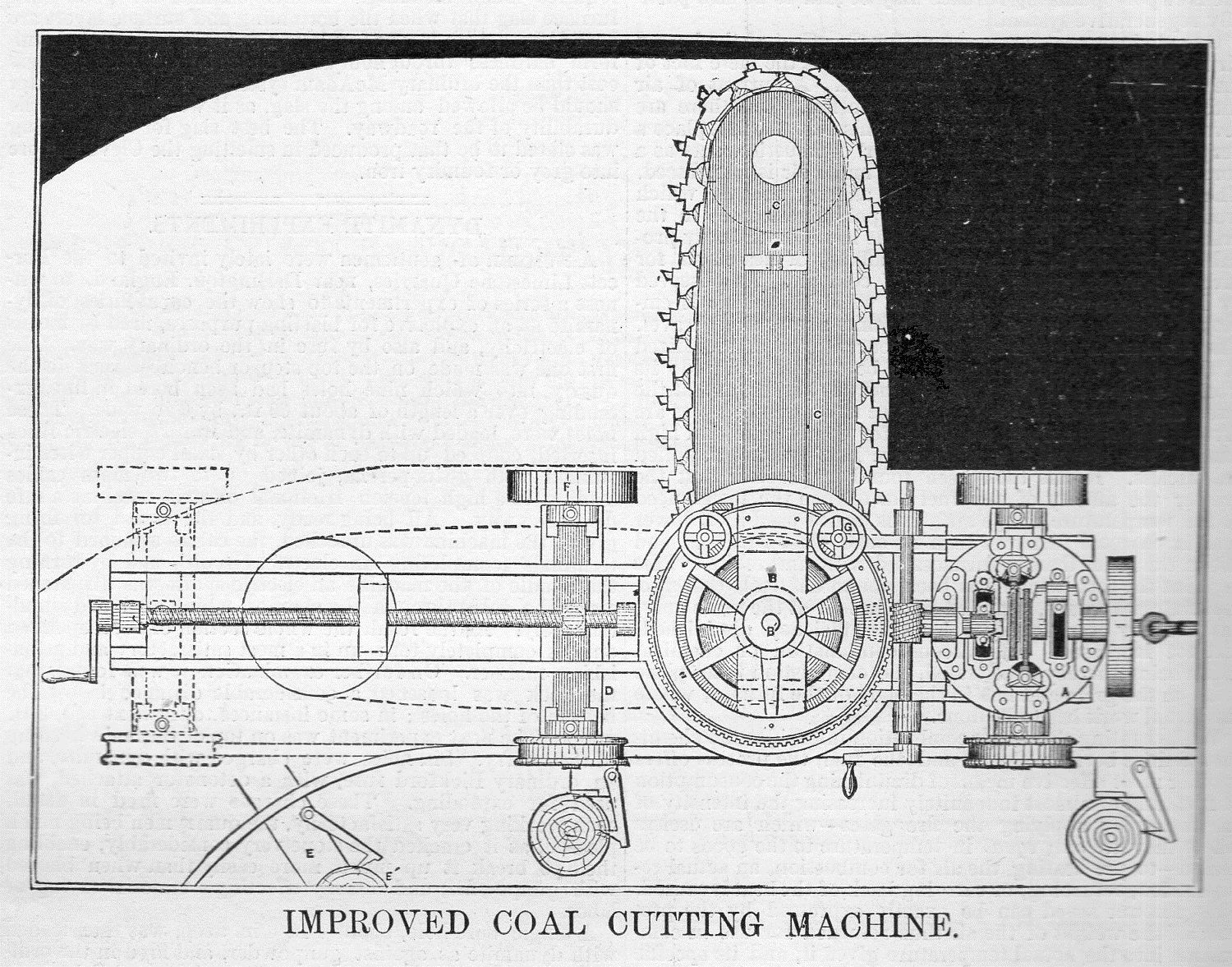
    COal cutting machine194

    The beautiful diagram for this beast appeared in Scientific American Supplement No 107, January 19, 1878, and is a cut of the machine looking straight down.  This was a monster for its time, weighing in at 3,800 pounds, and could make a clear cut into a vein of coal that was 4′ long and 2.5′ deep, and could move along a face of coal 60′ long in one hour.  It no doubt was a tremendous boon for the men who would have been in there working the coal by hand.  This was the invention of Horace Brown, and was called the Monitor Coal Cutter, no doubt because it was long and low, looking as though it wasn’t 4′ high, giving it a silhouette similar to the Civil War ironclad warship (designed by the very busy John Ericsson).

    And for all of its weight and force and potential the machine moved along a railtrack that was only 29″ wide.  

    ·Posted by :

    ·in: