A Daily History of Holes, Dots, Lines, Science, History, Math, Physics, Art, the Unintentional Absurd, Architecture, Maps, Data Visualization, Blank and Missing Things, and so on. |1.6 million words, 7500 images, 4.9 million hits| Press & appearances in The Times, Le Figaro, Mensa, The Economist, The Guardian, Discovery News, Slate, Le Monde, Sci American Blogs, Le Pont, and many other places… 5000+ total posts since 2008.

Category: Technology, History of

  • A Fine Microscopical Innovation, 1873

    JF Ptak Science Books   Quick Post

    Microscpe binocular321

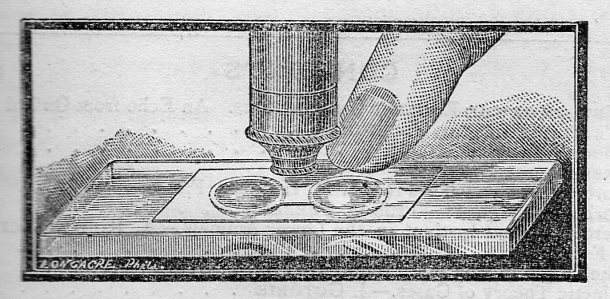
    This intereting and half-Surreal woodcut appeared as a small 3/4″x1 1/2″ illustration for an article in Nature for May 22, 1873.  I like it quite a bit.  It is tiny, spare, odd, and contains all of the necessary technical details.  And it was an innovation–just a fine piece of work.  

    ·Posted by :

    ·in:


  • Electric Lights and Fish Scales

    JF Ptak Science Books  Quick Post 
    Follow Me on Pinterest

    Firstexhibition

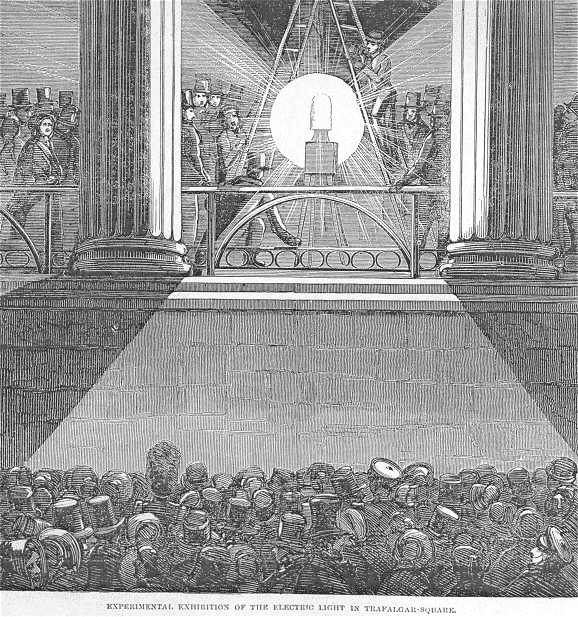
    The satirical sturgeon, the London Punch magazine, took many shots at innivation and invention over the years, mostly within the months and first year or two of the creation of whatever it was they were taking to the humor shed.  Electricity was one such area, and there were many poems and cartoons and satirical slings thrown in its path.  The “light bulb” as we know it didn’t quite exist in 1879 (the year of our cartoon) though the history of electric lighting was already quite long by that point–just not very effective, and certainly not in even limited distribution. (The next big step would be in 1880 with Edison’s vast improvement on the lightbulb.) Here’s a good example of Punch’s take on the electric light’s future –and the pallor of fish and fish sellers in the new era of artificial light:

    ·Posted by :

    ·in:


  • A Wireless Telephone, 1880

    JF Ptak Science Books  Post 2323

    Photophone

    Alexander Graham Bell was already mega-famous by the time he unveiled what he considered to be one of his greatest inventions.  Working at his L Street lab as well as from his home (which was just a few blocks away from my store in Georgetown, which was at the 34th & Volta Place, also just a few doors away from Alger Hiss’ old place, and a few doors the other way from Warren Christopher’s house where he slipped and fell on his last day in DC on the snowy steps and sidewalk that he never shoveled, and so on) he developed the photophone.  In the day, in 1880, when it was completed he considered the work so substantial and filled with so much potential that he left his plans on deposit in a sealed something-or-other until he announced the results for real, which came at a public lecture on August 27, 1880.  (This perhaps for the big taste of legal trouble he got into with his telephone–troubles and contentiousness that would continue for years. Also there was something in the air about this, so to speak, with an article in Nature attesting to rivals of the ingenious invention coming in the 23 May issue of the same year.) In any event, he found this invention to surpass his telephone and phonograph–except that few people today recall the instrument, much less what it did1.  

    It was a fantastic thing, an elegant device utilizing his discovery of the photoacoustic effect–basically, transmitting wireless telephone conversations, transmitting speech on light rays, a feat that would not be utilized until the last two decades of the 20th century, a precursor to fibre-optic communication–it was just decades away from practical application.  

    In his article in Nature of September 23, 1880, electrical pioneer Sylvanus Thompson writes (opening that weekly issue) that “sounds can be transmitted from one station to another wherever a beam of light can be flashed; …we may expect the slow spelling out of words in flashing signals of the heliograph to be superceded by the more expeditious whispers of the photophone” (page 481). Actually it seems that this paper beat the sponsor organization of Bell’s August address into general print, though The Electrician seems to have bested them both with an article on September 18.

    Bell was happy.  According to Ben Richmond at Motherboard, Bell wrote a lovely note to his father on his success: 

    “I have heard articulate speech by sunlight! I have heard a ray of the sun laugh and cough and sing! …I have been able to hear a shadow and I have even perceived by ear the passage of a cloud across the sun’s disk.”

    Notes:

    1.  Wiki quotes Donald J.C.  Phillipson and Neilson, Laura, entry on Bell in the  Canadian Encyclopedia online. “Of the 18 patents granted in Bell’s name alone, and the 12 he shared with his collaborators, four were for the photophone, which Bell referred to as his ‘greatest achievement’, telling a reporter shortly before his death that the photophone was “the greatest invention [I have] ever made, greater than the telephone.” Wiki and Philipson/Neilson.  


  • Human Computer Art, 1949

    JF Ptak Science Books   Post 2321  A Post called “Computer Art, 1949”, revisited and much expanded

    This is a great example of an exactly-what-is-this object, something that seems to be one thing, then the other, but then neither.  
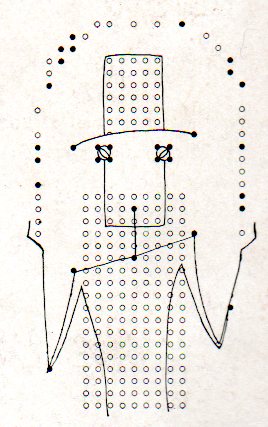
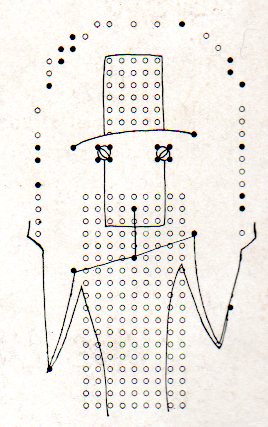
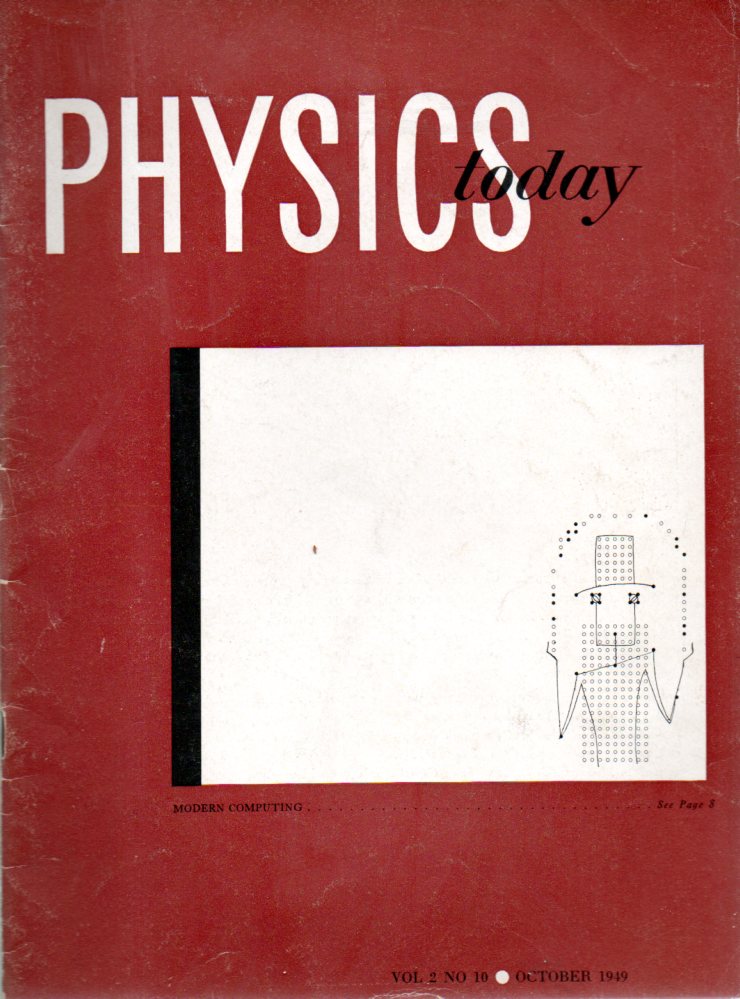
    Computer art154I’m not sure how to investigate this right off-hand, but I think that there is a special category in the history of art, subcat history of art and technology, subcat history of computer art, subcat using the technical aspects of the computer in art.  The image above comes from the front cover of one of the early issues of the “new” Physics Today magazine (volume 2, number 10), in October 1949–it is the artwork of Paul Bond, who created this portrait of a juggler “on a matrix sheet used for plotting computor [sic] plug board diagrams”, and is one of 11 such images.  So, while not computer art–artwork generated by the computer–it is artwork using items designed to operate the computer, a sort of very early computer-material montage.  (It would be in the first-time-ish category, but I can’t say this with any surety–it is however very very early for what it is.)

    It reminds me in a way of a magazine article using the illustration of a photograph–it was in the curious category of the first time an image of a photograph was published, that is to say it was a woodcut of a photograph though not the photograph itself.  This appeared in Golding Bird’s series of articles, “A Treatise on Photogenic Drawing”, which was five papers found and bound in the London-published journal, The Mirror.  and were extremely works on the new science of photography, appearing in issues from April 20-May 25, 1839. The image appears on page 241 (issue no. 945, Saturday April 20) and displays this first image of a photogenic drawing, which was the first publication of an image produced by any sort of photographic process.  (The process here is the ‘sun picture” , a photographic process, making this the first published “photographic” image, but really it is more like the first publication of a photographic image that was produced via woodcut.  It predates the first mass-published photograph by four years and the first (entirely) photographically illustrated book (The Pencil of Nature ) by six years.)

    Our computer artwork illustrates an interesting article (“Modern Computing”) by pioneers R.D. Richtmyer and N.C. Metropolis . Richtmyer/Metropolis have a very sober approach to the computer–and mostly speaking about the ENIAC–and address its romance, possibilities, and seemingly (to me) most of all “a need for defining the limits of computing machine operation, as well as its promise”. In effect, the authors really only address the known quantities of computing capacity in 1949, and even though tempted by looking into the future, they really do not. Their vision of the future is very pragmatic, and so far as speaking to future applications of the machine they choose the very Bartlebian philosophy and chose not to: they conclude “by their very nature, these applications are not easy to foresee, and perhaps, therefore, this is the point at which this discussion should close”, preferring to watch the beautiful and complex whirlwind in a thicket from the outside.  

    There have been much earlier images of automated steam-driven robots with some sort of calculating brain, and images of imaginative computer-like objects, and stretching back into the 18th century, so the idea of creativity and thinking and human-like qualities made by things constructed of metal and wood with a power source of steam or electricity and so on was well-established, though lurking in deep-background. Art made with the computer seems to come a fair bit later than this issue, later still than what might be considered the first art generated via the computer (which were images made from manipulating an oscilloscope) in 1952. This was the work of Ben F. Laposky (1914-2000) an Iowan and mathematician/draftsman and former sign-painter who took long time exposure photographs of waves motions on a cathode ray oscilloscope with sine wave generators and found beauty in them. His work was first exhibited at the Sanford Museum in Cherokee, Iowa, in 1952, as “Oscillons or Electronic Abstractions”1 –hundreds of other shows would follow.2 One of the earliest appearances in print of the oscillons is in Scripta Mathematica, Sept-Dec, 1952, pp 305 (and then somewhat later in Design, May 1953).

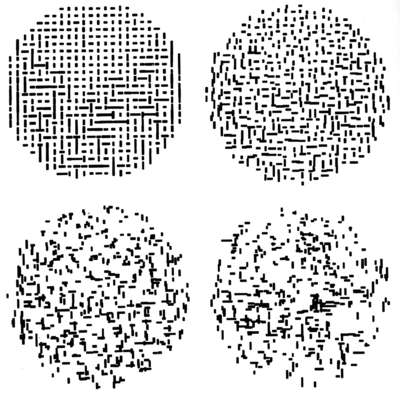
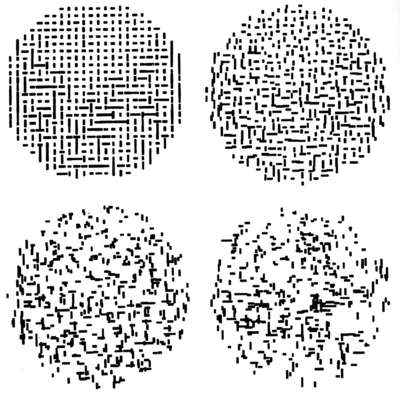
    Among the earliest computer-generated art–that is, art made via an automatic process input by humans by created by the machine–was created and noted by A. Michael Noll (b. 1939) with an IBM 7094 and described as “computer art” in “an August 1962 technical memorandum”3. Noll has written extensively (and interestingly! and early) on human/computer interfaces including computers and dance, fourth dimensional imaging, and much else4, including a fabulous comparative study of an original Mondrian and a computer-generated alternative5. (Noll is today widely recognized as one of the first in the field of digital art and 3-D animation.) 
    Noll

    [Image source: Compart, Cener for Excellence in Digital Art, here.]

    In any event, I think at the very least that the Bond artwork is very curious, interesting, and probably very early for what it is.
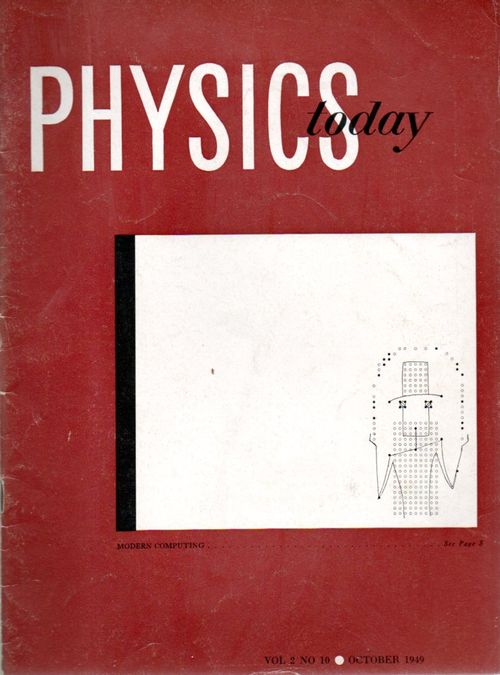
    Computer art153Notes.

    1. This reference was first found in Arthur I. Miller’s Colliding Worlds, (Norton, 2014) on page 66.  Miller is perhaps the most upper tier in upper tier historians of science with the specialty of art/science interface–over the years I have enjoyed his work enormously.

    –See here for a full text of Electronic Abstractions.

    2.  “Electronic Abstractions are a new kind of abstract art. They are beautiful design compositions formed by the combination of electrical wave forms as displayed on a cathode-ray oscilloscope. The exhibit consists of 50 photographs of these patterns . A wide variety of shapes and textures is included. The patterns all have an abstract quality, yet retain a geometrical precision . They are related to various mathematical curves, the intricate tracings of the geometric lathes and pendulum patterns, but show possibilities far beyond these sources of design.”—Sanford Museum, Gallery notes for Electronic Abstractions, 1952 (Wiki)  For a good appreciation of Laposky, see Alison Drain, “Laposky’s Lights Make Visual Music” in Symmetry 4/3, pp 32-33.

    3.  Miller, page 68.

    4. See the following: 

    Noll, A. Michael, “Short-Time Spectrum and Cepstrum Techniques for Vocal-Pitch Detection,” Journal of the Acoustical Society of America, Vol. 36, No. 2, (February 1964), pp. 296–302

    Noll, A. Michael, “Computers and the Visual Arts,” Design and Planning 2: Computers in Design and Communication (Edited by Martin Krampen and Peter Seitz), Hastings House, Publishers, Inc.: New York (1967), pp. 65–79.

    Noll, A. Michael, “The Digital Computer as a Creative Medium,” IEEE Spectrum, Vol. 4, No. 10, (October 1967), pp. 89–95

     Noll, A. Michael, “Choreography and Computers,” Dance Magazine, Vol. XXXXI, No. 1, (January 1967), pp. 43–45

     Noll, A. Michael, “The Effects of Artistic Training on Aesthetic Preferences for Pseudo-Random Computer-Generated Patterns,” The Psychological Record, Vol. 22, No. 4, (Fall 1972), pp 449–462.

     Noll, A. Michael, “Computer-Generated Three-Dimensional Movies,” Computers and Automation, Vol. 14, No. 11, (November 1965), pp. 20-23.

    Noll, A. Michael, “Computer Animation and the Fourth Dimension,” AFIPS Conference Proceedings, Vol. 33, 1968 Fall Joint Computer Conference, Thompson Book Company: Washington, D.C. (1968), pp. 1279-1283

     Noll, A. Michael, “Art Ex Machina,” IEEE Student Journal, Vol. 8, No. 4, (September 1970), pp. 10-14.

    5.  Noll, A. Michael, “Human or Machine: A Subjective Comparison of Piet Mondrian’s ‘Composition with Lines’ and a Computer-Generated Picture,” The Psychological Record, Vol. 16. No. 1, (January 1966), pp. 1–10.

  • In the Enigma Machine Family: the Hagelin Cryptographic Machine, 1942

    JF Ptak Science Books   Post 2320

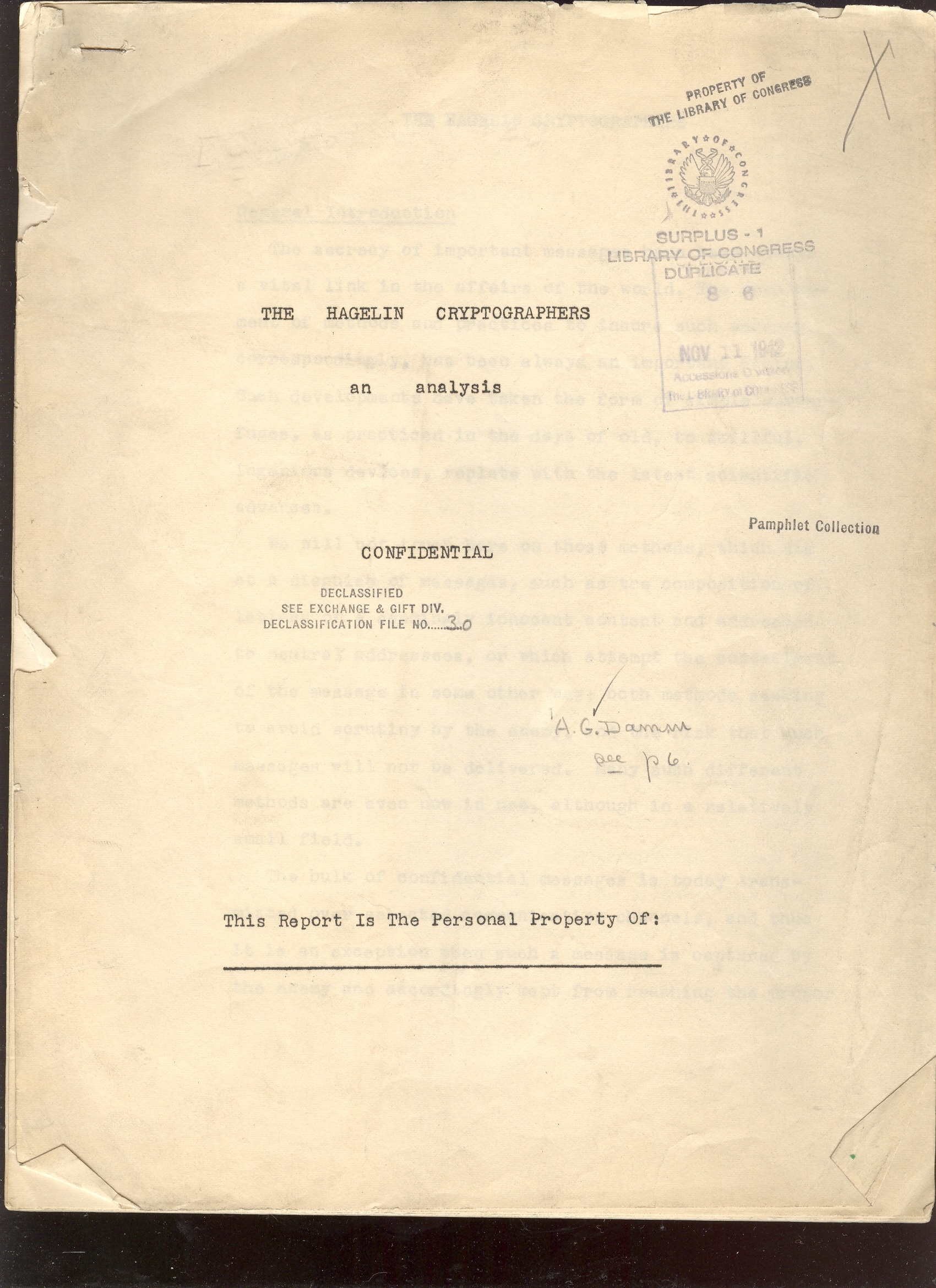
    This is a general report on the origin, development and status of the Hagelin “cryptographers”–a word used here to describe the physical machines (rather than the people working on codes). After his father invested in Aktiebolget Cryptograph, Boris C.W. Hagelin (1892-1983) took over ht leadership of the company in 1925, producing several fine models of encoding crypto machines, using Arthur Scherbius’ (as in the “Scherbius  Principle”, 1878-1929) rotor designs, some of which were marketed under the name “Enigma” (models of which were purchaed by the Wehrmacht in 1926 and modified for heavy use in the ’30’s and through WWII).  The company produced 140,000 units during WWII (while headquartered in the U.S) and is still in business today as Crypto AG, in Zug, Switzerland.

    Books--hagelin

    (The Hagelin Cryptographers, an Analysis. Stamped  CONFIDENTIAL, mimeographed in New York, by Ericsson Telephone,  1942.)    

    Sections in the document include “Models Built at Express Demand of the French Authorities”, “Evolution of Hand Cryptographer Type C-362”, “Hagelin Cryptographer Models” (BC-38 and C-362), “Methods of Operation”, “Superiority of Hagelin Cryptographers over Competing Makes”, and others, including a final section “How to Sell Cryptographers”. There is a mention of the “Enigma” machine on page 14, which is limited to mentioning that it is not sold outside of Germany. Although the Swiss firm founded by Boris Hagelin has manufactured, and continues to manufacture, many kinds of cipher machines, the words “Hagelin machine” will normally inspire thoughts of their unique lug and pin based machines.


  • Red Radio–Found & Manipulated Tech Art

    JF Ptak Science Books   Quick Post

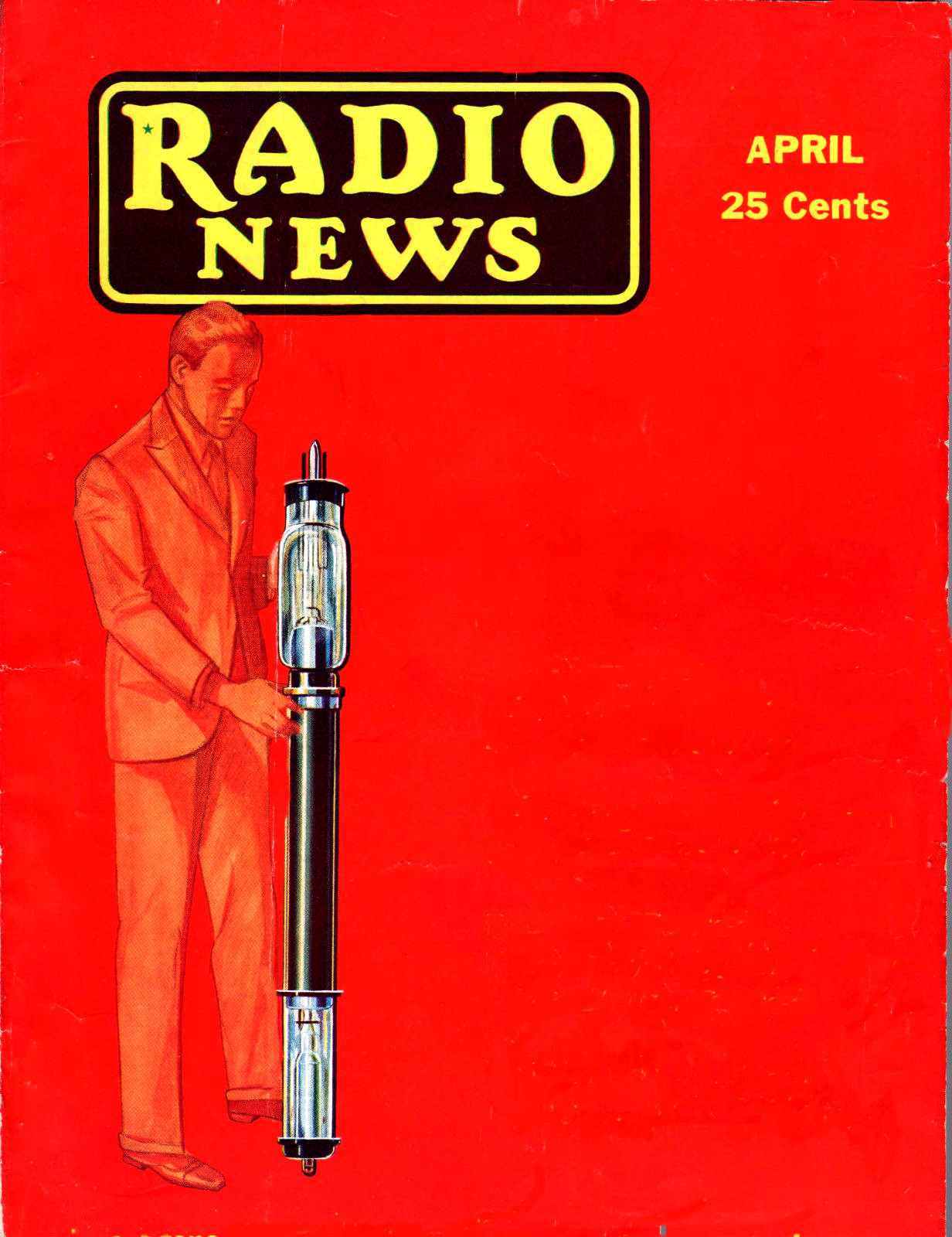
    I just like the cover art for Radio News. For at least the decade that I know about this journal published with very heavily red covers.  This one, for April 1931, was really red and also had some unusual design going on–especially after the cover text was removed. That fellow is standing there with the giant tube that helped the venerable KDKA (Pittsburgh, one of a few contenders for the title of “first commercial radio station” in the U.S.) reach millions of people, with a very powerful 400 kW signal–it basically made the station a local-national. (As it turns out the highest power ever authorized for AM radio was 500 kW to WLW (Cincinnati) in 1934, but which was modified down to 50 KW.)

      Radio News Red[The only manipulation was removing the text from the bottom right that displayed the issue’s contents–everything else is in situ.]


  • A Rare Technical Report on the V-1, 1945, Published in Newly-Liberated Paris

    JF Ptak Science Books   Post 2304

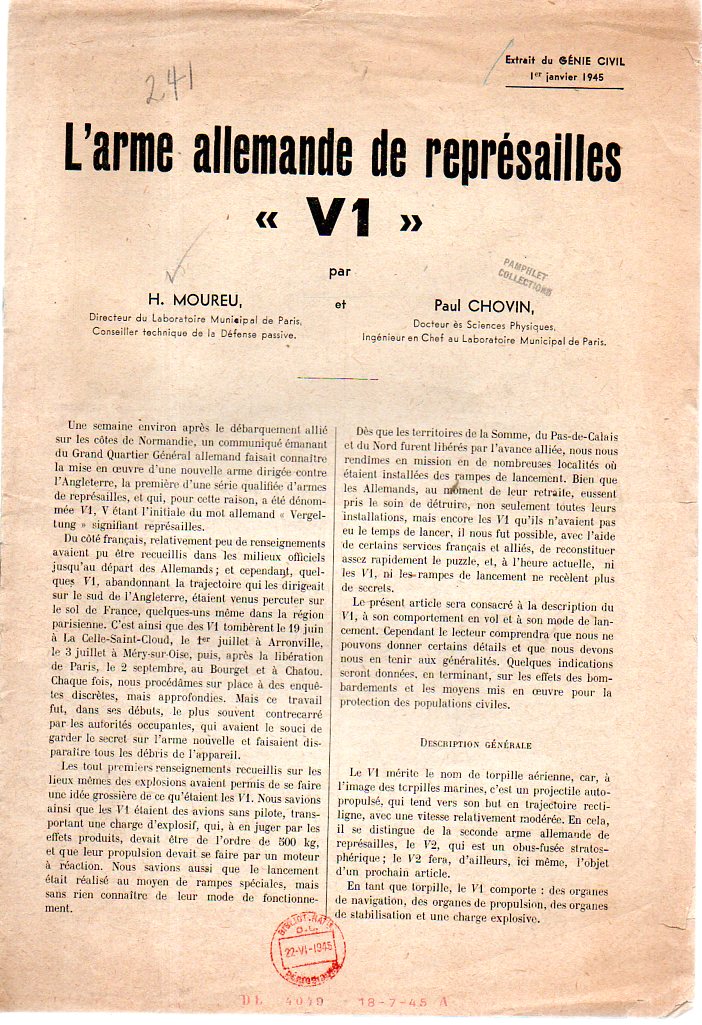
    The eyes of top-ranking Nazis must have popped when they saw this work by Henri Moreau  (1893-1978) and Paul Chovin.  It is a fairly technical paper on the V-1, the progenitor of their supposedly war-ending “secret weapon” the V-2, and to see the data and detail published in a tech journal in the city that was until very recently held in Nazi hands….well, there was very strong irony there.  “L’arme allemande de represailles <<V1>>”, seen here in offprint form, was published in Genie Civil, 1 January 1945–it is eight pages long, and printed in Paris (newly liberated from the German army 25 August 1944) in early 1945.  The offprint itself is a rare thing, with no copies whatsoever located in WorldCat, and nothing floating around on the interwebtubes. I was frankly surprised to find this fairly-well documented piece on the V-1, but no report itself, so I decided to reprint the report in its entirety. Some of the text runs off the side of the scanner, but that is the best I can do in scanning the pamphlet without taking it completely apart. 

    V1519


  • TV Field Trials, the Beginning of Networks, and an Early TV Dinner, 1936

    JF Ptak Science Books  Post 2302

    The first broadcast images in the history of television transmission were revolutionary if not very interesting.  Beginning in 1928 the first experimental Radio Corporation of America (RCA, via the National Broadcasting Company, NBC, its broadcasting division) images were of Felix the Cat, and something that would be received with 60-line clarity on a two-inch display.  For the most part, the daily two-hour broadcasts consisted of Felix or test patterns, broadcast from NYC, until 1931.  

    Tv 1936 set924

    Image quality increased markedly by the 1932 field trials with the use of iconoscope cameras, which allowed for 240-line reception though still with very noticeable flickering. The 1934 trials were improved further to 343 lines and with some less amount of flicker. 


    For the 1936 field test the transmitting station and offices for NBC and RCA were located in the Empire State Builidng (utilzing the mooring mast at the top of the building for the antenna, as well as some of the upper floors for the transmitter and offices on the 52nd floor, while the transmitting studio was located in the RCA building in Rockefeller Center).  The broadcast began on 29 June 1936 from W2XF/W2XK “to an audience of some 75 receivers in the homes of high level RCA staff and a dozen or so sets in a closed circuit viewing room…(in the RCA building)”.1


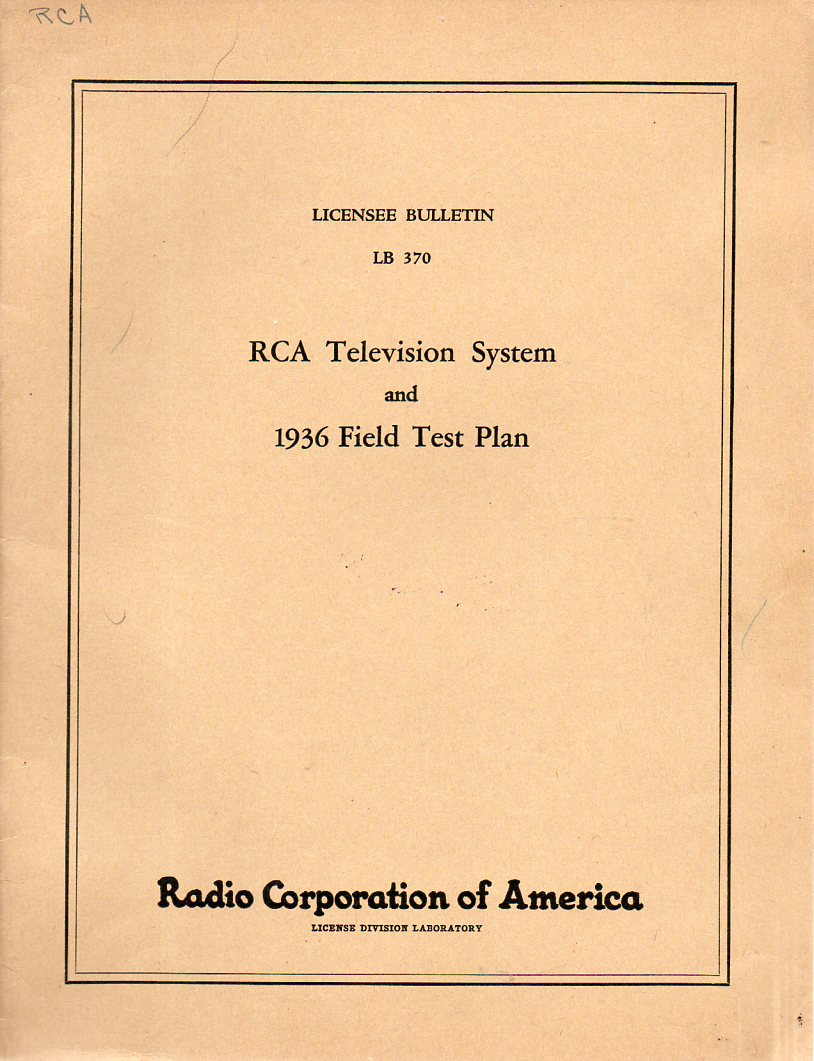
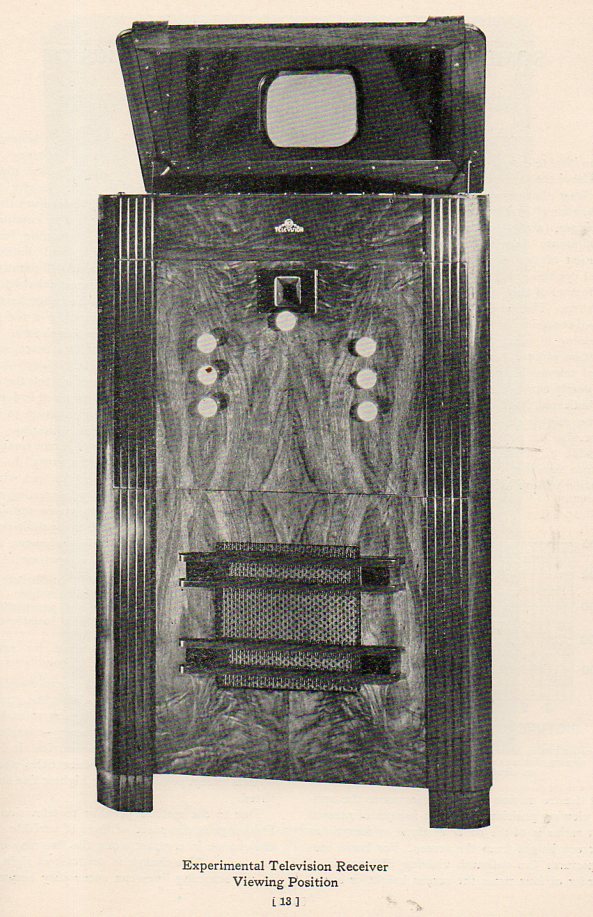
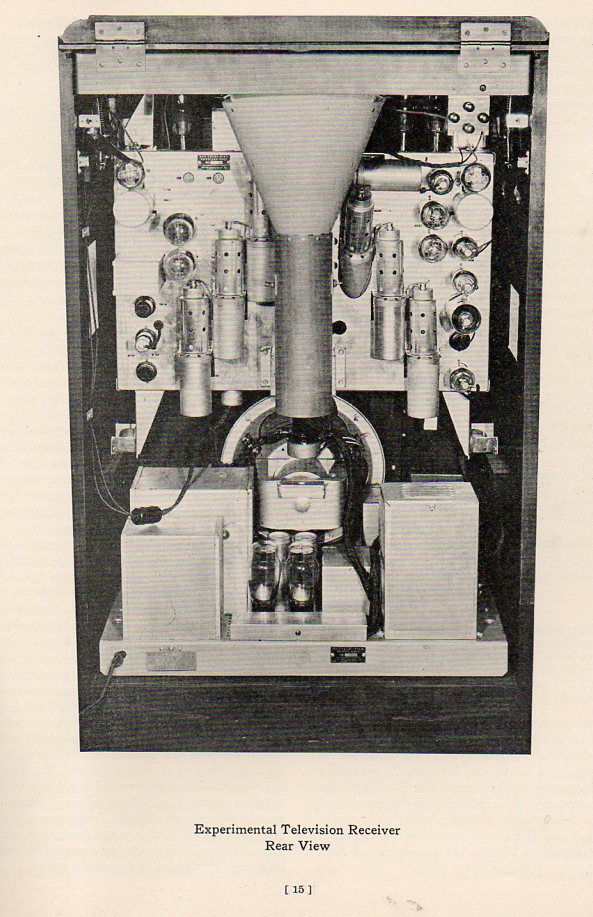
    The rare pamphlet [available for purchase from our blog bookstore, here] that I uncovered in the attic speaks to the first public demonstration. “The first public demonstration of these field trials took place on July 7, 1936 to RCA’s 225 licensees. Major General J. G. Harbord, chairman of the board of RCA announced that there were three sets in operation at the time, the most distant in Harrison, N. J.”2  It addresses the history of the field tests as well as the tech specs for the 1936 test, as well as the need to address the fuller and complicated issues of establishing a network of transmission capabilities:  “Television services required the creation of a system, not merely the commercial development of apparatus.”–July, 1936, RCA Field Test Plan, page 8.

    The set on which the transmission was received was the RCA RR-359 trial set:

    Tv 1936 set922
    and the innards:

    Tv 1936 set923

     Notes:

    1.  See The Television Museum, at Earlytelevision.org, here.

    2.  The Early Television Museum, located here.

    ·Posted by :

    ·in:


  • Single-Line Entries of Revolutionary Ideas: the Transistor, (1949)

    JF Ptak Science Books   Post 2298

    Transistor 066
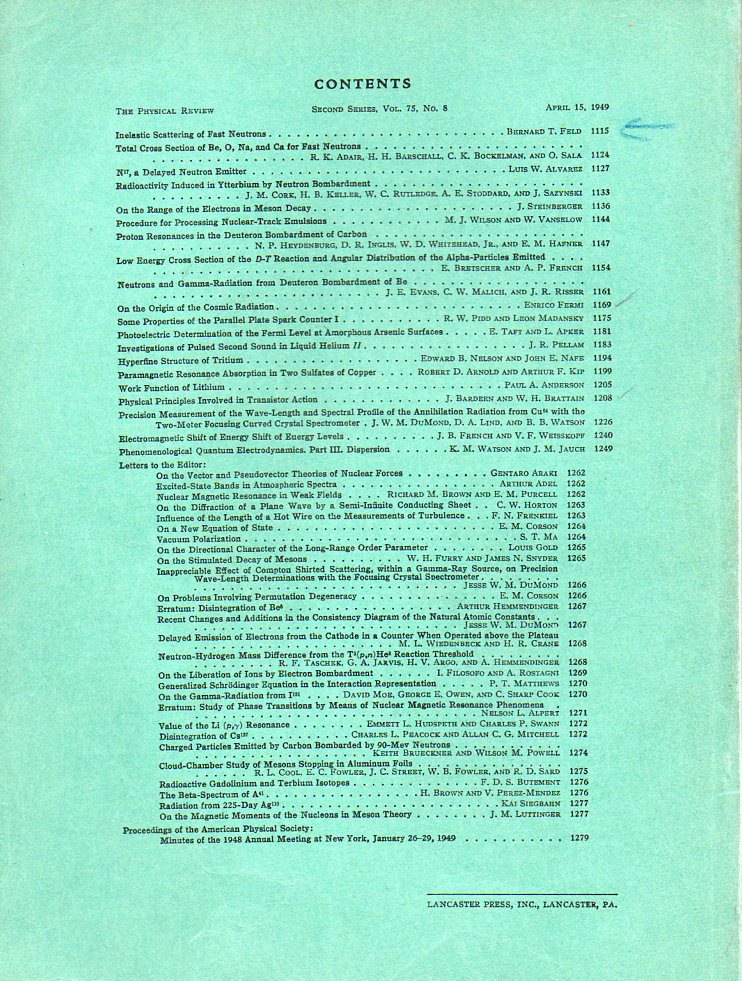
    One of the things I love about working my way through old scientific journals is when I find the issue that I’m looking for and scroll down the list of contributors to find the significant article that I want.  Long list, usually; and then, after making my way through 30 or 40 lines of tight type of the index I find it. [This by the way is one of those experiences that is being replaced by the digital library.]   Even though the paper on pp 1208 through 1226  of the 15 April 1949 issue of The Physical Review looks like any other, it is today seen as revolutionary. The entry for “Physical Principles Involved in Transistor Action” by John Bardeen (two-time Nobel in physics) and Walter Brattain (Nobel ’72) shows up about halfway down the index, sandwiched in some very good company (Enrico Fermi’s “Origins of Cosmic Radiation” and a number of others), and does not show up bolded, or highlighted, or with an asterisk.  Such is the nature of publication in the academic journal world, everything delivered with equal weight–the bolding stuff will happen later, in other venues.  But to see it right there in the flesh, so to speak, fresh and new and revolutionary, and looking like everything else, is really thrilling.  [See this entry for a similar report on the most valuable patent in history.]

    Transistor 064

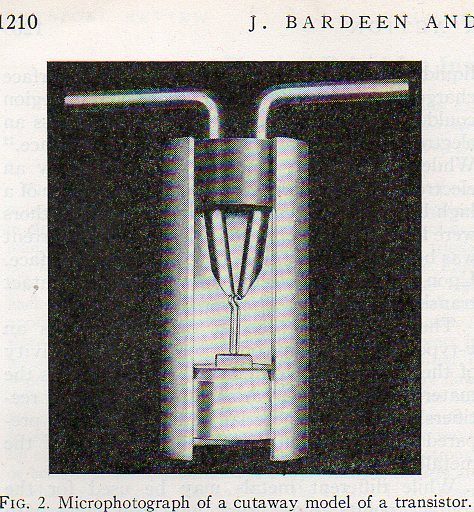
    It makes me wonder though how it would’ve felt to open this journal for the first time back there in mid-April ’49, turning to page 1210 to see the microphotograph of the cutaway of a model of the transistor.  This was the defining technical publication on the transistor1, which was the first massive step towards microminiaturization and the explosive new growth in the computer, allowing far more powerful machines to be designed in far less space, in far less amounts of time, and on and on.  It is one of the first steps in the Information Revolution, moving the computer from massive racks of electronic tubes to more simple, elegant, nimble and by-far faster circuit boards with transistors (and resistors, capacitors, inductors, diodes, etc.) to make an electronic circuit.  This would be the standard for computer construction, only supplemented by Jack Kilby (TI)  and Robert Noyce (Fairchild Camera) in 1958/9 with the integrated circuit, where transistors are made smaller still and produced in groups on circuit boards rather than individually.

    The photo above shows a cutaway of the transistor, and is the first time it was published–the first photo of what was one of the 20th century’s greatest inventions. 

    Transistor 065

    Notes

    1.  The paper was published simultaneously in the Bell System Technical Journal; Bardeen and Brattain were with the Bell Labs.  The Bell journal also contained another revolutionary paper in the same volume, Claude Shannon’s “Communication Theory of Secrecy Systems”, which is one of the most important early papers on electronics and cryptology.

    The full bit: BARDEEN,  John and Walter Brattain:  Physical Principles Involved in Transistor Action;  Lancaster, Pa:  Physical Review,  1949.  1st edition.  The Physical Review, Vol 75, Second Series, No. 8    8vo.


  • Early Robots as Explosive Anthropomorphs

    JF Ptak Science Books   Quick Post

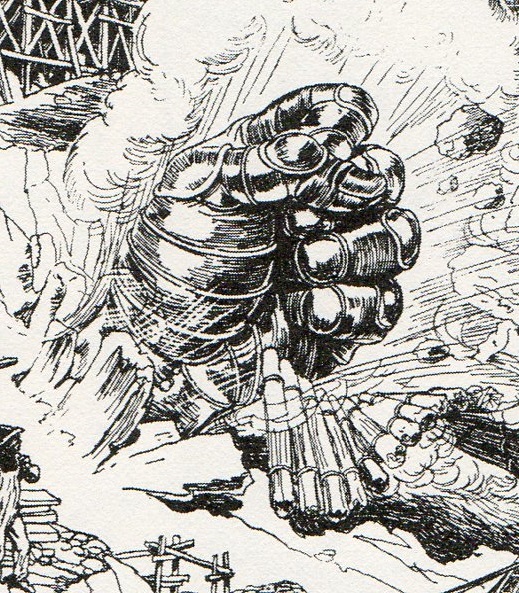
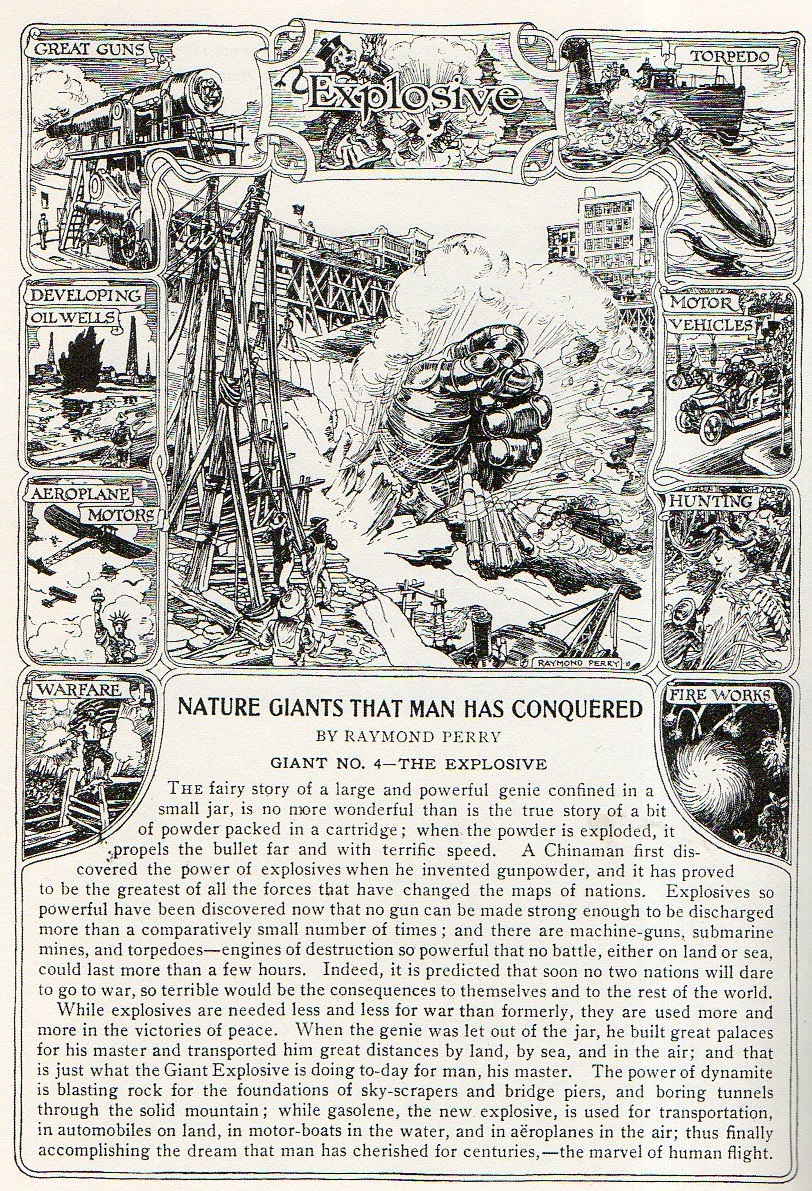
    I have been collecting images of mechanical men/robots pre-singularity antiquarian-quaint displays of advanced technical humans.  This is an unusual one that may or may not fit this, though there is a suggestion of MassiveMan in the gigantic metallic fist, which is supposed to show a successful combat of people over nature via the advancing bliss of explosives.  I’d just like to post this here before I lose it…

    Nature giants262

    Which is a detail from St. Nicholas magazine, 1911:

    Nature giants261