A Daily History of Holes, Dots, Lines, Science, History, Math, Physics, Art, the Unintentional Absurd, Architecture, Maps, Data Visualization, Blank and Missing Things, and so on. |1.6 million words, 7500 images, 4.9 million hits| Press & appearances in The Times, Le Figaro, Mensa, The Economist, The Guardian, Discovery News, Slate, Le Monde, Sci American Blogs, Le Pont, and many other places… 5000+ total posts since 2008.

Category: Technology, History of

  • History of Lines series: the Geometry of Cannon-Fire (1812)

    JF Ptak Science Books   Post 2369
    Cannons ha003
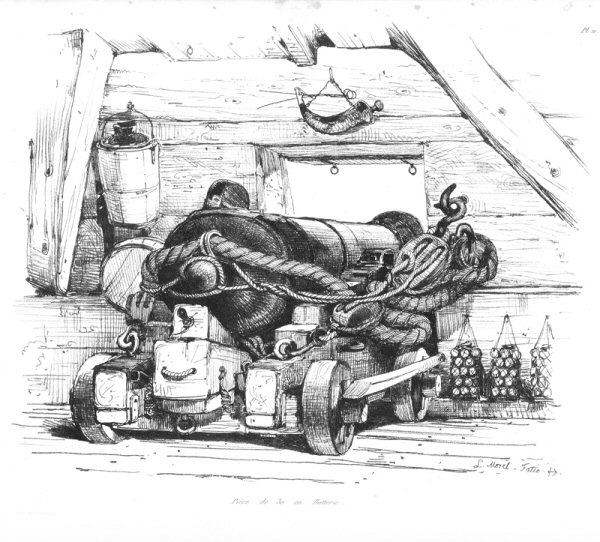
    There were many integral components to firing a cannon on a ship, not the least of which were the Powder Boys, the small, young, semi-strong kids who would run the gunpowder from a below-decks armory to whatever gun deck was needed.  It was a relatively simple procedure, filling up a longish tube (cannon  derived from the Italian  cannone–or large tube–which came from the Latin canna from the Greek  kannē , meaning something like a reed or any similar hollow thing) with gunpowder and then cannonball/shot and then wad, then causing the gunpowder/propellant to ignite and throw the ball.  Basically, that was it, though you needed to maintain the cannon, aim it, and so on (don’t forget to first swab the bore from unexploded gunpowder so you don’t blow things up!).

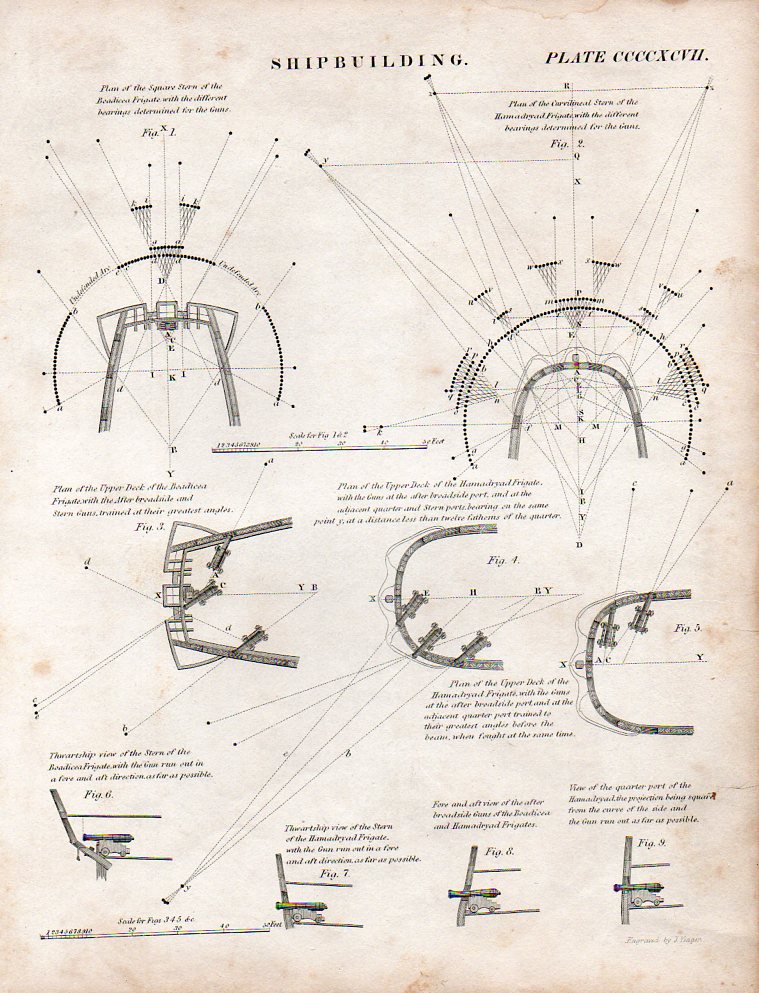
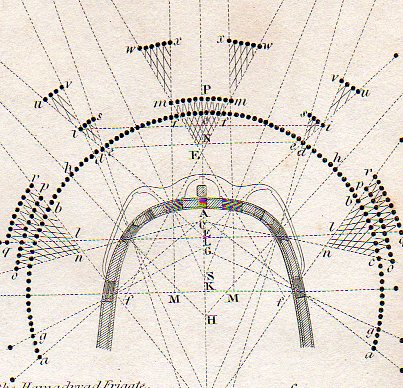
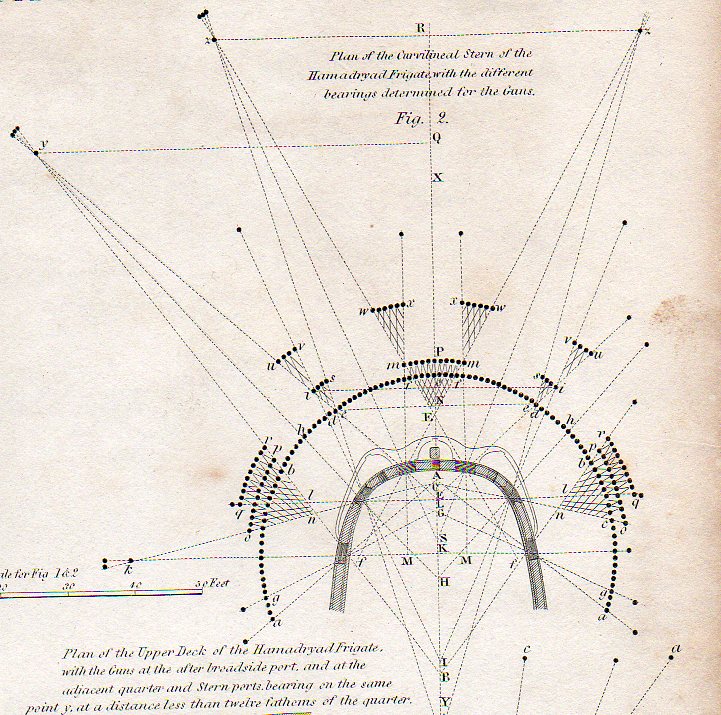
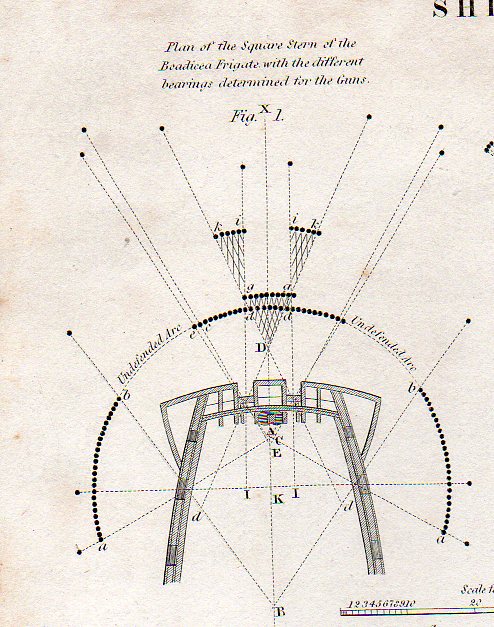
    The (first)  image above of found modernist/semi-dadaist artwork comes form 1812 and was found in Rees’ Encyclopedic Dictionary from the article on “Shipbuilidng”   and illustrates the ways in which the stern of a ship can be outfitted with cannons–actually, the sterns of the HMS Bodiceae (28 18-pounders)  and HMS Hamadryad  (36 guns). Also by this time cannons had been carried on naval ships for nearly four hundred years, while the first cannons appeared on the ground in Europe another few hundred years before that. 
    Cannons ha002


    In the third detail (below) we see the coverage of the four cannons placed in the stern of the Bodicae, mainly pointing out its weaknesses, showing the undefended arc, which comprises about 1/3, or about 60 degrees of the defensive posture.  The Hamadryad on the other hand shows 100% coverage of the 180+ degrees of attack possibilities shown, along with secondary and teriary areas of fire coverage covered by more than one gun.
    Cannons b004 

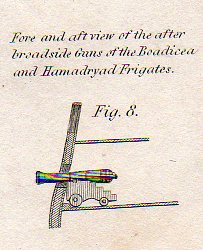
    A fine,tiny detail from the full engraved sheet:
    Cannons little005And the full sheet:

      Cannons001

    This is pretty much all that was needed to fire a cannon, except the men of course.
    File:Antoine Morel-Fatio pl10.jpg


  • The Deceive-o-Scope–the Motion Picture in 1848

    JF Ptak Science Books    Post 2364

    The moving picture is at base a deception, a series of still shots shown/projected/viewed in order at 16 or 24 or 48 or 60 frames per second (although a new and incredible slow-motion device records at a billion fps) which is enough to allow the brain to fill in the connections in-between the frame with the latent image (persistence of vision) so that our mind perceives that the display is continuous.  The first mechanical approximations of what we think of as the motion picture came into being at about the same time (as these things do happen) and mostly independent of one another.
    Plateau491

    [Image:  J. Mueller, Principles of Physics and Meteorology, published in Philadelphia, 1848, image on page 311.]

    The biggest name in this small group is Joseph Plateau (1801-1883), who constructed a two-disk slotted device in 1832, just at the same time as Simon Ritter von Stampfer (1792-1864, working in Vienna) constructed his own version.  Plateau called his the Phenakisticope; von Ritter, the Stroboscope–Plateau’s invention is Greek for what is essentially the title of this post.

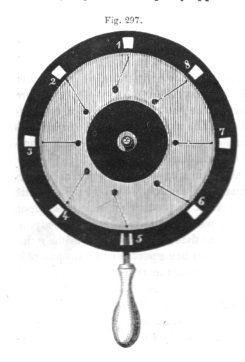
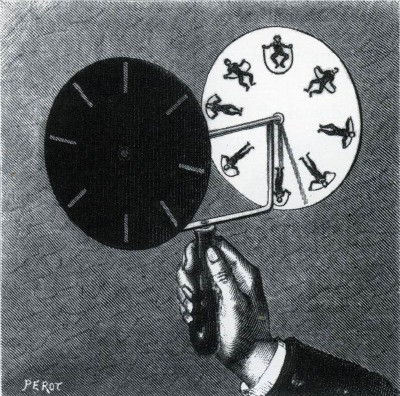
    The device was relatively simple for the effect it produced and future that it held–in one iteration it was a slotted disk on which 12 or 16 images of successive motion appeared; when spun and observed through one of the slots in front of a mirror, the images seem to come alive, moving in one fluid-ish motion.  There are other models (as shown below) though the principle and effect are the same.

     Plateau

    This was not the earliest attempt at animated motion, though it is the first that comes to resemble what would appear about 60 years later and what we could recognize as a “motion picture” but without the film.  For centuries before this there was entertainment via moving shadows cast by paper/wooden puppets in Shadow Shows (actors using figurines positioned between a light source and a white cloth/screen on which the shadows were projected.  Of course there was also this effect using the hands, with instructionals appearing in book to appeal to the Victorian parlor adult and child (like “Frank Fireside’s” Lights and Shadows on the Wall, a Handy Amusement for Winter Evenings, which actually appeared a little after the Plateau invention but which was cheaper). In the field of applied optics there was the magic lantern, a 17th century invention (though it shows up i the Leonardo notebooks) and appearing in the remarkable Athanasius Kircher’s (S.J>!) Ars MAgna Lucis et Umbrae in 1646. A bit later in the hands of Joahannes Zahn came the Kircher idea but with a sliding disk with several images on it that when projected and moved from left to right suggested movement.  The magic lantern was usually used within or behind an audience and projected forward–Robertson raised the ante on this by being one of those in the 1840’s who projected the images from behind a scree that was in front of the audience, so that the appearance of the images was unforeseen, with shocking results (and thus the naming of his apparatus quite appropriately The Phantasmagoria). 

    Permanent capture of these images would come several years later with the invention of Daguerre in 1839 though that would not come into effect for moving pictures for another 50 years or so. A stop-action photograph of a continuous event would come slightly before that, naturally, with the work of Eadward Mybridge and Etienne Marey whose results were produced in the early 1880’s. Edison’s kinetoscope would come in the early 1890’s and produce the first projected moving images, though there are many other names besides Edison who could lay claim for bring the inventor of cinema, and who are all at least pioneers of the genre, including Le Prince, Varley, Friese-Greene, Dickson, and Sklandanowsky. And most of that pre-history occurred here, with Plateau and Cie. 

    It is interesting that in the short span between Plateau and the publication of the first image in Muller’s work in 1848 that so many other events in the history of science occurred that, in effect, segmented and expanded understanding of previously quick and discrete events.  Like Morse’s telegraph (1837), Theodor Schwann’s cell division (1838), Murchison’s silurian system/stratigraphy, Meyer’s conservation of energy (1842), Doppler’s effect (1842), Joule’s conservation of energy (1847), and of course, Daguerre’s invention of photography. 

    ·Posted by :

    ·in:


  • The Fabulously Thorough Instructional on Using a Telephone, 1946

    JF Ptak Science Books   Quick Post

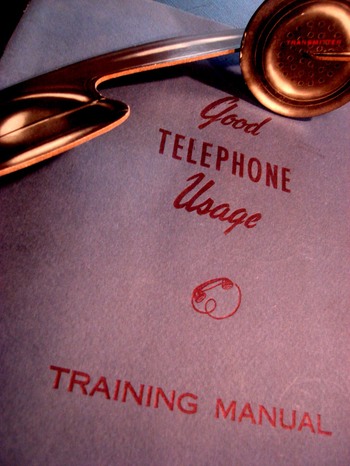
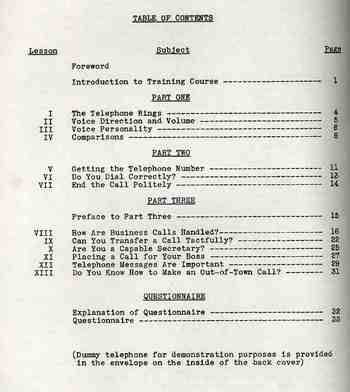
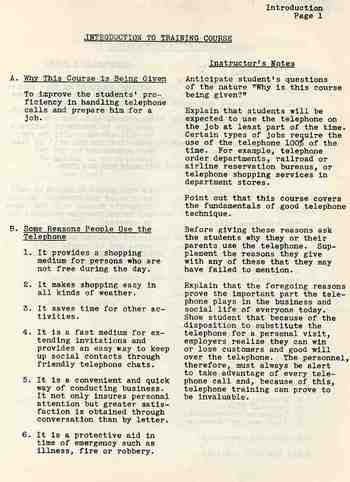
    Yes, this elegant, oversized, well written 1946 pamphlet explains in fabulous and excruciating detail how to use the telephone–and it does indeed come with a two-part heavy paper telephone receiver for the reader’s practice. It is packaged in an envelope in the back of the pamphlet with a large drawing explaining how to put the two pieces together.   The work is just so fulsome, wholesome, forthright, exacting and thorough that it just makes the casual reader stop in their tracks to applaud the effort of explanaion.  For example, it isn’t until page 13 that we get to pick up the receiver (and listen for the dial tone). I’ve reproduced some of the table of contents to give an idea of the extent of the telephone usage. 

    Ballistics_049

    What brings this so close to being from out of the science fiction past is that the booklet is ten years older than your narrator.  Atanasoff’s ABC, Bell Labs Mark II, Bletchley’s  Colossus, and Harvard’s Mark I machines existed, television was begnning to explode and half-doom radio for all time, and telephones were on their semi-last-leg of exploding their way into more American homes and businesses.  But somehow, here on the verge of the greatest electrical revolution in history, we were getting instructions on how to pick up the telephone.  But I’m really not complaining here, not at all–its just the nexus of the “how to listen for a dial tone” and the coming of the ENIAC one year after this pamphlet is published that is so startling.

    Even so, this instructional is more complete and (of course) better written than any of the computer manuals that came with any of the machines that I’ve purchase in the last 30 years. It is a thing of great and supra-obvious beauty.

    This is another example of a small job done Very Correctly.

    Blogsept3_tele489  

    Blogsept3_tele490


    ·Posted by :

    ·in:


  • A Picture of Sound, 1923

    JF Ptak Science Books  Post 2350                                                                                              The What is It? series

    Talkie detail


    Talkie383

    [Source: author’s collection] 

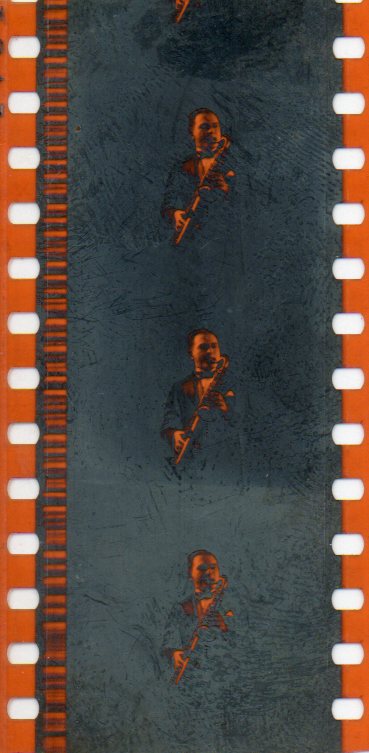
    This is a three-frame snippet from what is evidently among the first true talking motion pictures. It was engineered by Lee de Forest (1873-1961, inventor of the first triode vacuum tube, the Audion, in 1906, earning him the sobriquet of “the Father of radio”) and shown in NYC in December, 1923, which was nearly three years ahead of what is commonly thought to be the first ‘talkie”, the Al Jolson vehicle The Jazz Singer (1926).  Although not truly a first/first, The Jazz Singer was certainly the first mass-distributed talkie, and the first monetarily successful one.  The de Forest film was a sound-on-film motion picture, which represented the culmination of efforts to reproduce sound in the movies by many different practices, none nearly as successful as synching up the sound/film so that there was no displacement between the two.  Here wwe see the sound as the horizontal bars running along the left-side of the film, which in effect is the visualization of the medium of the movie industry to come. (The attempts at sound motion pictures are almost as old as the pictures themselves, the earliest version being simple recordings of the audio on a disk, then played along with the showing of the movie in two different systems.  Compared to nothing at all, these advances were very notable, especially if the timing between the two elements wasn’t off by very much.  These of course failed entirely in the face of the sound-on-film advancement.)  

    The breakthrough by de Forest turns out to be one of those stories where the inventor and brains behind the technological advance tries to implement and market the thing themselves, only to fail at the economic aspects of a great invention.  

    Film from the estate of Harold Sunde (1910-1991), who was responsible for the explanation and demonstration of the RCA “Photophone” invention–one of the earliest simultaneous sound-on-film recorders and projectors, and introduced the machine to England and Russia, where true sound-on- film motion pictures were seen for the first time.  

    ·Posted by :

    ·in:

    —

  • Tech Quiz: Oblivious/Careless Chaos-Catcher, 1894

    JF Ptak Science Books   Quick Post      Tech Quiz/What is It? series

    This is an addition to the infrequently-seen What is It? series of this blog…

    Okay, so I’ve given it away in the title–if not for that, this wouldn’t be a very obvious contraption, would it?  

    People catcher detail

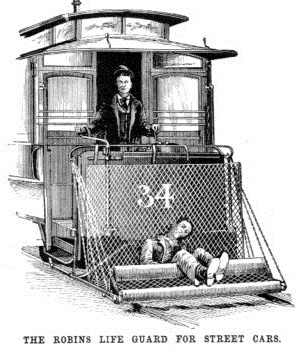
    There must have been a lot of people who had a problem with street cars in the 19th and early 20th centuries because in my meanderings through the Scientific American I have seen quite a few suggestions for dealing with the pedestrian vs the heavy moving metal problem. Many of them have to do with the humanified locomotive cow-catcher–that is an apparatus that would somewhat safely scoop up the unfortunate pedestrian before they became very fatally unfortunate.  Here’s just one example, found in the February 3, 1894 issue:


    Pepople catcher380

    Neither the scoopee nor the scooper look pleased.  

    This problem is better illustrated by an early film of street traffic–it is amazing in a way that the orchestration of non-fatalities is so seemingly superb, the coercive element of the destruction of liminal space pretty well hidden in the seeming confusion. 

     [Via youtube, “From trolley, down Broadway and Union Square. Street scenes, stores, crowds, carriages.–Early 1900’s”]


  • The Plane-Train and the Elimination of Curves, 1894

    JF Ptak Science Books   Quick Post

    Plane-train376

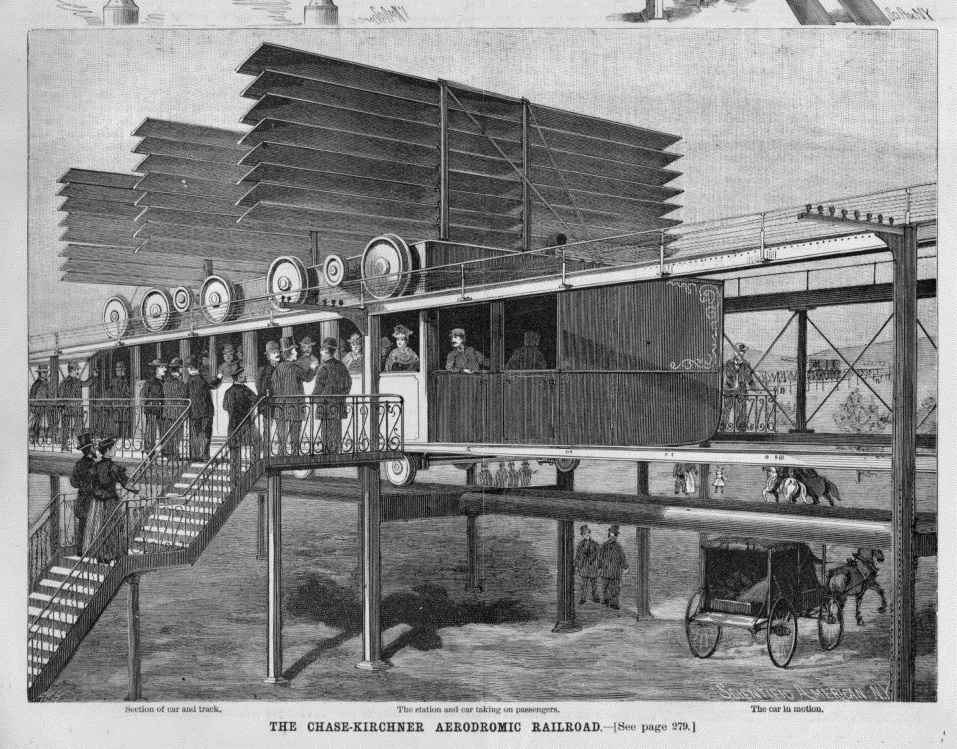
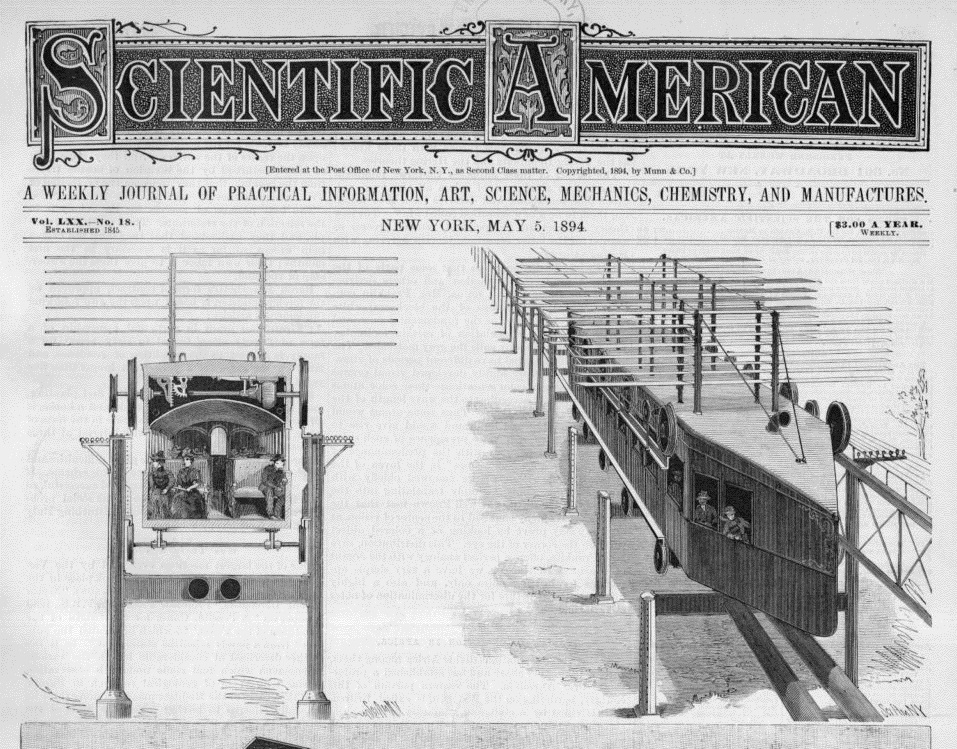
    In the history of transportation there haven’t been many marriages between trains and planes.  There have been proposals for Trains-Boats as we’ve seen in proposals for transporting ocean-going ships on a ganged series of railway cars and pulled  x-number of locomotives across the isthmus of Tehauntapec. I also recall a Balloon-Tramway-Train where hot air balloons were guided along a particular harnessed route 50 feet above the ground for miles and miles.  But the plane-train not found on the covers of Popular Mechanics in the 1930’s and 1940’s is a rare sight. I did spot a fantastic example of one though on the front page of the Scientific American for May 5, 1894. 

    Plane-train377

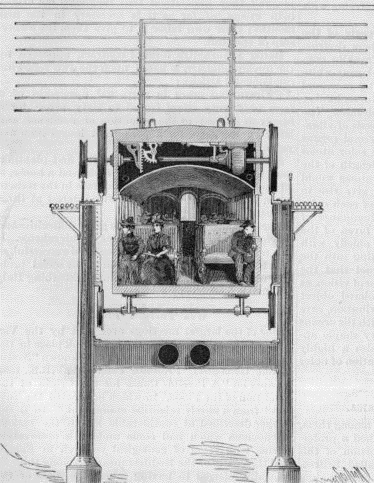
    It is a splendid beast–electric, under-powered, very heavy, and full of friction.  Somehow the engineers envisioned the train reaching speeds of over 130 mph, and with speeds this great it was essential that all curves be removed from the coast-to-coast rail line, making this a straight shot from coast-to-coast, literally.  (This would have just about doubled the land-speed record for sustained travel by rail, by steam.  I’m not sure what the record was for electric trains, though I’m pretty sure it is safe to assume it wasn’t close to the steam record.)

    The part about removing curves was mentioned twice in the article, so it was definitely not a typo.  The adjustable wings (here called “aeroplanes” which was the beginning of the terms that we now use to describe the whole aircraft) were added because it was felt that they would provide (some sort of) lift to the train. At the very least it was an interesting idea for 1894, and the wings would certainly have served a function of slowing the train down if they didn’t get ripped apart in the process.  

    Plane-train378


  • A Great Ad for the Comptometer, 1894

    JF Ptak Science Books   Quick Post

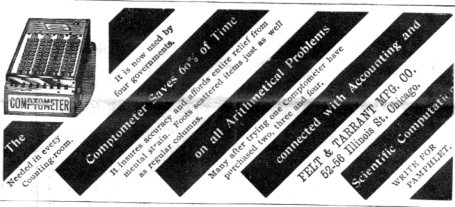
    Earlier in this blog I posted a magnificent illustration of the fabulous new comptometer adding/calculating machine, here.  I wanted to include this unusually designed ad for the machine somewhere on the blog before I lost it (again), and so here it is:

    Comptometer379In my experience the use of diagonal black-and-white lines like this for illustration or advertisements was really very uncommon.  


  • Visionary and Imaginary Speed–and, of course, the Ice People

    JF Ptak Science Books                                                     

    The ‘twenties is know as the “speed” decade—everything was going faster, increasing its speed, expanding to the limit:  this was true for the ability to communicate via telephone, the appearance of commercial radio, the great increase in the speed of trains and planes and automobiles; the music was fast, the movies were talking. 

      Rocket german

    There are many iconic images relating speed and the roaring twenties—generally though this spectacular cover for Otto Willi Gail’s Mit Raketenkraft ins Weltenal…vom Feurerwagen zum Raumschiff (1928)is much less frequently seen, though it certainly does get the message across.  Otto Gail was a creative German science fact and science fiction writer with a strong background in following the scientific and technical accomplishment in rocketry of the age, especially the works of Max Valier1 and Hermann Oberth2. Raketenkraft was more a peek into the future and pop techy work for kids than a straight-out scifi novel like his The Moon Stone, which was a story that brought us Atlantis, space travel and hidden ancient culture in the underground Ice World.

    Gail, ott--stone moon

    It’s the unfortunate Ice World that attracts my attention around Gail, swimming around his interesting and tech-involved scifi world like a melting and failing Moon made of hundred-year NYC garbage scows, the idea of a good engineer-turned-trash cosmologist named Hans Horbiger, whose ideas wound up being whispered into the ears of many monsters. Horbiger had some sort of vision-dream about stuff in 1894 and spent the next 30+ years fleshing out the idea, which sounds bad from the very start when the author admits to finding “Newton wrong”.  Anyway without losing too many minutes thinking about this time-hole, Horbiger’s theory worked ice up to being the primary and primordial ingredient of all processes in the universe, with ice planets circled by ice moons, and some sort of gooey ice ether to make it all go ‘round. Oh yes: there were superior ice people living in the interior of the earth.  Horbiger died in 1931, but his many followers managed to work the theory into a presentable Jewish-baiting anti-relativity Deutsche Physik form for the new government of Adolph Hitler in 1933, and it was there that his ideas took hold in the cancerous Himmler and Hitler and others, a happy marriage at last, the ridiculous to the unspeakable. I’m not sure where the ice people are today, but I did saw some awful History Channel show that stated that Hitler never did die in the bunker and was removed by submarine to the interior ice people of earth, flying around the insides of our globe “in a UFO”.

    And so I associate poor Gail (1896-1956) with the Horbiger mess, and not his good work in science reporting and popularization.  So it goes.

    Gail, otto ice theory

    The other thing that you can say about Horbiger—he had a full-out behemothian mustache.  That’s about it.

    Notes

    1. Valier seems to have been the first person  killed in a rocket-related incident, blistered by his exploding rocket-car.

    2.  Oberth is another one of those Germans working at Peenemunde (along with Wernher von Braun and a great host of others)  trying to kill as many people in the UK as possible who wound up in Huntsville, working for our government.  It is all so problematic.  It is interesting that there is little in the Air and Space Museum (as part of the Smithsonian system)  that mentions von Braun.  He is burioed in a simple grave in a cemetery next door to a Jewish cemetery in Alexandria , Virginia.  I also remember going to some restaurant in the diamond district that, in very high bad taste, served up a beer called the Wernher von Brown–von Braun certainly had his hands covered in Jewish blood at least to the wrists, and to have a product so stupidly named as that in that place was just one of those impossible things that happen every day.

    ·Posted by :

    ·in:


  • Old Electronic Brains: 1950

    JF Ptak Science Books   Post 2349

    Berkeley simon915

     
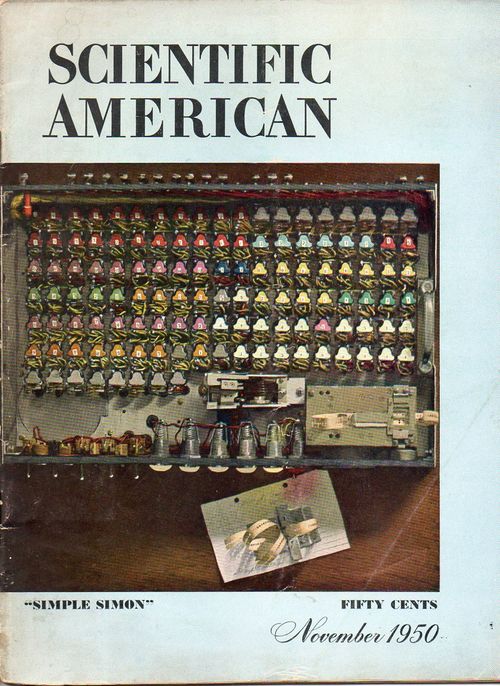
    The first exposure of the American public in general to a “personal computer” may have been in this issue1 of the Scientific American for November 1950–an article called “Simple Simon” by Edmund Berkeley.  ( Berkeley also wrote a book called Giant Brains, which seems to me to be the first mass-consumption book–written in terns for the general public–on how the computer works, and the design of “how a machine will think”.  Berkeley looks at the MIT Differential Analyzer #2, the Moore School ENIAC, Bell Labs’ General-Purpose Relay Calculator, and the IBM Automatic Sequence-Controlled Calculator.) 

    The Simon was a five-hole paper tape (which was its data entry and memory) 2-bit storage relay-based computer that could use numbers from 0 to 3.  It was extremely limited, but it worked, and it was real.  And affordable.  And a baseline for things to come.

    Berkeley introduced the idea for Simon in Giant Brains:

    “We shall now consider how we can design a very simple machine that will think.. Let us call it Simon, because of its predecessor, Simple Simon… Simon is so simple and so small in fact that it could be built to fill up less space than a grocery-store box; about four cubic feet….It may seem that a simple model of a mechanical brain like Simon is of no great practical use. On the contrary, Simon has the same use in instruction as a set of simple chemical experiments has: to stimulate thinking and understanding, and to produce training and skill. A training course on mechanical brains could very well include the construction of a simple model mechanical brain, as an exercise…”–Edmund Berkeley, in Giant Brains, 1949, p. 22 

    In the Scientific American paper Berkeley introduced the machine and how it functioned; he also described three  three outcomes for Simon:

    • First: “Simon itself can grow.  It possess all the essentials of a mechanical brain…”
    • Second: “It is likely to stimulate the building of other small mechanical brains.  Perhaps the simplicity and relatively low cost of such machines may make them attractive to amateurs as the radio set and the small telescope.”  [The “low cost” in 1951 was $600–equal to about $3000 today.]
    • Third:  “It may stimulate thought and discussion on the philosophical and social implications of machines that handle information…”

    Berkeley finishes the three-page article with the following paragraph, looking into the not-too-distant future:

    “Some day we may even have small computers in our homes, drawing their energy from electric-power lines like refrigerators or radios … They may recall facts for us that we would have trouble remembering. They may calculate accounts and income taxes. Schoolboys with homework may seek their help. They may even run through and list combinations of possibilities that we need to consider in making important decisions. We may find the future full of mechanical brains working about us.”

    Scientific American in that same year published another early computer effort of high marks: the great Claude Shannon’s “A Chess-Playing Machine.” This is the first (and popular) appearance of Shannon’s technical paper (which would appear a month later in the Philosophical Magazine), and it is the earliest appearance of an attempt to understand the necessities of a computer for playing a game of chess.

    “Since the mid-1940s, scientists had aimed to create a thinking machine, an apparatus that could compete with or even surpass the human brain in logical operations, pattern recognition, problem solving and even language. Chess was found to be a useful testing ground because of its combination of simple rules and mind-bending complexity… Shannon was fascinated by chess’ potential in the pursuit of what he called ‘mechanized thinking.’ But he became convinced that computer chess and other AI pursuits should not be modeled on human thought… Computers, at least as they were understood then, could calculate very quickly, following programmed instructions. This particular strength—and limitation—of computers suggested a different route for AI, a new sort of quasi-intelligence based on mathematical computation. Chess would be a central proving ground for this new type of intelligence. Theoretically, at least, the game could be fully converted into one long mathematical formula” –David Shenk, The Immortal Game of Chess, pp 201.

    This was another fantastic advance in thinking about computers and their applications at a very early stage of the computer game–perhaps more so with Berkeley than with Shannon, at least for the popular consumption end. In any event, they are both very interesting papers.  

    Notes

    1. Berkeley, E.C. (1950). “Simple Simon” in Scientific American No. 183, November 1950, pp. 40-43. 

    2. Shannon,  Claude E. “A Chess-Playing Machine.” New York:  Scientific American,  1950. Volume 182, No. 2, February 1950, pp 48-52.


  • The Physics and Non-physics of Catching a Baseball

    JF Ptak Science Books  Post 2348

    If I was a Nazi going back in time and given the opportunity to assassinate five allied leaders to change the direction of the war, I’m pretty sure that one of my choices would be Vannevar (that’s “van ee var” Bush (not related to you-know-who).1  He was the head of the Office of Scientific Research and Development (OSRD) for the U.S. for World War II, which is saying A LOT.  It was his responsibility to determine where and how to apply effort and brainpower and money for the best outcome to win the war–and he did a fabulous job.  Wasted effort/money/power/intelligence costs a lot, especially during wartime, and Bush did an absolutely superior job in performing this task. He was also a great engineer, a fine creator of analog calculators; he was a visionary and often is referred to as the grandfather of the internet; he was VP of MIT, and many other things, on and on.  

    However, in his grand opus one thing he wrote was that baseball was not a scientific game.

    I’m pretty sure he was joking around because the game is all angles of motion and repose (and a lot of the later), of effort and response, and in the immortal words of the Great Beakman (of TV science show for kids fame), “everything goes somewhere”.  

    Bush chose to leave a little mystery in the game when he wrote about it in Science is Not Enough, (1967) in the essay “When Bat Meets Ball”. The pitch, the crack of the bat,the flight of the ball, the outfielder turning instantly to get to the place where he thinks he needs to be, calculating all of this on the fly so that he can catch the ball, is in some sense like tracking enemy aircraft or an ABM.  The outfielder, running along, has sorta figured out the velocity of the pitch and the angle at which the ball leaves the bat, figuring out acceleration, elevation, and manipulates it all in his head to sand in a certain grassy spot to be in exact location to interfere with the ball’s response to all of the vertical and horizontal displacements and the work of gravity to return it to its initial altitude of 0 (+the distance of the glove to the ground).  Which is all pretty cool stuff, and it happens it the rain or wind or whatever conditions and perhaps with a hurt ankle, all of which get tossed into the equations.  

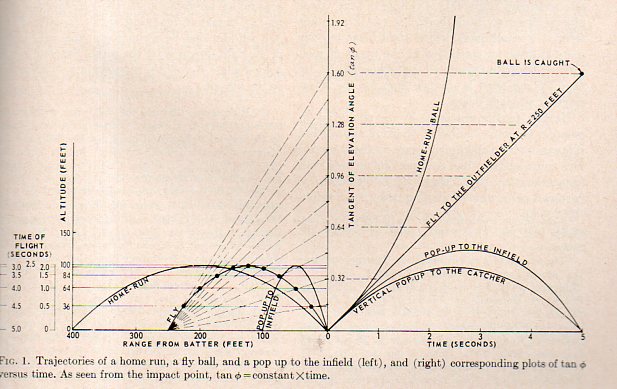
    This is all beautifully addressed in a short article called “Catching a Baseball”, by Seville Chapman of the Cornell Aeronautical Lab in the October 1968 issue of the American Journal of Physics.  Dr. Chapman also offers up the following figure, which is helpful and pretty, but which would have bounced off completely of the invisible shield of fielding mediocrity that enveloped the otherwise fantastically gifted Manny Ramierez (or Ted Williams or any other number of great hitters who were not so much interested in fielding because it wasn’t hitting).  

    Anyway, here’s the illustration from the Chapman article:  

    Baseball physics368

     Notes:

    1.  Some of the others would have ot be Churchill (probably my first choice, because he held everything together from 1940-1942 and created an effective war machine…without him the war may well have been lost, well before the U.S. would have become involved; also of course F.D.R., and probably Eisenhower for his superior handling of the Invasion  and for the push east.  I am not sure about who I might choose on the Soviet side.  I wouldn’t choose them in the first rank, but I’m not sure who I would choose first to do in between Montgomery and Patton–it is easy to neglect Montgomery for all of the obvious reasons, but when everything is said and done he was very effective and successful given his own plodding and unpleasant way)…