A Daily History of Holes, Dots, Lines, Science, History, Math, Physics, Art, the Unintentional Absurd, Architecture, Maps, Data Visualization, Blank and Missing Things, and so on. |1.6 million words, 7500 images, 4.9 million hits| Press & appearances in The Times, Le Figaro, Mensa, The Economist, The Guardian, Discovery News, Slate, Le Monde, Sci American Blogs, Le Pont, and many other places… 5000+ total posts since 2008.

Category: Technology, History of

  • Man as Robot and Robot as Man

    JF Ptak Science Books  

    I’ve written earlier in this blog about the advent of robots and human machines, and I’d like to add these two images to that thread.    Both are male, which is not horribly surprising since the earliest creation of a female robot belongs to the fertile Fritz Lang, who used his creation in his extraordinary movie Metropolis in 1927.  (Male robot-like creations go back fairly deeply into the 19th century; so perhaps the creation of female robots was verbotten because of the possibilities for unacceptable sexual fantasies in the high- and post-Victorian world, struggling under the weight of many and multiply-applied public inhibitions. Perhaps it was because of the possibility of sexual relations with an inanimate object that was the cause for uni-gender robots, or perhaps it was a fear of a powerful, intelligent, unstoppable, superior creation that was also “womanly”.  I don’t know.)
    Robot human machine817

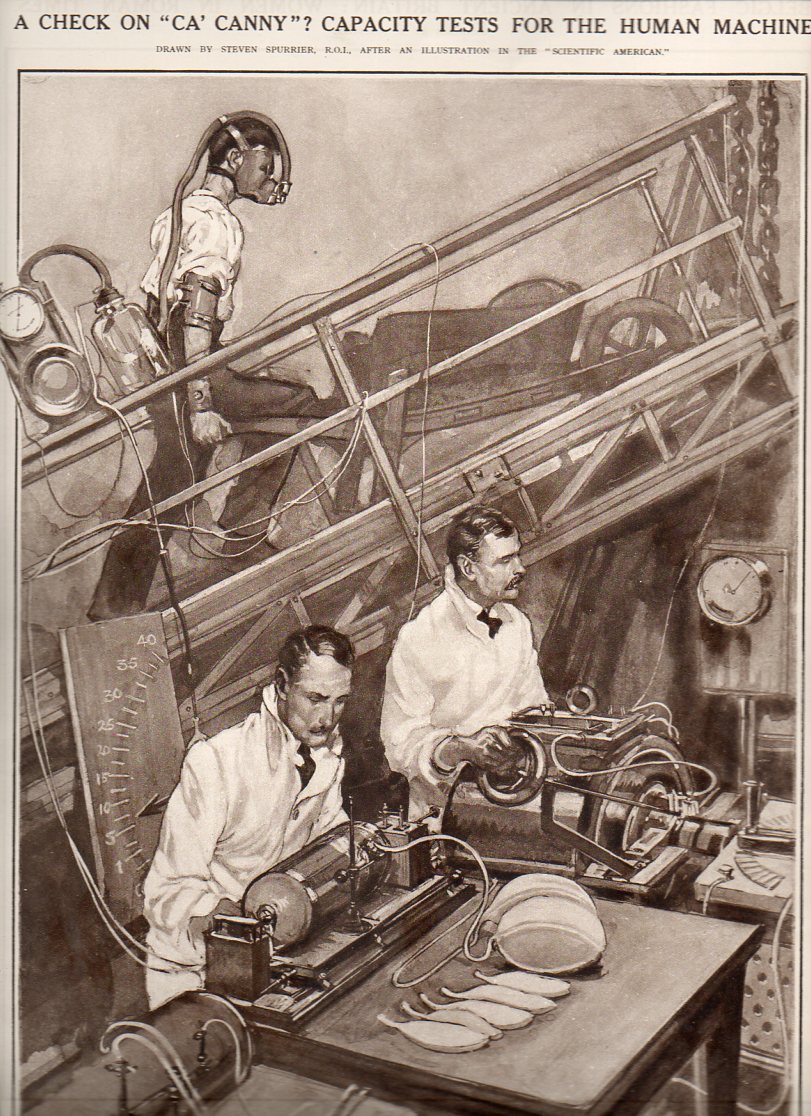
    [And by the way “ca’ canny”–which I’ve never bumped into before–is evidently a practice of deliberately slowing down work.]

    The first is an image of the “human machine”, a cog-like adaptation of human workers in a Frederick Taylor-like Scientific Management study.  Though many people had written and worked around Taylor’s 1911 semi-revolutionary book (and not necessarily a good revolution, but one nevertheless), I’m not certain that I’ve seen the worker trussed up so before this, encumbered by so many technical testing elements as to make him look like a cyborg (though that term would still be a while coming into the vocabulary.  

    This image is actually testing a person’s energy expenditure while pushing a wheelbarrow on an incline, and utilizes the newly-created equipment of the French physiologist Langlois, which in 1921  may well have measured for the first time  the real-time changes in the rhythm of the heart and blood pressure, changes in body temperature and lung capacity of humans in an activity.  I have no doubt that the results would have been very interesting to cardiologists, and probably didn’t mean a thing to industrialists like Henry Ford, who would’ve plowed ahead with their demands on their workers regardless of what tests said, schedules being schedules and all. 
    Robot steam816 

    (I’m no tsure where this experiment fits in, historically speaking, even within the context of biological advances for that very year.  Frederick Banting was able to do some pretty nasty stuff to dogs in a basement lab somewhere at the University of Toronto and come up with a successful treatment for diabetes mellitus–insulin, which would save the lives of millions and earn Banting a Nobel two years later.  In the quasi/fake biological arenas came two biggish events: Jung’s creation of the concepts of introvert and extrovert, and Hermann Rorschach’s one-way conversational device for detecting psycho-pathological conditions (in people).  I suspect that the Langlois data would fit in there somewhere along the rough edge of Jung and Rorschack, if only because the data was real.          

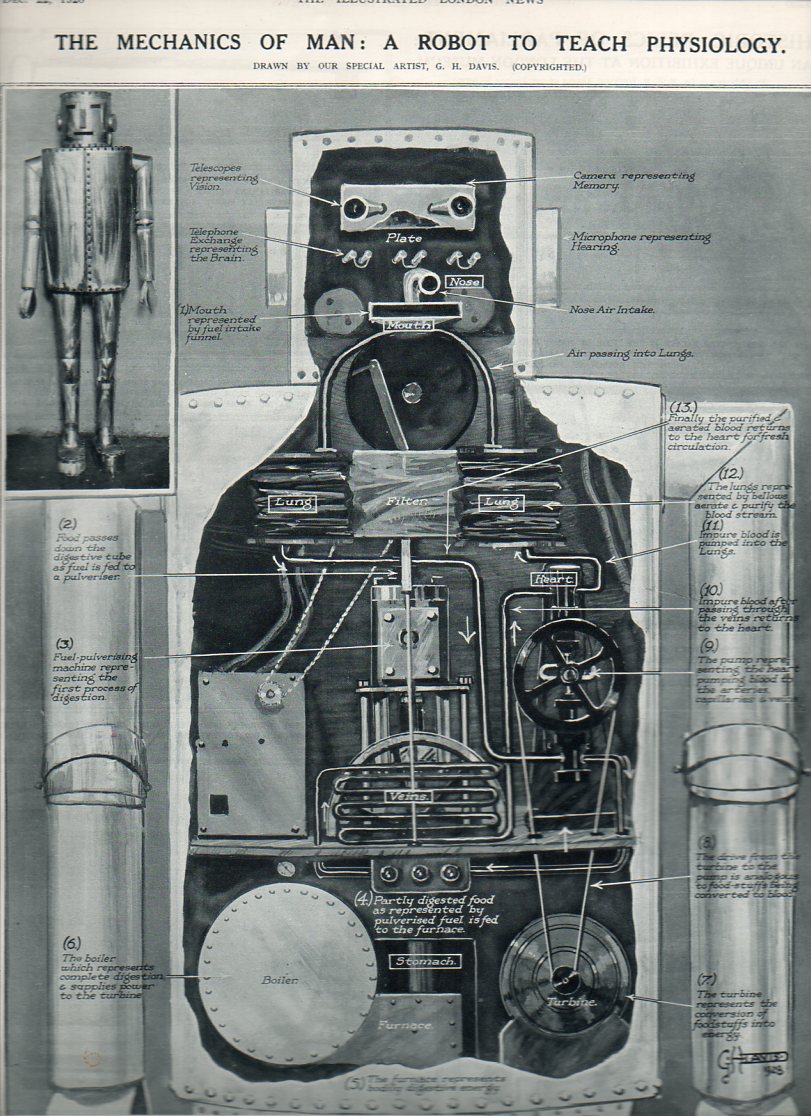
    The second image is in a way a reverse sequence of the preceding–an out-and-out robot that was being used to teach human physiology.  In this case, the robot was a steam engine, constructed for the Schoolboys’ Exhibition at the New Horticultural Hall for 1928, perhaps under the  influence of Karel Capek’s newly published drama R.U.R., which coined the term “robot”. The biological functions of humans were reinterpreted along a more user-friendly vocabulary of the steam engine, using pumps, boilers, hinges, belts, pulleys, filters, compressors and a furnace to explain the functions of respiration and circulation.   It was an interesting approach to show these functions on their most basic level–and in less than 75 years, many of these mechanically represented organs were actually replaceable by real mechanical units performing the same task as the biological (as in the heart), while others could be replaced (via transplant). 

    Man as machine and machine as man.

  • Searching for Extraterrestrial Intelligence, 1961

    JF Ptak Science Books  Post 2379

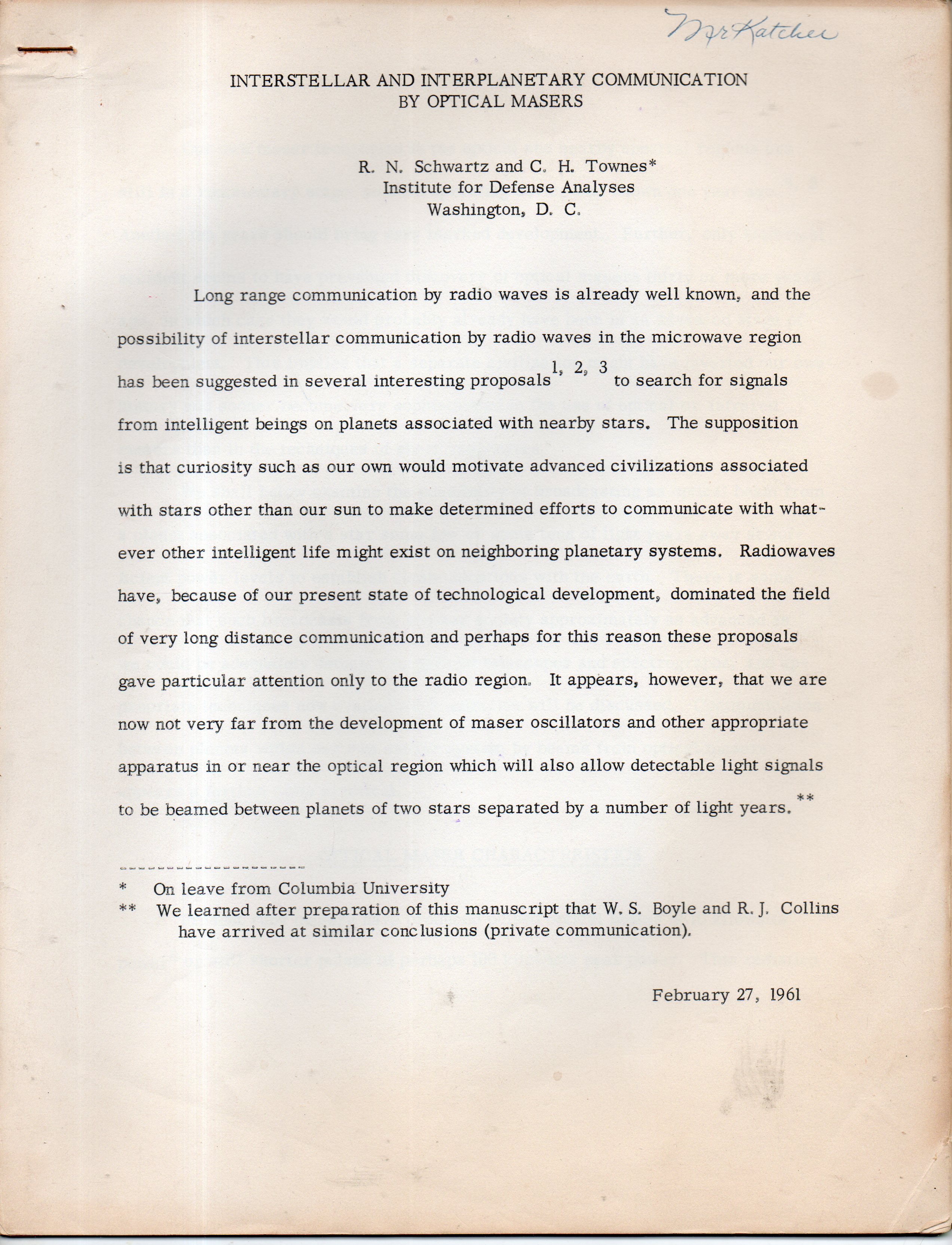
    I uncovered a somewhat found-again-lost-again paper in the collection here, an unusual small-distribution version of a great paper in the history of the search for extraterrestrial intelligence. The work is by N.R. Schwartz and Charles Townes,  “Interstellar and Interplanetary Communication by Optical Masers”, which appeared in the journal Nature for April 15, 1961 (volume 190, pp 205-208), and I have seen it referenced here and there as a started-it-all sort of paper as the first applied and elaborated scientific effort “to communicate with other intelligent life [which] might exist on neighboring planetary systems”. That is to say it is a more involved approach to detection than the two earlier and perhaps more-famous papers by G. Cocconi and P. Morrison, “Searching for interstellar communications” (a short paper published in Nature, volume 184, No. 4690, pp. 844-845, September 19,1959) and F. Drake’s “How can we detect radio transmissions from distant planetary systems?”, published in Sky and Telescope (volume 19, No. 3, pp. 140-143, January 1960).

    SETI586

    The present copy is an offset, stapled affair sent to the editor of Physics Today; it has the  annotation “Mr. Katcher” in a secretarial hand at top, that being David Katcher, the founding editor-in-chief. This is a pre-printed version, and is dated more than a month before the article’s publication, and is dated February 27, 1961. 

    Both Schwartz and Townes were at the Institute for Defense Analysis in DC at the time of publication, Townes being the Director of Research; later in 1961 Townes would become Provost and professor of physics at MIT. In addition to the Nobel Prize in physics, Townes  was awarded the Templeton Prize (in the understanding of religion and science).

    The full text as it appears in six pages in Nature appears here at Coseti; it is obviously a different format from the 14-page variety that I have here, and has a few minor changes, though for all intents and purposes the text is the same.  

    The Cocconi/Morrison paper is located in full text here at Coseti.

    Also just for the sake of it, the Drake equation (1961) for determining the number of extraterrestrial civilizations, here, again at Coseti.


  • Massiveopolis: Filling in the North Sea (1930)

    JF Ptak Science Books   Post 2378

    This is part of a series of Mega-Massive Invisible Engineering, the Filling-it-In Section. Other examples from this series not necessarily filling-stuff-up include:

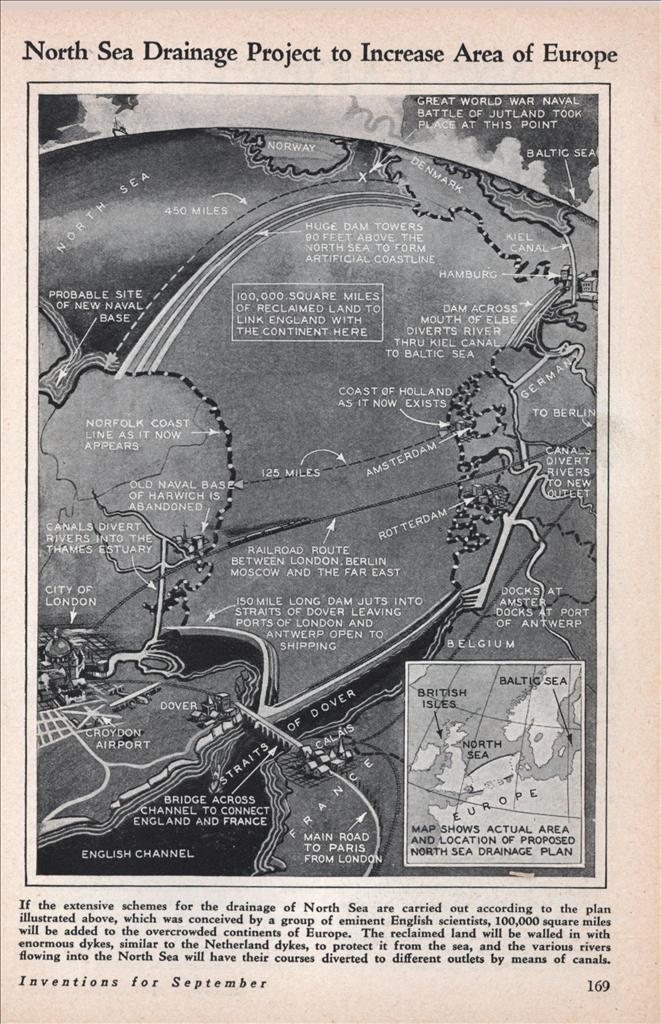
    The title of this post is a bit of a tweeker–the project is not to fill in the entire the North Sea, just the southern North Sea.  This actually makes a pretty big difference bathymetrically, because the sea floor gets mighty deep up along the coast of Norway. Still, though, as impossibly ambitious projects go, this is still a massively unstable consideration, the entire North Sea or not.  

    North sea[I owe the fun I had thinking about this project to two great sites: Modern Mechanix and Imaginary Cities–Modern Mechanix for posting it to begin with and Imaginary Cities for tweeting it.  These are two great sites well worth subscribing to.]

    A sort-of Atlantis was drowned some 8500 years ago, a large piece of land that connected what is today Great Britain and Europe. Rising water did away with this territory leaving behind the great island nation and much else. The plan referred to above in the title is the extraordinary thinking for “raising” that lost Atlantis-esque land, and was floated in the September 1930 of Modern Mechanics. 

    The author maintains some sort of possibility for recovering some 100,000 square miles of submerged land that would connect south-eastern England with France, Belgium, the Netherlands, and Denmark. It would be accomplished by erecting some 700+ miles of dykes and dams and then, somehow, emptying all of that surrounded and captured water into the sea that it once belonged to.  

    100,000 square surface miles is an area twice the size of England, three times the size of Lake Superior, nearly the size of the Caspian, and equal to the size of Colorado. 

    The English Channel and the straits of Dover would become a divided thoroughfare; the Thames would be part of a canal system that would extend along the old Norfolk coast to The Wash; a bay from the Straits would extend inland to Belgium, where it would be met by a canal system that would extend to the Baltic.  All of this would be held in place by a 150-mile long dam of unusual  shape. And just for good measure, bisecting these two would be a monster bridge from Dover to Calais. 

    This is of course extraordinary, but when we look north we see a breathtaking proposal for a  450-mile long, 90′-high dyke extending from the English coast to Denmark. The artwork claims that this is 90′ above the water for the rest of the North Sea, which means that the structure would have to be at least 110′-150′ high, plus the foundation. Luckily for the designer the southern North Sea is a relatively shallow water sea, 20-40′ deep, though there is a stretch of 100′ miles where the depth is considerably deeper.  I haven’t considered yet how wide this dyke would be, except that it would be, well, big.

    There is also a drawing for a London-Berlin and points east train. The  Elbe is dammed, and it looks as though the Netherlands is no longer the Lowlands, everything there being “filled in”, with the sea being moved some 200 miles to the west. 

    This is just a short spec piece that appeared in a popular science magazine 84 years ago, but there is no mention of what these changes might mean to the currents of the south North Sea, or Jutland coastal waters, or the Continental Coastal waters; or the changes it might dictate to salinity, or nutrients to the rest of the North Sea, to say nothing of the sea floor inhabitants and fish, and so on.  There would no doubt be some natural consequences to this (literal!) undertaking.  

    I suppose someone at some point would have to think about how all that new land would be divided, but I guess that would all take care of itself.  

    • Another related article from Modern Mechanix posting a Modern Mechanics May 1931 addresses the issue of water removal albeit at as much lesser scale, here.

  • On the Relation of Birds to Airship Flight (1890)

    JF Ptak Science Books  Quick Post

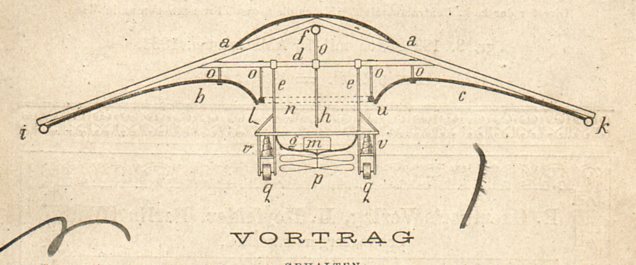
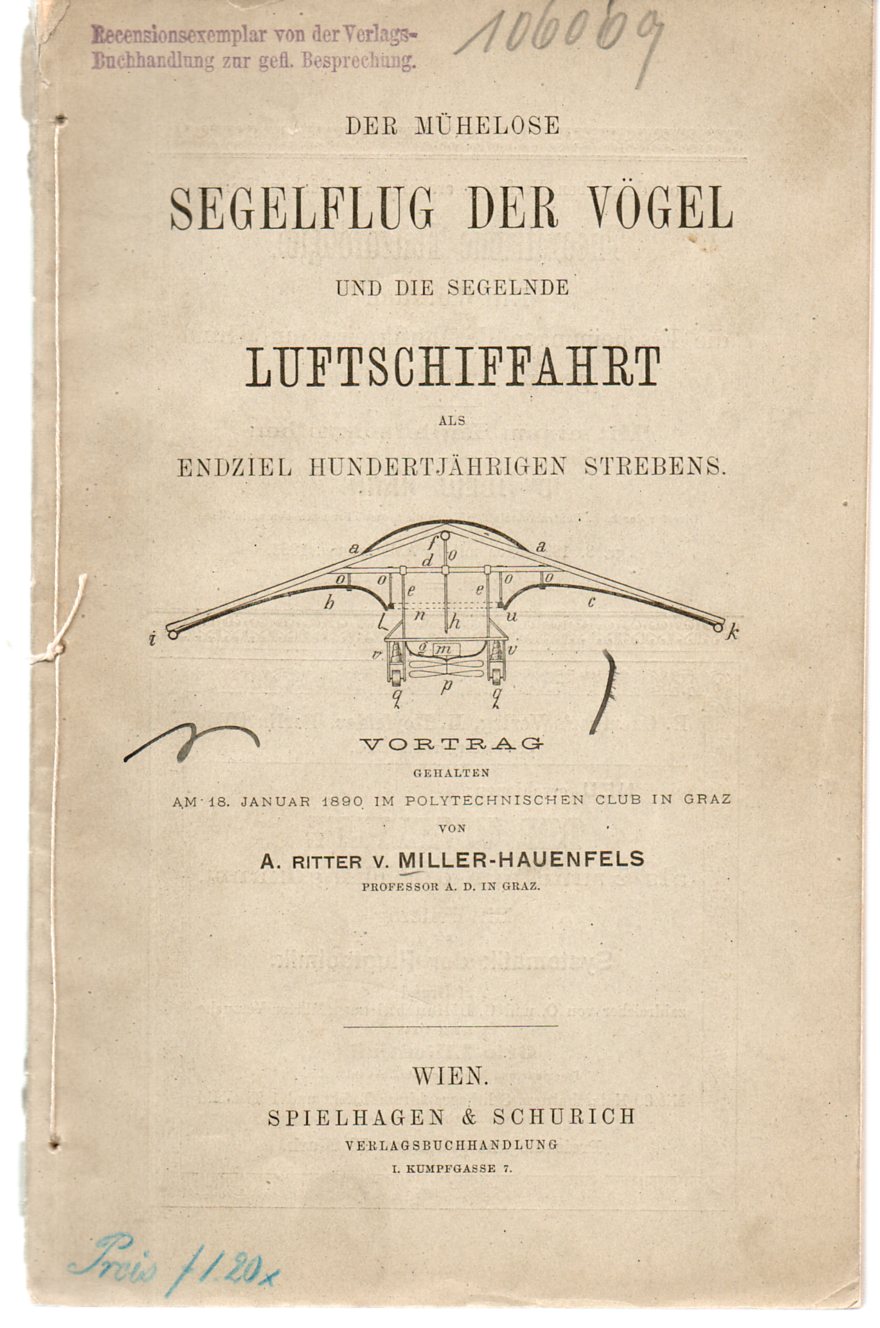
    Here’s an interesting and lovely little classic:  A. Ritter v. Miller-Hauenfels Der mühelose Segelflug der Vögel und die segelnde Luftschiffahrt als Endziel hundertjährigen Strebens. (Roughly “The effortless gliding of birds and the sailing airships as the ultimate goal for the end of the century”).The matieral was delivered  (January 18th) 1890 at the Polytechnischen Club in Graz and publisahed later that yer in Vienna by Spielhagen & Schurich.  My copy of this work also happens to have been in the collection of Vicktor Silberer, 1846-1924, a pioneer aviator from Vienna and a prolific author, jorunalist, and politician.

    Aviati0n ritter382


    Aviati0n ritter381

    In his lectures at Graz Miller-Hauenfels looks at the possibility of human (non-powered, gliding) flight via forward-progression bird flight, basing his work on that of Marey, Lilienthal and Parseval.


  • Rare Block Diagrams for the UNIVAC (1950)

    JF Ptak Science Books  Quick Post 

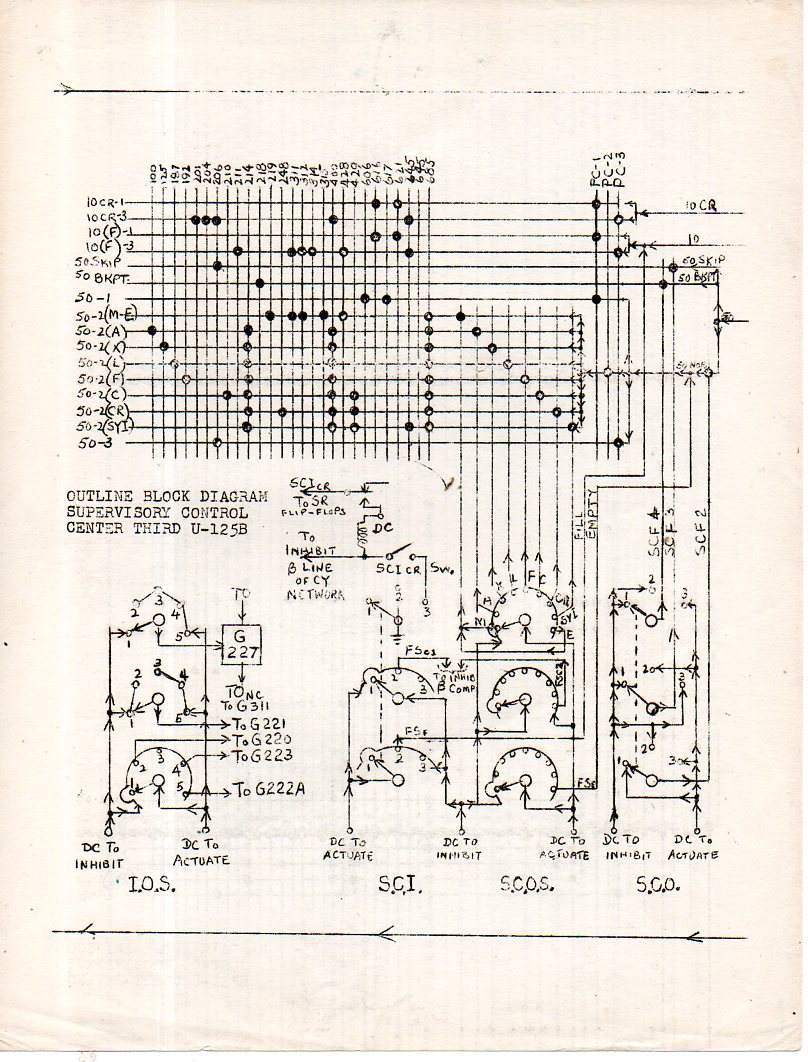
    The UNIVAC (Universal Automatic Computer) was the first commercially-available electronic computer, and the first computer to handle both numeric and alphabetic information, produced by Remington Rand, and  came into working service at the Bureau of the Census in 1951.  It was designed by John Mauchly and Pres Eckert Jr, who also worked together in the design and construction of the first digital computer, the Electronic Numerical Integrator and Computer (the famous ENIAC). The UNIVAC was a Big Boy: 25×50′, with 5,600 tubes, and 18,000 crystal diodes–given its workhorse nature and general success, by 1957 there were 46 UNIVACs in operation. 

    The following are working block diagrams of sections of the UNIVAC, produced by some sort of early offset process in 1950, slightly before the computer came to its working life.  I have a number of sections of the computer represented in this way, but not the entire machine–but what is here may be of interest to historians of computer science.

    MullendoreBlock diagrams497[Supervisory Contro Panel]

    Present in the collection:

    • 1.  The Supervisory Control Panel (2 sheets of 3, including center and left third, both undated but assumed to be 1950 like all of the others. [Shown above]
    • 2.  Input-Output controls.  3 sheets of 3. (left, middle and right thirds), dated 8/10/50 and 8/7/50.

  • The Discovery of the Future of Roads (1918)

    JF Ptak Science Books  Quick Post

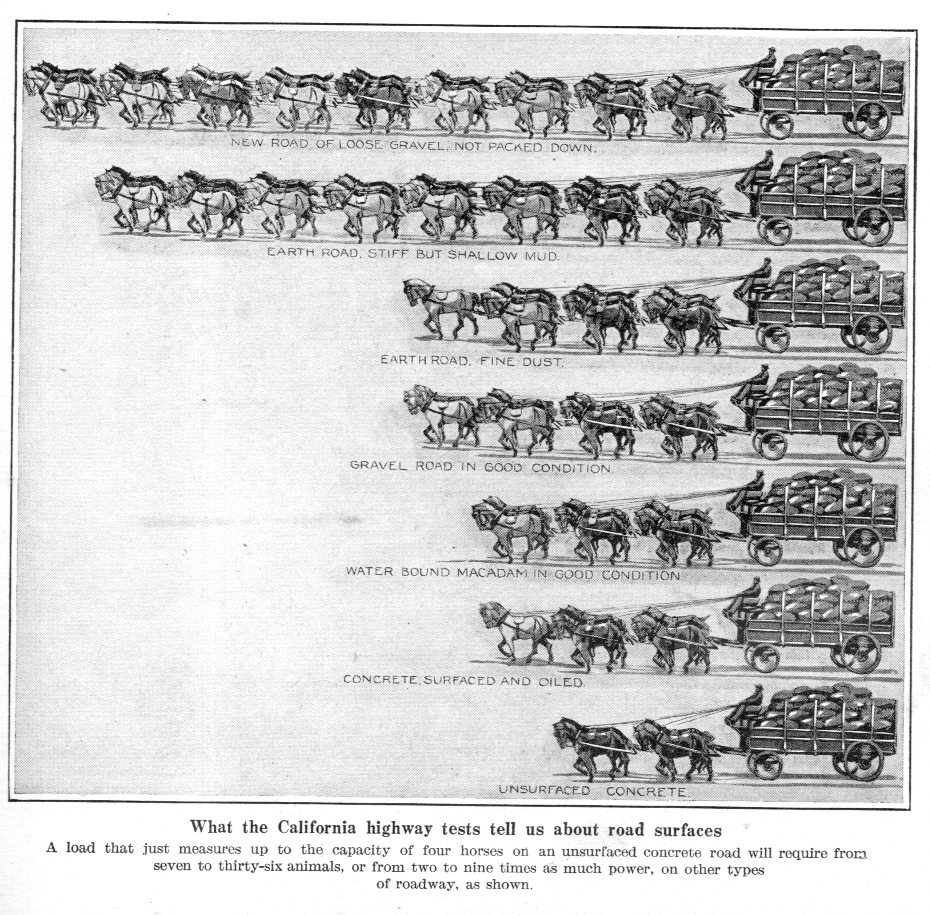
    “Only within very recent years has the paramount influence of roads upon the nation’s life been adequately realized”, so starts this article in the Scientific American for January 5, 1918. No doubt–between 1914 and 1918, the motor vehicle registration doubled and then nearly doubled again (1.7 million to 6.1 million over five years). And since it is far more relatively easy to make cars than  the roads they drove on, it is safe to assume that with this enormous increase in road traffic that it made planners and engineers of various shapes and sizes really think about the issue of roads in the future, as they could well see that car production was exploding and that car prices were making the auto affordable to just about everyone.    

    Roads571These artistic displays of quantitative data really do convey a message to a general audience–that aside from the engineering that went into them.  It is also useful to the historian or reader in history, or anyone interested in how people got from one place to another 100 years ago, and on what sort of surface they were making their way on…and what the surface of that road meant to the traveler.  I do not recall Mr. Holmes making any statements regarding travel time and the conditions of the roads on which the travel was made, but I have no doubt that he would have considered them using data much like this.  


  • Measuring Things with Mountains & the German Big Gun of WWI (1918)

    JF Ptak Science Books  Quick Post

    The story of the (very) long-range bombardment of Paris from points unknown is filled with questions in this article that appeared in the Scientific American on April 6, 1918.  The writer hadn’t an idea of the type of gun being used, the weight of the shell (yet), and just about all other details.  The author did wonder about the reasons for such a gun–that the idea of a long-range indescrimient bombing from a great distance just seemed to be beyond the wanting capacity of the countries fighting Germany.  

    The big gun was The Big Gun, later identified as the Paris Gun–a mysterious entity during the war, and after the war as well.  It turns out that when the Germany army retreated beginning in August that they also destroyed the weapon and just about anything connected to it.

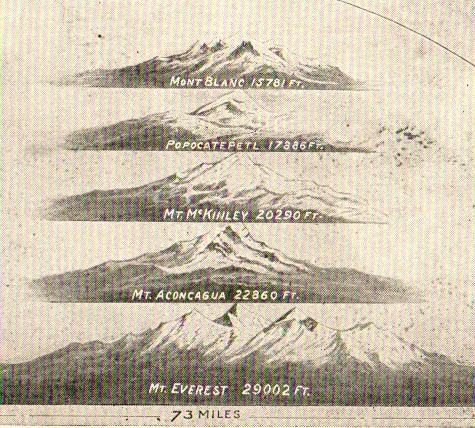
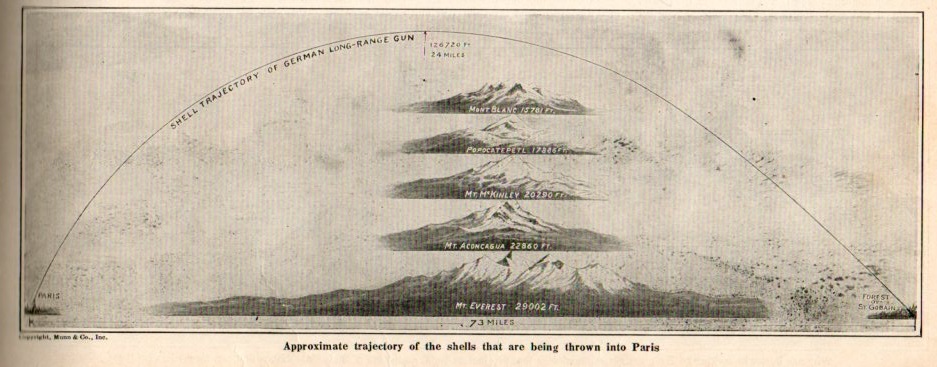
    The gun was extremely powerful.  At 256 tons it launched a 236-pound shell to a height never before achieved by humans launching/propelling stuff into the air–it left the barrel of the gun at about 1 mile/second, traveled 75 overland miles, reached a height of 26 miles…and then came down, exploding, killing.

    One very effective way of explaining the incredible height that the shell reached was measuring the zenith of its trajectory in terms of mountains:

    WWI--german gun569

    Which is a detail from:

    WWI--german gun568

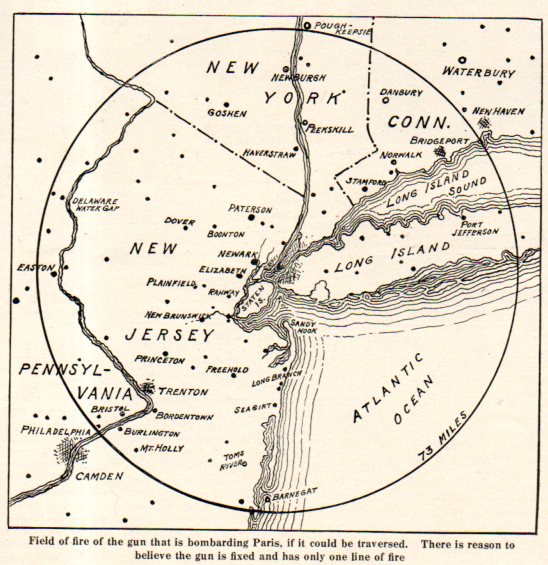
    And to give a more local understanding of the range of the gun:

    WWI--german gun567No doubt this map gave a true flavor and sense of dread to American readers on exactly what it meant to have to deal with a cannon whose reach was 75+ miles. 


  • The Time Equation in Robotic Workers (1922)

    JF Ptak Science Books  Quick Post                                                                   

    This ad (which was tiny in real life) appeared in the back pages of the last issue in June 1922 of the Illustrirte Zeitung (Leipzig), and to me it is a little peep into the future of vast industrialization and the coming of robotic replacements for certain human interactions. In this case, the robotics (here three years after the term “robot” was coined by Karel Capek in his R.U.R. Rosumovi Univerzální Roboti)) is a time-card machine.  Here the happy business owner is able to recognize what workers were working and via a short stroll over to the wall of cards he could tell who was at work and for how long.  It was a control of worker’s time and in a sense of their output, a real sense of ownership of the worker and industrialization of people.  Time and motion studies and Taylorism had started nearly 20 years earlier, but I do not recall seeing many advertisements that were disposed to suggest these new relationships.  

    German--time cards523

    Which is a detail from:

    German--time cards521


  • Ferris Wheel Tank, 1915

    JF Ptak Science Books   Quick Post

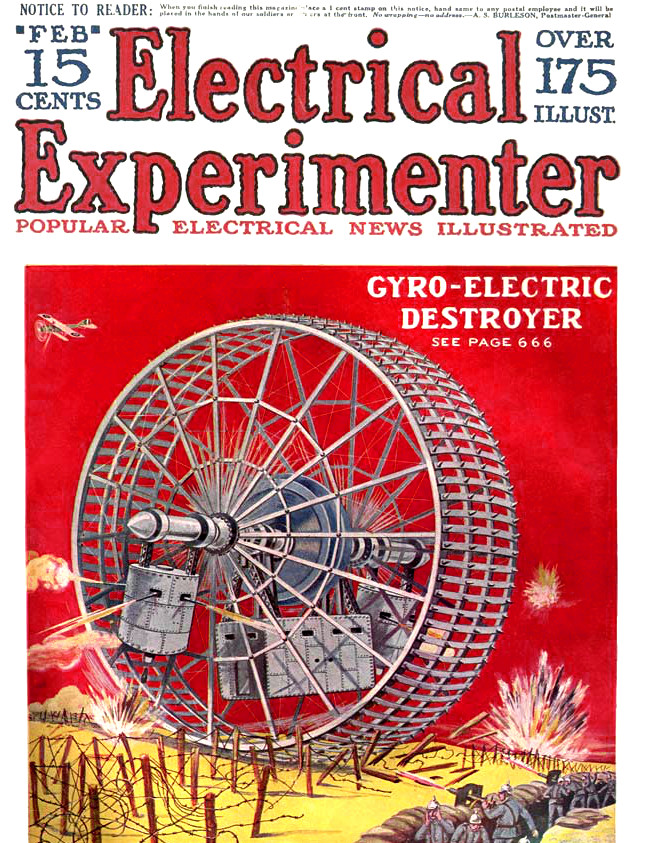
    A few days ago I was having a look at a Large & Impossible Tank, and today I came across this fabulous beauty from the Electrical Experimenter for February, 1915.   

    This 45′ monster would be somehow powered by electricity though there is no discernible power source or power train, and it would be steered by a gyroscope. (The use of the gyroscope is interesting–the idea of it acting as a control mechanism had been successfully introduced in the Whitehead torpedo in 1905, and used as stabilizing agents in airplanes and ships by 1910, and found in the first gyroscopic repeater compass by 1911, so the magazine and writer pretty much had their finger on the national gyroscopic pulse of the time.) Being hit by defensive cannon fire was said to have been not too much of a problem because the shells would mostly pass through the lattice work of the structure.  The armament in the suspended armored buckets would be “the same as British tanks”–the buckets also came equipped with a bomb chute (if you look closely you’ll see one in action here, the destroyer dropping a bomb on itself) for, well, bombing.  

    Tank--giant wheel

    ·Posted by :

    ·in:

    — —

  • A Classic in the History of Jet Propulsion (1946)

    JF Ptak Science Books  Quick Post

    Keenan Jet Engine577

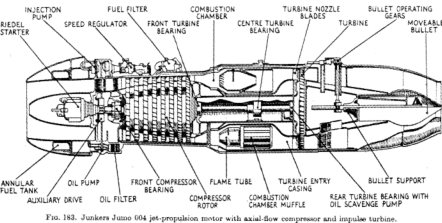
    This drawing comes from the great engineering classic that presented the prototype jet engine for all that would follow it–J.G. Keenan’s Elementary Theory of Gas Turbines and Jet Propulsion. It was published in the glorious Oxford blue cloth by the university and issued with the classically-design beige dust wrapper–it just has the feel of something solid and astute. Keenan’s work is a classic–it is a general survey of developments in the jet propulsion field and was among the very first books published on the subject.

    Keenan was not the first though to the jet engine party–Hans von Ohain and Sir Frank Whittle were. It was a classic idea-in-the-air example of two people working on a very similar idea at the same time without any knowledge of the other.  von Ohain was the first to produce an operational jet engine (1939) while Whittle was the first to patent (while getting his engine to be operational in 1941). Jet engines have been around for a long time (Romans having legislation on the use of variable jet sprays in water distribution) in different forms–fountains, fire hoses, marine jet propulsion (reaching back to 1871), and so on. But John Gregory Keenan’s book–that was a big and influential review, a major contribution to the field.