A Daily History of Holes, Dots, Lines, Science, History, Math, Physics, Art, the Unintentional Absurd, Architecture, Maps, Data Visualization, Blank and Missing Things, and so on. |1.6 million words, 7500 images, 4.9 million hits| Press & appearances in The Times, Le Figaro, Mensa, The Economist, The Guardian, Discovery News, Slate, Le Monde, Sci American Blogs, Le Pont, and many other places… 5000+ total posts since 2008.

Category: Technology, History of

  • Camera Obscura at War, II–Zep Buster

    JF Ptak Science Books, Quick Post

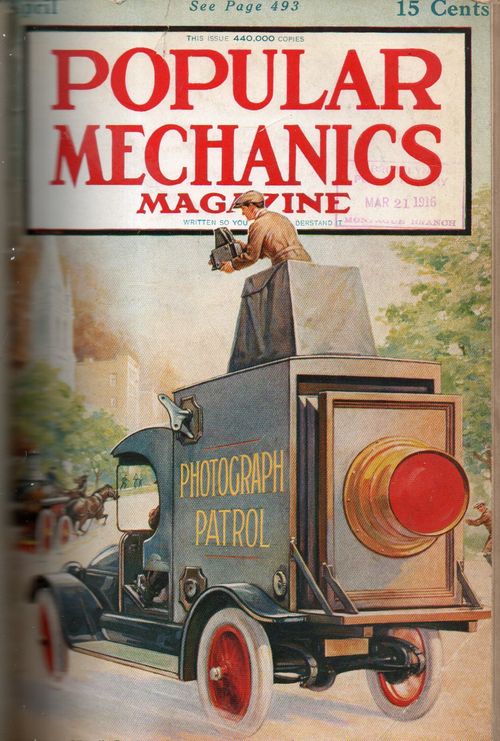
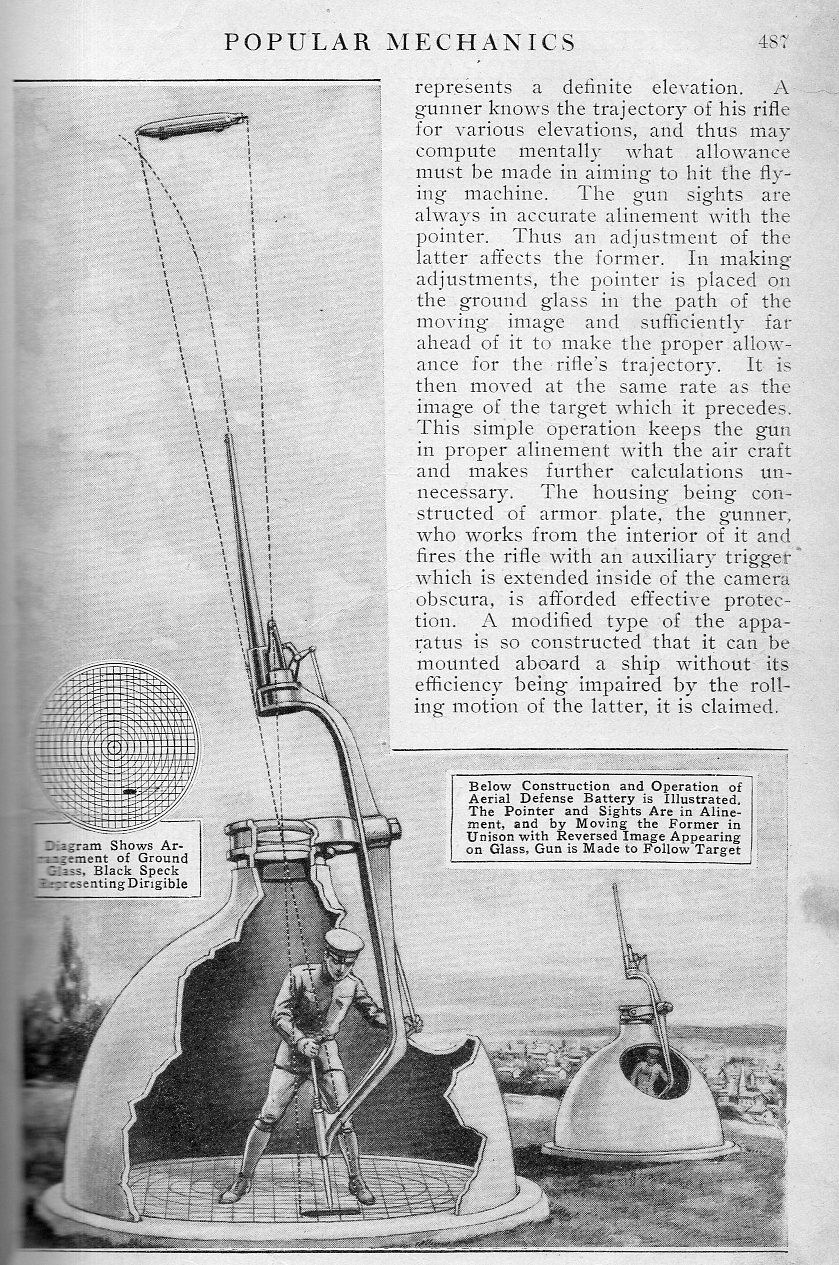
    Earlier in this blog I wrote about an unexpected military use of the camera obscura, here (“The Camera Obscura at War, 1885”).  Today I found another use, which was a guided/guiding anti-aircraft weapon.  I assume that this was mostly employed against the slower moving zeppelins (although in 1915 airplanes weren’t moving that much faster) due to its very limited range of fire.  The camera obscura itself didn’t move, and the relatively small occulus offered not that big a range of sky to work with. But that said the weapon was an ingenious and simple mechanism, an early and primitive semi-machine-directed anti-aircraft gun.  There is no mention of whether or not any of these were actually deployed, and compared to the AA guns that actually appeared in the first and second yer of the war, this attempt looks a little antiquated for the time.  The article also makes no mention of the artillery to be used, which is a major consideration.  

    Aa gun799

    The article appeared in Popular Mechanics, April 1916 (pp 486-7)


  • An Early Google Maps Radio Car–1925

    JF Ptak Science Books   Quick Post

    This image comes right on the heals on what has been a much-shared image of the pre-Google Map Car of 1916:

    Google radio781


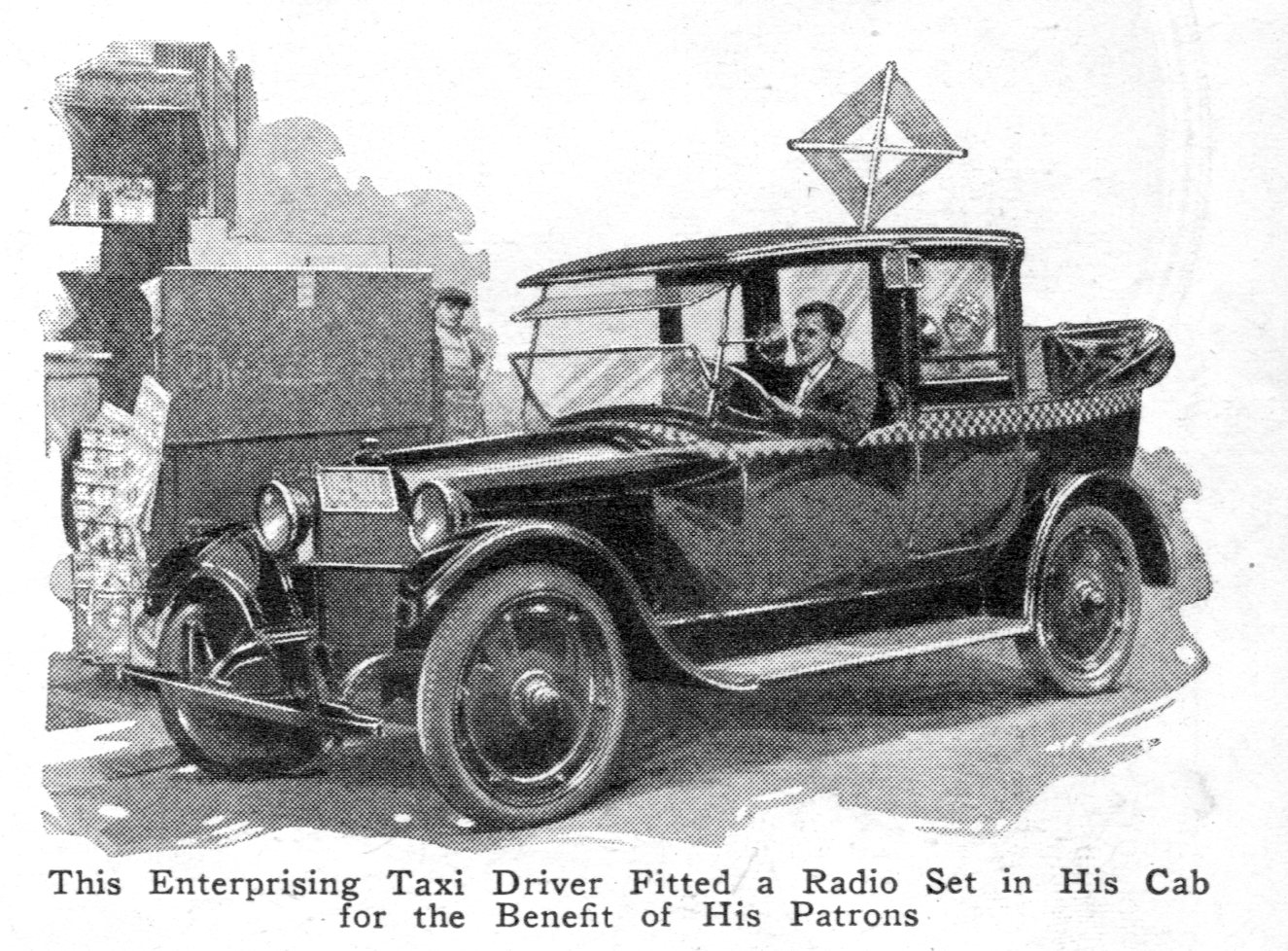
    [Image source: Popular Mechanics, volume 44, October 1925]

    And as you can see, it isn’t that at all, but the antenna on the roof of the cab does suggest itself on the odd-looking Googlemobile, and would have attracted as much attention as the Google car does today. At the time cars were not outfitted with radio set–this enterprising guy did so with his cab (mainly because he couldn’t bear to leave his wireless at home) and attracted a lot of attention and clients due to the novelty of having the still-relatively-new idea of wireless in a car (of all places).  

    Here’s that Google Map Car of 1916:

    Google car772

    As I said in that earlier post, this was simply a darkroom on wheels, made to look like an enormous camera.  If these folks were more enterprising they certainly could have made that darkroom into a camera, without that much fuss…except for the giant paper negatives, of course.

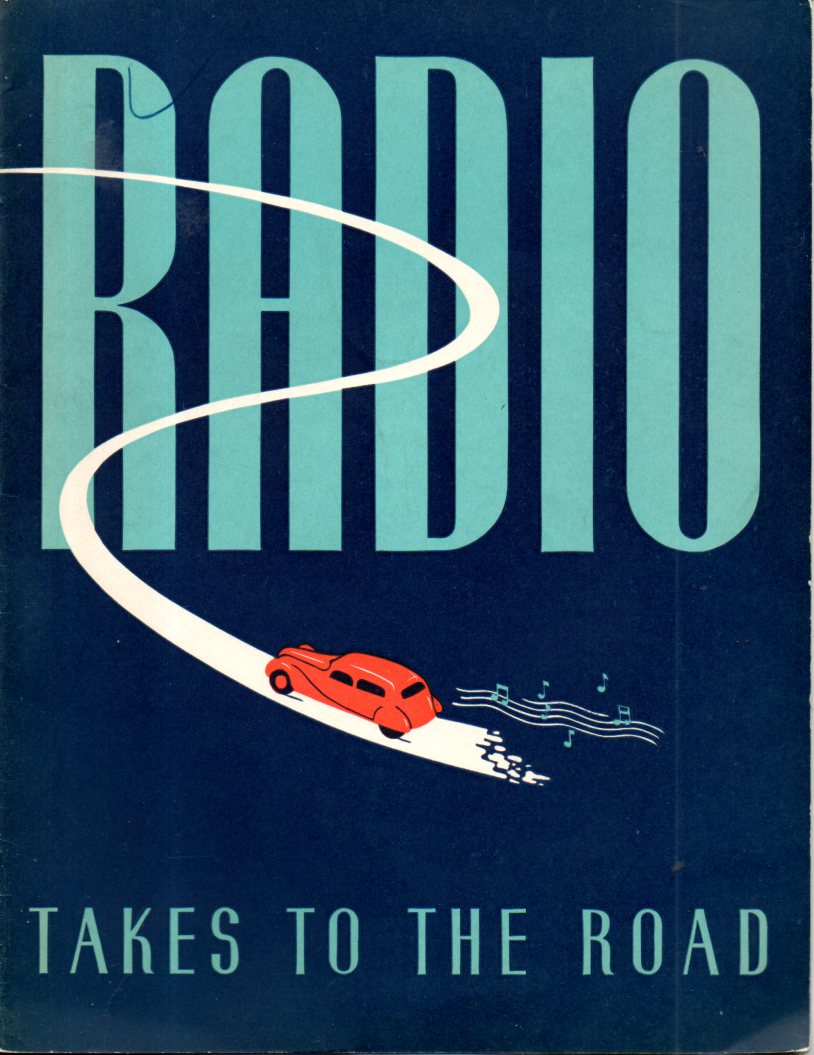
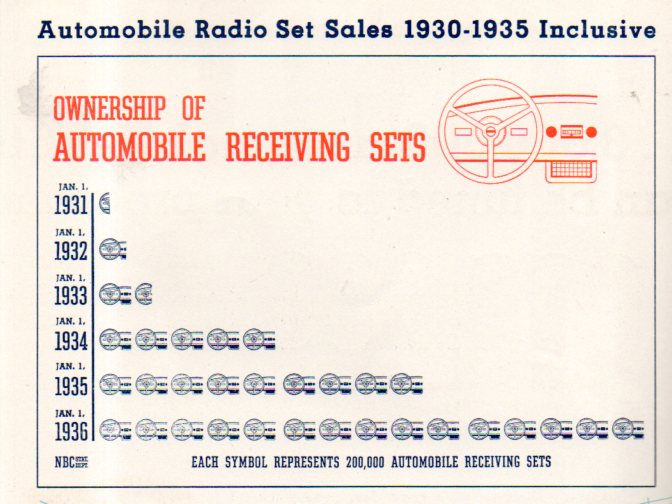
    Radios in cars though was a breakthrough idea in 1925, and as we can see in this lovely pamphlet (published in 1936 by the National Broadcasting Company as a revenue-enhancer) the idea of the radio in the car was just beginning to fly.  Shown in  a delightful graphic display of data using auto steering wheels as a unit of measurement, there were about 100,000 cars with “receiving sets” in 1931, and by 1936 there ere 2.8 million, which is significant growth. NBC points out that there were 22,400,000 cars on the road in the U.S., which meant that there were 20 million cars that needed radios, which meant that there was another gigantic mobile audience of 20-60 million people, which meant that there was a big opportunity for more listeners and a fantastic opportunity to sell advertisements of a value reflecting that new huge audience.  

    Google radio782

    And the delightful graph:

    Google radio783


  • Pianographics–Empirical Musicology, 1895

    JF Ptak Science Books    Post 2416

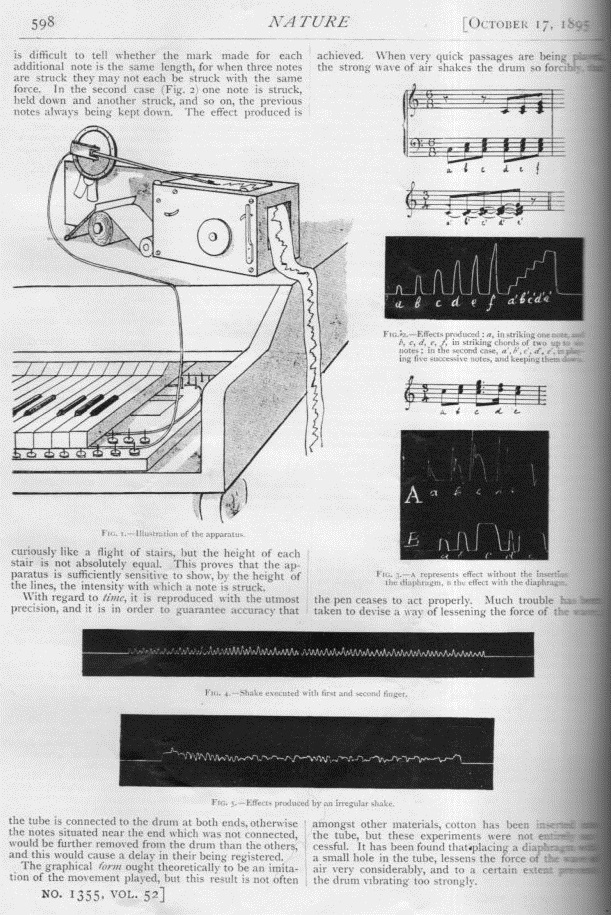
    Unlike the history of the vast majority of musical instruments, the piano could sort of play itself about 160 years after its invention.  The idea of making a device that would record notes from a piano, and then punch them out onto long strips of paper, and have them play through a music box or other automatic instrument (and later on, by Centennial time, on a player piano) was a truly inspired thing, I guess. That’s all fine and good, but none of these inventions really allowed for you to understand how a piano was actually played by a performer, and how that performer touched the keys–that would be  interesting on many levels beyond the mechanistic reproduction of note-playing. It seems though that it wasn’t until the close of the century that an invention was capable of recording the subtleties of key touch. And that was the work of A. Binet and J. Courtier  who published their results of their experimentation with new instrumentation in “Recherches graphiques sur la musique” (Graphic research on music) in Revue Scientifique.  The invention has been called “the start of the study of technical empirical musicology”.1

    The machine was described by C.H. Judd in Psychological Review2 in 1896:    “When a key is struck the style is deflected in such a way that the height of the deflection is proportional to the force of the pressure; the length of the deflection records the time; and finally the form of the curve gives a detailed account of the manner in which the movement was carried out.”

    In 1914 in “The Psychology of Piano Instruction” we find the following appraisal: “In much the same way have Binet and Courtier blazed the trail as Seashore puts it by tracing graphically the intensity form and time of finger movements in piano playing They point out the immense psychological interest there is in determining the kind of experience involved at the keyboard of a piano and the type of movements executed while at the same time graphic results obtained in this manner act as checks upon the performance Illustrations are given for instance to show the curve of a trill well performed in contrast to that of a trill poorly performed…”3
      
    In any event I found this article by chance in Nature for October 17, 1895, and thought the machinery and idea were fascinating. This was probably the first English translation of the paper, which soon again appeared in an article in Popular Science in the U.S. in the next month: 

    “When a certain point of perfection has been attained in piano playing it becomes very hard to distinguish inequality of touch yet owing to the varying strength of the fingers it is only with much practice that perfect equality is possible. As will be seen further on involuntary movements and irregularities scarcely perceptible to the shown by the graphical method…”
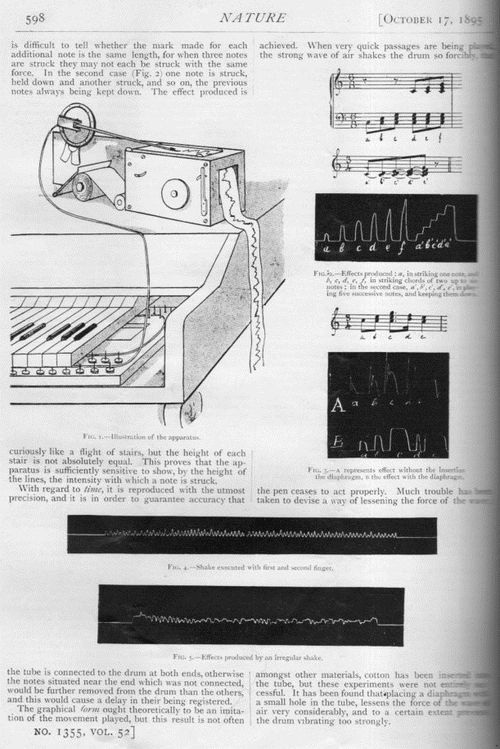
    Piano graphics756

    “The apparatus…is quite simple in construction and consists chiefly of an india rubber tube placed under the key board united at its two extremities by a registering drum also of india rubber When the notes of the piano are played the pressure on the tube causes a wave of air to be sent through it into the drum upon which is attached a pen that in the ordinary way is made to record its movement on a moving roll of paper The wave makes the drum vibrate which in its turn jerks the pen thus causing irregular marks to be left on the paper The board on which the tube rests is regulated by means of w edges adjusted by a screw the board being either lowered or raised When raised it almost reaches the notes of the piano and in this case the registering action takes place but if it is lowered the whole apparatus is disconnected from the key board…”

    The summation at the end of the Nature article: 

    “1. Dealing with its advantage from the psychological point of view it is found that the voluntary movements of the pianist can be observed without putting him to any restraint or embarrassment for the small tube does not affect the resistance of the notes nor is the exterior of the piano altered.”

    “2. For teaching purposes the device has been of great use.  The record on the roll of paper shows the faults so precisely that although they are scarcely perceptible to the ear there is no denying their existence.”

    “3. We are well aware that written music cannot show every slight change in the time the composer might desire. By applying the graphical method this difficulty is eliminated and the time will be reproduced with the smallest details.”

    Notes

    1. Empirical Musicology : Aims, Methods, Prospects: Aims, Methods, Prospects edited by Eric Clarke Professor of Music University of Sheffield, Nicholas Cook Professor of Music Royal Holloway,  p. 77

    2. Psychological Review in 1896, Vol 3(1), Jan 1896, 112-113.

    3. Journal of Educational Psychology, vol 5, 1914, “The Psychology of piano Instruction.”

  • Gas Masks of Cloth and Gauze (June 1915)

    JF Ptak Science Books    Post 2414

    Gas mask752

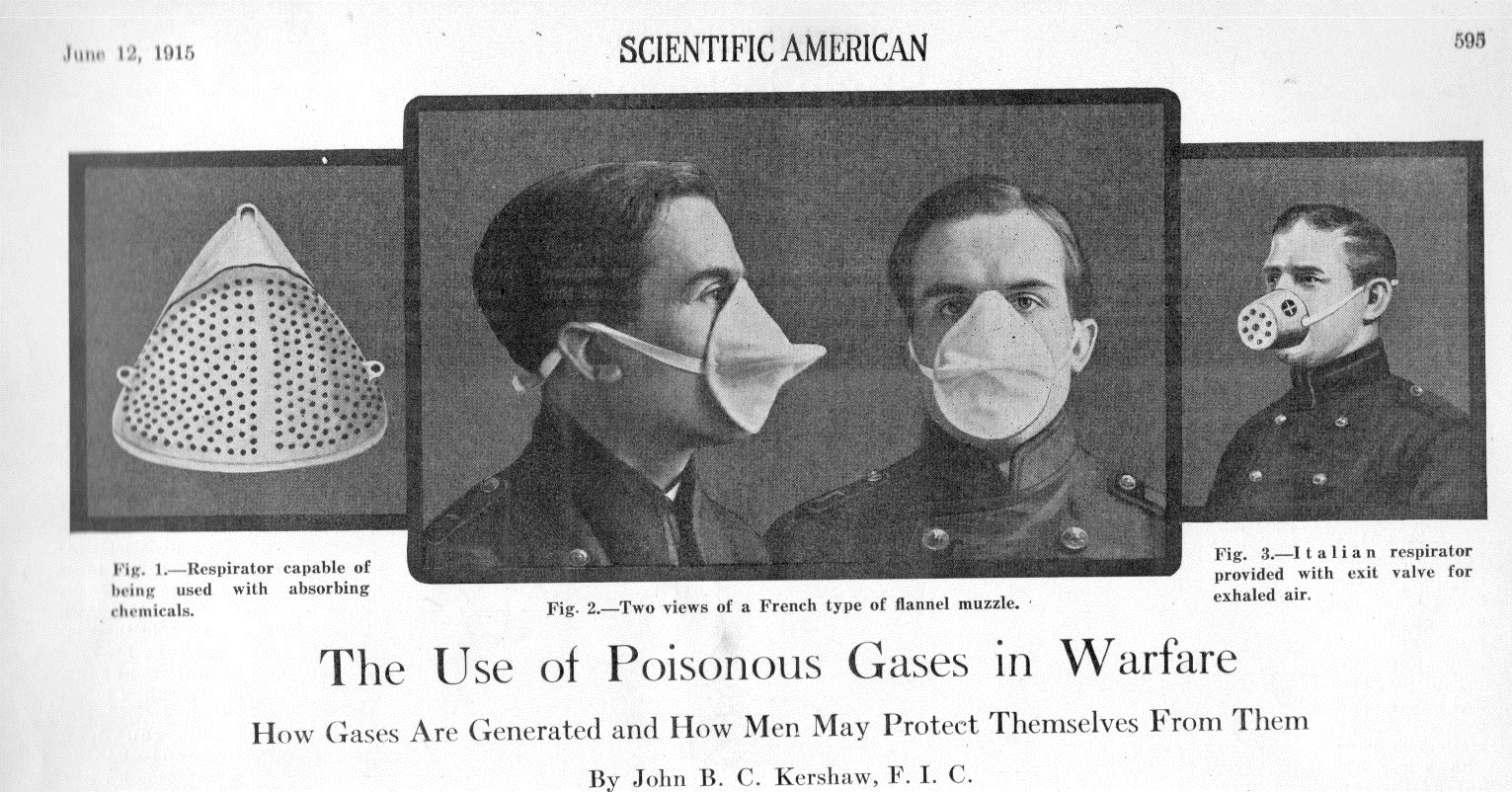
    About two months after the Germans used the first poison gas in WWI  (on April 22, 1915 against French Colonial troops at he Second Battle of Ypres in Belgium) the Scientific American published (on June 12, 1915) an account of some very early responses to the new lethal threat.  This was a more caustic and dangerous form of a warfare that existed for at least 2200 years, going back to the Peloponnesian wars, with pitch- and sulphur-saturated wood that was set alight and buried under siege walls, the noxious smoke incapacity the soldiers within the walls. As the SA article also points out, bellows  were used to propel the nasty and noxious smoke produced in a cauldron of burning charcoal, pitch and sulphur, blown hopefully over the walls and lines of the enemy–this at about the same time as the Athenians and Spartans were having it out.  

    There’s also indications that plague/disease-ridden animal carcasses were catapulted across enemy lines, armies going at one another using rockets of diseased meat. And so on.

    But the 150 tons of chlorine gas that the Germans sent over the French lines on that day was something entirely different–and far more lethal than any other gas previously used. (There was an earlier attempt to use gas in battle, employing an even nastier gas–xylyl bromide. It was dispatched January 15, 1915 against the Russians on the Eastern Front, but due to extreme cold most of the gas froze–it still however was potent enough to kill a thousand soldiers.) 

    The early response to protection from gas warfare was inadequate, with masks being sometimes little more than string and cotton gauze. This response was better than no response, because in the end it at least gave some millions of soldiers comfort to know that they were being taken care of, that something was being done to address the gas problem.  Of course this would last only so long as they didn’t have to actually employ the mask.  

    As the war progressed, the gas mask response improved, though so did the lethal varities of gases that were employed.  Even the best of the masks were incapable of defending much against phosgene and diphosgene–and then there was no protection at all from mustard gas, which was another beast entirely.

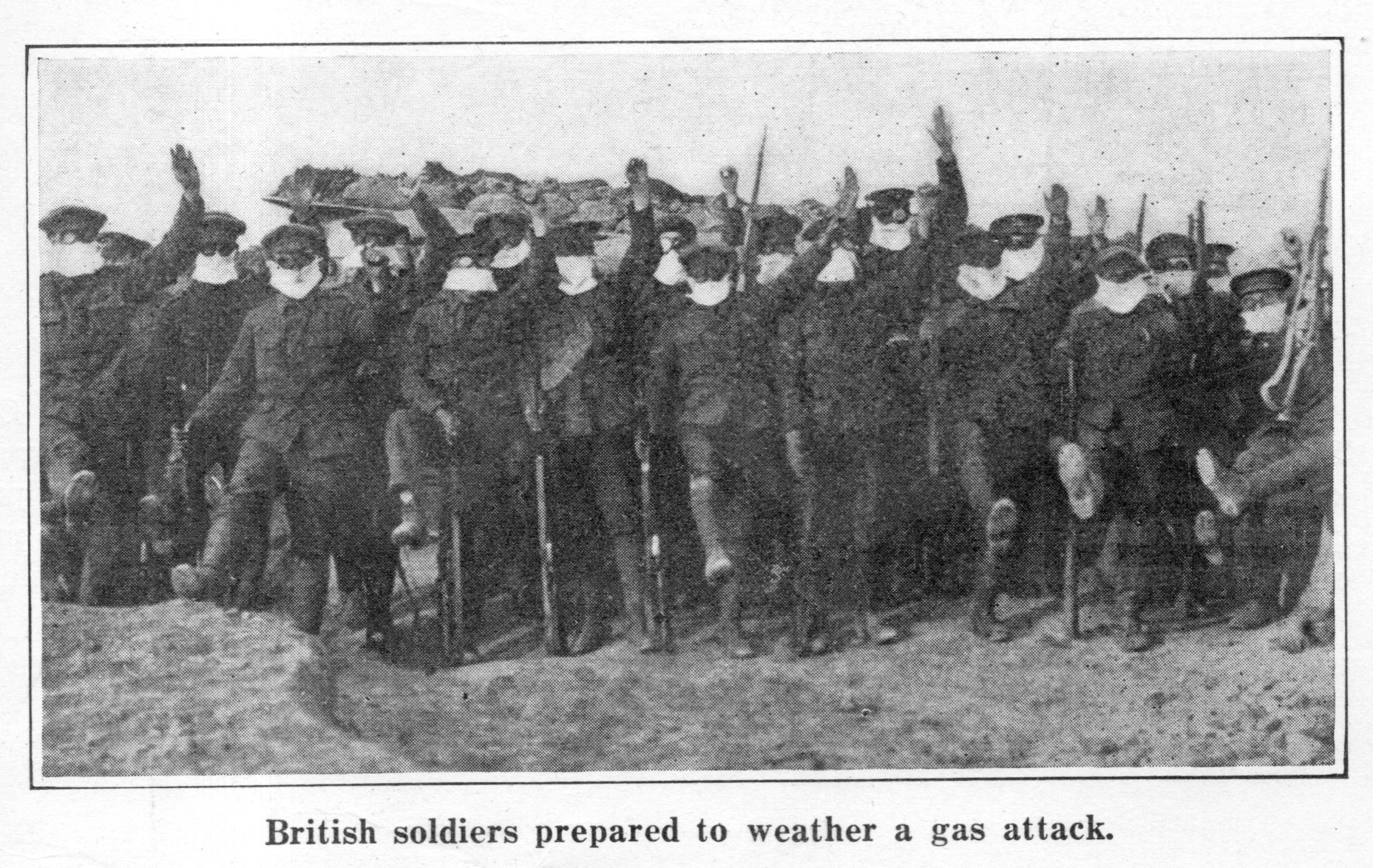
    It was the illustrations that stopped me in the Scientific American article–first for the flannel muzzle mask (above), which made my heart half-break; and then, just beneath that picture, a portrait of a group of British soldiers wearing cloth masks, who were “prepared to weather a gas attack”.  They were told that adding a little water to the mask would help stop the gas, a lot of which was hopeful expectation and wishful thinking.  

    Gas mask753

    An earlier post appears here, “Gas Masks and Poison Gas, World War I, 1915”, on early (November/December 1915) masks.  


  • Cut-Away Schematic: British Vickers Medium Tank, 1925

    JF Ptak Science Books  Quick Post

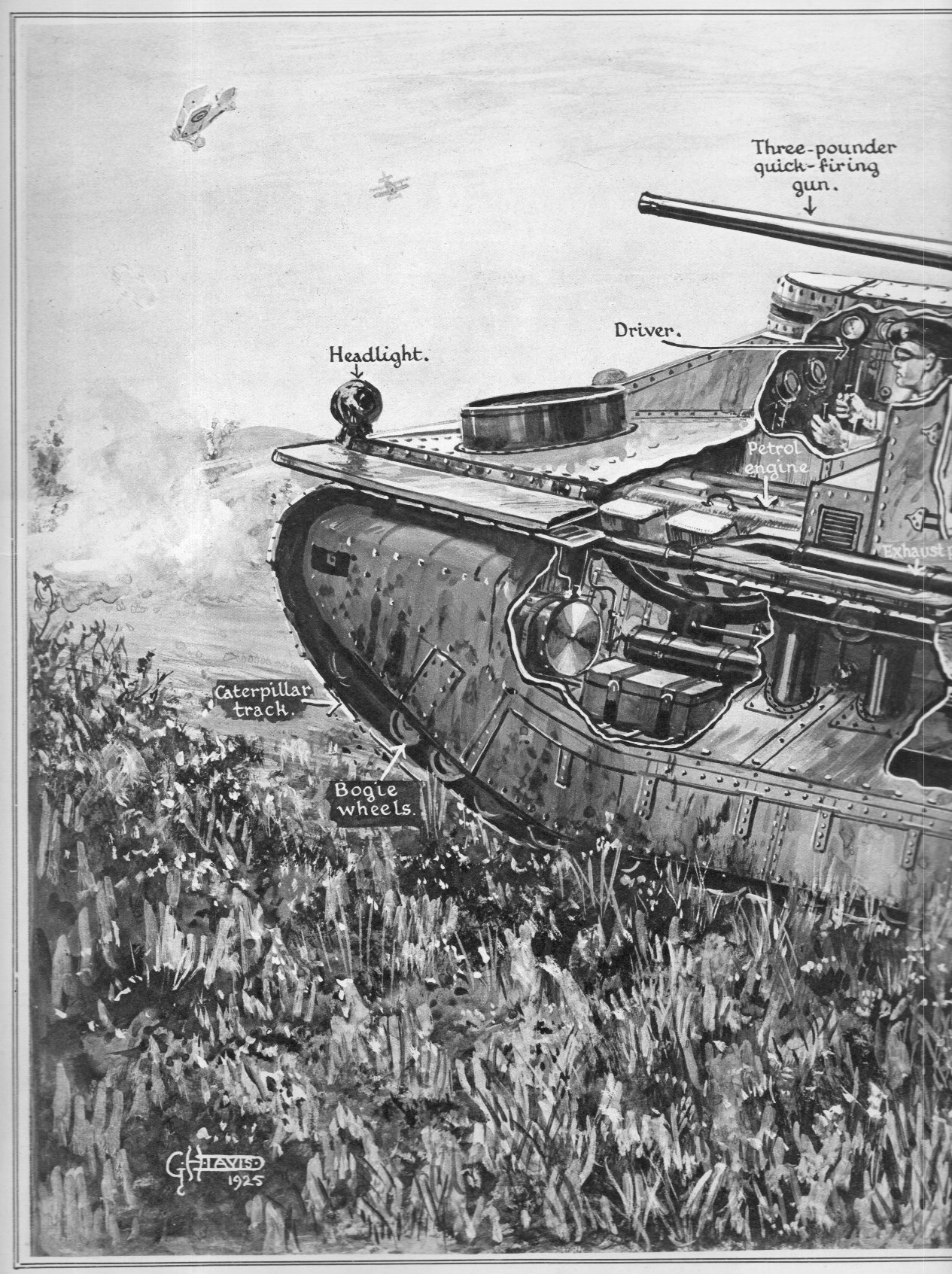
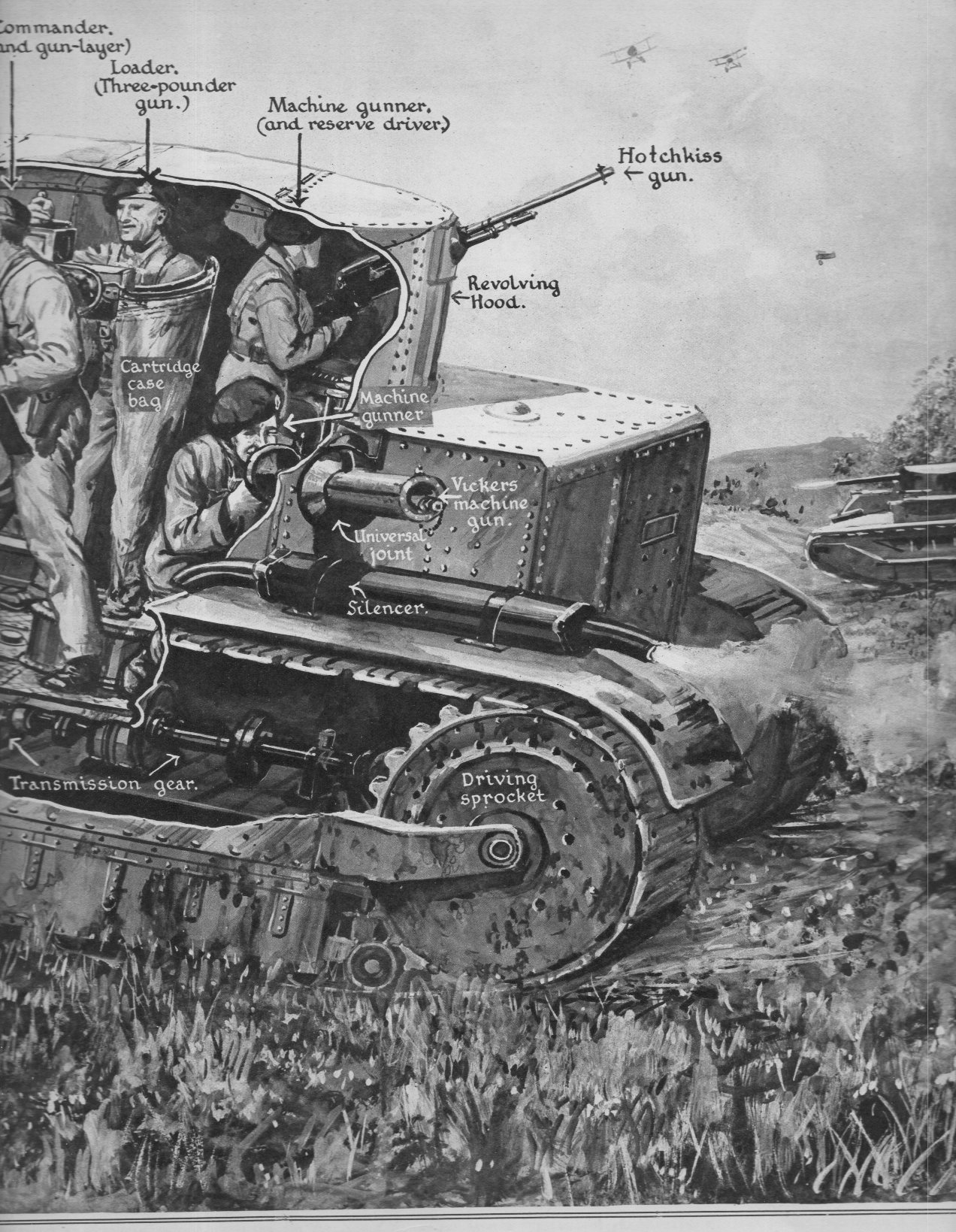
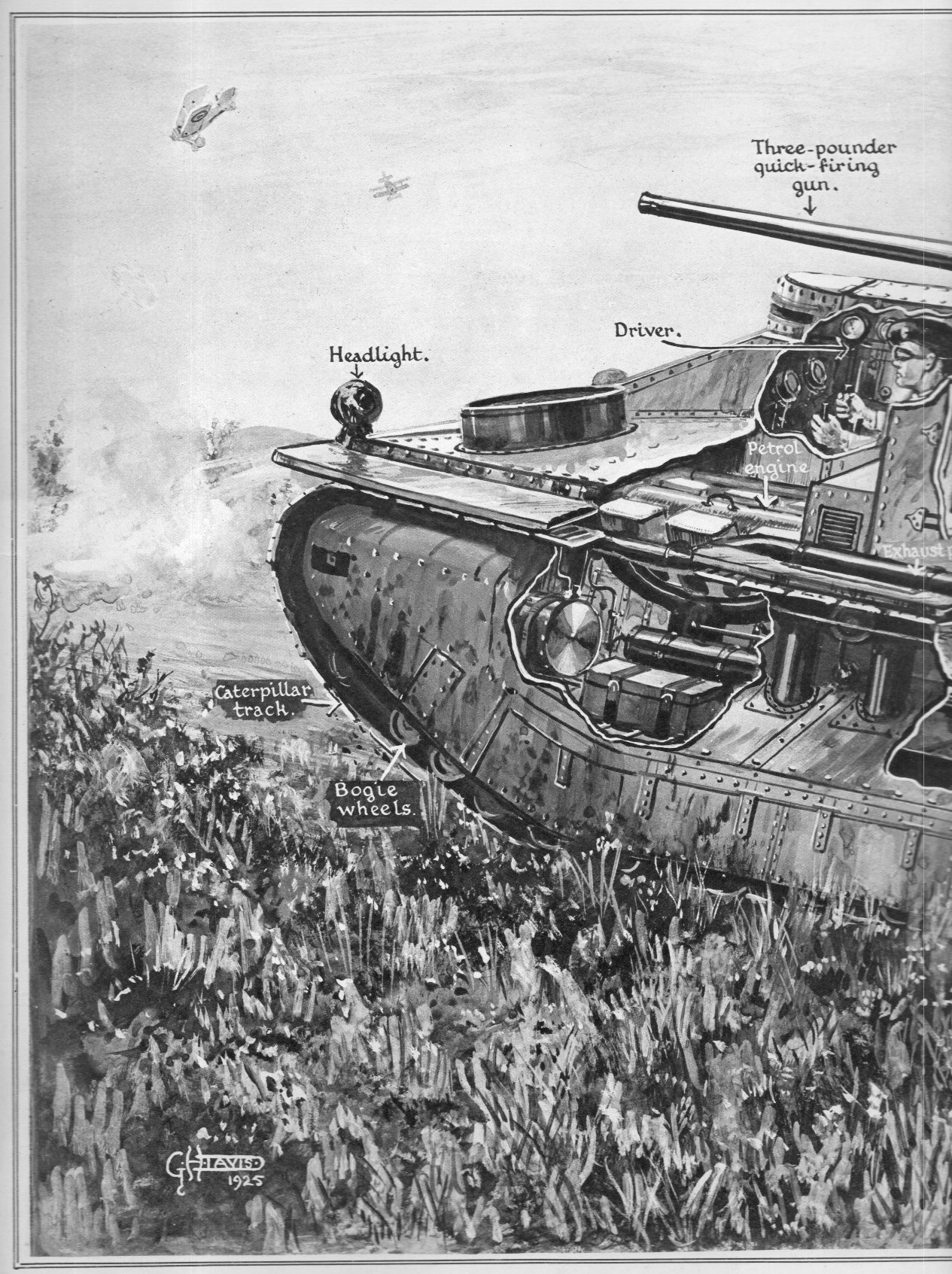
    One of my favorite popular technical illustrators of the 20th century was G.H. Davis (1881-1963), who worked enormous accomplishments for the Illustrated London News for some forty years.  His specialty seemed to be the cut-away schematic, showing half-exposed/half-not technical schematics on mostly oblique angles.  The example below is a fine one, showing the (not-named) British 1925 tank, which I believe must be the Vickers Medium I or variation thereof.  It was certainly an improvement over the tanks used in WWI, and for all intents and purposes it seems a “modern” tank. 

      Tank 1925743

    Tank 1925744


    Tank 1925743


  • A Beautiful X-Ray Tube

    JF Ptak Science Books   Quick Post

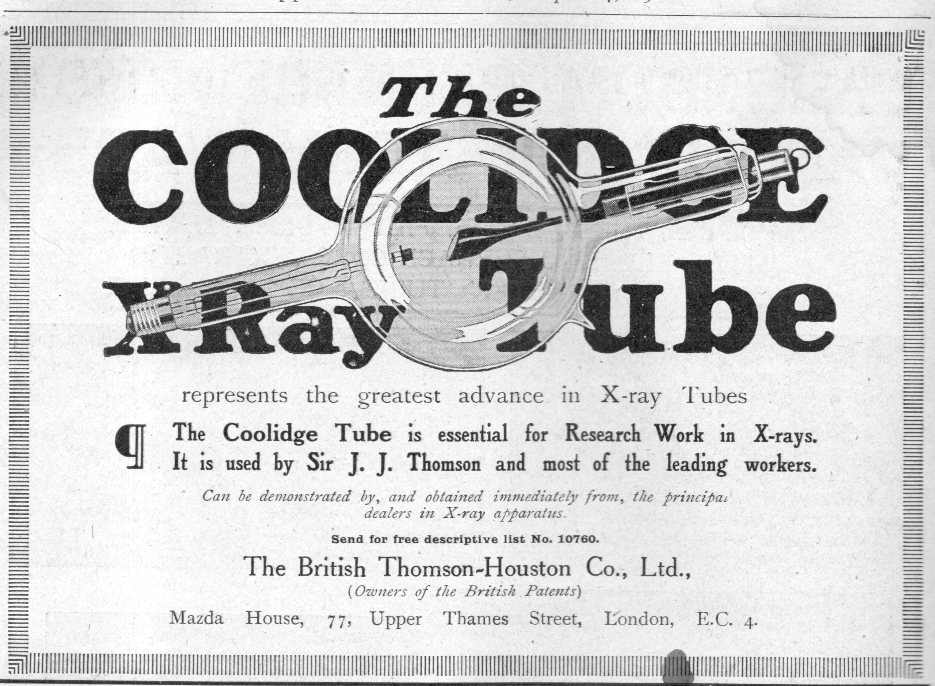
    Coolidge741William Coolidge (a long-lived inventor and EE man who ran the GE research lab) developed an improved x-ray tube that was like a Model T compared to existing Model A tubes.  In any event I just liked the design of this ad, which appeared in Nature in 1914–especially the rendering of the tube.  

    ·Posted by :

    ·in:


  • The Not-90′-Long Slide Rule

    JF Ptak Science Books    Quick Post

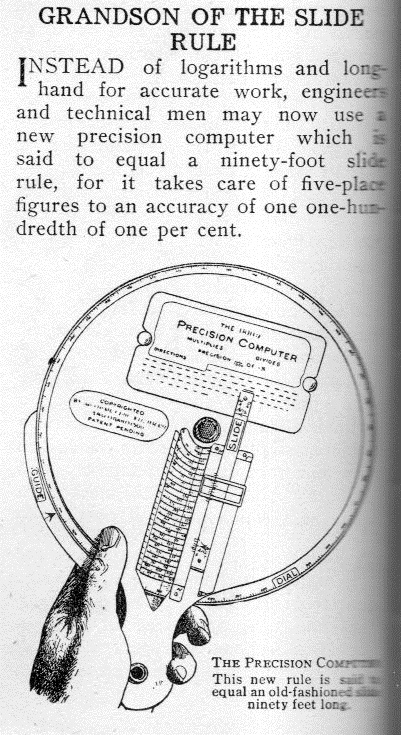
    I bumped into this short notice in the magazine Illustrated World for May 1916 and at first didn’t recognize the instrument.  It turns out that it is a skeleton drawing of the Ross “Precision Computer”, an 8″, multiple circular spiral (with 25 windings) circular slide rule.  It might have had the same effectiveness as a 90′ slide, though I read something elsewhere that it was more like 60′.  In any event, it was made of metal, and glass, and celluloid, and was an effective and elegant instrument. 

    Computer precision742

    [Illustrated World, May, 1916, page 388. Apologies for the fuzziness–the book was too thick and too old to force it flat on the scanner.]

    For more information as well as a photo of the instrument, see the Smithsonian Institution entry here:  http://americanhistory.si.edu/collections/search/object/nmah_690756


  • Tools of a Scientist, ca. 1700

    JF Ptak Science Books    Post 2409

    Friedlein941

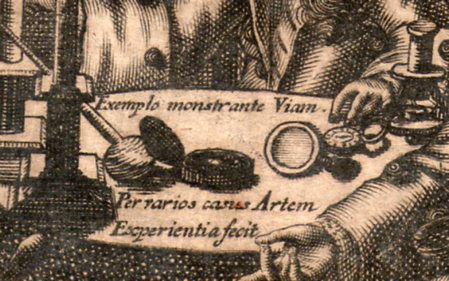
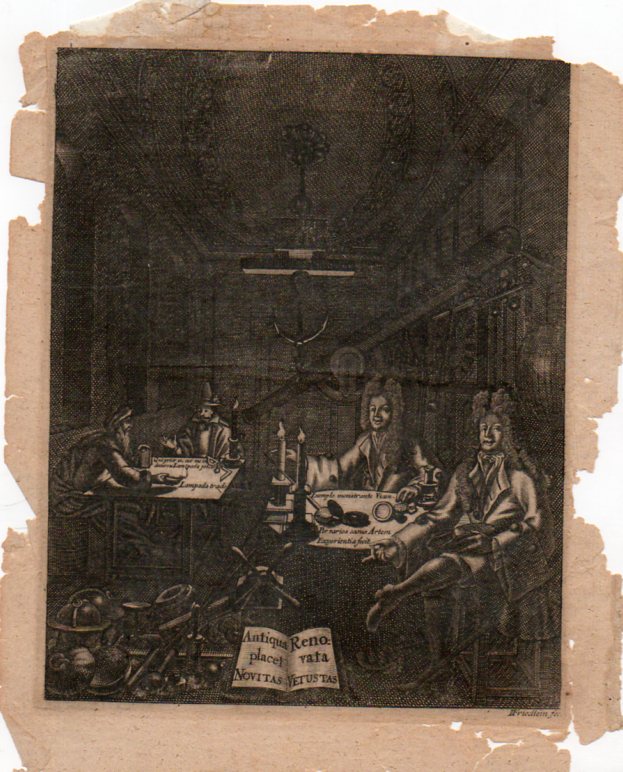
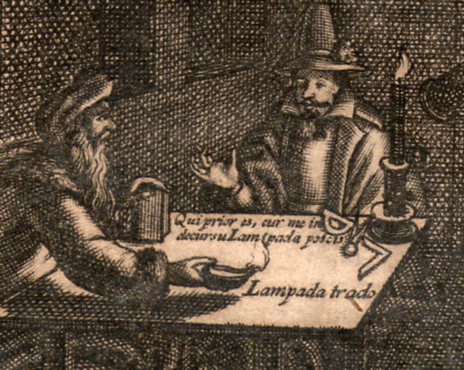
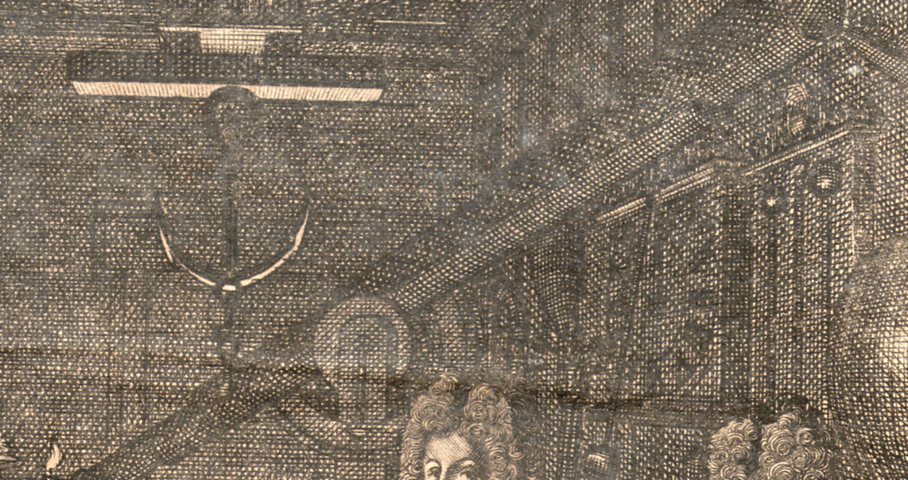
    This is an image of a  philosopher’s cabinet, engraving (on copper?) by “I. Friedlein fec”, who was Johnann Friedlein, an emigree from North Germany to Denmark, and who worked ca. 1680-1705. It shows the tools of the trade for someone working in natural philosophy (the name “scientist” would not come into use for another 130+ years or so1) and is an interesting insight into a small, polite gentleman’s club for experiment and investigation.

    Friedlein938

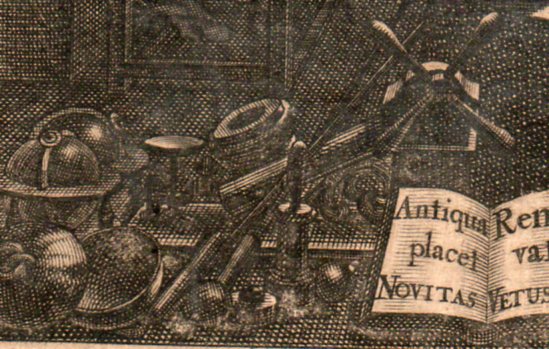
    The men surround a decent collection of scientific instruments–I can locate a compass, dividers, oil lamp, magnifying glass, microscope2  (at the right elbow of the figure on the right), terrestrial and celestial globes,  a (large) clock, barometer, and various weights and scales, and  behind it all looms a rather large refracting telescope3 (is it five inches?) 

    Friedlein939


    Friedlein940

    Friedlein942

    For all of these expensive and current instruments, the lighting these gentlemen set up for themselves is pretty poor, though of course it does add to the mystery and dark experience of the image.  

    Here’s another example of Friedlein’s  work, a frontispiece to Cryptographia, oder geheime Schrifften by Johann Balthasar Friderici, printed in 1685:

    Frontispiece, illustration from 'Cryptographia, oder geheime Schrifften' by Johann Balthasar Friderici, engraved by Johan Friedlein (17th century) published in Hamburg, 1685

    Nyt dansk kunstnerlexikon: bd. Indenlandske kunstnere (fortsættelse …)by Philip Weilbach:


    Notes:

    1. “Scientist”, in the Oxford English Dictionary (“science” is a much older word in English):

    1. A person who conducts scientific research or investigation; an expert in or student of science, esp. one or more of the natural or physical sciences.computer, earth, mad, natural, rocket scientist, etc.: see the first element.

    It is possible that the ‘ingenious gentleman’ referred to in quot. 1834  is Whewell himself.

    1834   W. Whewell in Q. Rev. 51 59   Science..loses all traces of unity. A curious illustration of this result may be observed in the want of any name by which we can designate the students of the knowledge of the material world collectively. We are informed that this difficulty was felt very oppressively by the members of the British Association for the Advancement of Science, at their meetings..in the last three summers… Philosophers was felt to be too wide and too lofty a term,..; savans was rather assuming,..; some ingenious gentleman proposed that, by analogy with artist, they might form scientist, and added that there could be no scruple in making free with this termination when we have such words as sciolist, economist, and atheist—but this was not generally palatable.
     
    1840   W. Whewell Philos. Inductive Sci. I. Introd. p. cxiii,   We need very much a name to describe a cultivator of science in general. I should incline to call him a Scientist. Thus we might say, that as an Artist is a Musician, Painter, or Poet, a Scientist is a Mathematician, Physicist, or Naturalist.
     
    2. “Microscope” (as a noun) in its earliest uses in English, in the OED: 
    1648   Bp. J. Wilkins Math. Magick i. xvi. 115   We see what strange discoveries of extream minute bodies, (as lice, wheal-worms, mites, and the like) are made by the Microscope, wherein their severall parts (which are altogether invisible to the bare eye) will distinctly appear.
    1651   N. Highmore Hist. Generation viii. 70   The white circle..by a Microscope appears now to be the Carina or back and neck of the Chick.
     
    3. “Telescope” (as a noun) in its earliest uses in English, in the OED:
    [1619   J. Bainbridge Astron. Descr. Late Comet 19   For the more perspicuous distinction whereof I vsed the Telescopium or Trunke-spectacle.]
    1648   R. Boyle Seraphic Love (1663) xi. 59   Galileo’s optick Glasses,..one of which Telescopioes, that I remember I saw at Florence.

  • What 1935 Looks Like, Tech-Wise

    JF Ptak Science Books    Quick Post

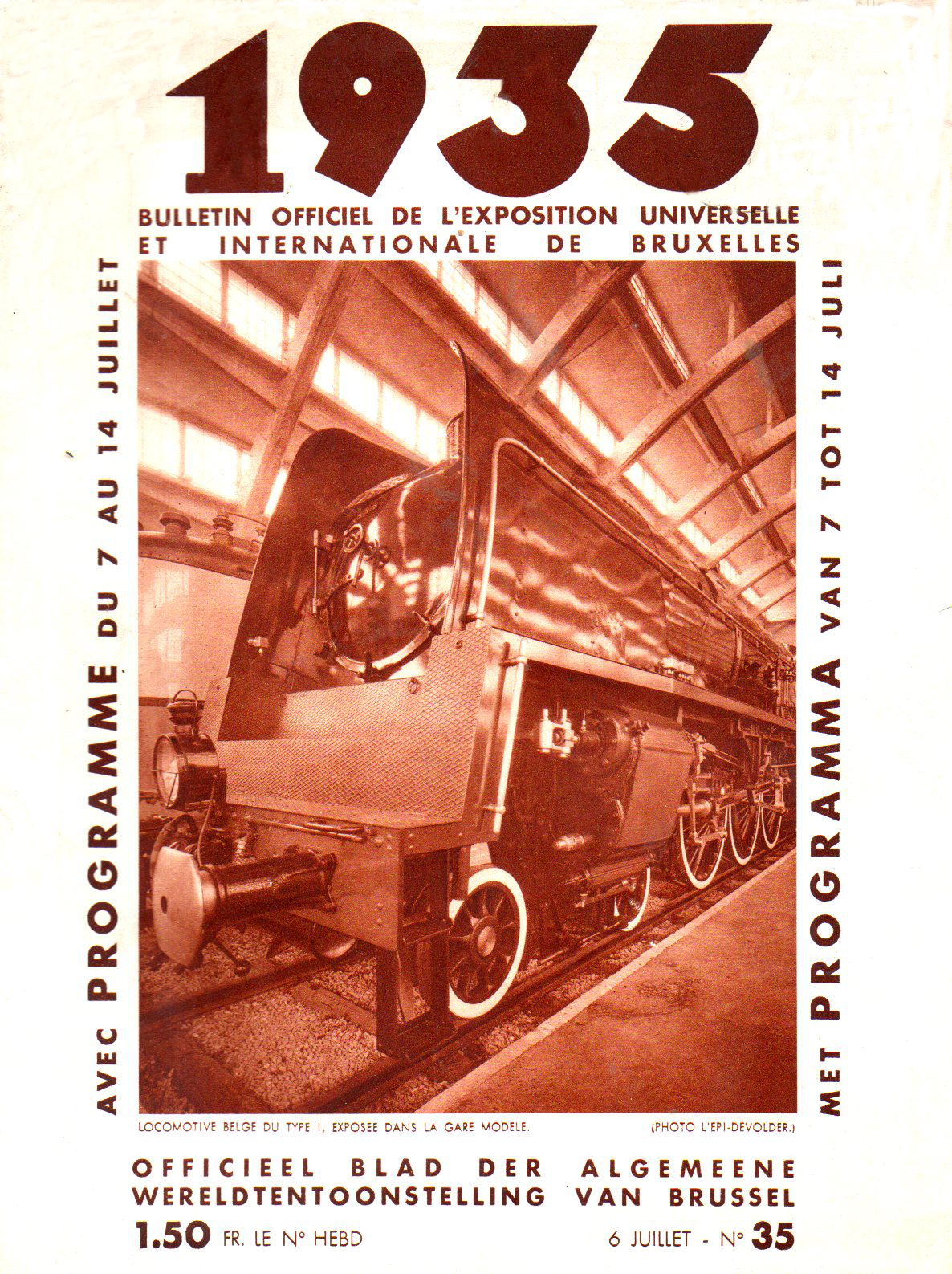
    As soon as I saw this pamphlet–and its cover–I thought that it was one of those perfect statements for a particular year:

    Loco 1935721The pamphlet is a program for an international expo in Brussels:  Bulletin Officiel de l’Exposition Universelle et Internationale de Bruxelles, and it is very heavily laden with trains and signals and track and such, all the properties of powerful movement and promise, gigantic power in a directed environment.  And beautiful.  

    ·Posted by :

    ·in:


  • Beautiful Ball Bearings, II

    JF Ptak Science Books  Quick Post

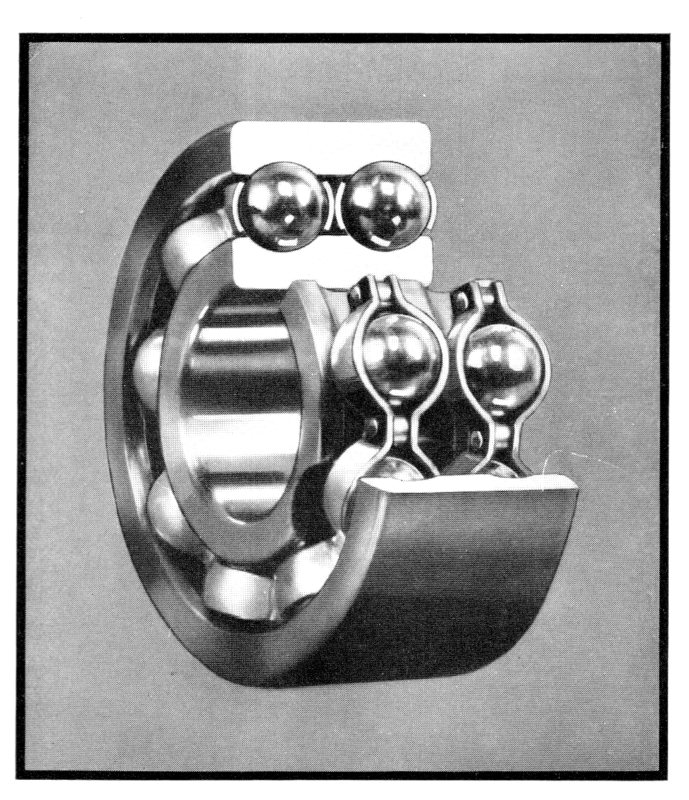
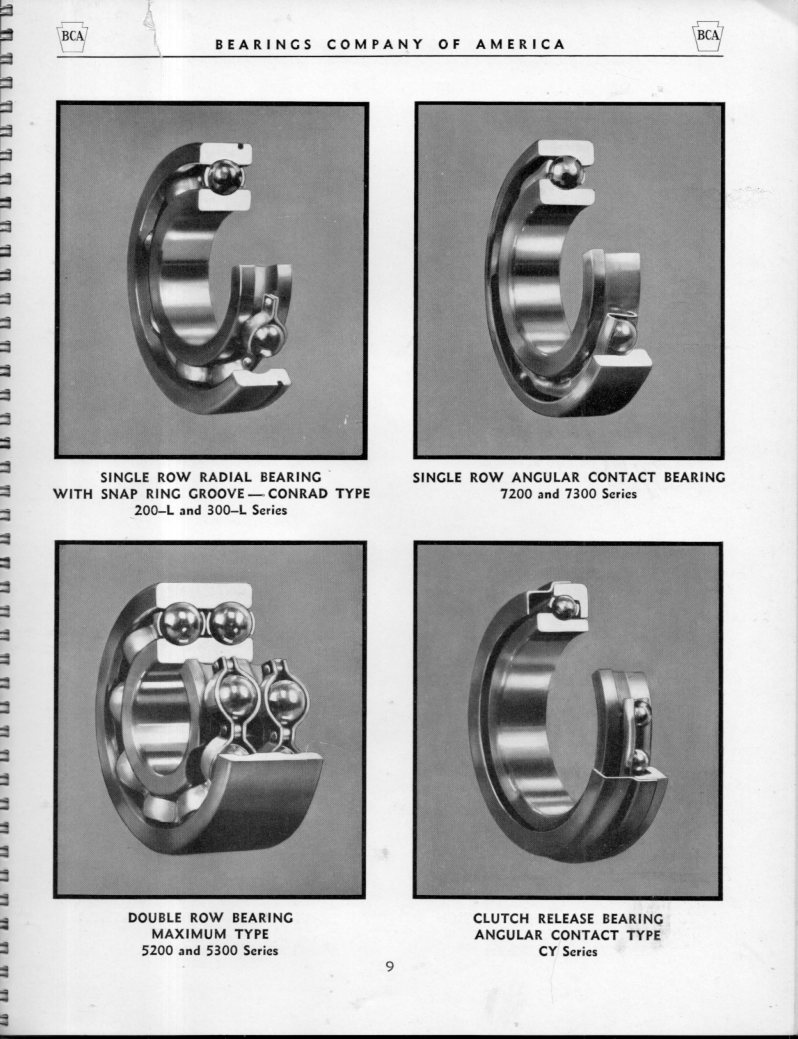
    Ball bearings are exceptionally important and have a long history, I mean, long stretching back more than 2000 years (in its most primitive form), finding formative articulation in the Renaissance, and then their first patent in 1869.  They are important parts in the history of technology, metaphorically similar to the elevator brake in the development of skyscrapers.  And they can be lovely objects in addition to their fine engineering and application. 

    The Bearings Company of America (of Lancaster, Pennsylvania, established in 1897) published a fine catalog (in 1938) for their products, including a few pages of photos of their gorgeous goods.  Sometimes photographs like these have as much artistic impact as the techno works of Paul Strand and Dorothea Lange–the images are just fine.  

    Ball bearings710


    Ball bearings709