A Daily History of Holes, Dots, Lines, Science, History, Math, Physics, Art, the Unintentional Absurd, Architecture, Maps, Data Visualization, Blank and Missing Things, and so on. |1.6 million words, 7500 images, 4.9 million hits| Press & appearances in The Times, Le Figaro, Mensa, The Economist, The Guardian, Discovery News, Slate, Le Monde, Sci American Blogs, Le Pont, and many other places… 5000+ total posts since 2008.
The story of the (very) long-range bombardment of Paris from points unknown is filled with questions in this article that appeared in the Scientific American on April 6, 1918. The writer hadn’t an idea of the type of gun being used, the weight of the shell (yet), and just about all other details. The author did wonder about the reasons for such a gun–that the idea of a long-range indescrimient bombing from a great distance just seemed to be beyond the wanting capacity of the countries fighting Germany.
The big gun was The Big Gun, later identified as the Paris Gun–a mysterious entity during the war, and after the war as well. It turns out that when the Germany army retreated beginning in August that they also destroyed the weapon and just about anything connected to it.
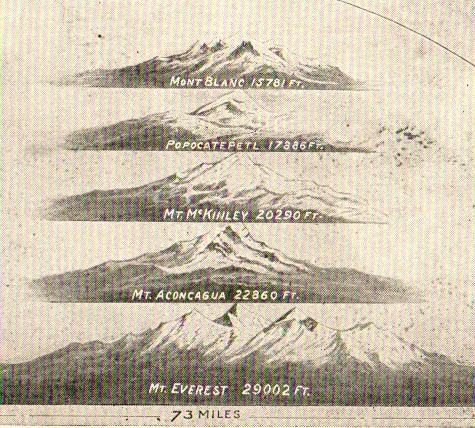
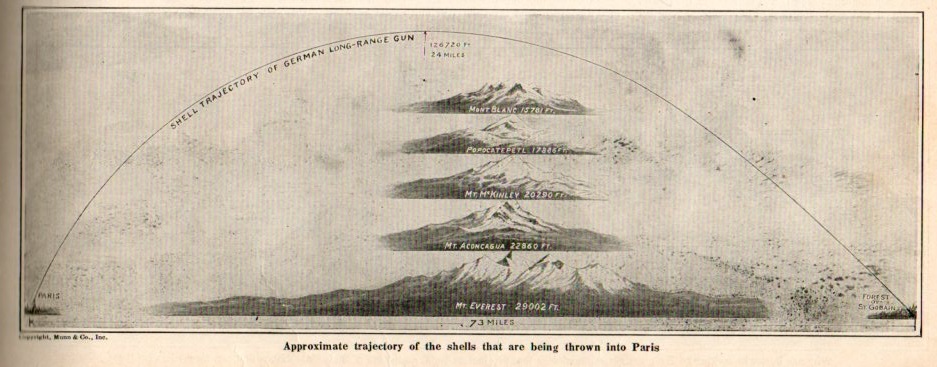
The gun was extremely powerful. At 256 tons it launched a 236-pound shell to a height never before achieved by humans launching/propelling stuff into the air–it left the barrel of the gun at about 1 mile/second, traveled 75 overland miles, reached a height of 26 miles…and then came down, exploding, killing.
One very effective way of explaining the incredible height that the shell reached was measuring the zenith of its trajectory in terms of mountains:
Which is a detail from:
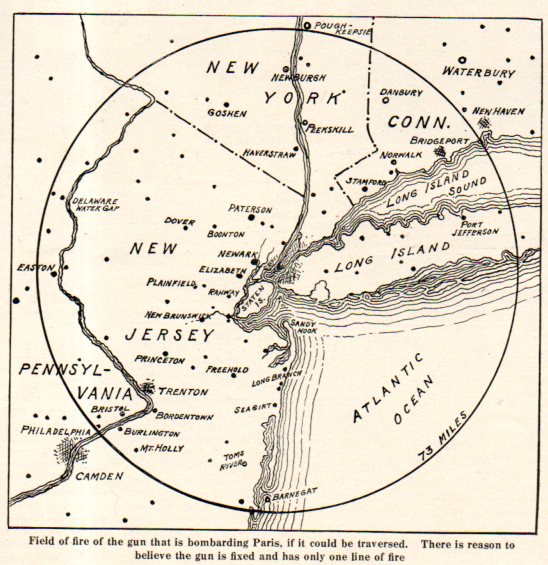
And to give a more local understanding of the range of the gun:
No doubt this map gave a true flavor and sense of dread to American readers on exactly what it meant to have to deal with a cannon whose reach was 75+ miles.
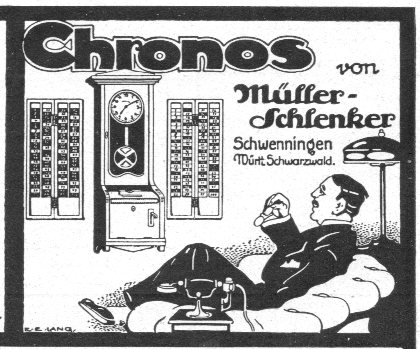
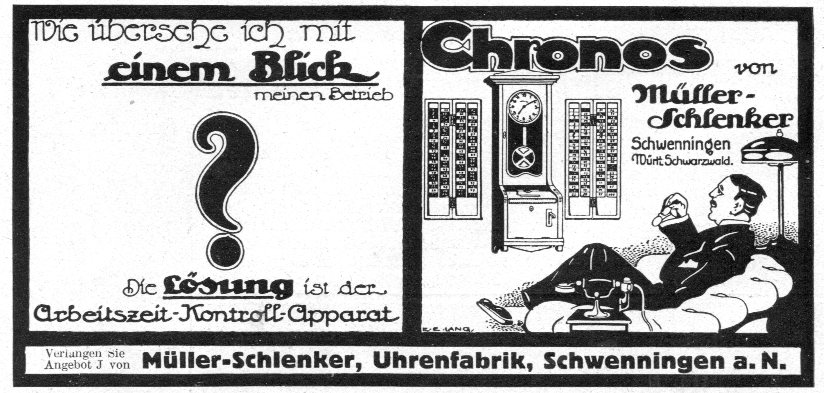
This ad (which was tiny in real life) appeared in the back pages of the last issue in June 1922 of the Illustrirte Zeitung (Leipzig), and to me it is a little peep into the future of vast industrialization and the coming of robotic replacements for certain human interactions. In this case, the robotics (here three years after the term “robot” was coined by Karel Capek in his R.U.R. Rosumovi Univerzální Roboti)) is a time-card machine. Here the happy business owner is able to recognize what workers were working and via a short stroll over to the wall of cards he could tell who was at work and for how long. It was a control of worker’s time and in a sense of their output, a real sense of ownership of the worker and industrialization of people. Time and motion studies and Taylorism had started nearly 20 years earlier, but I do not recall seeing many advertisements that were disposed to suggest these new relationships.
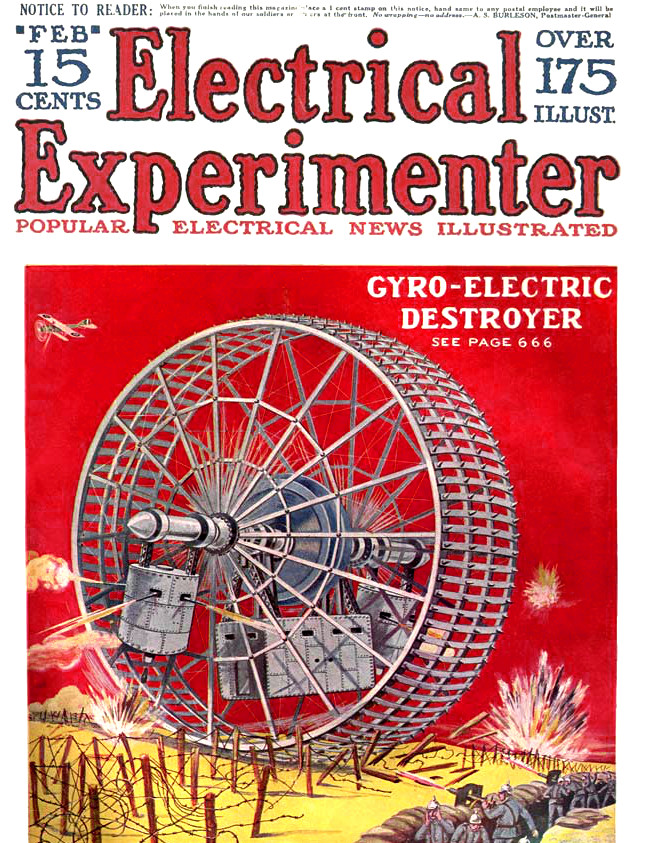
A few days ago I was having a look at a Large & Impossible Tank, and today I came across this fabulous beauty from the Electrical Experimenter for February, 1915.
This 45′ monster would be somehow powered by electricity though there is no discernible power source or power train, and it would be steered by a gyroscope. (The use of the gyroscope is interesting–the idea of it acting as a control mechanism had been successfully introduced in the Whitehead torpedo in 1905, and used as stabilizing agents in airplanes and ships by 1910, and found in the first gyroscopic repeater compass by 1911, so the magazine and writer pretty much had their finger on the national gyroscopic pulse of the time.) Being hit by defensive cannon fire was said to have been not too much of a problem because the shells would mostly pass through the lattice work of the structure. The armament in the suspended armored buckets would be “the same as British tanks”–the buckets also came equipped with a bomb chute (if you look closely you’ll see one in action here, the destroyer dropping a bomb on itself) for, well, bombing.
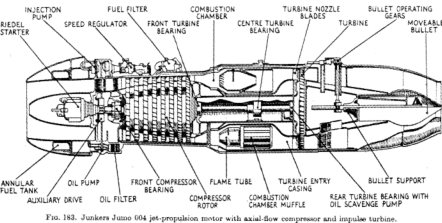
This drawing comes from the great engineering classic that presented the prototype jet engine for all that would follow it–J.G. Keenan’s Elementary Theory of Gas Turbines and Jet Propulsion. It was published in the glorious Oxford blue cloth by the university and issued with the classically-design beige dust wrapper–it just has the feel of something solid and astute. Keenan’s work is a classic–it is a general survey of developments in the jet propulsion field and was among the very first books published on the subject.
Keenan was not the first though to the jet engine party–Hans von Ohain and Sir Frank Whittle were. It was a classic idea-in-the-air example of two people working on a very similar idea at the same time without any knowledge of the other. von Ohain was the first to produce an operational jet engine (1939) while Whittle was the first to patent (while getting his engine to be operational in 1941). Jet engines have been around for a long time (Romans having legislation on the use of variable jet sprays in water distribution) in different forms–fountains, fire hoses, marine jet propulsion (reaching back to 1871), and so on. But John Gregory Keenan’s book–that was a big and influential review, a major contribution to the field.
This item is offered for sale at our blog bookstore, in “recent additions”.
Leonardo Torres y Quevedo1 (1852-1936) was a superior engineer, pioneer of remote control, a “prolific and successful inventor”2, and creator of the what is believed to be the first chess automaton3–in effect, the first human-machine game where the machine answered back. (There are earlier examples of chess machines, perhaps the most famous/infamous of which is the celebrated “Turk”, a faux chess automaton created in the 1770’s by Wolfgang von Kempelen, a supposedly mechanical device taking on all comers performing at a very high level, except that it was a fraud, a model of a machine with a human inside of it making the decisions, a sort of reverse robot.)
[Image of Torres’ chess playing machine from Scientific American Supplement, November 6, 1915, pg 297 (bottom)]
Torres wrote very little, mainly because he didn’t like to,4so mostly what is known of his work in print (outside of patent reports) is primarily a secondary source reporting on his efforts. There are three earlier appearances in print on the automaton–in Revista de la Real Academia de ciencias… de Madrid in 1913, La Nature5in 1914, and Asociación Española para el Progreso de las Ciencias, Congreso de Valladolid6, in 1915.
“In 1912 Torres built a robot capable of playing the chess endgame of king and rook against king and defeating a human adversary. This device, perfected in 1920, and the Telekino must be recognized as conceptually related to the calculating machine of Charles Babbage, as Torres Quevedo acknowledged in “Ensayos sobre automática. Su definición. Extensión teórica de sus definiciones” (Revista de la Real Academia de ciencias… de Madrid, 12 [1913], 391–419). His work in this field culminated in an electromechanical calculating machine introduced 26 June 1920, the prototype of which demonstrated that calculations of any kind can be effected by purely mechanical processes. In 1913 Torres Quevedo had established that a machine could proceed by trial and error, in contrast with current belief–“at least when the rules that have to be followed in trial and error are precisely known…”–Dictionary of Scientific Biography, vol 13, pp 431-2.
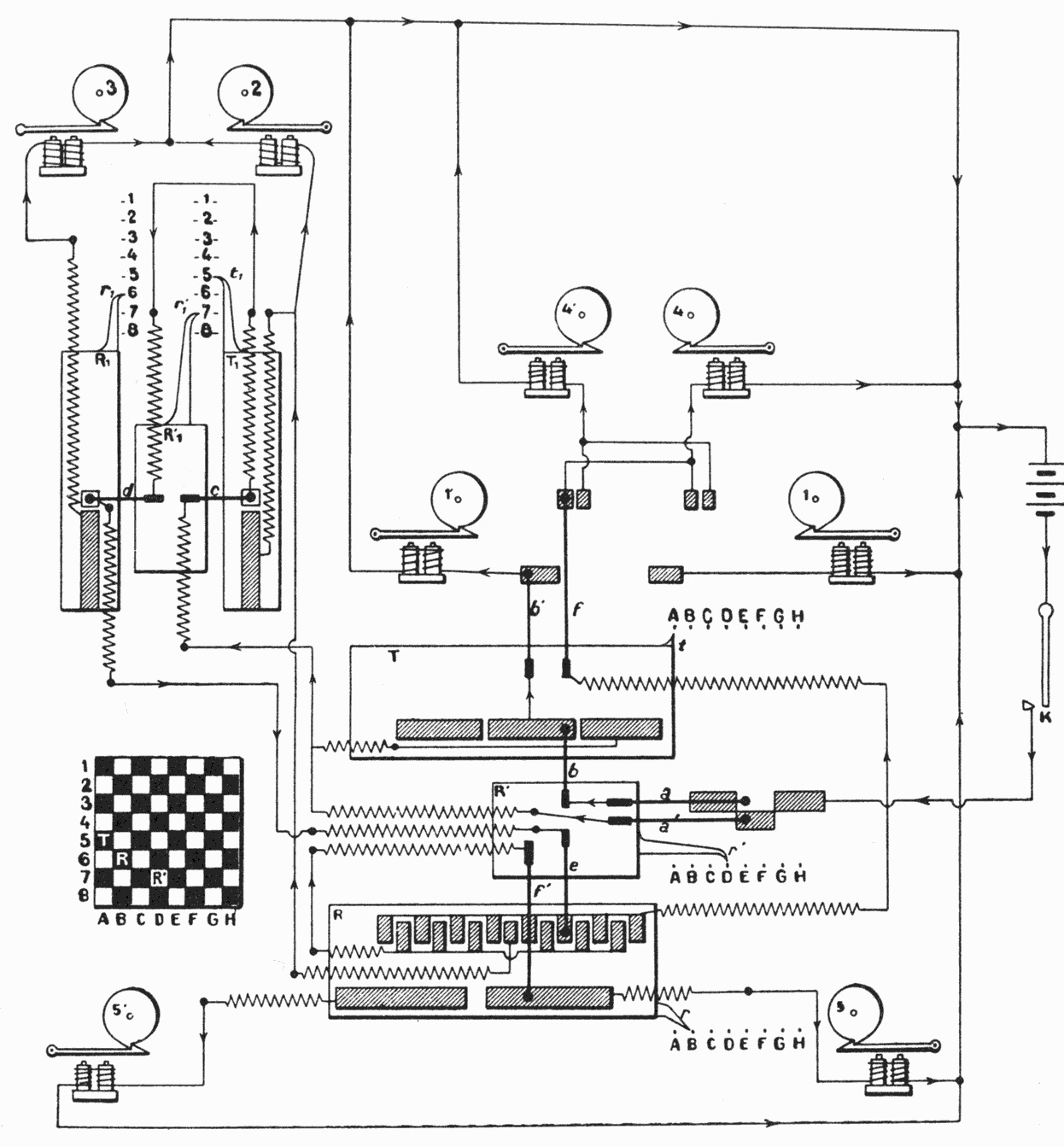
The first appearance of the chess playing machine to appear in English seems to have been in the Scientific American Supplement, November 6, 1915, pp 296-298 (appearing with seven photographs of inventions three of which are for the chess machine, and four schemtics all of which pertain to the chess machine): “Torres and His Remarkable Automatic Devices, He Would Substitute Machinery for the Human Mind”.
His superb creation, which he called “El Ajedrecista”7 (“the Chess Player”) was an electromechanical device which pitted an endgame between a King/King-rook, and was fully and completely hand’s-free functional. A later version attempted an improvement on this magnificent machine using magnets.
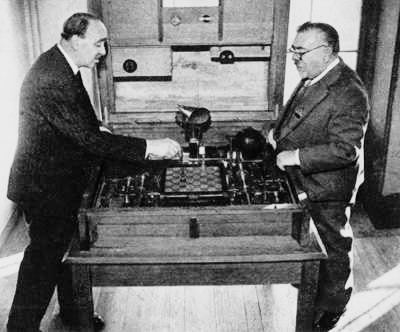
The machine was exhibited and demonstrated in 1951 by Torres’ son, Gonzala, showing how the machine worked to the inventor of cybnertics, the big-brained Norbert Wiener. A photograph of the meeting appears in the Eames’ great book, The Computer Perspective, though I downloaded this image (below) from Cybnertic Zoo:
ALSO: this fantastic video from youtube of the machine at work:
NOTES:
1. Nice piece on Torres y Quevedo in Wikipedia, here. And another, “Cyber Heroes of the Past”, http://wvegter.hivemind.net/abacus/CyberHeroes/Quevedo.htm
2. Brian Randell, Annals of the History of Computing, 4/4, October 1982, on the contributions of Ludgate, Torres, and Bush, with full text here: http://www.cs.ncl.ac.uk/publications/articles/papers/398.pdf
3. _____. “This chess automaton, believed to have been the world’s first…” ibid.
4. Torres Quevedo disliked writing–“for me a form of martyrdom,” he called it–and thus his scientific contributions must be traced from the few reports he did write and, especially, from the patents he obtained and the machines he built.” —Dictionary of Scientific Biography, volume 13, p 431.
5. Henri Vigneron “Les Automate” La Nature, 1914, found here: http://cyberneticzoo.com/wp-content/uploads/2011/01/Automates-La-Nature-Torres-1914.pdf]
6. “El autómata ajedrecista”, from Asociación Española para el Progreso de las Ciencias, Congreso de Valladolid, Vol. 2 (1915). 549-556pp. The scientific bookseller Jeremy Norman has a copy of this rare work offered at his bookshop, here.
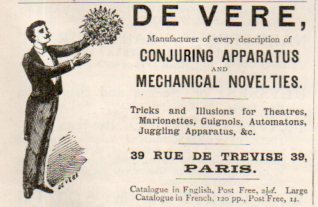
Here’s a very unusual bit that I found deep in the a volume of the great Nature magazine, for July 9, 1896. There were only 23 pages of text for the standard issue, with this one carrying eight very full pages of advertisements. The issue is full of the expected–and then there was this, a great unexpected ad:
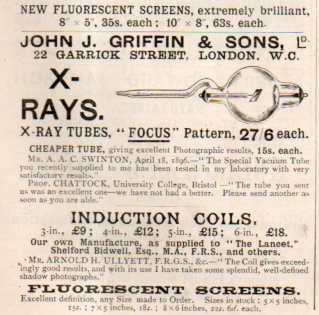
Nature was a semi-popular magazine for the general sciences in the great Victorian age, so it is quite possible that a generalist/not-necessarily-science type woud place an ad in it. The “magic” part is odd, though the “mechanical novelties” part of it makes a lot of sense. The other ads are lovely and engrossing and cover a wide spectrum of what teh active scientific mind in 1896 might want: x-ray tubes (for the earth-shatteringly new discovery of just months earlier), rock and mineral specimens, live specimens for dissection, galvanometers, descriptions of courses for science schools, mathematical instruments, and so on. It would be a high privilege to see teh store associated with any one of these advertisements.
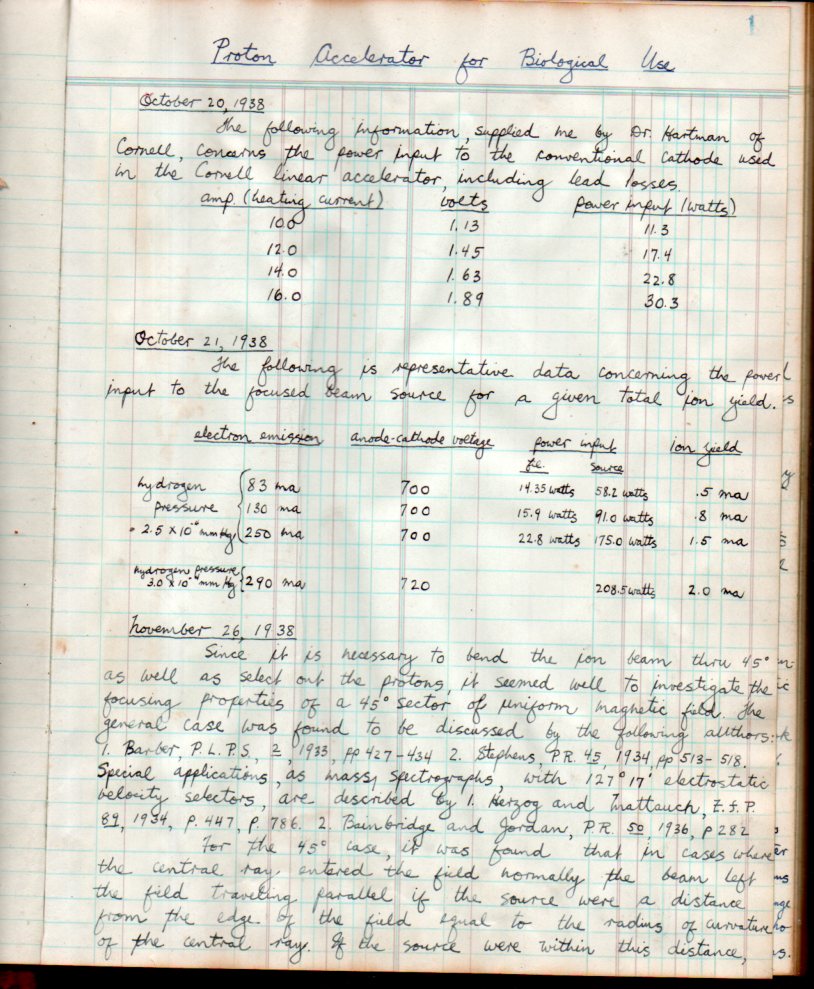
Here’s an example of some book detective work that I get to do, a lot. The book is actually a manuscript notebook, titled “Proton Accelerator for Biological Use” and kept by George W. Scott, jr., and written in a ledger book stamped “Haskins Laboratory”; the entries are from October 1938-April 14, 1941, and there’s 65 pages of entries of about 21,000 words. It’s concise and analytical, first-hand experiences and observations, notes kept by an experimenter to himself on constructing this machine. And the notebook came from the estate of Caryl Haskins, part of which I purchased years ago.
It turns out that the manuscript was fairly easy to figure out–tying everything up nicely in the end though wasn’t so easy.
The “proton accelerator” notes was on the construction of the M.I.T. cyclotron, which was the world’s first accelerator dedicated solely for meidical/biological use and a crucial instrument in the beginning of nuclear medicine.
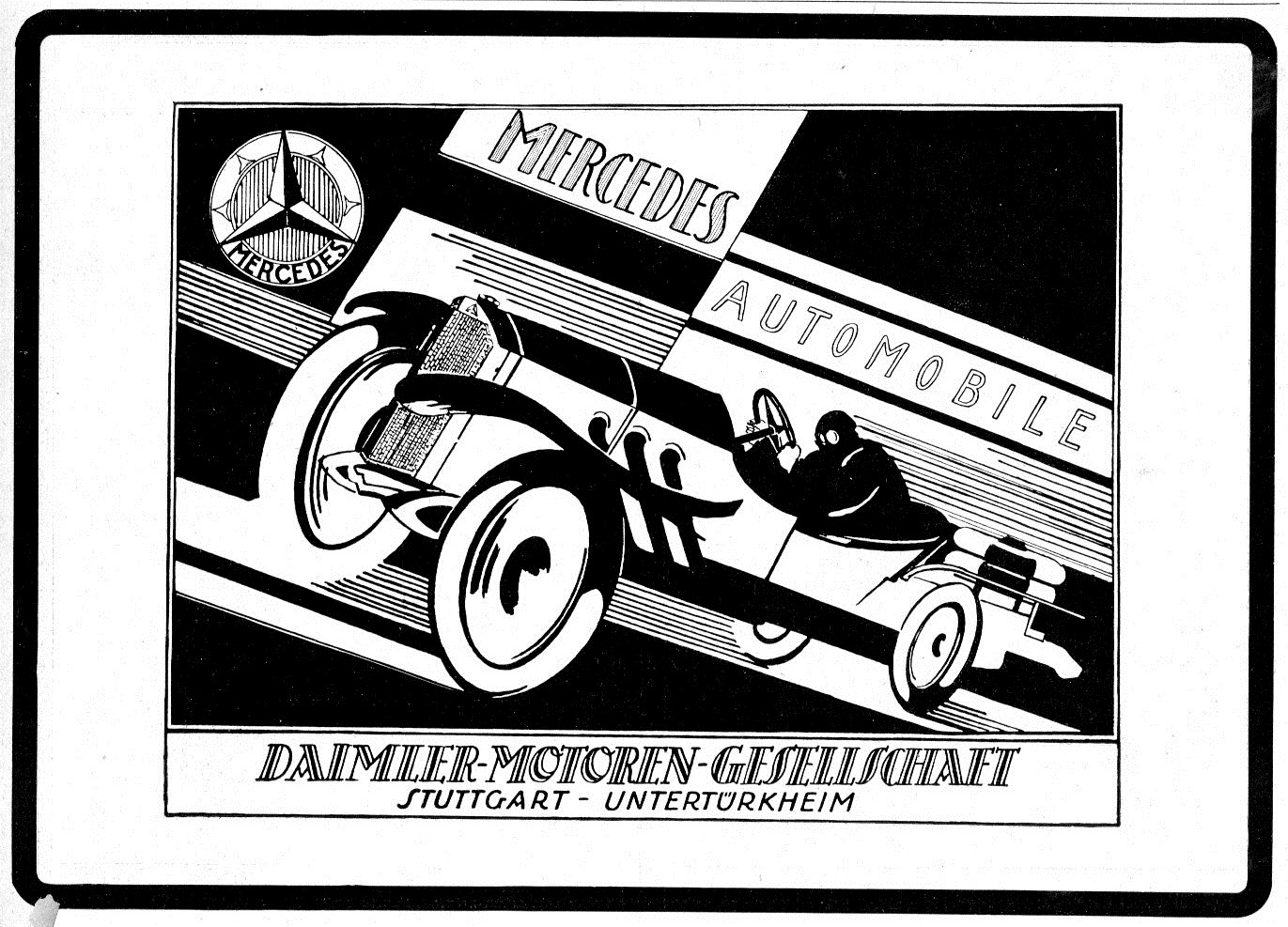
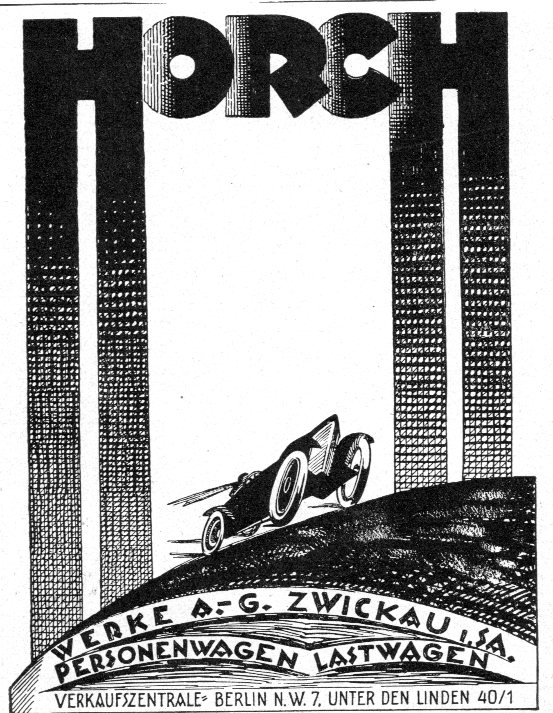
In browsing bits and pieces of a January-June 1922 volume of the Illustrirte Zeitung (Leipzig) I took notice of several ads that appeared in the back of each weekly issue. Cars. Fast cars. Fast cars going fast. It occurred to me that I really didn’t have any knowledge about when “speed” was shown in the sale of an automobile, though these ads were definitely in attendance here in 1922:
The are other ads to follow, images depicting great speed…though it strikes me that these sorts of displays come a little late in the history of the depiction of speed, especially given the experimentation in the art world with space and time. I’ll have a look at earlier volumes to see if I can determine when the ads began to appear, though it seems to my intuition and deep memory that 1922 is actually “early”.
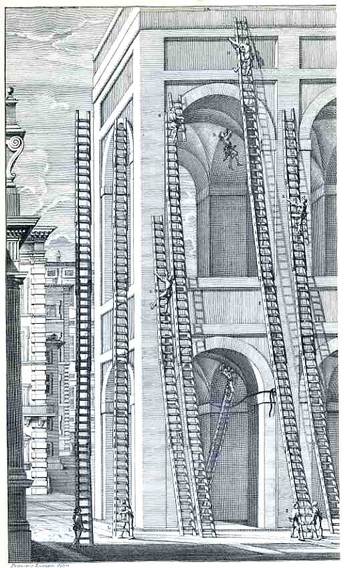
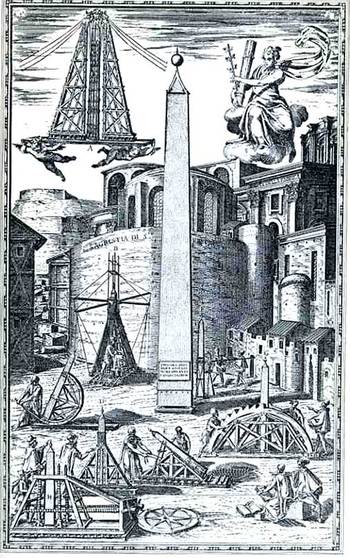
This gorgeous, near-dadist image belongs to Niccola Zabaglia, who published it in his book Castelli, e ponti di maestro Niccola Zabaglia con alcune ingegnose practice, e con la descriziojne del trasporto dell’obelsico Vaticano, e di altri del cav. Domenico Fontana, in Rome, in 1743. This is the literal and absolute height of pre-modern, pre-mechanized building construction in the soaring Roman Baroque, ordained by “maestro”, the master, Zabaglia (1664-1750), a spectacular (and necessary) proponent of practical mechanics as applied to the building trades. Among the “Castles” and churches and bridges alluded to in the title of his book, Zabaglia was responsible for affecting the maintenance and repair of St. Peter’s (more particularly to the basilica and the vault)—specifically, he had to figure out how to get the workmen and materials into place, and into very difficult and very high places, without damaging or destroying any of the existing decoration, artwork, sculpture, frescoes, and so on. This was no easy feat to perform back there in the dim, 265+ years-ago pre-electric pre-power past, with enormous technical and operational difficulties, and Zabaglia accomplished this was superior affect, devising complex and elegant moving and stationary scaffolds, hoisting and holding mechanisms for the ladders, and much else. He did just beautiful work, and he is a patron saint in the history of repair.
Ladders and scaffolds were important of course but were among the least of Zabaglia’s numerous accomplishments and inventions—they were so plentiful and useful that two Pope Benedicts ago (Pope Benedict the 14th) ordered their publication with actual teams of artists and engravers performing specific tasks.
This second image pertains to the tail-end of the Zabaglia title-page—the moving of the 500,000-pound Egyptian (carved during the reign of Nebkaure Amenemhet II, 1992-1985 BCE, and originally standing in the Temple of the Sun at Heliopolis) obelisk in 1586 by Domenico Fontana, which was one of the greatest engineering feats of the Renaissance. Moving this enormous and relatively delicate object (from the Circus Nero, where it was placed by the emperor Caligula in 37 ACE, to St. Peter’s Piazza del Popolo, 50 years or so before it would be more enveloped by Bernini’s flying wings) took years of (very) careful planning and months of motion and movement, not to mention an extra month to get everything into place and slowly raise the obelisk into its final position. Fontana had to be cautious and correct, and he was, performing a not-so-minor miracle of pre-industrial magic to move the priceless 250-ton iconic relic and place it perfectly down in the center of Christianity. now that must have been one hot Roman summer, especially for Fontana.
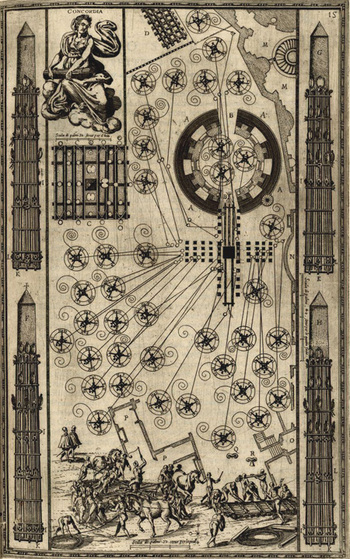
This image comes from Domenico Fontana’s Della trasporatione dell’obelisco Vaticano…(published in Rome by Bassa in 1590), and shows some seven scale models for the armature of movement (in the foreground) of the great obelisk An even more famous and luscious image is the plan of the moving implements as seen here, below:
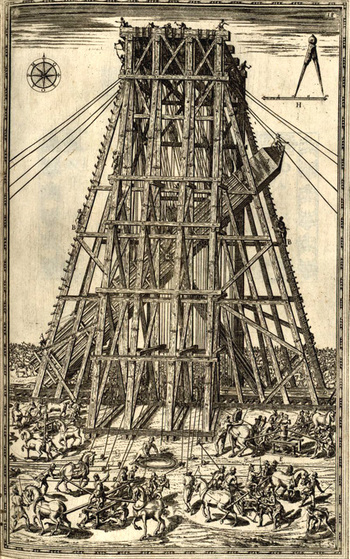
And again, another beautiful engraving showing the placement of the obelisk:
The small $25 miracle/godsend to number crunchers everywhere was this small, nine-place, sliding-digit chain-adder mechanical calculator, set in nickel-plated metal, and which we see in this fantastic and half-bizarre ad in Illustrirte Zeitung for June 1922. The instrument was about eight inches long and came in its owns hard case, and was a very good instrument for the lowish-end market. The add of course is fantastic. (“Die Erloesung” could I guess be transliterated as “Deliverance!” from the drudgery of making calculations by hand.)
 No doubt this map gave a true flavor and sense of dread to American readers on exactly what it meant to have to deal with a cannon whose reach was 75+ miles.