A Daily History of Holes, Dots, Lines, Science, History, Math, Physics, Art, the Unintentional Absurd, Architecture, Maps, Data Visualization, Blank and Missing Things, and so on. |1.6 million words, 7500 images, 4.9 million hits| Press & appearances in The Times, Le Figaro, Mensa, The Economist, The Guardian, Discovery News, Slate, Le Monde, Sci American Blogs, Le Pont, and many other places… 5000+ total posts since 2008.

Category: Social History

  • Blank, Missing & Empty Things: German Soldiers, November 1918

    JF Ptak Science Books   Post 1305

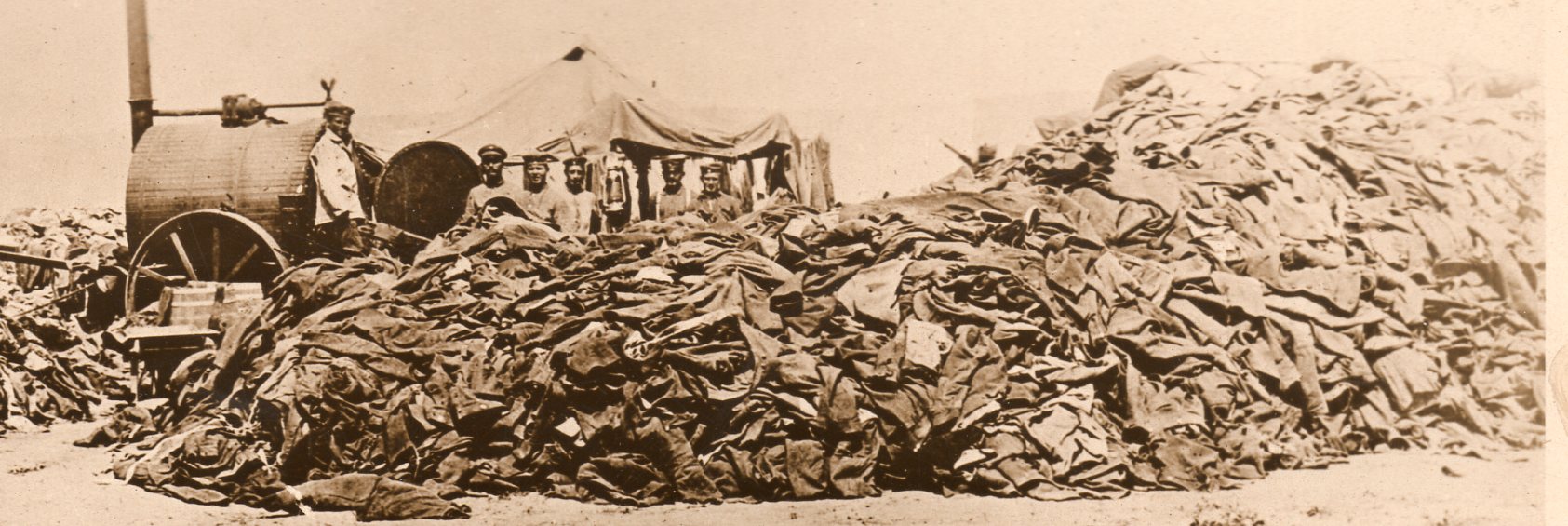
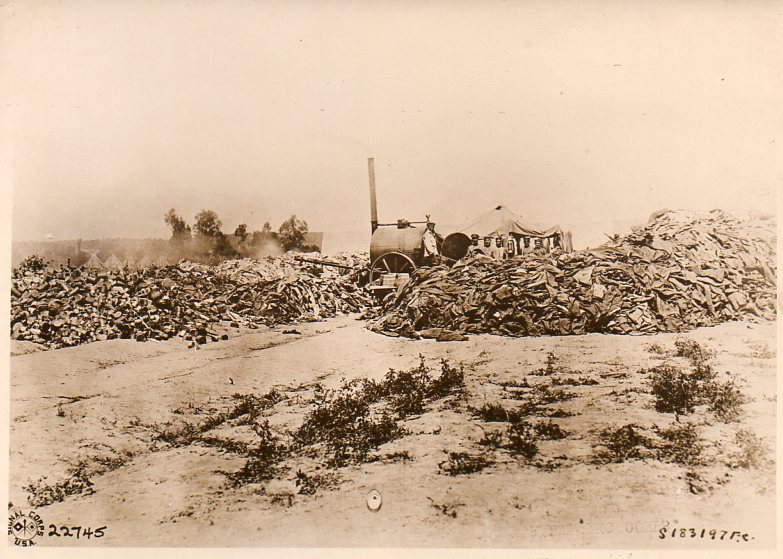
    This remarkable photograph is part of an archive of World War I Underwood & Underwood News Photo Service photographs I purchased many years ago.  It shows a pile of German soldiers’ uniforms–thousands of them–taken from German prisoners, the clothing headed for “cleaning and repair”. 

    World War I photos--empty uniforms287

    [This photo, along with mnay others, is available for purchase from our blog bookstore.]

    I didn’t know before this that the uniforms were repaired–I can imagine the cleaning part, since the prisoners must wear something, and deep into the fifth year of the war it seems hardly the case that they would be given anything at all to wear except for what they were captured in. the cleaning part sounds logical too, especially as the cleaning was being done by the prisoners themselves (pictured here).  Clean clothing makes for more sanitary conditions in mass compounds for thousands of prisoners, and lowers cost for the health maintenance for the prisoners in the short and long run.  And so far as repairing goes:  attached buttons make for closed coats; closed coats allow prisoners to have a better chance at staying healthy in the coming cold months. Just ask Napoleon about the cost of thread on the buttons of his army’s overcoats in the march towards Moscow.  (The thread that wasn’t used cost very little; the cheaper thread that was used cost everything.)

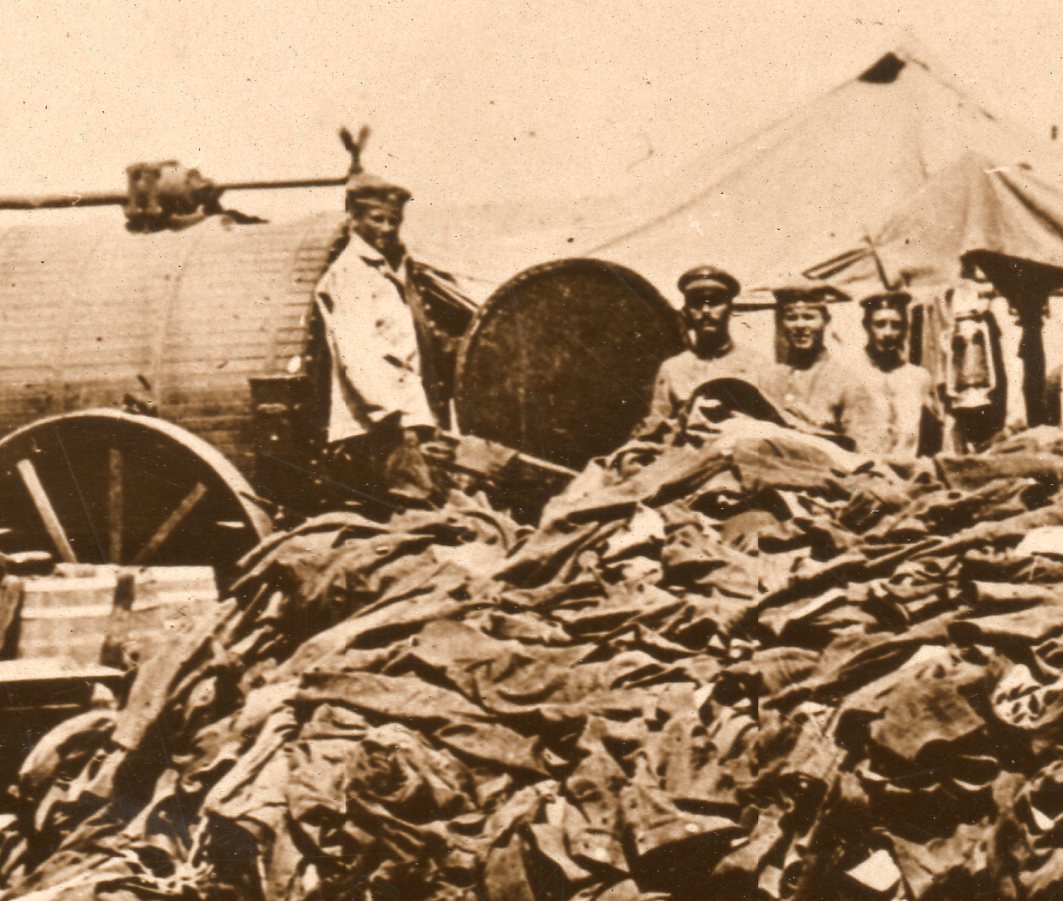
    And the detail:

    World War I photos--empty uniforms det288
    And closer still:

    World War I photos--empty uniforms detb290
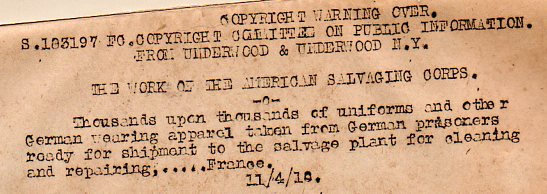
    And the text that was provided by the photo service company to be used along with the photo wen (or if) it was published. 

    World War I photos--empty uniforms txt289

    The cleaning and repairing went on, the prisoners kept coming in–even for those involved, the scent of the end of the war was in the air, though I doubt that the majority felt that it was only a week away. 


  • An Alphabet of Giants, Part II–Under and Over the Volcano with Rabelais

    JF Ptak Science Books Post 1278
    Gluttony127
    Rabelais may be that man who lived under/in/over the volcano.

    Francois Rabelais (1490-1553, writing under the anagram Alcofribas Nasier)   was perhaps as gigantic a man in spirit, need, want and appetite as his greatest creations, Gargantua and Pantagreul, and may well be the greatest ex-monk of ex-monks, a bubbling Renaissance Humanist.  I’m not saying that Rabelais spent 11 months in the womb or smoothed his hair with a 900′ comb or drank the milk of 17,000 cows like his creation Gargantua,  but he did have a staggering appetite for life.  He ate life as Honore de Balzac ate food.  Rabelais seemed to know no boundaries, and neither did Balzac, who would typically eat a hundred oysters,  twelve lamb cutlets, a duckling, partridges, fish, fruits, assorted vegetables, coffee, liquor, liquer, wine and so on, at one sittng.  Every day. Nor did Rabelais  necessarily drink like Eugene O’Neill or F.Scott or Edgar Poe or Hart Crane or Jack London or Dylan Thomas, though he did drink beond the boundaries.Thomas, though he did drink beyond the boundaries.

    One of my favorite writers–George Orwell–didn’t have much use for Rabelais, repulsed by his abuses, but that was to be expected.  So it goes.

    File:Francois Rabelais - Portrait.jpg

    The beginning and end of Epitaph for Rabelais, by Peirre de Ronsard:

    If anything can sprout
    From  a dead man  rotted out,
    And  if further generation
    Arises  from stagnation,
    A  grapevine will  surely take birth
    From  the belly and  the girth
    Of  good Rabelais, who  contrived
    Always  to drink while  alive…

    All you who  pass his grave,
    Be  you nobleman  or knave,
    Hang  cups on  this, his shrine
    To  vessels and sparkling wine;
    Hang  sausages and ham:
    For  if he  still has sensation,
    His  soul prefers potation
    To  lilies as a gift,
    And wine  gives a better lift


  • The Lost Memories of Things in the Way of the Horizon–Ugly Roads, 1922

    JF Ptak Science Books   Post 1303

    “There’s nothing so perfect as imperfection.”–Somebody.

    “The great unconquerables in the geography of human thoughts and ideas are the bad ones.”–Nobody.

    Bad ideas don’t so much go away as they get recycled. They can be replaced by good ideas or bad, but the ”original” bad ideas seem to linger on and on.  They are perhaps the indomitable inheritance of society, real and imagined.   

    Bad human-produced landscapes are an outgrowth of bad ideas, calamities large and small that come and go, the old replaced by something new that is good or bad or indifferent. With the landscape, the original landscape itself–apart from the idea that brought it about–is generally lost forever once it has been replaced.  There is no Bad Idea Spirit that brings it back whole again, unlike the generic Bad Idea, which can live on and on, unencumbered by history, like a Greek play or some deeper mythology.

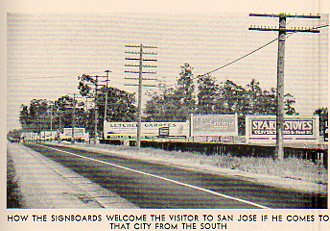
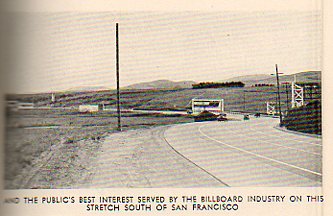
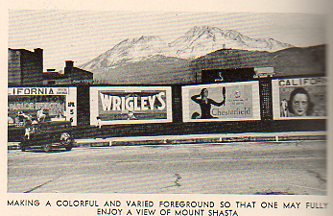
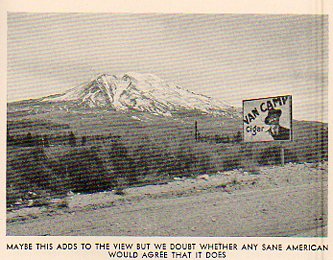
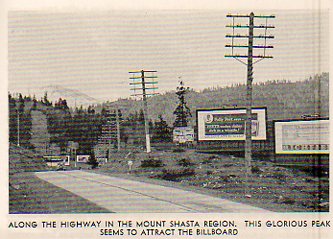
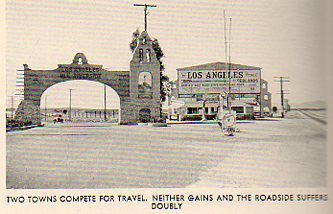
    Roadside billboards 273 Theoretically society is supposed to learn from recognized bad ideas, so as to not repeat them etc., which is one reason why we keep track of them, in the vain hope that someday someone somewhere in the history of our future will kill particular bad ideas off one by one. 

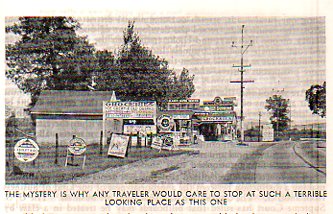
    Roadside billboards 274 In the meantime we can dwell on what we have, though with the removed bad idea landscape, it is more difficult.  That’s why it is important every now and then to familiarize ourselves with them when the opportunity arises, which is just what happened with this innocuous-sounding pamphlet, The Roadsides of California, a Survey1 (1922, and available for purchase at our blog bookstore)  Its not like it’s Pandora’s box–we can open this one and just a few, limited baddies come out, and fall limply to the floor.  But what we see is interesting, a slice of our memory of the horizon–a part of our “progress” that we’ve tried to excise–and what we can see now are the removed and forgotten things. 
    Roadside billboards 275 Roadside billboards 276

    Roadside billboards 278
    Roadside billboards 280 Roadside billboards 281 Notes

    1. This is actually an interesting pamphlet, an early attempt at removing the quickly generated ugliness that was cluttering new roads for the explosion of automobile travelers.  As quickly as cars were made in the new decade of the automobile, billboards and roadside attractions followed.  This pamphlet identified this phenomenon as a problem.


  • Why Kindle is No Good for Kids

    JF Ptak Science Books  Post 1277

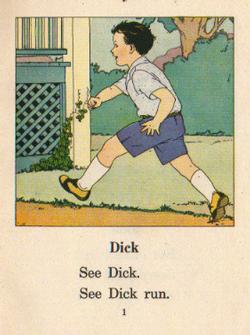
    Dick Words without Books–Kindle et al as a Dim Shadow in the History of Reading to Children The Kindle and its relatives may be a poor choice for reading to children–it’s a book and not a book, a collection of words without a wrapping, a constant reminder for what it isn’t, a cold remedy for warm memories.

    There have been a number of books “written” now that have no words.  Elbert Hubbard charmingly put one together in 1898 (called Essay on Silence).  More recently, there was The Nothing Book (1970), which was precisely that, and which found its way into the NYTimes book review section (“we have nothing to add”). Elsewhere in the arts John Cage produced a four and a half minute piece on nothing, while Samuel Beckett takes far less time to produce his ode to nothing in his play Breathing–all fine examples of nothing.

    There are more-lesser examples of nothing in literature, with books produced using nothing but the letter “I”, or commas, or periods/dots, or plus/minus signs.  They soberly add a little something to nothing and somehow come up with less than “something” and more than “nothing”, floating in a briney failed no-man’s-land of not-nothingness. Others have taken a different route around nothingness by simply dropping the use of a single letter in the formation of their novel–the lipogram isn’t even a stutter to nothingness, just a hollow something. 

    And that’s where the Kindle comes in, in the hollow somethingness. 

    Dick and Jane are something.  Or at least the physicality of reading them to children is something. The stories aren’t important, really–the handling of the book, the feel of the pages, the jumbling of position, the steadying of the text, the turning of the pages, trying to navigate the swirl of motions, the feel of the whole thing as a voice deciphers the tracks along the pages.  

    It’s the act of reading that might be the most mportant thing in getting children to appreciate the whole idea of reading. 

    Reading from a Kindle just won’t do, it can’t accommodate the range of differences, the cascade of varying stimuli, that comes from holding a book.  Books are always the same size inside a Kindle–I know t hat my own children love some books because of their shape, or they just like feeling something different in their own hands as they skip from title to title.  

    You also can’t give your kids the book that you had when you were little, seeing the way your name changes in your books as you grew older.  You won’t have a Kindle with your kid-scrawl on the flyleaf identifying the child-you in 1962.  The kindle has no personality of its own–which may be fine for people already reading, but not so for people just starting out.  

    You also can’t press a much-loved, hard-read copy of a favorite Kindle into your kid’s hands and expect some sort of response to it. There’s just too much missing from the reading experience with a not-a-book–you just don’t want to institute a sameness when what is needed is difference


  • An Unexpected “Discovery” in Correspondence to Santa, 1871

    JF Ptak Science Books

    Blogsanta121 I do love Santa. 

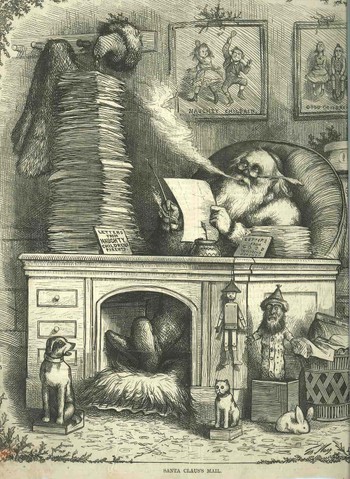
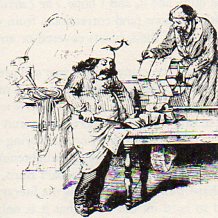
    And I know a little about him; but when I looked closely at this wood engraving of the man hard at work something struck me as very unusual to my Santa experience.

    The image is from 31 December 1871–coming after Christmas for some reason–and it is one of the very earliest depictions of the most universally recognized form of Santa. It was created (his image that is,  of course) by the incredibly prolific and almost-entirely socially responsible (except for Catholics and the Irish) Thomas Nast.  Nast created this standard, iconic image of Santa–plus the Republican elephant, the Democratic donkey, the Tammany tiger, and many more iconic public images. 

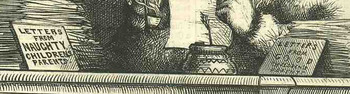
    In fairly famous and often used images I had never noticed that the letters that Santa is reading are being taken from the piles on his desk–but the letters are not written by children, but rather were sent by the parents.

    Is this end-of-the-year grading? Were the “naughty” children being ratted out by their parents?  Does Santa really need to be told all of this?  And who on earth really is deserving of a lump of coal, anyway?  I’m guessing though that this was simply a warning cartoon to children, saying to them that they’d better well be good or a letter will be going out from Mom and Dad to Santa in the afternoon mail

    This might make more make more sense if the cartoon wasn’t published five days after Christmas but appeared before the holiday. Perhaps it is perfectly placed–tis would’ve been the first issue of the weekly magazine after the holiday, so reminding children to be good after a Christmas in which they might not have received what they wanted may have been caused by their behavior.  And since part of Nast’s social power came from depicting events that were of interest to the working class and the poor and making them intelligible to the illiterate, where the cartoon/caricature could speak without words and make themselves understood, it might’ve been the case where parents would show the image of Santa to the kids and then tell them about the letter part to try and codify a different behavior in the new-coming-Christmas season. 

    Blogsanta121detail

    These questions aside, the lesson yet again for me is to look very closely when looking at complex images like this—especially when you think that you already know what you’re looking at…


  • The Origin of the Term “Intellectual Capital”, 1842

    JF Ptak Science Books   Post 1275

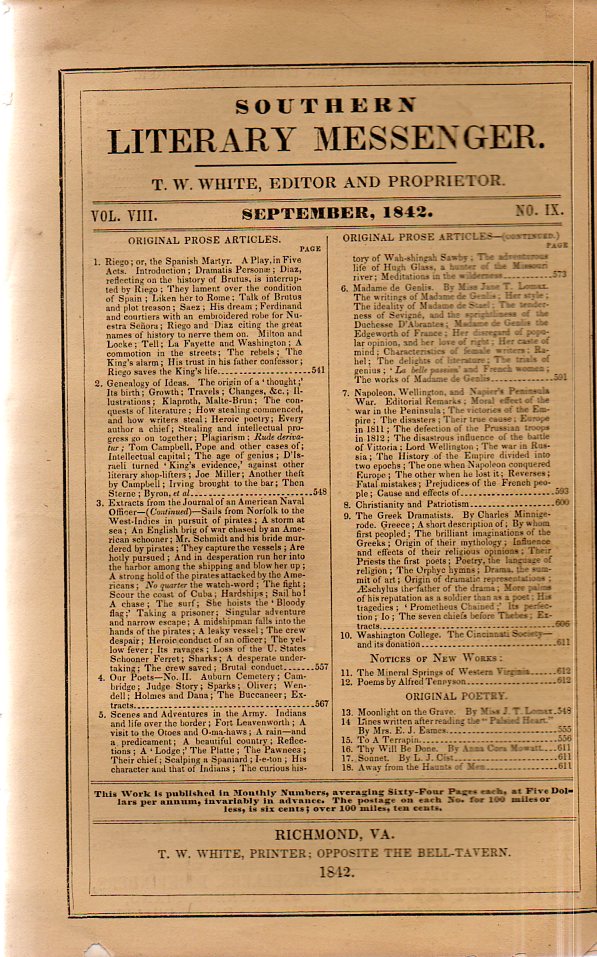
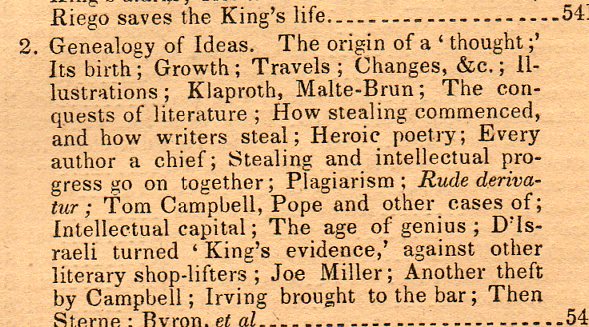
    Intel cap--cvr123   It seems that the first use of the term “intellectual capital” is seen to be with John Maynard Keynes in 1975; nice company of course, but the true first use seems to be much earlier.  It seems to appear in The Southern Literary Messenger (1834-1864) for September 1842, in an article “Geneaology of Ideas”, (pp 548-557) and written by “E.W.J.”, who turns out to be Edward William Johnston, writer/editor, born in Culpepper County in 1799 (or 1804), and brother of Confederate General Albert Sydney Johnston.  (It is also available from our blog bookstore.)

    Here it is:                   

    To resume now our historical deduction of matter Intellectual capital appears to be as capable of being amassed among a nation as materia1 wealth but by no means to follow the same laws –page 552

    If that isn’t what Keynes (and then everyone else) was talking about, I don’t know what is.

    Intel cap--cvr 2124The article is interesting for its dipping into the history of plagairism and finding it comfortably nestled somewhat undisturbed, comfortably even, in the general history of ideas:

    He who writes therefore steals as well as he can and as beggars when they can filch from no richer wardrobe purloin each others tatters so mean authors rob one another and go undetected partly because their works pass unscanned and parity because they from whom they borrow are unread So that after all the essential difference between the genius and the scribbler is not as to the fact of stealing nor even as to the quantity stolen but entirely as to the value of what they steal  (page 551)   

    Long intellectual history of borrowing and building, collection of tropes wound through entirely original work, based on some common building blocks that have been used over and over agian across the centuries.  When looking at the geneaology of ideas, the business of utter stand-alones is slim.  Shakespeare built upon Plutarch in bits and starts, for example, but everyone who knew everything at that time would’ve recognized the Plutarch shining through, Shakespeare himself finding it unnecessary to say any more about it.  Albert Einstein had not one footnote in the SRT paper of 1905, yet owed some intellectual heritage to Lorentz and Poincare.   Anyway Johnston writes about the fluid nature of the history of ideas with many fine examples (though not the two listed above), all of which can be read here in the full text of the article. 

    (This subject of plagiarism and forgery, of originality and copying, of recognizing what has come before and not, gets to be very knotty very quickly.  What is “real”, what is “original”, we are reminded, gets complicated and complex.)

    Notes:
     
    1.  The Southern Literary Messenger: Vols. I-XXXVI (August 1834 – June 1864, when it was eaten up by the war).  Even though it was an interesting journal with a good solid and long run, I guess many people will remember it for being edited for a short time by Edgar A. Poe, who also made a number of literary, critical reviews and poetical contributions to the magazine, though not in this issue for any of those three.


  • Yes, Franklin, There IS a Santa Claus. The Franklin D. Roosevelt/Santa Claus Connection

    JF Ptak Science Books   Post 1302
      Santa claus FDR title270
    FDR may well have been among our greatest presidents–but a reader, well, he was not.  Doesn’t matter, not really. (Harry Hopkins, long an adviser to Roosevelt and who held numerous high-level positions in the Roosevelt administration, once said that he never saw FDR with a book, let alone reading one.)

    There is a presidential library for him, of course, but that doesn’t prove that the Great Man read very much.  Maybe he just didn’t need to for the job. (That has been proved true in recent times though with a different outcome at the end of the presidency.)

    Santa claus FDR sig272
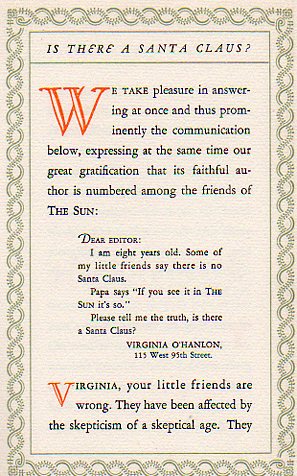
    And frankly I don’t care if Roosevelt read anything more than L’Il Abner.  But I do know for a fact that he did come into contact with a great piece of American social history in this famous story of a  girl named Virginia O’Hanlon (1889-1971) who wrote to the editor of the New York Evening Sun in 1897, asking “Is There a Santa Claus?” (Her father prompted her to write, stating that if one saw a positive response in the pages of The Sun, then it absolutely must be so.)

    Santa claus FDR 1st pg271 And of course there is a Santa Claus, and so wrote the editor. (See here for the full text of the response, and also about the man who wrote it–a nice story of a man who rose to the occasion after the assignment got batted around a bit.)

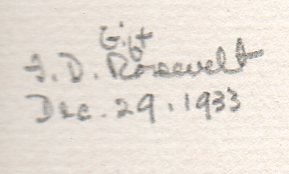
    The telling of the story in the book that I have here, an almost-fancy and semi-sumptuous little affair, was once owned by FDR.  It was no doubt sent to the new president from the publisher in December 1933.  Satisfied with the story and needing no further help with his own belief on the matter, Roosevelt sent his copy on to the good folks at the Library of Congress, and after six decades there, came to me. 

    For what is it worth, I think that FDR knew there was a Santa, and that was that.


  • Women Against Women Wanting the Vote, 1909

    JF Ptak Science Books   (Rapid) Post

    One in this blog’s  History of Women series

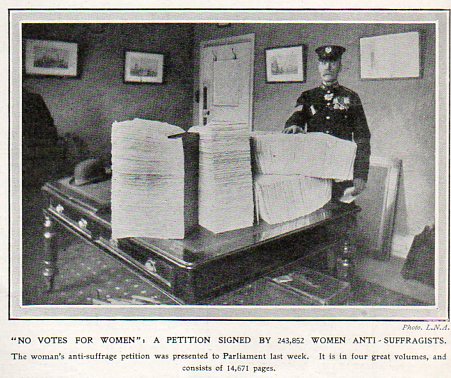
    WOmen--petition against vote121 By the time this photo of petitions against granting the voting to women in Great Britain appeared in The Illustrated London News in 1909, only six other places in the world had given women voting power:  Pitcairn Islands (1838), Isle of Man   (1881) , Cook Islands (1893), New Zealand (1893), Australia  (1902) and Finland  (1906). Admittedly, in the population of nations worldwide this was a very small percentage–smaller still if you considered the figure by population. The idea of universal suffrage was far from being popular, even only 101 years ago, within the lifetime of a few thousand people living today.

    There were no new additions between 1906 and 1913, but after that, from 1913 to 1920, 24 countries1 (including hundreds of millions of people this time) had granted the right,  not the least of which was Great Britain (1918) and the United States (1920).

    WOmen--petition against vote b122

    The complaints and arguments against women getting the vote have a recent ring to them:  the vote for many threatened the home, undermined the scope of the family, would destroy the foundations of marriage, would take women away from their domestic duties, and in general would weaken the nation.  It seems as though you could replace “votes for women” in this series of complaints with any number fof different issues today.


  • Examples of Colossally Bad Ideas–Sterilization, Eugenics and Soviet Racial/Genetic Domination Theory

    JF Ptak Science Books Post 1301

    Sometimes I need to make a post about a book simply to get it out of my system–once I’ve said something about a numbingly bad book, it usually just goes away, falling off the edge of the flat Earth rather than having its mast sink peacefully below the horizon. Such is the case with these pamphlets, one of which is so bad that its badness could not be contained in just one “volume” that it needed another. I almost wrote ” ‘little’ pamphlets” because they are, well, little–but little in size only, their badness easily transcending their size, and the idea of “size” in general. 
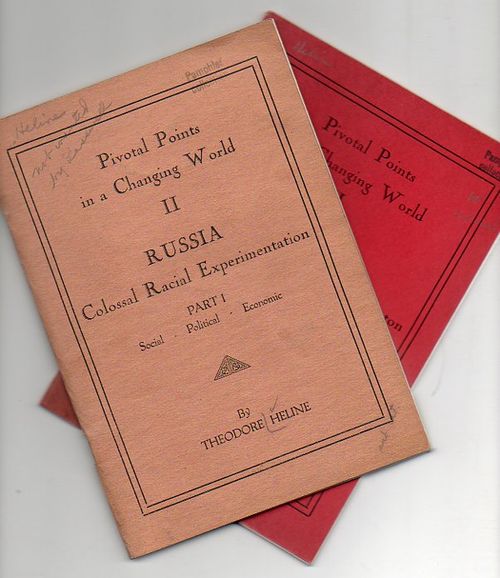
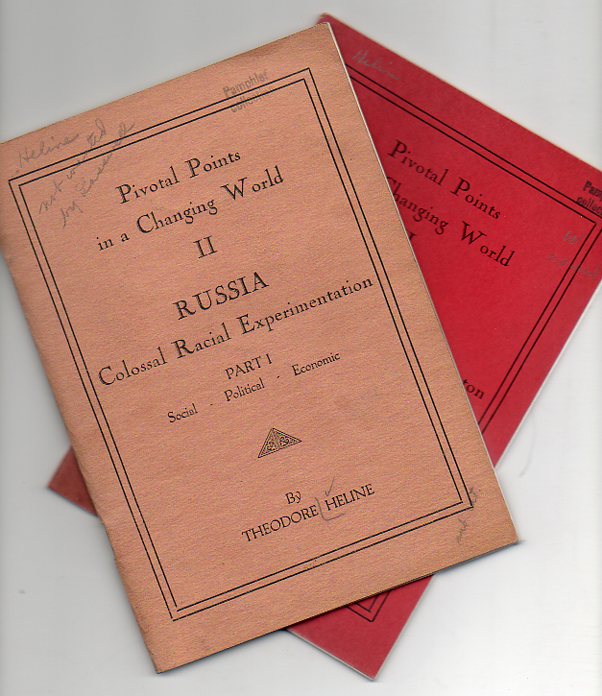
    Russia colossal Racial265

    [Note:  all pamphlets pictured here are available at our blog bookstore.]

    I never really liked the word “colossal” in the title of any book other than say a joke or magic book for children–outside that, I think the author is asking for trouble.  And trouble is the seat of reason in this work, which was published in 1939.  It is too painful to quote much from the text, but, right from the outset the reader gets a taste for what is ahead, being told that the New Russia (the Russians being “the most elemental of all white peoples”) is one way of saving the Nordic race, quoting The Rosicrucian Cosmo-Conception as a part-source, saying that “this race will collectively make up the sixth of the seven sub-races tat will constitute the present Aryan or Fifth Root Race” and it will “be expected to develop certain attributes that will contribute toward humanity’s ultimate perfection”.

     The author is enamored of the free voting system in the Soviet Union.  “No one visiting the Soviet’s pictorial Exhibit at the World’s Fair om New York could fail to be impressed by the dignity and attractiveness of the pictured polling places and the freshness and eagerness animating the faces of those figures who entered t perform their civic duty…” An incredible statement, validating the democratic freedom of the Soviet Union at a particular time in it history when millions of people had recently been starved to death, among other things.  The photographs of the coming genetic masters was proof enough of freedom than anything else. 

    The pamphlets grow heavier and more dense with each paragraph, the edges of the pages bending under their own filthy weight of vast stupidity and understated racial hatreds.  God and the superiority of whiteness and the gross disabilities of Catholics and Black people come along after a bit.  Jewish people aren’t even mentioned.   But the author states that it is a genetic “tick”, some sort of “genetic conscience” that comes into play that has prevented the “inferior races” (like Catholics or Blacks) to have come anywhere near attaining the presidency.  It is a spiteful, hateful pamphlet that is completely myopic about the rich, savory goodness that is the highest attainment of spiritualism/intellectualism/modernism and civilization that was the Soviet Union.  There would be little left to say about this work ten years hence, when the real stuff of the Soviet Union became more publicly common knowledge, and it became more difficult–I would think–for the author to reconcile his witches’ brew of Biblical nonsense, genetic debauchery and Cool-Whip history.
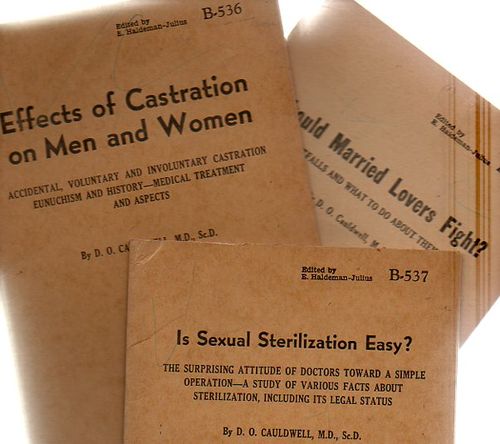
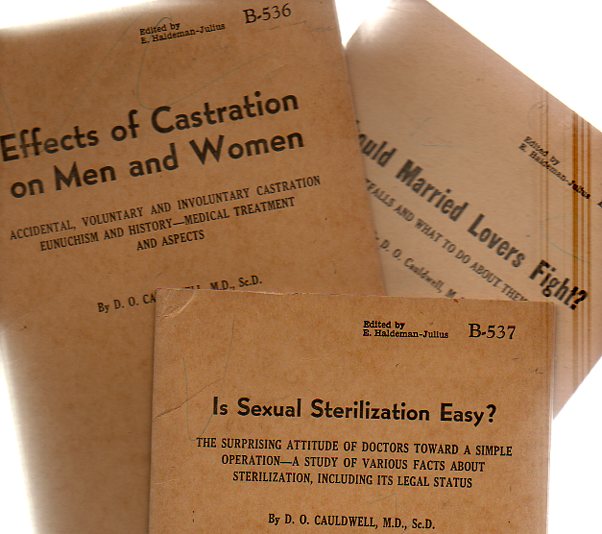
    Sexual sterilization Easy266The next assortment–all written just after WWII–asks some questions that one probably has never heard before.  “Should married lovers fight?” and “Is sexual castration easy?” are probably a pair of interrogatories that would never be heard in conversation in a hundred years of boring parties.  The contents of the pamphlets are a genuine struggle to get through–I picked my way through each for about 20 minutes before declaring defeat, except that I know enough to not have to think about these works again.

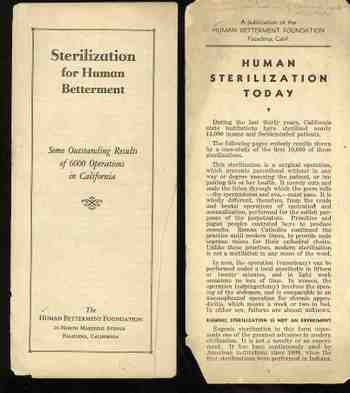
    The pamphlet Sterilization for Human Betterment, published by the Human Betterment Foundation (Pasadena, California),  states that 13,000 people in this category had been “asexualized” between 1909 and 1939 in California. (I should point out that California was the sterilization capital of the United States, with a third of all the national eugenics procedure performed in this state for this period of time) It defends this practice, saying emphatically that “eugenic sterilization is not an experiment”, and that “sterilization in this form represents one of the greatest advances in modern civilization”. 
     

    Blog1sept_10_sterilization538

    It continues:  “(sterilization) has been continuously used by American institutions since 1899, when the first sterilizations were performed in Indians”.  What?

    “Patients, relatives of patients, state officials, physicians,parole and probation officers, social workers, agree on the value of this practice” which was actually the “prevention of producing defective and handicapped children”.  I’m relieved that the probation officers were consulted.

    The Betterment people shed more light on the role of sterilization and sex offenses by women. (My bold.)  “Of 304 feebleminded girls sterilized and paroled, 9 out of every 12 had been sex offenders before commitment.  After sterilization, only one out of every 12 became a sex delinquent on parole”. 

    If this wasn’t such an awful story, “sex delinquent on parole”, a phrase I’ve never seen before, might make for a great 1950’s trashlit title. (It could’ve been a series, too:  all you need to do is take the title “Sex Delinquents on Parole” and add something to it, like “…on Parole from Outer Space” or “…on Parole:  Queenie the Slip Crown Breaks Her Knuckles” and so on.)

    The sorry story that I’ve interrupted with this bit of frivolity is that the “sex offenses” that are being discussed here is actually “prostitution”.  These young women weren’t committing violent acts of sexual savagery, they were just prostitutes, which meant that in most state they were “depraved”.  The “feebleminded” girls I would guess were poor or working poor, without the best education, and didn’t do well on whatever test was being administered to them to determine their test-taking intelligence. It seems to me that if  the goal was to liquidate prostitution that perhaps the men “seeing” these women should’ve been the ones faced with the operation. But that isn’t how the dominant culture viewed the situation, and that the best way to approach the problem was to remove the reproductive capacities from the weakest members of society.

    (Click on this table for a larger, clearer version of the number of forced sterilizations by state.)
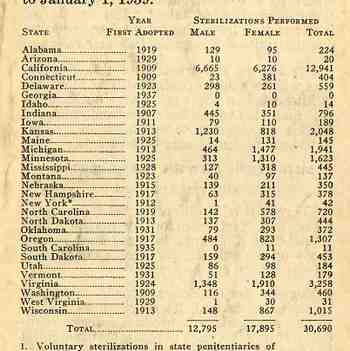
     Blog1sept_10_sterilization539This pamphlet was the co-authored spawn of Paul Popenoe (1888-1979) and E.S. Gosney (1855-1942) while both were on the board of the Human Betterment group. In addition to a strict diet of superior morality and race,  Gosney seems to have been the money behind the organization. Popenoe had a background in agricultural genetics with an overdrive taste for eugenics and race, somehow intersecting them with social hygiene and marriage relations. The “dr.” that Popenoe loved to insist attaching to his name was an honorary, unearned degree, which he must have felt he needed in order to secure the proper amount of intellectual identification necessary to write on intellectual identification. The Nazis wasted little time in translating and publishing this work, adding it to their official publications list in 1939. It was one of a significant number of intellectual imports that came into poor, besotted Germany; the imports came nowhere close to the amount of information banished, exported to the necessarily beautiful non-Aryan non-Nazi inferno. It was just the sort of thinly distributed stain that interested people like the Nazis.

    I wonder what “Dr.” Popenoe thought of this Nazi honor?

    The second pamphlet by the same people, Human Sterilization Today,. is in a swift eight pages in which the Betterment Foundation makes it case to use sterilization to check “the misery spread through the community by the unchecked reproduction of the human unit” (italics mine)..  They are closing in on the Big Picture in this work, aiming at the 5,000,000 “who will be at some point committed to state hospital as insane” and the other 5,000,000 “who are so deficient intellectually (with less than 70% of average intelligence) as to be, in many cases, liabilities rather than assets to the race”.

    This is exhausting reading, but it is a story that shouldn’t be forgotten, and could remind us that what we’re doing or practicing today might look  like the Human Betterment stuff 25 years down the road. 

    What is also deeply unsettling about Popenoe is that from this vast miasmaic idea set of misguided and forced statistics, philosophical racial extremism, “social hygiene”, eugenic sterilization of the enfeebled and socially undesirable, he managed to create the very first marriage counseling service/practice in the United States.  The American Institute of Family Relations opened its doors in 1930 (in L.A.!) with this dizzying philosophical semi-brew of sterilization and marriage talk-therapy, happily correlating the whole thing with exploding axis of divorce, love, social failure, racial impurity and castration.  And somehow it all seemed to make sense to allot of people, back there in the past.


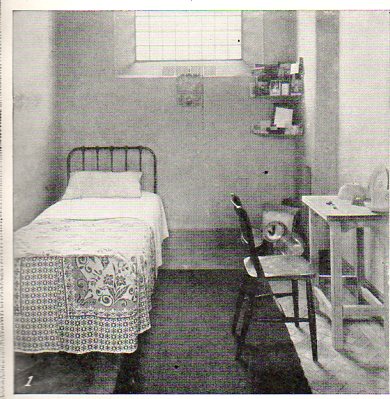
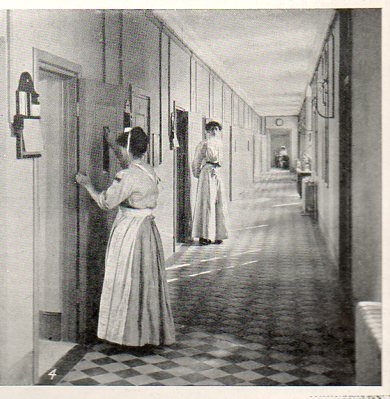
  • A Photograph of the Food Consumed “by the Inebriate in Captivity”

    JF Ptak Science Books   Post 1272

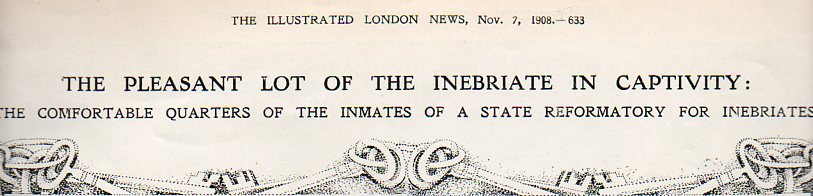
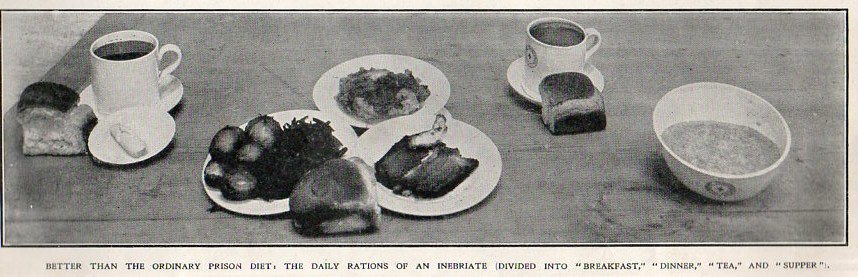
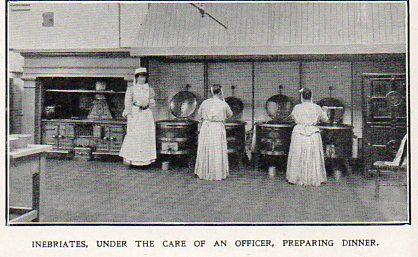
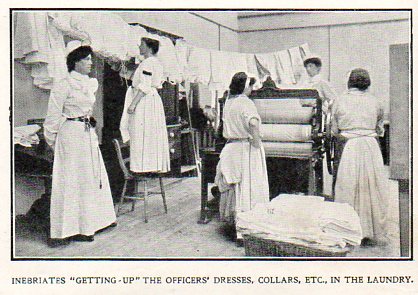
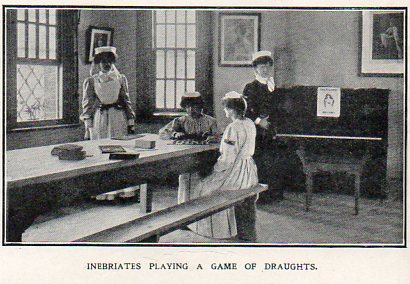
    I stumbled upon this while looking for an article on the Wright Brothers in The Illustrated London News.  I figure that this may be the first opportunity in recent decades that a photograph of the dinner table of  incarcerated British drunkards would be published–and some opportunities need to be serviced.  No doubt that this was an ideal table setting and selection of food because, well, that’s what people do– they normally don’t present an average-something for photographic display in national/international media.  Also the snapshot quality of the daily surroundings of the incarcerated was unusual, as was the Andrew Lang fairyland title to the two-page photo story. 

    Inebriate title115

    And the food:

    Inebriate food112

    A full day’s serving: breakfast included a six-ounce white loaf of bread, a pint of tea–and an ounce of butter on the last day of the term.  Dinner  included six-ounces of white bread, twelve ounces of potatoes, four ounces of French beans, four ounces of fresh meat, and eight ounces of fruit pudding. Supper  “was a pint of gruel”, pictured on right.

    Inebriate 2106

    The life in the state reformatory as an alcoholic British woman was hardly “pleasant” as the title states, though we don’t know what the author was comparing this to.  I suspect it was a general prison that was the benchmark for pleasantness, though perhaps it could have been an insane asylum , assuming of course that they didn’t seem nearly as pleasant as the “pleasant” scenes in these pictures.  The reformatory for alcoholics in Great Britain was established more along the lines of an almshouse or mental institution and seemed not terribly coercive–though given the border decorations for the photos on these pages–keys–there is no doubt that these people were incarcerated “for their own and the community’s good.”. Inebriate 4107

    Inebriate 6111

    Inebriate bed113


    Inebriate hall114