A Daily History of Holes, Dots, Lines, Science, History, Math, Physics, Art, the Unintentional Absurd, Architecture, Maps, Data Visualization, Blank and Missing Things, and so on. |1.6 million words, 7500 images, 4.9 million hits| Press & appearances in The Times, Le Figaro, Mensa, The Economist, The Guardian, Discovery News, Slate, Le Monde, Sci American Blogs, Le Pont, and many other places… 5000+ total posts since 2008.

Category: Social History

  • A Note on the History of Bad Beds (Bedlamia 2): the Utica “Crib” and Putting the Insane to Sleep, 1880.

    JF Ptak Science Books  Post 1349

    Following an earlier post that I made here on the History of Bad Chairs (including a contrivance made by Declaration-signer Dr. Benjamin Rush that immobilized the body, dulled the senses and kept the feet of its mental-patient-occupant in cold water for “treatment”) I’d like to start a short series on bad beds.  This part was excited by another historic psychological/shrinkological tool from the arsenal of doctors who treated the insane: an instrument of torturous treatment called the “Utica crib”. 

    It was a device used, obviously, to constrain the person placed in it–so that they could be controlled during the day if drugged and still not controllable, and to be used at night if the patient wouldn’t stay under their covers.  It looks pretty terrible, a squashed baby bed with a prison door for a top.  It comes as one in a long line of bad beds, including psychiatric hospital”tumbling beds”. centrifugal beds, and of course spiked beds of the inquisition, stretching beds form the same, Aushwitz  “beds”, and on and on, devices of torture made from places of rest.

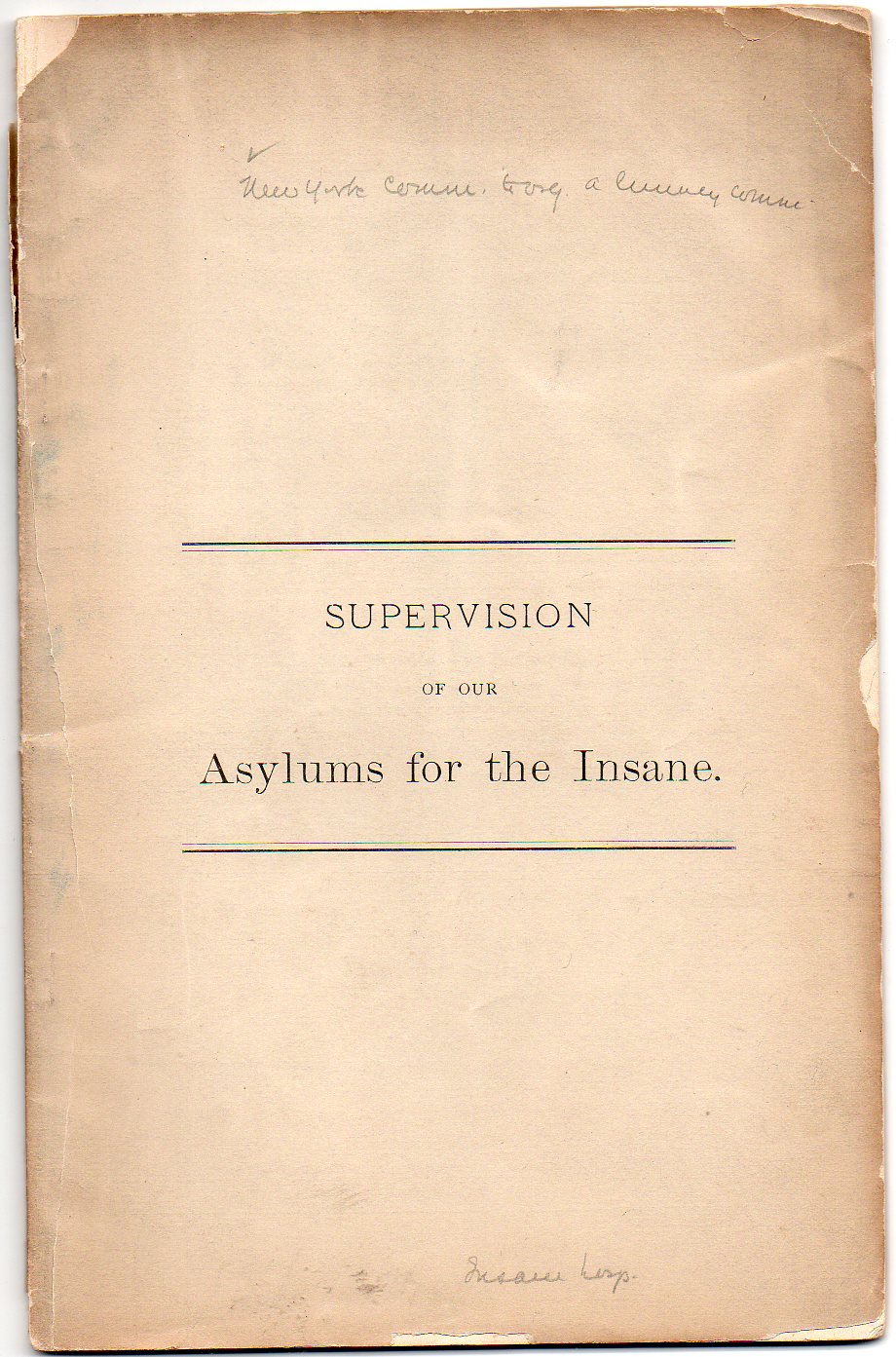
    Insane supervision453 The Utica Bed of the New York State Lunatic Asylum at Utica–if not actually constructed in Utica it was popularized  there–was put into use at about the same time that the facility was opened in 1843.  According to the numerous reports of New York State asylums directors in Supervision of our Asylums for the Insane1, it was about time (in 1880) that folks in control of the state institutions start to deal with their charges in a medical, treatable, fashion; to try and remedy the effects of mental illness rather than just use the asylums to warehouse societal outcasts.  And it was in this paper that the Utica Crib (and other retraining devices) came under very severe criticism. (The original pamphlet is available at our blog bookstore.)

    Edward C. Spitzka makes the point that the institutional that use devices like the Utica Crib–which was supposed to prevent patients from injuring themselves–actually had far more incidences of  patient injurious than those institutions which–with a similar clientelle–didn’t use them at all.  Spitzka made a very compelling case the the Utica Crib and other devices were archaic remnants of an earlier and darker time in the treatment of cases outside mental health, and they they were far more injurious to patients than not having them at all.  They also, he said, demoralized the staff of the hospital and depressed the medical supervision, making a mockery of treatment. All in all, Spitzka’s insights were accurate and prescient. 

    Notes:

    1.  Report of the Proceedings for Establishing a Board of Commissioners in Lunacy for the State of New York, published by Sherwood & Co., NYC, in 1880.  55pp.


  • Newspapers and Music in Bedlamia, 1850’s.

    JF Ptak Science Books   Post 1348

    Two short tales of attending the needs of the mentally ill in the 19th century:  asylum journals and treatment of mania via music.

    In the world of the treatment of the mentally ill, or of the possibly “deranged”, or the poor confused, or the old and demented, or the depressed of all ages, there have been some uncommon instances of creativity and rehabilitation in the constrained early days of warehousing patients, or inmates.  One example of this was the newspaper/journal called The Opal, which was published–extraordinarily–for ten years (1851-1860, in ten volumes and 3,000 pages) by the inhabitants of the State Lunatic Asylum of the State of New York at Utica.  This illustration–which is so far as I is (unfortunately!) the only image in the journal and is repeated month-to-month–depicts, I guess, the editor of the journal, in a cell, and with a terrified or manic or at least sharp-eyed thousand-yard gaze.  It is an unusual statement by the artist, perhaps, that the stone wall behind the editor’s bars look somewhat like the books bound with raised bands that are on the inside of his cell.  I’m uncertain as to whether this was a message, or whether this picture is just a picture.  But it is certainly odd to draw such a portrait of the editor of The Opal–greasy hair, sunken eyes, mouth ajar, crazy-gaze, and hardly very sympathetic.

    And the title page of the journal:

    Given the time, it is remarkable that such an enterprise occurred and lasted as long as it did.  It must have been an extraordinary aid to the people in Utica, allowed an avenue to express themselves, allow for creativity, allow for some independence of expressive thought  It was put loud and clear in the volume for 1854, on page one, in a bit called “A Message to Our Patrons”: “Forty-eight months [that’s four years since the beginning of the journal] have vibrated their moments on the engagements and extensions of the Opalians. The divine art of printing has conveyed through numerous and constant agencies the heraldry of Asylumian intellect, and in the varied developments of society, our paper hath been insinuated by the gentleness of humanity, and reciprocated in a fourfold state the harbingers of progression in kindness by exchanges, whose opening leaves hath borne refreshment from the wines on the lees of humanity, well refined by the studied graces of purity, sense, discretion and knowledge, to the great comfort of this retirement, hallowed by the superintendence of wisdom and virtue1.”

    The italicized “our paper” appears int he original. 

    And this example of trying to step somewhat beyond the modicum of dispensing agents for settling a “maniac”–a person it seems suffering from a manic stage.  Doctors and attendants tried to treat the patient with an assortment of narcotics, but they didn’t work; very liberal applications of btrandy occurred, which caused some sleepiness, but after two days the man woul dbe getting sleepy, anyway.  And then came the desperate measure (so to speak):  music.  It was certainly nothing new, really, the calming effets o fmusic having been know deep into antiquity.  Why it was not mor eliberally applied in mental institutions, I don’t know.  The case and description are found in the American Journal of Insanity (later the American Journal of Psychiatry) for 185 8:

    “The symptoms indicated, as it seemed, the prompt use of narcotics. Morphine was therefore given in doses gradually increased, till at the end of 48 hours, 3 gr. at a time, with strong laudanum injections, had been administered. This treatment seeming to have little or no effect, was abandoned and other means, such as baths, counter irritants, stimulants, djc &lc, resorted to, with but slight amelioration of the alarming symptoms. The patient had now continued in this state three days and nights, without sleep, and with little or no food. Pulse much of the time 120. Countenance anxious and sunken, presenting every appearance in fact, of approaching final prostration. Of the means above mentioned, the administration of brandy, in often repeated and large doses, seemed to act most favorably and effectually. Under its use the pulse came down to about 100. The patient also became more quiet* and manifested a slight disposition to sleep.

    “At this time, it was suggested by the father, that his son had always manifested a remarkable fondness for music, and that when a child, sleep had often been produced by it. A violin player was accordingly sent for, and the effect of his art tested upon the patient, with the most remarkable and immediate favorable effects. The nervous excitement began to abate at the sound of the fiddle, and in a very short time, the patient was in a sound sleep, from which he awoke in an hour or two much refreshed and nearly rational. By continuing the brandy, and when nervous excitement began to manifest itself, an occasional quietus from the fiddle, this singular state of mental excitement was, in a few days, entirely and permanently subdued.”

    In general, the 1850s were not a good time to be in a mental institution in the United States–or anywhere else for that matter.  There were 3700 people or so institutionalized in America at the time of the two stories (above).  It was really just about at this time that a national effort began to be organized to treat the institutionalized people more as patients than as inmates. 


    ____

    Notes:

    1. “In the diffusion of thought by the arts, its curiosity and character are enhanced by the manner in which it is communicated; and the respectful interchange of sympathy, and of emotions incident to nature that assimilate and affiliate the multiform interests and conditions of the human kind are so promoted by interchanges as to excite a brotherly regard for the correspondences, and a desire to advance their intelligences anew, when apprehended as the instrumentality of reasonable reliances.”

    Also this:

    Asylum Life; Or, The Advantages Of A Disadvantage, from The Opal


    Page 1:

     
    1  

    I have no care for copper or coin,
    I have no fear of any one’s frown;
    I’m fed by the hand that feedeth the best,
    And seldom molested is my sweet rest.

     
    2  

    I have walks to take, and news to read,
    With chit-chat and work the hours to speed;
    Good company, age, as good as the great
    Who have the charge of the “Empire State.”

     
    3  

    When ill, we have nurses; kind they be,
    And doctors too, without extra fee;
    When well, we can leave for homes far and near,
    While the Word of Life may be conned with care.

     
    4  

    Though sad, we may wait till brighter we grow,
    And health and good humor our faces make glow;
    When merry music may lend us her thrall,
    And consoling each other be less sad withall.

     
    5  

    And Love may abide, defended by prayer,
    And our hearts and our hopes be brightened elsewhere;
    We may write to our homes, and see our dear friends,
    And contented and blessed our destiny ends

    ·Posted by :

    ·in:

    — — —

  • SuperBad Ideas: Superhighway Through the Center of Washington D.C., ca. 1925

    JF Ptak Science Books  Post 1346    

    “A Paved United States in Our Day”

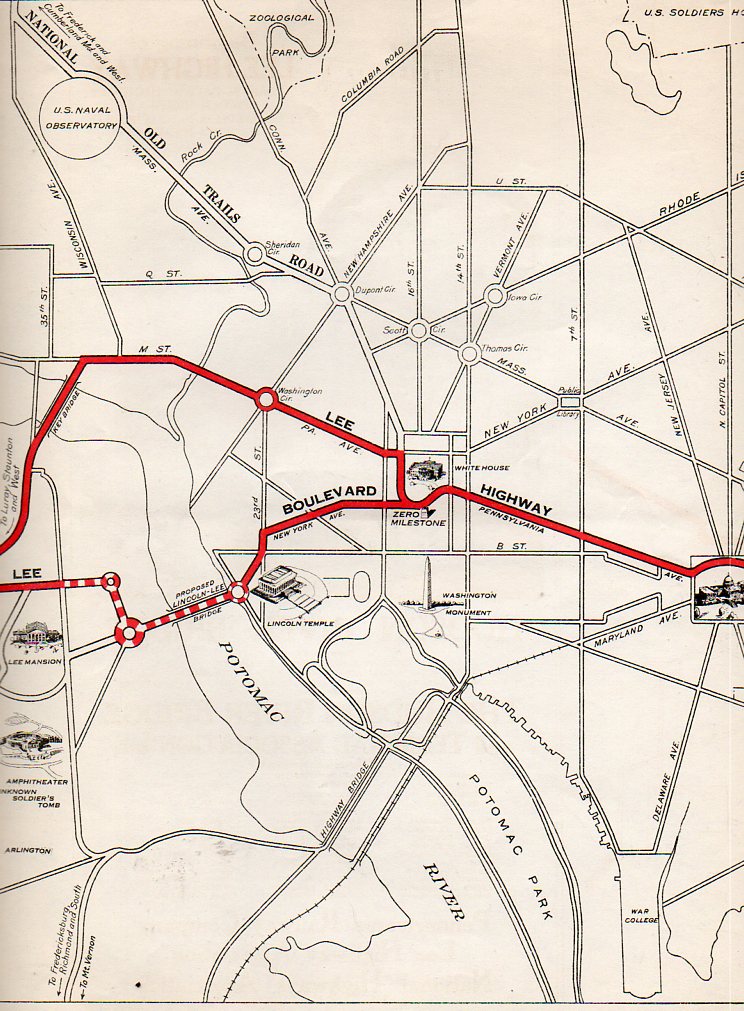
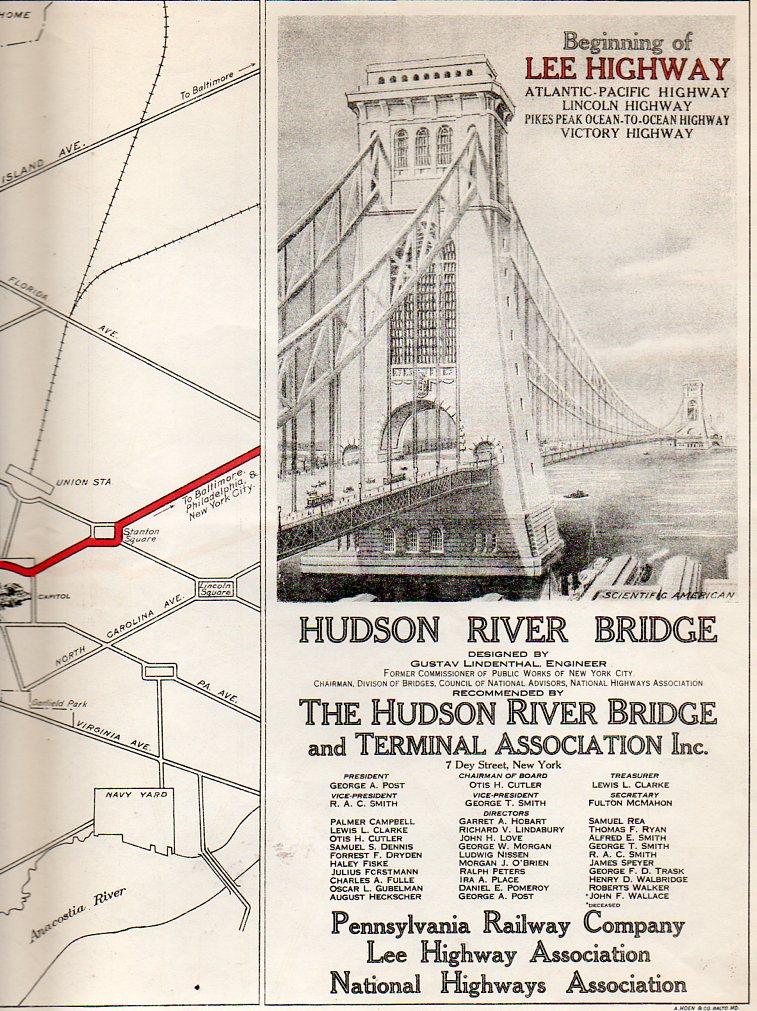
    If the planners of this highway had a crystal ball to see deep into the future–say, 1955–they would have been horrified to see the errors in their ways.  The equivalent of this plan might be something like picking up the Beltway, straightening it out, and running it  through D.C. along 16th street, with massive flyovers for the White House and other associated et ceteras.  This idea was published in an odd source, published by the Pennsylvania Railway Company/Lee Highway Association/National Highway Association auspices and the Hudson River Bridge and Terminal Association in about 1925, or thereabouts, just prior to the construction of the George Washington Bridge in NYC.  

    Lee Highway443 Lee Highway444


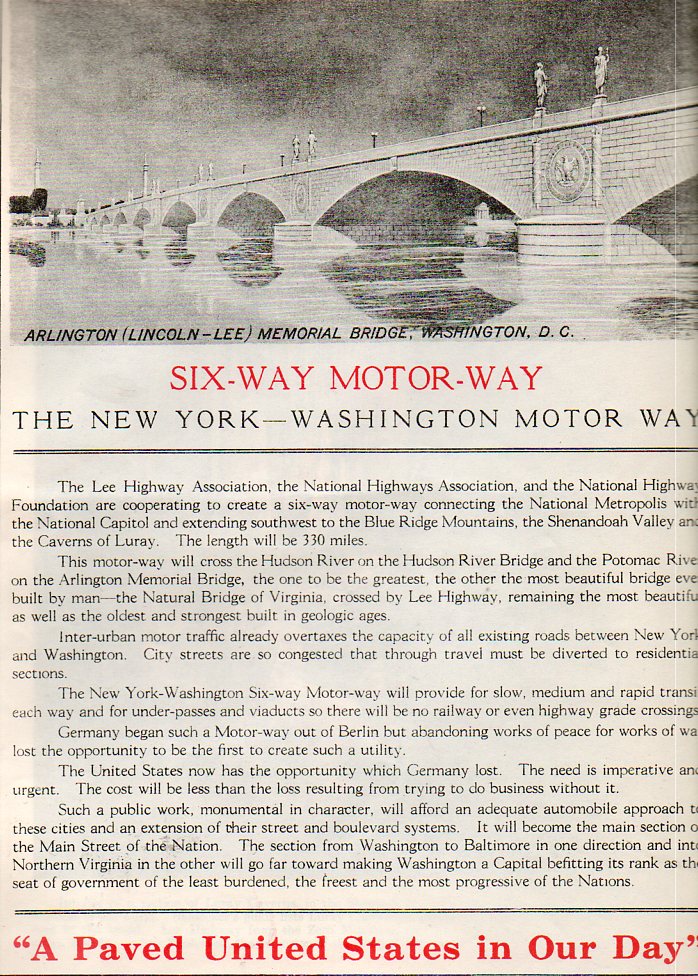
    The plan was for a six lane (“six-way”) motorway from New  York to Washington, starting with the Lee Highway (or King’s Highway, Route 1, one of the south’s oldest roads, and part of what was supposed to be a national autotrail connecting New York with San Francisco) and taking that highway across the proposed Arlington Bridge (called Lincoln-Lee here, without irony), up New York Avenue to the ellipse, rounding the White House, going down Pennsylvania Avenue to the Capitol, and then out again to Baltimore and NYC.  Another version called for the highway to go across Key Bridge, dumping everything in Georgetown, hooking right on M Street to Pennsylvania and on out again.  Having lived in D.C.(with my store in Georgetown) for 29 years, I can say without fear of ____  that this would ave been a massively bad idea then and in every decade since then, and probably would have been removed by 1960 just to recognize and correct the sheer, overwhelming badness of its conception. (The original of this map is available for purchase from our blog bookstore.)

    Lee Highway445
     The Memorial Bridge wound up being pretty close to this design–lacking the statuary, especially–and is quite a beautiful thing, especially when the designs for its rivals were considered.  The bridges in DC are almost all lovely, or at least those built before 1950. 


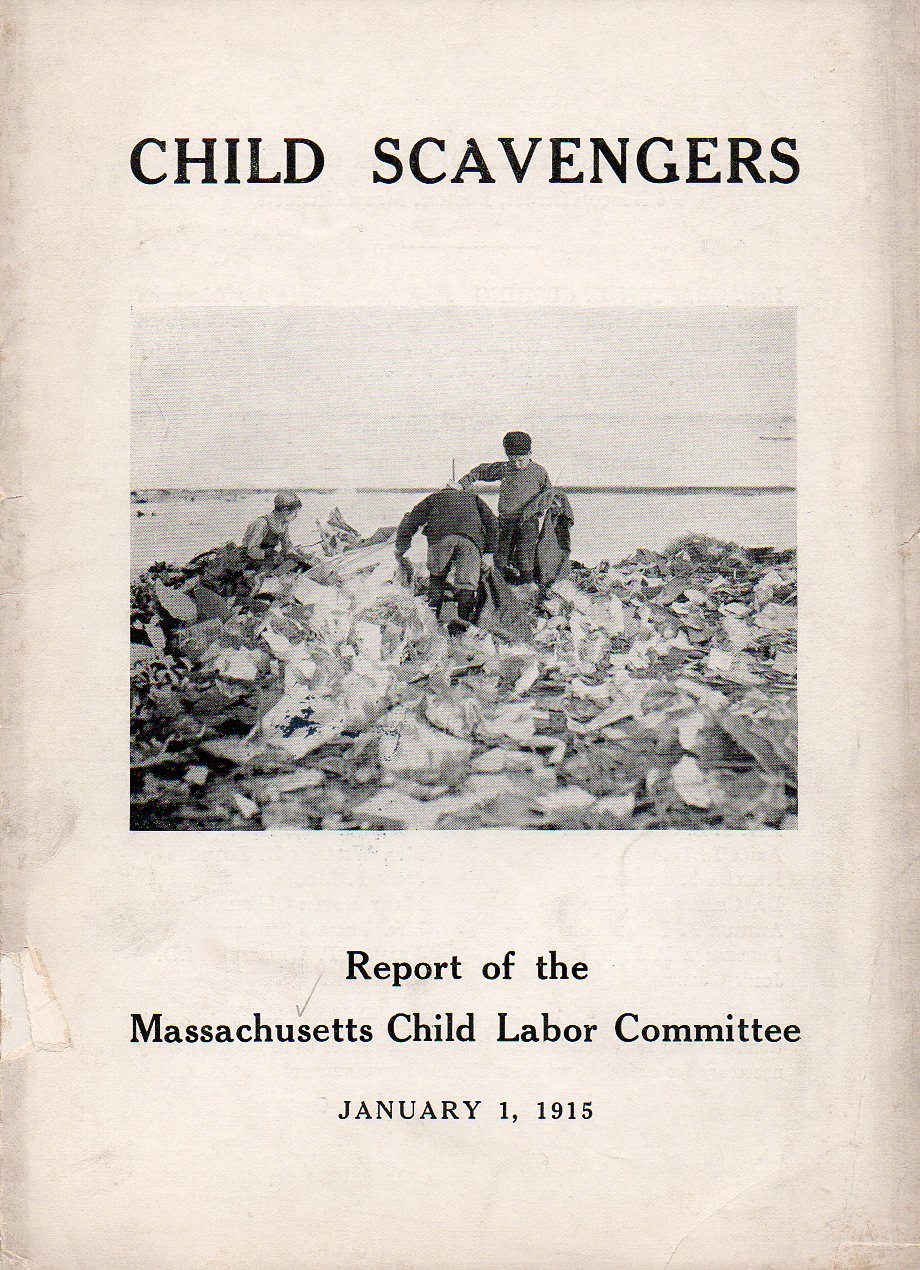
  • Map of Newsboy Work Violators, 1915–Child Labor & Child Scavengers

    JF Ptak Science Books   Post 1330 [Part of a developing series in the History of Normalcy]

    “There is work that profits children, and there is work that brings profit only to employers. The object of employing children is not to train them, but to get high profits from their work.” — Lewis Hine, 1908


    As rudimentary as the title of this pamphlet seems, it isn’t really quite so, not really completely in the column of not having child laborers and exploiting children.  There is a degree of exploitation allowable–yes it was a different time–and the map that I’ve plucked from this work shows the extent of rough-edging of the law that was tolerated.  The authors weren’t so much concerned that there were 2500 newsboys in Boston-proper hawking newspapers morning/noon/night, but rather that they found over a third of them weren’t wearing their Newsboy Selling Badge when confronted.  And it wasn’t that they were under-aged–just that they were badgeless. 

    Child scavengers362

    On the other hand, the Massachusetts Child Labor Law Committee cited unidentified “critics” (and I don’t doubt that there were many) saying that “children don’t work enough nowadays, and that child labor laws have left nothing for children to do, especially in the cty where there are no chores”. (This work is available for purchase from our blog bookstore.)

    And they did do a study of child scavengers, reporting that in “one dump in a Massachusetts city fifty-five children from five to fourteen years old were moving slowly over an acre of rubbish…” The authors report (unfortunately without reference) that in one Boston school distict of 2,128 children that 125 of them “do this work”, and that 500 children in Boston “are so engaged”.  This didn’t include the children who “gathered refuse” from martketsm freight yards, and ash barrells”  or who were sent out collected odd bits of dropped wood and coal. 

    Child scavengers map363

    But the fact of the matter is that these folks were just knocking at the big door of child labor reform, a big piece of which would come into being in the next year (1916) with the Keating-Owens Act, which began the strict reulation of child labor, defining what the terms “labor” and “child” were. (The act restricted minig occupations to children 16 and over, and for 14 years of age for the manufacturing industries; no night work was any longer permitted, and the work day was limited to eight hours.  This was the reform, so one can imagine what the labor was like before this legislation.) In 1890 there were something like 1.5 million children in the workforce, a figure which was raised to 2 million by 1910, and which was nearly halved (because of awareness and federal oversight) by 1920.

    Lewis Hine (1874-1940)–who gives us the quote to lead this short post–was a school teacher and sociologist  who was extremely aware of the plight of the children around him–well, children, and immigrants, and laborers; people without voices, or representation, poor working people.  He was a pioneering photographer whose images of these classes of people were revoltuionary, a tremendously important documentarian of a societal symptom that was pretty much misdiagnosed, or at least was chosen as something to not be seen.  That was hard to do when you had actual photographs of the grim situaiton. 

    Trodd-lewis-hine-01

    This could’ve been my grandmother. At about this same time. 

    File:AddieCard05282vLewisHine.jpg

    Hine also made some of the most  iconic labor images in American history, a vastly underappreciated heroic figure duirng his lifetime.


  • Tramp-Speak of Antiquarian Road Warriors: ABC’s of Tramps, Hobos and Vagabonds

    Elsewhere on this blog I’ve written a little about dictionaries and words–Sam Johnson, Ambrose Bierce, specialized dictionaries, canting dictionaries, dictionaries of vulgar and coarse language, dictionaries of first uses, dictionaries in distinct fields.
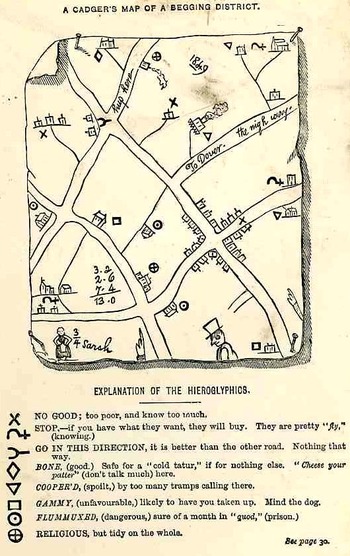
    Bloghobo_b200Hobo dictionaries, guides to hobo slang, are different from those of robbers and thieves and rogues.   They may borrow from one another, but the hobo language seems a little more dignified, and not as directed towards crime as that of, well, the criminals.  An even greater distinction is the hobo alphabet, a Morse Code if you will, a hieroglyphics, for hobos-to-hobos, written in chalk without the benefit of electricity. (I’ve written about that phenomenon here, though I’ll at least reproduce an extraordinary map of a “begging district” found as the frontispiece to the lusciously-titled The Slang Dictionary; or, the Vulgar Words, Street Phrases and Fast Expression of High and Low Society… printed in London by John  Camden Hotten, in 1870.)

    Back to words.

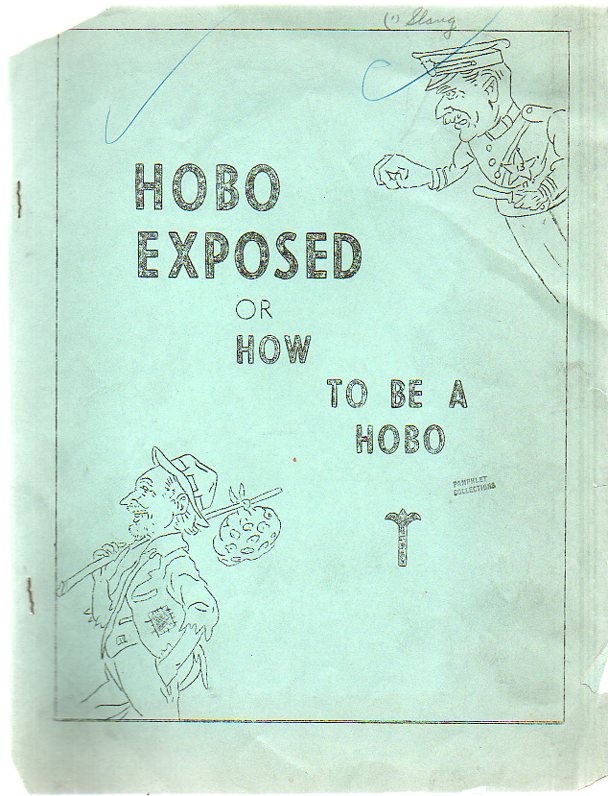
    Part I:  Hobo Slang Collected by a Common and Perhaps Hobos lingo title344 Make-Believe Hobo
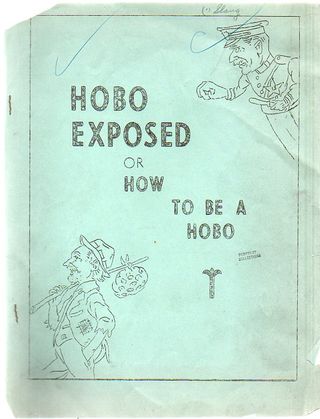
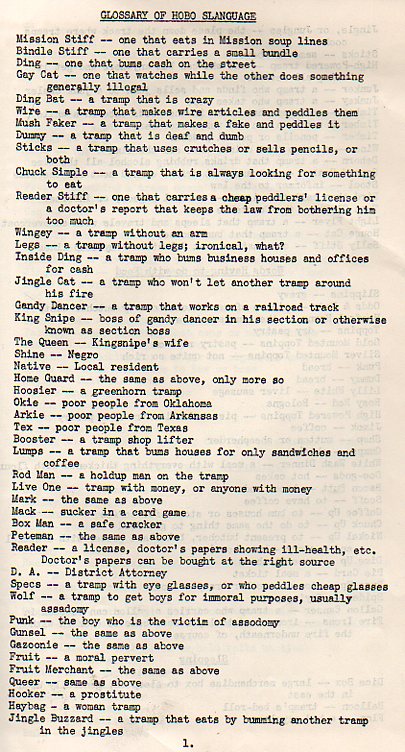
    Hobo Exposed, or How to be a Hobo, at pamphlet  with no claim for a writer but copyrighted by “Kelly’s Specialities” in 1946,  is dedicated to Sun Down Slim, Boston Blackie, Sticks Red and Commissary Blackie.  [This item is available at our blog bookstore.] It gets right to the point of my interest, the Hobo Slanguage.  The collection here is not quite as road-elegant as the collection of the Hobo King, below–not that it is less “regal”, just more common and less imaginative. 

    For example, “Wingey” is the name for a hobo without an arm; “Sticks” is a tramp who sues a crutch; “Legs”, well, you know.  On the other hand I find “grouch bag” (which was a bag of Bull Durham tobacco worn around the neck, which was either valuable enough to be worn that way to keep people out of your pockets or you just didn’t have any pockets), “hogger” (a railroad engineer), “dice box” ( a large discarded merchandise box to sleep in), “slippins” (gravy), “canned heater” (an unfortuate tramp who drinks sterno), “Jingle Buzzard” (a tramp who begs food from other tramps) and so on.

    There are many others:
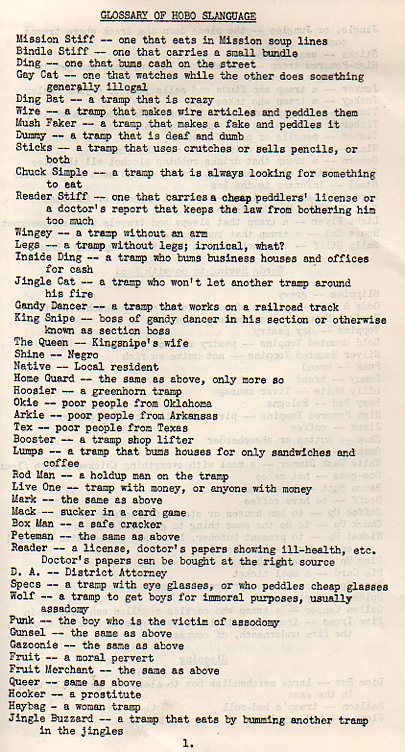
    Hobos lingo a341
    [This section continued below.]

    Part II: Hobo Slang Collected by the King of Hobos
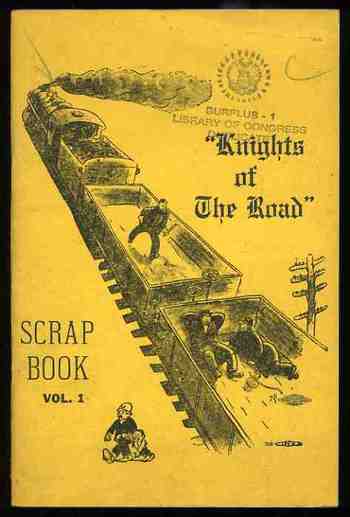
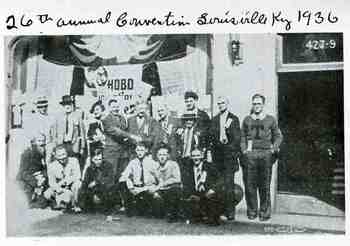
    1blog_oct_8_hobo_cvr785 There have been many Kings of the Hoboes, and Emperor of the Hobos, in the history of American Hobodom.  The most widely recognized of all this royalty is, probably, Mr. Jeff Davis, who was elected King of Hobos each year from 1908 to 1935, until in 1935 at the Pittsburgh meeting of the annual “Hobos of America” his minions gave up elected him King for Life. Of hobos, that is, the Knights of the Road; he was also a real hobo, unlike the pretenders, who in general were not. (Nels Anderson in his Men On The Move, written just as the Depression was broken, (1940) observed: “Whatever else may be said of King Jeff, his romanticizing the hobo is not without a basis in reality, and his poetic interest in the species arose from experience. But King Jeff has placed on a pedestal a man who belongs to the past. The hobo belongs with the pre-Hollywood cowboy and the lumberjacks of the Paul Bunyan legends.”)

    Mr. Davis was certainly very effective in getting the message out—on freedom and responsibility to irresponsibility—and was a great organizer and popularizer. He helped to establish hobo meetings, newspapers and literature (a sample of which is at left). He also had a few movie appearances: in The Arkansas Traveler, 1938 and The Bridge of Sighs, 1915, he ably played the role of a hobo.
    1blog_oct_8_hobo_cvr786

    And what about the missing counterpart of Jeff Davis–Queen of the Hobos? There were certainly allot of women hobos during the Depression; Harry Hopkins estimated that there were something like 13,000 “sisters of the road” who were out and about in the 1930’s. I guess the most famous of them though was one who did not exist; and what parts of her that were real were mostly those of one man: Ben Reitman. Sister of the Road (1940) was supposed to be an autobiography of legendary Boxcar Bertha, but it was really an assimilation of Reitman’s own experiences sprinkled about those of women from his life. Reitman, who was described (by himself) as a “hobo, whorehouse physician, musician and tour manager/lover of Emma Goldman” (??) was probably not without enough experiences to float another character or two, had his story of Bertha wind up in the hands of exploitation movie maker Roger Corman. The good news about that though was that Corman gave the project to the very young Martin Scorcese who produced an odd and not bad film on no budget, and Boxcar got to live again.

    But what brought me here to begin with was Davis’ breakdown of some very colorful hobo slang, all of which was found int eh little yellow pamphlet (pictured above), and published as a “reference manual” in 1947.  And so:

    Gay Cat.  Someone who “beats it from town”, settles down with a job and puts together some money so that he can get on the road again.

    Gandy Dancer. “Is a hobo shovel stiff, a muck-stick artist”, a common laborer

    Pearl Diver. A hobo dishwasher and who works for his meal.

    Mush fakir. A hobo umbrella mender with a patch kit and a second-hand umbrella strapped to his back. (Evidently these guys were put out of business when larger stores began offering umbrella repair on their own.)

    Bindle stiff. A hobo who carries his stuff in a sack on a stick, including toothbrush, “but he does NOT carry blankets”.

    Kywah. An honest hobo pitchman peddling soap, perfume, jewelry, novelties, pens, knives and potatoes peelers.

    Kewah. :Makes and sells articles such as willow stands…”

    Scenery Bum. “A young tramp who bums it around the country, just for the fun of it.”

    Ring-tail. “An ignorant, harmless tramp.”

    Fuzzy tail. “A smart aleck tramp, jack of all trades, a fourflusher, big bluff, false alarm, and piker of the worst sort, who most always carries a “punk kid” or “road kid” (a runaway boy).”

    Dingbat. “An old tramp professional beggar who dings the main stem (begs on the main street).”

    Stew bum. “An elderly tramp who wastes his time continually drinking rot booze.”

    Jungle Buzzard. “A tramp who loves to eat but is too lazy to get the ingredients for a mulligan stew. He eats what is left when the gang leaves the jungle fire.” Yum.

    Road Yegg. “A vicious tramp of the petty larceny type, a cheap crook.”


  • The Big Lie Department: Japan and its Version of Chinese “Aggression”, 1937

    JF Ptak Science Books  Post 1319

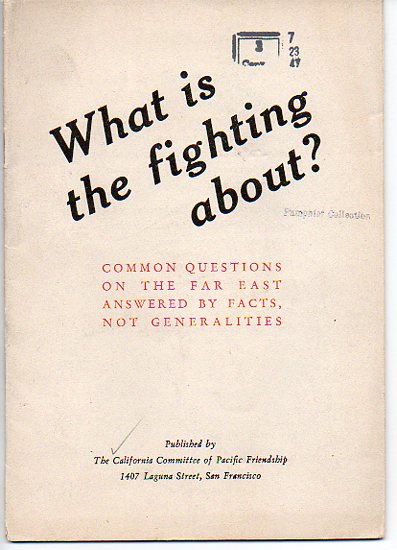
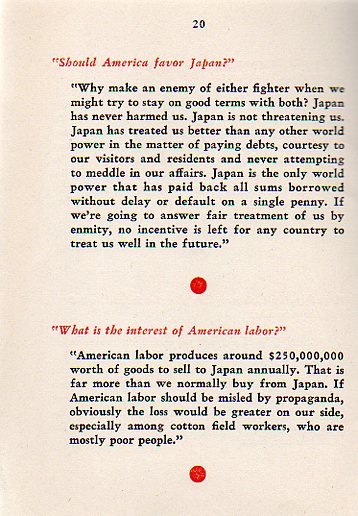
    This little  pamphlet is a great example of The Big Lie–propaganda so vast and so vicious and so far from the truth that people tend to believe it because, well, because no one would or could tell lies so Gargantuan and Pantagruelian and expect to get away with it. They were statements so spectacular and seemingly untrue that their very reverse weight gave them weight enough to necessitate “truth”.  Mostly on this blog the Big Lies I’ve dealt with came out of Germany–these had to do with the International Jewish Conspiracy, the plot of Poland to attack Germany, the resettlement that was going to be provided for French workers who came to the Nazi’s side to do technical work for the Wehrmacht, and so on. 

    Big Lie--Japan319 In this case it is Japan’s turn at The Big Lie to make its case to justify its already long and very bloody attack and occupation of China.  In short, what the publishers–the California Committee of Pacific Friendship (located at 1407 Laguna Street in San Francisco, the site of which today is ironically occupied by the Chinese Consulate)–tell their American audience is: that the Japanese are not aggressive; that China was planning to attack Japan to help unify their own country; that Japan needed to occupy Manchuria to protect Japanese citizens; that at the same time Japan was invited into China and was not going to leave because no one else does; and that is it is in the best interest of the U.S. to continue its valuable trade with Japan in order to protect the  poor people who pick cotton that goes into essential American-Japanese trade.  Virtually everything in this report is nothing.   Thats what makes it a Big Lie. [This pamphlet is available at our blog bookstore.]

    Part of the issue of invading China’ was to prevent Chinese aggression towards Japanese citizens, which was “a politically attractive campaign” and a cause of :China’s backwardness”. 

    There is no mention of Japan’s invasion of Manchuria in September 1931 following the Mukden Incident, an earlier version of a Gulf of Tonkin incident, a manufactured bit of terrorism by the Japanese military perpetuated against itself to give the Empire a reason to attack China. .  Manchuria was subdued by 1932 and  renamed Manchuko, and then used by the Japanese for its fantastic assembly of raw materials.

    In the same vein it was alleged in this pamphlet that it was China which bombed itself at Shanghai (Songhu), not the Japanese, starting what would be months of fighting in one of the largest and bloodiest battles of the 1937-1945 war.  It doesn’t make much sense for this top be the case, as the  National Revolutionary Army of the  Republic of China was vastly over matched by the  Imperial Japanese Army of the Empire of Japan.  (The Chinese enjoyed a 2:1 advantage in troop strength, but totally overwhelmed by Japanese tank and aircraft numbers and tech superiority.)  This pamphlet was published in November 1937, so the end of this battle–the first really of that would be twenty-two or so major engagements of the war–was still months away.  No doubt that an updated version of this pamphlet printed in 1938 would note the 70,000 Japanese soldiers killed without mentioning their own belligerent status or the 200k Chinese killed during the same time.     

    Big Lie--Japan text320
       

    The Japanese wouldn’t have to bother with this sort of propaganda after 7 December 1941.  It would’ve been hard to explain it all, especially the 17,000,000 Chinese civilians being killed in the process. And the 3 million Chinese soldiers1. Quite a long and twisting road from protecting Japanese citizens in Manchuria in 1931.

    Notes       

    1. Nationalist Chinese military forces included 1,320,000 killed in action, plus 1,797,000 wounded, with another  120,000 MIA. The Communist Chinese forces included another : 500,000 total casualties. Japanese forces include about 396,000 KIA plus another 430,000 MIA and WIA. Another estimate from the Japanese side gives the figures for Japan’s losses at ( 1937–1941) 185,647 KIA. 496,000 wounded, and 430,000 incapacitated; plus for the  1941–1945 period,  another 202,958 dead.   Nationalist Chinese estimates for Japan’s losses for 1937-1945 were 1.77 million KIA and 1.9 million WIA


  • What Free Things Cost–The Washington Times and the Eugenics Society

    Years ago when I lived in DC a new, upstart newspaper, The Washington Times (a conservative, Sun Yung Moon Unification Church organization-owned entity that is painful to italicize) spent years trying to establish a toehold in the area readership.  For years they spent a dollar per daily reader trying to get their message out–the cult leader himself, Rev. Moon, has stated that the paper has cost over a billion dollars to keep “competitive”. Since its founding in 1982 the paper has always lost money but has kept its focus on target–recently though there have been breaks in its rigid far-right exterior, changing some of its rhetoric to be more accommodating, like for example in 2009 deciding to use the word “gay” rather than “homosexual”.  The paper was owned by New World Communications–a branch of the Unification Church–from 1982 to 2010, when the paper was sold directly back to Moon for $1.  The paper is still in publication a,most 30 years later.  And even though the Unification Church says that the paper is independent from editorial control, former editors of the thing have said otherwise.  [New World Communications owns UPI by the way. Happy Happy World World]

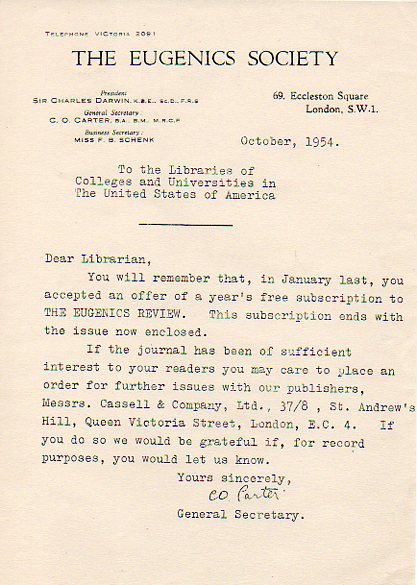
    Eugenics soc316

    For several years running as a matter of fact the Washington Times threw their newspaper onto my lawn, a freebie, news gratis–they just kept coming, day after day, even after I called them requesting that they stop the free delivery.  They didn’t.  I simply didn’t want to be included as a statistic as a “reader”, because grass-reading was evidently a statistic they could deal with. Had I been a lawyer I think I would’ve sued them for littering, as that was about the extent of the value of their newspaper, to me.  I guess if you give something away long enough, people get used to it, and then, after many years, they are guilt ridden to buy, or–like a phantom song from the radio that you’ve heard so many times that you know it by heart even though you don’t like it–it becomes part of your routine.

    That’s what I thought of when I saw this circular slide out of one of the volumes in the warehouse of the Journal of the Eugenics Society.  It warned librarians that the free ride their library had been given by the society was about to end–maybe–and that if the institution wanted to receive any further issues, they would need to buy them.

    Unlike  the Washington Times–still in business today–the Eugenics society didn’t make it.  It died decades ago. Died a death long overdue, died in its seventh decade.  Pieces of it lived from ancient times, famously with Plato, developing in more modern times into a societal, philosophical, scrapingly biological branch of pseudoscience, aimed generally at improving the human population through a more-or-less longitudinally dreamed belief system.  It was squared away and rounded up with social stats of Karl Pearson and number crunching of Francis Galton (who misunderstood the writing of his cousin, the beautiful Charles Darwin). And in spite of coming into a sort of Renaissance in the early twentieth century, it was mostly put away by Nazi monsters, who broke whatever basis in reality that eugenics had, almost entirely dealing the belief system a mortal blow.  Some people still felt comfortable with it enough to use it to continue a practice of population control by sterilizing anti0social elements–including prostitutes and drug addicts, and people of low IQ, but mostly, almost entirely, poor people–up until the 1970’s. 

    It looks like a desperate thing to me, this flyer (available from our blog bookstore, here).  It may well have been real, it may have been the case that it wasn’t this piece of propaganda that I see  it as to help sell a fatal science…but I don’t think so.  It looks pathetic, paper collar and starched shirt and doctorates and cufflinks and privileges notwithstanding.  And it reminds me of the desperate attempts of propaganda machines like The Washington Times to get its message across–even when it is very clear that there are not nearly enough people to fund it, a message machine in desperate search of an audience.


  • The History of Children, 3/7: Books, Book-Making and Booksellers

    JF Ptak Science Books  Post 1287    Continuing the post 1285

    “Taking the Scarecrows out of Wisdoms Gardens”

    This is Part 3/7 of John Comenius’ great work, the first illustrated instructional to children, first written in 1676 and then translated into English in 1726–it is from this translation that all of the images (below) are taken.  This is the second of seven installments on introducing 17th and 18th century children to wide ideas, the other sections including: Part 1, Occupations; Part 2, Anatomy; Part 3, Books and Book Arts; Part 4, the Sciences; Part 5, Morals and Philosophy; Part 6, Games and the Arts; and Part 7, the Military.  

    The work itself: John Amos Comenius’ Orbis Senfualium Piélus: Omnium Principalium in Mundo Rerun/ &f m Vita АШопит,  translated as Pictura et Nomenclatur, the Visible World, or A Nomenclature, and Pictures of all Chief Things that are int he World, translated into English by Charles Hoof…1726.

    The purpose of the book, writes the translator in the introduction of the 1726 12th edition, is:  

    To entice witty children to it, that they may not conceit a torment to be in the school, but dainty/are., For it is apparent, that children (even from their infancy almost) are delighted with Pictures, and willingly please their eyes with these fights: And it will be very well worth the pains to have once brought it to pafs, that fcare-crows may be taken away out of Wifdom’s Gardens…”

    Even at this early stage of publishing books for children it was easily recognized that children learn better when eased into their subject with pictures.  This is not so far off the mark with the moderns, and in its own way a precursor to the Dick and Jane and Dr. Seuss books–not so much for subject matter, but for the very act of putting a book into the hands of a child and getting them comfortable wit the idea of reading.  It seems to me that this is by far the most important lesson-the actual content at tis point is secondary to the act of holding a book.  


    [merged small][merged small][graphic]

    The Ancients nvrit /яTables done over with wax ivith a hrazen Poitrel, i. ivith theJharp end, i. ivhereofletters ivereengraven, and ruhhed out again with the hread end, 3.

    Afterwards they writ Letters with a fmall Reed, 4.

    We ufe a Goofe-quill, 5. the Stem, 6. of which tue mabe with a Pen-knife, i7. then ‘wt dip the Neb in an Ink-horn, 8. which is ßopped wit h aStopple, 9. andiiie put our Pens into /rPennar, 10.


    [merged small][ocr errors][graphic][merged small][merged small]

    makttjfik a Paper-mill, 4. of Linen nigs, 5. fiampedto Malh, 6. ‘which heing taken up in Frames, 7. . he fpreadetb into Sheets, 8. andfetteth them in the Air that they may he dried.

    1 vsenty -ßve cf thefe make a C¿iure, д. t•wenty Squirts a Ream, 10. and ten of thefe a Bale of Paper, 11.

    That iwhich is to laß long is written on Parchment, 12

    [merged small][ocr errors][merged small][graphic][merged small][merged small]

    taketh them out one hy owe,and according to the Copy,(•which he hath faßened hefore him in a Viforum, 2.)compofeth •words in a Compoíing-ftick, 3. tilla Line he made; he putteth thefe in a Gaily, 4. till a Page, 6. he made, and thofe again in a Form, 7. and he locket h them up ., •. in Iron Chafes, 8. •with Quoins, 9. leß they Jhould drop out, and putteth them underthe Prefs, 10. Then the Prefs-man heateth it ever •with Printers Ink, hy means of Balls, 11. fpreadeth upon it the Papers put in the trinket, 12. •which heing put under the Spindle, 14. on the Coffin, 13. and prejfed down -with a Bar, 15. he maieth to taie mprejjton.


    [merged small][merged small][graphic][merged small][merged small][merged small][ocr errors]

    [merged small][graphic]

    In times paß they g hued Paper to Paper, and rolled them up together, into one Roll, 1.

    At this day the Book-hinder bindeth Rooks, ivhilß he ivipeth, 2. ever Papersßcrpt in Gum-water, and then foldeth them together, 3.

    hec.teth ivith a hammer, 4.. J hen ßitcheth them up, ç. prefj’eth them ii a Prefs, 6. .ivhich hath tivo Screws, 7. glueth them on the hack, cutteth off the edges ivith a round Knife, 8. and at laß comer et b them ivith Parchment o/Leather, 9 maketh them handßme, andfetteth on Clefps, 10.

    Olim agglutinahant Chartam Chartae,. convolvetiantque eas in unum Volumen, 1.

    Hodiè Compaclor compingit Lihros, dum tergit, 2. Chartas niaceratas aqua glut tnef я, deinde complicat, 3. rr.alleav, 4.tum confuit, 5. cemprimitPrtlo, 6. quod hahet duos Cochlea!, ~. conglutinat dorio, demr.rginat rotundo Cuttro, 8. tandem veftit Membrana, vel Corio, д. efTormat, Scafiigit Unchndcs, 10.

    A Book

    [merged small][ocr errors][merged small][graphic]

    A Book, as to its outtuard Shape, is either in Folio, i. er in Quarto, i, in Oitavo, 3. in Duodecimo, 4. either made to open Side-ways, ç er Long-ways, 6. ivith Bra2en Clafps, 7. or Strings, 8. and Square-boflês, 9.

    Within are Leaves, 10. nvithfwo Pages, fometimes divided ivith Columns, 11. and Marginal Notes, 12t.

    [ocr errors][merged small]

    [merged small][ocr errors][graphic]
    [ocr errors]


    [ocr errors][ocr errors][merged small][ocr errors][ocr errors][graphic]

    7 he Study, 1. ii a place -where a Student, 2 apart ftоm Men, fttteth alene, addicted to his Studies, ‘whilji he readelh Booki, 3. luhith heing within hit reach be laytth open upon a Deflc, 4 andpickttb all theheß things out of them into hit ozvii Manual, 5.  cr market h them in than  with a Daih, 6. cr a little Star, 7. m the Margin.


  • Forests in the Trenches: Axe Men Soldiers, 1918

    JF Ptak Science Books   Post 1305

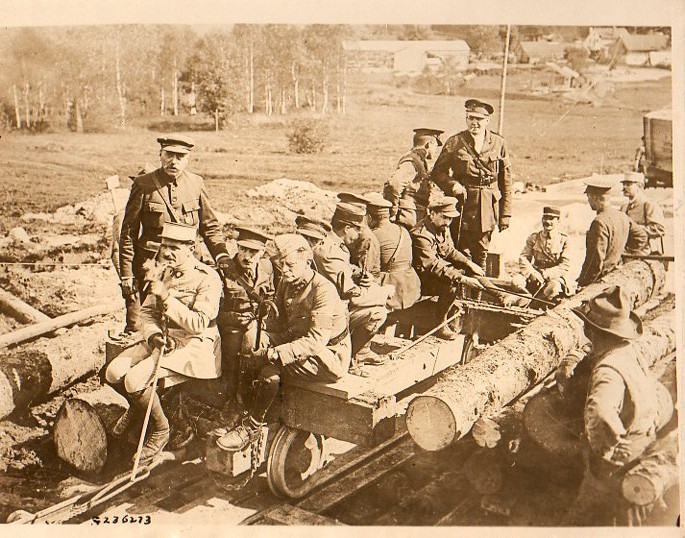
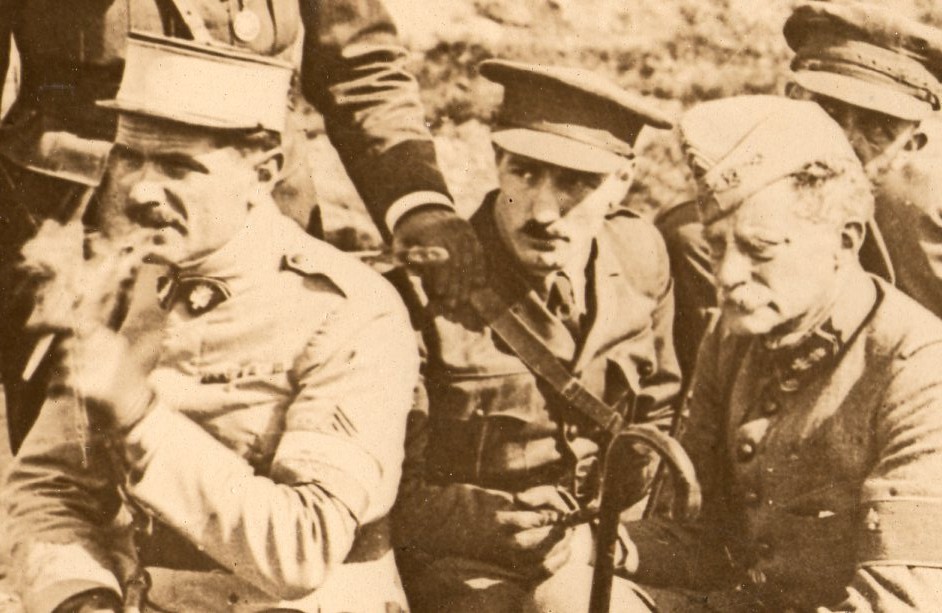
    One thing that I haven’t thought about–among many–is how the lumber for lining WWI trenches was provided.  This issue came about while looking at this World War I news photo service image (by Underwood & Underwood), an image showing a group of journalists accompanying a troop of Canadian soldier lumbermen, all riding on top of felled trees loaded onto railroad cars, the lumber headed towards the Front.  When you think about battles along the many fronts during the war, you don’t think about all of the missing trees, some large percentage of which wound up being utterly splintered during the first stages of battle.  So the lumber needed to keep the sides of the trenches intact must’ve come from somewhere, somewhere else. 

    World War I photos-=axe men295
     [The original photo is available from our blog bookstore, here.]

    World War I photos-=axe men b296
    Given that there were something on the order of 12,000-25,000 miles of trenches for the war (a figure taken from the PBS site on the Great War)–that would mean that there were many miles of trees needed to shore up the ditches.  This is just another one of those infrequently considered indicators of how massive the supporting efforts to the supporting efforts ( and etc.) of the war effort was on each side–that there was a corps necessary as a provider for the construction of the walls of trenches is staggering, especially when you consider the amount of lumber that was necesary to do the job. 

    ·Posted by :

    ·in:

    — —

  • History of Children, 2/7–the First Illustrated Rendering of the World for Kids: Anatomy

    JF Ptak Science Books  Post 1286    Continuing the post 1285

    “Taking the Scarecrows out of Wisdoms Gardens”

    This is Part 2/7 of John Comenius’ great work, the first illustrated instructional to children, first written in 1676 and then translated into English in 1726–it is from this translation that all of the images (below) are taken.  This is the second of seven installments on introducing 17th and 18th century children to wide ideas, the other sections including: Part 1, Occupations; Part 2, Anatomy; Part 3, Books and Book Arts; Part 4, the Sciences; Part 5, Morals and Philosophy; Part 6, Games and the Arts; and Part 7, the Military.  

    The work itself: John Amos Comenius’ Orbis Senfualium Piélus: Omnium Principalium in Mundo Rerun/ &f m Vita АШопит,  translated as Pictura et Nomenclatur, the Visible World, or A Nomenclature, and Pictures of all Chief Things that are int he World, translated into English by Charles Hoof…1726.

    The purpose of the book, writes the translator in the introduction of the 1726 12th edition, is:  

    To entice witty children to it, that they may not conceit a torment to be in the school, but dainty/are., For it is apparent, that children (even from their infancy almost) are delighted with Pictures, and willingly please their eyes with these fights: And it will be very well worth the pains to have once brought it to pafs, that fcare-crows may be taken away out of Wifdom’s Gardens…”

    Even at this early stage of publishing books for children it was easily recognized that children learn better when eased into their subject with pictures.  This is not so far off the mark with the moderns, and in its own way a precursor to the Dick and Jane and Dr. Seuss books–not so much for subject matter, but for the very act of putting a book into the hands of a child and getting them comfortable wit the idea of reading.  It seems to me that this is by far the most important lesson-the actual content at tis point is secondary to the act of holding a book.  

    [graphic]

    Septan Mtaies Hominis. A Man is ßrjt un Infant, 1. j Homo di primum Infasts, 1.

    tien

    [ocr errors]

    [merged small][merged small][ocr errors][ocr errors][merged small][graphic][merged small][merged small][ocr errors][ocr errors][ocr errors]
    [graphic]
    [ocr errors]
    [ocr errors]

    [merged small][graphic][ocr errors][ocr errors]

    a Tongue and Palate,
    and Teeth, 16.
    in the Cheek-hone.

    A Man s Chin
    is covered ivith a Beard, 14.
    mnd the Eye
    {in •which is the White
    and the Apple)
    •with Eye-lids,
    and an Eye-hrow, 15.

    The Hand heing clofed, is a Fift, 17. heing of en ira palm, i8, in the midß is the hollow, 19. of the Hand i the extremity is the Thumh, 10.iviehfour Fingers, the Fore-finger, 2s. the Middle-finger, гs. the Ring-finger, 23 and the Little-finger, 24. .

    In every one are three ]o\ms, a. h. C. and asman knuckles, d. e. f. ivith a nail, 25.

    [ocr errors][ocr errors][ocr errors]

    [merged small][graphic]

    In the Body are the Skin .nvith the Membranes, the Fleih ivith the Mafcles, the Chanel;, .,

    the Griffles,
    tie Bones andthe Boweli.

    The Skin, i: heing puttV ef, the Fleih, 2. appeareth, vol in a continued lump, Lut heing diftnhuled, es it ‘were in ßufi puddings, fuihuh they callMukks, ivhireof1here aie reckoned four hundred and five, heing the Chañeis cf the Spirits to move the Members.

    The Bowels are the inward Members:

    As in the Head,th.rBrains, 3. heing compajfed «bw with a Skull, and

    In Corpore funt Cutis cum Mimhranis, Caro cum Mufcults, ..’

    Canales,
    Cartilagines,
    Oßi & Vecera.

    Cute, 1. detraíla,
    Ca”o, 2. appaiet,
    non continua raafsâ,
    fed dil.tributa,
    tanquam in farcimina,
    quos vocant Mu/tules,
    quorum numerantur
    quadringenti quinque,
    canales Spirituum,
    ad movendum Memhra,

    Vijcera funt Memhra interna:

    Ut in Capite, Cerehrum, 3. cire umda tum Crem», Sc

    [ocr errors][ocr errors][ocr errors][graphic][merged small]

    The Arteries currying Blood from the Heart;

    4’he Veins returning the Mood to the Heart}

    The Nerves carrying Setife and Motion throughout the Body from the Brain.

    You jkallßnd thefe three, 1. t’very inhere joined together.

    Beßdes, from the Mouth into the Stomach it the Gullet, 2,

    the way of the meat and drini, and-hy it to the Light!, the Wezand, 5. for hr.athing; f cm the Stomach to the Arfe it a great Gut, 3. to purge out the Ordure; from the Li-ver to the Bladder, the Ureter, 4. for making ‘wJter. .

    Tie Bones are in the Head, the Skull, 6. the ttuo Cheek-bones, 7. with thirty tTvo Teeth, 8. Then the Back-bone, 9. the Pillar of the Body, tonfifling of thirty four turning Joints, that the Body may hend itfelf

    The Ribs, re. ,uihereof there are twenty four.

    The Breaft-bone, 11. the five Shoulder-blades, ii. the Buttock-bone, 13.. the bigger Bone in the . Atta, 15. *W/¿/kfi’crBone inthi Arm.

    V-Л ù •;

    vi;

    [ocr errors][ocr errors][merged small]

    [merged small][merged small][merged small][merged small][graphic][merged small][merged small]

    Mußcal Типа.

    The Nofe, 3. fcenteth fmelh and ßinhs.

    The Tongue, 4. •with the reef of the Mouth taßet Favours, •what is fweet or hitter, keen or hiting, four or каф.

    The Hand, 5. hy touching difcerneth the quantity and q: ality of things; the hot and cold, the moifl and dry, She hard andfft, the fnooth and rough, the bsavy and light. The in•ward Sen fes are three. . The Common Senfe, 7. under the forepart of the head, afprehendeth i

    t/.ings taken from the oufward Senfes.

    The Phantafye, 6. under the crown of the head, judgeth ofthefe things, t hinket h and drcameth

    The Memory, 8. under the hinder part of the head, layeth up every thing end fctcbeth them out; it Ufethfome, and this is forgetfulnefs.

    Sleep, is the reft of the Senfes.

    [ocr errors][ocr errors]

    [merged small][graphic]

    The Soul is the Life tf the Body, oie in the ivhole. Only Vegetative in Plants;

    Withal Seníltive in Animals;

    And alfo Rational in Men.

    This confifteth in three things;

    In the Underftanding, wherehy it judget h, and underßandethy – a thing good and evil, or true, or apparent.

    In the Will, •whereby it choofeth, and deßreth, tr rejeéleth, er mißiketh a thing knovn.

    In the Mind, •whereby it purfueth

    Anima eft vita corpoiii, una in tota.

    Tantum Vegetativa In Plantis;

    Simul Senßtinsa in Ahímalibus J,

    Etiam Rational is in Hernie/i

    liaec coniiftet in trihu»;

    In Mente (Intelleflu) qua cognofcit, & intelligit, honum ac malum, vel verum, vel apparent»

    In Voluntate-, qua eligir, Sc concupifcit, aut rejicit, & averfatur cogniuim.

    In Animo, quo prpfequituv

    [merged small][merged small][merged small][graphic][merged small][table]