A Daily History of Holes, Dots, Lines, Science, History, Math, Physics, Art, the Unintentional Absurd, Architecture, Maps, Data Visualization, Blank and Missing Things, and so on. |1.6 million words, 7500 images, 4.9 million hits| Press & appearances in The Times, Le Figaro, Mensa, The Economist, The Guardian, Discovery News, Slate, Le Monde, Sci American Blogs, Le Pont, and many othr places… 5000+ total posts since 2008.
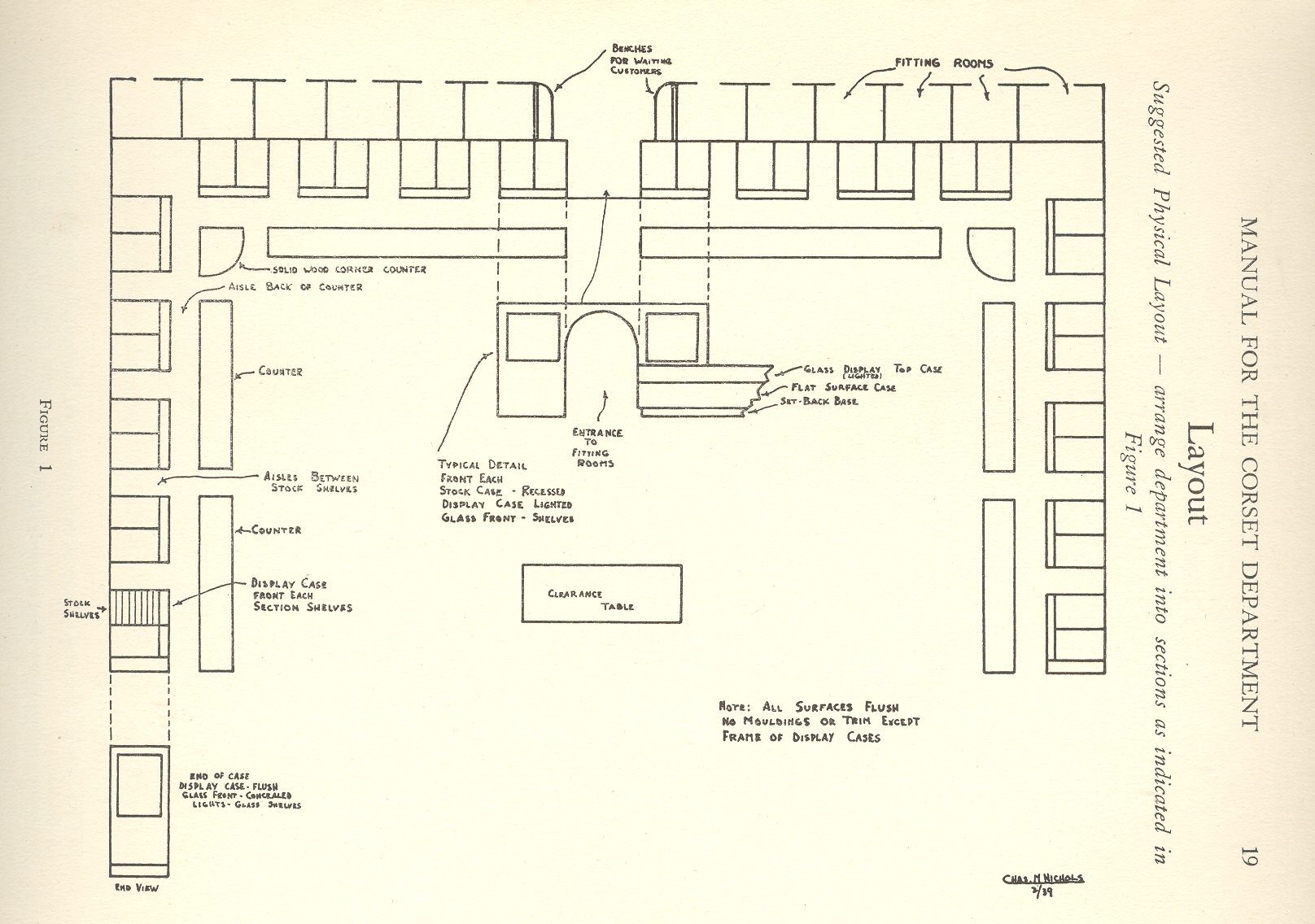
This finely produced, 75-page pamphlet lists all you need to know about marketing and maintaining a corset department in 1939–all except how to actually get back to 1939 to utilize this font of knowledge. It was published with great seriousness for a serious business by the School of Retailing at New York University, a serious object for serious people. Among the many things I’ve never thought of before thinking with this pamphlet were corset maps–and one of these happens to appear in this publication, a map of an idealized corset department, which to me looks to be large, sanitized and medicinal, an oddly institutionalized presentation of an intimate something, something more of artistry and chance and possibility than an orthotic.
I should think that I would like to make a Kingdom Map for his image, some day. It looks to me ready to accept the responsibilities of landforms or ideas or statistics or changes or comparisons in place of its plain nature of counters and countertops and display cases, empty boxes waiting for something a little more invigorating to depict. Or maybe not, maybe the chance of display of transformations is enough to suit its peculiar, perhaps singular, needs.
Or maybe on the Corset Map instead of substituting land and sea for corsets and boxes, one could substitute the noises of a quiet house at night, or the sound of heavy boots in a brittle-dry snow in the deep cold. Or maybe a map of the discovery of children’s laughter, or inconvenient pauses in conversations through the history of human speaking…or a map of lost ways.
Maybe the Corset Map could be used for a template for the things we will forget and the things we’ve forgotten, in which case the boxes need not be filled in, giving us a new version of the Bellman’s Map from Mr. Dodgson, a new subcategory of maps–the blank map. Or it could be the outlines for a map of the places that you meant to say something, but didn’t. Perhaps it could be used to outline where and how many times that people tell/told you that they’ll miss you if you step away, making hollow boxes of simple loneliness because we can’t be there all of the time.
Or maybe the corset map is just a corset map.
[This item is available for purchase, here.] The other surprise is how expensive these undergarments were.For example, the Lily of France and Mme. Irene Corset Company (NYC) sold a girdle “for the heavy figure” (liberally sprinkling the word “heavy” throughout the description of the product like, well, sprinkles) for $132. The $132 corset is equal to about $2000 in today’s currency, or roughly a 15:1 increase. There were girdles and etc. in all price ranges, but the (1939) $30-$60 range seems to have been the most common; even still, the $30/low-medium quality item is about $430 in today’s dollars, and the cheapest of them all at 5 bucks goes in today’s economy at 75 dollars or so. I’m not familiar with the value of undies today, but this sure sounds like a whole hell of a lot of money.
$132 for underwear in 1939 was a tremendous amount of money for the average person—even for the upper-middle class, it was a bunch, considering that you could buy a decent new car for $700.It would also be equal to a half year’s worth of an average house rent ($28/month) and 1320 gallons of gasoline.
It sounds like it was very expensive to keep the up with the idea of an ideal figure, which of course was partially create by this same sort of company, creating both need and demand for its product.
1939 Price Comparisons:
Wages per year, average: $1,730.00 Minimum wage: 30 cents/hour Milk, by the gallon: 35 cents Postage stamp, 1st class: 3 cents Dow Jones: 131 Gas, average price of a gallon: 10 cents Bread, by the loaf: 8 cents Hamburger Meat, by the pound: 14 cents Automobile, new, average: $700.00 House, new, average: $3,800.00 House rent, average: $28.00/month
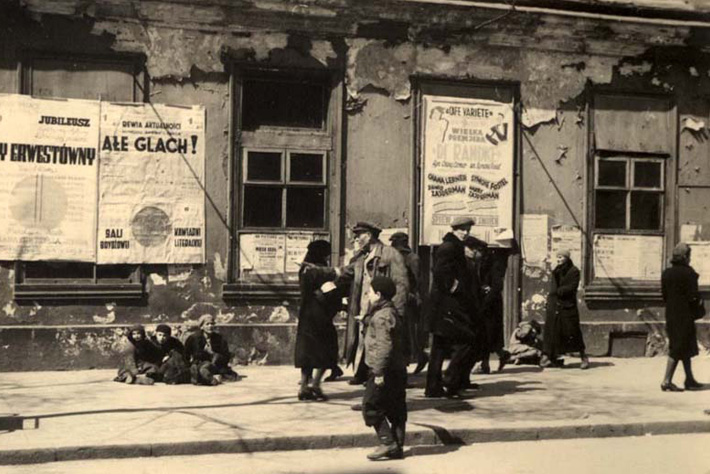
I’ve felt that a great history lesson for school kids would be to make them keep a diary for some other kid from some other time, introduce them to the minutiae of life from another time and perhaps another place. With some guidance they could make interesting entries in their diary for, say, 15 June 1897, writing about chores, the daily schedule, what they studied in school, how they were dressed, how they got food on the table and kept the house clean, how they would spend 25 cents, what they would see from some given vantage point, and on and on. This could take place in their very own home town; it could be multi-generational, requiring them to talk to the scary white hairs, or it could reach far back into history and be of an entirely different place altogether. After they were assigned a particular place in time and space, you could give the kid subtle hints, like this one (below), asking them what they thought it might mean by dialing the phone number 200 80 in Warsaw in 1941. And what did that pair of lightning bolts mean, anyway? I think that once they were made to figure it out for themselves, as though they might’ve been there, and then could record their feelings and observations in a diary might actually bring history to life (especially once they had their “holy crap” (and probably worse) moment at what these numbers implied).
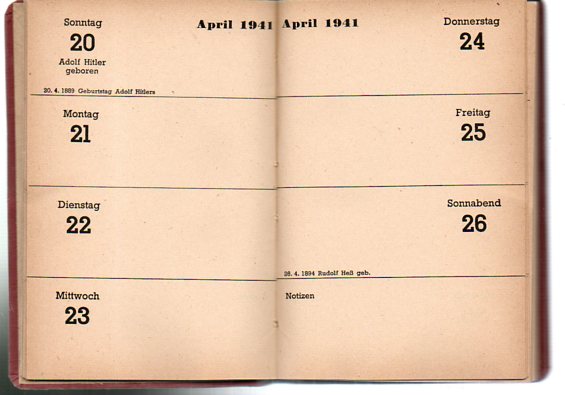
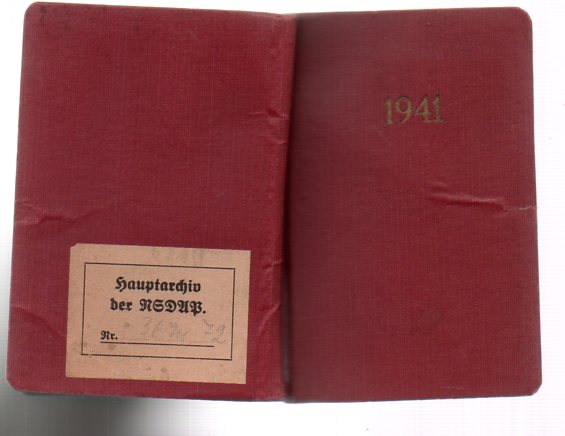
This is one of the ideas that came home again uncovering this odd booklet, which is a Nazi diary for those stationed in the Generalgouvernment (Tascehnjahrbuch 1941 fuer den Deutschen im Generalgouvernement) , for the year 1941. The General Government (or more fully the Generalgouvernement für die besetzten polnischen Gebiete) was one administrative section of occupied Poland, the country being divided in 1939 after the German invasion of 3 September 1939, with the western section being retained by the Germans and the Eastern given over to occupation by the Soviets via the Non-Aggression pact between the USSR and Germany.
This looks like an every day diary for the period, except for the Nazi (or NSDAP) regalia and German imprint of Generalgouvernment in Krakau. And, all of the annotated highpoints of the year for the most overly voracious parts of German militarism as well as for the hotpoints of Nazi history. Hitler, (above) Goering, Goebbels and other leaders’ birthdays are highlighted, not to mention seminal points in the development of the Nazi party and party-adoptees (Richard Wagner has a number of entries for suggested celebrations).
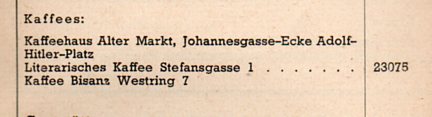
There are also helpful directories in the back pointing to any number of cafes located in a growing number of “Adolf Hilter Platz’s” throughout Poland (including three in Radom), as well as fares for the use of the railway and postal system.
We also see the following telephone number: 23075. That’s for the Literarische Kaffee Stefansgasse I, Krakau. This is the location that the Reichsminister and administrator Hans Frank (about whom we’ll read inb a moment) decided to hold a chess tournament in 1941, to satisfy his own need for chess while freshly in the pursuit of the murder of millions of people.
‘Frank was extremely interested in chess. He not only possessed an extensive library of chess literature but was also a good player, and he even “received” the Ukrainian chess master Bogoljubow at the castle. On 3 November 1940 he organized a chess congress in Cracow. Six months later he announced the setting-up of a chess school under Bogoljubow and the chess master Dr Alexander Alexandrovich Alekhine, and he visited a chess tournament in October 1942 at the “Literary Café” in Cracow.”–Hans Frank (subtitle: Hitlers Kronjurist und Generalgouverneur) by Dieter Schenk (Frankfurt am Main, 2006) “and quotes a reference to chess on page 177 (given below in our translation)…”[Source: Chesshistory.com., here.]
For the record, the Generalgouvernement was proclaimed in October 1939 just after the invasion of Poland and included most of what was left of Poland, which was gone again, barely 20 years after it returned to the map following WW1. In March 1941 Hitler made a decision to “turn this region into a purely German area within 15-20 years”. He also explained that “Where 12 million Poles now live, is to be populated by 4 to 5 million Germans. The Generalgouvernement must become as German as Rhineland”. Following the Wannsee conference of 20 January 1942, the Secretary of State of the Generalgouvernment, Dr. Josef Buhler (Warsaw # 222 05, a listed number in this book) began implementation if the Final Solution in Poland; by the time the Soviets entered and took control in late 1944, more than 4 million people—most of them Jewish—had been killed.
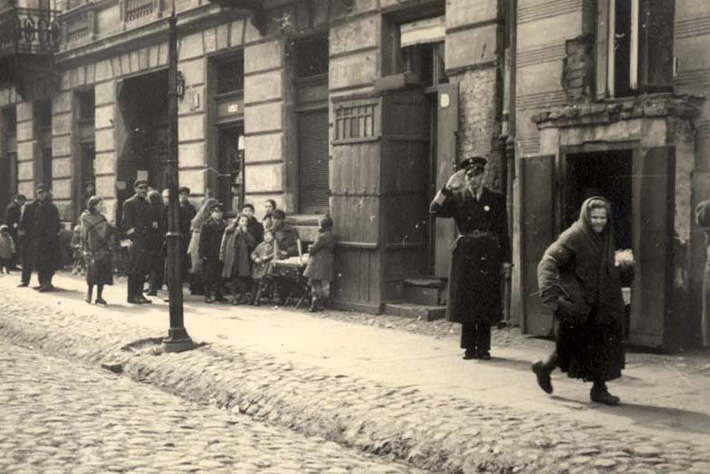
[Photograph of a Jewish policeman, from the Jost collection.1]
The man in charge of it all here in Poland, Hans Frank, has his photographic portrait as the frontispiece, and his number is listed, too. He was an horrendous butcher who was tried and convicted and executed for his crimes against humanity (at Nuremberg on 16 October 1946, aged 46–the decision of the court read, in part, that Frank was “…a willing and knowing participant in both the use of terrorism in Poland, as in the economic exploitation of Poland in a way that led to the starvation of a large number of people, also in the deportation of more than one million Poles as slave laborers to Germany and in execution of a program that had the murder of at least three million Jews. “). In a speech December 16, 1941, Hans Frank said:”We cannot shoot these 3.5 million Jews [in Poland], we cannot poison them, but we will take measures that will somehow lead to successful destruction; and this in connection with large-scale procedures which are to be discussed in the Reich, the Government-General must become as free of Jews as the Reich …..We must destroy the Jews wherever we find them and wherever it is at all possible, in order to maintain the whole structure of the Reich…” Frank did his share of annihilation of Polish Jews and Polish citizens–almost as much as any other Nazi official, government or military leader–over the six years (1939-1945) that he ruled over this territory.
[Another image from the Jost collection.]
Josef Buhler, by the way, was tried after the war by the Supreme National Tribunal of Poland for crimes against humanity, condemned to death on July 10, 1948, and executed in Kraków.
This is really a fetid little booklet, its empty pages waiting for some sort of horror, all of which was actually taking place in real life, escaping their record.
Distribution of food in General Government as of December, 1941
Nationality
Daily calorie intake
Germans
2310
Foreigners
1790
Ukrainians
930
Poles
654
Jews
184
I wonder where all of those conversations went, exactly, after they were ended. Did they sink into the copper wire like auditory signals (very very slightly trapped) in clay pots? I think not of course. But all of those phone numbers in this book to all of the special police and propaganda police and racial police and SS and on and on, all of those calls and conversations about this horrific undertaking, just seem to me as though they should’ve gone somewhere, caught in the myth of the machine, somewhere in the electromagnetic world, like a primitive internet.
I really can’t stand what those simple phone numbers meant.
Footnotes:
1. The Generalgouvernement was the central part of three general districts of the divided Poland, and it proved to be the terminal for millions of people deemed as undesirable or threatening. It was particuarly impossible for Jews, the Generalgouvernement proving to be the place where they were collected in ghettos and housed under mniserable and starvation conditions until they began to be shipped out to concentration camps in early 1942. By 1944 all of the ghettos had been liquidated, and with them, their inhabitants. The Soviets did finally liberate the Generalgouvernement (from the Nazis) under delayed conditions in the winter of 1945, initiating Pogroms against the Jews by summertime.
Notes:
The Wannsee conference (I will not use a capital “C) was a meeting of leading Nazi officials and treacle who formed the decision to implement the Final Solution t the “Jewish problem” in Germany— it was the real beginning of the Holocaust.
The men who made this determination to begin with the wholesale destruction of human beings included:
SS-Obergruppenführer Reinhard Heydrich (Chief of the RSHA and Reichsprotektor of Bohemia-Moravia), presiding Dr Josef Bühler (Government of the General Government) Dr Roland Freisler (Reich Ministry of Justice) SS-Gruppenführer Otto Hofmann (Race and Resettlement Main Office, RuSHA) SA-Oberführer Dr Gerhard Klopfer (NSDAP Chancellery) Ministerialdirektor Friedrich Wilhelm Kritzinger (Reich Chancellery) SS-Sturmbannführer Dr Rudolf Lange (Commander of the SD for Latvia) Reichsamtleiter Dr Georg Leibbrandt (Reich Ministry for the Occupied Eastern Territories) Martin Luther (Foreign Office) Gauleiter Dr Alfred Meyer (Reich Ministry for the Occupied Eastern Territories) SS-Gruppenführer Heinrich Müller (Chief of Amt IV (Gestapo), Reich Security Main Office (RSHA)) Erich Neumann (Director, Office of the Four Year Plan) SS-Oberführer Dr Karl Eberhard Schöngarth (SD, assigned to the General Government) Dr Wilhelm Stuckart (Reich Ministry for the Interior) SS-Obersturmbannführer Adolf Eichmann (Head of Referat IV B4 of the Gestapo), minutes secretary
1. “German soldier Heinz Jost strolled through the Warsaw Ghetto taking illegal pictures. Almost 50 years later, they resurface in a disturbing exhibition.”
“An enfeebled urchin lies clutching the sidewalk like a breast. Three people pass by behind it; only one of them, a malnourished woman, looks down at the child. In a second or two, they will be gone and the child will be alone again, even more helpless, if that is possible. Did such dying children (there were thousands of them in the Warsaw Ghetto in 1941) know that something was horribly wrong with the world? Or did they think that squalid suffering is all that this disappointing life has to offer? wrote children, Mary Berg wrote in her diary of the ghetto, “no longer have a human appearance and are more like monkeys than children. They no longer beg for bread, but for death.” Terribly, the child on the sidewalk cocks its eye at the camera, unable to ward off the final cruelty of being photographed by a German soldier.
“Eerie approximation: Heinz Jost, a small-town hotelkeeper serving in the German Army, had the day off on Sept. 19, 1941. It was also his birthday. For reasons lost to history, Jost decided to spend the day inside the walls of the Warsaw Ghetto. He carried a camera and, contrary to regulations, took 129 photographs of the ghetto and its doomed inhabitants. The pictures lay unseen in a dresser drawer for four decades before Jost rediscovered them. He gave them to the German magazine Stern, which donated them in 1987 to the Yad Vashem Archives in Jerusalem.
“What Jost found in this neighborhood consecrated to death was an eerie approximation of normal daily life that only gradually (especially as the exhibition is arranged) reveals its ghastliness. At first, street life seems no more deprived than that in lower Manhattan earlier in the century. And the jackbooted soldiers relaxing in a touring car appear more arrogant than evil. But surely they must have known, as Chaim Kaplan recorded in his Warsaw diary, that “Anywhere a tree has been planted, or a bench has been placed, Jewish children are forbidden to derive enjoyment.” Elsewhere, peddlers hawk bread, grubby vegetables and coal by the individual lump, one woman sells Star of David armbands in varieties from printed paper to embroidered linen. “These armbands are very much in demand in the ghetto because the Germans arevery `sensitive’ on this score, and when they notice a Jew wearing a crumpled or dirty armband, they beat him at once,” Mary Berg observed. After these images, the pictures of gaunt bodies on morbid rickshaws, the merciless common graves and the catatonic attendants are but numbing epilogue.
“There are those who say that to measure any other barbarism against the Holocaust is to trivialize the unequaled tragedy that befell the Jews. Looking at these pictures, however, it is hard not to be struck by resemblances that suggest that the horror of the Holocaust has not been obliterated, but simply broken up, crushed into powder and raked into the soil of contemporary life. Even in our very rich country, the number of tattered beggars, slumped in despair on city streets, grows steadily greater. The bearded, skull-like heads of the Warsaw Ghetto’s interned are remindful of AIDS victims in the last stages of the plague. And it is almost impossible not to realize that we have seen, and still see, pictures of bodies of innocents lying dead under perversely meaningless advertising signs, at the feet of blase soldiers who think they’re just doing their jobs.”
And another, shorter review:
Heinrich Jöst’s Photographs. In the Ghetto of Warsaw: Heinrich Jost’s Photographs, edited by Gunther Scharberg, published by Scalo, distributed by D.A.P. 2001.
“Among the many books released on the Holocaust, the complete set of Jöst’s photographs of the Warsaw Ghetto is a valuable resource for scholars. Jöst, a hotel owner and sergeant in the Wehrmacht, took photographs of the Warsaw Ghetto in late 1941, which he shared with the journalist Schwarberg in 1982. Originally exhibited at Yad Vashem in Jerusalem, these photographs are now available, along with Jöst’s recollections, to a wide audience (Jöst died in 1983). Although the graphic nature of the pictures is disturbing they show, for instance, starving children dying in the streets they provide a record of the Warsaw Ghetto separate from official Nazi propaganda and as such are extremely valuable. Recommended for all libraries.” –By Frederic Krome, Jacob Rader Marcus Ctr. of the American Jewish Archives, Cincinnati.
Having just finished a short post on human-powered machines (Georg Bockler in the mid 17th century) and with Juneteenth fast approaching, I thought about another sort of human power—slaves. I wanted to make a short post on the conditions in which Africans were taken (sold and stolen) from their home continent to North America (and later just to the United States).
Slavery as an institution in the U.S. existed from 1619-1865, failing, ultimately, with the ratification of the 13th Amendment (the first proposed in 60 years) to the Constitution by the end of 1865. (The African slave trade—though not slavery itself—was outlawed in 1807, by a law passed jointly in the United States of America and the United Kingdom, with the US law taking effect on January 1, 1808.) The amendment was ratified relatively quickly by the legislatures of the necessary three-quarters (27) of the original 36 states in 1865—Mississippi, the last of the original states to ratify the amendment, did so in 1995, 135 years following its initial rejection. Though almost all of the states had ratified the amendment in January and February, it took until December 4th and 6th—months after the crushing failure of the Confederacy—for North Carolina and Georgia to vote for it. (The remaining 9 states voted for the amendment as follows: Oregon California and Florida in 1865; Iowa and New Jersey (which had initially rejected the matter in 1865) in 1866; Texas in 1870; Delaware, the First State, in 1901; Kentucky in 1976; and Mississippi, somehow, in 1995 .
The Emancipation Proclamation was issued September 22, 1862, with a three-month long pillow until it took effect on January 1, 1863 . Juneteenth refers to the freeing of the slaves in Texas (at Galveston) with the reading of General Order No. 3, on 19th June 1865. Texas was the last refuge of Southern Slavery, and it all ended on that day.
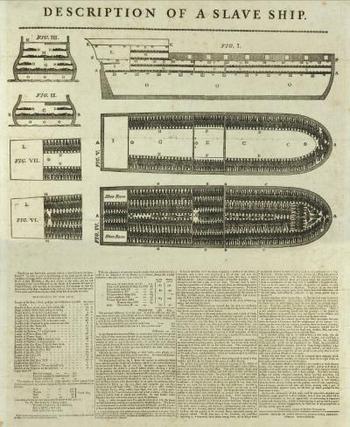
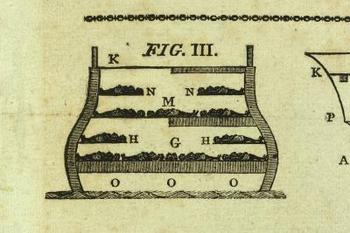
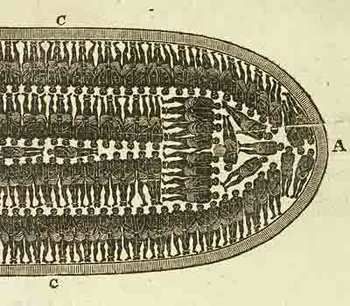
The famous image above (of the British slave ship Brooke) is taken from An Essay on Colonization, particularly applied to the Western Coast of Africa….by Carl Bernhard Wadstrom, printed in London in 1794. Wadstrom (1746-1799) was devoted abolitionist and Swedenbourgian who planned, advocated and practiced (via his relationship with the Nordenskold brothers and the Philanthhropic Society a working agricultural colony on the West coast of Africa) the end of slavery and the return of removed slaves to Africa.
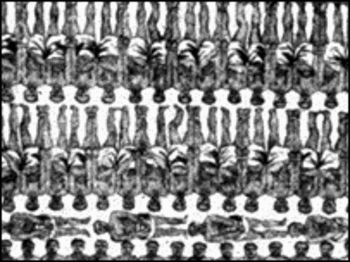
The images pretty much speak for themselves. Though it should be pointed out that this engraving depicts about 480 slaves packed into the modified hold of the Brooke; in reality the Brooke carried between 500 and 650 slaves to America (meaning the conditions were even more crowded than depicted here), losing on average about 125 people to the insufferable and depraved conditions (dysentery, heat, malnutrition, lack of water, scurvy and so on).
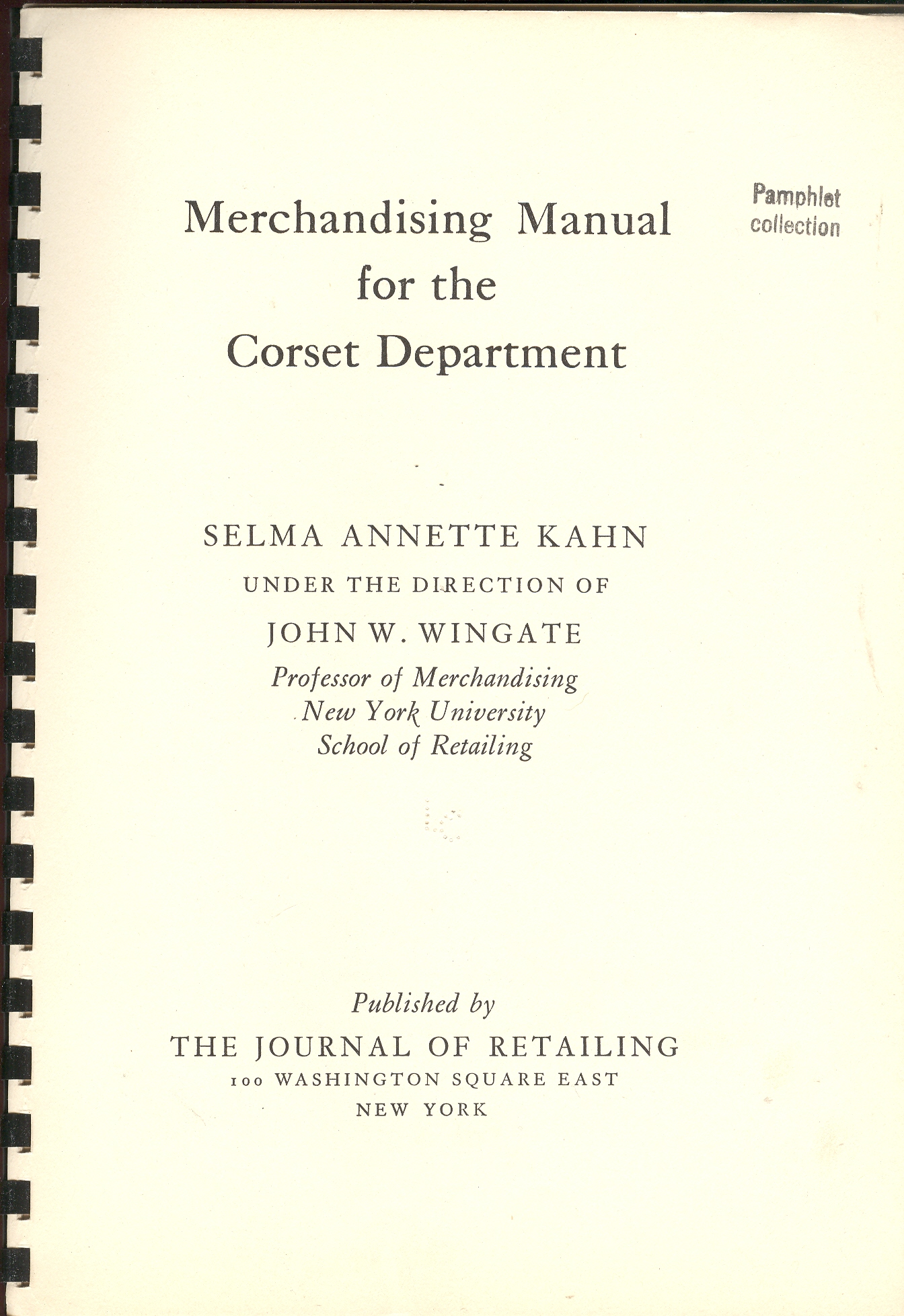 This finely produced, 75-page pamphlet lists all you need to know about marketing and maintaining a corset department in 1939–all except how to actually get back to 1939 to utilize this font of knowledge. It was published with great seriousness for a serious business by the School of Retailing at New York University, a serious object for serious people. Among the many things I’ve never thought of before thinking with this pamphlet were corset maps–and one of these happens to appear in this publication, a map of an idealized corset department, which to me looks to be large, sanitized and medicinal, an oddly institutionalized presentation of an intimate something, something more of artistry and chance and possibility than an orthotic.