A Daily History of Holes, Dots, Lines, Science, History, Math, Physics, Art, the Unintentional Absurd, Architecture, Maps, Data Visualization, Blank and Missing Things, and so on. |1.6 million words, 7500 images, 4.9 million hits| Press & appearances in The Times, Le Figaro, Mensa, The Economist, The Guardian, Discovery News, Slate, Le Monde, Sci American Blogs, Le Pont, and many other places… 5000+ total posts since 2008.

Category: Social History

  • The Origin of the Term “Intellectual Capital”, 1842

    JF Ptak Science Books   Post 1275

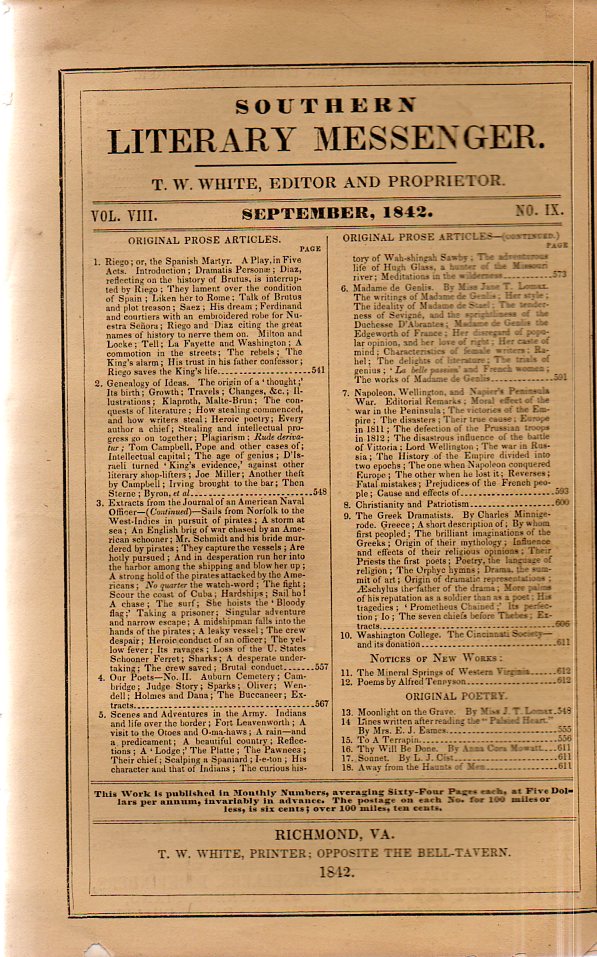
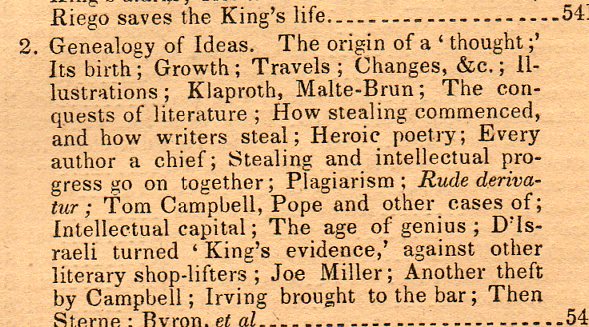
    Intel cap--cvr123   It seems that the first use of the term “intellectual capital” is seen to be with John Maynard Keynes in 1975; nice company of course, but the true first use seems to be much earlier.  It seems to appear in The Southern Literary Messenger (1834-1864) for September 1842, in an article “Geneaology of Ideas”, (pp 548-557) and written by “E.W.J.”, who turns out to be Edward William Johnston, writer/editor, born in Culpepper County in 1799 (or 1804), and brother of Confederate General Albert Sydney Johnston.  (It is also available from our blog bookstore.)

    Here it is:                   

    To resume now our historical deduction of matter Intellectual capital appears to be as capable of being amassed among a nation as materia1 wealth but by no means to follow the same laws –page 552

    If that isn’t what Keynes (and then everyone else) was talking about, I don’t know what is.

    Intel cap--cvr 2124The article is interesting for its dipping into the history of plagairism and finding it comfortably nestled somewhat undisturbed, comfortably even, in the general history of ideas:

    He who writes therefore steals as well as he can and as beggars when they can filch from no richer wardrobe purloin each others tatters so mean authors rob one another and go undetected partly because their works pass unscanned and parity because they from whom they borrow are unread So that after all the essential difference between the genius and the scribbler is not as to the fact of stealing nor even as to the quantity stolen but entirely as to the value of what they steal  (page 551)   

    Long intellectual history of borrowing and building, collection of tropes wound through entirely original work, based on some common building blocks that have been used over and over agian across the centuries.  When looking at the geneaology of ideas, the business of utter stand-alones is slim.  Shakespeare built upon Plutarch in bits and starts, for example, but everyone who knew everything at that time would’ve recognized the Plutarch shining through, Shakespeare himself finding it unnecessary to say any more about it.  Albert Einstein had not one footnote in the SRT paper of 1905, yet owed some intellectual heritage to Lorentz and Poincare.   Anyway Johnston writes about the fluid nature of the history of ideas with many fine examples (though not the two listed above), all of which can be read here in the full text of the article. 

    (This subject of plagiarism and forgery, of originality and copying, of recognizing what has come before and not, gets to be very knotty very quickly.  What is “real”, what is “original”, we are reminded, gets complicated and complex.)

    Notes:
     
    1.  The Southern Literary Messenger: Vols. I-XXXVI (August 1834 – June 1864, when it was eaten up by the war).  Even though it was an interesting journal with a good solid and long run, I guess many people will remember it for being edited for a short time by Edgar A. Poe, who also made a number of literary, critical reviews and poetical contributions to the magazine, though not in this issue for any of those three.


  • Yes, Franklin, There IS a Santa Claus. The Franklin D. Roosevelt/Santa Claus Connection

    JF Ptak Science Books   Post 1302
      Santa claus FDR title270
    FDR may well have been among our greatest presidents–but a reader, well, he was not.  Doesn’t matter, not really. (Harry Hopkins, long an adviser to Roosevelt and who held numerous high-level positions in the Roosevelt administration, once said that he never saw FDR with a book, let alone reading one.)

    There is a presidential library for him, of course, but that doesn’t prove that the Great Man read very much.  Maybe he just didn’t need to for the job. (That has been proved true in recent times though with a different outcome at the end of the presidency.)

    Santa claus FDR sig272
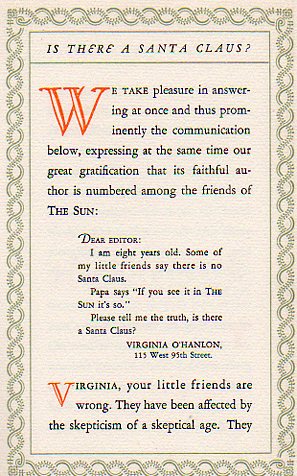
    And frankly I don’t care if Roosevelt read anything more than L’Il Abner.  But I do know for a fact that he did come into contact with a great piece of American social history in this famous story of a  girl named Virginia O’Hanlon (1889-1971) who wrote to the editor of the New York Evening Sun in 1897, asking “Is There a Santa Claus?” (Her father prompted her to write, stating that if one saw a positive response in the pages of The Sun, then it absolutely must be so.)

    Santa claus FDR 1st pg271 And of course there is a Santa Claus, and so wrote the editor. (See here for the full text of the response, and also about the man who wrote it–a nice story of a man who rose to the occasion after the assignment got batted around a bit.)

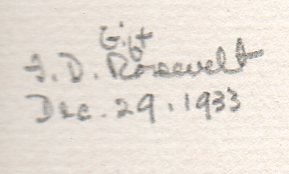
    The telling of the story in the book that I have here, an almost-fancy and semi-sumptuous little affair, was once owned by FDR.  It was no doubt sent to the new president from the publisher in December 1933.  Satisfied with the story and needing no further help with his own belief on the matter, Roosevelt sent his copy on to the good folks at the Library of Congress, and after six decades there, came to me. 

    For what is it worth, I think that FDR knew there was a Santa, and that was that.


  • Women Against Women Wanting the Vote, 1909

    JF Ptak Science Books   (Rapid) Post

    One in this blog’s  History of Women series

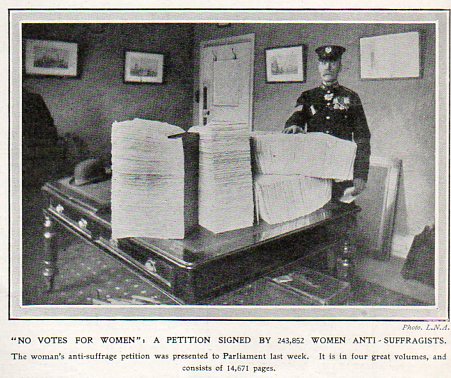
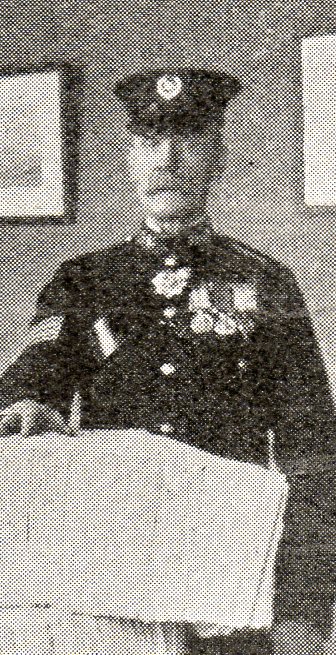
    WOmen--petition against vote121 By the time this photo of petitions against granting the voting to women in Great Britain appeared in The Illustrated London News in 1909, only six other places in the world had given women voting power:  Pitcairn Islands (1838), Isle of Man   (1881) , Cook Islands (1893), New Zealand (1893), Australia  (1902) and Finland  (1906). Admittedly, in the population of nations worldwide this was a very small percentage–smaller still if you considered the figure by population. The idea of universal suffrage was far from being popular, even only 101 years ago, within the lifetime of a few thousand people living today.

    There were no new additions between 1906 and 1913, but after that, from 1913 to 1920, 24 countries1 (including hundreds of millions of people this time) had granted the right,  not the least of which was Great Britain (1918) and the United States (1920).

    WOmen--petition against vote b122

    The complaints and arguments against women getting the vote have a recent ring to them:  the vote for many threatened the home, undermined the scope of the family, would destroy the foundations of marriage, would take women away from their domestic duties, and in general would weaken the nation.  It seems as though you could replace “votes for women” in this series of complaints with any number fof different issues today.


  • Examples of Colossally Bad Ideas–Sterilization, Eugenics and Soviet Racial/Genetic Domination Theory

    JF Ptak Science Books Post 1301

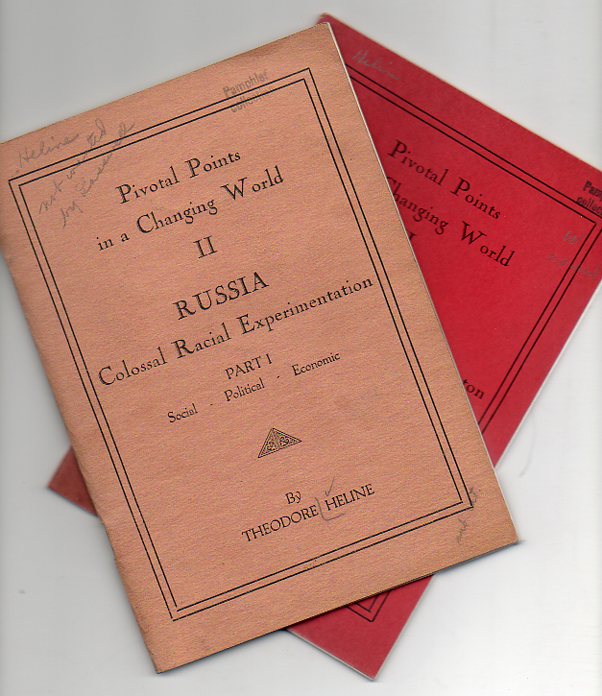
    Sometimes I need to make a post about a book simply to get it out of my system–once I’ve said something about a numbingly bad book, it usually just goes away, falling off the edge of the flat Earth rather than having its mast sink peacefully below the horizon. Such is the case with these pamphlets, one of which is so bad that its badness could not be contained in just one “volume” that it needed another. I almost wrote ” ‘little’ pamphlets” because they are, well, little–but little in size only, their badness easily transcending their size, and the idea of “size” in general. 

    Russia colossal Racial265

    [Note:  all pamphlets pictured here are available at our blog bookstore.]

    I never really liked the word “colossal” in the title of any book other than say a joke or magic book for children–outside that, I think the author is asking for trouble.  And trouble is the seat of reason in this work, which was published in 1939.  It is too painful to quote much from the text, but, right from the outset the reader gets a taste for what is ahead, being told that the New Russia (the Russians being “the most elemental of all white peoples”) is one way of saving the Nordic race, quoting The Rosicrucian Cosmo-Conception as a part-source, saying that “this race will collectively make up the sixth of the seven sub-races tat will constitute the present Aryan or Fifth Root Race” and it will “be expected to develop certain attributes that will contribute toward humanity’s ultimate perfection”.

     The author is enamored of the free voting system in the Soviet Union.  “No one visiting the Soviet’s pictorial Exhibit at the World’s Fair om New York could fail to be impressed by the dignity and attractiveness of the pictured polling places and the freshness and eagerness animating the faces of those figures who entered t perform their civic duty…” An incredible statement, validating the democratic freedom of the Soviet Union at a particular time in it history when millions of people had recently been starved to death, among other things.  The photographs of the coming genetic masters was proof enough of freedom than anything else. 

    The pamphlets grow heavier and more dense with each paragraph, the edges of the pages bending under their own filthy weight of vast stupidity and understated racial hatreds.  God and the superiority of whiteness and the gross disabilities of Catholics and Black people come along after a bit.  Jewish people aren’t even mentioned.   But the author states that it is a genetic “tick”, some sort of “genetic conscience” that comes into play that has prevented the “inferior races” (like Catholics or Blacks) to have come anywhere near attaining the presidency.  It is a spiteful, hateful pamphlet that is completely myopic about the rich, savory goodness that is the highest attainment of spiritualism/intellectualism/modernism and civilization that was the Soviet Union.  There would be little left to say about this work ten years hence, when the real stuff of the Soviet Union became more publicly common knowledge, and it became more difficult–I would think–for the author to reconcile his witches’ brew of Biblical nonsense, genetic debauchery and Cool-Whip history.

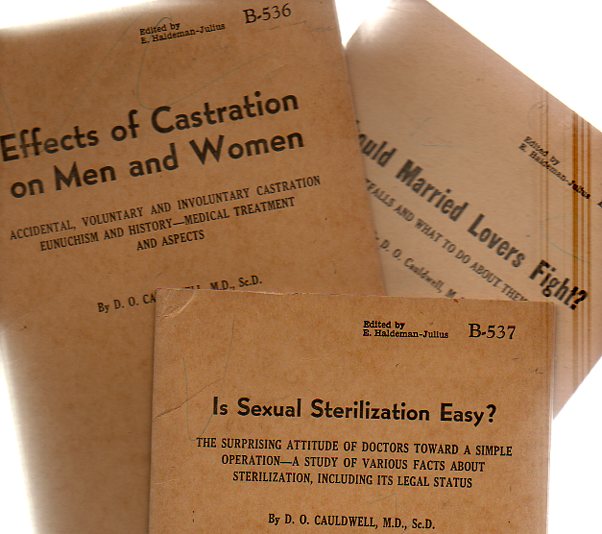
    Sexual sterilization Easy266The next assortment–all written just after WWII–asks some questions that one probably has never heard before.  “Should married lovers fight?” and “Is sexual castration easy?” are probably a pair of interrogatories that would never be heard in conversation in a hundred years of boring parties.  The contents of the pamphlets are a genuine struggle to get through–I picked my way through each for about 20 minutes before declaring defeat, except that I know enough to not have to think about these works again.

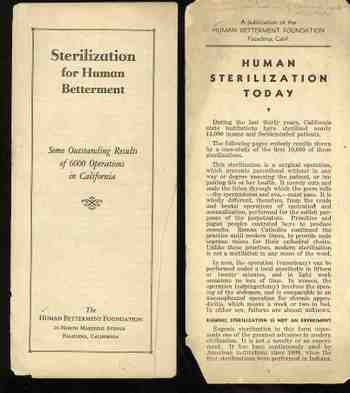
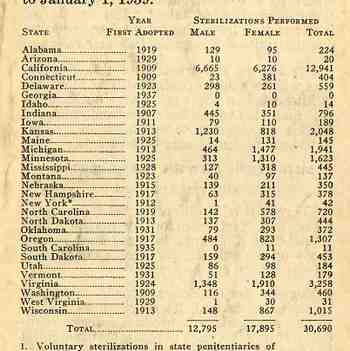
    The pamphlet Sterilization for Human Betterment, published by the Human Betterment Foundation (Pasadena, California),  states that 13,000 people in this category had been “asexualized” between 1909 and 1939 in California. (I should point out that California was the sterilization capital of the United States, with a third of all the national eugenics procedure performed in this state for this period of time) It defends this practice, saying emphatically that “eugenic sterilization is not an experiment”, and that “sterilization in this form represents one of the greatest advances in modern civilization”. 


    Blog1sept_10_sterilization538

    It continues:  “(sterilization) has been continuously used by American institutions since 1899, when the first sterilizations were performed in Indians”.  What?

    “Patients, relatives of patients, state officials, physicians,parole and probation officers, social workers, agree on the value of this practice” which was actually the “prevention of producing defective and handicapped children”.  I’m relieved that the probation officers were consulted.

    The Betterment people shed more light on the role of sterilization and sex offenses by women. (My bold.)  “Of 304 feebleminded girls sterilized and paroled, 9 out of every 12 had been sex offenders before commitment.  After sterilization, only one out of every 12 became a sex delinquent on parole”. 

    If this wasn’t such an awful story, “sex delinquent on parole”, a phrase I’ve never seen before, might make for a great 1950’s trashlit title. (It could’ve been a series, too:  all you need to do is take the title “Sex Delinquents on Parole” and add something to it, like “…on Parole from Outer Space” or “…on Parole:  Queenie the Slip Crown Breaks Her Knuckles” and so on.)

    The sorry story that I’ve interrupted with this bit of frivolity is that the “sex offenses” that are being discussed here is actually “prostitution”.  These young women weren’t committing violent acts of sexual savagery, they were just prostitutes, which meant that in most state they were “depraved”.  The “feebleminded” girls I would guess were poor or working poor, without the best education, and didn’t do well on whatever test was being administered to them to determine their test-taking intelligence. It seems to me that if  the goal was to liquidate prostitution that perhaps the men “seeing” these women should’ve been the ones faced with the operation. But that isn’t how the dominant culture viewed the situation, and that the best way to approach the problem was to remove the reproductive capacities from the weakest members of society.

    (Click on this table for a larger, clearer version of the number of forced sterilizations by state.)

     Blog1sept_10_sterilization539This pamphlet was the co-authored spawn of Paul Popenoe (1888-1979) and E.S. Gosney (1855-1942) while both were on the board of the Human Betterment group. In addition to a strict diet of superior morality and race,  Gosney seems to have been the money behind the organization. Popenoe had a background in agricultural genetics with an overdrive taste for eugenics and race, somehow intersecting them with social hygiene and marriage relations. The “dr.” that Popenoe loved to insist attaching to his name was an honorary, unearned degree, which he must have felt he needed in order to secure the proper amount of intellectual identification necessary to write on intellectual identification. The Nazis wasted little time in translating and publishing this work, adding it to their official publications list in 1939. It was one of a significant number of intellectual imports that came into poor, besotted Germany; the imports came nowhere close to the amount of information banished, exported to the necessarily beautiful non-Aryan non-Nazi inferno. It was just the sort of thinly distributed stain that interested people like the Nazis.

    I wonder what “Dr.” Popenoe thought of this Nazi honor?

    The second pamphlet by the same people, Human Sterilization Today,. is in a swift eight pages in which the Betterment Foundation makes it case to use sterilization to check “the misery spread through the community by the unchecked reproduction of the human unit” (italics mine)..  They are closing in on the Big Picture in this work, aiming at the 5,000,000 “who will be at some point committed to state hospital as insane” and the other 5,000,000 “who are so deficient intellectually (with less than 70% of average intelligence) as to be, in many cases, liabilities rather than assets to the race”.

    This is exhausting reading, but it is a story that shouldn’t be forgotten, and could remind us that what we’re doing or practicing today might look  like the Human Betterment stuff 25 years down the road. 

    What is also deeply unsettling about Popenoe is that from this vast miasmaic idea set of misguided and forced statistics, philosophical racial extremism, “social hygiene”, eugenic sterilization of the enfeebled and socially undesirable, he managed to create the very first marriage counseling service/practice in the United States.  The American Institute of Family Relations opened its doors in 1930 (in L.A.!) with this dizzying philosophical semi-brew of sterilization and marriage talk-therapy, happily correlating the whole thing with exploding axis of divorce, love, social failure, racial impurity and castration.  And somehow it all seemed to make sense to allot of people, back there in the past.


  • A Photograph of the Food Consumed “by the Inebriate in Captivity”

    JF Ptak Science Books   Post 1272

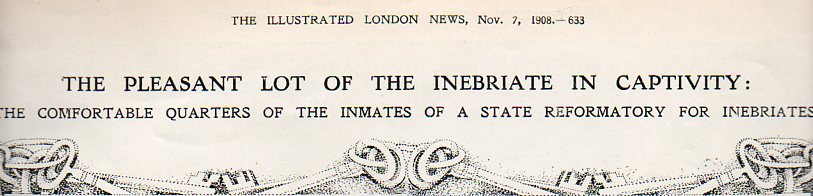
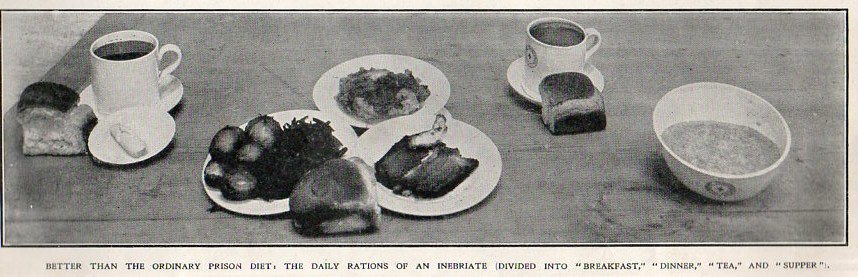
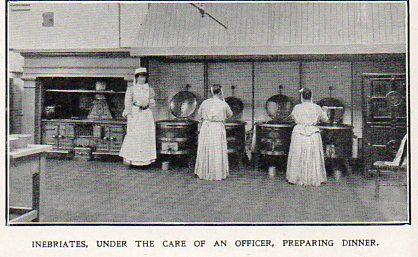
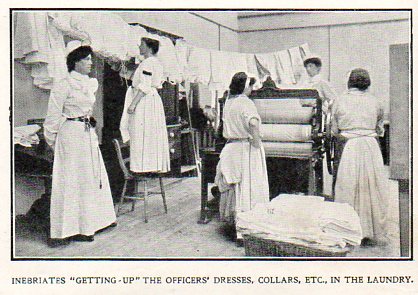
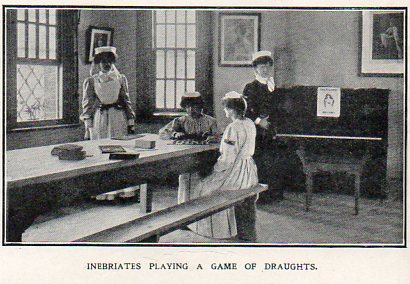
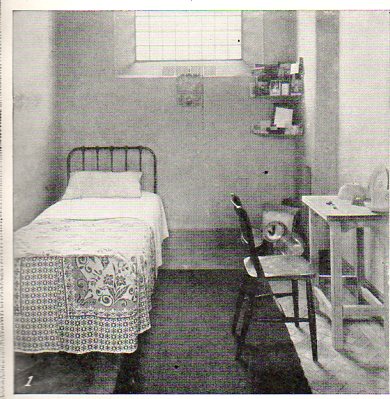
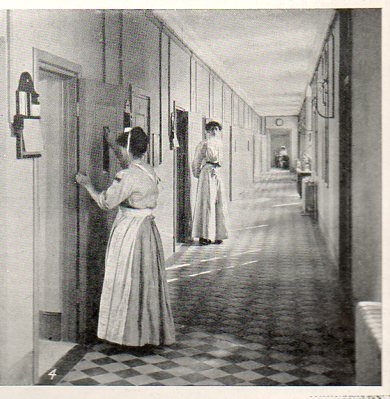
    I stumbled upon this while looking for an article on the Wright Brothers in The Illustrated London News.  I figure that this may be the first opportunity in recent decades that a photograph of the dinner table of  incarcerated British drunkards would be published–and some opportunities need to be serviced.  No doubt that this was an ideal table setting and selection of food because, well, that’s what people do– they normally don’t present an average-something for photographic display in national/international media.  Also the snapshot quality of the daily surroundings of the incarcerated was unusual, as was the Andrew Lang fairyland title to the two-page photo story. 

    Inebriate title115

    And the food:

    Inebriate food112

    A full day’s serving: breakfast included a six-ounce white loaf of bread, a pint of tea–and an ounce of butter on the last day of the term.  Dinner  included six-ounces of white bread, twelve ounces of potatoes, four ounces of French beans, four ounces of fresh meat, and eight ounces of fruit pudding. Supper  “was a pint of gruel”, pictured on right.

    Inebriate 2106

    The life in the state reformatory as an alcoholic British woman was hardly “pleasant” as the title states, though we don’t know what the author was comparing this to.  I suspect it was a general prison that was the benchmark for pleasantness, though perhaps it could have been an insane asylum , assuming of course that they didn’t seem nearly as pleasant as the “pleasant” scenes in these pictures.  The reformatory for alcoholics in Great Britain was established more along the lines of an almshouse or mental institution and seemed not terribly coercive–though given the border decorations for the photos on these pages–keys–there is no doubt that these people were incarcerated “for their own and the community’s good.”. Inebriate 4107

    Inebriate 6111

    Inebriate bed113


    Inebriate hall114


  • The Big Lie–Poland as an Aggressor Against the Reich, 1939

    JF Ptak Science Books  Post  1298      (This is the second post written on this pamphlet–it is a stunner to me every time I see it. The earlier post was written in September 2008 and can be found here.)

    Here’s an interesting entry from the instrumental librarians’ tool WorldCat, a massive 75 million item book database that I use with some frequency, trying to determine whether some obscure-sounding/looking pamphlet or book is actually Not Around, like not in library collections.  (When something just isn’t there, not located, it makes the work even more interesting to me.)

    Poland’s Designs on Germany has the sound and feel of a piece of propaganda, right from the start, just from the supra-obvious title page and the very feel of the production.  Looking for my proof-in-the-pudding–the printing information and source for the information–I found none.  Another strike for the propagandist.  (And another interesting point: the phrase “Poland’s designs on Germany” is a non-starter on Google, not located on the web, or in JSTOR, or in other pay-for web commercial communities.)

    Photo

    (This item is available for purchase at our blog bookstore.)

    Then of course there was the content, which is a simple, serial distribution of The Big Lie, painting Poland as an aggressor, hungry for German land and people. So far as I can tell there is nothing truthful in this work whatsoever, or at least I should say nothing that is assertive to the point of Poland being an “aggressor”. There are seven maps illustrating the points.  These are the great hallmarks of The Big Lie–a lie so vast that no one is supposed to think it possible that someone would tell a lie so fantastic, that no broadcast lie could be so incredibly big as to have been invented and told,  and so the lie must be true.  Hitler wrote about this admiringly in Mein Kampf, expressing an idolotry for the idea in print, recognizing it as a powerfull tool of subversion and propaganda, and then went ahead and followed the instructions. 

    Then comes the entry in the WorldCat–I found that the year was 1939.  It would be in September of the year that Hitler would attack Poland and the war would begin.  Who would have thought that the Nazis were acting in self defense?

    The WorldCat entry:

    Poland’s Designs on Germany as expressed since the British guarantee.  [Berlin W 62, Rauchstr. 27]  [Dt. Informationsstelle],
    1939
    23 S. : 7 gez. Kt. ; 8.
    Other Titles:     Polnische Ansprüche auf deutsches Reichsgebiet. engl.
    Locations    Library    
    Germany    BAYERISCHE STAATSBIBLIOTHEK     
    Germany    BIBLIOTHEK DES HERDER-INSTITUTS     
    Germany    DIE DEUTSCHE NATIONALBIBLIOTHEK   
    Germany    STAATSBIBLIOTHEK ZU BERLIN

    And there it is: “Dt. Infomrationnsstelle” is the Deutsche Informationnsstelle, the German Information Centre.  The  GIC exists today in name only, but during the National Socialist period leading up to the war and during WWII it was an outlet for German propoagandistic works. There are no copies of this particular work, evidently, in libraries in the United States. This is too bad, because this is a tremendously insulting document, an insistent, insinuating, unforgiving document to the ridiculous, perverted manner of thought and logic of the Nazis.


  • What a Fascist Really, Really Is: Defining Things, June 1945

    JF Ptak Science Books   Post

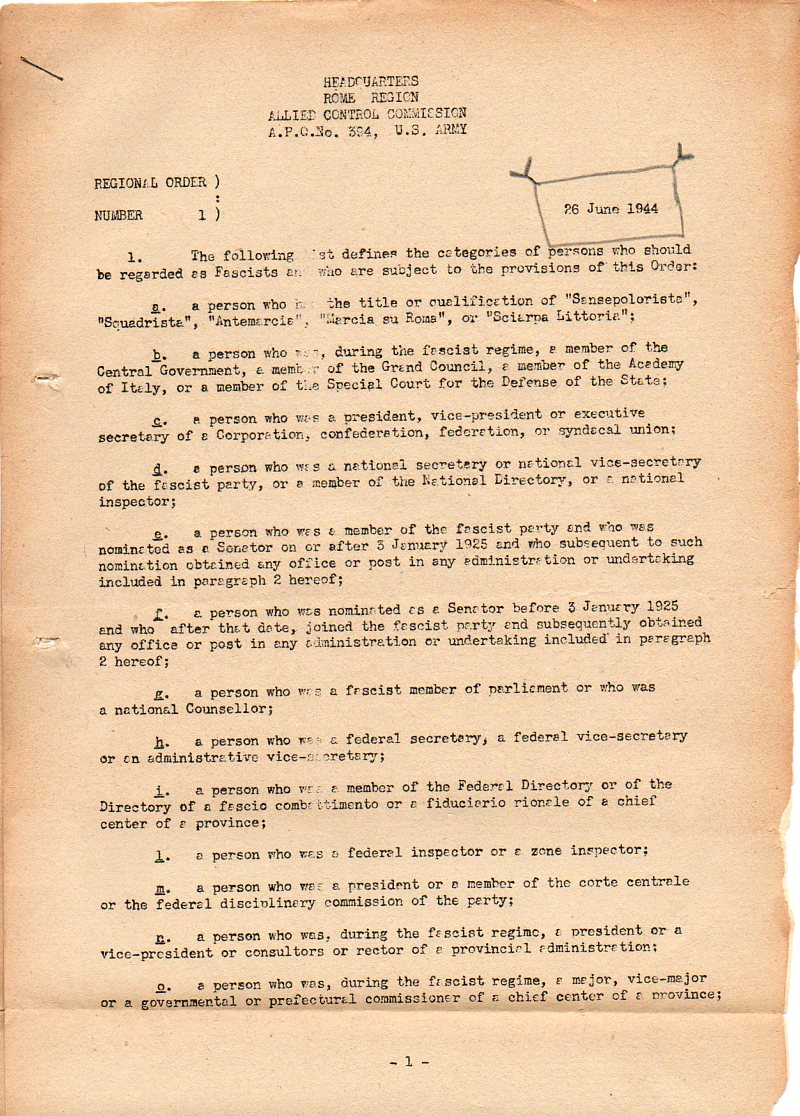
    In the history of words and the history of writing them, the history of writing down what words mean came relatively late in the word game.  The first dictionary for the English language is difficult to establish–it wasn’t Dr. Johnson’s 1746 effort, as fabulous as it was.  There were more than a hundred earlier efforts, the earliest of which may be Robert Cowdry’s A Table Alphabeticall… as the first English dictionary, which was written in 1604. (Its more easy to determine the first American dictionary, Dr. Webster’s, 1828 .) It may be that dictionaries and assemblies of rogue/thieves language appeared well before Johnson, by perhaps as much as 175 years, providing the good readers and listeners in England with a ready tool for understanding “non-standard” (slang) words of the English language (with A New Dictionary of the Terms Ancient and Modern of the Canting Crew, by “B.E.”, being the best known of these early works, published in 1698.)

     It is interesting to me that in addition to Johnson et al another  writer–or rather set of writers–were responsible for the first Johnsonian-first dictionary in German, the  Deutsches Wörterbuch by the Brothers Grimm.  These are good examples of modernity, though there are earlier examples for other languages–Petrus de Alingio’s manuscript of 1286 and the Catholicon as the first printed alphabetical listing of Latin words appeared very shortly after Gutenberg’s Bible did on the same press.  But then these were both many centuries into the use of the language.

    WWII--Italy Fascist a042

    And this just to say how much I like the road to words–especially when they come from unexpected places. One fine example of this is the directive below, issued by the headquarters of th Allied Control Commission (“APO No 394″) in Rome in the summer of 1944.  (This would actually be the American arm of the ACC, which was commission set up by the Allied Powers to deal with the administration of defeated countries at the end of the war.  Three weeks after D-Day the end of the war was in sight (Bastogne and Co. not withstanding), though far more so in Italy than just about anywhere else, and so the implementation of governing and occupying plans needed to be established.  One of the primary features here was to ensure that the old Fascists not be included in the new Italian governments (along the lines of denazification in Germany, which had a more laissez-faire approach to defining Nazis, especially wealthy and useful ones), and the primary issue in finding and excluding Fascists was to define what was meant by “fascist”1.  These are those working guidelines, at least on 25 June 1944. 

    Notes

    1. The first use of “fascism” in English reported by the Oxford English Dictionaries occurs in 1921:
    1921    19th Cent. July 148   The Fascismo was born in the provinces, where the extremistic menace was stronger.      

    Other interesting reports of the usage of the word continue in the OED:

    1922    Q. Rev. Jan. 148   A section of the Press..now veered completely round to the cause of Fascism. The Fascist terror increased in intensity.
    1923    Contemp. Rev. Jan. 44   We do not want Fascismo in this country.
    1923    Contemp. Rev. Nov. 557   Fascism in Germany will never be more than one of several factors.
    1925    Weekly Westm. Gaz. 10 Jan. 320/2   The outrages which have been associated with Fascism have gradually alienated much of the support which it won two years ago.
    1934    tr. K. Heiden’s National Socialism xvii. 354   The electoral victories all over Europe with which the Labour Parties have replied to German Fascism.
    1936    Discovery Dec. 378/1,   I have strongly criticised modern education and the methods of handling youth generally as inculcating excessive respect for authority and thereby conducing to the growth of Fascism.
    1939    A. Cobban Dictatorship v. 124   In March 1919..Fascism was still..a revolutionary and socialist movement, hostile to the monarchy, to finance, and to parliamentary government, demanding social reform and workers’ control, but separated from the other branches of the socialist movement by its intense nationalism.
       
    And the definition of the word “fascist” from the same year, 1921:
     “One of a body of Italian nationalists, which was organized in 1919 to oppose communism in Italy, and, as the partito nazionale fascista, under the leadership of Benito Mussolini (1883–1945), controlled that country from 1922 to 1943; also transf. applied to the members of similar organizations in other countries. Also, a person having Fascist sympathies or convictions; (loosely) a person of right-wing authoritarian views. Hence as adj., of, pertaining to, or characteristic of Fascism or Fascists…”


  • The Not-Yet Iconic Hamburger, 1956

    JF Ptak Science Books   Quick Post

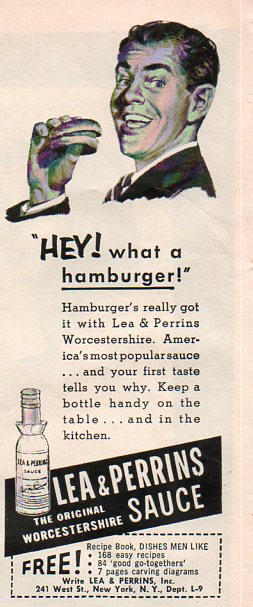
    Hamburger236 I was looking for something completely different when I stumbled over this simple ad for Worcestershire Sauce. What was instant recognizable to me was that the hamburger was just exactly that–a hamburger.  There was the burger and the buns, and that was it.  except of for the fancy Worcestershire sauce, brought to America from the old country.  In the ultra-centrifuge micro-cautionary ads of today, it would seem impossible to show a food product in such simplicity and so remarkably unposed–the buns are uneven, and imperfect, and there’s nothing about the burger to suggest itself as good except for the smiling, suited man. 

    McDonalds was selling burgers at this time, and for 15 cents a pop.  I’ve seen television commercials advertising burgers  for a buck here in the present, cheaper than what the thing was in 1956, that dollar covering only 12 cents of expense then. The current burger is cheaper still if you consider it as part of an hourly minimum wage; the 1956 minimum was 75 cents/hour, while 2010 is about ten times that; that means that the 1956 hamburger was 1/5 of the hourly wage, while the product in 2010 was 1/7 of the minimum wage.  The extreme cheapness of the current hamburger must make it seem a good deal for people working at or below the minimum wage, providing a food-like product to fill the belly for very little money in exchange, and with very little nutritional value. Perhaps that explains why 50 million Americans eat a a hamburger place of some sort every day–it is a vastly successful  business model predicated on delivering an almost entirely valueless version of an essential component of daily life, with constant advertisement duping people with greasy heart clogging goodness delivered by a bouncing clown or a little girl with freckles.  But of course there were worse things–this one just happened to catch my attention this morning.

    The hamburger has maintained its cheapness over the years, and certainly is one of those things from the ’50’s whose back-then price has translated into a more-expensive price with CPI-adjustments over time.  There are other staple-like thingas that were more expensive in 1956 than now: milk/gallon:  92 cents  1956 and $7.44 in 2010 dollars) and coffee,  93 cents (1956) or  $7.52 (2010).  Gasoline was 23 cents/gallon or $1.86 in 2010 dollars. (Gasoline pricing is another, more complicated story, for another time.)

    Don’t forget to order  your copy of Dishes Men Like! It has seven pages of carving diagrams.


  • After Liberation–Rare Interviews Relating to the Jewish People In Germany, November 1945

    JF Ptak Science Books  Post 1260

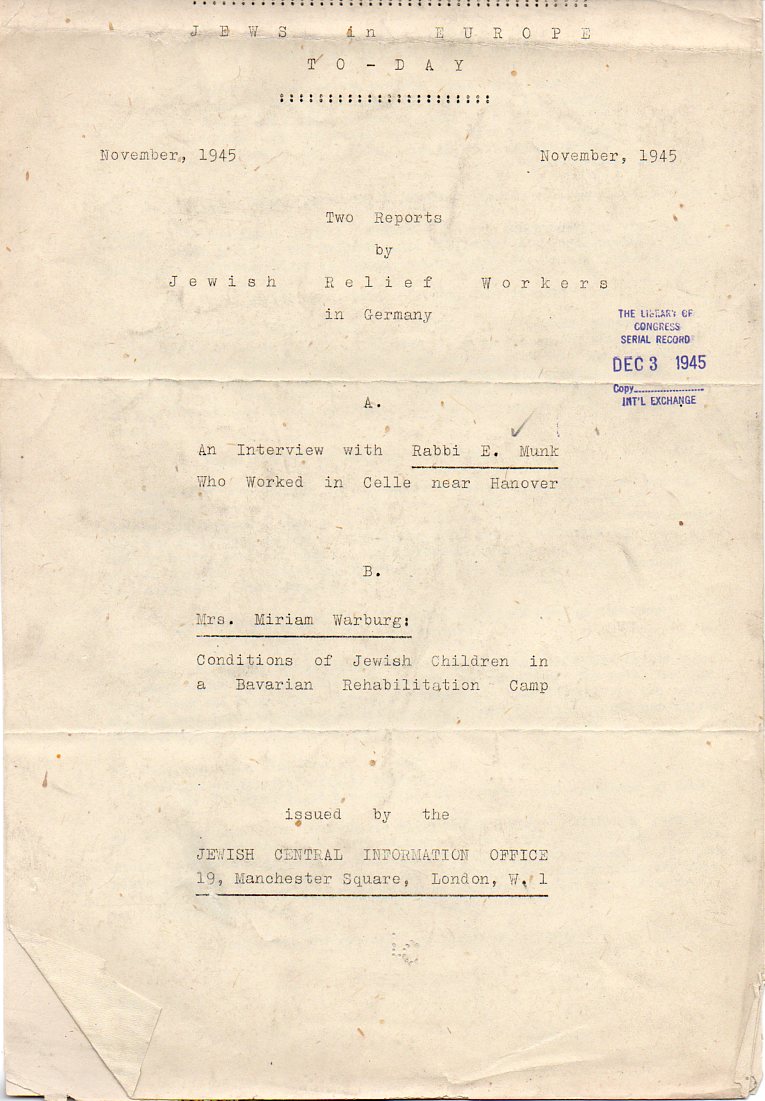
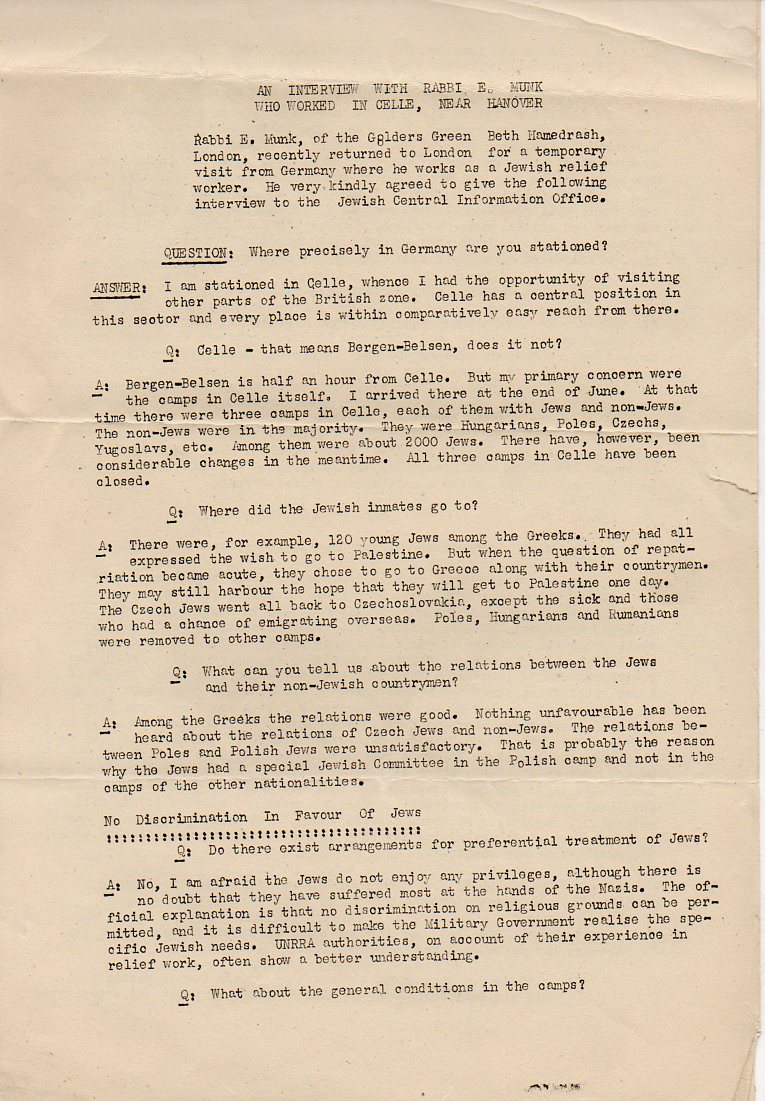
    Jews in Europe Today. Two reports by Jewish Relief Workers in Germany, published in  London by the Jewish Central Information Center at war’s end,1945, is a difficult document on the condition of Jewish Holocaust survivors in Germany right at the end of the war, October and November 1945.  The two reports comprising the whole: (1.) Interview with Rabbi E. Munk Who Worked in Celle Near Hanover, and  (2.) Mrs. Miriam Warburg, Conditions of Jewish Children in a Bavarian Rehabilitation Camp.

    Jews in europe today a015 This rare document–I can find no copies in libraries worldwide, (according to RLIN, BMC, CARL, Marchive, the NUC and the massive WorldCat)– presents interviews with people who were on hand doing relief work right after the concentration camps were liberated and right at the beginnings of helping (or simply housing in many cases) the many displaced, newly-liberated people.  (There were some 6 million displaced persons at the beginning of the peace, including a (very) estimated 200,000 Jews.)     

    This document is a small insight into the conditions of the Jews in October/November 1945, and which is also I think unpublished.  It was still an enormously difficult tome for the Jews–even though liberated, many thousands were still dying due to their treatment at the hands of the Nazis. For example, when Bergen-Belsen was liberated, there were some 60,000 Jewish survivors, but by the end of the first two weeks more than 9,000 of that number had died. In addition to continuing medical problems there were also high tides of anti-Semitism that ran through many of the DP camps–many of which received people by nationalities and not by religion, so there were continuing problems for Polish Jews who were placed in general Polish camps and who suffered from anti-Semitism there. 

    Rabbi E(lie) Munk of Golders Green Beth Hamedrash, London, contributed his report from a relief trip to Germany and was interviewed by the Jewish Central Information Office. Munk was in Celle, near Hanover, and attended three displaced person camps in the vicinity of the Bergen Belsen concentration camp (with his remarks occupying pages one through three of the document). He reported on the numbers of people in the camps as well as the relations between nationalities and Jews within the camps. For example, he says that the relations were good between Jews and Greeks, but “the relations between Poles and Polish Jews were unsatisfactory”. Regarding the question of discrimination in favor of the Jews, Munk stated that “the Jews do not enjoy any privileges, although there is no doubt that they have suffered the most at the hands of the Nazis”. He found the general conditions within the camps “to be generally appalling…many of the inmates have lost their will power …all they want to do is go to Palestine…”

    On the question of German Jews, Munk reports that “there were no German Jews in the camps of the British zone which I visited…but that there were some Jewish communities, although most consisted of ‘mixed marriages and half-Jews’”. He continues: “on the whole, I am afraid, we have to accept the fact that the overwhelming majority of the German Jews have ceased to exist. The rest are a broken people”.

    Munk was questioned on  the German people’s attitude towards the Jews, stating that “I don’t think that there is any wide-spread feeling of guilt with regard to what had been done to the Jews…anti-Semitism is forbidden, but expressions of sympathy are also wanting…”. He also went on to say that the feelings of the refugees to go to Palestine was strong and genuine.

    The remarks of (the Englishwoman) Mrs. M(iriam) Warburg occupy page four through twelve, and gathered  under the title “Conditions of Jewish Children in a Bavarian Rehabilitation camp”, at  Froehrewald, and dated September, 1945. It is ironic that this camp was located on a “housing estate” of I.G. Farben, producer of integral chemicals to the Nazi war effort and also o fcourse manufacturers of Zyklon-B.  She too refers to the refugees in the rehabilitation camps as “inmates”, and states that the Jews are still treated like prisoners, even when being “closely guarded” by American soldiers, which “the Jews resent very much…they are still prisoners, are not allowed to move about freely, and are punished daily for trespassing….”   

    These are difficult documents to read but should and must be witnessed.

    (See the blog’s bookstore for purchasing the original.)

    Jews in europe today b016

    ·Posted by :

    ·in:

    —

  • Executing Numbers instead of People: Lincoln and the Sioux, 26 December, 1862

    JF Ptak Science Books  Post  1298

    (Continuing Post 669)

    The great mystery was how those Indians were smuggled out of the grave, in spite of the watchfulness of those guards.   From the Autobiography of Theodore Edgar Parker
    Sioux Lincoln234
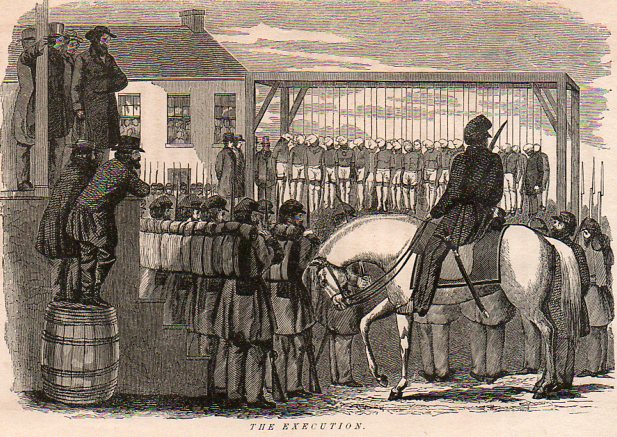
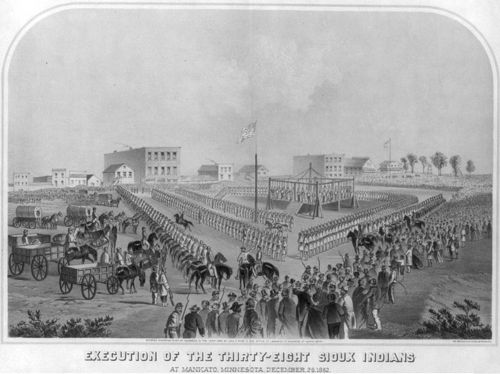
    One of the darkest moments of the spectacular Lincoln presidency came on 26 December 1862 when the president chose to not interfere with the vengeful hanging of 38 Santee Sioux (just south of St. Paul, Minnesota).  This was the legal outcome of a short-fought “war”(known variously  as “The Great Sioux Uprising”, “the Dakota War of 1862” and “Little Crow’s War”)  between U.S. soldiers and several Siouan tribes.  It was a war brought on by the desperate tribes after suffering failed crops and the reneged treaty obligations (including a long-overdue payment of $1.4 million for the purchase of 24 million acres, or about a nickel an acre) of their Great Father in D.C.  It was really more like a hunting expedition—the Indians, who had rampaged and taken hostages and killed over 200 white settlers and farmers, were at the end of their endurance. The warriors were ill-equipped for almost anything, with little food and failing horses, and were positively no match for the federal troops who would hunt them down and destroy them.  The end result was a six-week course of “trials”, conducted by a  commission of unsure legality, hearing the cases of 393 people over a span of 42 days, convicting 323, and sentencing 303 to death by hanging. Lincoln commuted most of the 303, but left 38 to be killed.
    Sioux Lincoln full235

    [This image is available for purchase from our blog bookstore.]

    “Destroy” isn’t my choice for words—it is used over and over again in the communications between the field commander General Henry Sibley and the general in charge of the entire region, General John Pope.  It turns out that Pope was of the Tecumseh Sherman school of Indian relations, writing for the record:

    “It is my purpose to utterly exterminate the Sioux. They are to be treated as maniacs or wild beasts, and by no means as people with whom treaties or compromise can be made.” 
    Blog==july 1==mankato

    Sibley was a hardened veteran but comparatively understanding towards the Indian, though his communications read much harsher than that.  At least he used the word “destroy” rather than “exterminate”, though that was small comfort to those on the receiving end of that vocabulary. (In a letter written in October 1862 to four Sioux chiefs whose tribes might be seen as harboring the breakaway, “warring” tribal elements led by chief Little Crow, Sibley said that he was out to “destroy” Little Crow and that the chiefs  should be as invisible as possible, as the Union soldiers “might not be able to distinguish you from the guilty bands” and could kill them also/instead.)

    The war, which began in August ended almost immediately, found the troopers breaking the backs and the wills of the Indians at the Battle of Wood Lake in September 1862.  From that point on, it was Sibley’s job to round up as many of the warring bands as possible and bring them to justice in a military court of law which would not disappoint those with vengeance in their hearts.  The major difficulty seems not to have been the resistance of the Indians but of the problems of supply for the troops.  The prairie grasses then were brittle and dry and brown, forage was extremely limited, and moving 2000 men was a difficulty.  Little Crow and his followers of course had much less, plus they had already been semi-starved up to that point—now that they were on the run, their situation was beyond desperate. 

    And they weren’t hard to find.  Sibley’s main concern was to get as many in for trial and judgment and (probable) execution as possible before word leaked out that the guilty were going to be killed and their women and children impounded.  Sibley wrote to Pope on 3 October:

     “It is probable I shall not order any execution of the guilty until I can get those understood to be coming down to surrender themselves in my power, as otherwise they might be deterred from returning.”

    Deterred, indeed. He continues:

    “I shall send the Indians composing the friendly camp to the lower agency, in charge of a detachment of troops, to collect the corn and potatoes in the fields, which have remained hitherto undisturbed. This camp is composed of about 1,200 men, women, and children; mostly the latter, there being but about 250 men among them. How they are ultimately to be disposed of is a question for the determination of the proper authorities. They comprise perhaps nine-tenths of those who have not been actively engaged in the war.”

    So Sibley was successful early on his round-up campaign, catching all of those women and children–sounds like of the 1,200 that he overtook, there were about 500-600 kids.  The next day Sibley reported to Pope that the Indians were coming to surrender of their won free will, though they were doing it “slowly”. 

    Little Crow’s people were “coming in but slowly” and “I  may still be necessary to attack them”.

    Attacking for slowness.  In a later letter of 8 October Sibley notes that there is an actual reason for the slow movement:

    The messengers dispatched by me to the upper camps returned last evening. They communicated my demand to their small camps, one of which, of 20 lodges, will be here this morning. They say that they dispatched young men to the larger camp, and they state that they were informed that all of the lower Indians were moving down, but slowly, as their horses and oxen are so poor and weak that rapid marches are impossible.

    On 6 October Sibley reports to Pope on some other bands of the guilty Indians starting to slip away, writing of “destroying” them as well:

    “The bands of Lower Sissetou Sioux, headed by Sleepy Eyes and White Lodge, consist of perhaps 100 or more fighting men, and these have gone with their families toward the Cotean des Prairies; they will probably be found on or near the Big Sioux or James River, where they usually make their fall hunts, and they can only be overtaken and destroyed by a sufficient force of mounted men…”

    The next day, 7 October, Sibley seems to continue to play a diminishing role of understanding-the-Indian, telling Pope that the lawbreakers “small mercy”, preferring to wait until all of the Inians were brought in before he started to hang anyone.  Of course thius was all pre-trial conversation.

    If I succeed in securing them, as I hope to do, I shall have in my hands three- fourths of those principally concerned in the outbreak, and I promise you they will receive but small mercy at my hands. I have 20 prisoners under sentence of death by hanging. 1 have not yet examined the proceedings of the military commission, but although they may not be exactly in form in all the details I shall probably approve them, and hang the villains as soon as I get hold of the others. It would not do to precipitate matters now, for fear of alarming those who are coming forward to take their chances.

    As awful as this sounds, Sibley was a little too liberal and deliberate for General Pope, who wanted to get things settled immediately if not sooner—Pope actually wanted the Indians shipped to him so that he could dispatch the offenders upon arrival.  Sibley to his credit fought this. 

    Once the deed of rounding up the Sioux was completed, there was a quick trial, and 303 of the braves were found guilty and sentenced to be hanged. 

    The text of the orders from the Executive Mansion–and signed by Abraham Lincoln–to General Sibley read as follows:

    “Ordered that of the Indians and Half-breeds sentenced to be hanged by the military commission, composed of Colonel Crooks, Lt. Colonel Marshall, Captain Grant, Captain Bailey, and Lieutenant Olin, and lately sitting in Minnesota, you cause to be executed on Friday the nineteenth day of December, instant, the following names, to wit”… [39 names listed by case number of record: cases 2, 4, 5, 6, 10, 11, 12, 14, 15, 19, 22, 24, 35, 67, 68, 69, 70, 96, 115, 121, 138, 155, 170, 175, 178, 210, 225, 254, 264, 279, 318, 327, 333, 342, 359, 373, 377, 382, 383]. The other condemned prisoners you will hold subject to further orders, taking care that they neither escape, nor are subjected to any unlawful violence.

    The condemned did of course have names but I haven’t been able to find them as yet. 

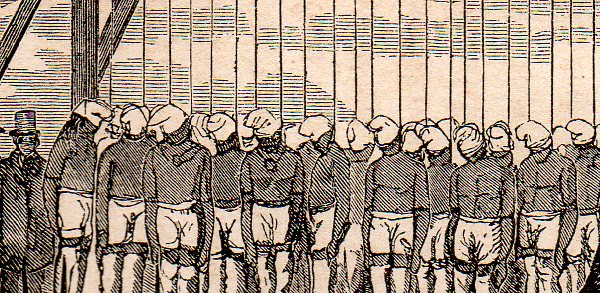
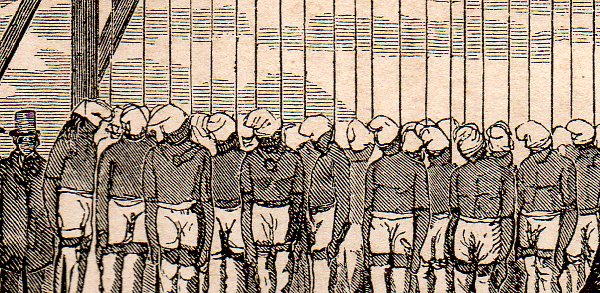
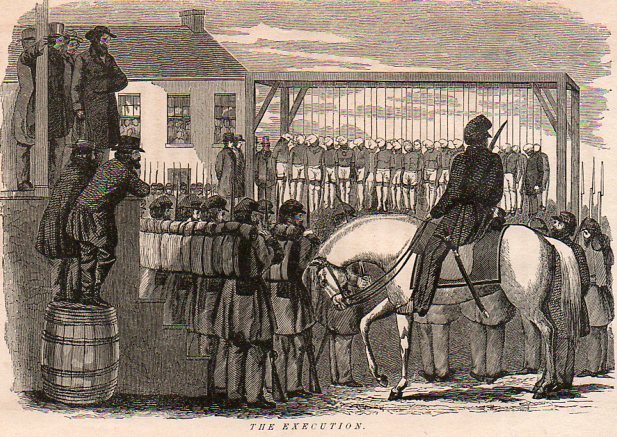
    The detail of the wood engraving that I’ve shown above may have these men shirtless in the bitter cold.  They were being watched by men in columns, at attention.  Then there were others who were standing on a barrel to get a better view. Others were on horseback.  Outside the obvious monstrosity of the situation, not having your feet on the ground, not standing, not bothering to keep yourself erect as witness to the enormity, was inexcusably bad behavior.  

    The sentences of all but 38 were commuted.  On the morning of execution the men were marched in 35 degrees below zero cold twelve miles to the place of execution at Mankato (outside of St. Paul).  The scene is reported by eyewitness  Theodore Potter (recorded in The Autobiography of Theodore Edgar Potter):

    “On the morning of December twenty-sixth our company was ordered to march to Mankato and act as guard at the execution. We were in our saddles and on the way before daylight. The distance was only twelve miles, but the thermometer registered thirty- five degrees below zero, and before we reached Mankato many of the men had frozen ears and feet, and all suffered severely from the intense cold.”

    Potter describes the execution thus:

    “At Mankato we met several other companies of our regiment who had been ordered here for the same purpose as we. Hundreds of angry men who had suffered at the hands of these savages were camped within sight of town. They were well armed and officered and were determined that the two hundred and eighty-two Indians who were not to be executed that day by the law, should suffer execution at their hands. Colonel Miller, who was in command of the troops had a force of fully two thousand men, including one battery of artillery, with which to protect his prisoners. The execution took place in the early afternoon. The thirty-nine Indians were ranged on one long platform and executed at the same moment, in sight of a vast multitude of people besides the two thousand troops. At the appointed moment W. W. Dooley, a former member of my militia company and a chief of scouts, whose family had been killed by the Indians at Lake Shetook, stepped forward and cut with an axe the two-inch rope that held the scaffold suspended and the entire number were plunged to death. The prisoners met their end like true soldiers of the plains. Missionaries who had been with them for years were permitted with them during their last days. When the time came for them to go to the gallows the braves asked to have the chains taken from their legs so that they could go in Indian style, single file. This was allowed, and they marched to the scaffold singing their Indian war- song, which was joined in by all the other prisoners. Each Indian placed the rope around his own neck and sang while the death cap was drawn down over his eyes. For five minutes after the scaffold fell everything was as hushed and silent as death itself. Then the crowd began to quietly disperse. The settlers who had formed in companies prepared to make an attack on the barracks, but Colonel Miller had his force well disposed to repel any attack, and the people saw that it would be foolhardy to make an attempt to storm the jail protected as it was by the force of disciplined soldiers. Nearly all the soldiers present were Minnesota men and many of them had had friends killed by the Indians, so that their sympathies were with the settlers and it was well understood among them that if an attack was made on the barracks, and they were ordered to fire on their own friends, they would do so indeed, but would see that none of the attacking party should get hurt. Fortunately the attack was not made and the settlers dispersed.”

    The hanged men were buried in a mass grave, though they didn’t stay buried for very long at all.  Potter concludes:

     The executed Indians were ordered buried on an island in the river near the spot of their execution. All were to lie in one grave and a strong guard was stationed to protect their remains. That night our company returned to St. Peter. On the way several sleighs passed us at different times with only two men in each sleigh. The surgeon of our regiment, a Dr. Weiser, who was riding at my side, remarked that it looked as if those sleighs might have dead Indians in them in spite of the guard at the grave. I jokingly assured him that even if there were dead Indians in those sleighs, there was no danger of his losing his scalp to them. That night after reaching St. Peter and supper at the Nicolet Hotel, the doctor invited me upstairs to the third floor, saying that he had some valuable Indian relics he would like to show me. There on the floor lay three of the Indians that had been buried that afternoon and placed under a guard consisting of a full company of live Minnesota soldiers. The great mystery was how those Indians were smuggled out of the grave, in spite of the watchfulness of those guards. It was soon known to all that their bodies had escaped the grave and were distributed among museums and hospitals in this country and abroad.

    Unfortunately, as we all know, these actions were all “normal”. The aftermath of all of this in Minnesota was that all of the remaining tribes were expelled and all Indian reservations were abolished.  That pretty much ended the “Indian problem” in Minnesota.