A Daily History of Holes, Dots, Lines, Science, History, Math, Physics, Art, the Unintentional Absurd, Architecture, Maps, Data Visualization, Blank and Missing Things, and so on. |1.6 million words, 7500 images, 4.9 million hits| Press & appearances in The Times, Le Figaro, Mensa, The Economist, The Guardian, Discovery News, Slate, Le Monde, Sci American Blogs, Le Pont, and many other places… 5000+ total posts since 2008.

Category: Prints–looking HARD/deeply at

  • What Pictures Tell Us: Medieval Treatment of Women in a Renaissance World

    JF Ptak Science Books LLC  Post 553
     blog 19 obst chair711
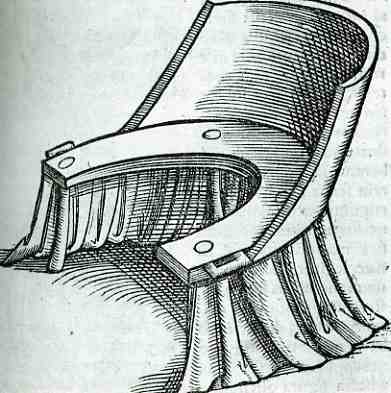
    There are all sorts of famous seats:  seats of wisdom, of power, of lameness, of government, of discontent, of honor, of learning, of war; there’s the hot seat, the best and worst seats, a seat on the board, a seat on the bench, a seat at the bar; there are captain’s chairs, endowed chairs, and famous chairs (like architectural gems/mules of Mackintosh, Wright, Saarinen, van der Rohe, Eames, Gehry, LeCorbu) and famous seats (at the original Yankee stadium or a Roman coliseum).  The seat pictured at left, though, is anonymous and lonely, but it is full of a story. 

    Sometimes one discrete, odd image can tell you a lot of history or the story of its time:  It might seem simple and benign, but once you stop to think about it just  little, an entirely different story can emerge.  Take for example this woodcut from Jacob Rueff’s De conceptu et generatione hominis, et iis quae circa haeac potyissimum consuderantur (in six books), published in Zurich by Christoph Froschauer in 1554.  It looks like it might be a seat straight out of an old WC, but it is actually a birthing  blog 19 obst astrolog712chair.  And it doesn’t look particularly inviting (or not threatening) for the tasks to come; and such was the state-
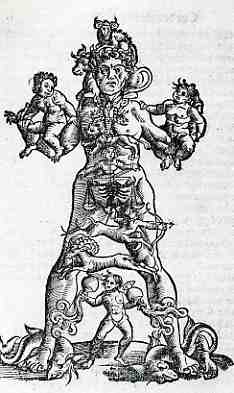
    of-the-art of birthing children in 1554.  Well, earlier than that, really, because Rueff’s work was an improved version of a still earlier work by Rosslin (Der swangern frauen). I look at this chair/seat, and I think,  “oh dear god”, even with an historian’s sensibilities, knowing full well that it hadn’t been changed much for hundreds of years prior to this publication.  There’s quite a bit in this book’s 66 illustration to excite the historian of medicine, some of which are rather beautiful and demanding, like this astrological representation of anatomy (at right).  But it is still the chair in all of these pictures that is the most powerful to me. When all of the medical advancements and distractions were boiled away, and the discussion of the two types of foreceps was eliminated, it all came down to a woman in an uncomfortable, stiff-backed straight-up chair.   A chair with no cushion or throw or anything of any sort for the comfort of the woman, though there was an extensive dust ruffle flanking it.  And as great as the advancements were in medicine in the first part of the  16th century, dealing with women in labor was still a Medieval practice.

    I should also point out that the Rueff book, as old as it was, was reprinted, translated, into English with many of its ideas riding out time intact, published in London eight decades later.  The chair was still there. 

  • Baroque X-Ray of the Soul: Jacob Boehme’s “Psychologia”, 1632

    JF Ptak Science Books LLC  Post 546

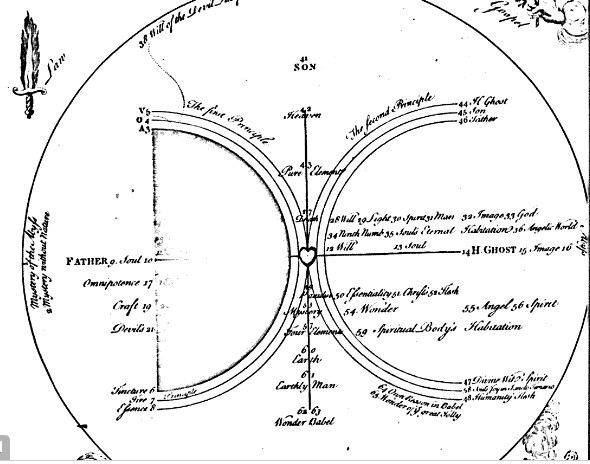
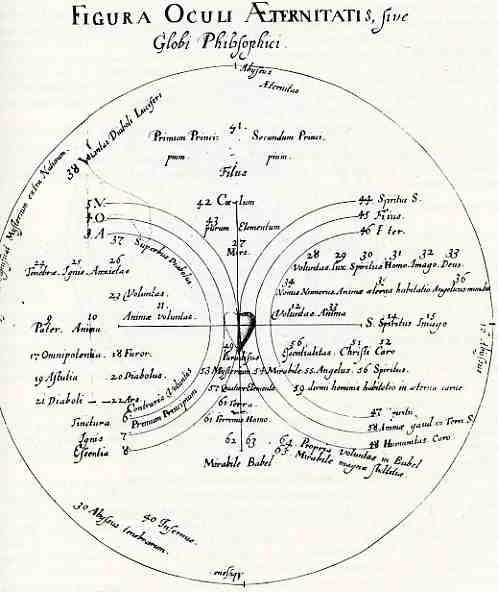
    0 abay feb 23 boehme622This solar-systemesque plan of the human soul appeared in Johannes Werdenhagen’s translation of  the expansive Jakob Boehme’s Psychologia [graece] vera I[oanni] B[oemi] T[eutonici] XL quaestionibus explicata, printed in Amsterdam in 1632.  Boehme’s (1575-1624)  original work waited for 8 years following his death to appear in print in any form, fearing during his lifetime that perhaps some retribution for his barrier bending work might find him–and it turns out to have been true, as this book (and the only one of Boehme’s subsequently published works) made its way onto the Roman Index in 1633.  Boehme was a mystical panthesist and psychic who blended the Kabbbalah,  Valentin Weigel, Paracelsus and the Bible in doses wide and narrow, finding his own advanced-Lutheran voice in works concerned with sin, evil and redemption, populated with angels and grace and on and on, in a world view far-reaching and way to complex to go into here. 

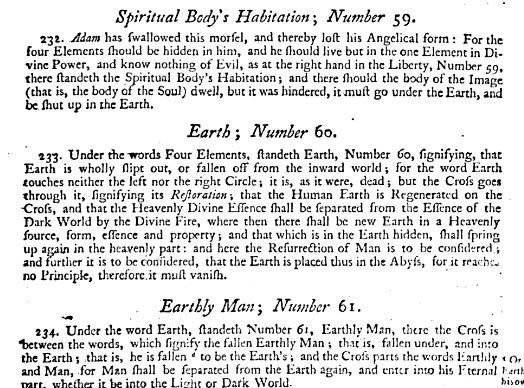
    Part of that philosophy is displayed in this map of the soul, found in Psychologia–it would’ve been fairly impenetrable to me had I not found an English translation (below) of the image, published in Forty Questions Concerning the Soule in 1655. 

    I thought that I was going to try to make a summary of the map, but, honestly, it is too just involved and intertwined and complex to do this quickly, so I’ll just let whoever cares to have a go at it under their own steam.  I will point out that the major geographical feature here is the cross at center, which is actually Christ’s crucifix and the great delineator of the system of the soul. But this is a gross simplification of the work of an unschooled man who rose to be a cobbler before compiling his remarkable set of ideas.  I’ve included a few explanations of the 63 items incorporated in the map–it is a difficult go, particularly since this was part of only the first of the forty questions addressed in the book. 

    Zzz--boehme

    Zzz--boehme xray
     

    *Another example of Boehme’s style of writing:
    “For he that will say, I have a Will, and would willingly do Good,
    but the earthly Flesh which I carry about me, keepeth me back, so that
    I cannot; yet I shall be saved by Grace, for the Merits of Christ. I
    comfort myself with his Merit and Sufferings; who will receive me of
    mere Grace, without any Merits of my own, and forgive me my Sins
    .
    Such a one, I say, is like a Man that knoweth what Food is good for his
    Health, yet will not eat of it, but eateth Poison instead thereof, from
    whence Sickness and Death, will certainly follow


  • Emerging Oddness in Durer: the first bookbag (?) and a lonely dot (for the History of Dots)

    JF Ptak Science Books LLC Post 542

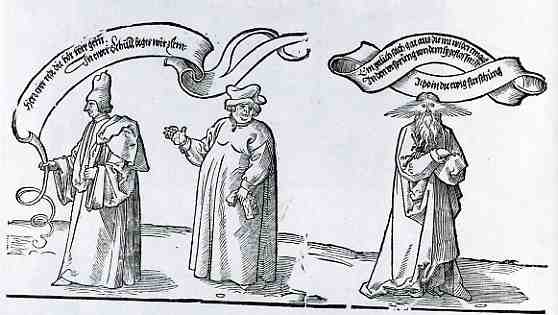
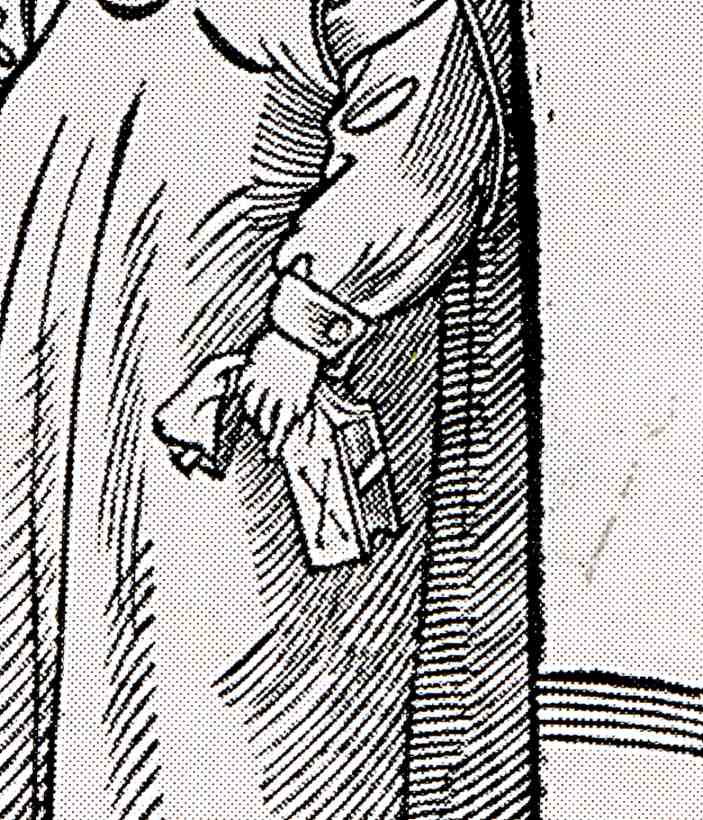
    It seems a little sinful to be looking so closely at the great Albrecht Durer for such trifles, but, well, my eye fell on these micro-notes, and won’t let them go.  Using “emerging” as a verb, what comes floating up to me from the minor realm in the Michelfeldt Tapestry, a woodblock illustration completed across three sheets, is the middle figure in sheet three.  He stands, a plumpy measure of a man, between two figures with balloon legends floating above them. The first figure is a priest or scholar whose ballooned sentiment translates to something like “Lord, we are listening to your oration, we crave to attend your school”; the second figure with balloon thoughts is much more interesting to me, this one reading “Everything that goes out now re-enters the source from which it flowed”, a good circular bit coming from the head of a man with starshine eyes. These two people deliver some pretty weighty observations, but I’m distracted more by the middle-man, who happens to be carrying a book in a sack.  What’s the book doing in a silken purse?  I must say I’ve never noticed a book in a bag in the renaissance before this–maybe they’re all over the place, but I’m guessing not, otherwise this guy wouldn’t’ve made such a strong impression on me. 

     blog 11 durer book bag682
     blog 11 durer book bag683

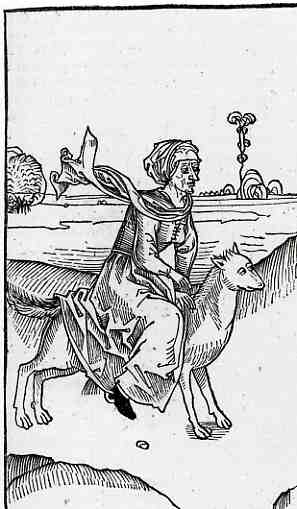
    Second is this woodcut of a witch riding a wolf (appearing in Ultricus Molitor’s Von den Unholden oder Hexen, printed in 1491)–it catches my attention not for the wonderfully flowing robe, or the fact that women riding anything at this point in the Renaissance* was not common, but the small dot right under the wolf.  What is the dot doing there? Why not just leave the foreground a blank, like the sky?  I don’t know why I’m so distracted by this thing, but I am.  And while I’m at it, that landscape in the background is pretty unusual, too:  what is that squiggly bit to the right of the witch? 

     blog 11 durer dot681

    *Witches riding animals, even in the further work of Durer, comes much more into play int he first quarter of the 16th century. See also the work of Aldorfer, Schauffelein, Grien and others. 


  • Pre-modern Advanced Technologies and Looking at the History of the Future

    JF Ptak Science Books LLC  Post 541


    Future (Definition)  That period of time in which our affairs prosper,
     our friends are true and our happiness is assured.  
    Ambrose Bierce, Devil’s Dicitonary
    “It is by no means an irrational fancy that, in a future existence, we shall look upon what we think our present existence, as a dream.”  E.A. Poe

    Looking “into” what the future might hold  is a nasty business suited for hairshirts, geniuses and fools–except of course to say that there will be what would seem to us to be shock and awesome display that will wash over future generations like the shock of Darwin washing over those in the 1870’s.*  Looking into the past of looking into the future is far more approachable but not necessarily “easy”.  The major difficulty in finding the future amidst all the historical majors and minors is that given the optical distortions in the broadening of our depth of field to our WayBack Vision.  It is harder to see things that are out-of-place to a given tBlog--jameson satelliteime given our familiarity with it.

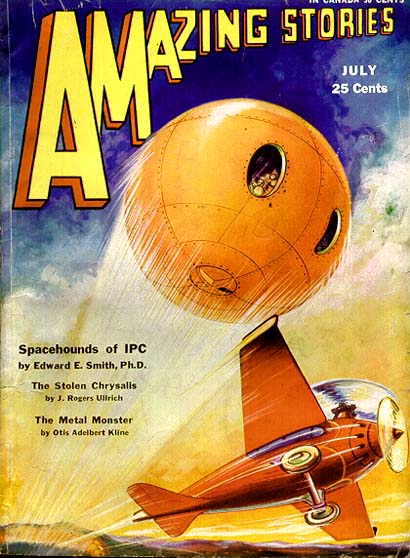
    (Neil R. Jones (1909-1988), a relatively obscure scifi writer, seems to be the first to introduce the concept of a history of the future in his Amazing Stories article of July 1930 called “The Jameson Satellite”.  (It is interesting to note that at about the same time he also introduced the word “astronaut”, and, further into the decade introduced some of the first appearances of cyborg/robotic story characters.))

          blog mar 10 future676

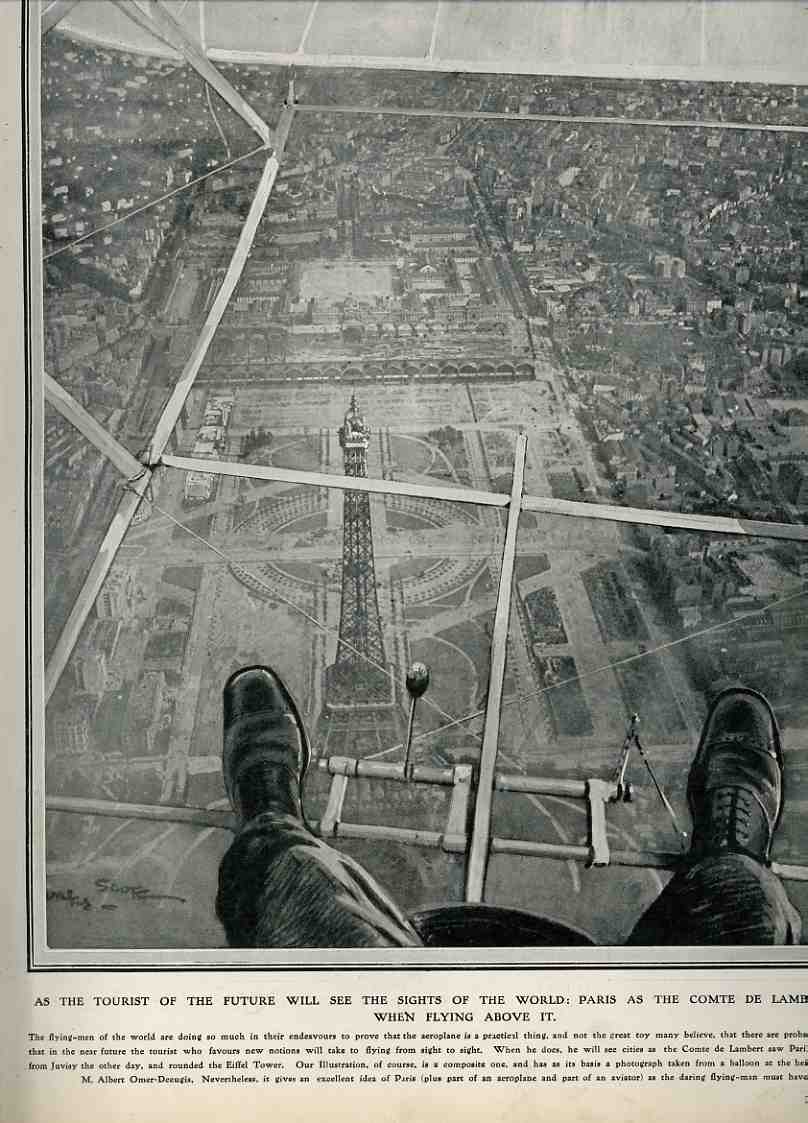
    The idea of identifying these parts of future history is certainly easier when they identify themselves so, as seen in the caption of this wonderful you-are-there image of a person flying in an aeroplane over the Eiffel tower, and printed in the redoubtable Illustrated London News for 1909.  The writer leaves himself plenty of wiggle room, though still firmly convinced that even though flying was still in its relative infancy in Europe, the time would certainly come when people would flit about it planes simply to see great wonders. 

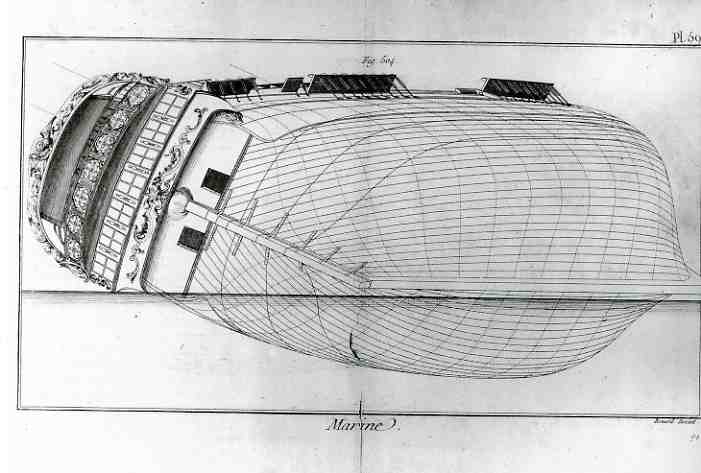
     Images of at the edges of contemporary technical capabilities and whose skill hints at bigger things to come are trickier to see. Take for example the following engraving found in the Encyclpoedie methodique*, published  in Paris from 1782 to 1830.  This engraving depicts a ship of the line in an unusual perspective, best suited I think to show th eshape of the hulol, and looking to me extremely similar to a computer-generated graphic. 

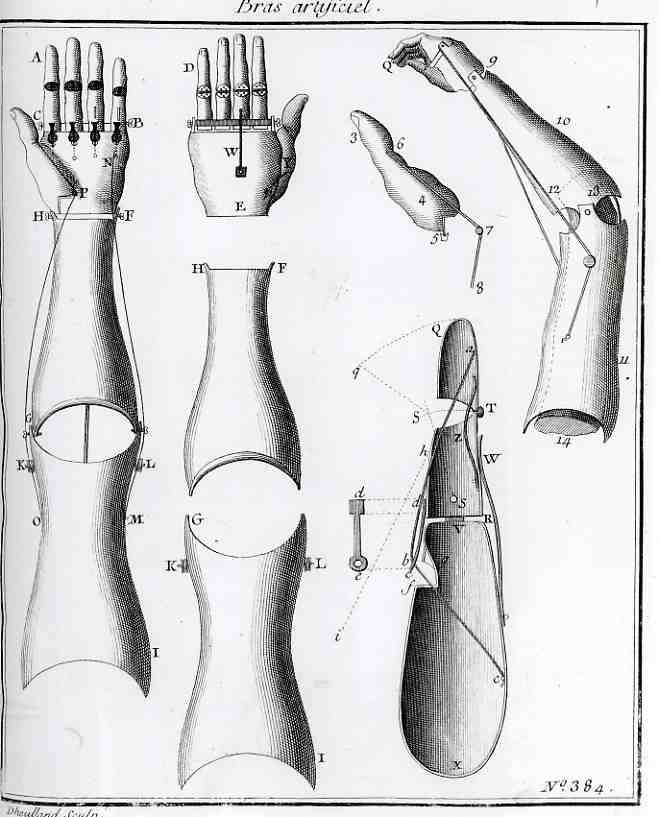
    Also, the fantasitic ebay mar 10 republican674ally articulated and probably unworkable set of metalic artificial limbs was another peep into the future–I think that the technology necessary for these limbs to be anything close to operational just escaped its manufacturer when they were designed in the 1760’s.   ebay mar 10 republican675

    In any event the exercise of finding the future in contmeporary writings of the past is interesting and fruitful, and really does make you pay attention to your sense of history and what modern prejudices one brings to it. 

    *”We may expect that a series of shocks of the type of Darwinism will
    be given to established opinions on all sorts of subjects. One cannot
    suggest in detail what these shocks will be, but since the opinions on
    which they will impinge are deep-seated and irrational, they will come
    upon us and our descendants with the same air of presumption and
    indecency with which the view that we are descended from monkeys came
    to our grandfathers. ..
    JBS Haldane, “Daedalus, or Science and the Future

    ** The L’Encyclopédie méthodique ou par ordre de matières par une société
    de gens de lettres, de savants et d’artistes; précédée d’un Vocabulaire
    universel, servant de Table pour tout l’Ouvrage, ornée des Portraits de
    MM. Diderot et d’Alembert, premiers Éditeurs de l’Encyclopédie
    appeared in over 200 volumes, and was a version of the famous Diderot encyclopedia,m though expanded, and ordering its iformation according to subject area rather than alphabetically.  


  • Blank and Empty Things: Disembodied Celestial Hands and Arms, Part 3.

    JF Ptak Science Books LLC    Post 538

    0 blog march 5 missing arm656
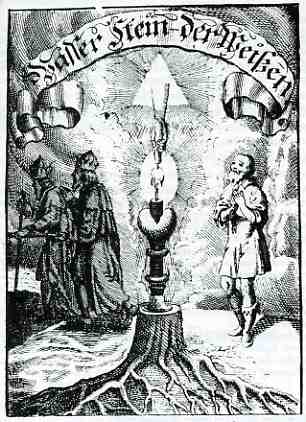
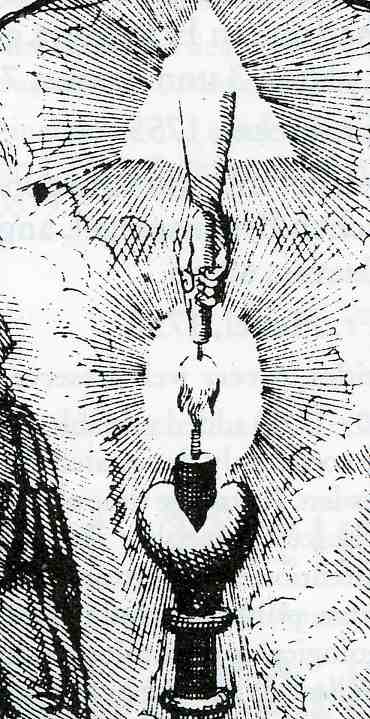
    This wonderful and dimly provocative image from Johann Siebacher’s Wasserstein der Weisen, oder chymisches Tractaetlein…. *, a curious alchemy book of obscured pubom Johann Ambrosius  Siebmacher’lishing heritage, printed around 1660, is a sort of standard celestially-disembodied standard, though in this case the torch-holding hand may be coming through a trinitarian window/hole in the sky, straight from the body of the Der Herr Gott.  Or perhaps not: perhaps this is an illustration of alchemical genius emerging from a Biblical interruption in the sky, igniting a heart-held philosopher’s stone fixed to a well-rooted sepulchre, the very tree of life.  The religiously-robed folks are retreating into the deeper shadow without the sight of the gloriously-enlightened lump, plainly visible to the plain observer.  

    Or not.  Siebacher uses an epigram at the end of his book calling the whole chymical art into question:  “It is an easy matter to prepare gold in the furnace out of metals:
    at times there is found a man to whom the secret is revealed. Why is not
    every alchemist rich? The reason is that one thing is wanting which many
    seek with anxious care. Common gold is not fixed, and, when brought to
    the test of fire, quickly disappears and perishes. But he who knows the
    tired gold, which at all times remains the same, and from which nothing
    is lost, he is the possessor of the true Art, and may be called a good
    and practical Sage and Chemist.” Rich in vision, and in spirit, with holes in the pockets.

    0 blog march 5 missing arm657

    *Johann Ambrosius Siebmacher.
    Wasserstein
    der Weysen, das ist, ein chymisch Tractätlein, darin der Weg gezeiget,
    die Materia genennet, und der Process beschrieben wird, zu dem hohen geheymnuss
    der Universal Tinctur zukommen, vor diesem niemalen gesehen. Darbey auch
    zwey sehr nutzliche andere Büchlein der Gleichformigkeit und Concordantz
    wegen angehenckt, nemlich, 1. Iohan von Mesung. 2. Via veritatis der einigen
    Warheit…
    , Frankfurt, 1619, 1661, 1703, 1704, 1709, 1710, 1743, 1762.

    Or,

    The Sophic Hydrolith; or Water Stone of the Wise, That is, a chymical work, in which the way is shewn, the matter named, and the process described;
    namely, the method of obtaining the
    universal tincture. Chapter
    One:  A BRIEF EXPOSITION OF THE WONDERFUL WATER STONE OF THE WISE, COMMONLY
    CALLED THE PHILOSOPHER’S STONE.


  • Revolutions in the Color “Red”: Paul Gauguin and Edwin Hubble

    JF Ptak Science Books LLC  Post 531

    A circus passed the house—still I feel the red in my
    mind.
      Emily Dickinson, 1866

    Color expresses something by itself.  V. van Gogh

    Pure color!  You must
    sacrifice everything to it
    …  P. Gauguin

     
    Standing in my friends Lucy & Andy Archie’s store, standing near a
    window and catching some sun on a cold stinking day, a large red jar cast a
    long red shadow along the wall, causing me to think about the color. (It was a
    pretty nice shadow.)

    Red has turned up as an important color in terms of
    patriotic/vitriolic symbolism (as in the revolutions of 1848, Garibaldi,
    communism), Aztec cochinealial luxury,  important burial dress of the
    Cro-magnums,  signs of divine favor and
    condemnation, Roman red divine, Egyptian danger, royal cinnabar of China ,
    Indian bridal dresses, Japanese heroic figures, and on and on (into the lower
    realms of red tape, blood red, fire, blind anger, love/passion, evil, crushing
    impropriety,  and etc.)

    Red’s most important contributions, perhaps, at least in
    modern times of the past few hundred years or so, comes in the field of art and
    science—and its appearance really is pretty monumental, and weirdly
    coincidental in their placement in the chronology of Big Important Stuff.  The birth of impressionism (with Monet and
    the Salon des Refuses), the greatest change in the history of art since the
    rediscovery of perspective, and the solidification of spectrum analysis (Bunsen
    and Kirchhoff), both occurred around the period of 1859-1863—the great use of
    red for both of these developments would come somewhat later, though the red
    roots began here. 

    Img128
    The achievement of Bunsen and Kirchhoff, started in the
    epochal year of 1859 (the same year seeing the publication of the Origin), was
    nearly as spectacular as any other scientific achievement of that century.  The two men showed—and this would have been
    incredible to the mind of the 19th century—that individual atoms had
    their own spectral signature.  When the
    Englishman William Huggins absorbed their work, he realized immediately (as did
    Bunsen and Kirchhoff) that the spectroscope could be turned on the sun and all
    the rest of it—the results of the experiments of these three revealed the
    elements of what stars were made of, something that must’ve seemed like science
    fiction come true.  The second part of
    the second step* in this fabulous discovery and application came 65 years
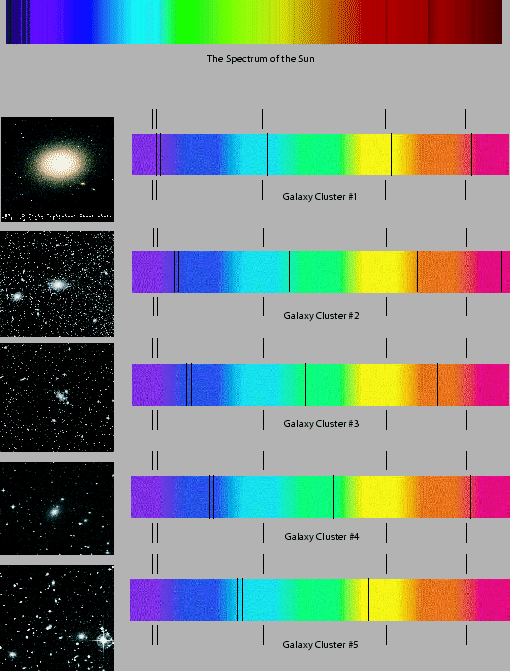
    later, when American astronomer Edwin Hubble** theorized and proved  that the red shift that occur in the spectra
    of all galaxies actually (a phenomenon which had been observed for years but
    not understood) meant that they were all racing away (at a speed proportional
    to their distance, Hubble’s Law) from the Earth—the basis of the Big Bang.  Cosmological significances aside, this was
    also a big deal for the advancement of color, as it really hadn’t played a very
    major part at all in the history of science to this point (excepting the
    brilliant occasional bits like Newton’s
    Opticks). Color just wasn’t a part of
    the great systems and ideas of Plato, Pythagoras, Aristotle, Euclid,
    Kepler, Newton
    and so on—it just didn’t come into play. 

    Blog--gauguin

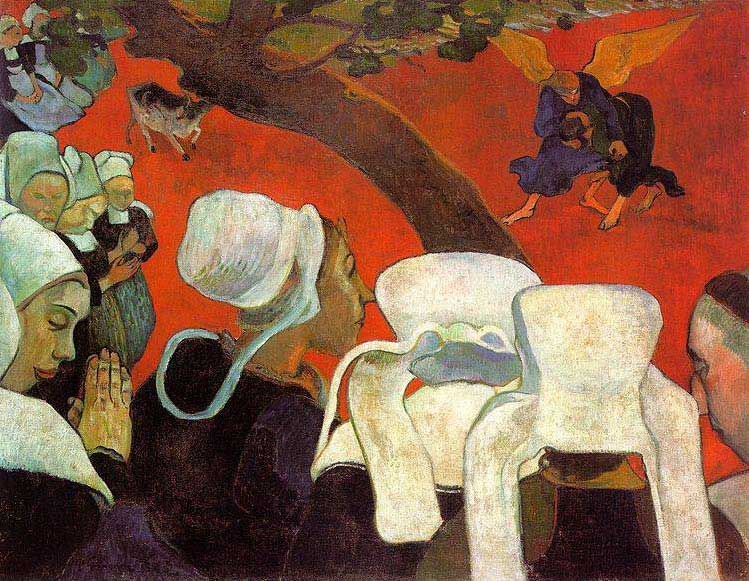
     Now, as to the importance of Red in art.  It comes for me with Gauguin.  Gauguin and his red grass.  Red grass doesn’t mean anything today, but in
    the early 1880’s, well, red grass was, simply, everything.  It was a revolutionary idea to make the idea
    of what grass”is” subject to the color that the artist thought was demanded by
    it subject, and that all of this was an artistic variable in the control of
    each individual interpretation.  It
    happened right there in the middle of the Impressionist movement, and was the
    beginning of the end for representational art, the final blow to which would
    not occur until 1911 with Mr. Kandinsky.


    This was a lot to blow through in under a thousand words,
    and undoubtedly I’ve slandered several good ideas—but I think overall that this
    is a reasonable idea, this importance of the color RED.  There’s much more to be said about the
    Impressionists and a whole bunch more on the absence of color in the history of
    science, but that’ll have to come later. 

    Of no importance but of some smiling interest is the notion
    that the paintings that were rejected for exhibition in juried salons (in
    France in the 1860’s) and which were used in a new movement and in new “juried”
    shows called Salon des Refuses, were all stamped with an “R” on the back of
    their canvases.

     _______

    *the first great advancement coming in the solving of the
    so-called “ultraviolet catastrophe”, arriving through the Maxwell equations of
    1873 and riding into the quanta of Planck in 1899/1900 (and then to quantum
    mechanics).

    **Hubble, Edwin, “A Relation
    between Distance and Radial Velocity among Extra-Galactic Nebulae
    ”
    (1929) Proceedings of the National Academy of Sciences of the United States
    of

    America

    ,
    Volume 15, Issue 3, pp. 168-173


  • Return to the Poem-amatic: Tristan Tzara’s Dadaist Poetry Engine

    JF Ptak Science Books  LLC  Post 530

    Scan0001

    Each thing we see hides something else we want to see.
    –Rene Magritte

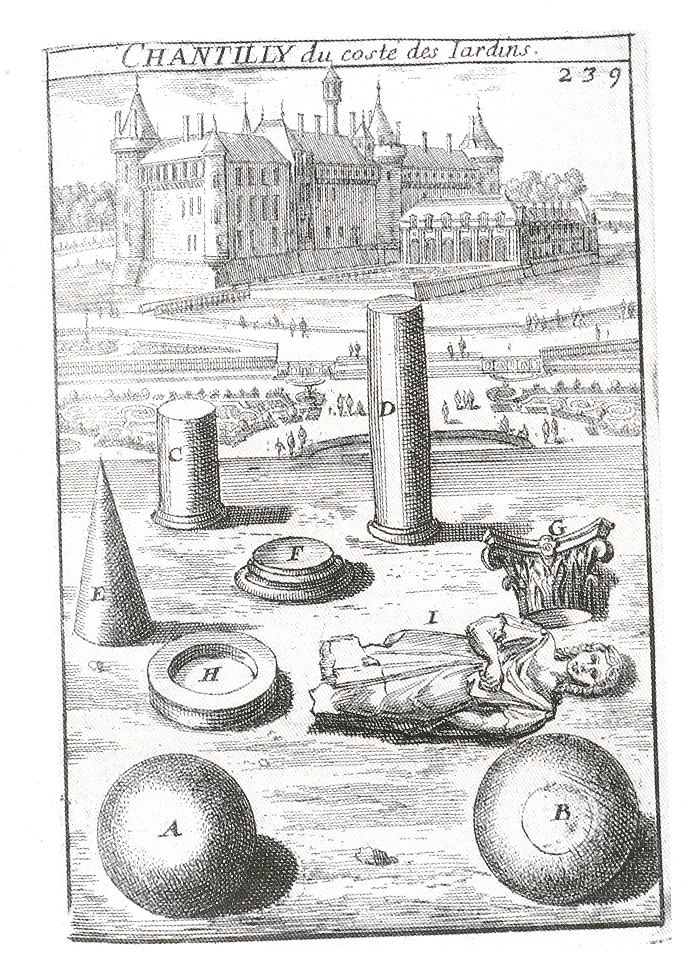
    I am very fond of images like this–images that show us  everything and nothing. The engraving was meant to show some of the ephemeral antique bric-a-brac collected by whatever collector was currently residing at Chantilly.  Remove that explanation, and the meaning of the engraving goes spinning into whatever space you open for it.  It is a wonderful thing to open these dis-associated image combinatorics to free interpretation, each viewer finding their own meaning in a mysteriously composed components. 

    This of course was an unintentional artifact of the artist and engraver.  Images like this–confusing, anti-intuitive, misleading–weren’t constructed to be so (at least not in a major and determined way) until the arrival of the Dadaists in the 20th century.   This was a short-lived, proto-archaic (?) group with a confusing history, a tumultuous existence, and a short and sure ending.  They were disengaging from the avant garde to form a group that went somewhat beyond*
    Dada

    (Even the naming of the group is a story of unusual ripeness and spoilage, no one being able to tell the truth of how it came into being.  Suffice to say that “dada” either was or wasn’t found by an accidental grazing through Larousse by Tristan Tzara in February 1916.  At least Hans Arp tells this as the true story, saying too that he was there, along with his 12 children and a brioche in his left nostril. Anyway the naming doesn’t seem to matter terribly much to a group like this that disposed of and twisted names proper and otherwise.)

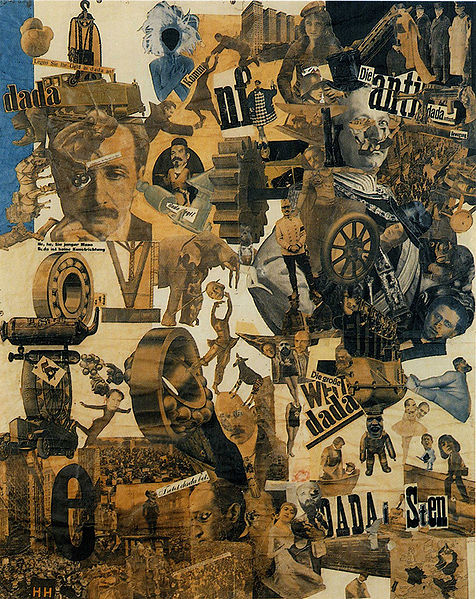
    An example of a Dadaist work is at right, by Hannah Höch, Cut with the Dada Kitchen Knife through the Last Weimar Beer-Belly Cultural Epoch in Germany, 1919)

    The Dadaists, born in the Cafe Voltaire, were interested first in the written arts, and didn’t move to painting and the plastics for a couple of years.  The first among these creative equals was probably Tristan Tzara  (born Samuel or Samy Rosenstock, also known as S. Samyro, 1896–1963) who was first a writer and poet before an artist.  True to the Dadaist great non-existent history, Tzara set forth a method of constructing poetry.  It was basically an engine for a simultaneous poem, as in the “bruitist” Futurists tradition, which built upon the work of Hugo Ball, who in turn was the inventor of the sound poem (Lautgedicht). And so tongue deep in cheek, Tzara set forth these principles:

    To make a Dadaist poem:

    • Take a newspaper.
    • Take a pair of scissors.
    • Choose an article as long as
      you are planning to make your poem.
    • Cut out the article.
    • Then cut out each of the
      words that make up this article and put them in a bag.
    • Shake it gently.
    • Then take out the scraps one
      after the other in the order in which they left the bag.
    • Copy conscientiously.
    • The poem will be like you.
    • And here you are a writer,
      infinitely original and endowed with a sensibility that is charming though
      beyond the understanding of the vulgar.

    Scan0002 (Some few weeks ago I made a post about an automatic poem-making device–the poem-amatic fist micrroscope–a
    fun little bit about making poems of ordinary printed pages by
    recording what you saw of them in the visual field seen through the
    barrel of a semi-closed fist. 
    Then there is the entry “Poetry from Found-Wordist and Book Pathologist
    Mr. Ignatio Norme
    , Found-Wordist and Page Number Collector (Boston, Mass.;
    1923-1988))” in my growing and imaginary museum catalog called Weltin and
    Wantin.
      Mr. Norme constructed poems in
    much this same way, except that he stripped his poems out of the lines of his
    books. His effort is here, called Primo VI, the Analysis of Man//Fantasies
    brillantes
    (by  “the man who found obscure
    phi-related connectivity between random word placement, page number and the poetic
    ideal”).

    Now.
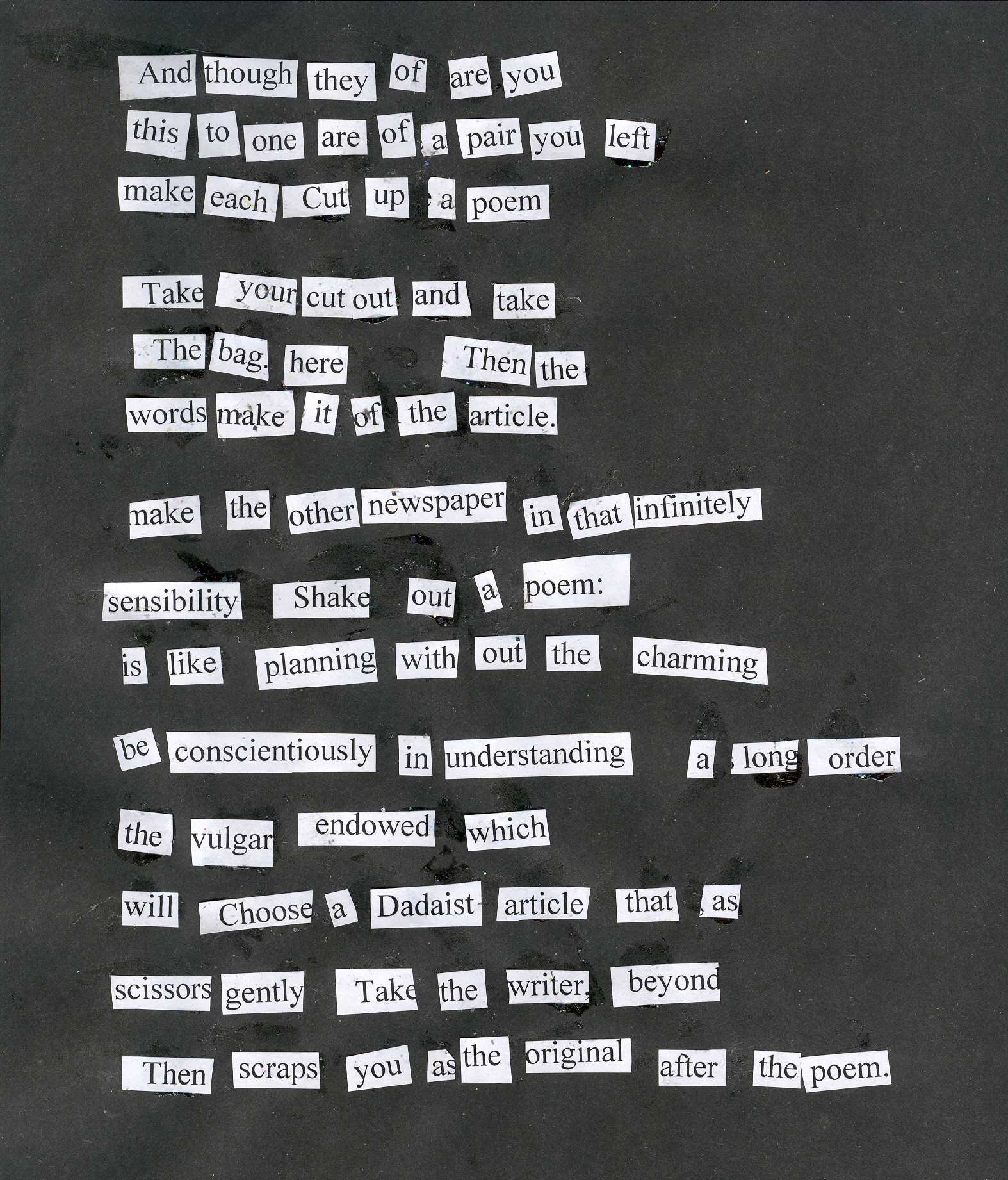
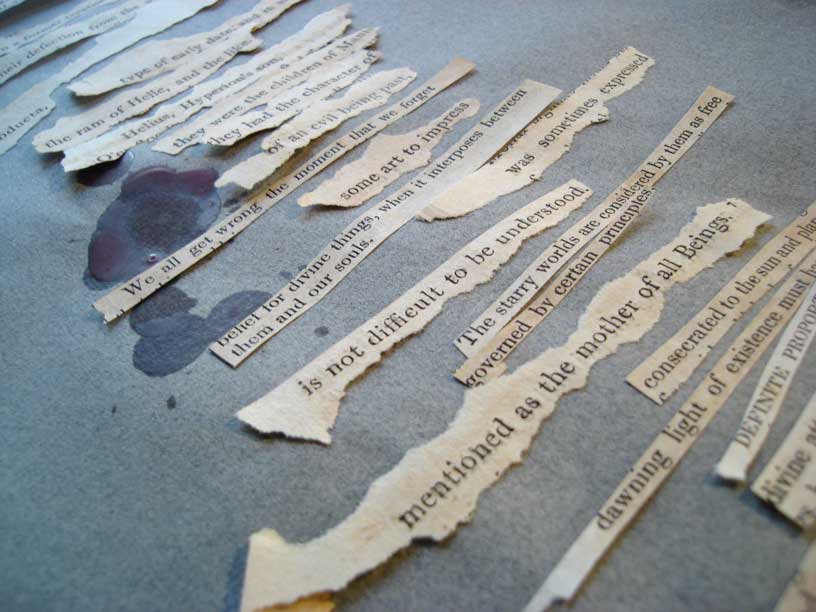
    I tried this out, but not with newspaper–rather I did it with Tzara’s instruction itself, and let me tell you, it doesn’t work.  There’s just too much left to chance, and, frankly, too many prepositions, too much grunting work.

    On the other hand, if you lay out the pieces before you and determine to allow yourself 15 minutes to select a poem from the scattered bits on the table, then the method does stand some sort of chance.
    Here’s what I came up with, and it is almost something or other; at least I think that  is probably not nothing.  In the very least, though, it is a very interesting exercise, trying to get your mind to find a poem in strips of paper.  In that way Mr. Tzara was perfectly correct. 

    (Below is a fragment of Mr. Norme’s work.)

    Blog--norme

    _______

    *  Dada is the groundwork to abstract art and sound poetry, a starting
    point for performance art, a prelude to postmodernism, an influence on
    pop art, a celebration of antiart to be later embraced for
    anarcho-political uses in the 1960s and the movement that lay the
    foundation for Surrealism.
    —Marc Lowenthal, translator’s introduction to Francis Picabia‘s I Am a Beautiful Monster: Poetry, Prose, And Provocation


  • The First Fisheye View? Vienna, 1529

    JF Ptak Science Books LLC  Post 567

    Fisheye


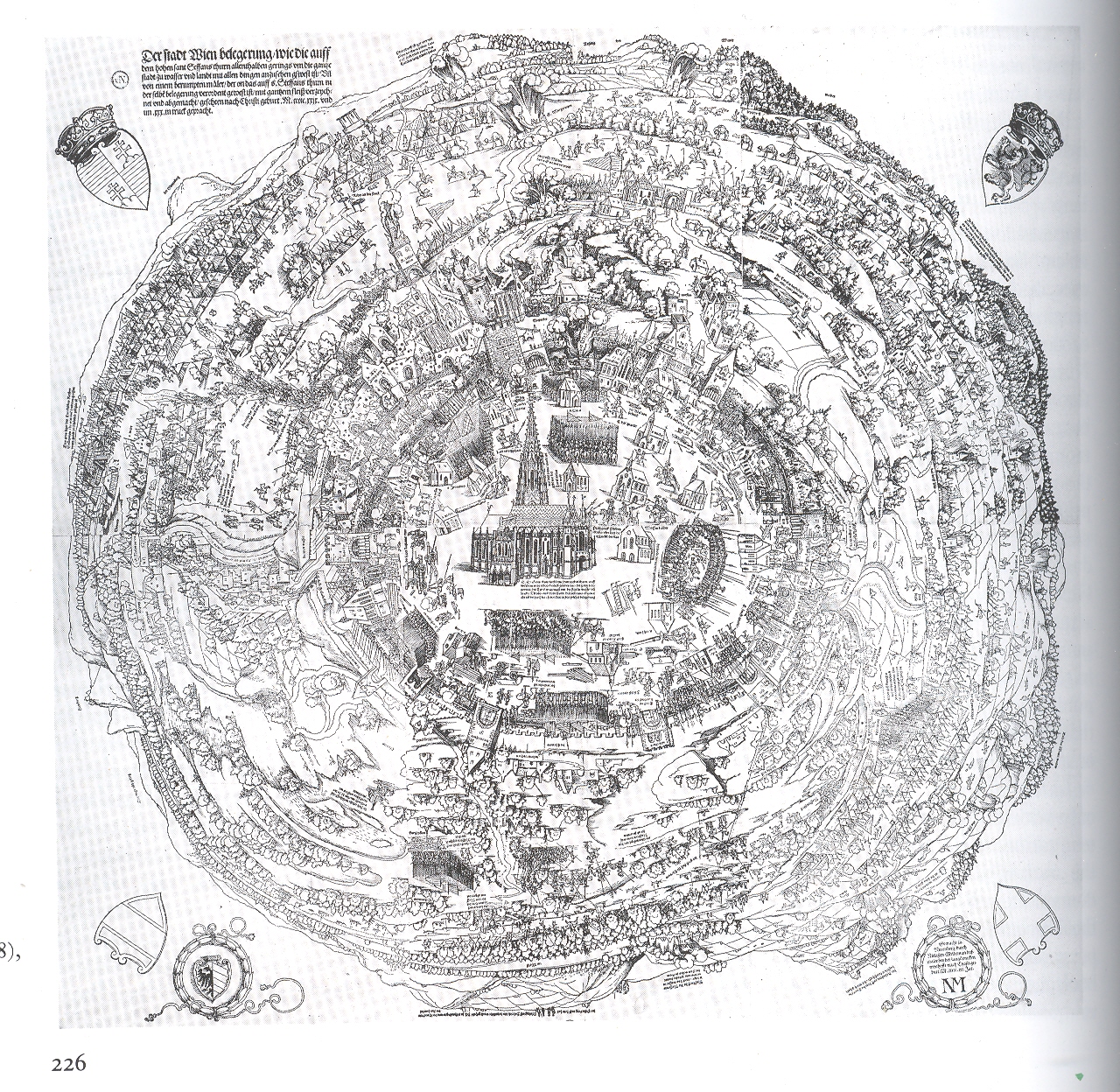
    This magnificent woodcut,
    The Siege of Vienna*, executed by Nicolaus Meldmann, was published in 1529/30 and depicts a view of the city of Vienna from an extraordinary and perhaps unprecedented perspective.  I’ve paid some attention to antique images that look straight down at things (Looking Straight-on At Things  and  Looking  Straight-Down on Things) and I can say that they are in general pretty uncommon–this is the first time though that I’ve noticed a fish-eye view looking straight down, an image conveying a 360-degree horizon-to-horizon landscape.  It is just simply phenomenal, even if a fair number of the buildings in town are missing and so on–the (unnamed) artist-on-the-spot actually climbed a high spire and made a number of sketches, extrapolating it all into this horizon-bending whole.  But the representation of the city wasn’t the paramount concern in the print–it was the placement of what was going on outside of it that was important. And what was happening concerned all of Europe–it was the invasion by the Muslim Ottoman
    Empire
    , led by Sultan Suleiman I (the magnificent)
    , and in 1529 they had made their way through Hungary and into central Europe, laying  seige to the principal city of Vienna with an army of 150,000 (or 300,00) soldiers. . It was the high point of the Ottoman expansion, as they were ultimately turned back by the Austrians in a determined and complex series of battles of mining/tunnels versus anti-mining and anti-tunnels (such battles being fought, still, deeply into World War I).  So this print was made for a wide audience of Europeans, trying to get a glimpse of the siege of Vienna and the positions of the Ottoman forces, knowing that the outcome of the siege could very well hold the fate of the rest of Europe.  

    If you check out the other posts in this blog on “Looking Straight Down” you’ll see a number of examples of early straightdownedness–none though approach the vast area that the artist of this print had taken under control and displayed. 

    *I found this reproduction in Landau and Parshall’s beautiful, attentive and intuitively incisive The Renaissance Print,1470-1550, published by Yale University Press in 1994.  It is a rich book, with very deep depth and a light touch, hard to do in an academic/historical work.  But they did it. 


  • Van Helmont’s Lovely Title Page and his Sorry Slip into Curative Magnetism

    JF Ptak Science Books LLC  Post 514

    0 ebay feb 10 helmont553

    Joan Baptiste van Helmont’s
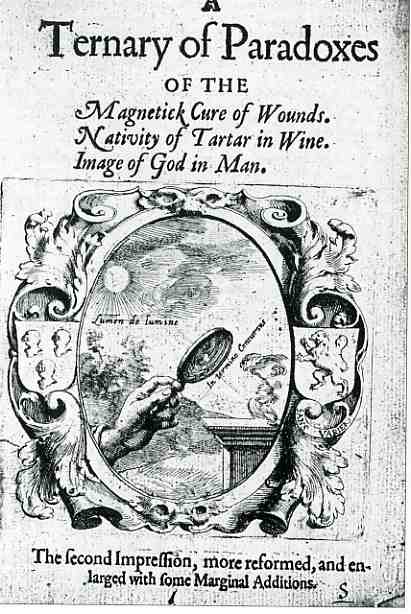
    A ternary of paradoxes : the magnetick cure of wounds, nativity of tartar in wine, image of God in man.
    (printed in London  by James Flesher for William Lee, 1650), offers its own unintended paradoxes (and joined the field of relatively few books with the word “paradox” in their title).  Purportedly a work of science, van Helmont offers the reader his views on the curative powers of the loadstone.  Of particular interest is Helmont’s (1579-1644) discussion of the weapon salve, a cure for injuries caused by knives and swords. The unique feature of this ointment was that it was not applied to the wound but to the weapon which caused the wound, though in the midst of other very problematic scientific observations, this wasn’t so bad.  For example, Helmont presented a recipe for making scorpions, which involved bricks, sunlight and basil, from which a scorpion would come. 

    And what exactly is Helmont’s place in the history of science?  Difficult to say:  he did make several important physical discoveries, and did present what some have called the modern approach to experimentation (firm insistence on relateable objects in empirical observation and so on); however, he was a reaching alchemist misty mystic who rejected syllogistic thought, mathematics*, human reasoning.  These are hard bits to let go.

    All this said, what with scorpions and magnetic treatment of wounds, he comes close to the generation of infection in wounds:  “Upon the solution of Unity in any part the ambient air…repleted with various

    0 ebay feb 10 helmont555

    evaporations or aporrhoeas of mixt bodies, especially such as are then
    suffering the act of putrefaction, violently invadeth the part and
    thereupon impresseth an exotic miasm or noxious diathesis, which
    disposeth the blood successively arriving at the wound, to
    putrefaction, by the intervention of fermentation. ” With his magnetic
    sympathy, Van Helmont expressed clearly the doctrine of immunity and
    the cure of disease by immune sera: “For he who has once recovered from
    that disease hath not only obtained a pure balsaamical blood, whereby
    for the future he is rendered free from any recidivation of the same
    evil, but also infallibly cures the same affection in his
    neighbour…and by the mysterious power of Magnetism transplants that
    balsaam and conserving quality into the blood of…’
    Problematic greatness just needs to be understood in greater detail
    than simply disregarding everything because someone disdains logic…

    Note:

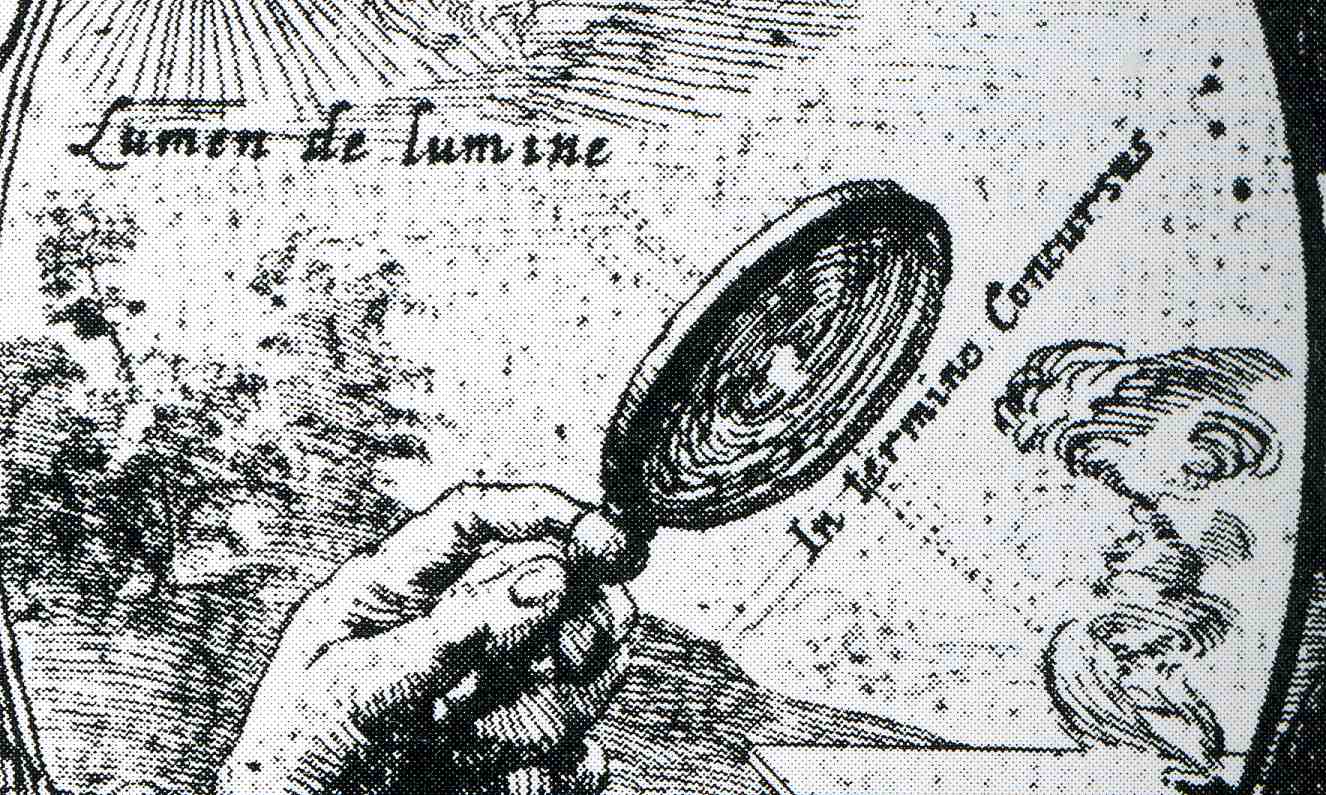
    The interesting image in the middle of the title page is more religious symbolism than what seems to be a straightforward physics reference, and the bulk of it lies in the “lumen de lumine” inference, which in the Nicene-Constantinopolitan Creed confesses faith in Jesus Christ as Lumen de Lumine (Light from Light).  Once you replace the optics with the divine, the rest of the image and its relationship to the contetns of the obok becomes more clear.

    *

    Helmont thought about the restrictiveness of mathematics, and that the quantitative aspects of things that math addressed missed their interior qualities, thus making mathematics not able to see what things are.  Oopsie.


  • The Discovery of Nothing: Things out of Place Deparment #4 AND a History of Blank and Empty Things #32

    JF Ptak Science Books LLC  Post 513

    0 blog feb 11things out569

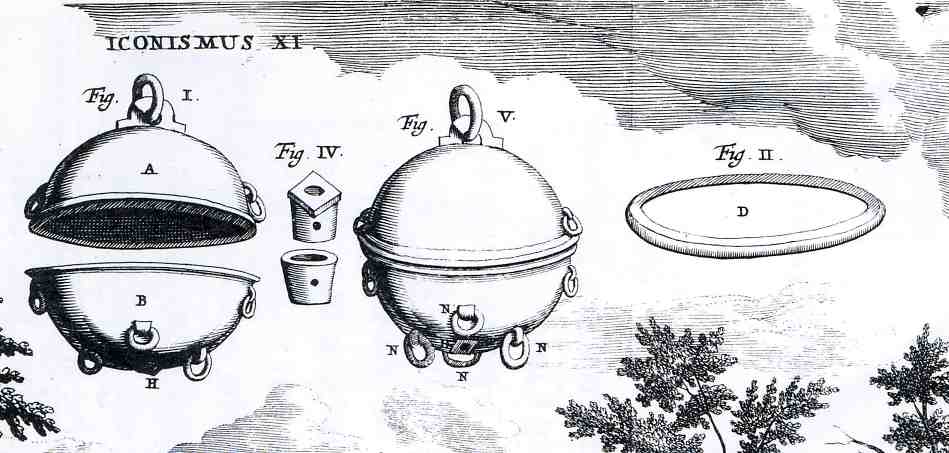
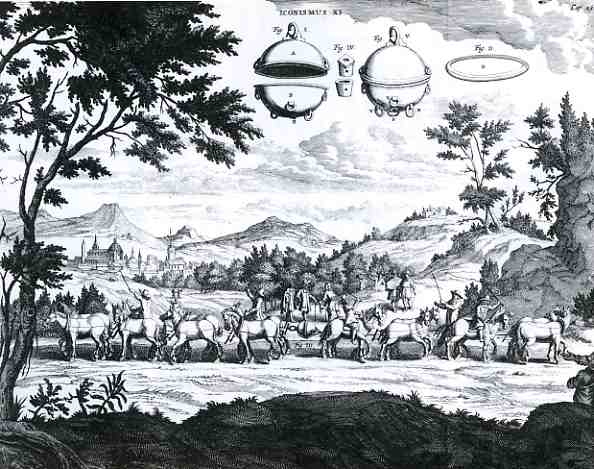
    This is really just another bit of fun–the four objects in the sky weren’t unrelated to the scene, not at all, though if you wanted you could certainly create a fantastically rigorous and bizarre story for them; they certainly did define the concept of “nothing” for the Blank & Empty Things thread of this blog.  here is no doubt that the image has a very quiet, possibly Dadist origin.  In fact, this is one illustration from one of the greatest experimental physics books of the 17th century, coming as it does from Otto von Guericke’s  Experiemnta nova (ut vocantur) Magdeburgica de vacuo spatio (Amsterdam, 1672).  In another minute department, this one is also I guess the greatest book ever written by a Mayor of anywhere (as von Guericke (1602-1886) was mayor of

    0 blog feb 11things out568 Magedeburg for 33 years).  The image shows the greatest of von
    Guericke’s efforts, and one of the greatest (or most important)
    experiments in experimental science–the dramatic demonstration of the
    vacuum, showing here that teams of horses could not pull apart two
    halves of an evacuated sphere, and of course the efficacy of air
    pressure operating against it (um, the vacuum). The “floating” bits in the sky were an exploded view of the sphere that was the subject of the experiment. 

    What was more important though, and what the general reader today might easily miss, was that von Guericke created something that many scientists and philosophers said didn’t, and couldn’t, exist:  the vacuum.  In modern times, Copernicus depicted the universe as a vast void; Descartes came in the back door (following the ancient and interesting though incorrect theory of Aristotle*), not liking the idea very much, and claiming that such empty space couldn’t exist.  Von Guericke provided the proof that the vacuum, that nothing, did exist. 

    _______

    *Aristotle (384-322 BCE) theorized that as air became thinner objects moving through it would move faster, which is true; he further speculated that if there was no air at all, that if vacuums did exist, then objects would move infinitely fast, which he correctly assumed was not possible, and thus the vacuum could not exist.