A Daily History of Holes, Dots, Lines, Science, History, Math, Physics, Art, the Unintentional Absurd, Architecture, Maps, Data Visualization, Blank and Missing Things, and so on. |1.6 million words, 7500 images, 4.9 million hits| Press & appearances in The Times, Le Figaro, Mensa, The Economist, The Guardian, Discovery News, Slate, Le Monde, Sci American Blogs, Le Pont, and many other places… 5000+ total posts since 2008.

Category: Prints–looking HARD/deeply at

  • A Note on the History of Simultaneity

    JF Ptak Science Books     

    There is a great, unifying factor drawing together Aztec glyphs, Little Nemo in Slumberland, Marcel Duchamp, the Renaissance Sienese Sassetta, Guillaume Appolinaire, William S. Porter—they all display disparate chronological sense to a single story.
    Blog--may 25--st. anthony
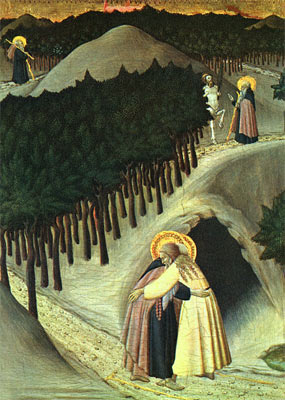
    The concept of displaying the passage of time, relating multiple events taking place at the same (or different) times, is really quite a lot older than the what is generally considered to be its recent modernist beginning.  Duchamp’s Nude Descending, which is a masterpiece of modernism displaying unfolding time and multiple perspective views across time of the same object, is the direct descendant of centuries-old artworks.  The Egyptians and the Aztecs certainly made use of this idea of multiple stories at multiple times in their stone storyboards.  Closer to the present is the genre of early Renaissance painting like Sassetta’s The Meeting of St Anthony Abbot and St Paul the Hermit (painted circa 1440), which shows several aspects of the story over time, and depicted on the same canvas. (We see the beginning of St. Anthony’s journey at top left, heading out on his journey as a younger man, winding his way through dark wood and along a curving trail; we see him a second time as an old man, and then lastly at bottom, elderly, finally meeting the other monk.)
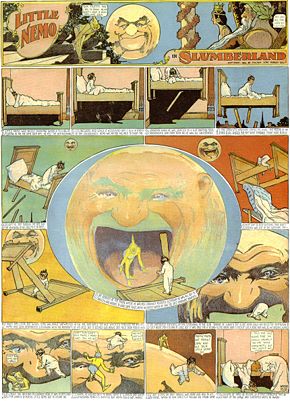

    Blog--may 26--nemo

    The rollout of the Sassetta masterpiece (hanging happily at  the National Gallery in D.C.) reminds me a lot of the great hallmark of storytelling at the beginning of the twentieth century—no, not Barzun or Cendars, but Little Nemo (who predates all of the other greats who were to come in the next ten years or so).  Winsor McCay’s (1871-1934) Little Nemo in Slumberland (appearing in the Hearst newspapers beginning in 1902)—better yet, the comic strip in general—adopts a platform for storytelling that is nothing short of revolutionary.  By breaking out the development of the narrative in front of the reader and on one single sheet of paper gives the author fantastic maneuverability.  This is also seen in the early motion pictures of Edwin S. Porter (like The Ex Convict, 1905) and D.W. Griffith (The Lonely Villa, 1909) who both use a new concept of contrasting editing—cutaways from the main action and pace of the.
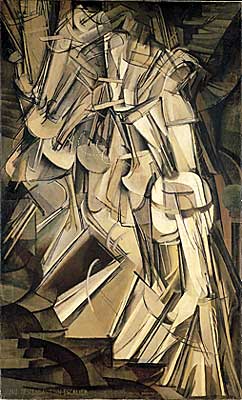
    Blog--may 26--nude descending


    film and incorporating vignettes of actions that are related and happening elsewhere, sometimes all of it happening at once.   The story is able to develop multiple themes that are occurring at the same time but in disparate locations—the artwork of futurists Balla and Boccioni and the unclassifiable Duchamp reach for the same end, and so to (again) with Apollinaire and Cendars and the rest…and all of them coming into view in 1912/1913 or so.

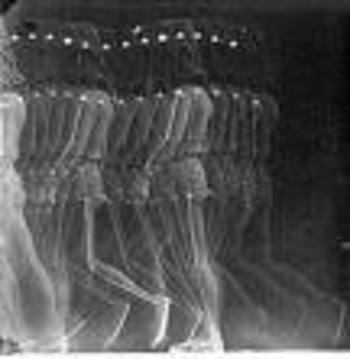
    There’s a lot to talk about on the tech end of this too, not the least of which is the work of Etienne Marey who made highly successful photographic investigations (in the 1870’s and 1880’s)
    of all manner of locomotion, some of the results of which look like the x-ray of Duchamp’s Nude.  Perhaps the greatest early enablers of technological simultaneity are the telegraph and (more impressively) the telephone, both of which allowed people to be in two different places at the same time (so to speak).
    Blog--may26--marey

    Again, this is just a note, thinking out loud, about the concept of simultaneity, and I doubt that I’ve even broken the surface…I’ve not even considered the math and physical aspects of it all, not even a whisper about Einstein and Schroedinger.  I’ve just done a search and found two works by eminent historians of science on this topic which I should think would demand reading:  Max Jammer’s Concept of Simultaneity (2005) and Peter Galison’s Einstein’s Clocks, Poincare’s Maps and the Empire of Time (2003).  I’d like to return to this post when I think I might have an idea of what I’m talking about…


  • Detail in Renaissance Paintings: Carpaccio’s Venice

    JF Ptak Science Books LLC  Post 627   Blog Bookstore

     While finishing yesterday’s post on the occasional
    nothingnesses of details in Renaissance painting and using one of the painting
    by Vittore Carpaccio to make my point, I stumbled upon another image by this
    Renaissance master that was almost all detail,
    and of great somethingness. 
    Blog--may 25--madmanThe painting
    is
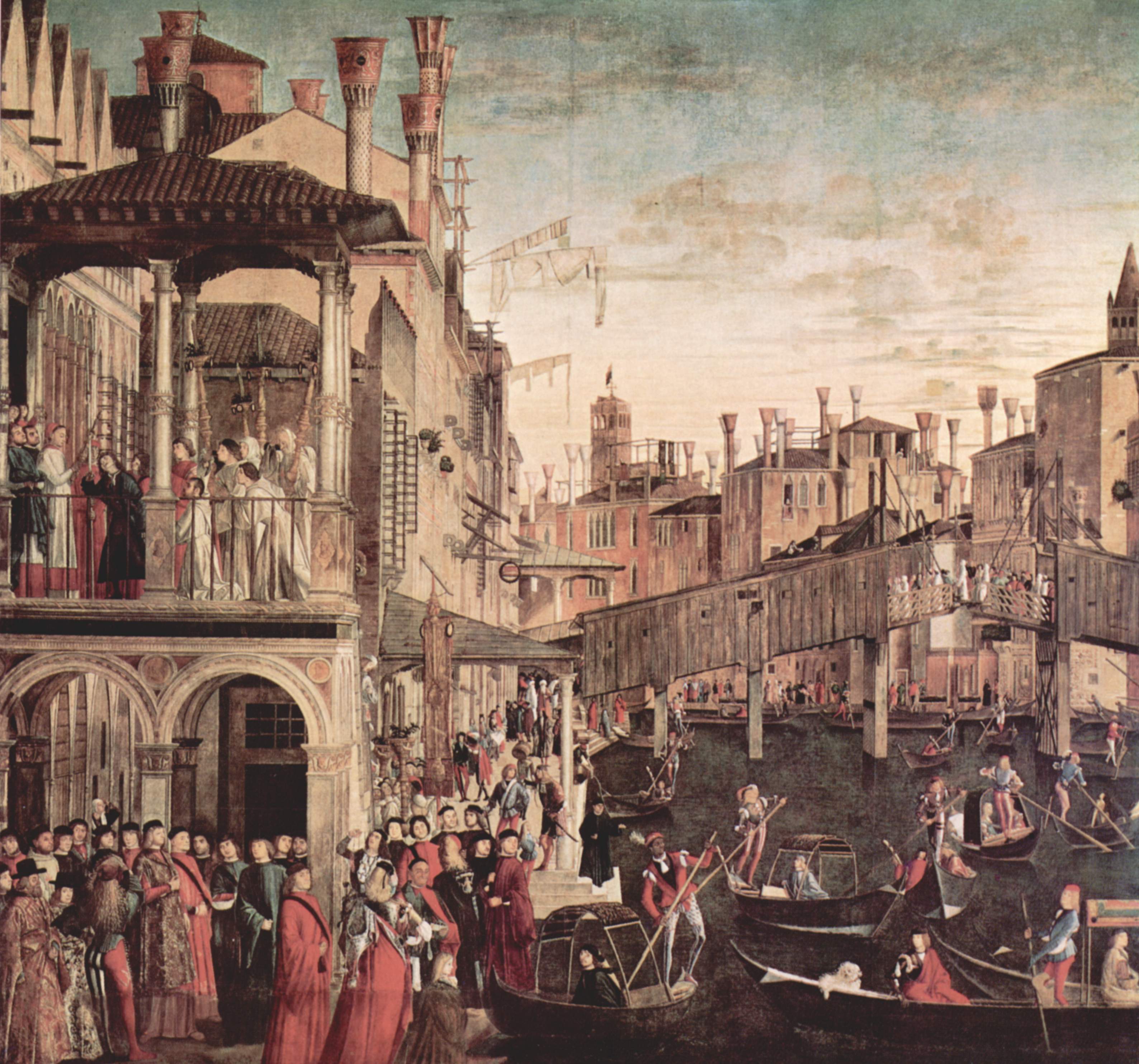
     Il miracolo della reliquia
    della Santa Croce
    (“The Healing of a Madman”, painted in 1494), which is a
    large, extraordinary and detail-filled canvas of a street scene in Venice. The subject of the painting is Francesco
    Qerini, the Patriarch of Grado (which was the old name for the Patriarch of
    Venice, one of the four Sees, with patriarchs reaching back to the 6th
    century), who was healing a mad/possessed man of whatever aliments finding
    safety in him, and evidently accomplishing the task with a tiny piece of the original
    cross of Jesus, given to Qerini ‘s patriarchy in the 14th
    century.

    The miracle itself takes up only a very small portion of the painting—you
    can find it in the upper left, in a spacious loggia, the “madman” (I think)
    crooking his head to look up at the outstretched crucifix; a quiet, almost
    secondary acquiescence to all of that other energy in the painting.  Even though not the intentional subject of
    the painting, it is the wooden  Rialto Bridge  (the version built in 1458) that takes center
    stage, though I guess one could say that the key area of interest was the city
    of Venice 
    itself.  Or the throngs of its citizens
    enjoying the airy passage through the city. 
    The focal point does seem to be the bridge, which had the capacity to
    open for taller ships, and was a focal point of transfer for the
    community. 

    There is some reason for this outside of the artistic sense—the paining was
    one of nine commissioned by the Confraternity of the Scuola Grande di San
    Giovanni Evangelista, which was a major concern in Venice.So it would seem that Venice
    was meant to be as much a part of the appeal of the painting as was the miracle
    that called for the attention in the first place.  

    This was a very crowded scene, the foreground and background material and
    subjects as important as the subject itself; it was a greatly democratized work
    calling as much attention to the city of Venice as the miracle being worked
    within it—and it still remains a calm and quiet vision  Perhaps it is the steadfast of the objects
    above the street, like the pot-like chimneys (at least 26 showing) and the
    clothes-drying poles with their flag-like fare that contribute to the quietness
    above the bustling city street.  Experts
    say that this is a superb rendering of the cityscape, with accurate coloring, a
    beautiful documentary of life in Venice 
    just at the end of the 16th century. 
    In addition to the cityscape we see all manner of small life in the many
    people in the painting:  passengers in
    the gondola are carrying pets (at least one dog and a bird), the stores at the
    foot of the bridge, an open air market (with sellers lined up with small
    tables), plus all manner of styles in dress.

    It is a wonderful example of the opposite of yesterday’s post:  something where all of its comparative “nothings”
    were the most important part of the unit.


  • Seeing Renaissance Pillows: a Short Bit on an Unnecessary Topic

    JF Ptak Science Books LLC  Post 626  Blog Bookstore

    Evelyn, a dog, having undergone

    Further modification

       Pondered the significance of short-person behavior

    In pedal-depressed panchromatic resonance


    And other highly ambient domains…


    “
    Arf” she said.
    —F. Zappa, One Size
    Fits All
    (“Evelyn the Modified Dog”)

    Blog--may 25--garofalo

    I was going to write something completely different about
    these images for this post—but I fell completely into the beds of these
    paintings—actually, I missed the beds and made straight for the pillows.  I really didn’t have anywhere to go with
    this–no point, no cozy tie-ups—and when I told about my wife Patti Digh about
    this problem she wisely told me to forget about a point, and “send it out into
    the world”.  (Patti has no doubt that the
    subject of this post sounds like an unending and probably unendurable doctoral
    dissertation.)  And so when faced with my
    own set of sensory inputs that couldn’t come to some sort of comprehension, “arf”  sounded pretty good.

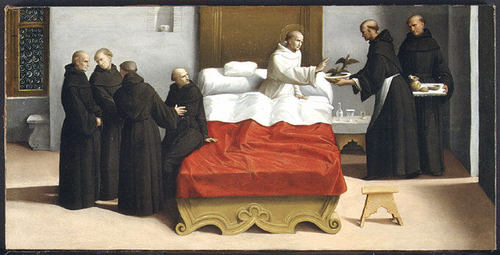
    The first image is an oil on canvas (transferred from wood)
    by Garofalo (Benvenuto Tisi da Garofalo, Italian, Ferrarese, 1476?–1559) called Saint Nicholas of Tolentino Reviving the Birds and painted around 1530. The
    man in the bed is a deathly sick St. Nicholas, an Augustinian monk, who was
    attended by no fewer than six of his brethren. 
    They are shown offering him a plate of roasted birds, but Nicholas, a
    vegetarian, rose from his bed and in rejecting the food brought the birds back
    to life.  We see that long, bed-width
    pillow with a small cozy on top of it

    Blog--may25--lorenzo

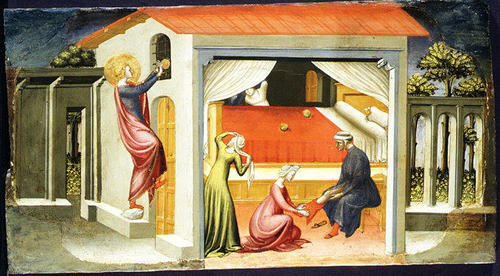
    In another painting of another Nicholas, Bicci di Lorenzo’s
    (Italian, Florentine, 1373–1452) Nicholas Providing Dowries (date

    1433–35), we see the Bishop of Myrna in Asia Minor Nicholas pushing bags of
    gold through a transom and into a house. Sounds a little like St. Nick of
    Christmas lore, though this St. Nick was providing the dowries to three
    daughters of a destitute man unable to provide his offspring with money of his
    own. (Not having money for a dowry was a major deal in these times—without the
    money the women probably would not have been able to marry, forced to other not
    savory means for providing money for their daily needs to survive.  Here again we have a big red bed, with a
    bed-width pillow, and the smaller pillow on the top of it all.

    Blog--may 25 --carpaccio

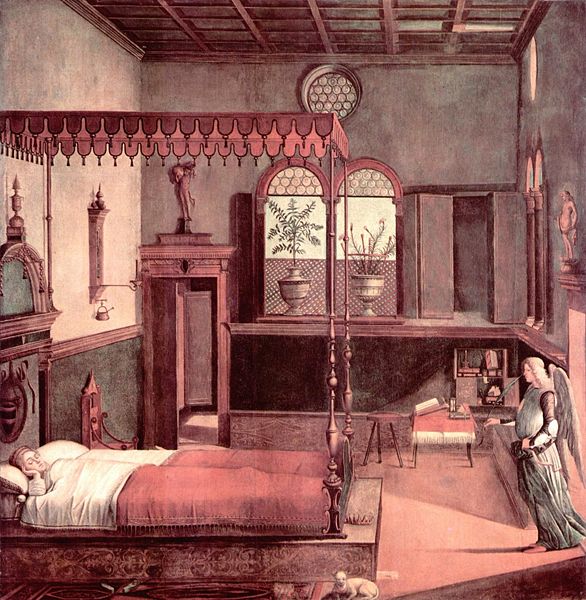
    The last example belongs to Vittore Carpaccio (c. 1460 – 1525/1526), in his The Dream of St.
    Ursula
    (painted 1495).  Again, the same:  red bed, big pillow (though no little fellow
    is visible).  There is a strange small
    ball-like object near her head at the base of the pillow, and her slippers are
    where they were when she stepped from them into the bed.  It looks like she has six books in her work
    area at the back of the room (as well as an hour glass on the desk).   There is a problematic burst of light on the
    ceiling from the high window to the left of the door—it doesn’t seem likely
    that this splash of light could be on the ceiling given the shadows in the
    room.  Oh well. 

    And so.  There are
    more examples of these pillows, but we probably don’t need to look at more
    right now—just noticing them is probably enough. Sometimes finding interesting
    detail in the detail leads somewhere, and sometimes not. There is a continuing
    thread
    in this blog that looks at the importance of incidental detail in art,
    though today’s  post chooses the “sometimes
    not” option.


  • On Learned Ignorance: George Hartgill’s Astronomical Tables

    JF Ptak Science Books  Post 620    Blog Bookstore

    According to negative theology, ‘there is not found in God anything other
    than infinity.’  (Cusa, De Docta Ignorantia, vol. I, § 26)

    “With respect to the intellectus, reason (ratio) is at the horizon…but with respect to the
    sense, reason is at the zenith, things that are within time and things that are beyond time
    coincide in reason.”(Cusa, De DoctaIgnorantia, vol. III, ch. 6, § 216


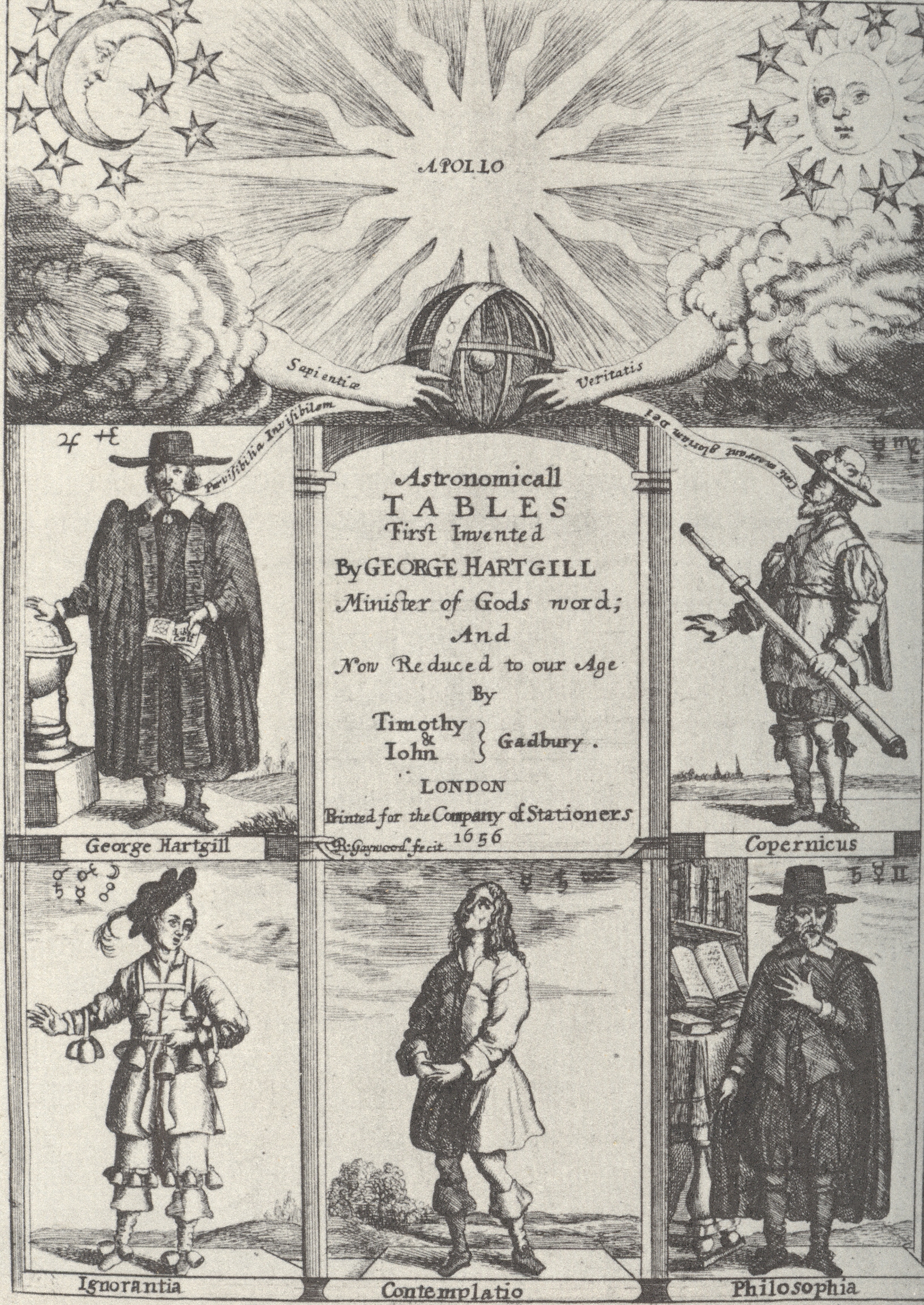
    Blog--May 20-hartgill In my imaginary Encyclopedia of Interesting Title Pages, the Astronomical Tables shewing the Declinations….* by  George Hartgill** is very much middle fare,  very interesting but not overly so (I say sniffily), but very much worthy of attention.  The initial bit that caught my attention was small and sort of trifling: it seemed that the writer possessed  the temerity to place his own portrait on the title page across from that of Copernicus.  As it turns out, the selection was obvious and logical, though I wouldn’t know that until I pieced together the symbolisms of the page.  Aside from that, there was a fair amount of action on the title page, and for all of that it retained a certain spareness, a lightness in spite of itself.

    The title page is an elegant call to synthesis of science, philosophy and religion in the understanding of astronomy. To start: at the top-center is the burning sun, “Apollo”, the great and perhaps most important of all the Olympians, the god of sun and light (among other things).  The arms of the heavens (signified by the arms reaching out from the Moon and Sun) embracing a globe of the earth within an armillary sphere. The arms carry the legends of “spientiae” (“wisdom”) and “veritatis  (“truth’).  Surrounding the title proper are five figures, the upper two being Hartgill and Copernicus.  The word balloon coming from Hartgill’s mouth says “per vidibilia invisibilem” or “ the visible and the  inivisible”, and touches the hand of wisdom; Copernicus’ balloon I can only partially read, but it seems to end “gloria dei” (to the glory of god), and ends under the arm of truth.  In turn these two figures rest on three others:  Ignorantia, Contemplatio and Philosophia. 

    Ignorantia here is depicted by an entertainer decked out in bells.  He isn’t necessarily “ignorant” per se: the “ignorance” comes in multiple forms: one is of the intelligent and educated person knowing the things that weren’t yet known; another in terms of a belligerent ignorance, insisting on the known and the comfortable in the face of compelling new evidence stating otherwise; and also of simple ignorance of not knowing and not caring.  Contemplatio and Philosophia pretty much speak for themselves.  The three of them seems to support the advanced “ignorance” of Hartgill and the mathematical/philosophical Copernicus, all of which are illuminated by the wisdom and truth of the source of all light.  Its simply a wonderful, well-designed title page.

    *Astronomical tables shewing the declinations, right ascentions, and aspects of three hundred sixty five of the most principall fixed stars and the number of them in their constellations after Aratus : as also the true oblique ascentions and descentions of all the said stars upon the cusps of every of the twelve houses of heaven according to their latitude….1656.

    **Granger’s Biographical History of England (1824), says of Hartgill: (he was)…”chaplain to the Marquis of Winchester, was a painful preacher, a reverend divine, and a most excellent mathematician, as appears by his ” Astronomical Tables;” which, according to the judgment of the best astronomers, could not have cost him Jess than seven years’ labour, considering the perfection of the work.”


  • The Invention of Small Things and the Coming of the Internet–Back to the Flea

    JF Ptak Science Books LLC  Post 615  Blog Bookstore

    “A network of such [computers],
    connected to one another by wide-band communication lines [which provided] the
    functions of present-day libraries together with anticipated advances in
    informationstorage and retrieval and [other] symbiotic functions.” —J.C.R. Licklider, 
    his epochal “Man-Computer Symbiosis”, 1960

    There is a famous
    and most likely apocryphal story made famous in Stephen Hawking’s A Brief History of Time where a famous
    “scientist” (I‘ve heard him described as James Jeans, for one and the nicest
    fit, others say Bertrand Russell though it matters not) is confronted by a
    member of his audience during a lecture on astronomy/cosmology.  A woman rises and confronts the speaker,
    determining that what has come to pass as fact regarding the universe is all
    rubbish, and that the Earth was in fact a flat object resting on the back of a
    turtle.  The speaker then asks her what
    the turtle is standing on; she replies immediately of course that it is another
    turtle, and that it is “turtles all the way down”.  It’s a nice story, and bears some resemblance
    to Native American stories of the Earth born on the back of a turtle, of the
    Hindu legend of the Earth being borne by an elephant standing on the back of a
    tortoise, and so on, all the way down. 
    Even Dr. Seuss’ Yertle the Turtle
    can make an appearance in this one.

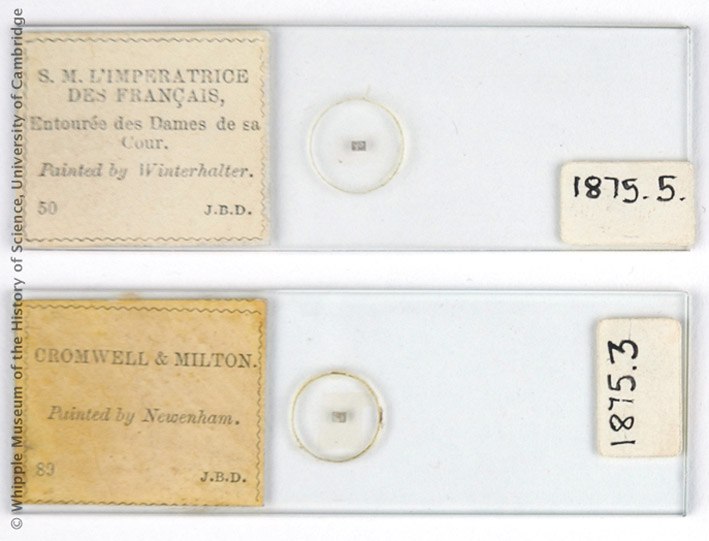
    1875large

    This came to mind
    thinking about the contribution of (the not-entirely forgotten) John Benjamin
    Dancer (1812-1887) to photography and its relation to the history of the
    Internet.  Dancer was in the immediate
    second wave of the greats of photography following the short first wave of
    Niepce and Talbot and Daguerre, and did come up with a number of very good
    ideas at the birth of photography—one of them in theory is an early foundation
    stone for the technical distribution of data and information.(These two slides are  examples of Dancer’s work and are reproduced from the Whipple Museum of the History of Science, Cambridge.)

    Dancer evidently
    went to work immediately after reading of Daguerre’s 1839 process.  The technical aspects of the Daguerre effort
    were les daunting than they were messy—he found the descriptions “crude and obscure”,
    and proceeded with his own series of experiments, producing a camera some six
    weeks later.  It is interesting too that
    he seemed to have based the camera on a camera obscura:  “being a practical optician the camera was
    one of my own construction, such as I had frequently supplied to artists for
    tracing the outline of views in the camera….”

    He lectured later
    in that same year (1839), showing lantern slides of his accomplishments to
    crowds of up to 1500 people.  His great
    accomplishment was in the field of microphotography—I should say rather that he
    invented the field.  And it is of great
    interest that the first images that he made using the brand new invention of
    the camera coupled with a microscope was that of a flea.  In yesterday’s post I wrote about Robert
    Hooke’s Micrographia and his spectacular discovery of the fineness and detail
    of biological specks like the flea, showing audiences—the world—for the first
    time that these insignificant creatures represented an entirely new,
    just-discovered world, and that they were as tremendously well-developed as any
    other large living thing.  Back to the
    flea, as it were, went Dancer—I have no idea whether he knew he was calling on
    Hooke’s iconic image or not.  But it is
    at least a lovely coincidence.

    Dancer also
    displayed images of documents that he reduced by a scale of 1/160, printing a
    fully-legible copy of a printed document that was only 3mm tall.  The significance of this invention seems to
    have been lost until it was picked up again in 1853 by the great John Herschel,
    who recognized the process as a way to archive significant documents.

     I like it more for its possible impact,
    perhaps, on some of the thinking on the construction of a world-wide
    distribution of knowledge, as a necessary step to get to the stage where
    Vannevar Bush—who was widely acknowledged as being the grandfather of the
    internet at a MIT Conference about a 20 years ago—could theorize about his own
    precursor to the internet–the Memex,
    describing it for the popular audience in the Atlantic Monthly in June*, 1945. 
      Among many other things,
    Bush—who was also, probably, one of the great figures of WWII for his heroic
    role in leading the U.S. scientific and technical war effort and seeming to
    make the correct decisions all of the time—foresaw a means of distributing
    data, more or less instantly, calling on the delivery of microfilmed
    information. Bush, who was also a great engineer and father of one of the
    countries best analog computers (in 1931/33), had the notion for a world wide
    technical distribution of knowledge, but, as he wrote this in 1945 (!), could
    not see far enough into the future development of the digital computer (the
    ENIAC just being born at that time, though it must be pointed out that Bush was
    open to the idea of magnetic storage). 
    His ideas were very far reaching, touching on microminiaturization and
    artificial intelligence, and his ideas even now aren’t so much coyly science
    fiction as they are, well, implemented. 
    There’s a lot of Bush’s memex that are in place today

    So, the turtles and
    wondering about Dancer’s influence in the string of inventions and discoveries
    that gave birth to the www: how far down do these influences go?  The touchstone for the creation of the internet
    is usually seen as being with JCR Licklider (see quote above) in 1960, or with
    Paul Baran or Leonard Kleinrock a year later; but perhaps it is earlier still with
    the implementation of ARPA (set into place immediately after the launch of Sputnik).  Of course none of this is possible without
    computers, so you could work your way back through time to the transistor, to
    Bush, to the Stibitz (Bell)Relay Computer, to Johnny von Neumann, to the thermionic tube (Bush), and then
    all of the support discoveries and inventions that rolled into these, and so
    on.  Back to photography, back to Babbage’s
    plans for his analytical engine, back to the invention of moveable type, to the
    invention of paper, to the creation of libraries, to the general idea of the
    popular distribution of knowledge.  All the
    way down.  But I do think it worthwhile
    to think of Dancer’s contribution in so far as it allowed people to think of
    easier, quicker ways of moving around vast amounts of data and
    information.  And that I think is worth
    remembering. 

    *I’ve also got to
    say that at the same time Bush was writing about the future of intelligence he
    was also at work developing the U.S.  response to the upcoming race in atomic weapons.  He and his team were busy crafting responses
    and policies and the reaction of the Soviets and the sharing of the atomic bomb
    data and all of that, and all before the test at
    Alamogordo. Really, the guy was spectacular.


  • The History of Dots Part 9: the Cell and Robert Hooke

    JF Ptak Science Books Post 614   Blog Bookstore

    This is another in a continuing series of posts on the History of Dots.  Let’s face it:  dots are the alpha and the omega of our existence, from the imaginary point in space; to the great dots in the sky seen by the ancients for thousands of years before their vastness and complexities were revealed with the invention of the telescope (and etc.); to the fantastic smallness of “dots” whose organization was revealed through the invention of the microscope; to the atomic and sub-atomic world, right to the very point of singularity. The dot is a big deal. 


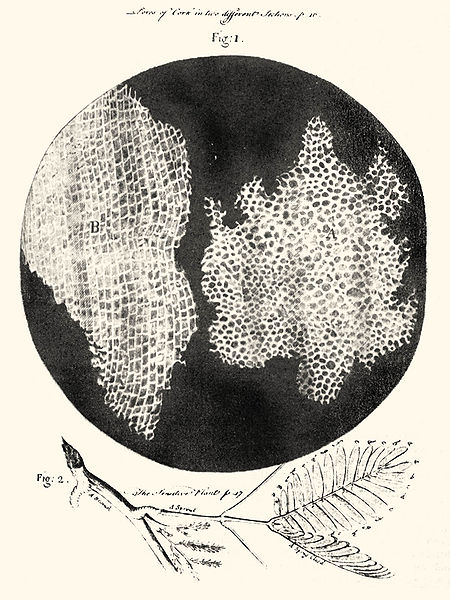
    May 15 hooke cork

    Had there been no Newton every school child would know the name of Robert Hooke (1635-1703) in its place—he was polymathic, totally energized, big-thinking non-sleeping experimentalist and theoretician who worked across numerous disciplines (physics and astronomy, to chemistry, biology, and geology, to naval technology), not the least of which was architecture (having helped Christopher Wren in the design of the new St. Paul’s).  He was an enormous figure who was also never below a fight or argument, and whose grasp of his own very considerable accomplishments never seemed to be limited by what he had actually done. Some people lay the blame for Hooke’s obscurity upon Newton’s great and tireless vindictiveness against Hooke, but that’s by far from the whole story of Hooke’s troublesome personal legacy.  Not only is his portrait not on the coin of the realm nor hanging everywhere in the halls of academia, but there is no known surviving portrait of the man.  He didn’t come close to Newton’s enormity, not really, but in the absence of  Jupiter and Saturn even the Earth starts to look a little bit big.among the rest of the planets.

    One of the very big things that he did was to become the first person to observe “cells”—the “dots” of concern in this post.  After reading Antonie van Leeuwenhoek’s* (1632 – 1723) work  Hooke had made (by Mr. Cock) a version of the L’s microscope, reproduced some of the observations, and then set out on his own.  The slice of cork pictured here was the first time anyone had seen such things as cells, Hooke believing them to transmit the essentials of the plant.

    In “Observation XVIII” of the Micrographia, he wrote: “. . . I could exceedingly plainly perceive it to be all perforated and porous, much like a Honey-comb, but that the pores of it were not regular. . . . these pores, or cells, . . . were indeed the first microscopical pores I ever saw, and perhaps, that were ever seen, for I had not met with any Writer or Person, that had made any mention of them before this. . . “

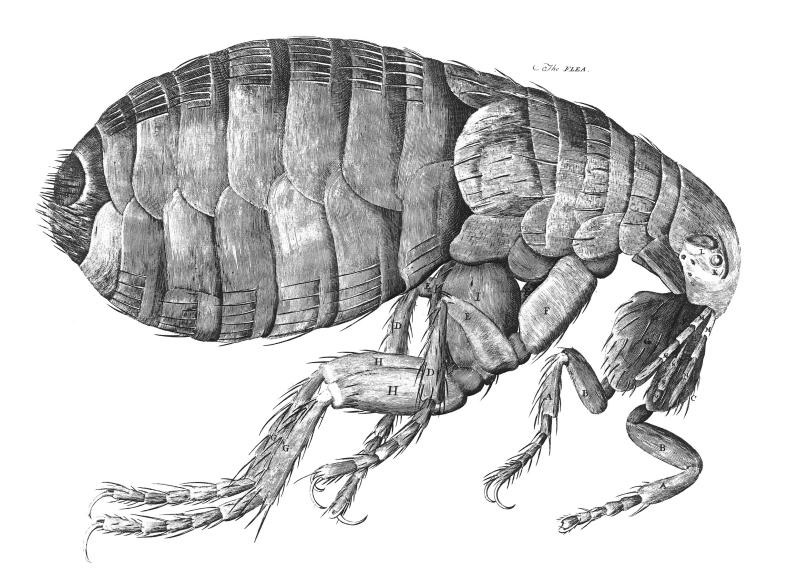
    Flea

    The 28-year old Hooke published the results in a gorgeous and revolutionary book, Micrographia, in 1665, which became an instant best seller and highly praised and valued. (Samuel Pepys, perhaps among the shiniest stars whose imprimatur was like a royal blessing, said the book (was)“the most ingenious book that I ever read in my life.”) There is no telling what the people of the mid-17th century thought of seeing such incredible discoveries in the little semi-invisible stuff that made up their normal, daily lives.  The only thing that somewhat equates to this would be if the first images of the Hubble were those of Earth-bound objects whose detail had previously been unknown.  Hooke’s observations and drawings of things like the common flea were just an astonishment—that such a creature of “low order” could have such intricate detail and design was a complete revelation.  The drawings of the fly’s eye, too, was an inescapable wonder, an incredible object to consider as having any detail pre-microscope, and then revealed to have unimaginable design and elegance. 

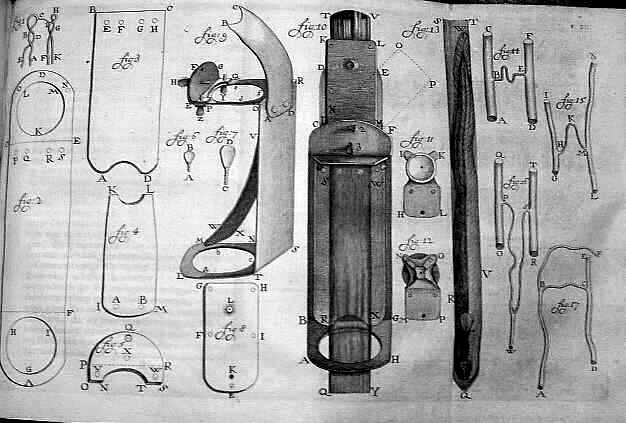
    May 15 van Ls microscope


    *Leeuwenhoek’s major contributions came in the form of letters to the Royal Society.  He operated in his own cellular world, if you will, not having been schooled in languages outside of his own native Dutch or receive any real formal education in the sciences at the university level.  He labored mostly alone save for his great correspondence. For example, in a letter of September 7, 1674, Leeuwenhoek described observations on lake water, including an excellent description of the green charophyte alga Spirogyra: “Passing just lately over this lake, . . . and examining this water next day, I found floating therein divers earthy particles, and some green streaks, spirally wound serpent-wise, and orderly arranged, after the manner of the copper or tin worms, which distillers use to cool their liquors as they distil over. The whole circumference of each of these streaks was about the thickness of a hair of one’s head. . . all consisted of very small green globules joined together: and there were very many small green globules as well.” 

    The image above is  an engraving of one of Leeuwnhoek’s later microscopes–in  the history of his work, Leeuwenhoeck made something like 500 scopes, with powers varying from 50-500x. 


  • Crowds: Servicemen and B-17s at the End of WWII

    JF Ptak Science Books Post 608 

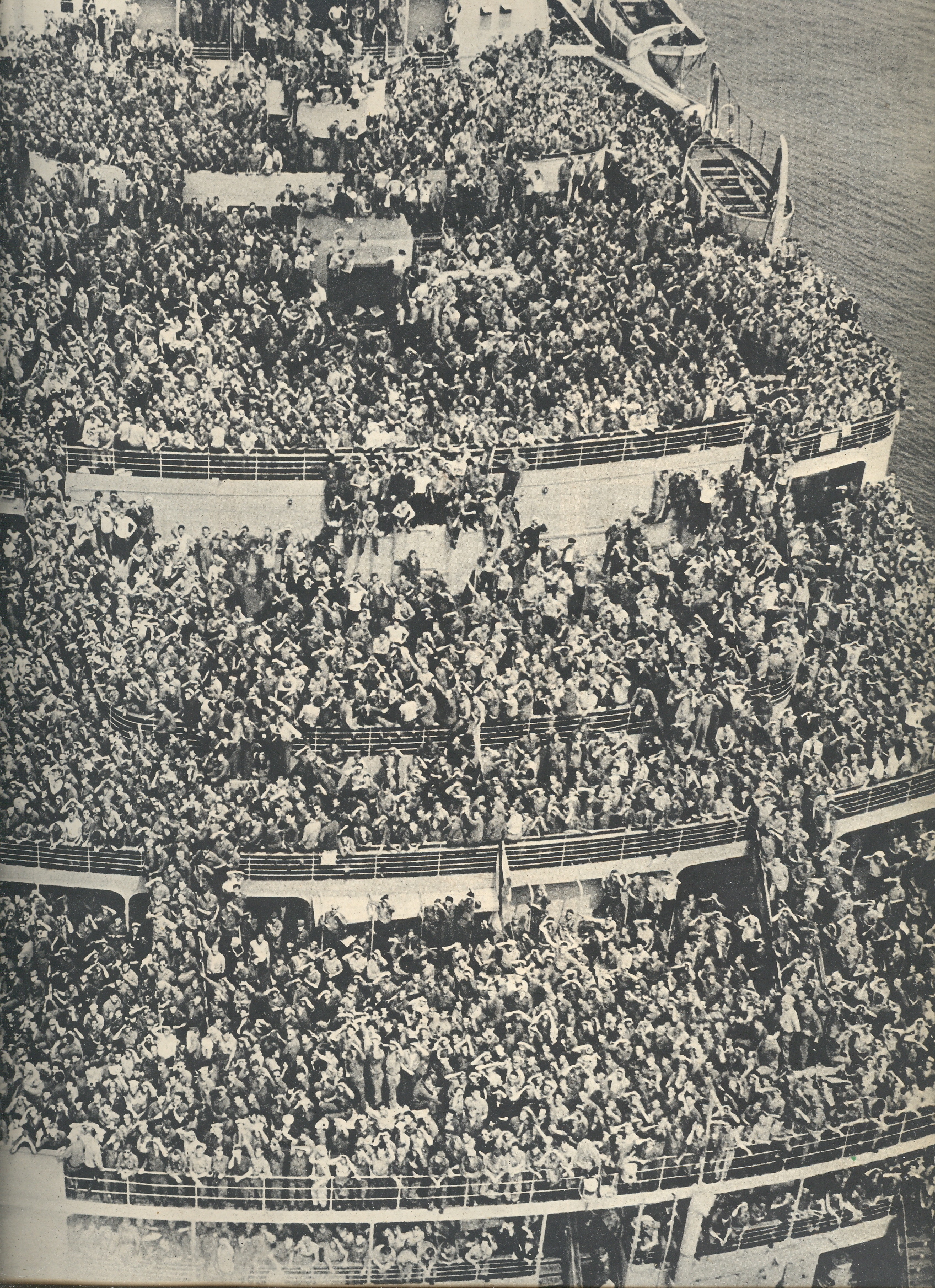
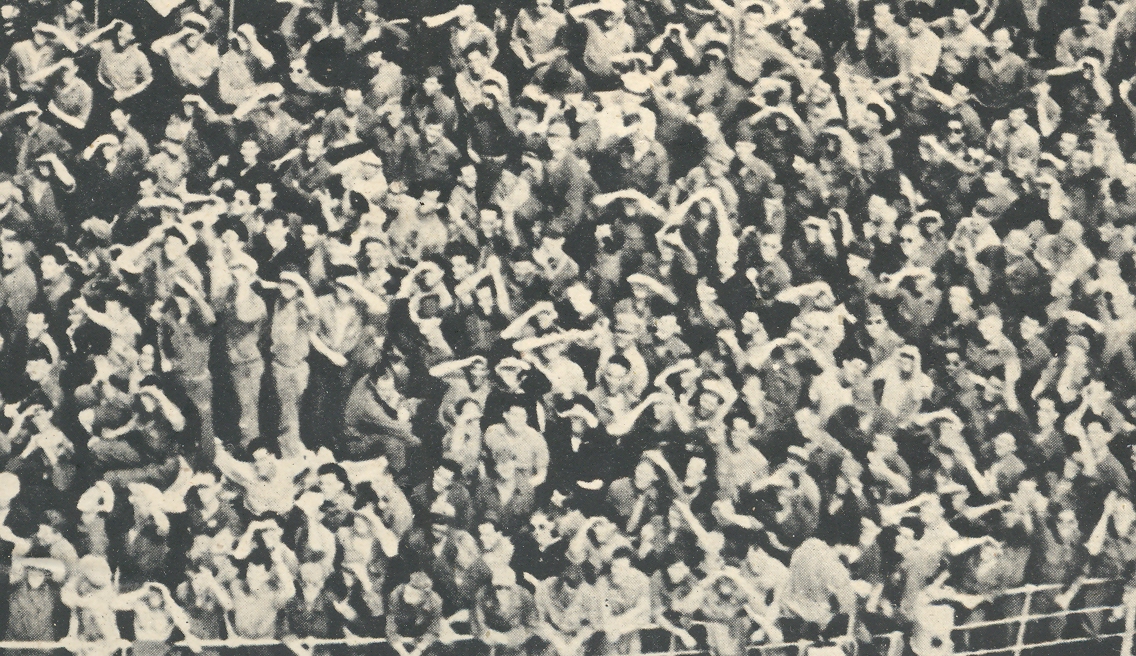
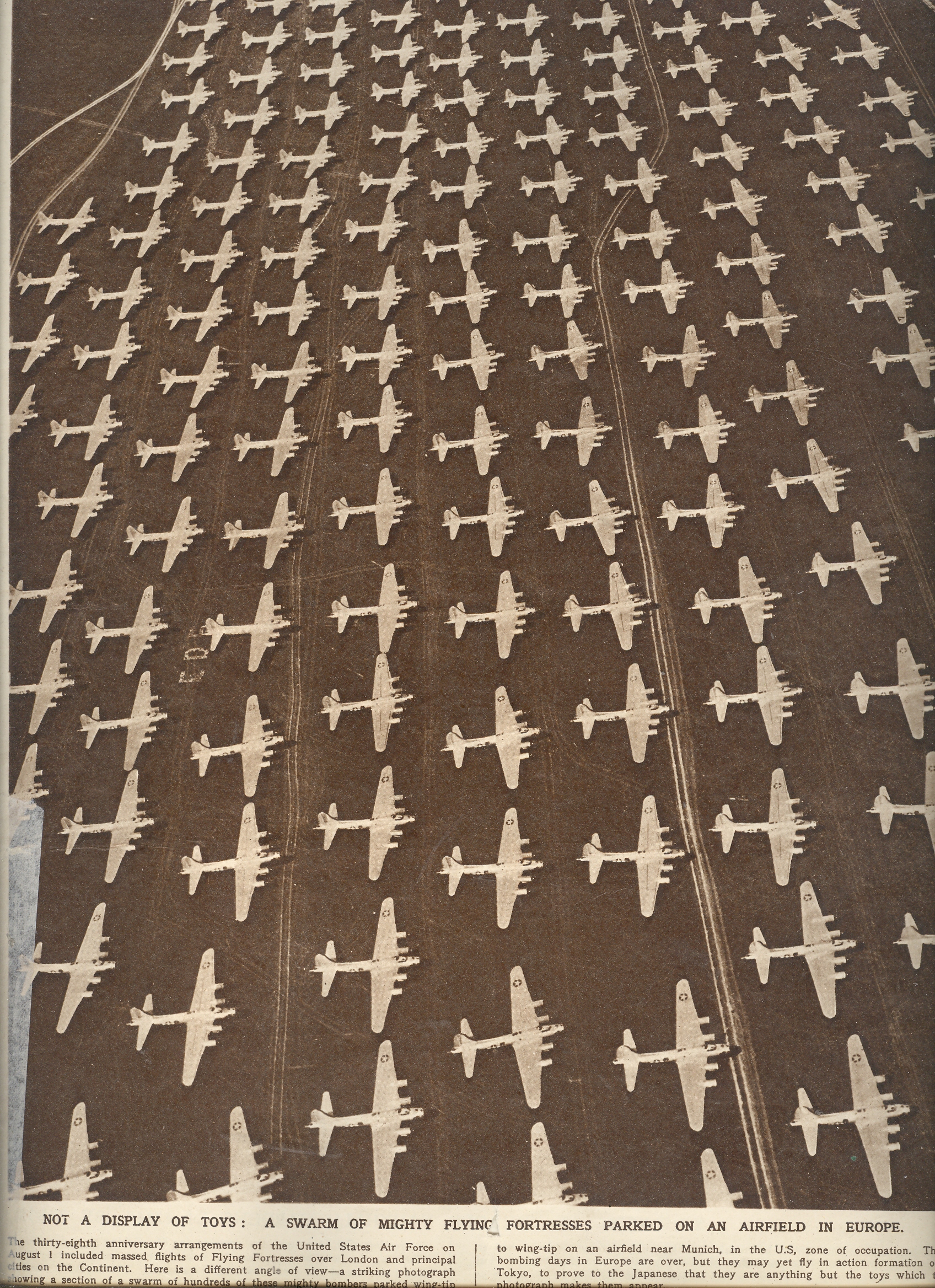
    These two images of crowds come in the same remarkable issue of The Illustrated London News for 4 August 1945—the war in Europe  was over, and the war in the Pacific, for all intents and purposes, would be over in days.

    Blog--may 8--vrowds QE


    The first image shows  passengers on board the “Queen Elizabeth”—a contingent of 14,000 American soldiers beginning their journey home following the defeat of Hitler.  It is a raucous, joyful image, with nearly everyone waving, happy to have arms to wave, happy to be alive to wave their arms, happy to be going home.Blog--may 8--vrowds QE det  


    The second, “Not a Display of Toys”, shows only one section of a large airfield “in Europe” (actually in U.S.-administered Munich).  There’s about 300B-17 (e?) parked wingtip to wingtip, off duty now from the fight in Europe, but (as the caption says) prepared for a fight in Japan. I don’t think anyone in high command had any doubt that these planes had seen their last action.  The atom bomb worked, and would work again (and again, and more so if necessary), and the fear that these planes would make their way East was not a real concern. This photo represents about 7% of the highest number of B-17’s in service in Europe at any given time. 

    Blog--may 8--vrowds


  • A Bit on the History of the Insides of Things: Renaissance Anatomy

    JF Ptak Science Books LLC  Post 604   Blog Bookstore                                                      

    Much of human intellectual history has been dedicated to looking inside, seeing
    the unseen, the stuff underneath, the invisible, the clouded, the inscrutable, the
    things-behind-something-else.   If you could somehow weigh all of the stuff that
    we know that is “visible” versus all of the other stuff that is not, I think that
    the scales would fly over instantly into the world of the unseen. Some of this
    material though does not have a measure:  for
    example, numbers are part of the unseen world, ideas made of nothing, points
    and lines in an imaginary series of planes and dimensions, and so have no mass
    themselves. Everything that is alive on and in our bodies, on our skin,

    Blog--may 5 skeleton

    in our
    water and food, and which were all basically unknown until the invention if the
    microscope, have little weight in and of themselves, but when  you add the whole biota together…well, then
    you’ve got a whole weighty lot of nothing  Then there’s the stars unseen beyond the six
    or eight thousand that we can see without a telescope, the rest of the universe
    waiting, discovered only 400-odd years ago, a very weight affair (and that’s not counting the dark matter). 
    I know that this is sort of a horrible argument, a beery and inelegant way
    to describe the path of human knowledge, but it strikes a (dis)chord with me.  

    One part of this invisible empire is within us—the elements of our bodies.  The Egyptians knew enough to do very simple
    surgery and to perform a more-complicated mummification ritual, but in general
    the body remained fairly well undiscovered until relatively recent times.  Publishing findings on those dark
    explorations was another matter, the first image of a human skeleton not
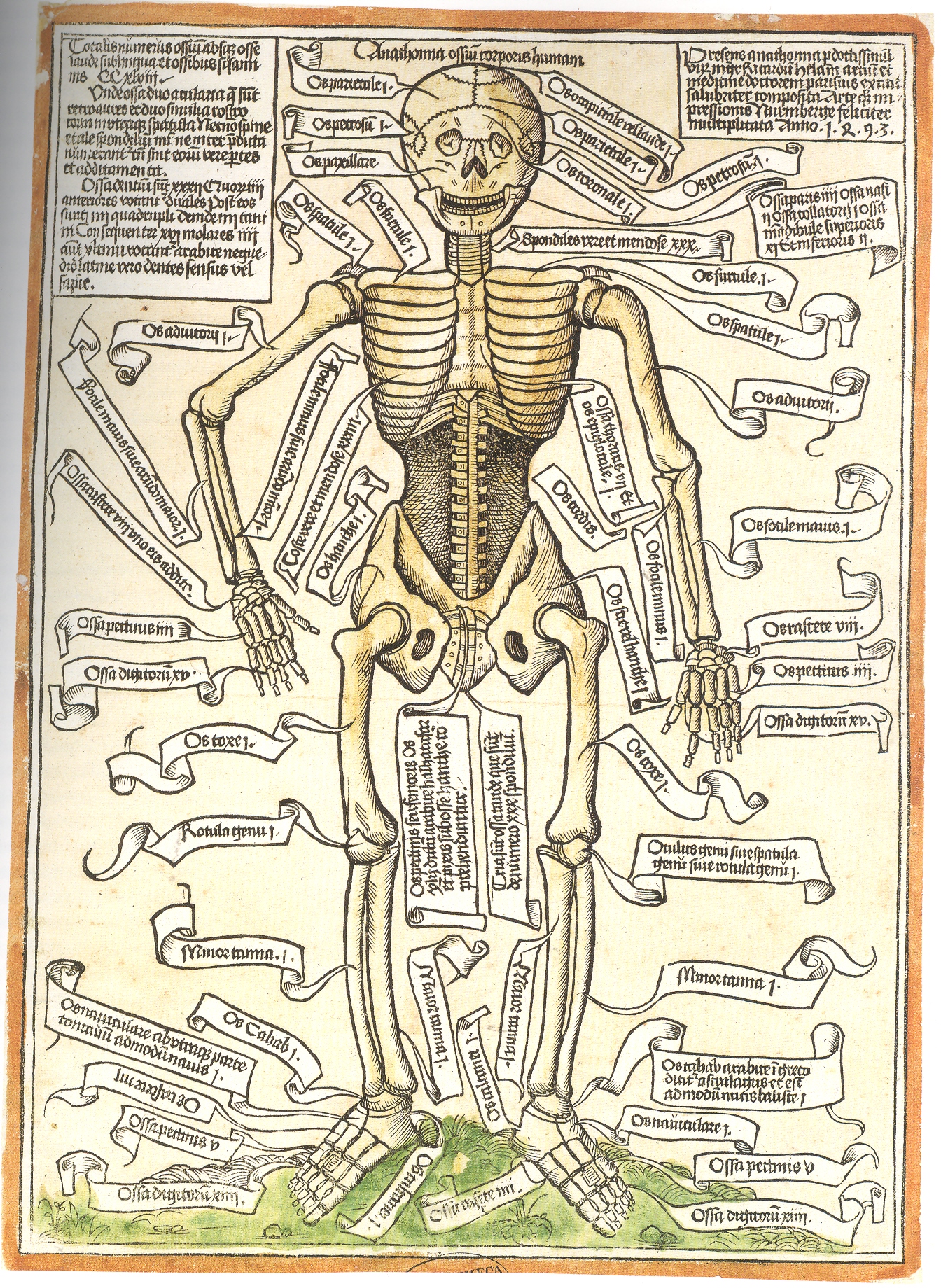
    published until 1493 (shown here, the Anathomia ossium corporis humani)–this was the first revelation to the real world of science following a sleepytime of about 8oo years under the very heavy gaze of institutional religions. 

    This all changed in 1543 with the publication of the first modern anatomy , Vesalius’s revolutionary De Humani Corporis Fabrica—it proved to
    work as a template for the display and presentation of anatomical practices and
    medical rigour for many years to come, solidifying the pursuit of the knowledge
    of the human body into a discipline.  

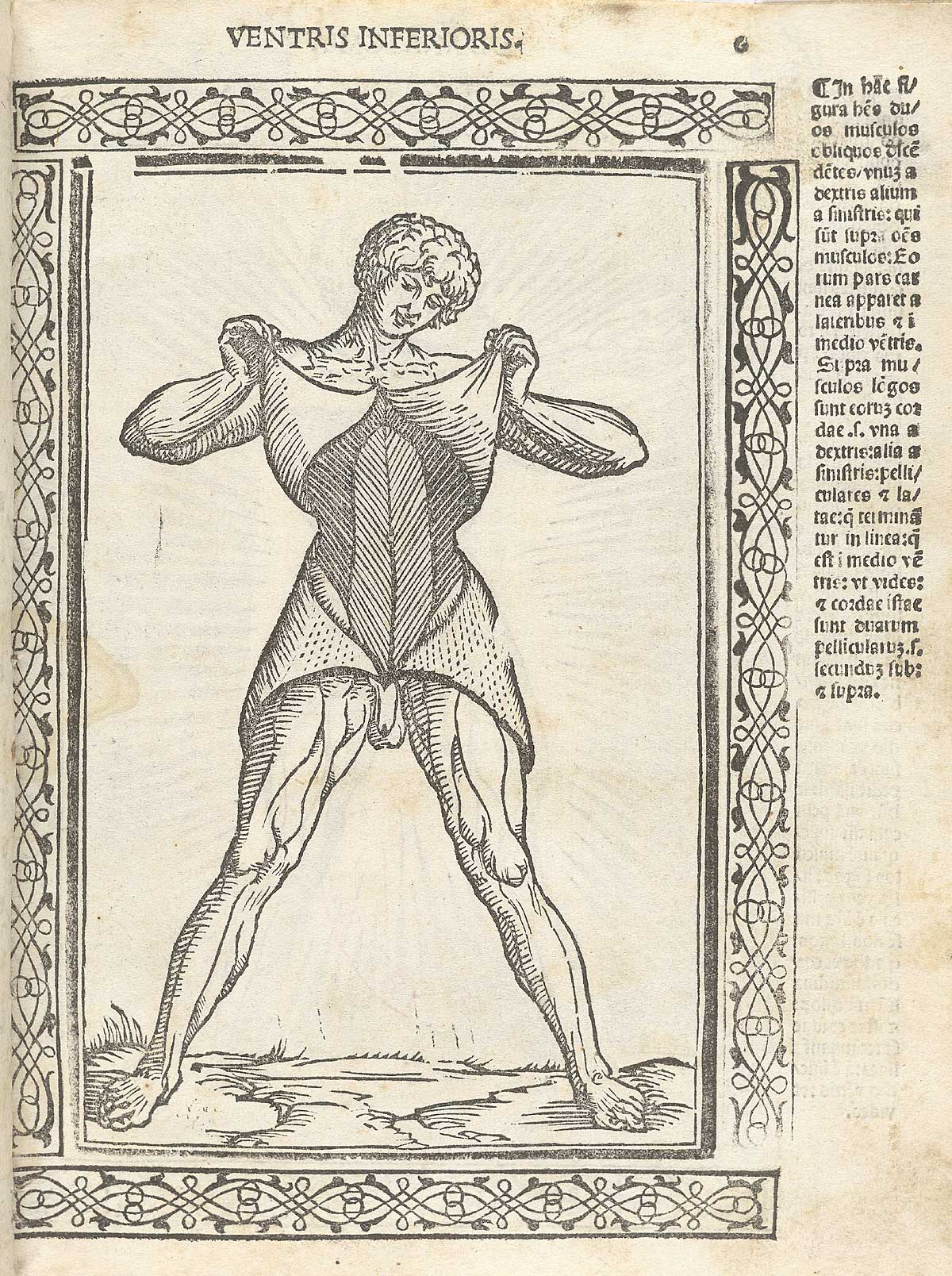
    Berengario_p06r Some of the predecessors weren’t
    so rigorous, as with 
    Jacopo Berengario
    da Carpi’s (ca. 1460-ca. 1530)
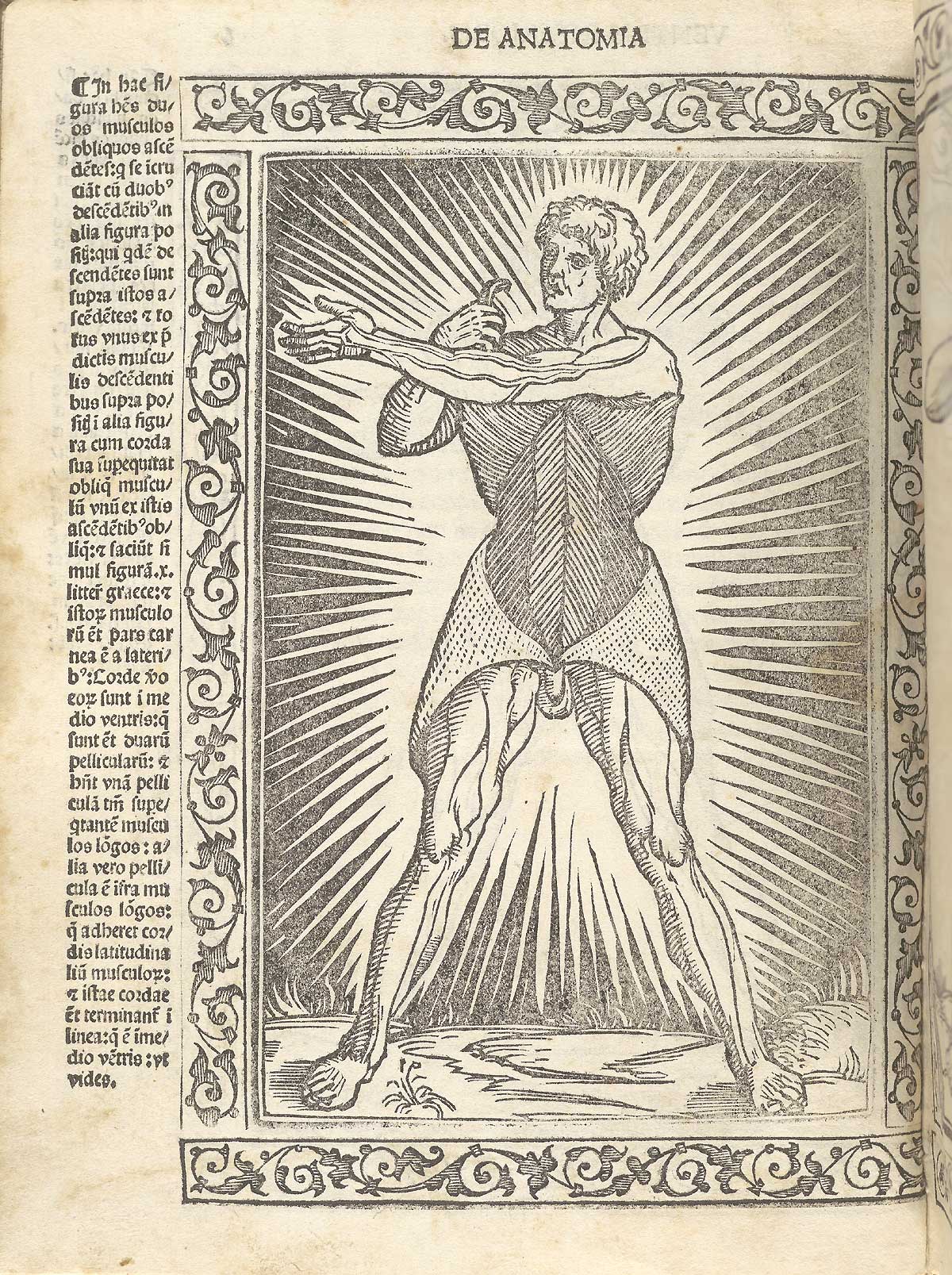
    Isagogae breues, perlucidae ac uberrimae in anatomiam humani corporis, who used several of the same images to illustrate different anatomical aspects.  (In  the  two examples right and below show the same anatomical display–the difference is the rather extraordinary background, and that’s it.) An
    other example is 
    Charles Estienne’s 1545
    De dissectione
    partium corporis
    (“On the dissection of the parts of the human
    body”) who simply ran out of scientific steam int the preparation of some of its
    many (lavish) illustrations—he used existing artwork of torsos and simply performed
    a printectomy on them, replacing some of the sections of the print with some anatomical
    detail.  The practice worked well enough,
    but the overall effort did not make it a landmark in the history of medicine. 

    Berengario_p06v

    I just wanted to touch very briefly on the rediscovery of the body in the 1490-1535 period.  To that end I’ve constructed this  table with data  pulled directly from the National Library of Medicine pages
    for anatomies on the web–all I did was place the records in a table so
    that they could be listed chronologically.  The numbers at left are
    clickable
    and will take you directly to the images of the work at the
    NLM site.  This is just a sampling of anatomies, though it may prove to
    be highly useful for folks in the science and the arts. 


    Chronological list:

        Author: Mansur
    ibn Ilyas (fl. ca. 1390).
       Title:
    Tashrih-i badan-i insan. [Anatomy of the Human Body].  Publication Information: [
    Iran, ca. 1390].            

       Author: Ketham,
    Johannes de (15th century).
      Title:
    Fasiculo de medicina.   Publication
    Information:

    Venice: Zuane & Gregorio di Gregorii, 1494.                 

          Author: Hundt,
    Magnus (1449-1519)
    Title:
    Antropologium de hominis dignitate…                          Publication Information:
    Leipzig: Wolfgang Stöckel, 1501.                              

        Author: Berengario
    da Carpi, Jacopo (ca. 1460-ca. 1530).
    Title:
    Isagogae breues, perlucidae ac uberrimae in anatomiam humani corporis.              Publication Information:
    Bologna: Beneditcus Hector, 1523.        


  • A Surprised Christ and Internal Dialog: St. Francis and Bartholomaeus of Pisa, 1510

    JF Ptak Science Books LLC Post 582
    Blog Bookstore

    Blog--christ surprised
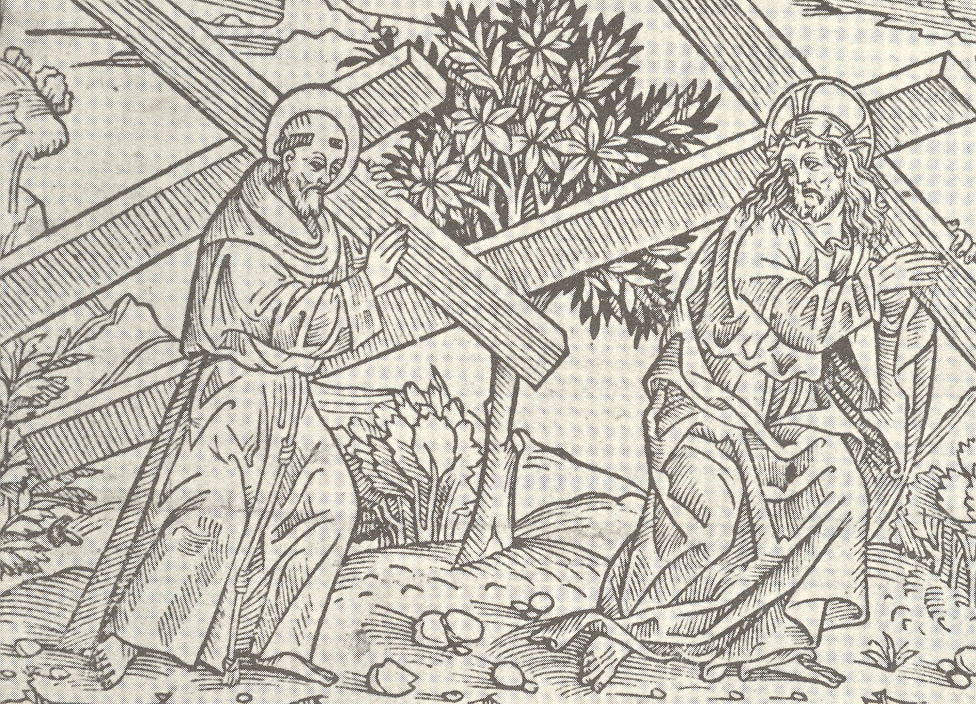
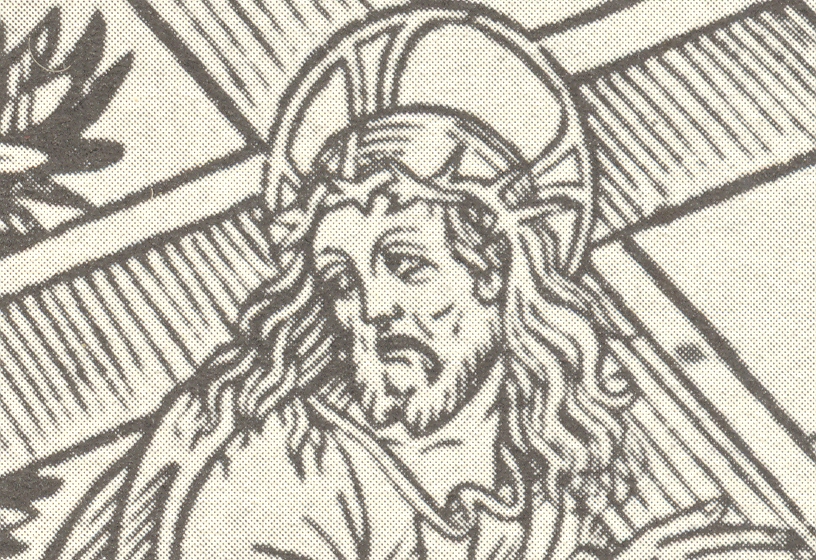
    In Portrait of the Artist as a Young Man, Joyce uses Ovid’s (Metamorphoses, VIII:188) epigram  Et ignotas animum dimittit in artes (“And he applies his mind to unknown arts”  and which continues “and changes the laws of nature”) to describe Daedalus.  It may well address the smaller world of interpretation and metamorphosis of images as it does the larger.  I found this image (at left) in an old bookseller catalog from 1980–it is pretty singular, a show-stopper in a way, the dual burdens of the agony, Christ and the other man.  Actually the woodcut is from the beautiful Liber conformitatium vitae Beati Francsici ad vitam Jesu Christi  (1510) by Bartholomaeus de Rinonichi of Pisa and depicts a scene from the life of  St. Francis of Assisi (1181-1226).  The bookseller notes the work as being very curious and lets it go at about that. On the one hand the work may just well be the massive correspondence on the similarities between the beloved St. Francis and Jesus Christ that it seems to be.  When I look though at the images I can’t help seeing an anti-St. Francis twist to it all. One thing I think that is inescapable is the quizzical look on Christ’s face–he is definitely not sharing the agony, or welcoming a helper. He is clearly at wonder–which in itself is wonderful, as I cannot think of another image showing Christ “surprised”.  It would seem to be a not-subtle attack on the Franciscans in general, an effort to rid it of an exalted place by depicting Francis’ multitudes of too-close similarities to Christ, attacking the order much like the attack on the cults of Mary a thousand years earlier.  I really don’t know–I’m terrifically beyond my element here–I’m just pointing out some surprisingly bothersome aspects of some of the illustrations.  
    Blog--christ surprised 2
    Then again, I’m sure I’m wrong about this “surprised” bit, as this book was a standard for the Order for many years–I just don’t understand the pictures and the interior dialogs that they implied.  I turned to Joyce–perhaps the great master of the internal dialog–to see what I might find there, and then to Hugh Kenner, a revered Joycean interpreter.  And what I found in Kenner commenting on the internal dialog was this:

    “…the Portrait is important not only as an independent work of art but also as a demonstration that the intricate analogical simultaneities of Ulysses and Finnegans Wake are not irresponsibly excogitated from esoteric reading, but grow out of Joyce’s persistent contemplation of intense psychological experience”

    I might as well be working my way through Derrida on Joyce, though without the great suffering.  Could you make that sentence any more difficult by using the same number of words (and without creating poststructuralist vocabulary)? Probably not. His insight might be as obscured as mine.


  • Is the Antiquarian God Left-Handed?

    JF Ptak Science Books LLC  Post 581      Blog Store Site

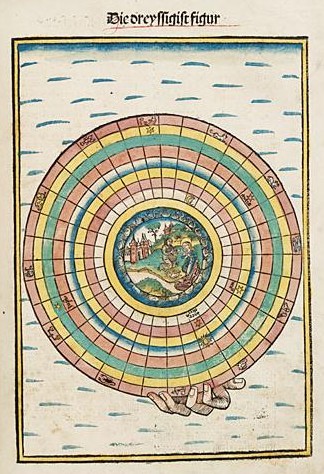
    Blog--fridopion This woodcut is the work of Michael Wohlgemut (1434 – 1519) for an illustration in Stephan Fridolin, Der Schatzbehalter oder Schrein der waren Reichtümer des Heils und ewger Seligheit, which was one of the 15th century’s most brilliantly illustrated books.  It was printed printed by Anton Koberger in Nürnberg in 1491, and formed the backdrop for his even more ambitious book of the next year, the Schedel Liber chronicarum (also known as the Nuremberg Chronicle).  Both books’ illustrations were by Wohgemut and Pleydenwurff atelier (a “school” in which Albrecht Durer had received some of his early training). 
    Hands_of_God_and_Adam
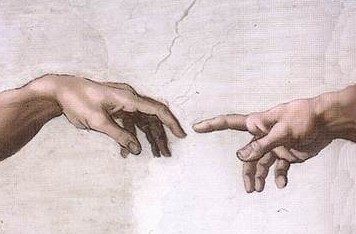
    This center of this woodcut shows the birth of Jesus Christ, a scene circumscribed by numerous other layers representing the heavens and, ultimately, the universe with layer of the heavens  given a zodiacal symbol.  The whole is set in a sketchy blue “sky”, supported underneath by the hand of the creator.  The left hand.  Generally, at least in my memory, images of the creator’s hands have been the right hand.  I’m not so sure why this one is the left.  But it is, and, well, that is unusual.  I don’t know what it means, if anything. 

    LeftHand2