A Daily History of Holes, Dots, Lines, Science, History, Math, Physics, Art, the Unintentional Absurd, Architecture, Maps, Data Visualization, Blank and Missing Things, and so on. |1.6 million words, 7500 images, 4.9 million hits| Press & appearances in The Times, Le Figaro, Mensa, The Economist, The Guardian, Discovery News, Slate, Le Monde, Sci American Blogs, Le Pont, and many other places… 5000+ total posts since 2008.

Category: Prints–looking HARD/deeply at

  • Triumphantly Unusual Images of the Eiffel Tower

    JF Ptak Science Books LLC  Post 732  Blog Bookstore

    ===blog--aug 26==eiffel

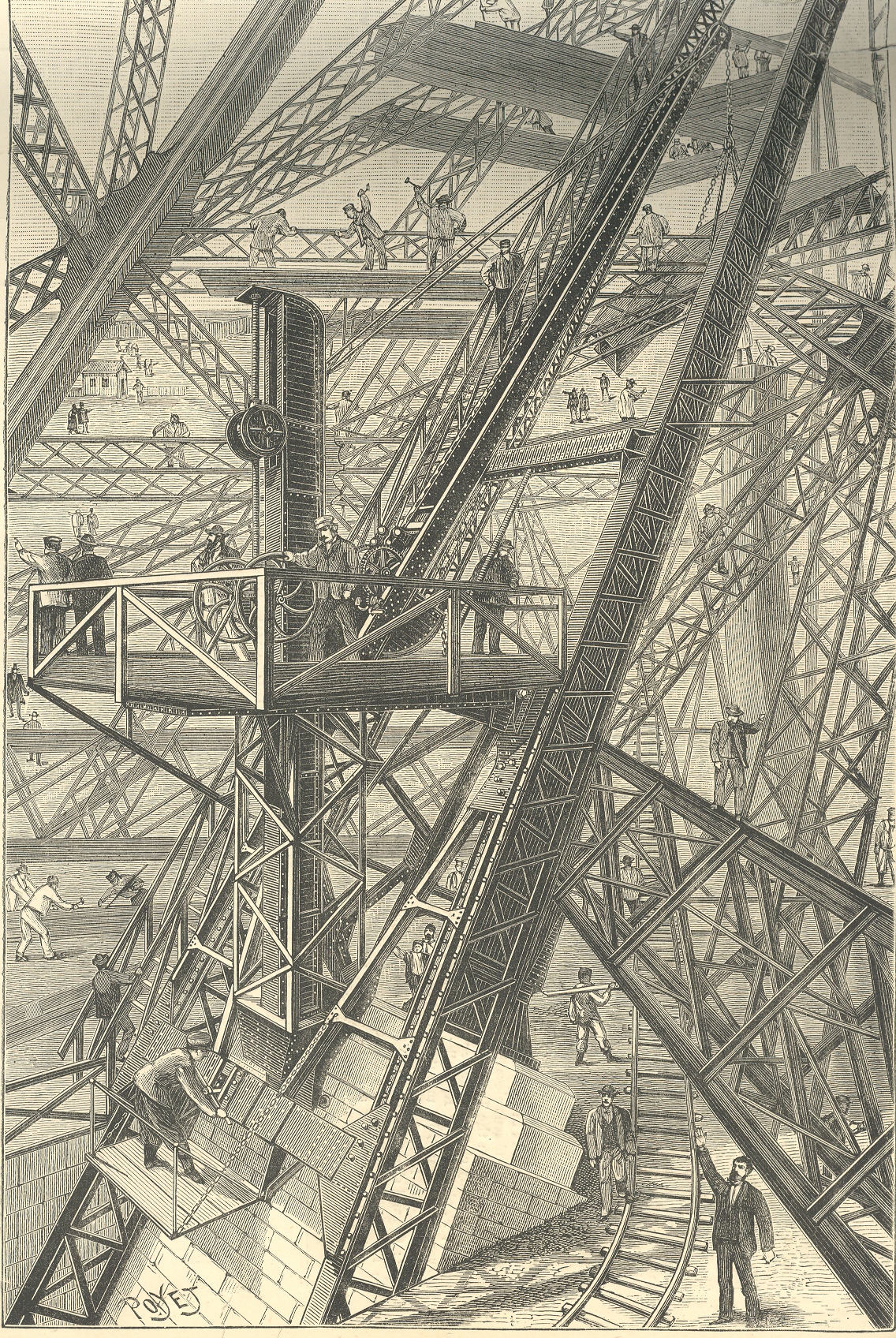
    This image of the building of the foundation of the Eiffel Tower, which appeared in the
    Scientific American in 1888, appears both orderly and chaotic, a dizzy miasma
    of activity and a confusion of right angles. 
    (My six-year-old Tess says that it looks “worky”.)  Part of the issue is the fine quality of the
    jumble, with 90-degree angles everywhere, which confuses the eye.  Another part is the perspective, which is odd
    in places, and which takes the whole of it and makes the print into a near
    Escher-like experience of impossibility. 
    IT is this spatial confusion which makes this print so uncomfortable to
    me. For instance it seems that the observer’s point of view may be in several
    different positions, depending

    Eiffel odd

    on where you resolve to fix our eye: if you choose
    the worker’s shed in the upper left corner as a reference point, the height of
    you viewpoint will be different than if you used, say the first pointing man in
    the foreground as reference.  Also that
    pointing man sands next to a little rail track that seems to hoist itself into
    the air before disappearing.  There’s
    much else, but these examples will do for present.

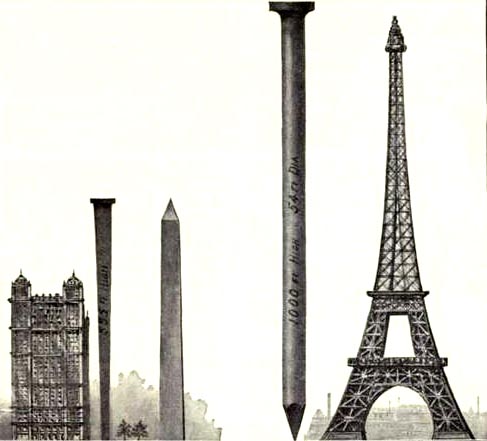
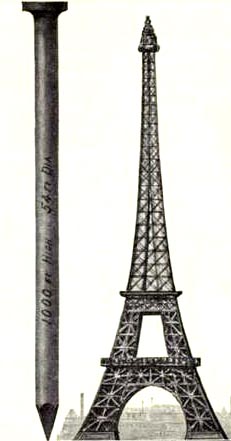
    These other images are the first nail & Eiffel Tower images I’ve ever seen.  The explanation is simple enough, though I think I’d much rather not know. 

    This image and data is from the generally useful data and
    interesting if not useless info Scientific
    American Reference Book. A Manual for the Office, Household and Shop
    ,
    by Albert A. Hopkins, and published in 1903. It gloriously depicts the annual American finish nail production in terms of Eiffel Towers:  there were evidently 10-million 100-pound kegs of these nails made in 1902; if they were made into one big nail, it would be this one–52′ in diameter and 1000 feet tall.  I guess another useful visual bit would be the representation of the number of new houses built/kegs of nails, which would make this image a little more meaningful; though, perhaps, we may not be going for meaning, here, necessarily.


    Eiffel odd det


  • Powerhouse Woman Aviator: Amy Johnson, 1930

    JF Ptak Science Books LLC  Post 731  Blog Bookstore
    ===blog==aug 25=amy johnson

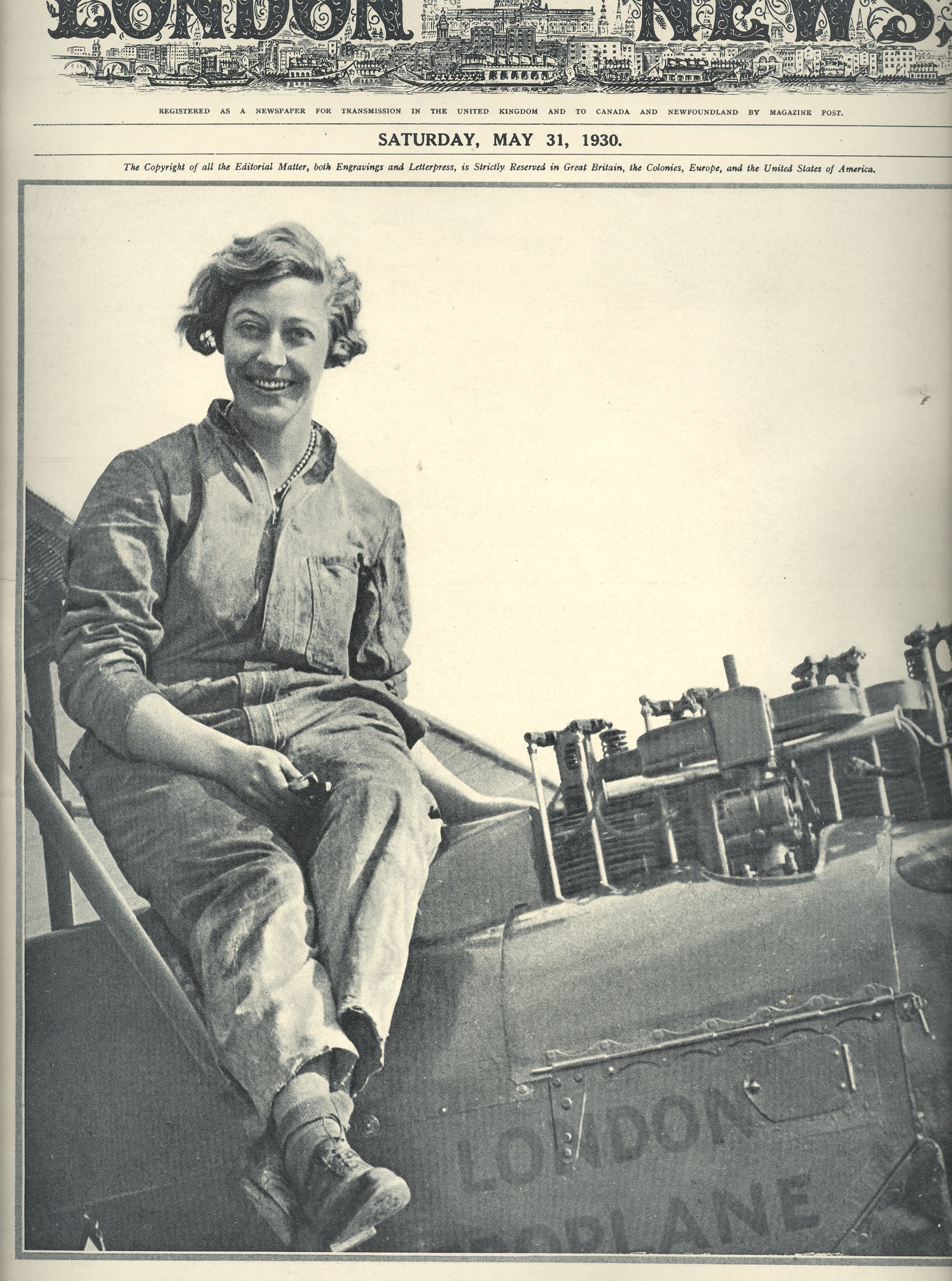
    Amy Johnson was the real deal. She was apparently hell-bent
    on flying:  she took her class “A” flying
    license in 1929 (at age 26) after just sixteen hours of training, and got her aviation
    engineer license a few months later (becoming one of the first women in England
    to do so.)  She was then off to Australia, by
    herself, becoming the first woman to make this as a solo flight.  Ms. Johnson covered all the bases in flight, knowing
    how to fly, having the stamina and courage for flight, and also being able to
    work a trade in the engine.  (Here she
    was the only woman ground engineer certified by the Air Ministry.)

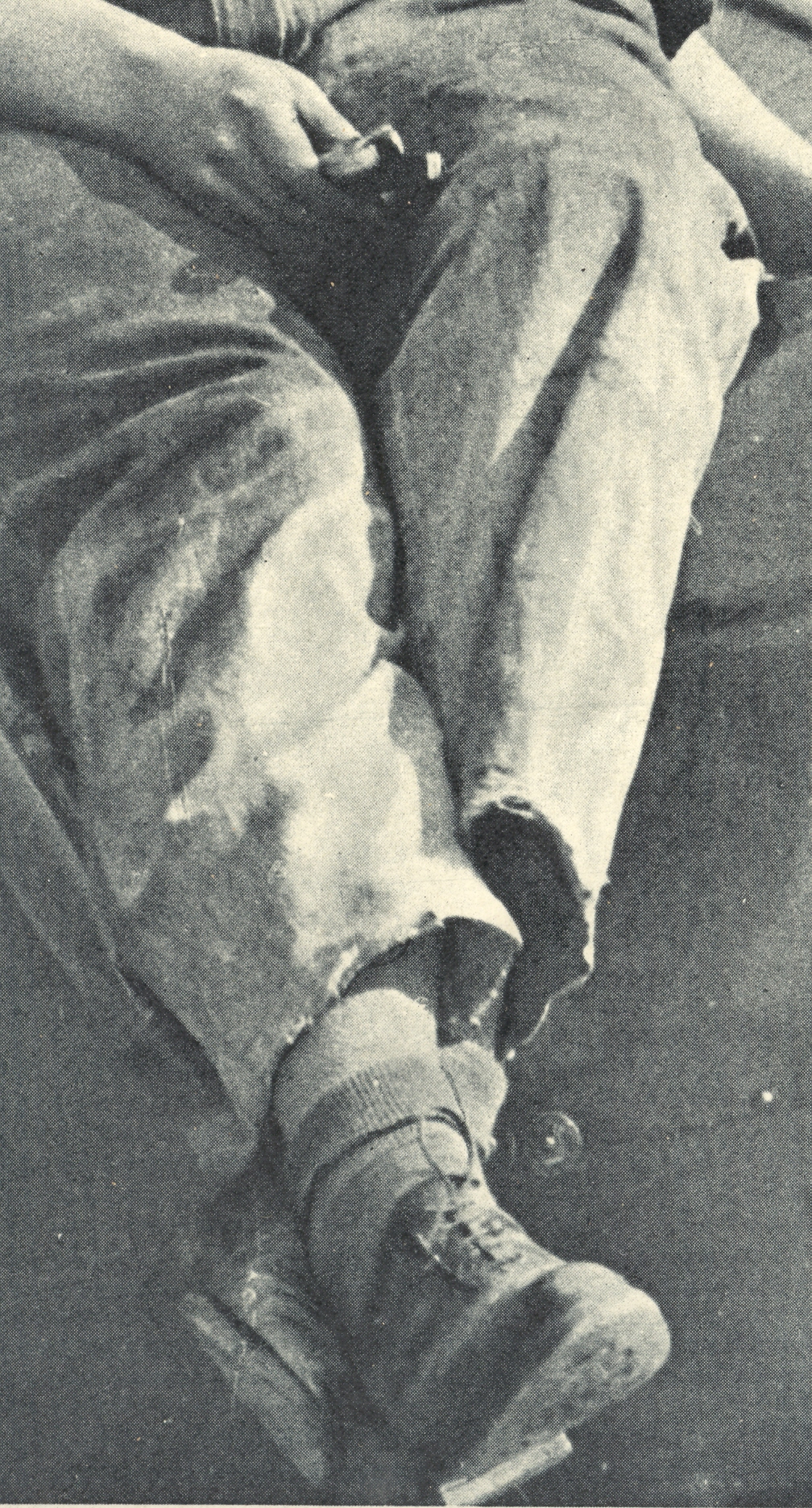
    When you look closely at this happy picture you can tell
    that Ms. Johnson came upon her frayed and worn pant cuffs honestly, as she did
    her oil/grime stained trouser legs.  This
    was no glam shot.

    Detail

    Amy Johnson accomplished other feats and firsts in aviation
    history before dying in the line of duty flying in 1942.     


  • Saving the Unsavable: Antique Wrapped Gifts and Retinal Memory (?)

    JF Ptak Science Books LLC  Post 726 Blog Bookstore

    Don’t think, just look! –(early) Ludwig Wittgenstein  Don’t look, just think.–(late) Ludwig Wittgenstein

    There is a certain class of things of the world that just weren’t intended to be saved.  There are the truly impossible things, like saving a battlefield in situ, or wrecks of various types (though there are war memorials featuring wrecked aircraft and tanks and such), and beautiful clouds1, or waves, and so on. There are things that shouldn’t be saved, really, like unstoppable, non-foreseeably-useful biological agents, (real, and not the imaginary) massive weapons of mass destruction, and certain ideas that should never been taken our of the thought-vault and acted upon.   Down the list from the deeply impossible comes the extraordinarily not-probable, like the collection of things found in books that Marty Weil featured on his ephemera blog a few weeks ago. 

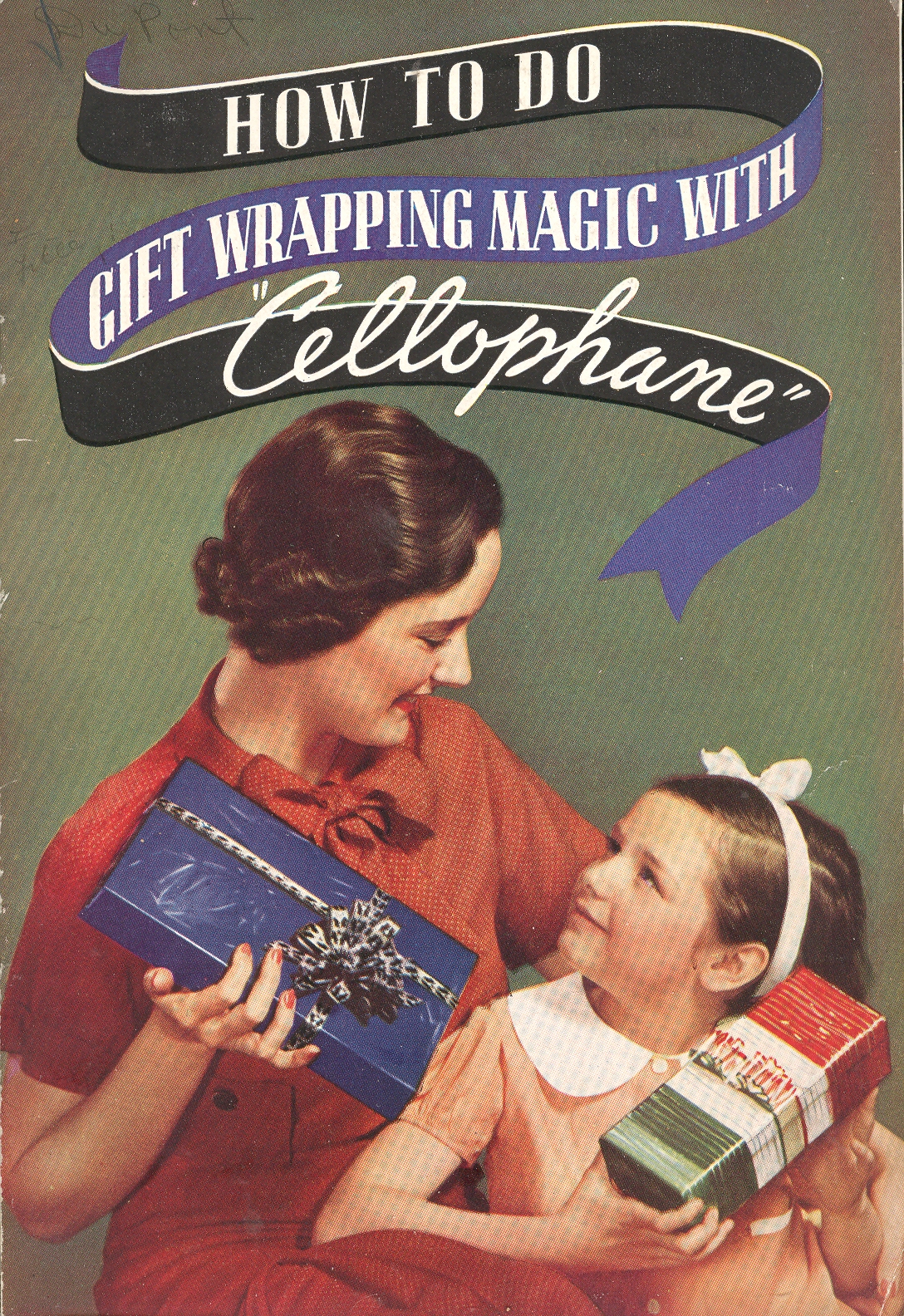
    ===blog==aug 10--color celophane cvr Which brings me to gifts—actually, gifts in wrapping paper meant for presentation.  These things in-and-of themselves wouldn’t survive unless the gift was lost, or given and then not unwrapped (a la Ms. Haversham—she still had her wrapped wedding presents, yes?), or something that interrupted the process.  Whereas some ephemera out there in the world might be saved for mysterious or obvious reasons—like baseball programs or ticket stubs—these things are generally post-usage; I’m not sure why anyone would save birthday/wedding gifts, unopened, unless they were one of the dark and disturbed characters in a black-and-white Jim Jarmusch film (with a musique concrete Tom Waits soundtrack).  Or a David Lynch toss-away character, the person standing by the side of the road, middle of nowhere (Texas), late at night, standing stiff, combing his/her hair, eyes closed. Anyway, I guess you can see now where I’m coming from with people who make collections of unopened gifts.===blog==aug 10--color gift wrap

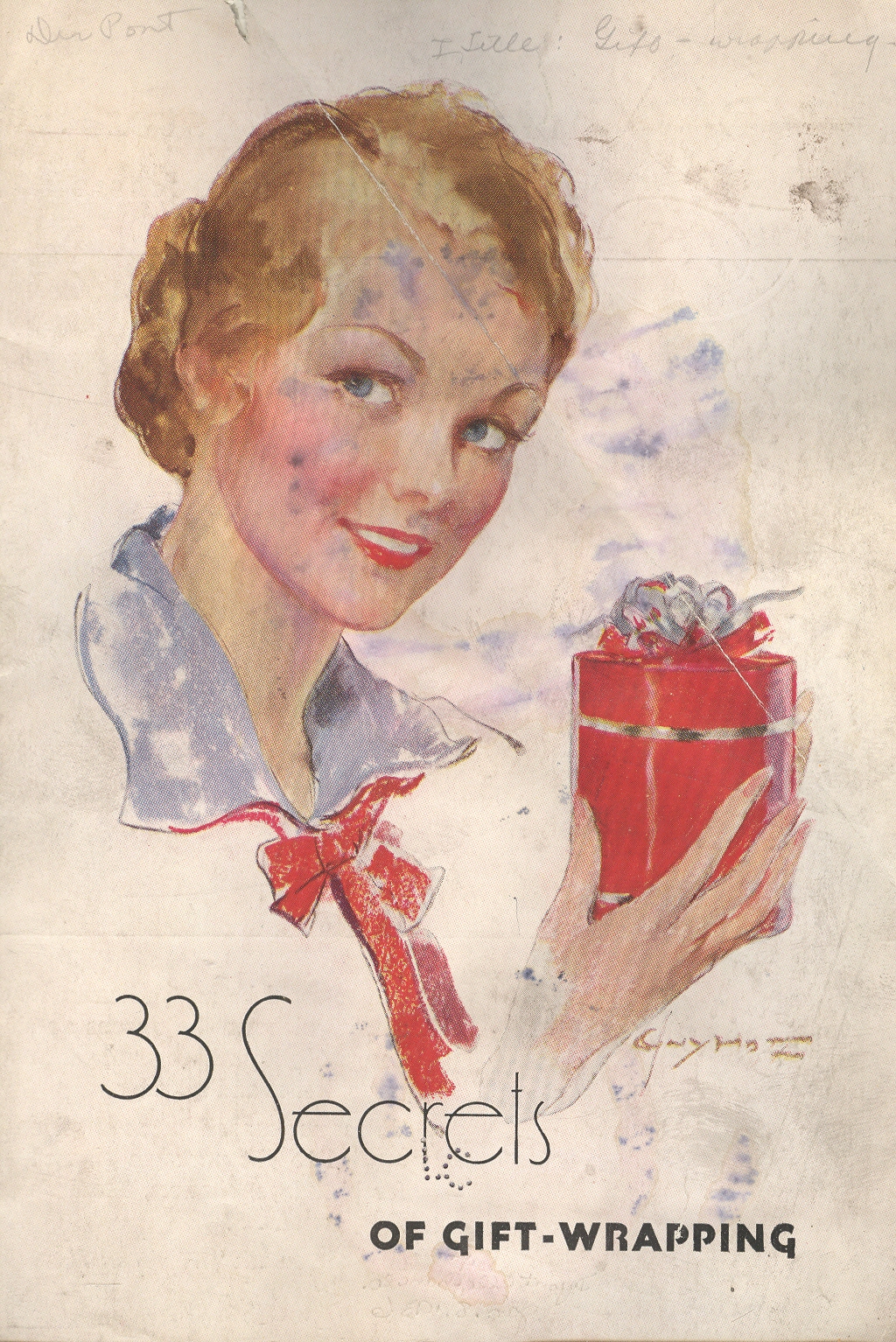
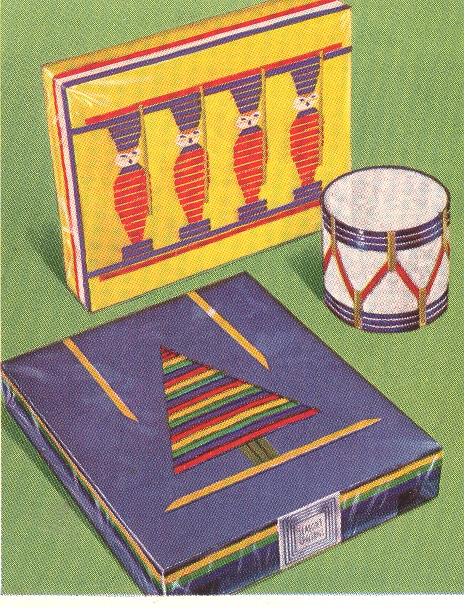
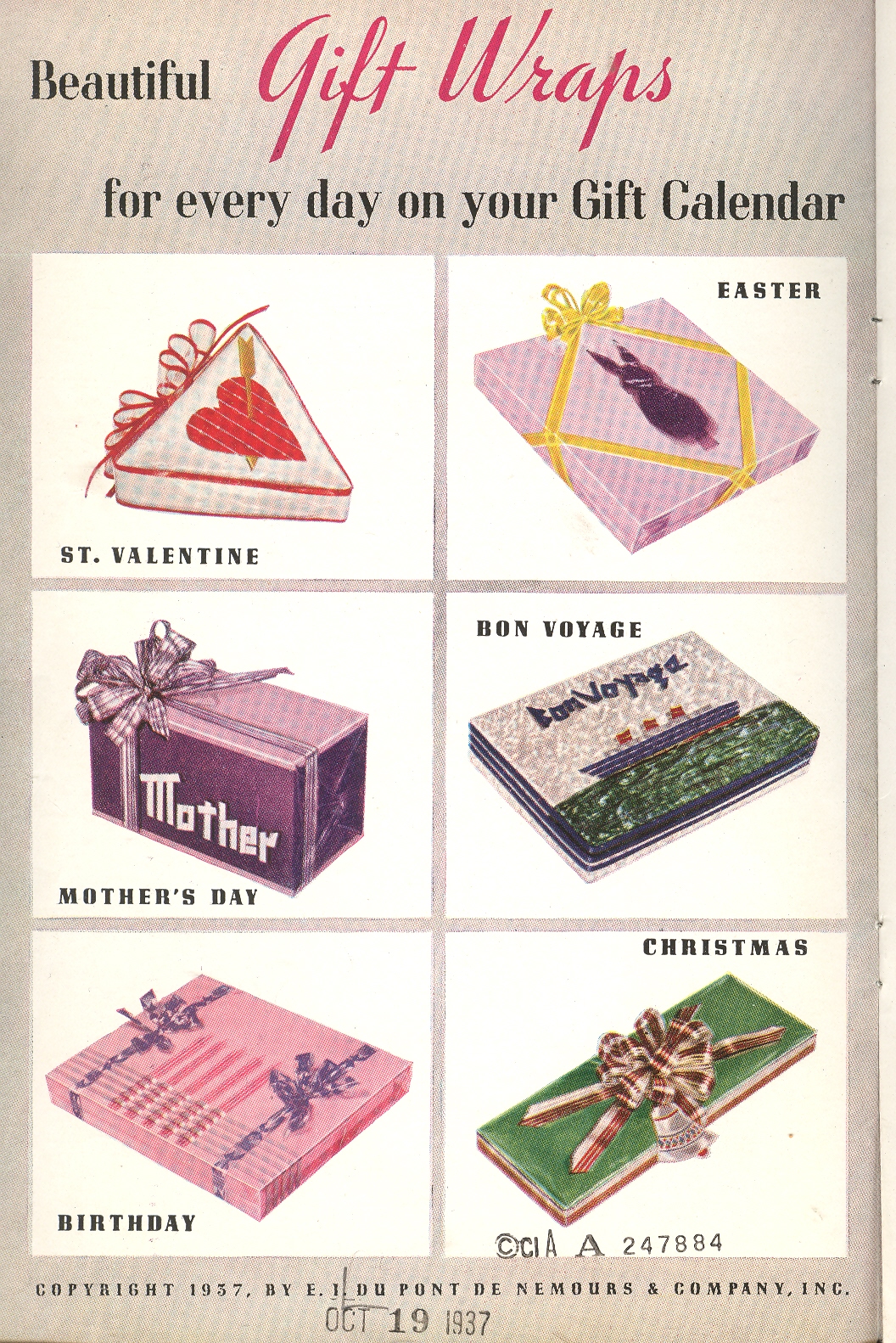
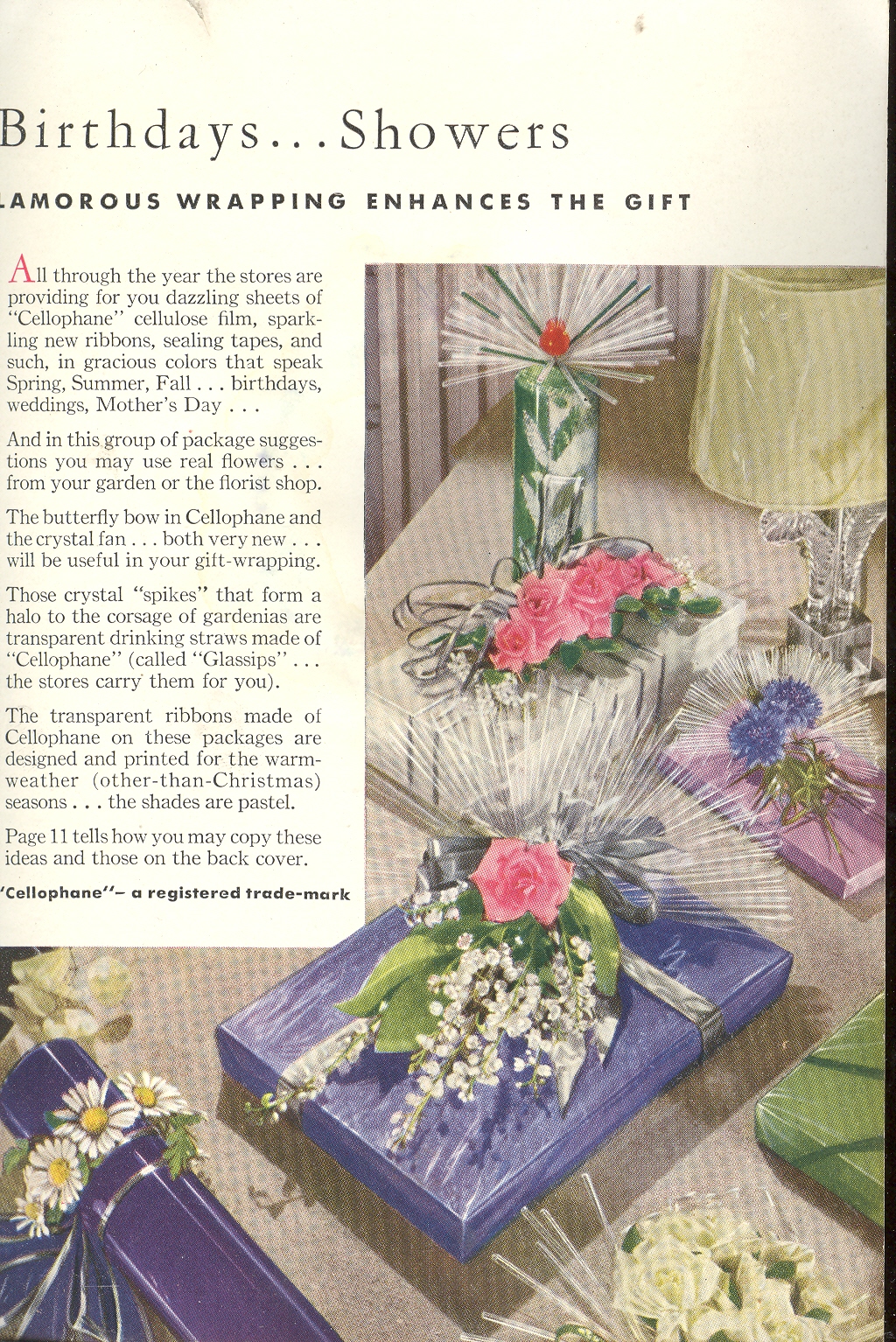
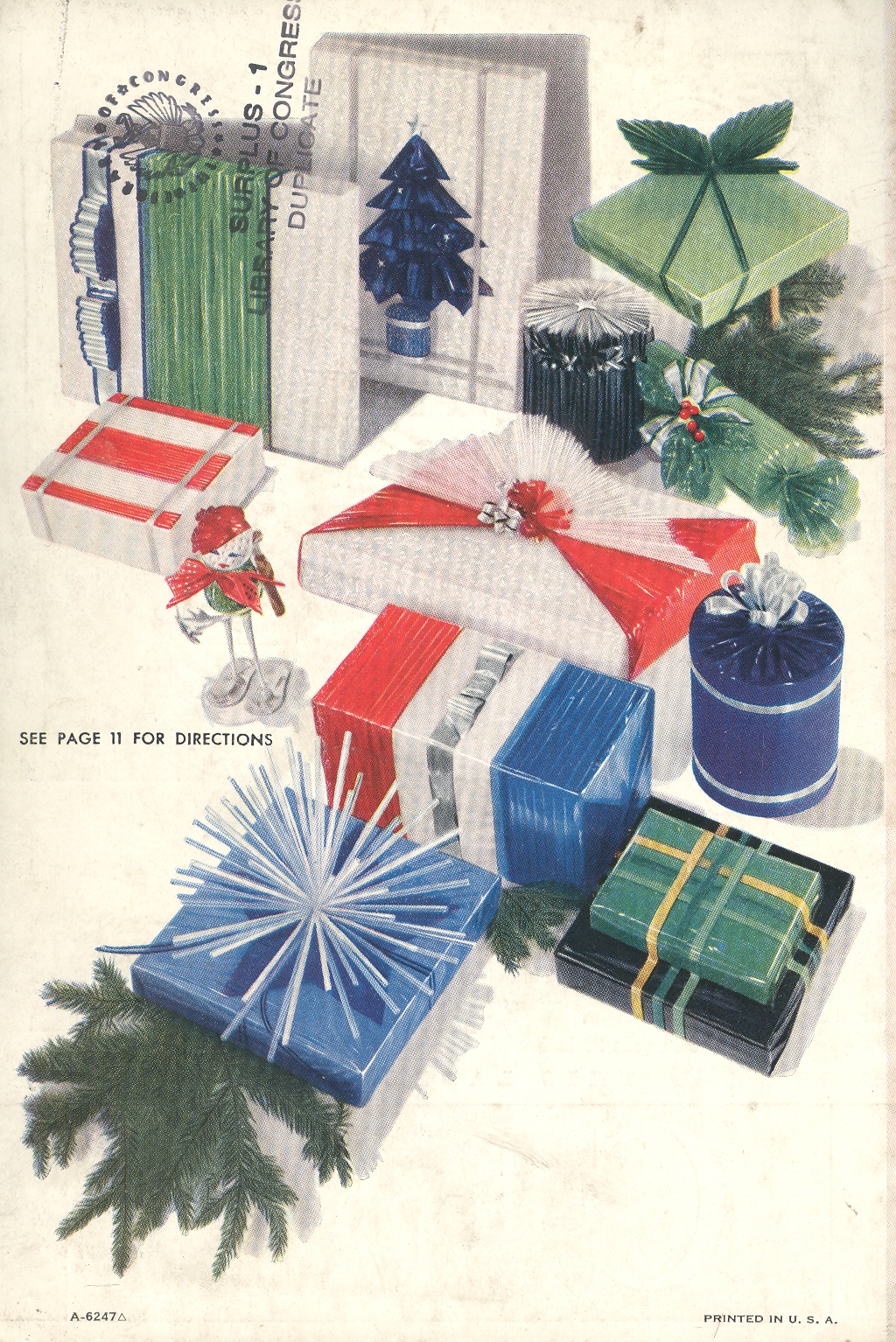
     Hence the pleasant surprise when I opened these two pamphlets, How to Do Gift Wrapping Magic with Cellophane (1937) and 33 Secrets of Gift Wrapping (1940).  Cellophane (from cellulose and diaphane, “transparent”) is a polymer (along with rayon of glucose and was developed (patented in 1912) originally to protect table cloths from spills before the very much wider apps were seen for it. (Earlier in this blog I wrote about how plastics and cellophane changed the way the American public purchased their food, stuff now being sold by how it looked, with consumers pretty much or the first time being able to see what they were getting, among much else.) Ostensibly these two pamphlets are simple manufacturer’s promos to move cellophane products; but for me the interest was seeing all of the displayed examples of wrapped presents.

    ===blog==aug 10--color celophane 001

    I had a  curious reaction to these pictures—somehow, even though the gifts tended towards the garish/gaudy by today’s standards of color schemes, the images and color selection seemed familiar and pleasing.  Certainly gifts couldn’t have been presented in such a way before, a high-sweet luster and translucence only available with cellophane.  It must’ve been quote a new and luxurious experience for folks to use, and so they used it quite a lot, much like the early days of Wordperfect (or WordStar!) when people were finding their sea legs for the wide new powers of presentation.

    ===blog==aug 10--color celophane

    But seeing these present/gift pictures seemed a  little like sinking into a comfortable old chair, like a soft neural pillow finding a retinal memory of the long past, even though these gift exchanges happened decades before I was born. Weirdly, the colors seemed a little more than a description of the way my eye reacted to different bits of the visible spectrum.  Even though I know I don’t like these colors together—or separately sometimes—they still had a queer appeal to me. 

     ===blog==aug 10--color gift wrap2 001This has swung a little far from the original target of this post.  The main point is still the survivability of stuff that demands to be destroyed in order for it to be used, and the use is entirely unknown until that destruction (of the wrapping of the present) is completed.

    Notes:===blog==aug 10--color gift wrap2

    1. These things can be imaged in 3-D, and holographed, but the thing itself cannot be saved; or at least, not yet.  Cool to imagine someone in The Future doing this…

    . 

  • The Origin of British Bug Books

    JF Ptak Science Books LLC  Post 721  Blog Bookstore

    +++bugs2

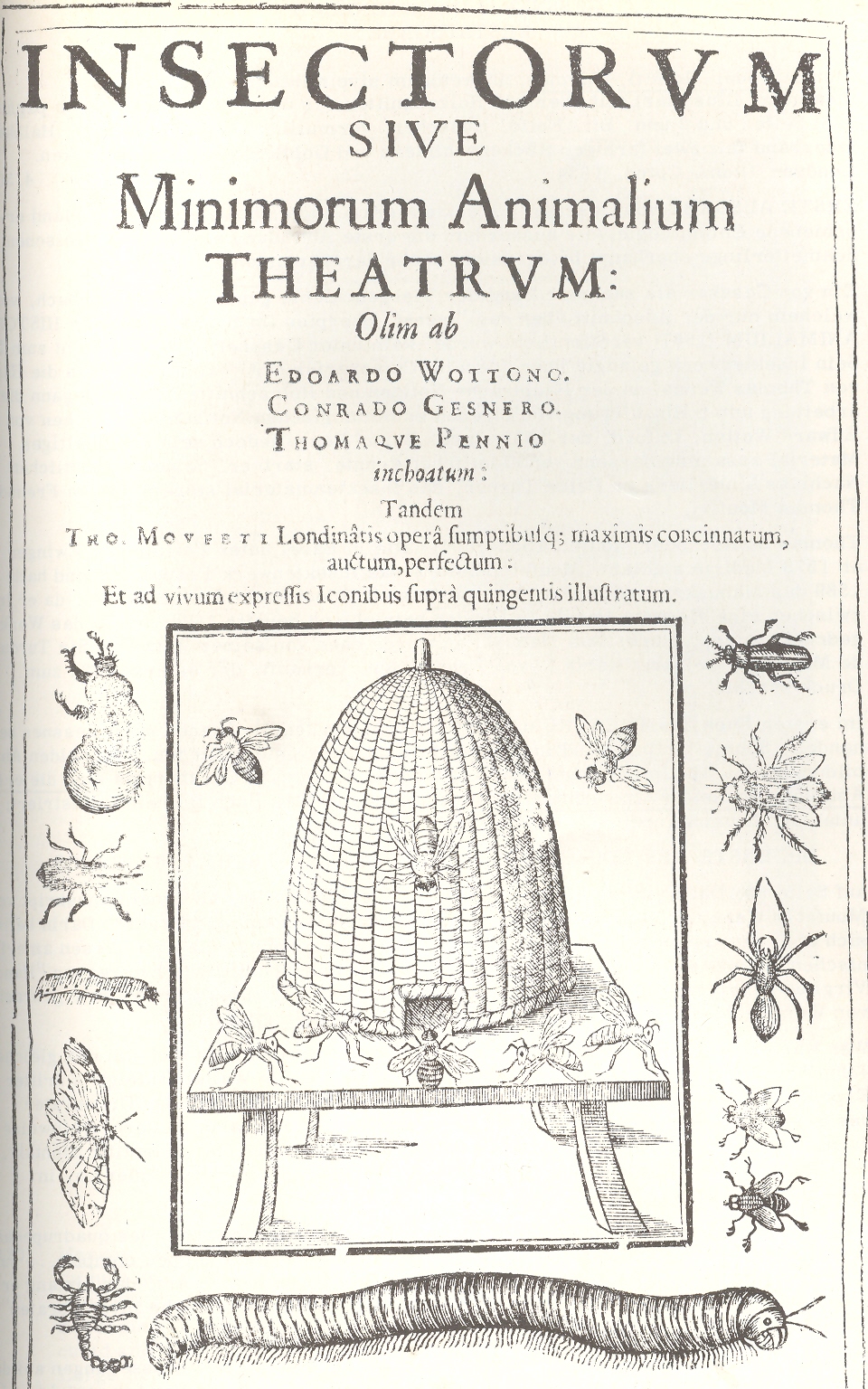
    The first book printed in England relating to bugs and bugiana, the first entomological work, owed its life to a
    considerable bibliographic heritage, and also offered up the beginning of a
    nursery rhyme

    +++bugsperhaps more repeated than any other over the last 470
    years.  The book (Insectorum sive Minimorum Animalium Theatrum: olim ab Edoardo Wottono.
    Conrado Gesnero. Thomaque Pennio inchoatum: Tandem Tho. Moufeti Londinâtis
    operâ sumptibusque maximis concinnatum, auctum, perfectum: et ad vivum
    expressis Iconibus supr…
    ) was “by” Thomas Moffett (or Muffet or Moffet),
    who acquired it after a number of others had, and after others had written (most)
    of it, as we see in the title, with the appearance of the names Gesnero (“Gesnero”),
    Thomas Penny (“Thomaque Pennio”), and Edward Wotton (“Edpardo Wottono”).  It is a considerable work very long in the
    making, and has hundreds of small and delightful illustrations, not the least of
    which is the appearance of the millipede on the book’s title page, which is my
    principal attraction here.

    Mr. Moffett’s child, Patience, is* the Little Miss Muffet of
    the nursery rhyme. 

    Little Miss Muffet sat on a tuffet,

    Eating her curds and whey;
    Along came a spider, who sat down beside her
    And frightened Miss Muffet away.

    *Or
    perhaps not.  Patience was his stepchild
    who probably did not share her stepfather’s fascination for bugs and spiders;
    and as much as I like the idea of Patience being the model for the rhyme, she
    doesn’t reach far enough into the future, what with the first printing of the
    rhyme appearing in 1805.  But it does
    make a good story. 


  • Paul Klee, Henry Darger and Puppets, Real and Imagined

    JF Ptak Science Books Post 717  Blog Bookstore


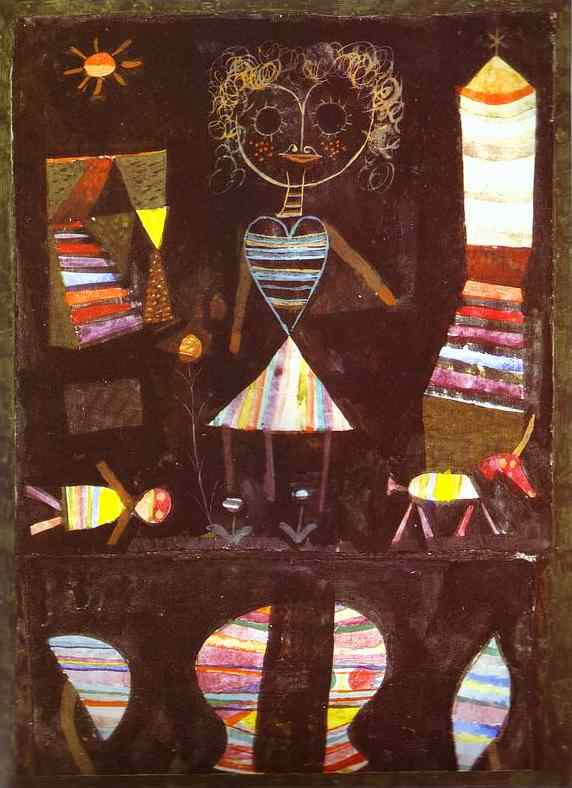
    While he was serving in the German army, Paul Klee’s 1917 journal entry (#1032) contained this pearl, coming being advice from his sergeant to him and the rest of the non-com grunts:  “Let’s not kid ourselves, at our workshop– you won’t get ahead. There you’ll find advancement.”

    Klee (born in the same year as Einstein and died in the second year of the European War, 1940) was a leading and inventive modern painter, who along with Franz Marc and Wassily Kandinsky created the Blaue Reiter movement, and who worked in close proximity to many of the major art movements of the new era.  He was an iconic, creative artist of vast influence.
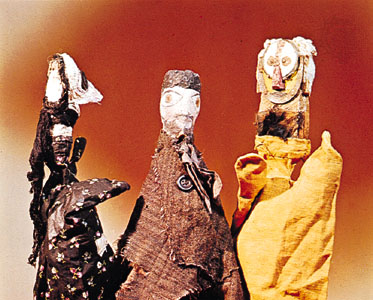
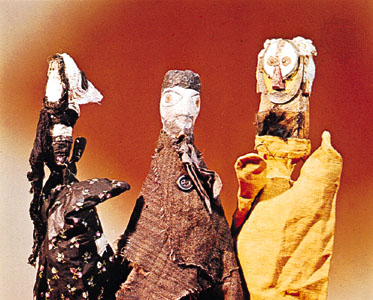
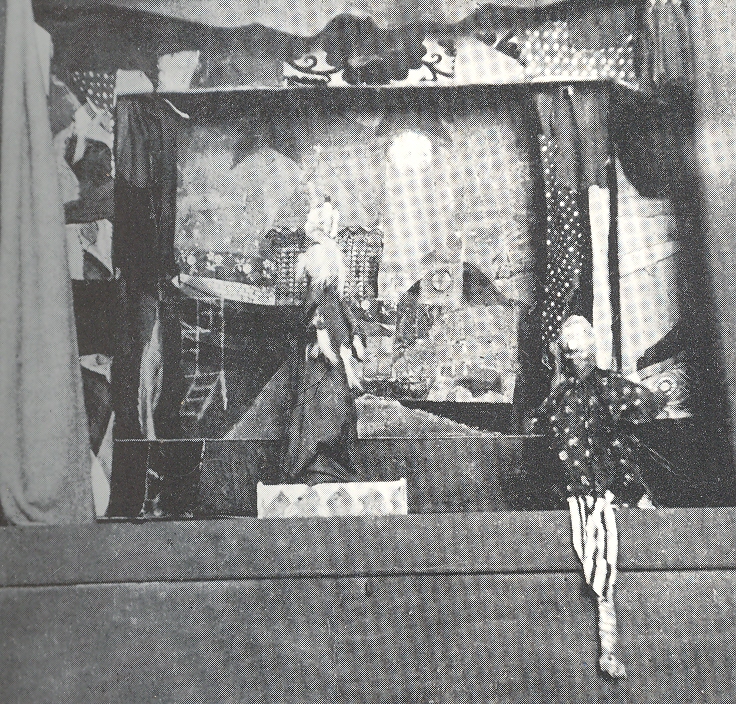
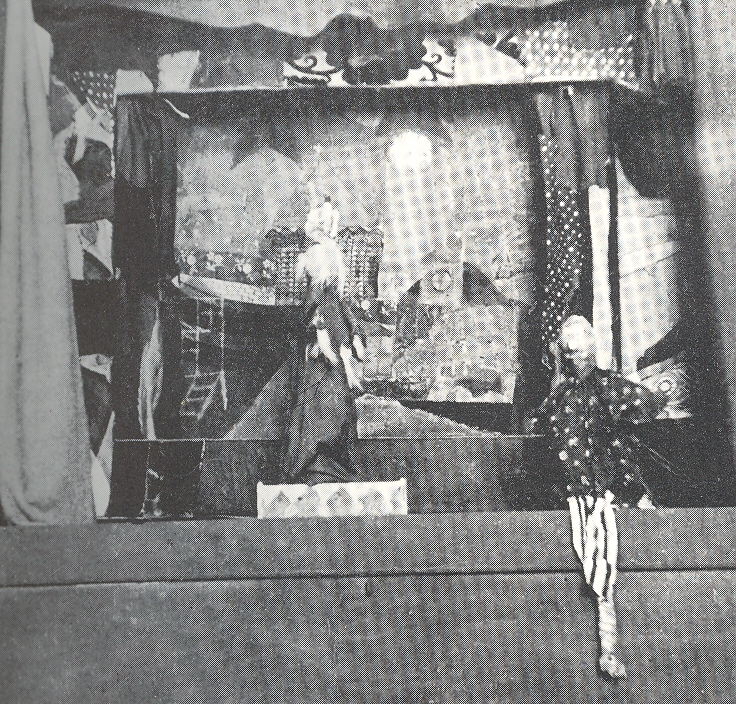
    ===blog==aug 19==klee puppet color What struck me today was this image of Klee’s hand-made toys and this seldom-seen image of the puppets he created for his boy, Felix, around 1922.  (Felix was 13, Paul  43.)  Evidently Klee made 50 or so of these puppets, 30 of which have survived.  They are lovely and whimsical and are examples of quick, creative work with found and manipulated objects.  I can certainly visualize Klee getting drawn into the project—his diaries too show that he was interested in his son’s development, taking note of the different small, developmental things that lots of folks can miss when their child is growing up.  The puppets are intimate, made for his son for play, and are composed of bristle and bone and nutshells and electrical outlets and bits of gingham and cloth and wire and buttons.  Stuff from the junk drawn or whatnot box.  Klee did construct more elaborate puppets for his connection with the theatre, and of course was also a sculptor.  But I do like these little puppets, much in the same way as I enjoy the small toys made by Alexander Calder for his kids.
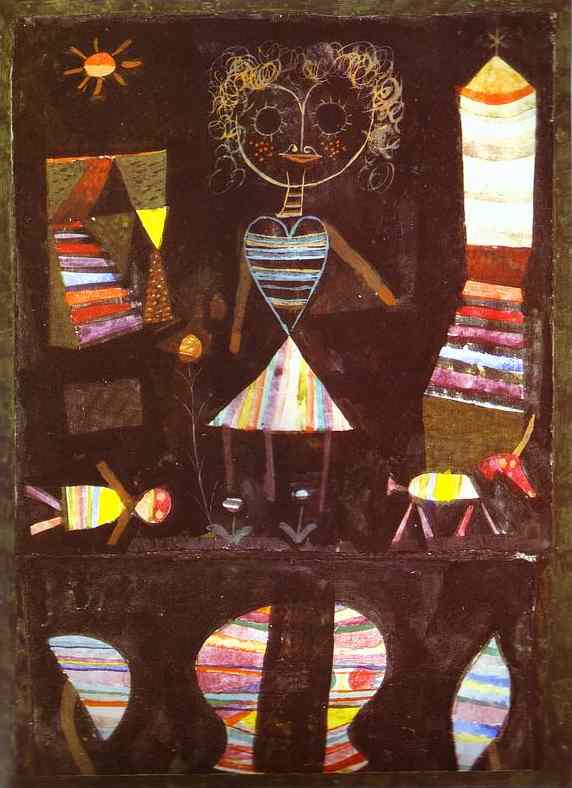
    ===blog==aug 19==klee painting puppet 1923

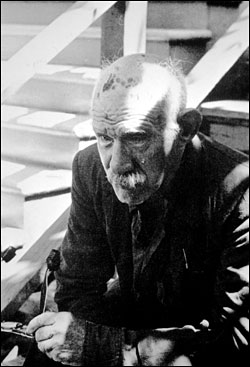
    And somewhere in there imagining Klee getting a little lost in constructing these puppets arose the image of Henry Darger, the severely-imaginistic, primarily invisible-in-life  outsider artist who found his fame in post mortem glory.  Darger’s  (1892-1973) work—and life—were discovered only after his death, when his apartment in Chicago became an archaeological dig by his landlords, and his massive and outré output became “discovered”.  The process of discovery seemed not to interest Darger in life, as he had extremely limited contact with people and was basically an Invisible in work, pushing mops and brooms for most of his life to make his rent.  In the meantime, in the lifetime not at work, Darger was very busy in his own created world, typing out a 15,000-page novel/world called  The Story of the Vivian Girls, in What is known as the Realms of the Unreal, of the Glandeco-Angelinnian War Storm, Caused by the Child Slave Rebellion…  (This is just one of his works of fiction—another is a 10,000-page work called  CrazKleey House: Further Adventures in Chicago, and another is a  work of autobiography (?), where Darger spends 200-odd pages on his early life before slipping away into a 4,800-page diversion on a tornado called “Sweetie Pie”.)
    His artwork was primarily concerned with this constructed environment of the Vivian girls, and I must say that it is fascinating to me, but only forensically—I don’t “enjoy” it per se, even though it is phenomenal, and fantastical.  The subject matter—often veering into bestial brutality towards children, with lots of dripping redness–is just too deeply twisted and disturbed for me to enjoy, though I do have an appreciation for the stuff that surrounds it all. 

    And so what does this all have to do with Paul Klee and puppetry?Darger
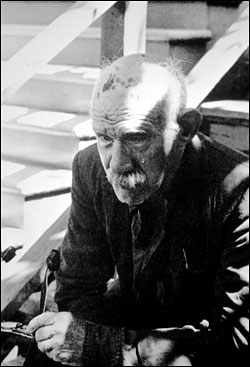
    Nothing, except in a fiction that I’ve had in my head about Darger (pictured at right)   for as long as I’ve known about him, and which is also wholly unsupported by fact or reasonable supposition.  Listen:  from the first moments that I knew of him, I pictured Darger returning to his rooms at night after a day of cleaning, mopping, scrubbing, taking abuse for spills not cleaned, and then reliving the entire day at night in miniature.  In my own story, Darger created small figurines and puppets through which he re-enacted his day, complete with sets of the rooms in which he worked.  Perhaps he lost himself in these moments, finding a vindication in miniature stages in his second-story walk-up that he couldn’t in his daily life, allowing his creative, 50,000-page nighttime imagination to open up. 

    That’s what I had in my own head when I saw the image of the Klees’ theatre, and puppets.  Certainly my Darger idea is not what Klee had in mind; nor is it anything that was in Darger’s mind, either.  Just mine.

  • Gorgonzola Cheese, Red Wine, Lemon Soap. Joyce’s “Ulysses”.

    JF Ptak Science Books  Post 716 

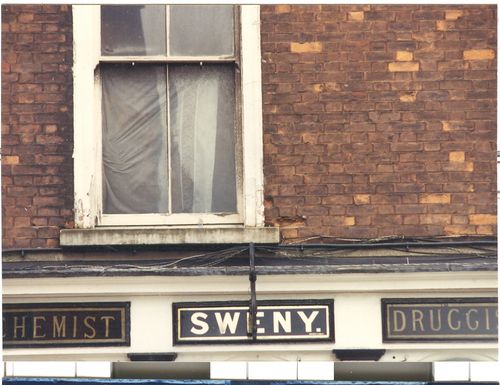
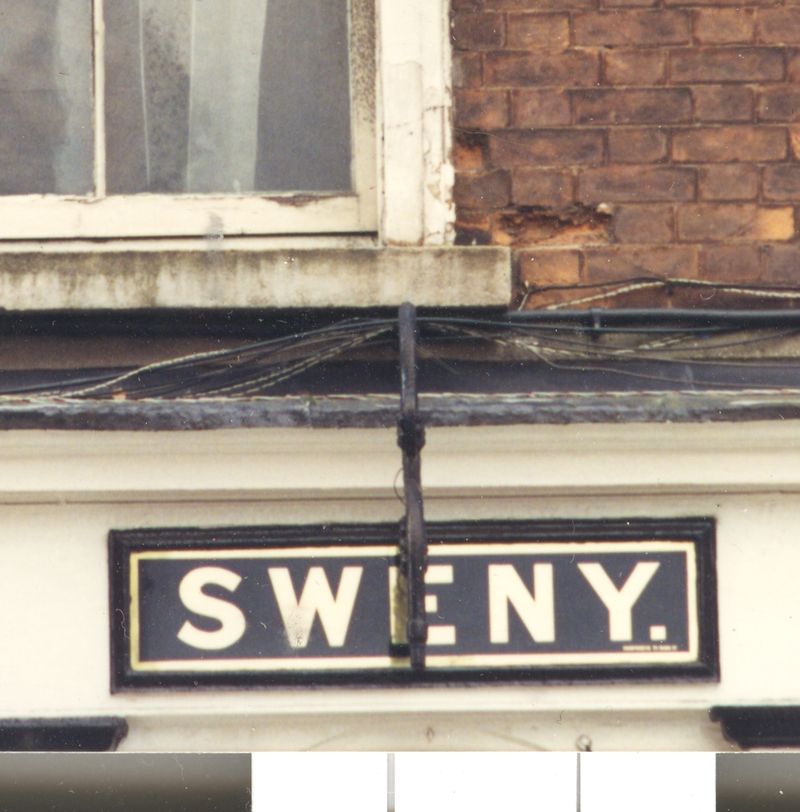
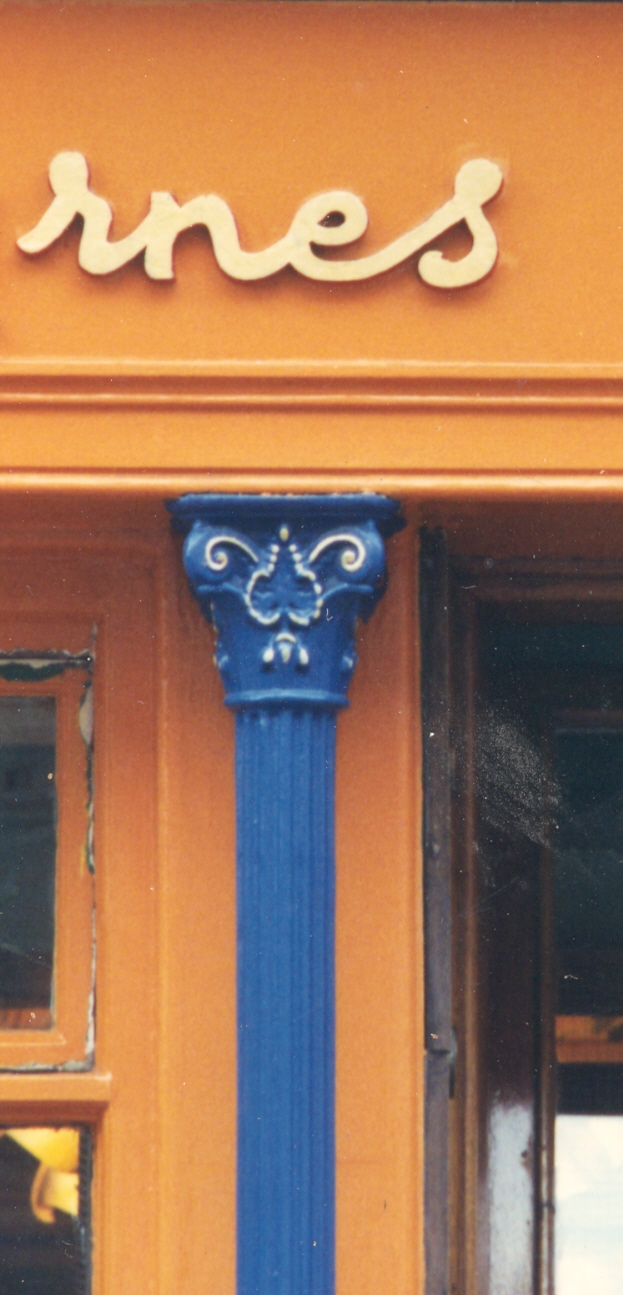
    I just came across these image that I made on a trip to Dublin some years ago.  Carrying the bags for my wife, Patti Digh, who was actually working there, I described my own work by going on a Ulysses tour. It was Sweny’s and Davy Byrnes (seems like two e’s are missing there, no?)  that I liked the most–particularly so for the chemists, because it looked as though nothing major had happened in there in  years, or at least that was the sense of the smallish creaking shop.  I wanted some lemon soap.

      Sweny_1_

     Sweny’s is described by Brendan Kilty in his book on the great chemist’s shop, called simply Sweny:  “It is the epiccentre of some extraordinary events in literature and history. If you stand at Sweny’s door and describe a circle with a radius of 100 yards give or take you will find your North point outside the birthplace of Oscar Wilde on Westland Row and your South point at his home at No. 1 Merrion Square. To the west, you will still find the faint paint of Finn’s Hotel on the gable of Lincoln Place. Nora Barnacle, James Joyce’s lover and ultimate wife, worked here as a chambermaid and it is from the front door of Finn’s Hotel that she spied on Joyce as he stood outside Wilde’s house when she deliberately stood him up on the evening of the 15th June 1904.”

    Some of the uses of  Swenys in Ulysses occurs as follows:

    “Sweny’s in Lincoln place. Chemists rarely move. Their green and gold beaconjars too heavy to stir. Hamilton Long’s, founded in the year of the flood. Huguenot churchyard near there. Visit some day.”

    And also the following:

    Sweny _2_

    “THE SOAP: We’re a capital couple are Bloom and I. He brightens the
    earth. I polish the sky.
    _(The freckled face of Sweny, the druggist, appears in the disc of the
    soapsun.)_

    SWENY: “Three and a penny, please.”
    BLOOM: “Yes. For my wife. Mrs Marion. Special recipe.”

    “At that point, the time I was there, you could still buy lemon soap–loose, or three to a small wooden box.  I still have mine and it still has a fine scent…”

    Then there’s the lovely Davey Byrnes pub, which makes a number of appearances throughout the book. 

    “He entered Davy Byrne’s. Moral pub. He doesn’t chat. Stands a drink now
    and then. But in leapyear once in four. Cashed a cheque for me once.”

    And then there is:

    ===blog==aug 13==bsweny 001

    Davy Byrne came forward from the hindbar in tuckstitched shirtsleeves, cleaning his lips with two wipes of his napkin. Herring’s blush. Whose smile upon each feature plays with such and such replete. Too much fat on the parsnips.
    “–And here’s himself and pepper on him, Nosey Flynn said. Can you give us a good one for the Gold cup?
    “–I’m off that, Mr Flynn, Davy Byrne answered. I never put anything on a horse.
    “–You’re right there, Nosey Flynn said.”
    “Mr Bloom ate his strips of sandwich, fresh clean bread, with relish of disgust pungent mustard, the feety savour of green cheese. Sips of his wine soothed his palate. Not logwood that. Tastes fuller this weather with the chill off.”
    “Nice quiet bar. Nice piece of wood in that counter. Nicely planed. Like the way it curves there.”
    “–I wouldn’t do anything at all in that line, Davy Byrne said. It ruined many a man, the same horses.”


    Byrnes outdoors


  • Snowflakes and Fort Construction–Scamozzi & Palmanova

    JF Ptak Science Books LLC  Post 715

    My apologies for the formatting problem below–Typepad again has struck with its incongruities. Again.  Did I mention “again”?)

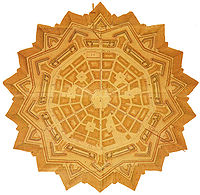
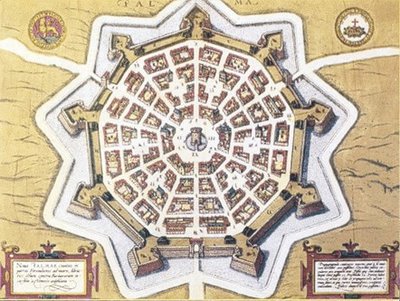
    Vincet Scamozzi, a gifted and powerful architect
    (and whose portrait appears, weirdly, disjointed and floating and entirely out
    of place in the frontispiece to his famous book, completely separated from the
    connectedness of his work) was also the designer of this gorgeous star “fort”
    at Palmanova, in northeastern Italy
    —mainly
    the Turks—but nothing ever threatened the place.  Until Napoleon, that is,
    who took the town without a flight in 1793. 

    ===blog==aug 17==gold
    This is actually a plan for an entire town, the brainchild of its Venetian benefactors, 
    the very essence of which was fortification, repulse, security and defence. An
    18th century  Maginot Circle, so to speak—it was a perfectly designed
    system for a fortified town for the time in which it was designed (1593). 
    It was supposed to stand to face the enemies of Venice
    I
    wonder if anyone derived inspiration in fort design from snowflakes?  It
    seems a little doubtful, perhaps, since snow wasn’t dealt with in scientific
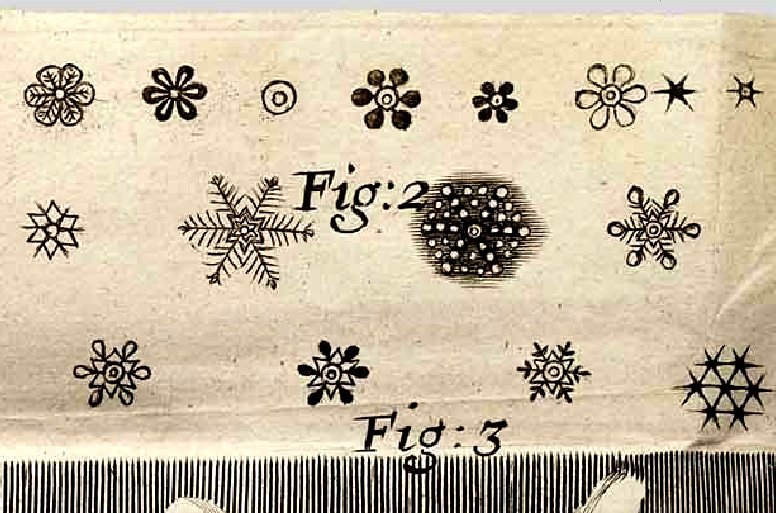
    detail until the every busy Johannes Kepler wrote his treatise on the six-cornered snowflake; and it also wasn’t seen under a microscope in its fabulous detail until 1665 by Robert Hooke.  This was also about the time that modern canon tech was about to
    make these sorts of designs not terribly practical. [Just last week I mentioned
    that a fort on the island next to the island that my family vacations on,
    Tybee, just south of Savannah , is home to the first rifled canon attack on a stone fort—the result was brutal and definitive,
    the day of the fort was done. Until of course the tinny home fort was invented
    by the American federal government to protect hundreds of millions of people
    form devastating nuclear attacks by building steel and stone bunkers under a
    bit of earth in the backyard, making every person their own bit of royalty, reigning
    over one’s grave.===blog aug 17==palmanova  

    But that’s another story. Kepler thought very
    deeply about snowflakes as a result of a serendipitous encounter with one—his
    sympathico correspondence with a snowflake on his coat led to him publishing
    (in 1611) a short treatise called A New Year’s Gift, or On the Six-Cornered
    Snowflake
    , thinking that perhaps the snowflake’s six-cornered symmetry
    revealed something much deeper about the basis of nature and the universe. He
    was racing himself towards a significance of the facultas formatrix, or
    morphogenetic field, and its relationship to everything else, as Kepler was
    looking for a great pattern, his own 17th century Grand Unified Theory. The
    26-year-old  Robert Hooke seems to be recognized as the first to throw the
    snowflake under a microscope, publishing drawings of them and just about
    everything else that he saw in his monumental (and tall, being 13-inches high)
    Micrographia
    (1665)–the first truly scientific book of modern times. 
    Hooke The largest of the large images was saved for the flea, showing the
    unsuspecting public the great and beautiful nature of what seemed like a
    fantastical beast (under magnification).  Snowflakes appeared in the book,
    revealed in their intricate and seemingly-symmetrical nature.  They were
    fantastic, not-yet imagined images. In between these two giants was
    another–Rene Descartes–who was actually the first to render a relatively
    accurate pre-microscope image of a snowflake and did some very good thinking
    about their structure.]

    Perhaps though it is the opposite, perhaps most of these pre-Renaissance Western European forts do bear resemblances to snowflakes, though without attribution.  (I just did a quick google search on some of the major writers on the construction of forts, and “snowflake” makes not one appearance.) Of course there is no mention of any biological acuity in ancient and near-ancient city plans that bear striking resemblences to human biological units.  I guess you really don’t need to have any idea about on the subject of crystal growth or know what super-cooled cloud droplets look like in order to design something that looks like one…


  • Paradise Alley: Slavery in Alaska, 1899

    JF Ptak Science Books LLC   Post 714   Blog Bookstore

    The Klondike Gold Rush, or the great Alaskan Gold Rush, took place at the very tail end of the 19th century (starting 1896/7) along the Klondike River near Dawson, Alaska.  It was a wild, woolly (literally) time, with communities of thousands springing up in just a few days–Klondike itself grew almost immediately to 40,000, stretching all human services, food being the scarcest commodity.

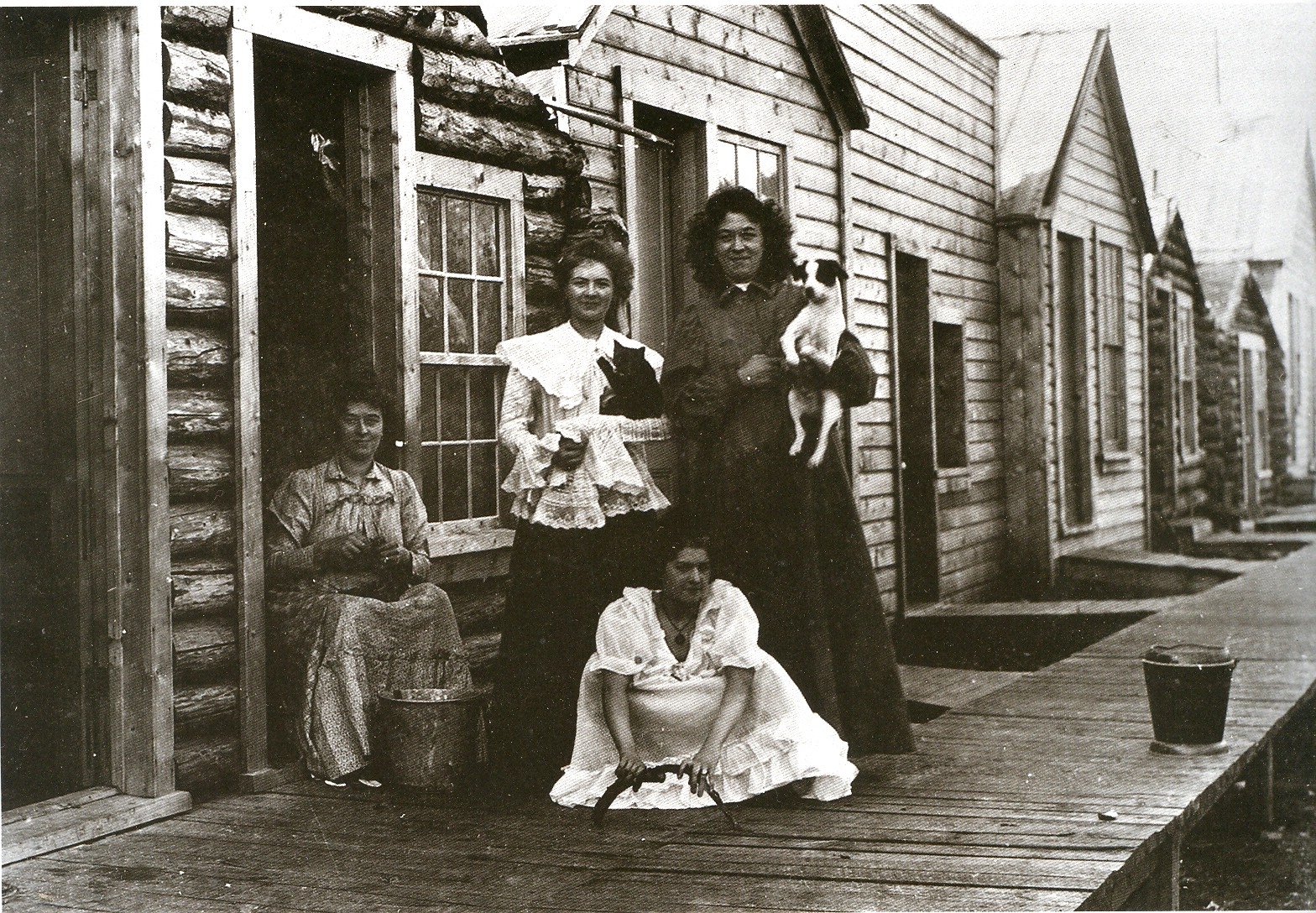
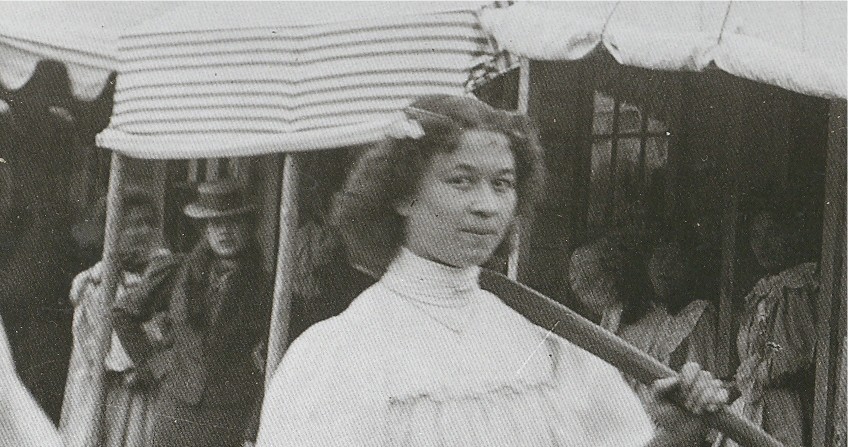
    One service to humans that was ably met was sexual, filled by legions of prostitutes, some of whom arrived in the Klondike of their own free will, and others, not.  This photo, made near Dawson, shows “Paradise Alley” (behind front street) an almost-overnight series of rough-hewn log bungalows sweatily constructed for lonely needs. There were evidently 70 of these little huts, all in a row, each with the woman’s name above the door, presumably rendered in chalk.  (It seems that the photos I’ve seen of women in the Klondike show many smiles, but no toothy ones.)

    ==blog==aug14==paradise alley

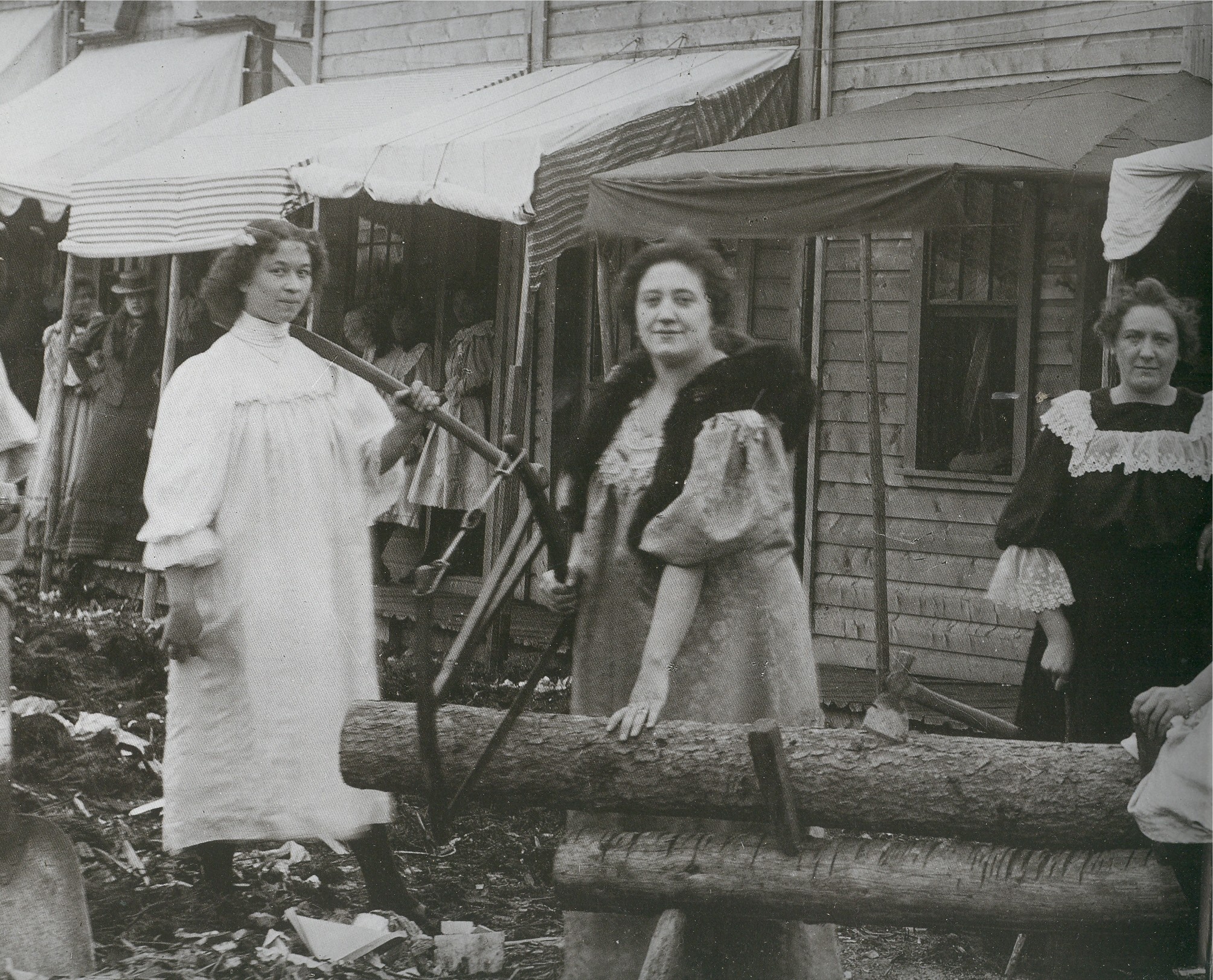
    This is a detail from a photo seen in Pierre Berton’s The Klondike Quest (a big, beautiful book of high rank for a popular history, interestingly published with a more shouty title in America as Klondike Fever) showing the working women of Dawson working at other trades.  I particularly like the picture of the high-collared white-dressed angel-woman witht he axe on her shoulder…and the woman behind her, under the make-shift cloth awning, her hat tiled forward and her hand jauntily on her relaxed hip.

    ==blog==aug14==paradise alley2

    Prostitution wasn’t legal, nor was gambling or the encyclopedia of con games that evolved here–but all certainly flourished, with many fortunes made outside the gold fields. Mr. Pantanges started his movie house empire here, and Donald Duck’s Uncle Scrooge started his pile of money bags, as did many other people.  But the 12.5 million ounces of gold wasn’t exxactly distributed with equality to the dozens of thousnds, and probably hundreds of thousnads of people who came to the Klondike looking for their fortunes.  I’m certain that in this vast game of winners and losers, there was moreof the later and less of the former. 

    ==blog==aug14==paradise alley3


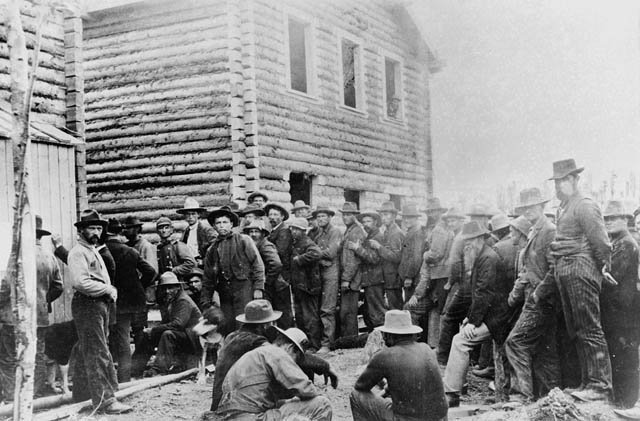
    This image of miners waiting to register their claims gives us a pretty decent idea of the clientelle available to these women.  Oy.  Seems to me an impossible way to live–for the women, that is.

    ==blog aug 14=miners waiting2

    ==blog aug 14=miners waiting                                                                                                                                                         


  • Liverpool, the Battle of Britain, and Alois Hitler, 1940-1942

    JF Ptak Science Books LLC  Post 711 Blog Bookstore

    ===blog==aug 10--crowd

    It is ironic that the last day of blitz bombing against Liverpoolin WWII claimed the house at 102 Upper Stanhope Street, the home of
    Alois Hitler (Jr.) (1882-1956), Adolf’s brother.  Alois and family survived because they were at the delivering end of this effort–Berlin–during the war,  Alois serving beer throughout the course of the conflict to happily favored
    stormtroopers.  But at one time before
    WWI the Hitlers lived there at #102 until abandoning England for the Vaterland.  There is a long and unsubstantiated rumor
    that Adolf lived there too in 1912/13 attempting to avoid Austrian conscription,
    but that claim seems entirely unsupported to historians, though it has proved fertile imaging ground for the theater..  Alois Jr. seems to have been a violence-prone
    washout, and unwanted and unacknowledged by his half-brother, winding up with far
    right wing proclivities post-war. When those plans fizzled, he signed photos of
    his brother for tourists for a few dollars each, providing a bit of his own surrealist-concrete theater. He did contribute a son—Heinz Hitler–to the war effort.  Heinz, Hitler’s nephew, was taken prisoner in
    Operation Barbarossa and sent to Moscow’s 17th-century Butyrka prison, a truly evil place, which was
    once home to 20,000 “political” prisoners taken during the Great Purge, among
    much else.  Heinz melted into the stone
    after months of interrogation, which must’ve turned into sport after the first
    few days.===blog==aug 10--cover

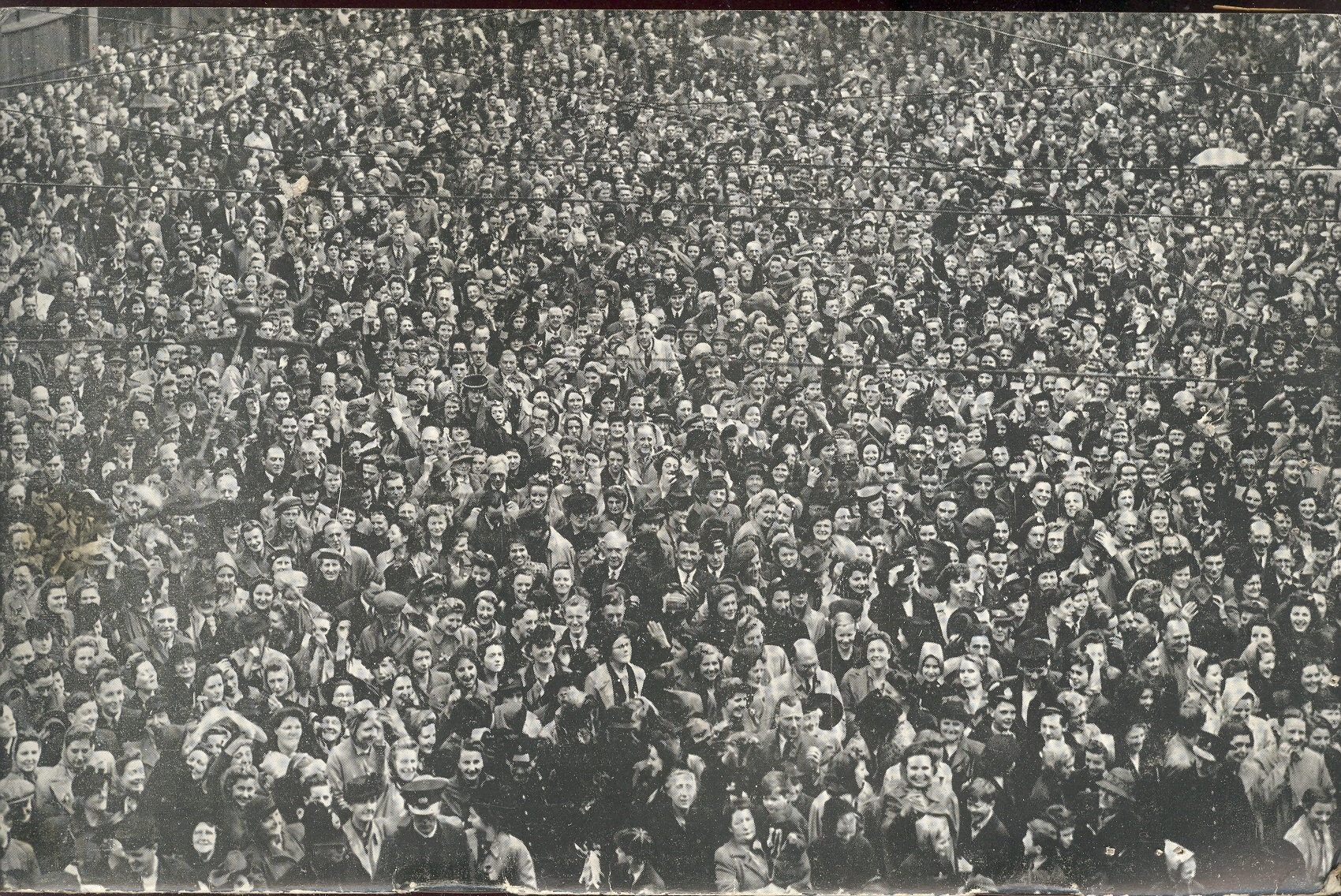
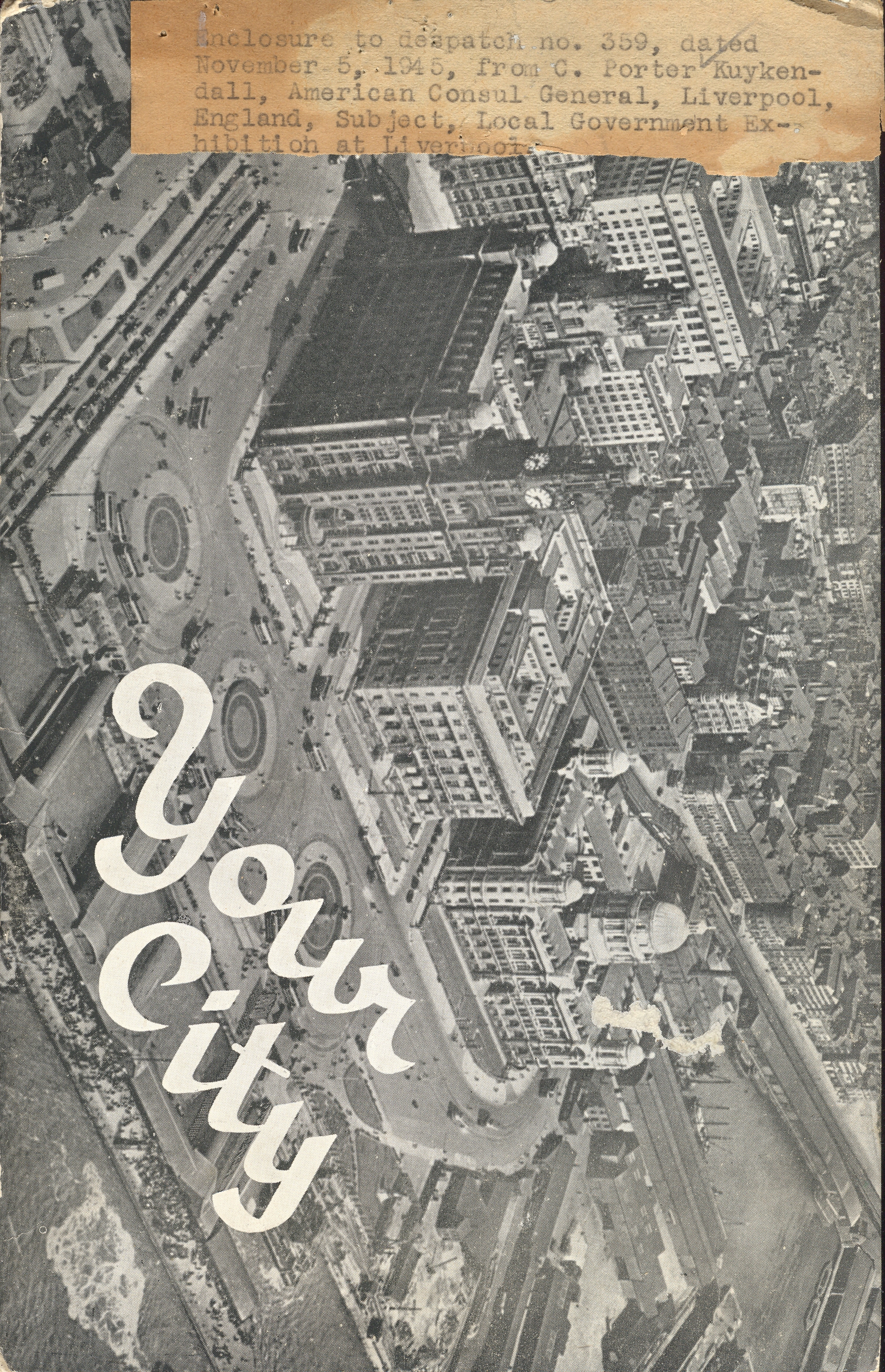
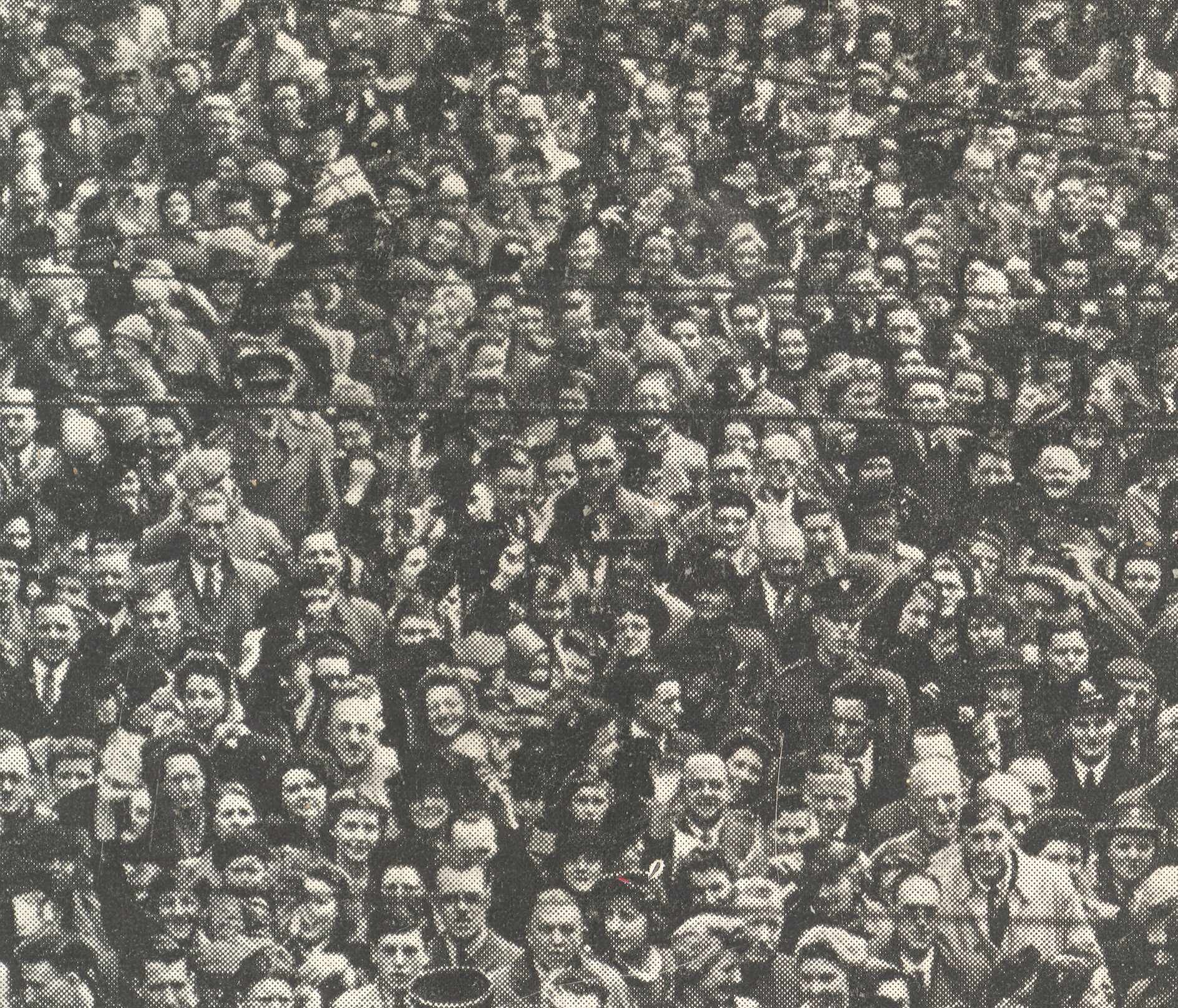
    That’s not what I wanted to write about here, though.  It is the image of the crowd on the back
    cover of this pamphlet, Your City, a citizen’s guide to Liverpool,
    published in October 1945.  It seems to
    me that the crowd scene here numbers about 4000 people, which is representative
    of the number of Liverpudians killed between 1940-1942 in the German air
    attacks on the city.  Liverpool was the
    second-most lethal city to be in during the war for air attack (following London’s losses of better
    than 30,000), due to its importance in the production of war-necessary goods.

    ===blog==aug 10--crowd det

    In a true stiff upper lip, deeply old-school, and very highly admirable fashion, there is no mention of the
    war, no mention of damage from air raids, no mention of anything untoward.  No photos of anything bombed out.  Nothing. 
    This was also pretty much in line with the official reporting on the
    bombing, which for obvious reasons was greatly downplayed in the press.  (There is no need to provide free reporting
    on the effectiveness of your enemy’s bombing campaign to the enemy.) This was a simple vision of the future, and a call for all citizens to register a concern with the proper functioning of their city.

    The large crowd scene struck me as a very quiet memorial to
    those killed in these terror attacks.


  • Waiting for the Atomic Goodbye: Yucca Flats, ca. 1955

    JF Ptak Science Books LLC  Post 710

    ===blog=yucca

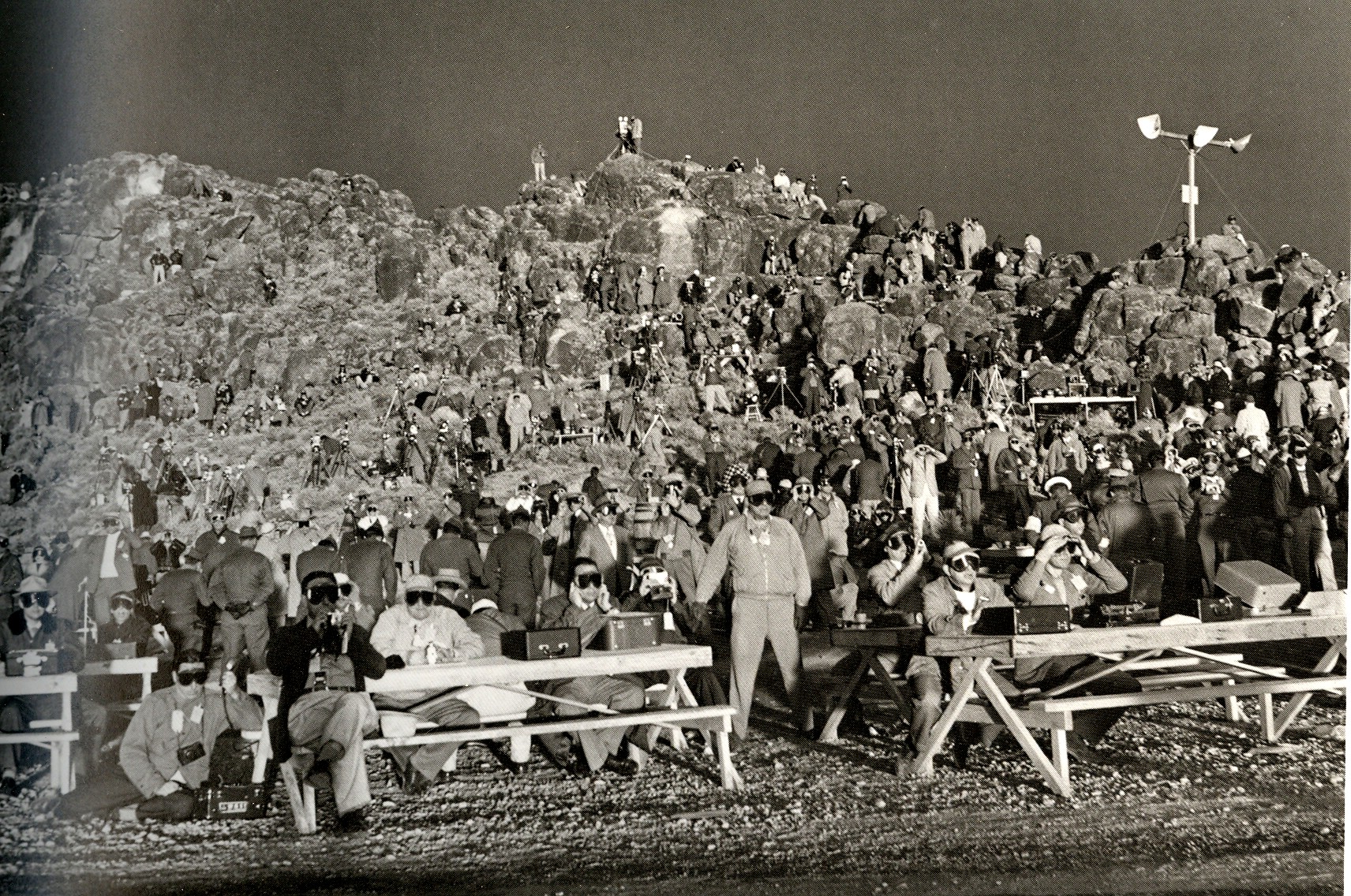
    This indelible image has two big residences
    for this blog, as follows:

    Perspective 1:  Waiting to Say Goodbye Department, part
    2. 

    Yucca Flat
    is a big, wide place in the desert,
    about 65 wide-landscape miles northwest of
    Las Vegas, Nevada. 
    As part of the Rhode-Island-sized Nevada Test Site (NTS) it is also the
    most irradiated and radiation-polluted place in the country.  It was the site of some 749 nuclear tests–about
    80% of all the nuclear tests carried out at NTS. And it shows, and will show,
    pretty much forever.

    This remarkable photo of a test shot
    was made at Yucca in the mid-1950’s—in the dark.  Actually it was dark, pre-dawn before the
    viewing station of observers was completely, Georgia-O’Keefe-like illuminated
    by the brilliant explosion.  The people
    here were gathered at “News Knob”, about seven miles away from the detonation
    point, and all wearing dark, welder-strength goggles to prevent the blindness
    that would’ve occurred if they looked at the explosion without protection—best
    yet was to wear the goggles and have your back turned to the flash (as some in
    this picture did).

    This is perhaps the greatest single photo demonstrating the power of nuclear
    explosions. You can see the devastating effects, and the giant rising mushroom
    clouds and all, but they’re like photos of the Grand
    Canyon—nothing really captures the essence of the thing.  This image makes the entire idea somewhat “habitable”,
    graspable, in a weird, visceral way, placing the power of the event in an
    imaginable context. 

    Perspective 2: Where to be and Where to Look Department; Turning Around.

    This is another monumental photographic image in the turning-completely-away-from-what-everyone-else-is-looking-at
    department, following such massive images as Ed Clark’s  iconic FDR
    photo.  Just as Mr. Clark pointed (see my
    post from last year), the picture to be made was not the newsreel shot of the
    President’s casket being borne to the train, but it was in the face of the
    accordionist, who Mr. Clark found by turning away from the scene being recorded
    by a hundred other photographers.  It was
    his picture that told the emotional story of that evident.  Just as is the case with this anonymous,
    undated photo from the test shot at Yucca, bringing the unimaginable back to some degree of human understanding.

    Notes:

    Photo from Frances Fralin, The Indelible Image, Photographs of War, 1846 to
    the Present
    , based on a show at the Corcoran Art Museum, Washington DC, 1985,
    and published by Harry Abrams.