A Daily History of Holes, Dots, Lines, Science, History, Math, Physics, Art, the Unintentional Absurd, Architecture, Maps, Data Visualization, Blank and Missing Things, and so on. |1.6 million words, 7500 images, 4.9 million hits| Press & appearances in The Times, Le Figaro, Mensa, The Economist, The Guardian, Discovery News, Slate, Le Monde, Sci American Blogs, Le Pont, and many other places… 5000+ total posts since 2008.

Category: Prints–looking HARD/deeply at

  • Fun in the 16th Century Bath: Minerals, Spirits, Frolic and Ennui

    JF Ptak Science Books LLC  Post 790  Blog Boosktore

    + bathing 001

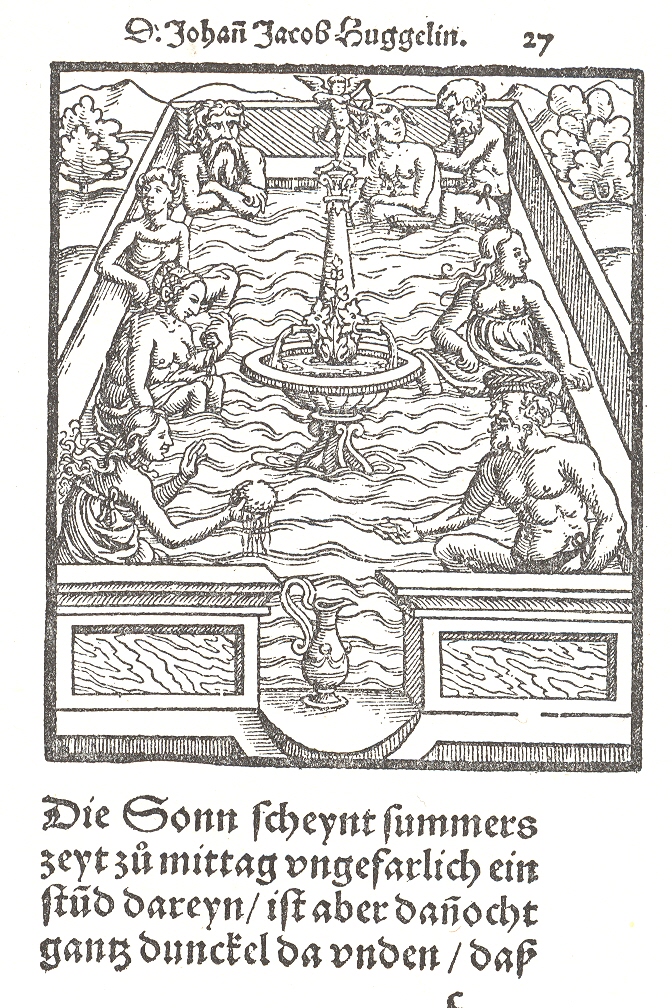
    There’s much real and important content in this woodcut, but I focused first
    on the few semi-entertaining and problematic figures positioned at the corners
    of this bath.  First things first: it
    appeared in Johann Jacob Huggelin’s Von
    heilsamen Baederndes Teuschenlands
    …, published in Mullhausen in 1559, which
    was a treatise on the mineral baths of Germany and their medicinal and
    therapeutic claims.  This woodcut occurs
    in the title page—and as a matter of fact, the exact image appears three years
    later in one of Paracelsus’ principal works, Baederbuchlin… published in Mullhausen, again, in 1562.  (This is one of Paracelsus’ most well-known
    efforts, and is seen as being one of the earliest works on hydrotherapy, but it
    is definitely predated by Huggelin.)  

    There is a gauzy modesty to the bathers, the men wearing a skimpy Euro-covering (with a nice bow), and the women a flouncy covering that is pulled down under the breasts.  The pair in the front look to be sharing a sponge, while another pair (towards the middle of the bath edges) are contemplating the landscape.  One of the pair in the rear right corner is getting  a nice scrubdown, while the most interesting-looking of the bath crew sits opposite, arms folded, looking sullen or filled with lost hope or just left out. 

    + bathing 2

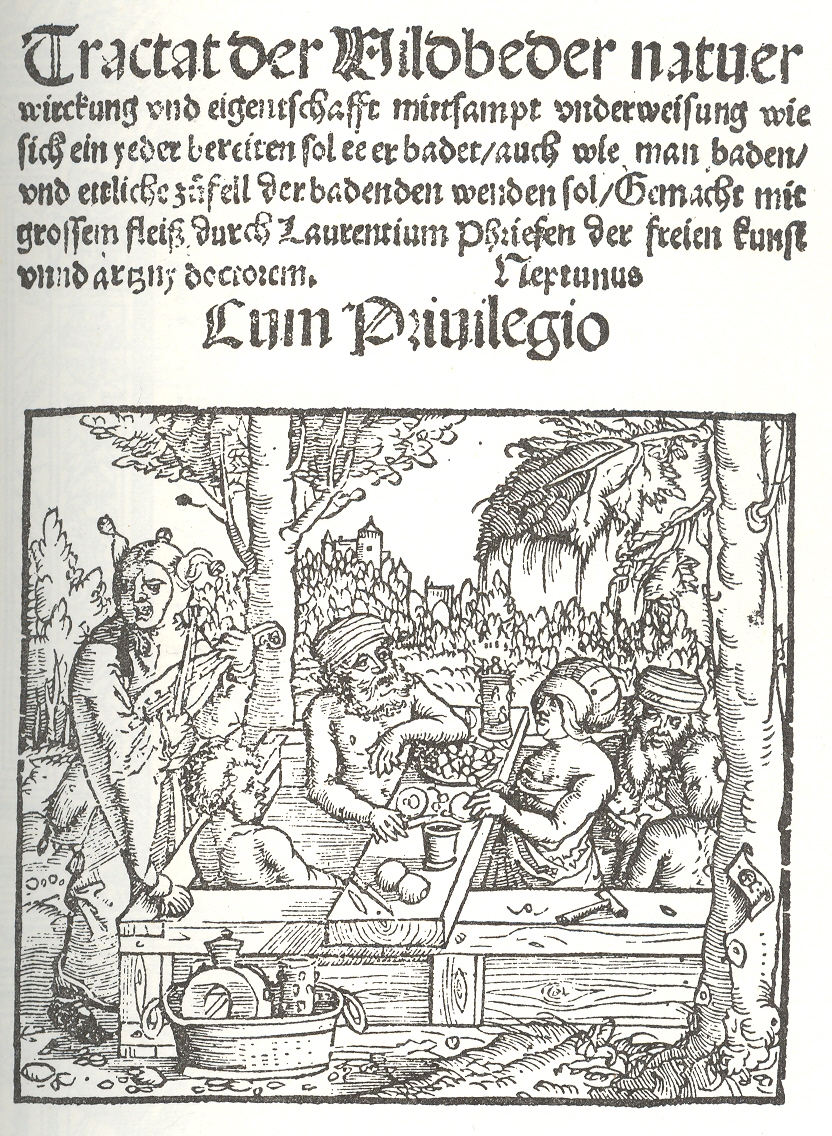
    More fun and more unbalanced is this image from Lorenez Fries, Tractat der Wildbeder, printed in
    Strassburg in 1519,  where those taking the
    baths for the medicinal spirits of the water to wash away their medicinal grit,
    and gout and grimes tried to help the water with food and alcohol.  There’s nothing wrong with that so far as I
    know, and evidently there’s nothing written about despoiling the massaging/washing
    powers of the bath in the Handy Handbook
    of Balneological Rules and Regs.
    As in the first image, the bathers are
    decently and modestly clad, only here they are enjoying fruits and meats, and have
    a jester/fool entertaining them with a viol. I imagine that if you were gouty or had the flu, an hour or two in a bath filled with music and food and spirits wouldn’t do too much damage.


  • The Story Behind the Iconic Image: Robert Hooke’s Flea, 1665

    JF Ptak Science Books LLC  Post 766  Blog Bookstore

    …”it is my hope, as well as belief, that
    these my
    Labours will be no more comparable to the Productions of
    many other
    Natural Philosophers, who are now every where busie about greater
    things; then my
    little Objects are to be compar’d to the greater and
    more beautiful
    Works of Nature, A Flea, a Mite, a Gnat, to an Horse, an
    Elephant, or a Lyon.”—
    Robert Hooke
    at the end of his 28-page preface to
    Micrographia1 (1665)
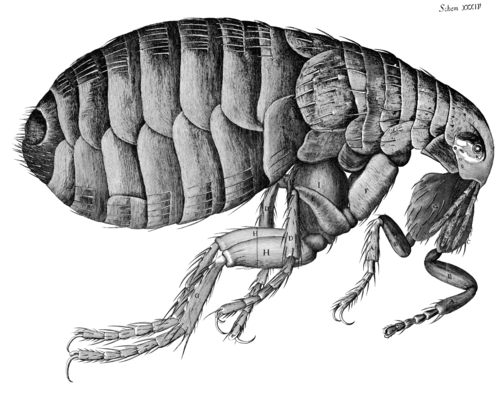
    Hooke--flea

    I’ve written elsewhere in this blog about Robert Hooke, and
    how, if there had somehow and impossibly been no Newton, he might’ve taken Sir Isaac’s place
    in the popular mind.  He was a tireless,
    relentless observer and experimenter, who lost little effort in a stranded idea
    and pursued interesting and problematic questions relentlessly.  More than others too he chased his won glory—minor
    but long and insistent—the years of which wore thin on many people in the
    scientific community.  But there were
    many characteristics of the man that made him not quite so lovable and
    endearing—not that Newton was any of those things, as he was not, but if you
    are going to be a secondary luminary to a super nova you’ve got to have
    something else going for you that the other man doesn’t have—sharing, helpful,
    greatly generous—to get you into the long pre-dusty pages of history. Also it would’ve
    helped if Hooke chose his battles with a little more aplomb and ingenuity—the
    war which began in 1672 with Newton went very badly for Hooke and followed him
    to the grave (and far beyond). 


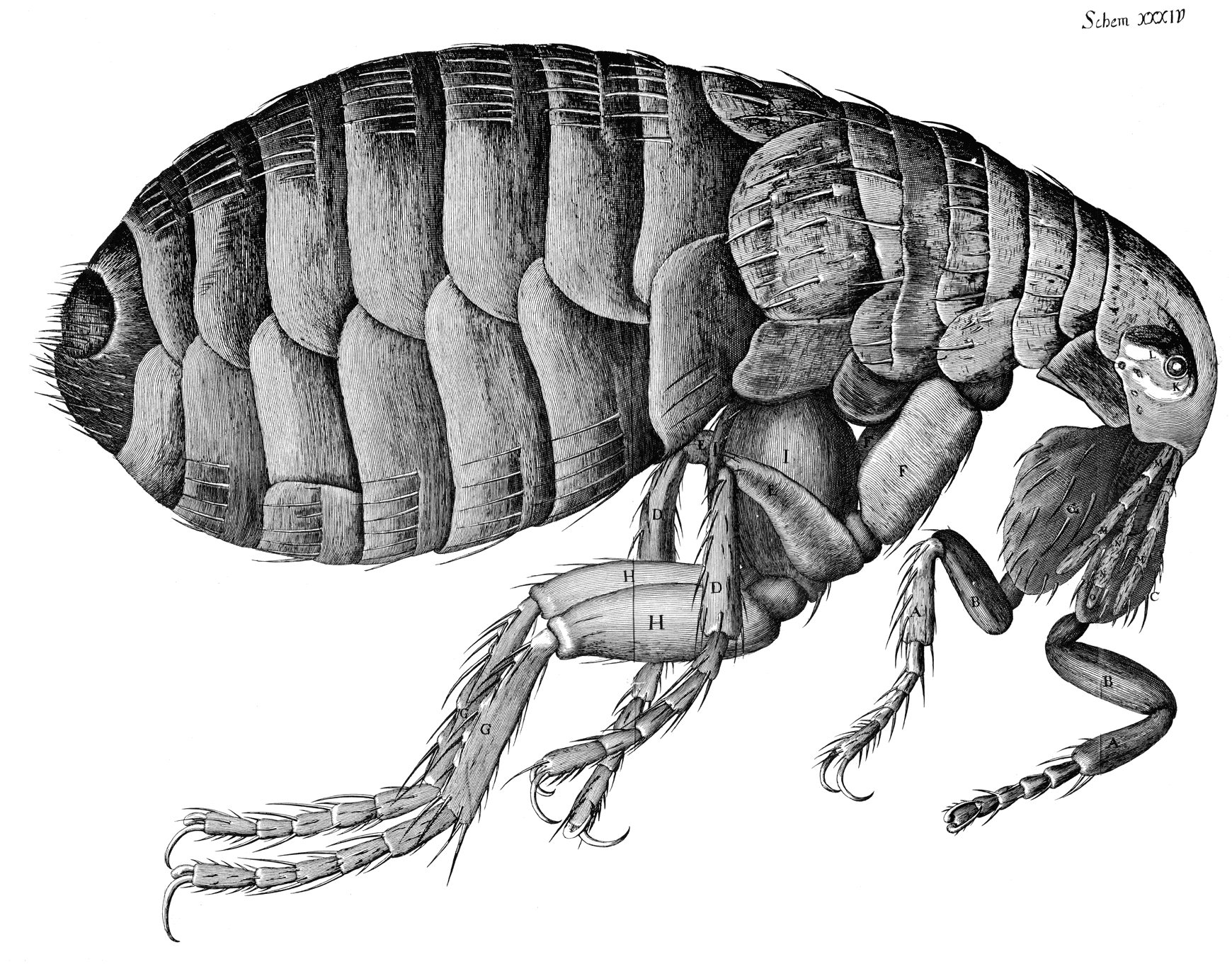
    What I’d like to talk about right now, though, of the many
    things to talk about concerning Robert Hooke, is the most iconographic image he
    ever produced, and perhaps one of the most famous scientific images of the 17th
    century—the flea. 


    The 28-year old Hooke published the results in a gorgeous
    and revolutionary book, Micrographia (a lovely e-text edition appears at Gutenberg, here) in 1665, which became an instant
    best seller and highly praised and valued. (Samuel Pepys, perhaps among the
    shiniest stars whose imprimatur was like a royal blessing, said the book (was)
    “the most ingenious book that I ever read in my life.”) There is no
    telling what the people of the mid-17th century thought of seeing
    such incredible discoveries in the little semi-invisible stuff that made up
    their normal, daily lives.  The only thing that somewhat equates to this
    would be if the first images of the Hubble were those of Earth-bound objects
    whose detail had previously been unknown.  Hooke’s observations and
    drawings of things like the common flea were just an astonishment—that such a
    creature of “low order” could have such intricate detail and design was a
    complete revelation.  The drawings of the fly’s eye, too, was an
    inescapable wonder, an incredible object to consider as having any
    detail pre-microscope, and then revealed to have unimaginable design and elegance. 


    It turns out that the flea was not the most important object
    that Hooke had in mind with the Micrographic—it
    was part of an overall attempt at making sense of all creation, the bug part of
    the book occupying only a part of the (only) one-fifth of the book’s 246 pages
    devoted to living creatures.  The book
    actually starts with inanimate objects (the needle, followed by a razor, linen, silk, glass canes, flint, and so on), and then works it way through living
    stuff, ending up talking about light and the Moon and the cosmos. 
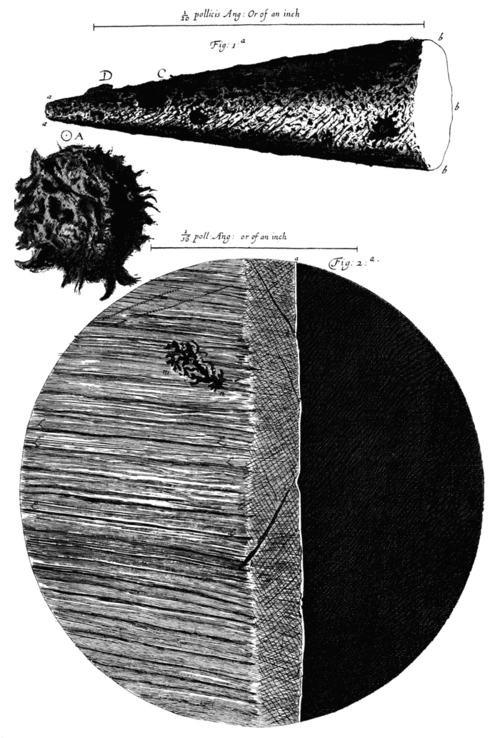
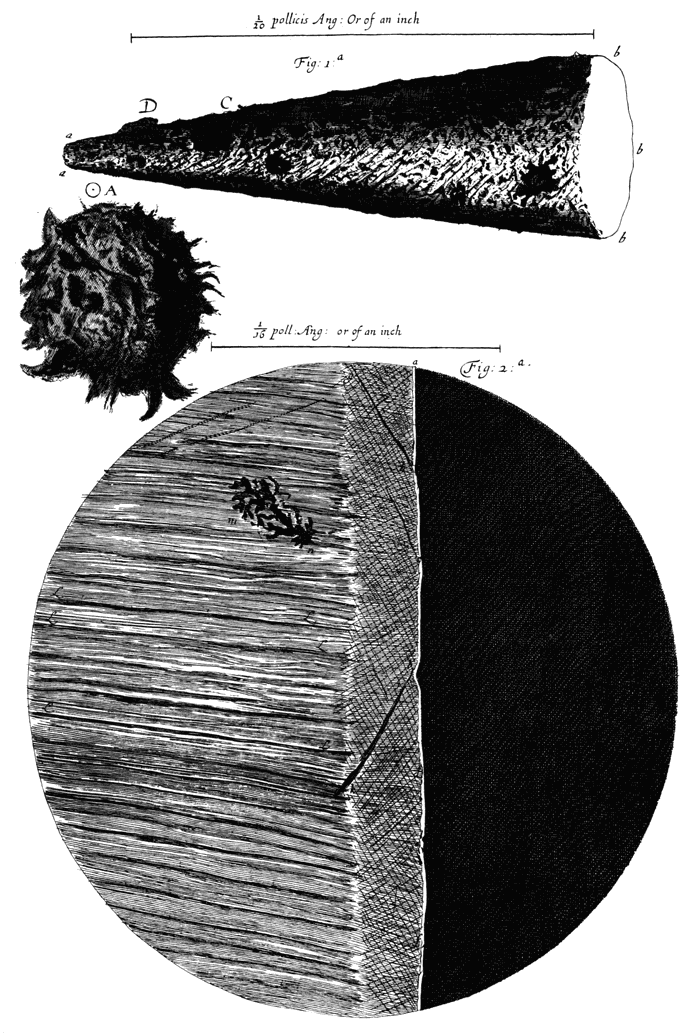
    Hooke--needle

    The opening images of the book are actually
    of the edge of a razor and the head of a needle—under magnification they showed
    a bitter, ragged edge and a nubby, pitted point (respectively)—which would have
    been almost as unimaginable and shocking as the flea….except that the flea of
    course opened possibilities of entire worlds of things alive in our
    semi-invisible environment.  Things
    really weren’t as they seemed to be.


    Hooke’s flea, as spectacular and revolutionary as it was,
    was only a part of the story—the rest of the behind-the-picture narrative lies
    in a much wider and more complex view of all things, living and not,

    in which Hooke tells us we should employ the
    microscope/macroscope to solve disputes in our “wandring senses”. Not bad
    advice at all.


    In the preface to the
    Micrographia Hooke states:

    Thus all the uncertainty, and mistakes of humane actions, proceed either
    from the narrowness and wandring of our
    Senses, from the slipperiness or
    delusion of our
    Memory, from the confinement or rashness of our Understanding,
    so that ’tis no wonder, that our power over natural causes and effects is so
    slowly improv’d, seeing we are not only to contend with the obscurity and
    difficulty
    of the things whereon we work and think, but even the forces of our own
    minds conspire to betray us.

    These being the dangers in the process of humane Reason, the remedies of
    them all can only proceed from the
    real, the mechanical, the experimental
    Philosophy, which has this advantage over the Philosophy of
    discourse
    and
    disputation, that whereas that chiefly aims at the subtilty of its
    Deductions and Conclusions, without much regard to the first ground-work, which
    ought to be well laid on the Sense and Memory; so this intends the right
    ordering of them all, and the making them serviceable to each other…

    He continues with a short outline of how to accomplish this:

    The first thing to be undertaken in this weighty work, is a watchfulness
    over the failings and an inlargement of the dominion, of the Senses.

    To which end it is requisite, first, That there should be a scrupulous
    choice, and a
    strict examination, of the reality, constancy, and
    certainty of the Particulars that we admit: This is the first rise whereon
    truth is to begin, and here the most severe, and most impartial diligence, must
    be imployed; the storing up of all, without any regard to evidence or use, will
    only tend to darkness and confusion. We must not therefore esteem the riches of
    our Philosophical treasure by the
    number only, but chiefly by the weight;
    the most
    vulgar Instances are not to be neglected, but above all, the
    most
    instructive are to be entertain’d; the footsteps of Nature are to
    be trac’d, not only in her
    ordinary course, but when she seems to be put
    to her shifts, to make many
    doublings and turnings, and to use
    some kind of art in indeavouring to avoid our discovery.

    The next care to be taken, in respect of the Senses, is a supplying of
    their infirmities with
    Instruments, and, as it were, the adding of artificial
    Organs to the natural; this in one of them has been of late years
    accomplisht with prodigious benefit to all sorts of useful knowledge, by the
    invention of Optical Glasses. By the means of
    Telescopes, there is
    nothing so
    far distant but may be represented to our view; and by the
    help of
    Microscopes, there is nothing so small, as to escape our
    inquiry; hence there is a new visible World discovered to the understanding. By
    this means the Heavens are open’d, and a vast number of new Stars, and new
    Motions, and new Productions appear in them, to which all the ancient
    Astronomers were utterly Strangers. By this the Earth it self, which lyes so
    neer us, under our feet, shews quite a new thing to us, and in every
    little
    particle of its matter; we now behold almost as great a variety of
    Creatures, as we were able before to reckon up in the whole
    Universe it
    self.

    1. The
    full title of the book: MICROGRAPHIA, OR, SOME Physiological Descriptions OF MINUTE BODIES, MADE BY MAGNIFYING.
  • The Indredible and Useless Dog Engines of 1895 and 1939

    JF Ptak Science Books   Post 797 (Sept 2009) Extended. 


    ++00++ 9.22 dog det


    In 1702, at the beginnings of the Industrial Revolution, Thomas Savery (c.1650 – 1715) began the idea of calculating the work done by steam engines over that done by horses, writing in his book, The Miner’s Friend:

    “So that an engine which will raise as much water as two horses, working together at one time in such a work, can do, and for which there must be constantly kept ten or twelve horses for doing the same. Then I say, such an engine may be made large enough to do the work required in employing eight, ten, fifteen, or twenty horses to be constantly maintained and kept for doing such a work…”   But it was James Watt who first introduced the term ”horsepower” while trying to advertise and place forever the idea of his steam engine over than of the earlier Newcombe engine and, of course, horses.”

    ++00++ 9.22 dog


    James Watt (1736-1819), Scottish inventor and “re-inventor” of the steam engine, the man who put the ‘power” into “horsepower”, determined that a horse could turn a mill wheel (of a 12-foot radius) about 144 times in an hour (about 2 ½ times a minute), traveling 2.5x2pix12 per minute.  It has been shown though that on average a horse will work at about 1.5 horsepower like this for an hour on and off; and less than 1 horse in other times; a man could work at 1.5-2.5 horsepower for a short time, but generally would pull about a tenth of that for an extended time.


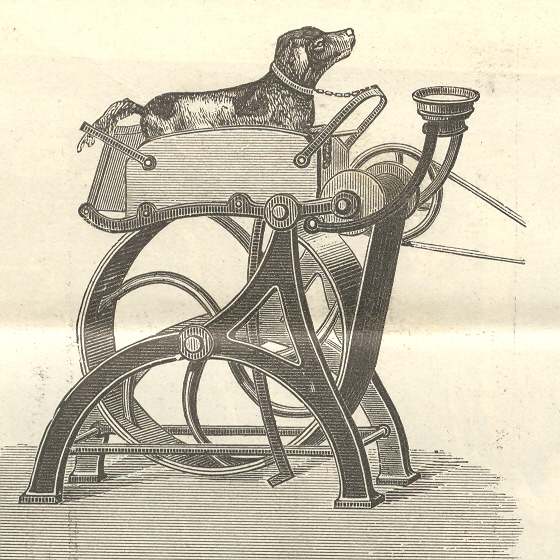
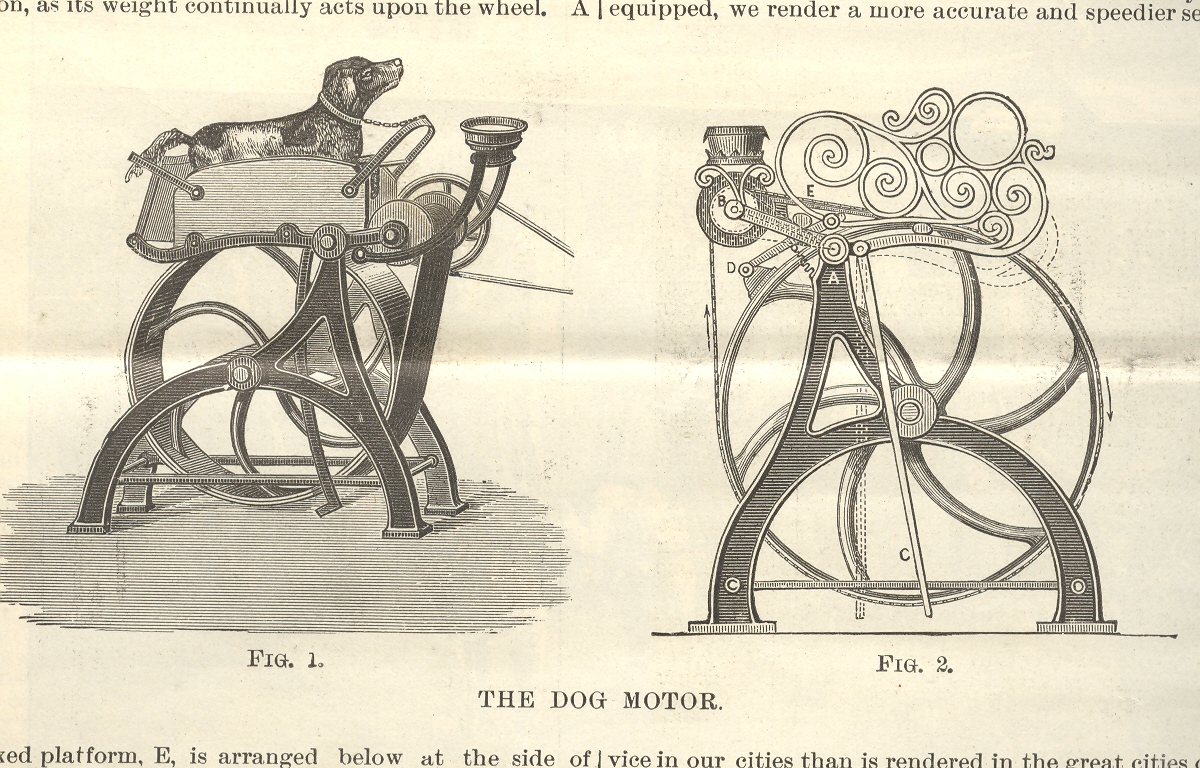
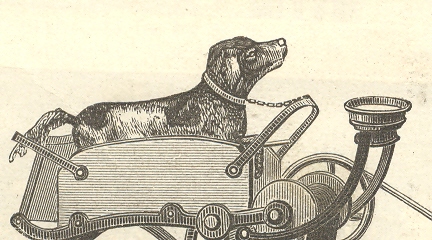
    And so we come to the crux of the biscuit of this post:  a dog motor.  This entirely, utterly, unconvincing and thoroughly bad idea was fully fleshed out by a M. Richard (naturally of Paris) for the Agricultural Exhibition and re-published from La Nature in the Scientific American Supplement  on 10 August 1895.  It is slightly lovely in its high Victorian way, or at least so until you consider that an animal goes in side the thing, working its way along an infinite belt, a cup of water just within reach.  The dog would power the large wheel, which would turn a smaller wheel and belt, which in turn would be connected to smaller, and so on, until it reached whatever it was it was powering, which is left entirely to our imagination.  Even when I squeeze my eyes in a telescoping effort, I cannot see what it is that this poor doggie might power.  Given the descending orders of radii of the wheelworks, perhaps the tenth-horsepower dog engine ran a fan, or something, something remarkably insignificant.  It does tell us something about over-design, like buying a ten dollar bill with a twenty. 


    ++00++ 9.22 dog det 2


    Another, more recent but less serious attempt at utilizing canine power was found in Popular Science for 1939:


    The thing that really bothers me is that both of these really bad ideas occurred in years where there were fantastic ideas in the history of physics–1895 being the home to the discovery of the atomic world in the work of Wilhelm Roentgen, and 1939, well, more of the same plus making the atomic world go “boom”.

    In this same vein, and keeping with the highlight-year-for-physics theme, is this thing, created in the 1880’s but published in Popular Science in 1933:

    With the help of Laura Massey (Bookn3rd !), from the wonderful bookseller blog, The Cataloguer’s Desk at the great Peter Harrington Rare Book Shop (London), I’m including an 18th century version of sweating dogpower called the Turnspit:

    File:Turnspit Dog Working.jpg

    I’m not sure what it is that would keep the dog running after it realized in the first half-minute that it will never be able to retrieve that hanging thing set out in front of him/her–maybe things got poke-y. 


  • Going from “Nothing” to Everything in a Few Years: Einstein at the Solvay Conference, 1911

    JF Ptak Science Books LLC  Post 761 Blog Bookstore

    By “nothing” I mean Einstein’s relative “nothing” of early
    1905 compared to the rest of the hard-working, Ph.D. laden physics field in the
    major universities of Germany.  And
    certainly Einstein was nothing and somewhat nowhere in this regard just prior
    to his momentous year of 1905*, scrounging around the fringes of the academic
    world, working as a patent examiner, trying to get his doctorate hammered out
    and accepted. 

    Then come the summer of 1905, and the dates June 9,  July 18,  September 26 and November 21—the publication
    dates of his four papers in the Annalen der Physik, and with them a new epoch
    in the history of physics, a true modernizing, revolutionary effect takes
    place. 

    But Einstein quietly gets his dissertation accepted (and his
    degree confirmed in January 1906 from the University of Zurich), and his revolution
    is started, absolutely certain of his results, but privately worried about
    whether all of it would be as beautiful as Newton ’s theories. The ball is forever set in
    motion.  And to make a little extra
    money, Einstein takes a private student for instruction at the end of the
    year.  He is 26 years old. 

    The odd thing (although not odd when explained by Abraham
    Pais in any of his three books relating to Einstein) is that Einstein would
    remain at the patent office for another four years, though he is promoted to
    second class expert in 1907.  Einstein
    does become a private college lecturer in 1908, but stays with the patent
    office until October 1909 (even though he is awarded his first honorary
    doctorate in July from the University of Geneva) when he begins work as an
    associate prof for theoretical physics at Zurich.

    Things speed up for Einstein from this point, and he is
    suddenly and rightfully acknowledged as being one of the most important
    thinkers in the field of physics in the world by being invited to the
    ultra-exclusive Solvay Conference for theoretical physics in 1911. (By the time of the conference, Einstein
    had been a professor at the German University in Prague, in 1910.)
    At 32
    he is the youngest person there, surrounded by some of the best minds in the
    business. 

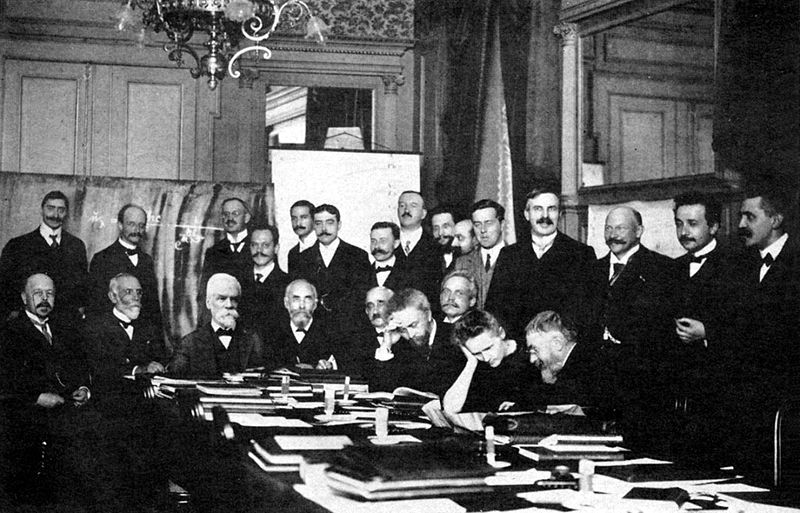
    Solvay

    [Invited attendees for the 1911
    Solvay Conference at the Hotel Metropole. included   Seated
    (L-R): W. Nernst, M.
    Brillouin
    , E. Solvay, H.
    Lorentz
    , E. Warburg, J. Perrin, W. Wien,
    M. Curie,
    and H. Poincaré. Standing (L-R): R. Goldschmidt, M. Planck,
    H.
    Rubens
    , A. Sommerfeld, F. Lindemann, M. de Broglie, M.
    Knudsen
    , F. Hasenöhrl, G. Hostelet, E. Herzen, J.H. Jeans, E.
    Rutherford
    , H. Kamerlingh Onnes, A.
    Einstein
    and P. Langevin.]

    Einstein is evidently not moved by the proceedings, writing
    that he had heard “nothing new”, at least at the formal meetings.  The conference was for a full week,but since
    everyone was staying at the same hotel (which would’ve been a pretty potent
    address for that week) I assume that a lot was discussed in private—evidently Einstein
    was extremely quiet during the official proceedings, but became animated in
    private, post-conference conversations. 

    My point for this post, really, is quite simple—the extraordinary
    academic rise in Einstein’s fortunes during the 1909-1911 period, captured in
    this famous photo.  Einstein was a bona fide powerhouse (the powerhouse) by this point, what with
    his revolutionary 1905 papers, plus the blockbusters of 1906, 1908 and 1911,
    and still yet getting stronger. (Incidentally, I always wondered about Einstein’s
    hand position in photos like this, showing one hand seemingly forming a neat
    zero with index and thumb. Actually, that hand is in the same position for this
    photo and for the other Solvay Conferences that Einstein attended (the 2nd,
    5th and 6th)—the mystery for me was solved by my friend
    Dr. Raymond Cooper, who pointed out to me that it was just Einstein holding his
    pipe.

    *It really is hard to overstate the importance of Einstein’s
    efforts in this year.  Really.

    The four papers in volume 17 of the Annalen der Physik:

    –Über einen die Erzeugung und Verwandlung des Lichtes
    betreffenden heuristishen Gesichtspunkt
    , (“On a Heuristic Point of View
    concerning the Production and Transformation of Light.”) being the photoelectricity/quantum
    of light paper, received March 18 and published June 9.

    –Die von der molekularkinetischen Theorie der Wärme geforderte Bewegung von
    in ruhenden Flüssigkeiten suspendierten Teilchen
    , (“On the Movement of
    Small Particles Suspended in Stationary Liquids Required by the Molecular-Kinetic
    Theory of Heat”), being the  Brownian
    Motion of particles/atomic theory
    paper, received May 11, published
    July 18.

    –Elektrodynamic bewegter Körper, (“On the Electrodynamics of Moving
    Bodies”), being the special relativity theory paper,. received
    June 30 and published 26 September.

    –Ist die Trägheit eines Körpers von seinem Energieeinhalt
    abhängig?
    (“Does the Inertia of a Body Depend upon Its Energy Content?”),
    being the mass-energy equivalence paper (and the kernel of E=mc²),
    received September 27 and published November 21.

    A List of the Solvay Conferences (the number, followed by
    its year, a translation of the title of the conference, and the conference
    chair):


  • Welsh Mining Boys and Orwell’s “The Road to Wigan Pier”

    JF Ptak Science Books LLC  Post 755  Blog Bookstore

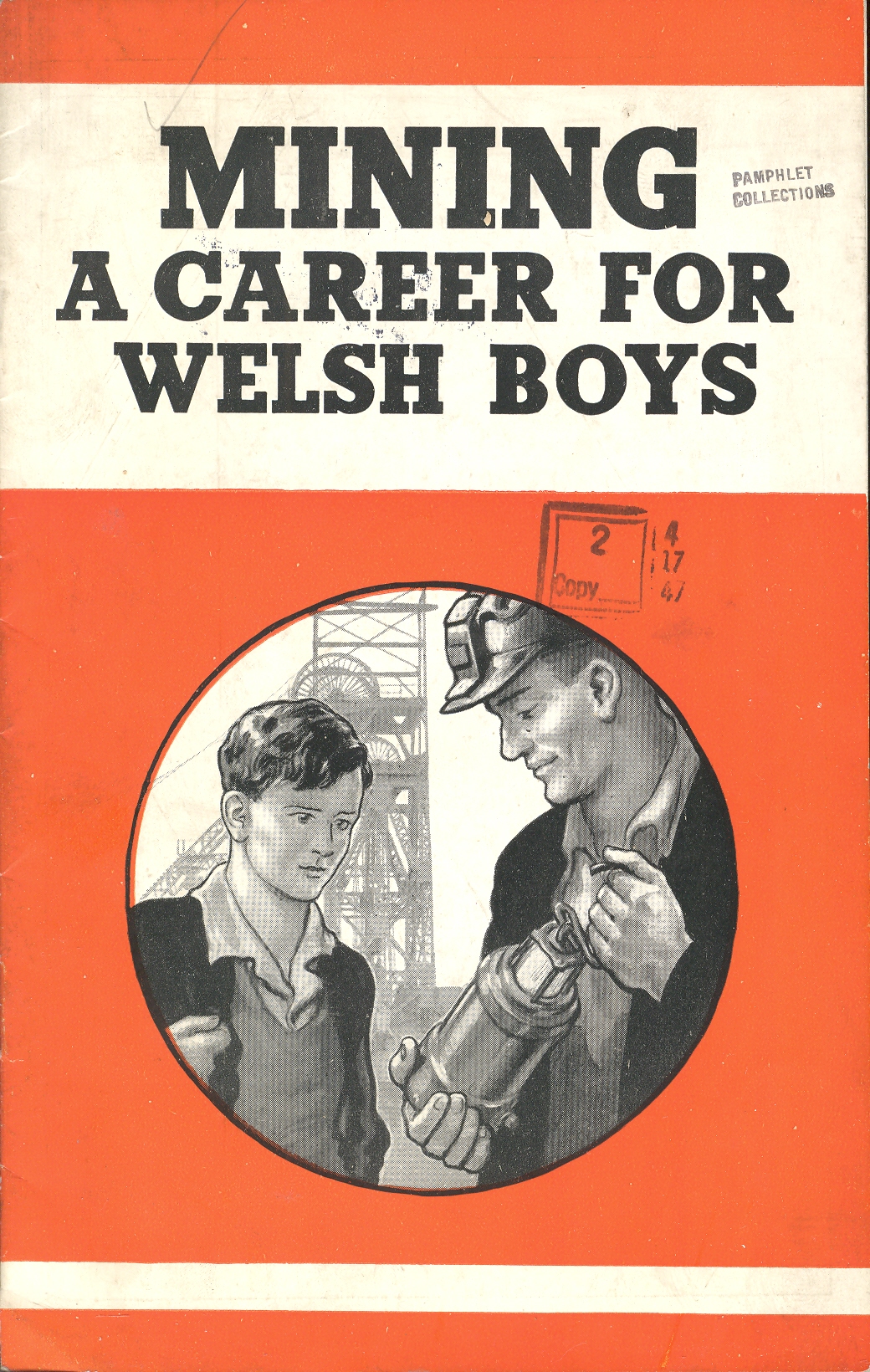
    I came across this pamphlet this morning and it reminded
    immediately of George Orwell’s description of Northern
    England mining life in his work The Road to Wigan Pier.  Not that the (1946) pamphlet wasn’t arresting
    on its own—particularly the “boys” part, which actually doesn’t identify an age
    more than a period of time (“the time for leaving school”).  The pamphlet makes a good, strong recruiting

    ++00++ 9.15 welsh mining cover  

    effort for younger blood in one of the most demanding harsh-environment jobs on
    the globe–which is a tough thing to do, as these kids would be married to
    short handled shovels, moving earth and coal deep underground in a foul-air
    enclosure if they signed on.   


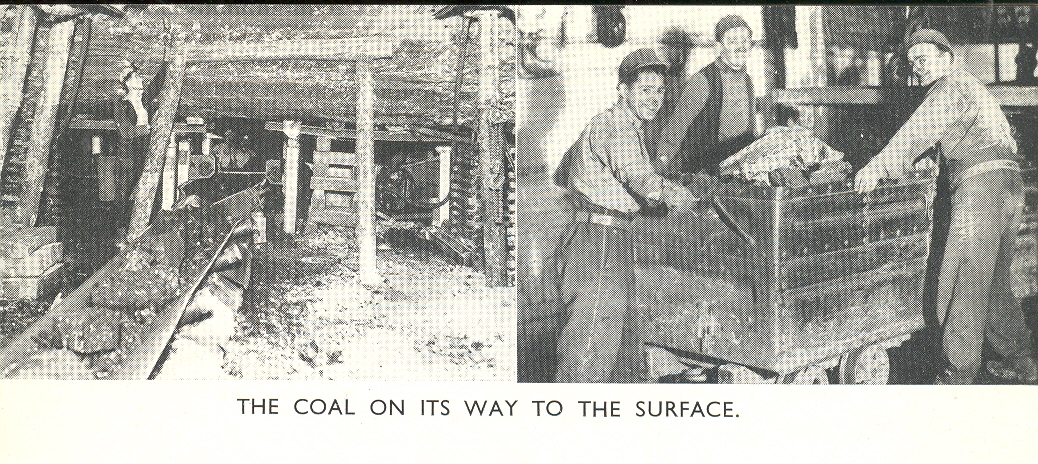
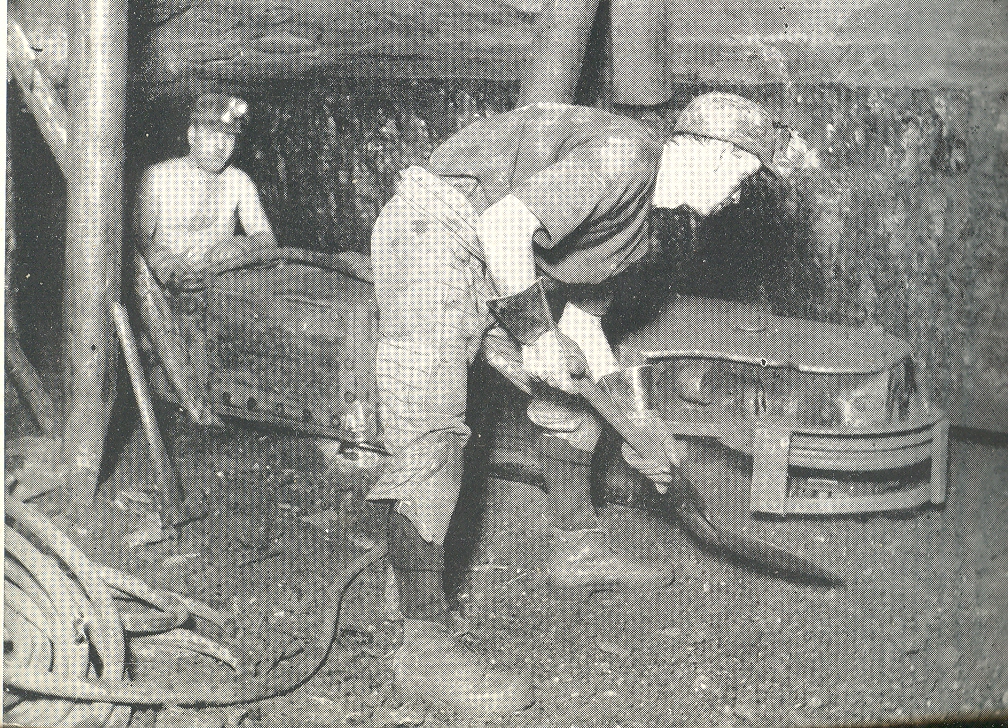
    “There is a hint of mystery about a colliery” the pamphlet
    states, but doesn’t explain, though several of the photos of working miners
    must certainly have slapped a bit of reality into the mind of the reader.  Being a miner was bitter-tough, but if this
    is what your work landscape was composed of, and this is what your father did,
    I guess that this is the life you got used to, familiar with, as time wore down
    mining’s “mysterious” edges.

    ++00++ 9.15 welsh mining workers 001  ++00++ 9.15 welsh mining workers

    Miners performed amazing tasks of physical endurance and
    mental acuity in a tediously difficult and unhealthy endlessly-challenging surrounding.  Deep underground.


    It was in The Road to Wigan Pier that Orwell may have
    reached his highest heights of social insight and reporting—particularly in
    bringing out the conditions of the working poor and the psychology, morality
    and neurosis of unemployment..  But it is
    his description of the miner’s environment that stays in my head.  Orwell observes that the 7.5 hour shift
    miners would only being their workday once they had arrived at their particular
    station—and as Orwell beautifully points out, miners had to “travel” to their
    work zone once they arrived in the mine. 
    Some of these commutes were 90 minutes or more, each way—most were
    moving at least a half-hour before getting to 
    the point where their day would being. 
    It was a crouching, spine-slashing, knee-crunching scramble through
    dark, sharp areas not four feet high, interrupted by crawling through smaller
    spaces…and always with your head up so that you could see where you were
    going.  It was a whole new set of muscles
    that you had to develop for this travel…and then, after that, then you went to
    work.


    As Orwell writes:


    “You do not notice the effect of this till you have gone a
    few hundred yards. You start off, stooping slightly, down the dim-lit gallery,
    eight or ten feet wide and about five high, with the walls built up with slabs
    of shale, like the stone walls in Derbyshire. Every yard or two there are
    wooden props holding up the beams and girders; some of the girders have buckled
    into fantastic curves under which you have to duck. Usually it is bad going
    underfoot—thick dust or jagged chunks of shale, and in some mines where there
    is water it is as mucky as a farm-yard….


    A page later:


    Orwell wigan pier

    “At the start to walk stooping is rather a joke, but it is a
    joke that soon wears off. I am handicapped by being exceptionally tall, but
    when the roof falls to four feet or less it is a tough job for anybody except a
    dwarf or a child. You not only have to bend double, you have also got to keep
    your head up all the while so as to see the beams and girders and dodge them
    when they come. You have, therefore, a constant crick in the neck, but this is
    nothing to the pain in your knees and thighs. After half a mile it becomes (I
    am not exaggerating) an unbearable agony. You begin to wonder whether you will
    ever get to the end—still more, how on earth you are going to get back. Your
    pace grows slower and slower. You come to a stretch of a couple of hundred
    yards where it is all exceptionally low and you have to work yourself along in
    a squatting position. Then suddenly the roof opens out to a mysterious
    height—scene of and old fall of rock, probably—and for twenty whole yards you
    can stand upright. The relief is overwhelming. But after this there is another
    low stretch of a hundred yards and then a succession of beams which you have to
    crawl under. You go down on all fours; even this is a relief after the
    squatting business. But when you come to the end of the beams and try to get up
    again, you find that your knees have temporarily struck work and refuse to lift
    you. You call a halt, ignominiously, and say that you would like to rest for a
    minute or two. Your guide (a miner) is sympathetic. He knows that your muscles
    are not the same as his. ‘Only another four hundred yards,’ he says encouragingly;
    you feel that he might as well say another four hundred miles. But finally you
    do somehow creep as far as the coal face. You have gone a mile and taken the
    best part of an hour; a miner would do it in not much more than twenty minutes.
    Having got there, you have to sprawl in the coal dust and get your strength
    back for several minutes before you can even watch the work in progress with
    any kind of intelligence.


    “Coming back is worse than going, not only because you are
    already tired out but because the journey back to the shaft is slightly uphill.
    You get through the low places at the speed of a tortoise, and you have no
    shame now about calling a halt when your knees give way. Even the lamp you are
    carrying becomes a nuisance and probably when you stumble you drop it;
    whereupon, if it is a Davy lamp, it goes out. Ducking the beams becomes more
    and more of an effort, and sometimes you forget to duck. You try walking head
    down as the miners do, and then you bang your backbone. Even the miners bang their backbones fairly often. This is the reason
    why in very hot mines, where it is necessary to go about half naked, most of
    the miners have what they call ‘buttons down the back’—that is, a permanent
    scab on each vertebra
    . When the track is down hill the miners sometimes fit
    their clogs, which are hollow under-neath, on to the trolley rails and slide
    down. In mines where the ‘travelling’ is very bad all the miners carry sticks
    about two and a half feet long, hollowed out below the handle. In normal places
    you keep your hand on top of the stick and in the low places you slide your
    hand down into the hollow. These sticks are a great help, and the wooden
    crash-helmets—a comparatively recent invention— are a godsend. They look like a
    French or Italian steel helmet, but they are made of some kind of pith and very
    light, and so strong, that you can take a violent blow on the head without
    feeling it. When finally you get back to the surface you have been perhaps
    three hours underground and travelled two miles, and you, are more exhausted
    than you would be by a twenty-five-mile walk above ground. For a week
    afterwards your thighs are so stiff that coming downstairs is quite a difficult
    feat; you have to work your way down in a peculiar sidelong manner, without
    bending the knees. Your miner friends notice the stiffness of your walk and
    chaff you about it. (‘How’d ta like to work down pit, eh?’ etc.) Yet even a
    miner who has been long away front work—from illness, for instance—when he
    comes back to the pit, suffers badly for the first few days.

    And the first paragraph of chapter 3:

    “When the miner comes up from the pit his face is so pale
    that it is noticeable even through the mask of coal dust. This is due to the
    foul air that he has been breathing, and will wear off presently. To a
    Southerner, new to the mining districts, the spectacle of a shift of several
    hundred miners streaming out of the pit is strange and slightly sinister. The
    exhausted faces, with the grime clinging in all the hollows, have a fierce,
    wild look. At other times, when their faces are clean, there is not much to
    distinguish them from the rest of the population. They have a very upright
    square-shouldered walk, a reaction from the constant bending underground, but
    most of them are shortish men and their thick ill-fitting clothes hide the
    splendour of their bodies. The most definitely distinctive thing about them is
    the blue scars on their noses. Every miner has blue scars on his nose and
    forehead, and will carry them to his death. The coal dust of which the air
    underground is full enters every cut, and then the skin grows over it and forms
    a blue stain like tattooing, which in fact it is. Some of the older men have
    their foreheads veined like Roquefort cheeses from this cause.”


    Now THAT is some good observation and reporting.  Orwell did a spectacular job in relating the
    viciously difficult jobs done by these thousands of outstanding men.

    Notes for Reading on Orwell

    Crick, Bernard.. George Orwell: a life. London : Secker and Warburg, 1981.

    Davison, Peter. George Orwell: a literary life. London: Macmillan, 1996.

    Pearce, Robert. Revisiting Orwell’s Wigan Pier. History 82: 267 pp. 410-424

    Rodden, John.. The politics of literary reputation: the making and claiming

    of ‘St. George’ Orwell. New York/Oxford , 1989.


  • The Forensic Microscope and Hidden Images in Art

    JF Ptak Science Books LLC  Post 744  Blog Bookstore

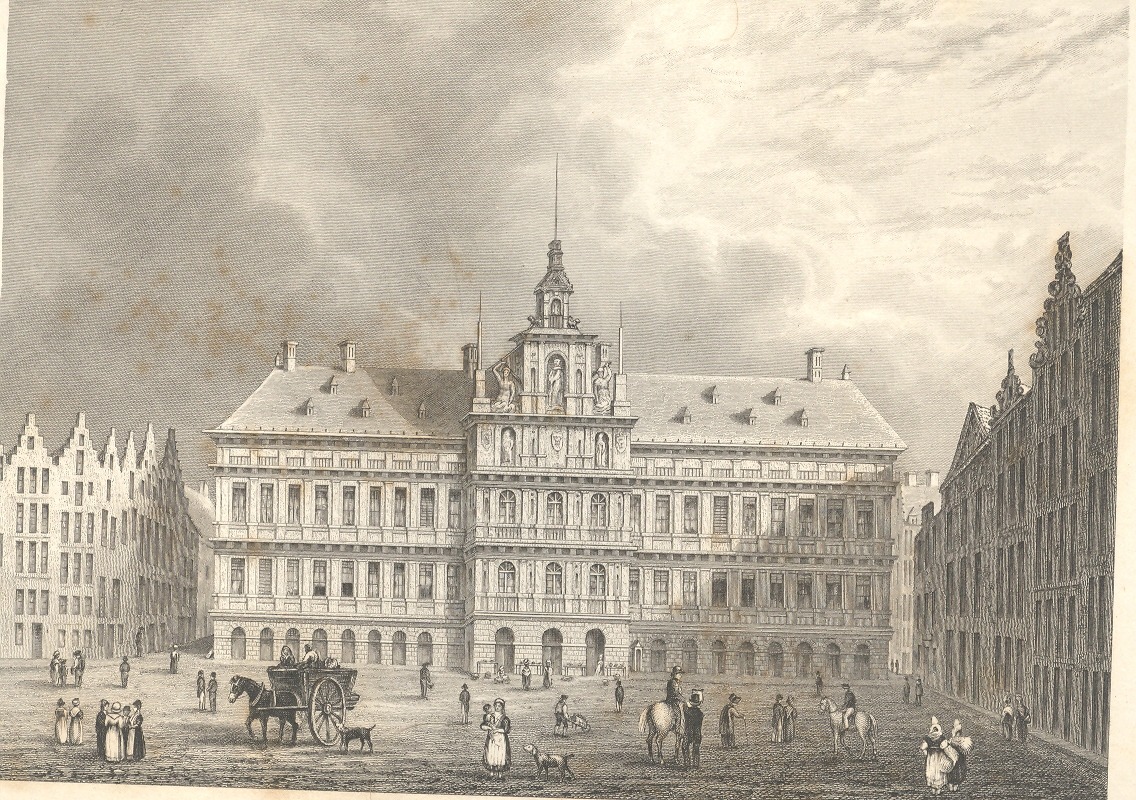
    I’ve written before about the found, incidental figures of “filler” art found in larger works,generally inconsequential  images used to supplement the empty foreground or provide handy perspective or scale for the subject at hand.  In this example, a steel engraving of Town Hall at Antwerp, the principal focus of the artist is the architectural structure, the public square and the surrounding buildings.

    +++looking closely
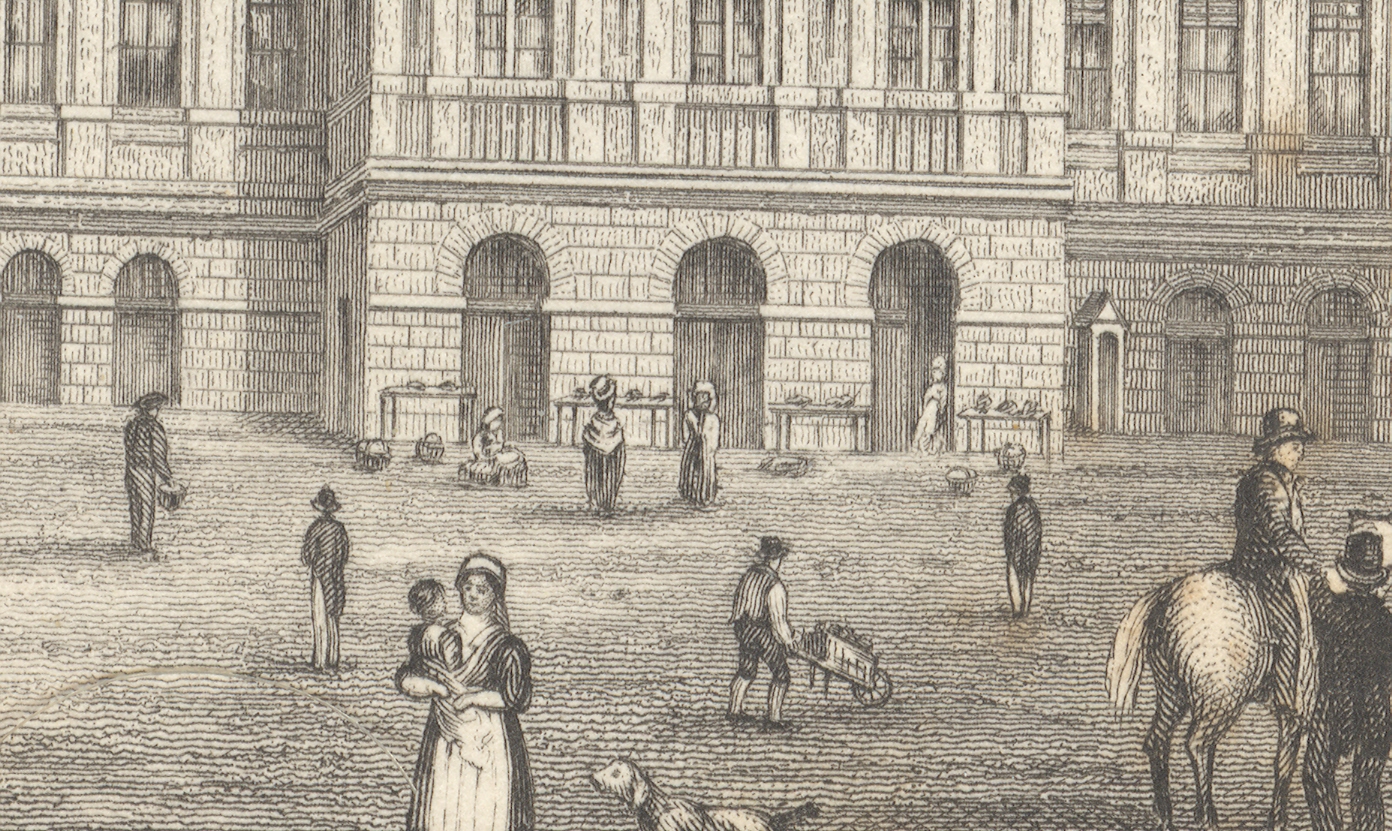
    To give the whole engraving some buoyancy and scale, the artist provided a fairly active scene of town life going on in the square.  Now of course he could’ve made the figures more generic, but the artist went far beyond that, recording some of the lost city life of the 1830’s. 

    +++looking closely detail

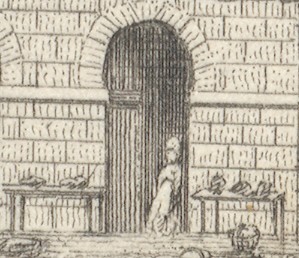
    The truly interesting bit here is barely observable in the original; but, under magnification, we see a very rich and minuscule “engraved photograph” of a slice of daily commerce and street life in Antwerp.  If you look at the central entrance to the town hall you can see three main (and large) doorways, and if you look clos+++looking closely detail2er still, you’ll see something leaning against the portal at right.

    Extraordinarily, what the artist snuck into the original is a tiny (2mm) figure watching over several tables of her (fruits?/vegetables?) ware, waiting for a customer. There doesn’t seem to be much interest in her stuff, currently, and she has allowed herself a little relaxation, leaning against the doorway.  I’ve found this sort of extremely minor subject matter and its ephemeral connection to the larger work at hand to be just fascinating.  I wonder why such detail would be added–why would the artist, or engraver, take such care and interest in such minor visions.  Perhaps this is just what was at hand on the days the artist fleshed out his work; perhaps it was the work of the engraver, alone, incising yet another semi-boring architectural image; desperate for a little artistic activity, adding some interesting, almost-invisible touches, here and there.  Perhaps no one would ever really notice them, but whoever was responsible for adding such incredible, extra-dimensional details would certainly enjoy knowing they were there, recognized or not.

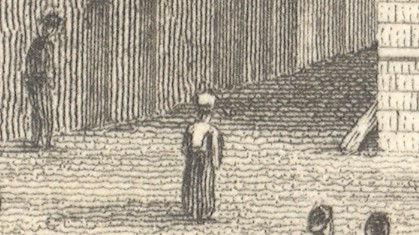
    And while we’re at it–why in the world was that log-like+++looking closely detail4 thing at the base of the extreme left of the Town Hall included in this picture? I just adore that such ephemeral interest was included in this type of work–its reasoning lost forever, except that which we give it.


  • Political Majesty at the Interior and Exterior of Creation (1588 & 1680)

    JF Ptak Science Books LLC  Post 742  Blog Bookstore

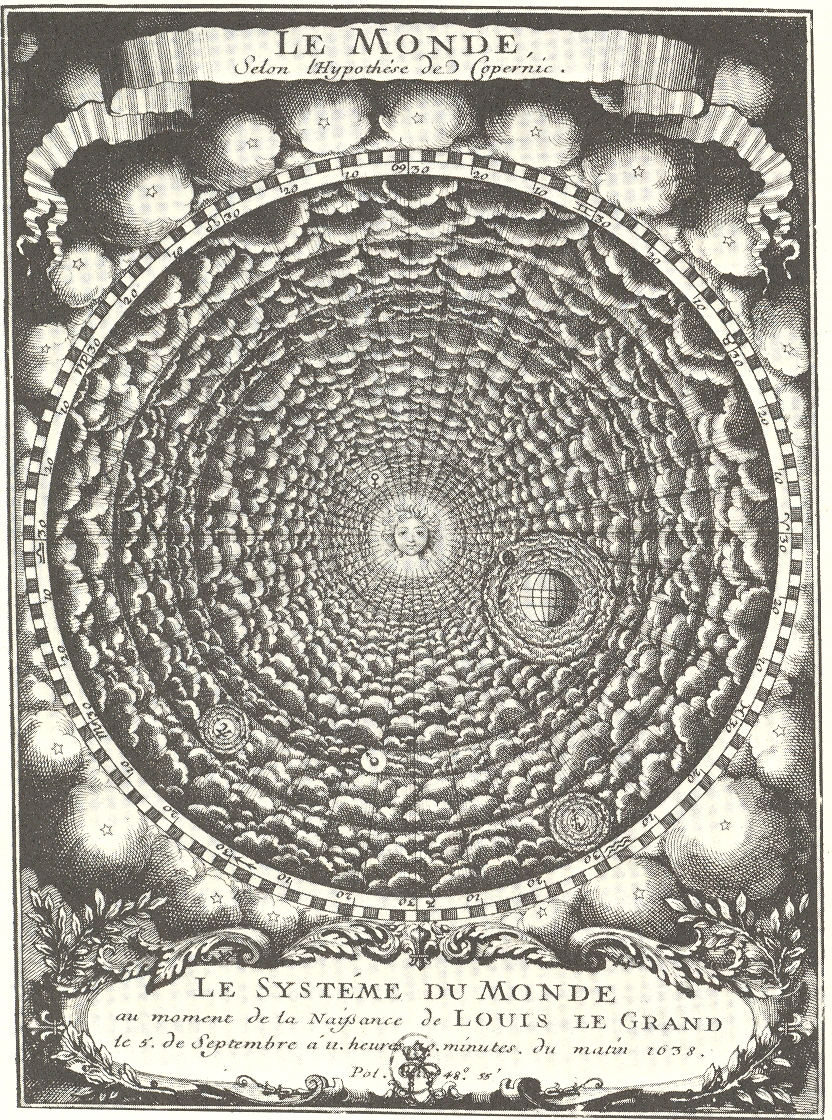
    This engraving Le
    Monde Selon l’Hypthese de Copernic. Le Systeme du Mondeau movement de la
    Naissance de Louis le Grand le 5 de Septembre 11. heures 20 minutes du matin
    1638
    , is a

    +++Louis Grand Universe singular representation of the universe at a singular moment in
    time.  And that moment in time was the
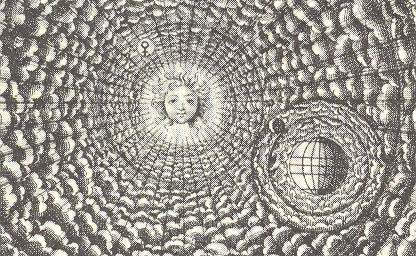
    birth of Louis le Grand, or Louis XIV, the Sun King, pictured at the moment of
    his birth at the center of the Copernican universe. The future (72-year-long
    reign) king smiles benignly at us from the center of the universe.

    +++Louis Grand Universe 2

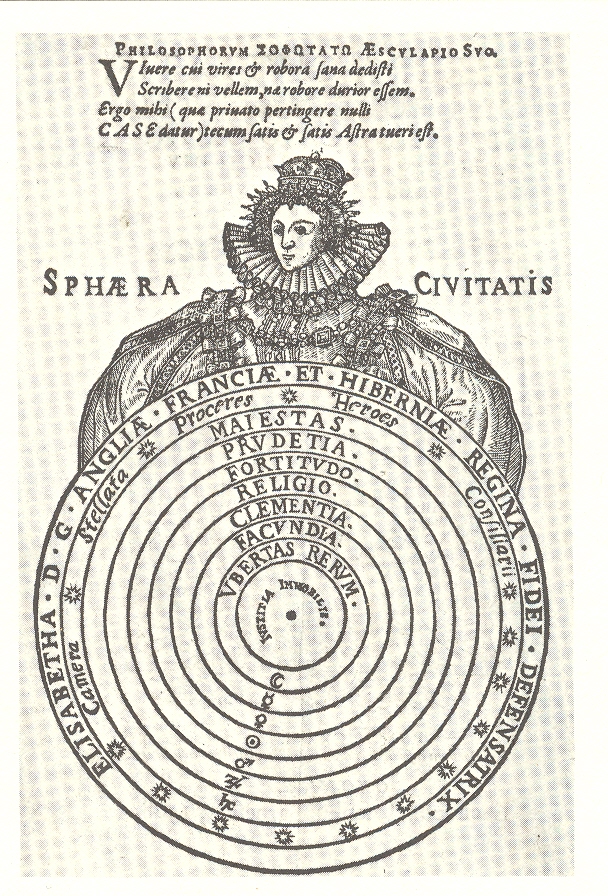
    On the other side of the coin is the all-reaching embrace of
    the deity-like Queen Elizabeth, who cradles the nine successive spheres of the
    universe.  The innermost sphere is
    occupied by the Earth, the center of all things, around which are labeled the
    seven spheres of the planets:  “urbetas
    rerum” (immovable justice) of the Earth, “facundia” (eloquence) of Mercury, “Clementia”
    (clemency) of Venus, “Religio” as the Sun, “Fortitudo” (fortitude) of Mars, “Pridetia”
    (prudence) of Jupiter, and “Majestas” (majesty) of Saturn.  Beyond the sphere of Saturn is that of the
    fixed stars (consisting of the Star Chamber, the nobles, Lords, Counsellors);
    and beyond that, in the last sphere, is Elizabeth.   


    +++Louis Grand Universe 3

    The image appears in John Case’s Sphaera Civitatis  (1588,
    The Sphere of the Commonwealth) who
    writes in his preface “How well civic machinery accords with heaven’s form, and
    how it is distinguished by like figures, our republic, unique, will declare on
    behalf of many. Do you see the stars, wheeling around in their alternating
    course, and Justice, who weighs causes in her balanced pans, the unchangeable
    center of our universe?” [Full text here.]


  • Propaganda in Maps: the Polish “Corridor”, 1939

    JF Ptak Science Books LLC  Post 739  Blog Bookstore
    +++korridor 2
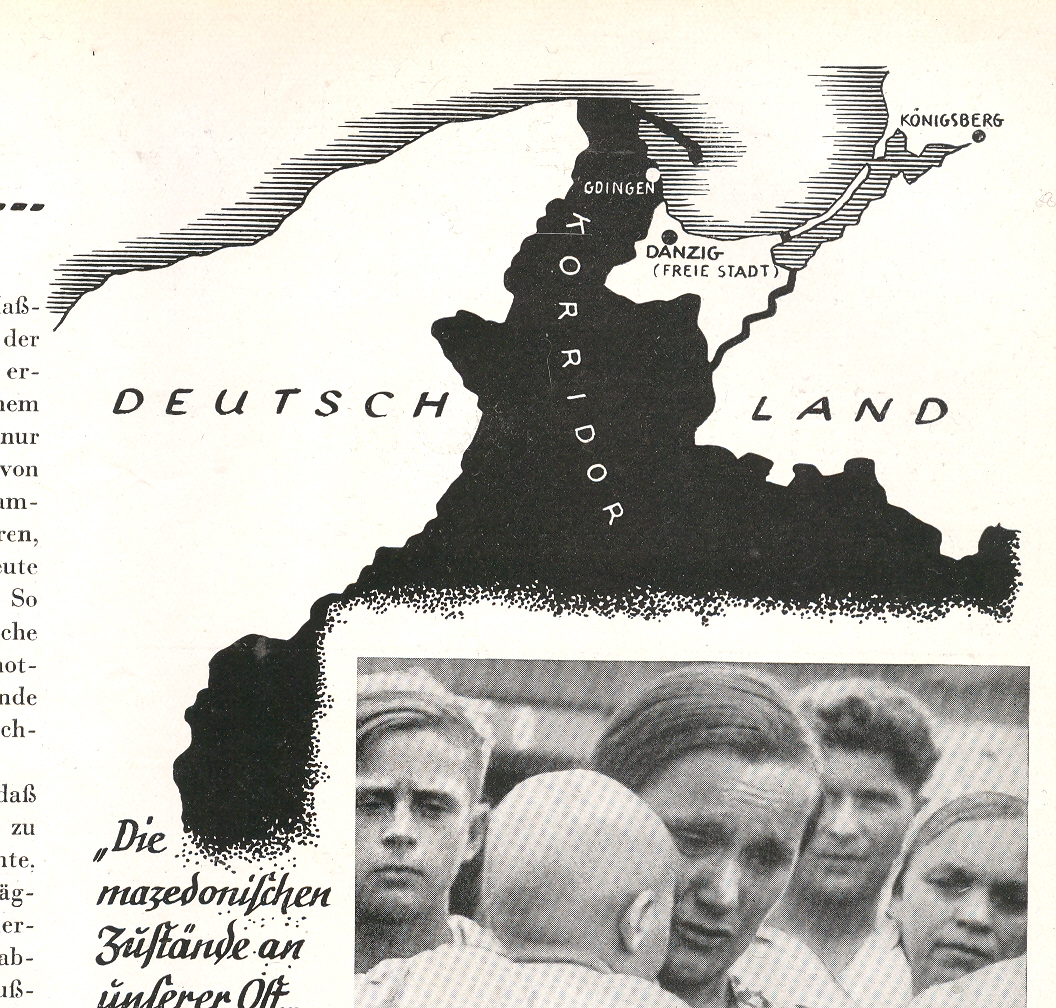
    There’s a war on?  Really?  You wouldn’t know it from the cover page of the most popular magazine in Germany, the (Leipzig) Illustrirte Zeitung, published 7 September 1939. The odd thing is that for months, years, previously there was a huge and occasionally overwhelming militaria scent to this magazine (a sort of LIFE magazine-like affair in its way), paving the way for the reading population (which I’m sure must’ve been in the millions) for the stuff to come.  I’ve looked at every issue of this magazine from 1933 to 1939, and there is simply no mistaking the under- and over-current of the war preparation.  It was just relentless.  And so to finally come to the real fighting part of the beginning of the war it is a little odd to see the cover of the mag decorated with Mother Earth in the herb garden.  The contents of the issue is not what I expected either–not much dedicated to fighting outside of happy and relieved Gdanskers saluting their warm welcome to the advancing Nazi machine, images of the “mongrels” who were living in the places that had once been occupied by Germans, and an “apology” of sorts as to why all of this was necessary.All of which was bluster and diatribe–its hard to imagine, really, how someone living in Leipzig reading this thing over breakfast could’ve nodded their head in logical consent with the magazine’s specious arguments.

    Which brings us to the small inset map depicting what was one of the major “problems” for  Germany with Poland–the northern stretch of Polish land that touched the Baltic, the so-called Polish “Corridor“.  This polemical affair shows exactly what the Germans thought of the territory, a piece of Germany now in enemy hands, a dagger struck through the heart of Prussia.  

    +++korridor Poland of course didn’t think of the land in terms of a “corridor”, and as a matter of fact the term was an offensive one.  It was simply a part of Poland, one which was returned to the Poles with the rest of the country (which had been disappeared, absorbed, with the Treaty of Vienna in 1815) in 1920.  It was essential with repatriation that this land be included, giving Poland a natural access to the Baltic, and an ability to follows it major river (the Vistula) all the way to the sea.  Without access to the Baltic, Poland’s economy would have been strangled, the country simply wouldn’t have had a good stake to survival.  It was a return of land that had been connected to the Polish Crown from 1466-1772.

    The ethnicity issues are long and deep, and something I can’t get into right here. But Germany certainly made the claim that there were huge German populations in the corridor who needed to be rescued, and who suffered under the control of the inferior Polish people. But as I said, this is a complex issue–the population in the area was probably around 45% in 1920, and this before the huge repatriation efforts to bring those German people home.  There may have been so many Germans in that area because of a massive Germanization of the area in the 19th century…and on and on.

    The Polish government did sign a Non-Aggression Pact with Germany in 1934, after which everything got on the slow boat to hell.  In the months before the Germans attacked, through the summer, there was much frenzied back-and-forth, an awful lot of negotiations that were so much meaningless talk as a mask for the inevitable.  Whatever was agreed upon and signed, Germany was going to attack, anyway, come what may.  And so they did.

    [I should point out in closing that, just a few days ago, the Airminded.org site reminded us all of H.G. Wells’ 1933 The Shape of Things to Come, and his prediction on the start (or re-start) of the next great war, right there at the Polish “corridor”, and right soon.] 


  • What Things are and what things Aren’t Department, #3: Things that Aren’t ‘Bridges” or “Floating Land”.

    JF Ptak Science Books LLC  Post 772  Blog Bookstore

    My friend Jeff Donlan sent me a link to a site in which librarians-on-coffee-breaks
    were busily renaming classic book titles as they might be re-titled today. For
    example, we have:

    Old: Richard III ;
    New: R3: Judgment Day

    Old: Frankenstein, or
    The Modern Prometheus;
    New: Frankenstein:
    Wrath of the Supercorpse

    Old: Das Kapital;
    New: Labor Value: How Today’s Companies
    Get the Most out of Their Workforce.


    You get the picture. And so it was with this in mind that I
    came across this unusual woodcut in the delightful publication called The Mirrour of Literature, Amusement and
    Instruction,
    published in London on 25 January, 1840.  There are all
    manner of fringe-interesting and ephemeral materials here—necessarily
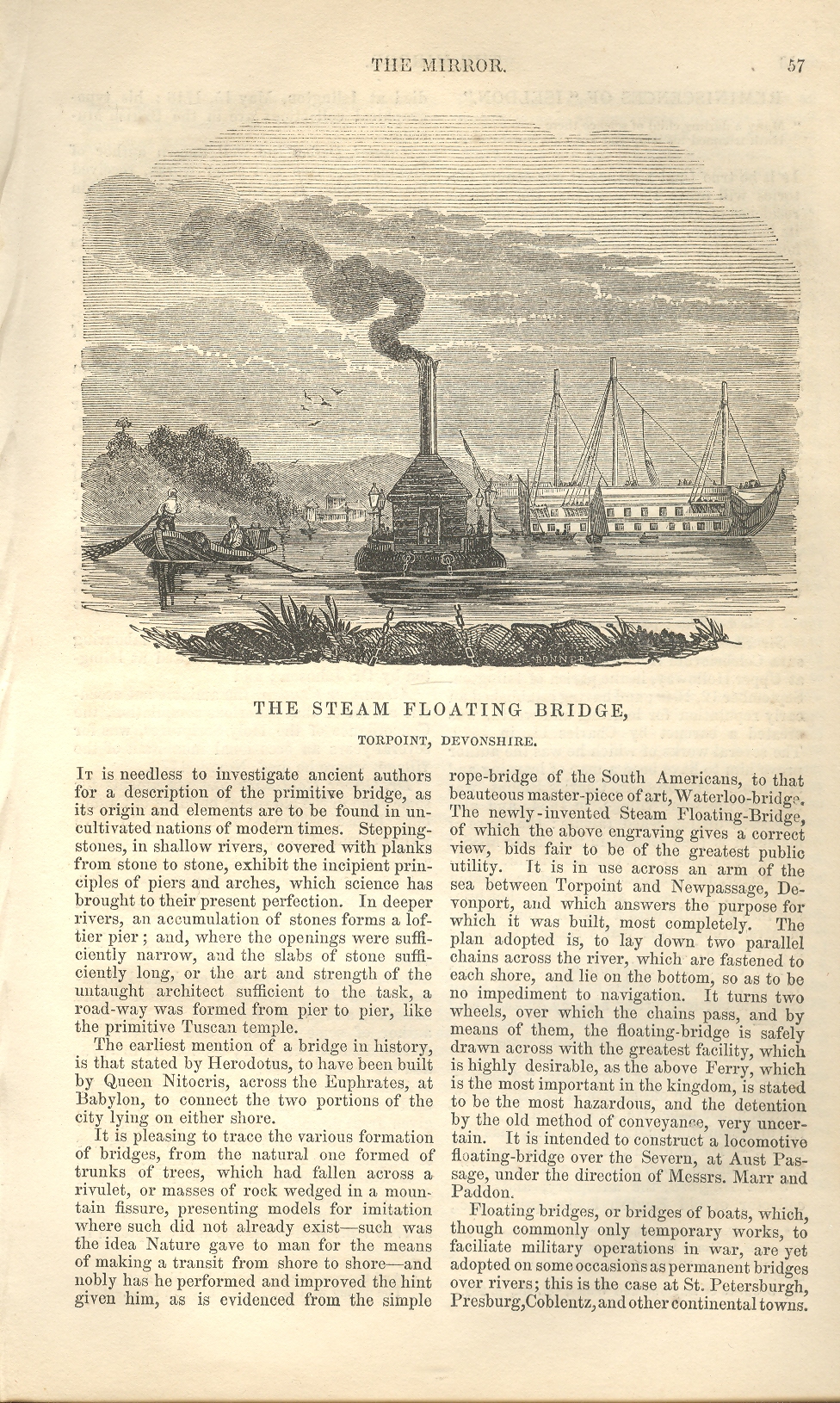
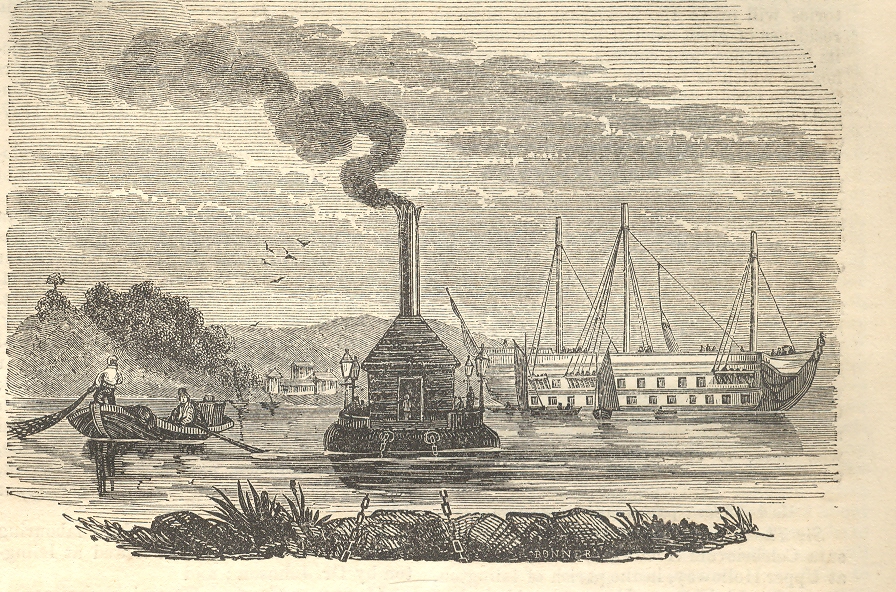
    unexpected, as in this short article about “The Steam Floating Bridge”
    (of Torpoint, Cornwall to Devonport, Devonshire crossing the Hamoaze).


    ++00++ 9.29 floating bridge 001

    At first glance
    this looked like a remarkable modernized way of reformulating the word and concept
    for “boat” or “ferry”. (What audacity!—though perhaps it was someone trying to
    evade patent protection by calling a boat “a bridge”, leading an entirely new
    wave of renamed inventions into a shadow industrial revolution…)  But luck on this was only half-full—on closer
    inspection (and of course before actually reading the article, set aside like
    so many instructional manuals) you can see the “bridge” part of the
    steam-driven barge:  two chains leading
    from the land, then under water, then up again on the bow/stern of the business
    end of the barge, then down again, and then on to the other shore.  This all does sound quite like an old common
    ferry to me, but if the good Cornish people felt it to be a bridge, then a
    bridge it is.

    ++00++ 9.29 floating bridge

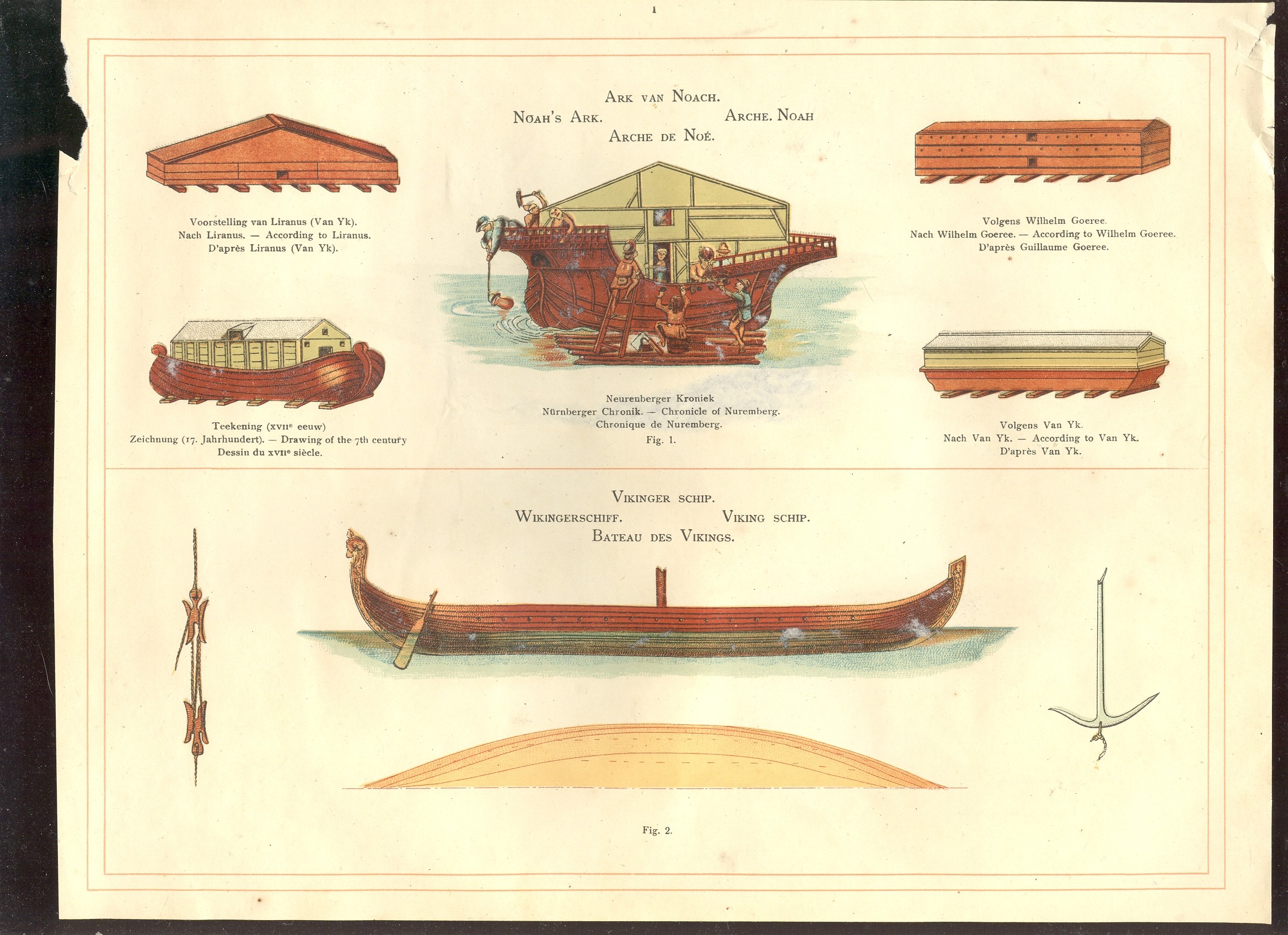
    Loosely connected to this floating “bridge” is the so-called
    floating “land” used by associates of the mystical Noah to help in the
    last-moment construction of the great ark. 
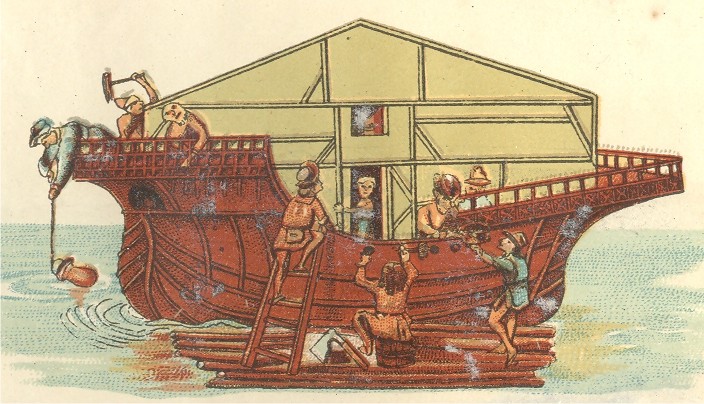
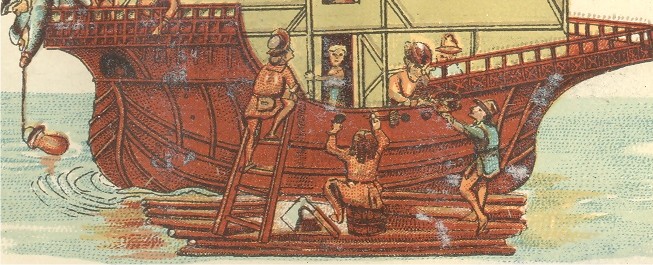
    The activity on board is a little confusing to me, as is the
    room-enough-for-three bit of floating “land”, which I would hazard to call a “raft”. 

    ++00++ 9.29 noahs ark

     I
    should point out that the guy with the hammer-like tool is working on the roof
    and not the head of the person in the flattened foreground, though this would
    make for a better story, taking a step towards an ancient Murder on the Orient Express.  


    ++00++ 9.29 noahs ark detail2

    I wonder also about the guy collecting water with the jar, as it seems
    that if he waited for just a little bit longer the water would be coming to
    him. (This image is a 19th-century republication of the scene from the 1493 Nuremberg Chronicle.)

    **A longer and fuller description of the “bridge” is found in
    the Saturday Magazine for 1842, here. 


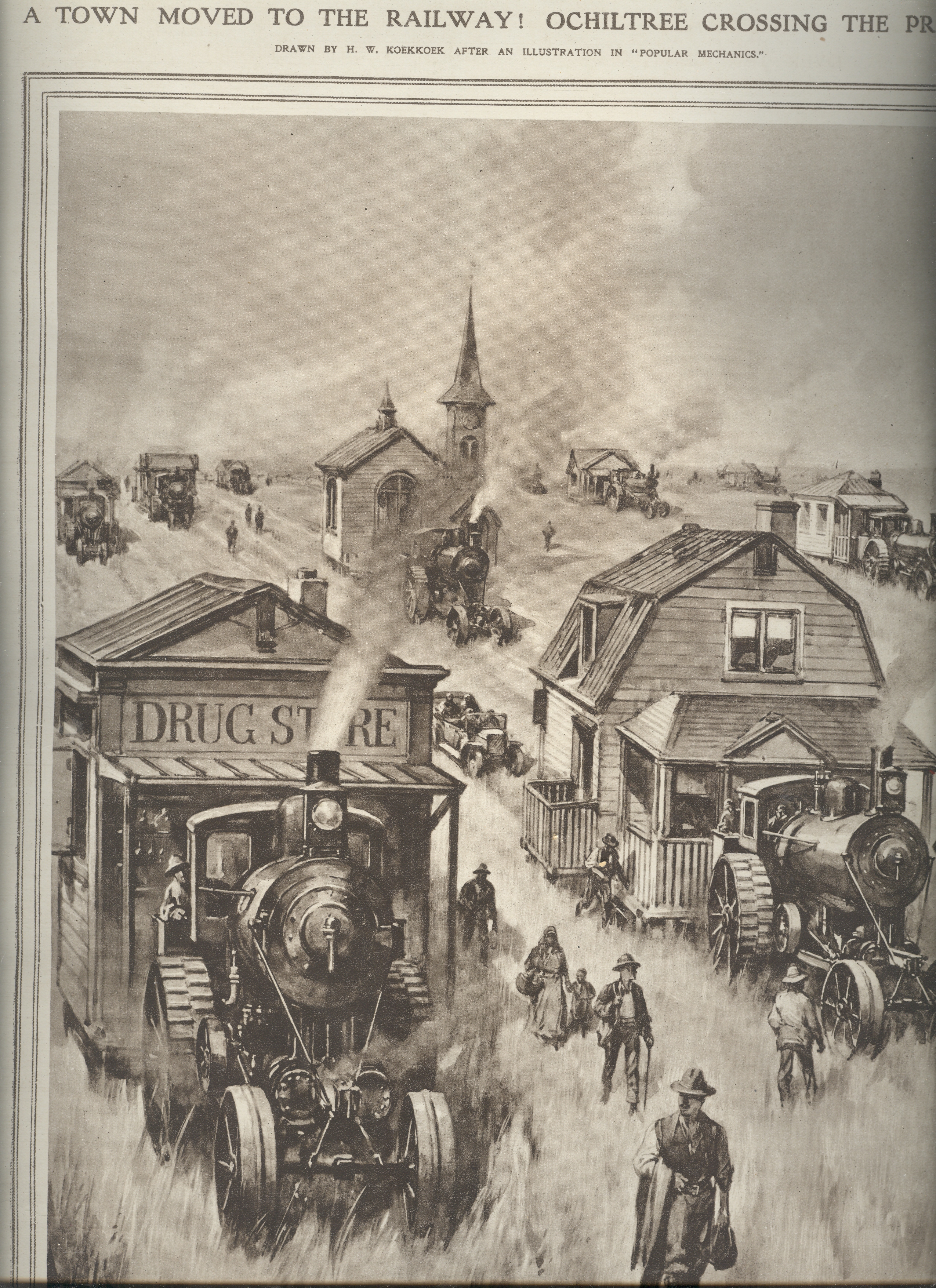
  • Racing Houses and Lost Cemeteries: Ochiltree, Texas, 1920

    JF Ptak Science Books LLC   Post 768  Blog Bookstore

    ++00++ 9.25 ochiltree, texas

    Dateline:  Ochiltree, Texas, 20 October 1920.  Mr. Ralphsted Winston has been racing houses for the 30 years.  “Yep.  House racing is older’n auTOWmobiles by a large space; we’ve had tractors for a good time longer than cars, and more powerful, too.  It was just natural to do something with them more than find black soil”.  And so evidently came house racing.  A reporter wondered if there was one particular house that was best to race with.  “Sure” replied Mr. Winston, “houses with porches.  Let’s the breeze to let the breeze come out to show them” he explained, somewhat. 

    For the last ten years Mr. Winston has been racing a different sort of house.  “God’s house” he said firmly.  “Churches.  Round here, in North Texas, they’re small-built with wood and such, and aren’t too heavy, makes for nice tight turns and a solid straightaway”. 

    “And chapels?” came a question.

    “Not allowed.  Got to be a church” came Mr. Winston’s reply, his jawline cracking.

    “The only problem with churches”, he continued, “is that not one of them has ever won a race.  Ever. Even in the best conditions, we get bested by porches, schoolhouses, even soddies”.  “Yup”, and then came a long, ponderous spit, “not a one, won”, extended a chuckling Mr. Winston.

    A reporter asked, “Why don’t you have a race with nothing but churches. Then at least you’ll have a winner.”

    “There will be a whole LOT of losers.  Maybe ever one” replied an eyebrow-raised Winston. “I do guess that someone would have to win, even if they were from Oklahoma, they’d be a winner too.  Not everybody has to wind up in a drown ditch.  But in the land of the blind , you don’t have to be a happy one-eyed king.”

    Well, this really isn’t a race of houses, though I’d much rather think of this picture in these terms.  (The church is passed on the left, on the right! There’ll be hell to pay for those maneuvers!”) What is happening here is that the town of Ochiltree is being moved closer to the railroad that passed the town by, by 15 miles or so. It was the North Texas and Santa Fe RR (Shattuck, Oklahoma to Spearman, Texas) that left Ochiltree behind; and just after that, a new town called Perryton appeared, established there on the railway line, taking all of the interest (and the county seat) away from Ochiltree.  So what happened was that Ochiltree decided to move to Perryton, to become part of that town, evidently leaving nothing but space wherer the town used to be. (The Handbook of Texas said that the town “disappered completely”.) I wonder though if there weren’t a few people who decided to stay, who just wouldn’t move; who in 1921 found vast new distances between them and whoever else was left, all of the other buildings gone, pulled up out of the ground, lock, stock and barrel.  And what about the cemeteries for the two churches that were moved? According to the good folks at the Perryton Memorial Library, the cemeteries were left, and still there, in a town that isn’t.  (On the other hand I can’t imagine how a small town would’ve moved a cemetery–there may have been 500 people in Ochiltree at the point of departure, and perhaps another250 or so who were over the years already departed…that means that every able-bodied person would have had to dis-and-re-inter one fallen town member, which may have been way to much to ask of anybody given that they were already moving the entire town.)