A Daily History of Holes, Dots, Lines, Science, History, Math, Physics, Art, the Unintentional Absurd, Architecture, Maps, Data Visualization, Blank and Missing Things, and so on. |1.6 million words, 7500 images, 4.9 million hits| Press & appearances in The Times, Le Figaro, Mensa, The Economist, The Guardian, Discovery News, Slate, Le Monde, Sci American Blogs, Le Pont, and many other places… 5000+ total posts since 2008.

Category: Prints–looking HARD/deeply at

  • Blank and Missing Things #31: Missing Earth

    JF Ptak Science Books LLC     Post 504

    Scan0001
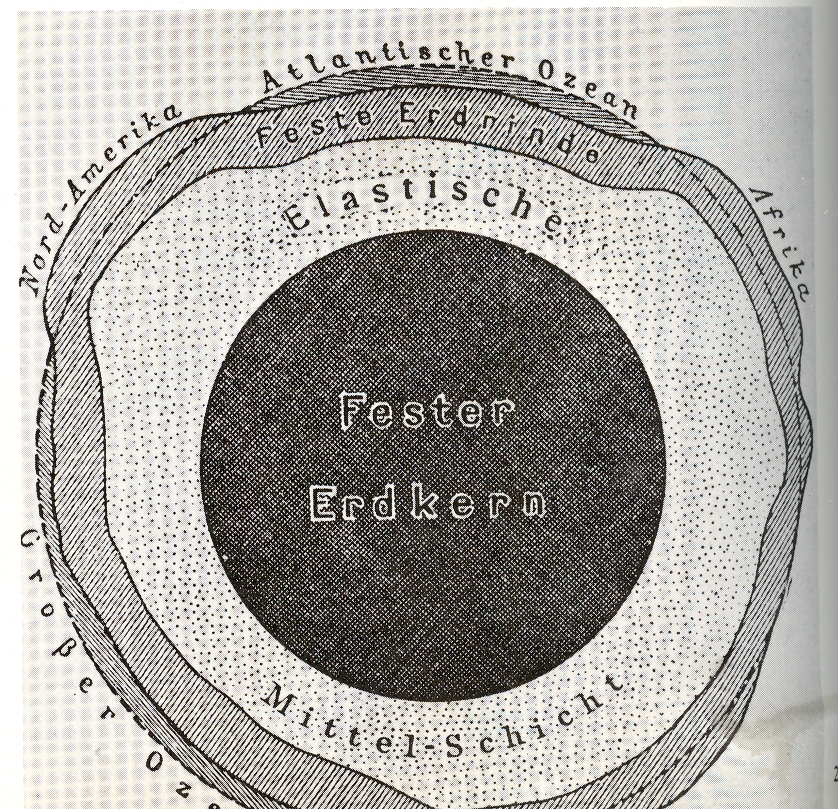
    In 1830 when Amos Eaton, filling up his chair and burning
    the  midnight oils in his home in Albany New York, was figuring out the
    insides of the earth  He had but little direct evidence to go on, and the publications on the topic of the center of the earth were left to speculation not much better then than science fiction (a term which had not been invented yet; neither for that matter had the word “scientist”).  
    A  very careful  observer, Eaton applied what he knew about the strata
    of the earth to a theory of how the landforms of the upper/outer mantle
    were formed. (Eaton (1776-1842) was as influential a teacher as he was a
    theorist and observer:  some of his
    students include the following Big Names (for which many buildings on university
    grounds are named for ):  James Dwight
    Dana
       (geologist, zoologist), James Eights
     (Antarctic
    explorer), Asa Gray
    ( greatest 19th c American botanist), James Hall 
    (first New York State Geologist), Joseph Henry
    (developed electromagnetism, all-around smart guy who
    communicated with everyone, secretary of the Smithsonian and so on.)

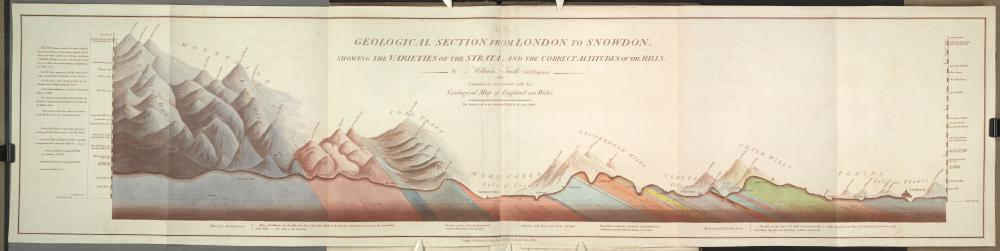
    He applied the discoveries of stratum of William Smith (1759-1839, the “father of English Geology”) drawing on a number of maps of his, such as “Strata
    Identified by Organized Fossils. : Containing Prints on Coloured Paper of the
    Most Characteristic Specimens in each Stratum” of 1815  and “Geological section from London to Snowdon; showing the varieties of the
    strata, and the correct altitude of the hills” of 1815 (pictured below), plus much else.  

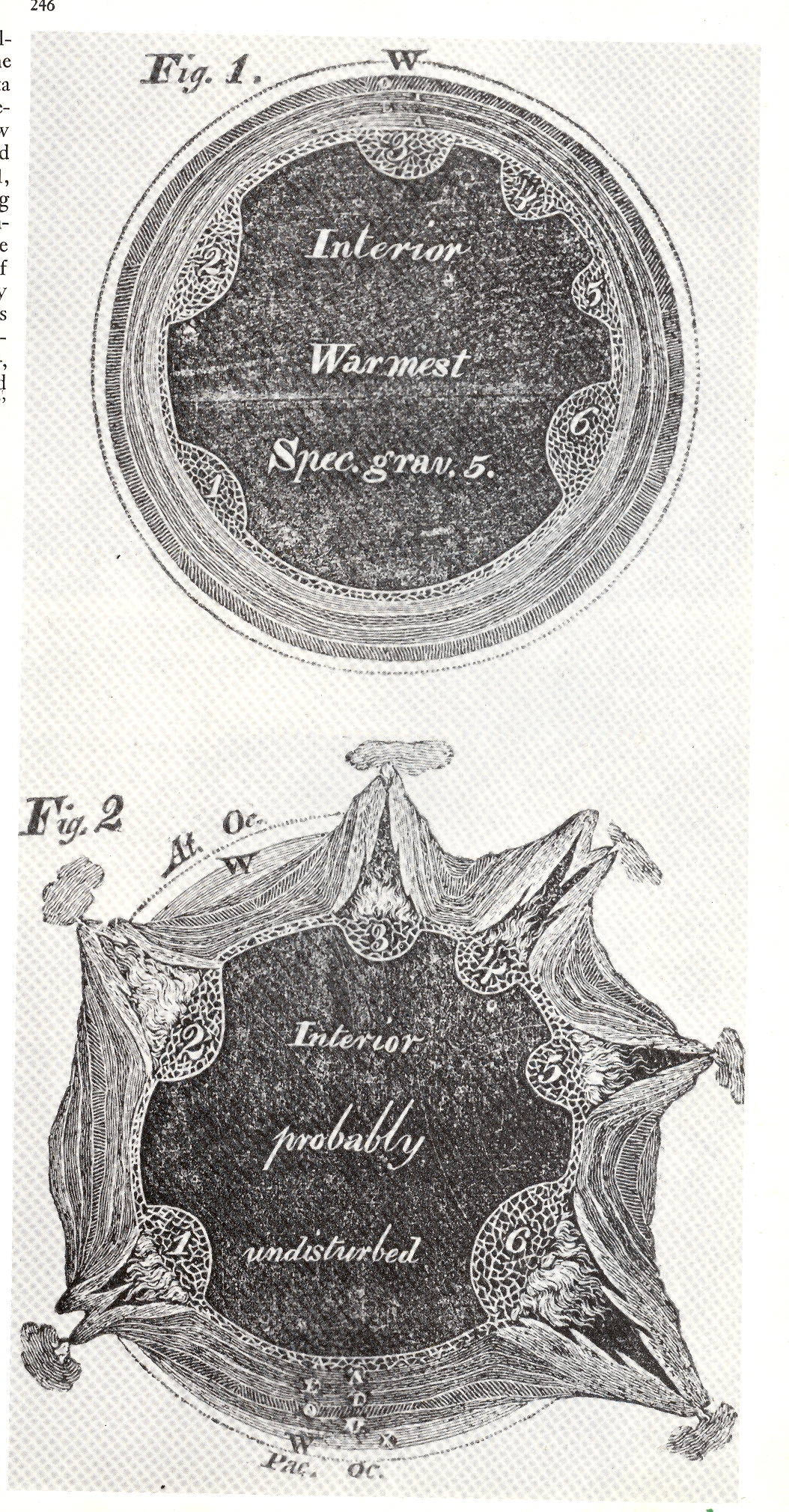
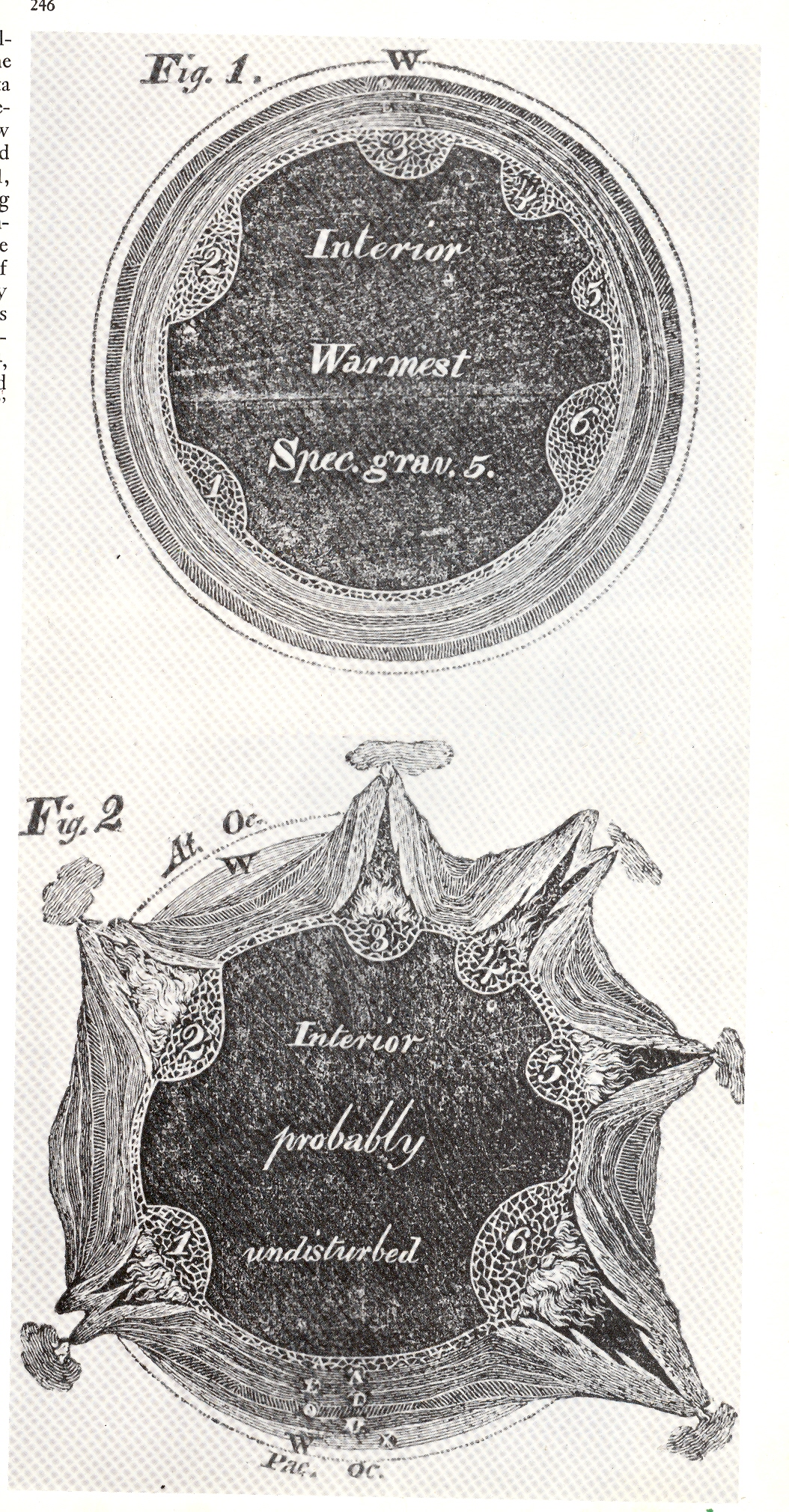
    These two images (left) of cross-sections of the earth appeared in Eaton’s Geological Textbook, (1830). The top shows the earth in perfect harmony and in cross-section, depicting the strata in six layers beneath a calm and palcid ocean.  There was trouble though located inside the six bulbous bulbs on the interior of the innermost strata:  as we see in the second image, the six bulbs, filled with
    Scan0003
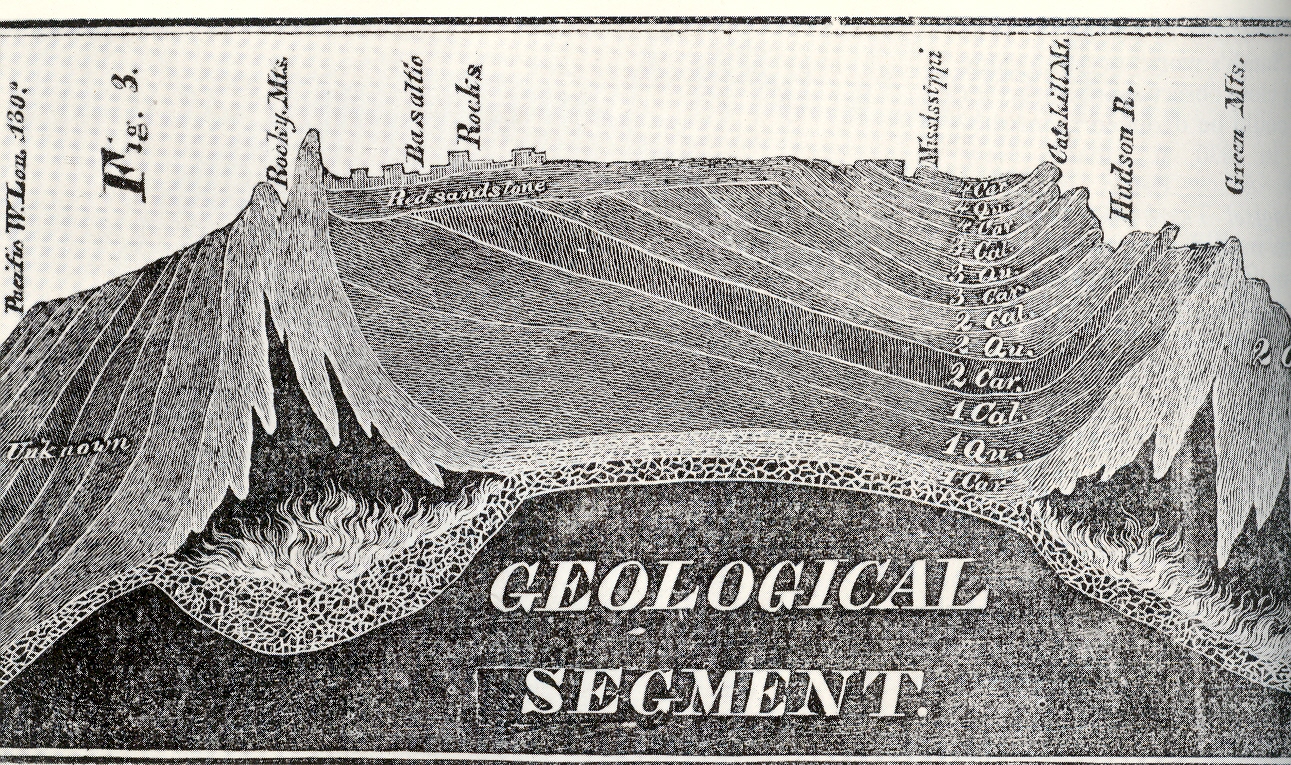
    “combustible material”, combusted, forming volcanoes and such, thereby parting the waters and forming the continents. It was some pretty  good thinking for the time.  But what attracted me to these images was the labeling of the interior of the newly-exploded earth, “interior probably undisturbed”, and blank beyond that point.  a dark, blackish mass, unknown and from where Eaton sat, unknowable.  But Eaton did do an extraordinary job in trying to imagine this stuff, piecing things together from the geological record in those pre-Darwin, pre-Lyell days.  The woodcut at right appeared in the same publication as that above–this incredible rendering depicts the entirety of  North America  in profile, which was a vast leap of faith, an image so severe in its accomplishment that it is difficult today to realize how shocking it must’ve seemed to the readers of 1830.  I believe this was the first time a true geological cross-section like this was attempted–again to see an X-ray (pre-dating that discovery by 65 years by the way) of the earth and to have it be not so terribly bad (compared to today) was just a phenomenal achievement

    ________

    Just for the record, Smith’s map of the London area–which presages the Eaton map somewhat–appears below:
    Blog--earth nothing smith


  • Children’s Games in Art in the 16th & 17th Centuries: van de Venne and Brueghel

    JF Ptak Science Books LLC  Post 503

    0 blog feb 5 van de venne537
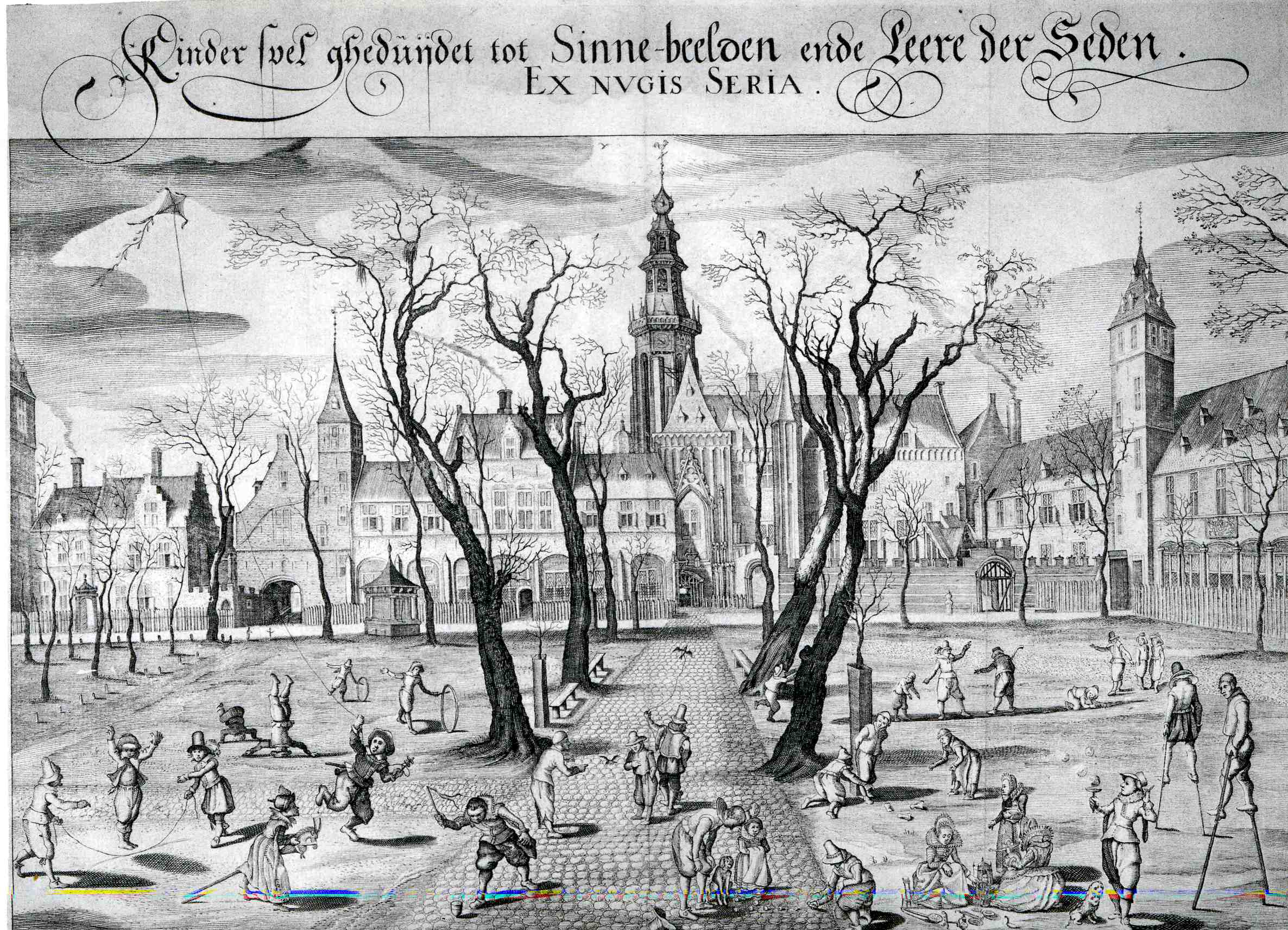
    Adrieaen Pietersz vasn de Venne, must’ve been familiar with
    the work of Peter Brueghel.  I’m not
    saying that Brueghel owned the genre of vernacular allegory, but he certainly
    comes pretty close to that.  In any
    event, van de Venne (1589-1662), a Delft artist who produced this illustration which so much reminds me of Brueghel worked
    a hundred years after the great master—(the elder Brueghel belonged to the
    Netherlands Renaissance, and died in 1569). 
    Having been raised in Deflt, studied in Leiden and died in the Hague, I
    suspect it would’ve been impossible not to come under the influence of Peter or
    the others in the Brueghel family collective, though it would’ve been Peter
    (the elder, who was also known as “the Peasant”) who it seems to me lays the
    greatest claim to some of van de Venne’s thinking.    

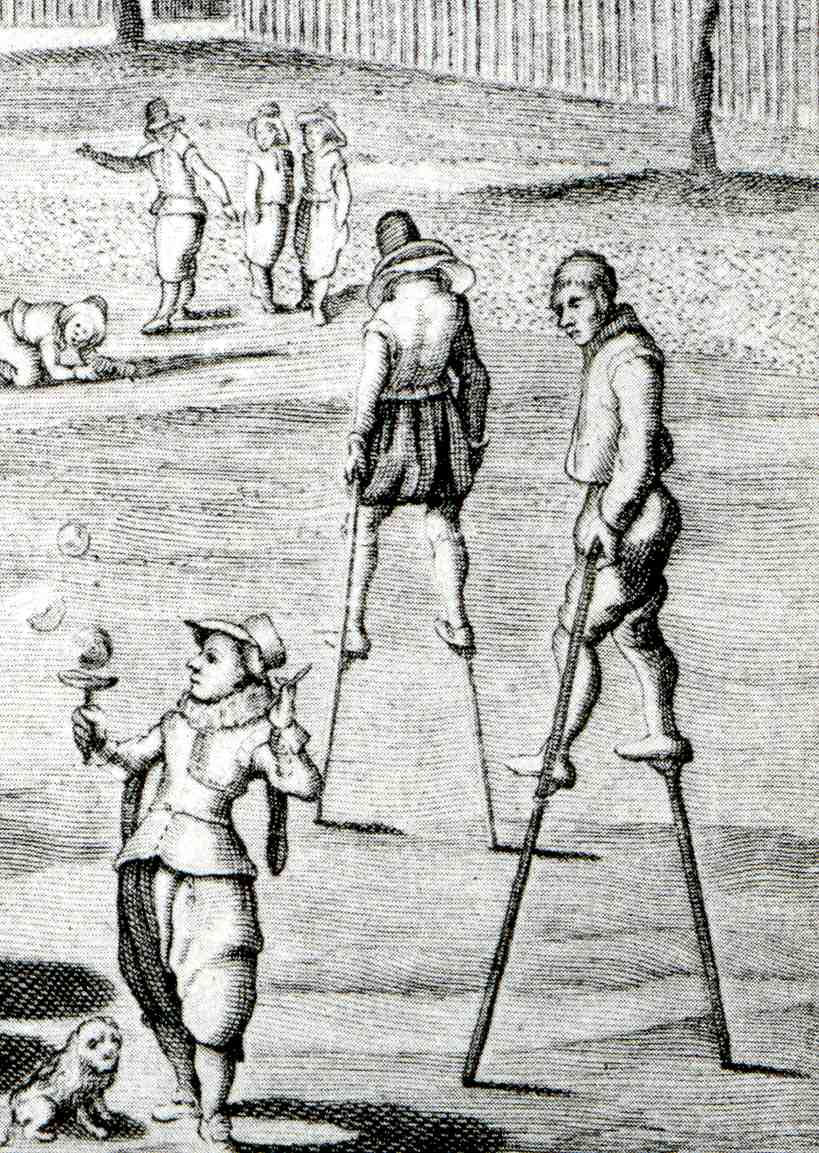
    The subject of van de Vene’s painting (shown here above)  of children’s game is as much a
    parable as it is a recording of games that kids played in the Netherlands in the
    early 17th century.  The
    children are occupying themselves with supreme simplicity, allowing their
    imaginations to form the areas that the physical toy could not; around them we
    see older folks, walking on stilts, seemingly above all of the childish
    bric-a-brac of living.  I think too that
    the spare trees decorating the walk in front of the square of churches in the
    background are there to illustrate what he saw as the lack of imaginative
    fertility of the churches’ reach into the world of the living.  It seems a pretty harsh painting to me once
    you get beyond the fantastic depiction of children at play.  (This genre, of kids playing, is not a very
    wide one in the history of art, believe me.) 

    I think that when you look at the works of van de Venne and
    then at those of Peter Brueghel, there is a close 0 blog feb 5 van de venne538
    connection, as though the
    later painting was simply an intellectual descendant of Brueghel  This is especially true when you look for
    example  at such Brueghel paintings
    as  Ass at School, 1556, Parable
    of the Sower
    , 1557, Landscape with the Fall of Icarus,
    c.1554-55,  Netherlandish Proverbs, 1559,The Fight Between Carnival and Lent,
    1559, Portrait of an Old Woman, 1560, and Temperance, 1560.  This becomes especially, easily clear when

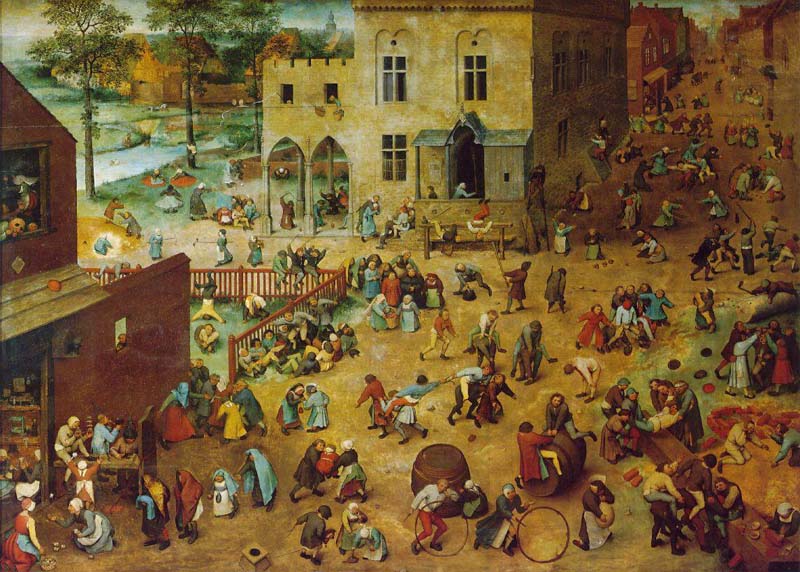
    you see the Children’s Games, Brueghel’s spectacular
    1560 achievement in which 250+ children are shown at play at some 80+ games,
    seemingly taking over the square of this small town.  This is a painting of enormous importance in
    the preservation of time spent at play. Evidently the experts have identified
    almost all of the games being played and toys being used;  the toys are all known, but there are a few
    games that remain a mystery to 21st century eyes. 

    Van de Venne seemed not to have had followers in his footsteps,
    exactly.  He went on in the later quarter
    of his career to specialize in depicting his subject matter in painting in
    various forms of gray, with his principal subjects in his genre paintings being
    peasants, the poor, the maimed, the ugly, the infirmed, the out-of-place, and
    children.  Seems as though this approach
    did not lend itself to the glorious revival of sumptuousness and color that was
    coming to the Netherlands just at the time of van de Venne’s death.  

    And, just  for the record, the Brughel painting:

    Bruegel_games 

    Richard Muhlberger, in What Makes A Bruegel A Bruegel? (New York: Metropolitan Museum of Art and Viking, 1993, pages 15-16)
    tells us that:

    “Brueghel painted an entire town inhabited by about two
    hundred fifty children. At first the image seems to capture a
    holiday, but soon it becomes clear that the painting is meant to be an
    encyclopedia of children’s games. Because most of them are still
    played today, eight-four have been identified, while others not known
    to the twentieth century have yet to be recognized.”

    “Brueghel did not want to emphasize one game above the others. Not
    able to crowd them all up front, he painted them as if looking down at
    them from above so that none is blocked from view. While the distant
    children are smaller than the ones up front, their costumes are still
    bright. No matter where the children are, even in the shadows, Brueghel
    painted them as if they were in the noonday sun… At first it looks as
    though the boys and girls are scattered at random, like jacks thrown on
    the ground. Brueghel knew how to organize large crowds into patterns.
    The figures in the foreground of the painting are arranged in lines
    that fan out from the lower left corner and catch the viewer’s eye
    first. Of course, being formed of children, the lines refuse to be
    exactly straight! The youngsters in the street behind them are placed
    in small groups that form a back-and-forth curving line… Brueghel
    made all of the children’s faces similar. Differences in clothing are
    slight, and not many colors are used. But each child looks like an
    individual because of the way the artist painted bodies: No two are
    alike. After all, it is in the figures’ movements that the viewer can
    tell what games are being played. By focusing not on personalities but
    on the games, Brueghel gave them a universal meaning.”


  • Blank and Empty Things, XXX: Maps of Lunar Nothingness; or, When Nothing is Something

    JF Ptak Science Books  LLC  Post 502

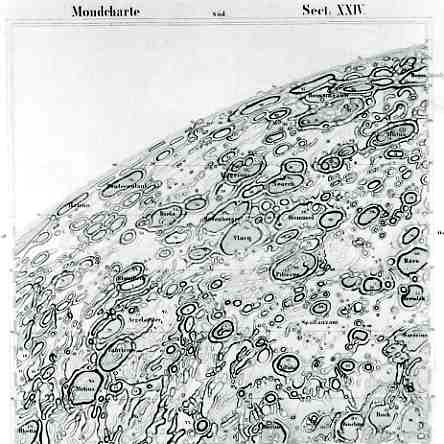
    0 blog feb 3 nothing scmidt515Actually, these maps are hardly maps of lunar nothingness–on the contrary, they are among the most detailed  maps ever produced (to their times)  of the lunar surface. The first, to the left, is by J.F. Julian Schmidt (1825-1894), who produced his monumental  opus to close observation and ultra-tidy detail in Mondkarte in 1878, a spectacular map of the Moon in 25 contiguous sections, which surpassed all other earlier maps–it shows riles, contours, valleys and thousands of new craters, not to mention the fact that Schmidt also calculated the heights of more than 1000 mountain peaks.  The map was produced with enormous precision by this careful observer, the lunar features presented in such a way as to be easily readable and extraordinarily detailed. It is this representation that gives the map an initially curious appearance of emptiness, when in fact the opposite is true.  (For a very useful and illustrated timeline of lunar history, see the blogsite of Chuck Wood.). 

    0 blog feb 3 nothing scmidt516

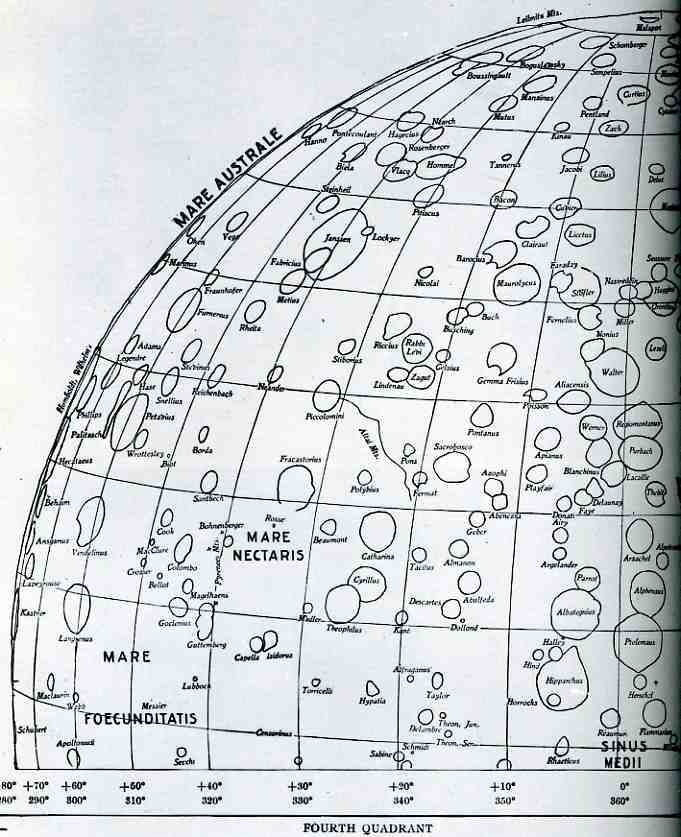
    The second example of nothingness is from William Pickering’s (1858-1938)  1903 index map of the Moon, which was constructed from his careful photographic surveys, and offers a very precise rendering of the major features of the lunar surface. It was made to accompany his exhaustive The Moon : A Summary of the Existing Knowledge of our Satellite, an atlas published in New York in 1903. The outline map is another example of something that appears to be somewhat empty while holding a vast amount of information.

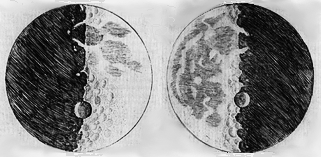
    A little beyond the scope of these two maps is that of Galileo Galilei (1564-1642), who in 1610 produced the first drawings* of the Moon made with the benefit of a telescope.  It was a shocking revelation for all those who saw it (when published in his Sidereus Nuncius, or “The Starry Messenger”, which was also the first published treatise on the Moon)  and I can only imagine what the common person with an average amount of scientific curiosity could’ve felt when seeing the image for the first time.  It was mostly a map of nothing, but the details present were extraordinary and fantastic–they revealed undisputed features of the Moon, images of contours that had been only rendered via considerable eyestrain for thousands of years. It also showed peaks and mountains and other jagged stuff, which disproved the running theory that the Moon was a perfect sphere devoid of such things. And then here, in 1610, was the first “close-up” vision of this complex object that had been followed by billions of eyes for thousands of years–it just had to be shocking. It was mostly nothing, but the bits of something that were present were a phenomenal vision.  

    1610-GalileoMoon *(Before people start writing in about the chronology of Galileo and the “first” claim, I know that the issue is a little knotty and a little more complex than old Galileo being the first on the scene.  William Gilbert–ultra-famous for things outside astronomy–drew an odd, wrong and surprisingly non-detailed map of the moon in 1603, though this wasn’t published until after his death and a lot of other lunar-related stuff happened in 1651.  There’s also some recently re-discovered telescopic renderings of the Moon made in 1609/10 or so by the Englishman Thomas Harriot which are of the same quality as Galileo’s. Within three years of the Galileo publication came the work of two astronomers on mapping the Moon: G. C. La Galla (publishing in Venice in 1612) and  P. Christoph Scheiner (in Germany) between 1611 and 1613.)


  • Inside-Out Privacy: Hermits, St. Simeon, and Cellular Phones

    JF Ptak Science Books LLC  Post 528

    0 blog feb 18 hermit600

    “Language is just no damned good.”–Marcel Duchamp


    0 blog feb 18 hermit601 It seems to me that when cellular telephones first appeared, they were to deliver a certain amount of privilege, a promise of speed in communication that would allow for more personal time and privacy.  But that was many years ago, back when paying for cable television meant no commercials.  The promise, or possibility, of privacy as a result of using this Ponzi scheme of constant data streaming is a demolished and smoldering pile, missing the smolder and the pile.  There’s just nothing in that smoking promise-hole:  no smoke, and not even a hole. 

    What it is, I think, is privacy turned inside out:  everything on the inside is now on the outside, a great big visible and vocal outside. 

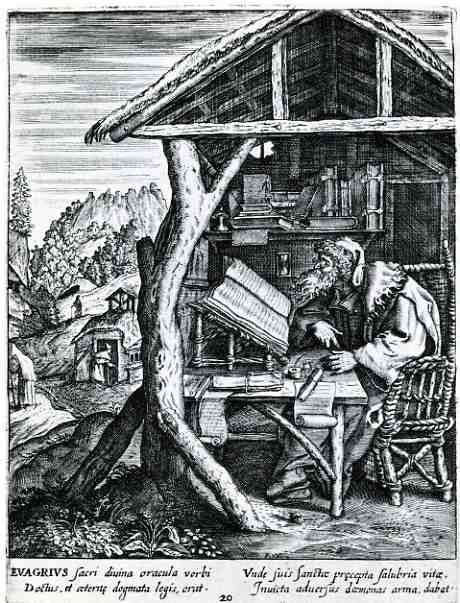
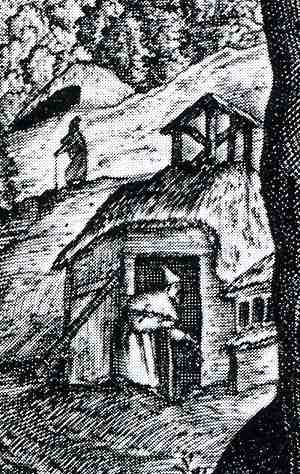
    Privacy, which means to me the promise of some time in which to do a little thinking, is much more in line, say, with the pursuit of a personal space:  not necessarily like that of the beautiful hermit in the image to the left here, but it at least represents the possibility of quiet, which represents a possibility of order and image-making, which in turn represents dreaming or thought or perhaps nothing at all.  It does mean something to the lead monk in this engraving, which belongs to the beautiful Illustrium Anachoretarum Elogia sive religiosi Viri Musaeum (“The Museum of Hermits”) of Giacomo Cavaccio (published in Venice in 1625).  This is a beautiful and remarkable book, with 32 full-page engravings punctuating 150 pages of text  surveying the literature and imagery of, yes, hermits.  Although living very simply, these hermits were all in order, living cleanly, with an impressive two-dozen or more books in their little huts.  St. Anthony, another very quiet thinker, lived in a similar fashion but without books and whose story was unknown until it came (post mortem by thirty years) to St. Augustine, appearing in his Confessions.

    On the other hand, in the history of quiet asceticism (athletae Dei, “athlete of god”),a hermit without the need of a hermitage, or quiet, or aloneness, a hermit who turned the concept of private thought inside out, was St. Simeon Stylites.  I’m sorry to say that he sounded to me like a person in desperate need to be seen being thoughtful and to display his quiet and dedication loudly.  Chained to an ever-heightening pillar, doing sit ups and reciting his conversations with the creator of the universe, Simeon made it into heaven as a saint after treading the earth as one.  Still he seems to have been the opposite of the expected.

    I wonder about this legacy of the invasion of the cell phone; I have little doubt that it is just the barest blink of future invasions of privacy to come, unstoppable and ultimately unwantable. M. Duchamp did say this about words–though he was talking about written and spoken, words–once they left the privacy of the brain, their meanings got all messed up. The interruption of privacy was what corrupted them and their meaning. (“I use it  (language) because I have to” Duchamp said.)  

    I can’t help but think about the speed of deliverables in the Brave New World.  It reminds me of an observation made by Mikhail Matyushin, in 1915: “Only motion cystallizes outward appearance into a single whole…a speeding train fuses the separatness of the cars into a compact mass…”  He goes on to say that “when at last we shall rush rapidly past objectness we shall probably see the totality of the whole world”, though I think that he got that part of it backwards, or perhaps inside out. 


  • Music, Math, and the Mathematical Piano: Pascal, 1645

    JF Ptak Science Books LLC   Post 524

    0 abay feb 23 pascal computer621

    Music is the pleasure of the human soul experiences from counting without
    being aware that it is counting. – Gottfried Leibniz

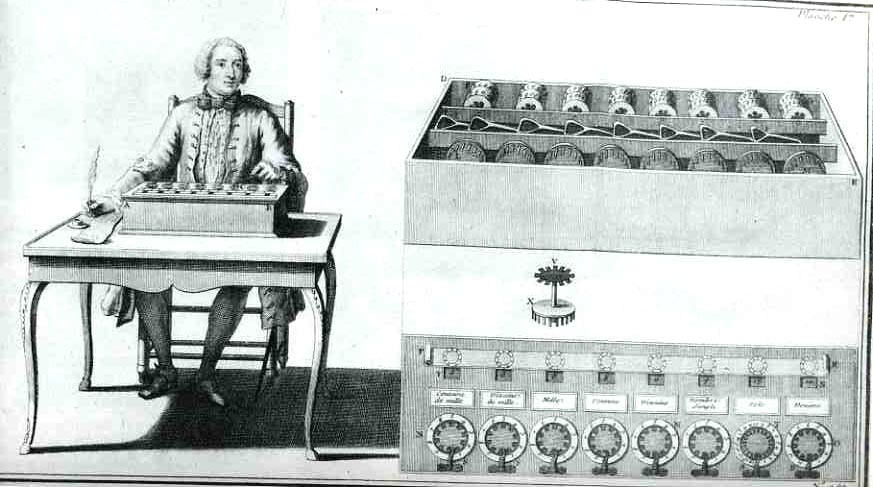
    Blaise Pascal (1623-1662), physicist and
    mathematician–rather, mathematician and physicist–and philosopher as well,
    invented the second mechanical calculator in 1645 (after that of Wilhelm
    Schickard (1592-1635) in 1623).  He had a
    phenomenal output in many different, difficult, and complex areas, all
    completed before he died at the improbable age of 39. (His predecessor in invention,
    Schickard, was dead at 43.)   We see him
    here, seated in front of his beautiful invention (called the Arithemtique, and
    the Pacalina), looking to be quite a bit older than his age at invention, which
    was 23.  He looked pretty content with
    himself, even though, I think, he didn’t care all that much for the machine–at
    least he didn’t care enough about it to perfect it, or to try to make real
    money on the thing.  But the picture of
    him here always looked to me as though he was playing an enharmomic harpsichord,
    or using some sort of musical instrument, or doing something more socially beautiful
    than the optical doing of arithmetic, though both were exhibitions of tuning
    the polyphonic sub-mysteries harmonies of nature.  His image seems to wed the millennial Pythagorian
    creation of the music of the spheres, and Leibniz’ scorn of Newton’s occult-y causes of nature’s
    phenomena, and of Augustine’s “distraction” of perfect creation—a polychord
    romance of science and music.

    Or, maybe, it was just a guy sitting behind a calculator.


  • Crowds #5: Clarity and Confusion in Displays of Human Masses.

    JF Ptak Science Books LLC  Post 523

    0 abay feb 23 crowd617

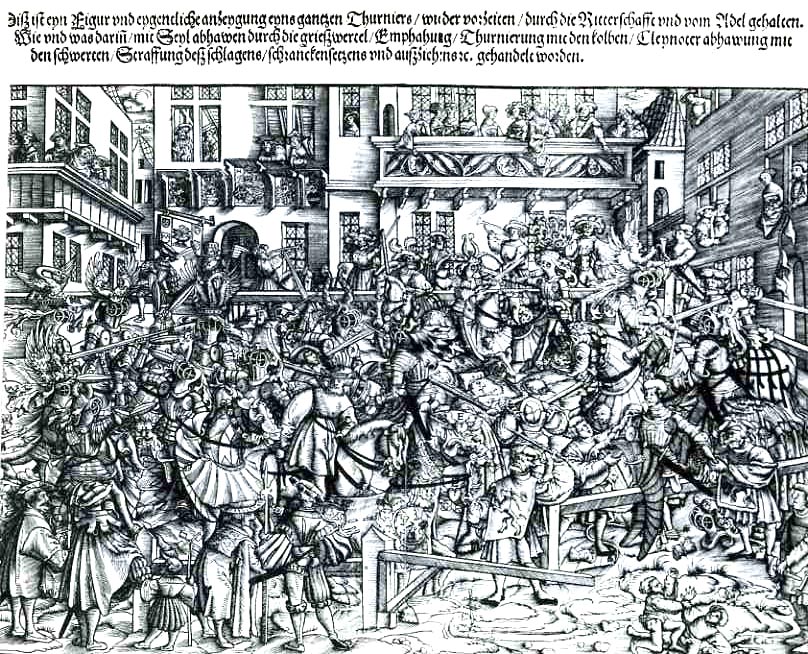
    I do enjoy looking at pictures of crowds–big crowds.  Images of the crowd are much easier to find in the 19th century and onwards (and particularly in photographs), though big displays of human seas (such as they were) began to show up in the late 15th century, and then, more as a matter of course, in the early 16th century.  What is enjoyable for me are the numerous vignettes that make up the whole, discrete visions within the larger visual field, a sweep of smallnesses that can seemingly stand on their own had they been bigger. 

    Depicting crowds can be a chore successful and not–for example, the image to the left, an amalgamated porridge of controlled mock combat, a sweeping chaos with appreciative bystanders, is so busy, and has so many constituent parts, that there 

    0 abay feb 23 crowd618

    really isn’t a “whole”.  I can hardly see the thing, for crying out
    loud, for all of the disconnected action.  The artist who produced this
    remarkably good/bad image for Georg Ruexner’s fantastic Anfamg, Ursprung und Herkomen de Thirnirs in Teutscher Nation
    (published in 1530) clearly had interest only in the details of the
    action; and thus the overall image is a beautiful confusion of starts
    and fits, defiant in its general appeal to comprehension.  The impression to me is a miserably layered oneness of discordant activity, a sloppy relief of enormous detail, the whole worth far less than the sum of its parts. 
    The only place that your eye gets a chance to rest and focus is on the two dozen or so spectators who are in the windows and balconies overlooking the small square where the tournament was taking place–their appearance, and also that of the small assembly of musicians at center, offer a calming influence to the rest of the picture.
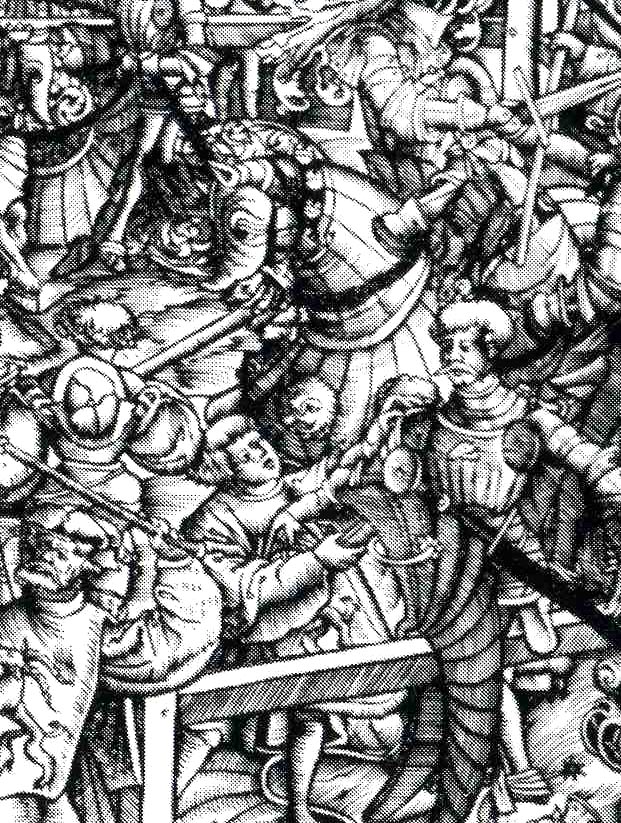
    One bit that leaps out at me, though, are the two small boys who seem to be having a fistfight, right there at the bottom-right of the image.  I can tell you that pictures of boys fighting finding their way into piece of renaissance art is a very rare thing.  Perhaps the artist was trying to send us a message, after all?

    (I know this is a pretty big complaint, particularly since the book is a monumental work on The Tournament, and it was done within the first 65 years or so of the invention of movable type printing, but I just found the thing so opitcally  corrosive that I wanted to surface it. )

    0 abay feb 23 crowd620

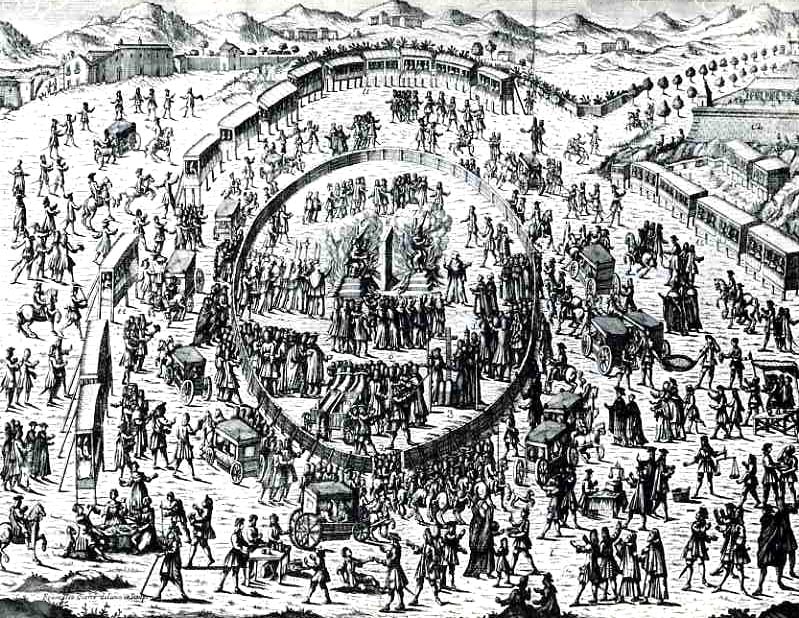
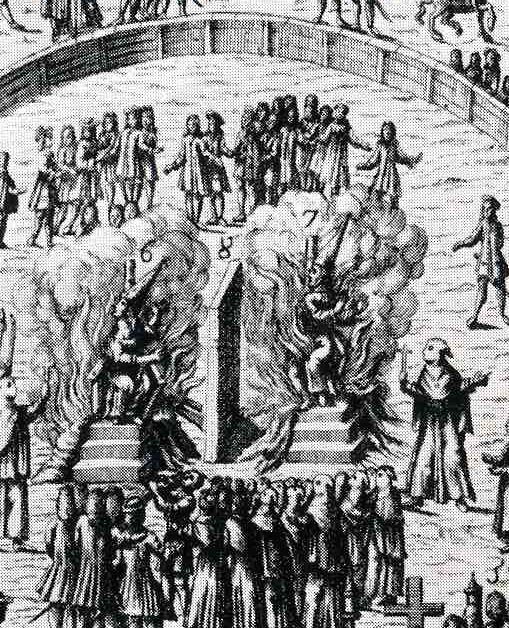
    The second example, coming to us from Antonio Mongitore (L’Atto Pubblico di Fede Solennemente Celebrato nella citta di Palermo, 1724) depicts an earlier scene, and one of complexity and order.  Unfortunately, the cohesion centers around the execution of two tried/convicted heretics–god knows what they did to deserve this cleansing sentence. It didn’t take all that much during the Inquisition to find yourself in deep black waters, as Mother Church seems to have been extraordinarily thin-skinned; the slightest abrasion to their slight slate of moral indignities could result in being hurt in foul way, and then burned alive at the stake. 

    But in looking closer at this image, I’m not sure sure that these two unfortunates were actually being burnt–it may be that they were being roasted alive.

    0 abay feb 23 crowd619

    They are seated, and the pyre seems to be only behind them–perhaps
    the flames hadn’t reached them yet; but people were in fact roasted,
    cooked alive, which may be even more girzzly than being consumed
    entirely by flames.  The two are being approached, or watched, or
    offered too-late benedictions by a line of clerics shielded by a
    crucifix–perhaps they were just reminding the condemned exactly who it
    was that they had pissed off. 

    There is no doubt that this was
    a popular diversion for those not in fear of being burnt at the stake,
    as there are probably hundreds of people in attendance, including those
    in a semi-circle of pre-modern “skybox” accommodations–undoubtedly the
    holier folks.  Piety of witnessing best in privacy and all that. 


  • A Beautiful Book of Terrible Things: Artillery, 1623

    JF Ptak Science Books LLC  Post 522


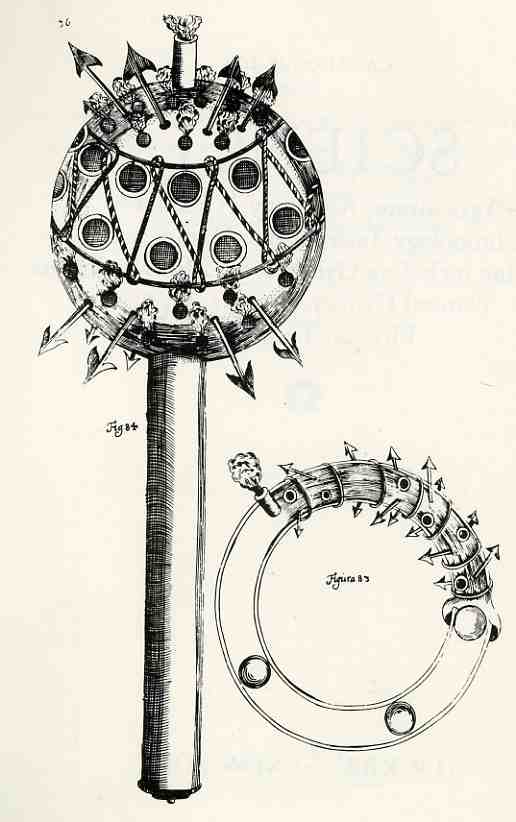
    0 blog feb 16 rockets596
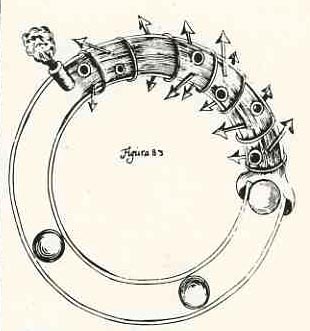
    0 blog feb 16 rocket detail

    Praxis Artolleriae Pyrotechnicae, printed in Osnabruck by Tilman
    Buchholtz for Johann Georg Schwaender, is one of those beautiful books
    of horrible things; beautifully designed and illustrated, with
    magnificent images of the horrifying necessaries that bind and tear
    nations and people.  Flying and land-based weapons o fall sorts filled
    these pages:  rocket, grenades, land mines, plus pyrotechnics and
    fireworks.  As jolly as this implement might seem, it is not a
    firework, at least not one for entertainment:  it was meant to
    dismember or kill.  Those “arrows” on the ring are not showing the
    direction of the flight of the module–they are spears.  This was a
    lethal weapon of the highest order–pretty, not-so-simple, and deadly.

    Some other beautiful terribles, published to about the year 1600, include: 

    Roberto VALTURIO 1472 Vérone De re militari

    Niccolo Fontana TARTAGLIA  1537  La Nova Scientia

    Vanoccio BIRINGUCCIO  1540 : De La Pirotechnia

    Conrad HAAS  1556 : Kunstbuch

    Girolamo CATANEO 1564 : Opera
    nuova di fortificare, offendere et difendere, et far gli alloggiamenti campali
    .

    Thomas DIGGES  1579 Arithmetical
    military treatise
    .

    Gabriello BUSCA 1584 Istruzione dei Bombardieri.   1585  Della espugnatione et
    difesa delle fortezze
    .  1606 :Della
    Architeltura militare
    .  

    Luys COLLADO 1586
    Practica manuale di artegliera.

    Jean BEAVIE 1591 Liège La
    pyrotechnie militaire

    Daniel DAVELOURT  1597 Briefve
    Instructions Sur Le Fait De L’artillerie de France
    .
    – 1606  L’Artillier.
    – 1608 : L’Arsenal et le magasin d’artillerie.
    – 1617  L’Art et la conduite des eaux sur le fait de l’Artillerie de 
    et ses dépendances

    Joseph BOILLOT.  1598 Modelles,
    artifices de feu et divers instrumens de guerre
     

    Gabriele BUSCA da Milano 1605 Della
    espugnatione et difesa delle fortezze
    .
    1598 Istruttione de’ bombardieri.
     

    Eugenio GENTILINI  1598 Instruttione
    di artglieri
    .

    David RIVAULT de FLURENCE 1605
    Les elemens de l’artillerie concernans tant la theorie que la pratique du
    canon
    .
    1608 L’invention description & demonstration d’une nouvelle artillerie
    qui ne se charge que d’air ou d’eau pure, & à neantmoins une incroiable
    force. Plus d’une nouvelle facon de pouldre a canon tres-violente qui se faict
    d’or, par un excellent & rare artifice non communiqué jusques à present.
    L’histoire du progrez & des premiers usages des armes à feu tant recentes
    qu’anciennes, est deduitte en l’avant-propos
    .  

    Leonhard ZUBLER 1608  Nova
    geometrica pyrobolia – Neuwe geometrische Büchsenmeisterery
    .


  • The Staggering Beauty of Barber Shops: Naive Surreal Department #22

    JF Ptak Science Books LLC  Post 519

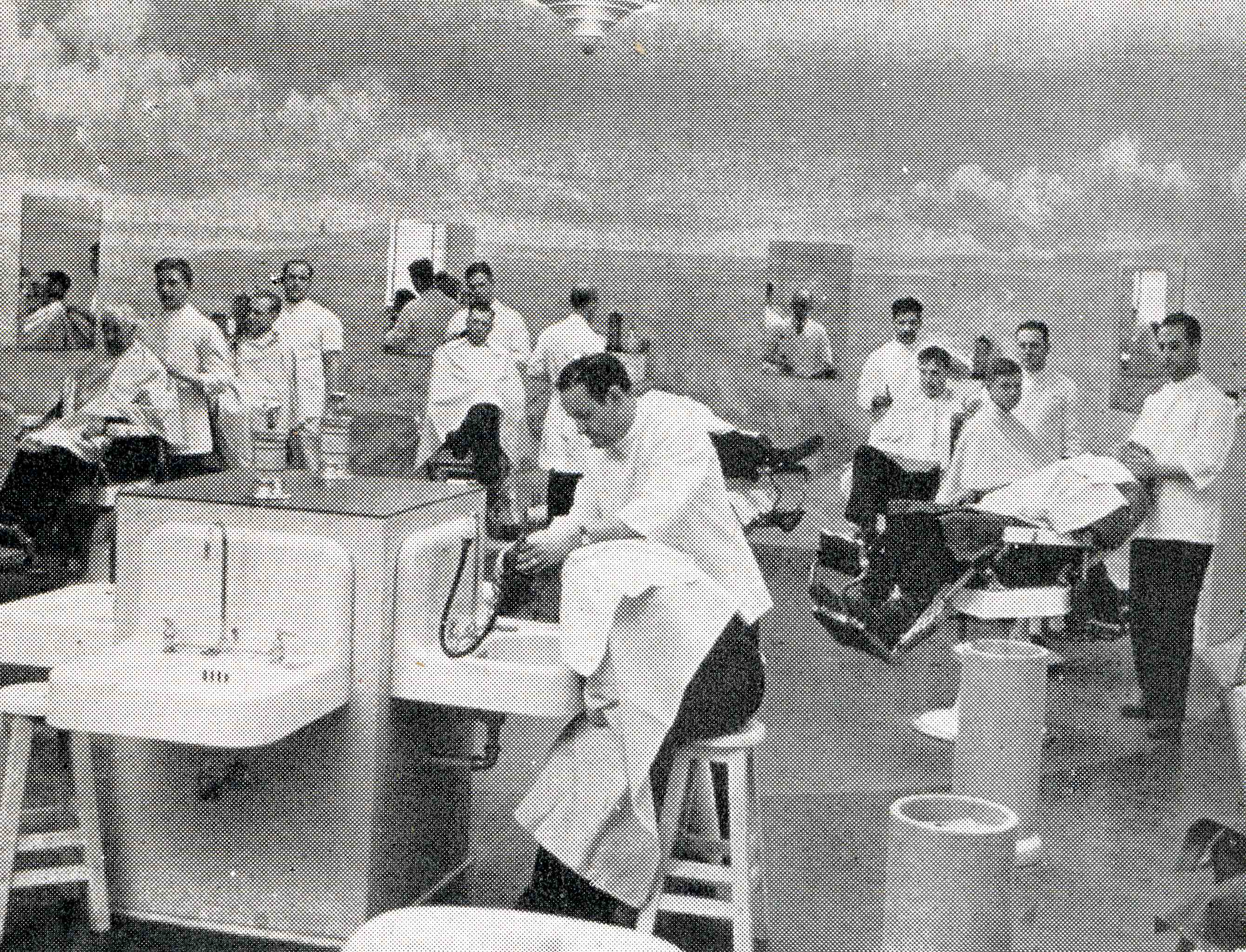
    0 blog feb 18 barber603
    If I didn’t already go to see Korean War Vet Mr. Jack for my (one) hair cut (and I really don’t mean “haircut”), I think that I could tear myself away from that wonderful experience to go back into time’s recent ankle-deep depths and go to this barbershop….or rather barber emporium.  The location or credit wasn’t given in the occupational pamphlet (The Canadian Census Classification Personal Service:  Barber) in which it appeared, which is altogether too bad.  I cannot recall (can you?) ever seeing such a Busby Berkeley arrangement of barber chairs, centered around a washing station, with clouds (!!) painted on the ceiling.  I would half expect to see Mr. Zero Mostel (oh well, not every did well at HUAC) lead them all in a dance routine where everyone finishes up very leggy and in a pool.  It may well be the case in this unnamed palace that we are seeing only half of the shop–evidence in my copy shows that there is the end of a chair in the foreground, meaning that there could be 15 chairs in there, making it one heck of a busy place, clouds on the ceiling or not.  (The clouds make sense, remembering that most men in 1946 would be going in to see the barber for a shave as he would a cut or trim–and why not look at something attractive when you’re on your back and someone is scraping your face with a very sharp tool?  Dentists should take heed…) 

    And while we’re at it, when exactly did womens beauty salons start to appear in earnest?  This pamphet states “But in 1913, when women took to “bobbed” hair, the barbers found a vast new market for their services.  In the last twenty-five years however a large part of this market has been lost to the hairdressers and beauty culture speciaists, most of whom are women.”  That would mean that–at least in Canada–men were doing this new “bobbed” styling  for their “vast” new clienetelle from 1913 to 1921. It would’ve been a very wide and languid hayride for barbers for those years, cutting the hair of both men and women.  I can imagine the shock of the first male barber seeing the first woman-operated beauty salon swing open its no-males doors–probably there on his street–and hear that glug glug glug sound of business being drained.  Bobbed hair giveth, and bobbed hair taketh away.  

    And now, speaking completely through my hat, I wonder about where women got their hair cut in the 19th century.  My guess:  they didn’t go “out” to have it cut; when they did cut it, they did so at home.  I cannot recall seeing any pre-WWI advertisements for hair cutting for women–as a matter of fact the overwhelming memory I have of women and hair going back into the mid 19th century is for hair care products showing women with enormously long hair adding balms and salves and lustreizers and so forth to it.  I can’t force a memory of an ad for anything having to do with cutting womens’ hair–not even an ad for shears.  Of course a very low percentage of women were in the workforce before WWI, and the women who were wealthier and could afford evening clothing could certainly afford to have someone come over and take care of their hair. Slipping back into the 18th century and slightly before, there was the issue of wigs and extenders–or whatever it was that society women would add to their hair to make it impossibly tall and full.  But that was a very restrictive percentage of women enjoying that privelege, and I’m not sure that it counts for my purposes here.

    My guess is that the money just wasn’t there.  Or it wasn’t there until women sorta started to work, and there was a shortish hairstyle that was not too complicated or time consuming to cut.   Again, I’m just guessing all of this out, but it does seem to make sense.  


  • Van Helmont’s Lovely Title Page and his Sorry Slip into Curative Magnetism

    JF Ptak Science Books LLC  Post 514

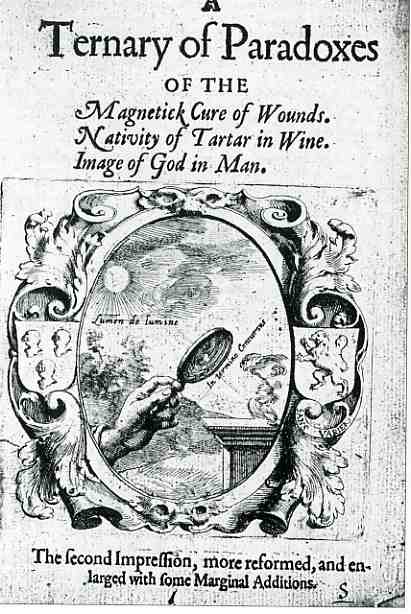
    0 ebay feb 10 helmont553

    Joan Baptiste van Helmont’s
    A ternary of paradoxes : the magnetick cure of wounds, nativity of tartar in wine, image of God in man.
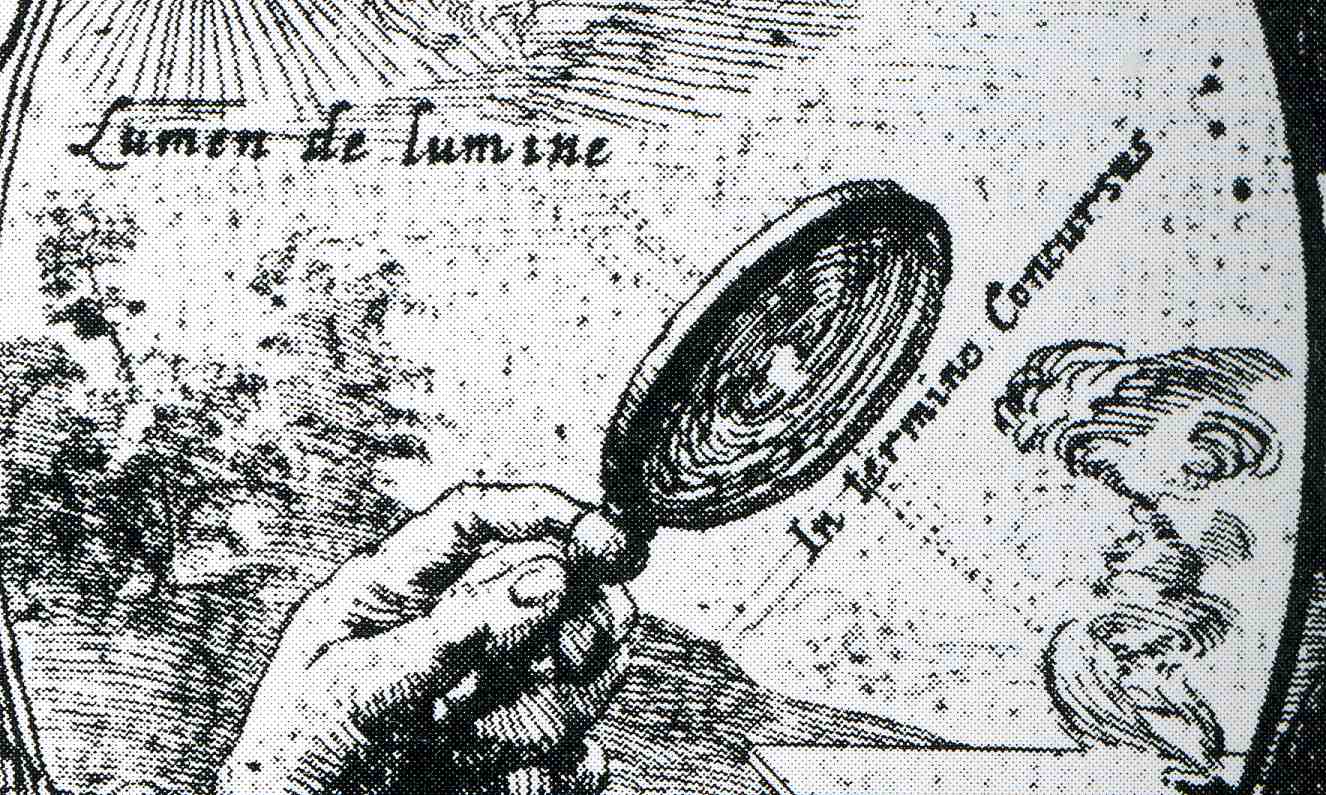
    (printed in London  by James Flesher for William Lee, 1650), offers its own unintended paradoxes (and joined the field of relatively few books with the word “paradox” in their title).  Purportedly a work of science, van Helmont offers the reader his views on the curative powers of the loadstone.  Of particular interest is Helmont’s (1579-1644) discussion of the weapon salve, a cure for injuries caused by knives and swords. The unique feature of this ointment was that it was not applied to the wound but to the weapon which caused the wound, though in the midst of other very problematic scientific observations, this wasn’t so bad.  For example, Helmont presented a recipe for making scorpions, which involved bricks, sunlight and basil, from which a scorpion would come. 

    And what exactly is Helmont’s place in the history of science?  Difficult to say:  he did make several important physical discoveries, and did present what some have called the modern approach to experimentation (firm insistence on relateable objects in empirical observation and so on); however, he was a reaching alchemist misty mystic who rejected syllogistic thought, mathematics*, human reasoning.  These are hard bits to let go.

    All this said, what with scorpions and magnetic treatment of wounds, he comes close to the generation of infection in wounds:  “Upon the solution of Unity in any part the ambient air…repleted with various

    0 ebay feb 10 helmont555

    evaporations or aporrhoeas of mixt bodies, especially such as are then
    suffering the act of putrefaction, violently invadeth the part and
    thereupon impresseth an exotic miasm or noxious diathesis, which
    disposeth the blood successively arriving at the wound, to
    putrefaction, by the intervention of fermentation. ” With his magnetic
    sympathy, Van Helmont expressed clearly the doctrine of immunity and
    the cure of disease by immune sera: “For he who has once recovered from
    that disease hath not only obtained a pure balsaamical blood, whereby
    for the future he is rendered free from any recidivation of the same
    evil, but also infallibly cures the same affection in his
    neighbour…and by the mysterious power of Magnetism transplants that
    balsaam and conserving quality into the blood of…’
    Problematic greatness just needs to be understood in greater detail
    than simply disregarding everything because someone disdains logic…

    Note:

    The interesting image in the middle of the title page is more religious symbolism than what seems to be a straightforward physics reference, and the bulk of it lies in the “lumen de lumine” inference, which in the Nicene-Constantinopolitan Creed confesses faith in Jesus Christ as Lumen de Lumine (Light from Light).  Once you replace the optics with the divine, the rest of the image and its relationship to the contetns of the obok becomes more clear.

    *

    Helmont thought about the restrictiveness of mathematics, and that the quantitative aspects of things that math addressed missed their interior qualities, thus making mathematics not able to see what things are.  Oopsie.


  • The Discovery of Nothing: Things out of Place Deparment #4 AND a History of Blank and Empty Things #32

    JF Ptak Science Books LLC  Post 513

    0 blog feb 11things out569

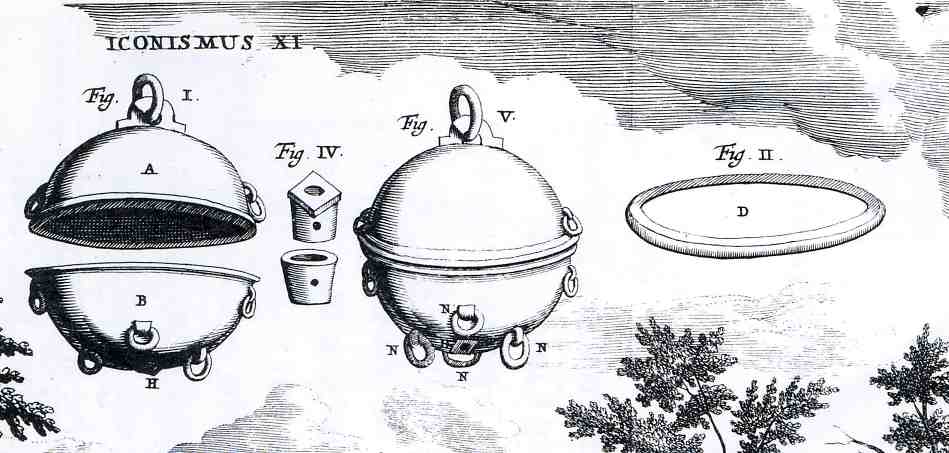
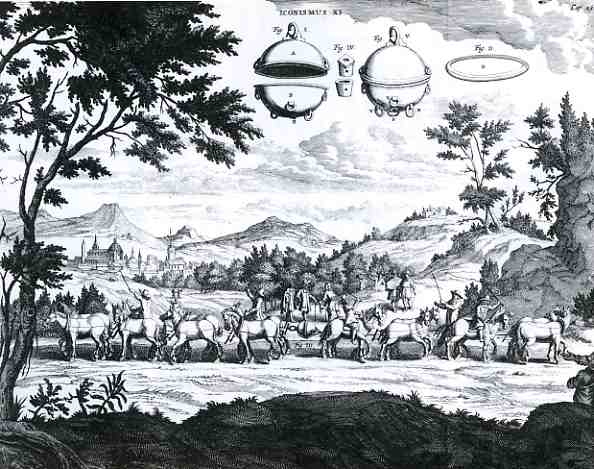
    This is really just another bit of fun–the four objects in the sky weren’t unrelated to the scene, not at all, though if you wanted you could certainly create a fantastically rigorous and bizarre story for them; they certainly did define the concept of “nothing” for the Blank & Empty Things thread of this blog.  here is no doubt that the image has a very quiet, possibly Dadist origin.  In fact, this is one illustration from one of the greatest experimental physics books of the 17th century, coming as it does from Otto von Guericke’s  Experiemnta nova (ut vocantur) Magdeburgica de vacuo spatio (Amsterdam, 1672).  In another minute department, this one is also I guess the greatest book ever written by a Mayor of anywhere (as von Guericke (1602-1886) was mayor of

    0 blog feb 11things out568 Magedeburg for 33 years).  The image shows the greatest of von
    Guericke’s efforts, and one of the greatest (or most important)
    experiments in experimental science–the dramatic demonstration of the
    vacuum, showing here that teams of horses could not pull apart two
    halves of an evacuated sphere, and of course the efficacy of air
    pressure operating against it (um, the vacuum). The “floating” bits in the sky were an exploded view of the sphere that was the subject of the experiment. 

    What was more important though, and what the general reader today might easily miss, was that von Guericke created something that many scientists and philosophers said didn’t, and couldn’t, exist:  the vacuum.  In modern times, Copernicus depicted the universe as a vast void; Descartes came in the back door (following the ancient and interesting though incorrect theory of Aristotle*), not liking the idea very much, and claiming that such empty space couldn’t exist.  Von Guericke provided the proof that the vacuum, that nothing, did exist. 

    _______

    *Aristotle (384-322 BCE) theorized that as air became thinner objects moving through it would move faster, which is true; he further speculated that if there was no air at all, that if vacuums did exist, then objects would move infinitely fast, which he correctly assumed was not possible, and thus the vacuum could not exist.