A Daily History of Holes, Dots, Lines, Science, History, Math, Physics, Art, the Unintentional Absurd, Architecture, Maps, Data Visualization, Blank and Missing Things, and so on. |1.6 million words, 7500 images, 4.9 million hits| Press & appearances in The Times, Le Figaro, Mensa, The Economist, The Guardian, Discovery News, Slate, Le Monde, Sci American Blogs, Le Pont, and many other places… 5000+ total posts since 2008.

Category: Militaria

  • Art & Artists as Wartime Magi–Making Things Disappear, 1918.

    JF Ptak Science Books  Post 1306

    Its a little difficult to think of Ellsworth Kelly, Jacques Villon, Grant Wood, Laslo Moholy-Nagy and Thomas Hart Benton as painters-for-war.  But its true, and true for many of hundreds of other artists in the 1915-1918 era. Its not as though they were in the trenches gunning down the enemy or lobbing hand grenades into the swirling gunsmoke. They were camofleurs, camouflage1 experts, artists employed as magicians, Wartime Magi, employed/drafted to make ships and such disappear. 

    Ever since it was (sort of) first noticed in 1915 that designs odd to the environment, stark geometric patterns and such, were capable of fooling the eye, people with  design capacity were pressed into service, rendering offensive and defensive instruments of war optically semi-impervious with variations of the then-five-year-old modern nonrepresentational art. That must’ve been a very odd position to wake up to every morning. 

    Of course the idea of camouflage in the animal world is probably 250 million years old–animals and insects have been blending into their environment for eons, and I’m sure too that early hominids did their fair share of walking behind brush.  But the idea of hiding great amalgamations of very heavy metal with paint is really quite modern.

    World War I photos--Camouflage291

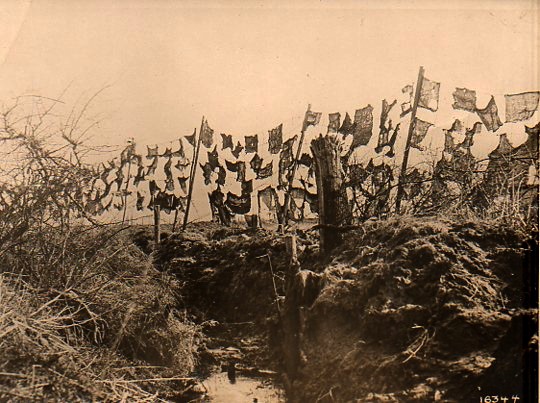
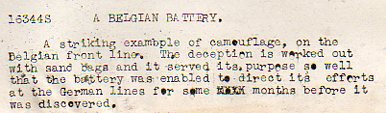
    In this photograph (available at our blog bookstore), the camouflage is more a more futuristic conception of art than the abstract and cubist approaches that were taken during the war, this looking more like assemblages of found material more than anything else.  And, according to the text that accompanied the photograph (which comes from 1918, from the Underwood & Underwood news photo service agency), the camouflage–empty sandbags thrown on a barbed wire fence) successfully concealed a gunnery emplacement for months on end. 

    World War I photos--Camouflage det292

    Notes

    1. A fine bibliography on camouflage appears here, at Leonardo Online.

    The definition of “camouflage” from the Oxford English Dictionary shows that it is a young word, in English:

    (n) The disguising of any objects used in war, such as camps, guns, ships, by means of paint, smoke-screens, shrubbery, etc., in such a way as to conceal it from the enemy; also, the disguise used in this way; freq. attrib.

    1917    Daily Mail 25 May 4/4   The act of hiding anything from your enemy is termed ‘camouflage’.
    1917    Daily Mail 16 July 5/3   The King paid a visit to what is called a camouflage factory.
    1922    C. E. Montague Disenchantment viii. 108   A French aerodrome across which the French camouflage painters had simply painted a great white high-road.

  • A Rare First-Hand Account of the Japanese WWII Surrender(s)

    JF Ptak Science Books  Post 1253

    Deglin c det956
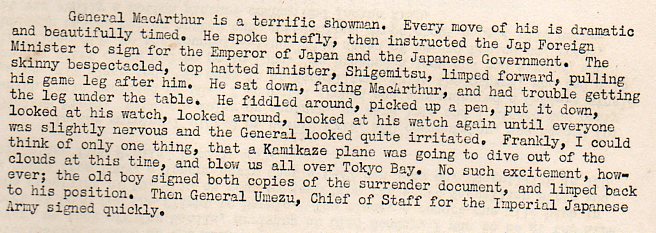
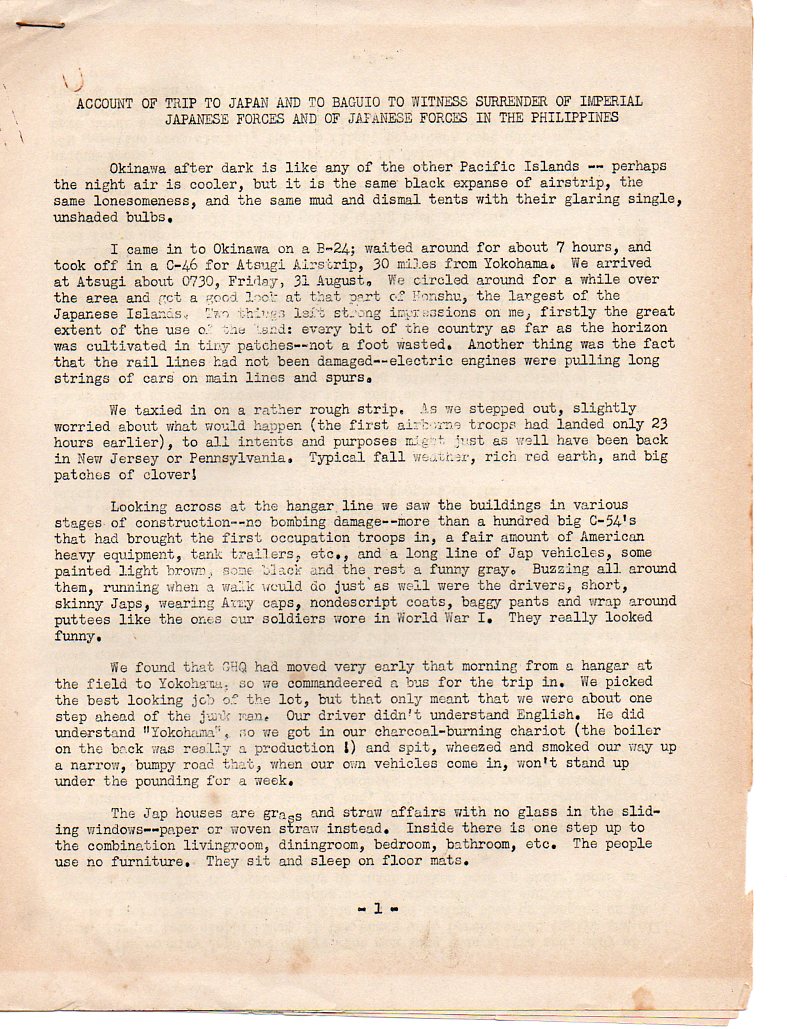
    After serving as public relations director for Madison Square Garden (1935-1942), T.L. Deglin wound up a Lt. Col. in the U.S. Army in a public relations capacity, finding himself a witness on 2 September 1945 to the Japanese surrender on the U.S.S. Missouri and at Baguio (in the Philippines). what follows below is his five-page (1750 word) description of those events.  The report is an offset-printed production, so it did see some sort of distribution, but I can find no mention of it anywhere. 

    My copy came as part of a large group of material (known as “The Pamphlet Collection”) that I purchased of the Library of Congress some years ago–the one cohesive factor to the collection-without-a-purpose was that the material was by and large no located in other libraries.  This may have been because of the great ephemeral nature of some of them, but the pamphlets saw very restricted play in the library circulation game. 

    [Content warning–there’s some very place/time/situation-specific derogatory language here.]

    Deglin a953

    I reproduce the document in full, below.  The original is also for sale at my blog bookstore. 

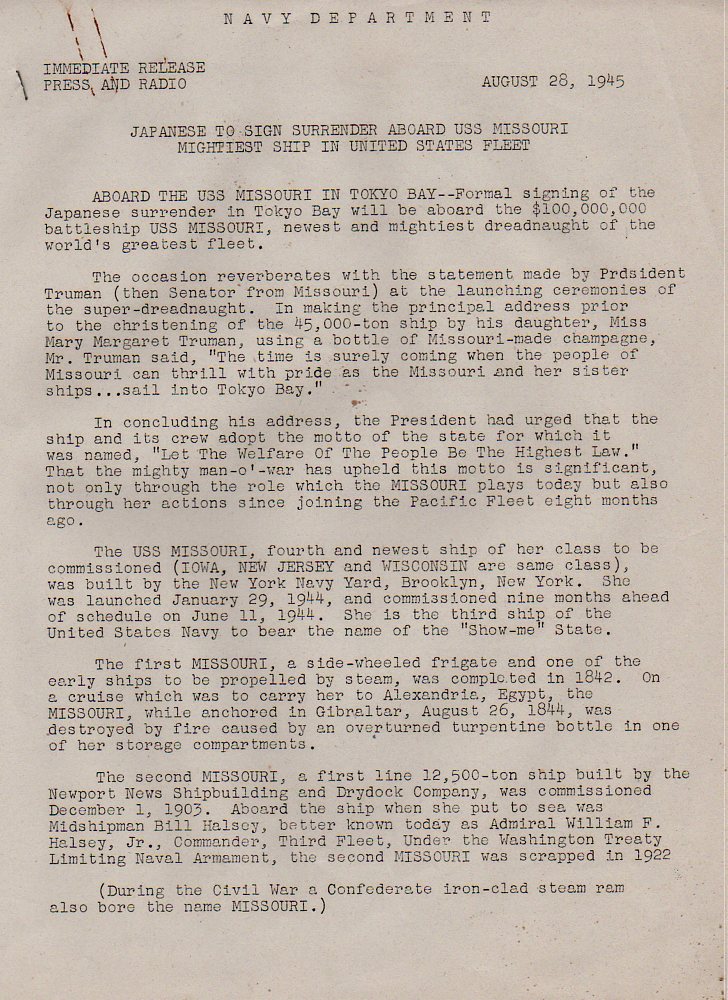
    Additionaly there is this U.S. Navy Department press relsease for announcing the surrender signing agreements, dated 28 August 1945.  This actually comes from the estate of Adm. Grace Murray Hopper via a sale through the Friends of the Arlington Library (Virginia) many years ago. 

    Japan surrender missouri959


    ·Posted by :

    ·in:

    —

  • Forests in the Trenches: Axe Men Soldiers, 1918

    JF Ptak Science Books   Post 1305

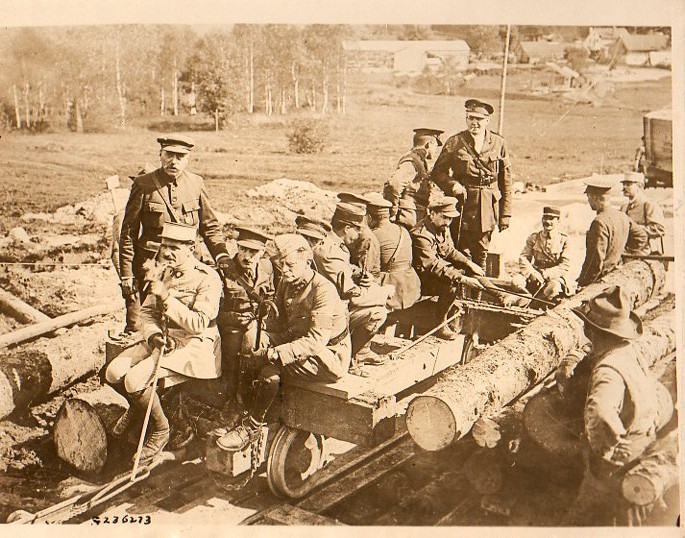
    One thing that I haven’t thought about–among many–is how the lumber for lining WWI trenches was provided.  This issue came about while looking at this World War I news photo service image (by Underwood & Underwood), an image showing a group of journalists accompanying a troop of Canadian soldier lumbermen, all riding on top of felled trees loaded onto railroad cars, the lumber headed towards the Front.  When you think about battles along the many fronts during the war, you don’t think about all of the missing trees, some large percentage of which wound up being utterly splintered during the first stages of battle.  So the lumber needed to keep the sides of the trenches intact must’ve come from somewhere, somewhere else. 

    World War I photos-=axe men295
     [The original photo is available from our blog bookstore, here.]

    World War I photos-=axe men b296
    Given that there were something on the order of 12,000-25,000 miles of trenches for the war (a figure taken from the PBS site on the Great War)–that would mean that there were many miles of trees needed to shore up the ditches.  This is just another one of those infrequently considered indicators of how massive the supporting efforts to the supporting efforts ( and etc.) of the war effort was on each side–that there was a corps necessary as a provider for the construction of the walls of trenches is staggering, especially when you consider the amount of lumber that was necesary to do the job. 

    ·Posted by :

    ·in:

    — —

  • An ABC of Bombing, 1940

    JF Ptak Science Books    Post 1245

    I’ve written on this blog on some odd alphabets, and I’m certainly aware of some unusual alphabet books (like the alphabet of acronyms for some of FDR’s social creations and an alphabet book for socially conscience city planning in 1940), and there are endless alphabet books for young people learning how to read, but I don’t remember ever seeing an ABC book for bombing.  Actually, its ABCs for after the bombing: (I’ve also written dozens of posts on “bombing” in general–just enter teh term in the google search at left for a listing.)

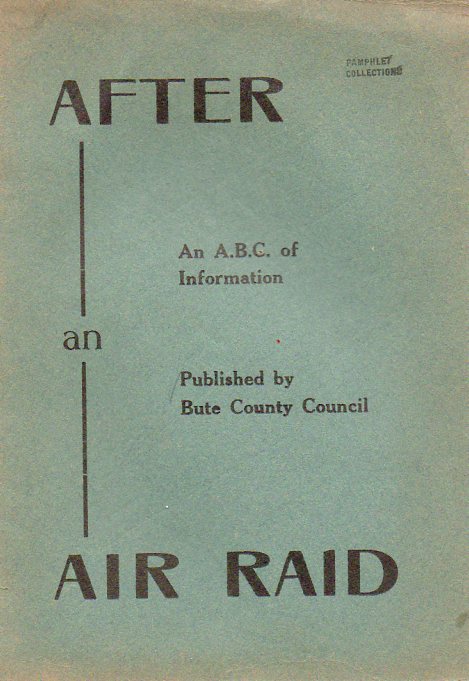
    Air raid884 After the Air Raid, an A,B,C, of Information,by the Bute County Council,  was published around 1940 (and which is available for purchase through our blog bookstore).This was printed in the town of Rothesay (by the “Rothesay Express”), which of course places publication in Scotland (though the Bute that I know is a county in North Carolina, 275 miles from where I sit–an old, 1760’s-founded county, up near the border of Virginia, closing in on the coat…its not-for-nothing that they call my part of the state “the Southern Highlands”, what with the huge influx of Scots/Irish coming into this area in the 18th 19th centuries).  It’s a curious publication, not the least of which is the unlikely place of its origin. 

    Another curious thing is that no other copy of this slight publication shows up in WorldCat/First Search–not only that, but there are precious few publications that are found in the 1940-1950 era with “after” and “air raid” in their titles. (The few I found are below.)

    The six-page pamphlet manages to cover 15 letters of the alphabet, plus a question mark at the end, for questions.

    The entries are very economical, tidy, and well written:

    “Money.
    If you are in need as a result of enemy action, you should explain your circumstances to the Assistance Board Officer who, if satisfied with your case, will help you.”

    “Orphans
    Notification should be sent to the Information Centre of any children who have become orphans as a result of air raids.”

    “Tools
    You may obtain a grant to replace tools which are essential to your work, apply to Employment Exchange for assistance.”   

    Very matter-of-fact.  I should think that if you needed to consult a work like this after having been bombed, that you’d want your information compact and direct.

    ·Posted by :

    ·in:

    — —

  • Odd Person Out–Large Crowds and the Singular Person in Photographs

    JF Ptak Science Books  Post 1194

    [These images are all available for purchase from our blog bookstore, here.]

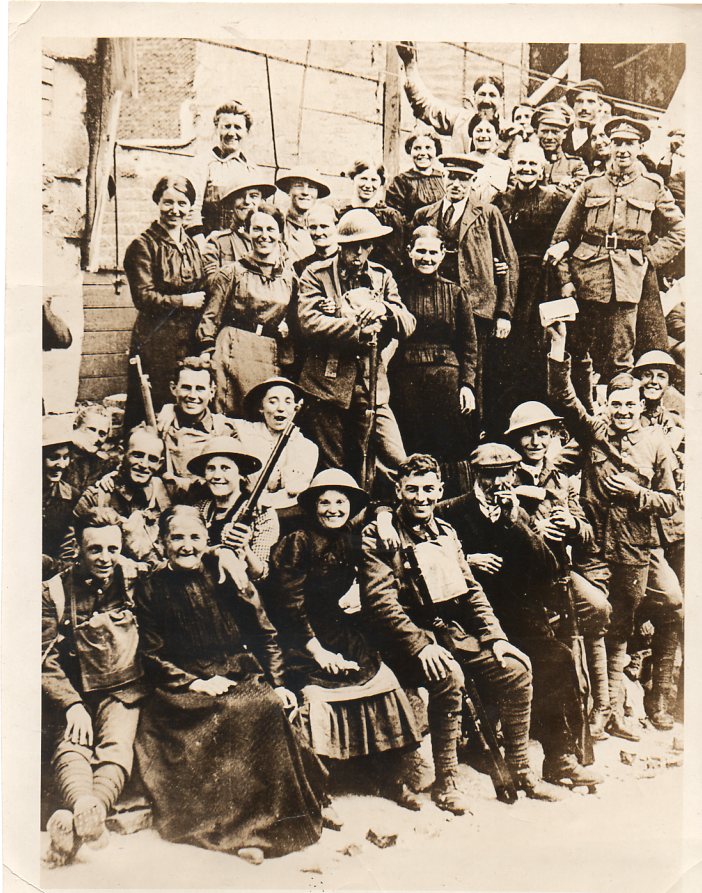
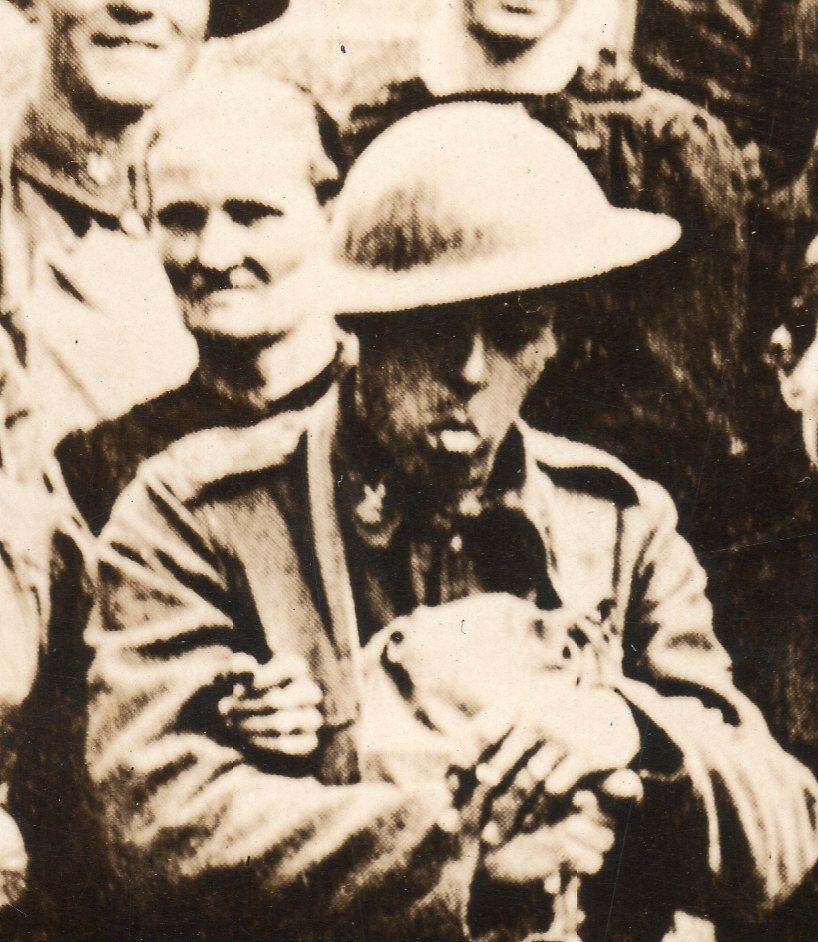
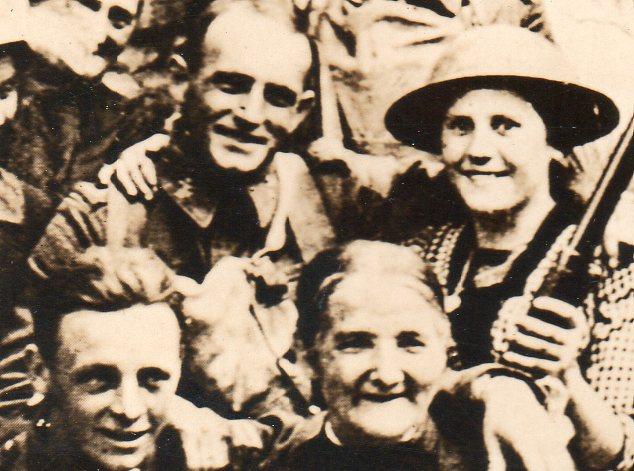
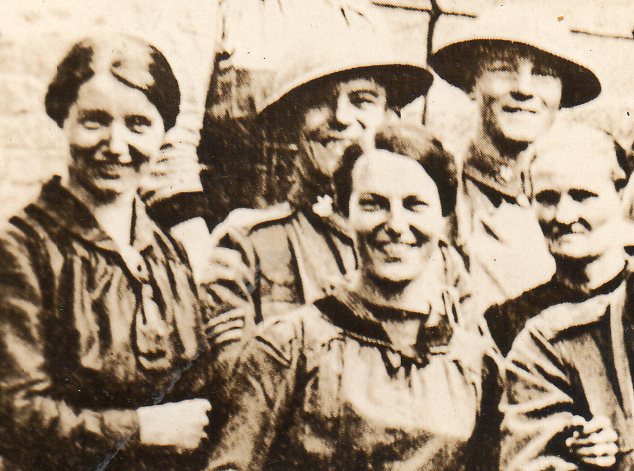
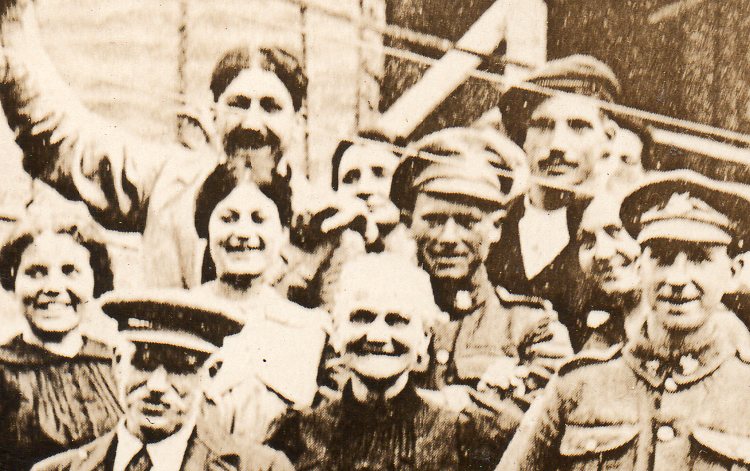
    (1) The Composition of Relief and Happiness–Minus One.  Free France, 1918.

    This remarkable photograph shows the joy and relief of the townspeople of Saudemont, France (20 kilometers south-east of Arras), after just having been freed from German occupation after four years of captivity. 

    WWI--crowds--free town701
    Saudemont had evidently suffered greatly over the four years, and seemed as though the population of the entire town was going ot be removed along with the Germans–but they weren’t, and teh town was simply abandoned, found and recaptured by these Canadian forces.

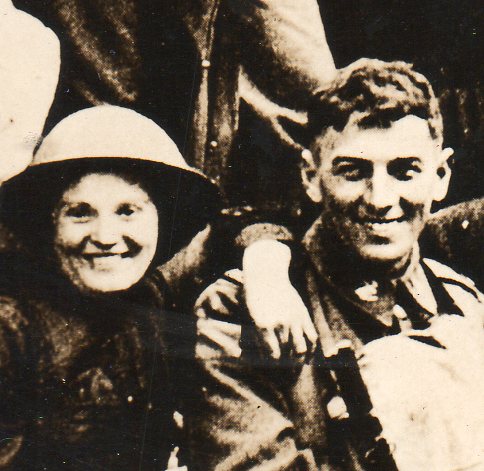
    The images of overwhelming joy are (almost) everywhere:

    WWI--crowds--free town detb703

    Except of course for the man at the fulcrum of the image (and the woman behind him), who remained, well, stolid:

    WWI--crowds--free town deta702
    But so far as everyone else is concerned:

    WWI--crowds--free town detc704
    WWI--crowds--free town detd705
    WWI--crowds--free town dete706
    WWI--crowds--free town detf707

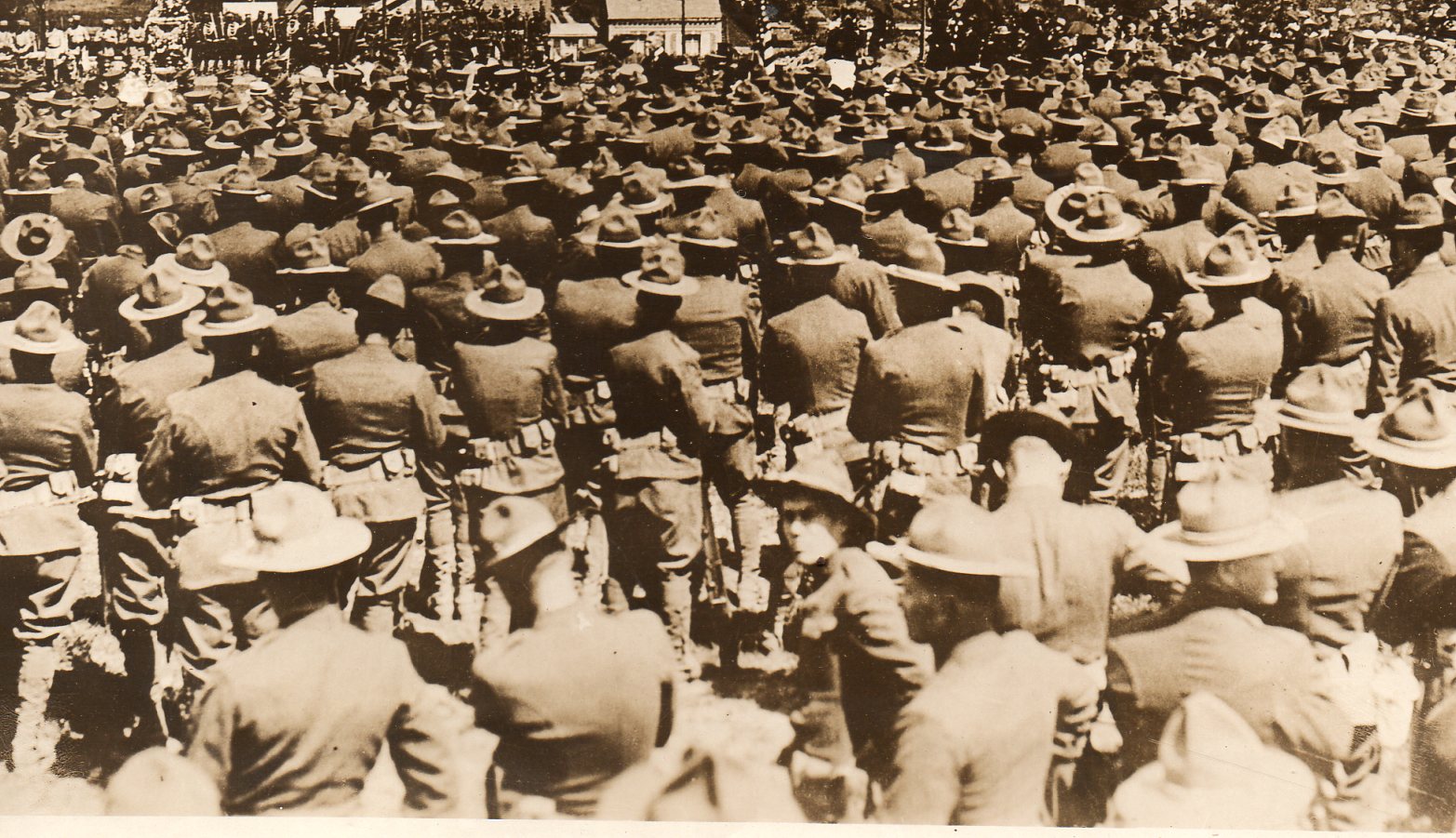
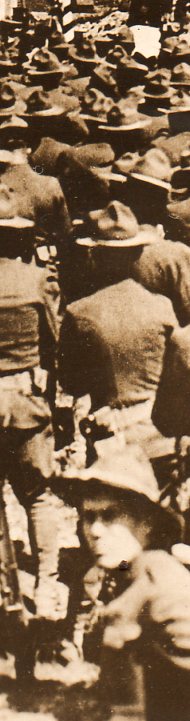
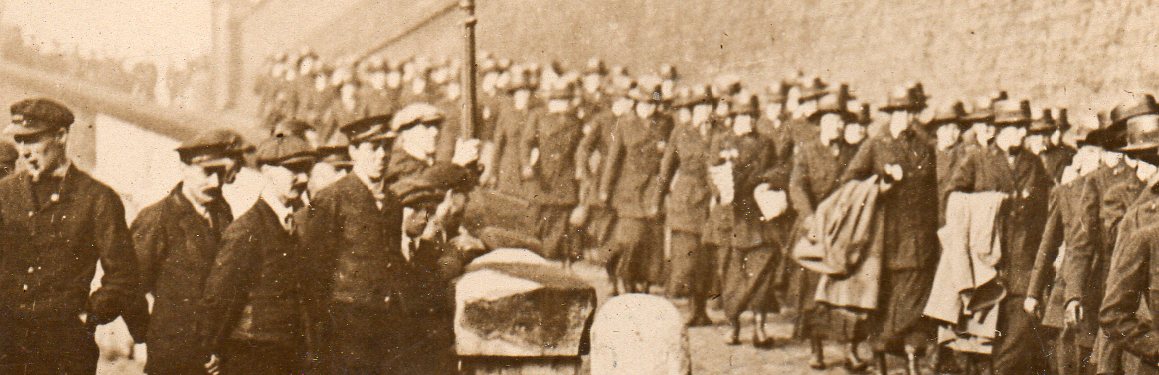
    (2) In this second photograph, taken of American troops at a ceremony at the cemetery of St. Marie, Havre, France in November 1918, the massive crowd (the largest funeral service held in France) is almost entirely focused on the proceedings–except this one serviceman in front, lathced onto the photographer.

    WWI--crowds--cemetery708
    WWI--crowds--cemeteryb709
    WWI--crowds--cemeteryc710

    (3)

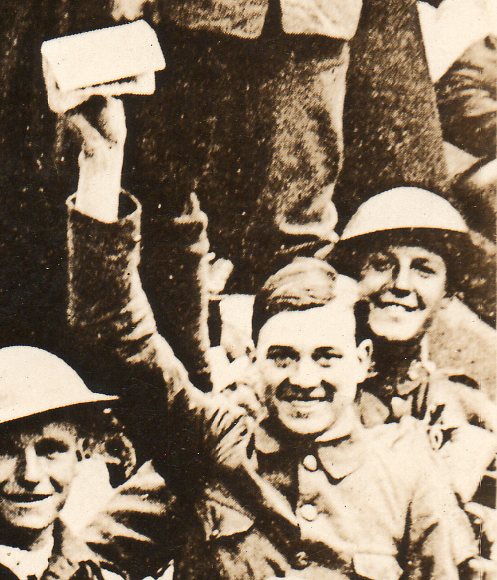
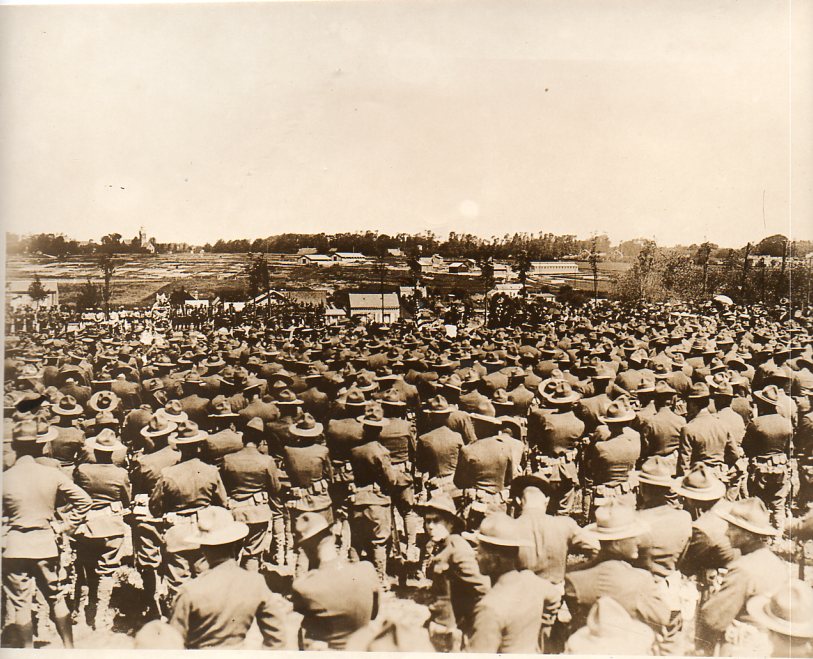
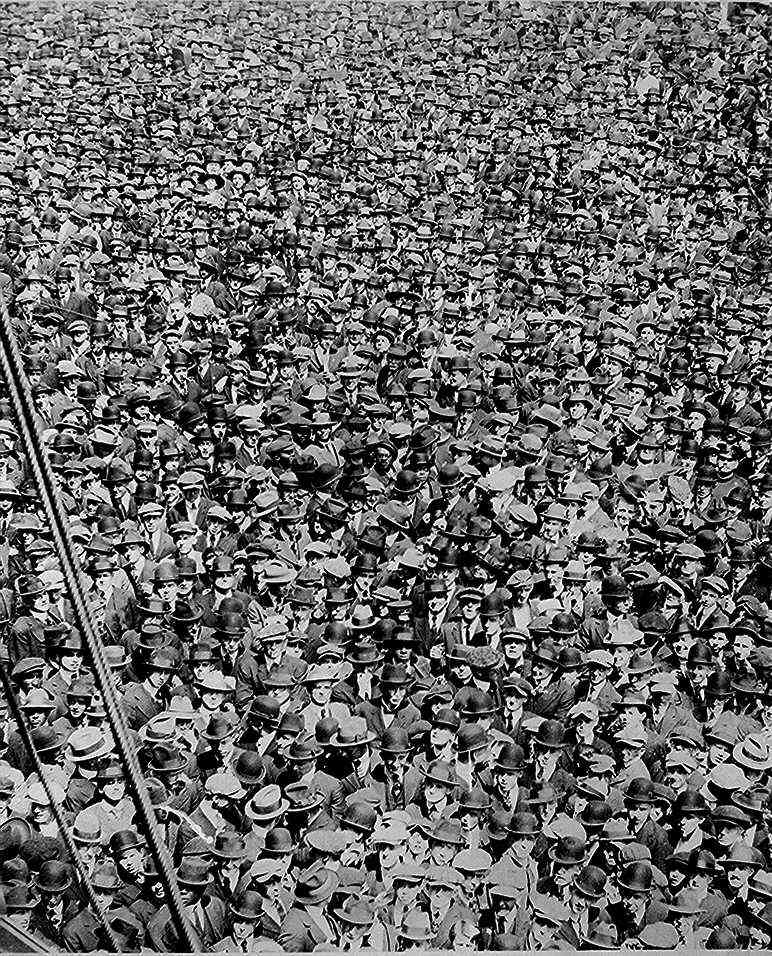
    Hatsdetail Another extraordinary image of pressed-together humans, of a human sea, a carpet of hatted men.  And believe me, every person in this image of (I’d say) approximately 5000 men has got a hat on.  There are hundreds of folks in the photo who re aware of the photographer and who are looking right at the camera, but there is only *one* person who is lifting his hat to the photographer. 

    Hats


  • Bombing Britain, 1940–a View from the German Side

    Dsc04742_2 JF Ptak Science Books  Post 1241

    It is essential to look at objects from alternative angles, especially in science, in order to determine the correctness, or fitness, of a finding, or opinion.  Even when consolidating data or evidence regarding the confirmation of an established bit,  you may very well find other strands of loose data that could help illuminate even a well established or iconic societal “given”.

    That the war was not going well for the Allies in September 1940 is an understatement—and the chief allies at this point excluded the United States, happily now recovering from the Depression, and still a full 14 months away from entering the war. 

    Dsc04739 What is very weird to me is that after having looked at every issue of LIFE magazine at least three times  from the start to the end of World War II, that there are more advertisements using war images than there are images of the war itself.  This actually continues into the spring of 1942, when LIFE got really busy, the war got really messy, and people started really dying.  And frankly even the coverage of Pearl Harbor in no way lived up to what I thought the coverage of a photo-magazine like LIFE would be. This is not a scientific study.  It just strikes me as odd, or propagandizing, that there should be such relatively scant, or undervalued, coverage of the fighting when sanitized images of that same fighting were being used to sell socks and shaving cream and cigarettes and such.  I understand the power of hearts-and-minds campaigns, but this seemed so amateurish, boorish even, that it just didn’t approach the level of a psychological ploy to pacify an American public that had virtually no interest in attending the European Theatre. 

    This was not the case with the British equivalent of LIFE—the Illustrated London News.  Actually, I should say that LIFE is a dumbed-down version of the ILN, which was the world’s first illustrated magazine, and which began almost 100 years before LIFE was born.  The ILN covered the war like it was a war being fought in their front yards—and it was.  Dsc04741

    This was also not true of one of the principle German equivalents of these two weekly photo-imags, the Illustriete Zeitung (Leipzig).  There was a  lot of war coverage, though much more sanitized than even the very sanitary (pre-1943) versions of reality issued by LIFE and the ILN.  The Germans by and large did not use war or military images to sell common-sue, every-day consumables; it rather concentrated on the glories of battle, real and imagined, as well as using a very grandly flatulent palette to paint the image of Adolf Hitler.

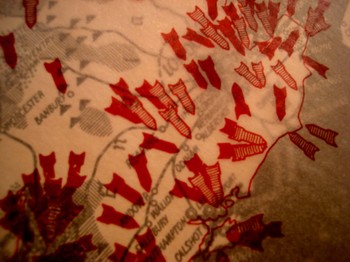
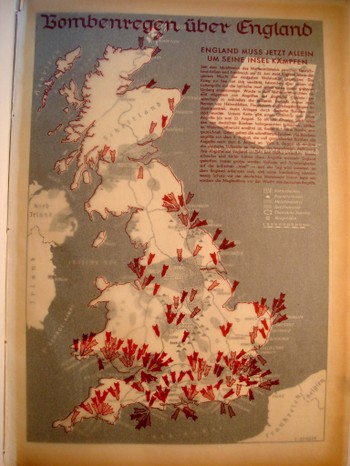
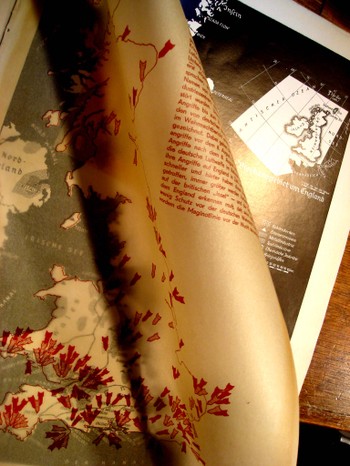
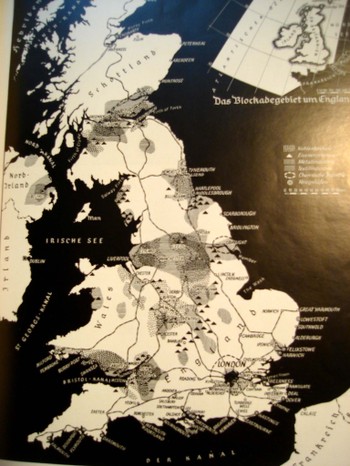
    What caught my eye was a map in the 5 September 1940 issue of the Zeitung.  (The cover woodcut illustration, by the way, is a sharpened point of the Roman standard bearer being used by the Fascist Mussolini government about to impale a running cat-thing that represented Somalia.  The Italians attrociously bombed innocent civilians in Somalia and Ethiopia with abandon and disdain.) On page 165 is a two part map, the upper part being a velum-like overlay, showing the German bombardment of England.  (“Bombenregen ueber England.  England muss jetzt allein um seine insel Kaempfen…” )  The template map is in stark black and white, showing locations of “war” industries, chemical plants, rubber works, textile plants, metal industries and gas works . The overlay shows the outline of the island with 150 or so bombs, imprinted with a color code to show what sort of industry it was intended for.  As you can see there was quite a cluster around London—I looked closely, and no one bomb was actually placed directly upon the outlined city of London. Suffice to say that no fool editor at the Zeitung was going to show their readers that German bombs were falling on a city. 

    Dsc04740 What this map shows me, outside of the propaganda aspect for its intended readers, is that the basic bits of the bombing campaign was actually true—that there was a whole crap-load of bombing going on, and going on quite well country-wide.  Certainly people in England knew this but knew it in chunks.  The Battle of England was being fought at this point, and the outcome was still undetermined—even though the Brits had the “ultra” and basically knew when the attacks were coming, and where.  But looking at this image of the bombing from a completely different, contemporary, and ENEMYsource hammered home the fact that England was being bombed, and bombed heavily, and that its future was in real doubt. 

    [This issue of the Illustriete Zeitung is is available for purchase from our blog bookstore.]


  • Gas Masks and Poison Gas, World War I, 1915

    JF Ptak Science Books   Post 1191

    In the long line of potent and horrible weapons, few are as so superbly bad as chemical and poison gas.

    WWI--gas mask full pg696

    [This image is available for purchase at our blog bookstore, here.]

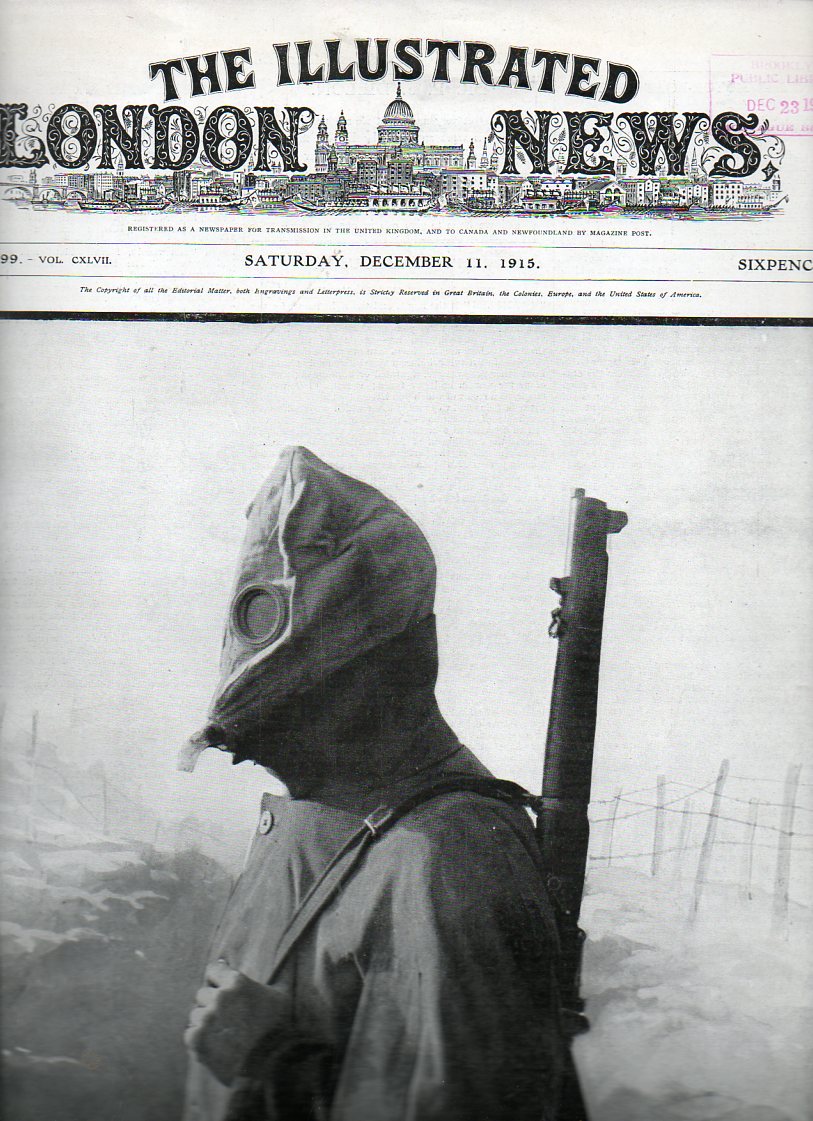
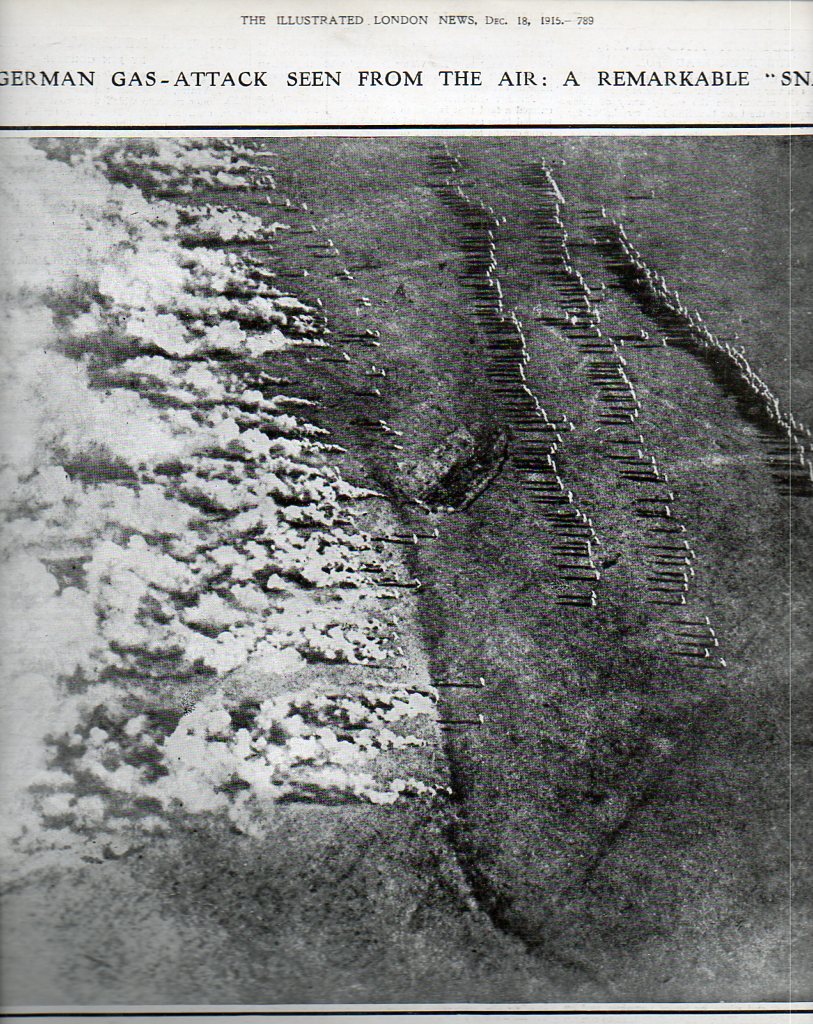
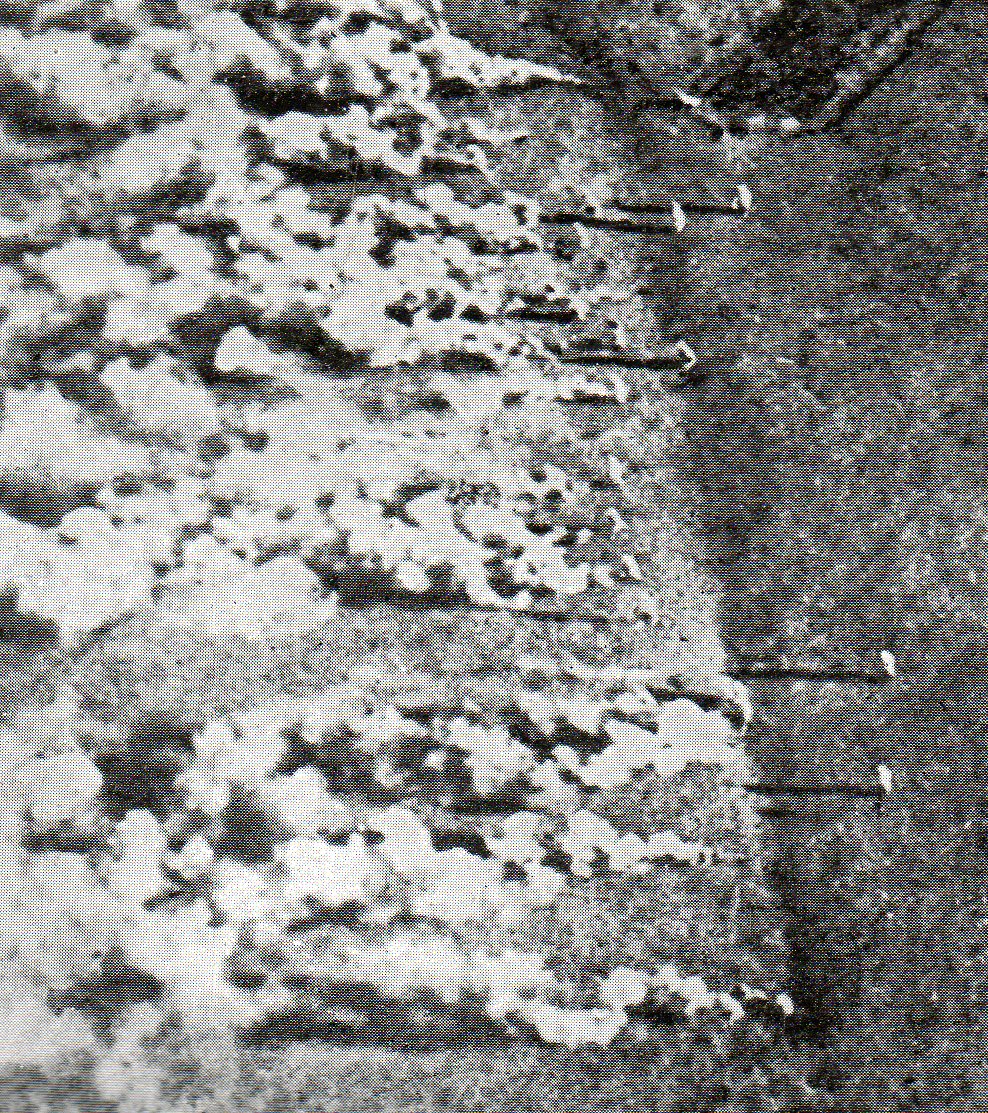
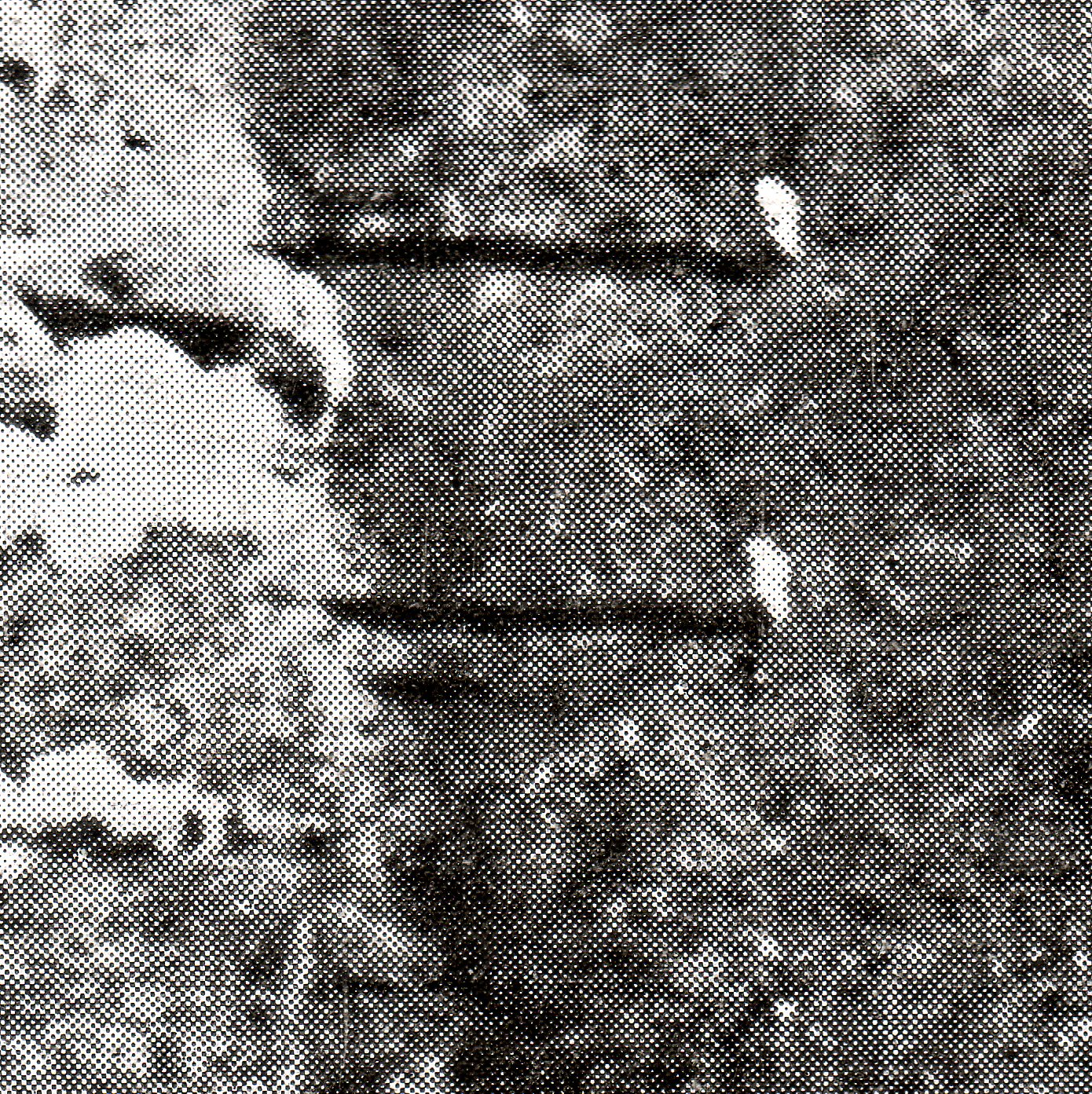
    The heading of this full-page photo from The Illustrated London News for 18 December 1915 really is quite understated—“remarkable” really doesn’t quite cover it.  First of all, photographs from moving airplanes were not common; secondly, this is one of the earliest images ever made of a poison gas attack in progress, just eight months after the initial use of German poison gas at Ypres (a first-hand account of which can be seen here http://www.firstworldwar.com/diaries/firstgasattack.htm  The experience of poison gas in warfare was still “new”–newer still for the Russians, who were at the receiving end of this unnamed  Eastern Front attack.

    The story on this goes as follows: during the night the German enemy forces crawled with metal and glass canisters of the poison gas to the very front of the Russian lines, or at least to the outer edges of the barbed wire perimeter.  The crawler would retreat, and then the whole of the attacking force would wait until daylight and a favorable wind condition at which time rifelmen would discharge at the canister, a direct hit mixing the contents fo the vials, producing the desired gas.  The wind would then pick up the gas and disperse it, the Germans waiting for the first leg of their attack to take effect on the poor soldiers in the trenches, and then attack once the gas had mostly cleared.

    WWI--gas attack697

    And the associated

    WWI--gas attack det b699

    And this solitary figure:

    WWI--gas attack detc700

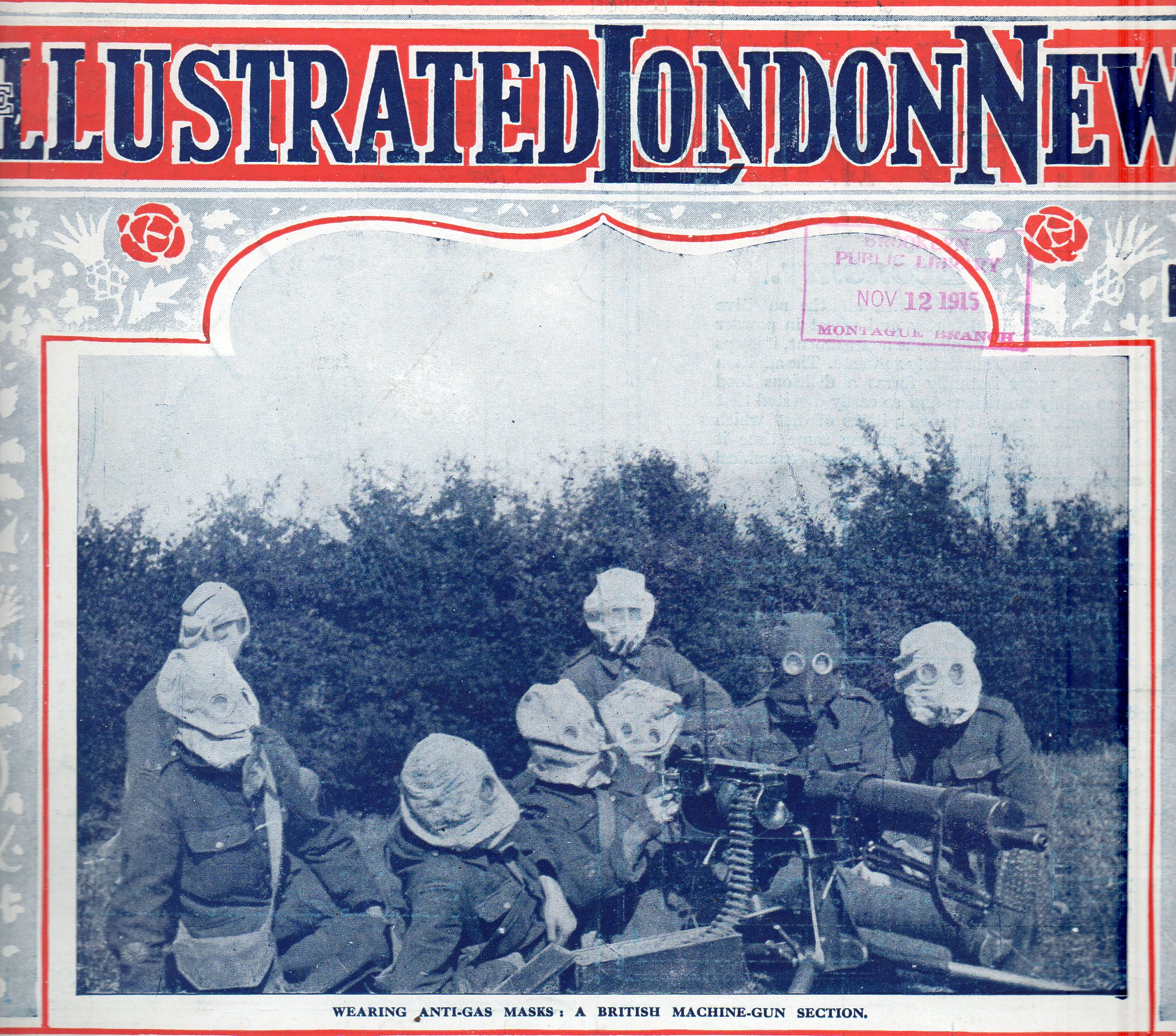
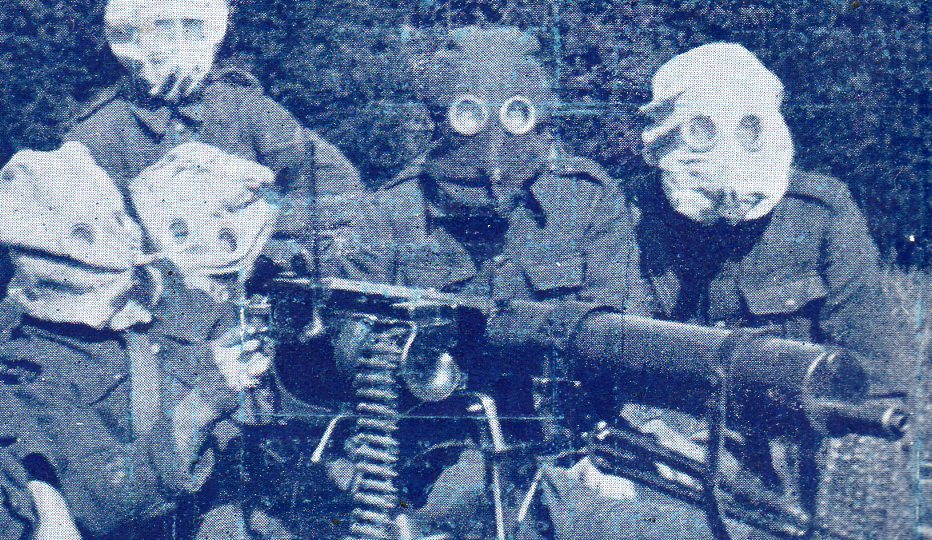
    The masks devised to deal with the attacks were soemtimes effective, sometimes not–actually, they were occasionally enhancers.  The earliest masks were creepy, unworldly, Coraline-like burlap-and-button-faced affairs–I’d hardly wnt to imagine seeing thousnads of these guys come running up to me with rifles and grenades in their hands attacking my position. 

    WWI--gas machine gun711
    WWI--gas machine gunb712


  • Evil Replaced by Evil: The Baltics, the USSR and the Nazis. An Anniversary, 25 November 1940

    JF Ptak Science Books   Post 1234

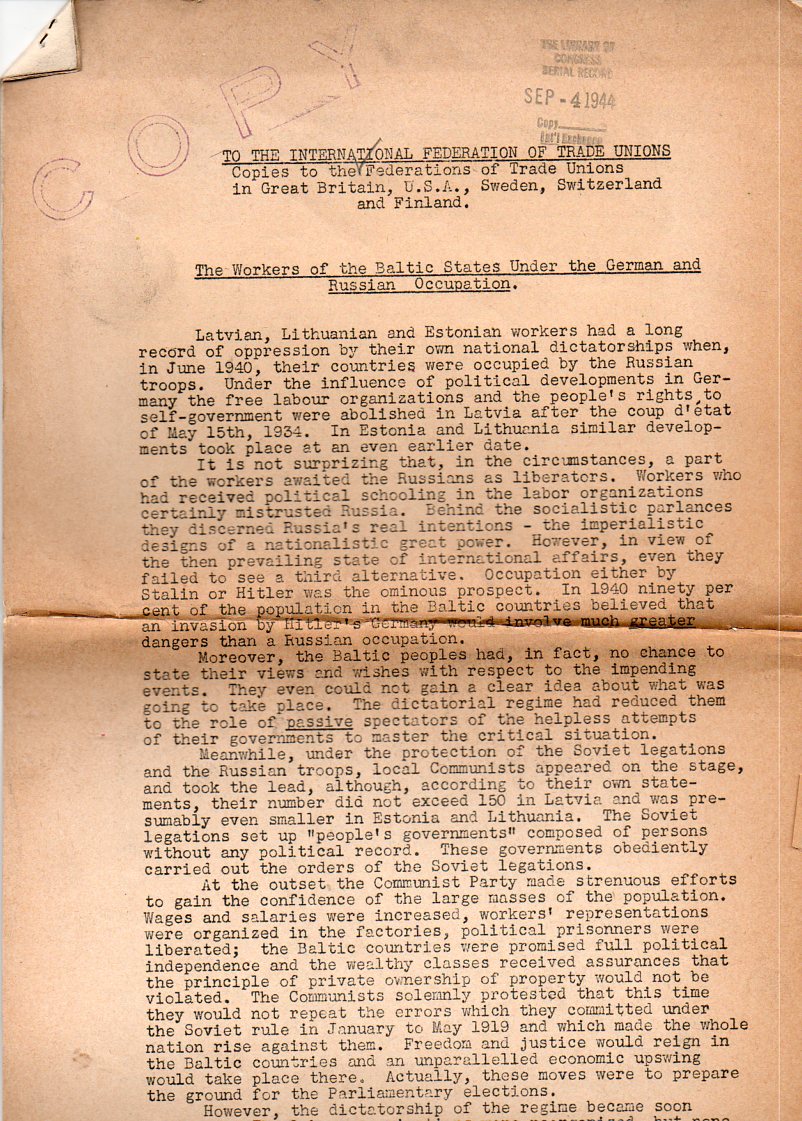
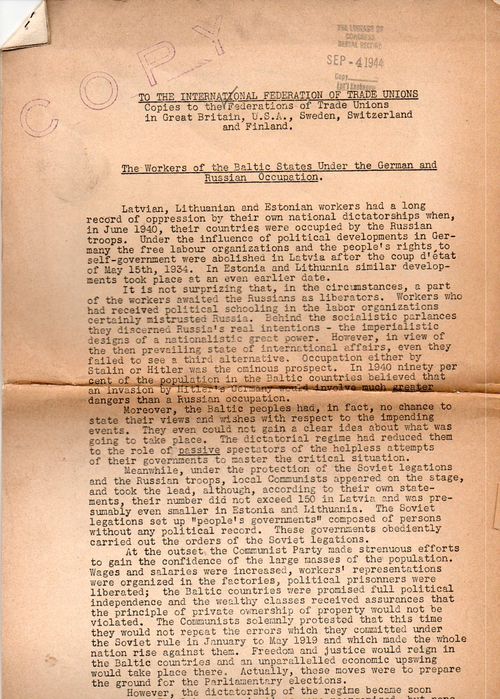
    This rare, offset-printed publication comes from the representatives of the Free Trade Unions of the Baltic States–a part of the International Federation of trade Unions (IFTU)–and is dated December, 1943, and is a witness to the brutal regimes that illegally and maliciously subverted the countries of Estonia, Latvia and Lithuania.
    (The IFTU was a social democrat-like organization that existed from 1919 to 1945, and which was a largely European body after 1925 when its main American counterpart, the AFL, chose to disengage.)
    Balticsb874
    [This document is available for purchase from our blog bookstore, here.  I would gladly reproduce the entire document except that given the nature of its reporduction the pages are brittle, meaning that the document could no tbe scanned unless taken apart, which I do not want to do, presently.]

    The six-page pamphlet is interesting to me because it provides some details on the rape of the Baltics–the theft of their legal status as nations, the murder and deportation of those who disagreed with the ruling Soviet and then Nazi occupiers, and then, lastly, the murder of the Baltic Jews–which, in December of 1943, was not common reading material.

    As a result of the Molotov-Ribbentrop pact, the Soviet Union moved into the Baltic states in June, 1940, after having compelled the thre nations to allow the establishment of Soviet bases on their soil.  In June of 1940 the life of the Baltics changed dramatically, when the U.S.S.R. overtly took control in the three countries. At the beginning of the Soviet brutalities, elections were stolen, military forces were moved, and murder and deportations and arrests began in earnest. In beginning to kill the soul of these countries, the Soviet union established a “Commissariat of the Interior…was a powerful apparatus for carrying out persecutions and taking reprisals”, a euphemism of the early part of the pamphlet which would be replaced by mor direct language just paragraphs later.

    But 25 November 1940 marked the final destruction of the independence of these countries when their national currencies were replaced by the ruble, allowing complete control by the Soviet Union, and plunging the countries into a malicious chaos, with the citizens now faced with an almost-order of magnitude change in their buying power.

    The report continues on the disappearances of workers and intellectuals, which came quite early in the Soviet occupation.  According to the document, tens of thousands of workers who were opposed to the new changes by the Commissariat of the Interior were arrested and deported to “enjoy a happy life” in prison.  More shocking details would come, highlighting the deportations, arrest and executions of thousands of people–tens of thousands who would be sent to “labor camps” in northern Russia, selected from”secretly drawn-up lists by the Communist Party”.

    There is in particular the mention of 14 June 1941–a bitter day in the history of the first Soviet occupation, though it seems that the author of the present paper did not yet have a full appreciation of the event, yet. Here the author mentions specially “equipped” railway cattle cars brought in from Latvia and used to deport 21,000 people from Lithuania, 11,000 from Estonia and 15,000 from Latvia.  In point of fact the period of 14-17 June 1941 was when the Soviets imprisoned/deported/murdered 100,000 Balts.

    After the Nazis trashed their non-aggression pact with the USSR and began their invasion (known as “Operation Barbarosa”) of the Soviet Union on 22 June 1941the Russians began to run, replaced very quickly by the advancing German armies. The author writes that “we have no exact data” on the deportation and execution in the earliest days of the Nazi occupation, but the conservative guess was that 50,000 had been deported and 10,000 executed.

    And then on to the Jewish question, where this paper reports that almost all of the Baltic Jews–by December 1943–were gone.  “Gone”in being  deported to   work camps, or collected in slums, or murdered.

    In the only underlining done in the printing of this pamphlet, we read that ‘All these murders are on the German conscience”, and then goes on to name the German officials responsible for the crimes. 

    In December 1943, when it was becoming apparent that the Germans were being turned in Russia, and that the Russians might return, there is this final plea from the pamphlet’s author:

    “Do not allow the red Army to occupy our countries.  Save our people from physical and legal annihilation.” OF course the Soviets who were replaced by the Nazis were again occupied by the Soviet Union in 1944–the Baltics would not see the Soviet Army leaves until 1995.

    This was a fast summation of a complex and complicated situation I the Baltic states for these years, but I just wanted to give the flavor for the background of this December 1943 pamphlet.  There were hundreds of references to mass killings and deportations (and vast rages of murders) that appeared in the press during this time period, but there was certainly not a collected resource for them all.  This pamphlet–quite rare in itself, as I’ve found no copy in any world-wide library holdings referenced in WorldCat–is another example of disparate reporting on what would be seen just 20 months later as a monumental climax of injustices.
    ·Posted by :

    ·in:

    —

  • Women in World War I–Rare Photographs, 1918

    JF Ptak Science Books  Post 1190

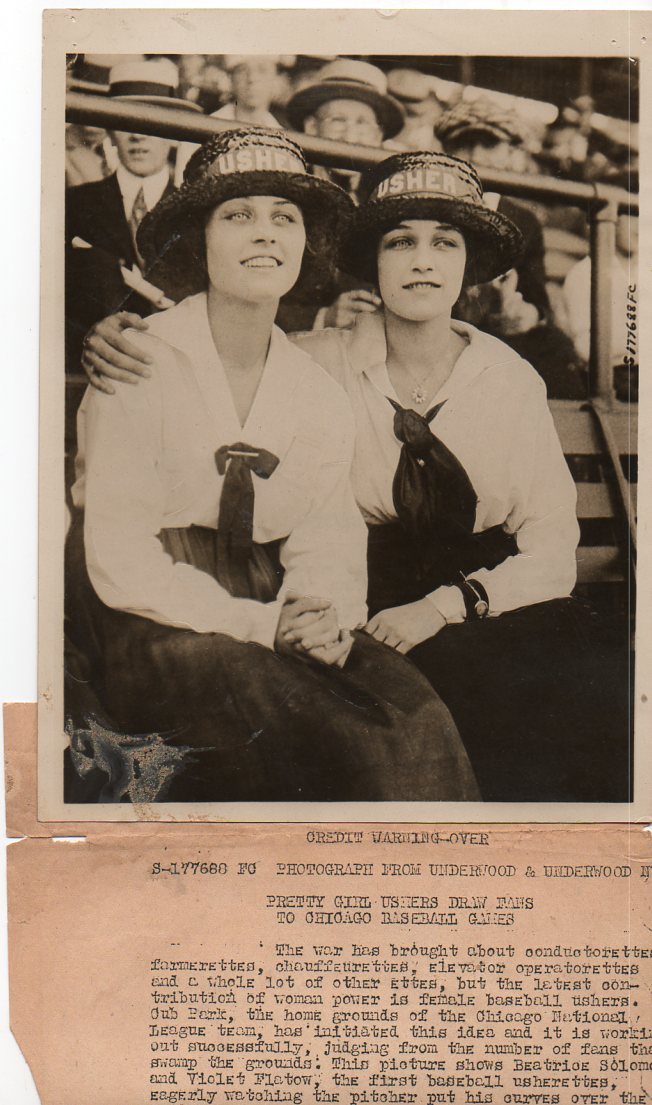
    WWI--e--women ushers684

    [All of the images below are available for purchase; see our blog bookstore for details.]

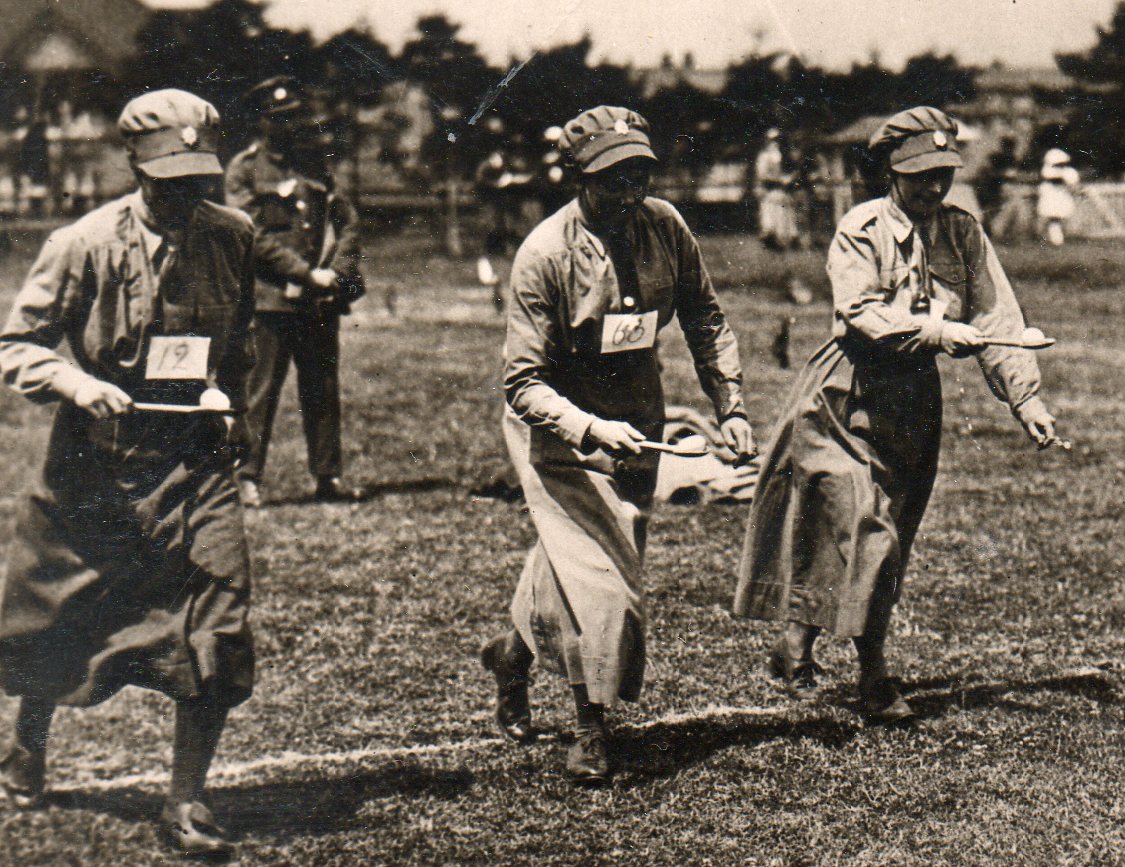
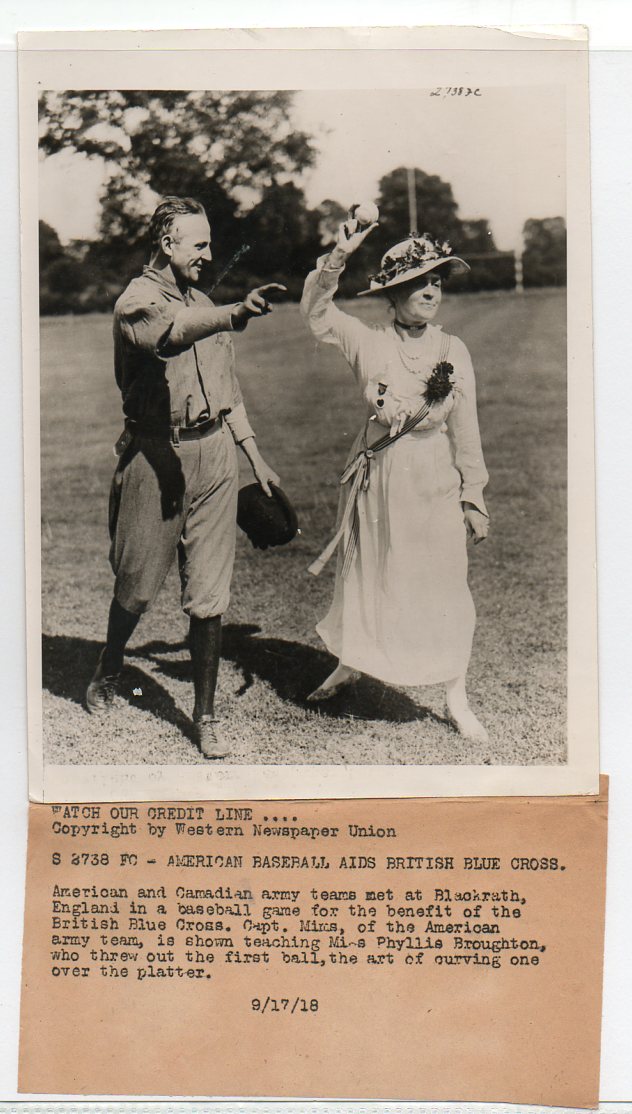
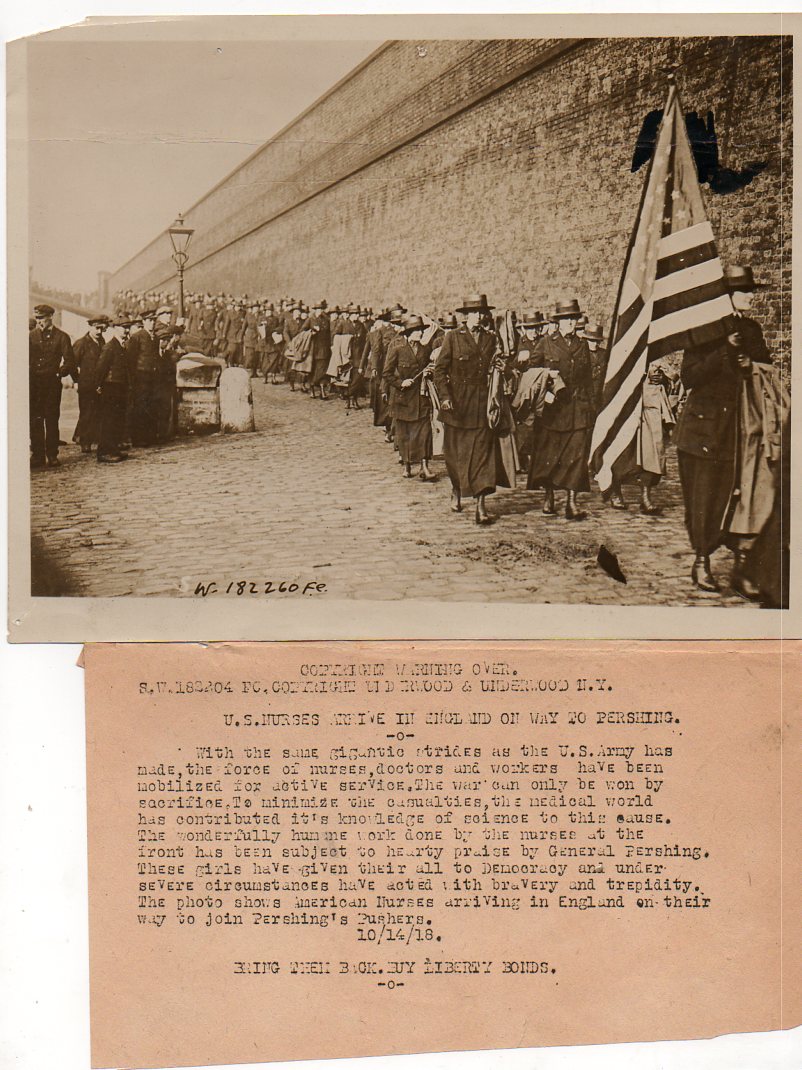
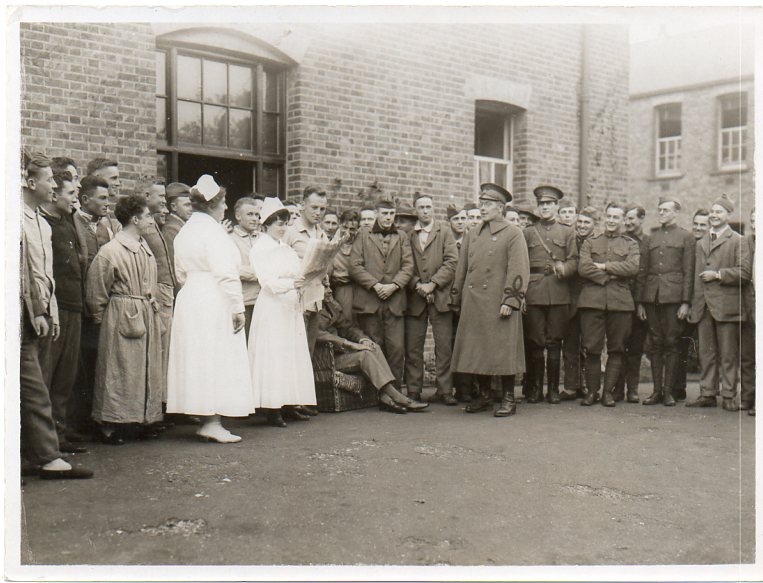
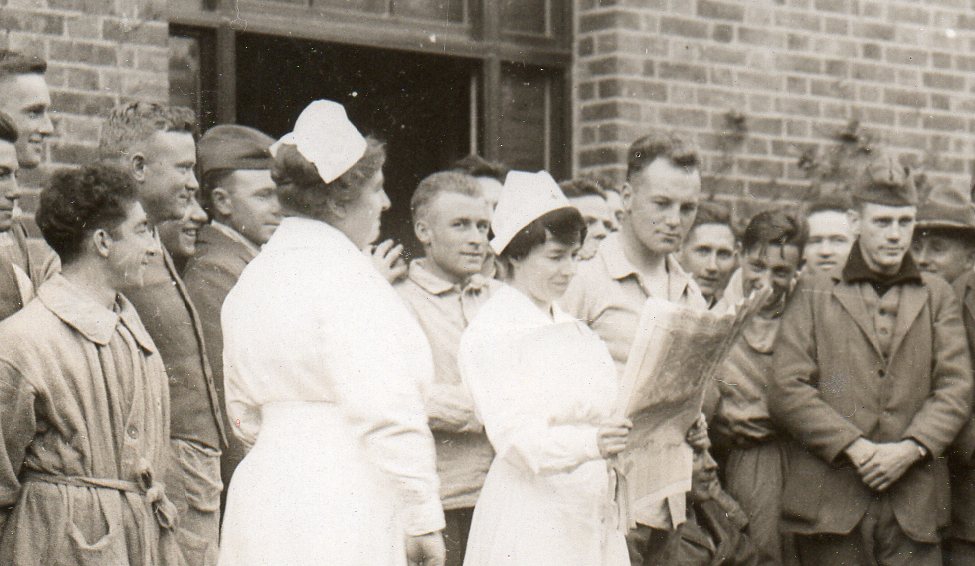
    This is another in a series of posts on images from my News Service Photographs of WWI collection.  All thousand or so of them were made in the last half of 1918 (save for a very few made in 1919) , in the last months of the grueling conflict, and were intended to be used by newspaper and magazines to illustrate stories about the war. An editor would send off a request to one of these agencies for, say, a photograph of marching American nurses, and the agency would send one back (for a fee) along with a caption.   There’s really no way for me to determine if these photos were ever published, and there is never an attribution for the photographer. 

    Most of the images have an accompanying descriptive text–this was to be used by whomever published the photograph, along with the attribution for the source of the photo. 

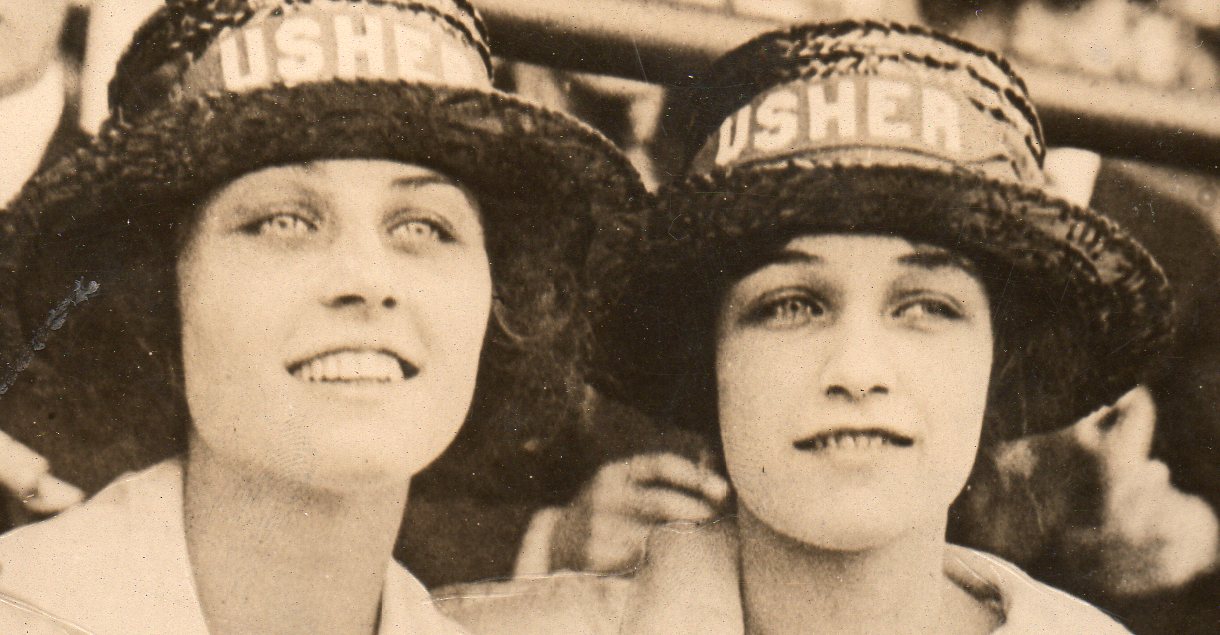
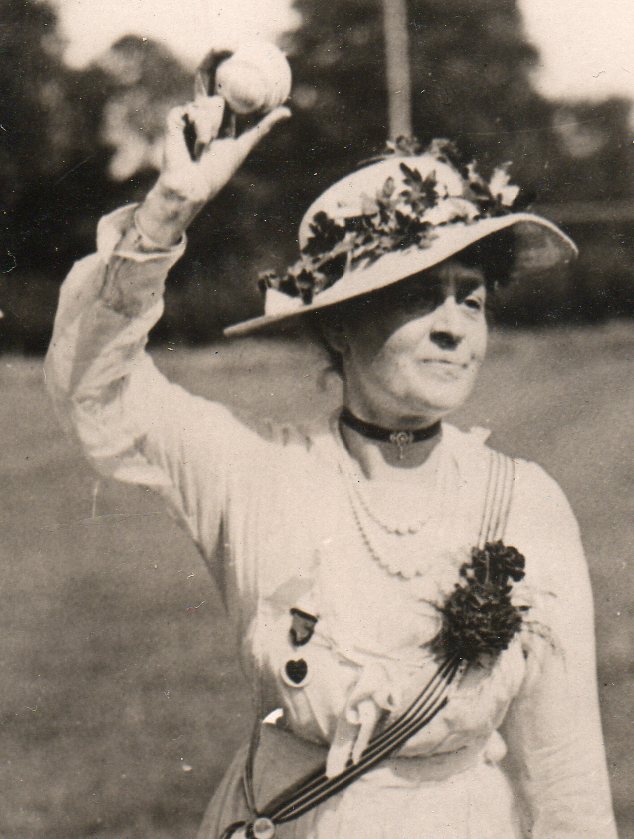
    In almost every case I supplied a detail of the image, hopefully of something that you’d want to see a detail of. 

    WWI--e--women ushers684
    WWI--e--women usher dets685

    ORIGINAL Photograph, 1918.  8×6 inches.  Very good condition.  $150

    WWI--e--women--egg race det664
      WWI--e--women-baseball672

      WWI--e--women-baseball det673

    WWI--e--women--nurse pershing653

    WWI--e--women--nurse pershing det654

    WWI--e--women--nurse reading paper659

      WWI--e--women--nurse reading paper det660


  • Finding Unseen Things In and From the Air

    JF Ptak Science Books  Post 1131

    Seeing more deeply--air weather det853

    Finding the hard-to-find, the invisible, the “hidden”, is an essential aspect of, well, mostly everything.  Whether it is Newton separating light with a prism to find its constituents, or Hooke investigating the formerly quasi-real microscopical world to reveal worlds within worlds, or Galileo using his telescope to quash the ideas of the unaided-eye-visible night sky as an unaltering perfection of creation, or Roentgen seeing through his wife’s skin, or Fraunhoefer finding the complex spectrum, or Henry Draper determining a chemical constituent of the sun, or the invention of the zero or negative numbers or subtraction, of finding Black Holes or other planets or the remnants of the Big Bang, or (Kandinsky) finding the nonrepresentational aspect of art, or Duchamp finding in an upturned urinal that art had no boundaries…the list goes on and on.

    One aspect of this “finding something in nothing” business that is interesting to look at because it is so local and discernible–and recent–is in air navigation and detection.  And I’ll do this using a series of excellent illustrations from The Illustrated London News, all of which are from the 1927-1938 period. 

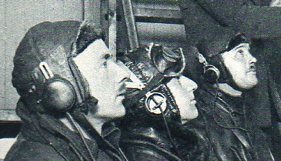
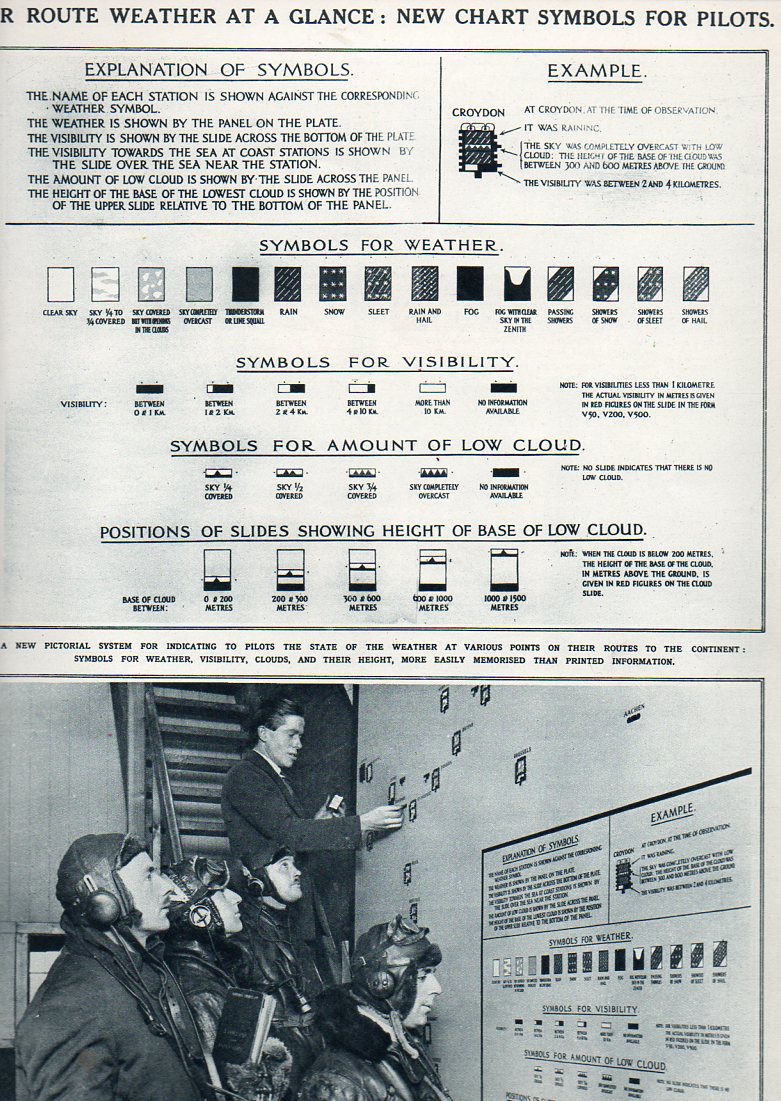
    The first is relatively simple, at least simple from here in the year 2014, which shows four pilots being briefed on weather conditions with a aerial chart for conditions along intercontinental routes.  The placement of these symbols represented a vast improvement over the earlier systems of readying pilots for what weather lay ahead, if indeed there were any communications at all.  This represents an early look at a codification of conditions and expectations for air travelers–a display of new and important data in 1927. 

    Seeing more deeply--air weather852
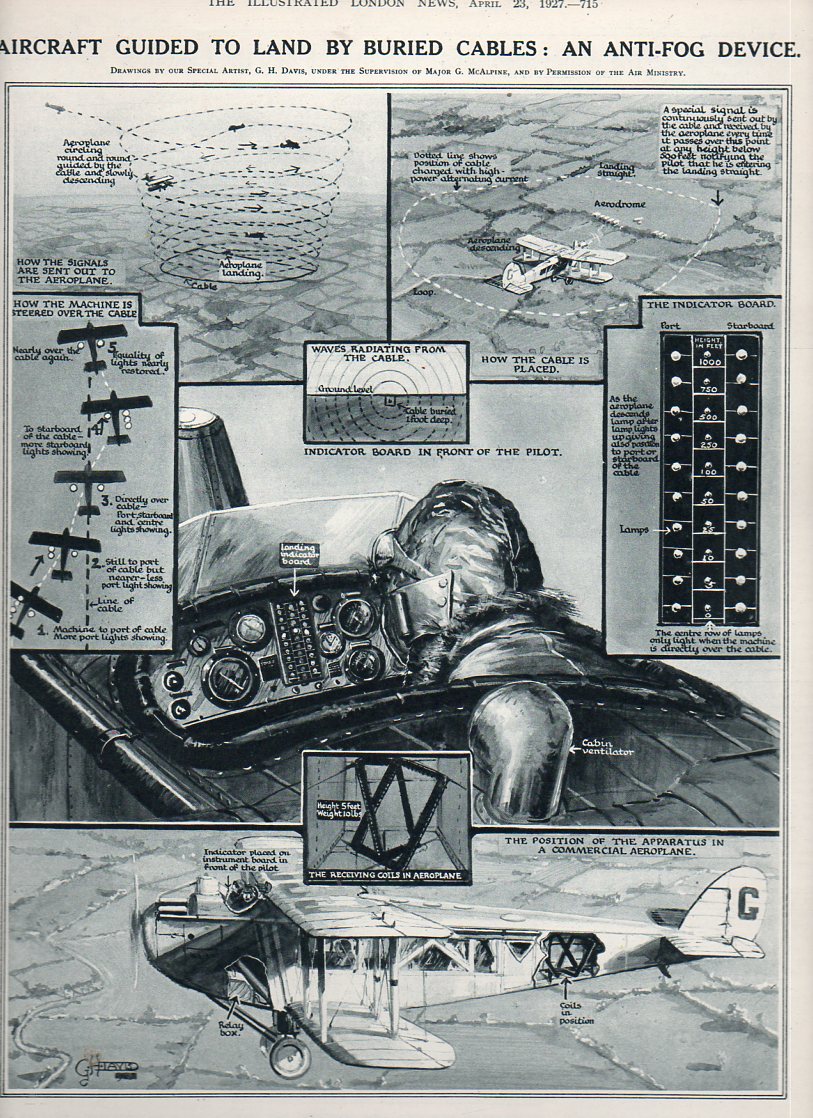
    Next is a brilliant device for assisting pilots to land in foggy and dark conditions–actually on how to find the ground safely.  In 1927 (again) a RADAR-like system was put into place on aircraft that involved receiving the signals of an ac-pulsed buried electrical cable that surrounded an airport.  The receiver (seen here on the flight panel of the pilot in an open-air cockpit) would be read to reveal proximity of the airport, the pilot making wider and then closer spirals in descent until his was basically within the buried airport cables and thus able to land.

    Seeing more deeply-anti-fog855
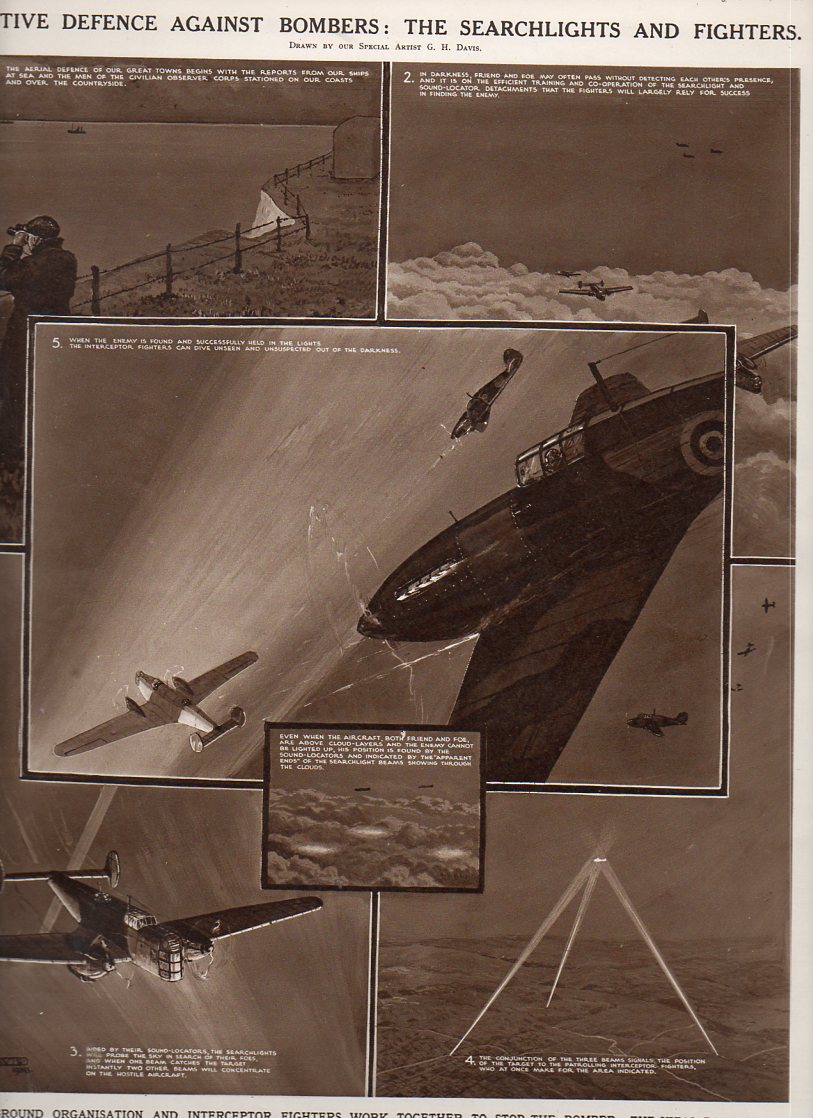
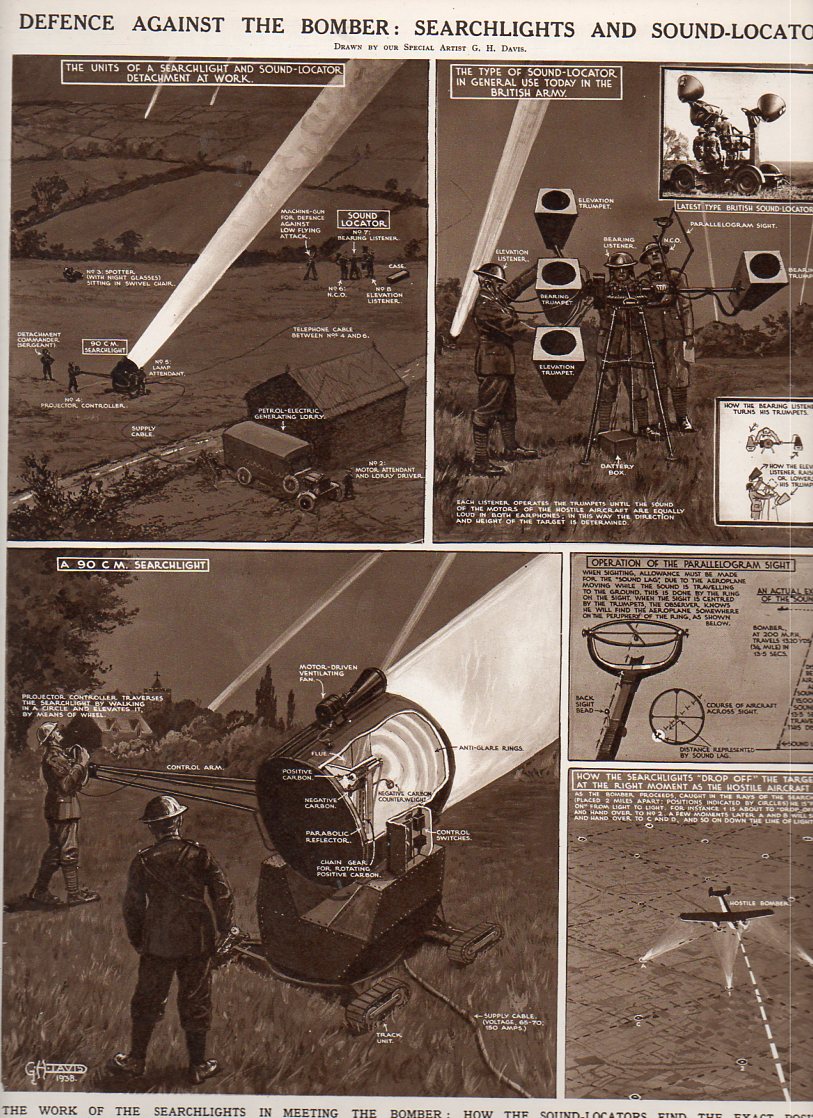
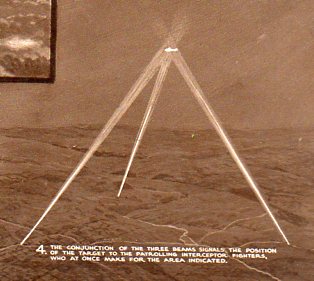
    Prior to WWII RADAR1 was somewhat functional but still in development, and as we see in this set of 16 July 1938 illustrations, the key methods for finding enemy aircraft at night (in order to shoot it down of course) was an audio-visual method, using “sound-locators” to find the approaching bombers and then spotlights to illuminate and track them to their destruction.  

    Seeing more deeply-searchlight856

    Seeing more deeply-defence against bomber854

    These images represent some idea of the state of the art of being able to find things–like the ground at night or approaching enemy aircraft–in the 1927-1938 period, all of which would be drastically changed in just the next two years.

    Seeing more deeply-searchligh detail857

    NOTES

    1. RADAR was coming very close to being developed in the early 1930’s–and in 1935 the process of experimentation and implementation was at a peak.  The development of this new technology was an international property, though perhaps no one owned it more in this period than the British, with Watson Watt giving his experimental ideas on RADAR to the Air Ministry on 12 February 1935 in a secret report titled “The Detection of Aircraft by Radio Methods”. Int his years alone there was feverish work being done by  Rudolf Kühnhold (Scientific Director at the ‘Kriegsmarine  Nachrichtenmittel-Versuchsanstalt) who in 1933-1935 established a RADAR-hunting company called Gesellschaft für Elektroakustische und Mechanische Apparate, or “GEMA”; there was also elements of the Royal Navy, Telefunken, Standard Elektrik Lorenz, Philips Company’s  (of Eindhoven, Netherlands) Natuurkundig Laboratorium, the Research Office of Nippon Electric Company, and even in the Soviet Union (until the key figures involved were murdered in Stalin’s purges–this one distinguished from others and referred to now as The Great Purge– of 1937), the French Compagnie Générale de Télégraphie Sans Fil (CSF), and  the Italian Regio Instituto Electrotecnico e delle Comunicazioni (RIEC, Royal Institute for Electro-technics and Communications) to name a few.  The United States of course had been long working on the project, at least since 1922 at the NRL, with considerable private (and federally funded) work done by RCA

    .
    Whipping ahead into WWII a very significant “battle of the beams” began between the U.K. and Germany, especially during the Battle of Britain, involving countermeasures, espionage, propaganda and false-positives in regards to the use and development of radio-based tracking and detection–the U.K. particularly making use of this technology in a wide-spread air defense system.  But it was in the United States in 1940 (and really by the U.S. Navy) that RADAR got its name (for RAdio Detection And Ranging) as well as its great impetus for development and deployment.