A Daily History of Holes, Dots, Lines, Science, History, Math, Physics, Art, the Unintentional Absurd, Architecture, Maps, Data Visualization, Blank and Missing Things, and so on. |1.6 million words, 7500 images, 4.9 million hits| Press & appearances in The Times, Le Figaro, Mensa, The Economist, The Guardian, Discovery News, Slate, Le Monde, Sci American Blogs, Le Pont, and many other places… 5000+ total posts since 2008.

Category: Militaria

  • The Face of Defeat, the Philippines, 1907

    JF Ptak Science Books     Post 1398

    This is what defeat looks like, or at least so it did in the Philippines in 1907, when the revolt against the Spanish and the Americans was finally at end, for the insurgents. 
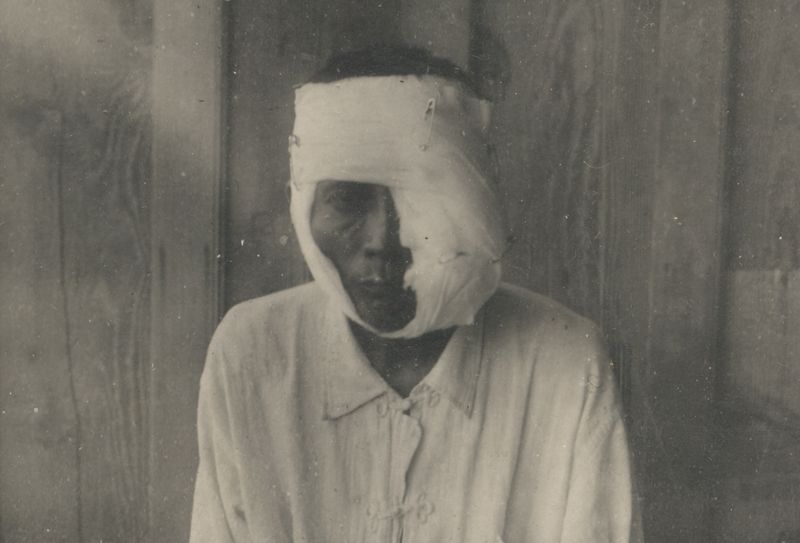
    ===blog==aug 24=big faustino face

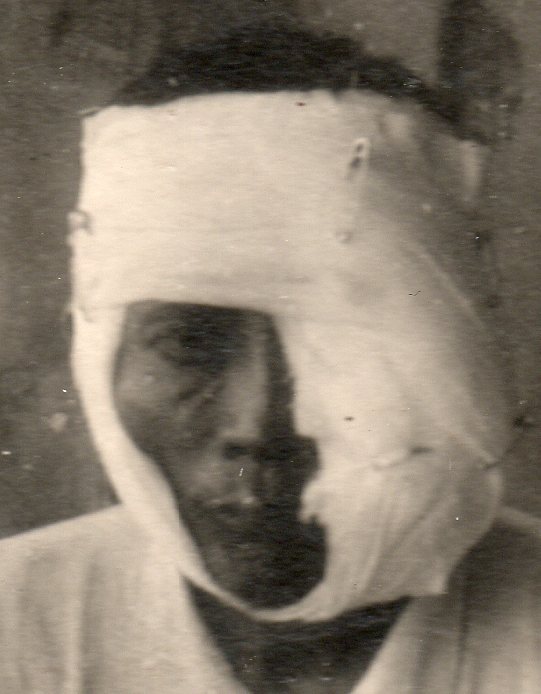
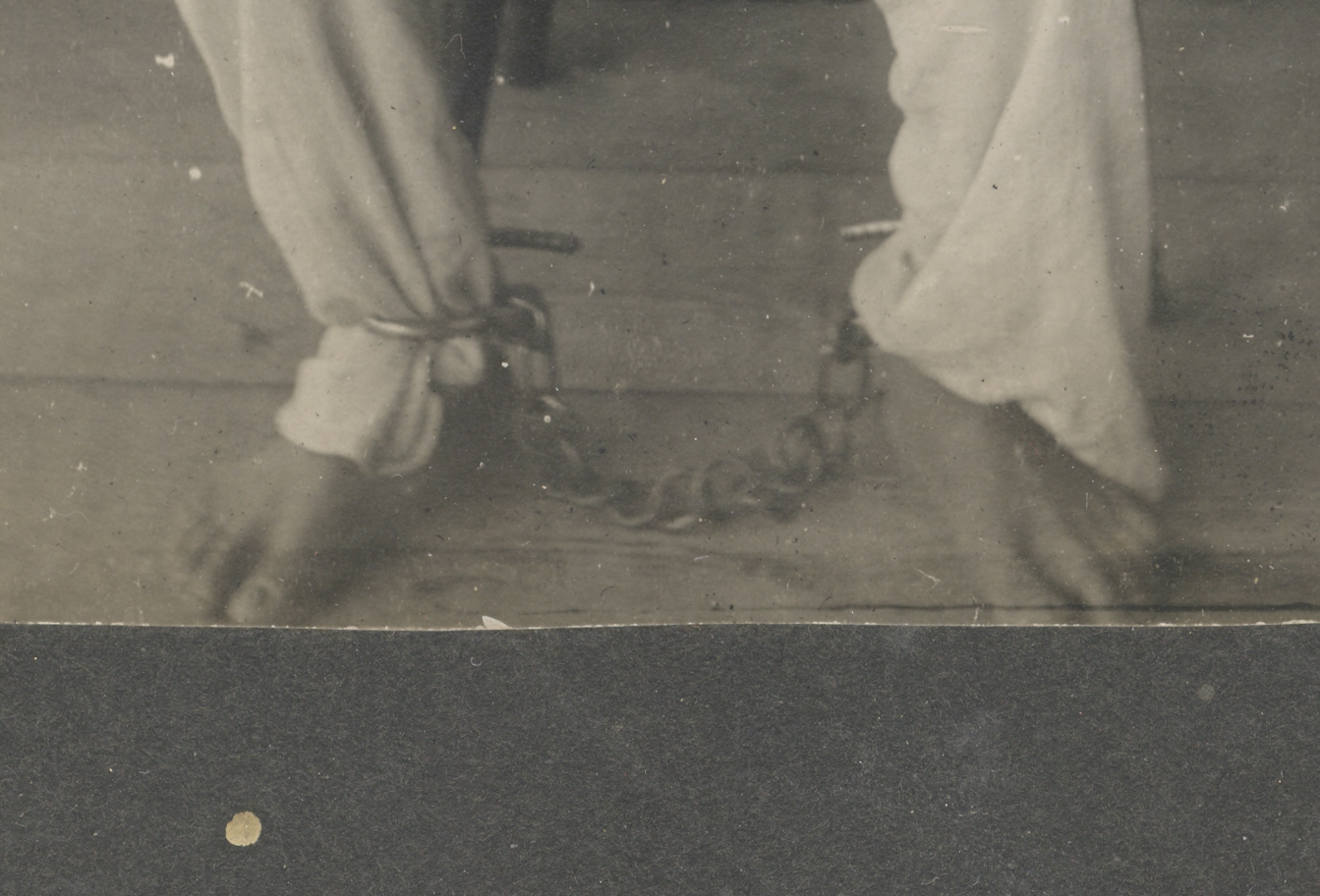
     Ablen Faustino (fl. 1880-1907), Philippine religious and resistance leader, was still fighting against the  American government seven years after the U.S. had claimed victory over the Spanish in the Philippines, and represented the last bit of Philippine resistance to American occupation and sovereignty.  There are many stories regarding his final disposition—some of which having the man escape into the woods to die an old man—but from the look of Faustino in this picture it seems as though he was going nowhere, except for a short walk into the heart of darkness that would swallow him just after the photo was taken. (The original photo is available on our blog bookstore site, here.)
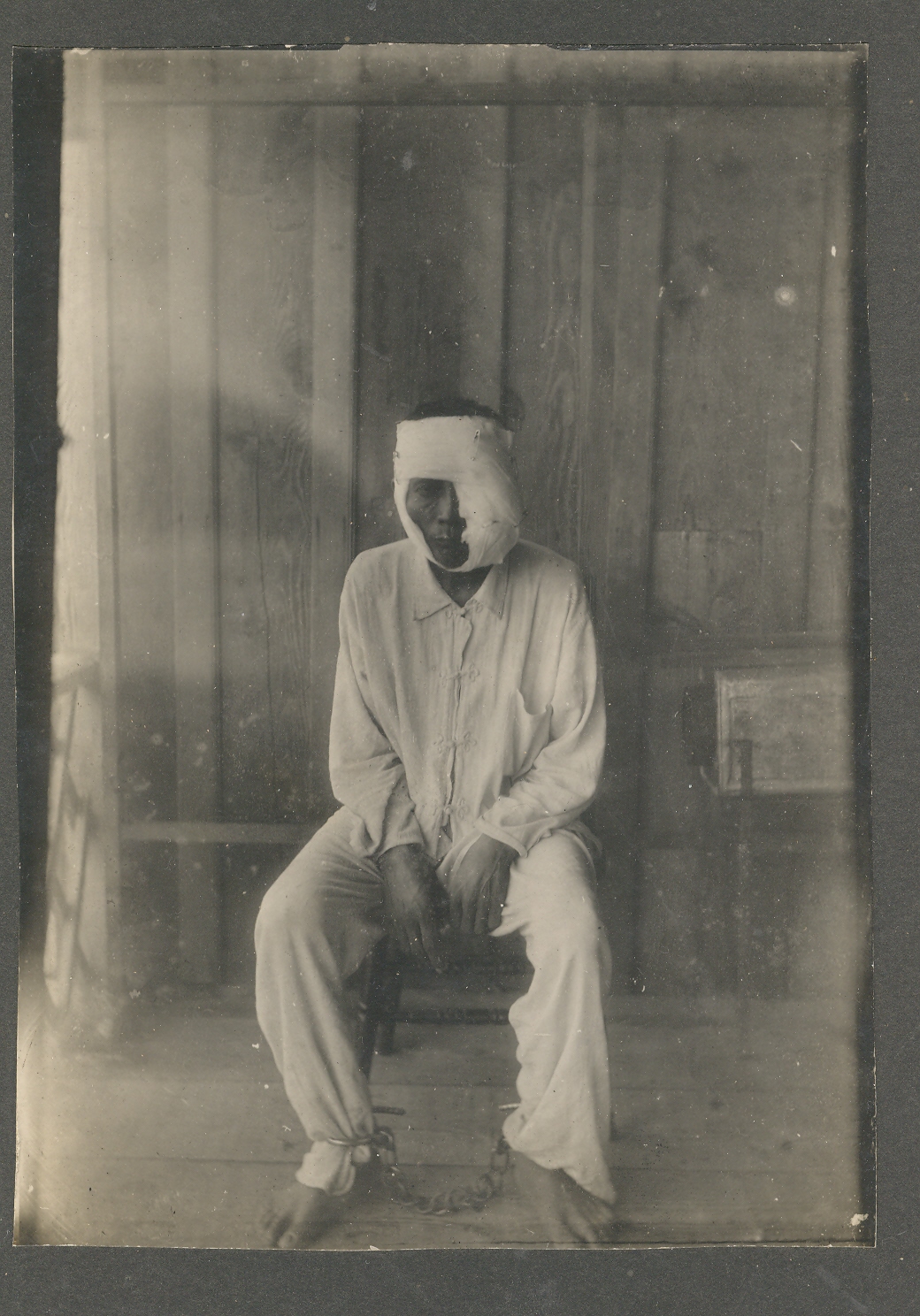
    ===blog==aug 24=big faustino smaller

    On the one Faustino was a terrorist; on the other he was a patriot and holyman fighting for his country.  He had fought the Spanish occupiers in the 1880’s until he was captured and imprisoned.  After his release and following the American victory, he founded a religious/insurgent group—the Pulahans–whose ultimate religious experience was to defeat the invaders or die trying.  (From where I sit it seems as the requisite belief was death in battle for this struggle rather than the actual victory which was the benefit to the followers.) The Pulahans for the most part eschewed firearms and other “modern” weapons, launching themselves into battle with bolos, knives, and little else, hoping for hand-to-hand fighting.  It is reported that there were 10,000-15,000 of these troops, making them a formidable army,  frightening if you were one of the soldiers that they were going to attack.


    Faustino208

    These post-war Pulahan Wars lasted from 1902 to 1907, ending with their leader’s capture by Philippine Constabulary and the 8th U.S. Infantry.One of the few official reports on Faustino’s capture was recorded in a legal document regarding jurisprudence in the arrest of the others who were with him that day.  In U.S. v. Espiridion Rota et al (found in the Supreme Court Reports of the Philippine Islands, volume IX, published in Manila in 1908), the unfortunate story of the application of law to the other five men is told, as is the mention of Faustino’s capture.  It turns out that when the others were taken into custody and the wheels of justice began to turn, they all pleaded guilty, and charged with the crime of brigandage.  Rota was sentenced to hanging and the others to imprisonment for 35 (+) years.  Plus court costs.  Their case was appealed because it was said the men had no idea what the guilty plea would get for them in the punishment phase; the Supreme Court upheld the conviction as well as the discipline, which was a little moot for Rota as he had already been hanged.
    Faustino209

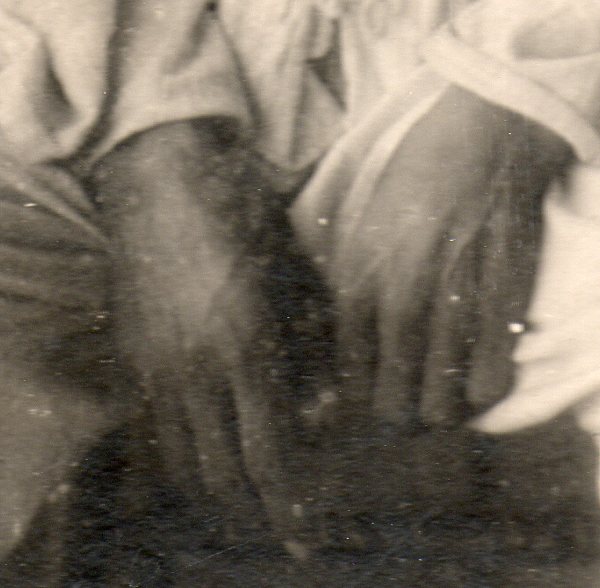
    ===blog==aug 24=big faustino feet What one might infer from this, I think, is that Faustino’s date with his punishment was probably met right there by the hut in which this photo was taken; that his destiny was sealed; and that rather than martyr a religious leader, the troops merely took the severely wounded  (and beaten?) man into the woods and disappeared him. 

    According to the historical sites which have used the other two photos of mine of this event (all done freely and without attribution, unfortunately), these are the only known photos of Faustino’s last times. 

    Another version of the capture of Faustino is less shining:
     

    ·Posted by :

    ·in:

    —

  • World War I Photographs–Full Metal Jacket, 1917

    JF Ptak Science Books       Quick Post

    WWI Photos Blindfold077

    WWI Photos Blindfold078

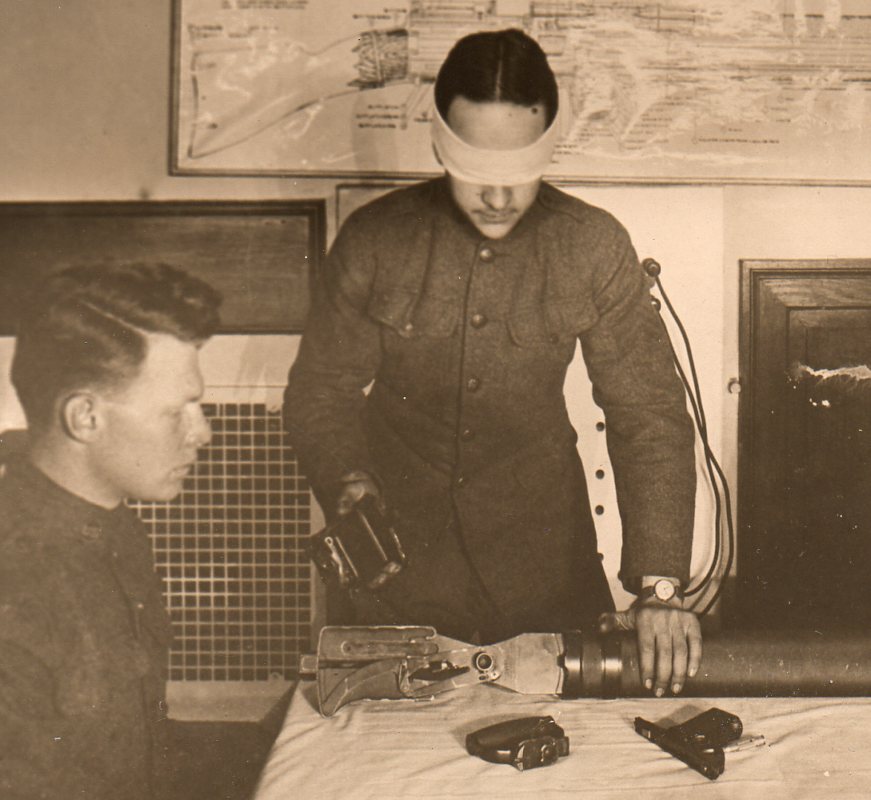
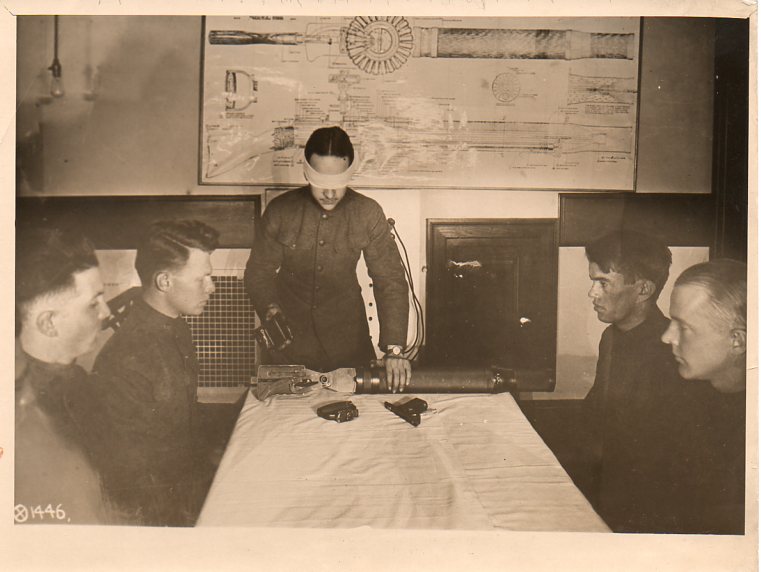
    I do believe that this is a Lewis Machine Gun, one of the most popularly-used automatic weapons by the BEF (and of American design). It was a gas-operated weapon firing a .30-06 Springfield at 500/600 rpm with an effective range of about a half-mile.  The drum magazine (not present here so far as I can see) held 47 and 97 rounds.  These soldiers were all business.

    The original is available here.


  • World War I Photos–Fifth Avenue and Not FIfth Avenue, July, 1918

    JF Ptak Science Books  Quck Post

    WWI--great images--traffic control053
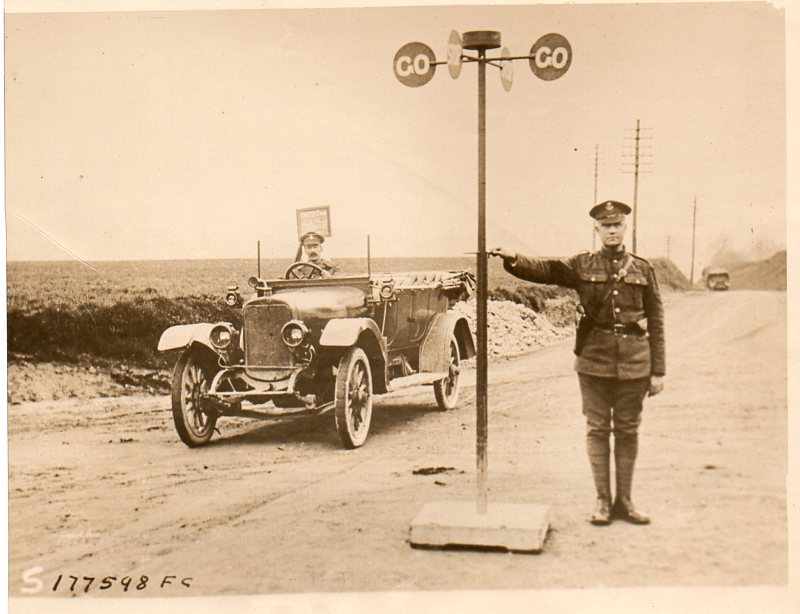
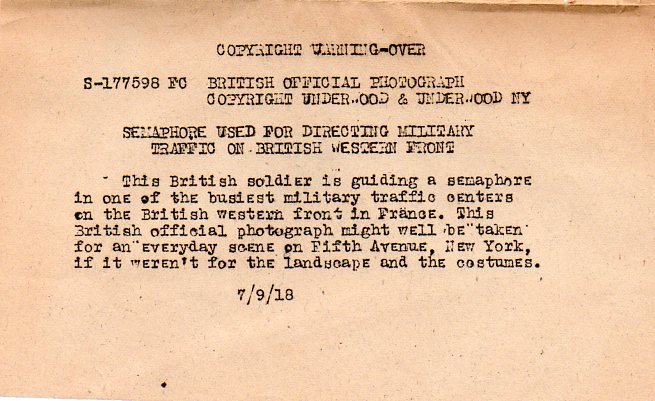
    This news photo service image (available from our blog bookstore) shows the action in “one of the busiest military centers on the British Western Front in France”, with a British soldier using a traffic semaphore to take care of the hustle and bustle.  The caption–almost always supplied with these photos as they were made by a pool of uncredited photographers covering the war for a consortium of newspapers and paid subscribers providing images and content for paying media–reads that the picture “might well be taken for an everyday scene on Fifth Avenue, New York, if it weren’t for the landscaping and the costumes”. 

    WWI--great images--traffic control054
    Indeed.  Actually, if you removed the landscaping, the vehicles, the background and the uniforms (clearly whoever wrote this copy had no feel for the fact that actors wear “costumes” and soldiers wear “uniforms”), and replaced it with paved roads, buildings on all sides, crowds of people and packed it all with automobiles and placed the scene on Fifth Avenue, then the scene would have looked like Fifth Avenue. 

    On the other hand, even if it were never to look at all like Fifth Avenue this intersection would have been exceptionally busy from time to time; I’m sure it could have seen thousands of troops per day, particularly since the Brits fielded probably a million troops in this region alone, and those troops needed to be fed and cared for, which means there would’ve been a constant flow of people, and machines, and materiel. 

    This is a fantastic photograph,though, though the captioning folks did it little justice. 

    WWI--great images--traffic control055

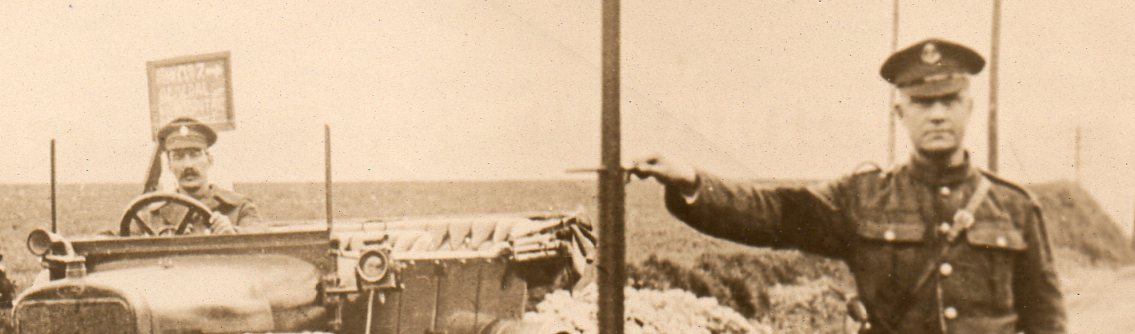
    I can’t quite make out the BEF-made sign in the background, placed for the use of the troops. 

    WWI--great images--traffic control056

    ·Posted by :

    ·in:

    — —

  • Children, Artillery and the Geometry of Cannon Fire

    JF Ptak Science Books  Post 1366

    Cannons ha003

    There were many integral components to firing a cannon on a ship, not the least of which were the Powder Boys, the small, young, semi-strong kids who would run the gunpowder from a below-decks armory to whatever gun deck was needed.  It was a relatively simple procedure, filling up a longish tube (cannon  derived from the Italian  cannone–or large tube–which came from the Latin canna from the Greek  kannē , meaning something like a reed or any similar hollow thing) with gunpowder and then cannonball/shot and then wad, then causing the gunpowder/propellant to ignite and throw the ball.  Basically, that was it, though you needed to maintain the cannon, aim it, and so on (don’t forget to first swab the bore from unexploded gunpowder so you don’t blow things up!).

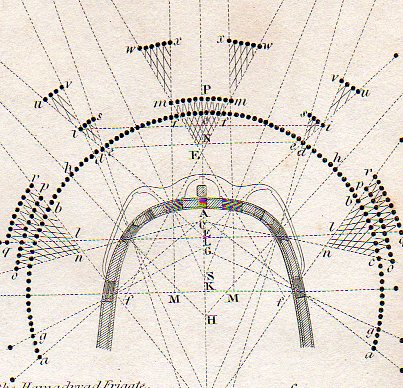
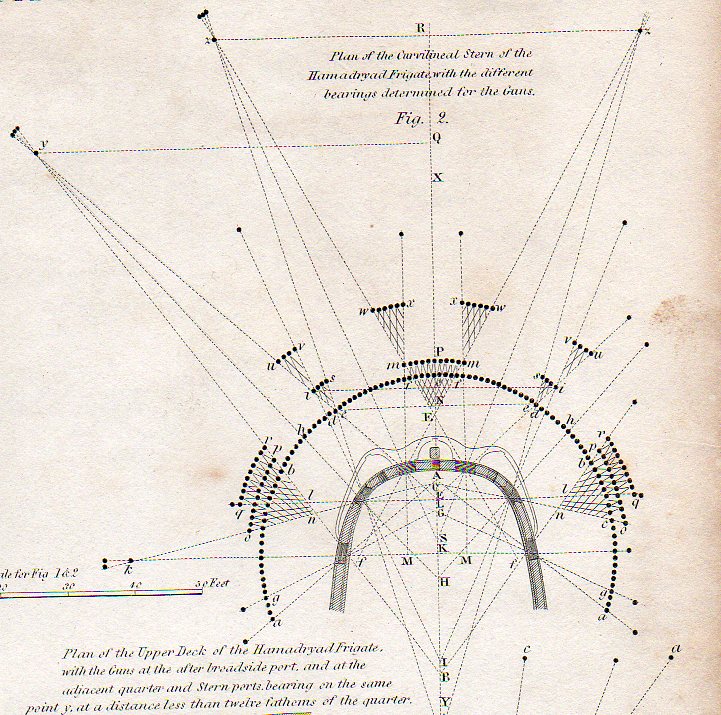
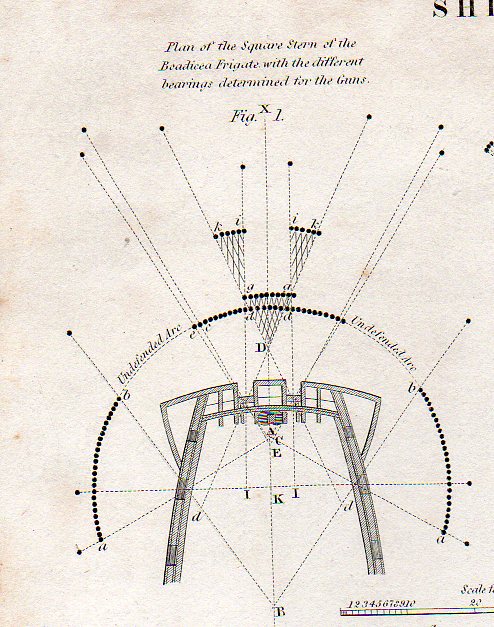
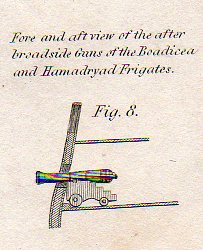
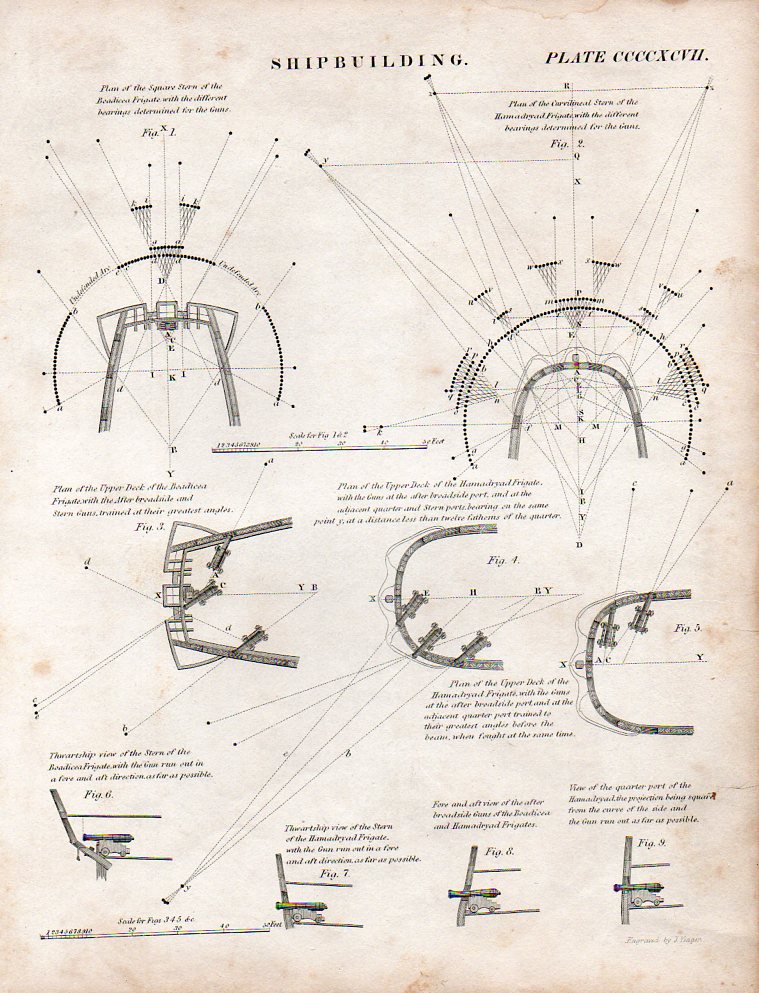
    The (first)  image above of found modernist/semi-dadaist artwork comes form 1812 and was found in Rees’1 Encyclopedic Dictionary from the article on “Shipbuilidng”   and illustrates the ways in which the stern of a ship can be outfitted with cannons–actually, the sterns of the HMS Bodiceae (28 18-pounders)  and HMS Hamadryad  (36 guns). Also by this time cannons had been carried on naval ships for nearly four hundred years, while the first cannons appeared on the ground in Europe another few hundred years before that. 

    Cannons ha002


    In the third detail (below) we see the coverage of the four cannons placed in the stern of the Bodicae, mainly pointing out its weaknesses, showing the undefended arc, which comprises about 1/3, or about 60 degrees of the defensive posture.  The Hamadryad on the other hand shows 100% coverage of the 180+ degrees of attack possibilities shown, along wioth secondary and teriary areas of fire coverage covered by mor ethan one gun.

    Cannons b004

    A fine,tiny detail from the full engraved sheet:

    Cannons little005 And the full sheet, available at our blog bookstore:

      Cannons001

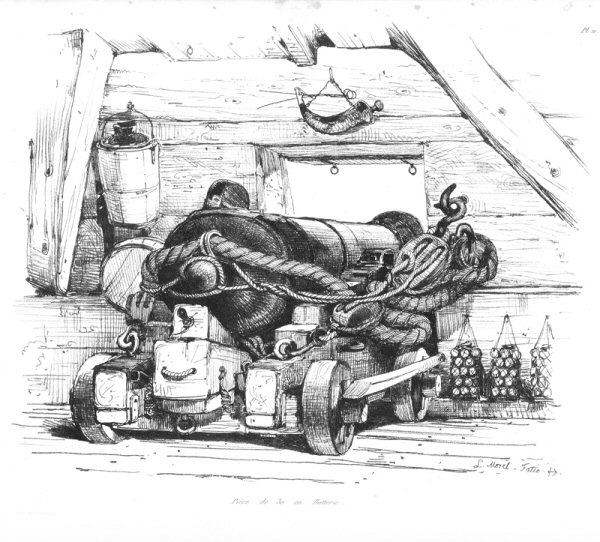
    This is pretty much all that was needed to fire a cannon, except the men of course.

    File:Antoine Morel-Fatio pl10.jpg

    NOTES:

    1.   I’ve written about before here, just enter “Rees” in the google box and there will be a dozen or so other posts.


  • Technical Drawing: an Early, Convict-Powered, Revolving Turret Ship
    JF Ptak Science Books   Post 1364

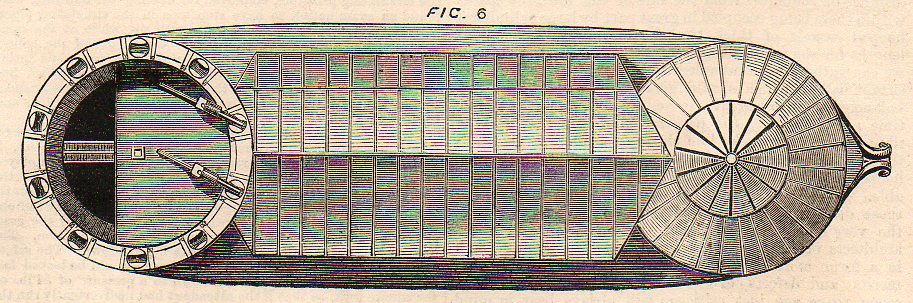
    Technical drwg--revovl turret circular540

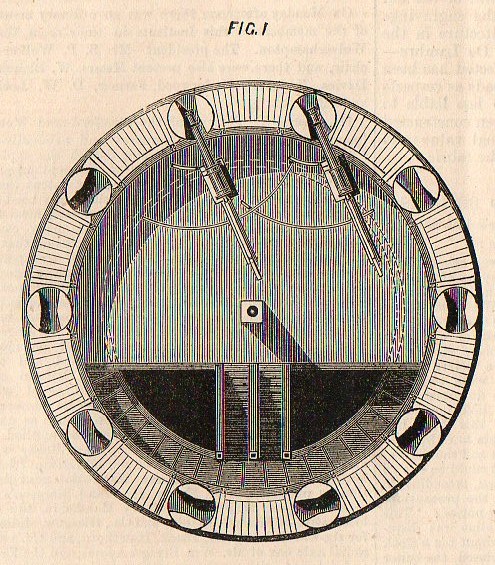
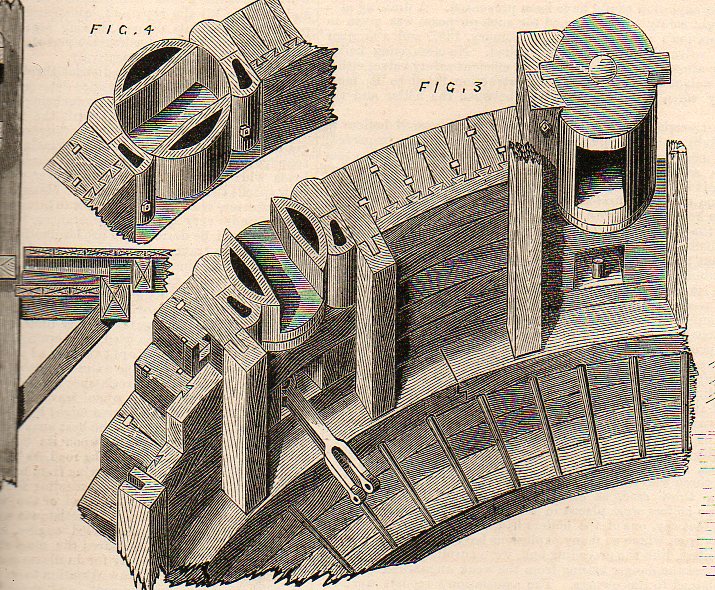
    This image (from the The Engineer for 30 October 1874) shows a plan of the top floor of a revolving battery designed by M. Baltard in 1831 (and which is available at our blog bookstore).  This idea is probably ancient, though it really only had major technological legs by the 19th century. Even though Baltard is given some fair credit for the modern rediscovery of the revolving turret–and in this short article he is given premier status–there were earlier engineers at work before him.  For example, in the earliest part of the 19th century Col. John Stevens designed a saucer-shaped floating battery that was supposed to be able to fire in any direction; T.R. Timbly–slightly after Baltard–applied in the U.S. Patent Office in June 1843 for a device he called a “metallic revolving fort”.  Then came the great John Ericsson–very long on accomplishments but very short now in modern memory, he is also one of those memorialized men in marble in DC for whom people have almost no modern recognition–who in 1854 produced an “impregnable battery revolving cupola”, which led to his great innovation on the Monitor.  And as we recall, the Monitor’s defeat of the Merrimack in Hampton Roads in 1861spelled the coming end of the wooden ship of the line–metal ships with mounted revolving turrets fore and aft would prove entirely too far superior to the 19th century wooden ship.

    Technical drwg--revovl turret537

    What we are seeing in the first engraving is the top floor of a two-story fortification–roof removed–showing the floor plan of the battery.  The walls and roof were stationary; the floor was not.  The two cannons were located on a revolving floor and were moved by turning the floor (basically) to one of the open firing windows (embrasures) a detail of which is above. When the barrel of the canon was pulled out of this opening, it was turned closed to prevent any fire coming into the fort.

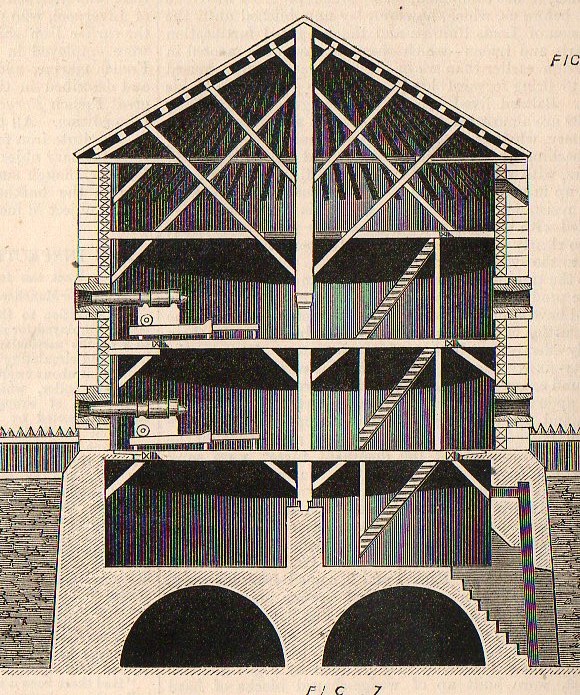
    The engraving below shows a cross-section of the two-turret land structure.

      Technical drwg--revovl turret535

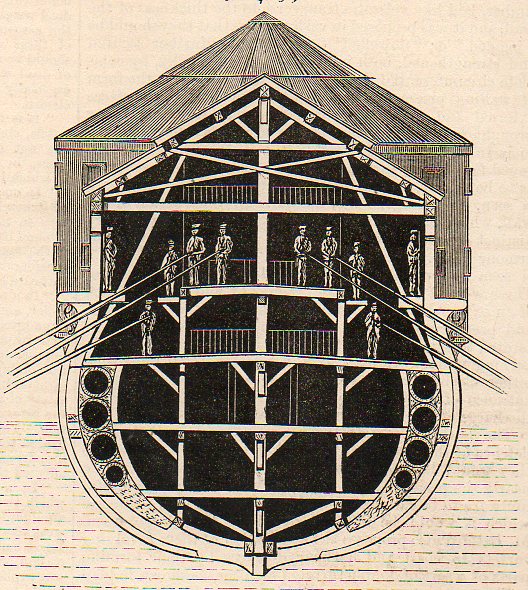
    The engraving below shows the idea of the land fortification shipboard, one revolving turret fore and aft. It turns out that the engine for the vessel was human, the engineer calling for “either” convicts (forcats) or soldiers to row to move and position the boat

      Technical drwg--revovl turret536

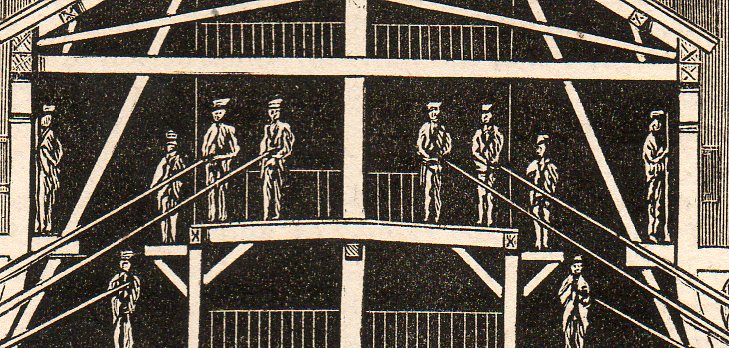
    And a detail we can clearly see the long sweep oars:
    Technical drwg--revovl turret big detail538

    And the turrets on the ship, the pre-Monitor-style ship:

    Technical drwg--revovl turret big detail539

    I assume that the boat was being used for coastal or harbor defense, or at least something very close to land, and was really more a floating, positioning battery than a boat.  Seems to me though that after everything was said and done, after all the work was accomplished and the boat built, that making the whole thing dependent on sticks of wood was a fatal flaw. 


  • Survivors on the Little Train to Hot Showers–WWI Photographs, 1918

    JF Ptak Science Books  Post 1329

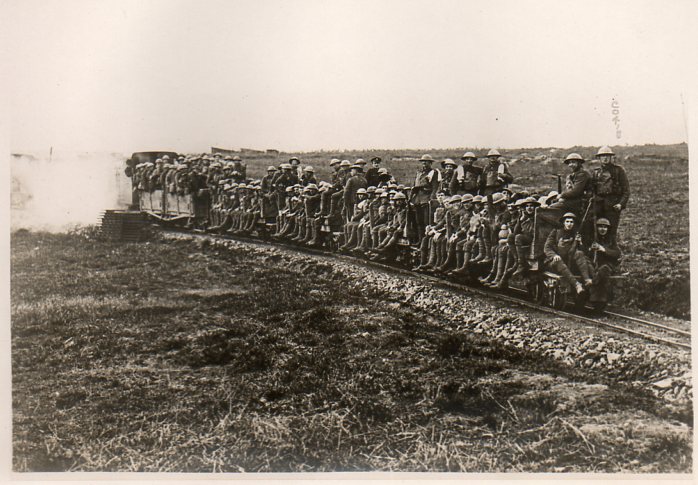
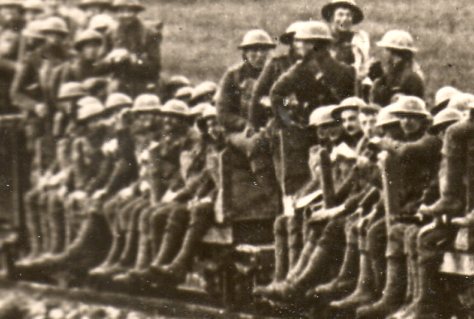
    I suppose there there was little to lift morale more than to have troops return to divisional from the front line to enjoy a hot shower–outside of course than to be brought home away form the fighting, entirely.  These soldiers were about to enjoy what I am sure was a well worn break from the action. (The original photo is available for purchase at our blog bookstore.)

    Marching railway car355
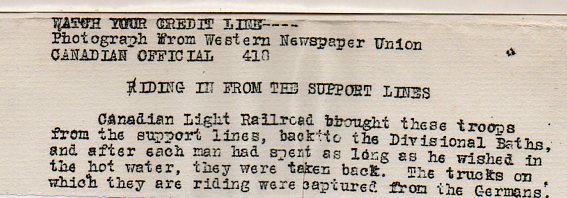
    The soldiers were riding a narrow gauge railroad, brought to France from Canada, headed back to safety and “the baths”. 

    [Also, in keeping with my previous post, to represent all of the casualties of WWI you would need this trainload of men to extend from NYC to L.A. and almost all the way back again, about 6,000 miles of people.]

    Marching railway car356

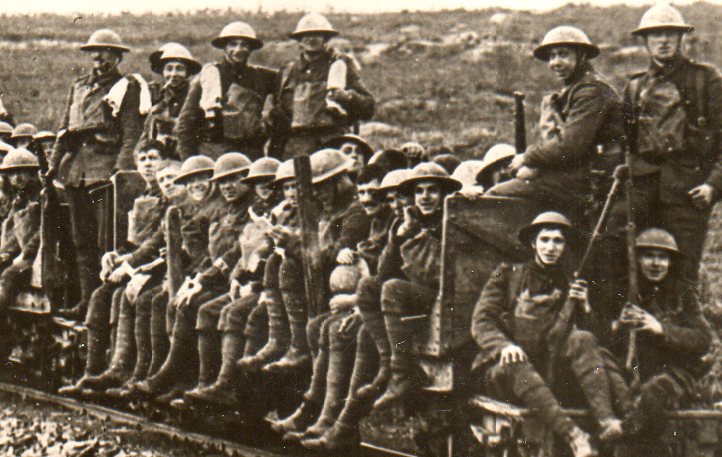
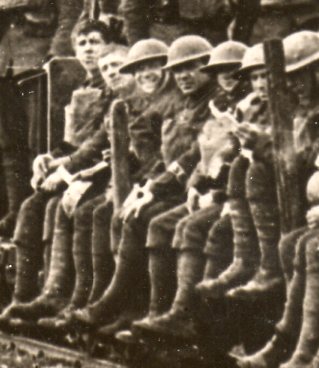
    And this, below–I see the soldier at the far right is reading a letter, I’m guessing a letter from home, as he has his knees tucked up maybe trying to protect its contents from prying eyes.  The soldier to his right is engaging in the age-old custom of reading someone else’s mail over their shoulder, desperate for any news from anywhere.  Who knows–maybe the guy was sharing. 

    Marching railway car357

    And then–as we are told in the caption for the photograph–they were given as much time in hot water as they wanted. And then:

    Marching railway car txt361

    I think the return trip would’ve looked much different.

    Marching railway car358

    Marching railway car txt360


  • Ghost March–Doughboys in London and Four Years of Mist, 1918

    JF Ptak Science Books   Post 1328

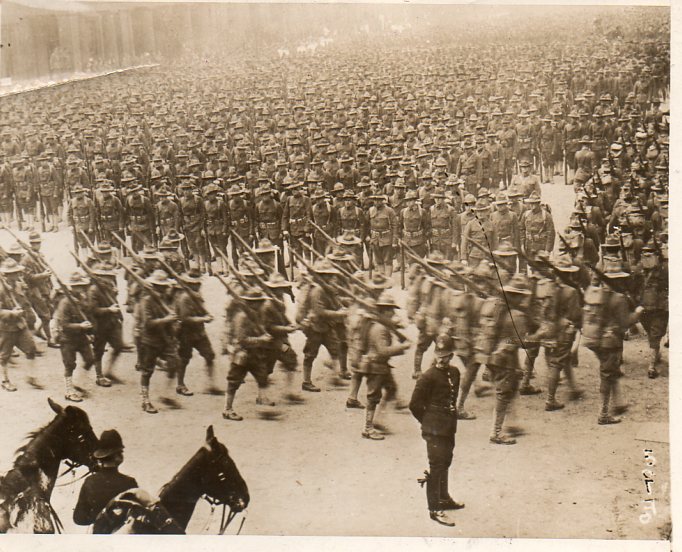
    .003%  That’s what I reckon this column of soldiers would represent of the total casualties of WWI.

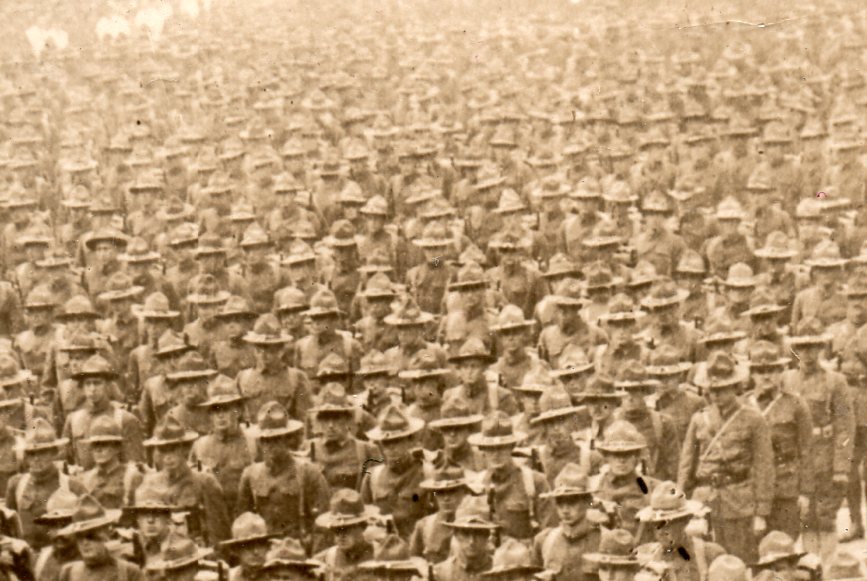
    Generally images like this are a virtual image-host for me, a bucket of ice cold water thrown onto a sizzling summer sidewalk, all sorts of ideas steaming from it.  But for photographs of Doughboys1 marching, especially assembling for parade, this one struck me a little more oddly than most, giving instant pause, making me concentrate on the haze, or dust, that allowed the columns of soldiers to blend into one another and fade, losing their boundaries with their mass receding into a dull blur. 

    Marching london 350

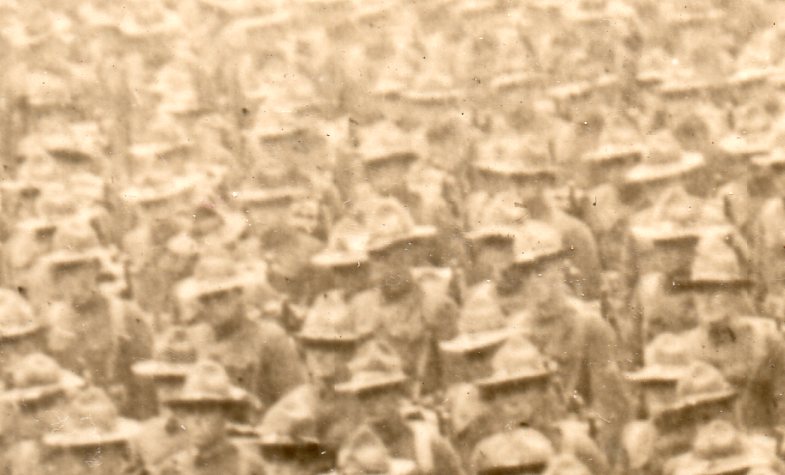
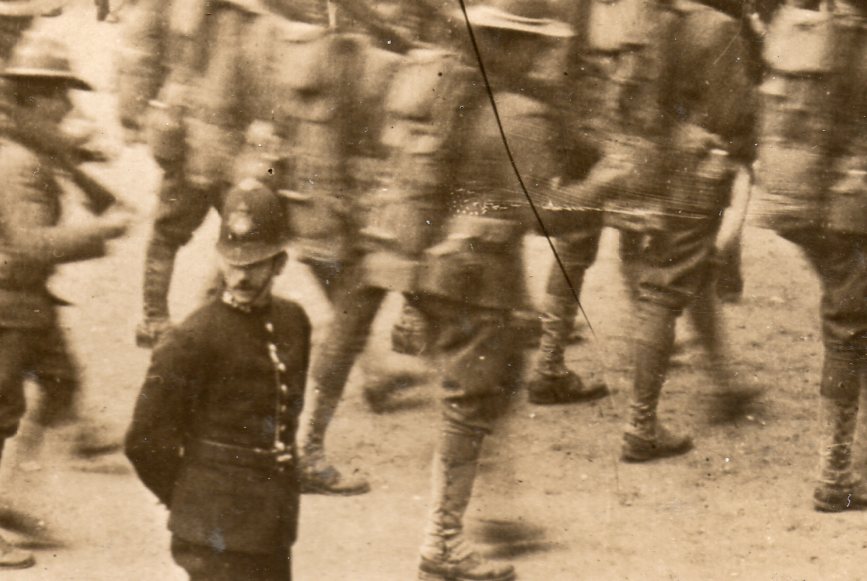
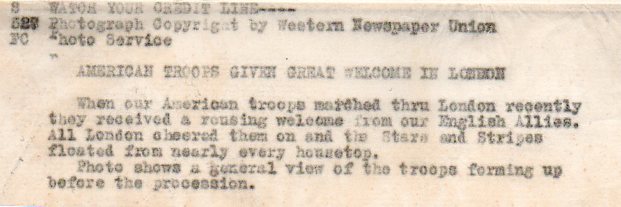
    The Western Newspaper Union was selling this image for insertion in newspaper or journal stories about the war, for a small use fee.  There were a few American organizations like Western Newspaper that were created to photographically cover the war, using pools of photographers who would distribute their work anonymously and which was available for common, general use for a small charge.  The photographs allowed out were certainly restricted and censored, though in my stash of these of objects (numbering about a thousand) I’d say that 10% of them look pretty edgy to my eyes.  Most of the action of war was not covered, but then again this aspect was still fairly technically difficult in 1918.  Images of pain were almost never allowed, and certainly not pain of Allied troops.  Aid stations were almost never covered as well, as were dead bodies, or at least those again of Americans or Brits or French or Canadian.  The imaging of the war was certainly under a fair amount of supervision and control. (The original is available for purchase through our blog bookstore. here.)

    Marching london det352

    The image shows American troops assembling for a parade through the streets of London before being deployed.  The mistiness of the composition looks like a statistic to me, these men standing for those who had come before and fallen.

    Marching london det353

     The U.S. lost .13%  of its population to casualties (125,000 killed and 205,000 wounded) during the war–a war which by the time America got here had already been visciously fought for three years, costing dozens of millions of lives.  The figures for everyone else weren’t nearly so “fortunate” as the U.S.:  New Zealand’s 18,000/41,312 killed/wounded amounted to 1.6% of its population.  The U.K. lost 2.19% (964,000/1,663,000), Italy was 3.48% (650,000/953,000 plus 650,000 civilian casualties), while France suffered a 4.29% (1.4 million/4.27 mil) blow of its total population to war.  Things were worse on the other side:  Germany 3.82% (2 mil/2.4 mil plus 426,000 civilian deaths, and the Ottoman Empire 12% (400,000/771,000 plus 2.1 million civilian deaths.   Worst of all was the Ally  Serbia, suffering a catastrophic 16% loss of its population to war, including 275,000/725,000 plus 426,000 civilian casualties.  As gruesome as the numbers were, the Americans felt only a small percentage of the total sting of war–by 11 November, more than 21 million soldiers would have been wounded, with 9.7 million soldiers and 6.8 million civilians killed.  It was an enormous price.

    And that’s what I see in the mist of what may be something like 10,000 soldiers on display n this photograph.  .003%  That’s two of these columns every day, twice a day, for the entire 1550 or so days of the war.   

    Marching london cop351

    Marching london txt354

    Notes

    1.  The origin of the term “Doughboy” is unclear, or varied, or rich, but it is at least pretty oldm beginning around the time of the Mexican American War in 1846-1848–evidently when the soldiers marched through dry, tough terrain they wound up being covered by earth with the color of dough.  Doughboy.


  • The First American Government Publication on Gassing at Auschwitz and Its High-Ranked Google Deniers

    JF Ptak Science Books   Post 1314

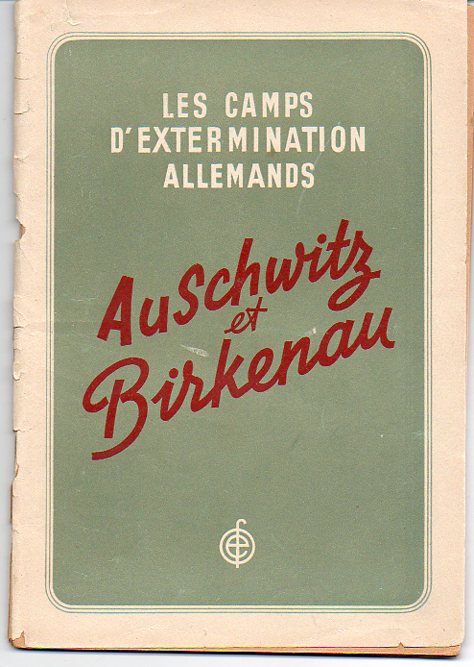
    In November 1944 under the direction and auspices of the War Refugee Board the first official U.S. government acknowledgment of the gassing of Jews at Auschwitz and Birkenau was published.  German Extermination Camps-Auschwitz and Birkenau1,  received scant distribution, and despite its rather splashy appearance in the New York Times2 of 26 November 1944, it seems to have been directly, immediately relegated to various archives, a scarce thing when it was new3.  Dusty On Arrival, DOA–a disappearance that looks like a censorship.

    Auschwitz Birkenau317 Reports of mass killings were not new in 1944; indeed in Roosevelt’s only meeting of the war with Jewish leaders in late 1942 he was told in no uncertain terms that millions of Jews were being rounded up and killed. There were no other meetings.  In spite of other evidence and hundreds of newspaper articles, November ‘44 was the best that we could do in saying something about the gassing.

    When I was researching a French edition (which I have available for sale at my blog bookstore) of this publication, which was published in Paris in mid-1945, I did a quick Google search under its title, “Les Camps d’Extermination Allemands Auschwitz et Birkenau” .   I was surprised to see that about half of the hits were for references to crackpot Holocaust deniers who fancied themselves as “revisionist historians”–the sites looked “normal”, and had sort-of academic-y names with “truth” and “accuracy” in their titles.  They looked like any other web/blogsite, even calling up references from other web/blogsites, though those sites were just more of the same.  And there’s one of the major problems of info-gathering on the internet–vetting accuracy. 

    This search result is not achieved if you remove the quotation marks and search in general under the title’s words as single entities–but for the title as a  phrase in itself, the results of the search were crackpot-heavy. 

    Searching Google for “Holocaust” and “Auschwitz” and similar words buries the denier-people, though not deep enough for my taste.  Still it is very disturbing to search the title of the publication and find all of these looney people–what does that mean, exactly?  Is this result due to these sites writing more about this particular title than respectable sites?  Or–since these people regard this pamphlet as the key publication in beginning what they call the ‘myth” of the Holocaust–they have somehow constructed their use of the phrase to better appease the Google algorithm?  My guess is that the denier people have simply written more on this one title than on any other, and have written on it more than bona fide historical sites, and thus come up higher in Google findings.  But whatever they’ve done these sites have managed to occupy a hefty percentage of Google hits when searching for the title of perhaps the first prime indictment against the Nazis as extraordinarily vicious murderers with that counter claims that the publication is nothing but a fraud.  And that’s nothing but disgusting.

    ____________

    1. The original, government publication was reviewed thus at the Simon Wiesenthal site:  “THE FIRST REPORT ABOUT AUSCHWITZ by JOHN S. CONWAY. At the Nuremberg trials, one of the principal documents used was a fifty-nine-page mimeographed report published in November 1944 by the War Refugee Board in Washington, D.C.1 It consisted of two eyewitness accounts, “both received from a representative close to the scene,” the first based on the experiences of two young Slovakian Jews who escaped from Auschwitz in April 1944 (Part 1, pp. 1-33), and the second by a non- Jewish Polish major (Part II, pp. 1-19). “

    2. U.S. BOARD BARES ATROCITY DETAILS TOLD BY WITNESSES AT POLISH CAMPS, New York Times, 26 November 1944.

    3. “Copies of the English edition are to be found in Yad Vashem, Jerusalem (in Hungarian), in the files of the World Jewish Congress, Geneva (in German), and in the Roosevelt Library, Hyde Park, New York: War Refugee Board report, Box 61: General Correspondence of R. McClelland: F: Miscellaneous Documents and Reports re Extermination Camps for Jews in Poland (in German).” And not many more other places. 

    Only four copies of the French version are located on WorldCat OCLC: WAKE FOREST UNIV; France AIX-MARSEILLE1-BU LETTRES; France    BIBLIOTHEQUE NAT & UNIV STRASBOURG; France    BIBLIOTHEQUE NATIONALE DE FRANCE     
    France;  BNU STRASBOURG, RCON PROJ


  • Fantastic Contrivances of Massive and Unneeded Difficulty–Bikes in War, 1897

    JF Ptak Science Books   Post 1345

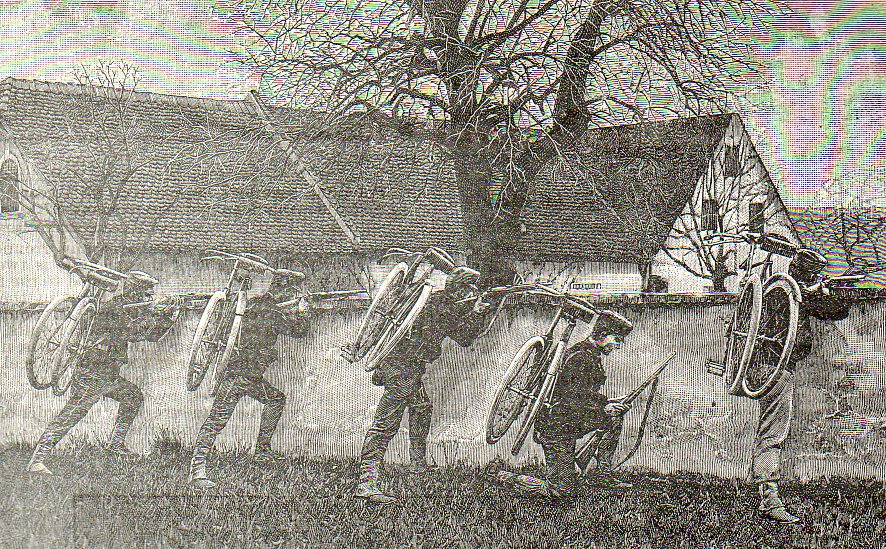
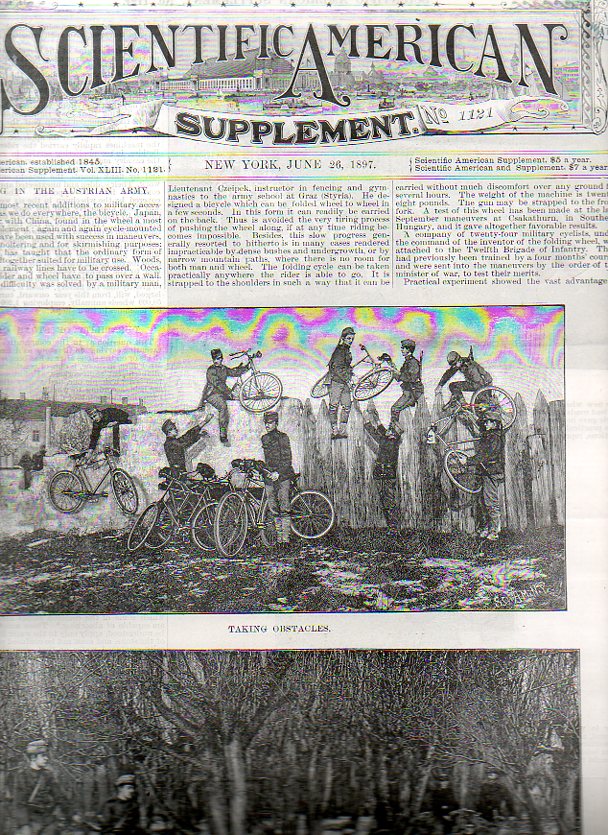
       Bike army 439

    When I see images like this, I can feel a symphony of bad ideas rattling  my bones.

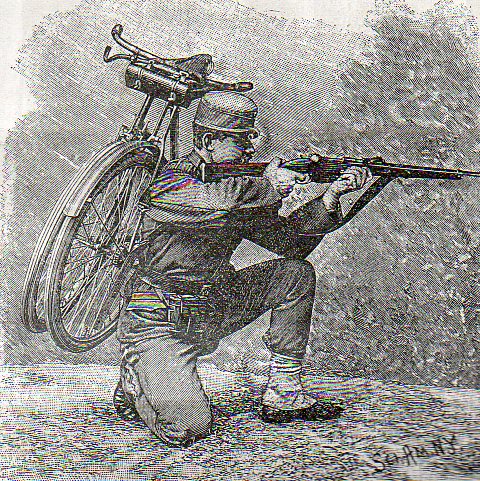
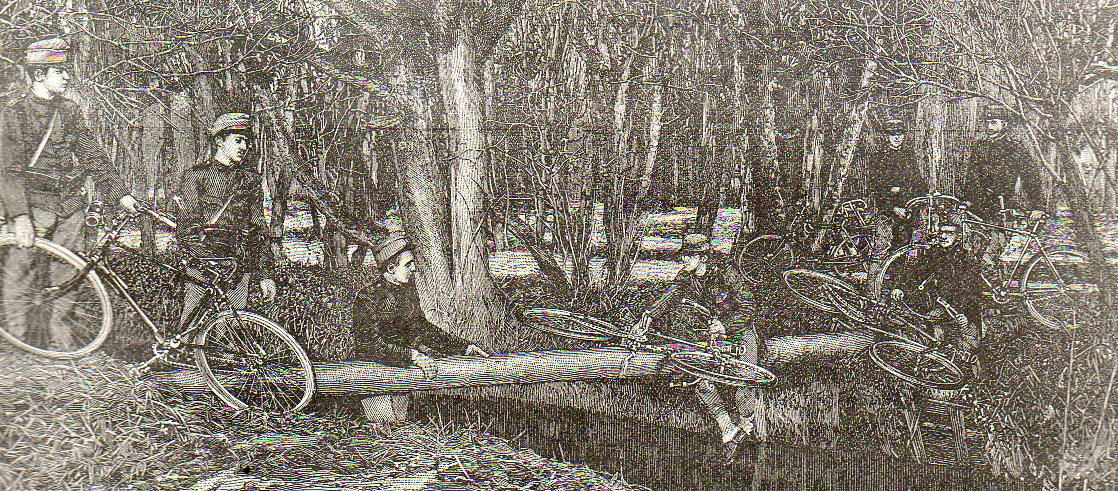
    Of contrivances great and unnecessary,  that of bringing the bicycle into the field of war–banking on a fabulous interest in the machine and riding a wave of enthusiasms enjoyed by millions–is among the loftiest of lofty unnecessaries of the past 150 years or so. When these pictures were published in 1897 interest in the bicycle was shattering; it was a popular conveyance, and then in just two or three years, an explosion:  millions of people suddenly needed one.  Bikes seemed to be everywhere,  which forced people to imagine new and different uses for the machine.  And so the Austrian army came up with a plan to include the bike in its plans of war, and it proved to be as about as useful as a double-decker horse.  And just like that–poof–the fragility of the bike’s expansive uses fell right off the table, along with the popular interest in it, which by the turn of the century saw the millions who had turned towards the bike turn away. 

    Bike army 440
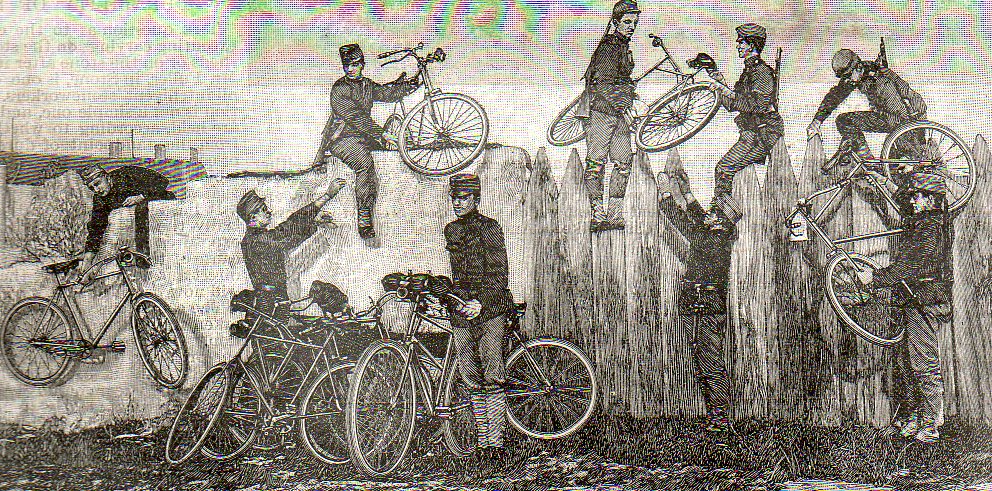
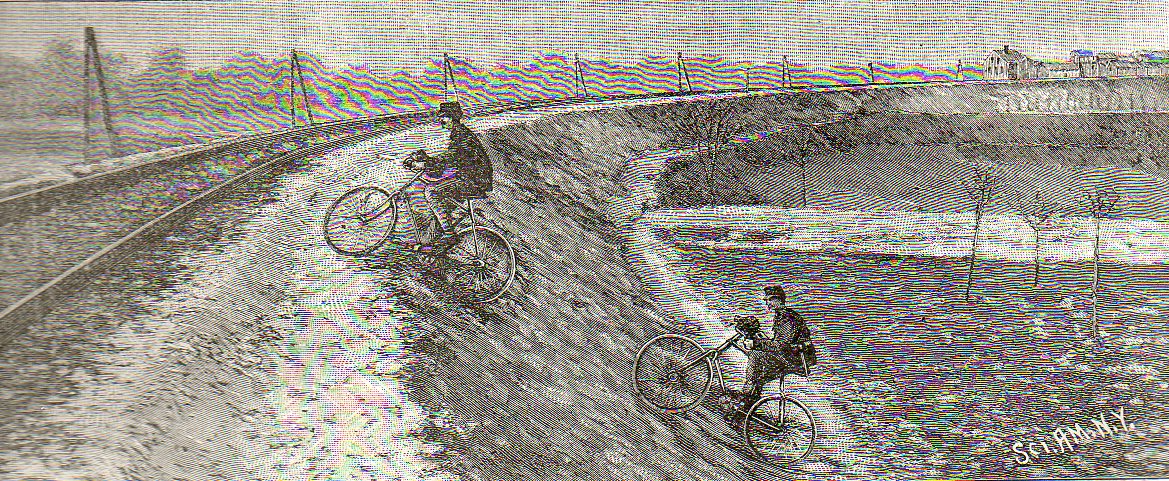
    It is difficult to image a more unpleasant (real) use for the bike than this.  The pictures seem as though they are part of a Monty Python montage, but they were indeed deadly serious–though I do need to credit someone, anyone, who came up with the idea of a folding bike to make it slightly more transportable.  (Overall though it seems almost as useful as a folding tuba.  Or sousaphone.)  If employed I think the idea would’ve proved to be more deadly to the biker than whomever the biker was attacking.  Or, more likely, fleeing.

    Bike army 436
    One can only shudder and what it must’ve been like, sitting on top of that fence, handing bikes (with lights and horns) from one side to the other, bullets flying, attempting an attack with 75 pounds of cumbersome trouble slapped to your side.  It must have felt insane.

    Bike army 441

    (The original print is available from our blog bookstore, by the way.)

        Bike army 435

    Bike army 437

    I think these men would have heard the music too as they slogged their ways through brush and trees and muck and the like, sliding their bikes along that log to keep them dry while the men stood in the wet. They would’ve heard the music too, a short little symphony played on folded instruments, which sounded as bad as it looked.


  • The pre-pre-Internet? The SAGE Defense System, 1959-1983.

    JF Ptak Science Books   Post 1341

    Quality Control of America’s Anti-Bomber Defensive “Shield”: the SAGE System, 1958

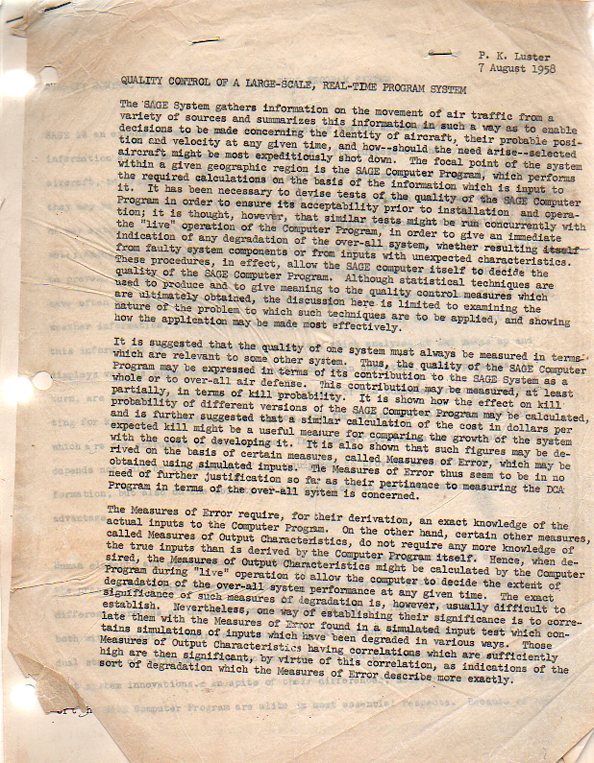
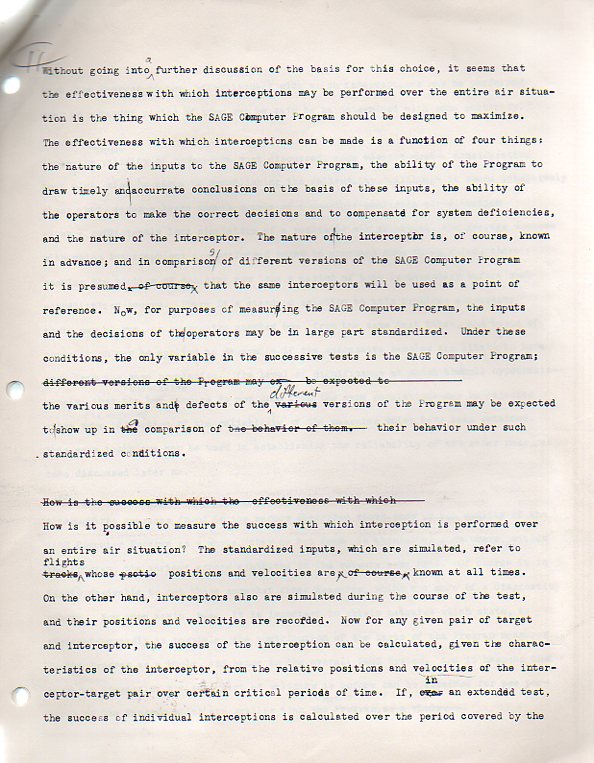
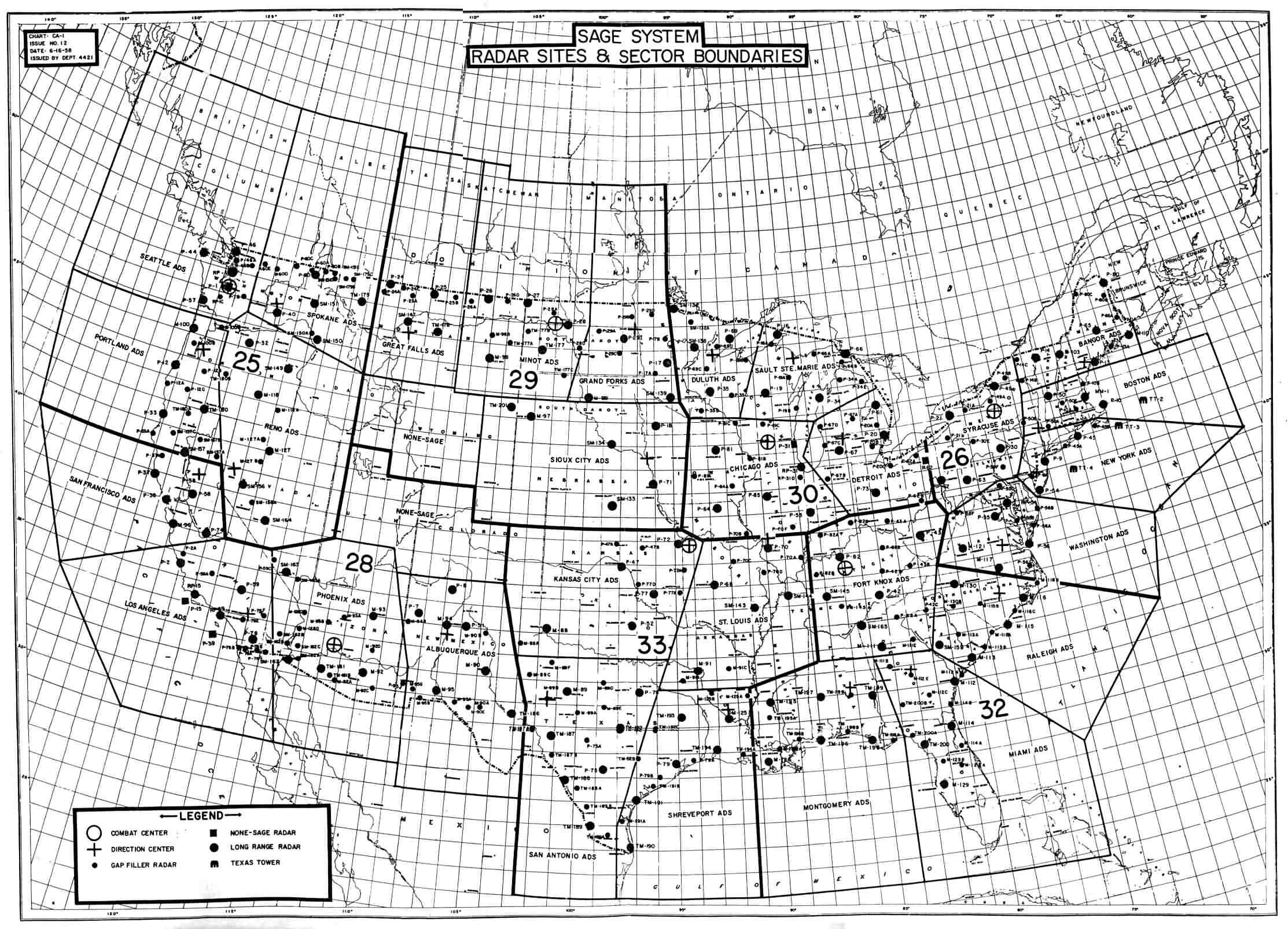
    SAGE403 The SAGE  (The Semi-Automatic Ground Environment) was an “air traffic control device”1 that was used to detect enemy aircraft, relate their position and speed to interceptors which would destroy the threat.  It was basically the air defense shield against attack of North America by Soviet bombers (in the pre-ICBM days of MAD). The MIT/IBM SAGE system was enormously important in the history of computing because of its many real-time, interactive and online aspects–it was an enormously successful and futuristic system, one of the “best” computers ever built. This paper on the computer’s ability to self-reference and check itself, by P.K. Luster, was written in 1958 and serves as an interesting insight into quality control for the world’s first nation-wide computer communication network.

    Luster (who at one time worked for a contractor in Arlington, Virginia, named the John D. Kettelle Corp) was one of hundreds of programmers who worked on the system, and in this case, for this effort of his, he looked at various ways for selecting the proper way for a SAGE to monitor itself in real time and make assessments of its own reliability.  This was a very tricky bit, of course.  SAGE was the largest computer ever built–it had 23 installations in the U.S. (And one other in Canada) each given the possibility of tracking about 400 aircraft at one time.  SAGE would track these developments, coordinate all efforts in response, and then if the flights were determined to be hostile /Soviet forces, would destroy the buggers with responses from “nuclear tipped” BOMARC and Nike missiles. (The Boeing Michigan Aeronautical Research Center and Nike missiles each carried a 1-5 kiloton warhead, enough so that if it was near its target it would be able to destroy it.The BOMARC looked like a jet aircraft; the Nike looked like a multi-finned, very sleek ultimate 1950’s imaginatively-styled rocket ship, but real.) Trying to insure that the system was accurate was a major consideration. (This document is available for purchase from our blog bookstore.)

    From Luster’s  paper:

    “It has been necessary to device tests of the quality of the SAGE computer program in order to ensure its acceptability prior to installation and operation…also to run it “live” in order to give an immediate indication of any degradation of the overall system.  In effect, allow the SAGE computer itself to decide the quality of the SAGE computer program…The discussion here is limited to examining the nature of the problem to which such techniques are to be applied, and showing how the application may be made most effectively.”

    SAGE402
    The SAGE system was of course functional, highly reliable, and ws used until 1983.  IT was a kind of early version of the Star Wars defense system envisioned by President Reqgana nd Edward Teller, among others.  Except that SAGE existed and worked.

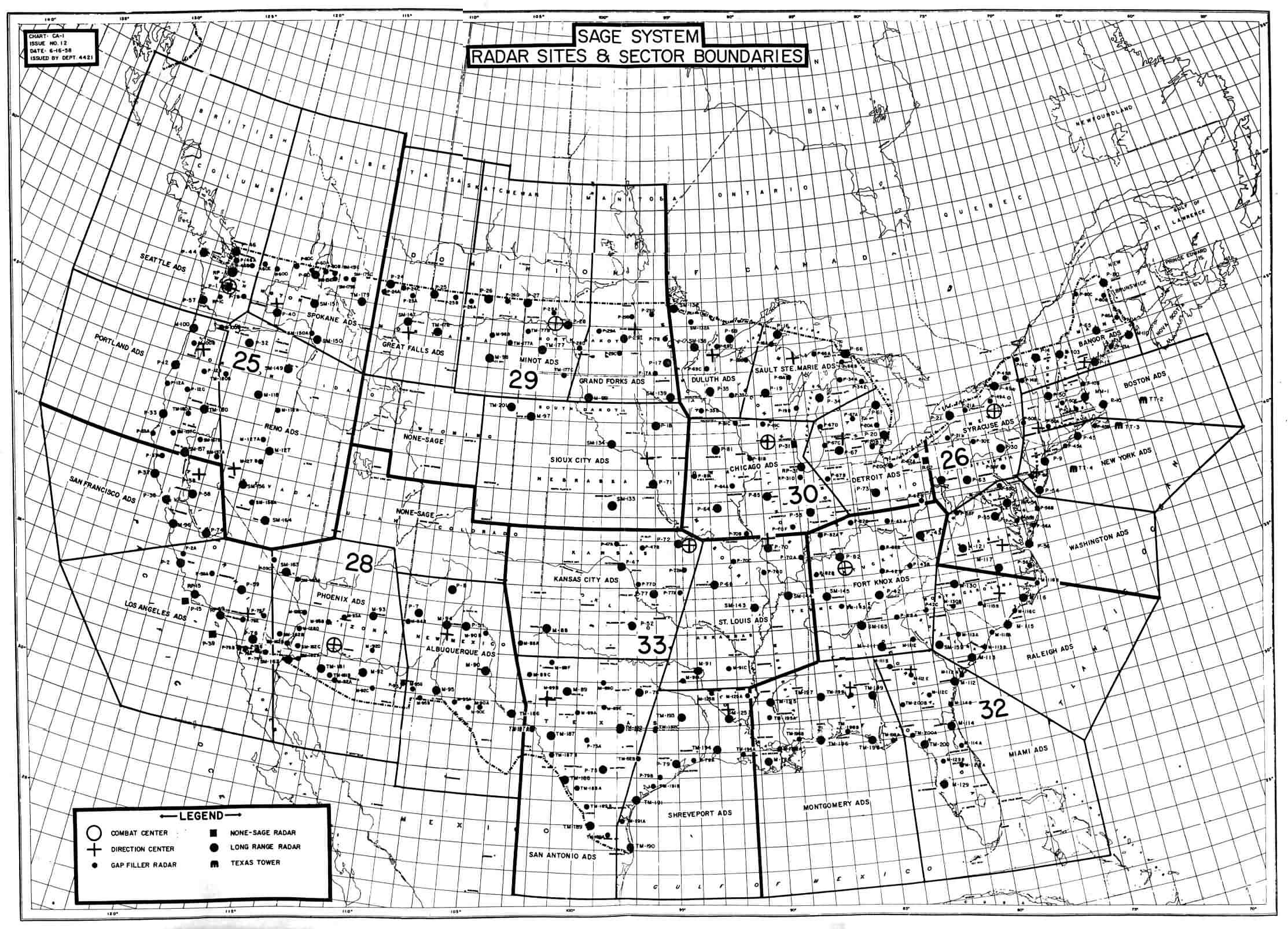
    It is interesting too to think of it in terms of a sort of pre-ARPANET pre-internet, a pre-pre-internet, in that the system has 24 remote nodes which communicated among themselves.  It doesn’t bear much resemblance to J.C.R. Licklider’s  Memorandum For Members and Affiliates of the Intergalactic Computer Network (1963)–the true first modeling suggestion for a working internet in which all of the main pieces of the internet are present, but it is at least in the neighborhood, as SAGE was the first operational nation-wide real-time computer network. ( It should also be pointed out that Licklider and other of the creators of ARPANET were programmers for SAGE.)  SAGE was in-place by 1959 and operating by 1963, but it had severe limitations as a national defense shield and was ill-equipped to counter ICBMs and SLBMs, but it was kept alive until 1983.   

    Sage network


     Notes

    1.  SAGE did become the template for SABRE as well as for the national air traffic control ssytem.