A Daily History of Holes, Dots, Lines, Science, History, Math, Physics, Art, the Unintentional Absurd, Architecture, Maps, Data Visualization, Blank and Missing Things, and so on. |1.6 million words, 7500 images, 4.9 million hits| Press & appearances in The Times, Le Figaro, Mensa, The Economist, The Guardian, Discovery News, Slate, Le Monde, Sci American Blogs, Le Pont, and many other places… 5000+ total posts since 2008.

Category: Militaria

  • The “Other” Hiroshima: Hamburg, Operation Gomorrah, Summer 1943

    JF Ptak Science Books   Post  1543

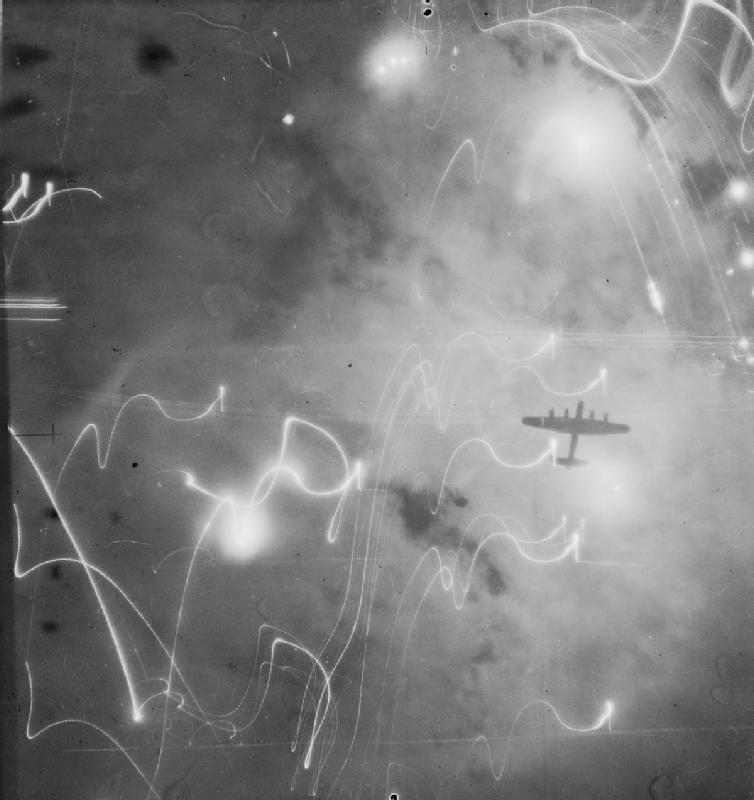
    It was during the spring and summer of 1943 that the Allies came to the conclusion that the idea of strategic bombing needed to be expanded–the expansion part grown to include the total destruction of the target city. 

    The “most secret” letter1 (dated 27 May 1943)  that outlined the coming approach to aerial bombing was sent by Air Chief Marshal Arthur “Bomber” Harris  to his six group commanders and detailed the more-new strategic approach to bombing cities–the city itself would be a strategic target, with the goal in this case of destroying the entire city.
    File:Attack on Hamburg.jpg

    Operation Gomorrah occupied four nights from 24-30 July, involving 791 aircraft on the 24/25th, 90-110 B-17s on the 25th, 131 B-17s on the 26th, 787 aircraft on the 27/28th,  777 on the evening of the 29/30th., and finally with 740 aircraft on the night of the last raid on 2/3 August.3,000+ aircraft were employed in the action dropping 9,000 tons of bombs.   At the end of the Gomorrah campaign, 42,600 people had been killed as well as almost 40,000 wounded, destroying about half the homes int the city and causing another million people to flee the city.  The greatest amount of damage and death occurred on the night of the 27th, when 787 British aircraft caused an enormous firestorm to be formed, at one point fueled by a 1500′-foot tall tornado of fire, which caused 150 mph fire winds, temperatures reaching so high (1800 degrees and more) that it  set the asphalt streets on fire.  Most of the dead were killed by asphyxiation, the oxygen pulled out of bomb shelters and hiding places to be used in the fires.  The infrastructure of the city had been largely destroyed before this day’s bombing, so getting firefighting crews to any of the new scenes would be impossible.  As a matter of fact, there was so much smoke generated from the previous day’s bombings that the USAAF B-17 attacks were suspended because targets could not be identified. 


    And from this point to the end of the war there were another 60+ campaigns flown at Hamburg, attacking and re-attacking oil storage facilities, shipbuilding industries, U-Boat factories, and the like.  53 missions involving several thousand aircraft, flying against the re-supplking and ruined city right to the end of the war, including 5 major actions in the last week of the war. 

    File:Hamburg after the 1943 bombing.jpg

    I don’t think that this was its own “Hiroshima” as British command thought, because, well, Hiroshima and Nagasaki have their own categories for destruction.  As does Tokyo. And Dresden.  It does though share a newness of bombing with Hiroshima in establishing the mission against Hamburg as a mission against an entire city rather than specific targets–certainly there were specific targets in mind for the hour or more worth of aircraft, but the overall effect was to support a carpet bombing plan and to initiate a fire so massive and destructive that the entire city would succumb.

    Newsreel of the bombing of Hamburg.

    Notes

    1.   The Harris ltter:

    MOST SECRET


    BOMBER COMMAND
    OPERATION ORDER NO. 173
    Copy No: 23 Date: 27th May, 1943


    INFORMATION

    The importance of H A M B U R G. the second largest city in Germany with a population of one and a half millions, is well known and needs no further emphasis. The total destruction of this city would achieve immeasurable results in reducing the industrial capacity of the enemy’s war machine. This, together with the effect on German morale, which would be felt throughout the country, would play a very important part in shortening and in winning the war.

    2. The ‘Battle of Hamburg’ cannot be won in a single night. It is estimated that at least 10,000 tons of bombs will have to be dropped to complete the process of elimination. To achieve the maximum effect of air bombardment, this city should be subjected to sustained attack.

    Forces to be Employed

    3. Bomber Command forces will consist of all available heavies in operational squadrons until sufficient hours of darkness enable the medium bombers to take part. It is hoped that the night attacks will be preceded and/or followed by heavy daylight attacks by the United States VIIlth Bomber Command.

    INTENTION

    4. To destroy HAMBURG.

    [Source]

    ·Posted by :

    ·in:

    —

  • “China, Glass, Auction & Negro Sales”: Photography of the Sherman Atlanta Campaign, 1864.

    JF Ptak Science Books     Post 1535

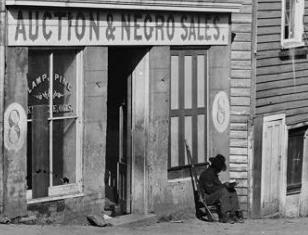
    Atlanta, Georgia.  Whitehall Street:  ” China, Glass, Auction & Negro Sales.” 1864. Photo by George N. Gardner.

    The first name people associate with photography and the American Civil War is Matthew Brady.  Brady did of course come up with the idea for photographically documenting the conflict and made images of his own, but the truth of the matter is that he had a lot of help making his record–other great names from the early period of American photography were employed by him, sent out into the field to record what they saw.  Alexander Gardner, Timothy Sullivan, James Gardner, William Pywell and eighteen others recorded the great events in addition to Brady, though for the most part it was Brady’s name on the finished work.

    One of these men was George Gardner (1819-1902), who at one point owned his own studio in Oswego, New York in 1847, working for himself until he joined the Brady force in 1861.  He left Brady in 1863, but he didn’t leave the war, becoming an official photographer for the United States Army, Chief Engineer’s Office and joining General William T. Sherman and the  Military Department of the Mississippi in 1864, at which point he documented Sherman’s Atlanta Campaign.  (One of the results of this effort was his 61-photograph work, Photographic Views of Sherman’s Campaign (1), published in a sumptuous leather bind in 1866, a big, heavy work with original albumen photographs.)  The images below, however, were not published in this work–all 61 images can be view here, at the collections of the Hargrett Library at the University of Georgia.

    Detail of the first image, above–the three other businesses that I can identify are tobacconists of one form or another.  It looks like a Union private is sitting quietly (reading?)  in front of the auction house, his rifle leaning against the wall.  There were a lot of people going into this place, if grime on the doorway is a testament to a legacy of busy-ness. 

    I wonder if you were coming here as a slave, without the ability to read or distinguish any sort of written character, I wonder what you would think of those two enormous “8” characters painted on the side of the building.  That symbol is an old one for infinity, continuing–I wonder how many cultures would have used that line as its own?

    Barnard negro sales detail

    Atlanta, Georgia, 1864.

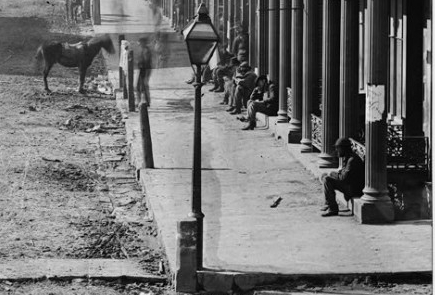
    The only reason that the private in the photograph above is captured so clearly is that he was probably reading, which means he was sitting still for the minute or so that it would take to make the exposure.  That’s what gives this image above its qualities of clarity and ghostliness–there are as many suggestions of people as there are imaged folks in this photo.  What we see plainly are the men sitting on the business stoops–look more closely and you’ll see many more moving along the sidewalk, the briefest bits of them being captured by the long exposure. (There is just a hint of someone leaning against the gas light fixture in the foreground.)

    Barnard atlanta street ghosts--detail

    Nashville, Tennessee.  1864


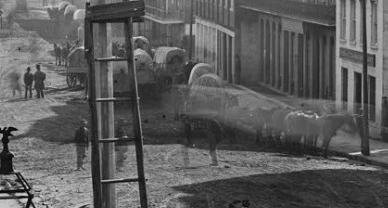
    Atlanta, Georgia.  View on Marietta Street, 1864.

     Detail:

    Barnard atlanta ladder detail

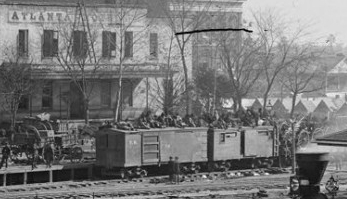
    Atlanta, Georgia.  1864. “Soldiers on boxcars at the depot.”  There was no date that I could find offhand on this image, so I don’t know if the soldiers were coming, or going, or already there and just trying to catch a breeze on top of the cars. It had to be after the end of the campaign, after Atlanta’s mayor James Calhoun surrendered the city following  the entry of Henry Slocum’s XX Corps on 2 September 1864, and sufficiently after that for the men to climb on top of the boxcar and not get fried by a scorching Georgia late summer sun.  They certainly weren’t busy pulling up the rails like they did in so many other locations in the city and vicinity, ensuring a de-mobilization of what had to this point been a primary center for Confederate munitions supply and manufacture. 

     Detail:

    Barnard atlanta boxcars detail
     

    Notes:

    1.  The full title of the book is Photographic Views of Sherman’s Campaign, Embracing Scenes of the Occupation of Nashville, the Great Battles around Chattanooga and Lookout Mountain, the Campaign of Atlanta, March to the Sea, and the Great Raid through the Carolinas.


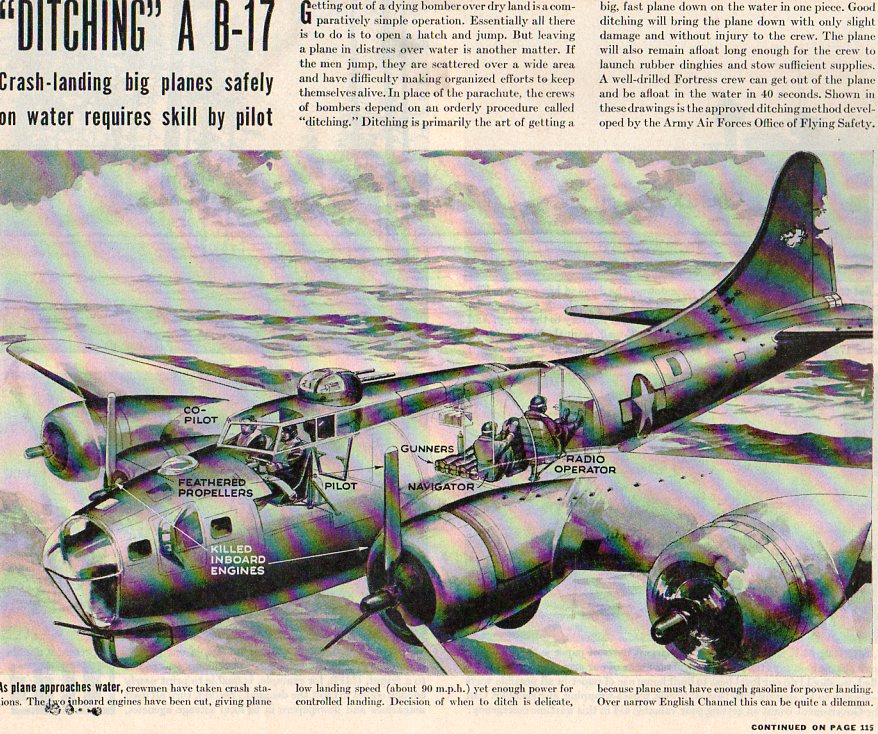
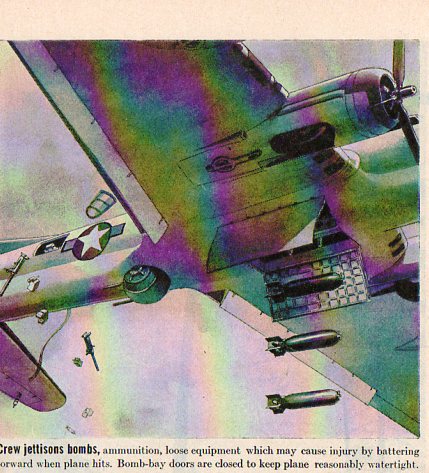
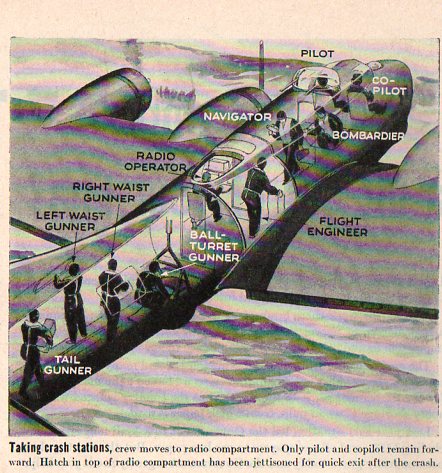
  • How to Ditch a B-17, 1944

    JF Ptak Science Books   Quick Post

    This interesting article appeared in Life magazine on 1 May 1944 and addressed something I’ve not though about before with the magnificent Boeing B-17.

    Aviation--ditching B-17555

    Aviation--ditching B-17556

    Aviation--ditching B-17557
    Aviation--ditching B-17558

    ·Posted by :

    ·in:

    —

  • The History of Aerial Bombing, Advertising and Laxatives

    JF Ptak Science Books  Post 1534

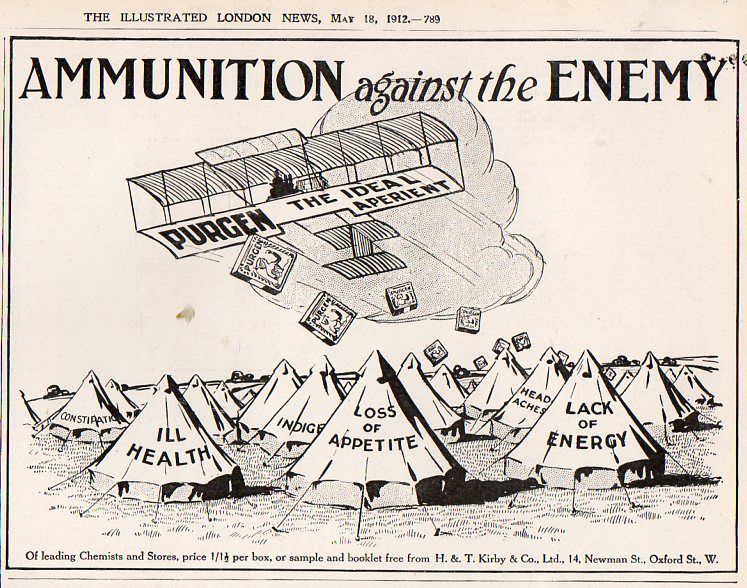
    The business of bombing people and places from airplanes/aeroplanes was fresh in the history of invention when this advertisement appeared in The Illustrated London News on 18 May 1912. 

    Bomb554
    Superweapons have been used against cities for quite some time in the new world of speculative fiction, and there had been real-life aerial bombings from hot-air balloons, but the first time that a bomb was dropped from a heavier-than-air airplane on anything happened just months earlier, on 1 November 1911, when Lt. Giulio Cavotti dropped a hand grenade from his Etrich Taube on the oasis of Tagiura, in North Africa during the Italo-Turkish War.  He dropped four parcels of hand grenades on the not-necessarily-military population at the oasis, injuring no one.  The attack was one of attempted vengeance, a payback by the Italians against the Arabs of Tripoli, in general, for having joined forces with the Turks to fight against them. 

    This air attack was fresh on the heels of a devastating slaughter of the Arabs at Tripoli on 25 October 1911–the Tripoli War would not come to an end until October of 1912. A complaint was lodged that the Italians had broken international law, as bombing from balloons had been outlawed by the Hague Conference of 1899–but the Italians argued that the spirit of the agreement did not apply to bombing from airplanes because airplanes were not balloons. The issue of the legitimacy of bombing from airplanes and then for bombing civilian populations would be a debated issue if not recognized as a restricted practice for decades to come.  As the cogs and wheels of the international court ground out its miniscule progress, people got blown up.  The people-blown-up part trumped international law almost every time. 

    In the meantime came this image of an airplane dropping boxes of Purgen, “the Ideal Aperient” on military-style tents  of “Ill Health”, “Loss of Appetite”, Lack of Energy”, and so on, all within the possibility of cure by this Purgen product.

    So, among the very first advertisements using the idea of aerial bombing as its own delivery system, was this one for Purgen.  A laxative.


  • Invasion Routes to the U.S.,1940

    JF Ptak Science Books  Post 1532

    This is a supplement to some earlier posts on this blog relating to the possibilities of the invasion of America:  Mapping the Invasion of America, 1942 (which is the most-viewed post from this blog, with over 500k readers), The Invasion of America, 1935,  and The Invasion of America, 1942, Part II to name a few examples.

    INVASION us  INVASION ROUTES

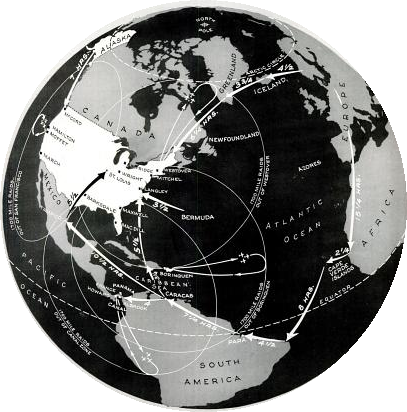
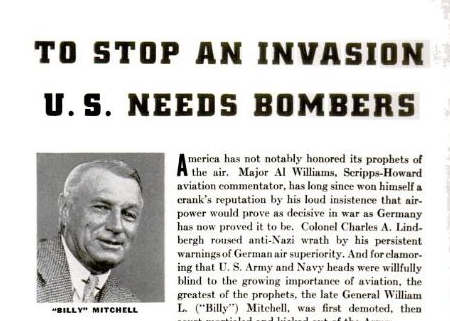
    In the 27 May 1940 issue of Life magazine appeared an article on Franklin Roosevelt’s call to American action in constructing an entirely new air force.   For years the air corps arm of the American military lingered in a kind of low-numbers unresolved limbo–but by May of 1940, it became painfully obvious that something drastic must be done.  By this point the European War was about eight months old, and the possibility of Nazi victory looked very real.  After all, the Blitzkrieg had been very successfully employed in Poland, and in May was used in the invasions of Finland, Norway, Denmark, Belgium, the Netherlands and Luxembourg. And France, of course.  By late May, 1940, France was already pretty much done, the Parisian capital falling weeks later on 23 June, with the country capitulating ten days later.  May also saw the collapse of the British and French armies along France’s northern coastline.  (The rescue of the 350,000 troops on the beach and in the harbor of Dunkerque had not yet taken place (but would within the next few days). It was bad stuff.)  In the light of the Nazi victories and the imminent fall of France, it was also time for people to start thinking about the invasion of England.

    Invasion-US

    Roosevelt and his adviser knew that America was headed into conflict, and knew that the country needed to get onto a war-time production basis. One way to begin preparations was for FDR to call for the increased production of the newest and one of the most important aspects of modern warfare, the airplane.  And not only an “increase” in production did the President call for, but a mountainous bump, an order of magnitude more in manufacturing of military planes. Earlier in 1938 the call for a 5,000-plane-a-year air force was shot down as being unrealistic–and perhaps so, even though the Nazis were just at the beginning of their outward thrust.  So in May, 1940, Roosevelt stepped up and asked for 50,000 aircraft. 

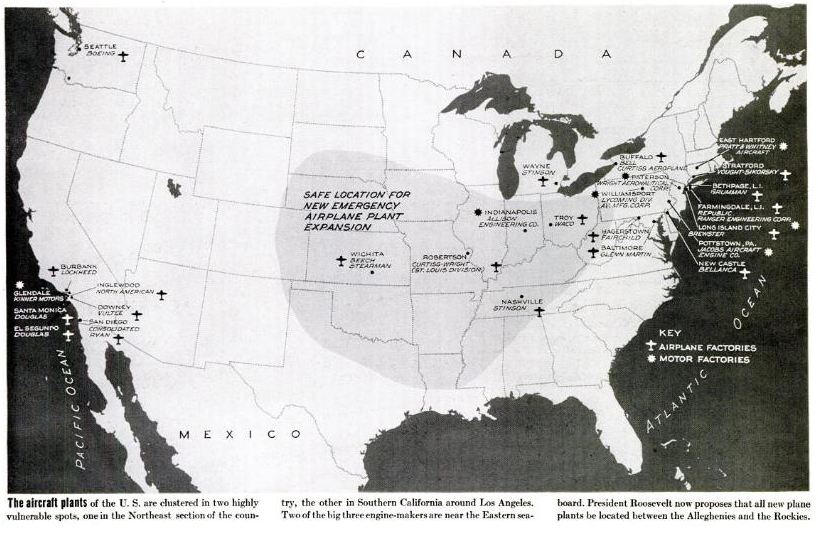
    No doubt the war in Europe gave everyone great pause, or scared them silly.  Two years before the number of 5,000 planes produced per year was seen as ridiculous–now the business of producing 50,000 a year seemed feasible–incredible, even, but the means of production were present, and so was the raw material and manpower.  It was seen that of the 84 aircraft production plants then functioning only 23 were producing military planes, so there could be a modernization of existing plants as well as the construction of new aviation installations. The production totals for the year 1939-1940–1,247 aircraft, including 477 produced for the U.S. Army and Navy, 311 for Great Britain, and 459 for France–represented only a small percentage of what the existing factories could actually produce. (And it turned out of course to be just the case, as we can see from the production numbers in the “notes” section, below.)

    There was also a certain amount of scare factor involved with waking up the American public to the needs for getting involved in the European conflict in the year-and-a-half before Pearl Harbor–that the Nazis wouldn’t stop in Great Britain, and that “invaders” could and would attack the United States. The need for increasing American war production was not only to supply the allied forces in Europe for stopping Hitler, but also would keep the Nazis away from the United States.  (Summarizing the points discussed by the President and other government officials, the map of the invasion of America looked something like the global view we see above.)  So if Roosevelt couldn’t stir the hearts and minds of the American public for keeping Europe aloft in American-built planes, then keeping the Nazis off Main Street might work. 

    What the map shows are the lines of attack for the un-named Nazi invaders–their aircraft making their way slowly across the Atlantic via Iceland-Greenland–Newfoundland, and across Europe -Africa-Cape Verde-Brazil-Paraguay-then across the Caribbean and right into Wilmington, North Carolina; and then of course all of the way across the Soviet Union to Alaska and then into Washington state.  The plan was that these advanced forces would come in, establish an airfield, grow , and then move closer to the U.S., stopping to construct bases all along the way.  The response, oddly enough, was for us to build “bombers” so that the airbases could be blown up.  That would also extend the effective range of air coverage from the United States to deal with the very-slowly-approaching enemy.  The circles on the map show the effective round-trip range of loaded American bombers and the territory that they could cover.  In general the map, in its own way, portrayed the United States as approachable to foreign invasion.  Some of this reasoning is a little inscrutable, but Washington was playing a game that needed to be won. 

    Invasion us 2
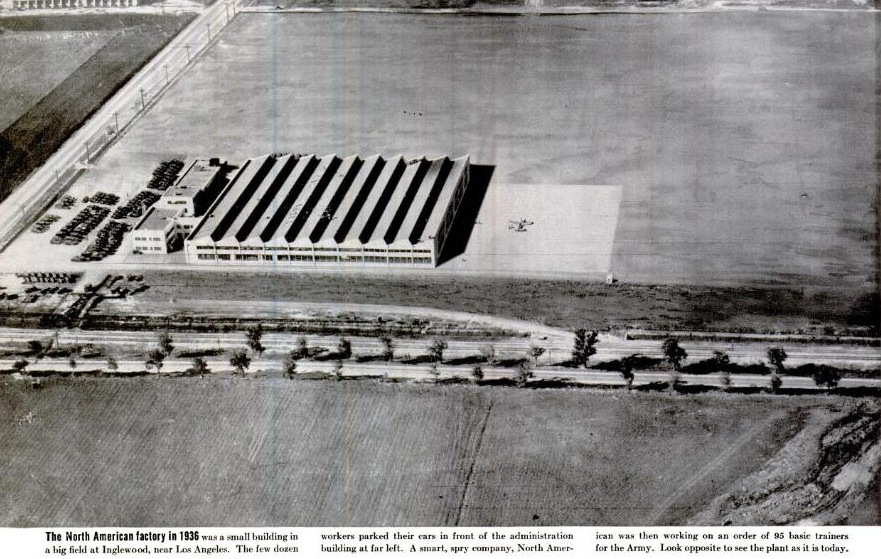
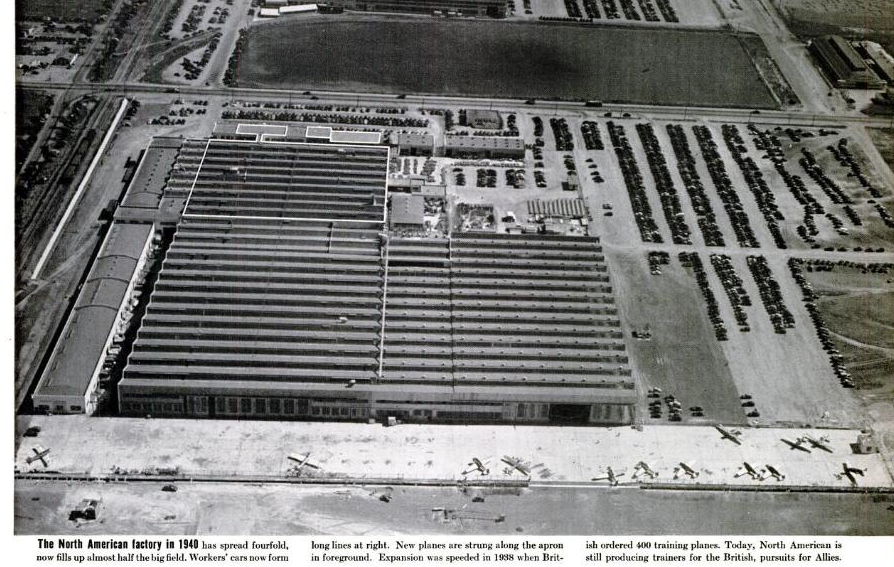
    These interesting before and after pictures of a ramped-up aircraft production industry were to supply some proof that the job could be done, and that this factory could very well be a template that the dozens of others could follow:

    [Aircraft production facility, “before”]

    Invasion US factory before [Aircraft production facility, “after”]

    Invasion US  factory after

    Notes

    Production numbers for U.S. aircraft manufacturing, 1940-1945:

    Type of airplane Total 1940¹ 1941 1942 1943 1944 1945²
    Grand total 295,959 3,611 18,466 46,907 84,853 96,270 45,852
    Combat airplanes 200,443 1,771 8,395 24,669 53,183 74,564 37,861
    Very heavy bombers 3,740 – – 4 91 1,147 2,498
    Heavy bombers 31,685 46 282 2,513 9,574 15,057 4,213
    Medium bombers 21,461 52 762 4,040 7,256 6,732 2,619
    Light bombers 39,986 453 2,617 5,954 11,848 12,376 6,738
    Fighters 99,465 1,157 4,036 10,721 23,621 38,848 21,082
    Reconnaissance 4,106 63 698 1,437 793 404 711
    Support airplanes 95,516 1,840 10,071 22,238 31,670 21,706 7,991
    Transports 23,900 164 525 1,887 6,913 9,925 4,486
    Trainers 58,085 1,676 9,294 17,237 20,950 7,936

    1,352


  • Bad Ideas Department: Attack Islands and the Invasion of England, ca. 1800

    JF Ptak Science Books   Post 1525 (Continuing, in a way, an earlier post.)

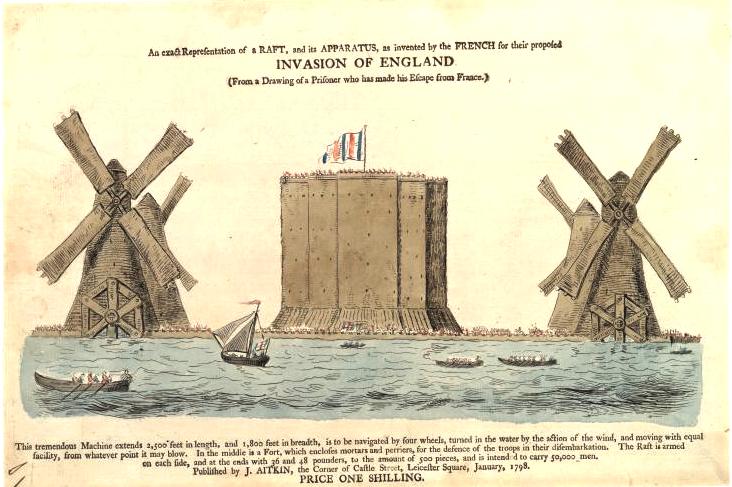
    Sometimes bad ideas aren’t really so until they are very, very big–and then put in water.  These are some examples of what was probably a propaganda campaign on a disturbing, Twilight Zone-y invitation to imagination of a French invasion of England at about the time of Napoleon.  Napoleon I.  England had been invaded before, but not by the wily Corsican.

    The first apparatus of war was a monumental thing, and was displayed for the world in this engraving, printed ca. 1798-1801.  An exact representation of a raft, and its apparatus, as invented by the French for their proposed invasion of England, printed in London by J. Atkin, portrayed the monster:  2500′ x 1800′, with a enormous stone fortification that seems to have been about 500×500′, the thing was powered by four water turbines driven by 550′-tall windmills, it was supposed to be capable of supporting 500 36- and 48-pounder canon, plus 50,000 troops.  It looks like it was built for calm water. 

    Invasion of England

    This next beast wasn’t quite so beastly as the first beast, a beast to the monster.  This was the St. Malo seacraft, a thing designed in 1791 that was supposed to be 600×33 feet, supporting the same 500 canon as above, and would transport 15,000 troops.  The added feature here–in addition to the windmill-driven engines, was a bomb-proof central structure, which I guess held the troops in safety as the ship was bombarded from the shore.

    Raft st malo

     The unlikely craft below, even though it looks not nearly as large as the preceding two craft, actually carried more troops (60,000) and more canon (600) than the ship.  I’m not at all impressed that the design we’re  looking at here could support a tenth of those numbers.  But, on the other hand(s), if it wasn’t going to be built and never existed, it really doesn’t matter that the scale was all mess up.  [Image source:  Low Tech Magazine.]

    http://krisdedecker.typepad.com/.a/6a00e0099229e88833012875609248970c-pi

    This satirical print shows a French invasion force making its way to England above and below the channel–there are attack balloons as well as a considerable atta-Chunnel. 

    http://krisdedecker.typepad.com/.a/6a00e0099229e888330120a65fa66b970b-pi

    [Image source:  Low Tech Magazine.]
    The truth of the matter is probably closer to the images below than they were to the massive attack-islands that are pictured above.

    File:My ass in a bandbox-Robert Holborn.jpg


    File:Conversation across the water.jpg


  • Spaghetti Map of the Army-McCarthy Hearings, 1954

    JF Ptak Science Books   Post 1489

    Some things are complex, and complicated and pretty–you don’t realize that they are this involved, exactly, because of the elegant way in which they are presented.  An anti-gravity undertaking by Brunelleschi, in creating his dome, was an enormous challenge,  solved with circles within circles, a series of nine of them enclosed in a polygon, the result being one of the most beautiful and iconic achievements in the history of architecture (and engineering).

    And then sometimes things are complicated and complex and look and behave that way, their messiness outdistancing their own necessities.

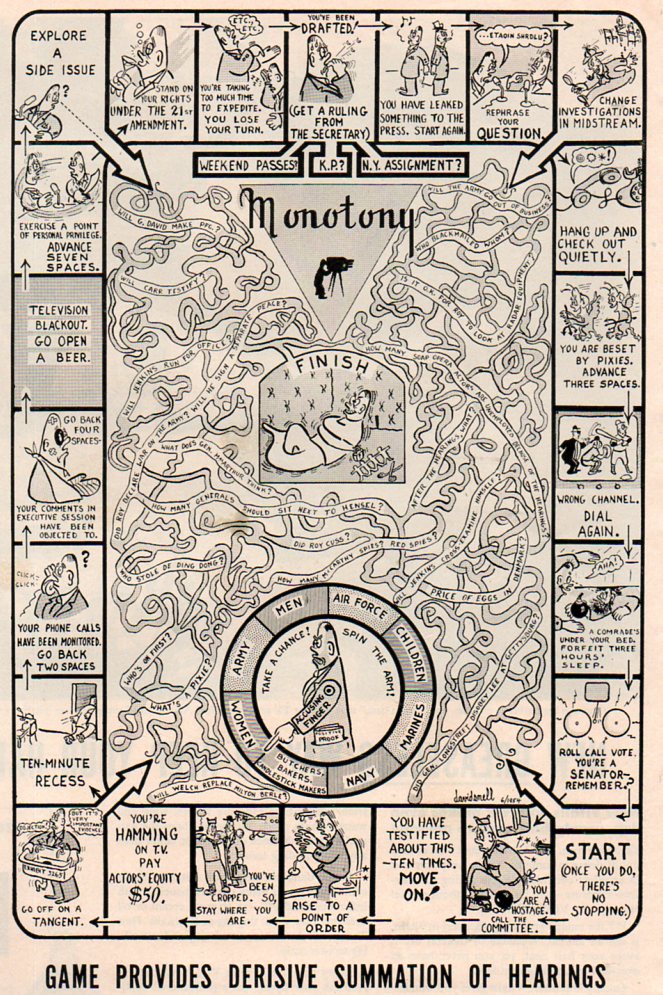
    Which gets us now to this game, a mass of entwined spaghetti, which was a tongue-in-cheek poke at the Army-McCarthy Hearings of the spring of 1954, a popular review in the tradition of Thomas Nast that is very effective.. The “Army” was the U.S. Army, and the “McCarthy” was Senator Joesph McCarthy, of Appleton, Wisconsin, a man who was about at the end of a short, meteoric career of vast unsubstantiated accusation, discord, lies and fraud. The hearings were supposed to sniff out Communists in the Army and the defense industry, because that’s what McCarthy did, being a rabid impersonator of a man with a decent mission. The hearings were long, involved, and traveled nowhere fast although much ground was covered.

     The bottom line to the whole affair was that as the first televised Senate hearings, McCarthy drew a huge audience, estimated at some 80 million people over the course of the event. And what happened was that “Tail-Gunner Joe” (an appellation he gave to himself that among many other things in his personal and public life were exaggerations) found out that he was seen better int eh minds of Americans when he was not being televised. In short, he was outed for many as a crude, threatening liar, and his career of ruining people in his quixotic quest for deeply-rooted Commies was about over when the last lights in the hearing room went out.

     Joe McCarthy would be dead in about three years, his liver failed, evidently (as his biographers say) from too much drink. He was a dangerous and divisive man, but one who had many friends and supporters to keep him re-elected and in power. (He was a darling of the Kennedys, being a favorite of Joe Kennedy, the godfather of Robert Kennedy’s first child, and one who dated two of the JFK’s sisters. Being Catholic and a vehement Commie-hunter went a long way with Joseph Kennedy, who had his own set of issues with power and rule.)

    McCarthy hearings495

    [Image source:  LIFE magazine, 21 July 1954, page 42.]


  • Archaeology of Bombing, 1913

    JF Ptak Science Books   Post 1472

    This is another in a longish series of posts on this blog on the archaeology of bombing, aerial bombing, and today’s installment comes from its earliest period.  The first air assault belongs to the Italians, who used the weapons from the air in bombing Tripoli in 1911, which they also found to be within the defensible scope of international law, even when used against a noncombatant population (which came on the heals of the Italian army’s massacre of civilians there).  Bombing from the air had happened earlier of course, but also entirely in fiction:  for example, Jules Verne bombed civilians in The Flight of Engineer Roburs (1886), and H.G. Wells had New York City in flames in The War in the Air (1908).

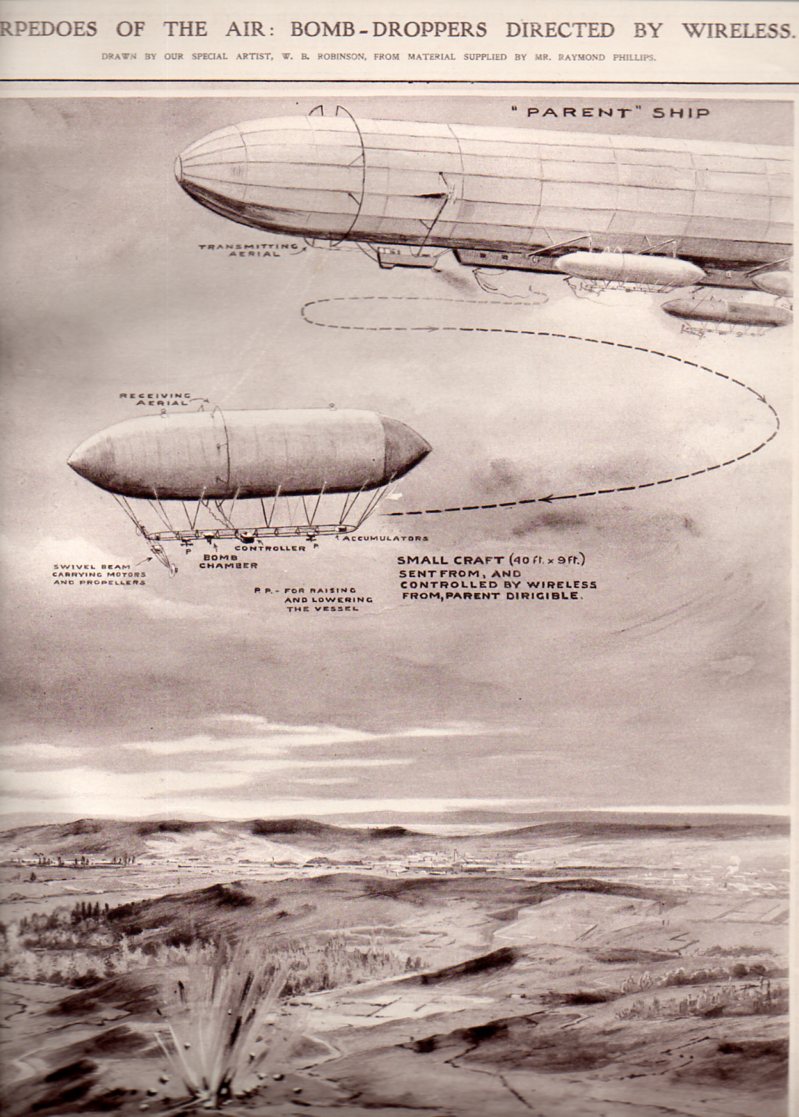
    “Torpedoes of the Air:  Bomb-Droppers Directed by Wireless”, a graphical story that appeared in The Illustrated London News on 6 September 1913, and drawn by W.B. Robinson, describes a sort of two-tier remote controlled aerial bombing arrangement of dirigibles.  The “parent” ship hosts a number of smaller dirigibles which are radio-controlled elements sent in to do the actual bombing, which allows for no human interaction with dropping the bombs and exposes only materiel to enemy fire.  (I should point out that each one of these early drones were 40′ long, making the parent dirigible something like 400′ in length if we are seeing about half of it in the illustration, and enabling the thing to carry perhaps 10 of these remote controlled units.  This dirigible would have been about as big as the monster Zeppelin LZ1.)

    Dirigibl e torpedoes481

    And this two years after this remarkable graphical display:

    Info display dreadnought237

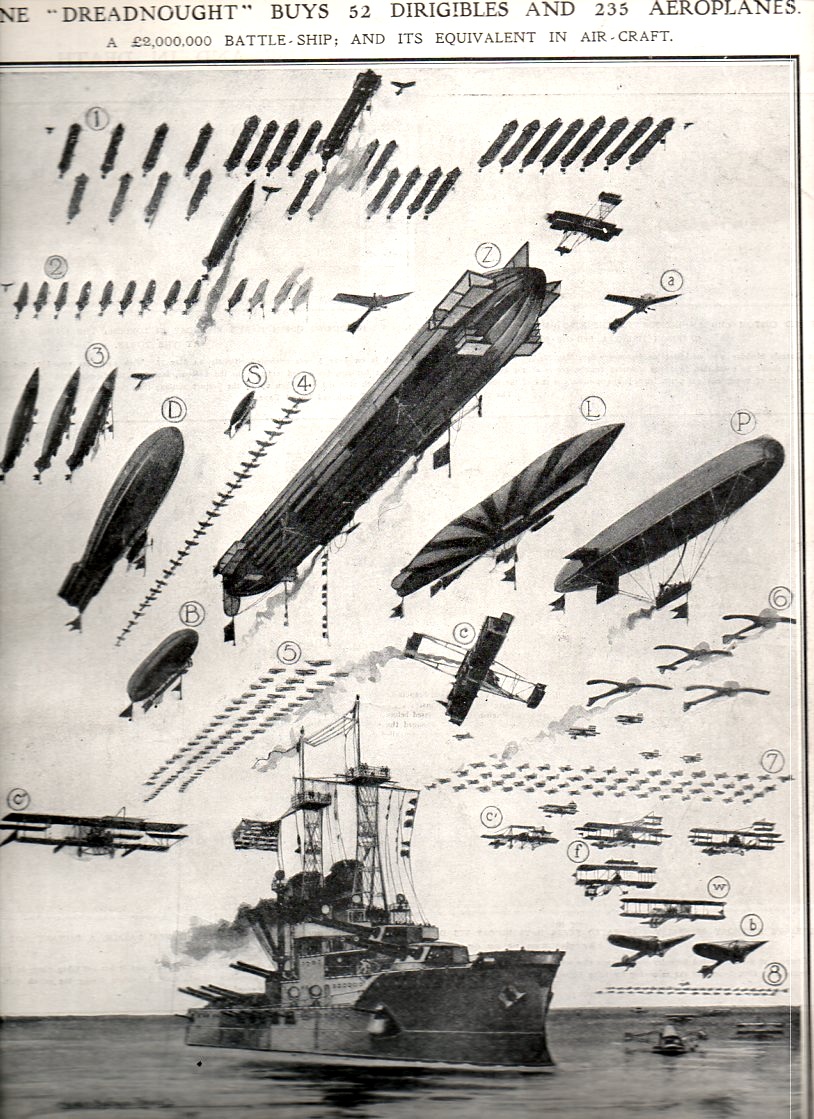
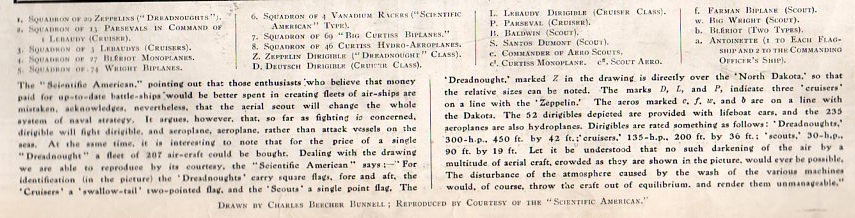
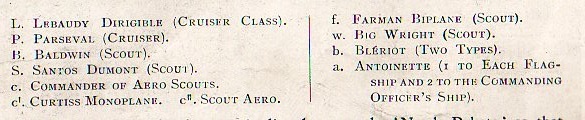
    There’s nothing quite so satisfying as seeing a representation of quantitative data like this where the graphical displays are flying.  “One Dreadnought Buys 52 Dirigibles and 235 Aeroplanes” is a full-page diagram appearing in the 3 June 1911 , making a very strong point that in the new air-age 2 million pounds for one battleship buys a lot of aircraft.  Of course this is a British journal and the ship is flying an American flag–the image originally appeared in the Scientific American just a short while before this publication, and so it also enumerates American and international aircraft, making for a lovely representation of a broad range of airplanes filling up the same sky.  (This image is available for purchase from our blog bookstore, here.)

    Info display dreadnought238
    Info display dreadnought239
    Info display dreadnought240


  • Tree Rings of Soldiers’ Uniforms, 1918

    JF Ptak Science Books   Quick Post

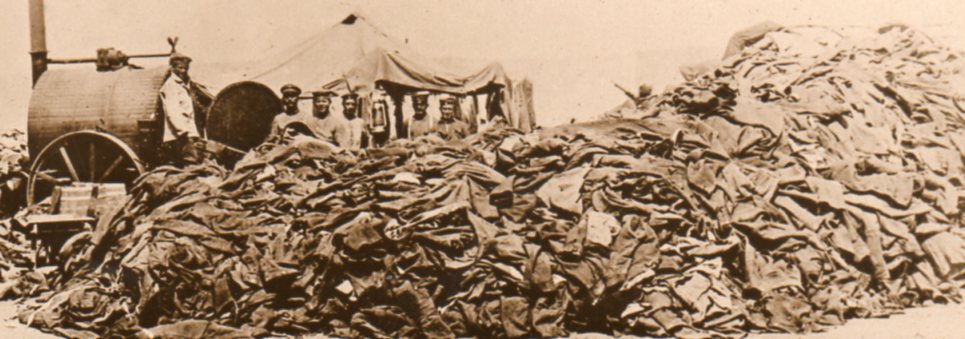
    WWI german uniforms500

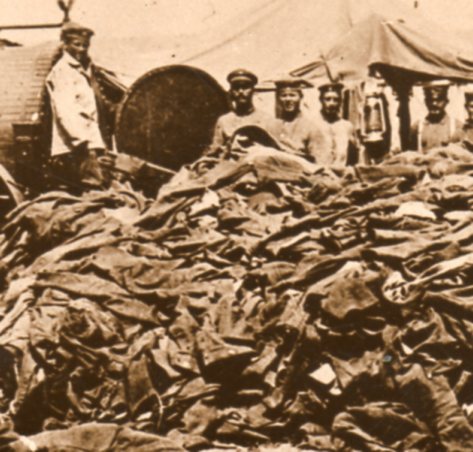
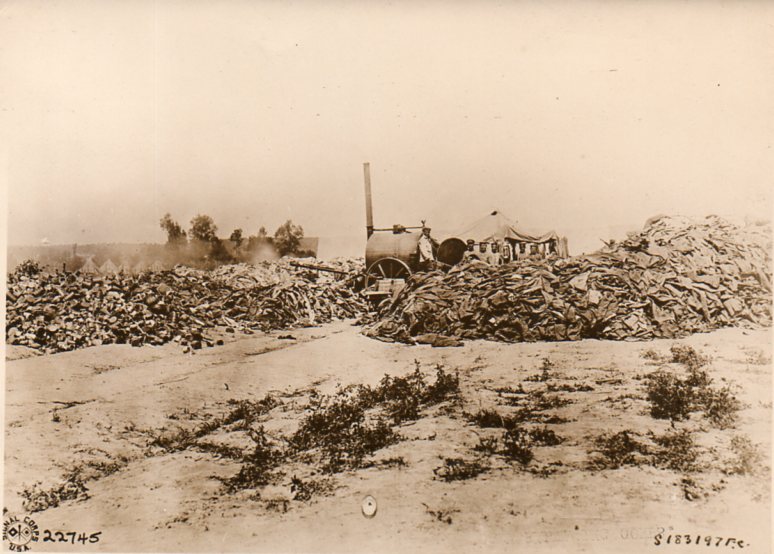
    Aside from the strong impact that this 1918 image [the original available at our blog bookstore, here] makes, the enormous mounds of clothing of captured German solders that were routinely handled as part of their processing, it struck a deeper chord to an older image still (that we’ll see below).  The photograph seems threatening to me, even though the action taking place in it wasn’t, it was mundane–the men, who I believe are German POW’s, are processing the clothing for disinfection and cleaning.  But the size of the mound reminds us of the magnitude of the numbers of the dozens of millions who were killed during WWI, as well as the millions who were taken prisoner.  What remains to be said about this image is how often that pile of clothing was replaced:  is it a monthly, or weekly, or daily pile?  My guess is that it was more daily than anything else, if for no other reason than there is an enormous oil lamp in the background of the photo, suggesting that the process went on all day and into the night.  My initial reaction is that this pile was replicated often during any given month….

    WWI german uniforms499
     
    WWI german uniforms498

    And the image it reminds me of are those made of the enormous mounds of buffalo hides, piles readied for shipment away from the Plains by rail. 

    Buffalo-Hides-lg

    I am in no way suggesting that the prisoner were skinned like the buffalo, not in any way.  But they do bear a resemblance in the way that thousands of men or buffalo could be represented in such a compact space, flattened husks of the living thing, gross representations of big numbers. 


  • Nazi Propaganda on Propaganda: on British “Atrocity Propaganda” (1938/9)

    JF Ptak Science Books   Post 1490

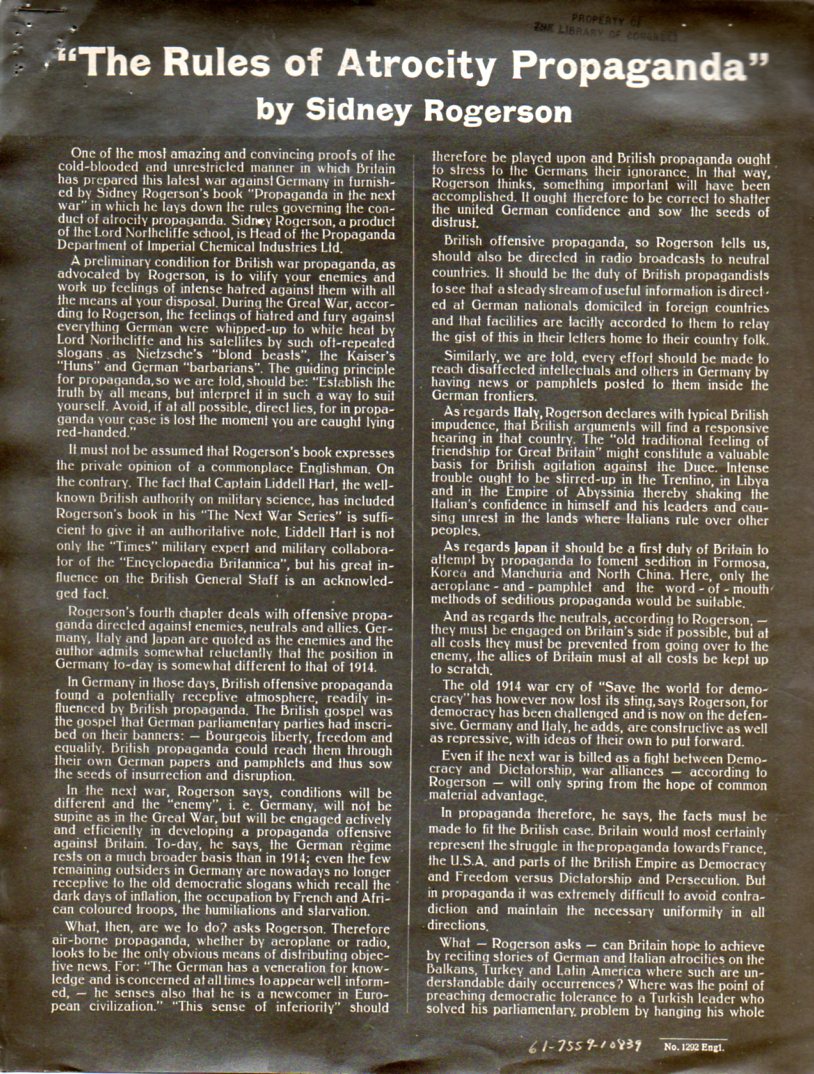
    As a small cog in the machinery of the Nazi Big Lie, this short sheet (supposedly written by a ” Theodore Kesselmeier”1), outlines a campaign of British anti-Nazi psychological warfare, and was written around 1938/9.  It is written in a book review format whose aim was the 1938 publication by Sidney Rogerson2,  Propaganda in the Next War, which was an alert (described as “brilliant” by John A. Pollard in The Public Opinion Quarterly for Autumn 1945) to the British government to establish central coordinating offices for information and communication for what the author felt to be the impending war with Germany.  In many ways Rogerson was responding to an enormous flood of information coming out of Germany about its own impending future, from the election and seizure-of-power by Adolf Hitler, to books like Ewald Barnse Raum und Volk im Welkriege (translated into Germany Prepares for War) of 1933, and on and on, a growing high tide that was without end. (Even from the most base popular study of Germany’s desires, for example, looking at every issue of the Illustriete Zeitung (Leipzig) from 1933 to 1939 as I have done, it is overwhelmingly obvious that Germany was preparing for the next war.  ThNazi propagandae case is made constantly and boldly in the magazine, which served in a way as Germany’s version of LIFE magazine.) [This item is available for purchase through our blog bookstore, here.]

    But the “reviewer” finds  the Rogerson work insulting and militaristic, hateful; an attack upon Germany.  He/they write(s) that the book is an offense, and part of an effort of  “the cold-blooded and unrestricted manner in which Britain has prepared this latest war against Germany”.  This part is odd because even at this late date, and given what the knew about the German war aims, Great Britain had done very little about preparing for war even until Munich. 

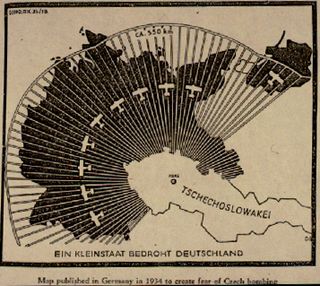
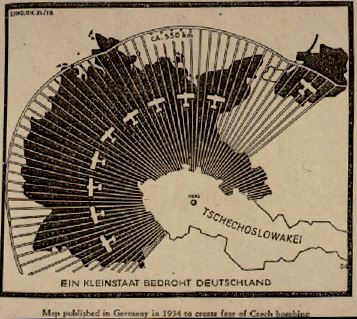
      I have aNazi prop number of these propagandistic pieces that came out of Germany at this time, some of which have been written about on this blog, and it seems no surprise now to see how many of them paint Germany as a victim of the war aims of the countries nearby:  Poland and Czechoslovakia were both presented as late as 1938 as having designs on Germany. This is just one of many examples of Nazi propaganda on propaganda, issues of lies within lies to the secret house of even-more-inner lies.  For example, this incredible map showing the Czech threat to Germany, above [source] and the shrinking  pamphlet, left [source].
     

               Rogerson496


    [page 2 is in the “continued reading” section, below.]

    Notes:

    1.  I suspect that “Kesselmeier” was the nom de plume of a section of writers laboring away in the dream factory of the psych-ops part of the Nazi war machinery.  It is much easier to produce reports when you have an entire group of people working on the project without need for the benefit of proof–or, for that matter–of truth. 

    2. Rogerson’s entry in Who’s Who:  “Publicity and Public Relations Consultant and author. Born 22nd of October 1894. Son of the Reverend S. Rogerson. B.A. in Modern History 1916; Served in the European War;

    ·Posted by :

    ·in:

    — — —