A Daily History of Holes, Dots, Lines, Science, History, Math, Physics, Art, the Unintentional Absurd, Architecture, Maps, Data Visualization, Blank and Missing Things, and so on. |1.6 million words, 7500 images, 4.9 million hits| Press & appearances in The Times, Le Figaro, Mensa, The Economist, The Guardian, Discovery News, Slate, Le Monde, Sci American Blogs, Le Pont, and many other places… 5000+ total posts since 2008.

Category: Medicine, History of

  • Snail Trails–Getting from the Law of Irritability to Articulated Clowns and Artificial Leeches

    JF Ptak Science Books  Post 1677

    The Laws of Irritability was a marvelous-sounding title (to our ears, in this year) for a rather important medical treatise on the contraction of muscles.  It was a medical treatise by Felice Fontana1 (1730-1805), and had nothing to do with what we would think of as irritability, and certainly was a long way from a book like Robert Burton’s beautiful and slightly unreadable (and fairly unendurable) Anatomy of Melancholy, even as much as we would like it to be.  After all, wouldn’t it be lovely, somehow, in a automated-Dickensian way, to see that there were 32 laws of irritability, and that this was the first of the afflictions like ennui and depression and so on that could be modified and codified, and I guess eventually commodified?  (Making these things into commodities didn’t have to wait for anything at all in the way of proof or scientific merit went; after all, they were published in published books, which would have to be purchased, so there’s an instant commodification to them.)  But alas the Laws of Irritability were nothing of the sort, referring to a set of observations and deductions more real than half-imagined self-references.

    But all of this leads me in a very uncommon route to articulated clowns and skeletons, and of course artificial leeches.

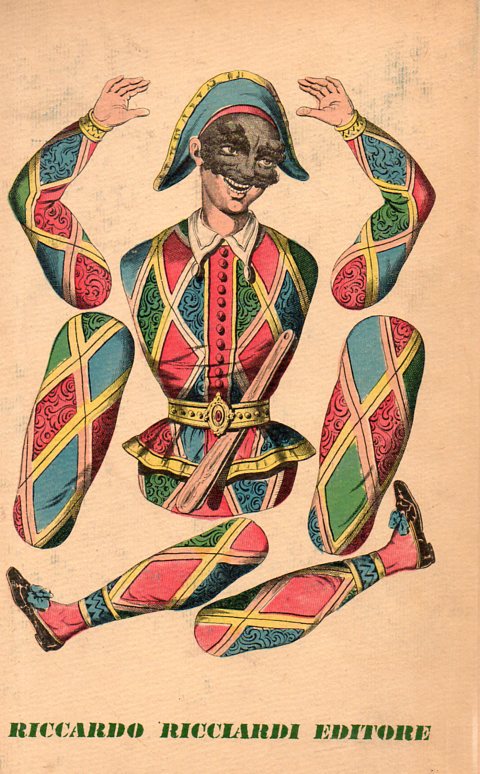
    This entire post started with the imaging that this book (below) by Fausto Nicolini, Vita di Arlecchino (“Harlequin’s Life”, published in 1958) and which contained a rather unusual bit to it-actually it didn’t so much “contain” it but displayed it.  The front and back covers were both illustrated with clown images–clown images that could be copied, its sections cut apart, and re-assembled into a working cut-out paper puppet.  Now I’ve been dealing with scarce/rare/non-existent books for 30 years, and I cannot recall a similarly-covered book, where the reader could turn its cover into a puppet.  But here it was. 
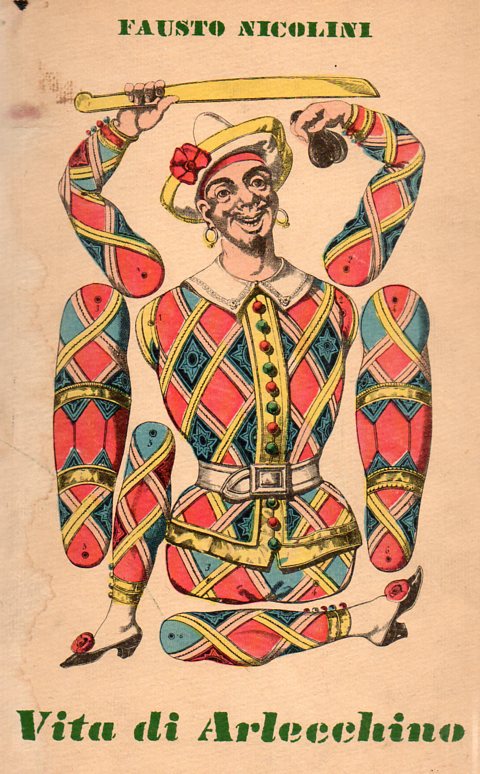
    Harlequin 1054[Click, enlarge, print and cut out your own dancing harlequin–the back cover is below.]

    It reminded me of another work, a beautiful anatomical treatise by Jean Baptiste Sarlandiere, first published in France but eventually printed and published in New York in 1837 as Systematized Anatomy, or Human Organography. The sample below shows exactly how the book was laid out, almost as an instructional on how to reconstitute the body–a cut-out book, made to be separated and then pulled together again as a whole, the joints articulated with string or brass brads, a book no longer now a little puppet, “A real live boy”.  (And yes it happens to be an Italian author–Carlo Collodi–who gave life to that naughty marionette…this is a tough story for kids, I think, even though I muscled my way through it with our younger daughter, leaving out some of the brutal stuff.)

    http://www.find-a-book.com/images1443/6989.jpg

    And it is via Sarlandiere that we get to our leeche issue, because it was he who fashioned the response tot he endemic leech shortages of the 1820’s and 1830’s with his creation of the artificial leech. 

    Oh to be in France in the 1830’s and be a illegal leech importer, for your fortune would have been made.  Leeches were still very important in medicine–as a matter of fact Francois Broussais2 saw the leech as a cure to virtually every diseases, saw them as a way of relseasing the inflammation and swelling and other complaints caused the body via strange and odd assaults on the body–the leech was a good and measured response to external insult, applied frequently and very liberally. 

    Evidently consumption on all fronts was on the rise, prices went high, but the availability of leeches went down.  In France alone, leech production (in 1836) fell from 50 million to about 18 million, all but 1 million of those staying within the country.  And so it was Sarlandiere who came to the rescue with his “artificial leech”3, something that would replace venthouses and bleeding cups and of course the leech itself.  It was something that he had already developed years before, but perhaps time had caught up to it.

    His devices are shown  below4 (expandable):

    An external file that holds a picture, illustration, etc. Object name is medhis5302-04-253-02.jpg Object name is medhis5302-04-253-02.jpg


    I’m unsure of the disposition of the artificial leech; Sarlandiere’s medical instrument lay in wait for the Dutch leech crisis, and seems to have gotten everyone through the sorrowful state of leechless affairs as they existed. At least he published images of what his invention looked like for the rest of the medical world to see and comment upon, and possibly use, and replicate.  This unlike other “advances” in instrumentation which were kept under wraps, and secret, such as in the case of the foreceps kept secret by the Chamerlains for several generations.  At least the widespread trust in the leech didn’t last much longer.

     

    [Source: Philosophy of Science Portal ]

    Notes

    1.  The work was published as De irritabiltatis legibus, nunc primum sancitis, et de spirituum animalium in movendis musculis inefficacia, revised and translated into Italian as Ricerche filosofiche sopra la fisica animale (1775)Fontana leges irritabilitatis constituit, ingeniosus homo et accuratus, published in 1767.

    “Formulated after the model of Newton’s principles in physics, the laws of Fontana on muscular irritability were an important but neglected contribution to the subject of muscular contractility. The first law concerned Haller’s concept of contractility as a property of muscle fiber itself, and pointed out that a contraction follows only after some stimulus. The discussion displayed insight into the underlying nature of tetanic muscular contraction. The second principle was the refractory period discovered by Fontana in heart muscle and applied to better understanding of the function of other muscles. The original third principle was a disproof of the efficacy of a theoretical entity, the ‘animal spirits’ . . . In his fourth law, Fontana pointed out the loss of contractility which results from stretching or compressing a muscle, and certain medical applications of this principle. The fifth law was concerned with problems arising from atrophy of disuse.”–Complete Dictionary of Scientific Biography, volume 5.

    2.   François Joseph Victor Broussais (1772–1838). Marie-Luce Jardin, Les Thérapies par les sangsues: les pratiques les plus anciennes aux traitements actuels hautement scientifiques, Université de Franche-Comté, Faculté de Médecine et de Pharmacie de Besançon, 2005, Thèse, pp. 32–3.

    3.  Jean-Baptiste Sarlandière, Bdellomètre du Docteur Sarlandière, Paris, Firmin Didot le jeune, 1819.
    4. Teunis Willem van Heiningen, “Jean-Baptiste Sarlandière’s Mechanical Leeches (1817–1825): An Early Response in the Netherlands to a Shortage of Leeches”, in Medical History (Wellcome Trust),  Med Hist. 2009 April; 53(2): 253–270.
    Harlequin 2055
    And more on Fontana from the DSB (“Fontana, Felice.” Complete Dictionary of Scientific Biography. Vol. 5. Detroit: Charles Scribner’s Sons, 2008. 55-57. Gale Virtual Reference Library. Web. 22 Dec. 2011):

  • On the Royal Hating of the Evil and Devil-Stink of Tobacco–King James I, 1604

    JF Ptak Science Books    Post 1676

    ”[Smoking is] a custom loathsome to the eye, hateful to the nose, harmful to the brain, dangerous to the lungs, and in the black stinking fume thereof, nearest resembling the horrible Stygian smoke of the pit that is bottomless.”–King James I, in “Counter Blaste To Tobacco”:, published 1604

    James I hated tobacco.  He hated every aspect of it, particularly since some smokers favored the stuff because of its purported medicinal and curing qualities–but for James it all led to vile stink, Devil worship and deep sin.  He just simply hated the whole idea–that and the person who introduced the notion and practice to James’ fair island, who was Sir Walter Raleigh.  And what did Raleigh get out of that deal?  Well, he certainly over the course of tars-filled time introduced the possiblity of grim, cancerous death to a billion practicers and had a miserable pipe tobacco named for him.  And he also was beheaded.  I can’t help but think that the smoking business had something to do with pulling James’ head into pulling Raleigh’s head off. (Well, it was actually “chopped” off, his bodyk buried and his head treated and stuffed and kept by his wife for the next 29 years.  In his prison cell in the Black Tower, Raleigh left a small container of tobacco, with the sentiment Comes meus fuit illo miserrimo tempo (It was my companion at that most miserable time) engraved upon its lid.)

    And so James wrote this piece in 1604, a thin 32-page evisceraton of tobacco and tobacco-users.  It is an antiquarian rush to righteous vindication, and it in no small measure helped James’ cause that he was right on a lot of his viciously-placed claims.

     
    Christmas Santa ciggies367

    The sins and vanities of the filthy use of tobacco were many but evidently described in three layers, like a good cake, though he does make a good case for the habit’s vileness.  Tobacco is mainly a sin of guilt and selfishness, of drunkness which is one of the great malfactors of all bad things, and of course the greatest sin of all in that it would impede the protection of the King and the realm.  James makes the case for tobacco use being an indolent, sick-making, vile producer of impotence and uncaring, driving all manner of sin that would lead to personal downfall and to the general “mollicie and delicacie of the wrath of overthrow” of kingdoms.

    First are you not guiltie of sinnefull and shamefull lust? (for lust may bee as well in any of the senses as in feeling) that although you bee troubled with no disease, but in perfect health, yet can you neither be merry at an Ordinarie, nor lasciuious in the Stewes…

    Secondly it is, as you vse or rather abuse it, a branche of the sinne of drunkennesse, which is the roote of all sinnes: for as the onely delight that drunkards take in wine is in the strength of the taste, and the force of the fume thereof that mounts vp to the braine: for no drunkards loue any weake, or sweete drinke: so are not those (I meane the strong heate and the fume), the onely qualities that make Tobacco so delectable to all the louers of it? …

    Thirdly, is it not the greatest sinne of all, that you the people of all sortes of this Kingdome, who are created and ordeined by God to bestowe both your persons and goods for the maintenance both of the honour and safetie of your King and Commonwealth, should disable yourselves in both?

    Christmas RR366
    The King also attacks the attractive and bogus medicinal properties of tobacco, and he takes care to list some of its precious capacities, from ridding people of the gout (instantly), to wakening the brain, to pox-curing, and even having the ability to cast out devils. Of course this belief was sustained as semi-fact for hundreds of years now, eventually worming its way into the all vast pockets of the Middle Class via print and other media as advertisements with doctors, dentists, nurses, pilots, sports figures, politicians (most famously perhaps being R. Reagan), and of course Santa Claus extolling various curative properties of cigarettes.  In the 20th century there was also the strong influence of Sexerettes–the possibility of sexiness curled around languid figures selling cigarettes to the young and old alike.


  • Electro-Punk Heavy Metal Birthing Machine–a Fantastically Bad Idea

    JF Ptak Science Books   Re-posting entry #1500

    I found this by accident, and needed to share it immediately, because in the splendid and chilly vastness of the infinite Encyclopedia of Bad Ideas, this entry would seem quite the poster child for such a stupendous effort–the mud to which all dust aspires. 

    The centrifugal machine for human birth…its hard to even finish that sentence, let alone finish it without wincing.

    I think what we have here is the Vitruvian Woman of Bad Ideas relating to human birth, the patent described more fully in this great piece by Marc Abrahams (of the Annals of Improbable Research) in The Guardian, 2006):


    Read the rest of this post here.


  • Sterilizing the Insane, Epileptics, Prostitutes, and More–U.S.A. 1929

    JF Ptak Science Books    Post 1335     On “the Privilege of Sterilization”

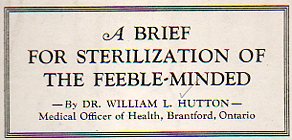
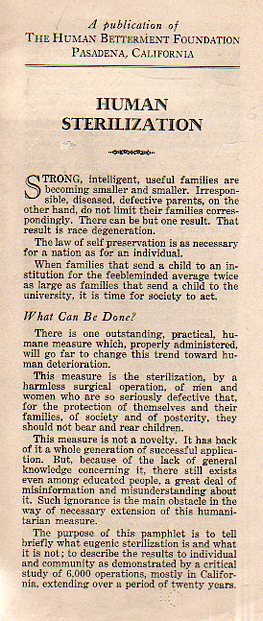
    Sterilization--feeble minded388 There are so many ways of spelling “n-a-z–i” without using a “z”.  Or the “n”.  The vowels come in handy, though.  The Human Betterment Foundation of Pasadena, California did just that, as did the Association of Ontario Mayors, the Eugenic Society, and many other correct-thinking associations and societies.  What these people had in mind was the raising of the genetic good through the malleable confusion of human rights issues resulting in the forced
    “asexualization” of the lesser elements of society–forced sterilization of inmates in state-run mental and correctional institutions, (I’ve written about sterilization and eugenics earlier on this blog, here, though the pamphlets I’m writing about today are different.Today’s pamphlets are available for purchase at our blog bookstore.)

    Sterilization--human steril389 To paraphrase the good doctor Hunter Thompson, (“when the going gets tough the weird turn pro”), the Nazis did that, becoming complete beasts, horrors even to their own horror, almost unimaginably so. (As a matter of fact, they were so bad that a certain percentage of the population believes that the Holocaust and the Nazi experimentation didn’t happen because, among other, race-hating reasons, the crimes were just too enormous to be true.)  But before eugenics studies were molded into what the Nazis needed they provided ample justification to other groups. before the Nazis were elected to power in 1933.  These American groups weren’t nearly on the same level as the Nazis, but they did create their own levels of hell, just not as deep and as profoundly grotesque as the Nazi-version.  But it was something very deeply disturbing.

    The Human Betterment Society put the issue quite simply in their slim little pamphlet, Human Sterilization–to save ourselves from “race degeneration”  society had to act and restrict ‘defective” men and women from bearing and rearing children.   There aren’t that many pages in this publication but they each present some astounding assertions, perhaps the most shocking of which is that this society had its eyes on a larger prize–the country was burdened by as many as 18 Million people with mental disease, who “put a charge and a tax on the population” and who would “cost a billion dollars a year” to take care of.  The Human Betterment people do not say outright that 18 million people should be sterilized, but the statements come in the middle of a pamphlet making the case for sterilization, so we are left with the determinant that riding this people from the gene pool would be a desirable outcome. 

    Dr. William Hutton makes the case for the humanitarian treatment of the treatment espoused in the title of his A Brief for the Sterilization of the Feeble-Minded (1936). “It would be unjust and anti-social to withhold the privilege of sterilization from the victims of mental disorders (the insanities)…”(emphasis mine). He dives into the deep-end of the sterilization issue, making the cse for dealing with the “blind, deaf-mutes, haemophilicacs and brachydactyly (deformed fingers)” in the same manner.

    Of course the Nazis performed all manner of sterilizations before 1939 and before they started to simply exterminate entire populations of who they considered to be human beings unworthy of life. The eugenics people didn’t want to kill people–they just wanted to take away all of their reproductive rights, forever.

    As it turns out, the list of the types of people who were subject to enforced, state-organized sterilization got a little shadow-y around the edges, enough so that prisoners or mental patients accused of “moral terpitude” could include, say, poor women forced into prostitution. The lateral motion of these sorts of issue were decided by different state agencies–in New Jersey for example it was the Board of Examiners of the Feeble-Minded; in Indiana, it was a board of “eugenics experts” (who were to be paid no more than $3 per case).

    The reach of sterilizations varied by state–some states did not have any laws regarding enforced sterilizations, though most did–the reach of the practice varied from state to state as well, some (like New York) reaching beyond the state penal institutions, mental hospitals and “homes for the feeble-minded”, and then right down into reform schools for boys and girls (with Michigan looking into industrial schools as well).   Some states–like Kansas–reached across these lines into the lives of epileptics; Michigan did not hunt for epileptics but did so for “imbeciles”. Oregon seemed to cast the widest net, including the “feeble-minded, insane, epiletpic, habitual criminals, moral degenerates, and sexual perverts” found in any institution maintained at the public’s expense who condition was found to be “inadvisable for procreation”.  Maine on the other hand simply included “other forms of mental disease”.

    By 1933 state-sponsored sterilizations of these classes of people reached the following totals:

    Blog1sept_10_sterilization539And so it almost ends, the story of sterilization growing weak and stale by World War II, exhausted and failing under its own exhaustion and failure.  The sterilization of sterilization really begins with the Supreme Court Decision of 1942, the Court finding unanimously that (in Skinner v Oklahoma) that Mr. Skinner’s–a chicken thief–right were being violated when faced with castration.  Justice William O. Douglas wrote:  “[S]trict scrutiny of the classification which a State makes in a sterilization law is essential, lest unwittingly, or otherwise, invidious discriminations are made against groups or types of individuals in violation of the constitutional guaranty of just and equal laws.”The practice continued with less abandon and more restrictive uses into the Nixon administration, which even as late as 1970 increased Medicaid funding for sterilizations, a weirdly appropriated funding that seemed to dramatically increase the sterilization of poor blacks.  Forced sterilization breathed its last in Oregon in 1981.  


  • On What Cost What–Treating the Navy’s Sick and Injured, 1813-1817

    JF Ptak Science Books   Post 1659 (expanded)

    Us navy medical 1817683

    Medical  expenses995When you think of expense and medical care, why on Earth should any of it cost so much?  Well, that question would make more sense if asked in the year 1819, because–according to the make-believe history of Medical Billing Capacity– the need for compensation for knowledge or spent stores or supplies or whatever was not very great, at all. 

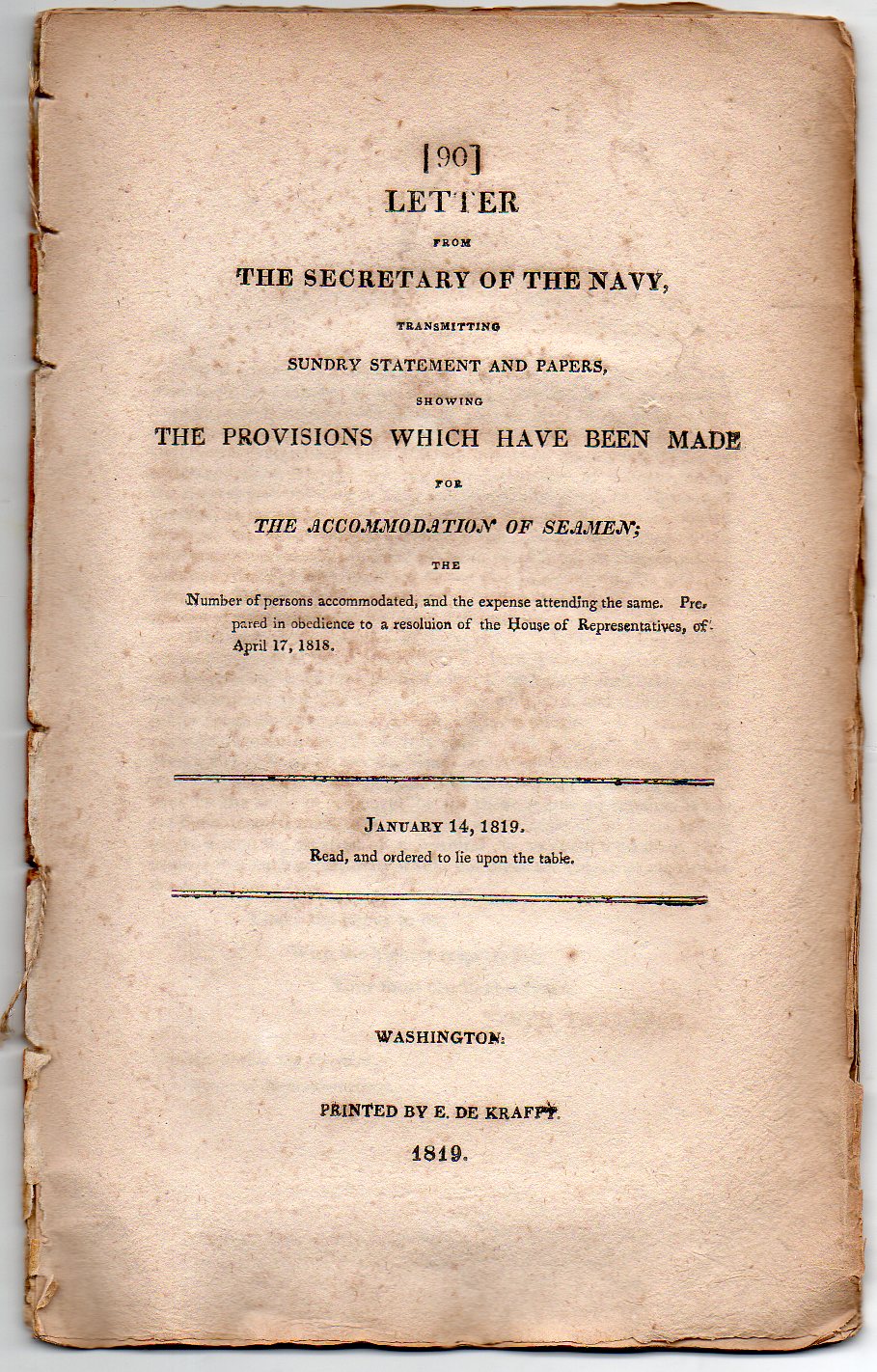
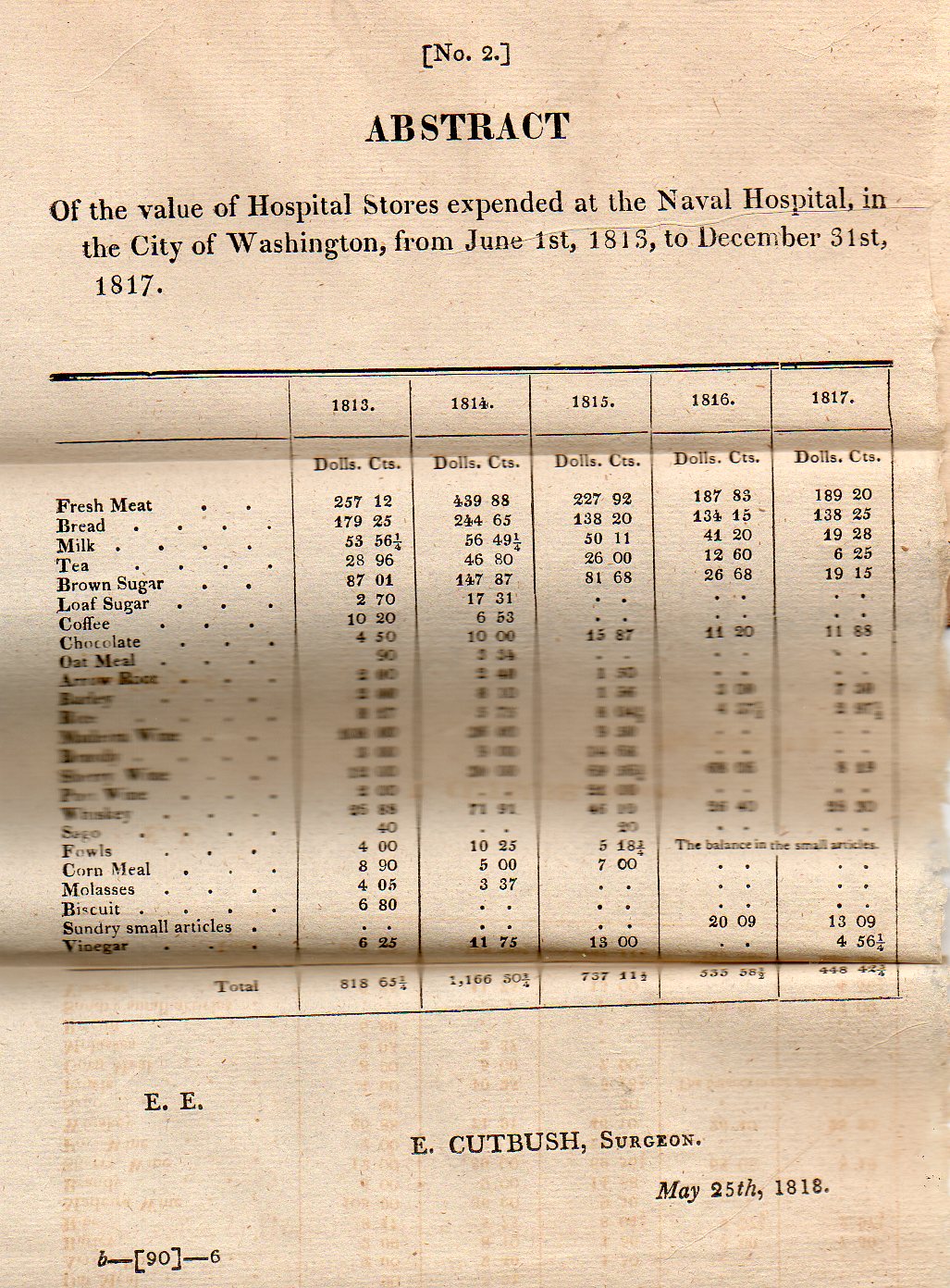
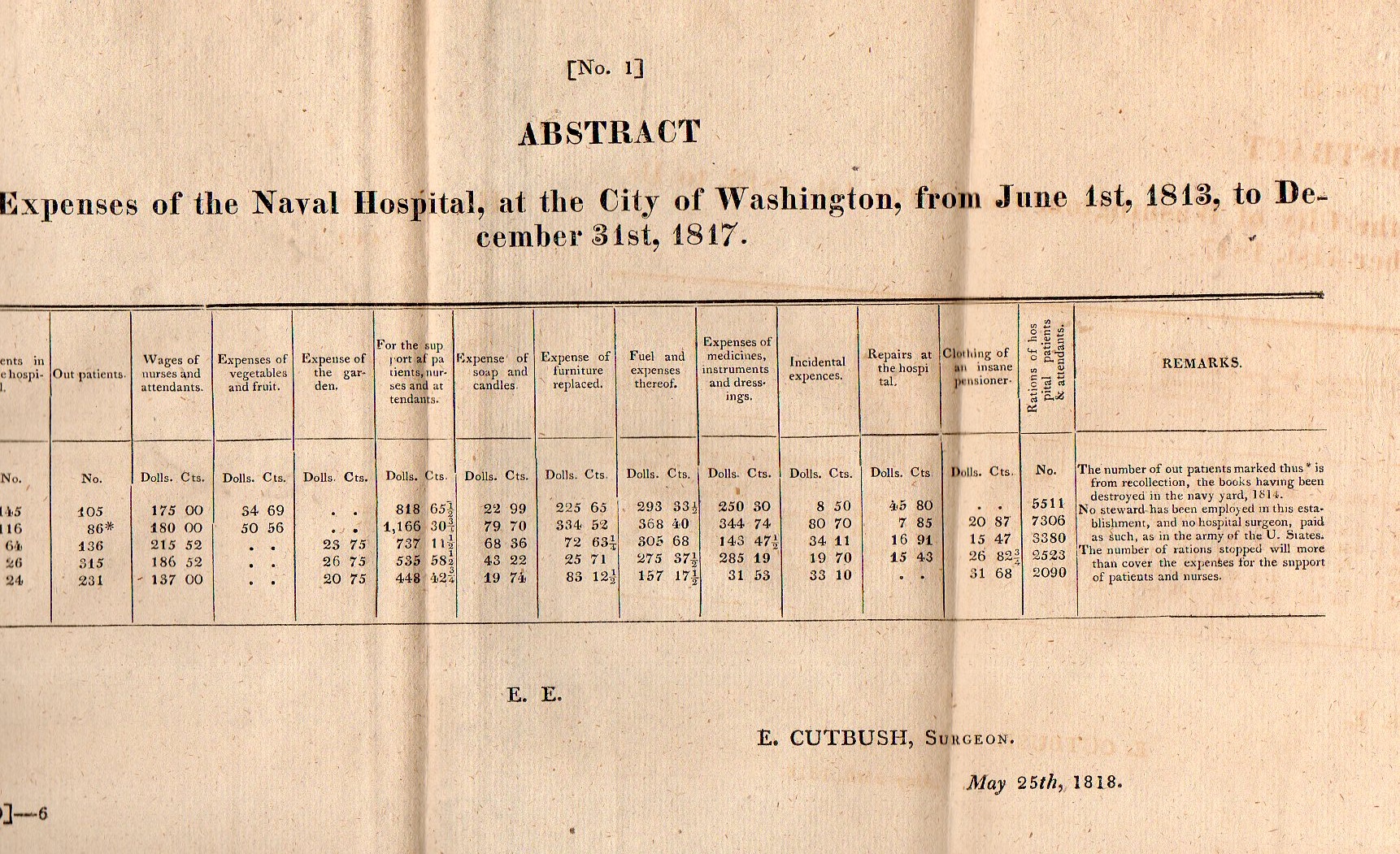
    E(ward) Cutbush, a very capable naval surgeon (and noted as the father of modern American naval medicine) attests to this, and did so in this report on the status and expense of the hospitals and medical care facilities available to the U.S. Navy (and which was published in 1819). He didn’t of course know necessarily that health care wasn’t very expensive at all–especially if relation to the price of wine–Cutbush just reported the numbers. 

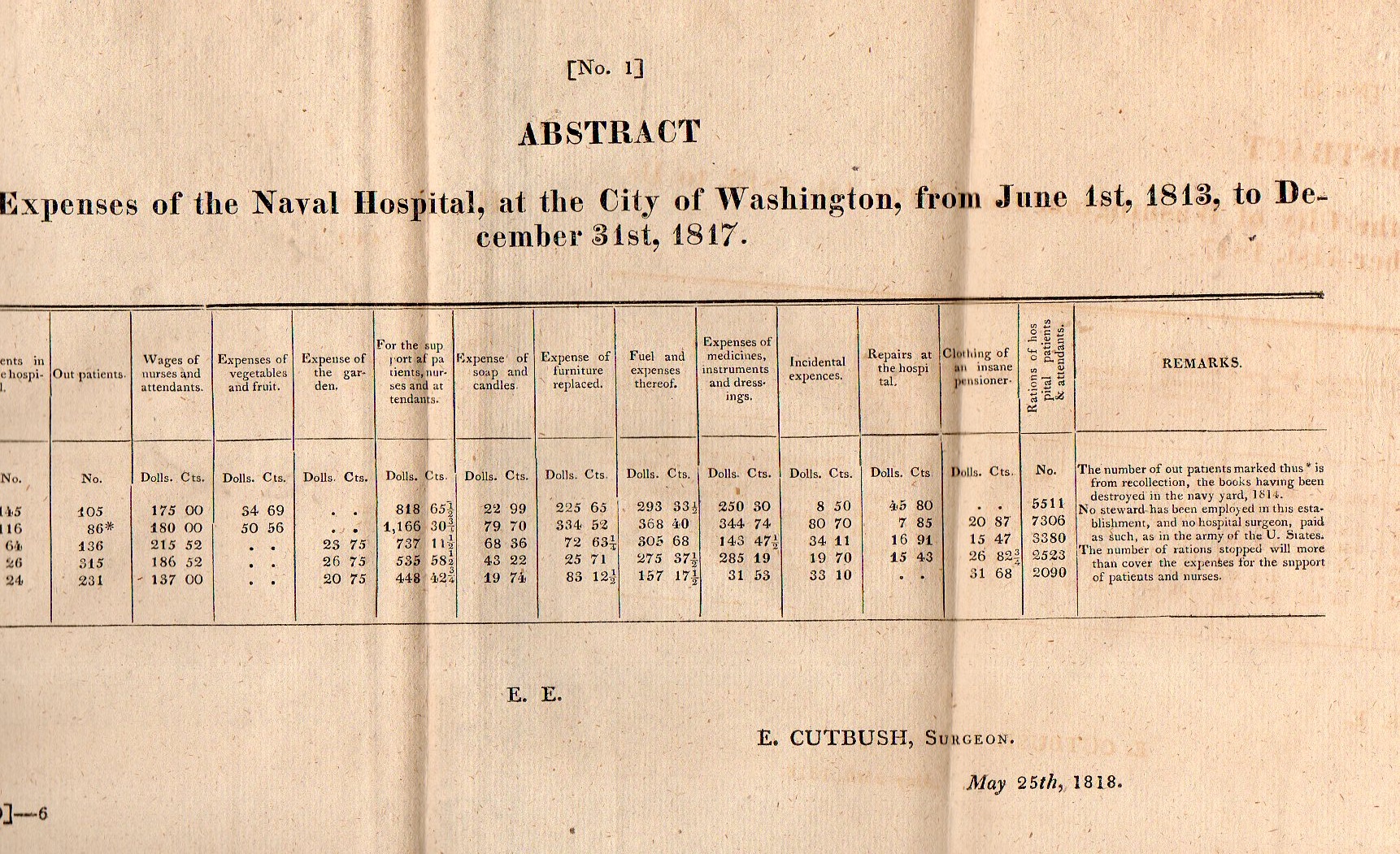
    And the numbers are interesting:  in 1814, for the U.S. Naval Hospital in Washington, D.C., for the 116 inpatients and 86 outpatients seen during the year, a total of $344.74 was spent on “medicines, instruments and dressings”, $1,166.30 on “support of patients, nurses and attendants” (which really meant food and sundries),  and another $180.00 in wages for  “nurses and attendants”.  By comparison, $79.70 was spent on soap and candles, $334.52 on replacement furniture, and $368.40 on fuel. $50.56 was spent of fruits and vegetables.

    And somewhere in there, we are shown that about $30 was spent on “clothing of an insane pensioner”, which I guess must mean that some old Seamen were judged to be “insane”, and needed clothing, before they were sent off and away from the hospital. 

    US navy medical spreadhseet

    [This image is clear once enlarged.]

    A little bit further on, Cutbsuh tells of the more exact expenses on food/”support” for the folks at the  D.C. hospital  in 1814.  By far the leading expense (in the total of $1,166.30 3/4) was meat, meaty fresh meat, which accounted for nearly half of the total outlay ($439.88).  Bread was next ($179) followed by Madeira wine ($108).  Actually all of the alcoholic beverages–which included Madeira, brandy, sherry, port and whiskey) added up to $153.00, almost as much as bread.  Meat, bread and booze then accounted for $726, or 62% of the food budget (less the minimal cost of fresh veggies).  Milk, tea and coffee weighed in at $92, which means the drinking-goods totaled $245, or 21% of the food outlay.  Barley, rice, oat meal corn meal and “biscuit” came in at $24; vinegar, molasses and brown sugar surpassed those staples at $97.

    Medical  expenses993

    We don’t get any information on the surgeon’s pay, unless we look at the stats for the naval hospital at Baltimore.  There, for 1814, we see that $352.00 was spent on medicine, $80 on surgeon’s instruments, $231 on fuel, $1645 on provisions, $18 for nurses, $18 for cooks, and $1282 on surgeon pay.  Unfortunately, I cannot find how many surgeons were called to receive this compensation, but we can see that their pay consumed 26% of the hospital expenses while caring for a total of 244 sailors over the run of one year.  It is not impossible that there was one surgeon on hand, and one nurse.  So, each sailor getting care from Baltimore received about $1.44 worth of medicine for their stay; the nurse and cook each got about 7 cents for each of the patients receiving care there, and the doctor picked up about $5.25 per sailor.

    Of course there wasn’t much in the way of surgical tools when compared with even the late 19th century to spend money on–ditto medicine.  Stand-alone hospital machinery was virtually non-existent in 1814, and so the major factor upon which all hopes were laid was the surgeon, a sort of walking hospital–a job of superior messiness and long and lonely responsibility.

    These numbers were for the late period of the War of 1812, when more than 2,650 servicemen were killed and 4,500 wounded.I could not in a cursory effort find the number of surgeons serving or employed during 1814, nor an overall figure on total medical care cost for seamen.  But it does seem likely that more was spent on milk, bread and booze than on medicine and surgical instruments.  And certainly the doctor cost far more than any other single unit int he medical care scheme–and, given that the greatest part of all care necessary resided with the physician, it was probably worth every penny (or fourth thereof.)

    Notes:

    1.  Cutbush at this time was given the direction of the “Marine and Navy Hospital establishment and of the medical and hospital Stores, which may from time to time be required for the use of the hospitals, or for the vessels of the United States equipped at this place.”-–Dudley, William S.. The Naval War of 1812, a documentary history, Volume 3.. Naval Historical Center, 1985.


    ·Posted by :

    ·in:


  • Did Galileo Know That He Was Galileo?

    JF Ptak Science Books     Post 1610

    Here’s an interesting lead sentence I found in 3QuarksDaily via Salon:

      “Karl Marx did not know what we know: he did not know that he was Karl Marx.”

    The author suggested that Marx would’ve had a better time in his life had he known what influence he wielded in what he was writing–basically, Karl Marx didn’t know that he was KARL MARX.  It is an interesting–and frightening–idea to think of someone laboring like that laboring (as it were) away in relative obscurity, or at least relative to the monumental influence it would come to have.

    The real question is not how many people might be in this category of not knowing who we know them to be, but if everyone is in this category at one point or another, and how long it took for them to understand the lasting significance of their work.  But for right now I’m interested to know what people think of the following ten science personalities, and to answer (in a simple survey), if they knew the significance of their work.

    The survey is simple and fairly straightforward, and asks questions regarding Copernicus, Harvey, Galileo, Einstein, Maxwell, Newton, Turing, Darwin, Lucretius and John Von Neumann. 

    You’ll have a chance to view the survey results at the end.  Thanks!

    Follow this link to the survey.


  • The Vast VD Landscape of “Procurable” Women: the Big WWII Poster Post on Veneral Diseases

    JF Ptak Science Books  Quick Post

    http://1.bp.blogspot.com/_Xq1_QVuOUV4/S_LGzpQOxBI/AAAAAAAAQlI/AAD8hijEhBk/s1600/1a4.jpg

    [All images from John Brown’s Public Diplomacy Press and Review Blog, here.]

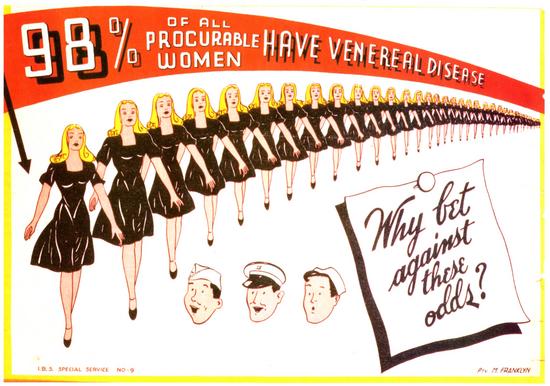
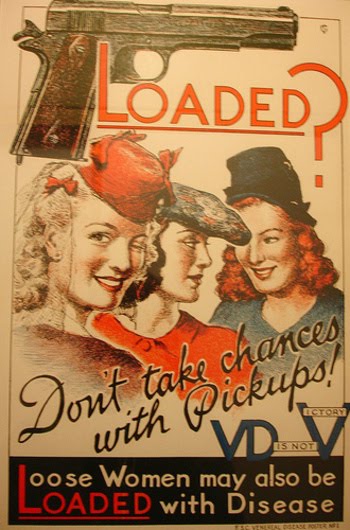
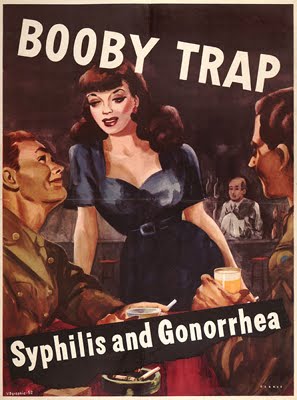
    Almost all of these posters were printed by the U.S. government as a preventative measure to help eradicate the costs of venereal diseases to the American armed forces.  They look a little outre and goofy and unbelievable in their way, but their message was very clear.  The effects of venereal disease too is a very clear one to military forces, because as important as it is to feed and clothe your troops, it is equally important to keep them healthy, for since the beginning of keeping armies there are always episodes of armed forces being decimated by disease, some percentage of them being sexually transmitted. 

    So I understand that the powers that be were trying to limit the lovelust interests of a (conquering) military force by scaring them,but sometimes the message came with a price, as with the lead poster on this post, which basically shrank the individuality of women down to the nexus, eliminating their individuality and robotizing them into VD-carrying sex toys.   .

    The percentage enough would carry this message, but a detailed view of the poster shows how it enunciates the mechanization of the female love receptacle:

    VD Poster det

    I don’t disagree with the underlying purpose of these posters, or even most of their sentiments–except of course for the lobotomized-disease-carrier-women parts.

    http://1.bp.blogspot.com/_Xq1_QVuOUV4/S_LHeo_CJQI/AAAAAAAAQlg/YU8fmOgsSxA/s1600/1a10.jpg

    http://4.bp.blogspot.com/_Xq1_QVuOUV4/S_LJt4wc0kI/AAAAAAAAQmg/ObWc9HCcJq8/s1600/1a22.jpg


    http://1.bp.blogspot.com/_Xq1_QVuOUV4/S_LI0YVjLQI/AAAAAAAAQmI/SQkMpPp6Wu8/s1600/1a18.jpg


  • History of Lines: the First Heart Catheterization, 1928

    JF Ptak Science Books  Post 1580   [Part of the History of Lines series.]

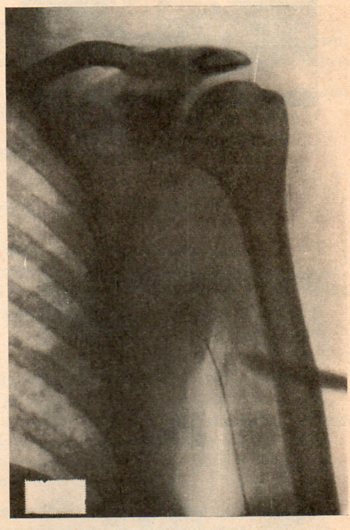
    Werner Forssmann (1904-1979) was a tough man.  He had an idea for injecting drugs into the heart quickly for certain emergencies and came up with the idea of cardiac catheterization, thinking that it might be possible to pass a catheter through the veins of the arm and into the right side of the heart.  In 1928 he acted on the idea, on himself: he applied a local anaesthetic and with a cannula inserted a catheter into the antecubital vein of his arm, sliding it 65 cm into his body; then he walked (with the aid of a nurse) into radiology and completed the journey of the catheter into the right auricle of his heart.  He had tried this procedure earlier with the aid of another physician, who wound up alarmed because of the pricking something in along the way, not to mention the possible danger of inserting a foreign object into a living heart. Forssmann met success alone on the second attempt, though he did make an x-ray of his experiment:

    Forssmann654

    That’s some pretty significant self-experimentation.  Forssmann would be awarded the Nobel Prize for Physiology or Medicine in 19561, 28 years after the publication of this epochal paper, and 13 years after the end of Forssmann’s career as a surgeon-major during WWII, also during which he became a Nazi. 

    Notes:

    1. “The Nobel Prize in Physiology or Medicine 1956 was awarded jointly to André Frédéric Cournand, Werner Forssmann and Dickinson W. Richards “for their discoveries concerning heart catheterization and pathological changes in the circulatory system…”

    The above image is a detail from the illustration used in the publication of Forssmann’s results “DieSondierung des rechten Herzens” in Klinische Wochenschrift (1928):

    ·Posted by :

    ·in:


  • History of Lines–the Heart, Arteries and the Circulation of the Blood, 1628 (1639)

    JF Ptak Science Books     Post 1570

    Harvey635
    I think that if I had a sense for design and some artistic talent that I could perhaps make something interesting out of bits and pieces of the details of a hundred famous lines.  Or two hundred.  Unfortunately, I don’t possess those talents, so I’ll just have to write about it as though it has been done, already.  If we could whisk ourselves away 50 years into the past to the great world of early broadcast television, back into the days of glorious black and white, it would be interesting to present the details singly and first on a game show like the lovable “What’s My Line” show. (Another guest, another one of the hundred or two that could appear, can be seen below*, though I think this one is a dead giveaway.)

    http://vintage45.files.wordpress.com/2011/04/whats-my-line.jpg

    Today’s line section from this blog’s History of Lines series comes to us from William Harvey, being an illustration in his epochal Exercitatio anatomica de motu cordis et sanguinis in animalibus (or On the Movement of the Heart and Blood in Animals).  It was in this book that Harvey published his experimental results on how blood moved through its course in the body, showing that the 1400-year-old Galenic idea concerning the movement of blood was all wrong. 

    Harvey634
    Harvey had conducted experiments via the scientific method–and was among the earliest to do so–and established early on, by 1615 or thereabouts, that the Galen theory regarding the movement of the blood was incorrect. He found that contrary to long-established belief the liver did not convert food into blood, and that the lungs did not push the blood through the  body, and that blood was not continuously generated.  Why wait until 1628 to publish his results?  I suspect that he was not looking forward to the problem and notoriety of publishing results that went against the medical grain–actually some of which were the exact opposite of the accepted practice–which in fact was the case for decades after the first edition appeared.  But Harvey presented his results in his short book in a concise way, explaining how it was that the heart and arterial systems functioned, and then in a second section of the work displayed how the blood was circulated rather than produced. (He was able to establish that if Galen’s theory was correct that the liver would have to produce 540 pounds of blood every day–a simple impossibility.)

    Harvey’s work had a revolutionary effect on the study of physiology and medicine at the same sort of level as Copernicus or the use of the telescope by Galileo–I think that there is little doubt in that.  Harvey was able to produce his results through experimentation and without the benefit of the microscope, which would have helped him enormously had he been able to identify capillaries–something that would have to wait for Marcello Malpighi and his publication in 1673, sixteen years after Harvey’s death. 

    Notes:

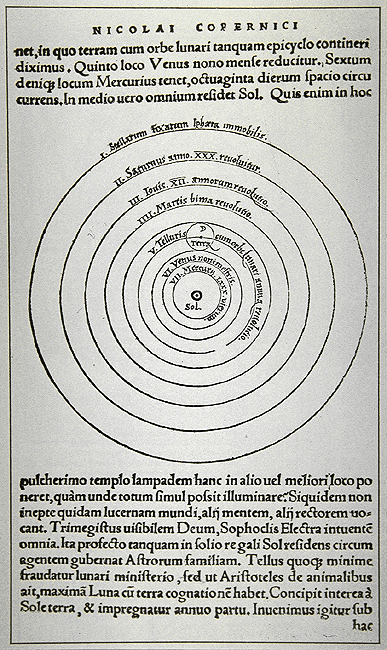
    Lines copernicus b

    The detail from the big image in Copernicus’ De revolutionibus orbium coelestium (On the Revolutions of the Heavenly Spheres), 1543.

    Lines copernicus


  • Society of Consequences: the Value of Life and the Importance of Horse Manure, 1859

    JF Ptak Science Books    Post 1524

    In the epochal year of 1859 (Darwin’s Origin of Species is published) Philip P. Carpenter (1819-1877) contributed a very interesting article to The Canadian Naturalist and Geologist and the Proceedings of the Natural History Society of Montreal (the full article appearing here).  Among many things, the intriguing title “On the Value of Human Life in Different Parts of Canada” suggests something that might seem a translucent to the modern reader–that in the statistics, somewhere, is a Bell curve that might establish what the “average” person was.  The idea of the “average man”–a statistical impossibility at the time–was important in the sociological application of the statistical work of the early and very influential mathematician Adolphe Quetelet (1796-1874, fl. 1840’s), whose theorizing underneath his numbers was questionable and wincing, but Mr. Carpenter really doesn’t approach this–he has a much more current and applicable idea in mind.  He was interested in the positive and major consequences of relatively minor government investment in the health of the population and the upkeep of the basic infrastructure of a city.

    In collecting his data on birth/death/mortality rates in some major cities in Canada, Mr. Carpenter undertakes a cost-benefit analysis (of sorts) to show how much it would cost to prevent a certain percentage of those deaths, and that a very small investment in maintaining a city’s infrastructure would wind up saving lives and money as a result.  It is an elegant, interesting argument.

    He points to some statistics for the city of Munchen, establishing that the sewering and cleaning of 20 street there reduced the mortality  rate from 31 to 25  per  1000 (“that is, preventing 21 deaths and 588 cases of sickness in seven months”), saving the community the cost of caring for the ill and reducing the amount of time lost in the workplace.

    Basically, Carpenter establishes that adding sewers and just simply cleaning the streets–basic sanitary measures–is an economic benefit to the local community, arguing that “as the cost of sanitary measures is generally the greatest obstacle to their adoption, it may be well to inquire whether their neglect is not still more costly”.  And that it not only made a certain amount of intuitive sense to undertake these measures, Carpenter felt as though he had the numbers (later found to be very problematic) to display how much more “neglect” would cost.  For example:

    A key and simple element to defining health for Canadian cities was horse manure, which those cities seemed to be awash in  Carpenter makes a very simple case for simply using the manure for fertilizer rather than just throwing it into the river, and that the act of cleaning this waste not only was beneficial for the health of the community, but was also had value for cultivation..  This may seem trivial now, but in 1859, evidently, it wasn’t an obvious issue.  Carpenter concludes:

    This was a very satisfying read, and the author made a simple, solid and convincing economic case for “doing the right thing”.  It would turn out later in the 1860’s and 1870’s that Carpenter’s statistical methods were deeeply flawed, leading to him being abandoned by the association that he helped to create–a bitter pill, to be sure, since the overall conclusions about public health were correct, if not the numbers.  After all was said and done, Carpenter was out to save people (particularly the poor), more so than an actuarial table. 

    Notes:

    An interesting table showing the relative health of the cities in the countryside versus, say, the Gotham of Montreal: