A Daily History of Holes, Dots, Lines, Science, History, Math, Physics, Art, the Unintentional Absurd, Architecture, Maps, Data Visualization, Blank and Missing Things, and so on. |1.6 million words, 7500 images, 4.9 million hits| Press & appearances in The Times, Le Figaro, Mensa, The Economist, The Guardian, Discovery News, Slate, Le Monde, Sci American Blogs, Le Pont, and many other places… 5000+ total posts since 2008.

Category: Medicine, History of

  • Hippocrates on Ancient Medicine

    JF Ptak Science Books   Quick Post

    Extract from “On Ancient Medicine”, by Hippocrates, translated by Francis Adams, (1891),  from his The Genuine Works of Hippocrates, published in New York by the medical publisher William Wood and Company.

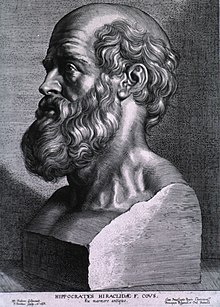
    Hippocrates, Hippocrates of Cos, Hippocrates of Kos, a man of enormous and justified fame, is considered the father of modern medicine. He lived during the age of Pericles, this great physician, (ca. 460-370 BCE), though his life per se, and perhaps even his works, are more of an accumulation of efforts of others through addition and edit than the work of the one man known as Hippocrates. Still he is the outstanding figure in antiquity in the history of medicine, and perhaps it really doesn’t matter if people could ever know his absolutely original works, or not. Part of his life may be legendary, but his lasting importance to the practice of medicine is all that really matters.

    ·Posted by :

    ·in:


  • “Ordinances For Sanitation In A Time Of Mortality”–Protection from the Plague, 1348

    JF Ptak Science Books  Quick Post


    [Image of a “plague doctor” trying to protect himself from the disease with long robes and a mask.]

    Ordinances For Sanitation In A Time Of Mortality
    Pistoria is a town about 40km northwest of Florence, and was visited by plague a number of times between the 13th and 18th centuries.  In this instance, below, in the plague season of 1347/8, the governance of the city issued a 23-point, nine-page proclamation, trying to protect the citizens from the vast threat that would cost the lives of a quarter of the residents of the town.  The text of the document treated the matter of plague at all levels, from an attempt at scientific treatment to regulations about how a person could be allowed back into Pistoria after visiting a plague area.


    ·Posted by :

    ·in:


  • Medicine–Listing of Nobel Prizes

    Nobel Prize in Physiology or Medicine: Chronology

    toi1901 “EMIL ADOLF VON BEHRING for his work on serum therapy, especially
    its application against diphtheria, by which he has opened a new road in the
    domain of medical science and thereby placed in the hands of the physician a
    victorious weapon against illness and deaths.”

    See the full listing (with summary text from the Nobel foundation) located in the “pages” section of this blog, here.

    ·Posted by :

    ·in:


  • Great & Lost-in-the-Dust Books: Love & Sex and the Freedom from Sin, 1549

    JF Ptak Science Books   Quick Post 

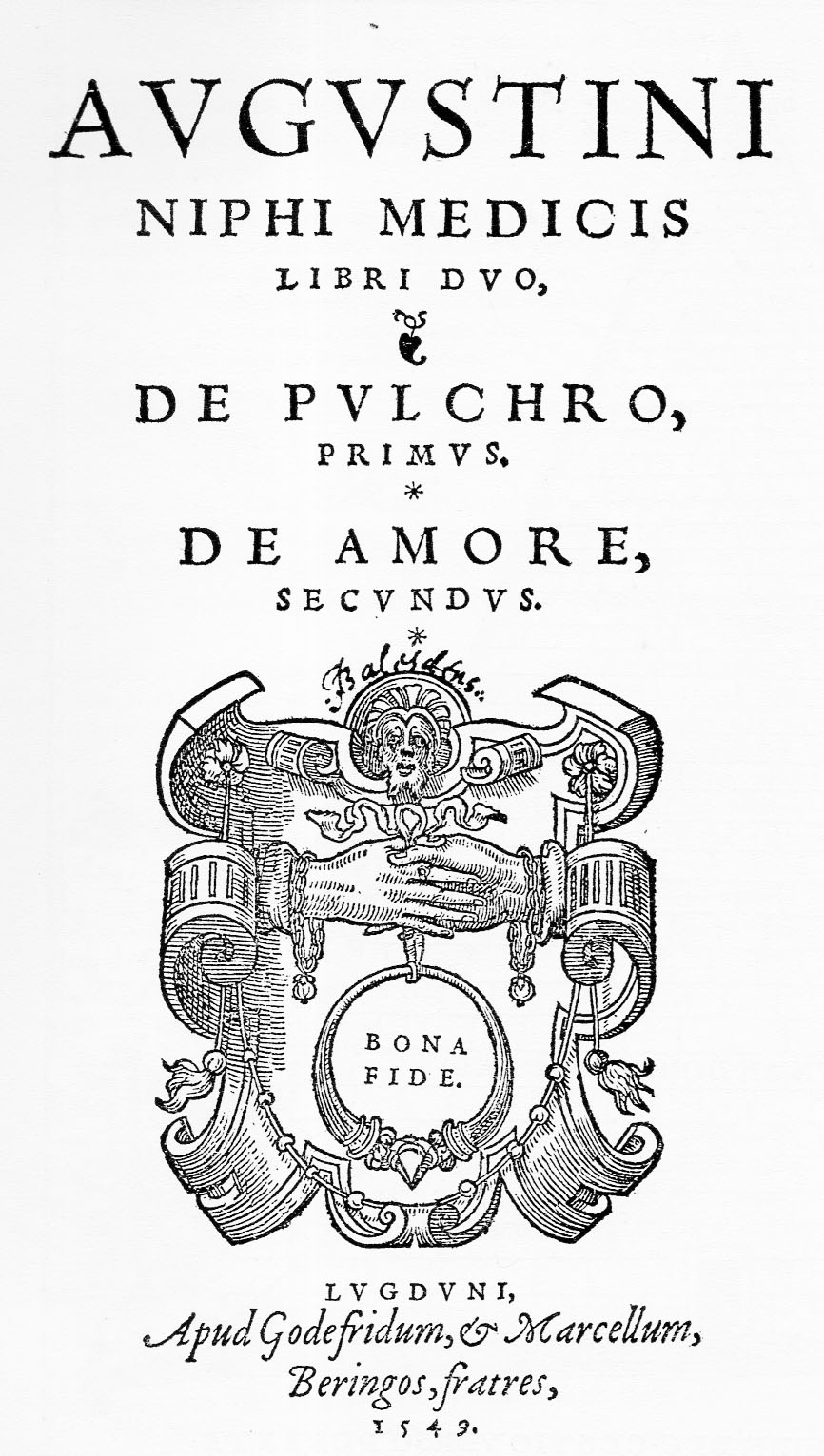
    In Agustus Niphus, Libri Duo de pulchro liber primus, de amore librer secundus, and printed in Lyon by Beringen in 1549, the scholar and Aritotelian Agostino Nifo of Sessa (1473-1546) wrote two significant treatises on the nature of beauty and love (liber primus and secundus, respectively).

    The amazing thing about this work is that Nifo analyzes the conditions of love and sexual expression as respondents to a  psychological basis, and since this was so, that love and sex are a product of the mind and not necessarily a simple undisclosed deire, that the act and thought coul dno tbe considered to be of siunful natures–basically, the two were as natural a thing as could be, and one does not condemn the acts of nature.

    Title pages bona fide775


  • The Invisible Man, 1785

    JF Ptak Science Books   Quick Post   [Part of the Series on Blank, Empty and Missing Things]

    Bandages767

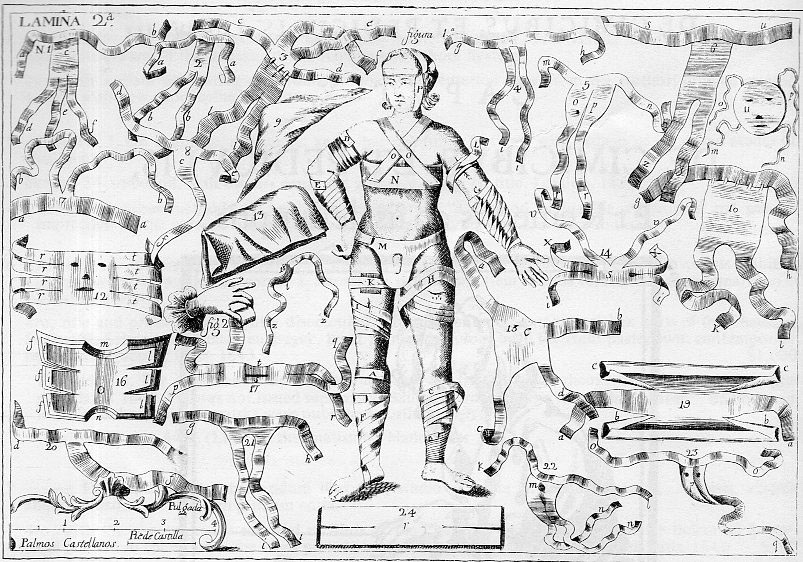
    What is mostly missing in this fantastic illustration from Tratado de vendages…. (Madrid, 1785) are people.  These multi-image plates of various dressings usually did not address people directly, and so looking at them out of context gives them a very heavy taste of the found-absurd. 

    For the time, of course, the book was an essential text on treating wounds, especially military ones. The author, Francisco Vila Canivell was born in 1721 in Barcelona.  By 1749 at only 28 years old, he had been educated in  France and received his medical education back in Spain at the Universtiy of Cervera, had fought in the Italian campaign (as a surgeon), became Surgeon Major of the regiment of Astiurias, and then on to keep charge of the Library of the Royal College of Surgeons in Cadiz. He was professor of osteology (and bandages!), as well as an obstetrician, ophthalmologist and midwife, until 1769 when he became Sugeon Major of the Army, and then proceeded on to other more esteemed positons, dying in 1797.


  • Post-Renaissance People in Bed on Title Pages

    JF Ptak Science Books   Post 1879  (Following an earlier post on the appearance of the first (?) suicide on a title page, here.)

    Edical bed747

    No doubt there are many examples of finding people in bed on title pages of books printed in the high Renaissance and Baroque–I found two pretty quickly.  Of course it would make sense to look at medical titles, as in the case of many examples where the borderland images of decorated title pages surrounding the text describing the book were often filled with allegrocial tales, which means that at some point in the allegroy involving  medicine that sooner or later someone is going to wind up in bed, overseen by their physician. 

    This is definitely the case with the following image (found at the National Library of Medicine, here):


    The book is by Maritn Pansa (b. 1580), and the title to the  Appendix consilii antipodagrici specialis darinnen X consilia specialissima (printed in 1615) shows lives that were led basically in pursuit of pleasures and vice and crime that would eventually lead to the big bad straight bed at the end of their perceived crooked road.  The title page tells of lives lived in pursuit of hunting, and wine, and women and song, as well as the abuse of children–creature comforts and vices which would eventually lead the practionner  to a sick-bed for their pursuit of foul ends.  The baseline here is a warning for those living a High Life in perhaps-exalted states would more than likely pay for their lifestyles with sickness in the end.

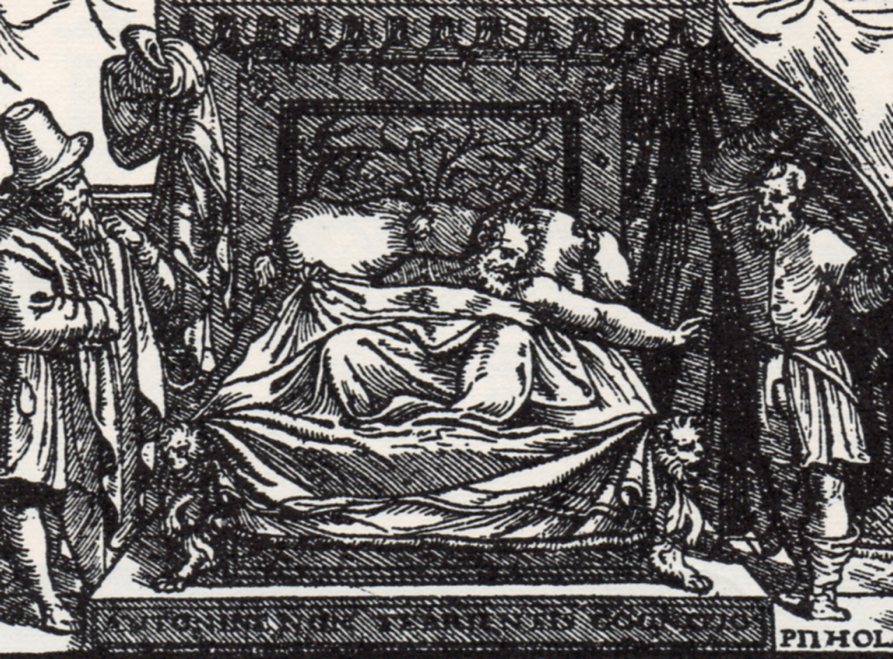
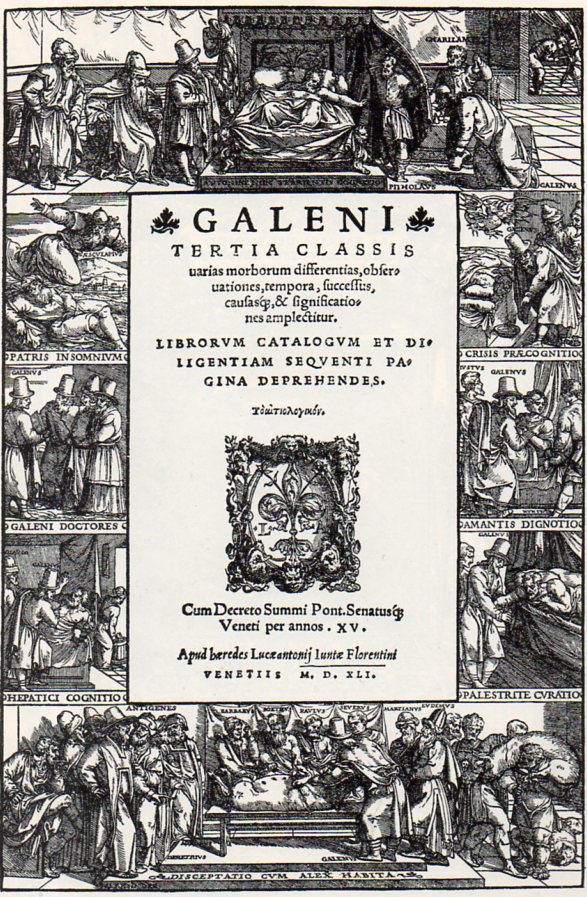
    Another good example is fond in Galen’s Tertia Classis uarias morborum differnetias, obseruationes, tempora, successius, causasqe & signficatio nes amplectitur…, which was published in Venice in 1541 with a beautfiul woodcut title page illustrated by a follower of Titian.  First and foremost, the capstone of the border images shows a sick patient being attended by doctors of classical greatness including Galen himself (at the extreme right of the first image, above). 

    Edical bed746

    Galen (Aelius Galenus or Claudius Galenus (AD 129– c. 200)), was an ancient too, and taking this little trip through time he must’ve seen some surprising things, not the least of which would have included this bed. It should be noted that until the publication of the revolutionary work of Vesalius, Galen was the largely-unimpeachable source of medical knowledge for some 1300 years.

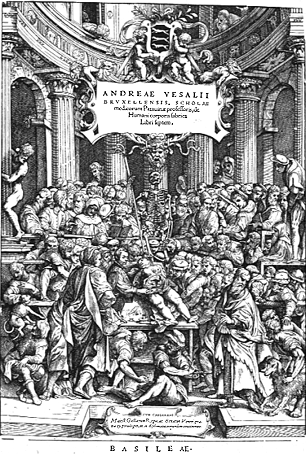
    And of course there is another sort of bed in the Vesalius book’s (De humani corporis fabrica libri septum…) title page, though this is the most uncomfortable of all:

    Medical--vesalius title page


  • Blank, Empty and Missing Things: a “Missing” Renaissance Masterpiece

    JF Ptak Science Books   Post 1874  [One in a series on the History of Blank, Empty and Missing Things.]

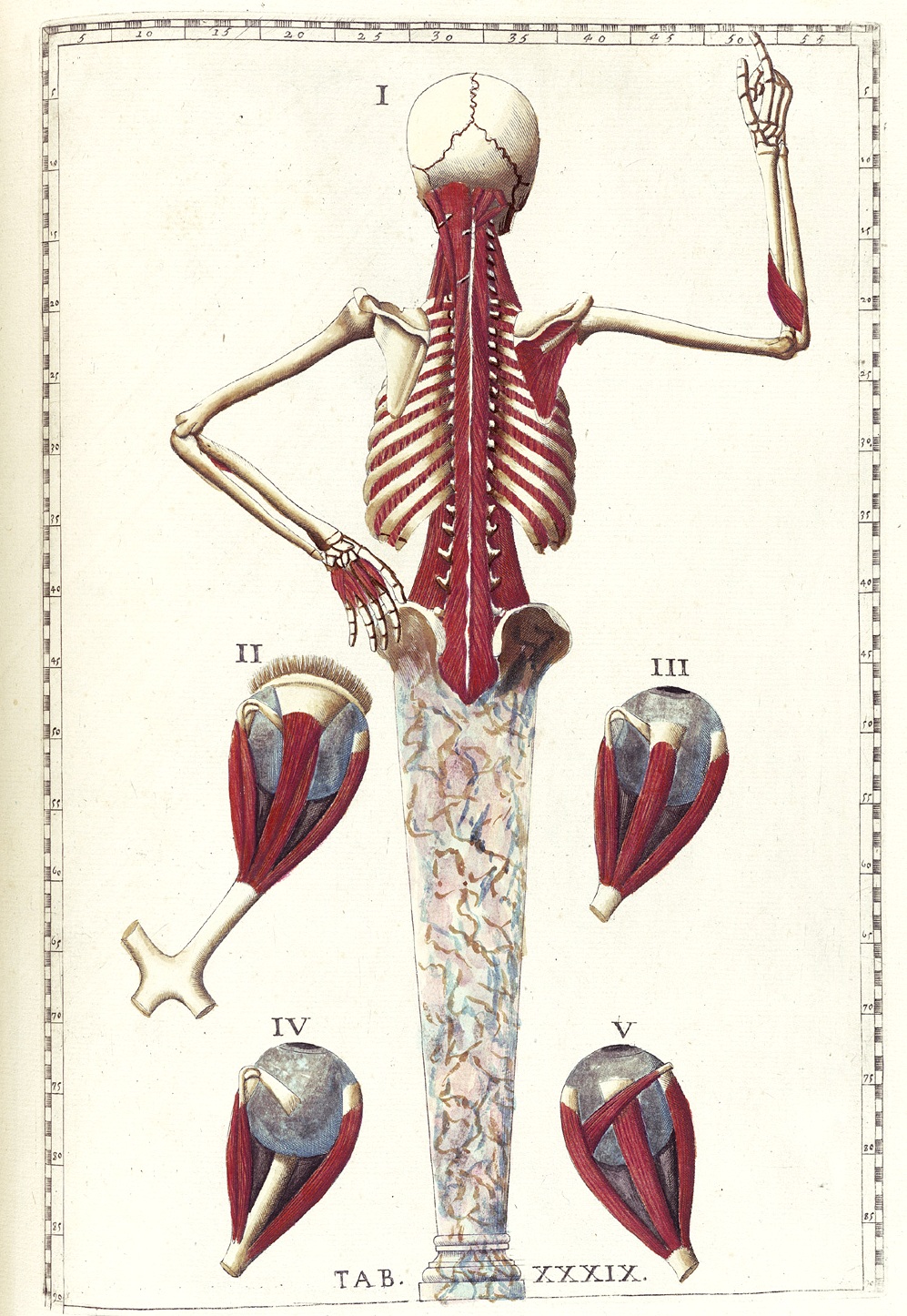
    The remarkable engravings below are even more so when you consider that they were published more than two hundred years afer the death of their originator.  Bartolomeo Eustachi (1500/1524-1574) was one of the founding member of a very small school of modern anatomy (another being Vesalius) who undertook very careful dissections in his study of the body, finishing (in 1552) a work of paramount importance just nine years after the publication of Vesalius’ revolutionary work–it was a work that would remain unpublished for 162 years.  The threat and fear of excommunication and other reprisals at the hands of the Catholic Church prevented its publication, the full work not seeing the light of day until 1714.  It would be published several times more in the 18th century, a great tribute to an anatomist whose work was still being studied more than 200 years after its completion.

    One of the great missing books then belongs to Eustachi, his Romanae archetypae tabulae anatomicae novis…(with the examples of images below being published in Rome in 1783) belongs to a very small class of technical/medical  books published long after they should have been and which still were found to be of great and substantial use. He was an absolutely superb anatomist, using dyes and injections for visually troublesome areas, as well as early versions of “microscopes” to observe miniscule bits.  He was a fine student of his physician father, well-versed in classical education, and by 1549 he was the professor of anatomy at the Archiginnasiodella Sapienza, where he was also able to avail himself of a number of cadavers for dissection.   

    He worked on his anatomy for several years, readying 47 plates for publication.  It would come to pass that only eight of them were published during his lifetime–those on the kidney and teeth, published as De Renum structura (the first work dedicated to that organ), and De dentibus (for the teeth), respectively. 

    The engravings–rather, the incised plates of the engravings–went missing after Eustachi’s death, and stayed so until (as noted above) 1714.  According to faqs.org , Eustachi’s work was still prized 160+ years later for their elegance and beauty and detail because:

    “… they provided some of the best descriptions of the base of the brain, the  sympathetic nervous system (the nerves that control the constriction of  blood vessels, among other things), the vascular system, and the structure of  the larynx.”
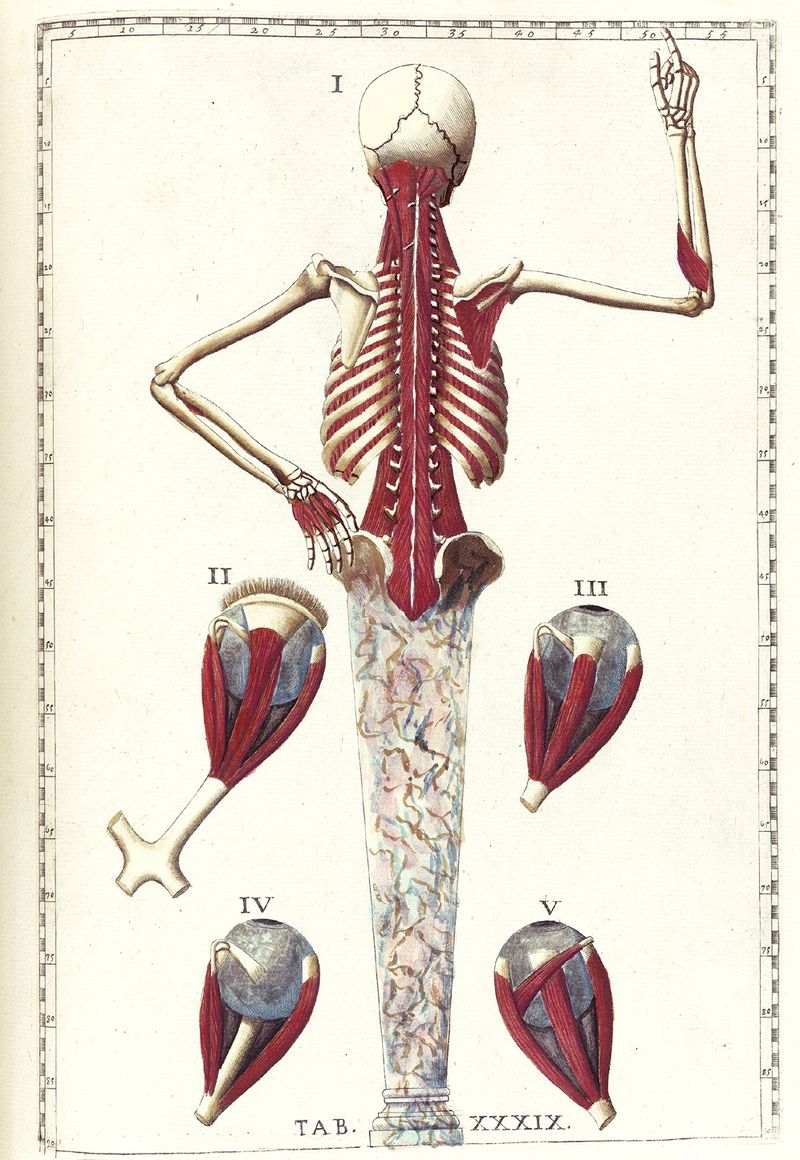
    Eustachi_t39 
    [More images below]
    among many other reasons.

    I can’t help but wonder what the result of the publication of this book would have affected if it had been available in 1552.  It stands to reason that if it was still being used in 1789, and still useful and respect and “current”, then it would lead me to believe that it would have had a major impact 227 years earlier.

    (Source: Bartholomeo Eustachi: Tabulae anatomicae. (Rome, 1783), . Historical Anatomies on the Web. US National Library of Medicine.)

  • Daily Dose of Dr. Odd: Chronicle of the Plague, Florence, 1336

    JF Ptak Science Books   Quick Post

    The Florentine Chronicle on Medieval Plague Marchione di Coppo Stefani

    Marchione di Coppo Stefani was born in Florence in 1336. He wrote his Florentine Chronicle in the late 1370s and early 1380s.  [Stefani, Marchione di Coppo.Cronaca fiorentina. Rerum Italicarum Scriptores, Vol. 30. ed. Niccolo Rodolico. Citta di Castello: 1903-13.]

    “Rubric 643: Concerning A Mortality In The City Of Florence In Which Many People Died”

    “In the year of the Lord 1348 there was a very great pestilence in the city and district of Florence. It was of such a fury and so tempestuous that in houses in which it took hold previously healthy servants who took care of the ill died of the same illness. Almost non of the ill survived past the fourth day. Neither physicians nor medicines were effective. Whether because these illnesses were previously unknown or because physicians had not previously studied them, there seemed to be no cure. There was such a fear that no one seemed to know what to do. When it took hold in a house it often happened that no one remained who had not died. And it was not just that men and women died, but even sentient animals died. Dogs, cats, chickens, oxen, donkeys sheep showed the same symptoms and died of the same disease. And almost none, or very few, who showed these symptoms, were cured.


  • 36 Great Anatomies, 1390-1899: Great Image Base from the NLM

    JF Ptak Science Books   Post 1835

    This table is pulled directly from the National Library of Medicine pages for anatomies on the web–all I did was place the records in a table so that they could be listed chronologically.  The references in the first left-hand column are clickable and will take you directly to the images of the work at the NLM site.  This is just a sampling of anatomies, though it may prove to be highly useful for folks in the science and the arts.  Enjoy. 

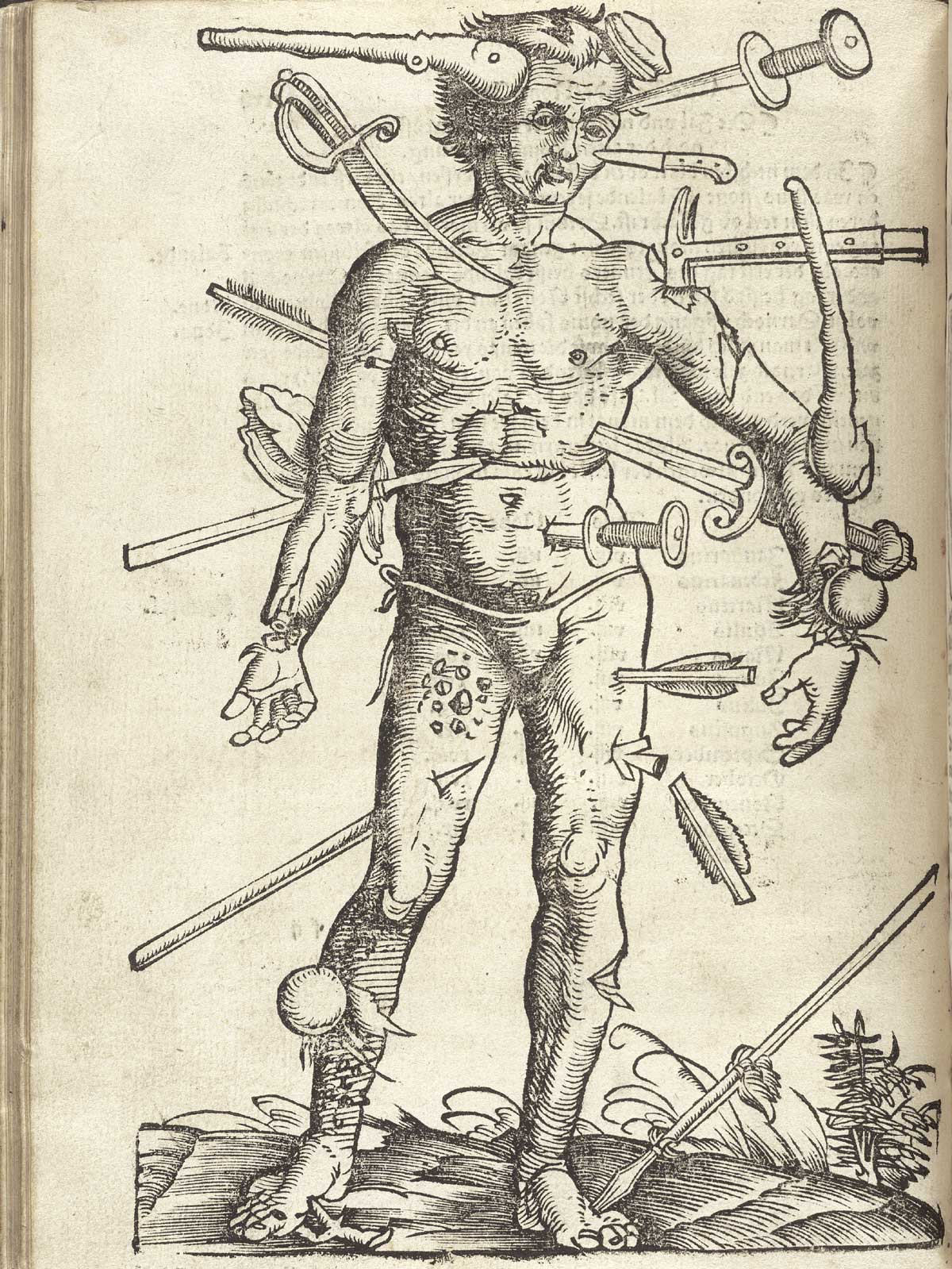
    Medical gersdorff_p21v[Image: Hans Gersdorff, Feldtbůch der Wundartzney : newlich getruckt und gebessert, published in 1528.]

    Chronological list.


  • Was Homer Color Blind? (1878)

    JF Ptak Science Books  Quick Post

    “Colour Blindess in Relation to the Homeric Expressions for Colour”, from Nature Magazine, volume 18, p. 676, 1878.

    “In an article on “The Colour Sense” in the Number of the Nineteenth Century for October last, Mr. Gladstone points out certain peculiarities…in the expressions of colour used by Homer. “Although” he says “this writer has used light in various forms for his purposes with perhaps greater splendor and effect than any other poet, yet the colour adjectives and colour descriptions of the poems are not only imperfect but highly ambiguous and confused”. And again-“we find that his sense of colour was not only narrow, but also vague, and wanting in description”.