A Daily History of Holes, Dots, Lines, Science, History, Math, Physics, Art, the Unintentional Absurd, Architecture, Maps, Data Visualization, Blank and Missing Things, and so on. |1.6 million words, 7500 images, 4.9 million hits| Press & appearances in The Times, Le Figaro, Mensa, The Economist, The Guardian, Discovery News, Slate, Le Monde, Sci American Blogs, Le Pont, and many other places… 5000+ total posts since 2008.

Category: Medicine, History of

  • Pabst Malt Extract as a Cure for Typhoid Fever, 1895

    JF Ptak Science Books 

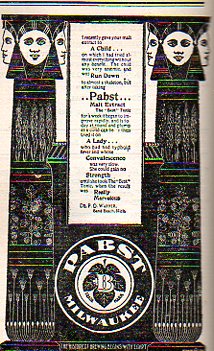
    Pabst Brewing Company, makers of Pabst Blue Ribbon Beer (evidently named for the Blue Ribbon that they did not receive in the 1893 Columbian Exposition) marketed one of their malt extracts as a curative, a palliative of some sort.  In this ad–rendered in a sort of Egyptian motif, because as we see in the legend at the bottom of the image in a barely-visible type, “the history of brewing begins in Egypt”–the malt extract is useful for a very wide variety of aliments. 
    Pabst372
    The two testimonies quoted in the ad come from a Dr. P.O. Warner, of Sand Beach, Michigan.  The first example is for the use of the Pabst product for an “anemic…run down to almost a skeleton” child–after a week of use of the malt extract, the child was again “plump”.  Unfortunately, the use of malt extract is generally used to treat constipation, and irritable bowel syndrome, and as a stool softener–something to help folks go to the bathroom….in the case of a weakened child, this seems to have been exactly the opposite thing to prescribe. 

    The second case is even more reaching:  “really marvelous” results in using Pabst malt extract to help a woman with/getting over (?) typhoid fever.  I’m not sure how this would have come into play, or if  the simple consumption of a Pabst beer would have been a less-harmful remedy. 

    The elegant ad appears in a beautifully printed nickel Little Magazine called The Chap Book, printed by the estimable Stone & Kimble of Boston. 
    ·Posted by :

    ·in:

    —

  • Listing Illnesses and their Causes of Inmates of the New Orleans Insane Asylum

    JF Ptak Science Books   Post 2072

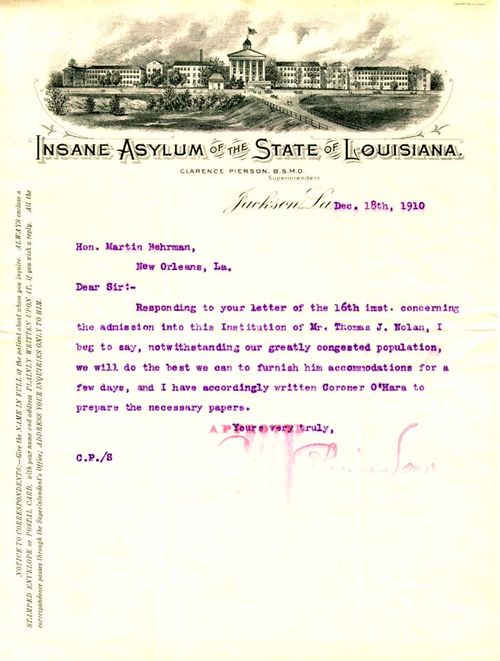
    Following a posting from a few days ago listing the causes of admittance of children to an insane asylum in Powick, U.K. from 1854-1900 comes this find–a rather extraordinary find, regarding the causes for admission as an insane person to the City Insane Asylum of New Orleans. This site has an incredible (and indelible) record of  the patients admitted from 1882 through 1916 (“Orleans Parish (La.) Civil Sheriff Register of patients transported to the State Insane Asylum, 1882-1917”), including the reasons for confinement, as well as the causes of the debility, plus the age of the person and their occupation. 

    Insane asylum NO

    Following the link will get you to the year-by-year index of admittance–there is no standardized set of instructions or rules to identify the illness or supposed illness, so the way that the physician factored the mental disabilities of the patient was open to some wide interpretation.Some of the reasons for admittance included stupidity, alcoholism, idiocy, epilepsy (still about the leading “cause” for admission), imbecility, insanity, dementia praeox,hysteria, “delusional about Italians”, religious mania, and so on.

    “Responsibility for insane patients (particularly the
    indigent insane) housed in the City Insane Asylum (or in various
    hospitals after the city facility closed) fell to the City Physician,
    who was to visit patients at least once a day and to discharge those
    patients who had sufficiently recovered. He also identified those
    inmates who had remained in the asylum “over the time prescribed by law”
    and reported their names to the sheriff of Orleans Parish, who arranged
    their transfer to the State Asylum at Jackson, La.
    “–Source

    The major subset of the diagnosed diseases and illness was the “-mania”. Aside from a general mania, there was an alpabetization of the competing manias, including religious-, chronic- , kelpto- , furious- , erato- , raving- , homicidal- , acute- , indcenidary- , puerpueral- , mono- , recurring- , delusional- , suicidal-, and a few others. 

    Insane asylum SIA  LA
    It is the “causes” of these challenges that seem to be the most viciously interesting part of this record.  Stuff that sent people into maniacal flights or rages or depressions and other anti-social behavior included but was not limited to alcohol, syphilis, weak mindedness, heredity, drugs-in-excess, old age, “womb trouble”, “attack of gripe”, “poverty and want”, jealousy, sunstroke, onanism, menopausia, hallucinations, masturbation, “mental worry”, “family troubles”, tobacco, softening of the brain, and so on.

    There is room for someone here to go through the 30-odd years of entries to see what were the most/least common causes of mental instability–it would be an interesting list to see someone else generate. 


  • Deeply Articulated Anatomical Engravings

    JF Ptak Science Books   Quick Post

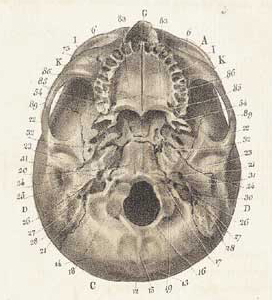
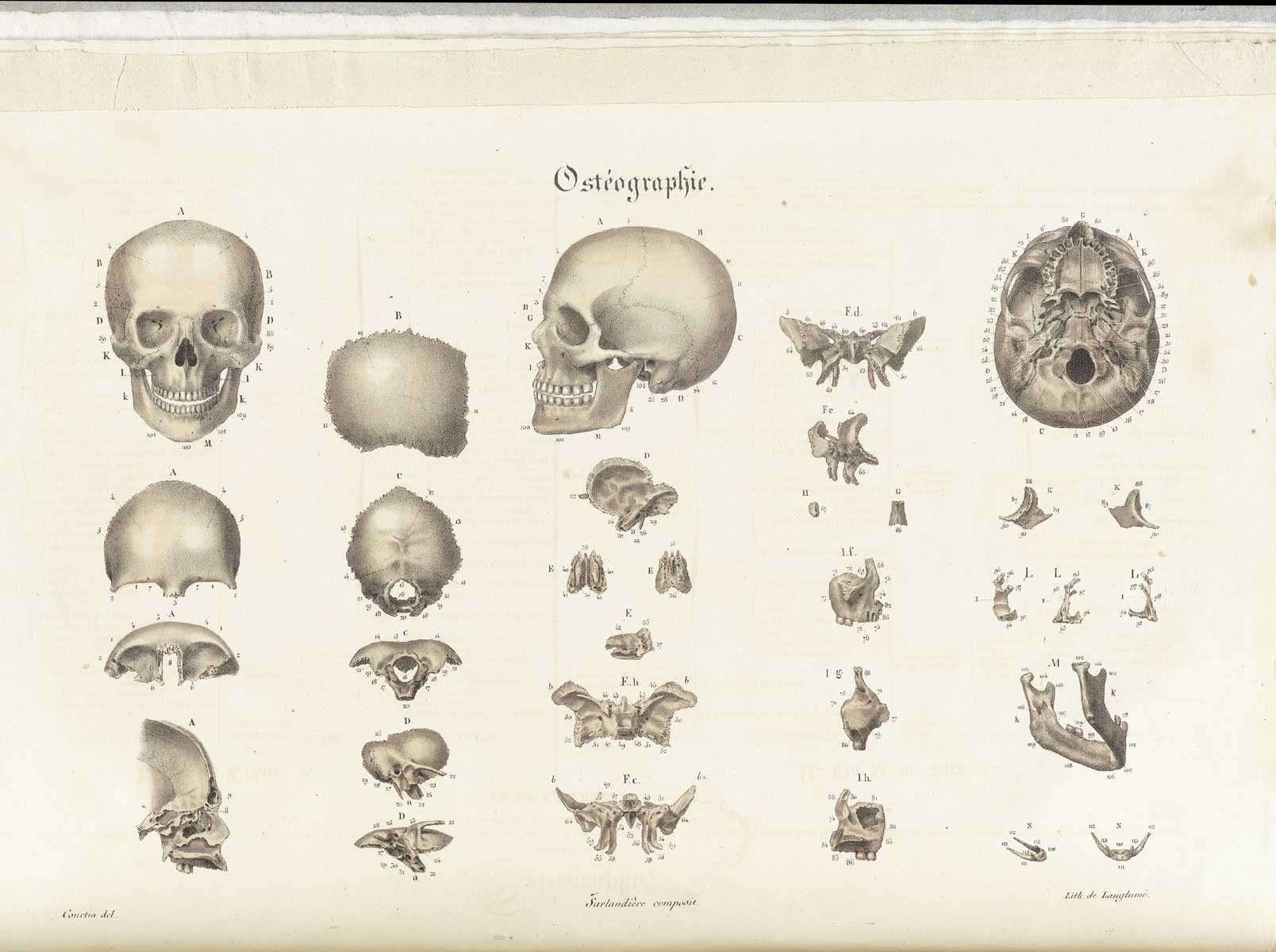
    Old bonesv detailThere is a real fabulousness in design for these images made by anatomist/physiologist Jean-Baptiste Sarlandiere (1787-1838) in his anatomy of 1829 (Anatomie méthodique, ou Organographie humaine en tableaux synoptiques, avec figures. Paris: Chez les libraires de médecine, et chez l’auteur, 1829). Or at least the organize has achieved some high order of merit, both in the lettering/numbering  and display of the anatomical object…and in their placement and arrangement on the sheets of paper.  They’re just very pleasing:  the very detailed and complex images are stuffed but concise, and the multiple-image placements are composed of very detail small bits with plenty of free space.  They’re just very well-designed. 

    [Source:  National Library of Medicine, here.]

    Old bones

    Old bones 2 det


    ·Posted by :

    ·in:


  • An Interesting 3-Section Perspective, 1560

    JF Ptak Science Books    Post 2069


    Cousin_p09 det
    [Detail from engraving in the seventh image, below]

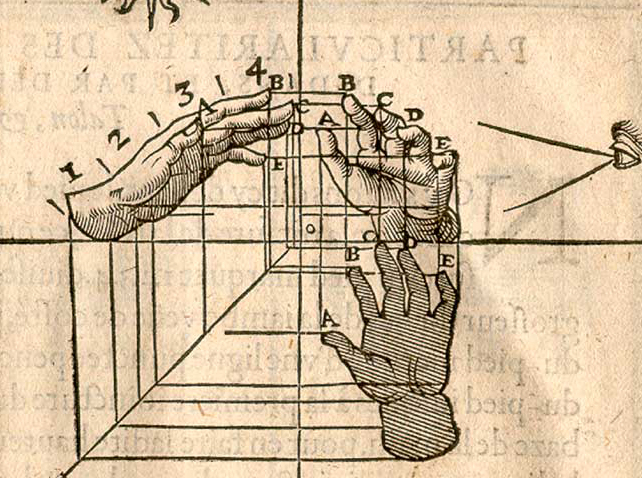
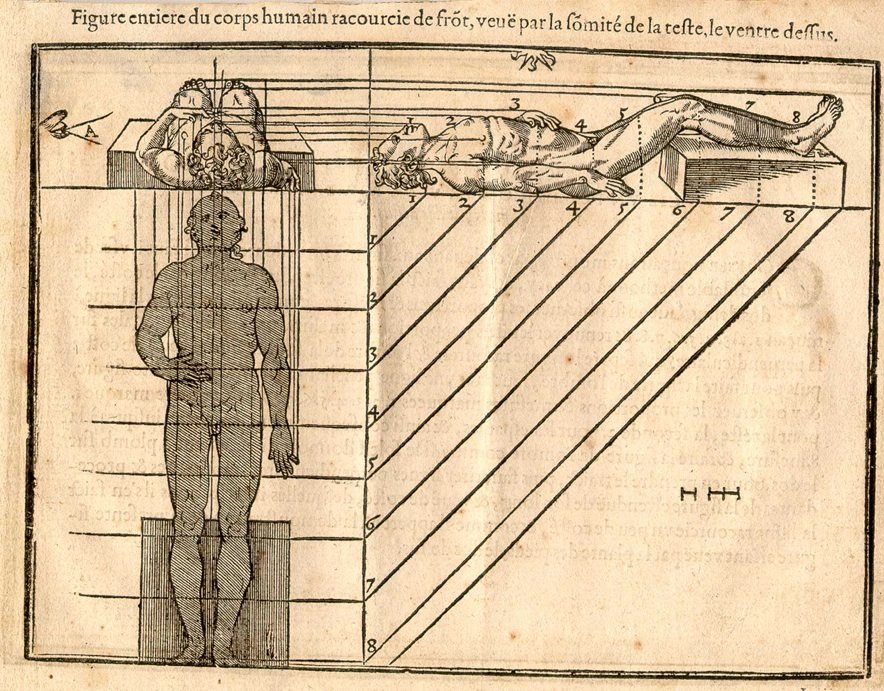
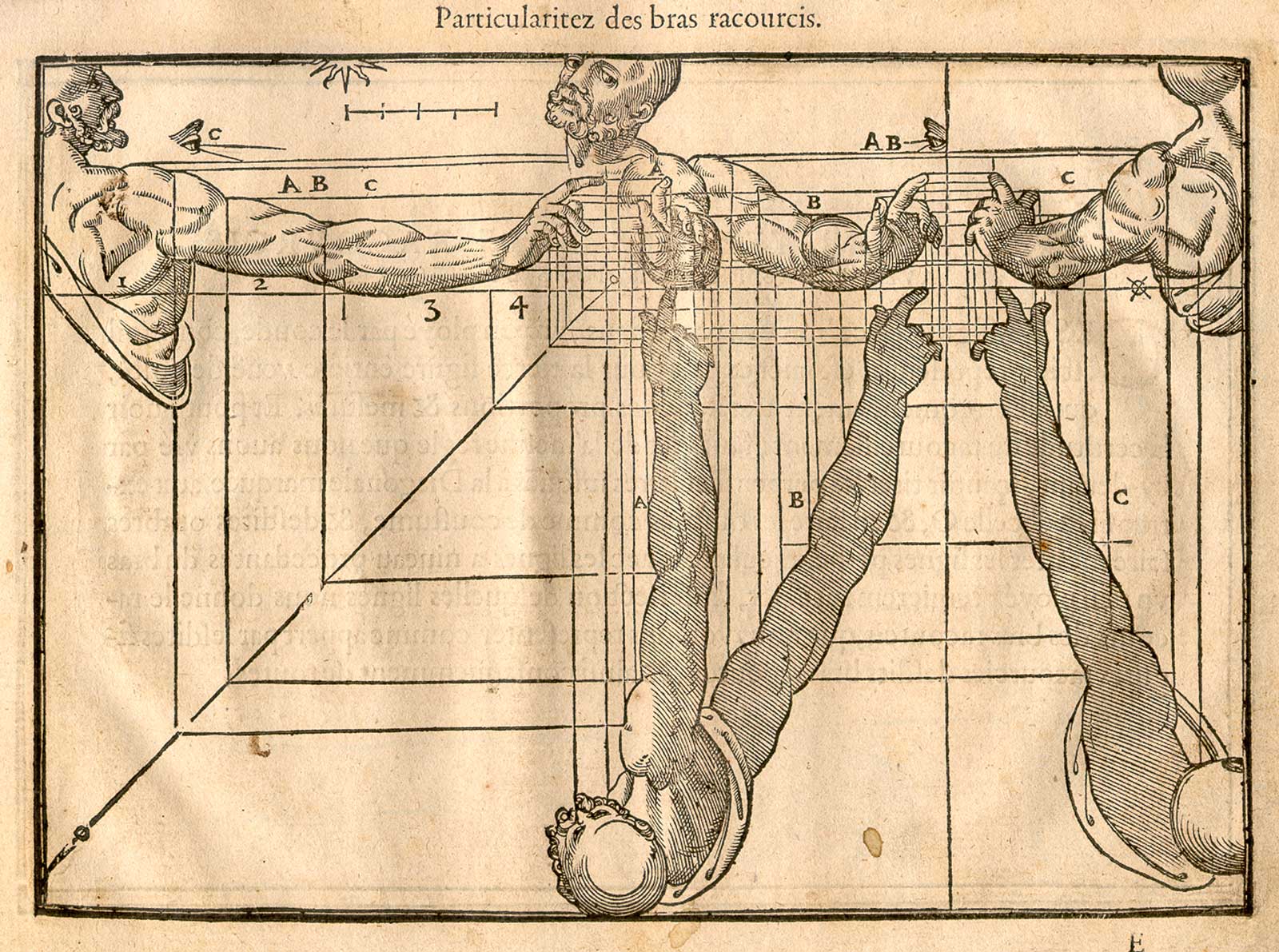
    I’m not sure if I’ve ever seen a 16th century human perspective drawing showing the body in plan and elevation and cross-section.  Jehan Cousin the Younger (1522-1595, in France), the son of Jean Cousin the Elder 91490-1560), a painter and sculptor, produced such an image in his Livre de Perspective, which was published in 1560. Well, the image definitely was published in 1560, though the artist may have been father and it may have been son–they worked closely together, and the Younger was taught at great length by the Elder, so much so that their work became indistinguishable. Nevertheless, the images I think are quite extraordinary, as we see below: 


    And so by Andreas Mantegna, a classic example:

    The following images come from the 1608 edition of the Cousin Perspective. a number of which are fairly unusual (all from the Library of Congress site, here):
    Cousin_p16


  • The Written Test of the Dead and the Bump Map of Crime

    JF Ptak Science Books   Post 2062 
    Follow Me on Pinterest

    Thanks to the always-fascinating book by Jan Bondeson, Buried Alive, the Terrifying History of our Most Primal Fear (W.W. Norton, 2001), which excited this interest in Dr. Severin Icard. 

    The determination of the occurrence of death was a major medical feature of the 19th century, the French in particular waging a fight for how this to be so.  Briefly
    put, for centuries even before Pliny death was described as the absence
    of an audible heart—the crux of the sentence being the word “audible”,
    so that the end of life was dependent upon being a physician’s/person’s
    capacity to hear the heart beating.  This might be very
    problematic if the person listening for that heartbeat had faulty
    hearing from defect or age, as the listener would place his/her ear on
    the chest of the patient to determine if the heart was functioning or
    not.  The stethoscope wasn’t invented until 1816 by Rene
    Laennec–who produced a monaural device much like a primitive hearing
    horn made of solid wood—which was a vast improvement over no stethoscope
    at all, by again was very crude compared to early 20th century devices.  It
    was much more preferred by most doctors (though there were contingents
    who distrusted the instrument and wouldn’t use it and still others who
    thought it an insult to their person insinuating defective hearing
    capacity) compared to the ancient hairy-ear-on-chest method.  It was also, in a small way, a kind of auditory x-ray.

    There were other ways to make the sometimes very difficult determination of actual death.  Some methods seem extreme, and a little barbaric, and at the very least, “odd”, but they were also effective to some degree.  For example, Leon Collongues believed that he could hear the capillary functions of a possibly-dead person’s fingers if placed in his ear; Jules Antoine Josat
    invented a nipple-pincher (“pince-mamelon”) life-rejuvenation device,
    operating on the assumption that a deeply sedated person could not
    resist a strong pinch of the nipple and would have to wake up if alive; the tongue-pulling idea of Dr. J.-V. Laborde; Christian August Struwe’s electrical device that delivered a dual shock to the eye
    and lip that was supposed to result in a twitch in the supposed-departed’s eye or lip; the tobacco enema of Antoine Louis; Barnett’s scalding death cure, which recommended burning the skin of the
    arm to see if it blistered (no blister/no life); and so on, deep into the fearsome, troubled and death-filled night.

    There was one death test, though, that went beyond the others, if only because it employed a “written test”.  This was the invention of Dr. Severin Icard, who devised a putrefaction test where the words “I am really dead” on a piece of paper written in acetate of lead would be placed under the note of the “deceased” where the words would appear if they came into contact with putrefaction gas dioxide of sulphur.  So, the “breath” of the dead would force the letters to announce their death.  Unfortunately the test was not fool-proof and the not-dead could sometimes produce dead results, which would be highly unfortunate in the premature burial kind of way…which is somewhat ironic, because that is how many of these dead tests came into being. 

    I should point out that Icard had another outre idea for the physical determination and identification of criminals.  He proposed that a substance be injected into an unidentified part of a felon to identify the person as a criminal.  the injection would produce a visible bump or lump on the person, somewhere; multiples were also possible, as were the locations of the bumps, so that a trained eye could determine the crimes committed by the Bump Map of Crime on the victim. 


    [Source: Journal of the American Medical Association, volume LVII, July-December 1911.]


  • The Structural Imposition of Anatomy

    JF Ptak Science Books   Quick Post   

     
    Follow Me on Pinterest 

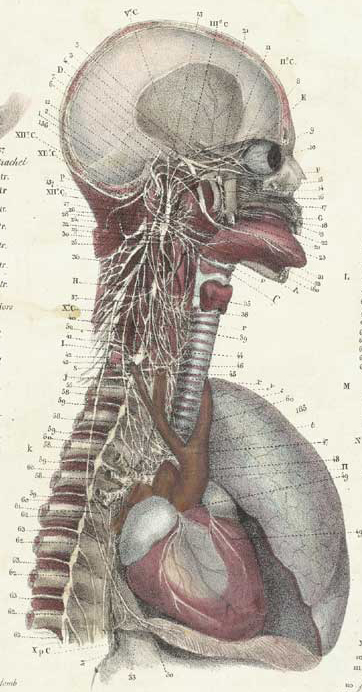
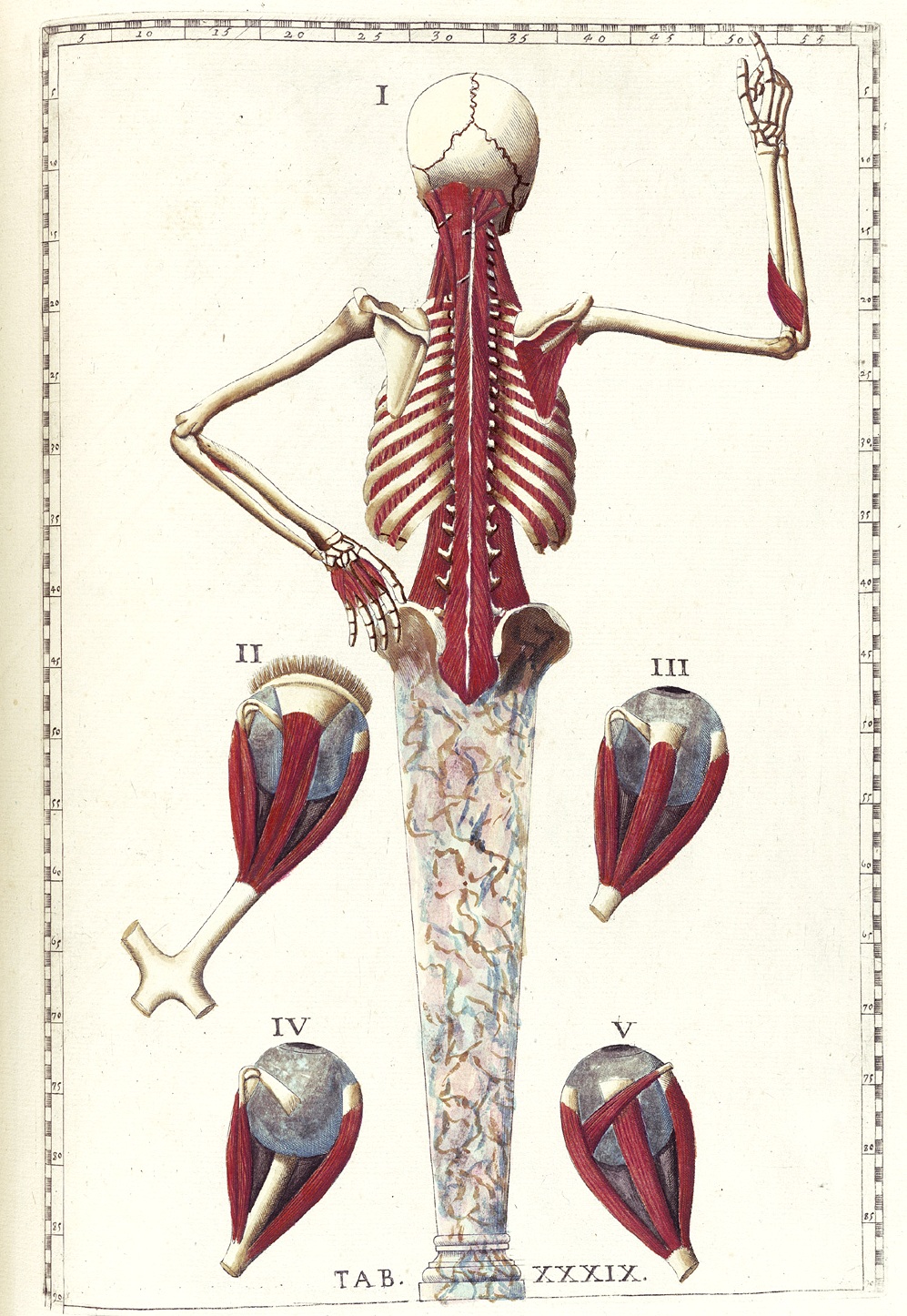
    There is something very art/plastic about this work, sculpture without the material, though there is already a marble stand from which the anatomical presentation springs.  The depiction of muscle is beautiful, and the inclusion of the muscles of the eyes–seemingly laid in to avoid letting the blank space go without use–gives the overall affect of the unintentional absurd.  The source for this delightful work is Bartholomeo Eustachi’s (d. 1574),  Romanae archetypae tabulae anatomicae novis…, published in Rome in 1783, the images drawn by Giulio de Musi for the anatomist Eustachi.  

    Eustachi_t39

    [Source:  National Library of Medicine, Dream Anatomy, here.]

    Eustachi

    ·Posted by :

    ·in:


  • NarcoPunk: Using Narcotics for Sleep & Enema Treatment of the Insane, 1845

    JF Ptak Science Books   Post 2009

    Follow Me on Pinterest


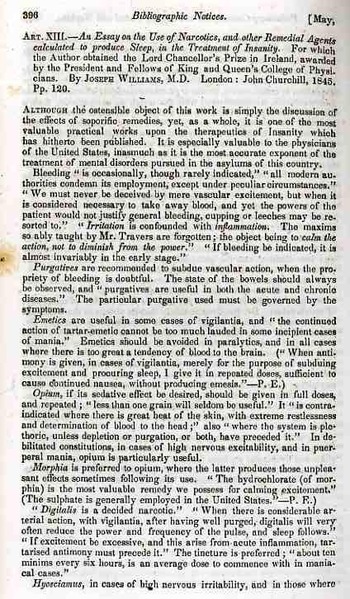
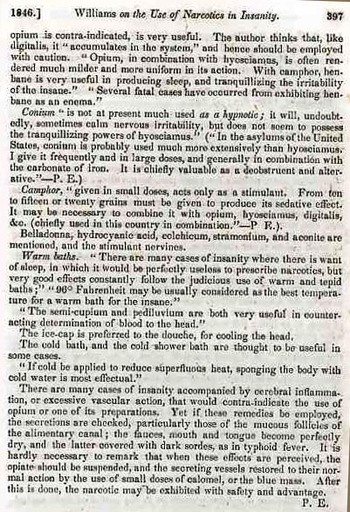
    This book review on the use of narcotics in treating the insane appeared in the New York Journal of Medicine for 1846.  The book, An Essay on the Use of Narcotics, and other remedial Agents calculated to produce Sleep in the Treatment of Insanity…., was by Joseph Williams, M.D., and was published in London in 1845.  The theory behind the sleep treatment was that the basic mechanism of insanity was “cerebral inflammation” or “excessive vascular action” in the brain—inducing deep sleep, evidently, was a good way to combat the over-active/inflammed/blooded-up brain.
    Blogdrugs_crazy254

    The article itself comes at an odd time in the history of the treatment of the insane.  It came almost 40 years after the establishment of  McLean Hospital (first known as the “Asylum for the Insane,” a division of the Massachusetts General Hospital), which opened on Oct. 1, 1818, and was the first hospital dedicated to the treatment of the insane in the U.S.  It came 70 years after the great advances of Benjamin Rush, who elevated the “Mental Patient” from chains on the floor to the status of medical or nervous illness or disease.  The use of narcotics over this period seems to have surged and waned.  In 1879, in an article in the New York Times, the reputation of the Asylum for the Insane on Ward’s Island in NYC was considered—and one of the high points was that it had (largely) discontinued the use of narcotics in treating the patients their. (There were still problems, of course, what with the asylum being overcrowded, housing 1100 in an institution meant to house 700, and where the chores and even nursing positions were staffed by the inmates, who were feed on 32 cents a day.)  As late as 1921, though, Jacob Alter Goldberg notes in his Social Aspects of the Treatment of the Insane, that there was a new, sharp increase in “toxic narcotic” treatments of the insane.  Of course, I guess one could replace “narcotic” with some sort of other misplaced treatment, like shock therapy, or Freudian mélanges, or something.  Each age must necessarily have their entry in the encyclopedia of embarrassments
    Blogdrugs_crazy255 . 

    In this article we find sleep assaulted by the use of the following:  purgatives (“to subdue vascular action when the propriety of bleeding is doubtful’), emetics, opium (to be used “in cases of high nervous excitability and in puerperal mania”), morphia (“the most valuable remedy for calming excitement”), hyosciamus (“to produce sleep, tranquilizing the irritability of the insane”).  It is weird to see that the last sentence in the description of hyosciamus reads “some fatal cases have occurred from exhibiting henbane as an enema”.  Henbane has been in use since ancient times, and is largely understood to be a dangerous/poisonous drug–to administer the thing as an enema leaves little doubt that it would kill people. 

    Still to come in the review is conium (“I have used it frequently and in large doses…it is chiefly valuable as a deobstruent and alternative”, followed by camphor, Belladonna, hydrocyanic acid, colchirum, stramonium aconite, and others.  “Warm baths’ makes an appearance (“90 degrees may be considered to be the best temperature for a warm bath for the insane”), as do cold baths, and the applications of ice caps. 

    I’m not so sure about what to make of it all, the sleep treatment of insanity I mean—after all, Joseph Lister only makes his epochal pronouncements on cleanliness in the operating theatre 15 or so years after this paper, which seems today to be the most rudimentary thing that one could do in treatment in the surgical room, so treating extra blood in the brain through drug-induced sleep doesn’t seem all that far away from the realm of possibility back there in early Victorian England.

    I don’t think I’ll forget the toxic narcotic enema any time soon, though.  Or the word “deobstruent”. 

    ·Posted by :

    ·in:

    —

  • A Map of the Human Ability to Replace Itself, 1610-1723

    JF Ptak Science Books   Post 2009

    Follow Me on Pinterest


    Blogmissing_man041_3

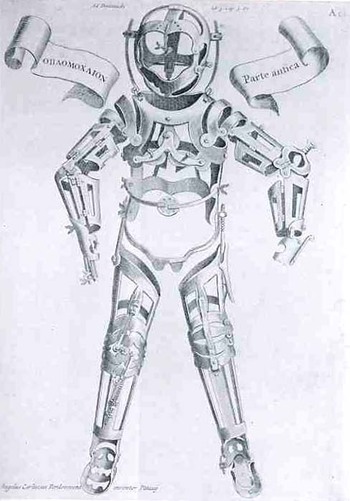
    This woodcut of applications and applicators to injured humans, lacking the human, waiting for the human, the missing human, was made by Hieronymous Fabrizzi (or Jerome Fabricius, 1537-1619), and found in his Opera Chirurgica, printed in 1723.  Even though this is a pretty straight-forward image, it strikes me as a little odd, a little off,  looking a bit like inhuman trappings, the entrapments of a human waiting to be built, an artificial skin with artificial bones.  It was much less than that, and in its way, much more—it was a statement of the advances of medicine in the 16th century, a map of the ability of man to replace himself; a map of the artificial man. Perhaps the image of our own artificial man, showing our ability to replace organs, bone, skin, limbs, etc.may come to look to the people of the near future the same way that we here in the present look back on Fabricius’ mage. 

    A Map of Getting Wounded

    Gersdorff_p21v_3

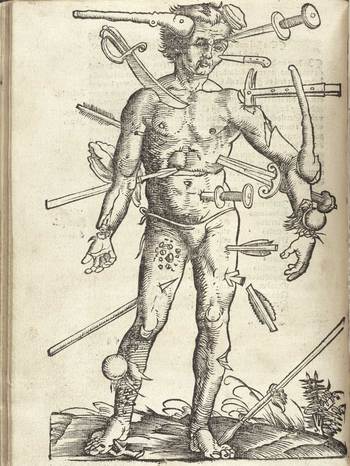
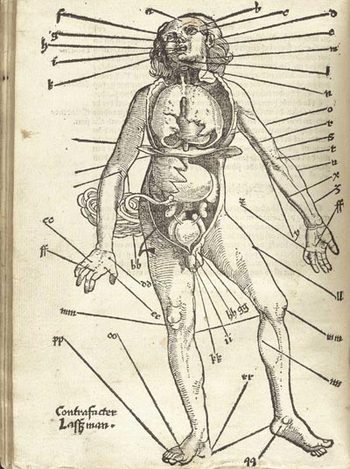
    This map of the wounded man was a very popular, much reproduced image, seeing publication in many works since it first appeared in Johannes de Ketham’s Fasciculus Medicinae,  printed in the year Columbus set sail for India.  It was a battle map, really—a battle for the human body, showing the effects of what happened to that body when someone tried to erase its existence.  The image is graphic, realistic and fairly gruesome, and highly useful.  It was accompanied by instructions on how to deal with all of the trauma, and to save the man thus that he could fight again.  In its way, this might be the earliest issue of M.A.S.H.  This woodcut, as the next, appeared in Hans von Gersdorff. Feldtbüch der Wundartzney (printed in Strassburg, by  H. Schotten, in 1528).

    A Map of Letting the Blood out of the Human Body.

    Gersdorffx400jpg_other_2

    Well, it really wasn’t like that, not how I mean by by snippy modernist viewpoint looking back on medical history with no contextual appreciation.  Bloodletting was an approach to healthfulness, as blood was seen as one of the four major elements (or “humours”) of the human body that needed to be kept in balance.  This was accomplished via the application of leeches or by the more common (and quicker) practice of venesection, or opening a vein to allow the blood to come out. (Let’s reference Steve Reich’s magnificent “Bruise Blood” creation of 1966 at this point—I don’t think that I’ll ever have a better chance to drop a reference to this piece of revolutionary music in regards to venesection again.)  Thus this map was map for the practiconers of bloodletting—the physicians, and more probably the barbers and other assistants who would inherit this lesser procedure from the more-busy doctors.  In the history of maps of anatomy and the general practice of mapping the human condition, this woodcut x-ray of the best places to drain human blood would not survive close to the age of modernity, disappearing almost entirely by the 18th century, and becoming much more scarce well before that.


  • Finding Scientific Method in Uroscopy, 1577

    JF Ptak Science Books   Post 1981

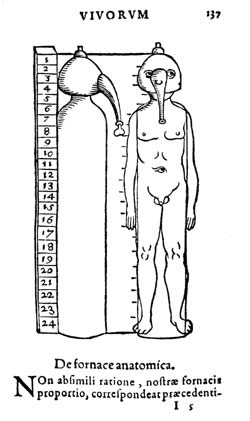
    Paracelsus furnace[Image: the anatomical furnace for the distillation and diagnosis of urine. From: Walter Pagel, Paracelsus: An Introduction to Philosophical Medicine in the Era of the Renaissance, second edition,  Basel/New York 1982, page 193/194. the image also found on line here.]

    While the ancient aspects of the inspection of urine as medical discovery seem distant, it is not so, the practice continuing for thousands of years, deep into the 17th century.  There are some surprises, though, here and there, in the recent history of uroscopy, particularly involving Paracelsus (Philippus Aureolus Theophrastus Bombastus von Hohenheim, 1493-1541), and specifically with his Anatomy, that is, the Dissection of the Living Body or of Distillation of the Urine, printed in 1577. This is one of the many of the works of Paracelsus printed posthumously–in his relatively short but very full life of 84 years, he published four books, but then in the 40 years or so following his death there were at least 14 more works that were published.  (A general overview of the works by and about Paracelsus–who worked in the areas of medico-occult and philosophy, alchemy, astronomy/astrology, theology, magic and more–can be found by piecing your way through the always-useful OCLC/WorldCat, here).

    In the practice of general uroscopy  urine was seen as a window into the health of the body–rather the lack of health.  For centuries urine was simply observed, its color plotted against color wheels.  Paracelsus worked in a different vein, and although this approach seemed as antiquated as possible after hundreds of years of practice, he adopted a proto-scientific approach to his urine inspection.  The idea of urine and his “anatomical furnace”, wherein the urine was distilled in a cylinder the size of the subject for interpretation, was a wide but interesting sidestep in the history of uroscopy, filled with some slight hope and more-than-slight abundance of need in belief. The point though is that Paracelsus went about this scientifically–no longer just an observational inspection: the urine was distilled, and coagulated bits (the “morbid species”) was separated from the urine, and the precipitated items were studied, a “chemical dissection” (according to Walter Pagels in his standard biography of Paracelsus 1982).  The cylinder was graduated in proportion to the subject; there was careful collection and handling of the specimen, and attempts were made to see beyond the standard practice of centuries past.  So there was some hint of scientific method in this work–something that Pagels notes but still labels the work “disappointing, albeit a subtle new brand of uroscopy”.


  • Strychnine for Weak Women, 1920

    JF Ptak Science Books   Quick Post

     
    Weak women061
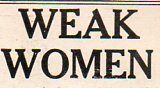
    Women, weak women, women with iron-poor blood, were sought by the manufacturers of Nuxated Iron, a small-bottled mottled mess that promised to increase vigor and iron levels, mostly through miracle.  It turns out that, according to various early studies, there was a very small amount of iron in the concoction, as well as small amounts of strychnine.  An E.O. Barker, M.D., reported to JAMA in 1923 that a small boy he attended who had taken 32 of these Nuxated Iron tablets died from strychnine poisoning.  There was no benefit from the iron, evidently; I wonder what the long term effects of small dosage ingestion of strychnine led to?  [“Weak Women” ad for Nuxated Iron from Illustrated World, November 1920/]