A Daily History of Holes, Dots, Lines, Science, History, Math, Physics, Art, the Unintentional Absurd, Architecture, Maps, Data Visualization, Blank and Missing Things, and so on. |1.6 million words, 7500 images, 4.9 million hits| Press & appearances in The Times, Le Figaro, Mensa, The Economist, The Guardian, Discovery News, Slate, Le Monde, Sci American Blogs, Le Pont, and many other places… 5000+ total posts since 2008.

Category: Industrial & Technological art

  • A Great Graphic Fumbled–What 300,000 Army Trucks Almost Looked Like, 1944

    JF Ptak Science Books   Post 1529

    If each of the 2,000 trucks pictured below carried $100,000,000 dollars in hundred dollar bills, how many trucks would it take to carry away the national debt?  Every one of them–this entire scene.  70 times.  Twenty miles of this convey, each truck carrying $100,000,000, would carrying off the debt.  Actually it would take 40 trucks (each with 100 million) to cart away the amount of debt accrued in daily interest on the national debt of 14 trillion dollars.

    Massive graphic548
    This Life magazine ad for the Chrysler Corporation–makers of Dodge–took the form of a public service announcement and a push to buy more ear bonds, though it really was an advertisement for itself and its wartime efforts.  What it proposed to graphically portray were the 300,000 trucks that it manufactured (to that point) for the U.S. Army–and the image that they use to get the point across is arresting, but it doesn’t come close to doing the job.

    It seems to me that the visible trucks here number about 2000 for the five columns; and I calculate that each of what we can see of the columns to be about 1500 feet long.  In order to show 300,000 trucks we’d need to show this page 150 times; or what Chrysler is showing is 1/150th of their total wartime production of trucks.  To show them all would take a lot of time for the two-star to review, hours, in fact.  I reckon that the five-column-wide display for the 300k trucks would be about 150 miles long. 

    Massive graphic549

    So even though this image is very persuasive and impressive, it doesn’t come close to the magnitude of the number’s display.

    Similar to the Chrysler ad is this:

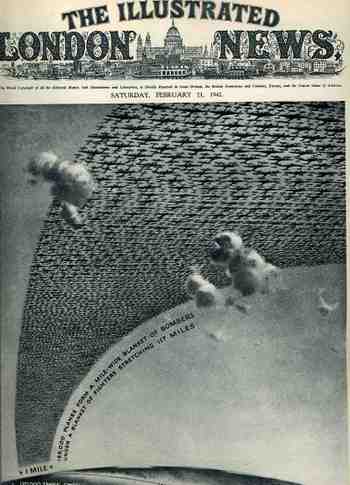
    1ebay_sept_30185000_planes695This arresting cover image for The Illustrated London News of 21 February 1942 illustrates the (new) American production program for planes and tanks for 1942 and 1943  The caption reads: “185,000 planes form a mile-wide blanket of bombers under a blanket of fighters stretching 117 miles” which is actually a double blanket of planes–if they were thinned out to form one layer it would stretch one mile wide from Washington D.C. to New York City, which is quite an unimaginable ribbon.

    The numbers and depiction are in some aspects similar, though it is still very difficult to get the point across of how massive these numbers really are.

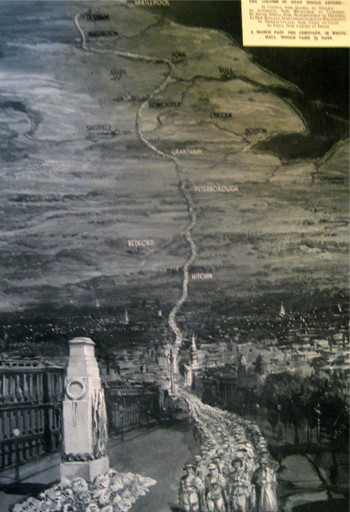
    The Chrysler ad says that the depiction of the trucks would “take up as much room as several million soldiers”, though it seems to me that any of the columns alone would do so. A while ago in this blog appeared a short piece on what 1,100,000 British war dead would look like, as presented by the Illustrated London News:

    Blogmarch

    The image (printed in 1933) shows the column stretching from London to Durham–London through Hitchin, through Bedford and Peterborough and Grantham, past Sheffield and Leeds and York, and then on to Durham–a distance of 269 miles or so.  Four across, a 269-mile column of dead soldiers.  That makes a pretty big point on an extraordinary sacrifice. 

    So the short end of the story is that back there during 1944, the Chrysler Corporation somehow managed to vastly underplay their war effort in an advertisement to themselves. 


  • A Backwards, Inside-Out, Oil + Iron Internet (1937)

    JF Ptak Science Books   Quick Post

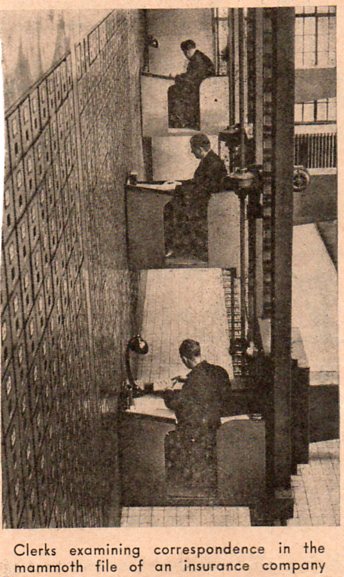
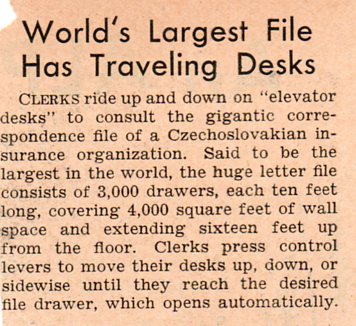
    I feel slightly queasy seeing this photograph, found in the August 1937 issue of Popular Science magazine–-it seems to me to be a backwards, inside-out analog cyberpunk (without the cyber) variety of the internet, a robotic device moving people around from data bit to data bit, an oil and iron process of automatic info retrieval, moving the user to the information rather than the other way around.  Desks517 Desks516 The image does put me in mind of Terry Gilliam’s Brazil, which renders info and other muck in a high-dystopian fashion with endless ducts and file cabinets, making things oppressively inaccessible in their accessibility.

    Brazil

    And to some degree there’s a little Spongebob similarity in there too, though without the iron nd metal part, just Mr. Squarepants and his cardboard filing cabinets for all of this thoughts and memories, serviced by smaller units of himself whop presumably have their own filing systems in their heads.  Filing cabinets, all the way down. 

    Spongebob's Brain
    There is a more-refined image of what is basically the same idea, found here in the fantastic bio-art of Fritz Kahn (1888-1968), who published his Der Mensch als Industriepalast (Man as an Industrial Palace or thereabouts) in Stuttgart in 1926.  Kahn is seen as a “modernist”, which I guess is true; to me he is far more than that–he’s “different”.

    In Charlie Chaplin’s great 1937 Modern Times, there are no file cabinets and I don’t think that there’s any paper, just the results of vast mechanization:

    http://www.altfg.com/Stars/m/modern-times-chaplin-conklin.jpg

    And of course, Fritz Lang’s Metropolis, made a little earlier, in 1927:

    Worker in Fritz Lang's movie, Metropolis

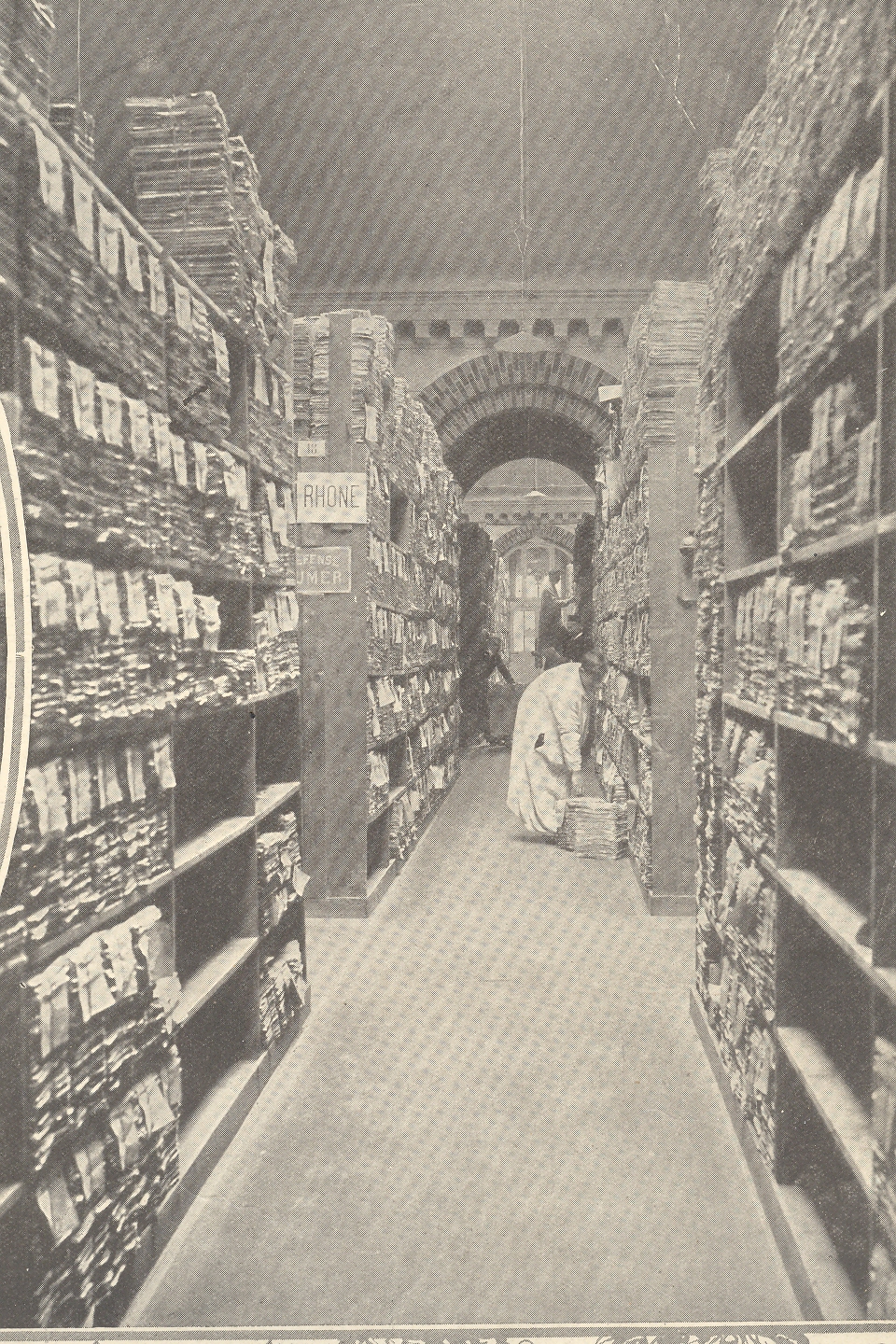
     And finally, an image of the semi-reverse of the gigantic filing system:  moving humans through mounds of paper not contained in file cabinets, stacked upon stacks of stacks.  Once everything is said and done, none of this info-sausage-factory seems very pretty.

    ++ blog ++ nov 16 french census 3


  • Precursor to Zombie-Phone-to-Deadsville: the Telephone Medical Metal Detector “X-Ray”

    JF Ptak ScienStructure513ce Books  Post 1495

    Did President Garfield Die Because of Metal Bed Springs?

    Thomas Edison famously took advantage of a naive reporter, telling the young man that he was working on an invention that would allow a person to telephone dead people–a story that was reported as true, and one which Edison (both thoroughly disgusted and joyful) helped to perpetuate to the day he died by simply not discussing the issue. (This story appears on this blog here.)

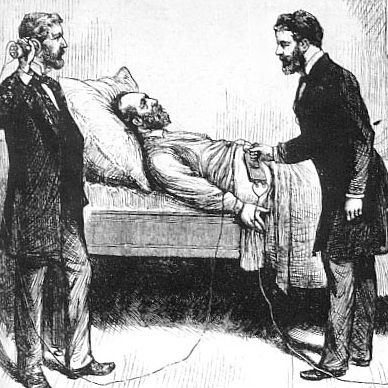
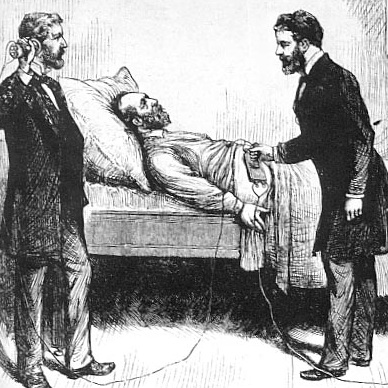
    Much earlier, only five years after Alexander Graham Bell first patented and published his invention of the telephone, the device was used by Bell to do some very early electrical medical imaging.  The new President of the United States, James Garfield, had been shot by Charles Guiteau in Baltimore and Potomac Railway Station (on 2 July, 1881, after a lengthy period of semi-abstract stalking and planning) Station in Washington, D.C., receiving fatal wounds in July and which would cause his death later in September.  The problem was that at this point in the history of surgery it was  difficult to locate bullets in the body, becoming more so if the bullet took a non-straight course through the wounded.  Normally, in 1881, a doctor could for example use a device called  a Nelaton probe, a thin porcelain device (as opposed to most other probes, which were metallic) to help locate the embedded bullet.  But given the nature of Garfield’s wounds, this was just not applicable, and the bullet escaped recognition from this and other probes.

    Bell enters the scene with an electromagnetic invention, the induction balance, which he created to detect interference on a telephone line.  In the process of experimentation Bell recognized that the balance could be disturbed if the metal and battery-fueled probe came into contact with a piece of metal.–basically, the device was a medical metal detector. Bell resolved to use the device on Garfield, passing the probe along the President’s body while another person listened to a telephone ear piece for the telltale “click” of a proximate metallic object.
    Bell telephone garfield
    Bell was not successful with this, or at least not so at this time, and the President died, succumbing to an infection, finally.  But Bell was able to perfect this instrument, something that stayed in use as the principal means of detecting metal objects in the body, and was about as fine an instrument as could be expected, though it was completely eclipsed by the revolutionary machines brought about by Wilhelm Roentgen’s discovery of X-Rays in 1895.  And as it just so happens, the first surgical case in which the x-rays were used was for a case involving a shotgun wound. 

    Finally, one of the reasons why Bell’s instrument didn’t quite work on President Garfield is that Garfield’s bed had a metal box spring, which very well might have played havoc with Bell’s instrument.  Perhaps if there was no metal in examining area, Bell’s device might’ve worked. 

    Notes:

    An earlier and more crude device had been invented by Wilhelm Heinrich Dove (1803-1879, a German physicist and early meteorologist) though I am not sure that it comes into play with Bell’s apparatus at all.

    From Harper’s Weekly, 13 August 1881:

    “The experiments made by Professor Alexander Graham Bell with the view of determining by the aid of the electric current the location of the bullet in the President’s person were of the most interesting nature. The possibility that a time might come when it would be necessary to make incisions at once for the removal of the bullet, without consuming precious time for further consultation, gave to the experiments an importance which added greatly to their interests.”

    “An apparatus known as the induction balance had been used by Professor Bell in analyzing metals. This instrument, modified so as to impart to it the highest degree of sensitiveness, was used in the search for the leaden ball. Its nature is such that it is not easily understood except by electricians. It consists of a battery, two coils of insulated wire, a circuit-breaker, and a telephone. The ends of the primary coil are connected with a battery, and those of the secondary coil are fastened to the posts of the telephone. This latter connection renders audible any faint sound produced by the circuit-breaker, or any change in the pitch of that sound. The coils may be so placed in their relationship to each other that no sound is made by the circuit-breaker. They are then said to be balanced, and the wires are extremely sensitive to the disturbing presence of any other piece of metal. A bullet like that with which the President was shot, before it was flattened, will, when placed within two and one-half inches of the most sensitive point on the pair of coils, cause a faint protest against the disturbance to arise in the telephone. A flattened bullet of the same bulk, when presented with its flat surface toward the coils, will make its presence felt at a distance of nearly five inches. When its sharp edge is turned toward the plane of the coils, no sound is produced beyond the distance of one inch.”

    “With these facts in view, the experiments to locate the position of the bullet in the President’s body were begun. The patient was bolstered up in bed, and he watched the proceedings with mute interest. His physicians stood around. Professor Bell stood with his back toward the President, holding the telephone to his ear, while Mr. Tainton, Professor Bell’s assistant, moved the coils over that portion of the abdomen where the leaden ball was thought to be imbedded. When the sensitive centre of the instrument was immediately over the black and blue spot that appeared shortly after the President was wounded, Professor Bell said, “Stop! there it is.”

    “The experiment was repeated several times — once with Mrs. Garfield listening at the telephone; and she told the President when the coils had been brought to the spot where the presence of the bullet had previously caused the delicate instrument to give forth a singing sound. From these tests it was inferred that in any event the bullet was less than five inches from the surface, and that if it was only slightly flattened, or if its edge was turned obliquely toward the surface, it might be much nearer to the skin. The conclusion reached was that if it should become necessary to remove the bullet at any time, this might be speedily accomplished by two quick cuts with the surgeon’s lancet.”


  • Graphical Display of Information: Identifying Ships from the Air, 1942

    JF Ptak Science Books  Quick Post

    Aircraft regonition494

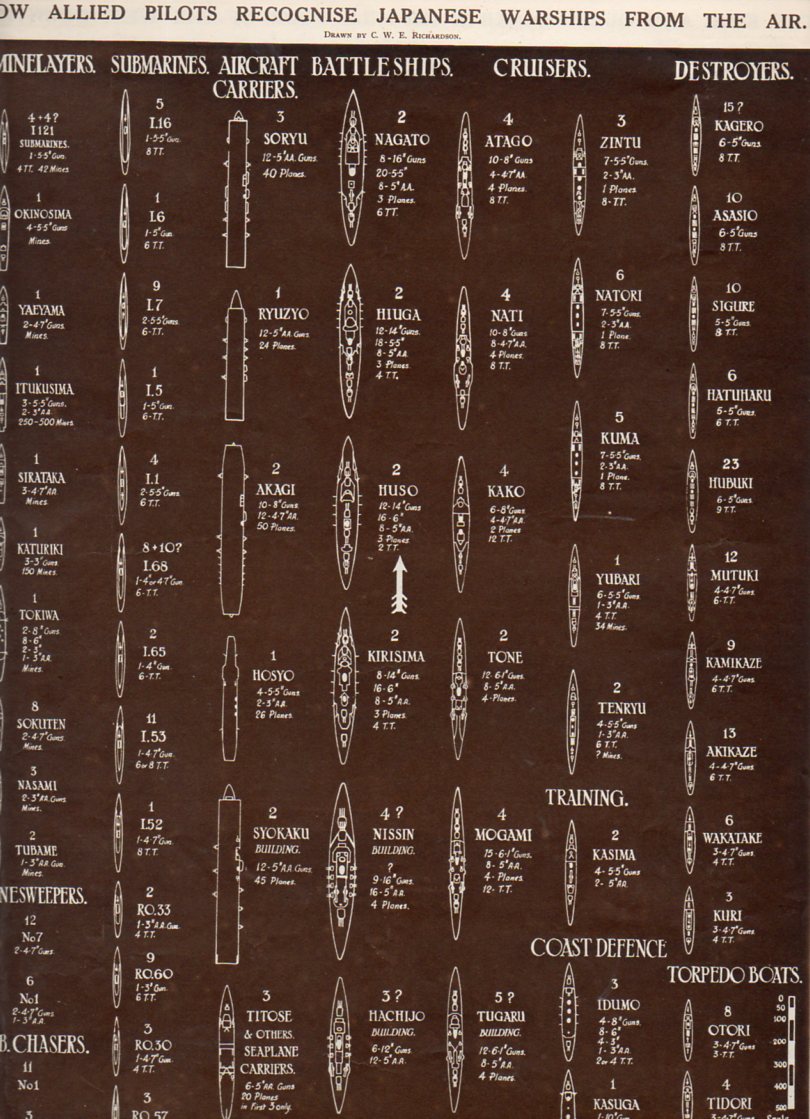
    “How Allied Pilots Recognize Japanese Warships from the Air”, a graphic that appeared in The Illustrated London News on 16 May 1942, displayed in silhouette the different sorts of Japanese warships that might be targets of allied planes.  There’s a lot of data on this one long sheet of paper, showing minelayers, submarines, aircraft carriers, battleships, cruisers, destroyers, subchasers, torpedo boats, training vessels and coastal defense ships–65 in all.  It is a great display, presenting a great amount of data in limited space, clearly and concisely, and very easy to distinguish and read. 


  • Species of Explosions: Human Anatomy, Explained

    JF Ptak Science Books   Post 1479

    Anatomia universale... by Paolo Mascagni and Antonio Serantoni

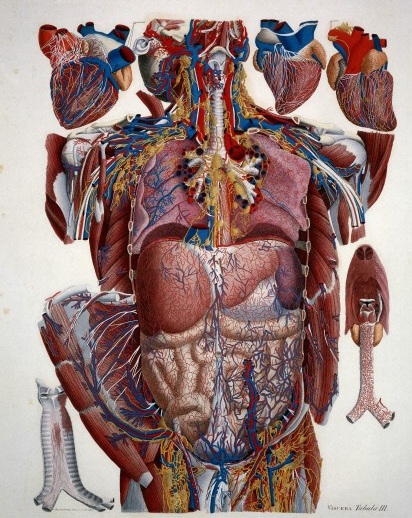
    Species of explosions come in all sorts of shapes and sizes, and basically release some sort of energy (chemical, nuclear, mechanical and so on), but in the cases we’ll look at here they are none-of-the-above.  The energy released in these explosions are in the form of potential, a knowledge-driven, controlled and reversibly ordered demolition, a deconstruction in slow motion.  The medical “explosion view” for the study of anatomy is a remarkable thing, especially when you considered not only the pre-Cat and pre-MRI times, but also the pre-Xray (1895) days of imaging the inside of the body–the images not only show you the bits and pieces alone but also in relation to the other bits around them.  The body becomes an archaeological dig, each level preserved so that a viewer could easily see the dependencies and relations between one thing and another. 
    Take for example Paolo Mascagni’s (1755-1815) beautiful Anatomia universale (an example seen above), which was printed in Florence in 1833 and has the look and sensibility of something much later.  Mascagni is able to achieve this depth not only from the exploded view, but also for the (somewhat exaggerated) coloring setting the specimen on top of a blank background the combination of the color and the background giving the whole thing a 3-D-ish feel–and if not that, then certainly a living image in which there is some fair amount of depth. 

    Anatomy exploded
    Another version of the exploded view which is also quite effective from the same work by Mascagni is his “exploded thorax”, showing a more limited display of the more closely-aligned organs. 

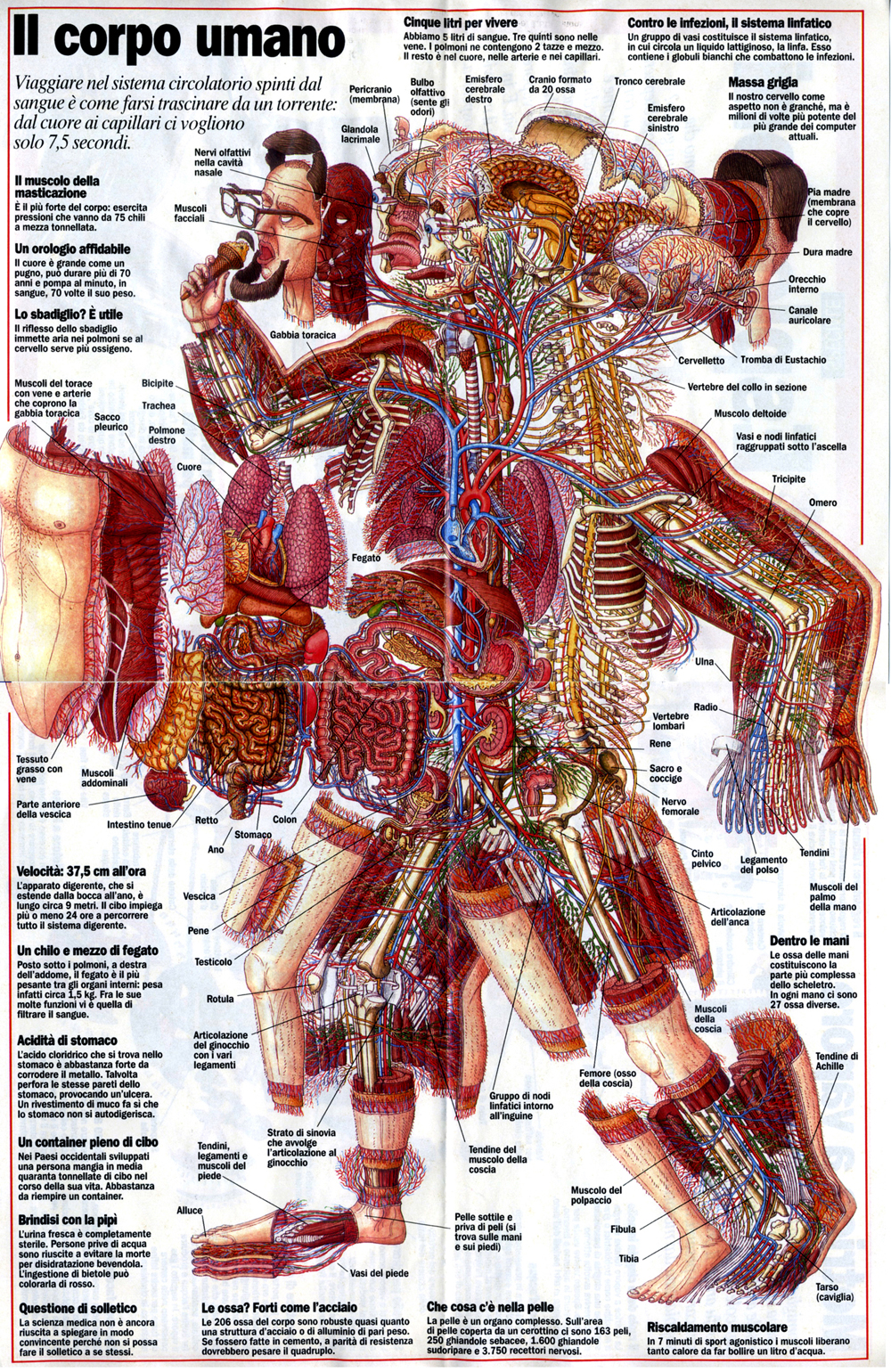
    When these views appear today–which is generally much more uncommon given the other technical ways of envisioning multiple layers of complex associated items–they have more of a sense of the antiquarian, retro feel to them, though they are no less useful for it.  As a matter of fact  I still prefer these views for understanding technical and engineering  and architectural complexes than anything else. And the modern master of this genre for me is Stephen Beisty, who performs his magic mostly in the tech and engineering fields, but who occasionally dips into the messy wet stuff of biology, as we can see in this fabulous exploded view:

    Anatom exploded beisty

    There are of course many other examples of (drawn) exploded views in the history of anatomical illustration, but I think these will do for now as good examples of the art.


  • Architecture of Insanity

    JF Ptak Science Books   Post 1474

    Insane asylum485

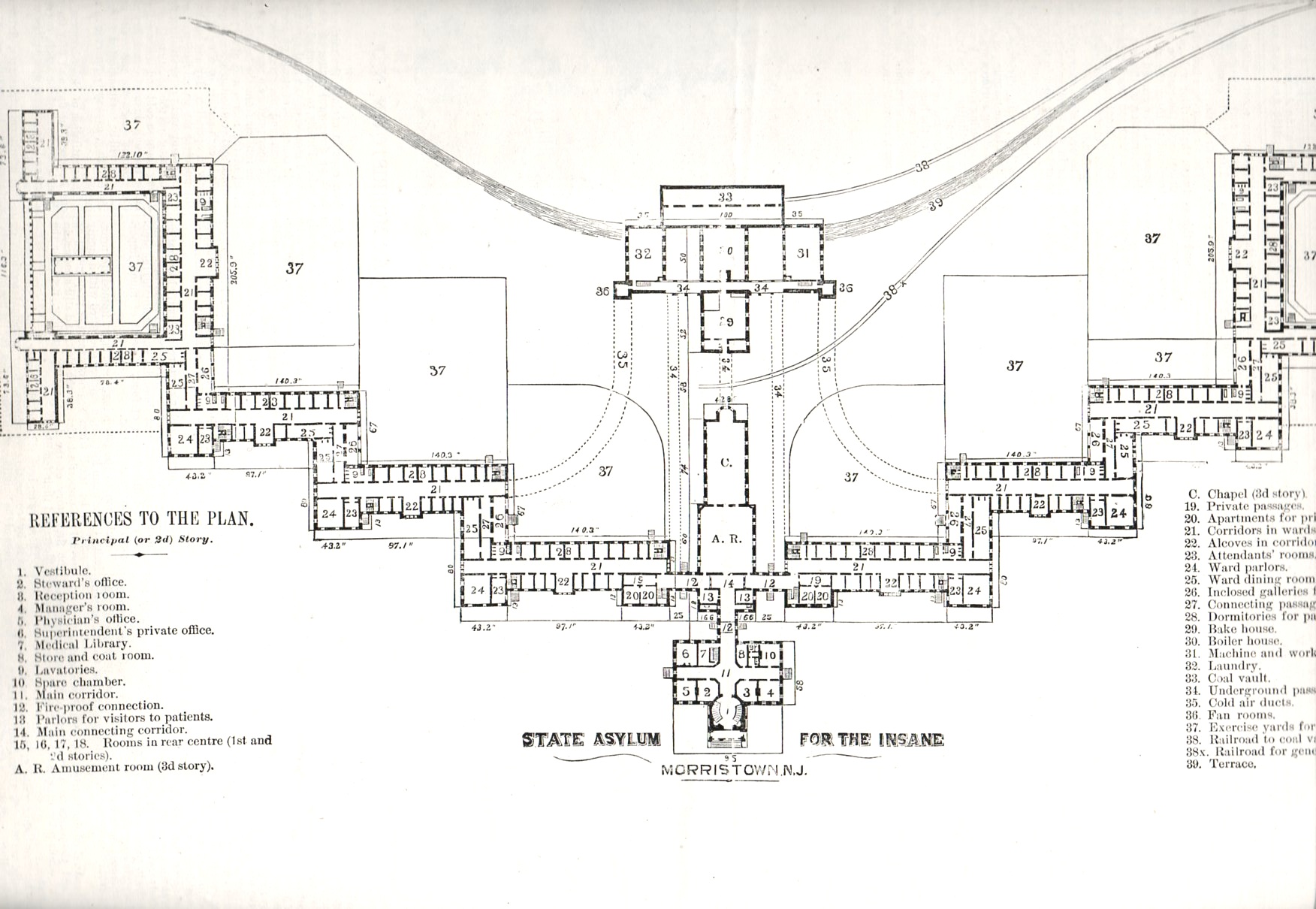
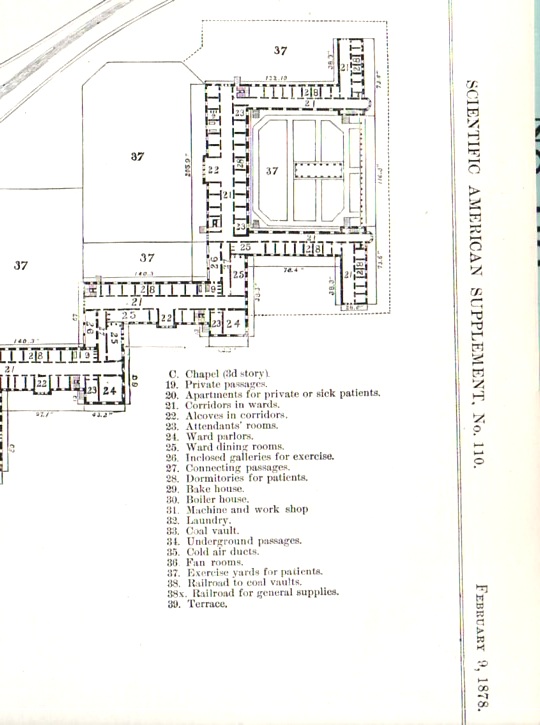
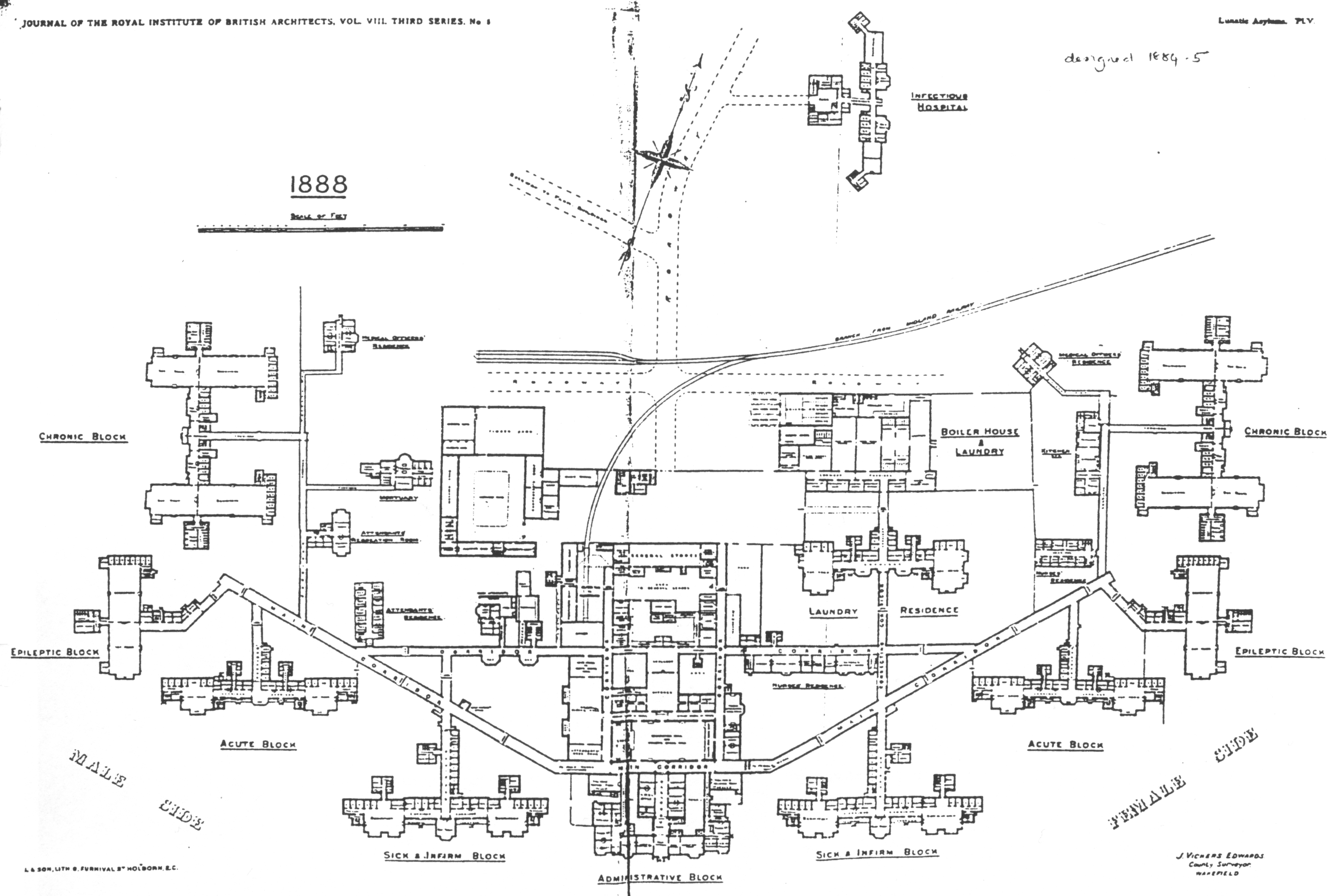
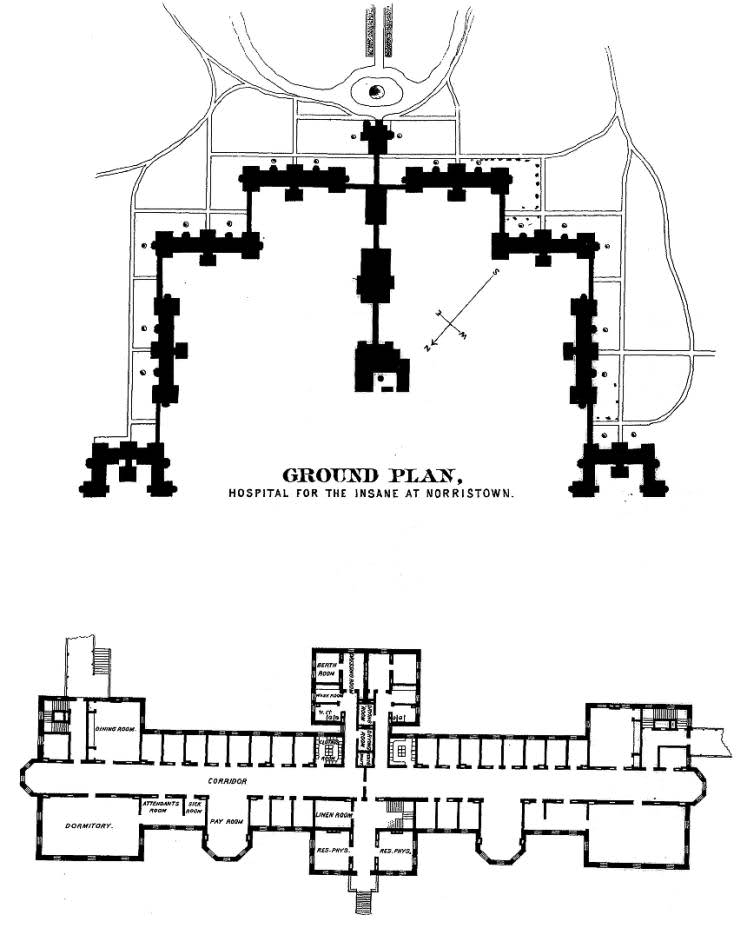
    I was browsing an 1878 issue of The Scientific American, looking for an article on torpedoes, when I came across this stunning architectural plan of the Morristown (New Jersey) State Asylum for the Insane–I recognized its design as something I had seen before, several times, at least.  This design required a lot of land and a lot of bricks–the building was a few stories high and laid out far and wide, built to accommodate 2,000 patients.  The design was intended to allow patients comfortable living space, room for privacy as need be, exercise area and plenty of open yards around the structure for sun and fresh air.  Of course building like this were quickly filled and filled some more, requiring the space for rehabilitation to be used for stockpiling other patients until more appropriate situations arose, which they mostly seemed not to.

    Insane asylum486

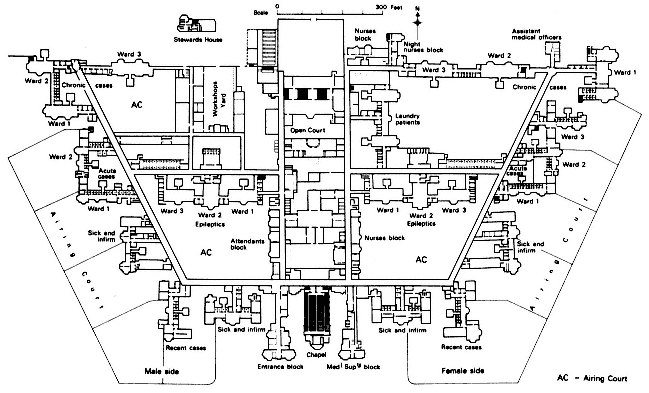
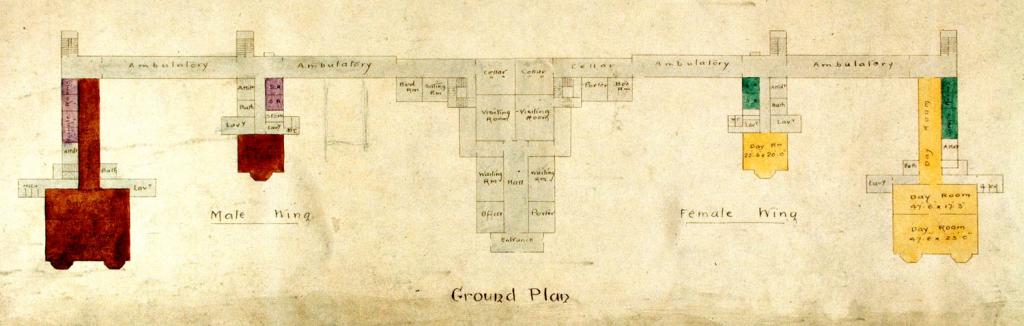
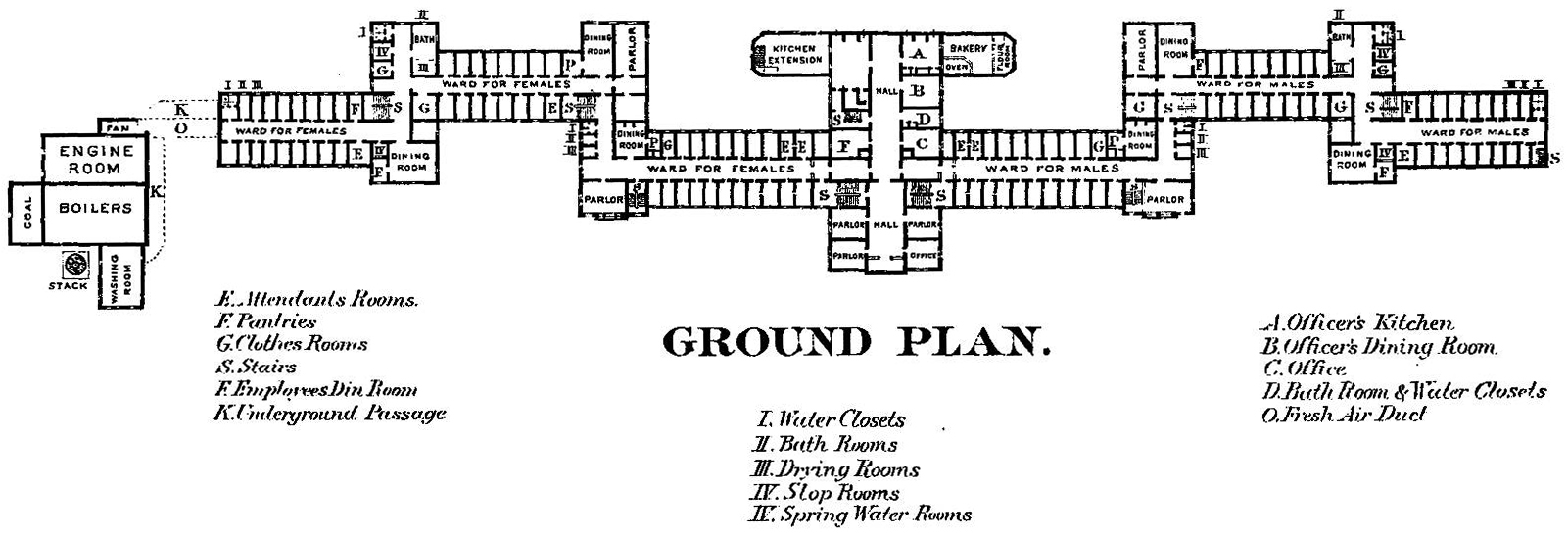
    And so I went looking around the web for other examples of mental/insane asylums, places constructed for the good of the society and partially to aid people who were suffering from some sort of yet-to-be-defined mental illness.  From what I have found so far, there is a definite them to a good many of them, resembling in some fair manner the Morristown design (above). 

    (An interesting and lush/ruinous photo essay on Morristown can be found here.)

    I suppose that in some ways these architectural plans are maps, outlines to an elusive wellness; given the (generally) small staffs, the abilities of the time to diagnosis mental illnesses, the limited capacities for treatment, and general overcrowding, that the “wellness” part of the desired ends of these plans/maps was almost entirely allegorical. I suspect that if for some reason you found yourself in an extended stay in a place like this and weren’t insane, then you would be after a while.

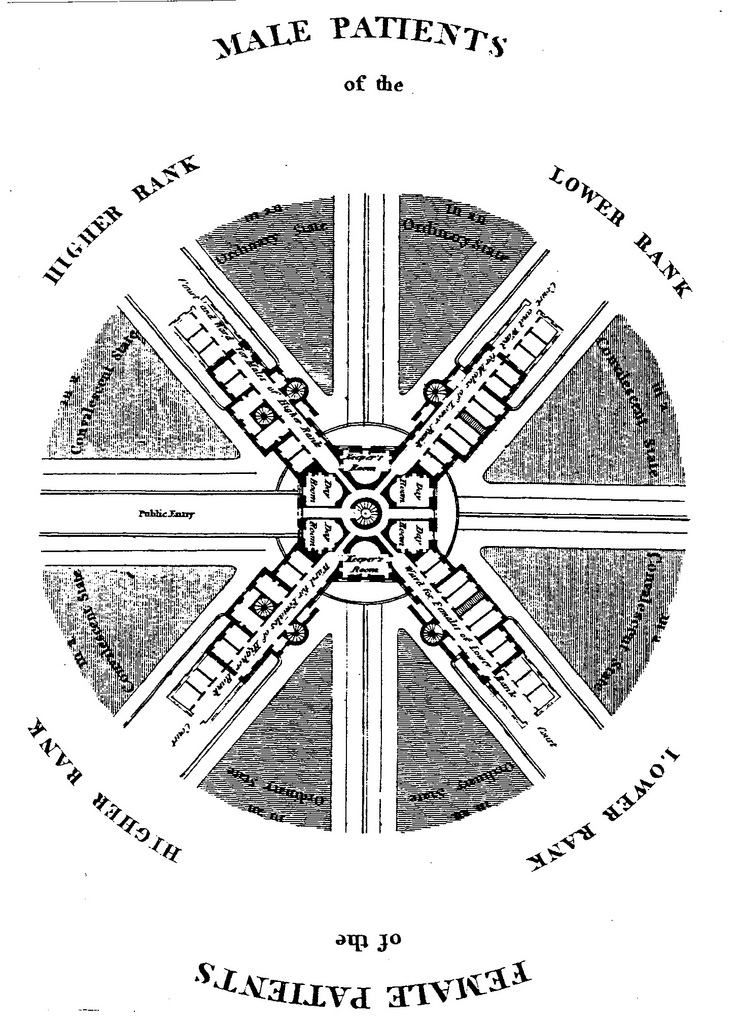
    The Glasgow Lunatic Asylum, designed by the  architect William Stark (1770 – 1814):

    Lunatic  glasgow

    [From:  Thompson, John D. & Grace Goldin. The Hospital. A Social and Architectural History. Yale University Press, New Haven and London. 1975.]
     

    Insane asylum maryland state hospital

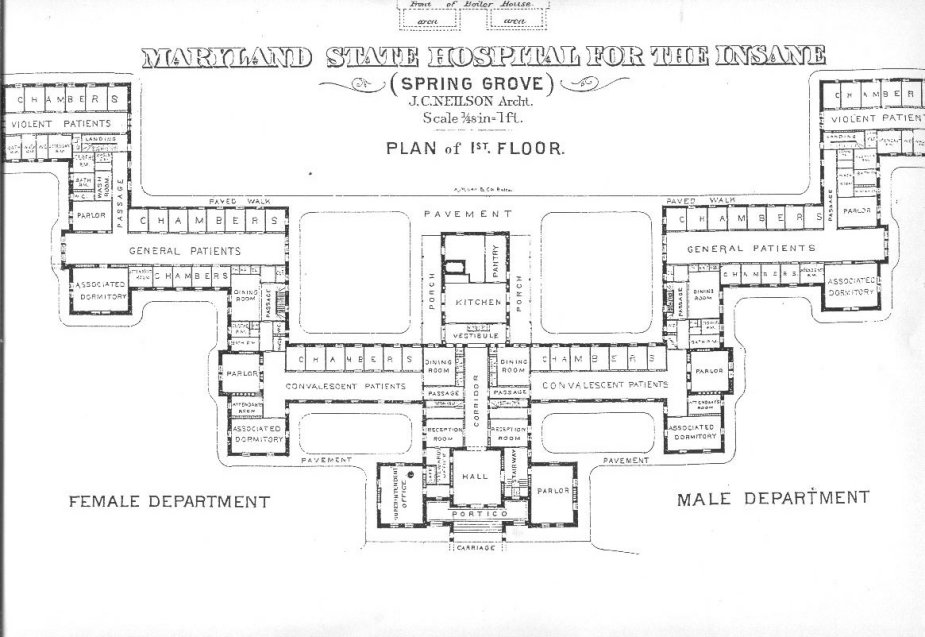
    Maryland State Hospital for the Insane (here)–in this plan, the further away you get from the main entrance, the more deeply “disturbed’ the patients.  It must have been a long walk from the “violent” ward to freedom. 

    Lunatic cane hill

    Cane Hill, the Third Surrey County Pauper Lunatic Asylum, built 1882 (details here)


    Lunatic claybury county

    Claybury Lunatic Asylum, Woodford, Essex:

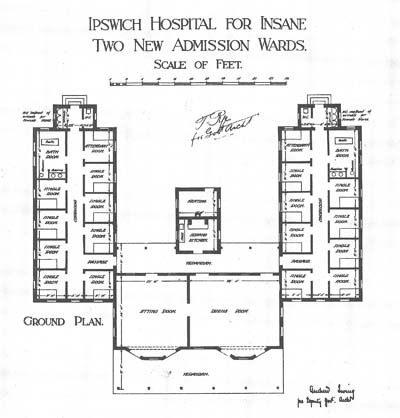
    Insane ipswich

     The Byron House, constructed 1915, at the Ipswich Lunatic Asylum (Byron house was to become the infamous Karrala House.)

    Lunatic buffalo richardson

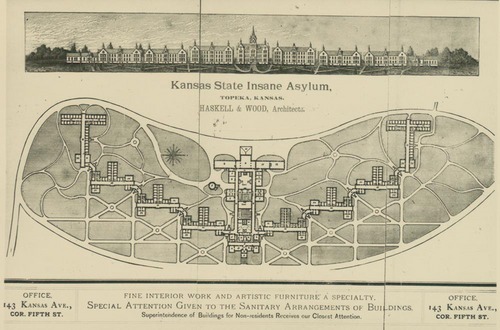
    Buffalo lunatic asylum, a spectacular structure designed by H.H. Richardson, with grounds and landscaping by none other than Frederiick Law Olmstead and Charles Vaux  The image above (and below) are the Kansas State Lunatic Asylum constructed 1880.  Information on these two institutions and the man who brought them about is located at the Kirkbride Buildings blog, here.

    Lunatic kansas


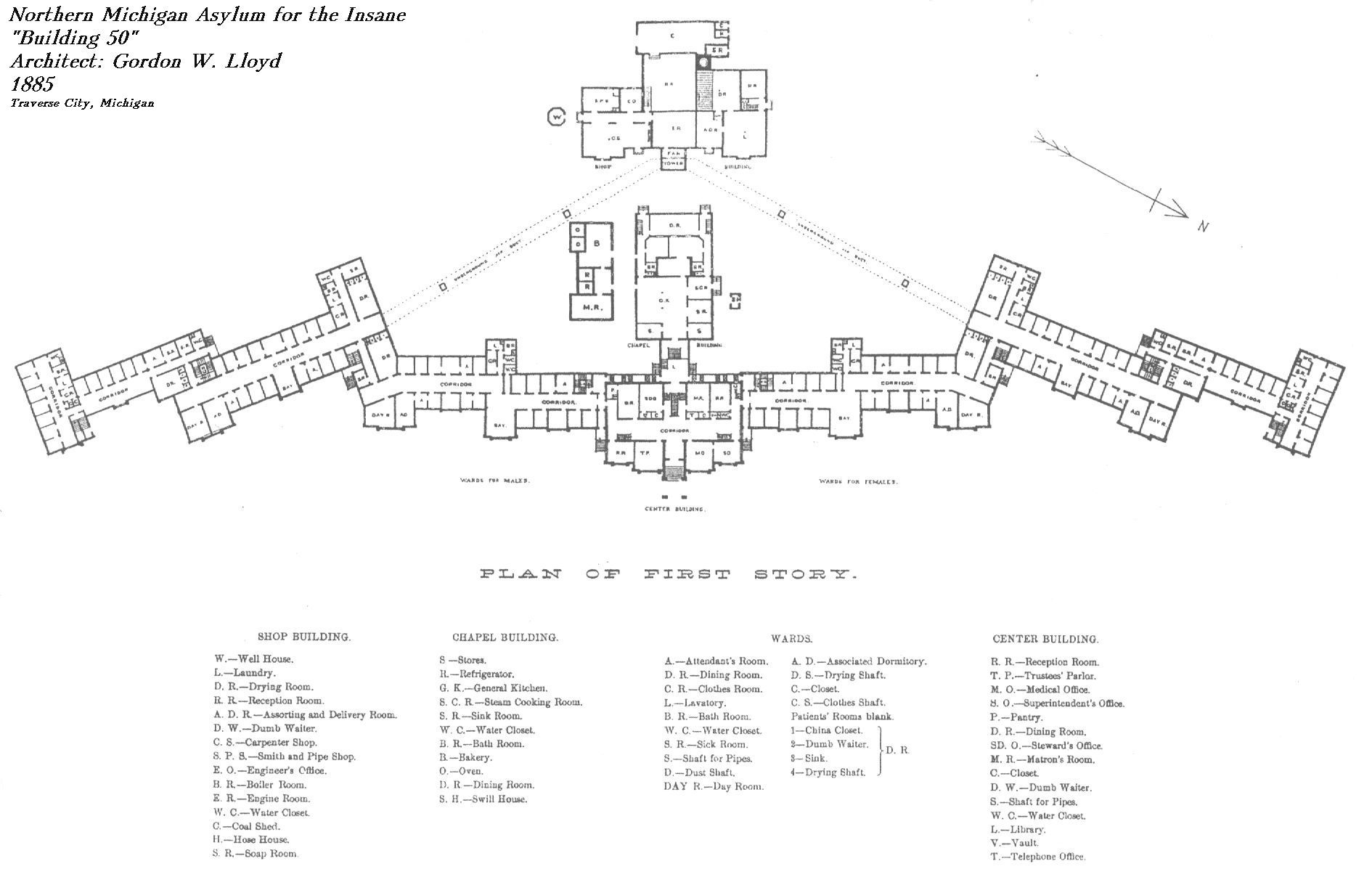
    Northern Michigan Asylum for the Insane, built by Gordon W. Lloyd in 1888:

    Lunatic  northern michigan

    Seacliff Lunatic Asylum, New Zealand:

    Lunatic seacliff


    HArrisburg (PA) State Lunatic Asylum, the first to be built according to the Kirkbride Plan:

    Lunatic  harrisburg

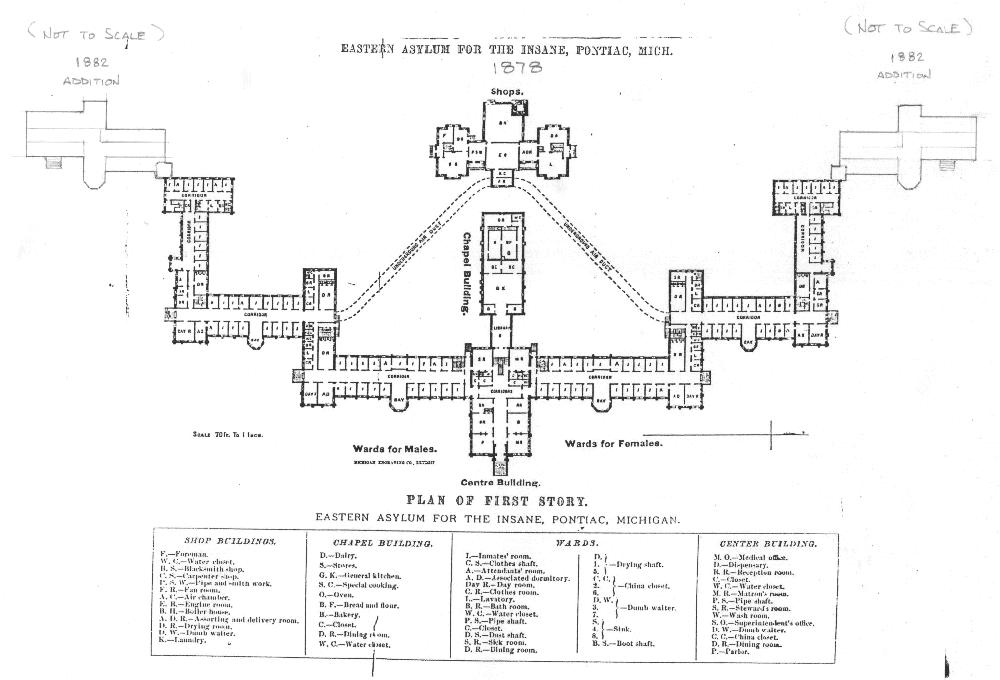
     Eastern Asylum for the Insane, Pontiac, Michigan, constructed 1882:
    Lunatic  eastyern asylum


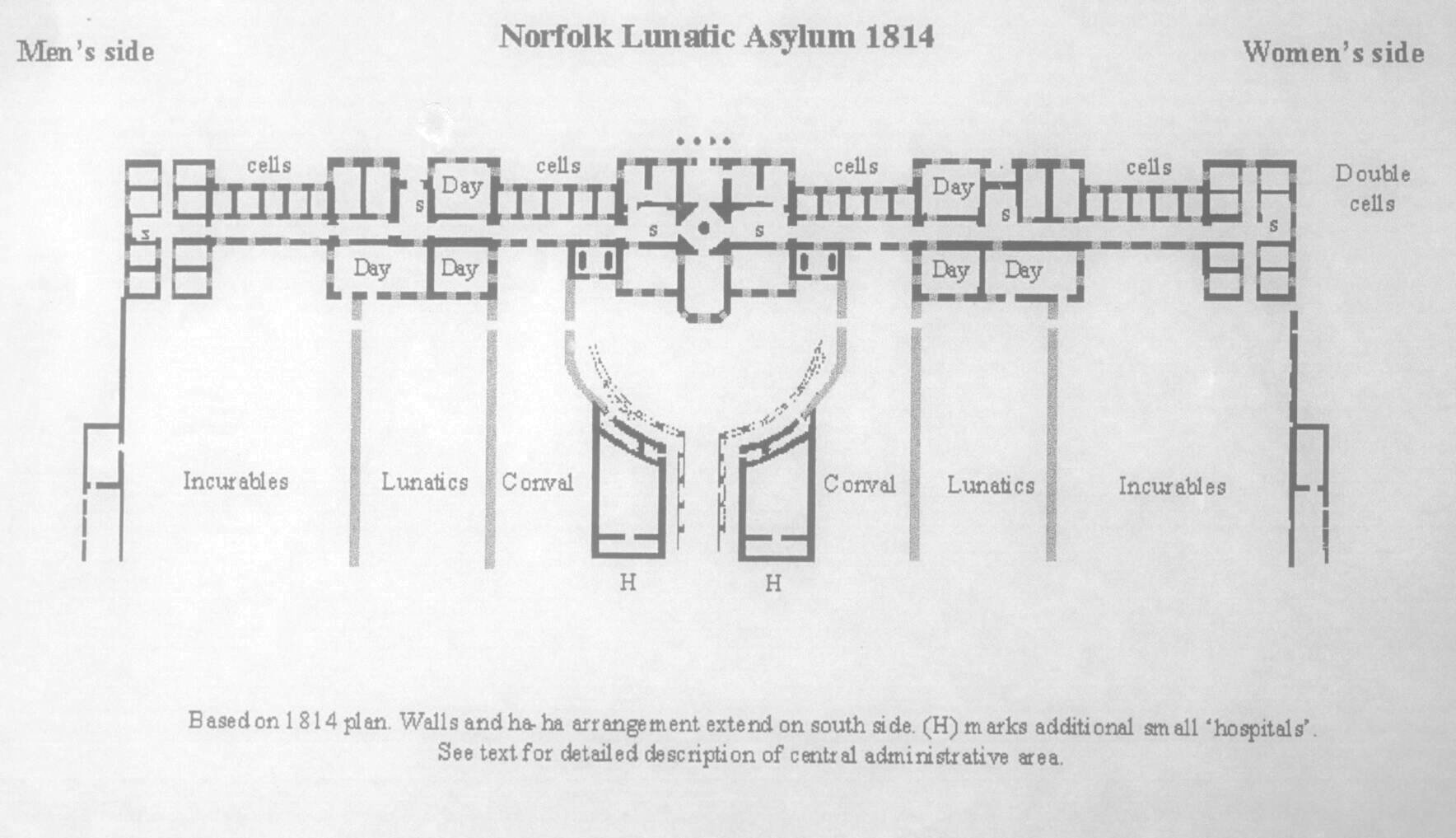
    Norfolk, England, Lunatic Asylum, 1814

    Lunatic norfolk

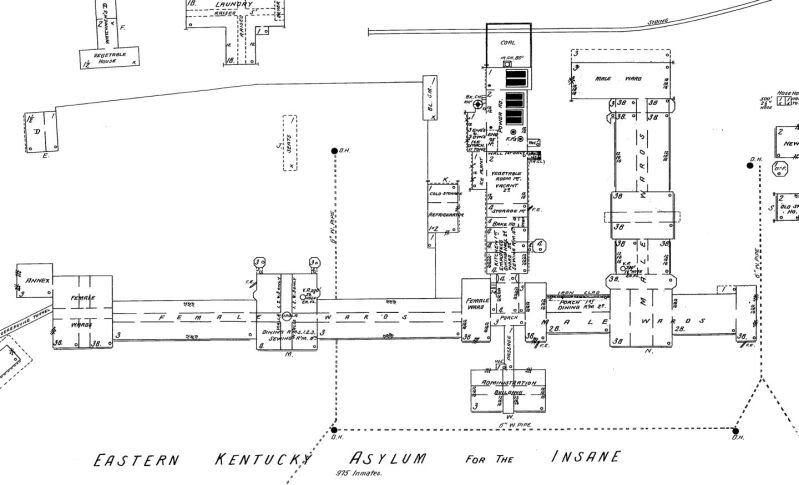
     Eastern Kentucky Asylum for the Insane:

    Lunatic--eastern KY hospital for the insane


    Norristown Hospital for the Insane:

    Lunatic--norristown hop for the insane


  • Archaeology of Bombing, 1913

    JF Ptak Science Books   Post 1472

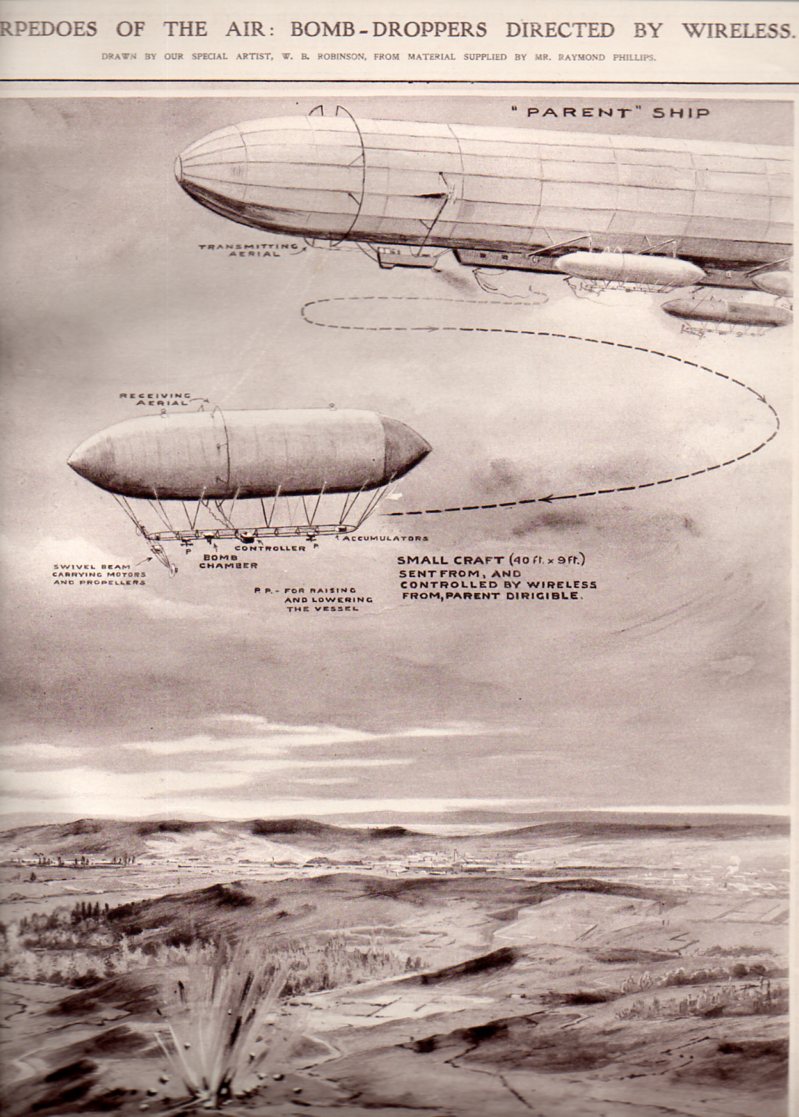
    This is another in a longish series of posts on this blog on the archaeology of bombing, aerial bombing, and today’s installment comes from its earliest period.  The first air assault belongs to the Italians, who used the weapons from the air in bombing Tripoli in 1911, which they also found to be within the defensible scope of international law, even when used against a noncombatant population (which came on the heals of the Italian army’s massacre of civilians there).  Bombing from the air had happened earlier of course, but also entirely in fiction:  for example, Jules Verne bombed civilians in The Flight of Engineer Roburs (1886), and H.G. Wells had New York City in flames in The War in the Air (1908).

    “Torpedoes of the Air:  Bomb-Droppers Directed by Wireless”, a graphical story that appeared in The Illustrated London News on 6 September 1913, and drawn by W.B. Robinson, describes a sort of two-tier remote controlled aerial bombing arrangement of dirigibles.  The “parent” ship hosts a number of smaller dirigibles which are radio-controlled elements sent in to do the actual bombing, which allows for no human interaction with dropping the bombs and exposes only materiel to enemy fire.  (I should point out that each one of these early drones were 40′ long, making the parent dirigible something like 400′ in length if we are seeing about half of it in the illustration, and enabling the thing to carry perhaps 10 of these remote controlled units.  This dirigible would have been about as big as the monster Zeppelin LZ1.)

    Dirigibl e torpedoes481

    And this two years after this remarkable graphical display:

    Info display dreadnought237

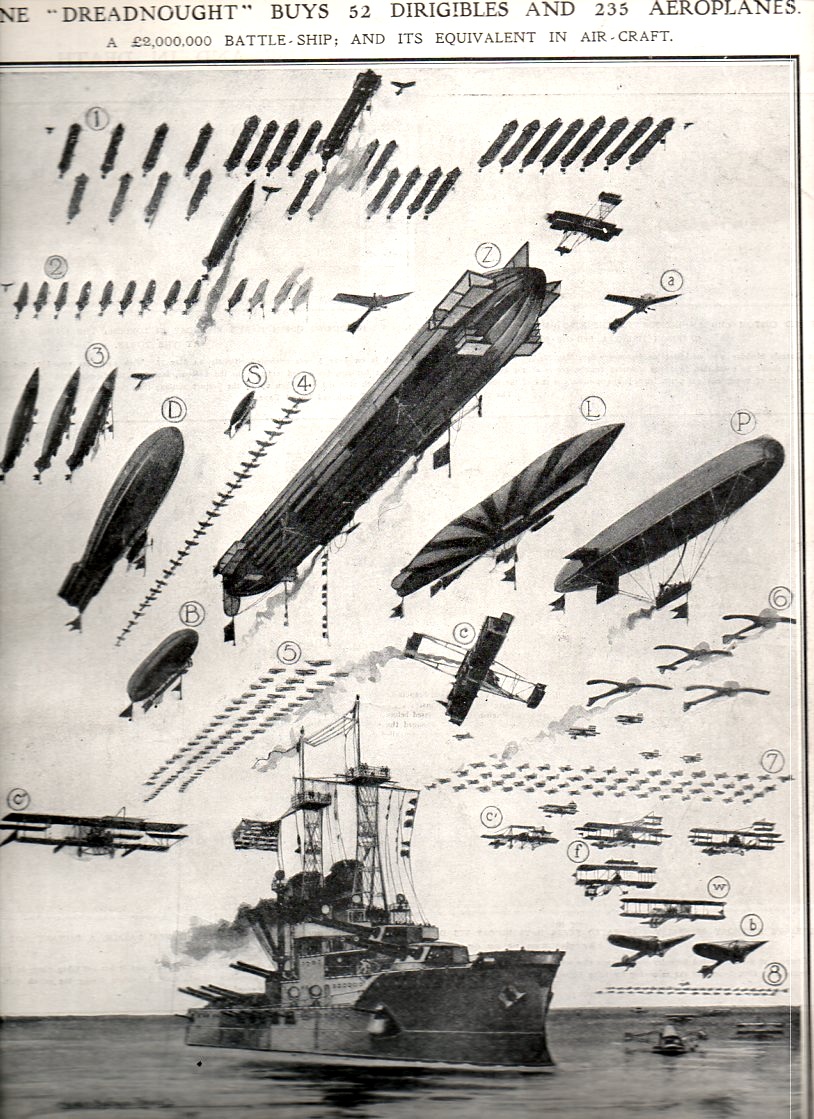
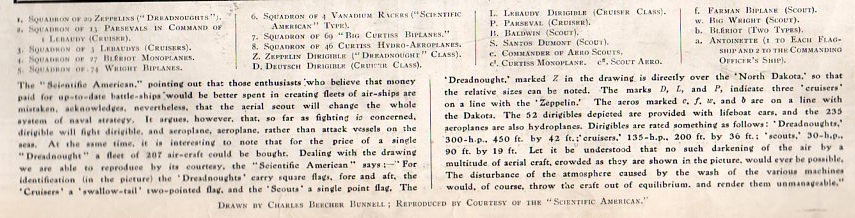
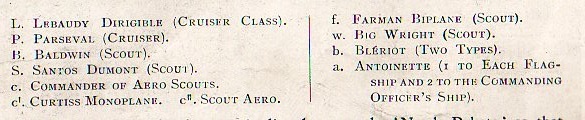
    There’s nothing quite so satisfying as seeing a representation of quantitative data like this where the graphical displays are flying.  “One Dreadnought Buys 52 Dirigibles and 235 Aeroplanes” is a full-page diagram appearing in the 3 June 1911 , making a very strong point that in the new air-age 2 million pounds for one battleship buys a lot of aircraft.  Of course this is a British journal and the ship is flying an American flag–the image originally appeared in the Scientific American just a short while before this publication, and so it also enumerates American and international aircraft, making for a lovely representation of a broad range of airplanes filling up the same sky.  (This image is available for purchase from our blog bookstore, here.)

    Info display dreadnought238
    Info display dreadnought239
    Info display dreadnought240


  • Standardizing Precision and Beautiful Technical Prints: Ramsden’s Dividing Engines

    JF Ptak Science Books   Post 1452.223221 and a quarter

      Ramsden386

    I like the idea of having something called a Dividing Engine–perhaps it would divide seeds, or complex problems, or simple problems, or perhaps it would divide division. 

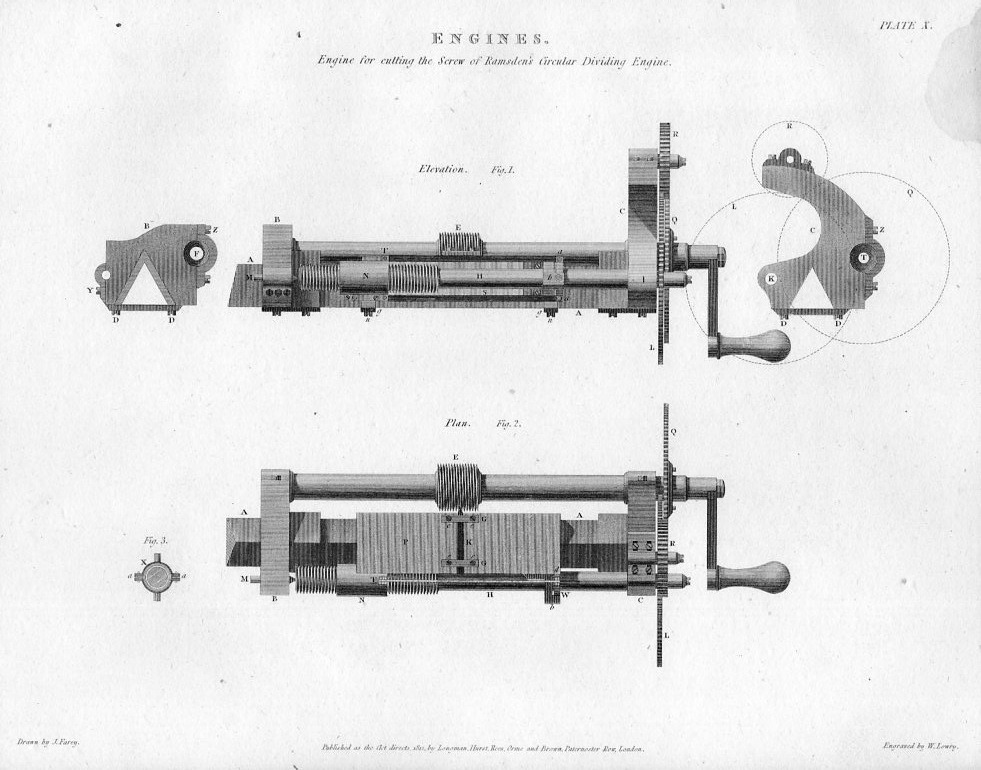
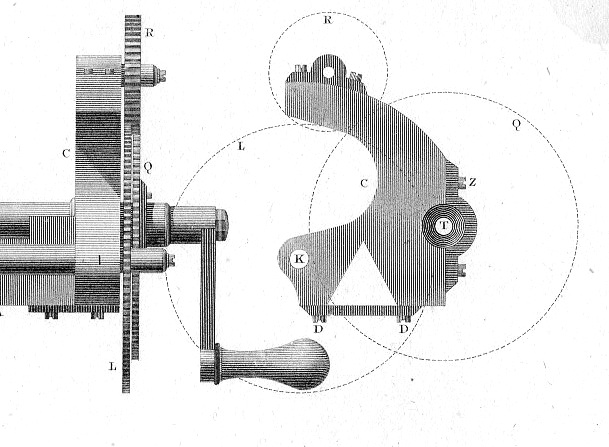
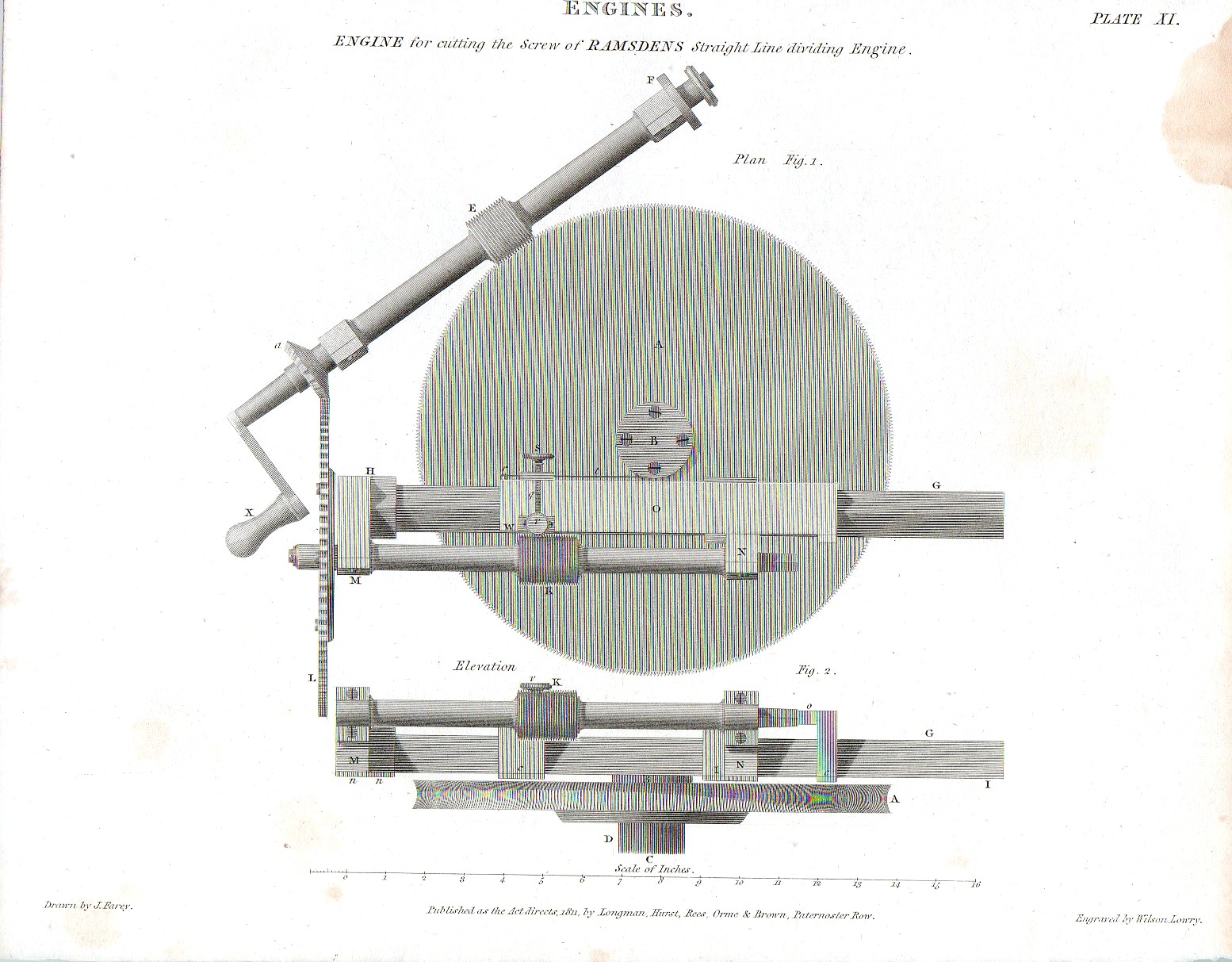
    What it really refers to here is a precision tool that whose effects were extremely wide felt but about which we don’t really hear about today.  This is the dividing engine of Jesse Ramsden,and Englishman who invented a circular instrument that would incise precise values on precision instruments like surveying compasses, delineate the linear and circular scales of measuring instruments used in astronomy and navigation,   Before Ramsden, the engraved marks on instruments would have been made by each individual manufacturer, each of those depending on marks that they made in the past, generations of such things in a line, over and over, a quite individualized effort, necessarily dependent upon the precision of each manufacturer. In 1777 Ramsden produced an instrument1 of exception precision that was correct and fine and dependable2. [The image above was found in Abraham Rees’ monumental Encyclopedic Dictionary…, and is entitled “Engine for cutting the screw of Ramsden’s Circular Dividing Engine” and was published in 1814.  Below is a detail of the plan for the winding of the gear works. In order for his machine to work at such a high degree of accuracy the component parts must also have been of a very high calibre–to that end Ramsden developed what is essentially the modern screw cutting lathe from which he manufactured the gear works for his Straight and Circular Dividing Engines.3]

    Ramsden387
    And then there was the “Engine for cutting the Screw of Ramsden’s Straight Line Dividing Engine”, which is an absolutely gorgeous piece of drawing.  A person could crawl all over this image in varying degrees of microscopic inspection and find all sorts of beautiful internal images, a large example appears here:

    Ramsden388

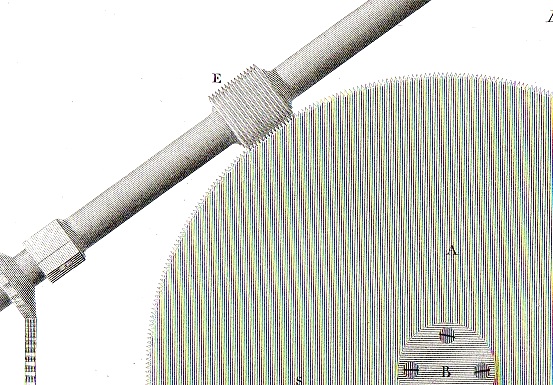
    And its fantastic detail:

    Ramsden389

    Basically though Ramsden’s inventions were key additions to the developing scientific technologies of the Industrial Revolution, integral improvements necessary for integral improvements. 

    Notes:

    1.  He published a Description of an Engine for dividing Mathematical Instruments in 1777.

    2. “The dividing engine was simple to operate. The instrument being divided was fixed to a large wheel on top of the engine. When the treadle was pressed, the wheel and the instrument were turned through a fixed angle. Then with the right hand, a cutting tool guided by a system of swinging links was used to mark the instrument scale. The process was repeated until the complete scale had been divided. Although this was many times faster than hand-dividing, it was backbreaking work having to lean over the engine to work on a small instrument.”-“Dividing Engine.” Smithsonian National Museum of American History. americanhistory.si.edu/collections/navigation/object.cfm?recordnumber=694508

    3. From WIki–“The first truly modern screw-cutting lathe was likely constructed by Jesse Ramsden in 1775. He appears to have been the first person to put a leadscrew into actual use (although, as Leonardo’s drawings show, he was not the first person ever to think of the idea), and he was the first to use diamond-tipped cutting tools.[2] His device also included a slide rest and change gear mechanism. These form the elements of a modern (non-CNC) lathe and are in use to this day. Ramsden was able to use his first screw-cutting lathe to make even more accurate lathes. With these, he was able to make an exceptionally accurate dividing engine and in turn, some of the finest astronomical, surveying, and navigational instruments of the 18th century.


  • The Problematic and Unspeakably Brief Beauty of Linoleum: Italy, 1933

    JF  Ptak Science Books   Post 1418

    Linoleum italian275
    In my imaginary History of Lines there is a chapter or two for humans-in-line(s).  In the history of the world, the fourth and fifth decades of the twentieth century—the 1930’s and ‘40’s—were big ones for human lines.   Big does not imply good, because as we all know lots of humans lined up for all manner of unspeakable nastiness during this time and well more than 100 million didn’t make it out alive (considering all of the wars, purges, revolutions and stupidity).

    The lines here are a little more benign, though with shriveled overtones of corrected respect.

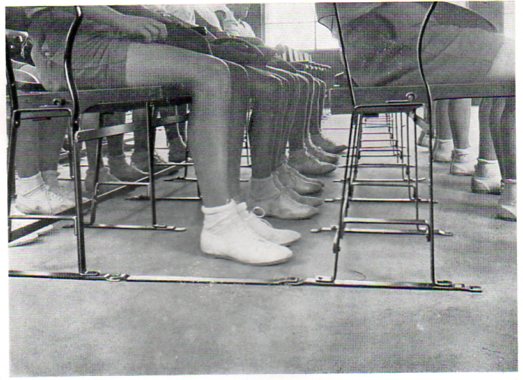
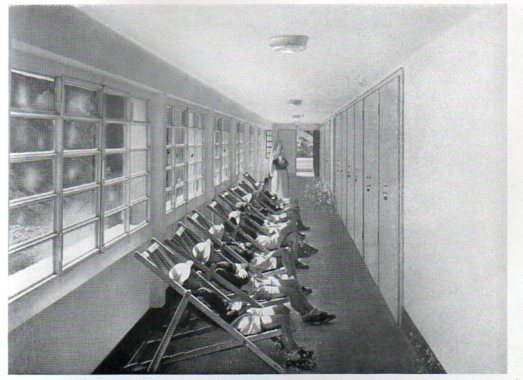
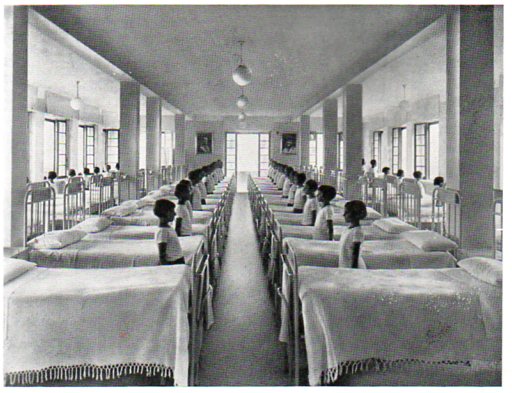
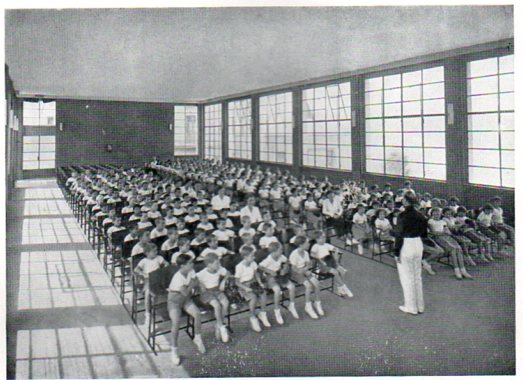
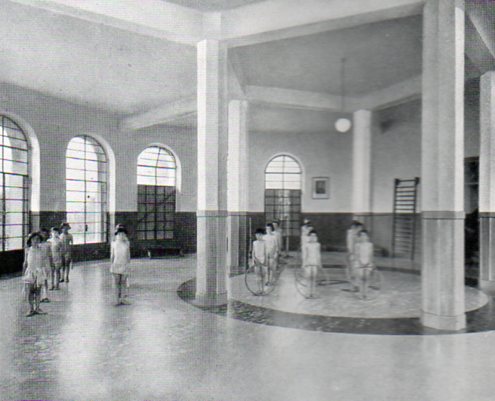
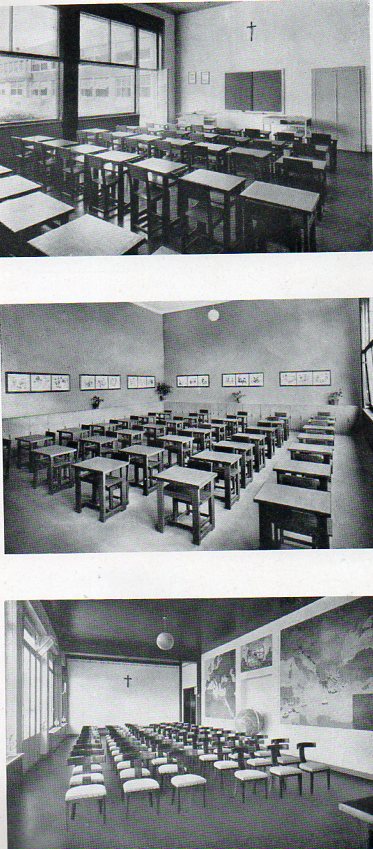
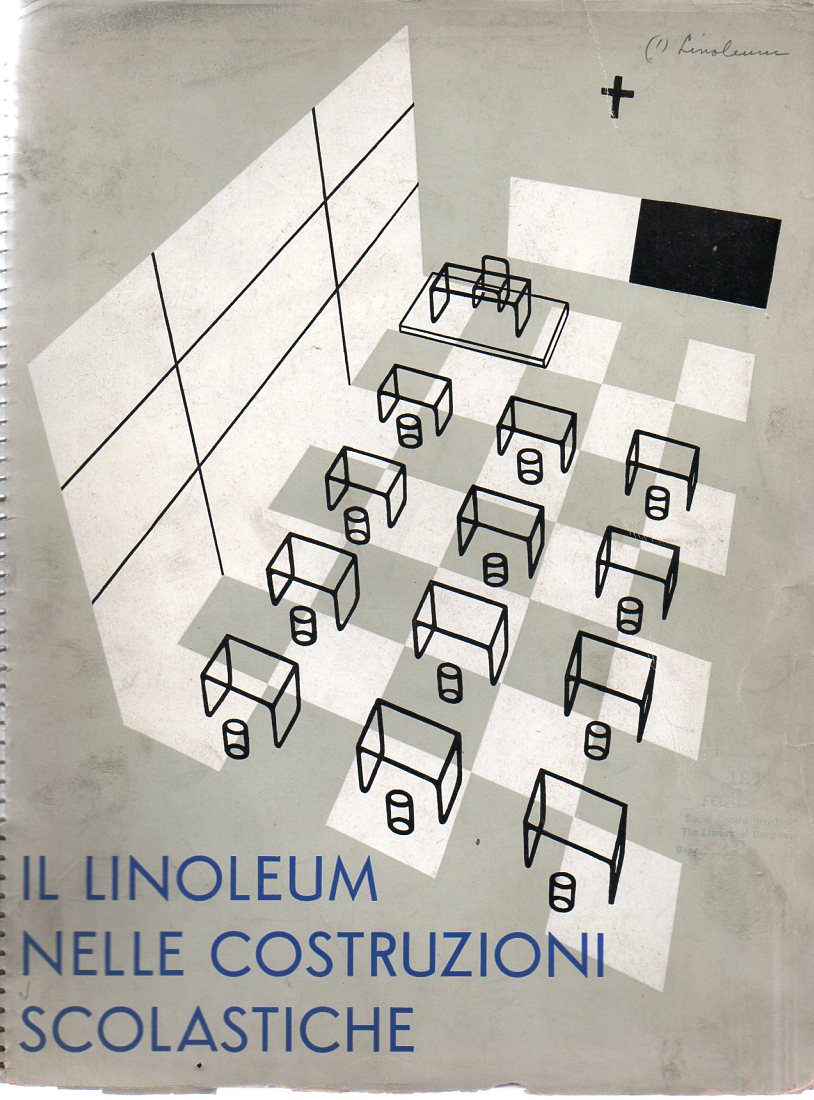
     Oppressive obedience in a well-designed environment is still like dressing your ear-infected 14-year-old St. Bernard/Jack Russell (?!) mixed breed in baby booties—its just not right, and these images attest to this simpy comparison. All of these photographs come from a delightful manufacturer’s catalog for linoleum products (Il Linoleim nelle Costruzioni Scolastiche), which was printed in Milano in 1933.(The original is available at our blog bookstore.)

    Linoleum italian277
     I’ll undoubtedly write a post on this stylistic beauty later on, but suffice to say for right now that it really is a lovely thing.  If only we could forget the Mussolini part.  Now I’m no fan, necessarily, of linoleum, but if I had to live on a linoleum island far removed from civilization and I had to choose a design for my world, I would choose the designs from this catalog, without hesitation. They’re spare, well-proportioned, beautifully design utilitarian designs; they are also very shiny and cold with a dispirited order, but so it goes.  The catalog seems to speak for its times, the inspired design bowing to the weighty needs of the flatulent state.

    Linoleum italian278

     Even though the people (mainly child people) are in very structured environments, they still look as though they really don’t believe in whatever it was was happening–of course the y were at school, or in an academic environment, or hospital, or something (as the titlf of the work states). There is something just wrong in the child-straight lines and seemless expanse of linoleum, something that looks as though details have been left out, that there is a ground-in sameness to everything, that the indifference to difference is so to make the children of a sort of sameness.  Ihope that they did okay–most would be around 80 or 85 by now, if they survived.

    Linoleum italian276


    Linoleum italian279

      Linoleum italian271

    Linoleum italian272 

    Linoleum italian270


  • Display of Information: What a Dreadnougth was Worth in Airplanes, 1911

    JF Ptak Science Books  Post 1408   [Display of Quantitative Information series]

    Info display dreadnought237

    There’s nothing quite so satisfying as seeing a representation of quantitative data like this where the graphical displays are flying.  “One Dreadnought Buys 52 Dirigibles and 235 Aeroplanes” is a full-page diagram appearing in the 3 June 1911 , making a very strong point that in the new air-age 2 million pounds for one battleship buys a lot of aircraft.  Of course this is a British journal and the ship is flying an American flag–the image originally appeared in the Scientific American just a short while before this publication, and so it also enumerates American and international aircraft, making for a lovely representation of a broad range of airplanes filling up the same sky.  (This image is available for purchase from our blog bookstore, here.)

    Info display dreadnought238
    Info display dreadnought239
    Info display dreadnought240