A Daily History of Holes, Dots, Lines, Science, History, Math, Physics, Art, the Unintentional Absurd, Architecture, Maps, Data Visualization, Blank and Missing Things, and so on. |1.6 million words, 7500 images, 4.9 million hits| Press & appearances in The Times, Le Figaro, Mensa, The Economist, The Guardian, Discovery News, Slate, Le Monde, Sci American Blogs, Le Pont, and many other places… 5000+ total posts since 2008.

Category: Industrial & Technological art

  • Daily Dose of Dr. Odd: Sierpinski Triangles & the Empire State Building

    JF Ptak Science Books   Daily Dose series   [Also part of the History of Lines series] 

    So, Nat’rists observe a flea

    hath smaller fleas that on him prey,

    And these have smaller fleas to bite ’em, and so on ad infinitum.

    –Jonathan Swift, 1733 

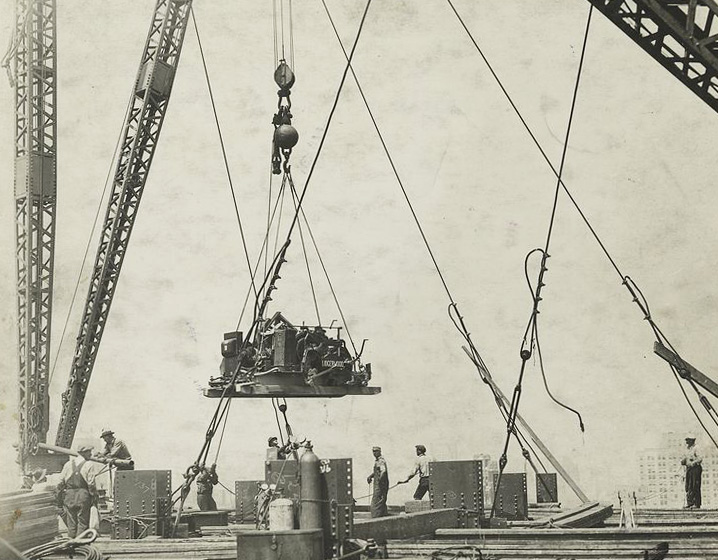
    There are a lot of triangles in this fabulous photo of the construction of the Empire State Building in 1931–a lot. At least fifty–more if you use your imagination or get your pinhole specs out. It is simply an excellent photo in which I’m seeing things of a reducible nature–not in the sense of a Sierpinski triangle/sieve/gasket, obviously–but just a simple exercise along those lines (ha!), experiencing the image by recognizing different sorts of boundaries within it.

    Lines empire state bldg

     [Source: New York Public Library Digital Collections, here.]


  • Air-Punk: Underwater Cyborg Diving Suit (1797)

    JF Ptak Science Books   Post 1853

    Diving bell horizontal656

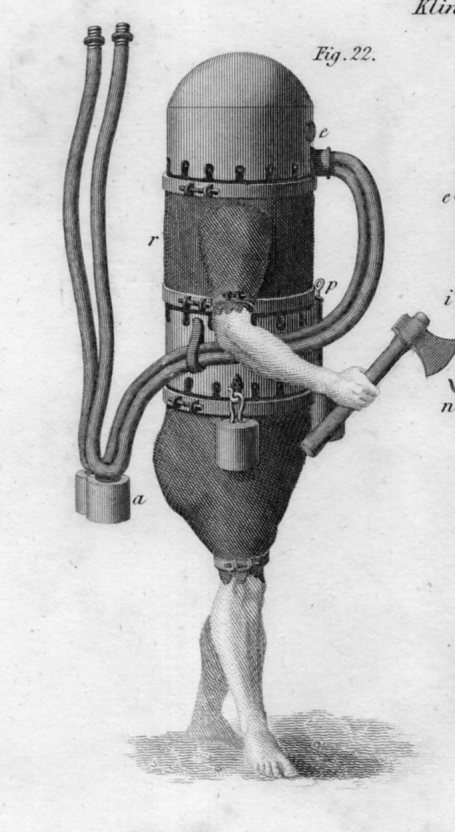
    Well, not really. It is however an early diving suit (and perhaps the earliest apparatus worn on the person and submerged) the creative and comparatively lightweight effort of Karl Heinrich Klingert, who produced it at the very end of the 18th century, in 1797 or thereabouts.  The suit was made of a metal helmet and wide metal girdle, with the vest and pants made of a waterproof leather, and with leather (?) leg straps.  The air would be pumped down to the diver from a turret above (see below, just) and would arrive in the diver’s helmet via weighted air tubes. 

    Here’s a side and occupied view:

    Diving bell horizontal654


  • On Words: Fining (and Refining), 1683

    JF Ptak Science Books   Quick Post

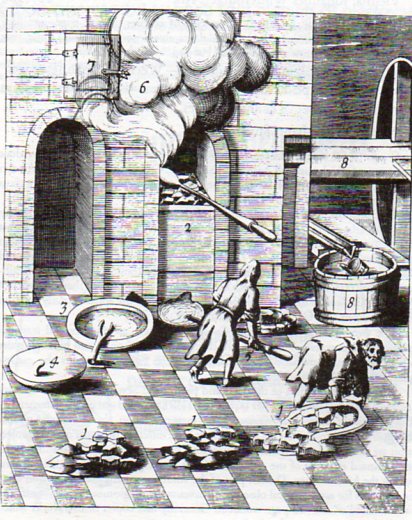
    We hear daily reports referring to refining, but there are very few about fining.. But there the word was, (appropriately) stick in the title of John Petrus’ translation of Lazarus Ercker’s classic work, Fleta minor: the laws of art and nature, in knowing, judging, assaying, fining, refining, and inlarging the bodies of confin’d metals. In two parts / the first contains assays of Lazarus Erckern … in V books : originally written by him in the Teutonick language, and now translated into English ; the second contains essays on metallick words, as a dictionary to many pleasing discourses, by Sir John Pettus … Knight .  (See the Richard Westfall entry at the  Galileo Project on Erker, especially on how he was able to support himself.  The book itself is an engineer’s delight, with applications of practical experience on all aspects of mines, mining and working with mined products.  It turns out that the original work by Ercker was so useful and popular that it was still around more than a century after Ercker’s death.  Oh yes–the original German editions were also among the first technical books to be supplemented by illustrations of the topics.)

    Fining425
    The story of iron is very old in Europe–and much older in China, older by more than another thousand years or so.  In Europe, though, iron from a blast furnace that has a high carbon content and a low melting point is called cast iron, and is quite brittle and cannot be worked by a smithy; fining is the process of cooking that cast iron up to its boiling point and skimming away the carbon, thereby giving the iron a higher melting point and a great capacity to be worked by a smith.  This product is called wrought iron, and it was a major step forward. 

    Which really does have something to do with a more popular definition of “fining”, which for the sake of simplicity would mean just to make something, well, “finer”.  I can imagine an eight-year-old figuring that out when aged six. A good, no-nonsense, perhaps 400-year-old word. 


  • A Temple of Texts–Steampunk Victorian Printing Cathedral

    JF Ptak Science Books  Quick Post

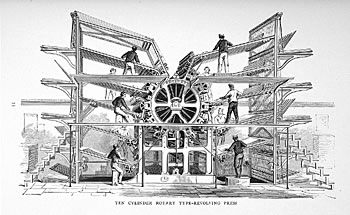
    This is what printing looked like, once upon a time, a great and giant mass, tended by works, massive sheets of paper flying this way and that, smoke from a steam engine drive (somewhere)–heavy, loud. Accurate.  A temple of texts (apologies to William Gass).  The illustration is from Robert Hoe’s A Short History of the Printing Press and of Improvements in Printing Machinery from the Time of Gutenberg up to the Present Day (1902) and exhibits a ten cylinder rotary type-revolving press

    Pritning machine[Source: Harry Ransome Center, here.]

    In addition to being a state-of-the-art (and above that, really) printing press it is in image a generator of metaphors–there’s certainly plenty to go around, even on just a surface investigation of the woodcut.  You can easily see a feeding-the-beast scenario in there–for news or for technology or steam or motion or whatever else), as well as darker interpretations, making the printing press into a spider as well; also, there’s humans being subservient to the god of technology from whom all good things come, and so on.  I’d really just like to feel one of those gigantic newspapers in my hands, fresh off the press…


  • Complicated Simplicity: A Marconi Wireless Graph of Connections at Sea, 1907

    JF Ptak Science Books  Quick Post

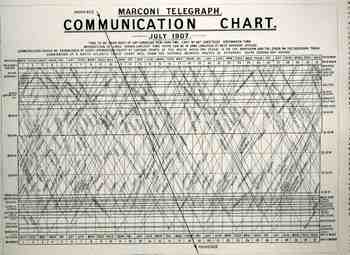
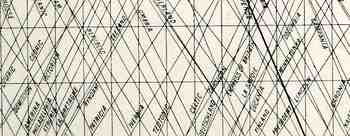
    This is an illustration of the approximate times and places that ships at sea could expect to be able to communication with each other by the relatively new invention of wireless telegraphy. (We’re talking about Marconi here and just very briefly; this is not the place for the discussion of what he did or didn’t “borrow” from his predecessors and contemporaries such as Heinrich Hertz, Oliver Lodge and Nikolai Tesla.  He at the very least however owed all of them at least an enormous helping of gratitude, and probably more.  Then there’s Marconi’s very conservative technical continuation in the field which is confusing and interesting.  And finally but not the least of all of the stuff about Marconi is his comfort and support of the Fascist regime in Italy, where Marconi became a member in 1923, escalating in his fame through the party ranks to have none other than Benito Mussolini serve as the best man in his second wedding.  But as I said that’s all for another day.) It appeared in The Illustrated London News for 7 September 1907,surrounded by an article on Obelia in the “Science Jottings” section of the magazine.  This chart isn’t
    1blog_oct_13marconi_at_sea816

    quite as complicated as it seems, really: all you need to do is follow one line from the top to the bottom.  Simply put, each diagonal line represents a specific ship (all of which are named) and their positions as they make their ways across the North Atlantic ocean; each intersection represents the time and place that two ships can communicate via wireless with one another.  So, for example, the Empress of Britain will on its six-day voyage be able to communicate at least 26 times with other ships for news and information.

    What this seems to me to be is the supplemental efforts of the ocean-going ships

    1blog_oct_13marconi_at_sea817

    to the newly established trans-Atlantic radio-telegraphic company and installation opened by Marconi in October 1907.  Even though the first transatlantic communication is celebrated as having taken place in 1901, the performance, even in 1907, was still spotty.

    Again, I’m just after this for the image 


  • Snail Trails–Getting from the Law of Irritability to Articulated Clowns and Artificial Leeches

    JF Ptak Science Books  Post 1677

    The Laws of Irritability was a marvelous-sounding title (to our ears, in this year) for a rather important medical treatise on the contraction of muscles.  It was a medical treatise by Felice Fontana1 (1730-1805), and had nothing to do with what we would think of as irritability, and certainly was a long way from a book like Robert Burton’s beautiful and slightly unreadable (and fairly unendurable) Anatomy of Melancholy, even as much as we would like it to be.  After all, wouldn’t it be lovely, somehow, in a automated-Dickensian way, to see that there were 32 laws of irritability, and that this was the first of the afflictions like ennui and depression and so on that could be modified and codified, and I guess eventually commodified?  (Making these things into commodities didn’t have to wait for anything at all in the way of proof or scientific merit went; after all, they were published in published books, which would have to be purchased, so there’s an instant commodification to them.)  But alas the Laws of Irritability were nothing of the sort, referring to a set of observations and deductions more real than half-imagined self-references.

    But all of this leads me in a very uncommon route to articulated clowns and skeletons, and of course artificial leeches.

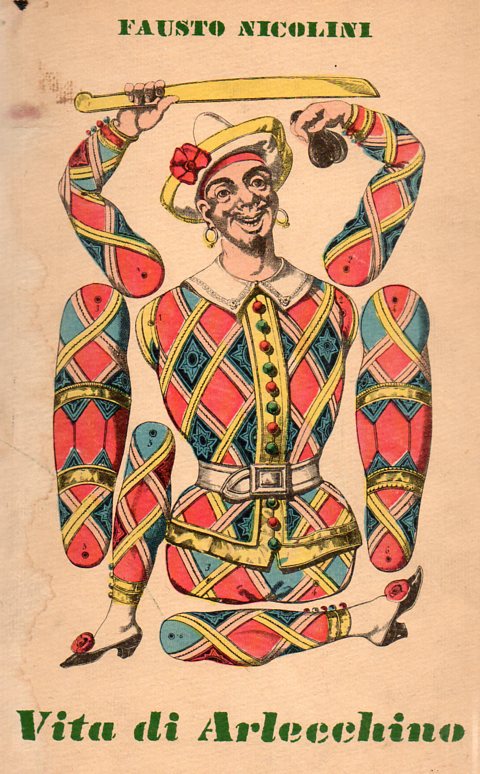
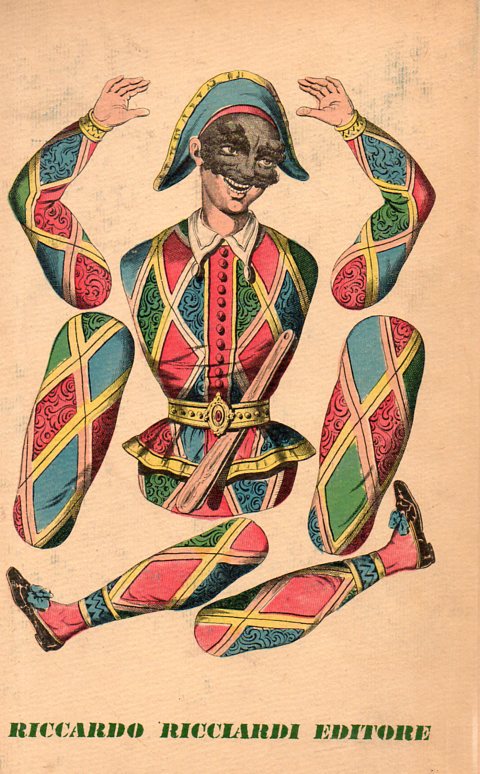
    This entire post started with the imaging that this book (below) by Fausto Nicolini, Vita di Arlecchino (“Harlequin’s Life”, published in 1958) and which contained a rather unusual bit to it-actually it didn’t so much “contain” it but displayed it.  The front and back covers were both illustrated with clown images–clown images that could be copied, its sections cut apart, and re-assembled into a working cut-out paper puppet.  Now I’ve been dealing with scarce/rare/non-existent books for 30 years, and I cannot recall a similarly-covered book, where the reader could turn its cover into a puppet.  But here it was. 
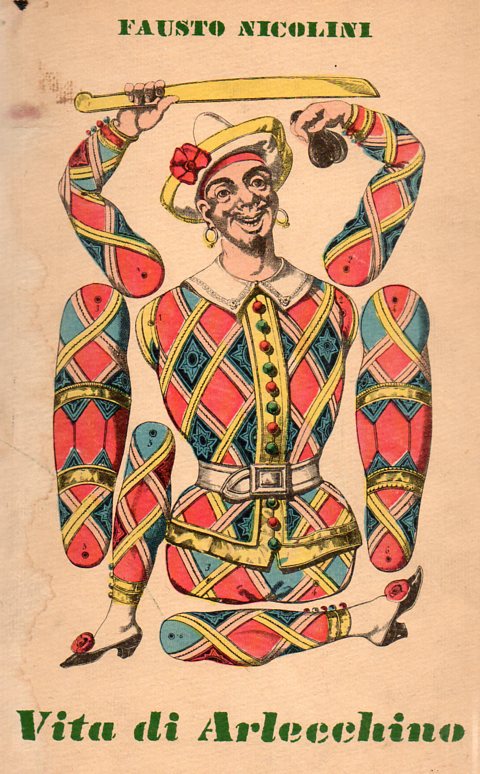
    Harlequin 1054[Click, enlarge, print and cut out your own dancing harlequin–the back cover is below.]

    It reminded me of another work, a beautiful anatomical treatise by Jean Baptiste Sarlandiere, first published in France but eventually printed and published in New York in 1837 as Systematized Anatomy, or Human Organography. The sample below shows exactly how the book was laid out, almost as an instructional on how to reconstitute the body–a cut-out book, made to be separated and then pulled together again as a whole, the joints articulated with string or brass brads, a book no longer now a little puppet, “A real live boy”.  (And yes it happens to be an Italian author–Carlo Collodi–who gave life to that naughty marionette…this is a tough story for kids, I think, even though I muscled my way through it with our younger daughter, leaving out some of the brutal stuff.)

    http://www.find-a-book.com/images1443/6989.jpg

    And it is via Sarlandiere that we get to our leeche issue, because it was he who fashioned the response tot he endemic leech shortages of the 1820’s and 1830’s with his creation of the artificial leech. 

    Oh to be in France in the 1830’s and be a illegal leech importer, for your fortune would have been made.  Leeches were still very important in medicine–as a matter of fact Francois Broussais2 saw the leech as a cure to virtually every diseases, saw them as a way of relseasing the inflammation and swelling and other complaints caused the body via strange and odd assaults on the body–the leech was a good and measured response to external insult, applied frequently and very liberally. 

    Evidently consumption on all fronts was on the rise, prices went high, but the availability of leeches went down.  In France alone, leech production (in 1836) fell from 50 million to about 18 million, all but 1 million of those staying within the country.  And so it was Sarlandiere who came to the rescue with his “artificial leech”3, something that would replace venthouses and bleeding cups and of course the leech itself.  It was something that he had already developed years before, but perhaps time had caught up to it.

    His devices are shown  below4 (expandable):

    An external file that holds a picture, illustration, etc. Object name is medhis5302-04-253-02.jpg Object name is medhis5302-04-253-02.jpg


    I’m unsure of the disposition of the artificial leech; Sarlandiere’s medical instrument lay in wait for the Dutch leech crisis, and seems to have gotten everyone through the sorrowful state of leechless affairs as they existed. At least he published images of what his invention looked like for the rest of the medical world to see and comment upon, and possibly use, and replicate.  This unlike other “advances” in instrumentation which were kept under wraps, and secret, such as in the case of the foreceps kept secret by the Chamerlains for several generations.  At least the widespread trust in the leech didn’t last much longer.

     

    [Source: Philosophy of Science Portal ]

    Notes

    1.  The work was published as De irritabiltatis legibus, nunc primum sancitis, et de spirituum animalium in movendis musculis inefficacia, revised and translated into Italian as Ricerche filosofiche sopra la fisica animale (1775)Fontana leges irritabilitatis constituit, ingeniosus homo et accuratus, published in 1767.

    “Formulated after the model of Newton’s principles in physics, the laws of Fontana on muscular irritability were an important but neglected contribution to the subject of muscular contractility. The first law concerned Haller’s concept of contractility as a property of muscle fiber itself, and pointed out that a contraction follows only after some stimulus. The discussion displayed insight into the underlying nature of tetanic muscular contraction. The second principle was the refractory period discovered by Fontana in heart muscle and applied to better understanding of the function of other muscles. The original third principle was a disproof of the efficacy of a theoretical entity, the ‘animal spirits’ . . . In his fourth law, Fontana pointed out the loss of contractility which results from stretching or compressing a muscle, and certain medical applications of this principle. The fifth law was concerned with problems arising from atrophy of disuse.”–Complete Dictionary of Scientific Biography, volume 5.

    2.   François Joseph Victor Broussais (1772–1838). Marie-Luce Jardin, Les Thérapies par les sangsues: les pratiques les plus anciennes aux traitements actuels hautement scientifiques, Université de Franche-Comté, Faculté de Médecine et de Pharmacie de Besançon, 2005, Thèse, pp. 32–3.

    3.  Jean-Baptiste Sarlandière, Bdellomètre du Docteur Sarlandière, Paris, Firmin Didot le jeune, 1819.

    4. Teunis Willem van Heiningen, “Jean-Baptiste Sarlandière’s Mechanical Leeches (1817–1825): An Early Response in the Netherlands to a Shortage of Leeches”, in Medical History (Wellcome Trust),  Med Hist. 2009 April; 53(2): 253–270.
    Harlequin 2055
    And more on Fontana from the DSB (“Fontana, Felice.” Complete Dictionary of Scientific Biography. Vol. 5. Detroit: Charles Scribner’s Sons, 2008. 55-57. Gale Virtual Reference Library. Web. 22 Dec. 2011):
  • Comparative Displays of the Heights of Things: Centennial Tower, 1876

    JF Ptak Science Books    Post 1675

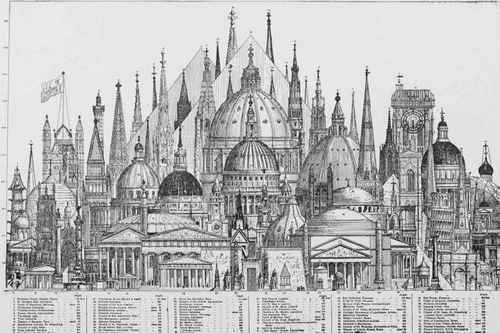
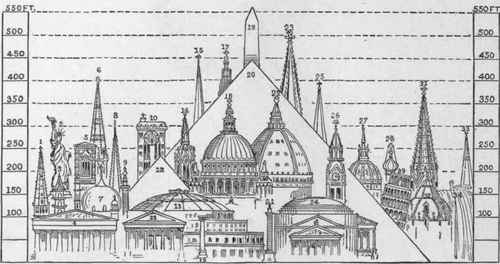
    The 1876 U.S. Centennial Exposition (formally called the “International Exhibition of Arts, Manufactures, and products of the Soil and Mines) in Philadelphia was a grand and fabulous showing of all things American, celebrating the hundreth anniversary of the signing of the Declaration of Independence.  One of the crowning objects of the fair was to be the never-built 300-metre tall Centenniel Tower, pictured here in the 24 January 1874 issue of Scientific American.  The structure appeared in relief against the background of other tall things built by humans, show in a relatively new fashion for displaying quantitative data comparisons in the same scale.

    http://upload.wikimedia.org/wikipedia/commons/9/93/The_Centennial_Tower_Philadelphia_1876.jpeg

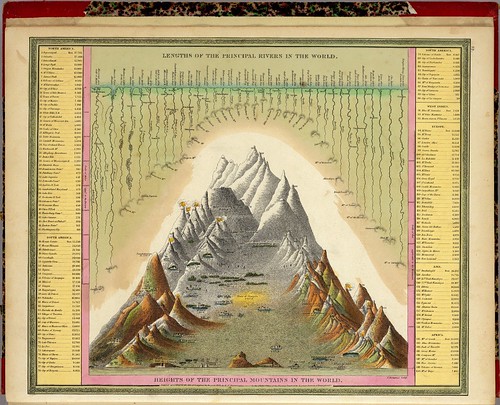
     The practice of showing, say, the comparative heights of mountains and lengths of rivers by loading up all of the samples on one piece of paper for the ease of recognition was begun in the 18th century, but only rare; it began with some fits and starts in the 1820’s again and then much more widely around mid-century, and seeming to peak at the end of the century before going somewhat dormant for the next few decades or so.

    Another nice example of comparative heights of buildings:

    COMPARATIVE HEIGHTS OF SOME OF THE PRINCIPAL BUILDINGS OF THE WORLD


    And this as well:

    Comparative Diagram Showing Highest Buildings And  396

    [Source with key to the images found here, at Chestofbooks.com]

    The excellent Bibliodyssey blog contributed a good healthy post on the subject of comparative heights of mountains map (here) with many fine examples of the art.  Its a curious thing to me that the  business of using same-scale comparisons in architecture is relatively new, coming (I think) as an invention of Etienne Durand in the 1840’s.)

    Here is one such example:

    Heights Of The Principal Mountains In The World (Mitchell) 1846

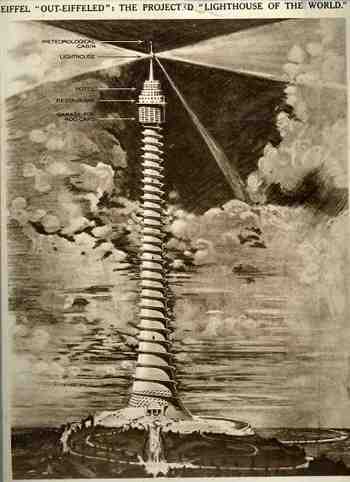
    But getting back to the tower itself and it unbuiltedness, here’s another example of an unbuilt tower–taller and bigger than the Centennial–which was proposed by Eugene Freyssinet (and which I wrote about earlier in this blog here):

    Big_archout_eiffeled140


    Another in what is a long line of unbuilt towers would be this contribution by Vinnie Ream Hoxie (ca. 1874-6)  which was his response to the finishing of the not-completed Washington Monument.  Congressional sympathies towards spending money to complete the Washington Monument dried up to nothingness in 1856, just eight years after construction on the monument was begun.  The consequence was that the monument was only a nubbin for several decades, standing about a third complete–it was Hoxie’s idea no doubt to provide a sort of quick-and-dirty approach to finishing the project.  Of course this looked like exactly what it was, and the idea died its own lonely death, thank goodness. 

    http://www.nationalbuildingmuseum.net/Large%20Images/unbuilt/4._Washington_Monument_Sheet_2_web.jpg

    It had little appeal, at least to me.  It is somewhat reminiscent of the exhibition of the completed forearm of the American Statue of Liberty, which as it turns out was also exhibited at Phildelphia in 1876, years before the completion of the rest of the statue.  Short and stubby.


    File:Collossal hand and torch. Bartholdi's statue of "Liberty.", from Robert N. Dennis collection of stereoscopic views.jpg

    There are many other entries in the history of unbuilt towers, but their day will have to wait (for this blog, anyway).


  • Visualizing Depth: Thinking Deep on the Depths of the Oceans in Units of St. Paul’s Cathedral

    JF Ptak Science Books   Post 1660

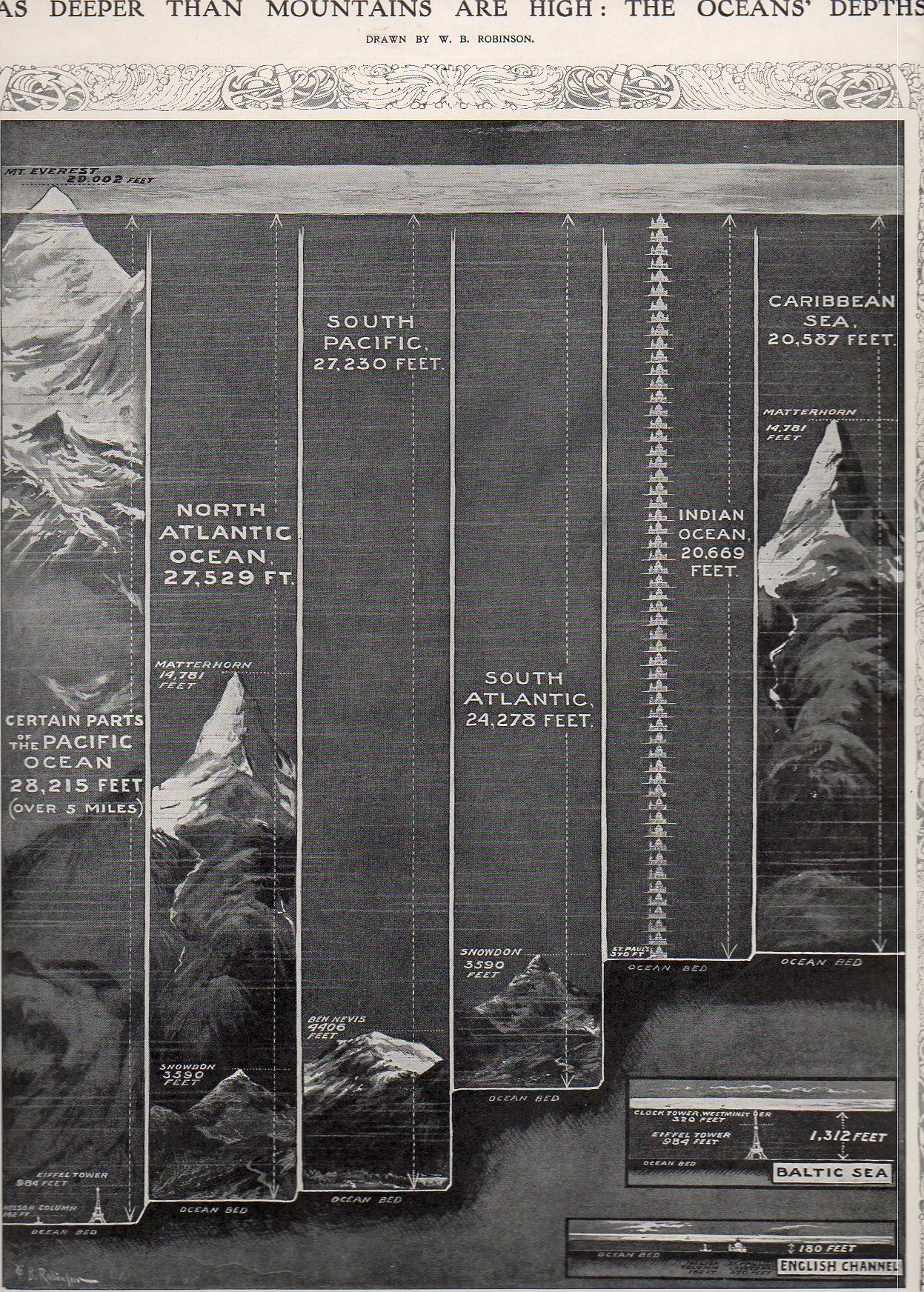
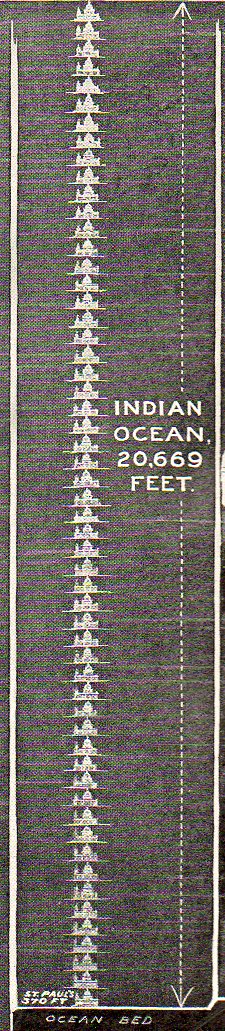
    Although maps showing the depths of the oceans existed from about the mid-19th century (through the pioneering work of the American father of oceanography, Virginia’s Matthew Fontaine Maury1) few casual readers would have ever seen a more approachable representation of information than what appeared in the Illustrated London News for 8 October 1910. Although Maury’s maps are elegant, they didn’t receive nearly as wide a distribution as this ILN image–also they weren’t nearly quite as relational as the 1910 version.

    Sea depths533

    Granted, the 1910 comparison chart only displays one statistic–the supposed greatest dept of five oceans, two seas and the English channel–it does so in such a way as to make those numbers immediately approachable to any reader, which is always an issue in relating scientific information to the general reader.

    Sea depths ist pauls537 {One of the standard unit of measurement for the purpose of this display was St. Paul’s Cathedral.]


     What W.B. Robinson presented was a way of looking at an invisible entity through very visible means–comparing depth to the heights of things that everybody in 1910 knew: the Eiffel Tower (relatively newly constructed out of 18,000 prefabricated highly-engineered pieces) and St. Paul’s Cathedral. So rather than stating that the Pacific Ocean is 28,000 feet deep, Robinson chose to replace feet with Nelson’s Column–174 of them. Or 29 Eiffel Towers. The 20,000-foot deep Indian Ocean was actually 56 St. Paul’s deep, while the Baltic Sea was deep enough to not quite cover one Eiffel Tower with one Westminster Bell Tower on top (ha!); and the English Channel at its deepest wouldn’t quite cover St. Paul’s.

    This is really the way to display data in my book, especially to kids.  This is one of the few ways of making the information accessible and understandable across almost all age ranges. 

    Notes:
    1.  Actually the work goes back a century before Maury with Buache, who produced this map of the English Channel in 1737–the data points are veyr numerous, but this is the very first time that such information was available on a map.

    Sea depths idouth pacific536 Sea depths indian535


    NOAA Photo Library Image - map00004

    And Maury again with this first map of an oceanic basin, published in 1853:

    NOAA Photo Library Image - map00001

     And in 1752, Philippe Buache produced this fantastic and first-of-its-kind map for the depths of the English Channel:

    NOAA Photo Library Image - map00186

    Here’s an extraordinary cross sectrion of a part of the ocean floor produced in 1857 by the HMS Cyclops in preparation for laying the Atlantic Cable:

    NOAA Photo Library Image - map00010


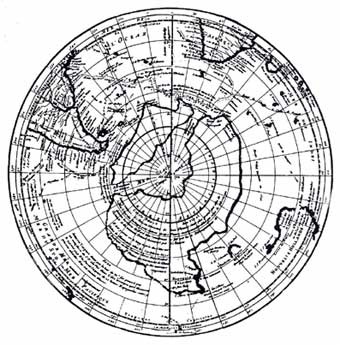
    Its also interesting to note here Buache’s work on this map of Antarctica, published in 1737.  Buache put together all of the known (to him) information about the mass in the South, bits taken from other maps, and accumulated them into what was the best-possible guess on what was down there in the Antiopode.  Pretty good detective work given the amount of material that he could work with.


  • Rockets to Outer Space, 1923

    JF Ptak Science Books    Post 1657

    http://www.rogersrocketships.com/UserFiles/Image/RRS_New_Docking_Bay_Images/DB_002_Die_Rakete_Book.jpg

    This is some beautiful thinking and work by the rocket pioneer, Hermann Oberth (1894-1989)–the teacher of Wernher von Braun, a highly functioning leader at the Nazi V-1 and V-2 base of Peenemunde, and of course after the war working for various aeronautical/astronautical concerns in Switzerland, Italy, Germany and the United States. In America he would work for von Braun at Huntsville, Alabama from 1955-1959 on the Army’s ballistic missile program,  a late addition to the many German scientists scooped up right after the war in Project Paperclip and deposited in the Deep South. 

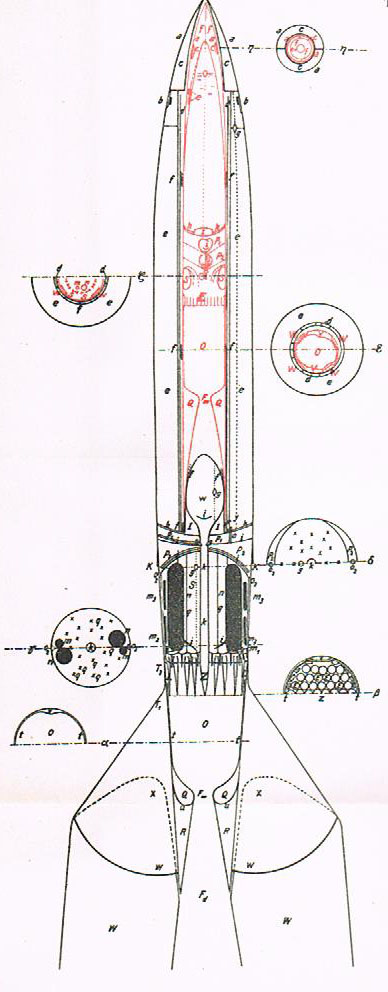
    The gorgeous design above is the front wrapper of his rejected doctoral dissertation, Die Rakete zu den Planetenbraeumen (“The Rocket Through Planetary Space” or “The Rocket to Interplanetary Space”), published in Oldenbourg in 1923.  Oberth’s work was printed in a very small edition and even at that he had to pay for part of the pamphlet’s printing–it turned out that the work was an instant success when issued, selling out quickly.  A second edition vastly expanded the original’s 92 pages into 429 in 1929. 


    Oberth
    In Old Testament vocabulary, Oberth’s work is Genesis for space travel and aeronautics–or at least he is one of two or three authors of Genesis, along with Goddard and Hohmann.

     
    The Modell B from The Rocket through Interplanetary Space -H. Oberth 1923

    As it turns out, in his extra moments, Oberth served as a technical advisor to Fritz Lang on his film, Frau im Mond, and his influence shows, even from cursory examination.

    Image


  • Big Numbers and WWII Aircraft–Artistic Displays of Quantitative Data

    JF Ptak Science Bools  Quick Post

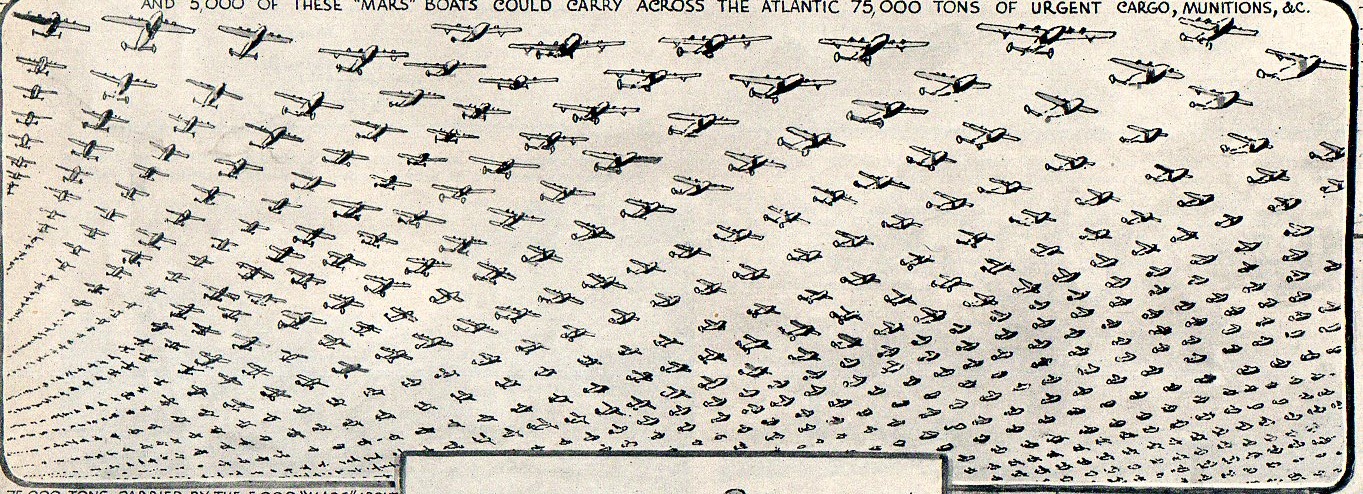
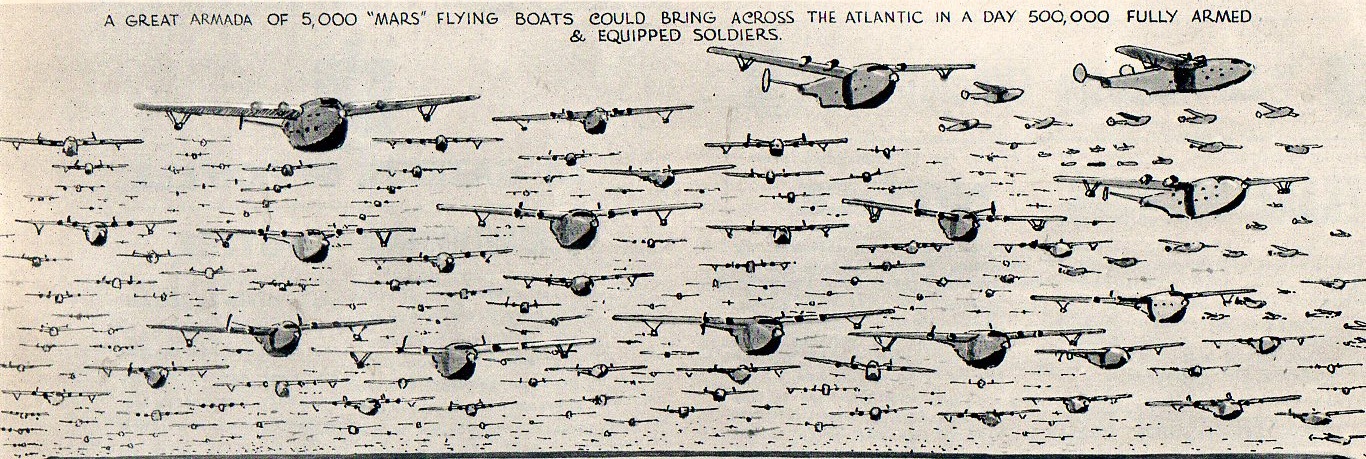
    This post continues an earlier series on the artistic display of quantitative data–putting a face on big numbers. In particular it extends a collection of images of Second World War airplanes, “A Big Sea of Planes:  Quantitative Display of World War II  Bombers. The images below appear in the 17 October 1942 issue of the Illustrated London News in an article about the possibility of replacing seaborne troop and materiel transport across the Atlantic from America with the big Martin JRM Mars aircraft, getting the troops there faster and safer and releasing at least part of the naval force for wartime activities.  The images are pretty compelling:

    Airport987

     The caption states that 5000 Mars planes could get 500,000 soldiers to Europe.

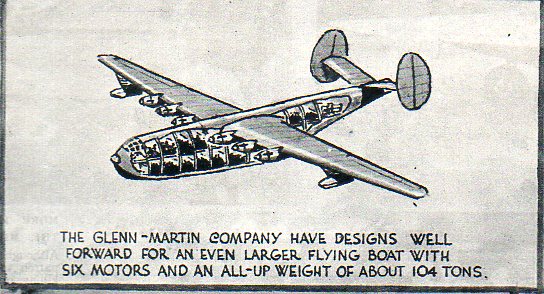
    Airport988

     These were big planes1 (200′ wingspan, 117′ long, 38′ high, more below) and could haul 130+ troops.  By the time though that the powers-that-be were figuring out who the main contractor would be for production (and those production numbers in early 1942 were about 500 per year, at that point, anyway) the Battle of the Atlantic was already–in 1943–fairly well decided.  The U-Boot problem was solved enough for a continuous flow of soldiers and supplies, though not without a high cost in the first half of the Atlantic campaign.  (Overall, from 1939 to 1945, some 3,500 Allied merchant ships  and 175 Allied warships were sunk, costing the lives of 72,200 Allied sailors and merchant seamen.  The Germans lost more than 780 submarines along with fully three-quarters of all sailors in the U-Boot fleet, making some 30,000 men.)

     Below, a cutaway for the Mars:

    Airport989

    Stats and Technical data on the Glenn-Martin(from Jane’s Fighting Aircraft of World War II, (1945):