A Daily History of Holes, Dots, Lines, Science, History, Math, Physics, Art, the Unintentional Absurd, Architecture, Maps, Data Visualization, Blank and Missing Things, and so on. |1.6 million words, 7500 images, 4.9 million hits| Press & appearances in The Times, Le Figaro, Mensa, The Economist, The Guardian, Discovery News, Slate, Le Monde, Sci American Blogs, Le Pont, and many other places… 5000+ total posts since 2008.

Category: Blank and Empty Things; A History of

  • Missing Things Making Holes: Soviet Bread-not-Bombs in Finland, 1940

    JF Ptak Science Books LLC   Post 917

    [This post is a hybrid category bridging “Blank and Empty
    Things” and “A History of Holes”—it is really an entry for blank and missing
    things making holes]

    1.  The Soviet Union’s foreign minister Molotov1 wanted to make it very clear
    to the rest of the world that his country was not bombing civilian targets in Finland during
    the winter war of 1939/1940.

    Blog jan 23 bomb

    2.  Molotov insisted that targets that were being bombed near
    Finnish cities were actually airbases.

    2.1   Also, since the
    complaining FDR was over 4000 miles away there was no way that he could “see”
    what was being bombed.

    3.  If there were civilian targets that looked as though they
    were being bombed, then

        3.1   they weren’t being bombed; and

        3.2   if anything at all was going on the Union of
    Soviet Socialist Republics was  dropping
    bread on the town’s/city’s starving inhabitants.

    4.   So far as
    undefended, non-military targets were concerned, the Soviet
    Union
    redefined “bomb” as “bread”.

    5.   Therefore, what
    we’re seeing in this image above are not bombs, but bread; that, or the houses
    were airbases, which would turn the bread back into bombs.

    Molotov insisted that no civilians were direct targets of
    Soviet bombing campaigns in Finland.  Also, if there were people being killed in
    these bombing raids they would necessarily and by definition be aircraft
    workers or air bases support staff or other military personnel.  

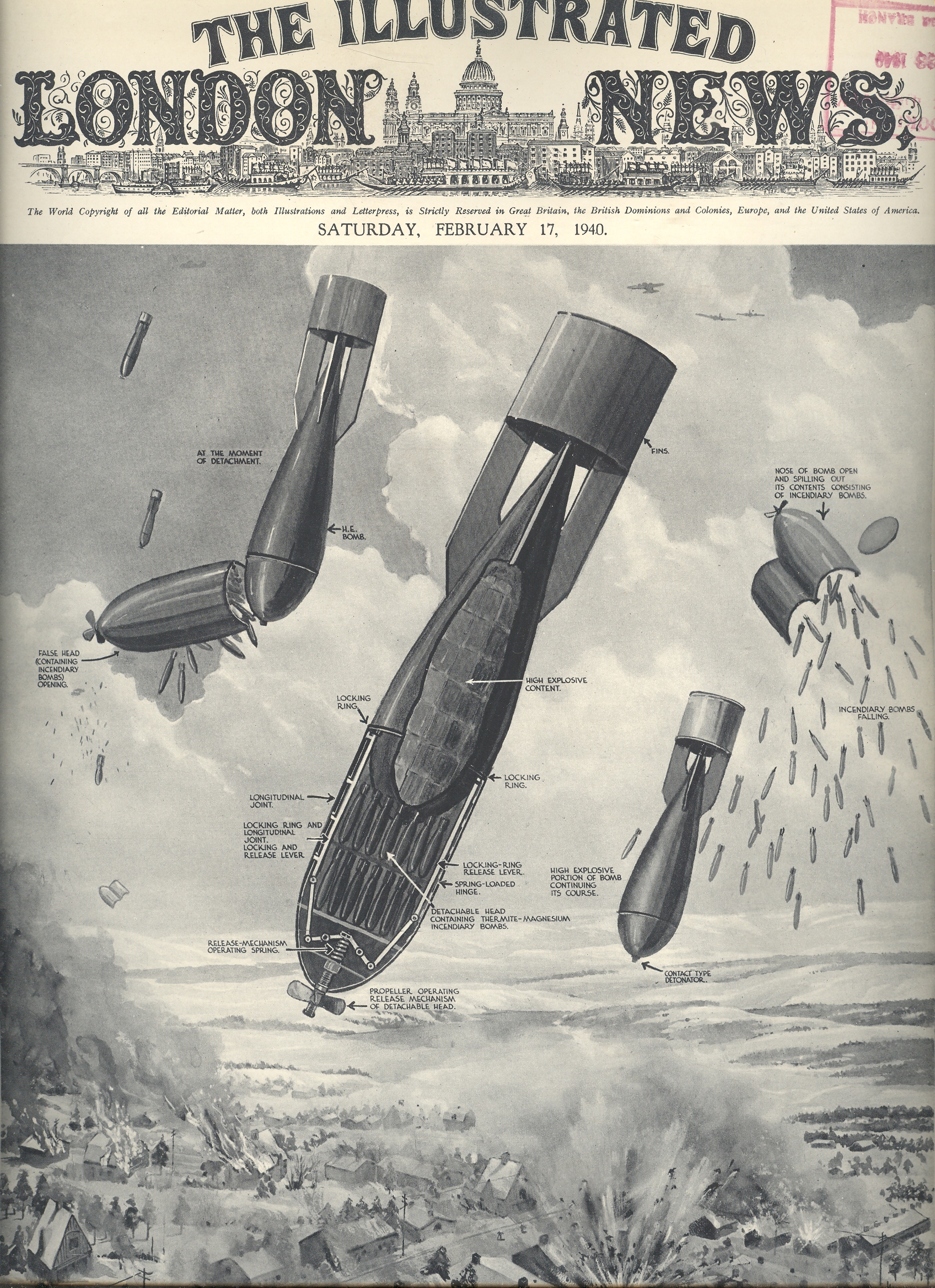
    This strikingly designed image is from the 17 February 1940
    issue of The Illustrated London News;
    the design is by G.H. Davies, the phenomenal ILN draftsman, and elegantly (and forcefully) depicts the innards
    of the bomb and its effect on its target.

    It is a spectacular and brilliant presentation of the
    new(ish) Soviet hybrid terror bomb that was being used in the non-existent
    attacks on Finnish cities.  [The 5’ bomb
    was made to be deployed in two sections: 
    the front end of the bomb inside the false nose cone contains dozens of
    incendiary bombs, released by a revolutions-generated cap propeller, which fall
    away from the main section of the bomb, which contains a high explosive.]

    Since the non-existent bombs that were not being used against
    non-military installations and were actually bread, the Finns gave the weapons
    the nickname of “Molotov’s Breadbaskets”.

    This was just a down-right nasty bomb, and the illustration
    shows it falling on and destroying a quiet town with no visible military
    advantage. The town not being bombed was called Sortavala, which—after numerous Soviet
    attacks in December 1939—was in actuality destroyed by Soviet air power on 2
    February 1940.

    The man ultimately responsible for this campaign and the
    murder of millions of his own countrymen through means of induced starvation,
    disappearances and ruthless killings—Joseph Stalin—was post mortem dispatched
    in much the same manner as the reasoning listed above.  Stalin was ignored to the point of
    non-existence, de-Stalinized and  left
    entirely out of the 50-volume second edition of the Great Soviet Encyclopedia2  published just a few years after his 1953
    death. Stalin executed his brutal and long-time political compatriot Lavrentii Beria, (1899 – 1953)
    right before his own death, ordering that people who owned the GSE to physically cut out the
    Beria entry
    . It is unfortunate that Stalin could not have been denied his
    existence 30 years earlier.

    Molotov, on the other hand, in spite of his enormous sins
    against humanity (as principle architect of the Great Terror, the extermination
    of millions of Ukranians, and etc.) was finally removed from government
    following Khrushchev’s de-Stalinization campaigns (i.e. by 1962)  and managed to live out the rest of his life
    alive, not dying until 1986 at the age of 96.

    (The “Molotov Cocktail” by the way was not named for him by
    Soviet soldiers or freedom fighters or whatever fighting for the USSR—it was
    named for the petrol bomb used by Finnish soldiers and civilians fighting
    against the Soviets invading their country  in 1939/11940 and again in 1943/4)

    Notes

    1. In 1940 Molotov was the foreign minister of the Soviet Union, and had just completed negotiating the
    Non-Aggression pact with Nazi Germany. 
    This gave the USSR free range for its relations (read “occupy/annex”)
    Estonia, Bessarabia, Latvia and the Ukranian/Belorussian-occupied section of
    Poland (to the Curzon Line), and to also conduct its war with Finland.  The fierce Finns never lost their
    independence, though they did lose a part of their country. 

    2. The GSE had a somewhat complicated publishing history,
    winding up with 65 volumes over its two editions, constructed with very
    questionable state-controlled X-Ray communist vision spectacles. There is so much in these volumes that is wrong/sanitized/fiction that I have no idea how a non-specialist might be able to use the thing.
  • “The First Thing is to Find Some Men” How to Get a Boy-Date, 1941

    JF Ptak Science Books LLC  Post 914

    [Continuing the posts “What Makes Human Robot Girls, 1941” and The Missing Pieces of Women, Pope Joan and the Proper Girl]

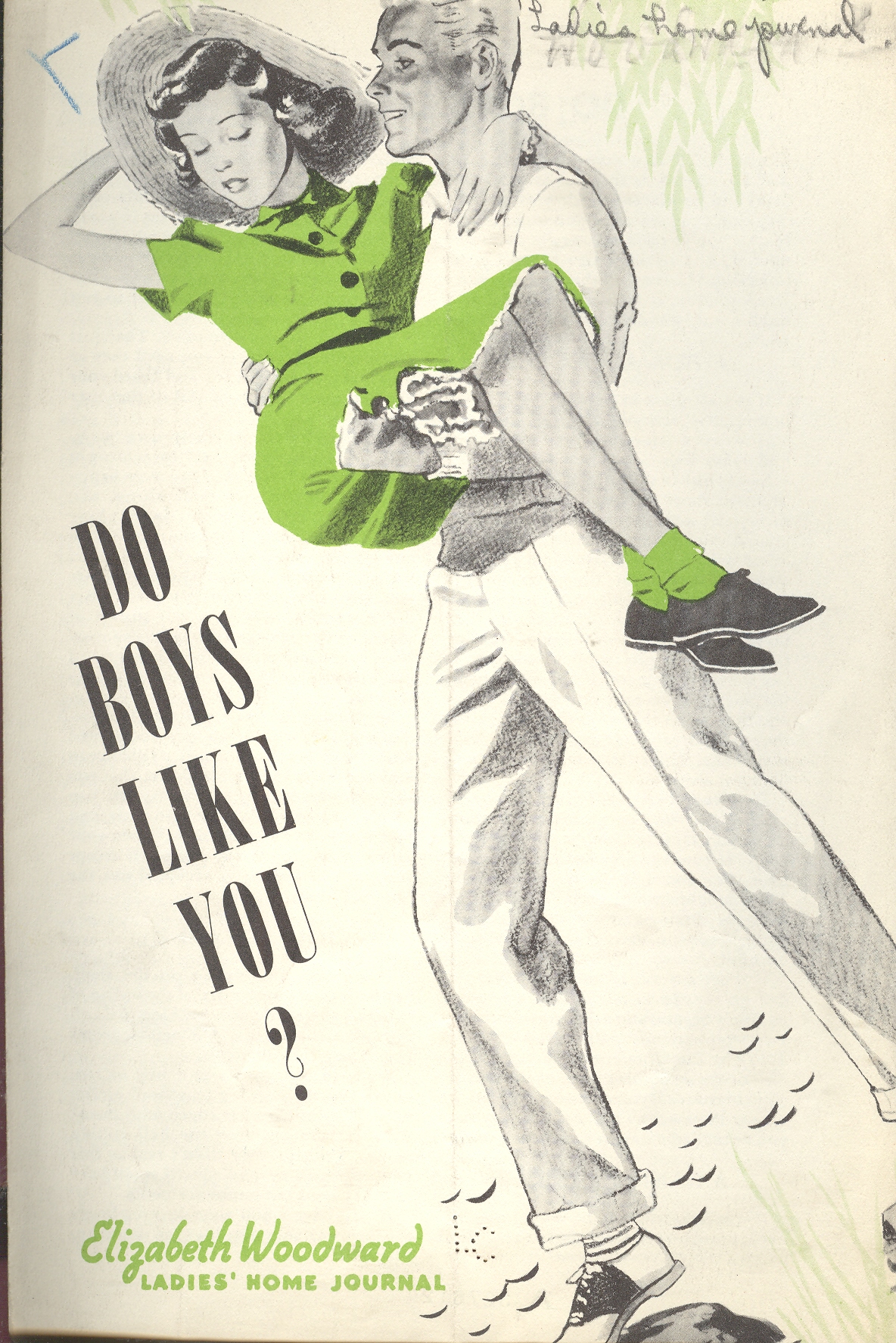
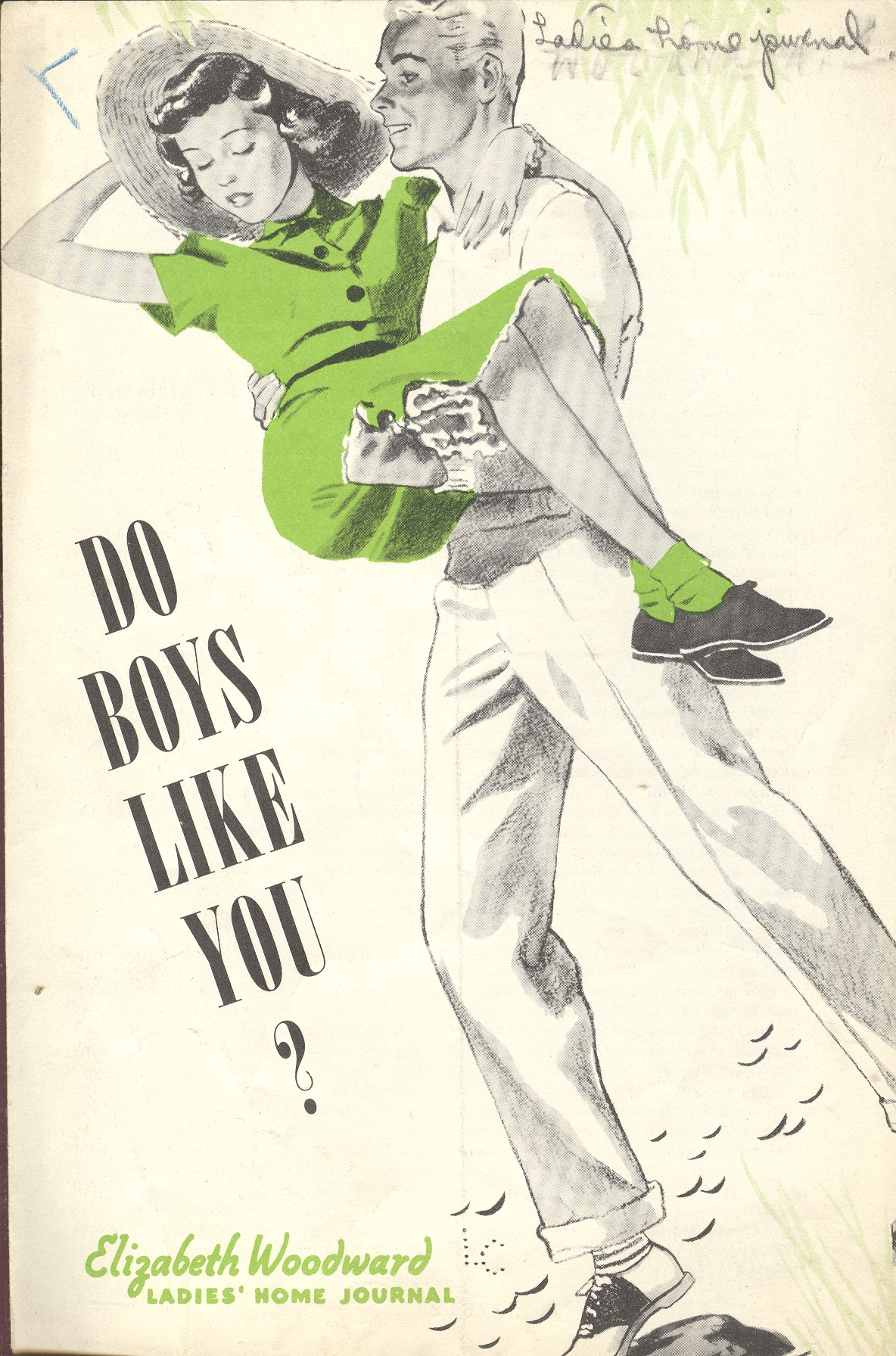
    Do Boys Like You? is
    the name-of-the-game for girls, evidently (“set out to make yourself worthy of a boy’s
    affection.  Just one boy—any boy…”),
    brought to you as a part of a long, continuing series by Elizabeth Woodward in
    the Ladies’ Home Journal in the early
    1940’s. Blog jan 20 boys like you

    This installment is about getting a boy for a date, and how to make
    oneself getable and datable and boy-friendly, all while maintaining the
    thinnest veneer of self-acknowledgment (“be adaptable as a chameleon”) as possible while staying true to “yourself”.  It is a cocktail of overall old-lady sense
    and deep ruffled bows writ by the hand of gender entrapment and not-so-subtle
    subjugation. Let’s get to it with some of the more archaeologically-interesting
    statements of this social-norms-establishing pamphlet:

    Paragraph: (Intro):

    “Do boys like you, or don’t they? Its as easy as that!  Either you have dates and go places with lots
    of boys, or they don’t pay any attention to you at all.”

    Paragraph: “A Female World”

    “…the first thing is to find some men.” (Which is odd
    because “men” is used only one other time beyond this reference—its all boys
    and nothing but boys.)

    “Short of throwing yourself on their (boys’) mercy, see if
    you can’t wrangle an introduction out of the girls who do know boys…”

    “Your parents could invite their friends over for dinner and
    ask them to bring along their son. And you do a good job on him!” (I’m not sure
    what that “job” is.)

    “They (boys) can’t find you if you’re packed away in a mob
    of females.”

    Paragraph: “A Rank Outsider” (on being the new girl in a
    community):

    “The girls have things under control and they don’t want any
    interference from you.”

    “You might know more than they do, and you just might talk
    down your pug nose at them.”

    “…you’d better get accustomed to traveling alone…”

    “Give them every chance to find out that you aren’t high
    hat, that you like the same things they do, that you aren’t out to sniggle
    their men away…”

    “When they (the girls) accept you, the boys will too…”

    Paragraph: “an Old Story”

    “(Boys) are so used to looking at you that they think of you
    as furniture.You’ve got to be new!”

    “If you’re fat and pudgy, make yourself lean, sleek and
    smart.”

    Paragraph “Take it Easy”

    “…its going to take practice to make boys like you. Take it
    easy. Set out to make yourself worthy of a boy’s affection.  Just one boy—any boy…”

    Paragraph “A Few Gentle Hints” (Seems that we’ve gone way beyond this by now.)

    “Don’t run around with girls who are dud.”

    “Don’t go in pairs with a girl who is overwhelmingly popular…Better
    pick a girl who will give you an even break.”

    “Don’t languish for some local ‘hero’ who is sought after by
    all the girls in town.  He may be
    good-but he’s far out of reach…”

    “Don’t pick on a lad who has never had a date with a girl.”

    “Don’t be careless or sloppy when you’re talking with boys…”

    “Don’t expect (or even hope) that every boy you meet will
    ask you for a date.”

    And (not quite) lastly, but should’ve been:

    “Don’t go around thinking about boys constantly.”

    But lastly thus:

    “Act as though you are having fun. Be alive, gay and enthusiastic. Be interested in what’s going on. Be sweet, tactful, and adaptable as a chameleon. Have definite likes and dislikes, but don’t be so rigid
    that you are stubborn, opinionated and difficult to get long with. Be carefree,
    casual, easy, willing to play and fun to play with. And don’t be shy about
    liking the boys.

    THEN THE BOYS WILL LIKE YOU! [Emphasis in the original.]

    My poor mother would’ve been reading this…

    (Thanks to Jeff Donlan for pointing out that the chap on the
    cover carrying the girl away has joined the fabric of her skirt to (1)  hold
    onto and steady her and (2) make sure her skirt doesn’t fly up and out and is not actually touching her thigh…)


  • When a Compliment is Not: Newton and Hooke and the “Shoulders of Giants”

    JF Ptak Science Books LLC  Post 912

    I
    was tooling looking for vision quotes and came upon this by Samuel Taylor
    Coleridge (an unusual stomping ground for me) from The Friend (published in 1828):

    “The dwarf sees farther
    than the giant, when he has the giant’s shoulder to mount on.
    “

    This
    made me think of the over-quoted sentiment quoted again by Isaac Newton

    “What Descartes did was a good step. You have added
    much several ways, and especially in taking the colours of thin plates into
    philosophical consideration. If I have seen a little further it is by standing
    on the shoulders of Giants.
    “

    Newton wrote this in a
    letter (5 February 1676) to the immensely creative workhorse Robert Hooke1.  He was a tireless, relentless observer and
    experimenter, who lost little effort in a stranded idea and pursued interesting
    and problematic questions relentlessly.  More than others too he chased
    his won glory—minor but long and insistent—the years of which wore thin on many
    people in the scientific community.  But there were many characteristics
    of the man that made him not quite so lovable and endearing—not that Newton was
    any of those things, as he was not, but if you are going to be a secondary luminary
    to a super nova you’ve got to have something else going for you that the other
    man doesn’t have—sharing, helpful, greatly generous—to get you into the long
    pre-dusty pages of history. Also it would’ve helped if Hooke chose his battles
    with a little more aplomb and ingenuity—the war which began in 1672 with Newton
    went very badly for Hooke and followed him to the grave (and far beyond). 
    Newton and Hooke had many disputes—most notably
    in optics—basically because Hooke pursed Newton
    (among many others) for expropriating his ideas.  Hooke was over the line on this and probably
    pushed the point too far—Newton
    was enormously annoyed by this and other Hooke contacts and wasted no effort in
    trying to pay Hooke back the favor over the years.  Newton
    was famously sharp and could fashion that intelligence and wit into a terrifically
    nasty tool against those who bothered him.

    And
    so back to the “shoulders” letter. This always struck me as a bit too
    melodramatic for a Newton,
    and also a little too congratulatory for a field that he basically owned,
    especially since he was a towering egoist (and not without cause).  But he did pay Descatres (“des Cartes” in the
    original) a compliment; though I could not at all think of Newton referring to the dreaded Hooke as one
    of the giants’ shoulders he was standing upon. 
    Newton’s
    reference to “giants” might also have been a swipe at Hooke’s physical stature,
    which was terribly slight, small and crooked. 
    SO I think that Newton
    was referring to Descartes, and decidedly not Hooke.

    Blake_Newton

    So
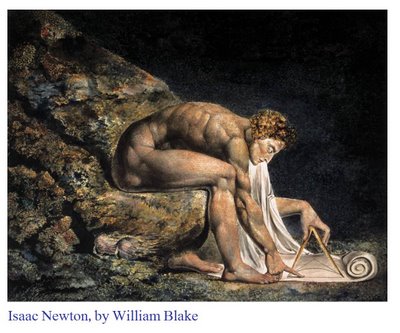
    this semi-ubiquitous scientific laudatory quote is perhaps not quite so.  Kinda like the very well known painting by
    William Blake featuring Newton
    as a naked geometer, figuring out the world, a color-tone praise of the great
    physicist.  Or perhaps not.  Blake I think simply didn’t like Newton, didn’t
    care for the scientist taking away the mystery of the world that Blake loved so
    much—especially in regards to color, which Blake needed to stay interpretative
    and mysterious.  Newton took part of that away, and I think
    Blake exercised a little payback in his artwork. 

    It
    seems to me that if one looked at the “shoulder” quote and the Blake artwork as
    works that were insults and not praises, they can be easily seen that way.  Its all a matter of perspective.

    Notes

    1.
    The 28-year old Hooke published the results in a gorgeous and revolutionary
    book, Micrographia (a lovely e-text edition appears at Gutenberg, here)
    in 1665, which became an instant best seller and highly praised and valued.
    (Samuel Pepys, perhaps among the shiniest stars whose imprimatur was like a
    royal blessing, said the book (was) “the most ingenious book that I ever
    read in my life.”) There is no telling what the people of the mid-17th
    century thought of seeing such incredible discoveries in the little
    semi-invisible stuff that made up their normal, daily lives.  The only
    thing that somewhat equates to this would be if the first images of the Hubble
    were those of Earth-bound objects whose detail had previously been
    unknown.  Hooke’s observations and drawings of things like the common flea
    were just an astonishment—that such a creature of “low order” could have such
    intricate detail and design was a complete revelation.  The drawings of
    the fly’s eye, too, was an inescapable wonder, an incredible object to consider
    as having any detail pre-microscope, and then revealed to have
    unimaginable design and elegance. 


  • Missing Pieces of Women: Pope Joan & the Proper Popular Girl of “The Ladies’ Home Journal”

    JF Ptak Science Books LLC  Post 910Pope joan weltknronik

    Listening
    to these dreadful stories this morning on NPR about the Vatican’s relations
    with the Roman Jewish community and the abortive WWII papacy of Pope Pius XII—the
    papacy of blank and missing compassion—I thought about the missing Papacy of
    Pope Joan.  Whether or not she existed is
    a question of debate; whether she was a pope or not is perhaps even less
    debatable.  What seems not impossible
    though is the ability of a large institution like the Catholic Church to make
    the entire issue of unwanted history or legacy to go away. 

    The
    historicity of this papacy is long and shows the murkiness of the earliest
    writers on Joan. She was supposed to have served as pope between Leo IV and
    Benedict III around the year 850.  The
    fuller versions of her history turn up in the 14th century, although
    the earliest mentions of a female bishop of Rome go back to the 9th
    century—Joan remains unnamed though until the 13th century when
    Martin of Opava’s Chronicon Pontificum et Imperatorum1(referring to
    Joan as “John Anglicus” or “John of Mainz”) does so for the first time.

    Joan apocJoan
    escapes the Middle Ages with a little flair, but doesn’t do so well in the
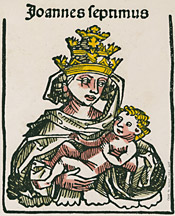
    Renaissance.  As a Missing Piece in the
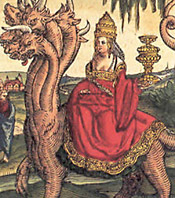
    history of the Papacy she turns up not-so-well represented:  for example, she is seen here looking good
    but turning up bad overall as the Whore of Babylon2.  She was treated as a disgrace, and impostor,
    someone who demeaned the Catholic institution by her sex and deception, though
    god knows that the history of the papacy is filled with horror stories3 that
    far exceed the reach of mere deception.

    So
    I was thinking about the piecing-together of the Pope Joan jigsaw and
    remembered an actual “womanly” jigsaw that could actually be pieced
    together.  This bit came together as a
    result of a post I did here just two days ago (What Goes Into Making Human Robot Girls, 1941), and was one of a series of
    intolerably heavy eight-page pamphlets cementing the structure of female social
    intercourse at the hands of the magazine The
    Ladies’ Home Journal
    . 

    Blog jan 13 Puzzle cvr

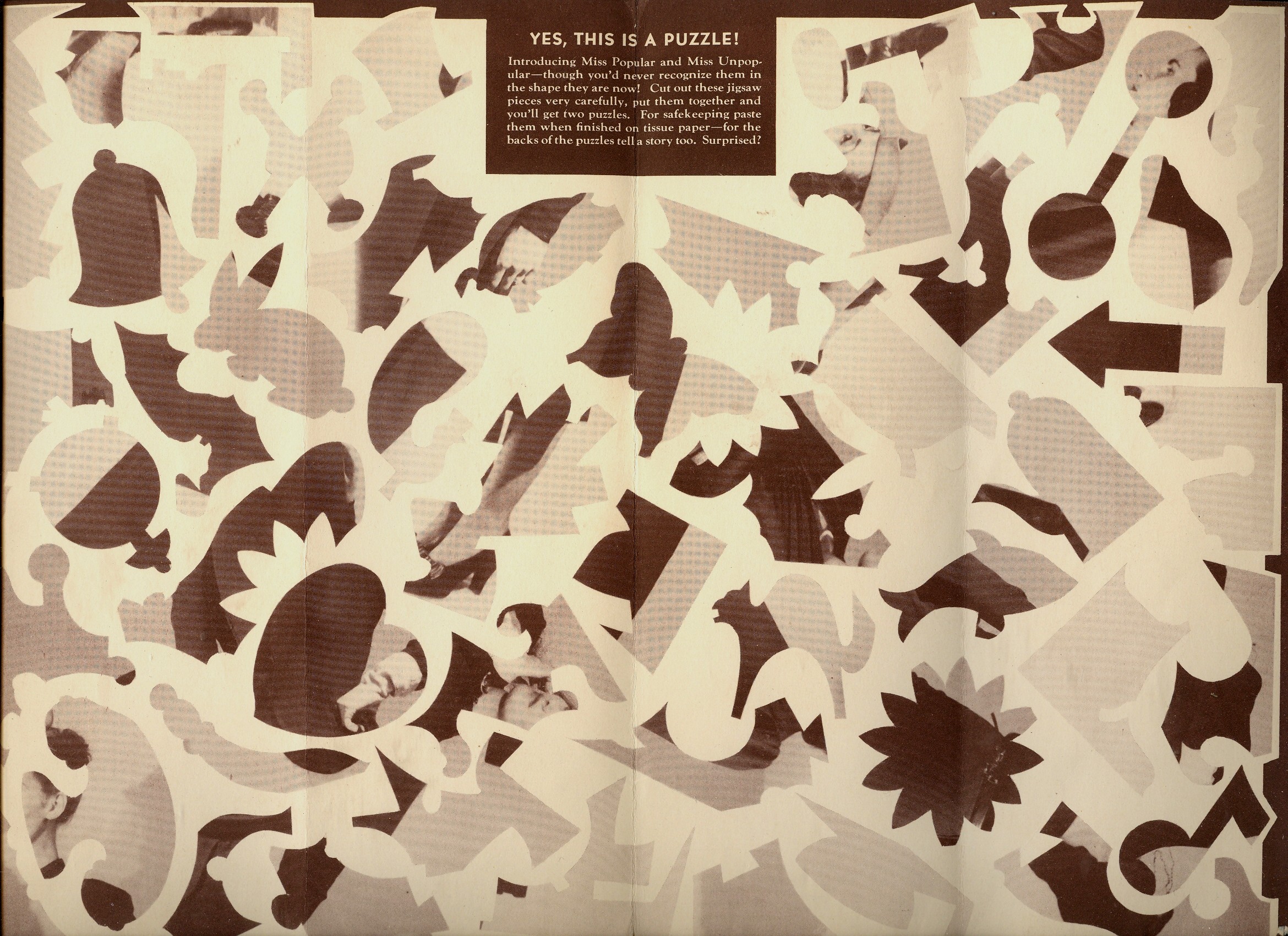
    One of these
    publications—hardly a pamphlet per se, just a folded 11×8 inch sheet of heavy
    stock—came without a title, presenting itself as a puzzle. The puzzle pieces
    are parts of two women, “Miss Popular” and “Miss Unpopular”: the reader was to
    take the publication, cut out the pieces, and reassemble them into hidden role
    models, with phrases describing each on the back of each puzzle piece, all done
    without the slightest possible understanding of metaphor or irony.

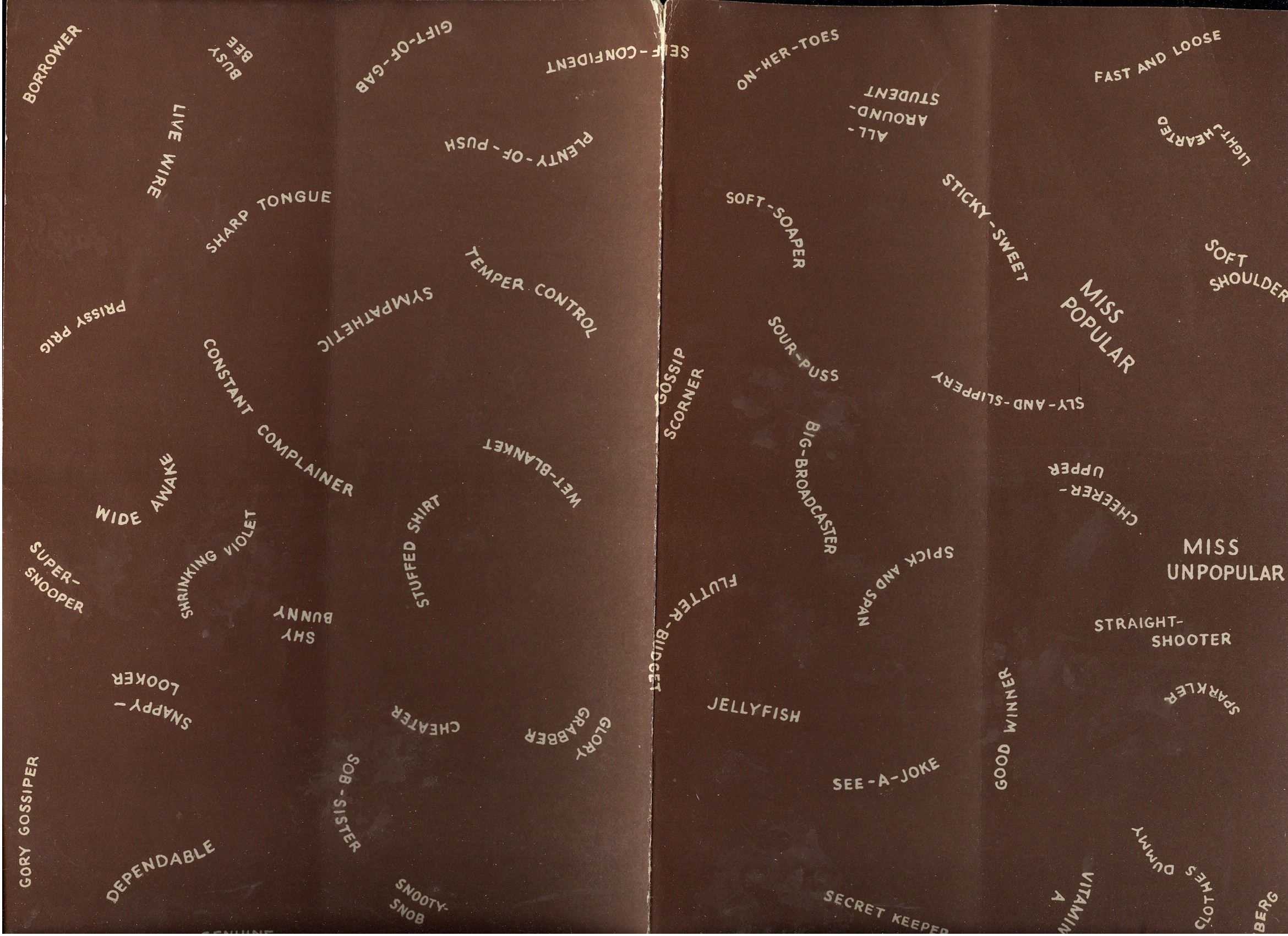
    Miss
    Popular phrases/descriptors
    : live wire, plenty of push, wide awake, snappy
    looker, dependable, genuine, secret keeper, on-her-toes, spick and span, light
    hearted, all-around-student, straight-shooter, gossip scorner, sympathetic,
    cheerer-upper, sparkler.

    Blog jan 13 Puzzle pzl

    Miss
    Unpopular’s phrases/descriptors
    : glory grabber, sour puss, cheater, sob-sister,
    snooty-snob, wet-blanket, borrower, prissy prig, sharp tongue, gory gossiper,
    clothes dummy, iceberg, sly and slippery, jellyfish, sticky-sweet, soft soaper
    (?) and of course fast and loose.

    And
    so girls—or young women—picking up this publication in 1941 were expected to
    cut this thing up and piece together the proper (paper) role model using the
    reinforcing traits of meager acceptance printed on the back of the puzzle
    piece. And poor Pope Joan, whether she was real or not, whether she was
    imagined or sunk purposefully away into the Pandora’s sisters’ boxes of forced
    forgetfulness—it really doesn’t matter—is just another woman or part of woman’s
    puzzle whose blank or missing piece has been extruded, forced into a form more
    friendly to a world less friendly to women. 

    Notes

    1.According
    to the Chronicon:  “John Anglicus,
    born at Mainz,
    was Pope for two years, seven months and four days, and died in Rome, after which there
    was a vacancy in
    the Papacy
    of one month…” [See continued reading section below for more]

    2.
    Babylon was the
    representation of the seat of evil on the Earth.  From the “Book of Revelation” (17:3–4):
    “And I saw a woman sitting on a scarlet beast, full of names of blasphemy
    with seven heads and ten horns. The woman was garbed in purple and scarlet, and
    gilded with gold, gems, and pearls, and bearing a golden goblet in her hand
    full of abominations and filthiness of her fornication.”

    3.
    Borgia and the Medicis not being the least of the story: see E.R. Chamberlin’s The Bad Popes, (1969)


  • History of Holes 12: Caves in mid-Renaissance Art

    JF Ptak Science Books LLC  Post 909

    “When [the soul] is firmly fixed on the domain where
    truth and reality shine resplendent it apprehends and knows them and appears to
    possess reason, but when it inclines to that region which is mingled with
    darkness, the world of becoming and
    passing away
    , it opines only and its edge is blunted, and it shifts its
    opinions hither and thither, and again seems as if it lacked reason.”  Plato, The Republic book. VI, 508d

    Cave--osservanza

    Plato
    dipped deep into the myth/metaphor/parable/analogy/allegory of the cave,
    contrasting it with the allegory of the sun, discussing the pursuit of
    knowledge real and not-so.

    I
    like the idea of the half-displayed, semi-schematic, fade-away disposition of
    the cave and how painters dealt with them and their hidden contents in early Renaissance
    art.

    Its
    difficult to show a cave, a dark hole (occurring in all rock types and
    topographic situations, btw) that really hadn’t been dealt with scientifically
    yet—even if humans had been using them one way or another for thousands of
    years. 

    I’ve
    noticed these images time in and time out, and I’ve not really saved them, or
    at least I haven’t segregated the odd etched or engraved images, though they
    are all here somewhere, so I can add to this post from time to time.  The image that I’ll use tonight comes from
    Harvard’s Fogg Museum and is the work of the Master of
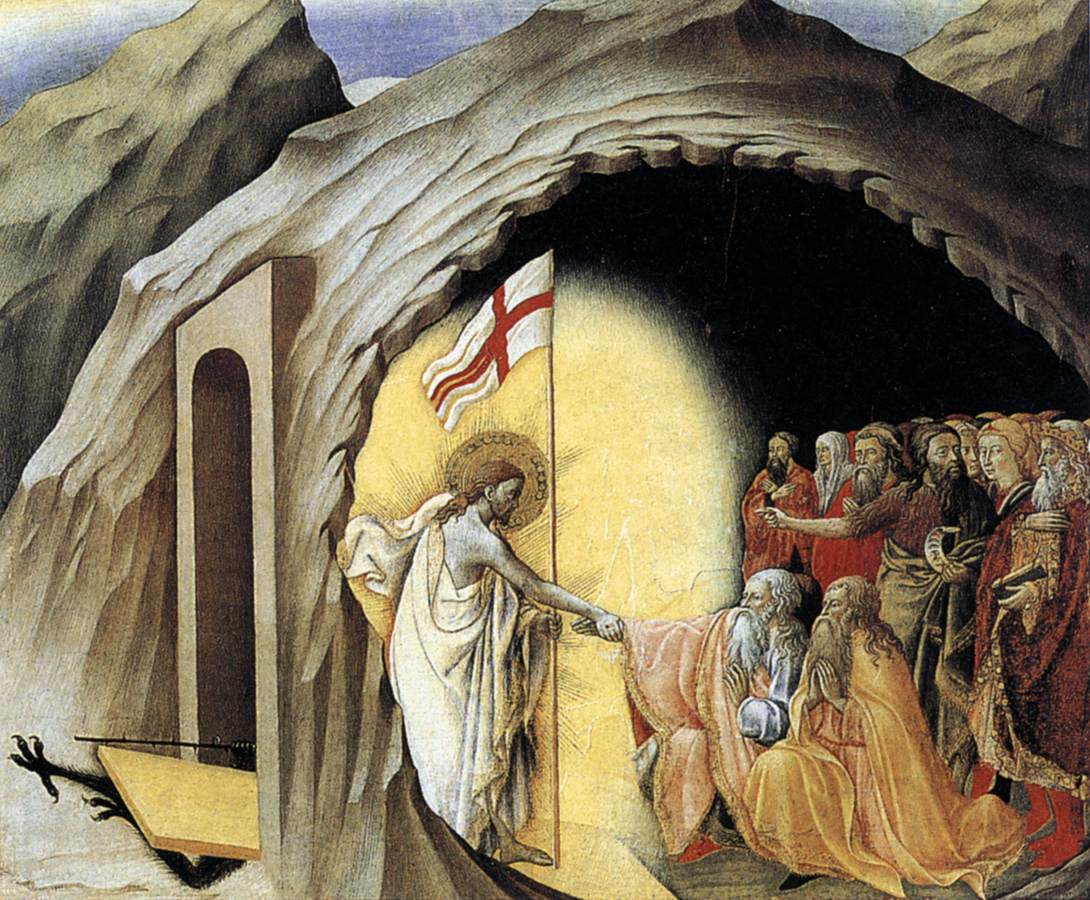
    Osservanza (Sienese school, fl 1430-1450, manuscript illustrator).  It is a popular image, “Christ in Limbo”,
    though of the others working in this genre we see Christ generally at the
    entrance to a tomb/cave-like place, standing just outside of the doorway (as with Mantegna, Durer, Pacher, Fra Angelico and others). The Master of Osservanza gives us an
    exquisite cutaway view of the cave of limbo, showing both the outside and the
    inside, which is an uncommon and beautiful perspective.

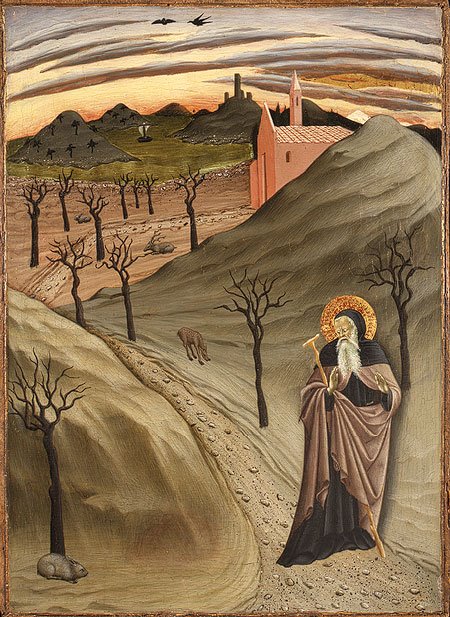
    I should add that the tearingly odd “Saint
    Anthony Abbot Tempted by a Heap of Gold”, also painted by the Master of Osservanza (ca. 1435) depicts the least-likely-of-all-saints-to-be-tempted-by-gold reacting in horror to, well, nothing.  Nothing at all. We see him reacting to what used to be there, but which for some reason was removed, painted-over at some dim point in the dusty past, for reasons that I do not know.  (And so the painting could easily move into my Blank and Empty Things series.) But the desert landscape is so sparse and the sky so surreal with bent clouds that it is easy today to overlook the gold entirely. 

    St. anthony

    [I know there’s SO much more to this business with the caves–I just wanted to get this post started before it all went down the thought-hole.]


  • What Goes into Making Human Robot Girls, 1941

    JF Ptak Science Books LLC  Post 907

    [See the follow-up post “First Thing to Do is to Find Some Men”; How to Get a Boy-date, 1941]

    An
    old friend of mine, Dr. Sam Koslov, was  brilliant, accomplished and polymathic, with
    great senses of wonder, inquisitiveness and humor.  He spent many years in research and as a
    long-time editor at Johns Hopkins APL.  He was a delightful and serious man, though
    one of the projects he worked on sounded much more like squeaky scifi than pure
    sci. That was Project Pandora, and science fiction it definitely wasn’t—it was
    an attempt at a form of control over human behavior via low level microwave radiation1. 

    This
    came to mind as I was leading through some very low level, high impact behavior
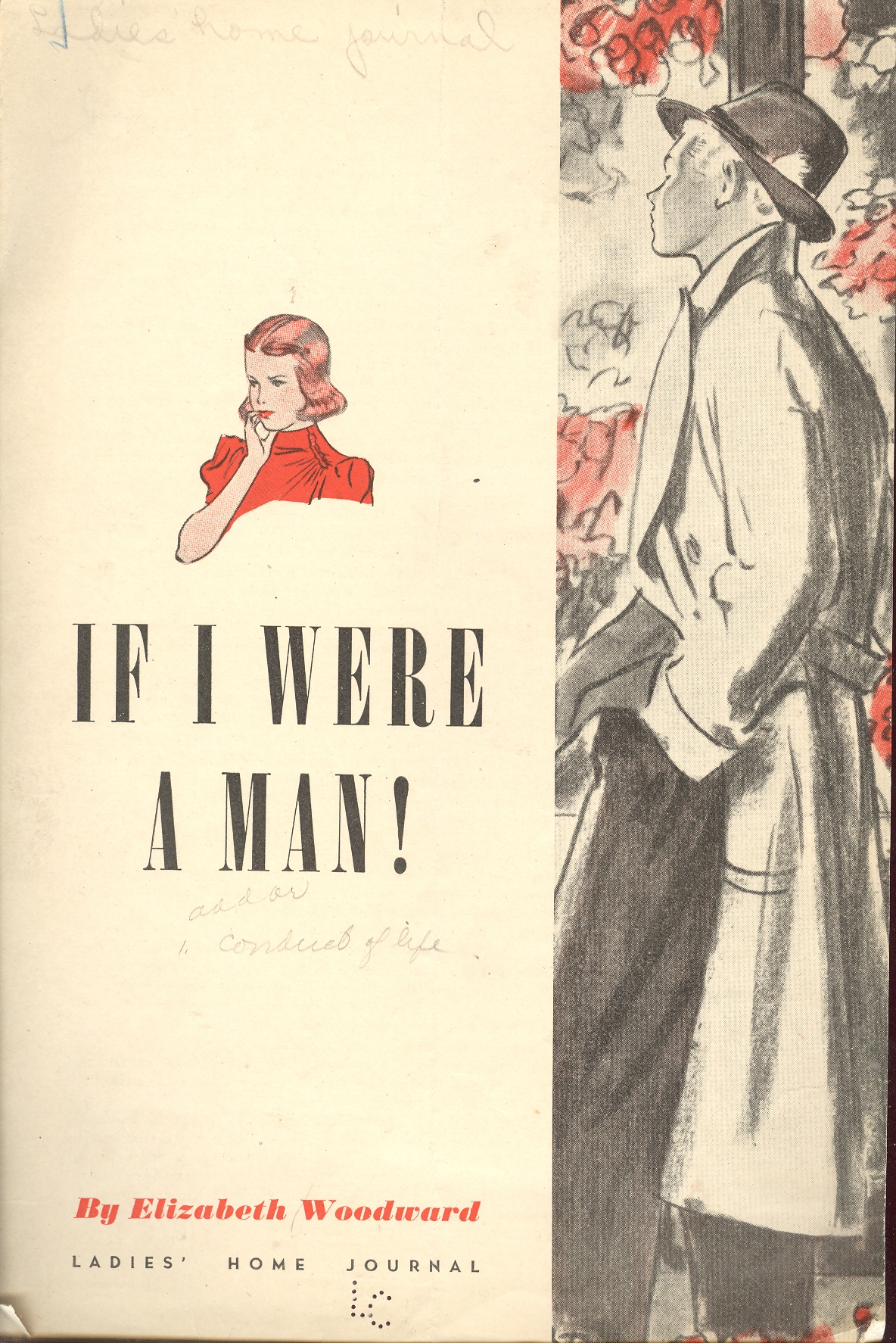
    control exhibited in a series of social engineering pamphlets published by the Ladies’ Home Journal in the early 1940’s. Blog jan 12 girlz--if i were a man It is heartbreaking, really, to think of people
    like my mother reading these things and being inundated by cultural architecture
    that left little to the imagination.  It
    seems so terrifically outrageous in 2010; and of course it makes me wonder
    about what things that seem so de rigueur
    today will be the Ladies’ Home
    Embarrassments
    of 2050Blog jan 12 girlz--ggnetlman preffered . 

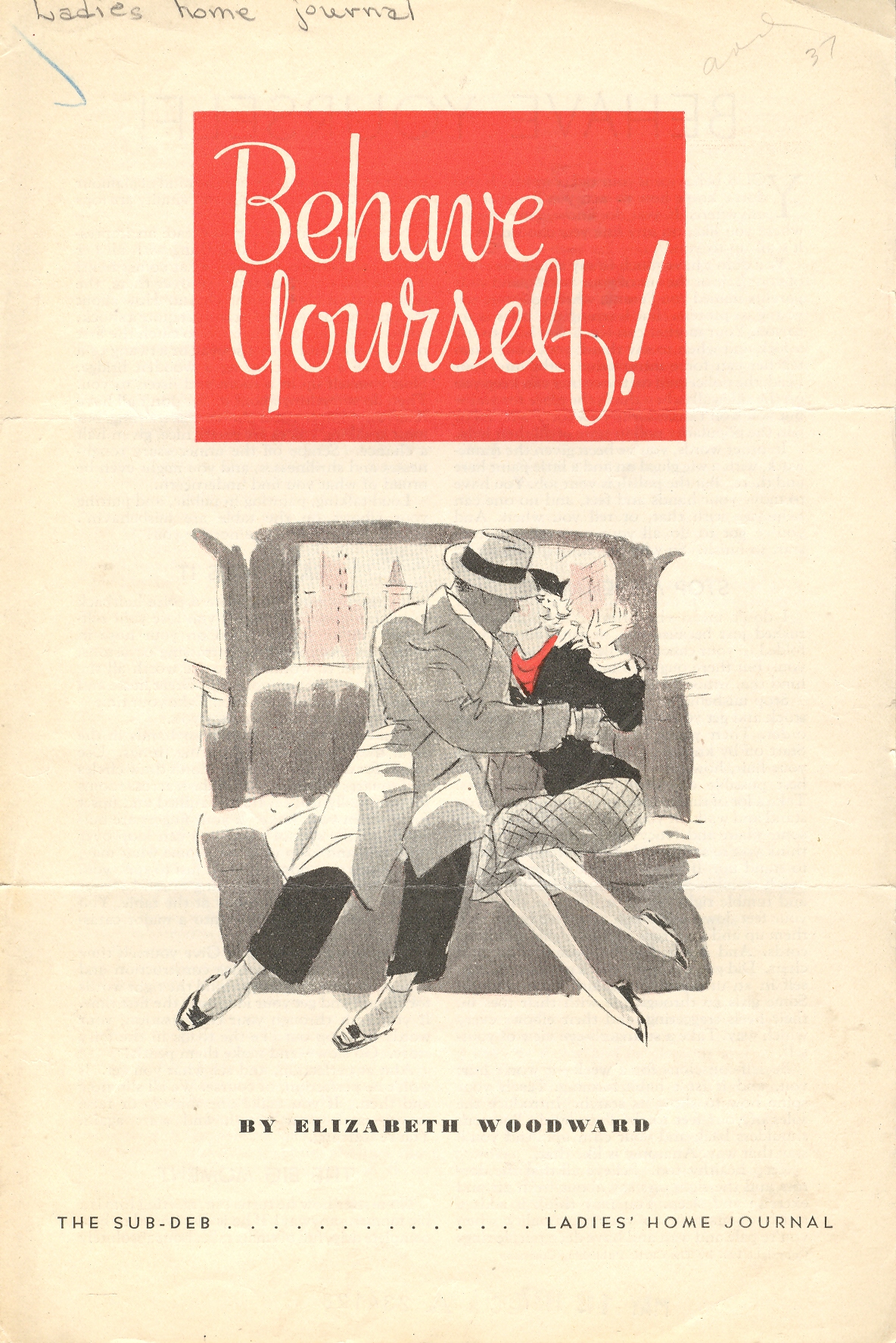
    Granted, nobody’s corneas were being shaken loose via this method, but the effect of the sentiments of control in these pamphlets still seem eye-poppingly
    strangulating.  I’ve included only a few
    examples here, but there are at least a hundred others to choose from.

    Blog jan 12 girlz--behave yourself

    Perhaps
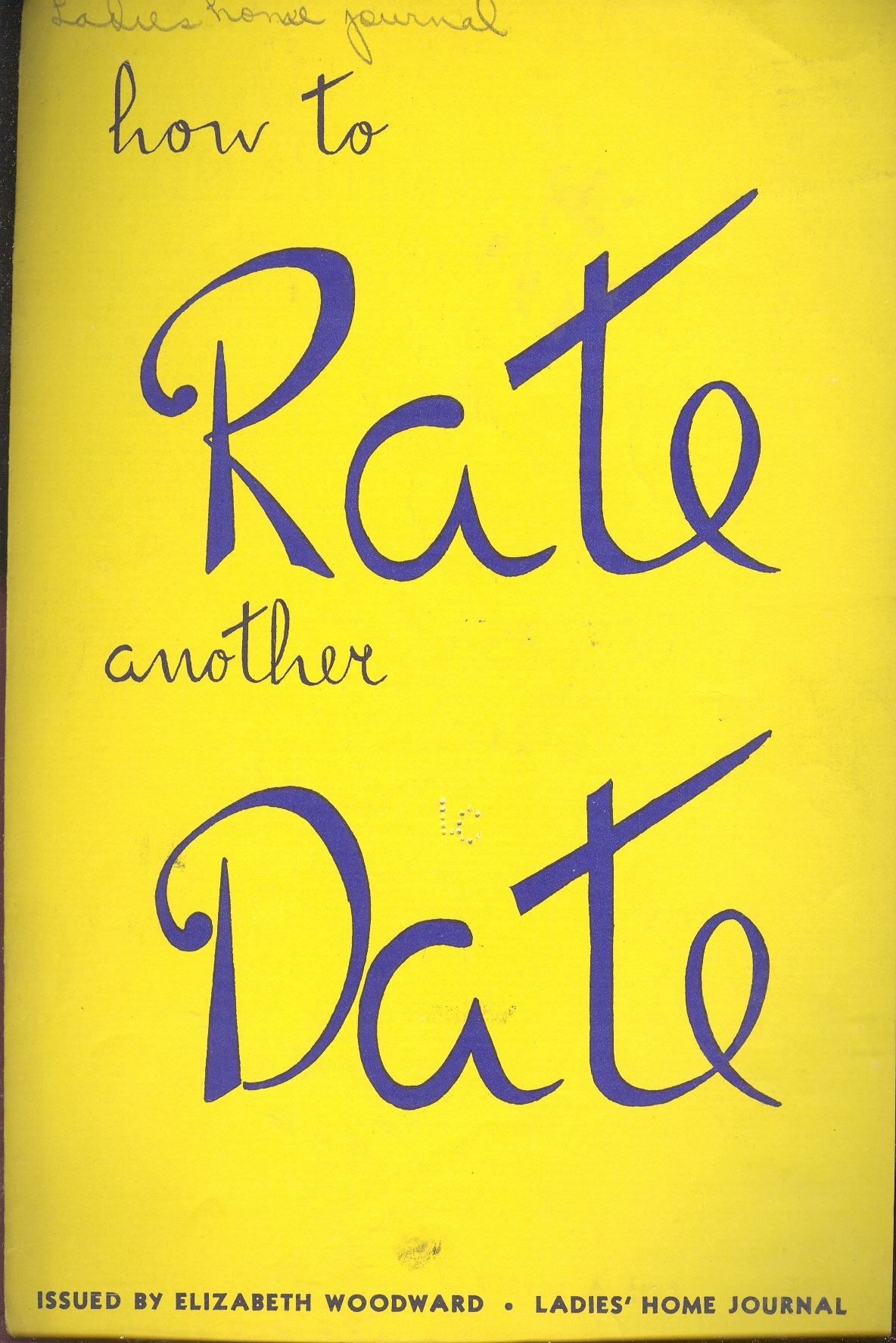
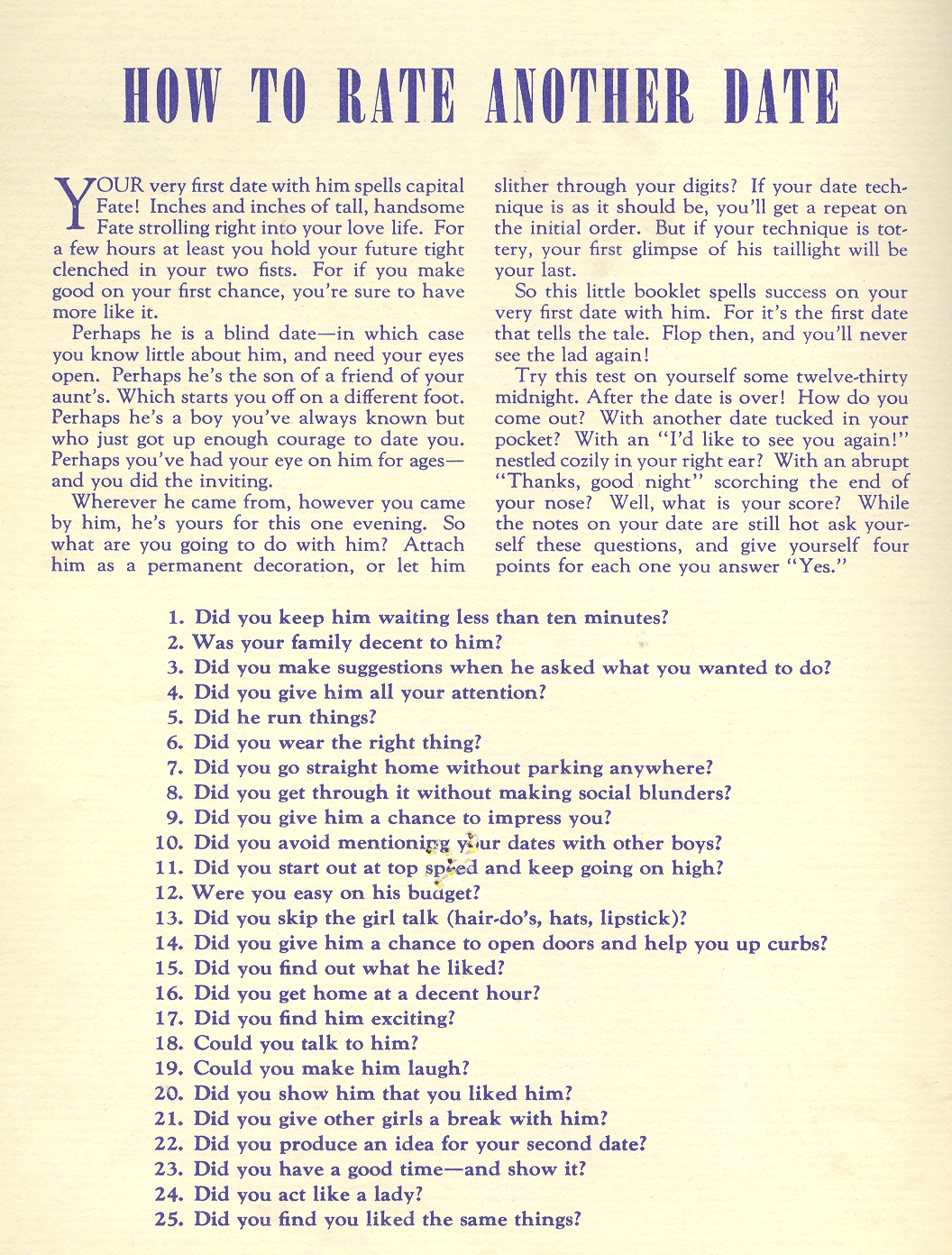
    it was the Date-Rate pamphlet that caused most of my teeth to fall out—it is
    sheer and painful, offering virtually nothing to the young women reading it and
    practicing its morality play but gender obedience and servility.Blog jan 12 girlz--rate a date

    “Did you give
    him all your attention?” “Did he run things?” “Did you give him a chance to
    impress you?” “Could you make him laugh?” 
    It isn’t until the final rating question (#25) that we get to something that
    opened the possibility of a two-way interest in the relationship, but only
    barely: “Did you find you liked the same things?”  Its sad, really. 

    Blog jan 13 RAE DATE txt

    When I read some of this to my 17-year-old
    daughter, she just looked at me with an open mouth and eyebrow furrows:  it was simply beyond listening to, for her,
    and certainly not anywhere near worthy of a response. 

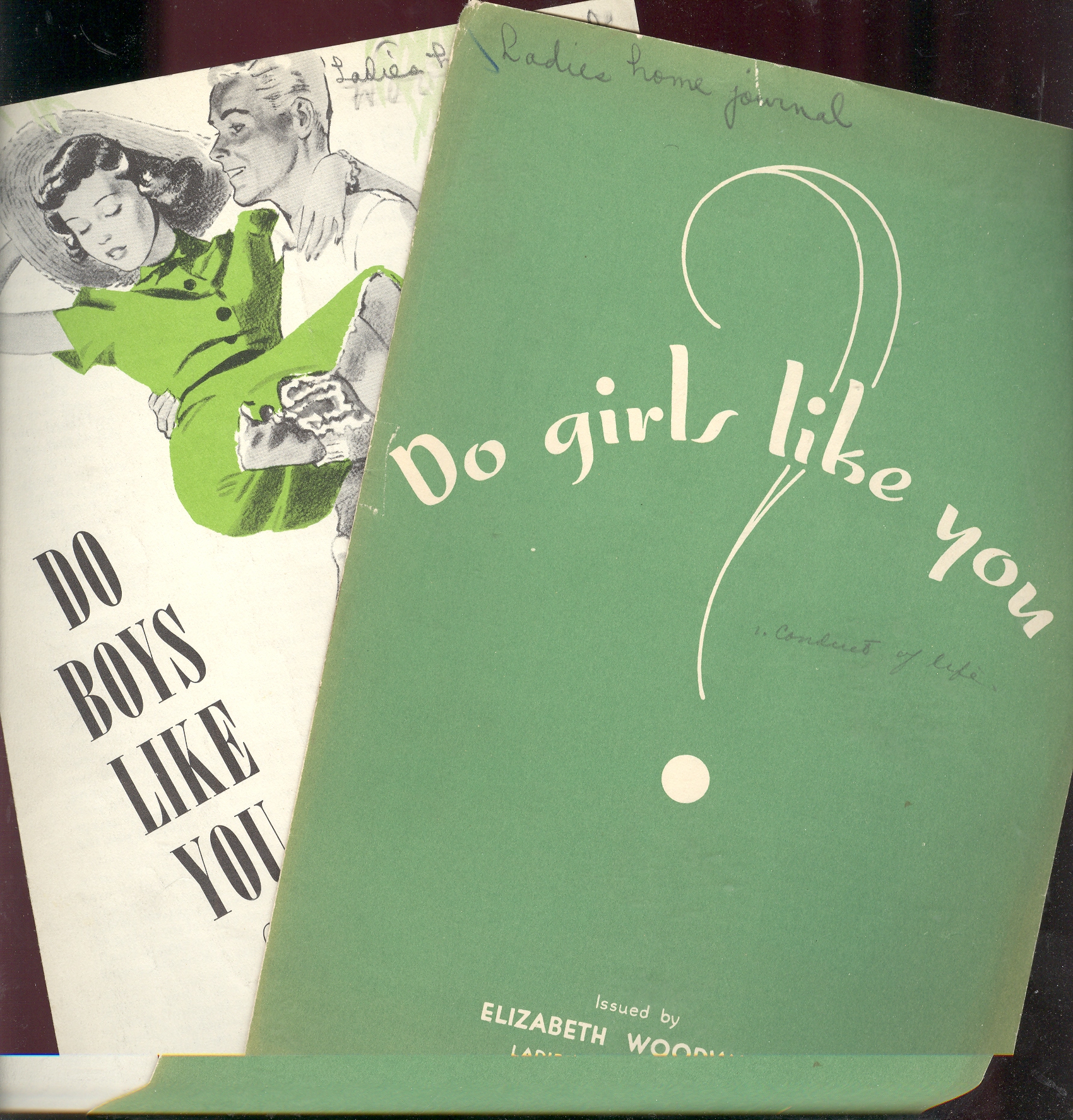
    Blog jan 12 girlz--do boys like you 

    Of course this is just the tip of the tip of the tippity tip of the iceberg on the control of social thought and the keeping of the male-dominated social order, and its only one part of a very wide spectrum of overall codifications, much of which seem pretty much left to history within two generations.  

    Blog jan 13 do boys girl like u

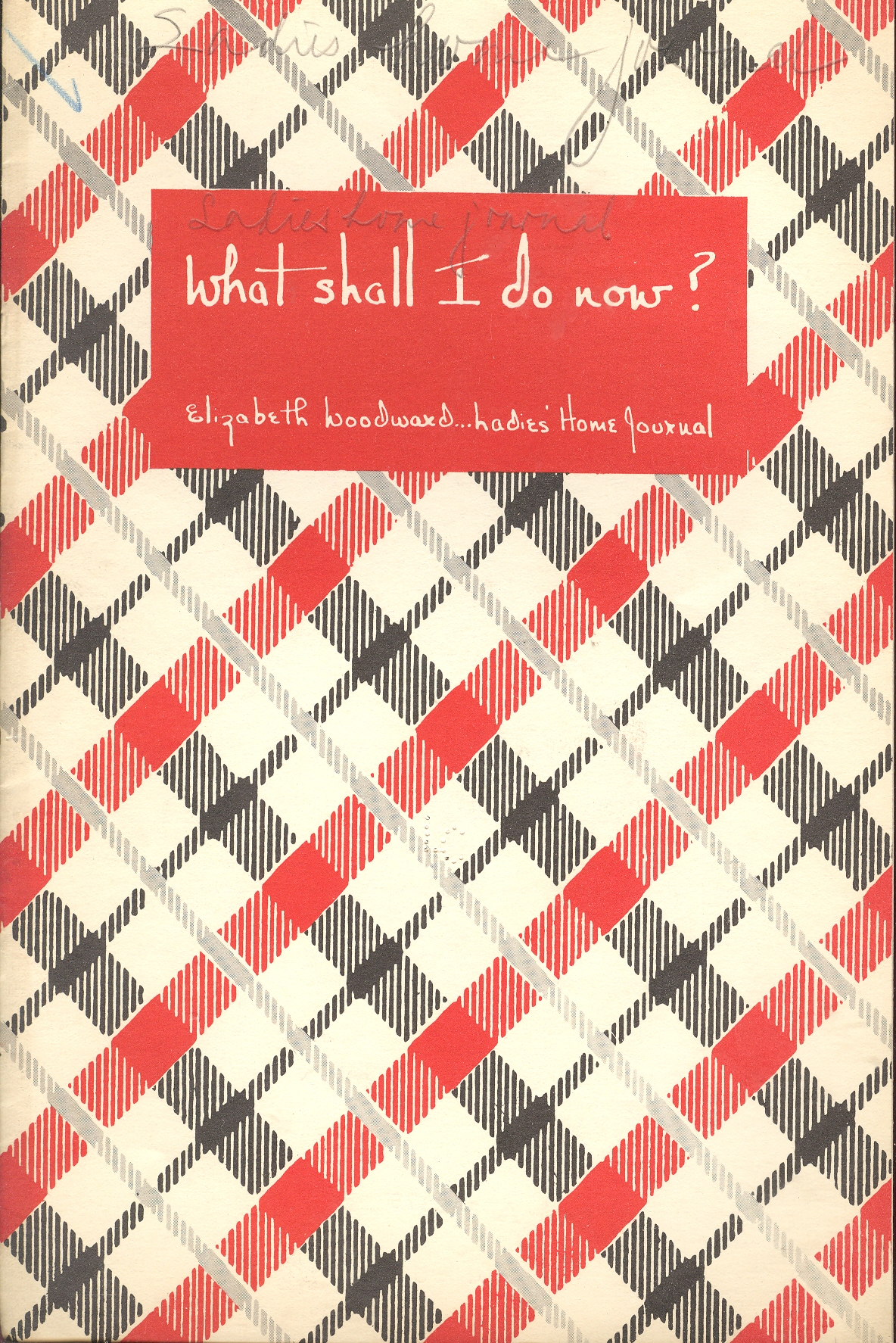
    Blog jan 12 girlz--whAT shall

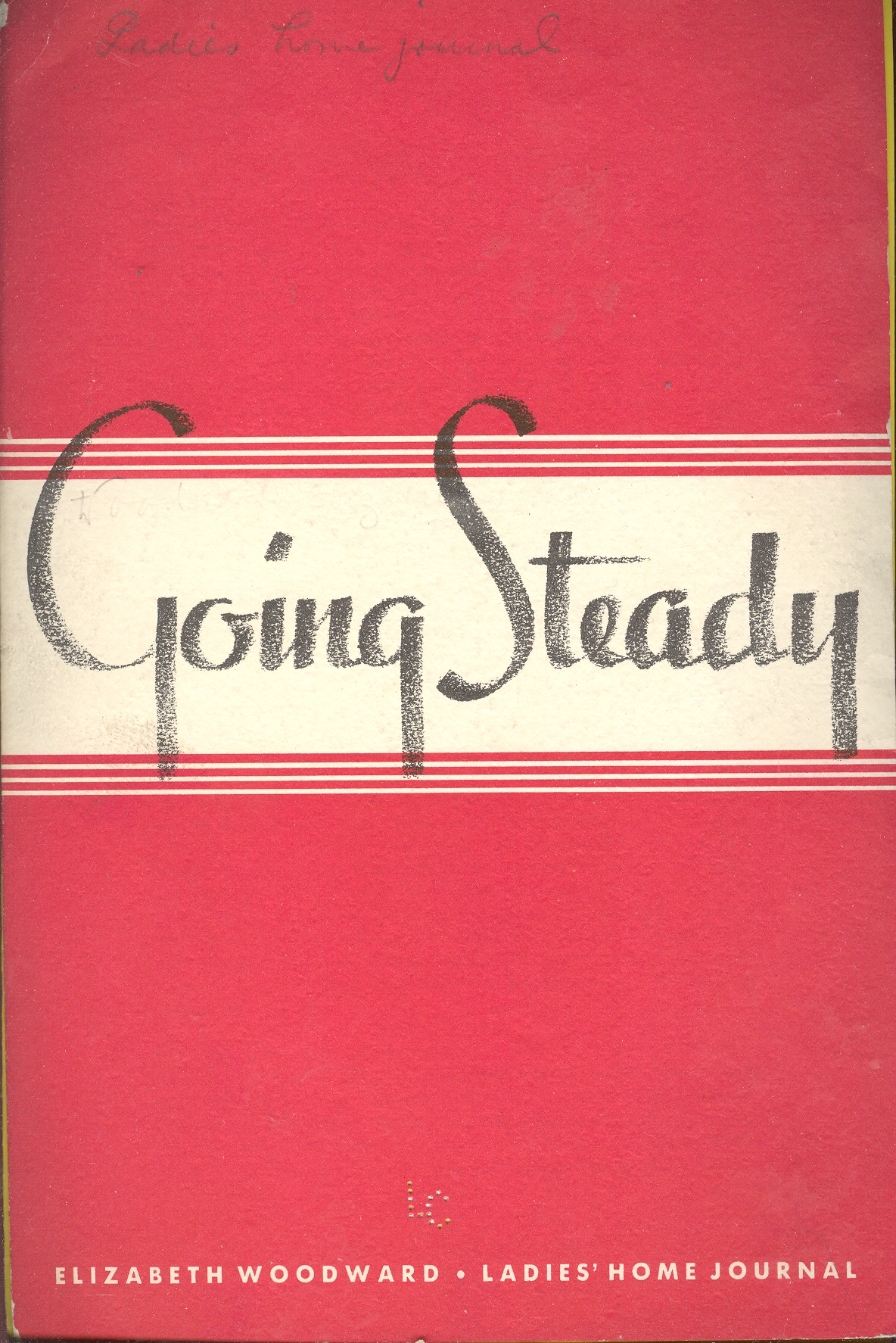
    Blog jan 12 girlz--going steady

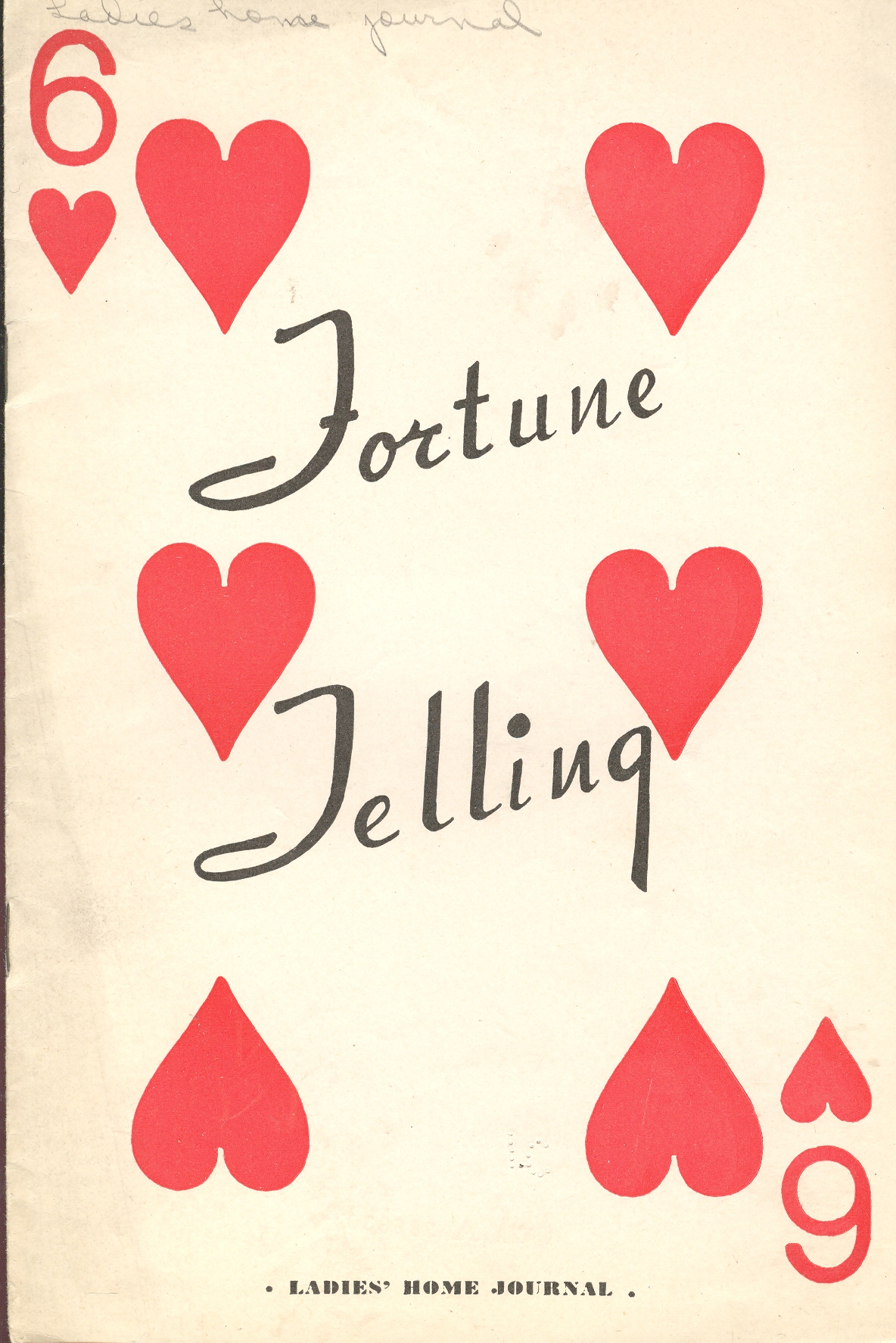
    Blog jan 12 girlz--fortune telling  

    Blog jan 12 girlz--awhat did you say

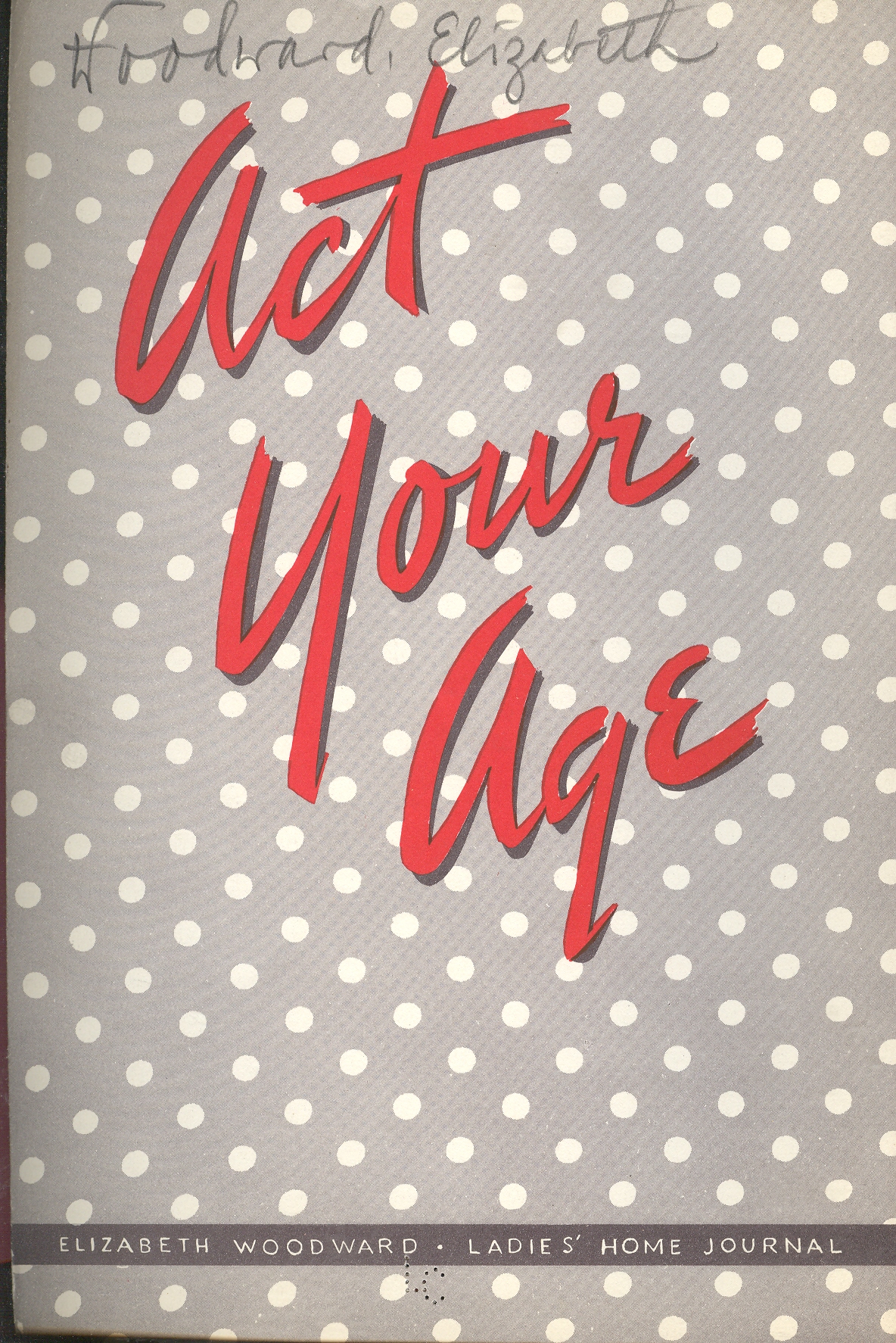
    Blog jan 12 girlz--act yer age


  • The Oldest Image of a Flying Pig? An Adynaton Antiquarian Illustration, 1687.

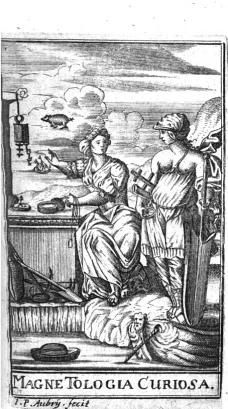
    JF Ptak Science Books LLC  Post 905Blog jan 11 dalence pigs fly

    How
    old is the  saying, or rejoinder, “…when
    pigs fly”?  I dunno, and frankly it
    doesn’t really matter. Except for right now, when I found this rather
    extraordinary image of a pig-in-the-sky from 1687.  It isn’t a flying pig, but I’m not sure what
    it is:  the origin of the image is from
    J.de  Dalence, Traite de l’Aiman (publihsed in Amsterdam in 1687), a book about the history
    of magnetism.  But nothing else matters,
    just the flying, atmos-floating pig, right there in the sky, perfect against a
    puffy cloud. 

    I
    suspect—without any intention of doing any research on my suspicion—that this
    may very well be the earliest depigtion of a flying pig.  And it just so happens to have appeared in
    the same year of Newton’s great Principigia. 

    And
    just for the record, I wonder how often anyone sees an image 300+ or more years
    old of any of the other great adynations? For example, “It is
    easier for a camel to pass through the eye of the needle,
    than for a rich man to enter into the kingdom of God”  from the Book of Matthew,
    19:24, just doesn’t seem to lend itself to empirical description, as it would
    pretty much lessen and defeat the purpose of the literary description.

    The flying pig, though, may be a horse of a different
    color, so to speak.


  • Shakespeare’s Renaissance Wisdom and the Turtle Dove

    JF Ptak Science Books LLC  Post 887

    Thinking about the second day of Christmas brought me to the turtle dove, and then almost immediately to William Shakespeare, and on to H.W.
    Seager’s delightful Natural History in Shakespeare’s
    Time
    being Extracts illustrative of the Subject as he knew it
    (London,
    1896)1.  Seager got to the point right
    away, quoting the turtle dove’s appearances in Winter’s Tale and Merry Wives
    before moving on to quote fabulous passages from Bartholomew de Glanvile and
    Albertus Magnus. 

    WINTER'S TALE, iv. 4

    FLORIZEL:

    “I think
    you have

    As
    little skill to fear as I have purpose

    To put
    you to’t. But, come; our dance, I pray:

    Your
    hand, my Perdita; so turtles pair

    That
    never mean to part.”

    MERRY WIVES OF WINDSOR, iii. 3, 44. 

    Henry VI, Part IDuke of Burgundy:

    “Myself, as far as I could well discern
    For smoke and dusky vapours of the night,
    Am sure I scared the Dauphin and his trull,
    When arm in arm they both came swiftly running,
    Like to a pair of loving turtle-doves
    That could not live asunder day or night.
    After that things are set in order here,
    We’ll follow them with all the power we have.”

    Then on to the 13th century Bartholomew de Glenvile, ostensibly a compendious theologian but who was also a general encyclopaedist who provided one of the widest views on the known natural history of the thirteenth century, drawing together all manner of facts and fictions from Greek, Arab and Jewish sources.  He was translated into English (On the Nature of Things)  and published in a spectacular volume in 1494 following the first printing of the work (Paris) in 1470 (De proprietatibus rerum).
                                                                                                                                 
    “THE Turtle hath that name of the voice, and is a simple bird as the culvour, but is chaste, far unlike the culvour, and if he loseth his make [i.e., mate], he seeketh not com- pany of any other, but goeth alone, and hath mind of the fellowship that is lost, and groaneth alway, and loveth and chooseth solitary places, and flieth much company of men…”

    And this:

    “He cometh in springing time and warneth of novelty of time with groaning voice. And in winter he loseth his feathers, and then he hideth him in hollow stocks. And against summer, in springing time, when his feathers spring again, he cometh out of his hole in the which he was hid, and seeketh convenable place and stead for to breed in. The Turtle layeth eggs twice in springing time, and not the third time, but if the first eggs be corrupt. Also the blood of her right wing is medicinable, as the blood of a swallow, and of a culvour or dove.”

    And further, describing a magical, fireproofing stone that could be found in the mouth of the Turtle Dove: 

    “Amatides is a precious stone ; if a cloth be touched therewith, the cloth withstandeth fire and burneth not, though it be put therein ; but it receiveth brightness and seemeth the more clear. And withstandeth all evil doing of witches…IT is supposed that in the maw of the cock Turtle-dove this stone is to be found, and hath virtue to increase concord and love…” 

    And from “Albertus Magnus” (though probably by a follower of his), The Book of Secrets: Of the Virtues of Herbs, Stones, and Certain Beats, Also a Book of the Marvels of the World, the use of the Turtle Dove’s heart: 

    “IF the heart of a Turtle-dove be worn in the skin of a wolf, the wearer will never thenceforth be wanton. If its heart be burnt, and put on the eggs of any bird, never will it be possible that they should be hatched. And if its feet be hung on a tree, from thenceforth it will not bear fruit.  And if a hairy place be anointed with its blood, and the water in which a mole has been boiled, the black hairs will fall off.”  

    Notes:
    Seager’s work was meant to be a polite background to the natural history of the time, and not an exhaustive treatise.  He says in the preface: “this book presents in a convenient form for reference a collection of the quaint theories about Natural History accepted by Shakespeare and his contemporaries. The work is meant to be rather a sketch than an exhaustive treatise, otherwise it would fill many volumes. The plan of the book is to give some illustration of each word mentioned by Shakespeare when there is anything remarkable to be noted about it. The term ” Natural History ” has been taken in its widest sense, as including not only fauna but flora, as well as some precious stones…”


  • BadTech 100 Years Ago: Zeppelin Tramway

    JF Ptak Science Books LLC  Post 875

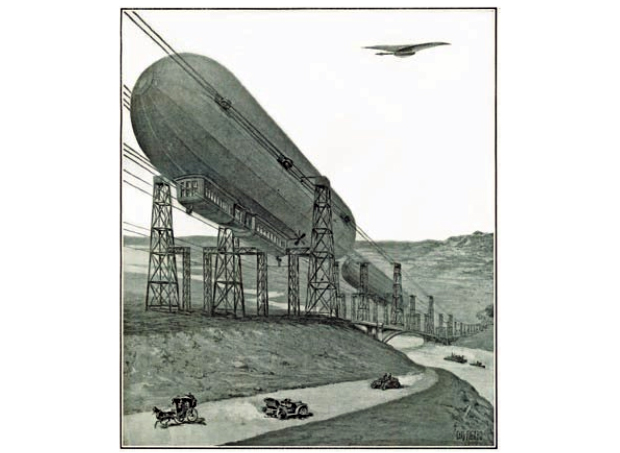
    Here’s a highly-flammable, closely-space and
    heavy-but-flimsy scenario just waiting for its first monstrous mishap. 

    Zeppelin


    This image is from the wonderful website of Alejandro
    Polanco Masa’s Tecnologia Obosleta, dedicated to antiquarian, paleofuturistic
    and non-existent technologies.  It comes
    from the December 1909 issue of Scientific
    American
    , and according to the article was an “impracticable mode of
    transit” envisioned by an unnamed German engineer.  It was a rigid structure airship–which means
    that it received its shape from a hard internal frame covered by a skin, rather
    than a balloon or dirigible, whose shapes are almost entirely dictated by a gas
    filling out their envelope—and looked a lot like Count von Zeppelin’s new
    (1899) LZ-1 flying machine.  No doubt the
    engineer with this land-based system had been caught in the considerable
    zeppelin fever which existed at the time. 
    It  stretched the engineering
    boundaries of the possible more than just a little, and looks to me like a
    disaster that should’ve happened almost immediately.  It was also supposed to speed along at 125
    mph, by who knows what means. Seems to me that there would be fifty towers per mile for a huge flammable Zep carrying not many people–it doesn’t seem to make sense to me, particualrly when railroads would’ve done a better job safer and cheaper moving more people and, of course, the freight that these things just couldn’t carry.   The
    SciAmerican ended: “There are engineering as well as financial objections to
    this scheme.”

    See HERE for other posts on balloons, dirigibles and zeps.


  • History of Blank & Empty Things #22: God in a Hole in the Sky

    JF Ptak Science Books LLC   Post 858  Blog Bookstore

    I think that I’ll start a thread on The History of Holes–which this post would secure nicely–though it will have to be differentiated from The History+ Dec 2 god hole of Dots and The History of Blank and Empty Things somehow.  Still, I like the idea.

    These title page illustrations may or may not reveal a hole
    in the sky, a glimpse into a blank heaven. 
    God knows that Heaven awaits its geology from Charles Lyell or cartography from Jed Hotchkiss, so this iconography that
    I’m creating for these two Renaissance views of the blank canvas of the universe
    may well be incomplete or completely wrong—but it is intriguing that there isn’t
    even a suggestion of what God’s environment might be.  This assumption that one might possibly be
    shown the celestial surroundings may also be enormously presumptive and
    unknowable/unseeable by human eyes, but since we are being shown a corporeal form
    of the Creator I thought that the  logic
    was also there to portray the Creator’s milieu, but it is not to be.  

    + Dec 2 god hole 2

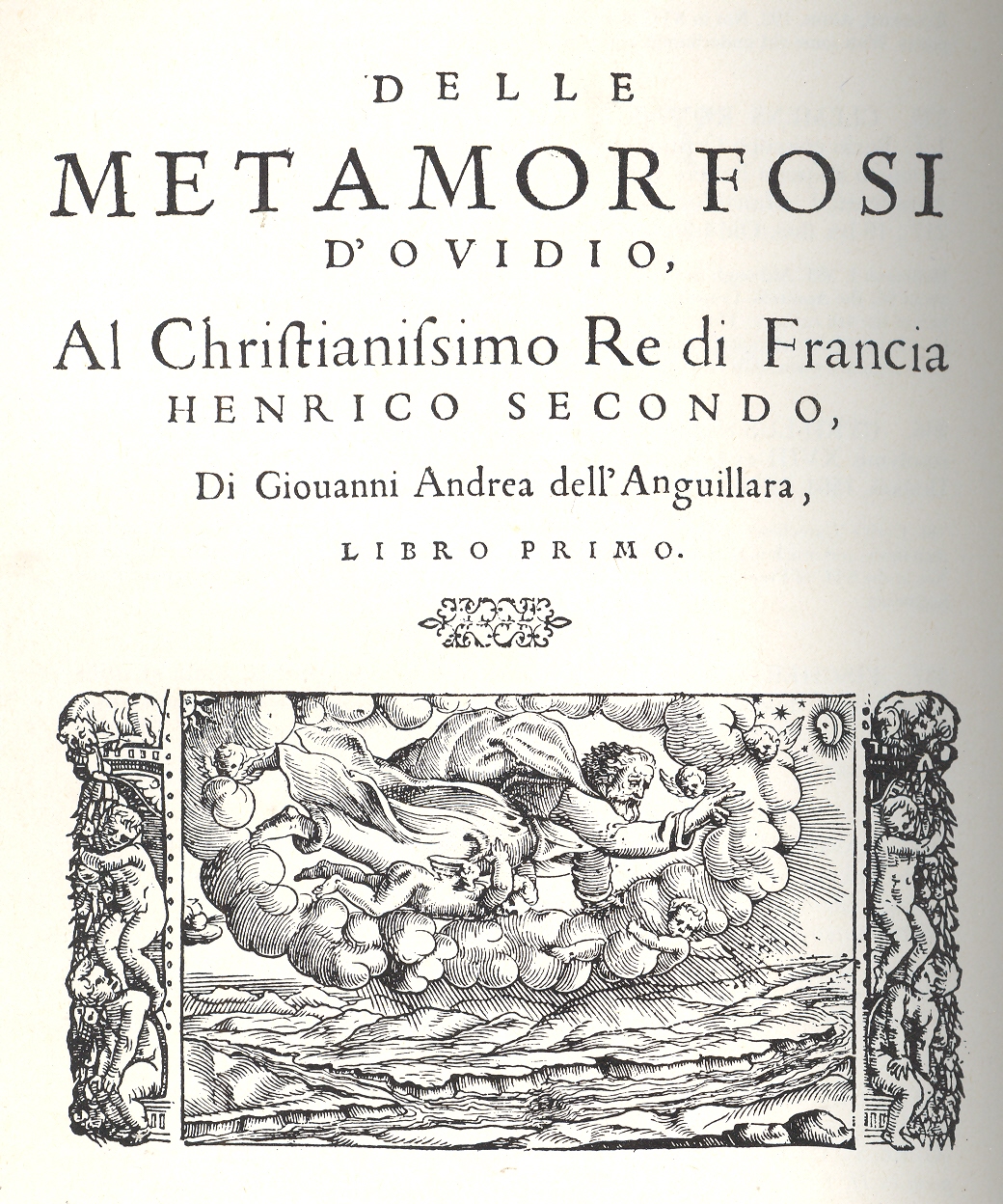
    The first title page is for the narrative poem Le Metamorfosi, Ovid’s  Metamorphoses,
    translated into Italian by Gioseppe Horologgi, and published in Venice in 1563.  It is certainly appropriate that God appears
    on the title page of this work, as Ovid tells the story of creation of all
    things and the history of man in the book’s 151 chapters—appropriate more so as
    this was one of the most popular intellectual biblio-tools of philosophers and
    writers right through the Middle Ages (having wide effect on Chaucer and Shakespeare on down).

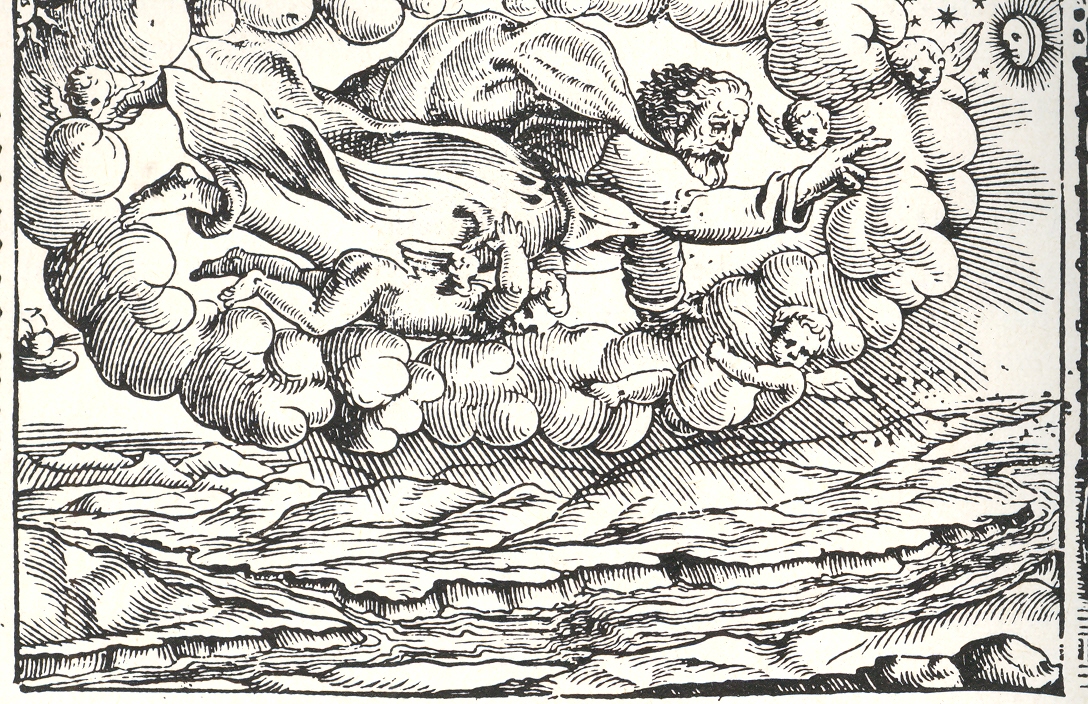
    The image seems to catch the Creator in the act between the
    fourth and fifth days, floating in a cloud-framed hole in the sky.  Beyond the hole there is a white emptiness—which
    makes me think that there is something; if there was nothing, I guess we’d have
    the absence of all color, or blackness. 
    Or perhaps not.  In any event I
    find the opening in the fabric of creation and its blankness/emptiness somehow
    restful. 

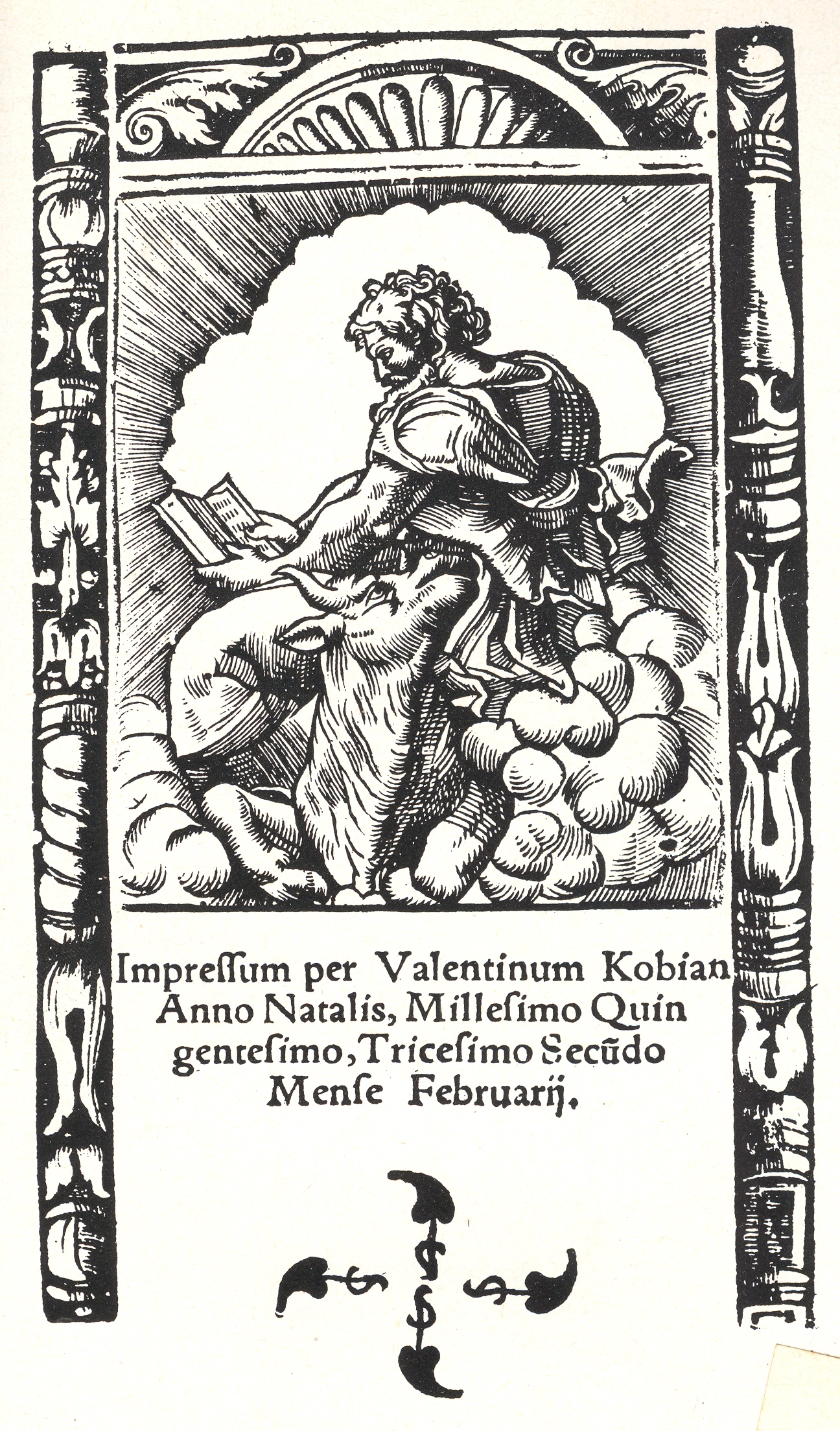
    The second image is a little more open to debate as to
    whether that is God in the cloud, reading, or not; I prefer to believe it
    so.  The image is the colophon for Johann Virdung’s2 (ca. 1465-1535, of Hassfurt0 Nova medicinae methodus…3, an astrological-medical book written by
    a celebrated astrologer, professor and correspondent of Joahnnes Trithemius.

    + Dec 2 god hole 3

    If this is to be the Creator in the clouds, reading a book,
    then I would take the white blankness behind him to be another opening in the
    sky.   The small interesting bit about the title page
    is that it spells out the year and the month and the day on which the book was
    printed, which was not very common at all, not a bit.

    I’ve certainly noticed white/blank/empty skies in prints,
    but I’m not so sure that the celestial hole has registered with me before
    today.  It has the potential for an
    interesting idea, in the opposite-of-a-black-hole category. Maybe. 

    Notes:

    1. The contents of the work, as follows:  Book I: Cosmogony, Ages of Man, Gigantes, Daphne, Io;; Book II: Phaëton, Callisto, Jupiter and Europa;;Book III: Cadmus, Actaeon, Echo and Pentheus;; Book IV: Pyramus and Thisbe, Perseus and Andromeda.;Book V: Phineas, the Rape of Proserpina;Book VI: Arachne, Niobe, Philomela and Procne; Book VII: Medea, Cephalus and Procris; Book VIII: Nisos and Scylla, Daedalus and Icarus, Baucis and Philemon; Book IX: Heracles, Byblis; Book X: Eurydice, Hyacinth, Pygmalion, Adonis, Atalanta, Cyparissus; Book XI: Orpheus, Midas, Alcyone and Ceyx; Book XII: Iphigeneia, Centaurs, Achilles; Aesacus; Book XIII: the Sack of Troy, Aeneas; Book XIV: Scylla, Aeneas, Romulus; Book XV: Pythagoras, Hippolytus, Aesculapius, Caesar.

    2. Lynn Thorndike:  Johann Virdung of Hassfurt again Isis
    25, 1936, p. 363; Faust and Johann Virdung of Hassfurt, Isis 26,
    1936/37, p. 321

    3.  Full title:
    Nova medicinae methodus, nunc primum & condita & aedita, ex
    mathematica ratione morbos curandi
    . 
    Available here!

    Other Virdung and astrology titles located at this marvelous
    site, here.