A Daily History of Holes, Dots, Lines, Science, History, Math, Physics, Art, the Unintentional Absurd, Architecture, Maps, Data Visualization, Blank and Missing Things, and so on. |1.6 million words, 7500 images, 4.9 million hits| Press & appearances in The Times, Le Figaro, Mensa, The Economist, The Guardian, Discovery News, Slate, Le Monde, Sci American Blogs, Le Pont, and many other places… 5000+ total posts since 2008.
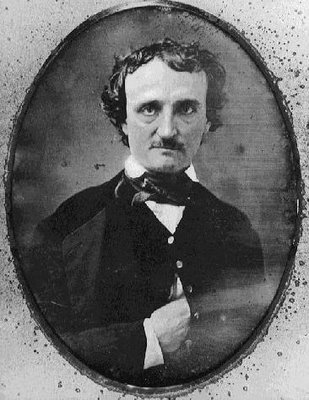
I was paging through the literary criticism and review volume
of my Collected Works of Edgar Allan Poe
and came to an unassociated wondering about what those “curious volumes offorgotten lore” from “The Raven” might’ve
been.First let me state that Poe was a
critical eviscerator, writing in advanced-smart hyper-bitch mode, capable of crushing anyone.It was here, doing book reviews and general
literary bric-a-brac commentary that he made his first real way into national
consciousness (working for Graham’s
and Southern Literary Messenger and others).When he set his mind to it the man could build
a quick and modest edifice in which to flash-burn an author’s work.And he made short effort of it, too.(An example of this rides below.1) He liked people, too, don’t get me wrong; but more often than not he was comparing others to his own very high standards, and most suffered from a lack of O2 in the end.
According to the little I’ve read about the man, Poe didn’t dip deep into the past for his reading, and wasn’t known for
keeping a library per se, though he did have books–books which he sold from time to time when
the money got short and his ambitions high.
My first guess for the first book in the “forgotten lore2”
category of this young student pining away over his lost love was Robert Burton’s Anatomy of Melancholy.Seldom have there been such great and
difficult-to-read books—and the first and only book of its author—so filled
with somewhat chance swaths of advanced learning and understanding that have
long survived the effects of its wrist-snapping weight on its reader.The book is filled, jam-packed with
polymathic geegaws that it makes the book both irresistible and forgettable.But it seems that Mr. Burton was not known—or
at least not mentioned—by Mr. Poe, so far as I can tell.
And so I wonder what else might fill this category?Poe knew his Milton, and the Paradise Lost might fill this description nicely.But what else? Voltaire? Swift (Tale of a Tub, 1704), or Sam Richardson’s Clarissa (1747) or Laurence Sterne’s Tristram Shandy(1759)? Perhaps Poe meant for the volumes to be forgotten and forgettable?I just don’t know, but I bet some of you
might have some ideas.
Notes
1. a great example of Poe’s criticism is seen in his work on Hawthorne’s Twice-Told Tales (1842):
“A skilful literary artist has constructed a tale. If wise,
he has not fashioned his thoughts to accommodate his incidents; but having
conceived, with deliberate care, a certain unique or single effect to be
wrought out, he then invents such incidents—he then combines such events as may
best aid him in establishing this preconceived effect. If his very initial
sentence tend not to the outbringing of this effect, then he has failed in his
first step. In the whole composition there should be no word written, of which
the tendency, direct or indirect, is not to the one pre-established design. And
by such means, with such care and skill, a picture is at length painted which
leaves in the mind of him who contemplates it with a kindred art, a sense of
the fullest satisfaction. The idea of the tale has been presented unblemished,
because undisturbed; and this is an end unattainable by the novel.”
2. Just in case, here it is:
Once upon a midnight dreary, while I pondered weak and weary,
Over many a quaint and curious volume of forgotten lore,
While I nodded, nearly napping, suddenly there came a tapping,
As of some one gently rapping, rapping at my chamber door.
`’Tis some visitor,’ I muttered, `tapping at my chamber door –
Only this, and nothing more.’
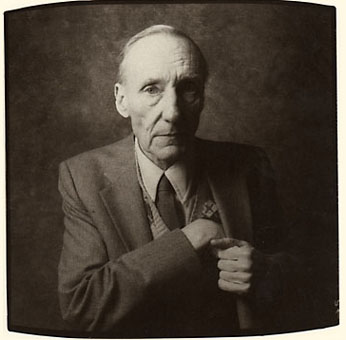
I think that William Burroughs is vastly under appreciated as a driving force behind American mid-20th century dark comedy.For a lot of people the thing missing from reading his books and shorter pieces is the laughter.The few times that I saw him read in the early 1980’s the audience roared—his deep, flat-and-rolling-at-the-same-time delivery pushed this forward, as did the very manipulative lines in his face (which drolly sprang into action at unexpected times, like punctuation marks).In any event, he was funny throughout, a point perhaps lost to folks considering his work as a serious statement on sumpin’ sumpin’. My opinion may very well be a minority, but I see Old Bill as a serious comedian in a dark sweaty Swiftian mold.
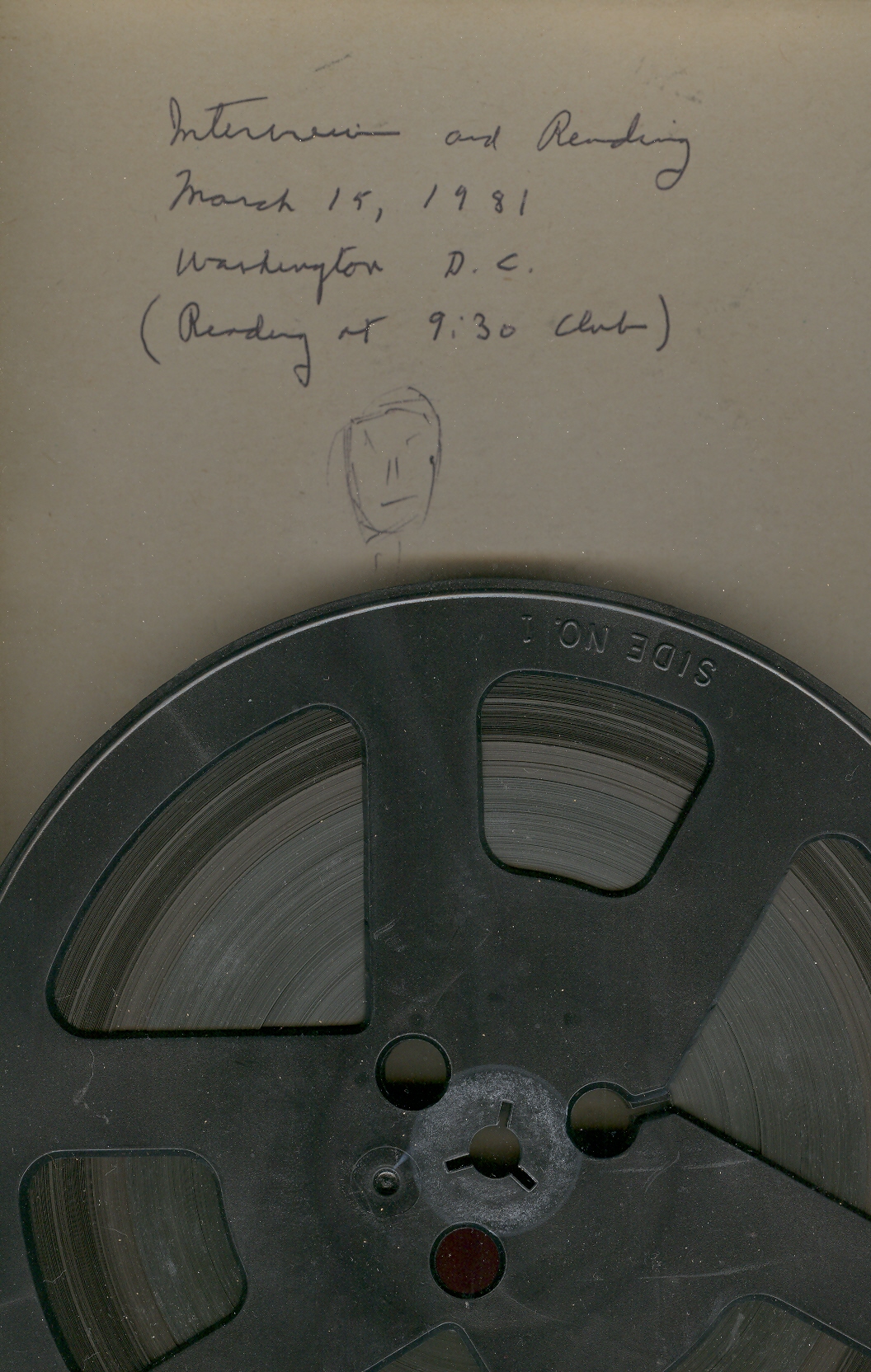
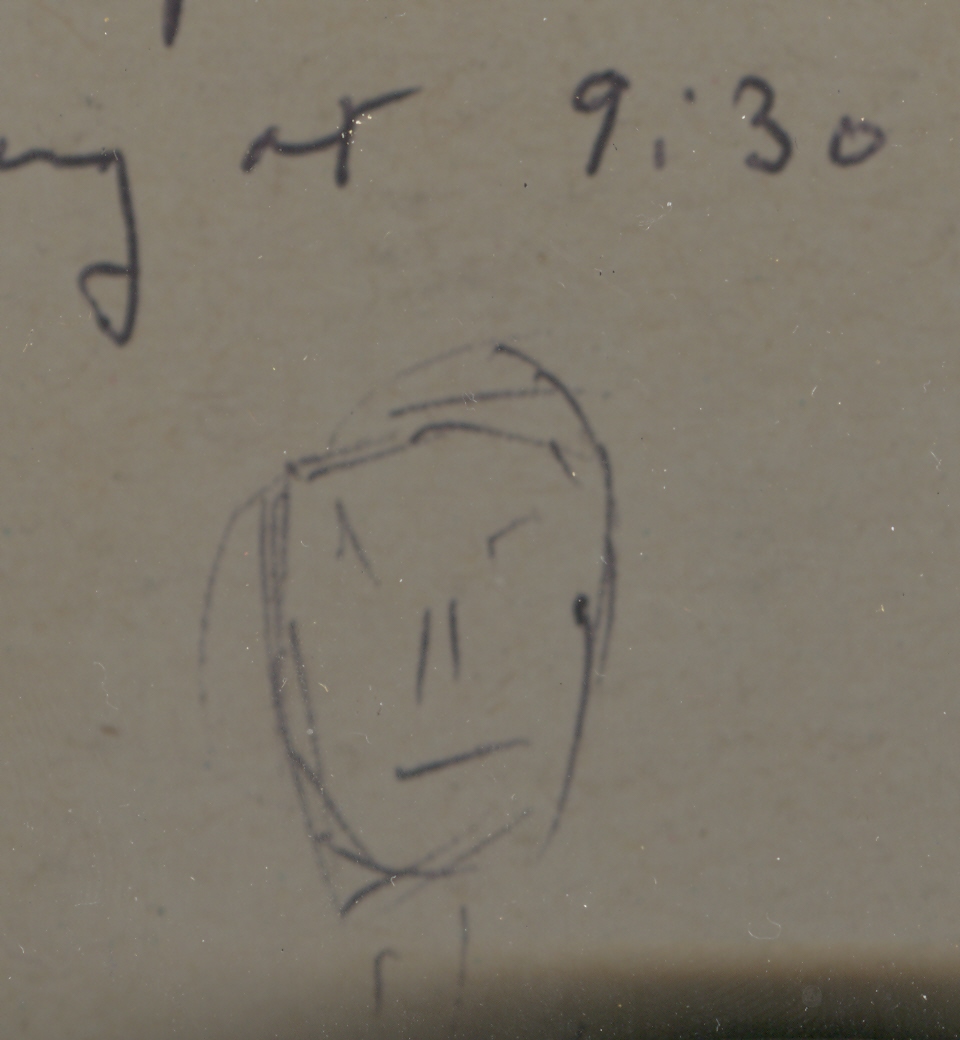
One of the times that I interviewed him was at the 9:30 Club in DC (in its antique incantation, an interesting venue showcasing unusual performers in a ruined brine of alcohol and urine).He was not anxious to be talked to after his reading, and I could hardly get the man to move, though he did become a little animated when pursued about man-machine confluence in the not-too-distant future.At the end of it, I asked—insisted—that he draw a self-portrait, something I had been asking of folks that I was coming into contact with.Burroughs did not want to do it, saying something like ”no one is interested in what I draw myself to look like”.But I told him that I was.And he did it.
He grumbled and flicked-out this disdainful self portrait, a very tentative and light effort compared to the title that he gave my interview (for my reel-to-reel tape box) just moments earlier.
I’ve always found his self-portrait to be pretty creepy—but he did have an awkward and condescendingly dark sense of humor about it–the only thing not missing from the self-portrait was its disturbance(s).
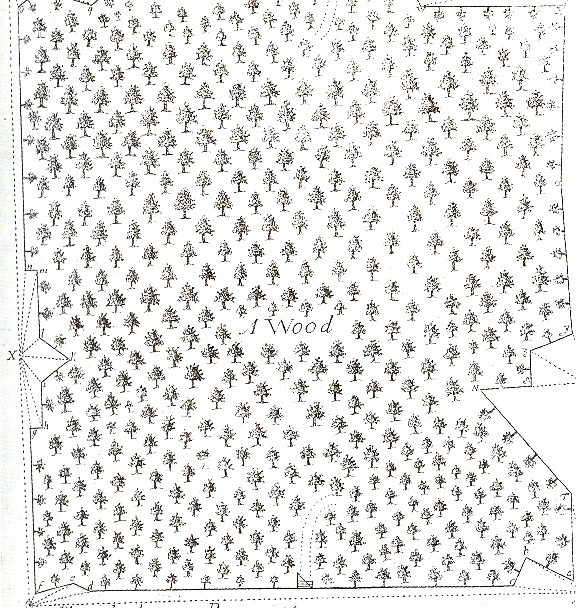
This lovely and lonely engraving comes from Vincent Wing’s (1643-1726) Geodaetes
practicus Redivius1 (The Art of
Surveying…), a book printed in London
in 1700.It is a classic work and much
used for over a hundred years—but I’m focused solely in this illustration for
triangulating in the woods.It is the
image of a stationary forest, a collection of neat trees devoid of movement and
motion and mission, a collection of solitaries, missing wind.I find it remarkable for being an
illustration that manages to show the missing things that you cannot really
see.
1. The full title of this work:Geodaetes practicus redivivus, the art of
surveying: formerly publish’d by Vincent Wing, math., now much augmented and
improv’d, with an appendix thereunto subjoin’d, shewing the whole art of
surveying by a new instrument, called the emperial table : performing exactly
in all respects, and in all cases that can possibly happen in the practical
part of surveying, the work of the theodolite, circumserentor, semi-circle,
chard and needle : with the description and use of a new quadrant : to which is
added by way of supplement, scientia stellarum, containing new and accurate
tables of the planetary motions, whereby the planets places both in longitude
and latitude, the places of the fixed stars, with the eclipses of the
luminaries, are more easily attain’d, than by any yet extant / by John Wing
Self- and purposefully-deceptive belief in spectacular
and unsupportable scenarios espoused by governmental leaders which affect the
lives of hundreds of millions of people deserve their own Dante-esque categorization:and that’s one that I haven’t come up with
yet.This post is one of a continuing thread on the history of atomic weapons.
I wonder how it was that we humans didn’t blow ourselves
into melty dissolving bits during the Cold War. Somehow all of those thousands of megatons of disastrously radioactive
explosives that were completely and reliably deliverable didn’t get
launched—not even by accident, not even during all of those hot itchy-finger DEFCON 2 situations.Did MAD (Mutually Assured Destruction )
actually work?Did the attempt at making
a winnable nuclear confrontation keep people from actually trying to do
so?Did the overwhelming and insane
buildup of weaponry actually have so much enormous and foul intellectual weight
that no one could actually make the decision to use the weapons for fear of
snuffing out all human life?
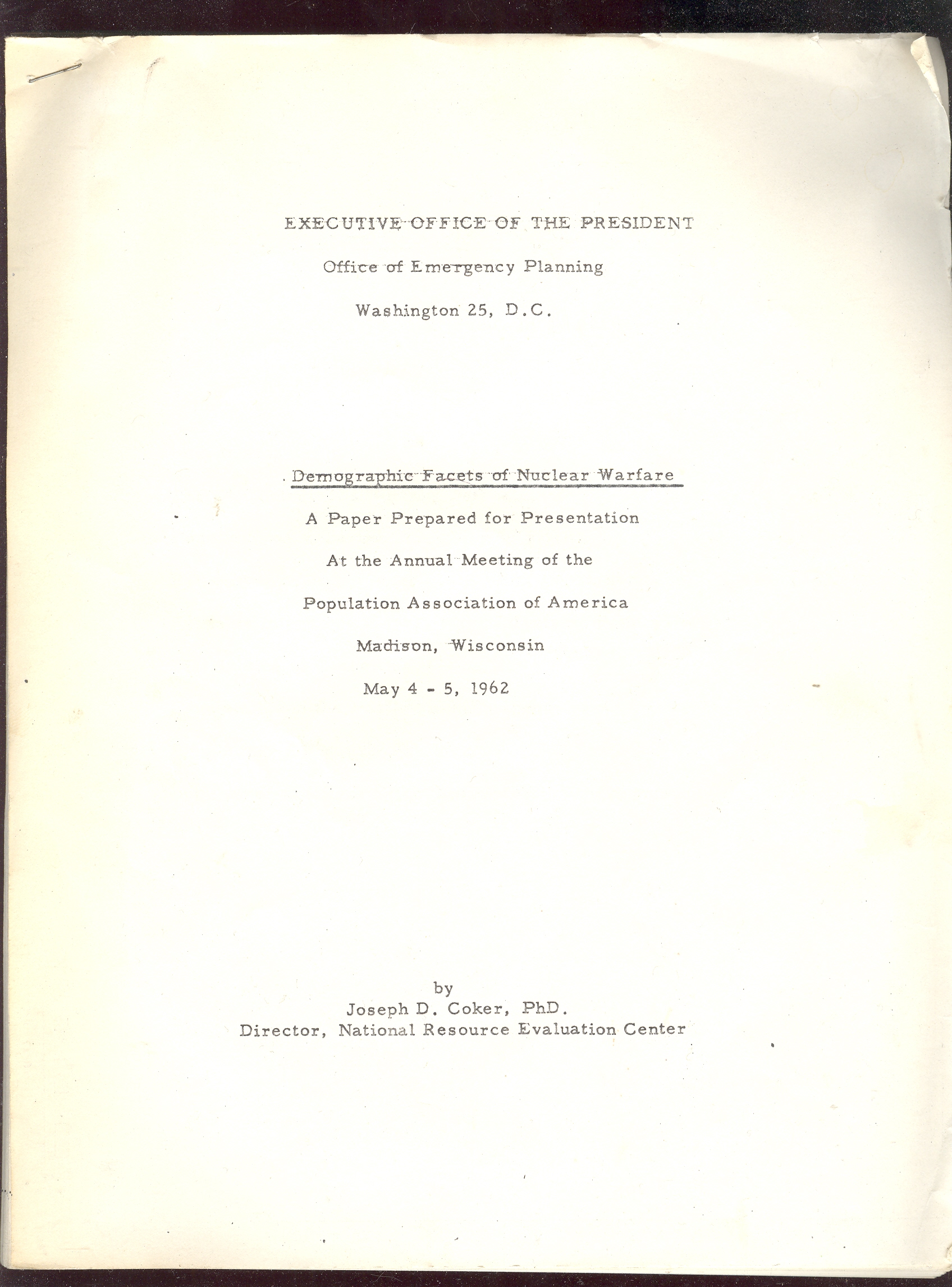
Here’s an embarrassingly shining case in point: Dr. Joseph D. Coker’s paper to the Population
Association of America representing the thinking of the Office of Emergency
Planning and the Executive Branch in general, which freely discussed the survivability
of the United States
following even a post-massive nuclear exchange. Dr. Coker was the director of the National ResourceEvaluation Center, which tried mightily to figure
out how/where /what/how the essential ‘stuff” of America could be saved/stored/allocated
after the end of the world.Actually,
Dr. Coker said that the big attack wouldn’t be the end of the world, so we needed
to plan for surviving.
A few cases in point, some of which, I must warn you, are
breathtaking and Strangelovian in their myopia:
Since Dr. Coker was addressing the Population Studies people, he
related much of what he had to say (regarding national resources) to the
American people.He found that millions
of people could be saved if they built a blast shelter (not a fallout shelter)
that was covered with mounds of heavy material and outfitted for an extended
stay of two to 22 days.The unfortunate
part of this scenario, Coker says, is that these shelters work best when 10
miles or more away from a detonation zone. And since these zones were all over the country targeted by thousands of
warheads, very few people (especially in cities) would be outside the 10-mile
ring, which made the blast shelter basically useless.
Coker notes that if an attack of 1000 megatons
[a limited exchange] was aimed exclusively at U.S.air bases, “total fatalities
will approximate 10% of the U.S.
population”.If this attack was aimed at
population centers rather than the air bases, it would kill 40% of the
population. A 5,000 megaton attack on air bases would produce 50% overall
fatalities in the U.S.;
if that amount was centered on large populations, the number would jump to 80%
of the population.10,000 megatons would
yield 75% and 95%, respectively.“A
50,000 megaton attack would kill almost all U.S. citizens under either
targeting assumption”.These figures
didn’t include radiation deaths.
A big variable here not controlled for was the distribution
of population at the time of attack.The
numbers that were used were compiled by the census and counted folks who would
be at home.So, the numbers above worked
if and only if the Soviets attacked after dinner when everyone was at home for
the night.Since it would make sense to
attack when people were at work at their industry or job or whatever during the
day—thus maximizing the effect of the bomb—the casualties would actually be higher.
And what does that mean? Dr. Coker relates this gem (on page 21): “The post-attack labor force
available thirty days after the attack probably will represent a significantly
lower fraction of the population than does the preattack labor force….” And
this: “A nuclear attack can be expected to alter the occupational composition
of the labor force.”
This sort of thinking overtakes the factual aspects of
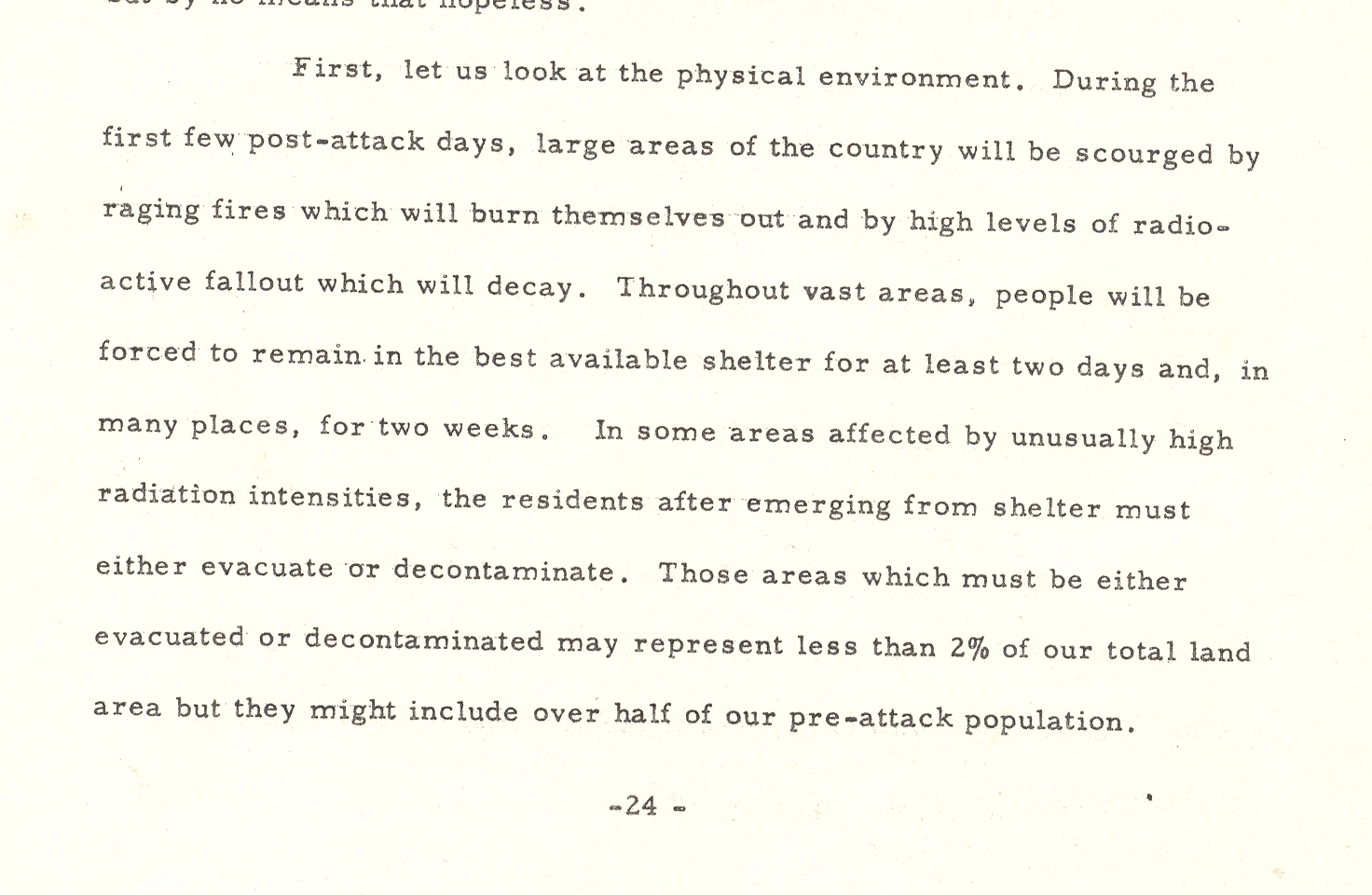
massive attack, with Coker stating on page 24 “I wish to sayemphatically that it [post-attack America] will
not be anything like that depicted in Neville Shute’s On the Beach.It will be bad enough, but not that
hopeless.”
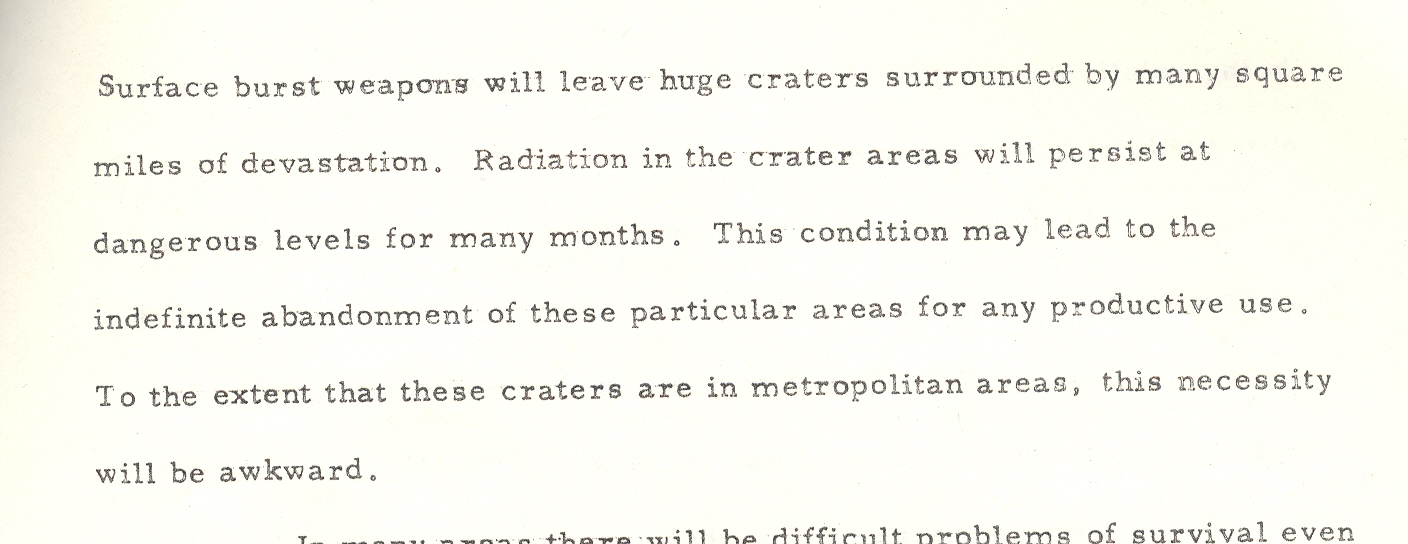
And this absolutely incredible/horrendous and perhaps worst-use-ever
of the word “awkward”:
For the love of King Neptune’s Pants:Awkward? How in the name of _______ could someone in such a high position and
authority relate massive attacks on every major American population center
which would cover the area in fire and thousands of gigantic highly radioactive
craters in which a city used to exist be called “awkward”?How great a sin was this, to influence
opinion on holocaust via pathetic and unreasonable means?
And then this, on the survivability of our governmental and
economic institutions:
“The post attack institutional environment will depend on
the continuity, resourcefulness and general effectiveness of our leadership and
the survival and resilience of pre-attack institutions…”
Hm?The post-attack
institutions will depend on themselves?
This of course is followed by a major plug for Dr. Coker’s own
work, because the preparations undertaken by the NREC will directly affect the
survivability of post-attack America.So don’t stop the funding.“The more complete and realistic our
preattack [sic] planning and preparations have been and the more effectively
the government is at all levels in inspiring and retaining the confidence and
support of the population, the less drastic institutional changes will
be.”So it is the mealy aspect of
inspiration that will direct the survivability of whatever it is that makes America
so.
I should point out that Coker’s use of “post attack” and
“pre attack” appear as two words, one word and a hyphenated word, depending on
nothing. This is only a forty-page document.
Another nugget on the post-Armageddon future on the
distribution of wealth, mostly hinging on blast shelters:“Per capita wealth in material terms may or
may not be reduced by attack.”There
will be a relatively proportional number of people who emerge from the smoking holes to staff surviving industry,
and so per capita wealth will stay about
the same.If, on the other hand,
people build more blast shelters, then the proportion of surviving workers to
factories will increase, and “the surviving plant capacity will be spread more
thinly among them”. It is left unstated, but what that means is that more successful implementation of blast
shelters would mean a reduction in per capita wealth. Dr. Coker also
forgets what he said earlier that the blast shelters really didn’t work unless
they were more than ten miles from a target. Considering that the industrial workers would be living close to, um,
industry, they will no doubt be (in 1962) in a ten-mile radius to where the
blast would be.Then of course there
would probably be more than one bomb, so the blast area would be more than a
ten-mile circle, and so on and so forth.
In the following paragraph, Dr. Coker somehow draws all
manner of feel-good high-probables around him, encasing himself like a sandman
in a thin layer of improbability, to come to the following conclusion:
“…few of the analysts who have studied carefully these
post-attack [sic] survival and recovery problems take any stock in the
oft-repeated theory that the survivors will envy the dead.On the contrary, after a very rough year or
two, the surviving population, if it so
chooses, can begin to enjoy the advantages of a social structure and a
physical environment not so very different from those which prevailed before the
attack.” [Emphasis mine.]
This is an astonishing work of incredible deceit, and may be
the worst quote of the lot.But it is so
difficult to choose between unacceptable bits of thinking like this, raking out the horrible from the terrible.
Here’s another deceit that was absolutely better understood in 1962
than the writer acknowledges:“The
long-term effects of radiation are subject to much less understanding and
certainty than are the short term effects. There is some evidence that increased radiation exposure results in
reduced life expectancy and increased evidence of leukemia and various
degenerative diseases…”And this:“Genetic effects are more
controversial.”Than what?! And this: “Studies
of the Hiroshima and Nagasakiexperience are said thus far
to be inconclusive.” Honestly this was
very well understood in 1962, and statements like these were enormously
irresponsible if the data were actually misunderstood and criminal if they weren’t.
There are many more examples—I’d say actually that the
entire paper was at the level of Apocalypse Fairy Tale—but I’d like to
close with just one more, this one using another fanciful version of the
possible post-nuclear future and another highly insulting euphemism.On transportation:“We hope in the near future to develop a
family of network and transportation models to estimate capabilities to move
surpluses into deficit areas in
order to cover deficits during each time period and to support the use of more
ambitious resource management techniques focussed [sic] on recovery problems.”Aside from bad sentence structure and
misspellings I could hardly imagine sitting through a presentation where a
person thought this stolen undercooked tripe. What we have arrived at here at the end of the paper is references to
smoke-in-a-hole cities being “deficit areas”, and the successful removal of
human consideration from the conversation—strange as Dr. Coker was addressing the
Annual Meeting of the Population Association of America.(I’d love to know what the association
members thought of the talk afterwards.)
And so what can we draw from the experience of knowing
thinking like this?Is it as sterile as
it might seem, so distant from our experience? The scenarios have changed, as have the leaders and delivery systems,
but the insatiable stupidities have evolved and morphedinto our own time.Its easy to raise our eyebrows now on the
whole MAD approach and the writings of people like Dr. Coker.The truth of the matter is that we have
plenty of this sort of thinking going on right now, big head-waggers that will
loom in our futures with the attached questions of “how could this have happened?”.WMD is one of the many examples of this, a
Big Lie that was repeated for years and which ultimately cost the lives of many
thousands of people and a great perpetuator of the culture of fear.President Bush
drove that one into the ground and so far as I know still employs it when
necessary, threatening listeners with fear of those three letters like they
were a practice hand grenade.(I recall
that a far-right radio personality filled with afterbirth
blood and urine eyes said that he would resign his show “in a year” if WMD were not found in
Iraq; that was five years ago, and of course he is still there, bloated and
ponderous and mostly violently wrong as ever.) The Savings and Loan debacle.The
deathly ambitious practices leading to our recent depression. The billion malnourished and desperate children in the world.And so on. The point is that there is no
paucity of thinking displayed by Dr. Coker in the past, and there is definitely
no lack of it right at this very moment.The
problem is seeing it for what it is in the present and to not have to wait for the future to get to the truth of the matter.
[And how can I end this discussion without a bit more of Stanley Kubrick’s magnificent Dr. Strangelove.., who pointed out these absurdities better than,perhaps, anyone?]
Ah, don’t fret! The ending is just below (and just when you are about to laugh (“Mein Fuhrer, I can WALK” the other and last shoe drops.).
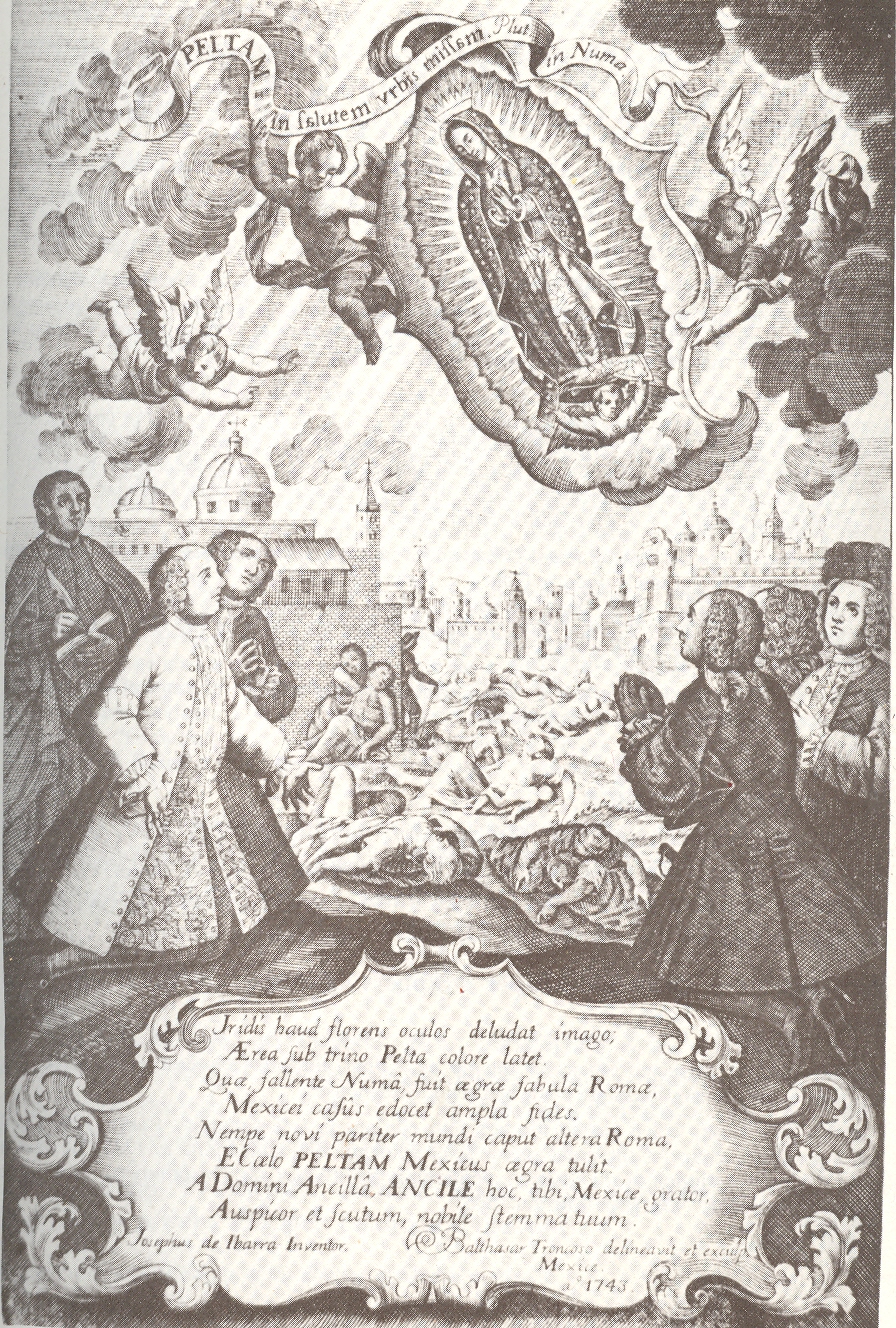
Images of
sacred interventions stopping the spread of disease is puzzling, as in this
powerful and disturbing vision of Our Lady of Guadalupe appearing above the
city of Mexico
in 17371.Mexico City was in the second year of a
devastating cholera epidemic where 40,000 had perished in that city alone.
I wonder why Heavenly intercession didn’t
come earlier?Of course the people of
the Valley of Central Mexico could’ve used some
heaven-sent strong-armed virtuosity many times over the centuries.In Mexico
City during the Cockuliztli epidemic of 1576 the
population of the non-Spanish (Native) population fell 50% in just a few
years.Over the period of 1545-1548 70%
of the population of the city nearly died of hemorrhagic fever.This epidemic was followed by many other
(major) epidemics (1576-78, 1629-1631, 1736-1741, 1761, and so on) involving
whooping cough, measles, typhus, smallpox , influenza, cholera, and of course
famine. Cholera—like this epidemic in Mexico City—according
to Rodolfo Acuna-Soto’s study2 seems to have been the least of the epidemic
worries in the Valley
of Mexico over the last
500 years.According to Robert McCaa’s
study of population studies3, 11 authoritative studies on the decline in
population in Mexico from 1519-1598 show an average and disasterous decrease of
about 50%4.
So with the
dozens of epidemics, the invasion of Europeans, and natural and unnatural
famines, I would have expected to see more demonstrations of charity from above
rather than this one skimpy display in the second year of a lower-echelon
epidemic.
1. From Caberra y Quintero Escudo de Armas de Mexico…, printed in Mexico in 1746. There is much else of interest in this book–which is probably the best and most famous of the local histories of the city–besides the image that I fixated on.
2. [Rodolfo
Âcuna-Soto.] Forum on Microbial Threats//Global Climate Change and Extreme Weather
EventsDecember 5, 2007 “The use of Historical data sets in Understanding Ecosystems Responses to Climate Change and the Importance
ofLong-term Monitoring
Programs…”
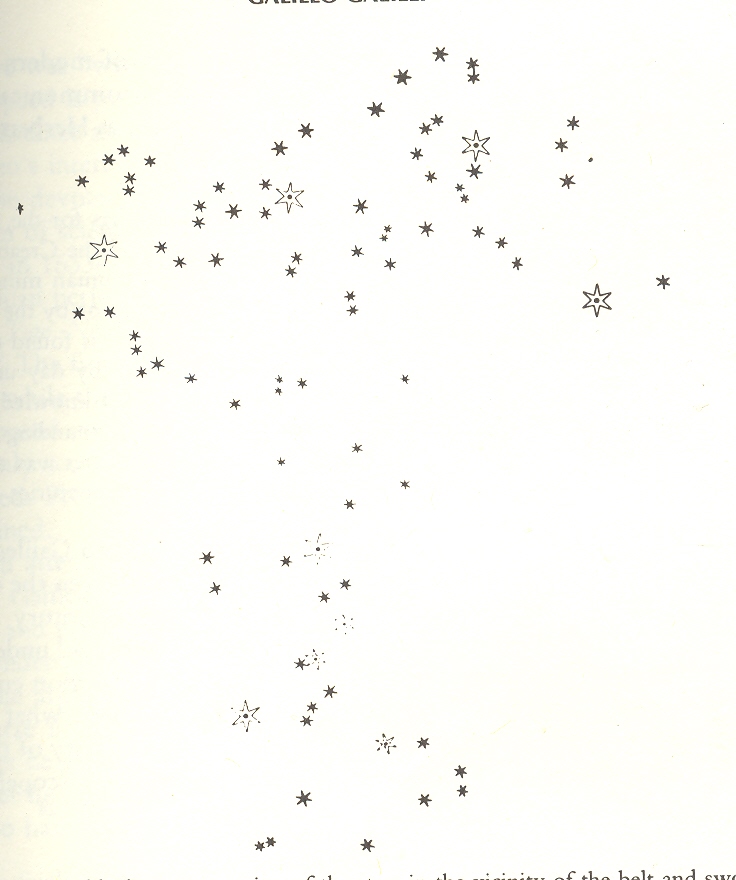
This installment of the continuing thread on the history of dots questions the sublime machinery of the primum mobile in the work of Galileo, particularly in his The Siderreal Messenger (Sidereus nuncius) of 1610. The reception of this extraordinary work was deep and profound, and the images of the “dots” were of extraordinary importance.
The perfection
of the Creator’s plan was being shown to be not-so-perfect in the late Renaissance, a major chink
showing up in the work of the dead Copernicus in 1543, which showed that the
Earth was not the center of the great cosmological eye.In the same year the body was also shown to
be not so much built in god’s image with its bitter working revealed in one of
the greatest anatomy books ever written, Vesalius’ revolutionary De Humani Corporis Fabrica .
Problematic bits
started showing up regularly wrapped in scientific proof:the existence of a vacuum, thought to be
impossible given the perfection of creation, was shown to exist inOtto von Guericke’s Experiemnta nova (ut vocantur) Magdeburgica de
vacuo spatio (Amsterdam,
1672).
The
stupendous idea of additions to the night sky, which had been thought to be
immutable and unchanging, came into being with Tycho Brahe’s 1572 discovery of
a new star (Nova) in Cassiopeia and added to in 1602 by Kepler’s announcement
of another new star—both events showing that the night sky was not complete and
that it was actually changing.
When you
consider Galileo and his use of the newly-invented telescope it is usually a little
far down on the list of accomplishments that his explosion of the night sky is
considered.In addition to everything he
did (applying mathematics to the study of physics, understanding
the physics of motion, developing the telescope and the microscope and other
precision physical instruments and so on) Galileo pointed the
not-yet-astronomically-used telescope to the sky and expanded the size of the
universe by a factor of ten.It was so
utterly astonishing an idea I can hardly think how the not-prepared mind of
1610 would’ve reacted to the idea. Certainly it was not a happy acknowledgment coming from the Holy
Father, though a simple defense could’ve been that this miracle was divinely
revealed ,and that it was there all of the time but just unknown to humans, and
so not threatening the orthodoxy of Christian belief.But that wasn’t the case, and Galileo would
soon enough be in trouble with the church and its inquisition in short order.
The dots in this image are the dots of never-before-seen stars, part of an
unobserved sky that was revealed only under magnification.The size and scope of the new bigness of the
universe was staggering, and of course opened the question immediately to the
possibilities of yet a larger universe revealed under yet more
magnification.I don’t know the answer to
this, and I wonder where Galileo might have publicly mused about how big the
universe might actually be, and if he ever dreamed about the possibilities of
telescopes that were 15 feet across rather than just two inches, and what those
beasts might reveal.
*I’ve looked at the use of the telescope in the hands of
Galileo before HERE (The Telescope
in Galileo’s Hands: the Expansion of the Universe, 1610).
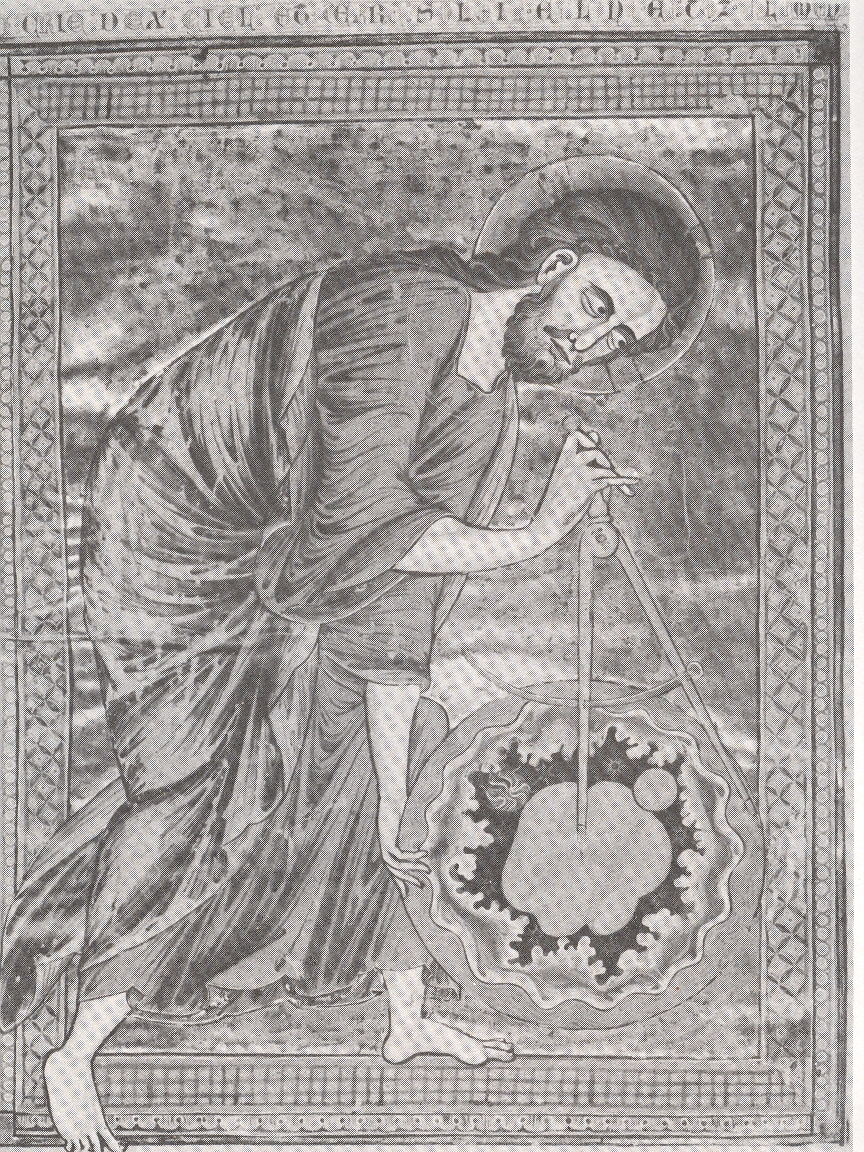
This sort-of
famous image, found in a French Bible
Mortalisee made in Reims in the 13th century,
displays The
Creator measuring its creation, a sphere of the universe containing all of the
stuff of creation, and including the Earth (pictured at upper right).At least that is what I think this is—Creator
stepping into the frame (its right foot outside the drawn border of the image),
holding everything that it has made, and holding it all in the midst of another
environment of some sort.What that
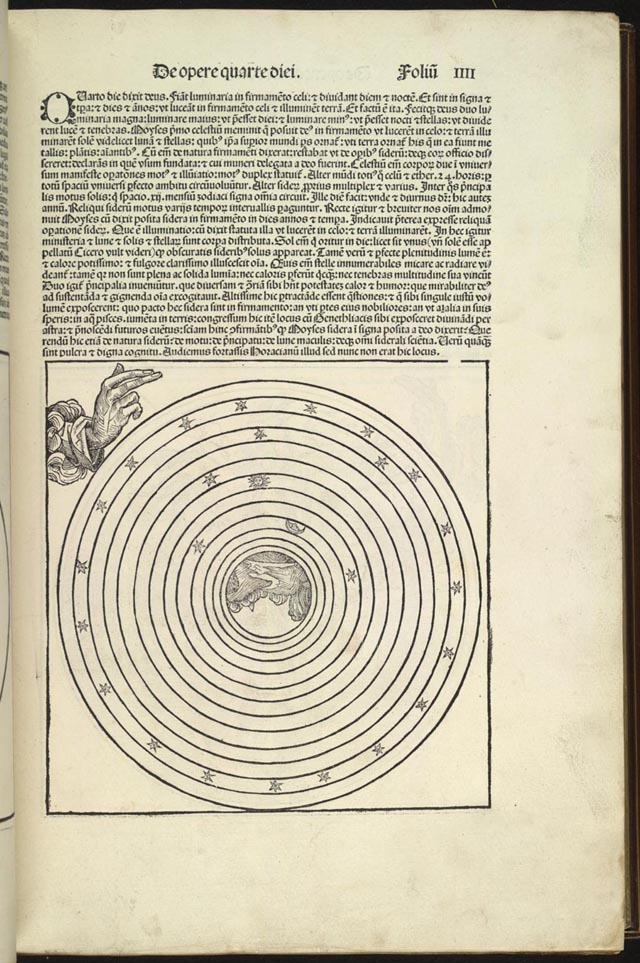
place might actually be, I don’t know. Is that the space in-between the light created on the fourth day
(pictured below from Schedel’s so-called Nuremberg Chronicle of 1493), the space
that wasn’t the greater light to rule the day and the lesser light to rule the
night?In this spirit it was the stars
that were supposed to separate these two lights, but the stars themselves in
many of the concentric circle cosmologies weren’t part of the Heavenly sphere
itself, which is what the Reim’s illustrations seems to say.I suppose that it is all simply displayed
somewhere in the OT, but from where I sit right now, this looks like a
painfully early Western image of multiple universes.
The other thing is: what is the Creator looking at? It is definitely very focused and wide-eyed, and is lasered on something about half of the diameter of the universe to the right, just on the other side of the dividers. Is this the biggest of the Blank and Empty Things that can be imagined?
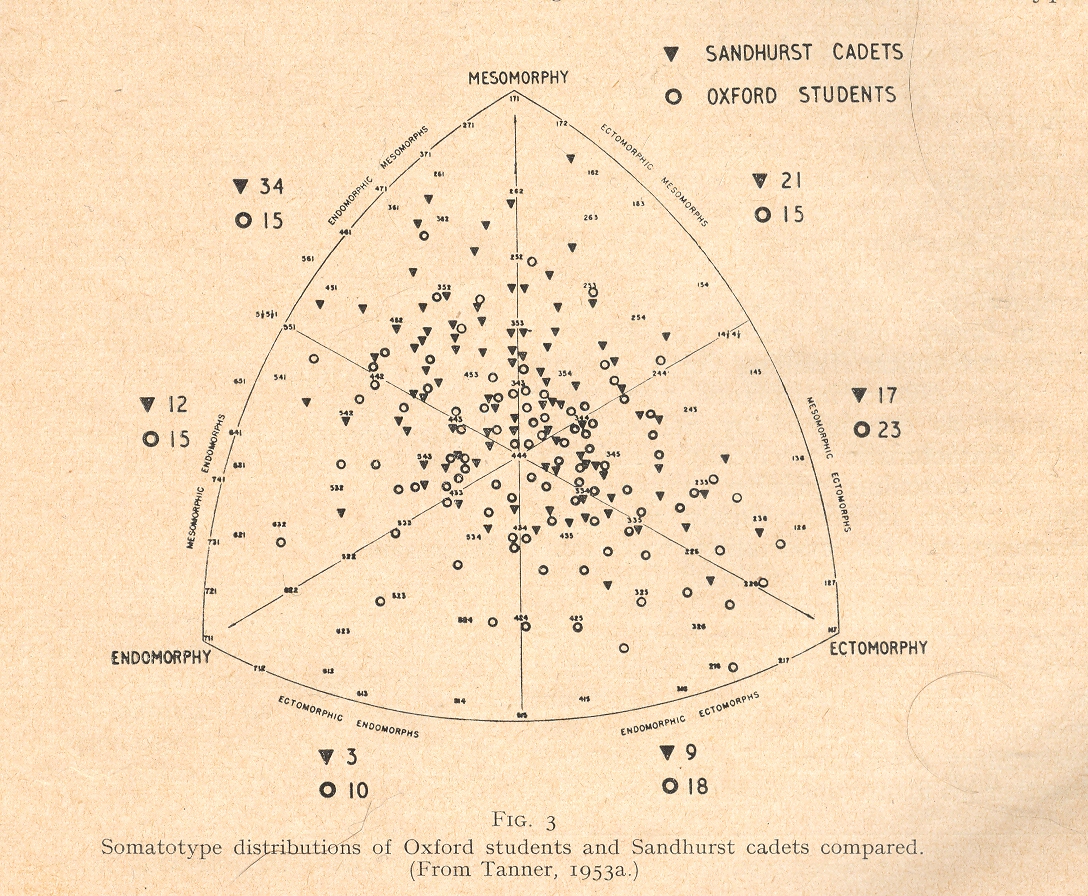
JM Turner (an M.D. and a Ph.D.) wrote “Physique and Choice of Career” for The Eugenics Review of October 1954. He reported on the statistical survey correlating body type and profession, one in a considerable line of such statistical drunkenness which found pseudo-scientific results from closeness of fit between fat, muscle and criminality and professions. I really don’t want to get very much into the details of this story because it just isn’t worth it–simply put, the doctor was finding correlations between some body types and students at an officers’ training academy and Oxford. The military officers in training were heavier than the Oxford students. The end. [Interestingly the author references an earlier study from 1939 which found correlations between body types and different sorts of crimes among 17,000 incarcerated juvenile offenders. Turner uses the results to support his own but also finds fault with the earlier study, stating that it lacked “any very workable classification of physique…his study was more of a high altitude aerial survey than a detailed map of the ground”. This doesn’t prevent the use of the findings, however.]
It was this sort of thinking that the sniffy and in-its-own-peculiar-way venerable The Eugenics Review (1909-1968) its influence, a cancerous spittle which found its way all over the globe. Eugenics was seated in the work of the very formidable work of the polymathic Sir Francis Galton (the word coined in his Inquiries into human faculty and its development
in 1883), and found its way into some deep scientific corners until its
was generally rejected at about the same time of the journal’s death.
The influence of eugenics reached far and deep and wide, finding its place even here near
where I live–deeper here, and later than expected, as it turns out.
The Human Betterment League, started in 1947 in Winston-Salem (North
Carolina) with the influence and money of James G. Hanes (of the Hanes
hosiery and underwear fortune), instituted a vicious resurgence of
interest in eugenic sterilization just at the time when this practice
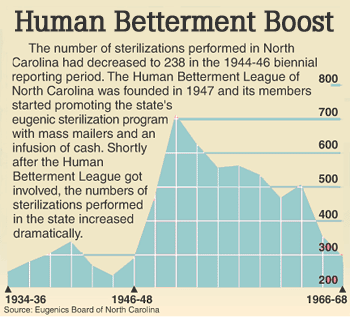
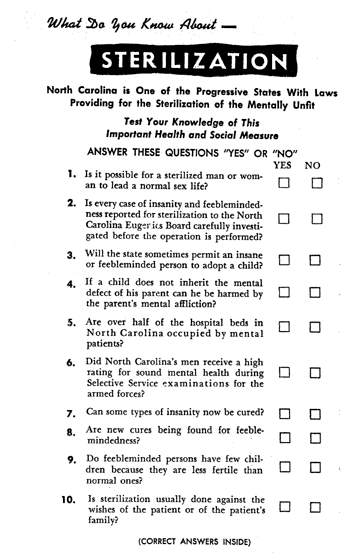
was beginning to come to its end in other places. As you can see, eugenic-based sterilization in North Carolina was sliding into social consciousness and decline just at the beginning the the Human Betterment reign of terror, spiking to over 700 sterilizations in just a few years after its underwear-y inception. The majority of the victims of this social cleansing, of this cleaning of the gene pool, of this save-us-from-“them” mentality,were black. SOme of these people were classified as “morons” according to standardized testing that many were never before exposed to; some were classified as deviants and defectives ready for sterilization if they chose to have a baby produced by rape. The road to racial purity was a wide one for the Betterment folks; fortunately, it was not a long road, though they were able to force sterilizations of thousands of unfortunate victims and did so until the late 1960’s. This is a bad story for the history of this state and one which is not frequently discussed, though reparations discussions are underway, cushioned by a very skimpy installment of 250,000 from the state coffers to establish offices and a board and bureaucrats to study the issue. This is many millions of dollars off the mark, but it does benefit some mid-level manager somewhere in the state capital at Raleigh…
[Source for sterilization pamphlet and graph: Against Their Will–the North Carolina Sterilization Program.]
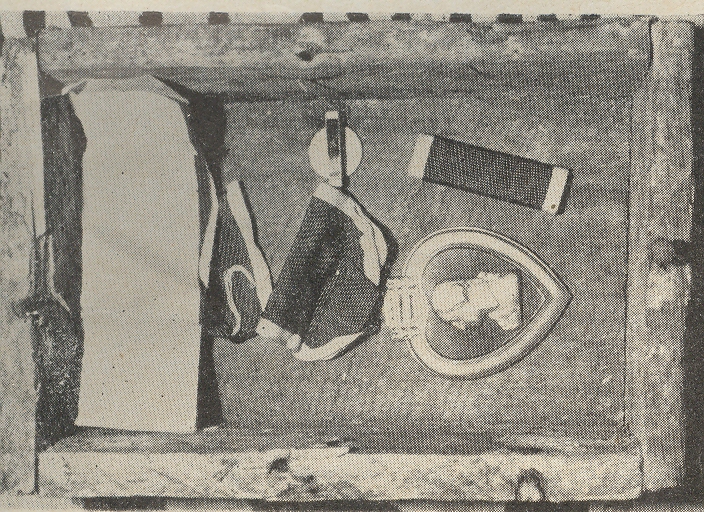
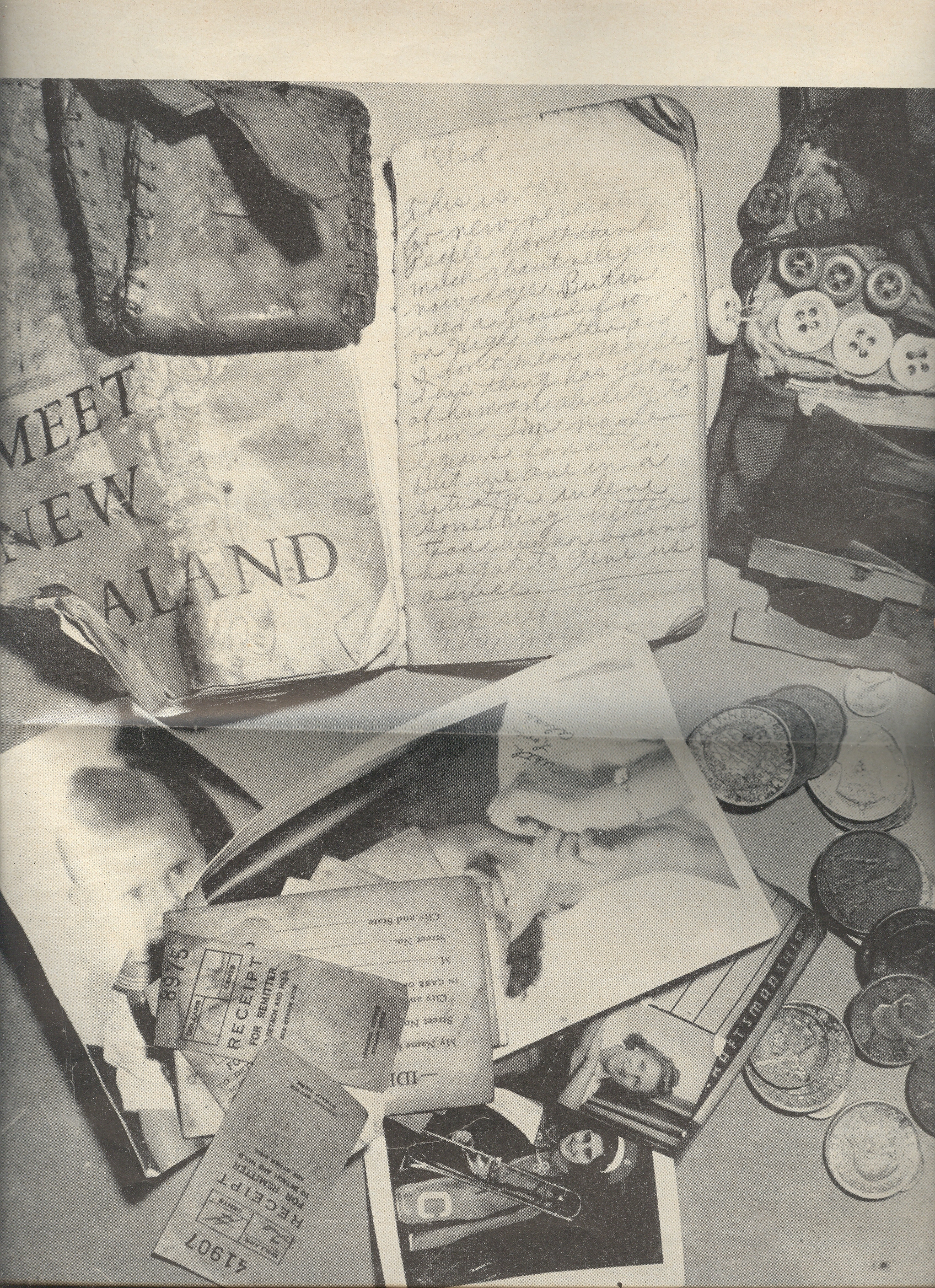
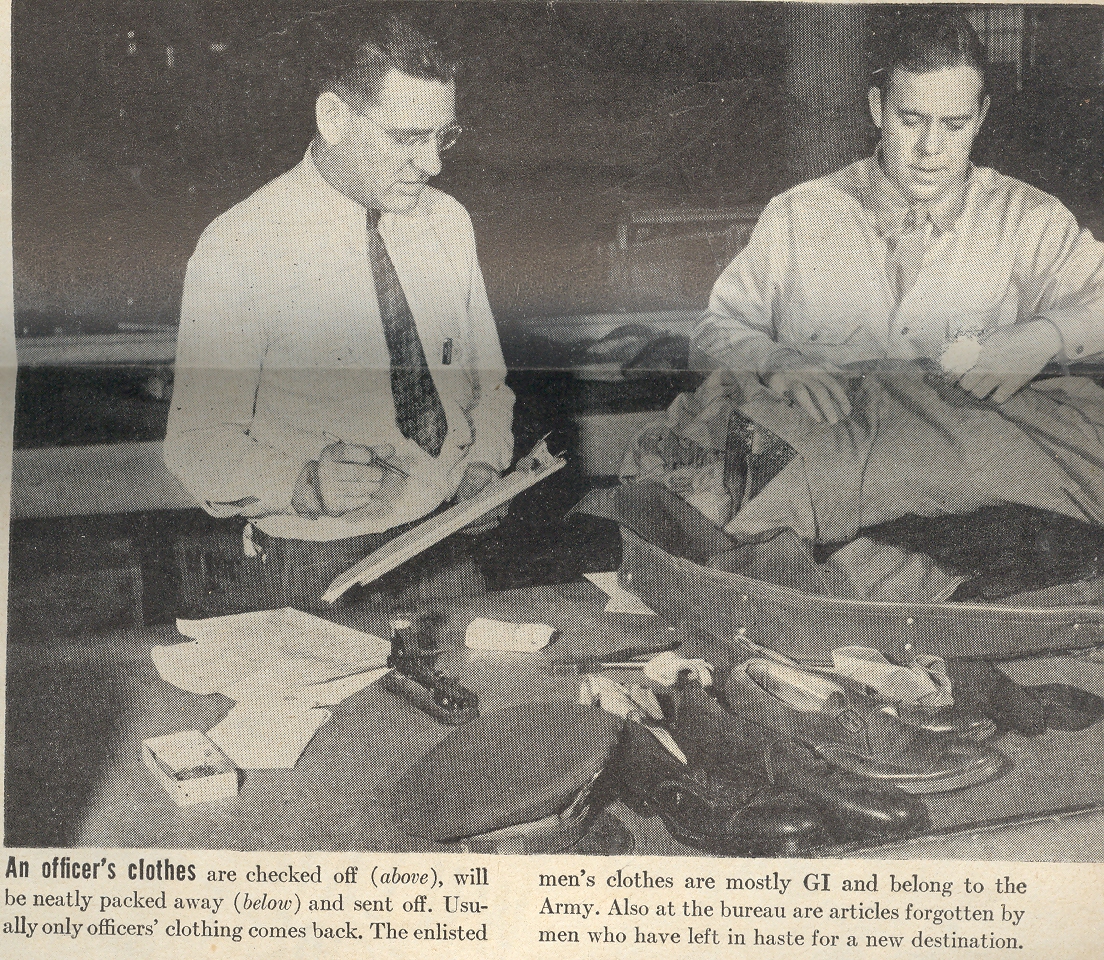
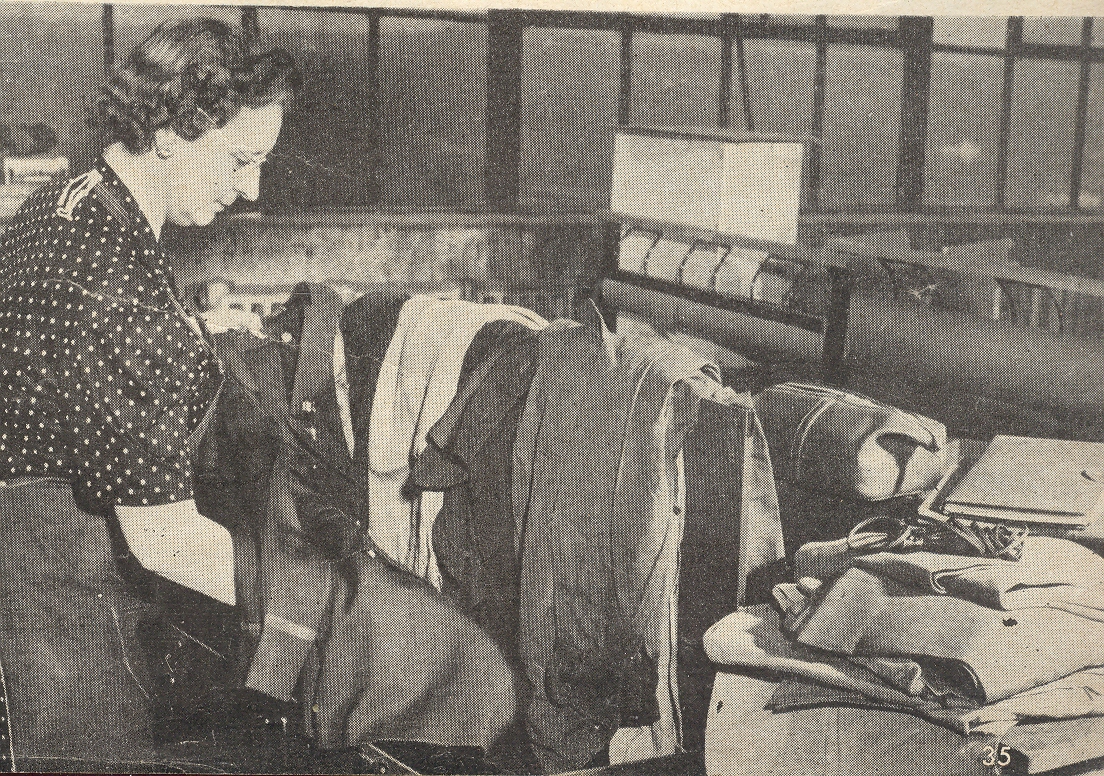
The material documented in this 17 April 1944 LIFE magazine article are the effects
of dead soldiers.It was surprising to
see this sort of coverage, given the place and the time: I do not think that we
will see photographs like this for our currents wars.The title of this short photo essay—the
shockingly stunted and bald “Dead Men’s Things”—should certainly have been
something else with more dignity than a movie title for a schlock Hollywood
B-production of the ‘50’s.The article is weirdly disjointed and heavy handed
considering the great and respectful duty at hand.I’m not saying that the writer didn’t
understand the enormity of the situation, as the article puts it quite
well:“To the people who go there, it
seems a more sacred place than a cemetery and the ordinary things it handles
seem the best kind of memorials to men who will never return…”The clumsy manner in which the whole deal is
presented was probably a series of unfortunate errors by a time-pressed
editor.
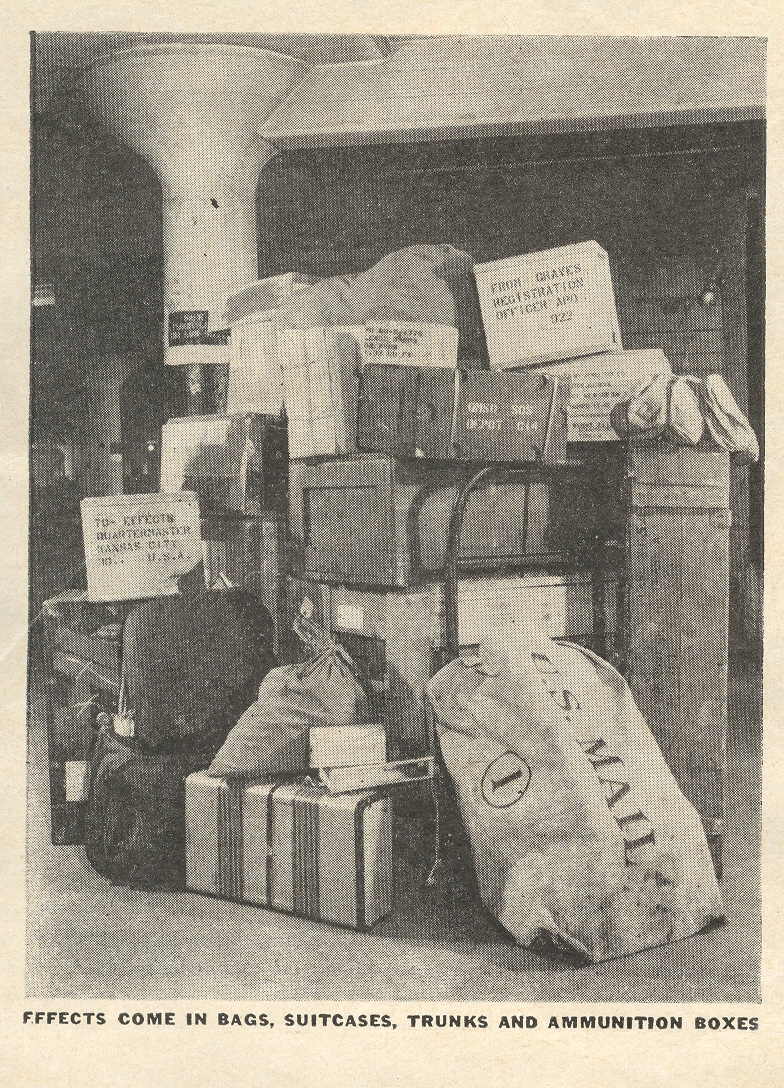
The story of the belongings of the killed servicemen goes
like this: the effects were collected by the quartermaster corps in a small village
in France, stored in 11
buildings and 150,000 square feet of storage, and then sent to the Army Effects
Bureau1 in Kansas City, Missouri. From there the material was further sorted and checked and
double-checked, and checked again, and then sent on to the next of kin.
It sounds like an overwhelming job, helping in the attempt
to deliver the high honor of restoring the last objects carried by a dead son
into battle to his parents.The thing I
can’t get out of my mind is the continuous rising tide of bags and boxes coming
in from Europe, all intimate reminders of
great loss.
1.“The job of the Commanding Officer, who is
the Effects Quartermaster (Continent), is to receive and safeguard thousands
of’ packages of irreplaceable
personal property until they can be returned to the owner or forwarded to the
Army Effects Bureau at Kansas City for disposition. Q-290 serves as a holding
and reconsignment depot in transmitting the property of casualties from the
unit in the field back to the owner, or in forwarding property of deceased to
the U. S.”
“When a soldier becomes a casualty (either
deceased, hospitalized, captured, interned, or missing), his unit commander
collects all personal property, inventories it, removes government property,
and forwards all the personal items to Q-290, marked with the owner’s
identification and status. If the owner is deceased, the property is documented
and forwarded immediately to Army Effects Bureau, Kansas City, for transmission to the next of
kin. If the owner is hospitalized, the property is placed in storage
indefinitely, subject to disposition instructions from the owner. If the owner
is missing, captured, or interned, the property is stored so that he may claim
it upon return to duty.”– From documentation on the website of the ArmyQuartermaster Museum.
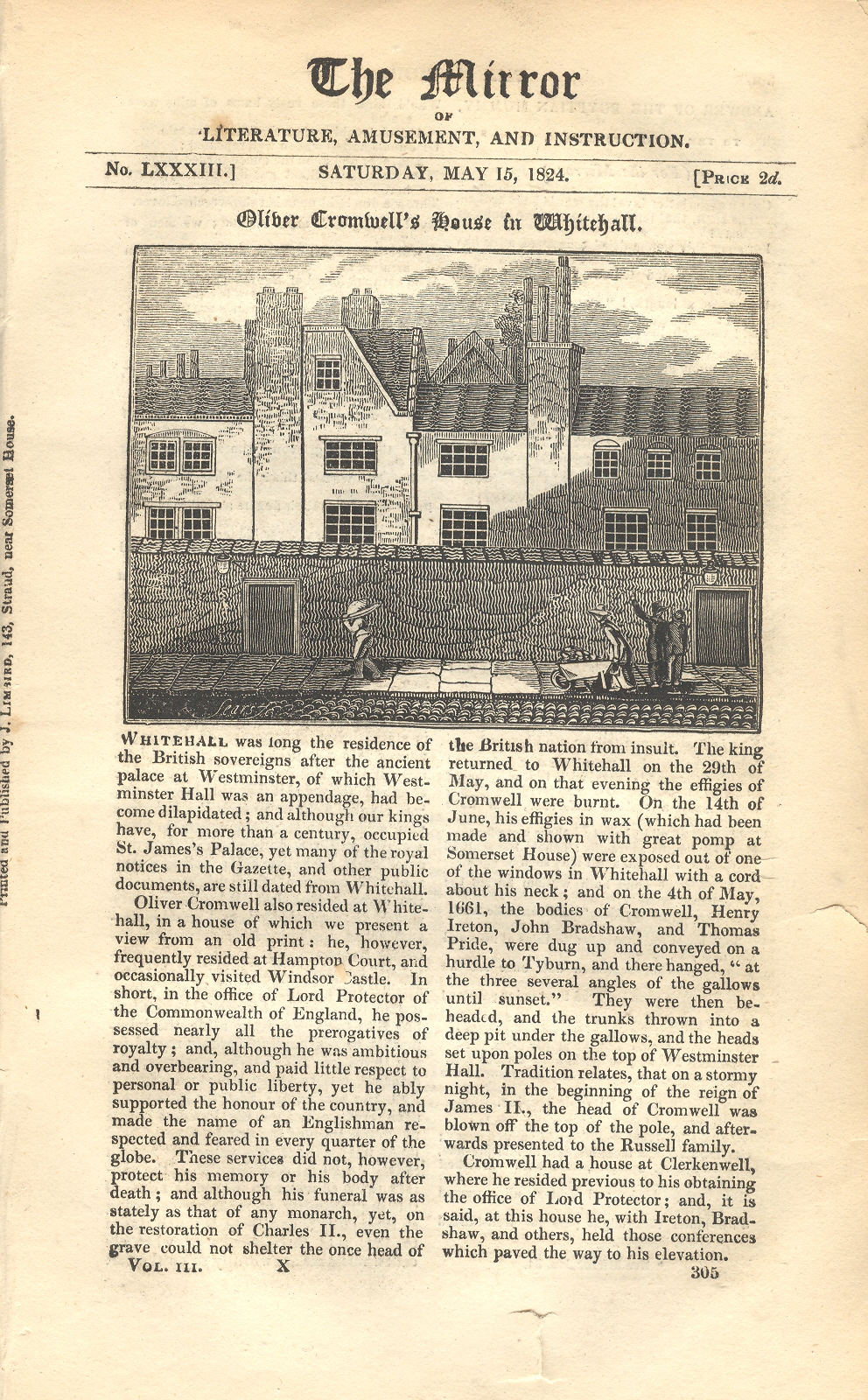
And so it came to pass under the vengeful gaze of the restored
Charles II that the nicely-buried Oliver
Cromwell was dug up from his monarchial pit, brought to the light, and then
hanged, and once twice-dead, was beheaded. To make matters worse for Cromwell, his body was tossed into “a deep pit
under the gallows” and his head displayed on a spike at Westminster Hall.I guess that his eyes at that point would’ve
been happy to see some more comfortable dirt.
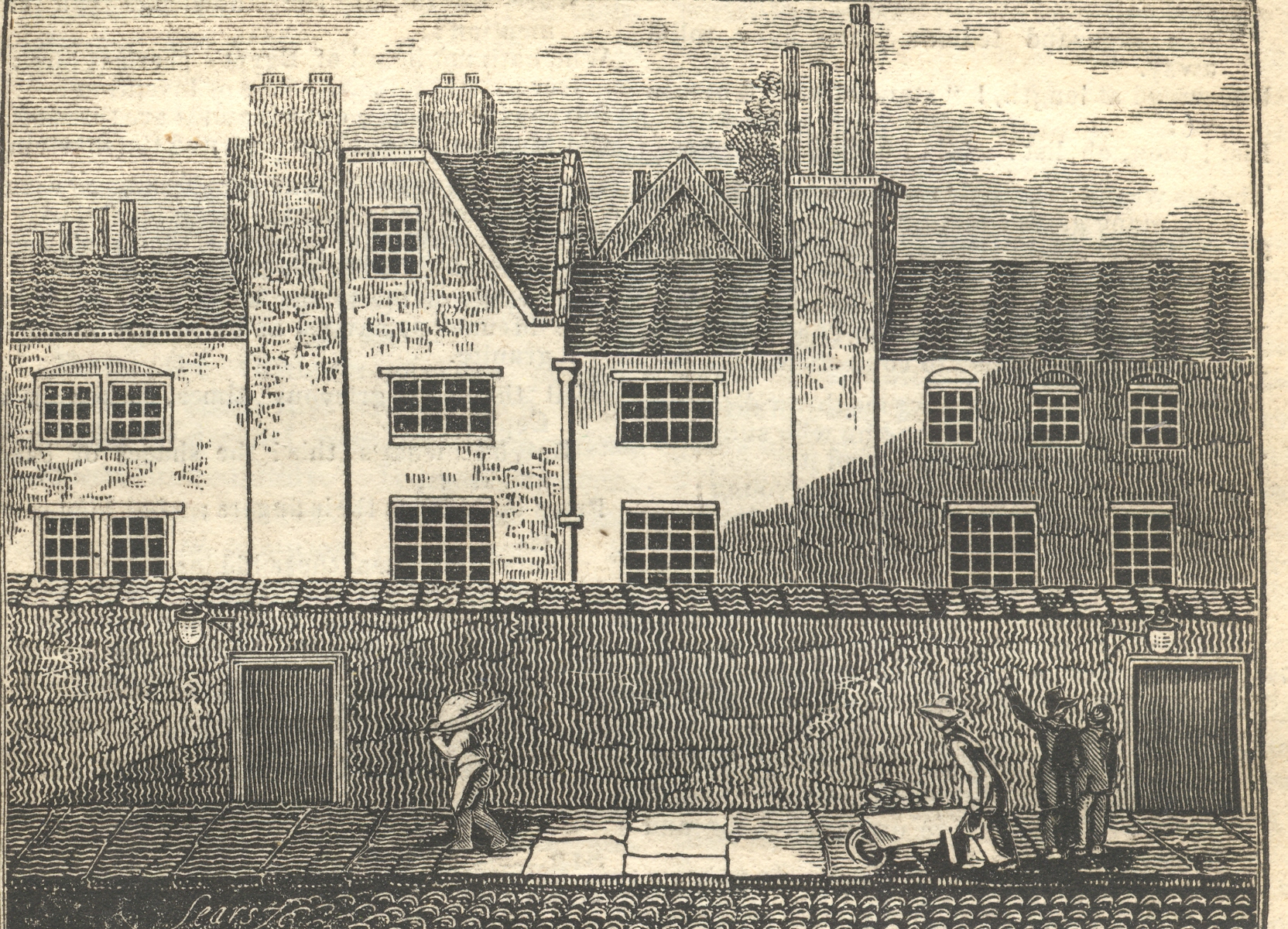
I’m just relating that story as part of the impression I got
from this 1824 woodcut of Cromwell’s house at Whitehall. It is an odd, forbidding scene: walled, dark, and with several uncomfortable characters, it feels cold
and empty, as empty-looking as a house could be. Perhaps that is a butcher with a slab of meat, and a dry-goods hawker with a wagon-full o fgoods, and a pair of drinkey buddies. Maybe not–but whatever they’re doing and whomever they are, its just a little David-Lynch-odd.
 I was paging through the literary criticism and review volume