A Daily History of Holes, Dots, Lines, Science, History, Math, Physics, Art, the Unintentional Absurd, Architecture, Maps, Data Visualization, Blank and Missing Things, and so on. |1.6 million words, 7500 images, 4.9 million hits| Press & appearances in The Times, Le Figaro, Mensa, The Economist, The Guardian, Discovery News, Slate, Le Monde, Sci American Blogs, Le Pont, and many other places… 5000+ total posts since 2008.

Category: Absurdist, Unintentional

  • Echoes from the Memory Hole–a Book that Set the World on Fire

    JF Ptak Science Books   Post 1670

    Dort, wo man Bücher verbrennt, verbrennt man auch am Ende Menschen.“–Heinrich Heine, saying that if people burn books, they’ll burn people, too, which have been proven to be the case.
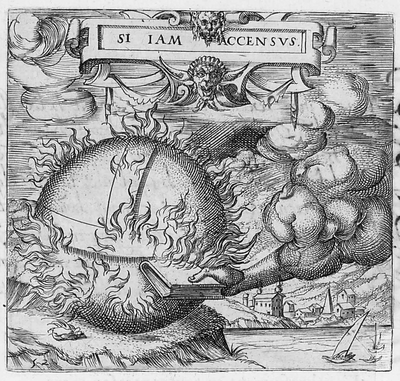
    av1615052pict

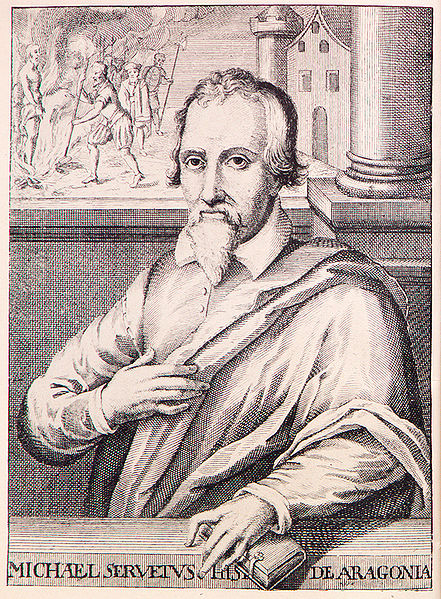
    Usually this story goes the other way around, where people of the world set books on fire–or entire libraries on fire (like the House of Wisdom, Baghdad, in the 13th century), some of them more than once (and in the case of the library at Alexandria, six times.)  Books are burned in repulsion and revulsion not only by their readers but also (and in greater numbers) by rulers who don’t want their potential readers to have any potentiality, or potential, reversing the flow of unwanted information back to the source. (The illustrious and esteemed have burned people as well as the villains–Thomas More sentenced John Tewkesbury, a London leather merchant, to the flames for “approved burning” for keeping banned books; for good measure More also had the works of Martin Luther burned, as well.)This later has a very long history, which is taken a step further when said leaders reach out to burn the books and their authors, sometimes at the same time.  This infamously happened to Michael Servetus (1511-1553, and who I wrote about here) and of course many others, entire castes of scholars burned or buried for being in the way.
    https://historyofideasblog.com/a/6a00d83542d51e69e20128779f1418970c-pi

    [Engraving of Servetus, being a good double-portrait showing him in the high life and then, in the upper left corner, being burned alive for his political activities ans for his books, which disturbed the notion of the heart-centered body and seat of all wisdom much favored by the clergy, replacing it with his notion of the heart as a muscle, as a functioning part of the body rather than its seat of wisdom.]

    The first mass, organized book burnings in the United States were instituted for self-preservation of an economic way of life–local merchants banned together to form book burning brigades for the threat to their livelihood, the Sears & Roebuck catalog, which I wrote about here.  Not quite on the scope of rejecting the lives and works of authors of what were deemed to be salacious or threatening to the core of the social structure, but in the long run perhaps they were something approaching that.

    The “Memory Hole’ is the euphemism for the dispatch and destruction of books in George Orwell’s 1984, not too far removed from the institutionalized book burning in Fahrenheit 451, though seemingly a furious leap forward from Reverend Lovejoy from The Simpsons.

    Reverend Lovejoy: “Oh hello Lisa! Can you recommend any books for my mobile?”Lisa: “Ooh absolutely! Well you know, anything by Jane Austen.”Reverend Lovejoy: “Jane Austen. Thanks Lisa, I’ll get right on it!”(Reverend Lovejoy drives away and reveals his Book Burning Mobile.)

    Reverend Lovejoy: “Oh hello Lisa! Can you recommend any books for my mobile?” Lisa: “Ooh absolutely! Well you know, anything by Jane Austen.” Reverend Lovejoy: “Jane Austen. Thanks Lisa, I’ll get right on it!” (Reverend Lovejoy drives away and reveals his Book Burning Mobile.) [Thanks to The Lisa Simpson Book CLub.]

    And for the first emblemata, above, comes the legend:

    Alta Dei flammas vox toto suscitat orbe, God’s voice on high stirs up flames in all the world,
    Dum nimis auerso mens mala corde furit. While all too strongly the evil mind rages with averted heart.
    Sed pia mens humilis paret. Sic excoquit aurum,  But the pious mind obeys in humility. So the furnace melts out gold,
    Et paleas eodem deuorat igne focus  and with the same fire devours the chaff

    And as it turns out the book to set the world on fire is the Bible, which is I guess appropriate given the number of books sought out and burnt by Mother Church, though I must say that far more books were banned than burned.  (I think so, anyway–there’s a number of iterations of the list of banned books–the Index Librorum Prohibitorum–which was kept from the mid-16th century to the mid-20th. I think that there is no massive list for books that were both banned and burned.)  Its a harsh-looking metaphor, particularly given the story of the Flood.  

    And in some cases the Bible-burning metaphor was hardly that but an actual event, and tragically ironic in the case of William Tyndale.  Tyndale was a scholar who among many other rich things brought to bear a new translation of the Bible done into English, which was a first, and which greatly displeased the ruling head of England at the time, King Henry VIII.  Henry had already burned translations of the Bible that he could not abide and thought heretical–not the least reason of which would have his multiple marriages condemned–and continued on to not only do so with Tyndale’s work, but also to Tyndale himself.  At the end of a long and complex story, Tyndale was found to be a heretic, and in 1536 was strangled to death on a platform before a large crowd, his head chopped off, and his body burned. After a few years Henry authorized multiple new translations of the Bible to be printed, all based on Tyndale’s work.  Tyndale stayed dead, though–his work had an enormous impact on other English translations of the Bible, not the least of which is the King James Version of 1611, where the overwhelming majority of the NT and OT was Tyndale’s.

    http://images.wikia.com/simpsons/images/1/1b/Book_Burning_Mobile.jpg


  • On the Cost-Effectiveness of Killing: Poison Gas (1921) and Atomic Bombs (1945)

    JF Ptak Science Books   Post 1678

    Chemical warfare

    Atomic bomb eco detil

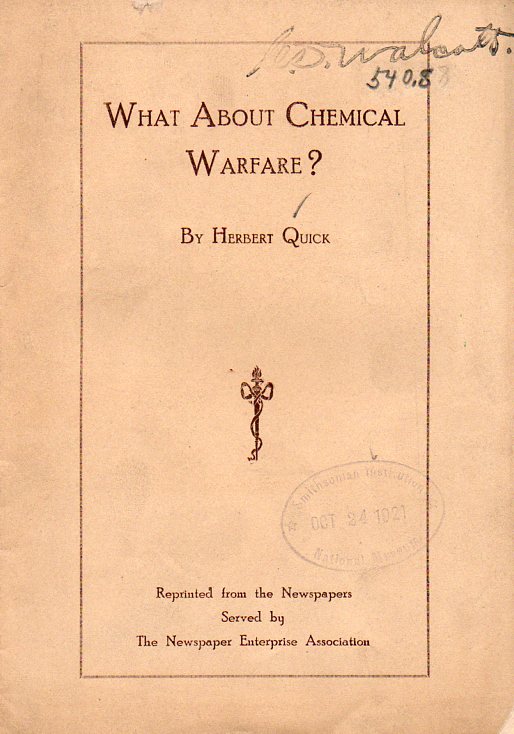
    Herbert Quick did a fair amount of thinking about the military use of poison gas, and it winds up, in the final analysis, thinking that it was tolerable.  What About Chemical Warfare? (published by the Newspaper Enterprises Association in 1921) is certainly a possible title for a Duck-and-Cover A-Bomb or You and Your Hormones kind-of-film–it has that certain stripe to it, bearing the certainty of wrongness that becomes more visible with each passing month.  (The pamphlet is available for purchase from our blog bookstore, here.)  But Mr. Quick took the slow boat around his issue, thinking about it a little long and out loud, before coming to his final conclusion in the chapter titled “Gas Warfare Cheapest and Most Effective Arm of Defense”.

    {See here for my post on Willis R. Whitney’s letter/proposal for establishing the American chemical warfare capacity, 1917.]

    He points out the enormous impact in the war effort that relatively small chemical corps played in WWI–something on the order of hundreths of one percent of all serving soldiers were employed in the combined chemical corps, saying “how small a body to produce such great results!” Which is true, assuming that by “great” he meant ‘widespread’, though it is unclear exactly what he was talking about.

    Mr. Quick (born in the first year of the American Civil War and dead four years after the publication of this pamphlet, writing evidently from the cushion of old age) does make a case for poison gas being not so inhuman as presented by most civilized people, pointing out both its high quick-death rate and survivability/recovery rates, which seems to be giving/taking at the same time. No matter:  “But woe to the army or nation that does not keep up with the times.  The Angel of Death will breathe in their faces” he writes. 

    The author alsoAir raid885 warns that though Germany was “stripped” of her war-making capacities, he thought it was not so of the industries necessary to produce poison gas. He points out that Germany can produce these munitions in secret, and that if any “militaristic nation conquers the world in the future”, it will be through the use of the poison gas it developed in secret. 

    Defense was also important:  “in the absence of efficient defense worked out beforehand, our great cities might be wiped out with gas bombs dropped from aircraft”.  Mr. Quick believes that protecting cities is possible, writing simply “preparation will prevent such a crisis”.  Indeed.  Unfortunately no ideas about this defensive posture were forthcoming, though he did bring himself around to writing about gas as a defensive tool.  Against looters. And rioters. And snipers.  “Gas puts the sniper in the power of his enemy” Quick writes, using the Marine action in Vera Cruz, Mexico, as a good example of where gas (“gas grenades”) would have come in handy.

    The bottom line is of course the bottom line, practically stating that poison gas as a weapon was indisputably more cost-conscious than anything else, by far, each dollar spent on chemical warfare being worth “from three to five hundred for the army”.  Poison gas services Quick says should be pursued, because “gas warfare cannot be stopped until all war is stopped”.

    Gas warfare “gives the educated, intelligent nations the advantages over the people of lower civilizations”.

    “When both sides are prepared it is much less inhumane than war with bullets and high explosives; but it means horrible annihilation to the army which is unprepared.”

    It is an interesting exercise to replace “poison gas” with other types of weapons, just to see how it reads.

    Mr. Quick was up and down in his treatment of poison gas and war, though almost entirely down.  One thing he didn’t see, that no one saw, really, was the use of a particular gas that was used to destroy millions of people, and which was developed quite in the open in Germany for many years, used for killing rats.  The Nazis simply used it instead on people.  No one saw Zyklon-B coming, and no one could have, even when they did.

    See also my post here on Hermann Goering and Zyklon-B.

    William Shockley–a future Nobelist and probable weak member of a Nobel-team that invented the transistor and which included John Bardeen and Walter Brattain, or I should say rather a team of Walter Brattain and John Bardeen including William Shockley–sent forth a memo on the mathematics of destruction and the use of the atomic bomb.  He was part of a largish team working on what to do with the new technology once the bomb had been used and the war won.  (I’ve written more on this paper here.)

    Shockley atomic


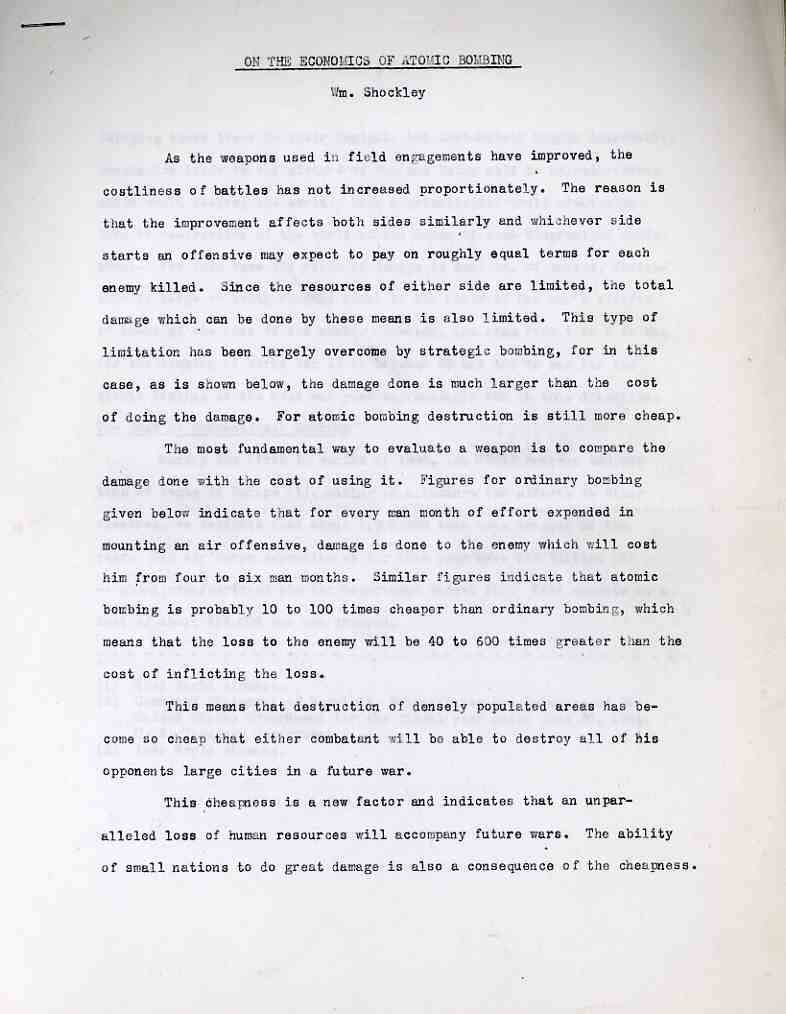
    This paper was written towards the end of 1945 and is on five pages and runs about 1500 words, and is an extension of work he had already been doing for Henry Stimson with Quincy Wright on evaluating the combinations of casualties that would lead the Japanese to surrender.  He begins this paper with a logical statement of the issue of the economics of conventional and atomic bombing, ending with the sentence “For atomic bombing destruction is still more cheap”.  What Shockley is getting to is the overall cost of the amount of destruction caused per square mile, and the conclusion that he draws over these five pages is the destruction caused by the atomic bomb is 1/100th the cost of conventional bombing per square mile destroyed (“atomic bombing is probably 10 to 100 times cheaper than ordinary bombing”).

    Shockley also recognizes that the problem in the near future will be the increasing cheapness of producing atomic (and greater) weapons, and their developing accessibility to small nations.  “This cheapness is a new factor and indicates that an unparalleled loss of human resources will accompany future wars.  The ability of small nations to do great damage is also a consequence of the cheapness.”  He writes further that taking this thinking to its “logical conclusion”, that at some point in the future a single individual will be able to use this new technology to destroy the world.  The main point though that he was making in this line of thinking was the dispersion and proliferation of the new technology–that an arms race would occur, and that it would be dangerous, and that it could be very very bad.  Shockley has of course nothing to say about any of that or the implications of his finds as that was not his charge. 

    After figuring that the cost of destruction by the atomic bomb was about $600,000 per square mile (compared to $6,500,000 per square mile for conventional bombing), Shockley concludes that “since the atomic bomb art is in its infancy, we may well expect future economies of a factor of 10 in cost per square mile destroyed…”


  • Tech-Quiz What is It? Can You Identify What Made this Patent Mega-Famous?

    JF Ptak Science Books    Quick Post

    I would not have made the intuitive leap to what this “game apparatus” would become from the simple reading of the opening two paragraphs of the patent description for it by its creator, J. Brunot:

    “This invention relates to apparatus for playing board games and more particularly to apparatus designed to facilitate scoring procedures in connection with the playing of such games. In many board games playing pieces are placed on certain contiguous or successive areas marked out on the board and the placing of the playing piece on certain predetermined areas results in an adjustment of the score of a player either by adding a bonus to the score or subtracting a penalty therefrom.”

    “Usually the predetermined areas which result in adjustment of the score are marked in a characteristic way in order to show how the score is to be adjusted.  However when a playing piece is placed on one of the predetermined areas it covers this marking and it has been found that frequently the playing piece has subsequently to be lifted in order to discover how the score should be adjusted. The object of the present invention is to provide board game apparatus in which the occasions for such subsequent lifting of a playing piece are eliminated or substantially reduced…”

    [Patent 2,752,158 GAME APPARATUS James Brunet and Helen Brunot Newtown Conn Application October 28 1954 Serial No 465,222 priority application Great Britain June 11 H54 5 Claims Cl 273 135]

    The patent drawing offers a much better visual clue, but it still really doesn’t bear a great witness to what the apparatus would become:


    And the story on the answer to what this is can be found at the SCRABBLE Association history section.


  • Comparative Displays of the Heights of Things: Centennial Tower, 1876

    JF Ptak Science Books    Post 1675

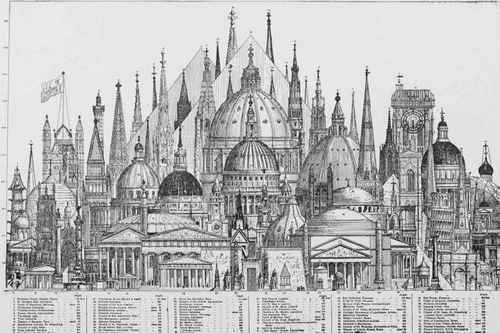
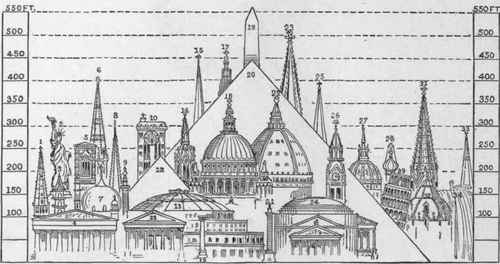
    The 1876 U.S. Centennial Exposition (formally called the “International Exhibition of Arts, Manufactures, and products of the Soil and Mines) in Philadelphia was a grand and fabulous showing of all things American, celebrating the hundreth anniversary of the signing of the Declaration of Independence.  One of the crowning objects of the fair was to be the never-built 300-metre tall Centenniel Tower, pictured here in the 24 January 1874 issue of Scientific American.  The structure appeared in relief against the background of other tall things built by humans, show in a relatively new fashion for displaying quantitative data comparisons in the same scale.

    http://upload.wikimedia.org/wikipedia/commons/9/93/The_Centennial_Tower_Philadelphia_1876.jpeg

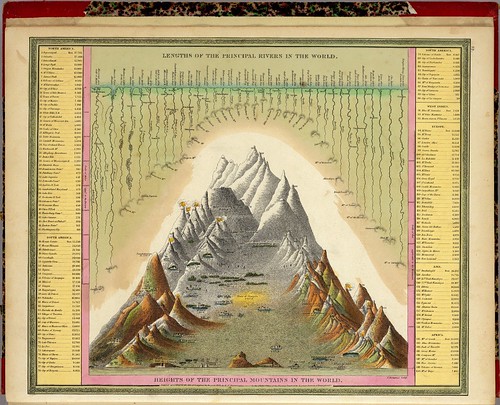
     The practice of showing, say, the comparative heights of mountains and lengths of rivers by loading up all of the samples on one piece of paper for the ease of recognition was begun in the 18th century, but only rare; it began with some fits and starts in the 1820’s again and then much more widely around mid-century, and seeming to peak at the end of the century before going somewhat dormant for the next few decades or so.

    Another nice example of comparative heights of buildings:

    COMPARATIVE HEIGHTS OF SOME OF THE PRINCIPAL BUILDINGS OF THE WORLD


    And this as well:

    Comparative Diagram Showing Highest Buildings And  396

    [Source with key to the images found here, at Chestofbooks.com]

    The excellent Bibliodyssey blog contributed a good healthy post on the subject of comparative heights of mountains map (here) with many fine examples of the art.  Its a curious thing to me that the  business of using same-scale comparisons in architecture is relatively new, coming (I think) as an invention of Etienne Durand in the 1840’s.)

    Here is one such example:

    Heights Of The Principal Mountains In The World (Mitchell) 1846

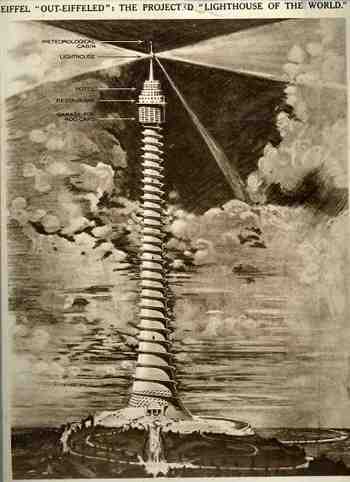
    But getting back to the tower itself and it unbuiltedness, here’s another example of an unbuilt tower–taller and bigger than the Centennial–which was proposed by Eugene Freyssinet (and which I wrote about earlier in this blog here):

    Big_archout_eiffeled140


    Another in what is a long line of unbuilt towers would be this contribution by Vinnie Ream Hoxie (ca. 1874-6)  which was his response to the finishing of the not-completed Washington Monument.  Congressional sympathies towards spending money to complete the Washington Monument dried up to nothingness in 1856, just eight years after construction on the monument was begun.  The consequence was that the monument was only a nubbin for several decades, standing about a third complete–it was Hoxie’s idea no doubt to provide a sort of quick-and-dirty approach to finishing the project.  Of course this looked like exactly what it was, and the idea died its own lonely death, thank goodness. 

    http://www.nationalbuildingmuseum.net/Large%20Images/unbuilt/4._Washington_Monument_Sheet_2_web.jpg

    It had little appeal, at least to me.  It is somewhat reminiscent of the exhibition of the completed forearm of the American Statue of Liberty, which as it turns out was also exhibited at Phildelphia in 1876, years before the completion of the rest of the statue.  Short and stubby.


    File:Collossal hand and torch. Bartholdi's statue of "Liberty.", from Robert N. Dennis collection of stereoscopic views.jpg

    There are many other entries in the history of unbuilt towers, but their day will have to wait (for this blog, anyway).


  • Ten Celestial Punishments for Impatience, 1630

    JF Ptak Science Books      Post 1674

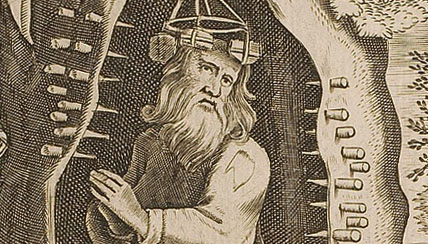
    (Thanks to Bibliodyssey for finding this image–you can find the great Bibliodyssey site here.)

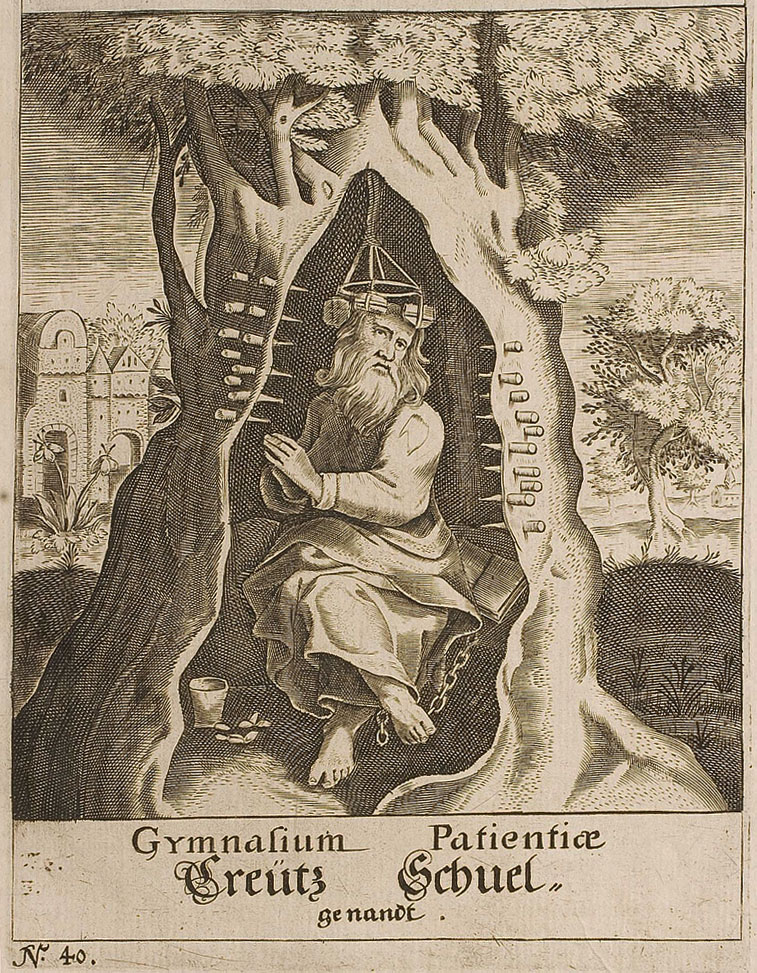
    Killing tree DETAIL


    And the full image:

    Killing tree

    And the source: Jeremiah Drexel, Gymnasium Penitentiae, 1630, and translated in 1640 as The School of Patience (the full text here) and the pdf of the Latin original here.)

    In the introduction to his work Drexel writes:

    “Dame Patience stands in place most eminent,
    Teaching her youths a doubJe document.
    That learn they must to form a passive right
    This pateint life, or else in future night
    That Paradise no plurail hath since sport
    and ease take pains at last in Pluto’s court”

     
    And should the teachings of Dame Patience not be heeded, even on Earth the impatient should suffer from at least these ten forms of torment:

    Whatsoever form of punisment, whatsoever kind of affliction or exercise in this world we affect, may be comprised and comprehended  in this tenfold order. For God hath in this his School of Patience  these following torments:

    (1) Rods;  (2) Arrows ; (3) Firebrands; (4) Garlands of straw; (5) Cudgels; (6) Snares and Chains; (7) Knotty clubs; (8)  Long clones; (9) Scouges or whips; (10) Sacks and bags.


  • A Heavy, Round, Wooden 17th Century Interweb–Two, Actually.

    JF Ptak Science Books    Quick Post

    booksnbuildings: kunstwissenschaftlerin:   ook wheel illustration in Agostini Ramelli’s Le diverse et artificiose machine del Capitano Agostino Ramelli (Paris, 1588). 

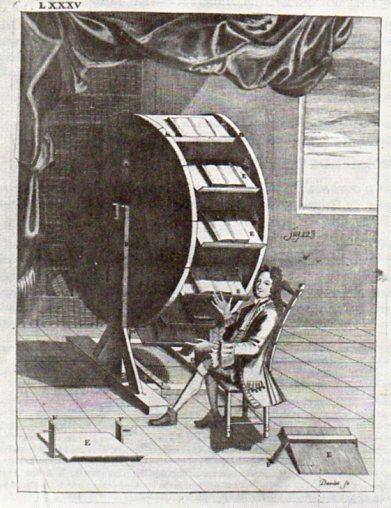
    Since there was no controllable source of electricity in the 17th century, there would need to be an alternative to delivering multiple sources of data to a seated recipient or researcher.  In these two instances, this issue was solved with wood–big wood.  And as we can see, the reader could choose from 12 different data sources–books–while not having to rise from the chair. 

    [Image source:  Agostino Ramelli, Schutzkammer Mechanischer Kunste, Leipzig, Georg Liger, 1620–a tall, thick book with 195 full page illustrations like this for all manner of invention and convenience.]

    Interweb 18th c045

    [Image sourceNicolas Grollier de Serviere, Recueil d’Ouvrages Curieux de Mathematique et de Mechanique...printed in Lyon by David Forey in 1719–another good-sized book with 85 full-page (Copperplate) engravings.]

    It also seems to me that there could be some doubling up on the placement of the books, allowing 24 of them to be displayed; there might also be something that could be done with a sliding shelf so that those two could be doubled, allowing 48 books to travel ’round at a time. This would be a huge boon to the reader here in  1620 and 1719, if that’s the way you were measuring “boons”.  It would be nice to have all of those sources open and available and neat, but one longish table would be good enough for that.  and certainly more furniture would be available to people contemplating having one of these monsters built for them because in almost all cases only the wealthy of the religious orders could possibly own 12 or 24 or 48 books at this point in history, so space would not have been a problem, necessarily. 

    The one thing that this interweb had going for it over the existing version–all of the sources used were vetted.


  • Medieval Chair-Shoveling and a Few Later-Day Shovelers of Note

    JF Ptak Science Books  Post 1672


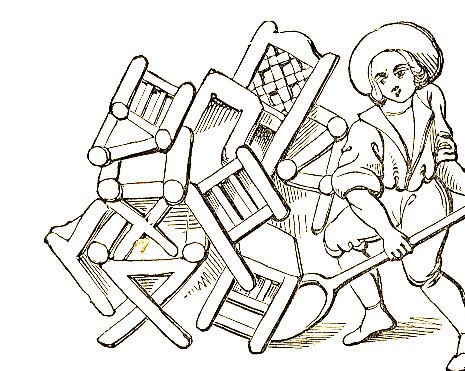
    + chair shovel

    Seeing this extraordinary woodcut of a sculpted feature on the Medieval section of the beautiful town hall of Brussels reminded me of famous shoveling, in general.  To begin with, though, I can’t fathom the meaning of this sculpture, shoveling chairs.  Perhaps it is a metaphor for the leaders not recognizing relaxation?  Or the (presumed) fact that there was no seating inside for the people doing business there?  Or that you were expected to seek your business and not loiter at town hall?  I really don’t know.  But images of other shovelers did pop into my mind. 

    The most instant shoveling comes from the song Big Rock Candy Mountain (which I’ve written about earlier here) and the very simple plea from a down-but-not-out man for not having to work with “short handled shovels1”.

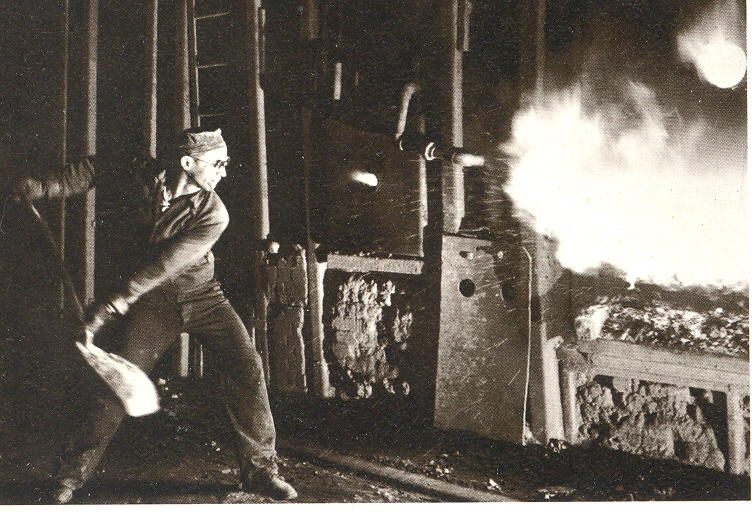
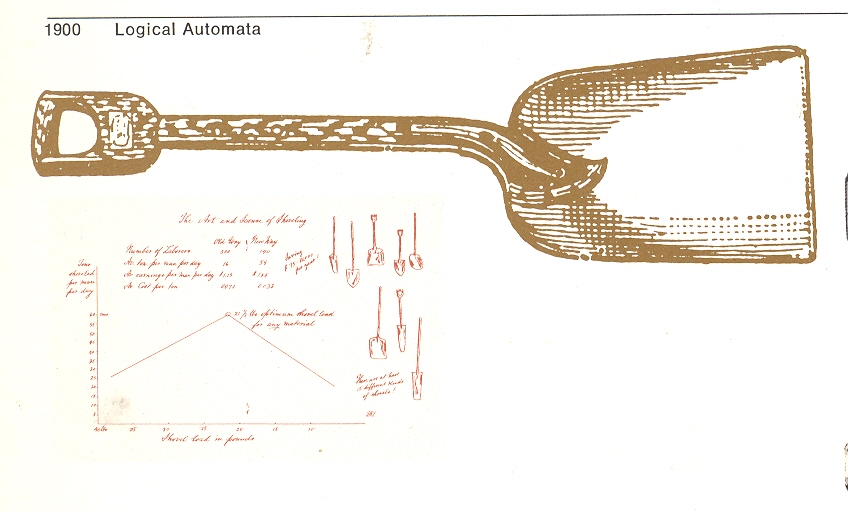
    Next in mind was Frederick Winslow Taylor, who was seen as an iconic leader in establishing human motion studies for efficient factory

    + chair shovelsteel shovel

    (and etc.) operations in early 20th century America.  He did very detailed motion studies of people working—say, in this case of a man shoveling coal into a furnace at Bethlehem Steel in 1907—to determine that best sort of arrangement/placement of tools and supplies.  It was very influential work, for sure, and Taylor, who loaned his name to the movement of this sort of effective watchmanship, (“Taylorism” and “Taylorization” and also “scientific management”) and took a huge step forward in establishing efficient factory and business operations and also automatizing the human working cogs in the workplace.  According to the wonderful Eames’ brothers book, A Computer Perspectives (1973), “Taylor established the scientific fact that…a first-class shoveler will do his largest day’s work when he had a shovel load of 21 1/2 pounds.  Then as a matter of common sense…it was necessary to furnish each worker with a shovel which woul dhold exactly 21 1/2 pounds of the particular material which he was called upont to shovel” (page 52).  This, by the way, is also a short handled shovel.+ chair shovelsteel shovel daig

    I then thought about the Seven Dwarfs from Snow White (incidentally Tom Waits covers the “Hi Ho, Hi Ho” song like no one ever did or will) but they all carried picks, not a shovel (so far as I can see) among them. 

    There are undoubtedly many great shovelers—they’re just not people I know about.  I can imagine that Casey Jones must’ve had help to feed his locomotive’s fires; the gold rushes around the world produced some very wealthy shovelers whose numbers were titanicly dwarfed by those who shoveled and lost; soldiers have shoveled themselves into the earth for protection for at least 170 years (actually I don’t know when before the U.S. Civil War that soldiers found protection in their own burrows); and so on, but I just don’t know anyone by name.  And so my rumination ends—I did say that it was wispy.


  • History of Fear: the Lure of High Sci-Fi Sexual Danger

    JF Ptak Science Books   Quick Post   [Part of a new series on the History of Fear]

    There just seemed to be something going on with women and clothing and sex and fear and sci-fi trouble, or at least so on the covers of a spectrum of pulp publishers in the 1930’s-1950’s.  Perhaps this had nothing more to do with anything than having a pretty woman posing next to the UNIVAC II in a 1959 issue of Computers and Automation. In any event, I stockpiled some of these images and collected them under the Fear-Sex heading, and for right now all I’m going to do is pass them along. 

    Are they really sexualizing danger? I have no idea what the content was of these issues, but from the looks of things, I’d throw hazard to the wind and say “yes”, at least to the visual aspect. 

    (Don’t forget to have a peek at an earlier post on Women in Sci-Fi Past-Future Distresses, here.)

    http://farm1.static.flickr.com/48/188844234_b5a2d881a5_o.jpg


  • Episodes in the History of Dropping Things–Baby Bombs, Bomb Babies and Dropping Women on Manhattan

    JF Ptak Science Books   Post 1670

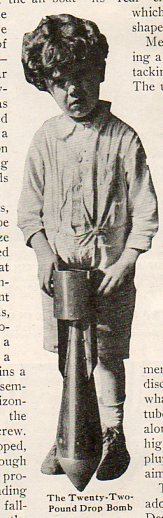
    Dropping things036In the history of dropping things–as distinguished from simple falling things–it must be said I think that this is the easiest of all human activities ever invented, and people have been trying to improve on this creation ever since.  After all, almost anyone can do it and–if you include pushing things over a ledge so that they might fall–most complex life forms can do it, too. 

    Of course there have been intellectual and technological adaptations, particularly when you include throwing and shooting things so that the objects have been charged with a “created height” so that they will be dropped in the designated location.  Cannons have been particular benefit to this aspect of advanced dropping.  And then of course there are the “Galileos” of dropping–like Galileo–and Jonas Moore and David Letterman and of course Seinfeld’s Kramer, and to a lesser extent there’s also every other person from the Boston area who represent hundreds of millions of people who drop a letter from somewhere in their spoken vocabulary.  There are people who drop their accents altogether, and of course politicians who drop the truth, and the tantilizers who drop suggestions, and paid-for pharmaceutical consultants who drop the untoward test results and their accountants who drop a zero when necessary.

    [Image source:  June, 1936, Popular Mechanics.]

    People drop options, they drop in and out and off, pennies and dimes, lawsuits and dumplings, coverage and names and the f-bomb.  They also drop dead and bombs, the last two being closely related, though more people “drop dead” when bombed because they are killed. 

    Bombs seem to be the biggest of all dropped things, especially bombs dropped by airplanes, and especially those bombs dropped on collections of people, which are called cities.

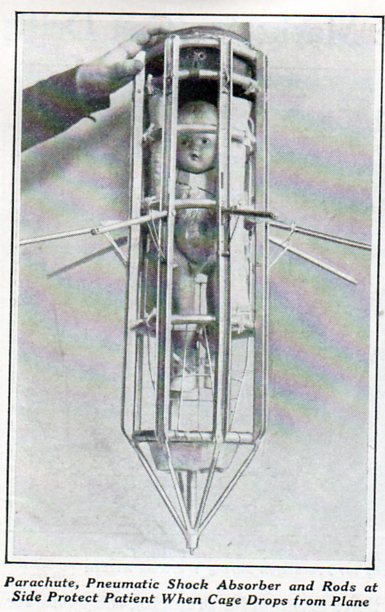
    Perhaps one of the strangest things to be dropped, though, is the following, found in  the September 1935 issue of Popular Mechanics

    Dropping things 2038This was a model of sorts for a critical-care-parachute-gurneystretcher, or something, for when a crew member of a U.S. Army Air Force aircraft was injured and needed care, though the article doesn’t specify where the person would be dropped. Overall it seems not the height of workable ideas, and suffered no doubt from its model using a baby doll, which just looks altogether wrong. 

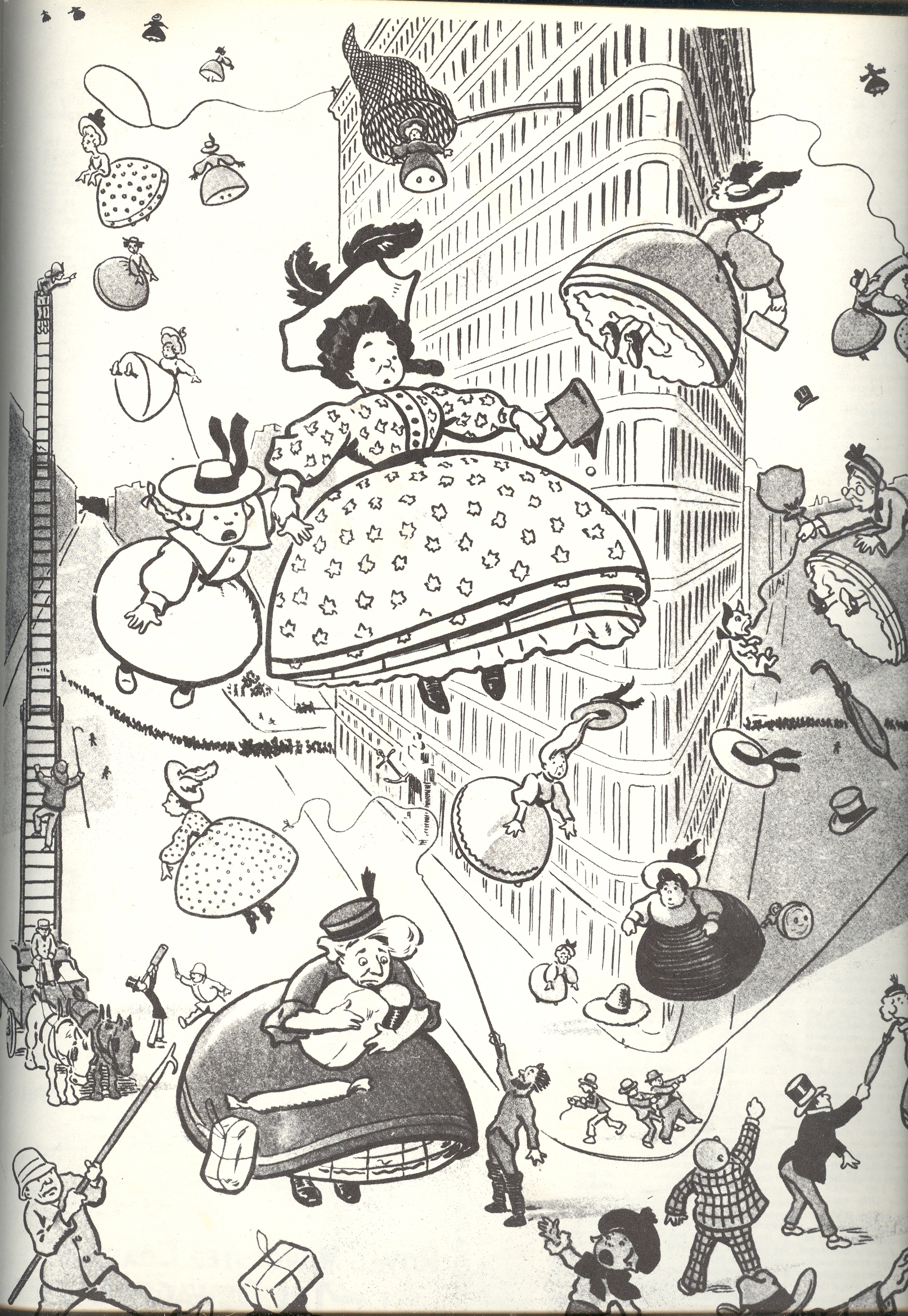
    And the last part of this episode is another strange bit:  dropping women on Manhattan. The  image comes from 1904 and–when taken out of context–it seems as though Manhattan is in for the worst of it, with a view in front of the Flat Iron Building of an aerial bombardment of women.  This is probably one of the few bad things that weren’t done with/at women, and would actually significantly predate the first use of explosives being dropped from aircraft.  Unfortunately the original, intended image was a poke at  crinoline  and featured women being blown up into the air rather than the other way around, though I like my interpretation better.

    5-women


  • Stuff-out-of-Place Department

    JF Ptak Science Books    Quick Post

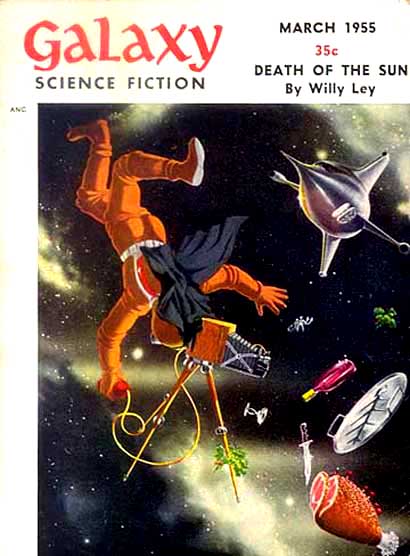
    I’ve been on a bit of a run on science fiction pulp covers of the 1930’s-1960’s, and I’ve collected some in this catch-all category of “Huh?”  These are wonderful images, and I have no idea what they represent, except that the image transcends its intent, in a way, and stands strongly for itself in some sort of Found Absurdist kinda way.  And once you look at it, most of all that one can say is “Well, there it is”.
    . 

    http://static.flickr.com/72/184347617_9e4c03889b_o.jpg