JF Ptak Science Books Picture Post
A Daily History of Holes, Dots, Lines, Science, History, Math, Physics, Art, the Unintentional Absurd, Architecture, Maps, Data Visualization, Blank and Missing Things, and so on. |1.6 million words, 7500 images, 4.9 million hits| Press & appearances in The Times, Le Figaro, Mensa, The Economist, The Guardian, Discovery News, Slate, Le Monde, Sci American Blogs, Le Pont, and many other places… 5000+ total posts since 2008.
Contact johnfptak at gmail dot com
JF Ptak Science Books Quick Post
(An earlier post on 1950’s atomic bomb popular culture appears here.)
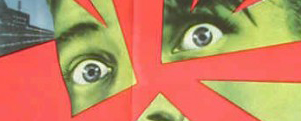
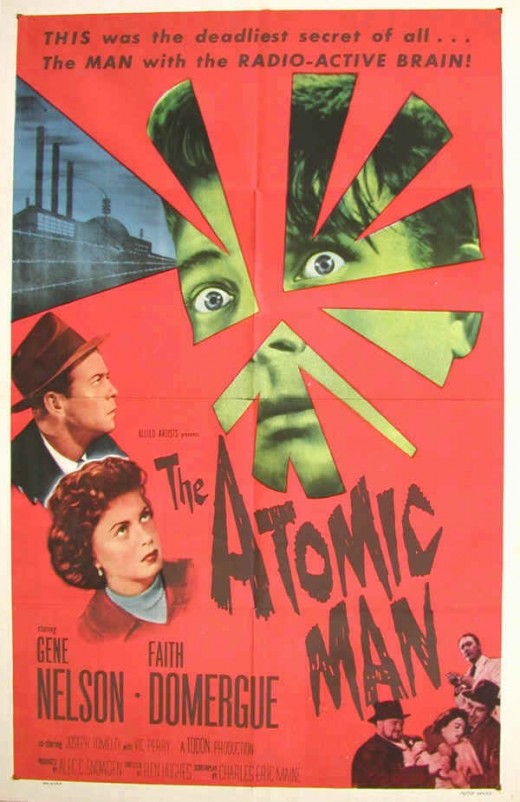
I strongly doubt that anyone could “read” or dowse or interpret eyeballs in these movie advertisements and take very much away from them at all outside of the big atomo-nuclear death-fear that gripped most people in the U.S. and the U.S.S.R in the 1950’s and 1960’s. That, and it made for a good way of selling the promised fear in these movies, gentle as they were by curernt standards, but fearsome nonetheless in context with their time.
[Images from the wonderful Retronaut site, here.]
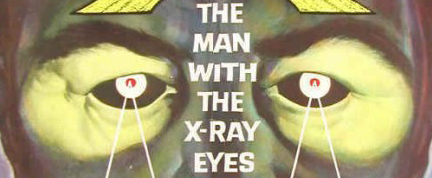
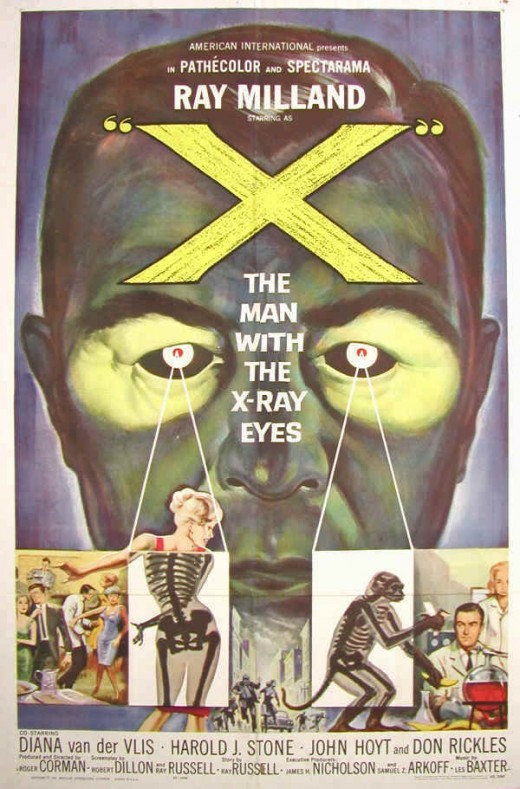
It is a little difficult watching even the clip of the Ray Milland movie in that he wasn’t really that much more different than the people around him, judging him. And it turns out that in this differentially-abled-free world, where everyone looked like the white couple in some commercial for Borax, that his weirdish blackish eyes were deemed so incredibly repulsive–though since not having slickee-boy hair was enough to be set apart from most groups, or at least those in this movie, its not that surprising that he would be turned into a monster. It didn’t take all that much to get down Monster Road, then.
JF Ptak Science Books Post 1686 Works in the Reverse Esteem of the Gettsburg Address
“The cheek of every American tingle with shame as he reads the silly, flat, dishwatery utterances of the man who has been pointed out to intelligent foreigners as the President of the United States”–The Chicago Times, on the Gettysburg Address, 1863.
We all know today what to expect when we hear something referenced as a Gettysburg Address–and we certainly know what something might be if it was referenced as not-the-Gettysburg-Address. The address as it was when Lincoln gave it didn’t even have a title, named as it was post facto by the newspapers and periodicals covering the event (on the spot or remotely). The speech is considered as being among the greatest ever given by an American, though at the time it its reception was very mixed—in many cases it was seen as a failure and even as an embarrassment to the solemnity of the moment and place. There were many newspapers which panned the speech (as in the case above with the Chicago Times, which at the time was considered more of a Democrat paper than anything else), while others (like the New York Times gave the speech a warm reception. The speech’s presence in national memory was crafted over time (not unlike Mr. Leonardo), its perception formed into the polished gem that it is seen as being today.
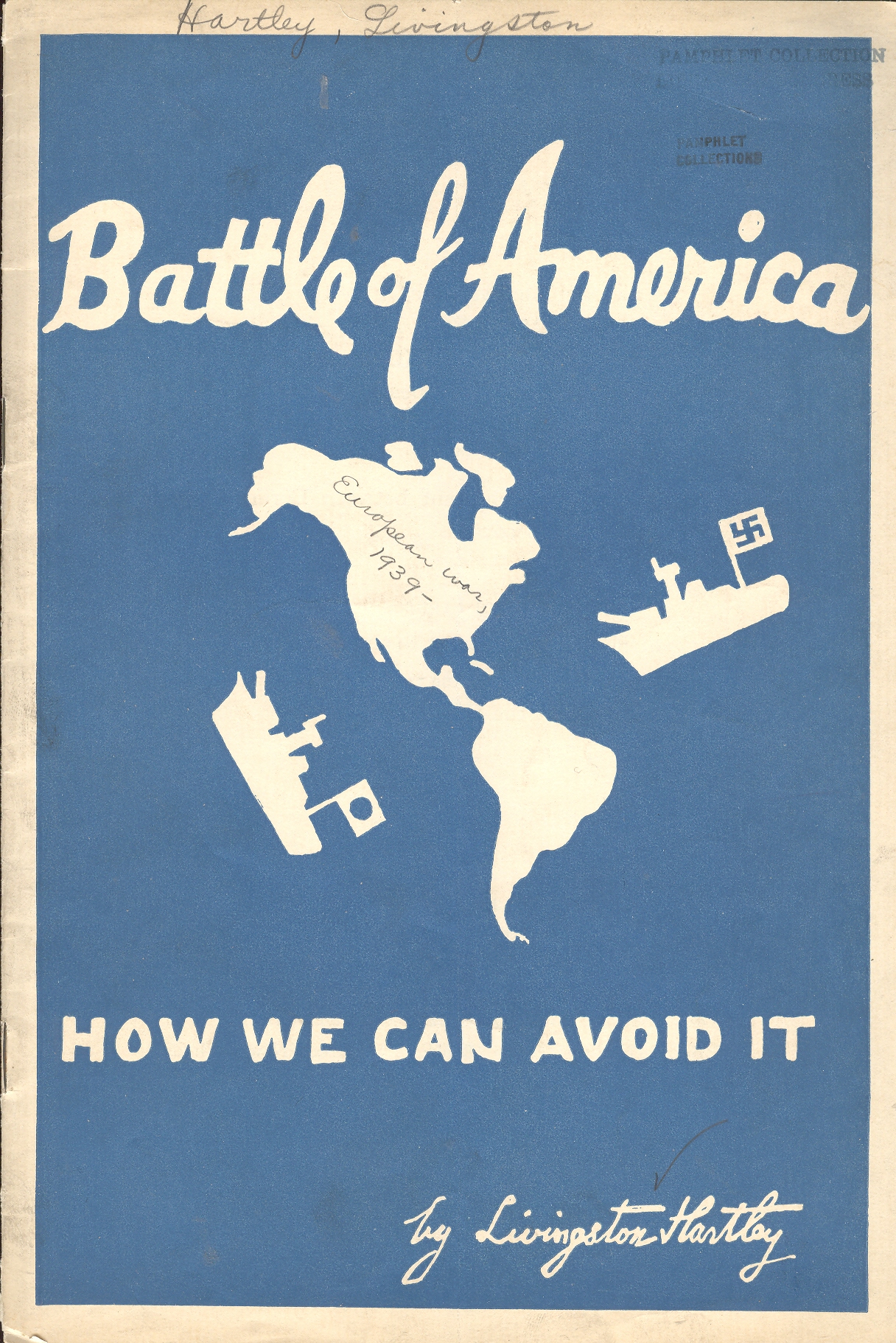
The possibility of the implied actions of the titles of the pamphlet below were somewhat similar, though in reverse. I’m not saying that some of them were always seen as quacky and the works of demented seers; their titles and possible content, though, were not seen as dismissible, and their concerns were real and a possibility. The concerns over “invasion” today depend on what invasion means. I don’t imagine that people are seriously considering the possibility of a land or air force attacking this country, though other sorts of invasions (biological, chemical, cyber, etc.) are a possibility.
The Battle for America/How We Can Avoid It (1939) was published by the Committee to Defend America by Aiding the Allies (and headed by William Allen White, iconic middle America newspaper editor and editorialist) which attacked isolationism and advocated strong support of the European effort. The thinking here was that if America didn’t become involved now it would so later, with battle lines of a Nazi-illuminated truce drawn close to American borders. So it was a pay-now-or-pay-more-later position from a man who supported the New Deal but whop didn’t support FDR. 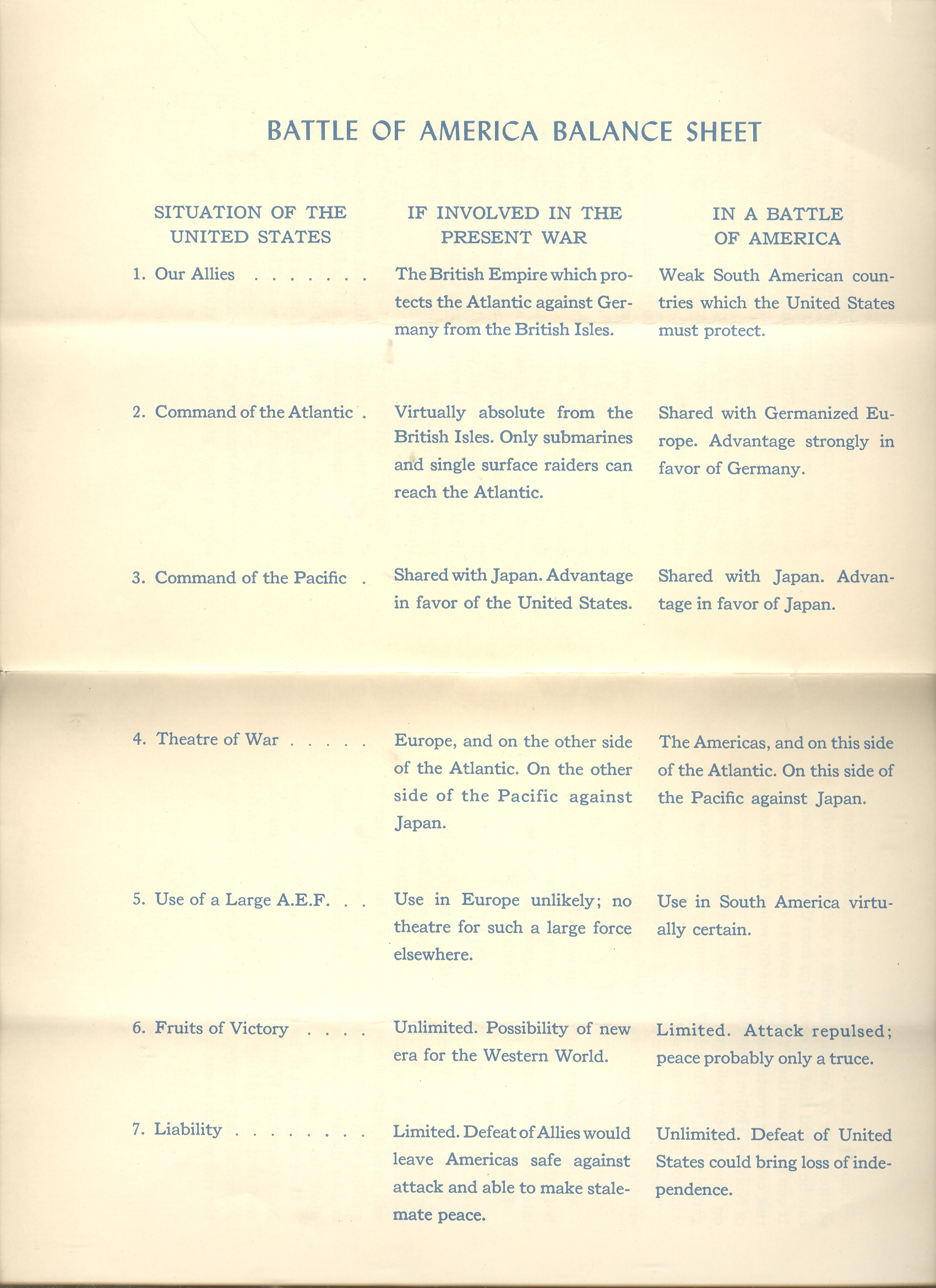
Much of this thinking looks a bit tenuous to me. For example the position excluded the use of an American expeditionary force in Europe (“for theatre for such a large force elsewhere”), though if nothing at all were done there would be a “certain” use of the AEF in South America combating Nazism. Also, if the U.S. backed the Allies with supplies and war materiel the “liability” to the US in the consequence of European defeat “would leave America’s fate against attack and able to make stalemate peace”. So at the very least, doing a little bit of something would d at least allow us to make a truce with the German/Japanese alliance. Doing nothing at all in this area would infer “unlimited” liability, and “defeat of the United States could bring loss of independence”. (“Could”?)
The way aid ourselves in this war “(was) to aid Britain to hold out to defeat Nazi Germany….the chance for Britain to hold out and win is a good risk for America”.
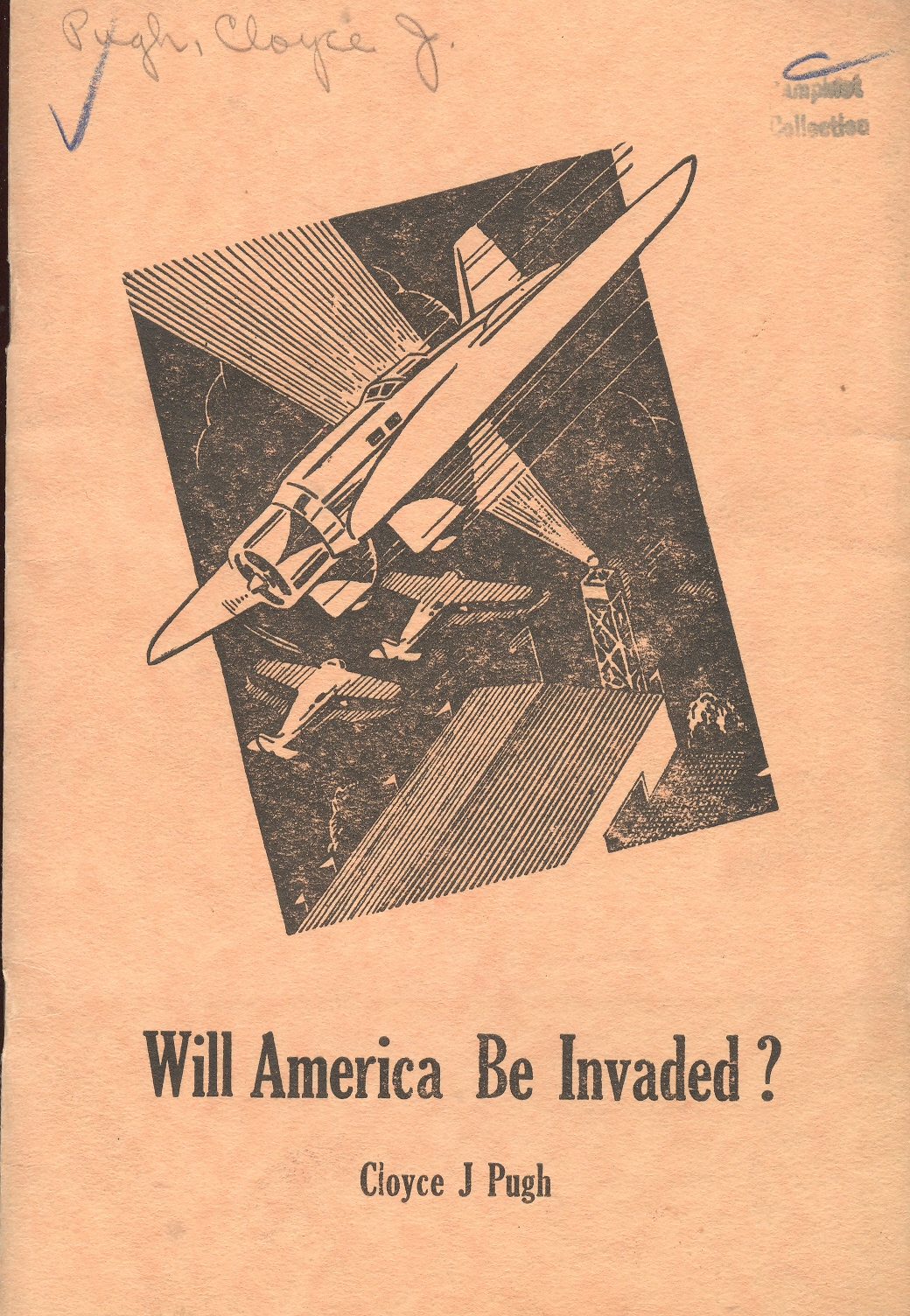
The second pamphlet, Will America Be Invaded, was published by the Christian Fellowship Press in Akron, Ohio, in 1941, and leans mightily upon scripture to state assumptions about the coming menace to America being presaged in the Bible. That invasion also seems to be allowed by God (according to prophesies and such) in pursuit of murky results. The conditions which will prevail “when God permits invasion” (according to this person’s reading of the bible)) include the formation of monopolies, extensive wine and music, “unbelief in God’s judgments”, conceit, “wine and bribes in high places”, and “perverted moral stanfa5rds. All of this—it is claimed—can be remedied through one medium: prayer; and prayer through only one mediator, Jesus Christ, who would then take the communications to god’s ear.
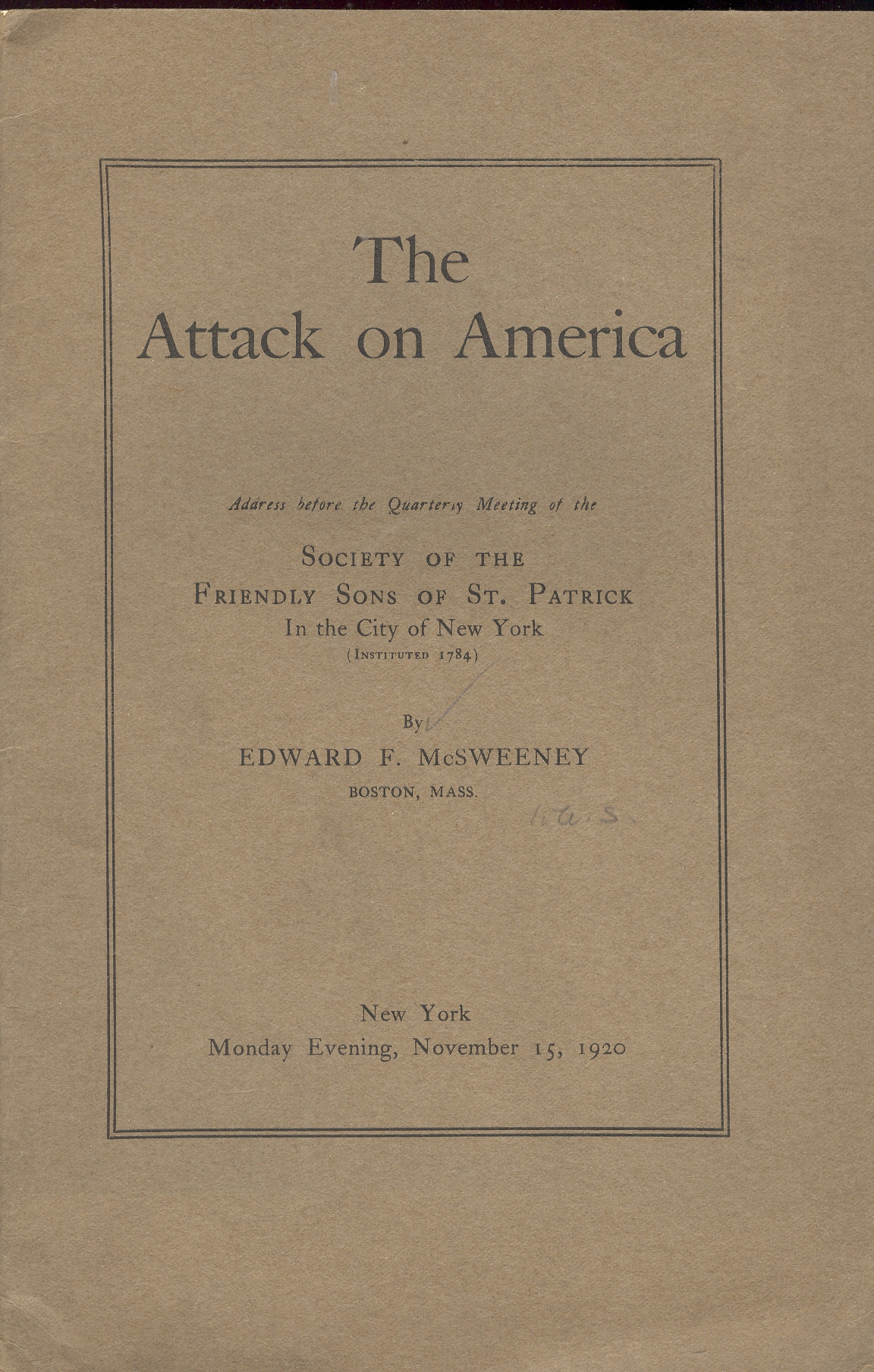
The Attack on America, published by the Friendly Sons of St Patrick (of NYC), was a cautionary pamphlet published in 1920 warning against certain dispassionate evils of British propaganda in the United States. Freedom or Enslavement for United States of America (sic), published in 1939 for the Mothers of United States of America (sic) advocated a freedom policy that prohibited conscription in foreign wars and would present a state of permanent neutrality. It also made some pretty vicious anti-Roosevelt attacks, finding him the Socialist root of the coming empire of American evils with a wildly power-mad and legislative-grabbing presidency.
Quite a grouping of pamphleteers concerned with the potential overthrow of the United States, each seeing the unfortunate possibility of national death via divergent and disparate means: the fall of the country due to not being part of the Allies during the war and also for being in it; biblical ordination of invasion that is only combatable through prayer; British and European propaganda control of the national welfare; and of course the diabolical Socialist menace of Franklin Roosevelt and the imperial presidency as the ruination of the nation’s future. All of this gently hidden by disturbing titles which really dont give you a hint about what wildly unexpected ways the end was approaching. And whatever they were, they were definitely not high-order thinking.
·Posted by :
·in:
JF Ptak Science Books Quick Post
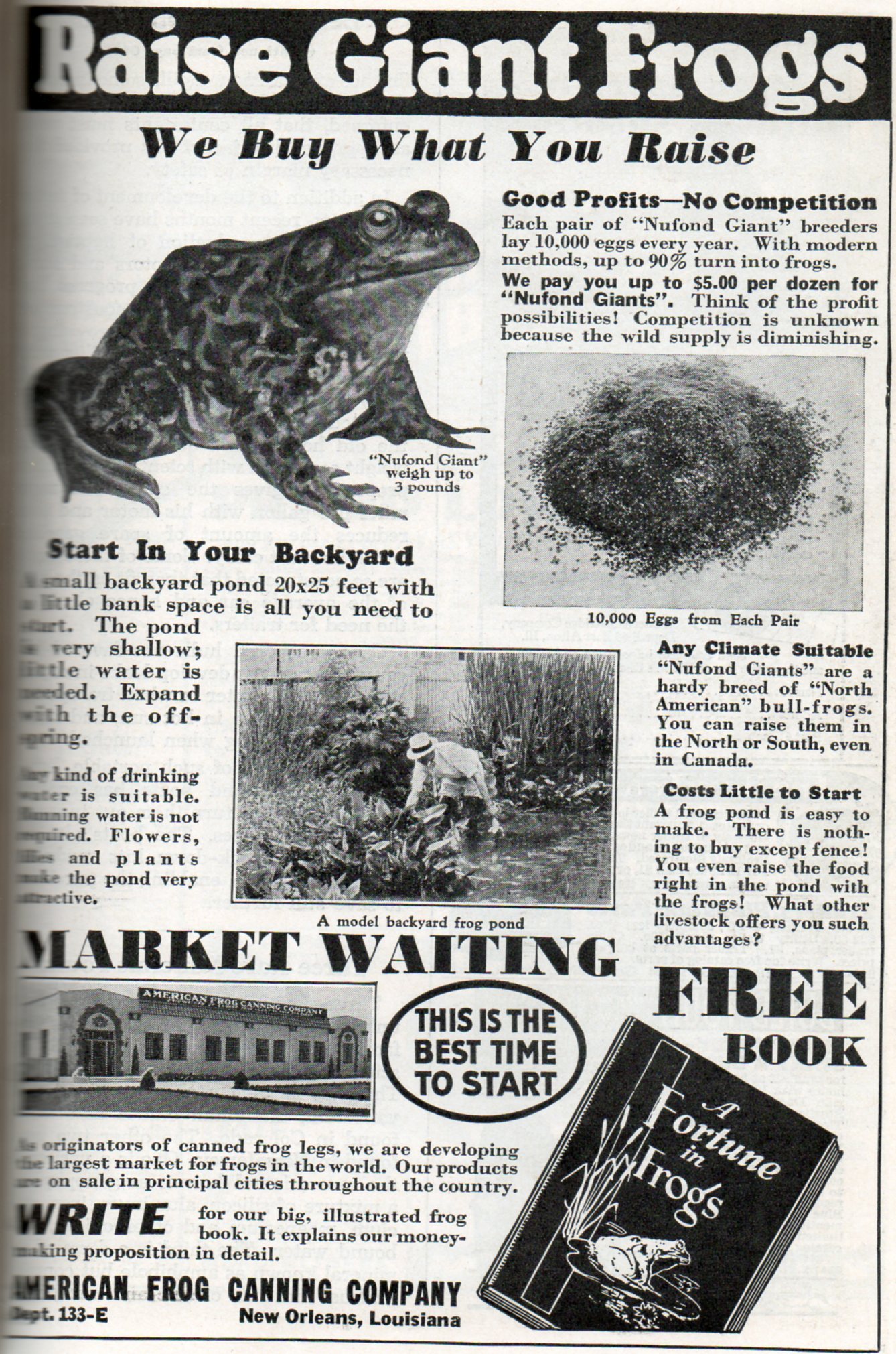 Well. In a small, simple way, a person reading this ad in the May 1936 issue of Popular Mechanics would have thought it quite easy to develop 10,000 frog eggs into a money-producing leg-farm in a scant 500 square feet of backyard scum pond.
And who in their right mind could resist the reader of “Raise Giant Frogs” with a picture of one of the three-pound bloaters to seal the deal?
And that luscious picture of 10,000 frog eggs–could that have simply been wasted space, unnecessarily pictured because the text and promises of frog killing were already so overwhelming the reading mind that the egg images were wholly superfluous?
I should say so.
JF Ptak Science Books Post 1684
On an early use of the term, Outsider.

Sometimes a word is just a word, and the elements of recognition sometimes inhibits that. Except in this case that the word seems to be just what it is and also indicative of what it would become.
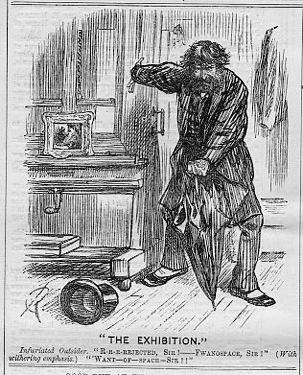
Outsider, or outside, outside the recognition of “official” art, of critiqued-art, is the English language equivalent/translator coined in 1972 (by Roger Cardinal) to illustrate the term art brut (“raw art”) created by Jean Dubuffet. Dubuffet created with others Compagnie de l’Art Brut in 1948, which in some respect was a reaction to a new sort of displayed art that had begun its life in the early 1920’s, mainly as the efforts of doctors treating psychiatric patients who were expressing themselves through their art. (Two famous examples include Dr. Walter Morgenthaler’s Ein Geisteskranker als Künstler (A Psychiatric Patient as Artist), published in 1921 on the work of perhaps the most famous people in the Outsider canon, Adolf Wölfli; and another being Bildnerei der Geisteskranken (Artistry of the mentally ill) published a year later by Dr Hans Prinzhorn.)
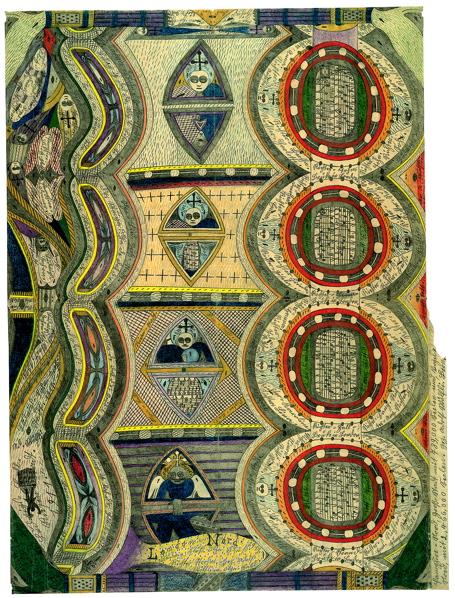
[Adolph Wolfi]
Well, “outsider” as we know it today in reference to the arts is definitely not what the editors of Punch magazine pursued in this cartoon for their issue of 6 May 1886. The “infuriated outsider” was simply an artist left outside a show, whose work was not accepted for exhibition. (And from the looks of it, the small work on the huge easel, being rejected for the “want of space” might not have been the reason for the artist not making the list.)
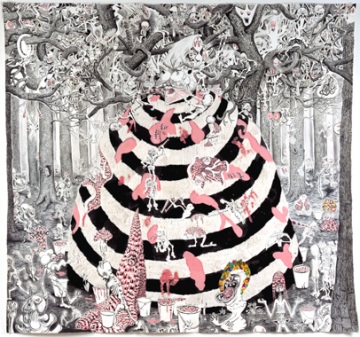
[Henry Darger]
This outsider was simply outside with probably-not outsider art. Henry Darger (1892–1973), Martín Ramírez (1895–1963), Paul Gösch (1885–1940), Charles A.A. Dellschau (1830-1923), Willem Van Genk (1927–2005) and so on were Outsiders, their work being Outsider/Art Brut and also being left outside for a long time. Far outside. In the far-deep outsider, further and deeper outside than the more aesthete outsider varieties of “outsider” art–like Impressionist, Cubist, Dada, Constructivist, Futurist–ever got outside.

[Willem van Genk, detail]
Anyway, I thought it curious to find the term stuck in the middle of a cartoon rant in an 1886 popular journal.
·Posted by :
·in:
JF Ptak Science Books Quick Post
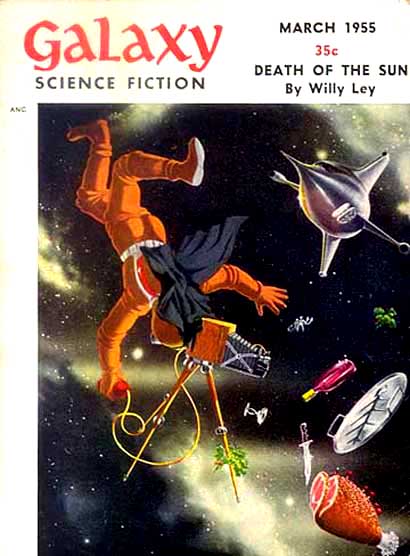
I’ve been on a bit of a run on science fiction pulp covers of the 1930’s-1960’s, and I’ve collected some in this catch-all category of “Huh?” These are wonderful images, and I have no idea what they represent, except that the image transcends its intent, in a way, and stands strongly for itself in some sort of Found Absurdist kinda way. And once you look at it, most of all that one can say is “Well, there it is”.
.
JF Ptak Science Books Post 1668
Part of Paper Microscope and Zoomology series.
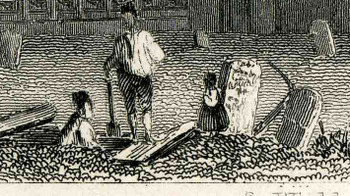
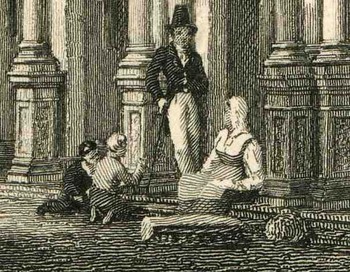
[Detail from the image immediately below, the small scene immediately in the foreground.]
Images hold selective secrets for different people of divergent interests. Sitting through a motion picture, for example, shows a series of still images flashed before us—in a single scene people bring to bear their own ways of experience and observation. A forensic pathologist will see things shown within their specialty different from someone with a chemical explosives background who will see a bomb differently from an ER doc who would respond to an emergency room differently from a bookseller who might notice in the scene that the paperback edition of a Tree Grows in Brooklyn being read by an American G.I. in 1944 didn’t exist yet, and so on. A single image can hold a tremendous variety of depth and interpretation depending on the observers’ perspective.
Most of the time when I look at prints now I am looking at the extraneous “stuff” that is used as filler to the print’s purpose. I’ve written about this a few times earlier in this blog under the (bad) general title of Prints—Looking HARD at…), and I find the uncommitted art just fascinating, sort of like “loose”, unnecessary snapshots of common life, everyday life, of people walking by. 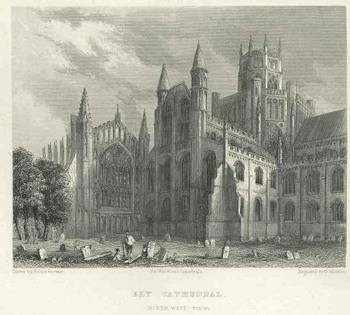
The two prints today that I stumbled upon have a particular interest—they depict semi-hidden children in the foreground-filling detritus of the architectural marvel that is the subject of the artwork. Children really don’t appear too terribly often in art from 1500-1850, so it is especially interesting to look really hard at these prints and pick out the kids and what they were doing.
Of course this begs the question of “why?”—why would the artist bother with such detail in the foreground, let alone bring children into the picture?
The first image is the gorgeous Cambridgeshire Medieval cathedral at Ely. This is an engraving showing the north west view of the cathedral, and it is of course grand and imposing. The curious foreground shows a somewhat dilapidated-looking cemetery, and looking further still we see two men digging a grave, and to the right of them, a small child, seemingly pointing and reading a gravestone. What an unusual detail this is, what with it occupying less than 1% of the area of the image in general.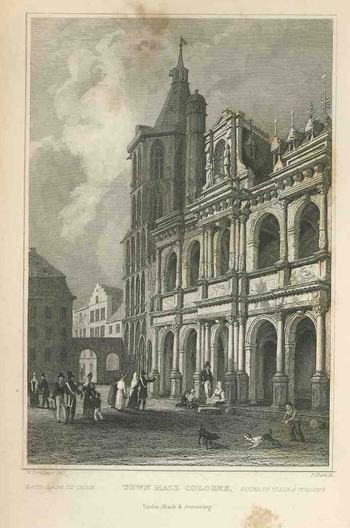
The second image (above) shows the façade of the Town Hall at Cologne. Of the twenty or so people in the street in front of the building, four are children (there’s also a pair of fighting/playing dogs). One of the miniatures scenes seems to show a boy in a “pick me up” pose. To the right of this is another, odder, scene, showing a woman—possibly a street food peddler—with her two boys(?), the children kneeling in front of a gentleman who is in turn leaning against a pillar of the Town Hall. What the boys are doing is a mystery, as is the intention of the artist in including them.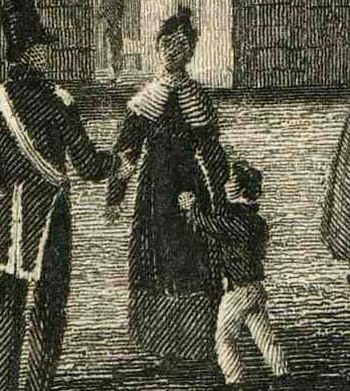 .
.
Unfortunately these “microscope” studies reveal only the basic forms of the semi-hidden, and really don’t ever seem to offer us a reason as to why they were preserved. Presently I’m happy enough to just recognize them and appreciate their small saved existence.
JF Ptak Science Books Post 1680 Part of a new series on the History of Fear

Perhaps you become scared of what is taught you or is available to you, or made available, or dreampt. Perhaps you can dream not-so-terrible things unless you have been exposed to them in one form or another, already. I can certainly recall from my childhood things that made me feel fear, and they weren’t very fearful–not really–at all, though they were at the time, because there was no way for me to process the weird adaptations to my imagination.
Certain things are taught to children as a matter of course, I guess, certain fearful things, like for example the oldish child’s prayer ruminating on a sleeping death, or some exacerbating tale from the brothers Grimm–how else are children to come up with the ideas of not waking up or being boiled alive or eaten by a witch?
And so I wonder about the fear factor imaged and implied in these early wonder/sci-fi magazines, meant for distribution to high-adolescents and adults. They simply do not look so terrifying, though I guess it is because the true business end of FearSell USA Inc had not yet been prioritized in the national economy–and certainly it was orders of magnitude away from approaching anything that we have today. Even the constant state of storm/terror available to us in a relentless flow from a simple avenue like The Weather Channel must be a testament to the dept of our fear depravity.
The stories–or the ideas of the stories, anyway–seem scarier to me now than the images of them on the covers of these magazines. It would be an interesting thing to make a timeline of fearful images to see how these things changed over the decades. Or centuries.
·Posted by :
·in:
JF Ptak Science Books Quick Post
There’s a track on this blog located in the feebly-named category “Looking Closely/Deeply at Prints” were tiny bits and pieces of engraved artwork are exhumed for closer story, like passing a paper microscope over the image to draw out the semi-invisible and show the secret life of prints. Often what this entails is some very curious work by the artist and/or the engraver as they sought to spice up a rudimentary architectural assessment of Salisbury Cathedral, or the town hall in Munich, or some sort of ruin in Surrey, or a street scene along old Broadway in NYC–and they would do this sometimes by including something artful and small, and completely unnecessary to the primary image on which they were working.
See this post for a good example (with other links) of this.
So, instead of having a few people in the street outside of Cathedral X to show the building to some sort of scale, the artist/engraver might include in their very tiny detail images of children fighting, or a legless beggar, or a pocket-thief, or a tripping aristocrat. Or a man rounding a corner with a baby coffin on his shoulder.
What happens here then is an intended-unintentional, sort of like an 18th century snapshot of Something that captures stuff of the daily grind in the process–and as it happens it is this stuff, the activities and the people doing the mundane chores of the 18th century that turn out to be the very interesting bits of the artwork. After all, it was this sort of invisible activity that would tend not to be preserved in artwork or other visual documentation–but here it is, locked away in an architectural appreciation of some building Y in some city Z. And we are lucky for the contrivances of those long-asleep artisans.
But the Zoomology posts are something a little different than this–they simply are a deep observation of an interesting detail in an antiquarian print or photograph that shows an artwork in and of itself, a sort of descending fractal of appreciation. And simple.
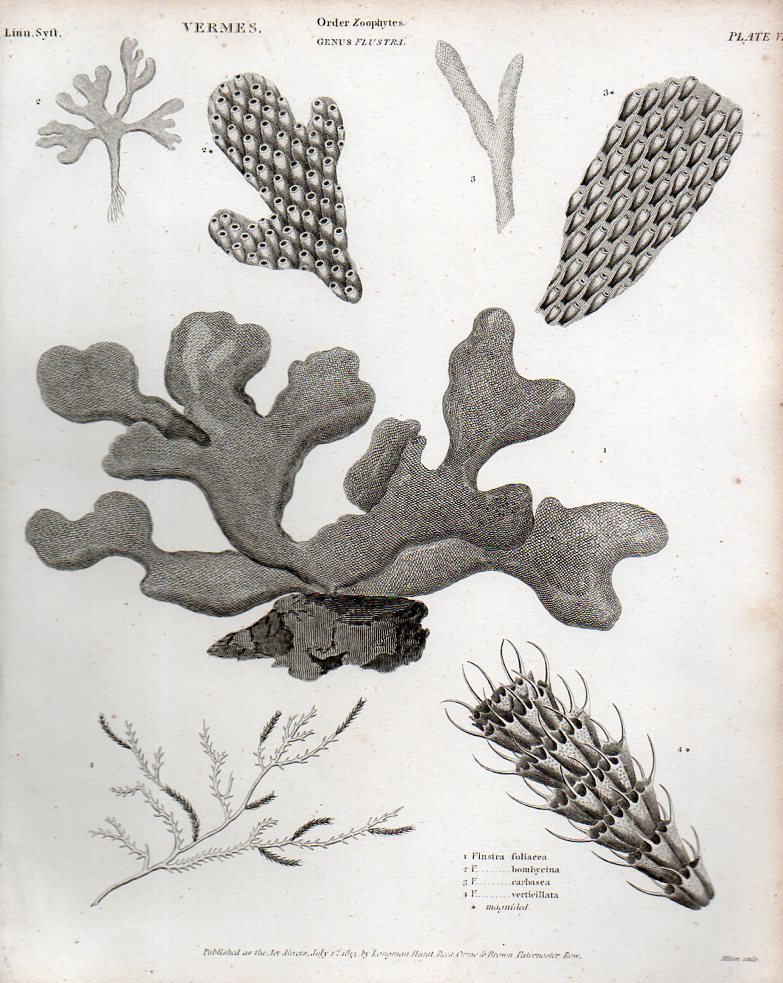
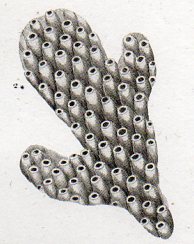
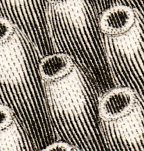
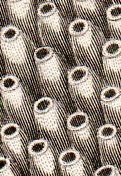
The first sample in this quick-posting category is the sea anemone, or Zoophyte (old school classification), that we see in this series of images (above and below) from the great and prolific Abraham Rees (who must have had a team Rees, a group of scholars like the Bourbaki who worked together mostly anonymously save for the (in this case real) man whose name is given credit for the entire work) and engraved in 1813. The image in question is a flustra bombycina, a Verme (according to the obsolete Linnaen taxonomy), and it just called out for deeper inspection:
And the zoom-out to the full image: