A Daily History of Holes, Dots, Lines, Science, History, Math, Physics, Art, the Unintentional Absurd, Architecture, Maps, Data Visualization, Blank and Missing Things, and so on. |1.6 million words, 7500 images, 4.9 million hits| Press & appearances in The Times, Le Figaro, Mensa, The Economist, The Guardian, Discovery News, Slate, Le Monde, Sci American Blogs, Le Pont, and many other places… 5000+ total posts since 2008.

Category: Absurdist, Unintentional

  • History of Dropping Things: Electro-Punk Machine for Waking/Smothering People

    JF Ptak Science Books    Quick Post

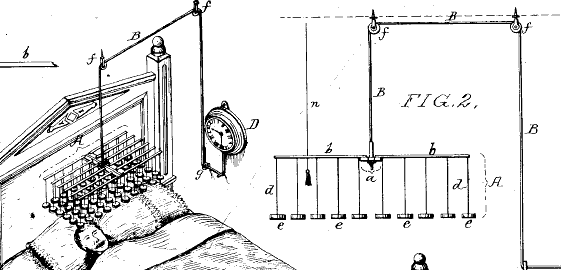
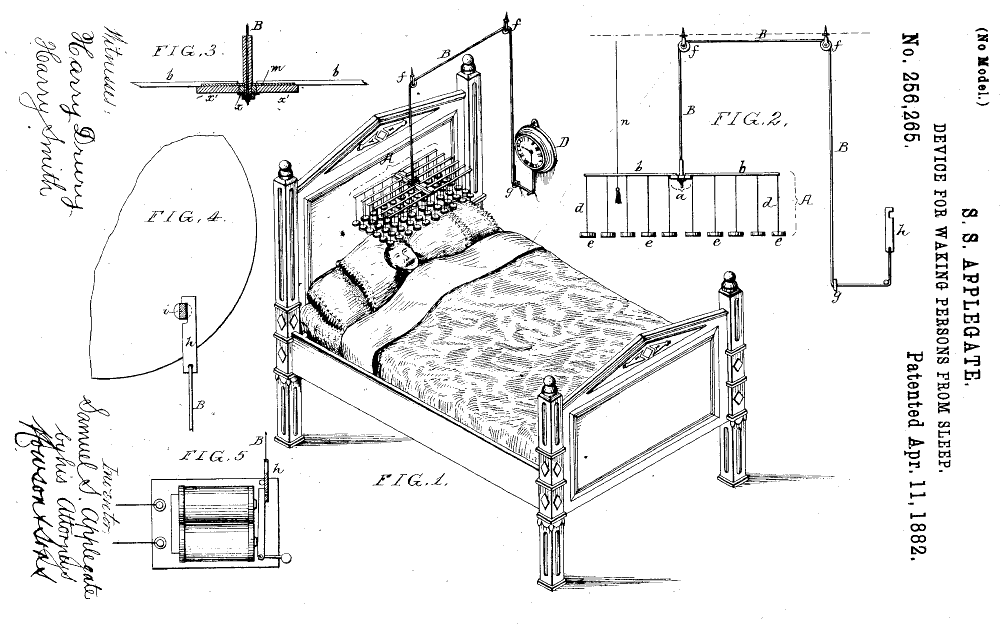
    Here’s an ambitious alarm clock that I stumbled across–something designed so as to not be ignored, something for the people who regularly sleep through simple alarm clocks.  This device, patented by Samuel S. Applegate in 1882, woke the sleeping client by dropping that cage-resembling apparatus on the sleeper’s head.  Evidently the ends of the suspension were soft, but hard enough to cause the sleeper to get straight-away back into the waking world. There’s probably nothing quite so like being slapped awake every morning.


    Patent waking people up
    The apparatus is seen better here–it is an unusual contrivance:

    Patent waking people up_edited-1

    Such a pretty picture of the sleeper, though I must admit the perspective would’ve been a bit of a challenge especially to a challenged  artist. 


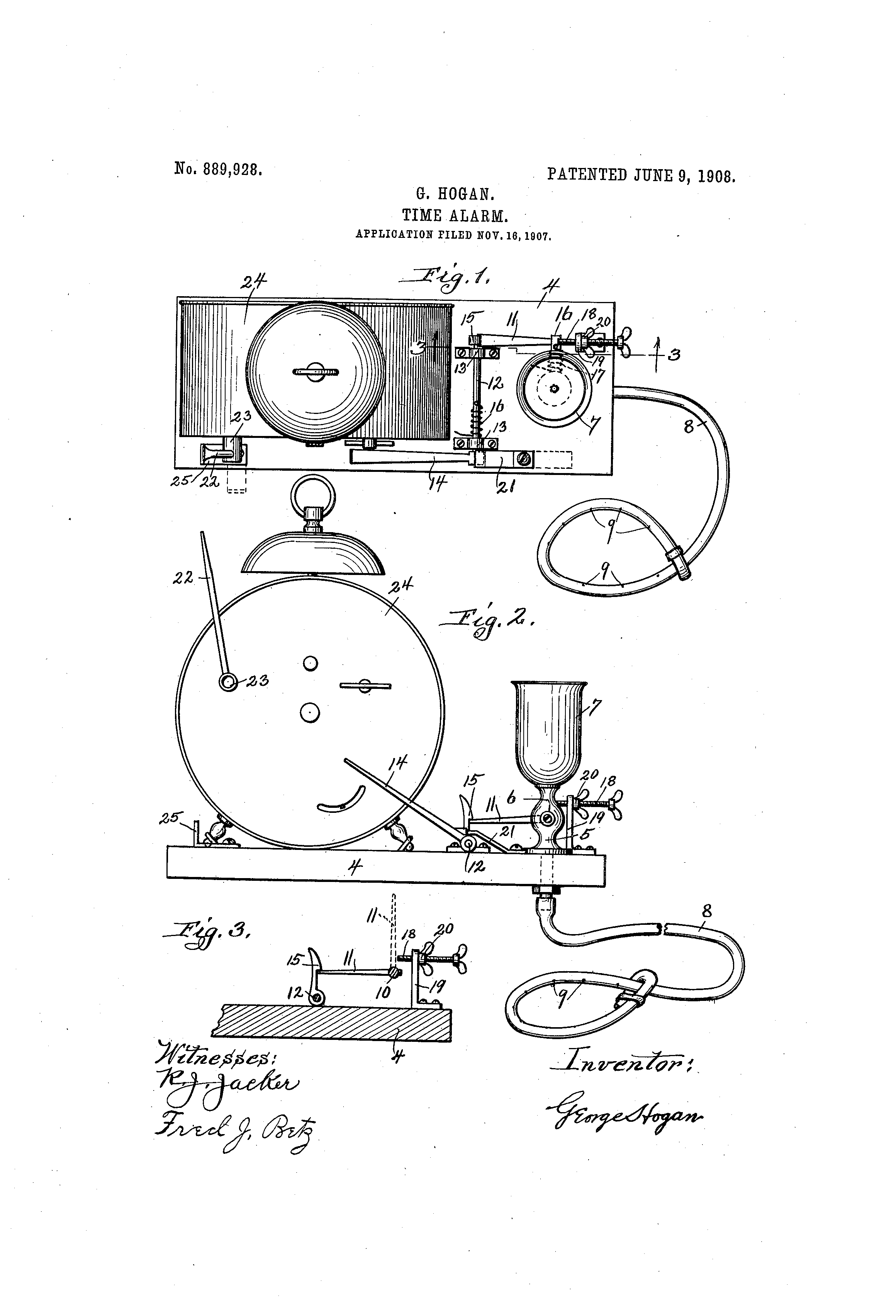
    Okay, this one is walking people using water dropped on the sleeper’s neck:

    Patent--time alarm


  • Modest Expectations–Engineers Stand in the Shallow End of the Future Pool

    JF Ptak Science Books   Post 1769

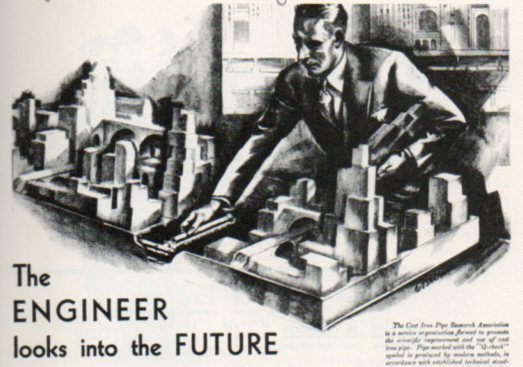
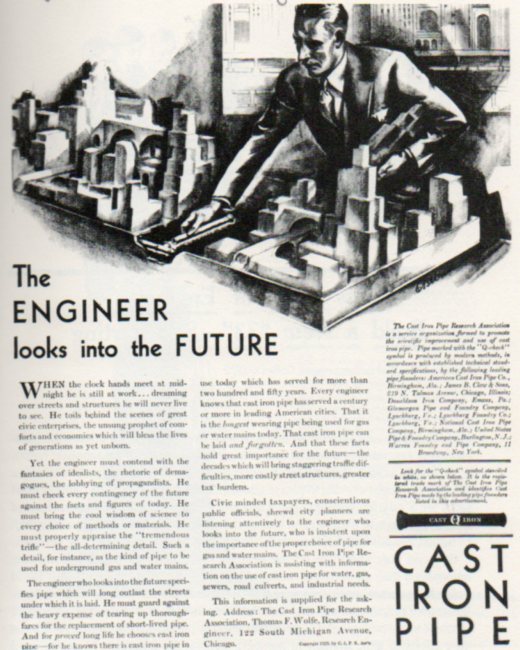
    The novel underneath its title can be good or bad in spite of it, independent of the flag under which it flies. Its just helpful, usually, if the title is as good as the book—better even, because, after all, Modest Expectations isn’t quite as good as the real thing. But “Modest Expectations” seems as thought hat would be the title of future vision in this advertisement that appeared in 1929. It is an advertisement in Collier’s magazine by an engineering company during the time in which The Engineer and the possibilities of engineering were running full-blaze in the United States. There was a belief in the idea of engineering as a cure-all to present and future problems, and the word was as prevalent in the sphere of social interaction as the prefix “e-” was in the early days on internet business and communication in the 1990’s.

    Engineer future410
    It seems as though there were few occupations immune from the “-engineer” suffix, whether they had anything specifically to do with engineering, or not. The “control safety engineer” described a crossing guard; “sanitary engineer” referred to what was known as a garbage man; “nutrition control engineer” was a food server, and so on, position names changed by the hundreds if not more, elevating the status of a profession by simply applying the meme’s suffix to the job title. IF you judged the overuse of the term by the actual accomplishments and achievements of engineering of the times, it was probably justified, give the enormous progress of engineering. In just the first decade of the 20th century enormous change were made in the way life was/would be lived with the introduction of the steam turbine generator, the internal combustion engine, heavier-than-air powered aircraft, the audion, the vacuum diode, the thermionic valve, Bakelite, and so on, all of which would soon bring technological change to create revolutionary changes in the way life was structured in the U.S. And worldwide.

    But given the gigantic changes in the first 30 years of the 20th century, what was it that the engineer was seeing in this advertisement, “The Engineer Looks into the Future”? What was it in the hand of the engineer in the illustration, what was he placing down in the city of tomorrow, today? A faster train, or space ship or part of a vacuum tube people-mover, or what?

    Engineer future411It turns out that this engineer didn’t have such lofty future-vision plans—in fact, the vision was subterranean, and the thing in the engineer’s hands was cast iron pipe. Yes, the future was in materials, and that material manifested itself in cast iron pipe, courtesy of the Cast Iron Pipe Association.

    Now cast iron had been around for a long time before 1929—even used as pipe the idea goes back into the 16th century. There were bridges made of cast iron in the 18th century, and the movement towards the modern skyscraper maybe traced back to cast iron facades and construction in the 1850’s. I’m not so sure why cast iron pipe was so significant in 1929—perhaps it wasn’t so very widely used. But I must admit to having a “moment of discovery” while I tried to reason why the future of engineering looked into a hole in the ground filled with cast iron pipe.

    Engineer future409
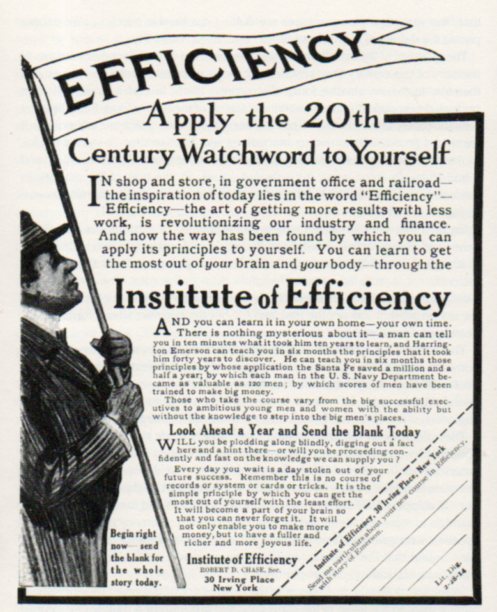
    Engineer future412Another interesting image that comes a little earlier on is this advertisement for the “Institute of Efficiency” (in 1917), which in effect takes the running-rampant ideas of engineering and applies it to the ways in which people ran their personal lives. Efficiency was as much a catch-word as “engineering”, and it was in this decade that saw the appearance of Scientific Management (Fred. Winslow Taylor) and its numerous offshoots. What bothered me about this ad marshaling the positive factors of the study-at-home courses in efficiency was its inefficient use use of space and communication of the idea. Not the least of which was the very odd bit in the bottom right corner, which the reader was supposed to fill in and clip off and send to the Efficiency people. There’s really no room to write, and you can’t actually mail the thing—and, if I was trying to get someone to purchase something about improving their efficiency I might have wanted to make it much easier for them to send me something with their name on it.  The whole effort just seems not very efficient.


  • Geology of Images: Finding Pre-biotic, Neo-Dadaist Images in Antique Astronomy Prints

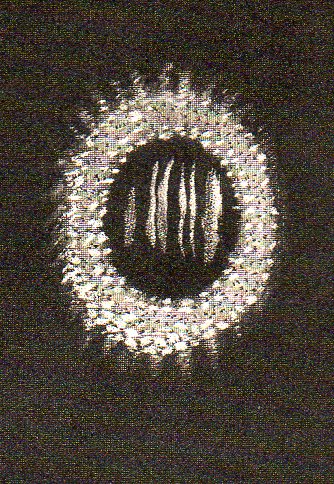
    JF Ptak Science Books  Post 1768Astro mictroscope--6b943

    Sometimes when you look hard enough you will see (if not actually “find”) what you’re looking for; determined to  make a discovery, you can sometimes force yourself into believing that what you’re seeing is what it was that was needed to be seen .

    The  microscopical world of astonomical antiquarian prints is an interesting one–and in some ways, modern ways, are  on the Robert Hooke/Micrographia magnitudes for the remarkable magnified worlds that their detail reveal–but mostly right now I’m interested in the odd/beautful designs that are hidden in larger scientifc engraved presentations.

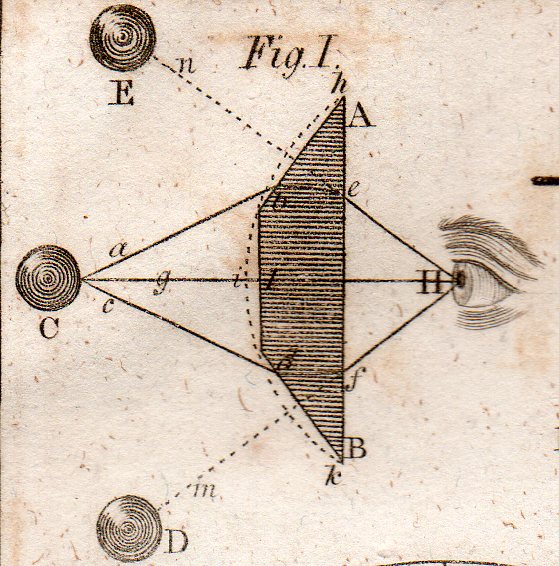
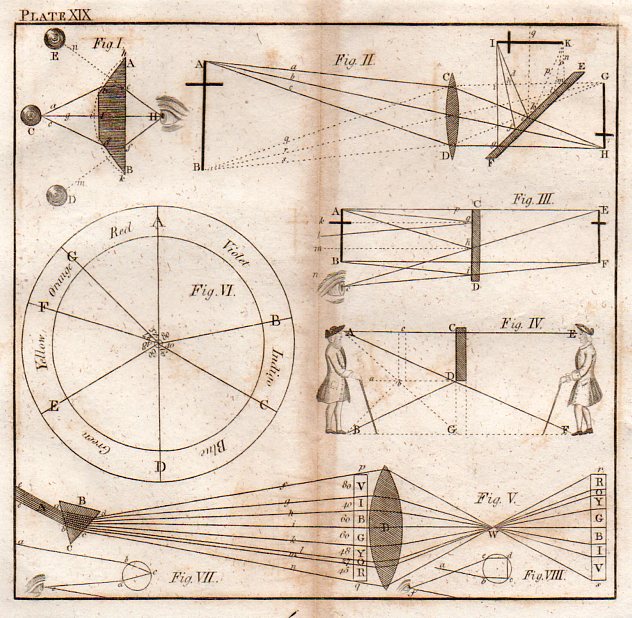
    Astro mictroscope--6942 [Even in fairly famous scientific images lke the one above–explaining the rainbow–there are all manner of unexpected artistic finds outside of their significant scientific contributions.]

    These images from the title of this post, on the other hand, are just simply “there”–all you need is a little magnification and some sharp vision, and the things come to life.  When looking hard at these images and seeing the teaming non-representational artforms that swim through so many of them it seems remarkable to me that these things weren’t seen as art before Kandinsy finally “discovered” this  artform in 1911.

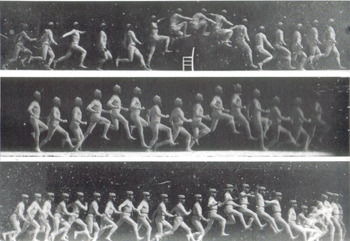
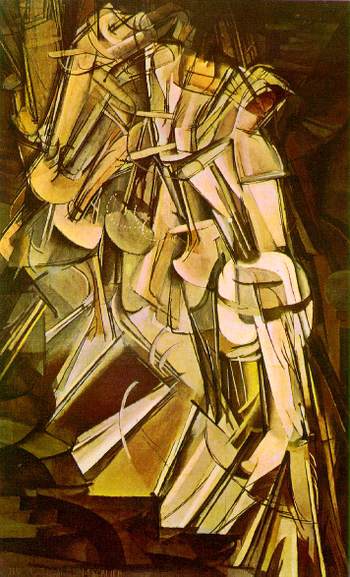
    (For example Mr. Marey produced a very remarkable Nude descending-like series of photographs 40 years before Duchamp–but the Marey images were observed scientifically, and I’m unaware of anyone who ever wrote an artistic appreciation of that work before 1900.  [Marey left, Duchamp right.] But that is another story.)

    Blogfeb_22mareyBlog_feb_22_nude

    For us today with almost 100 years of Kandinsky/Klee/Duchamp/Braque/Malevich under our belts it is relatively easy to see the artfullness of the pieces and bits of these engravings–not so a hundred-plus years ago, and harder yet for 200+. 

    For example, there are some things that take on an absolutely pre-biotic flavor, like material that we’d come to see a half-century ago, as in these details from an 1850’s  French lithograph on nebualae:

    Astro mictroscope--3b931


  • Strange Things in the Sky Department: Disintegratging Moon and Lunar Nuclear Alien Space Nazis

    JF Ptak Science Books  Post 1767

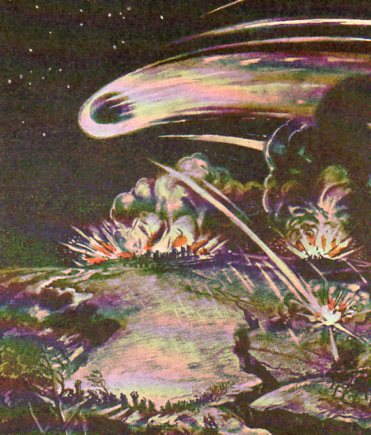
    In a post last week in the Strange Things in the Sky department: the Exploding Moon, I mentioned that images of the Earth’s Moon actually exploding seem to be quite uncommon. The ever-observant  Ray Girvan wrote to say that the Moon does just that in the 2002 remake of H.G. Wells’ The Time Machine, when Earth’s lunar mining operations disrupt it so that it makes the Moon disintegrate, raining parts of itself on Earth. 

    Strip Mining Shatters the Moon

    And it just so happens that I stumbled on another odd image of the Moon coming to its end:  a mention of a drawing by Thomas Voter, showing the Moon disintegrating under the force of the Earth’s gravity.  It appears in the November, 1939 issue of Popular Mechanics in the “Explorers of Space” article. 

    Moon explode407
    And then, on the next page of the magazine appears another image of the breaking Moon by Wallace Favereau, this also showing bits of the Moon slamming into the Earth.

    Moon explode408
    Thomas Voter’s illustrations led me to his image showing Boy Scouts flying on their odd destiny to the Moon for a rendezvous with Post-War Moon Nazis in what is a surprising juvie novel by Robert Heinlein, Rocket Ship Galileo (1947).  [Image courtesy of the excellent Roborant site, well worth a visit and bookmark, here.]  The three boy-rocket-experimenters are on their way their with their Nobelist uncle, piloting a thorium-fueled mail rocket that the Manhattan Project Uncle was able to rig up for interplanetary adventures, which gets them to a nuke-war-ravaged-Moon with victorious commanding Nazis over whom the intrepid travelers eventually triumph.  This really has nothing to do with exploding or disintegrating Moons, but finding a reference to Moon Nazis does classify as a strange-thing-in-the-sky. evidently the story is much disparaged by modern readers, though the author of Roborant feels as though there is a much greater depth to the story that the possible high-comic storyline implies. 

    It looks like there is a sub-genre for Evil Alien Space Nazis in books and film, but I just can’t go any further with the topic.


  • Cigarettes as Toy Soldiers: Playing with Tobacco, 1939

    JF Ptak Science Books   Quick Post

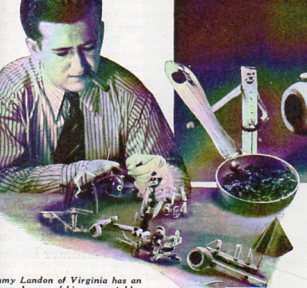
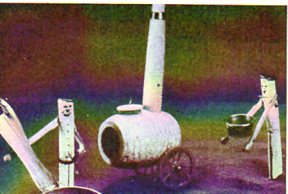
    Sometimes a bit that I post in this blog’s Unintentional Absurdist category need nothing more than an elementary introduction, their images usually being enough of a story–more of a story–than could be told of them.  This current installation, “Pipes and Cigarettes Form a Tabletop Army”, from Popular Mechanics for December, 1939, is a good example of this.

    The story is simple:  for some reason, Mr. Jeff London (of Virginia) and his son Tommy built soldiers and sailors and horses and guns and mess wagons and so on from pipes and cigarettes and matches. They called it “Fags Army”.  I’m not sure what compels this sort of expedition into creativity, but, well, here it is:


    Ciggie soldiers402

    Ciggie soldiers403

    ·Posted by :

    ·in:

    —

  • 17th & 18th Century Steampunk Flight

    JF Ptak Science Books   Post 1764  [Part of the Unintentional Absurdist/Surreal series]

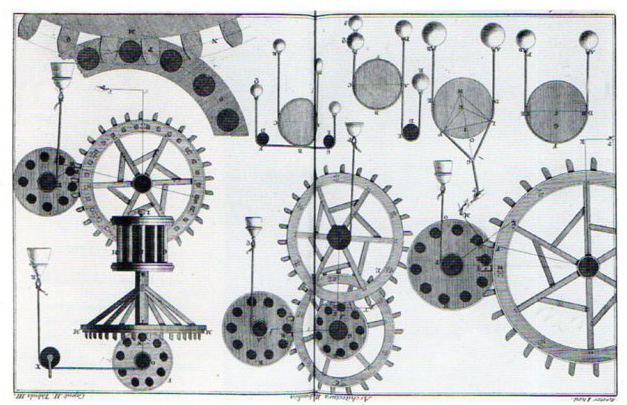
    Belidor upside down
    I’ve called on M. de Belidor (1698-1761) before in this blog, using some of the images of his books to describe the Found-Surreal, the Unintentional Dadaist (and so on), images that once slightly removed from their original context take on an entirely new life, sometimes fantastical and odd. 

    The engraving above is a fine example, an appears innocently (and beautifully, and importantly) in his Architectura Hydraulica (1740), and titled “Demonstration of Friction”.  I’ve simply inverted it and removed some of the numerical notation–and then, suddenly, it becomes a sort of Steampunk Balloon Machine–a lovely collection of small balloons lifting large wheels and cogs, assembling some sort of something in mid-air, demonstrating very little friction, of lightness and airiness

    Belidor was a remarkable engineer and theoretician who blended the two practices perfectly–actually one of the great issues in his career as trying to disseminate higher levels of techno-competence among people working with machines and using technology to some end.  He often found that the skills necessary to reproduce and maintain some of the machines he wrote about to be, um, lacking in the population at large.  He was also very transparent in technology’s role in military life (which at about the time he was writing was nearly tautological) and tried to apply the advancements he made in that area (as he was a military engineer and soldier) to the industrial and social sphere. In any event he was a very interesting man who produced books that were significant for a half-century or more past his death. 

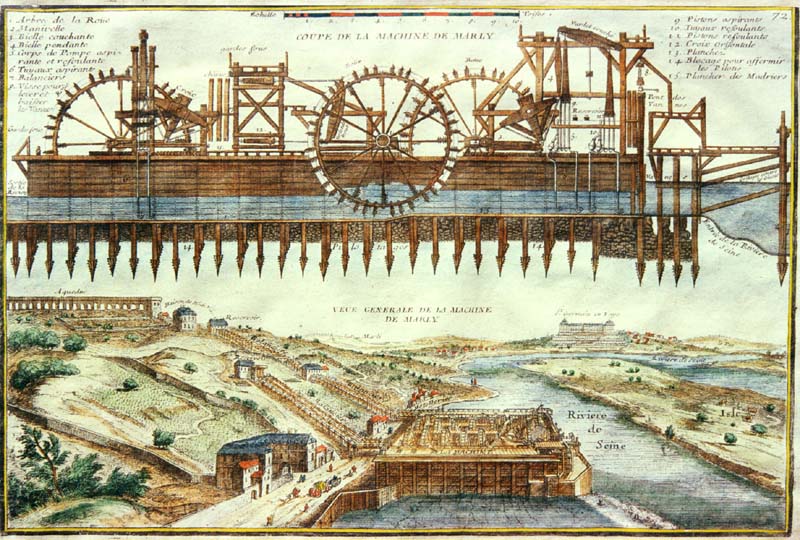
    The second image is even more striking, and is not altered at all–the difference in perspective comes with a difference of perspective, which in this case is simply labeling the image as something it isn’t, a Massive Steampunk Flying Machine of the 17th Century:

    http://world.std.com/~hmfh/mferclrsect.jpg

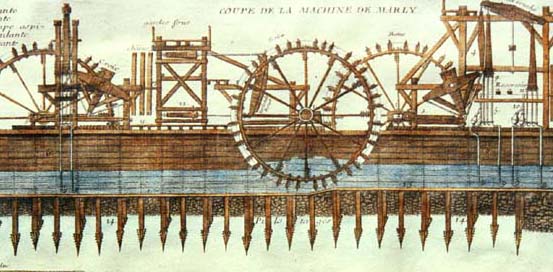
    It is nothing of the sort, of course, but if you suspend a little critical thinking then that is what this engraving sort of looks like.  In reality it a combined profile of the machine (top of the image) and view of its placement (bottom) of the great technological and engineering feats of the day, a modern marvel, a wonder–the Marly Machine. This was a large, integrated device constructed (over a seven-year-long period and finished in 1684) to pump water from the Seine to Louis XIV’s chateaux at Versailles and Marly, and did so magnificently up a 500-foot vertical rise to an aqueduct and then on to the final destinations.  Those paddle wheels on the sides of the installation were monsters:  36′ in diameter, capturing and releasing the water of the Seine to power 250 pumps which sent the water on its way up the long and steep hill. 

    Marly

    Here’s a view of the device in situ, with a long course of other implements ascending the hill.  [Images courtesy of Marlymachine.org.]

    So with a slight suspension of analysis and a little inversion, these two images take on a flighty life of their own, independent of their intended purposes.


  • Monopolis and Multiopolis: a Note on -apolises, -opolises, and Such

    JF Ptak Science Books   Post 1757

    Monopolis379
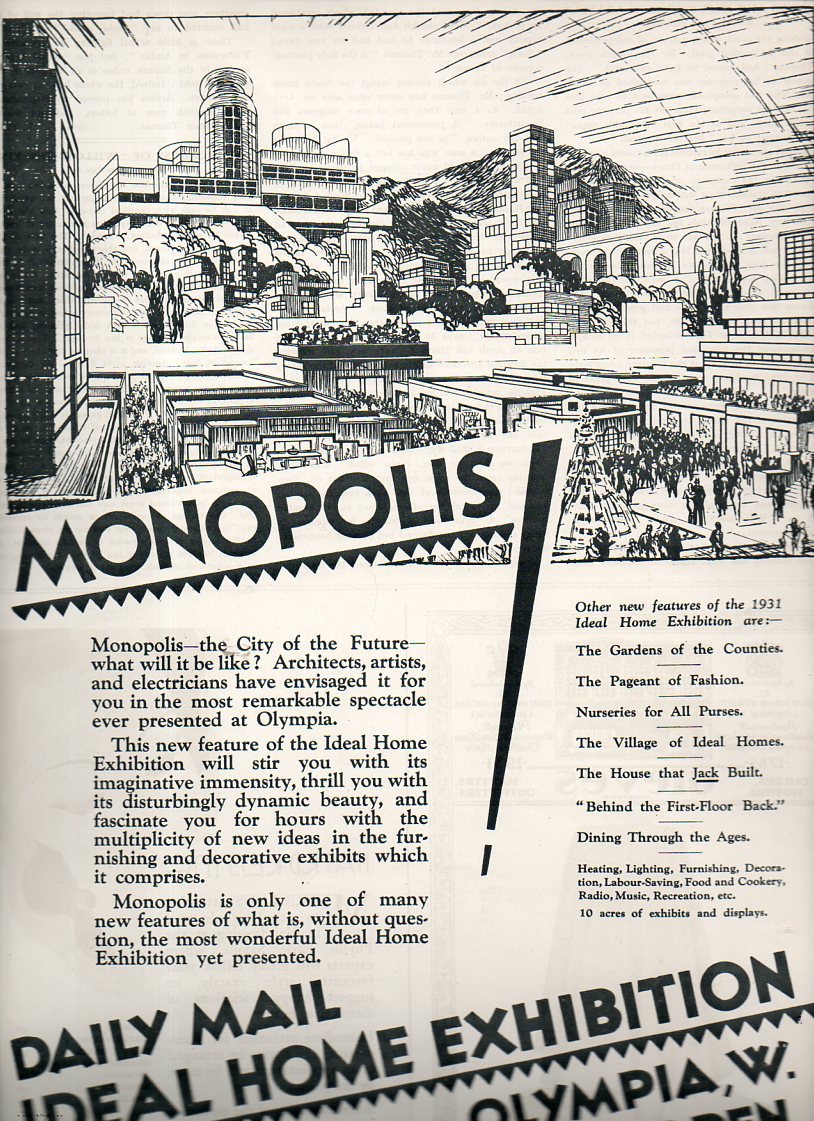
    Welcome to Monopolis!  “City of the future…imaginative immensity…disturbingly dynamic beauty…”

    The moment I look at it Monopolis suggests another word:  Multiopolis.  Although the originators of the Mono- word weren’t really suggesting plain vanilla wrappings for a one-size-fits-all existence, the more diversified-sounding Multi- at least sounds a little more enchanting and not so Orwellian.  It is also a little odd that I can find nothing on “Multiopolis”, not even in a popular Google search–and of course, having been printed in 1931, “Monopolis “can’t be “Orwellian” since Mr. Blair had not yet written any books, least of all 1984, which wouldn’t appear until the man was almost completely out of life. (Blair/Orwell wrote nine books in fifteen years, 1934-1949, and would die in January 1950.)

    Monopolis378


    “Monopolis” certainly suggests a gritty sameness, a suffocating city of similarity with no central decency.

    In this image (above), published in the Illustrated London News on 18 April 1931, Monopolis seems to live up to its promise in all aspects except for its name, which is actually pretty creative. The great building on the hill, the skyline in the mountain, all bauhaused-up with perhaps nowhere to go into the near-future, with really not that much, not too terribly much, to distinguish itself from a first-year architectural student’s semi-dreamed-upon work, though for some reason an aqueduct does makes an appearance to spice things up. 

    In the end, though, Monopolis was a simple title for a continuing series of new-house/design shows in London–it hasn’t much to do with anything, and was simply an interestingly-named bit for a bad advertising campaign.

    I wonder about a collection of “Opoluses”, like the Christianopolis of the Lutheran Christian Utopia, published  by Johann Valentin Andreae, in Reipublicae Christianopolitanae descriptio… published in Strasburg by the heirs of Lazarus Zetzner, 1619.  This is certainly among the most elegant of things ending with “-opolis”, even though it does look like a prison. Or hospital.  And no one would want to be in either in 1619. 

    [Source:  Martayan Lan with thanks]

    There is a small town in Kansas called Opolis, a place of 54 houses and 117 people or so.  It sounds like a perfectly nice bookend to places like Indianapolis and Minneapolis (and yes they’re both “apolis” and not “opolis”), not to mention Hotdogopolis, Bike-opolis, Planned-opolis, and the fantastically-named Possible-opolis. 

     I think that Monopolis just won’t do. 


  • Steampunk InnerNaughts of the 19th Century

    JF Ptak Science Books   Post 1743

     These creations weren’t so much about exploring the innerEarth than they were about surviving in the outermost, shallowest bits of its depth.  Survival gear for The Great Unpleasantness in disastrous adventures at sea was relatively scant for hundreds of years, although the nineteenth century did offer a number of new, Victorian technolust attempts for survival-at-sea.  

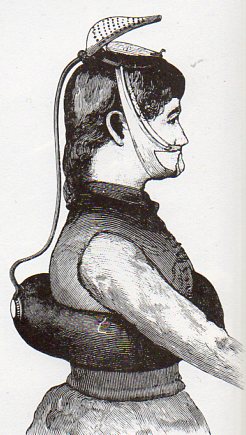
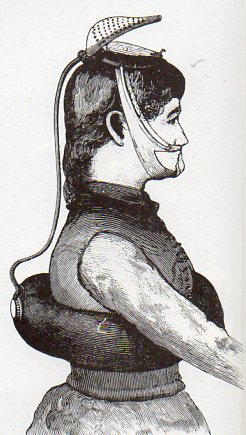
    I know that this first contrivance in some of its particular parts looks enormously compromised, but really the stuff attached to the woman’s head just allowed her to breathe about 10 inches higher than her mouth, though it seems to me that this air-catcher might catch more water than anything else.  Still, it was an interesting attempt at keeping people floating above the water when in peril.
    Innernaughts340In general though it seems to me that most of the big adventures in wearable life saving devices were big indeed, big and heavy–if there was just a little more room for a small engine, wed’ be in the Steampunk realm, as can be seen in this magnificent attempt by T. Beck in his 14 March 1876 patent:

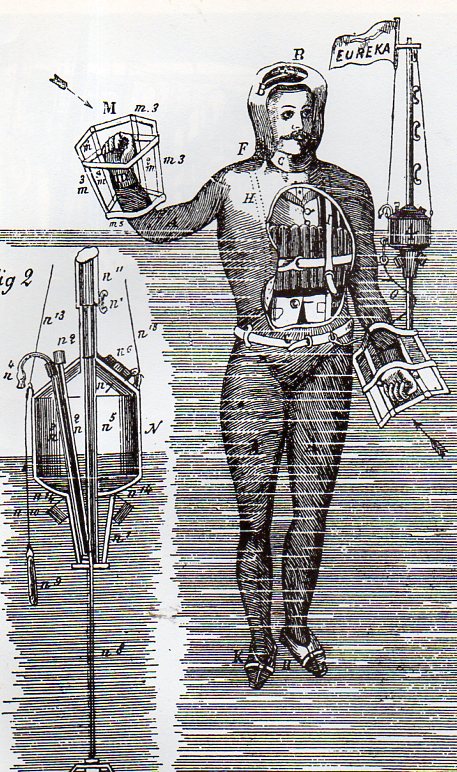
    This was somehow an improvement over a more complicated but still more sensible device that appeared earlier in 1869, the work of Captain John  Stoner.  He exhibited his creation in NYC off the piers in the East River as demonstration of the suit’s effectiveness, the whole of which was big news, appearing in the July 17, 1869 issue of Scientific American.  The suit was made of rubber, and was insulated and was equipped with a personal buoy which carried a “Eureka” flag and had a compartment filled with food, water, lighting materials, cigars, and of course reading material to help pass the time.  The hand-flippers on the other hand look like a very good idea. 
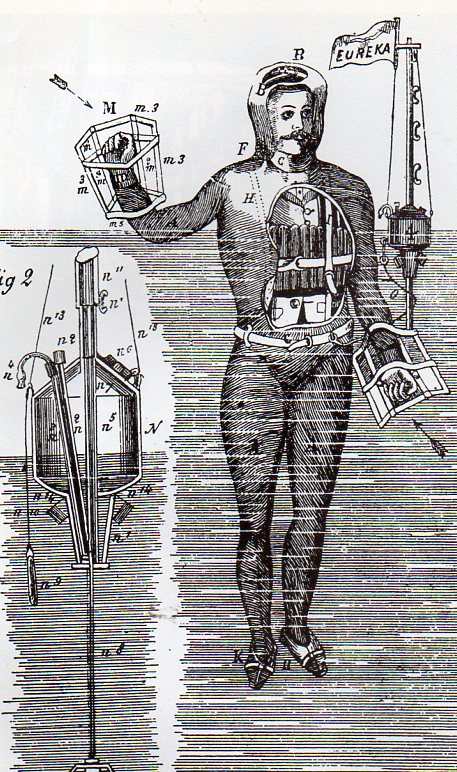
    Innernaughts339

    A more streamlined idea of the Stoner suit appeared in F. Weck’s patent application of 24 October 1876, again using a rubber suit, but this time the safety device was far less cumbersome, and equipped with little more than an interesting-looking breathing apparatus connected to a towed buoy which of course flew the American flag.

    Since I mentioned the possibility of cigars in the above-mentioned case, I should also point out that it took several decades for someone to patent a waterproof case for swimming with cigarettes, “in case the swimmer wanted to swim out to some rocks and then relax with a cigarette”.

    G. & C. Palmer came forward with another unusual idea in their 11 November 1873 patent, using chess-like figures to pus their idea of an expanding/collapsing life preserver vest, which would move in rhythm with ocean waves and theoretically protect the wearer from being overcome by bad swells.  I have my extended doubts about this one.

    Most of the patent applications that I’ve looked at tonight seem to lake one critical element–locomotion. Of course they’re assuming that the life vest is doing little more than keeping the wearer from drowning (though sometimes comforted with cigars and flags). A. McDonald went a little further with his invention (patented 17 January 1882) by putting a screw propeller on the belly of his life vest. It all looks very heavy and sinkable.

    F. Vaughan continued on the idea of a big, heavy wetsuit preserver by making his even bigger and heavier.  This 1879 creation looks to have about 10 inches (or more) or rubber in the suit, which means that if the thing wasn’t water-tight, and that if even a very slight leak developed, the wearer would no doubt sink like a stone. 

    A. Traub (in 1875) created something that was much less bulky and more accessible, a sort of unfolding life vest, that seems really not to do much of anything, but which was at least light:

    E.H. Brown (in 1884) had a somewhat different approach to the “life-saving” idea, turning the survival bit into a bucolic if ungainly adventure/romp device for the vacationer on the coast–the “hammock canoe”:

    \

    Though as cumbersome as this device seems it is quite in step with its contemporaries, at least so far as in being not-very-usable goes:

    And somewhere in all of this was the occasional good-looking idea that evidently got caught in the undertow of the heavier/punkier outfits–but in them you can see the beginning of the idea that would eventually work:



  • Placing London in Venice, 1892.

    JF Ptak Science Books  Quick Post

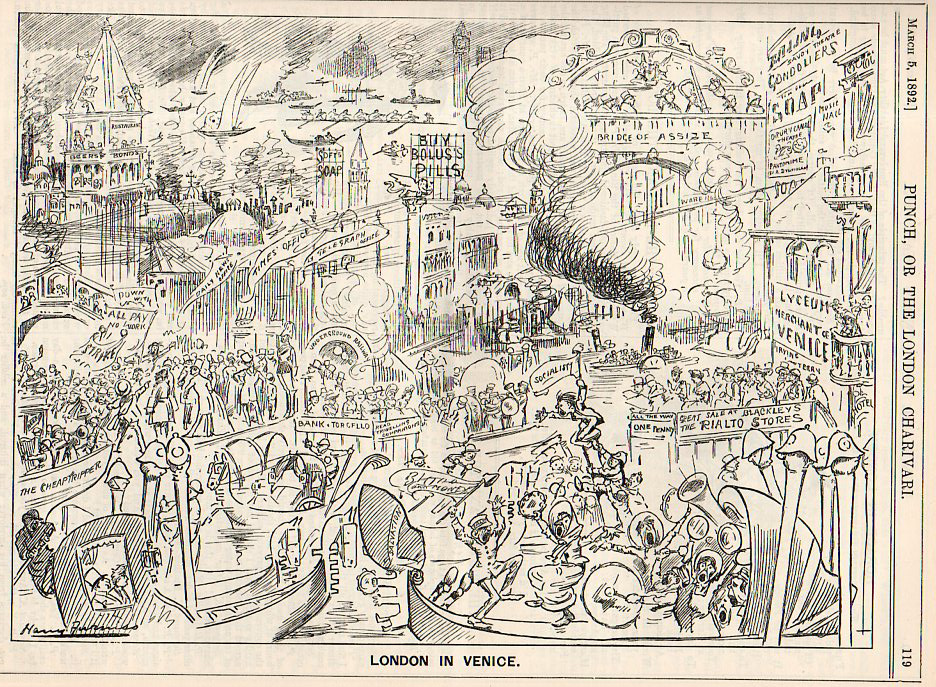
    This is a funny, unexpected and semi-absurd image, especially I think for 1893.  It occurs in the 5 March 1892 issue of Punch, or the London Charivari and seems quite literally to place bits and pieces of London on top of Venice, as if to show what that city would look like it it had some sort of urban renewal involving the removal of another city entirely to that place.  Its quite a neat idea, really, to put one city’s buildings on the topography of another city–it would be an interesting exercise, say, to place Manhattan in Savannah or Rome in Cape Town.  Perhaps it would be revealing in some way, if for no other reason than to visualize buildings in another scale.

    London in venice328

    I’ve seen images of a building or two of great note from one city placed out-of-context in another city or different situation, and of course city plans of one city laid on top of another is very common; but I cannot think offhand of another situation quite like the one above, cartoon or otherwise. 


  • The Gift that Keeps on Giving: Radium, in Powder or Suppository

    JF Ptak Science Books  Quick Post

    Radium.  It was for some short period of time a magnificent and harmless thing, soemthing with a life of its own, sort of, in the way that people used to think of electricity. 

    Adium299

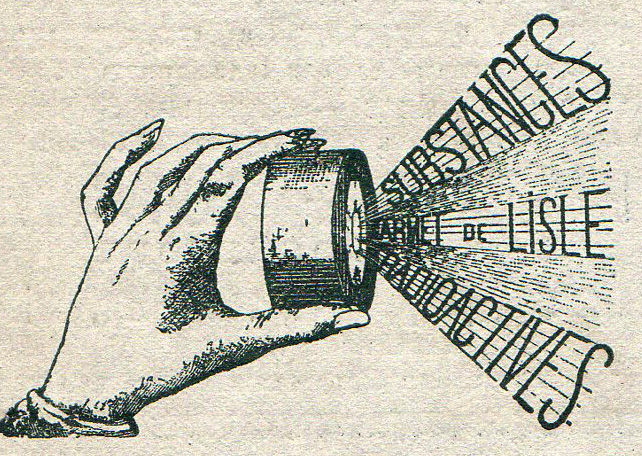
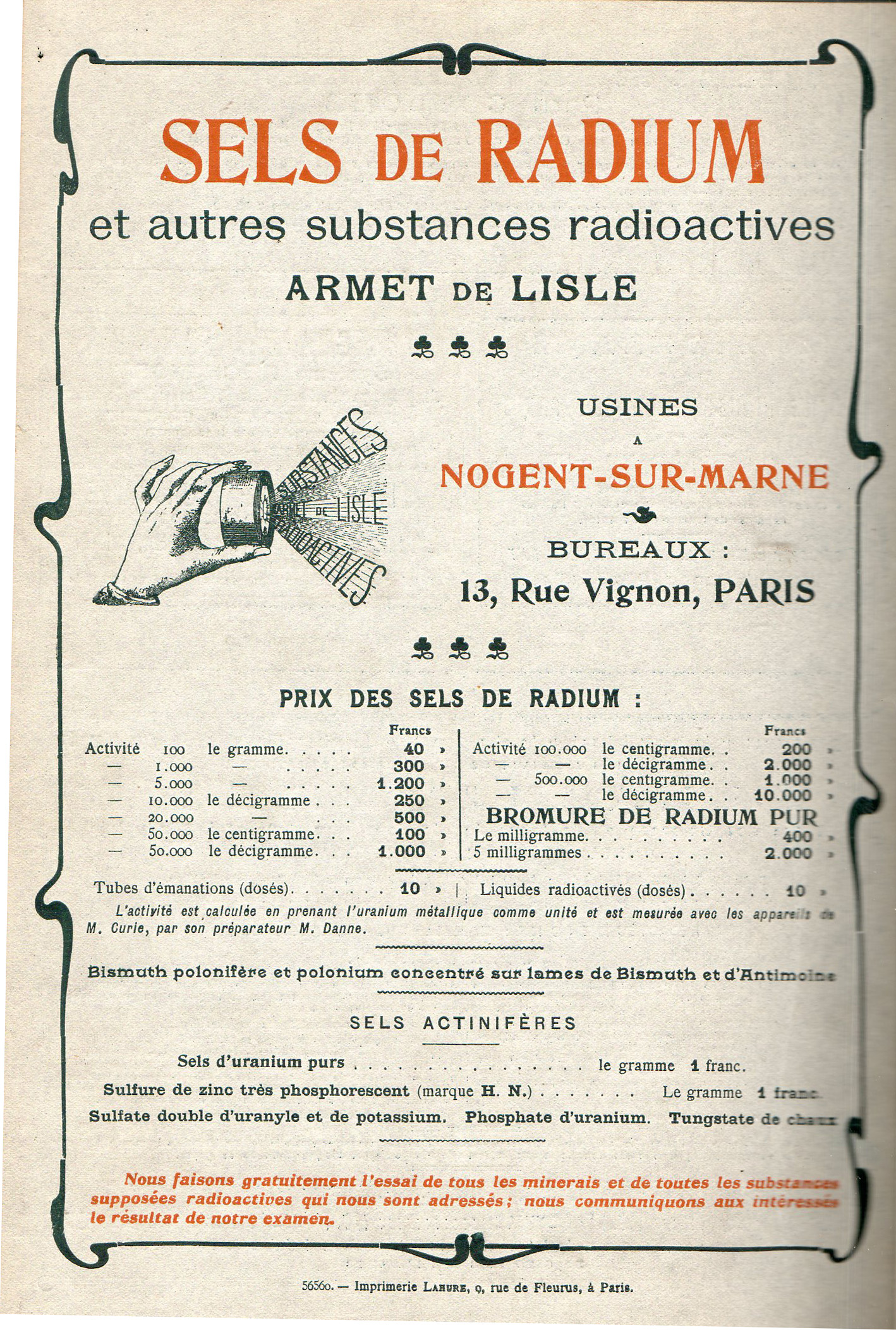
    This is a detail for an advertisement for radium salts, found in the December, 1903 issue of Le Radium.  At this point, just five years after the Curies discovered it and quick-published (in five days) their results in the Comptes Rendus…, the massive biochemical effects of human/radium interaction was not understood. And so the ads for firms like Armet de Lisle, which  was loudly selling Sels de Radium (and other radioactive substances like uranium salt  and uranium phosphate) without any real knowledge of the adverse health effects of its products.  (The Curies and Becquerel had noticed ulcertating reactions to their skin when it was left in contact to radium, and “radium dementia” had been reported beginning about 1900, but it would take quite some time for this radioactive material to be understood as lethal products.)

    Adium298Radium was used (in very small dosages) for the illuminating of instrument panels and dials (in, say, aircraft) and wrist watch faces into the 1960, though the major health factors ground themselves out in the worker who would come into contact with the radium itself. 

    Of course there were other uses for radium as a cure-all, which would have been a completely different story:

    In the early 1900s, real men used radium suppositories

    [which I wrote about here in “Radium Dance”]