A Daily History of Holes, Dots, Lines, Science, History, Math, Physics, Art, the Unintentional Absurd, Architecture, Maps, Data Visualization, Blank and Missing Things, and so on. |1.6 million words, 7500 images, 4.9 million hits| Press & appearances in The Times, Le Figaro, Mensa, The Economist, The Guardian, Discovery News, Slate, Le Monde, Sci American Blogs, Le Pont, and many other places… 5000+ total posts since 2008.

Category: Absurdist, Unintentional

  • Ultra-Massive Acceleration, Jules Verne, and Making Human Jelly. A Romance of 22,000 gs

    JF Ptak Science Books   Post 1722     

    [My apologies to my readers:  in an earlier version of this post I calculated that the Verne space module would be traveling 129,000,000 mph exiting the space cannon–that was wrong, I’m very sorry to say. The figure should have been 129,000,000 feet per hour, which would be about 25,000 mph.  Mea culpa.]

    Earlier in this blog appeared a post on the Eiffel Tower Happy Bullet.  It turned out to be a highly-circulated bit, what with the subject matter and all–describing a gigantic bullet filled with people and dropped from the interior heights of the Eiffel Tower and landing in a big watery hole at the bottom.  The effect of impact I think would have made those folks suffer Massive Internal Complications.

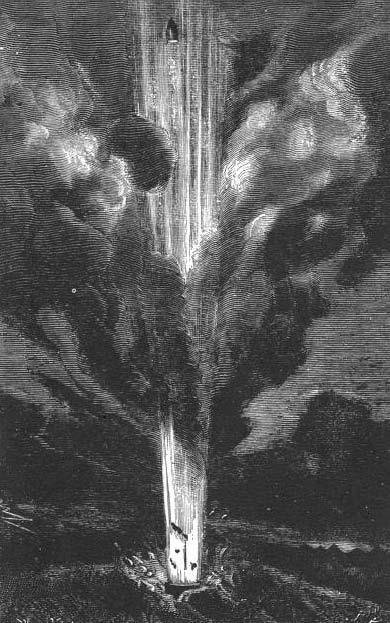
    Impressive as the Eiffel bullet idea was, it was absolutely nothing compared to what another Frenchman thought of at about the same exact time.  Perhaps no human could have suffered more internal disruption in any science fiction story than those who would have been subjected to Jules Verne’s (whose birthday is today, February 8, 1828 – March 24, 1905) space gun, an enormous Columbiad, the mode of propulsion for the travelers in his From the Earth the Moon/De la Terre a la Lune.

    Verne’s 20,000-lb projectile to the Moon would sit in a cannon-hole in the Earth that was 280 meters deep with a diameter of 2.7 meters, which would sit on the bottom of the hole capping off  200 feet of guncotton (!, weighing 400,000 pounds!).  Somehow this mass would be ignited, and as Verne (or his brother) calculated would produce an initial velocity of 12,000 yards per second, which is 36,000 ft sec, or about 24,000 mph, which is a big enough number to attain the (more or less correct) escape velocity Ve  of 11.2 km/sec. (Very high-velocity shells  fired by tanks fitted for kinetic energy penetrator ammo attain a muzzle velocity of 5700 ft/sec.) And somewhere in there would be a crew greeting a rather-ncredible-to-write-down 22,000 gs.  Astronauts in the Apollo program experienced something like 1g; dragster car drives who go from 0 to 100 mph in .86 seconds experience about 5.4g.  

    22,000gs is another thing entirely.
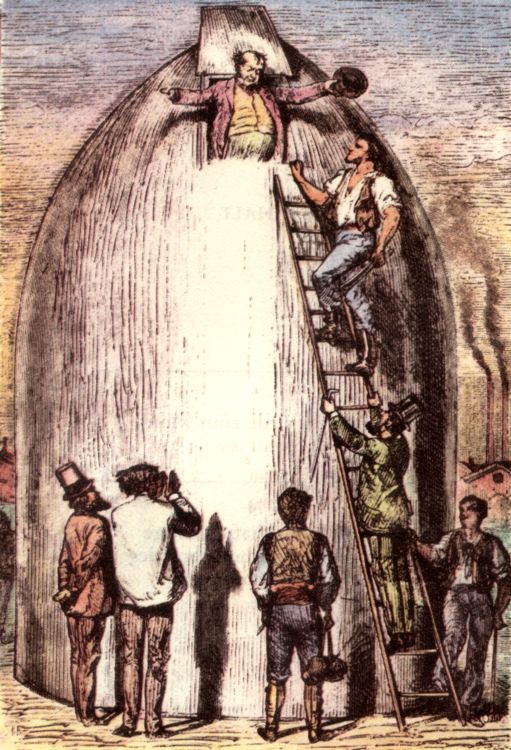
    File:'From the Earth to the Moon' by Henri de Montaut 39.jpg

    And difficult to imagine.

    File:FETMlaunch.jpg

    Jules Verne got a lot of stuff right in his long and lovely career–an there was quite a bit that he foretold correctly in this very story.  Just not the take-off. 

    The further-funny thing about this space gun is that it made another appearance in another Verne story, The Purchase of the North Pole, 1889.  During this period of human exploration there was a push to explore the Poles–in Verne’s story, an attempt is made to simply this exploration.  But not in the way you might think.  Verne was going to employ the space gun, again, but this time to alter the axis of the Earth so as to make it easier to get to the Poles and exploit their natural resources.   I must say that this answer was not at all clear to me, even with my best sci fi cap on:  but Verne saw it, saw that it would be better for all concerned to move the Poles rather than moves towards them. And that’s some pretty big thinking.
  • Eve’s Ovum, “Unused” Sperm & Embryological Sex Wars of the 18th Century–a note

    JF Ptak Science Books Post 1715  [Part of the History of Dots series.] 

    I wanted to land this post (the title of which is nearly as long as the article) on this little island in a wide sea of similar islands in the complicated 18th century history of embryology.  Where we came from and how living things developed really wasn’t very clear at this time, and really wouldn’t be until Karl Ernst von Baer discovered the human ovum in 1827.1

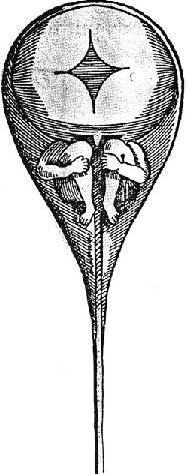
    HomunuclusThe issue of the ovaries as ovens–of homunuclus and palingenesis and epigenesis, the imaginary male-dominant anatomy of reproduction–was pretty much somewhat solved by the beginning of the 19th century.  Or at least the homunculus, the tiny but perfectly formed miniature human traveling along in sperm, was.  This character is pictured here, riding in the squinty-eyed imagination of researcher  Nicholas Hartsoeker2, who desperately wanted to see the thing, I think, and which found itself published in his book Essai Dioptrique  in 1695.  Spermatozoa was discovered earlier by the great Leeuwenhoek (1632-1723) and which was finally confirmed in its fertility hypothesis by Lazzano Spallanzani, who also happened to be an ovist, thinking that each egg contained a pre-formed embryo).

    The woman as a simple baker of a gift of preformed life was a medical belief that helped perpetuate the supposed inferiority of women, and that the woman’s part in the procreative process was a simple oven.  It was a difficult image/belief to resist, persisting well into the 19th century.  But there was another side of this debate as well, and that was that woman didn’t need the male sperm to proceed with the process of conception, with some scientists believing that coition had nothing whatsoever to do with the process.  And so there were battle lines drawn in the primordial embryological sand of the 18th century, each demanding a sex-dominant role in procreation. 

    And if sperm contained a perfect, pre-formed human being, waiting to be planted in the oven of woman, what happens to all of those-pre-forms in the sperm that went “unused”?  I imagine that if you were an 18th century pre-formationist that this would be a tricky and very uncomfortable question. If you could put on special sperm-specs that would allow you to see “ejected” and  “unused” sperm in the same sort of ways in which we can see non-visible light, that, well, you might want to watch your step and avoid smashing a fully-formed human being that had the potential of living for weeks on its own with the benefit of anything else at all. I have to admit that even for me this makes the picture of this Earth not very savory. The author of “A Brief History of Sperm” at SeductionLabs.org points out that at least one English country doctor, James Cooke, thought that this ejecta “might not die”, at all,

    “… but ‘live a latent life, in an insensible or dormant state, like Swallows in Winter, lying quite still like a stopped watch when let down, till [they] are received afresh into some other male Body of the proper kind’.”–from SeductionLabs.org, in its “A Brief History of Sperm“.

    It sounds a little like embryologico-guerrilla warfare.

    In the middle of the sides drawing themselves up for battle, choosing male- or female-dominant mechanics of procreation, or a combination of both, were the supra-ovists, who claimed that in this mess that every human who would ever be born on Earth was already present in the ovum of Eve.  There were some who tried to calculate the figure of how many people that ovum contained, but like the creation timeline of Bishop Wilberforce, the numbers were open to severe self-definign interpretations. 

    It is interesting to note these debates, though, because they weren’t really finally settled until just three generations ago. (Or four if you’re much younger than I.)

    Notes:

    1.  von Baer published his discovery in his Epistola de Ovo Mammalium et Hominis Genesi (Leipzig, 1827), followed by his two-part Ueber die Entwickelungsgeschichte der Thiere  in 1828 and 1837 on the history and evolution of animals.  The original paper did not catch on, immediately, and took some years to be established.  There was actually a paid competition going on in Europe at this time for the purpose of finding the ovum, and although aware of the award and thinking he had found the “prize”, von Baer was not well-doisposed to the idea of the “race”, and so really didn’t participate.  Jean-Louis Prevost (1790-1850) and Jean-Baptiste A. Dumas (1800-1884) also came to the conclusion that the “animacules” in the semen were responsible for fertilization.  The deal wouldn’t be solidified until Oskar Hertwig actually observed the fusion of the male and female material in the ovum of a starfish in 1876. 

    2. Hartsoeker (“heart seeker”) (1665-1725) was a microscopist of high order in addition to being a physicist and a medical doctor, never actually saw this thing in his investigations–he iterated that the little person must be there.  But he never did say that he observed it. 


  • “Writing of the Insane”, 1876: Very Early Art Brute Images?

    JF Ptak Science Books   Post 1712

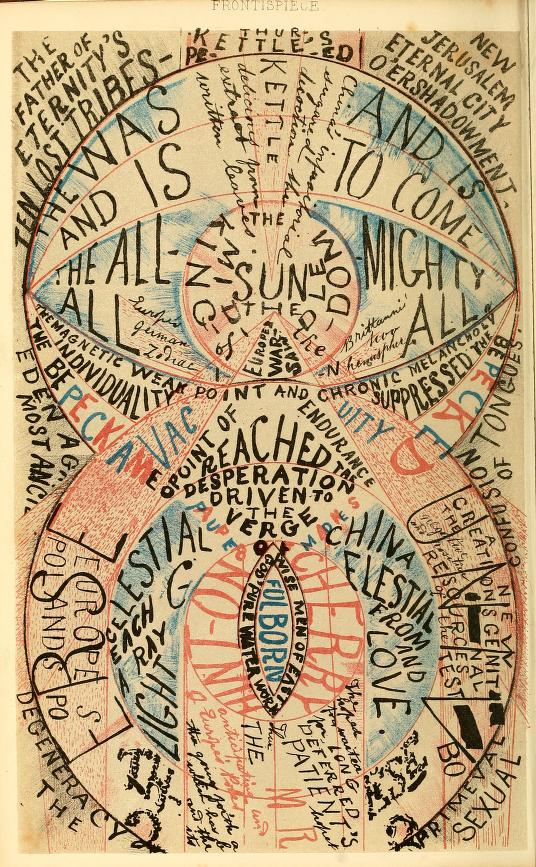
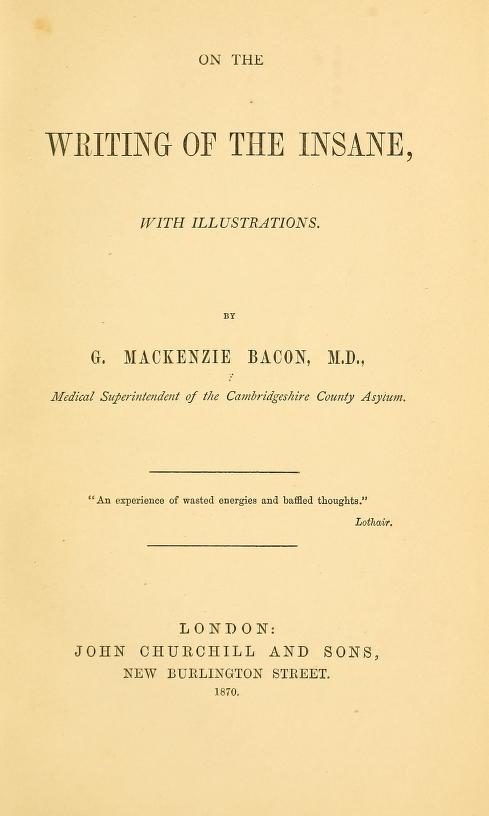
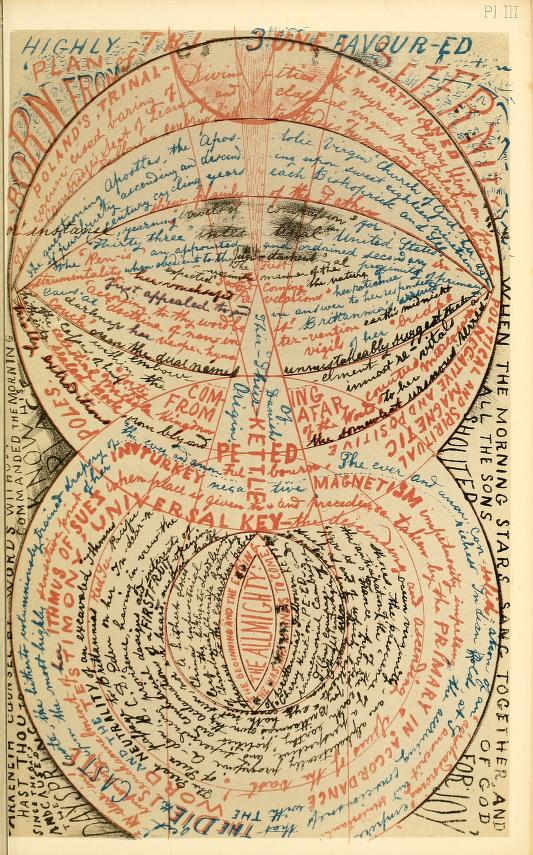
    Insane art 3 titke pageThis book–The Writing of the Insane, by George Mackenzie Brown, 1876– seems remarkable to me for the attention paid to the creative products of the insane. I am not sure when the first of these efforts occurred, but it seems to my experience that 1876 is an early production date for such an undertaking. It also seems to be a very early identification of the “special talents” of some of the observed individuals, including in the text of the book two remarkable (and remarkably “modern” looking) pieces of what today might be considered Art Brut/Outsider Art.

    The author is George Mackenzie Bacon (1836-1883), a doctor who took classes at Guys Hosptial and who had membership in the College of Surgeons in 1858.1 Bacon was the author of Primary Cancer of the Brain (1865) as well as an editing contributor of at least a dozen annual reports of the Committee of Visitors of the Cambridgeshire, Isle of Ely and Borough of Cambridge Pauper Lunatic Asylum (from 1869-1883 ro so). He definitely made improvements to the conditions of the inmates when he worked at Cambridegshire County Asylum (also known as Fulbourn Hospital, 1858-1992), where he provided those living there with more personal living space and patient-built work areas. This was certainly an interesting approach to take for the mentally ill, especially given the time and place.

    But in his (scant) published works it seems that the Writing of the Insane must be his masterwork for at least being among the earliest books to serve as an archaeology of deeply-different and illustrated thought:

    Insane art
    And this remarkable effort:

    Insane art 2

    [Source and full text, here.]

    This is certainly not a “celebration” of talent, but there are moments of recognition of such in the Writing of the Insane, which at the very least is a very early expose of the topic.  One of the earliest books written by someone who was admittedly “insane” (and this is very different from the many books written by insane, or brilliant, or misunderstood, or “complex”, or “different” author) came to us in 1846 by Green Grimes. thirty years before the Bacon work.  In  A Treatise on the Most Important Subject in the World: Simply to Say, Insanity…2 Grimes recounted his life at the Tennessee Hospital for the Insane, about which the blog Canton Asylum for Insane Indians writes:  “There are other Medical books which treat on Insanity, but comparatively few to the population, and none written by an Insane man,”

    Notes:

    1. There is scant personal information on Bacon available online. This data comes from the British Medical Journal, 3 March 1883, in an obituary on Bacon. 

    2. The full title is pretty full: A treatise on the most important subject in the world: simply to say, insanity: The only work of the kind in the United States, or, perhaps, in the known world, founded on general observation and truth. There are other medical books which treat on insanity, but comparatively few on the population, and none written by an insane man. This contains a short history of the author’s case, giving the general causes which produced the disease on him individually, manner of treatment and termination. Giving the only treatment by which a cure may be effected, the manner of detecting the disease, and the duties of sane parents towards the insane offspring of their bodies; with some general remarks upon idiotism, the jurisprudence of insanity, suicide, &c   

    The American Journal of Insanity simply states that the 94-page book is “very curious”.


  • Living Aloft, 1920

    JF Ptak Science Books  Quick Post

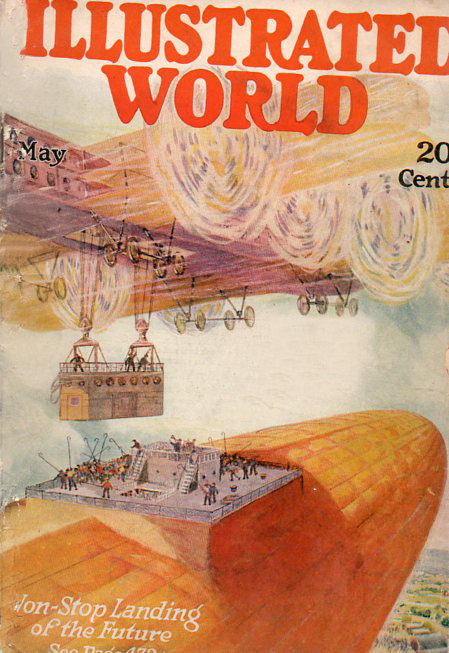
    Future flight108D.G. Lloyds certainly had an interesting–if not unique–vision of non-stop or uninterrupted cross-country aerial service, writing about Non-Stop Landing of the Future (Illustrated World, May 1920.)  And for Lloyds the future was soon, or tomorrow, because, frankly, the technology was there, if not the will.  Or the inclination.  Or the presence of a logic for creating such a service.

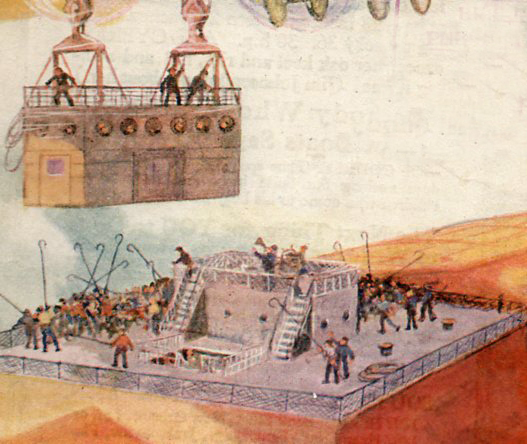
    It seems to me that after floating along for days at 75 mph (or thereabouts?) that, after finally getting across the country, a traveler might want to simply disembark.  But this behemoth envisioned by Lloyds wouldn’t have to actually stop–it was outfitted, designed to release/accept passengers while in flight.  Now of course take-offs and landings are the most dangerous parts of flying, and perhaps this is what Lloyds was trying to replace.  But to me it looks like he replaced one significant danger with, well, several other significant dangers. 

    Future flight111Look:  it just seems to me that any time you have a giant airplane synchronizing flying with an enormous dirigible to transfer exceptionally heavy cargo at an altitude of one mile that there is some substantial room for pilot(s) error.(s) and other freak whatevers.  Also, the issue of using dozens of men with shepherd hooks to grab a multi-ton object suspended from a moving platform to another moving platform seems to me, well problematic.  But it does make for a pretty picture.


  • Steampunk InnerNaughts of the 19th Century

    JF Ptak Science Books   Post 1743

     These creations weren’t so much about exploring the innerEarth than they were about surviving in the outermost, shallowest bits of its depth.  Survival gear for The Great Unpleasantness in disastrous adventures at sea was relatively scant for hundreds of years, although the nineteenth century did offer a number of new, Victorian technolust attempts for survival-at-sea.  

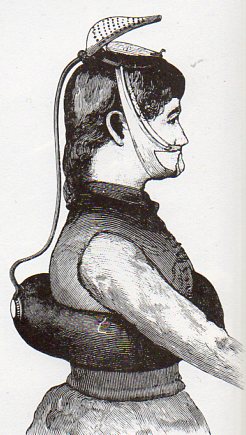
    I know that this first contrivance in some of its particular parts looks enormously compromised, but really the stuff attached to the woman’s head just allowed her to breathe about 10 inches higher than her mouth, though it seems to me that this air-catcher might catch more water than anything else.  Still, it was an interesting attempt at keeping people floating above the water when in peril.

    Innernaughts340In general though it seems to me that most of the big adventures in wearable life saving devices were big indeed, big and heavy–if there was just a little more room for a small engine, wed’ be in the Steampunk realm, as can be seen in this magnificent attempt by T. Beck in his 14 March 1876 patent:

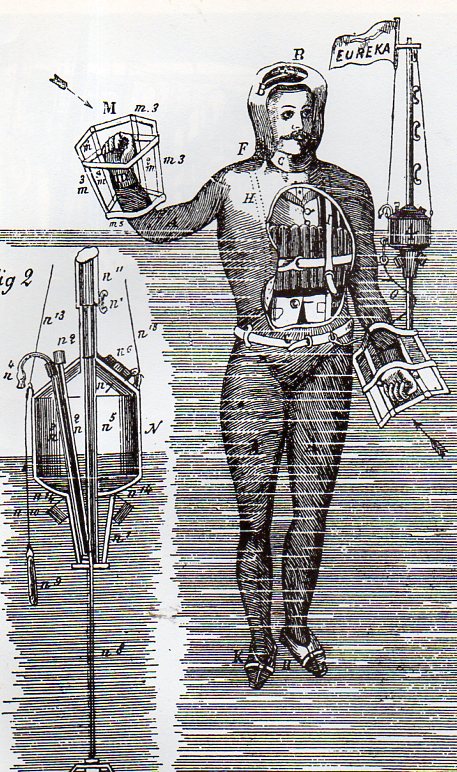
    This was somehow an improvement over a more complicated but still more sensible device that appeared earlier in 1869, the work of Captain John  Stoner.  He exhibited his creation in NYC off the piers in the East River as demonstration of the suit’s effectiveness, the whole of which was big news, appearing in the July 17, 1869 issue of Scientific American.  The suit was made of rubber, and was insulated and was equipped with a personal buoy which carried a “Eureka” flag and had a compartment filled with food, water, lighting materials, cigars, and of course reading material to help pass the time.  The hand-flippers on the other hand look like a very good idea. 

    Innernaughts339

    A more streamlined idea of the Stoner suit appeared in F. Weck’s patent application of 24 October 1876, again using a rubber suit, but this time the safety device was far less cumbersome, and equipped with little more than an interesting-looking breathing apparatus connected to a towed buoy which of course flew the American flag.

    Since I mentioned the possibility of cigars in the above-mentioned case, I should also point out that it took several decades for someone to patent a waterproof case for swimming with cigarettes, “in case the swimmer wanted to swim out to some rocks and then relax with a cigarette”.

    G. & C. Palmer came forward with another unusual idea in their 11 November 1873 patent, using chess-like figures to pus their idea of an expanding/collapsing life preserver vest, which would move in rhythm with ocean waves and theoretically protect the wearer from being overcome by bad swells.  I have my extended doubts about this one.

    Most of the patent applications that I’ve looked at tonight seem to lake one critical element–locomotion. Of course they’re assuming that the life vest is doing little more than keeping the wearer from drowning (though sometimes comforted with cigars and flags). A. McDonald went a little further with his invention (patented 17 January 1882) by putting a screw propeller on the belly of his life vest. It all looks very heavy and sinkable.

    F. Vaughan continued on the idea of a big, heavy wetsuit preserver by making his even bigger and heavier.  This 1879 creation looks to have about 10 inches (or more) or rubber in the suit, which means that if the thing wasn’t water-tight, and that if even a very slight leak developed, the wearer would no doubt sink like a stone. 

    A. Traub (in 1875) created something that was much less bulky and more accessible, a sort of unfolding life vest, that seems really not to do much of anything, but which was at least light:

    E.H. Brown (in 1884) had a somewhat different approach to the “life-saving” idea, turning the survival bit into a bucolic if ungainly adventure/romp device for the vacationer on the coast–the “hammock canoe”:

    \

    Though as cumbersome as this device seems it is quite in step with its contemporaries, at least so far as in being not-very-usable goes:

    And somewhere in all of this was the occasional good-looking idea that evidently got caught in the undertow of the heavier/punkier outfits–but in them you can see the beginning of the idea that would eventually work:


  • Placing London in Venice, 1892.

    JF Ptak Science Books  Quick Post

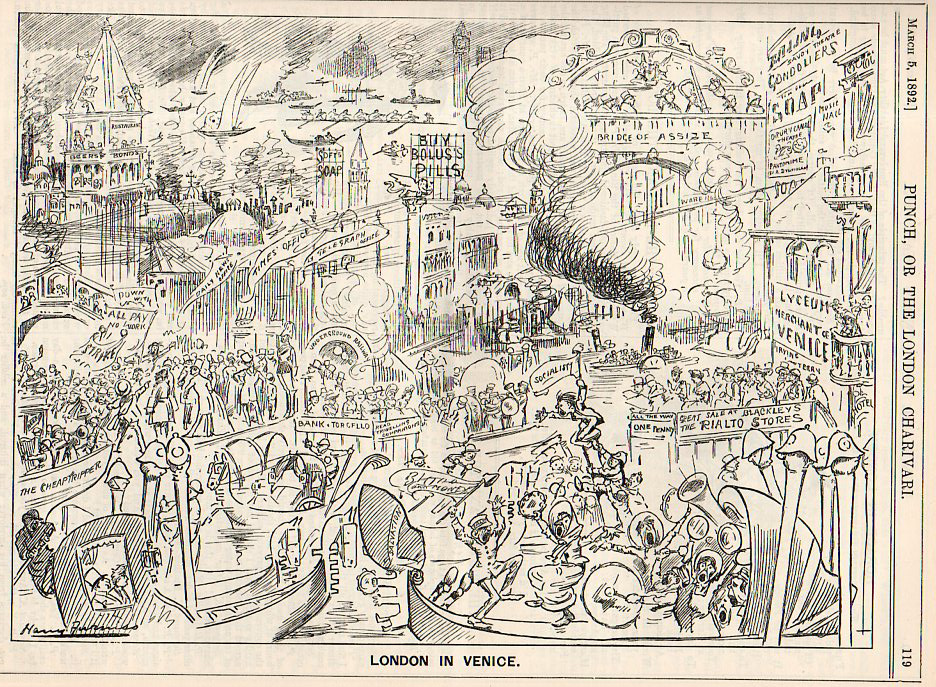
    This is a funny, unexpected and semi-absurd image, especially I think for 1893.  It occurs in the 5 March 1892 issue of Punch, or the London Charivari and seems quite literally to place bits and pieces of London on top of Venice, as if to show what that city would look like it it had some sort of urban renewal involving the removal of another city entirely to that place.  Its quite a neat idea, really, to put one city’s buildings on the topography of another city–it would be an interesting exercise, say, to place Manhattan in Savannah or Rome in Cape Town.  Perhaps it would be revealing in some way, if for no other reason than to visualize buildings in another scale.

    London in venice328

    I’ve seen images of a building or two of great note from one city placed out-of-context in another city or different situation, and of course city plans of one city laid on top of another is very common; but I cannot think offhand of another situation quite like the one above, cartoon or otherwise. 


  • The Gift that Keeps on Giving: Radium, in Powder or Suppository

    JF Ptak Science Books  Quick Post

    Radium.  It was for some short period of time a magnificent and harmless thing, soemthing with a life of its own, sort of, in the way that people used to think of electricity. 

    Adium299

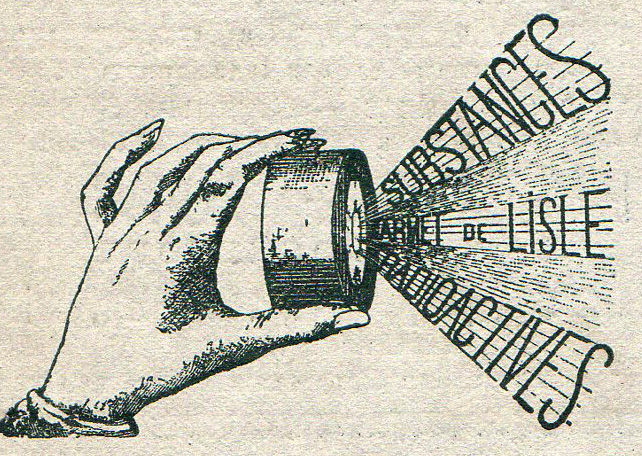
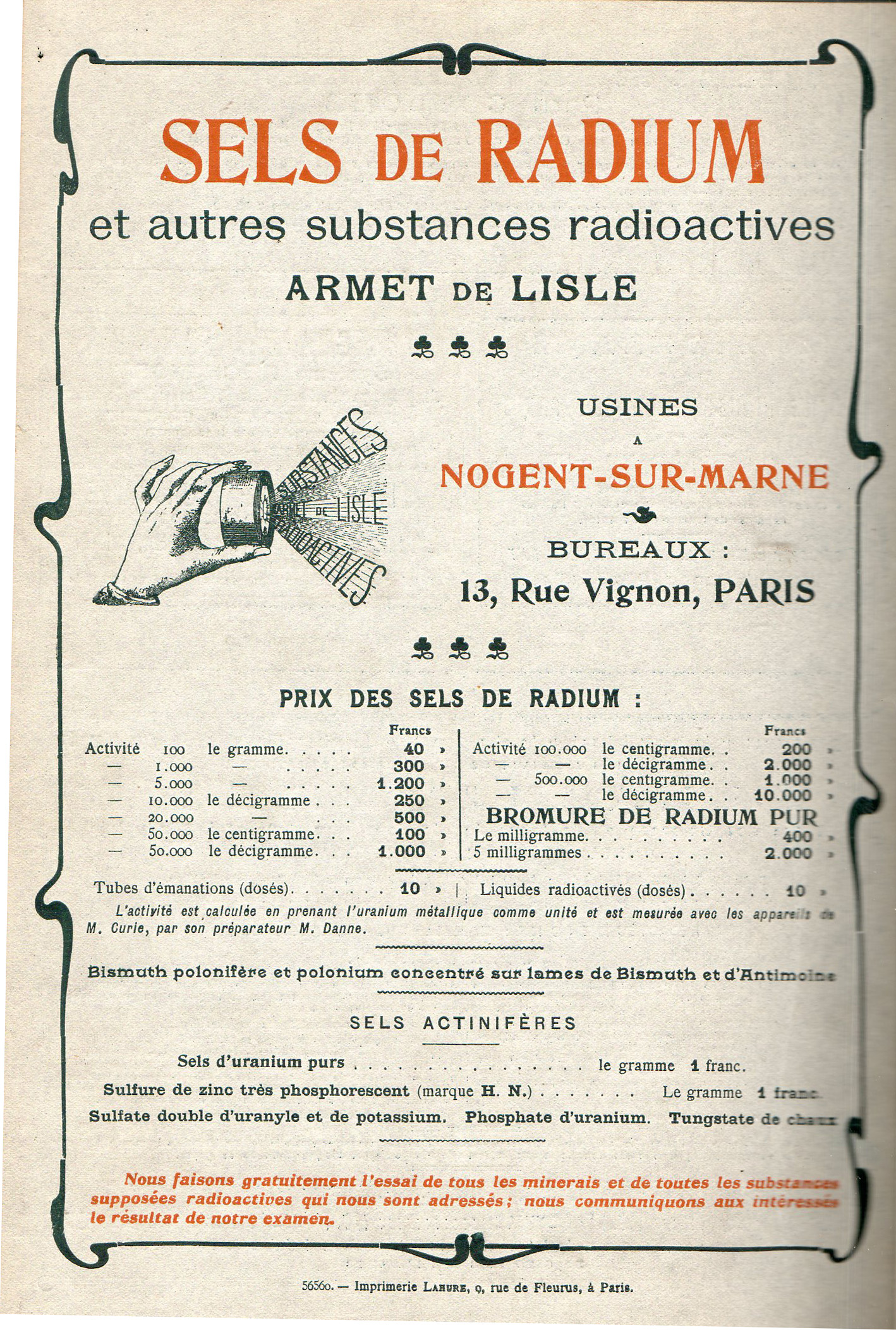
    This is a detail for an advertisement for radium salts, found in the December, 1903 issue of Le Radium.  At this point, just five years after the Curies discovered it and quick-published (in five days) their results in the Comptes Rendus…, the massive biochemical effects of human/radium interaction was not understood. And so the ads for firms like Armet de Lisle, which  was loudly selling Sels de Radium (and other radioactive substances like uranium salt  and uranium phosphate) without any real knowledge of the adverse health effects of its products.  (The Curies and Becquerel had noticed ulcertating reactions to their skin when it was left in contact to radium, and “radium dementia” had been reported beginning about 1900, but it would take quite some time for this radioactive material to be understood as lethal products.)

    Adium298Radium was used (in very small dosages) for the illuminating of instrument panels and dials (in, say, aircraft) and wrist watch faces into the 1960, though the major health factors ground themselves out in the worker who would come into contact with the radium itself. 

    Of course there were other uses for radium as a cure-all, which would have been a completely different story:

    In the early 1900s, real men used radium suppositories

    [which I wrote about here in “Radium Dance”]


  • Singular Placards and Perhaps a Singular Christianity?

    JF Ptak Science Books   Quick Post

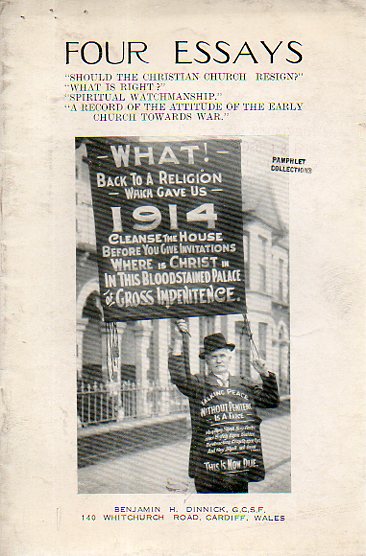
    I found this rather, um, provocative pamphlet that asks, right up front on the cover of the thing, “Should the Christian Church Resign?”  The author, who I think is the man holding the placard on the cover, is Benjamin H. Dinnick (Cardiff, Wales) who published the work in the 1930’s. 

    Dinnick286
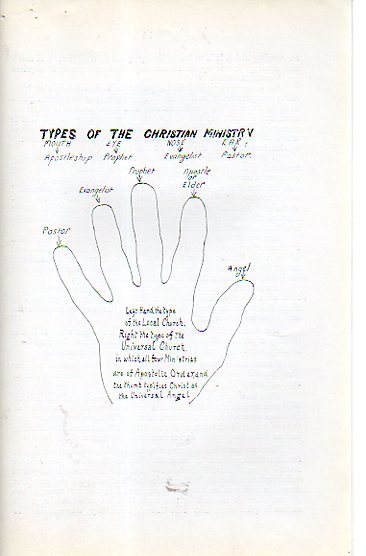
    I’m reproducing the cover and one of Mr. Dinnick’s impenetrable diagrams–I can’t really say what he was after or what he was for, but I find the images interesting. 

    Dinnick287


  • Nutmeg and the Roundabout Creation of New York City

    JF Ptak Science Books   Post 1705

    IMG_4880

    This may be the earliest image of “New York” as it was–that is “New York” instead of “New Amsterdam”.  From what looks like an extraordinarily bad trade (with 350-year-long hindsight), the Dutch and the English came to terms at the end of the second Dutch-English War (1665-1667)  one result of which traded the small island of Run in the Banda Islands for another small (but not nearly so small as Run) island in North America:  Manhattan.

    Manhattan didn’t have one thing that Run and the Bandas had, though, and that one thing was enormously valuable–nutmeg trees.  From the nutmeg tree came nutmeg and mace; nutmeg was a spice and a supposed medicinal, and traded for more than the price of gold, allowing its producers a phenomenal return on their investment.

    The Bandas were in a remote place removed from remote places in Indonesia.  In the island group–which rose from great depths of the ocean–the total land mass was about 180 km2. Not much, except if they were the only places on Earth producing a commodity in sensational demand. The Dutch kept control of the islands for a long time, and kept their trade in the spices an abject money-maker.  They secured their uncontested control of the island group at the end of that second Anglo-Dutch War with the Treaty of Breda, one section of which had the Brits returning Run to the Dutch in exchange for Manhattan, which was at the time still occupied by the Duke of York, who was the brother of Charles II and who would become James II.  And thus the island became “New York”.

    Due to various reasons–not the least of which was the Dutch murder and export of the un-murdered indigenous population of the Bandas, who were the people who actually best knew how to care and administer the nutmeg trees–the great trade in the spices continued with diminishing effect in the Napoleonic Wars, an unpretty story of much bloodshed and enslavement.

    {Image: “Fort Hollandois de l’Ile de Banda. – Hollands Fort op t’ Eiland Banda.”Original engraving  by J.V. Schley and printed aorund 1750 (39.5×25 cm) for  Antoine Prévost’s Histoire générale des Voyages published in Paris between 1746 and 1770.  The name of the structure was actually Fort Nassau.  The original engraving is available from our blog bookstore, here.]


  • Future Punk–Extreme Wright Biplane-ism in Skiing

    JF Ptak Science Books   Picture Post

    Future punk skier polane120
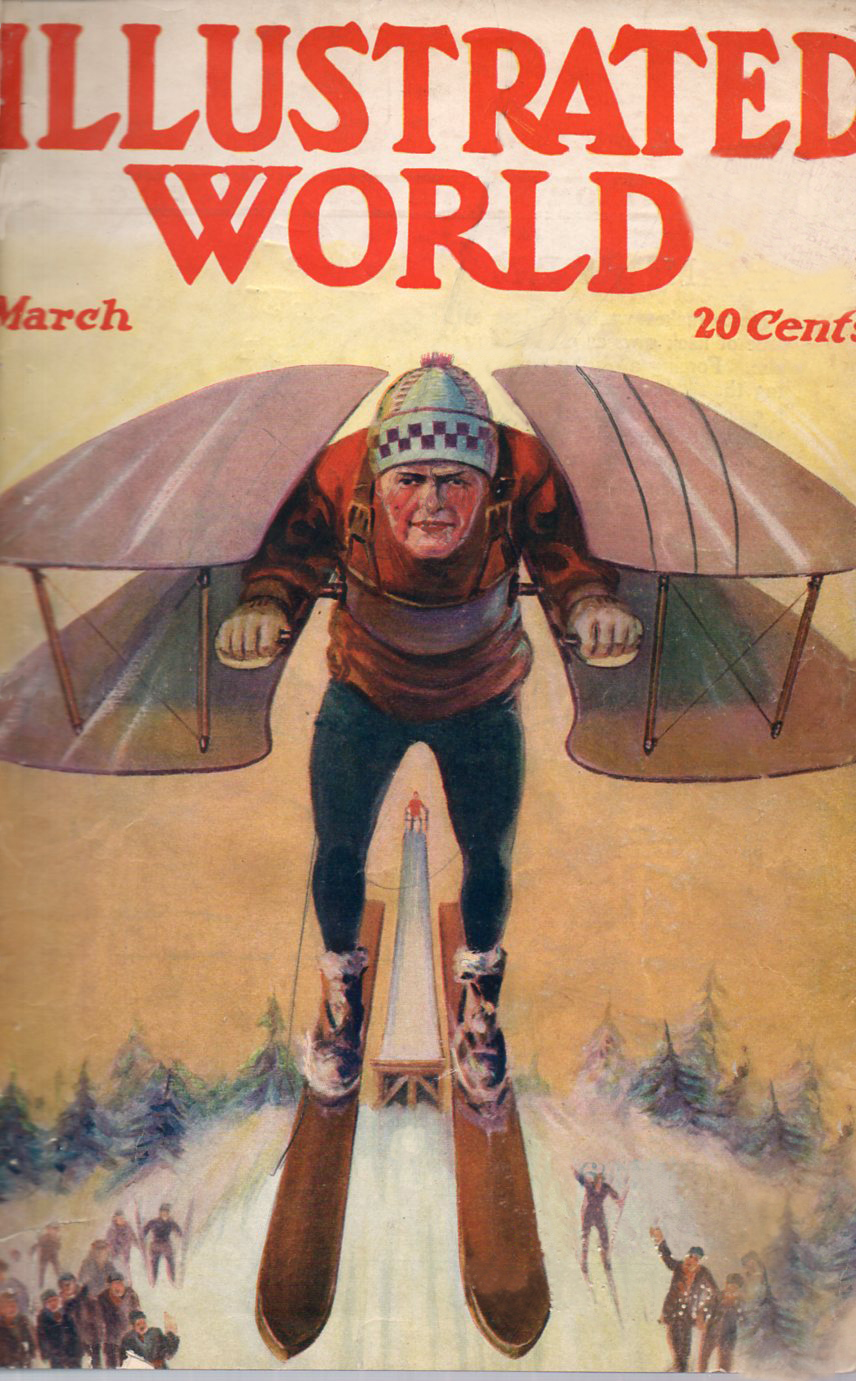
    I think that this bit of technical machination might wind up in the you’ll-put-your-eye-out category of cross-application conveniences.  The image appeared in Technical World magazine for May, 1920.