A Daily History of Holes, Dots, Lines, Science, History, Math, Physics, Art, the Unintentional Absurd, Architecture, Maps, Data Visualization, Blank and Missing Things, and so on. |1.6 million words, 7500 images, 4.9 million hits| Press & appearances in The Times, Le Figaro, Mensa, The Economist, The Guardian, Discovery News, Slate, Le Monde, Sci American Blogs, Le Pont, and many other places… 5000+ total posts since 2008.

Category: Absurdist, Unintentional

  • Inventing (1) Old Tone in New Violins & (2) New Tone in Old Violins. Patent Models.

    JF Ptak Science Books  Quick Post

    Finding old tone in the 19th was attempted in the following way, an interesting if not myopic attempt to put some play-time in a brand-new violin:

    First page clipping of GB 190303723 (A)

    Abstract of  GB 190303723  (A)

      Payne, R. H., and Broadbent, T. Feb. 17, 1903.

    In an instrument for reproducing sound, a resonating-chamber is used instead of a diaphragm and a trumpet. In the construction shown, the resonating-chamber consists of a violin body C mounted on an arm D extending from the instrument A. Fig. 2 shows means which may be employed for the mounting. The pin E passes through a hole in the neck C’, which is clamped by the nut E’. The pin E is mounted in the wooden block F journalled in the fork H on the swivelling-pin. Washers G, G<1> prevent the communication of vibrations to the arm D. The hole in the neck may be dispensed with, a screw or spring clamp being employed in place of the pin E. The reproducer K, Fig. 3, is cemented to the violin belly. The style K<1> is clamped in it by the screw K<2>. The violin has the usual sound post and f-holes in the belly and also holes C<2> in the back. Strings may be stretched across the resonator. When a violin body is used, the strings are stretched by the usual pegs in the neck. 

    This is not the most elegant invention for producing a more-interesting music from a stationary, non-human-played violin. 

    On the other hand, this is:

    The work is by Henry Konrad Sandell, and the patent was for a magnificent machine that produced 64 notes on the violin, and was accompanied by a 44-note piano, both played at the same time. It is a very impressive accomplishment, with several thousand of them produced over two dozen years by the Mills Novelty Company.

    Source, here. Mills Novelty, here  Henry Konrad Sandell,  and a photo of a restored and lovely Violinola, here with a sample of the music it produced (!)
    ·Posted by :

    ·in:

    —

  • Dosing out the Cures from “The Beast that no Existence Hath”–the Unicorn.

    JF Ptak Science Books   Post 1898

    Unicorn'770
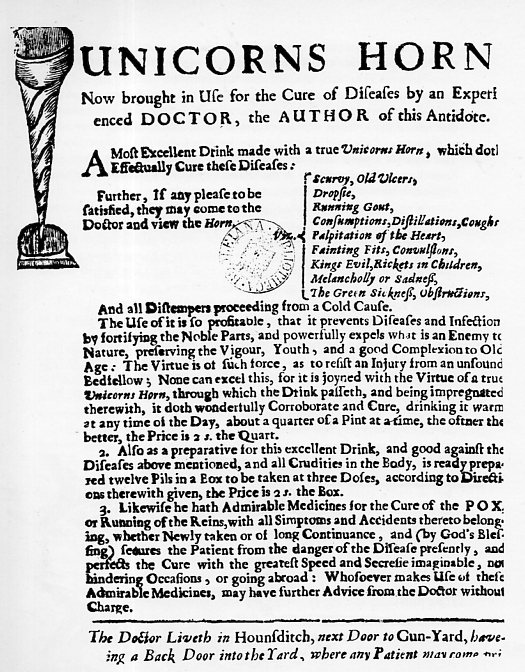
    Who could refuse to see a medical person advertising themselves as:

    “the Doctor Liveth in Houndsditch, next Door to Gun-Yard, having a Back Door into the Yard, where any Patient may come…”

    and especially one selling Unicorn horn curative extract?  The cure promises of  “the beast that no existence hath” (Rilke, Sonnets to Orpheus) sounded attractive, having the ability to dispense “scurvy, old Ulcers, Dropsie, Running Gout, Consumptions, Coughs, palpitations of the heart, Fainting Fits, Convulsions, King’s Evil, rickets in children, melancholy or sadness, the green sickness, and all distempers proceeding from a Cold Cause”  as well as “all crudities in the Body”.  But promises like this are almost always loyal only to that pretended self.

    Unicorn'769
    [Source for both images:  Rudiger Robert Beer, Unicron, Myth and Reality, Mason Oress, 1977.]

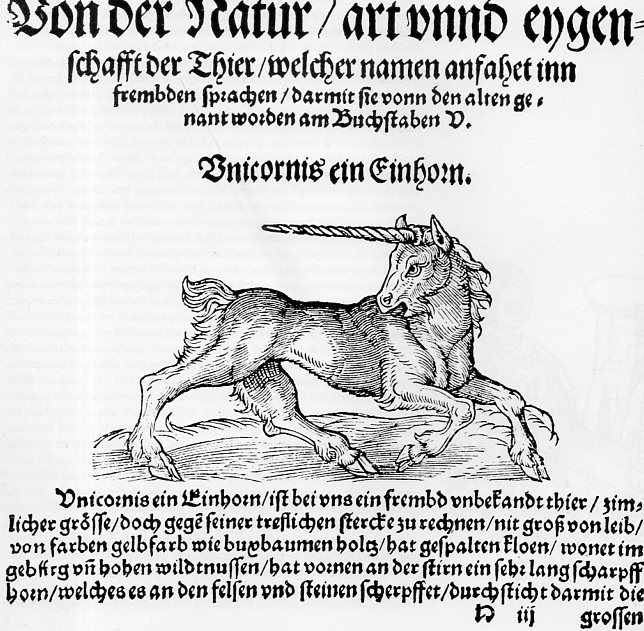
    In spite having a very long sales history over the milennia, pretty much the only place where unicorn horns have actually been seen were in apothecary shops selling narwal horns and in the constellation Monocaros (named so for the unicorn by Jacob Bartsch around 1624).  This great ground-up thing, one of the great mythic myths of all time, was a highly-inclined multi-purpose curative purgative suggestative ill-spoiler, capable of defeating nasty bodily nasties and enhancing things like our Noble Parts. For years it was worth more by weight than gold, though (depending on what it was that was being sold as unicron horn) ingested gold might have had about the same medicinal effect as a dose of unicron horn. 

    This fabulous image of a unicorn, draped in Renaissance-y literary moudlings appears in The secrets of Albertus Magnus: of the vertues of herbs, stones, and certain beasts : whereunto is newly added, a short discourse of the seven planets, governing the nativities of children : also a book of the same author, of the marvellous things of the world and of certain things, caused of certain beasts   being a translation of  De virtutibus herbarum, lapidum, & animalium quorandam libellus, and his De mirabilibus mundi, ac de quibusdam effectibus causatis à quibusdam animalibus (1543). 

    Hope faded in the greatest degree for the unicorn only in the 18th century, replaced immediately by any other number of empassioned impossibles, like magnetisma and curative electricity.

    A few handy resources:

    http://www.storehousesoflearning.com/links.htm  Useful links for Medieval images and manuscripts

    http://bestiary.ca/beasts/beastalphashort.htm  Great Bestiary, with searchable index of creatures; once inside, there are references to the animal from some of the leading Medieval bestiaries (and their ancinet sources), including Herodotus, Strabo, Guilaaume le Clerc, Pliny, Isidore, John Mandeville, and others. 

    Medieval book of birds http://archive.org/stream/medievalbookofbi00hughuoft#page/n7/mode/2up


  • Thomas Jefferson’s Arithmetic of Black People, 1783

    JF Ptak Science Books   Post 1869

    I was picking my way through Mr. Jefferson’s Notes on the State of Virginia (written in 1783/4), and dipped into Query 14, “Laws”.  Six pages in came the Great Man’s thoughts on being white and being black. He really didn’t have much hope for the black person in the new United States, and in an odd way, I think, did a sort of arithmetic calibration on the black race, giving a few points here and there “for”, and piling up the count “against”, making an overall large negative number for the possibility of the black and white races living together.  [The full text of the work us available, here.]

    In very many cases in his later writing Jefferson re-evaluates this thinking, as seen in this example, writing to Benjamin Banneker in 1791 (‘”No body wishes more than I do to see such proofs as you exhibit, that nature has given to our black brethren, talents equal to those of the other colors of men, and that the appearance of a want of them is owing merely to the degraded condition of their existence”), and in many others (as in the very full example1 of this 1809  letter to Henri Gregoire, shown below).

    Jefferson had already written somewhat earlier in the book about blacks on page 197, where he discusses albinism in black people as part of a natural history chapter dealing with animals:

    To this catalogue of our indigenous animals, I will add a short account of an anomaly of nature, taking place sometimes in the race of negroes brought from Africa, who, though black themselves, have in rare instances, white children, called Albinos…

    This is not promising. This is also the first appearance in the book of the word “negro”. [I wrote a short bit on the history of the fight for the capitalization of the letter “N” in “Negro” here; this was a fight that dragged itself into the first third of the 20th century.]

    I am no Jefferson scholar, not by any means.  Only familiar with the “basics” of Jefferson, and his design and architecture and technical aspects, and somewhat familiar with his writing on the basic morality of slave-holding, I was surprised to find what he had written about constitution of black people here in the Notes. 

    Perhaps I shouldn’t’ve been so, but I was.  Perhaps I wasn’t as familiar with Jefferson during the time of the Revolution as I thought, seeing him as not only a man who changed the product of his time but who was also a product of them, writing in his present on the state of blacks in America that seems to have been seen as a great error in the mind of the Thomas Jefferson who would read these thoughts in the future, and refute (and perhaps repudiate) them.


  • Bad Idea Department: F Lloyd Wright and the Goodness of the Bombing of Britain

    JF Ptak Science Books  Post 1866  

    [I’ve written earlier on a related and very bad idea, Atomurbia, for atom-bomb-proofing American cities, here.]

    Reading Nicholson Baker’s Human Smoke I found a set of very unflattering and semi-unbelievable quotes from the unpretty Frank Lloyd Wright.  Present at a MoMA exhibition he was sharing with D.W. Griffith (detailed in the publication Two Great Americans published by the museum in 1940), Wright chose the background of the Battle of Britain, in which German bombs were falling on English cities killing thousands, to promote his city design idea of Broadacre (among other things).

    In development since 1932 (appearing in his book The Disappearing City) and kept on until his death in 1959, Wright’s idea for city /suburban development spread a “city” ti its limits, nearly stripping it of its citiness and expanding it towards the horizon in a wide and low wave of a complete suburbia.  With this, Wright must have reasoned, Broadacre City must have seemed “bomb-proof” compared to the normal concept of the city, and decided to make the best of a horrible situation to promote his idea.

    And with this, he was quoted in November 1940 in the New York Times, saying:

    “I would not say that the bombing of Europe is not a blessing, because at least it will give the architects there a chance to start all over again”

    To say that this was an idea best left to the imagination rather than in the pages of the Paper of Record goes without saying.

    And what of the architects whose buildings were lost during the Blitz?  Say, like Christopher Wren?

    “I don’t think that anyone will miss Wren’s work very much” (This, and the quote above, found in Baker, page 248.)

    I’ve had a problem with Wright for a long time, but had never bumped into this part of his thinking before.

    [Wright’s wrongs on the Bombing of Britain are also recorded in Peter Shedd Reed (ed), The Show to End All Shows: Frank Lloyd Wright and The Museum of Modern Art, 1940 (MoMA 2004, here), and here, in the Milwaukee Journal for 22 June 1941, and also in the News Chronicle of London in”How I would Rebuild London”]


  • On the History of Title Pages: the First Image of a Suicide on a Title Page?

    JF Ptak Science Books  Post 1877

    Books  suicide on a title page_edited-1For a number of years following the invention of the movable type press, title pages were very simple affairs, generally starting with a simple statement of the title (the incipit) and then right off to the beginning of the book, right there on the same page, with the information about who printed the book where and when saved for the final page of text, the colophon.  Ornamentation came a little slowly (or perhaps slowly), with the first recognizable-to -modern-eyes title page appearing in the Calendarium of Regiomonatnus, printed in woodcut and metal-type in Venice in 1476, with the date unusually displayed in Arabic numerals. The issue of more appealing display in book presentation–the approachable title page, illustrations and covers–became a true issue after the printers in Augsburg in the 1470’s revolutionized book production by introducing a more industrialized method of production. 

    The issue of illustration really didn’t start to ramp up until after 1500 when the expensive and time-consuming standard of using woodblocks in the production of images was replaced by the copperplate engraving.  And it was during this time, in the very early 16th century, that ornate and illustrated images began to appear on the title page itself.

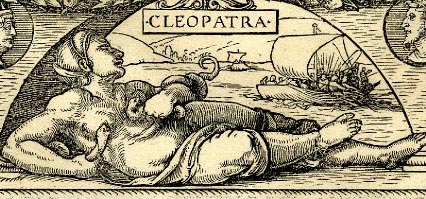
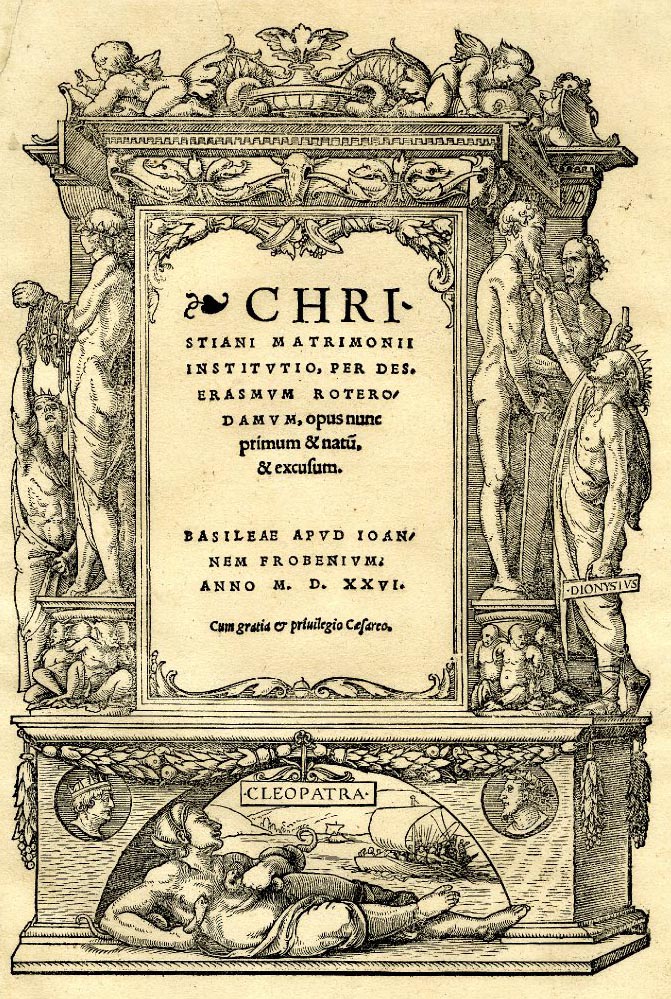
    One example of a curious approach to illustration belongs to Hans Holbein, who created a somewhat  three-dimensional ornamental and cascading title page that also happened to contain an image of Cleopatra in a suicide-by-snake.  The snake may have been an Egyptian asp, and perhaps not, if she committed suicide by this manner at all.  Cleopatra finally was led to this end on 30 August 30 BCE after a long string of affairs and consorts with Rome and its Emperors, failing finally after the death of Marc Antony and the rejection by OCtavian (who later would become Augustus, perhaps the greatest of Roman Emperors).  In any event, we see Cleopatra here committing the deed, with what may be some of Antony’s Alexandria-based fleet in the background.

    The design was copied many times, and used for a number of different title pages–the first time being in a work by Erasmus in 1523, and in the example below, later, in 1526.  Offhand it is difficult for me to say if there are earlier suicides on thte title pages of books, but this would certainly be among the earliest, if not the earliest yet. 

    (Also appearing on either side of the columns in the middle of the page is Dionysius of Syracuse, an autocrat of the highest order, here shown plucking bits of treasure from the statues of gods. There were two rules named Dionysius, father and son, I and II; the elder may have been killed by the younger via physician-assisted poisoning; the younger (of Damocles and the sword fame among other things usually not so pretty) was equally tyrannical and also came to a bad end.)


    Books  suicide on a title page


  • Bad Ideas Deparment: Scientific Finger Combs

    JF Ptak Science Books   Post 1876

    Hair fingers copy
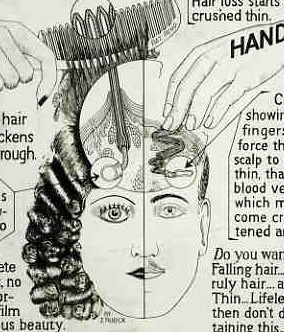
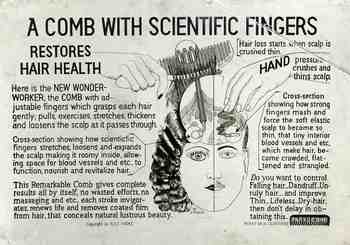
    Well. This item is of course lost on me, but the new “wonder-worker comb” somehow did an anti-crushing  something to the scalp and the hair root that promoted/restored and fictionalized hair health. The secret to understanding  it all, evidently, is that “bad scalp” is “crushed thin”.  This is brought about by “HAND pressure”, from  “strong fingers that mash and force the elastic scalp to become thin and such” causing  hair to be “more crowded, flattened”. For some reason the inventor didn’t speculate on whether other sorts of combs did this, or not; it looks as though he/she was targeting only those who combed their hair with their own non-plastic fingers, clearly elucidating this primal contest in a “wonder worker comb” vs. crushing/flattening comb fingers vocabulary.

     The comb with the adjustable fingers “pulls, exercises, stretches, thickens and loosens the scalp as it passes through” (the hair, the scalp?). It makes the scalp “roomy inside”, allowing the extra room that the hair needs “to function”. These hair restorative miracles is the result of the simple use of the comb, providing “complete results all by itself, no wasted efforts…”.

    The comb also, it seems, controls dandruff, and improves “thin, Lifeless, Dry-hair (sic)”.
    That’s a lot to ask of a piece of plastic.

    Blogcomb_hair230

    This  somewhat-scary item is a photographic postcard sent to the Library of Congress as a Copyright Deposit copy–part of the process of securing protection from intellectual theft via American copyright.  One is set to wonder about who–and why–this idea would be stolen. It would make an interesting story about Really Bad Ideas that were appropriated to no good end.


  • Daily Dose of Doctor Odd: Disappeared NYC, 1946

    JF Ptak Science Books   Quick Post

    This is part of a series on destroyed New York City that includes New York City: Attacked by Tentacled Flying Saucers, Giant Flying Snakes, Glaciers, and Mining Missile Space Aliens, 1929-1941 and H-Bomb Wipes out Brooklyn, among others.

    http://static.flickr.com/66/199900324_b6a6863a76_o.jpg


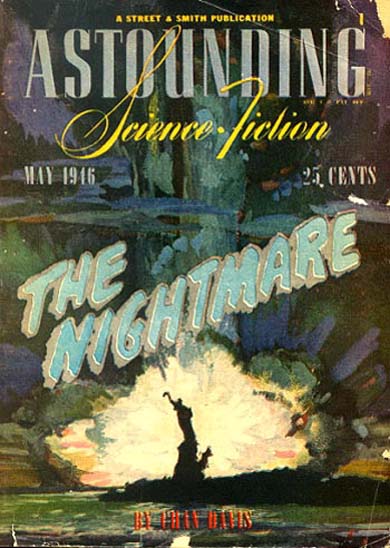
     ”This is a story of the immediate tomorrow – and of civilization headed down the  inescapable road to destruction – down the road that we have, already, selected – and its nightmare end.”

    Chandler Davis wrote this nightmare for Astounding Stories in 1946, and the artwork of the deteriorating-before-your-eyes Statue of Liberty fits this blog’s series of Disappearing New York series. Davis is a very interesting man–Ph.D. mathematics from Havard and professor of math at Toronto, a New York-born man who started his sci fi career early (age 20, with the story above) and who iimmigrated to Canada after his relsease from his HUAC-inspired prison term.  Davis was probably a born Leftie, a radical, and it evidently never left him. 

    The cover art is by William Timmins. 


  • Daily Dose of Dr. Odd: a Lovely Bit of Slightly Mysterious Design

    JF Ptak Science Books  Quick Post

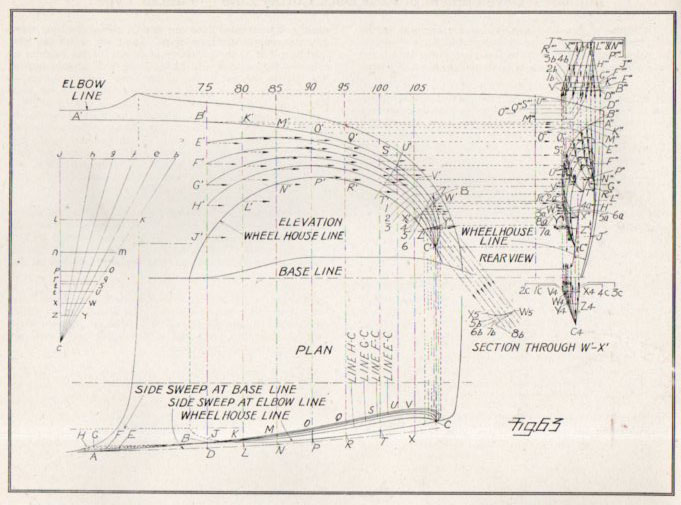
    Care to have a guess on the derivation of these designs? Well, I guess the indicators give this away, but had “elevation wheel house cover” not been printed in the it might have been harder to figure out what this simple and lovely thing is. 

    Design auto528


  • A Note on the Idea of Seeing Things Backwards

    JF Ptak Science Books   Post 1873

    Backwards--magritte

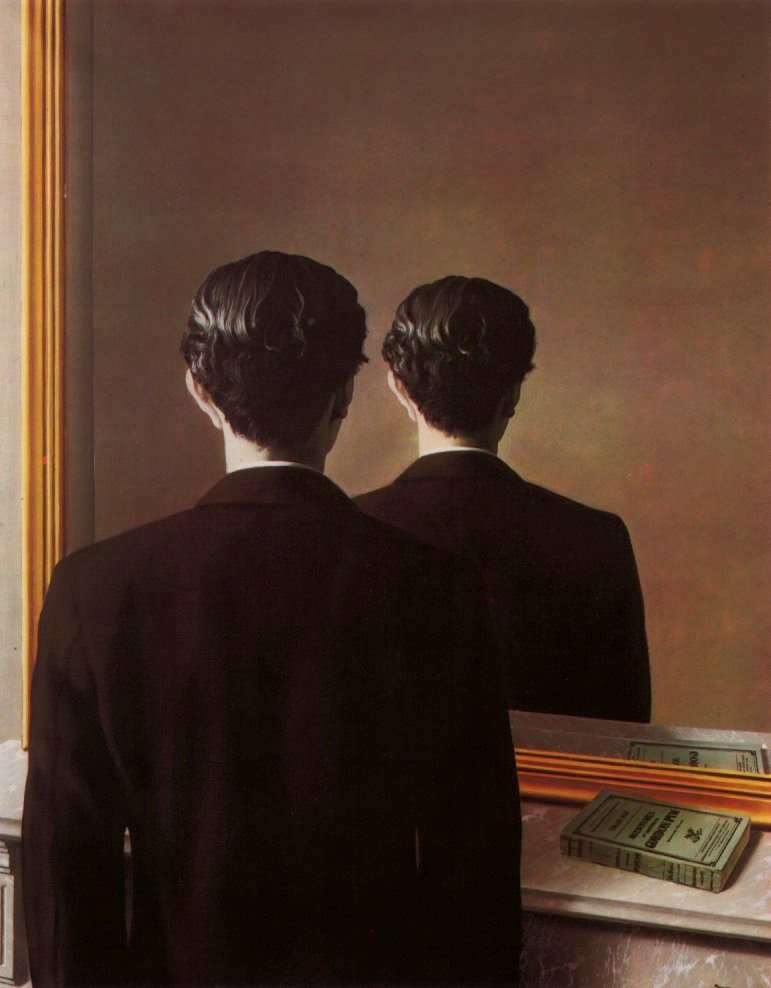
    Leonardo wrote backwards and from right to left, Benjamin Button lived backwards at the hands of Scott Fitzgerald, Rene Magritte’s man in the mirror saw the back of his head, Ignatz the Mouse I am sure saw the back of his head looking around the world with the world’s most powerful telescope, rugby passes are all done backwards, paper images of vue optiques appear backwards, lightning for all intents and purposes starts backwards from the ground up, reverse mathematics are worked from theorems to axioms, the Chicago River (1900) was engineered to flow backwards for the foreseeable future, while the Mississippi River famously flowed backwards for just a bit in the New Madrid earthquake of 1812. 

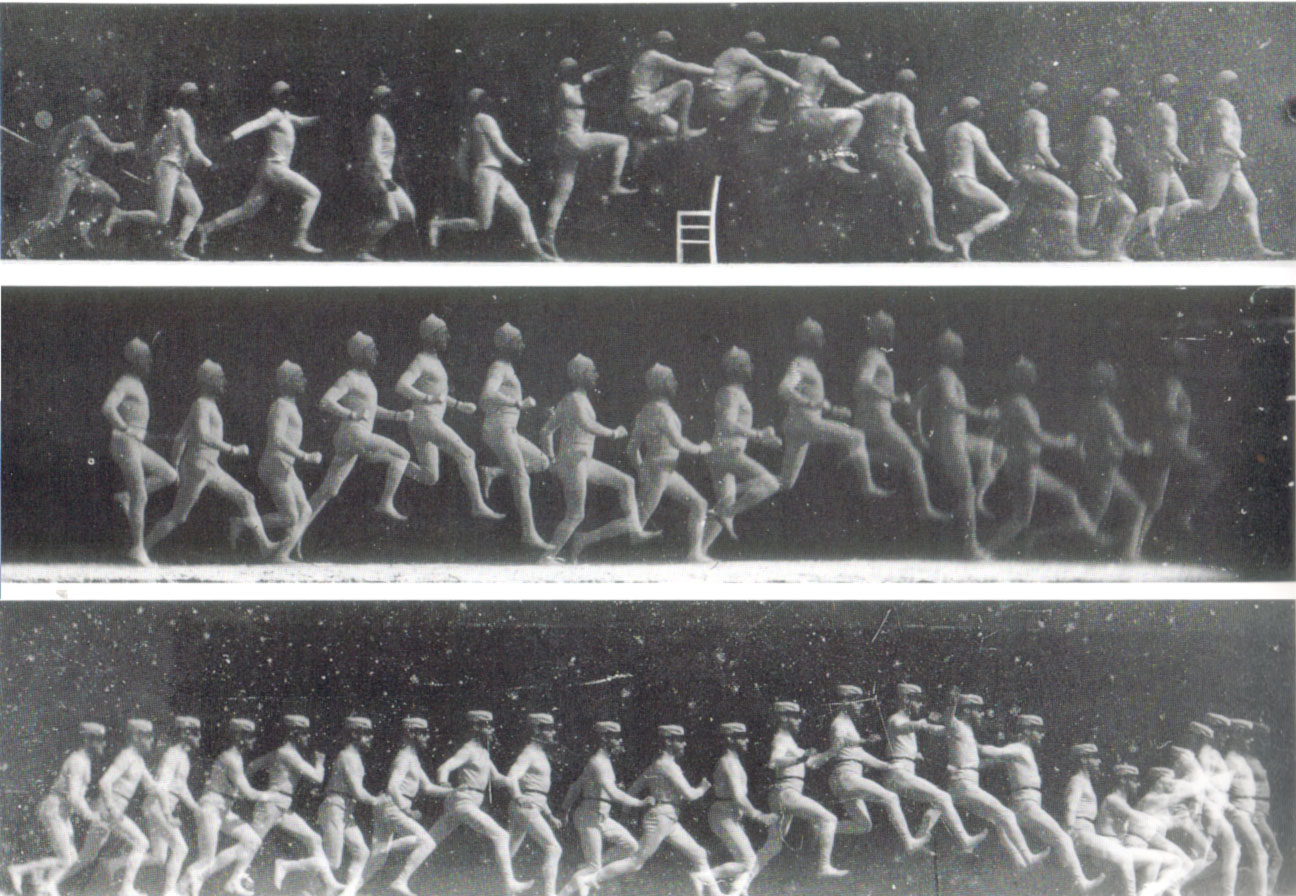
    Backwards--marey12

    I can only imagine what audiences must have felt when they saw the first moving pictures played backwards–seeing them played forwards was a novel-enough (and revolutionary) idea, but the simple idea of reversing the direction of the film would have proved to be equally fascinating.  Imagine the first time you witnessed a staged train wreck on film, back there in 18951, and imagine being able to see it played over and over again, until you were filled.  I’m not so sure that there were even any still photographs of a train wreck as it occurred to this point, even with advances in film speed and lens, so seeing the even unfold in front of you at leisure must have been overwhelming.  Now imagine these same folks seeing the event and watching the locomotives reconstitute themselves.  It would have been an extraordinary event.  Even observing the Marey sequences (above) and seeing what actually happens when a person bends over to pick up a pail of water would have revealed almost as much in new detail as when Galileo was in the middle of his earliest observations. 

    In a way the chance of controlling the direction telling of a story and seeing it displayed via moving images, and being able to see them backwards, may well have seemed a form of third-person time travel.  This came on the heals of what is for all intents and purposes the first time travel novel in  H.G. Wells’ (also in) 1895 The Time Machine (appearing earlier as “The Chronic Argonauts,” in 1888)2 and Mark Twain’s 1889 but much earlier than the first motion picture to use the idea of time travel (which was in 1921 and based on Twain’s work).  Being able to show a motion picture, and then stop it at will, and then reverse the order of time to begin everything all over again–visually–must have seemed a magnificent advantage. 

    Notes:

    1.  It is interesting that this very early motion picture , made by the great scientist-brothers Lumiere, l’Arrivee d’un train en gare, was produced in the same year as the Wells book.  Just two years later, the Lumiere Brothers published a catalog of their available movie strips, numbering 338 productions.  In 1898, after six catalogs, there were over a thousand strips.  This is remarkable, especially considering that there wasn’t a cinema industry yet.  The Lumieres are an interesting pair of people (both of whom survived their invention by about a half-century), making perhaps the most important discoveries in the history of cinema, and continued to be interested in other fields throughout their lives.  The cinema-industry part of their work didn’t seem to interest them all that much. 

    The history of moving images is complex and long.  I’m not saying at all that it begins with the Lumieres, or with Edison, as the pre-1900 field is well sprinkled with different and interesting attempts at fooling our eye–Chronophotograposcopes, Counterfivoscopes, Phantasmagorias, Klondikiscopes, Vileocigraphiscope, and so on, are just a few examples of the many attempts at locating the seat of photographic motion in the brain.  There are very early efforts, principally by J.A.F. Plateau (1801-1883) who rediscovered in 1829 the “persistence of vision” effect in which the eye will see a continuous stream of images if presented with a flow of static pictures at 16 frames per second over a one second period, which of course is the basis for the rest of everything that was to come.  There’s much more, but I wanted to at least point out these few important bits. 

    2..  I’m not sure what to  with Mr. Dickens, if he fits in this order with the time traveling Scrooge in A Christmas Carol (1843), or not.  Perhaps he does, and if so, then he precedes Mr. Wells, though the latter’s time traveler is outfitted with a machine and a scientific basis for the belief in it.  At the very least he is worth mentioning in the same moment.


  • Daily Dose of Dr. Odd: Sierpinski Triangles & the Empire State Building

    JF Ptak Science Books   Daily Dose series   [Also part of the History of Lines series] 

    So, Nat’rists observe a flea

    hath smaller fleas that on him prey,

    And these have smaller fleas to bite ’em, and so on ad infinitum.

    –Jonathan Swift, 1733 

    There are a lot of triangles in this fabulous photo of the construction of the Empire State Building in 1931–a lot. At least fifty–more if you use your imagination or get your pinhole specs out. It is simply an excellent photo in which I’m seeing things of a reducible nature–not in the sense of a Sierpinski triangle/sieve/gasket, obviously–but just a simple exercise along those lines (ha!), experiencing the image by recognizing different sorts of boundaries within it.

    Lines empire state bldg

     [Source: New York Public Library Digital Collections, here.]