A Daily History of Holes, Dots, Lines, Science, History, Math, Physics, Art, the Unintentional Absurd, Architecture, Maps, Data Visualization, Blank and Missing Things, and so on. |1.6 million words, 7500 images, 4.9 million hits| Press & appearances in The Times, Le Figaro, Mensa, The Economist, The Guardian, Discovery News, Slate, Le Monde, Sci American Blogs, Le Pont, and many other places… 5000+ total posts since 2008.

Category: Absurdist, Unintentional

  • Daily Dose of Dr. Odd: Baseball Players at the Sphinx, 1889

    JF Ptak Science Books   Quick Post

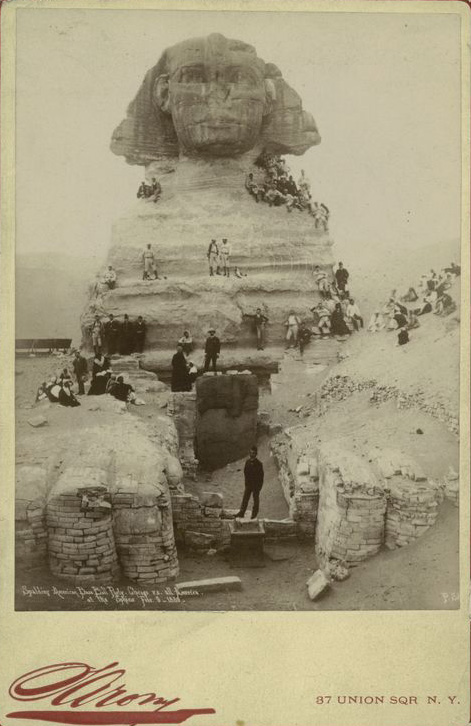
    The Sphinx has hosted all manner of guests in its existence, from circuses to Napoleon’s army using it for target practice, but I’m pretty sure that I’ve never seen an antique image of it with a swarm of baseball players:

    Baseball sphinx
    Source: the New York Public Library Digital Gallery, here.

    Baseball sphinx_edited-1
    The American baseball party at the Sphinx  [Spalding American Base Ball Party; Chicago vs. all America a…] (1889)

    ·Posted by :

    ·in:


  • Ancient “Spacecraft”: the Flavor of Moving Very Heavy Things a Long Time Ago

    JF Ptak Science Books    Post 1872

    Obelisk624
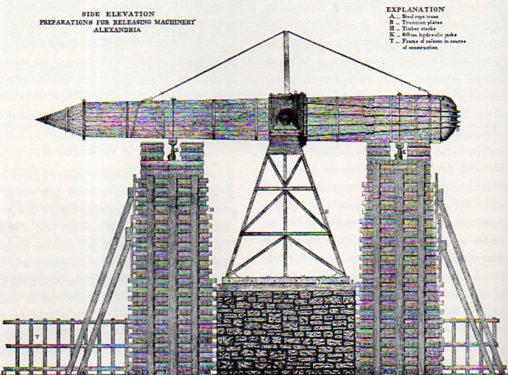
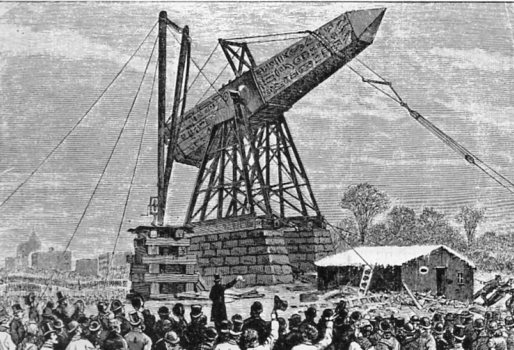
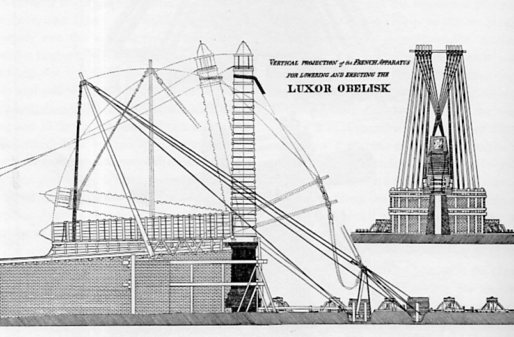
    This of course is not a story of ancient spacecraft, but it is about Very Large Things being manipulated in space in the days of steam and pre-steam engineering. It is hard to escape the “rocketship” interpretation, as some of the images, sculpted slightly out of context and cleansed of any identifying text and viewed with a squint, look as though they might be large booster rockets being readied for flight. They are of course images of some great and famous pieces of engineering–moving massive obelisks, and moving them in the 19th century and before.  And in the case of the Romans, and the original Egyptians, moving them way before our last millennium, moving 200- and 900-ton objects without benefit of very much at all. 

    Obelisk625
    Two of the great examples are the pair of obelisks that the Romans moved from Heliopolis to Alexandria, where they stood for another 2000 years.  Over time there was only one standing, and that one wasn’t doing so well by the end of the 19th century.  The fallen obelsik was taken to London in 1877; the other, the standing obelisk, was given to the United States by the Khedive of Egypt two years later, in 1879.  The man in charge of this second operation was Lt. Commander Henry H. Gorringe, U.S.N., who had the very tricky job of lowering the monolith, bracing it for transport by sea, fitting it out for a ship, and then transporting it to Central Park and raising it again.  He was able to accomplish this feat with the “fragile” 100-ton object in just a year.

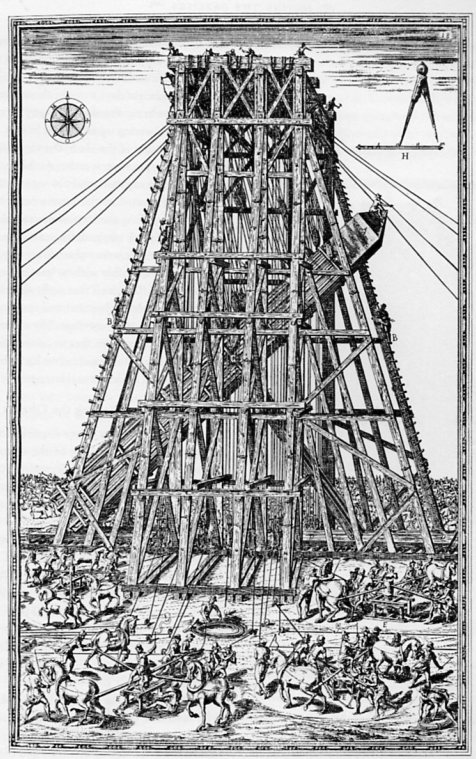
    This next image is more classical and probably iconic, at least in the history of science world, and is found in the superb book by Domenico Fontana, Della Transportatione dell’Obelisco Vaticano (published in Rome in 1590 and again in 1604):

    Obelisk627

    Obelisk626They really do have a certain modern taste for interplanetary access, at least to me.  That aside, it is interesting to consider what this vastly heavy movement must’ve looked like to people long ago, when big machines with enormous powertrains (like this 1,200 ton capacity 300′-tall mobile crane)could be hauled into service to do their end in manipulating highly problematic and very heavy things in space.  To think of moving these very heavy objects with steam (or less) was a daunting task, and to see these images showing the progression of movement of these things must have been enormosuly satisfying.


  • History of Blank and Missing Things: Letters

    JF Ptak Science Books   Quick Post  [Partof the series on the History of Blank, Empty and Missing Things]

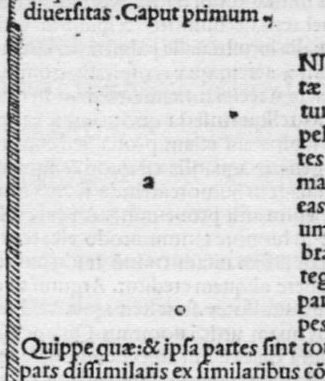
    This is a good example of one of those “mysteries” which seem hardly so when you find the very straightforward answer.  The appearance of this floating “a”:

    Blank a735
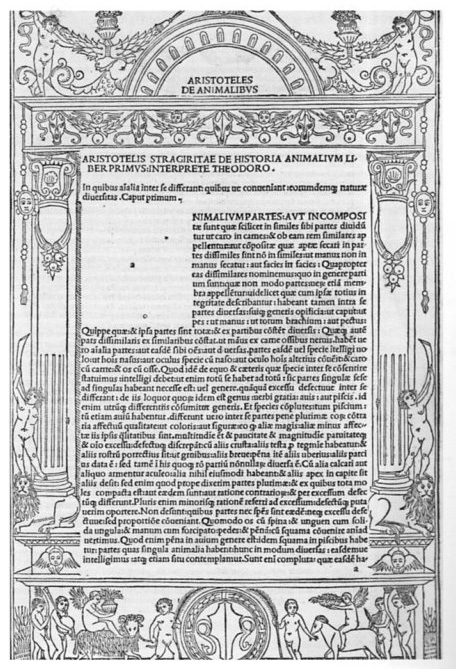
    The non-mystery is a product of a chapter beginning in a beautiful and very early (1476)  printed edition of Aristotle’s De animalibus. At first glance it looks like it might be an attempt at design/spacing, an illustration in a modern Dadaist vein, capturing space and attention while using hardly anything at all, a simple floating letter, an intentional placement of an object in an unusual field. It is that, in a very minor way, but the attention-getting device was used to gather up the focus of only one person.  The little “a”  is simply a place-holder, waiting for the the next stage in production of the book, for the rubricator to come in and decorate the space with a magnificent/articulated/flourishing capital “A”, which was the practice of this time.   

    Blank a734
    The reason why rubricated letters weren’t printed with the rest of the book is that in general the initials (and intricate coloring) were too complex and too colorful to be a product of the press. (The first Gutenberg book appeared in 1456 and although the first printed color appeared in the next year from the press of Fust the practice of multi-color printing with any sort of intricate application would take until the first third or so of the 18th century.) The artist responsible would come in and work on these sheets calling for decorated capitals before the book was bound–the letter “a” was there as a reminder for the work to be done–it also was the only way some of them knew what needed to be painted, as not every rubricator could read (thought they knew the letters of course). 


  • A Note on a History of Lying Down–Sinking Life Preservers and Goiter Chairs

    JF Ptak Science Books    Post 1870

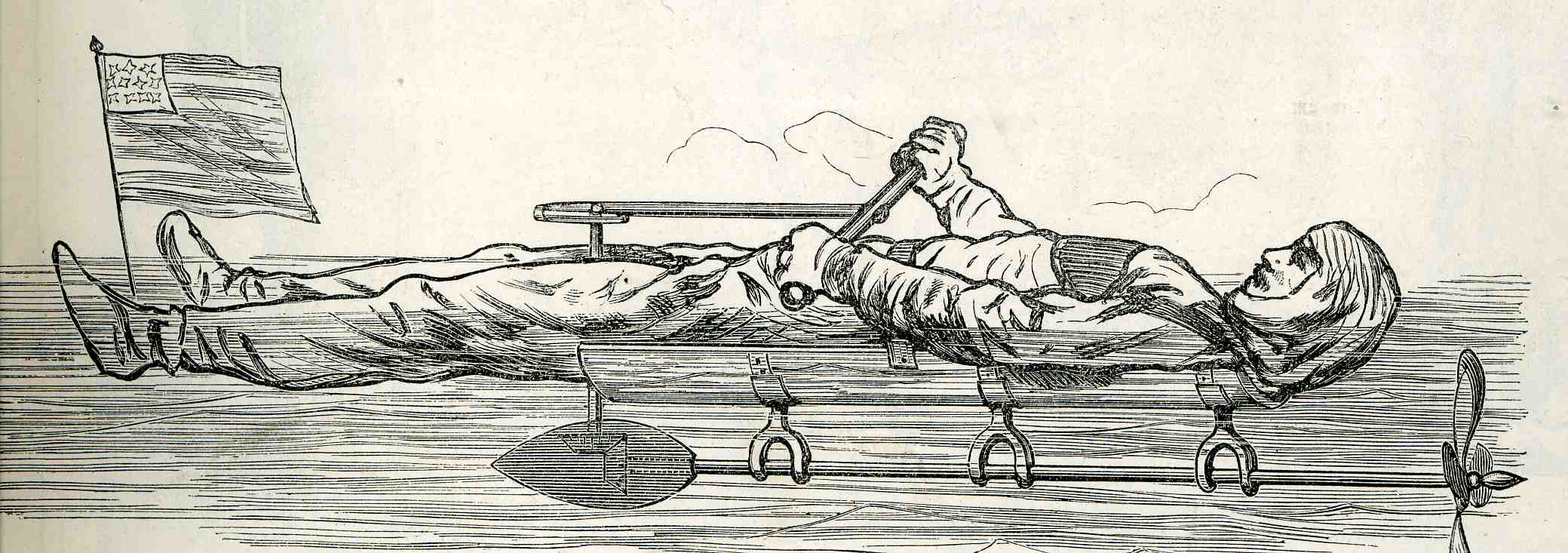
    0--blog---Nov 24--skinny114

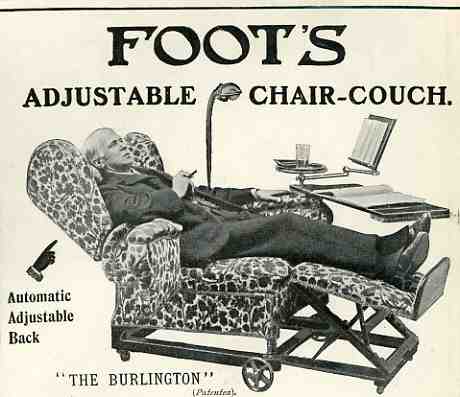
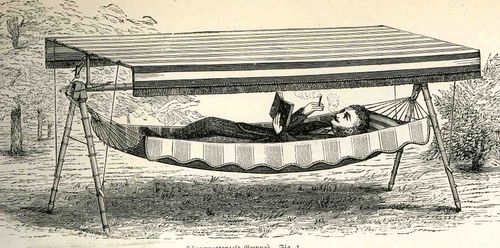
    I don’t have much to comment on in these images, just that they are striking and came to me in short order, and that they are all pretty narrow things.  They could fall easily into a Skinny category, or perhaps better still, they might slide nicely into the prototype for a series of posts on The History of Lying Down.  Or perhaps a combination of the two, or one being a sub-category of the other.  Certainly a history of humans lying down would be fairly massive, but scaling it down to late 19th century images of skinny and lying down might narrow the field a bit. 

    The first, (above),  is from Illustrirte Zeitung (Leipzig), and published in 1878; it depicts an American effort at simplified swimming, though sometimes when you simplify an already-simple thing, the results are fairly complex.  I haven’t much of an idea about how this would make sense, seeing that the body’s strongest muscles are not being used at all; further, judging by the flag, this guy is moving feet-first, and the whole procedure, despite body suit, look as though it would be terrifically cumbersome and bloaty.  And with the geartrain, plus the weight of the driveshaft and propeller, I don’t know how anyone would keep afloat.  Or how someone would keep their neck in that position for any period of time. In the world of Good Ideas, this would be an Anti-Good Idea. 

    0--blog---Nov 24--skinny116

    Foot’s Adjustable Chair Couch, which I found in The Illustrated London News for September 1902, was remarkable for its cushion-y formlessness, accepting the reader to itself like a body with a goiter.  There’s just something terribly wrong with it, reminding me somehow of undeserved and needlessly- rewarded comfort–too much comfort foully a perfectly reasonable invention like The Chair. 

    Next is this skinny, low, light semi-automated shaded hammock; little, narrow, and maybe comfortable to fit a 120-pound person.  This appeared in the Illustrierte Zeitung, again, for 1892.

    0--blog---Nov 24--skinny115

    Another idea, combining a bulky hiding and storage device with a slender and narrow place to lie down is S. Luder’s 1883 patent for a rolling and folding bed in a chest of drawers:


    In any event, this start of a list is simply in jest, an attempt at categorizing a few odd images and find a bit of complementarity where there is none. 

    ·Posted by :

    ·in:


  • Booze-Vision Atomic Farming and Other Nuclear Dreams

    JF Ptak Science Books  (Expanding an Earlier Post)

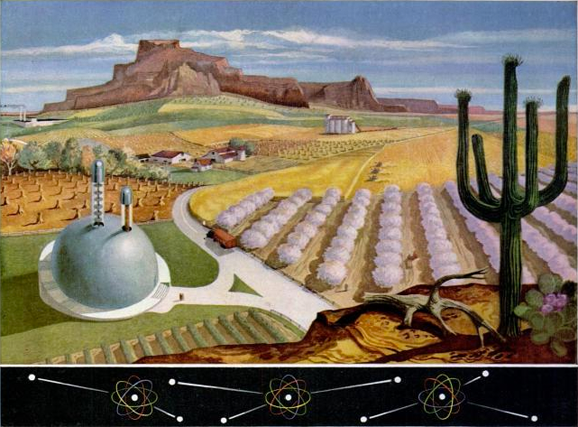
    Seagrams V.O. Canadian Whiskey powered the future through a series of a dozen or so ads for itself in the 1945-1947 period, taking a usually-strangled though occasionally interesting peep into what the future might bring.  (And of course the future is brought by men who drink Seagrams.)  In this ad, appearing in the 12 May 1947 issue of LIFE Magazine, we are told “deserts will bloom through atomic power”–how this might happen is left to the imagination. Also left to fantasy is what exactly is being farmed there in front of the incongruous “atomic energy plant”. Plastic smoke?  Taking a fractured approach to the possibilities one might say that atomic bomb mushroom clouds are being grown from seedlings here from the ground up, nurtured until the day they too will be as big as the blasts of August 1945.

    Atomic garden

    Oddly enough, the illustrator–who after all was just trying to sell alcohol–came pretty close to the truth, except that they got the power source wrong.  Rather than nuclear energy, it would be petrochemical industries that would lie there at the heart of America’s farm production (via seeds and fertilizers and so on)–I’m sure that it would’ve made more sense in a weak way back there in 1947 to believe the atomic story rather than the possibility that it would be petroleum that would drive the entire production of food forward. 

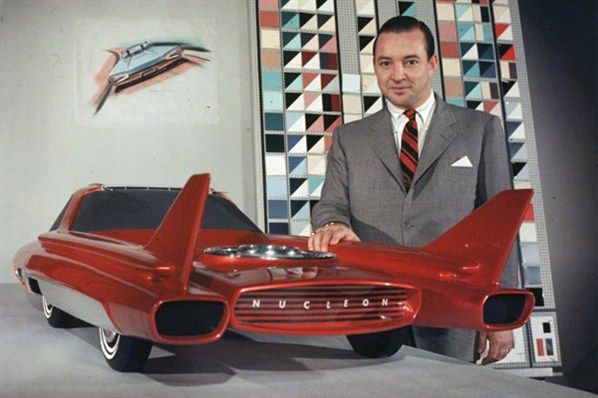
    There were many proposed uses for atomic energy over the next few decades, most not very good–the Ford Nucleon, a screamer with a 5,000-mile cruising range powered by a steam engine driven by a small uranium fission muscle box in the car’s rear, was one of those ideas.  The nuclear-powered submarine, which sounded like the Nucleon in 1946, was a solid workable idea, a science fiction come true in 1954 with the launch of the USS Nautilus (SSN-571).

    Ford nucleonNuclear medicine–although not powering an atomic heart–was a very important development that seemed not conceivable in the decade preceding its development.  Atomic-powered helicopters, trains and planes are other examples of the not-good-idea variety.  The nuclear powered space vehicle, which was first proposed in 1946 by Stan Ulam (and then in a report written by him and C.J. Everet  On a Method of Propulsion of Projectiles by Means of External Nuclear Explosions. Part I. University of California, Los Alamos Scientific Laboratory, August 1955, pictured and linked below), has morphed into something monumental in Project Orion, and to me sounds like a fabulous idea:

    [Source here.]

    IBut getting back to the liquor ads, here’s an weirdly prescien and naive image–“weird” anyway for a quick effort made by an artist trying to sell drunk juice–is this proto-internet office view, made in May 1945. There’s lots of passive solar going on here(though not really very effective when you consider the other ways of directing and filtering exterior light inside) in the office of tomorrow, but more important is the desk and the file cabinets.  The seated man is talking to someone across the country  via phone/wireless, with data en masse at his fingertips, a “computer” (in the old sense of the word, that being a person–and usually a women–given the charge of adding long columns of number or whatever and then doing the arithmetic, like a comptometer) working some sort of calculating interest on the largish calculating instrument. In general we see a decision-maker awash in responsibility connecting all of the parts of his world: a primitive, secular, analog internet.  And this too just at about the same time that Vannevar Bush introduced his own vision of the informational future with his superb Memex (which I wrote about earlier on this blog here.)

    Internet 1945


  • Outsider and Found-Dadaist Logic: Naive Captions and Text Illustrations, 1935

    JF Ptak Science Books   Post 1858

    Blogaugust_23_flaws437

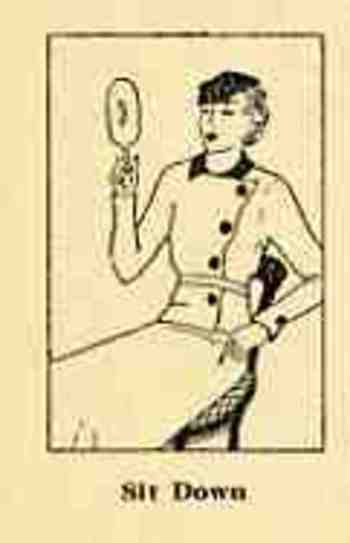
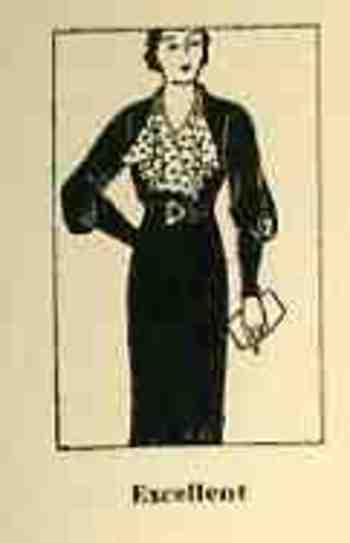
    This pamphlet (Are You Dressed Correctly?) comes from my extensive Naïve Surreal collection, which is composed of (a) pamphlets that were concerned with important ephemera in the past that today looks implausible  or impossible, and (b) pamphlets that addressed issues of, shall we say, a mostly-internal, very personal, High Imagination that may or may not have been part of the visual world or the imagined world of othersBlogaugust_24_flaws441_2.Kathleen Enright’s Are You Dressed Correctly? (1935) fits into category (a), mainly because the captions of the illustrations are  semi-devoid of connectivity with their illustrations, and in their simplicity are a bit of a challenge to make any association. That, or it is easy to disassociate image from caption and vice versa , making it easy for the images to slide right out of the book and stand on their own as some sort of self-educated Dadaist statement of simplicity. In this way they can almost form their own Alphabet of the Obvious. 

    Blogaugust_23_flaws435_3

    ·Posted by :

    ·in:


  • Happy Anniversary! Unsliced Bread–the Best Thing Since Sliced Bread.

    JF Ptak Science Books   Post 1855     Almost on this Day in 1932…

    Bread3

    Thanks to Emma Digh Ptak who gave me a book on the history of bread for Father’s Day!  Thanks, Buddy! 

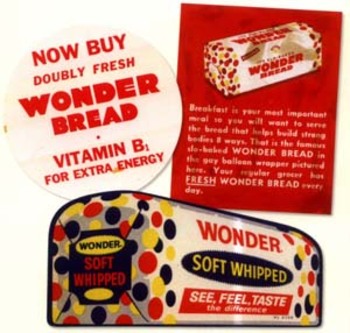
    This expression has a bit of a scent of death, of corporate sameness, about it. Its tale is one of innovation, deceit, deception; of ridding independence and quality, of providing a gross replacement for quality in the name of mechanized progress. The progress came in the form of a continuous loop delivering exactly the same loaf of bread, endlessly, to be cut and bagged and delivered to consumers–brought to us at t he expense of 97% of all of the bakeries that have ever existed in this country.

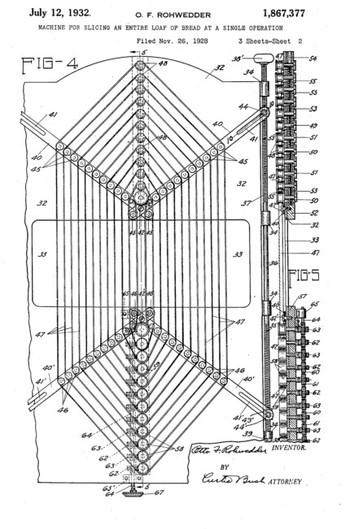
    The replacement of the small bakery began slowly, around 1850, proceeded with caution to the turn of the century, and was basically completed by 1940. In 1900 the small bakery outnumbered the corporate producers by 80:1. By 1939 the large company absorbed the practice of 95% of all dollars spent on baked goods. It was the continuous-belt bread baker that started of the replacement process in 1850 and 1866, sending the breadBread_patent_2 through long ovens on the endless feed. This was the start–it was in the high speed mixers that made the domination possible, thoroughly dispersing the yeast throughout the dough, making it possible to produce almost the exact same loaf of bread time and time again. It was then that the bread cutters–which had been around for some time but more or less perfected in 1928–could really do their job and finish production. The cutters would work exceptionally well so long as the stuff that they were cutting was the same–this done, multiple loaves could be cut every second, hundreds of times a minute, thanks to the mixer. Efficiency had reached high speed, and the cutters performed their revolutionary task.

    By 1942 the show was over for the small bakery–their non-uniform, hand made, thickish, irregular products replaced by bread clones: white, spongy and terrifically porous, and something that, once squeezed, would return to its original shape.

    Bread2

    The masterwork on the coming of mechanization is by S. Gideon, and is called Mechanization Takes Command, published by Oxford, (New  York), in 1948.  It is a work of great beauty and insight.  


  • Atomic Power with God, 1946

    JF Ptak Science Books   Post 1854

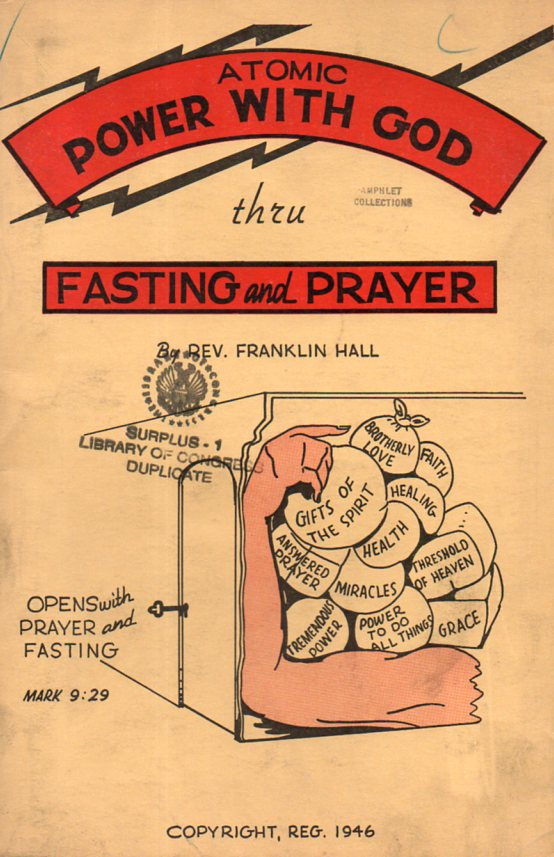
    Atomic power with god628
    Rev. Franklin Hall was a busy man:  with detritus haloes of failing humanity floating above everyone  (making them susceptible to the eternal lake of fire), he was on a concerted mission to save as many people as who would listen to his special message. Hall’s litany was equal parts simple and complex, as we can see even by just the title of one of his pamphlets: Because of Your Unbelief , Chains of Bondage, Food Slaves, Belly Worshippers, Fleshly Lusts, Unbelief, Doubts & Fears, Carnality (which I wrote about here), which was a short work of considerable claims with no basis of correctness or proof.

    He moved on, assuredly inspired by the use of the atomic bomb in August 1945, to write Atomic Power with God thru Fasting and Prayer (received by the Copyright Office in September 1946). As much as this might sound like an adult beverage of your choice, it is not; he set his course not on atomic power per se, but on the connection of fasting and prayer, because, as he writes on page 37, “the Bible is Ahead of Science”. (There haven’t been very many books at all written with the words “God” and “atomic” in their titles1–and this is one of those few.  And the Hall book is actually four of them, as this very small work went through  a number of revisions and four editions.)

    Which I guess is all fine and good, to a point, so long as the health debits do not pile up too high; the rest is a subject of faith, and about there there is not much that can be said that would be of any use.  In the long run it was rather tempestuous of Mr. Hall to assume that using the words “atomic” and “power” in the title of his re-polished gem-let was good to win him a few new readers, surfing on the tide of everything else in the world that was just at that time adding the prefix “atomic” to whatever product there was to be sold2.  And God evidently was right there among them. 

    Notes:


  • Air-Punk: Underwater Cyborg Diving Suit (1797)

    JF Ptak Science Books   Post 1853

    Diving bell horizontal656

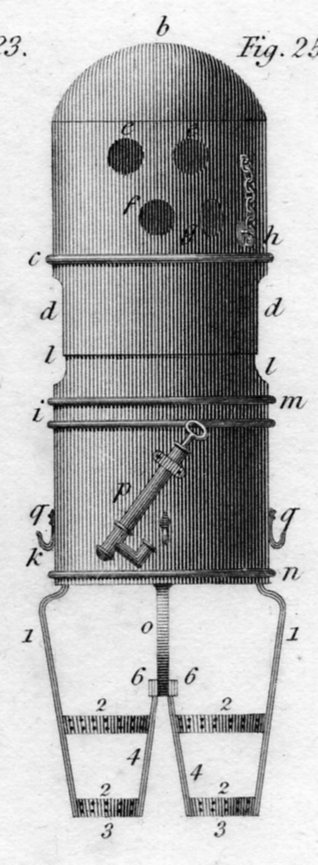
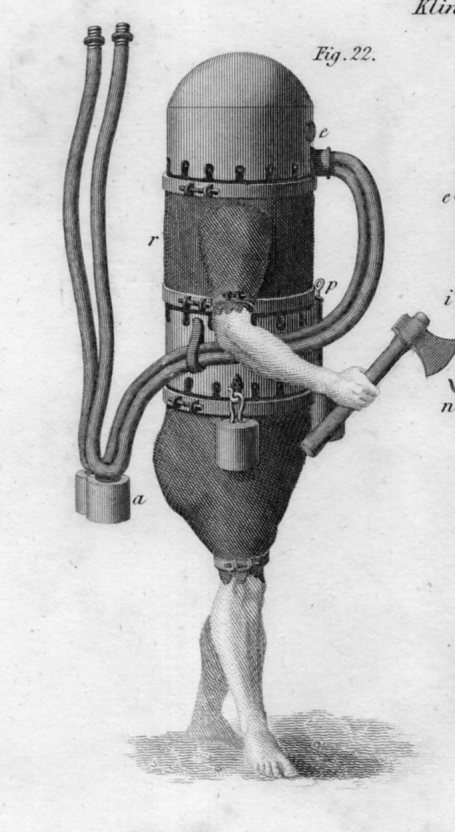
    Well, not really. It is however an early diving suit (and perhaps the earliest apparatus worn on the person and submerged) the creative and comparatively lightweight effort of Karl Heinrich Klingert, who produced it at the very end of the 18th century, in 1797 or thereabouts.  The suit was made of a metal helmet and wide metal girdle, with the vest and pants made of a waterproof leather, and with leather (?) leg straps.  The air would be pumped down to the diver from a turret above (see below, just) and would arrive in the diver’s helmet via weighted air tubes. 

    Here’s a side and occupied view:

    Diving bell horizontal654


  • “Kill Sin Pimple” and other Religious Nicknames of the 17th Century

    JF Ptak Science Books    Post 1841
    Barebones601

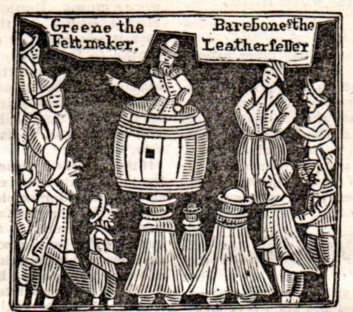
    Who Is that man pointing and speaking from the preacher barrel? 

    This quaint woodcut appeared as the cover illustration to a pamphlet entitled A Word to Fanatics, Puritanism and Sectaries1; or, New Preachers New, and it answers my question: the screamer is Mr. Praise-God-Barebone who is attended by his attender, a more-commonly named Mr. Green (“the Feltmaker”), and is shown preaching to a small crowd, many of whom are shown with long faces and in deep caricature, more so to mirror words they are hearing.  Barebones is not presented in a friendly light, as the pamphlet was a warning to the general reader of the rising crowd of untrained and possibly heretical religicos who were gathering attention in and about London in the (Cromwellian fanatical) 1640’s.  They were seen as diffident, destructive, and definitely of the dimpled damaged variety of street entertainer. The interestingly-named pamphlet and Mr. Barebone was reported by the  magazine, The Mirrour, (July 19, 1823) as “the object of the work is to ridicule such persons without education undertake to expound the Scriptures, and who, ignorant themselves, have the vanity to pretend to teach others”. The powers that be were not amused.

    After dispatching the screamers The Mirrour then lists a number of very compelling and some-never-heard-of-before-by-me nicknames, like Barebone’s brother “Christ Came Into the World to Save” Barebone, followed by these examples: Accepted Trevor, of Norsham; Redeemed Compton, of Battle; Faint Not Hewit, of Hearthfield; Make Peace Heaton of Hare; God Reward Smart, of Firehurst; EarthAdms, of Warbleton; Called Lower of Warbleton; Kill Sin Pimple, of Witham; Return Spelman, of Watling; Fly Debate Roberts, Britling; Be Faithful Joiner, of Britling; Mare Fruit Fowler, of ast Hadley; Weep Not Billing, of Lewes; and Meek Brewer, of Okeham.  The magazine claims official records as the source for these names, but, well, who knows–perhaps the editors were just attempting to put a larger exclamation point on their biting article.

    These are extraordinary names in some ways similar to the passive reportage nastiness of H.L. Mencken’s nickname walk-through in his The American Language, but not quite so–in that book, the old problematic sage of Baltimore staggers his way through unbridled American enthusiastic for the common person’s testing and misunderstanding of English.  The religious  nicknames  seem more like baseball nicknames from the 1920’s, or earlier.  But of course these names predate those efforts by nearly 300 years.

    Somehow I’d like to see trading cards for these guys–although half-ancient that don’t give much leeway to their modern sports varieties.  Baseball has provided ceaseless though a little limited entertainment, tending sometimes toward the poetic overstatement (the Chairman of the Board, The Mighty Slider, The Great Significance) though it does get down to business in the ‘40’s and ‘50’s (the golden age of BB nicknames).  Here are a few examples, minus the racist stuff:  Pork Chop, Tater, Gummy, Whale, Pickles, Rawmeat, Spud, Bunny, Beast, Kitten, Possum, Slug, The Rat, Pudge, Tomato Face, Buttercup. (The most effective nicknames could’ve been made by combining two of the single names:  “Spud Rawmeat”, “Pudge Slug” or “Gummy Buttercup”, for example.)  There’s an awful lot of them dealing with food, and a whole heck of  a lot dealing with facial features; they all seem to outweigh ball playing ability, by far.  All this said, I do have a sweet pull for the religious nicknames. 

    Notes:

    1.  Sectraries:   members of a sect, especially those who belongs to a religious sect that is regarded as heretical or schismatic.