A Daily History of Holes, Dots, Lines, Science, History, Math, Physics, Art, the Unintentional Absurd, Architecture, Maps, Data Visualization, Blank and Missing Things, and so on. |1.6 million words, 7500 images, 4.9 million hits| Press & appearances in The Times, Le Figaro, Mensa, The Economist, The Guardian, Discovery News, Slate, Le Monde, Sci American Blogs, Le Pont, and many other places… 5000+ total posts since 2008.

Category: Absurdist, Unintentional

  • Baking the Big Bang–Guns in the Oven, 1943

    JF PTak Science Books     Daily Dose of Dr. Odd


    Big Bang OVen861
    Having made a casual stroll through LIFE magazine during the War Years  (1939-1945) it seems to me as a general observation that there wasn’t that much attention paid to covering the war until 1942.  Then there was gradual coverage from January ’42 to the summer of 1942, when things really started to pick up for American involvement–of course there was the Japanese invasion of China earlier than that in the Sino-Japanese War of 1935-1945, and most of the rest of Europe and the U.K. had been busy fighting Germany since the autumn of 1939, and then the Soviets were brutally brought into the war following the abrogation of their on-aggression pact with the Nazis in 1940.

    The U.S. during those early years was having a very difficult national dialog about how America should deal with the conflict, a conversation that wasn’t turned into a great national monologue until 7 December 1941.  Anyway, its my impression that war coverage in the nation’s premier picture magazine was fairly skimpy until 1942.  By 1943, it was, in a way, all-war-all-of-the-time in the magazine’s pages, and in the ads as well.  Suddenly (over the course of 15 months or something like that), relatively benign products like Ronson lighters sold themselves on their “being able to take it”, with squinty-eyed sailors lighting their cigs with the war-tough Ronson; Mrs. Don Ameche was selling Coleman’s Mustard with a war flavoring, underwear ads used Hitler’s name to sell their product, and so on. (These examples appeared on just two consecutive pages.)  Use of the war in advertising appears in the Brit equivalent of LIFE, the Illustrated London News, but less so; in Germany, the Illustrirte Zeitung (Leipzig), the most popular popular-illustrated-read in that country, also featured war-based ads, but far less frequently. (Also the war coverage in that journal wasn’t nearly as frequent as in th eother two; and from my experience, as sanitized as the other two mags were, there was never any bad military news in the Illus Zeitung that I could see. Maybe ever.  Certainly Hitler wasn’t taking about it, even when he was sacrificing entire armies to the Soviets and Mother Winter.)

    So.  What does this mean?  I don’t know, not really. If the company was doing something for the war effort, and they advertised in LIFE, then the readers of that mag were going to know about it.  On the other hand, if the company produced underwear and seemed to really have nothing to do with the conduct of the war, they were wrapping their product up in a kill-Hitler ribbon  as well.  Was this “bad”?  Das machts nichts.  It is interesting, though, but I really don’t know how it is interesting beyond knowing that it is. 

    Big Bang OVen862
    Caveat: even though I’ve breezed through all of these magazines for the war years out in the warehouse, doing that rather than Doing Something Else, my grazing was not exactly an experimental undertaking. My observations are just general observations that seeped into me from a six-foot pile of war mags.)


  • Looking Straight Down Department: Antiquarian Waterspouts

    JF Ptak Science Books   Quick Post   Some examples from the uncollected series on Looking Straight Down can be found here and here.

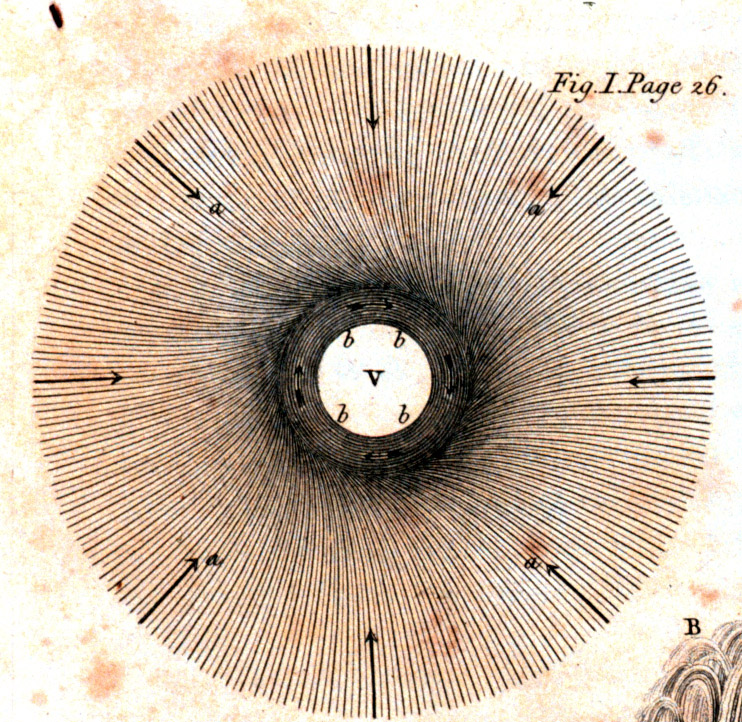
    I’ve been involved in this blog at retrieving and tabulating antique images that look straight down on something. Today I imagine that we all take these sorts of views for granted, what with satellite images and Google Earth and airplanes and all.  But in the pre-heavier-than-air era, seeing a published image that looked straight down from a height was quite rare. (And it needs to be strait down, not a bird’s-eye view.  Things are very different between looking obliquely from an airplane window onto a cityscape than skydiving directly down on top of it.)

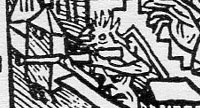
    Benjamin Franklin had long been thinking about waterspouts, going back at least to the early 1750’s, though he did not have an article about them in print until the appearance of “Physical and Meteorological Observations: Conjectures and Suppositions”  in the Royal Society’s Philosophical Transactions, LV (1765). The first image that I’ve been able to find of the waterspout occurs in 1774, though a prettier version of it is reworked a little, but with sharper delineations, in 1818:

    Waterspout detail

    Here’s the full image (with a magic square that related to another article in the volume):


  • Daily Dose from Dr. Odd: Hermits, Putridity & Long Life Spans in “The Bible”, 1826.

    JF Ptak Science Books   Quick Post

    [Les Ages de l’homme (The Ages of Man)  by D de Vosthem, late 16th century, source here.]

    Increasing nothingness and putridness can possible lead to longer life spans, at least this is an hypothesis posed by John Blake in his Geographical Atlas…, published in New York in 1826:

    ” Rare examples however of extreme longevity of a life of more than 150 years seem to he common to all countries without distinction. If England the salubrity of which is so highly extolled has furnished thrice or four examples of men arriving at the age of from 150 to 169 years. Hungary which generally speaking is not a very healthy country has scen the celebrated Pierre Czartou prolong his life to the 185th year and John Uovin at the age of 172 had a wife of 164 and a younger son of 117. It is in the Bannat of Temeswar a very marshy district and subject to the putrid fever that these examples of longevity and many others have been observed A mode of life which is soher and unruffled by tumultuous passions singularly contributes to longevity…”

    “According to the author of a very curious little work called the Apology for Youth* 152 hermits taken in all ages and under every climate produce a sum total of 11,589 years of life and consequently an average of 70 years and a little mare than thrice months for each whereas the same number of Academicians the one half belonging to the Academy of Sciences and the other to that of Belles Lettres gives only 10,511 years of life consequently 69 years and a little more than two months for the mortal career of each. It is therefore not improbable that in the ages of patriarchal innocence the period of 150 or even 200 years was much more commonly attained than it is in our times…”

    Notes:


  • The Devil’s (Gun) in the Detail (1489)

    JF Ptak Science Books  Quick Post

    Devil gun detail

    When I went to research this phrase, above, I was surprised to learn that it is about half as old as I. Playing on a slightly older  expression, “Le bon Dieu est dans le détail” (the good God is in the detail), commonly attributed to Gustave Flaubert (1821-1880), and of course “God in in the detail/s”, the “devil” part seems to be only from the mid/late 1970’s–a surprise.

    Nevertheless, we are still left with a surprise in this devilish detail from the incunabulum of St. Augustus, De civitate dei….(this printed in Basel by Johann Amerbach on 13 February 1489).  It shows it in its two panel woodcut the illustrious saint at top, working away at his desk; and at the bottom a battle between the cities of Babylon (founded by Abel) and Zion (“Syon”, by Cain).  In this battle Zion is defended by devils, and the devils are armed. 

    Devil gun772
    The angels of Babylon appear sympathetic but unresponsive to the devil-play, while an angel at top left seems to be blessing its devil enemy who seems to be scaring/screaming at her. In any event this is a lovely and complex image coming in the fourth decade of moveable type printing. 

    Now:  regarding Zion and Augustine, I really don’t know why the writer is putting devils in charge of the defense of “the city of the living god”. The many-times-mentioned Zion of the Old Testament,  “…Zion, the perfection of beauty, God shines forth” (Psalms 50:2), doesn’t seem to be calling for devils.  But then I don’t know this history of Jerusalem during the Byzantine period, 4th/5th century.  So far as wars and savages launched against Jerusalem, it was destroyed twice, attacked 52 times, captured/recaptured 44 times, and beseiged 23 times–perhaps this representation wasn’t too terribly much out of the ordinary. 


  • Inventing (1) Old Tone in New Violins & (2) New Tone in Old Violins. Patent Models.

    JF Ptak Science Books  Quick Post

    Finding old tone in the 19th was attempted in the following way, an interesting if not myopic attempt to put some play-time in a brand-new violin:

    First page clipping of GB 190303723 (A)

    Abstract of  GB 190303723  (A)

      Payne, R. H., and Broadbent, T. Feb. 17, 1903.

    In an instrument for reproducing sound, a resonating-chamber is used instead of a diaphragm and a trumpet. In the construction shown, the resonating-chamber consists of a violin body C mounted on an arm D extending from the instrument A. Fig. 2 shows means which may be employed for the mounting. The pin E passes through a hole in the neck C’, which is clamped by the nut E’. The pin E is mounted in the wooden block F journalled in the fork H on the swivelling-pin. Washers G, G<1> prevent the communication of vibrations to the arm D. The hole in the neck may be dispensed with, a screw or spring clamp being employed in place of the pin E. The reproducer K, Fig. 3, is cemented to the violin belly. The style K<1> is clamped in it by the screw K<2>. The violin has the usual sound post and f-holes in the belly and also holes C<2> in the back. Strings may be stretched across the resonator. When a violin body is used, the strings are stretched by the usual pegs in the neck. 

    This is not the most elegant invention for producing a more-interesting music from a stationary, non-human-played violin. 

    On the other hand, this is:

    The work is by Henry Konrad Sandell, and the patent was for a magnificent machine that produced 64 notes on the violin, and was accompanied by a 44-note piano, both played at the same time. It is a very impressive accomplishment, with several thousand of them produced over two dozen years by the Mills Novelty Company.

    Source, here. Mills Novelty, here  Henry Konrad Sandell,  and a photo of a restored and lovely Violinola, here with a sample of the music it produced (!)

    ·Posted by :

    ·in:

    —

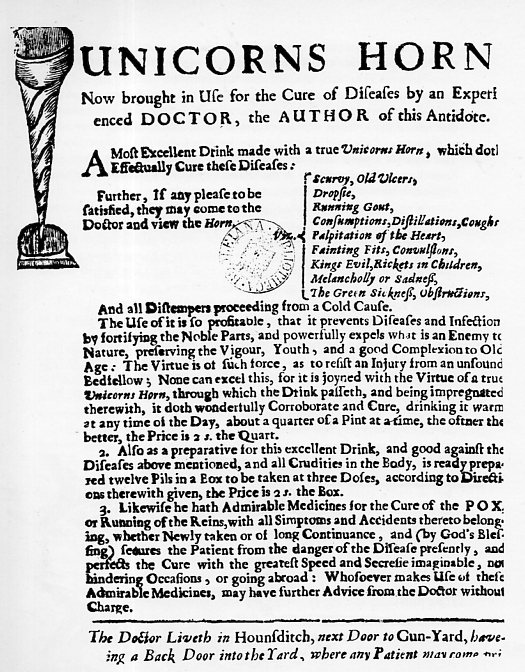
  • Dosing out the Cures from “The Beast that no Existence Hath”–the Unicorn.

    JF Ptak Science Books   Post 1898

    Unicorn'770
    Who could refuse to see a medical person advertising themselves as:

    “the Doctor Liveth in Houndsditch, next Door to Gun-Yard, having a Back Door into the Yard, where any Patient may come…”

    and especially one selling Unicorn horn curative extract?  The cure promises of  “the beast that no existence hath” (Rilke, Sonnets to Orpheus) sounded attractive, having the ability to dispense “scurvy, old Ulcers, Dropsie, Running Gout, Consumptions, Coughs, palpitations of the heart, Fainting Fits, Convulsions, King’s Evil, rickets in children, melancholy or sadness, the green sickness, and all distempers proceeding from a Cold Cause”  as well as “all crudities in the Body”.  But promises like this are almost always loyal only to that pretended self.

    Unicorn'769
    [Source for both images:  Rudiger Robert Beer, Unicron, Myth and Reality, Mason Oress, 1977.]

    In spite having a very long sales history over the milennia, pretty much the only place where unicorn horns have actually been seen were in apothecary shops selling narwal horns and in the constellation Monocaros (named so for the unicorn by Jacob Bartsch around 1624).  This great ground-up thing, one of the great mythic myths of all time, was a highly-inclined multi-purpose curative purgative suggestative ill-spoiler, capable of defeating nasty bodily nasties and enhancing things like our Noble Parts. For years it was worth more by weight than gold, though (depending on what it was that was being sold as unicron horn) ingested gold might have had about the same medicinal effect as a dose of unicron horn. 

    This fabulous image of a unicorn, draped in Renaissance-y literary moudlings appears in The secrets of Albertus Magnus: of the vertues of herbs, stones, and certain beasts : whereunto is newly added, a short discourse of the seven planets, governing the nativities of children : also a book of the same author, of the marvellous things of the world and of certain things, caused of certain beasts   being a translation of  De virtutibus herbarum, lapidum, & animalium quorandam libellus, and his De mirabilibus mundi, ac de quibusdam effectibus causatis à quibusdam animalibus (1543). 

    Hope faded in the greatest degree for the unicorn only in the 18th century, replaced immediately by any other number of empassioned impossibles, like magnetisma and curative electricity.

    A few handy resources:

    http://www.storehousesoflearning.com/links.htm  Useful links for Medieval images and manuscripts

    http://bestiary.ca/beasts/beastalphashort.htm  Great Bestiary, with searchable index of creatures; once inside, there are references to the animal from some of the leading Medieval bestiaries (and their ancinet sources), including Herodotus, Strabo, Guilaaume le Clerc, Pliny, Isidore, John Mandeville, and others. 

    Medieval book of birds http://archive.org/stream/medievalbookofbi00hughuoft#page/n7/mode/2up


  • The Invisible Man, 1785

    JF Ptak Science Books   Quick Post   [Part of the Series on Blank, Empty and Missing Things]

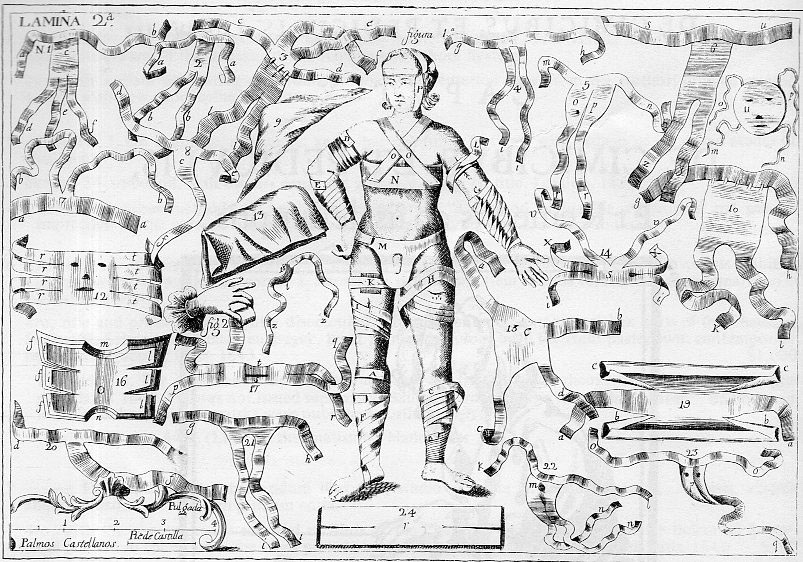
    Bandages767

    What is mostly missing in this fantastic illustration from Tratado de vendages…. (Madrid, 1785) are people.  These multi-image plates of various dressings usually did not address people directly, and so looking at them out of context gives them a very heavy taste of the found-absurd. 

    For the time, of course, the book was an essential text on treating wounds, especially military ones. The author, Francisco Vila Canivell was born in 1721 in Barcelona.  By 1749 at only 28 years old, he had been educated in  France and received his medical education back in Spain at the Universtiy of Cervera, had fought in the Italian campaign (as a surgeon), became Surgeon Major of the regiment of Astiurias, and then on to keep charge of the Library of the Royal College of Surgeons in Cadiz. He was professor of osteology (and bandages!), as well as an obstetrician, ophthalmologist and midwife, until 1769 when he became Sugeon Major of the Army, and then proceeded on to other more esteemed positons, dying in 1797.


  • Mark Rothko, 1870: Unidentified Pre-Modern Found-Modernist Art

    JF Ptak Science Books   Post 1895

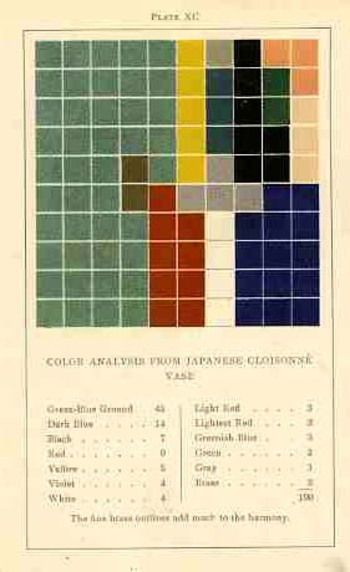
    This blog has long hosted a series of posts on “accidental” or “unintended” works of pre-modern modernist art found in displays of information and statistics in the sciences and mathematics, and even occasionally in art and design.  One such work–a 1904 triumph of accidental art issuing from an usunal work on color theory–belongs to an aesthetician named Emily Vanderpoel.  It is extraordinary in a narrower sense, and that extraordinary might not actually be positive for its original intent–the extra-intent of the book, what has come out of it for me, was something that was unintentionally accomplished by the author.  The images that she used to illustrate her color theory ideas–the basis of which are not really omprehensible to me–turn out to be artwork in themselves, a found art, the artistry of the images taking over the original intention for the arrangement of their color. She had introduced (though to no one, not really) a concept of beautifully arranged spatial color, artwork without a subject that could be recognized as any sort of natural object–non-representational art, finding publication several years before what is seen as the first inentional attempt at that genre, by Vassily Kandinsky in 1911. (Images below.) And when one strolls through the history of scientific illustration it becomes easier and easier to find such things, fabulous precursors to non-represnetational art, and Dadism, and Cubism and Surrealism. 

    Blogcolorvander_2poel_063These elements seem to be most populous in the illustrated sections of early encyclopediae, and dictionaries, and even encyclopedic dictionaries, where a number of different elements are displayed on the same page, different and generally unrelated images on the same engraved sheet, references for articles found in different parts of the book. 
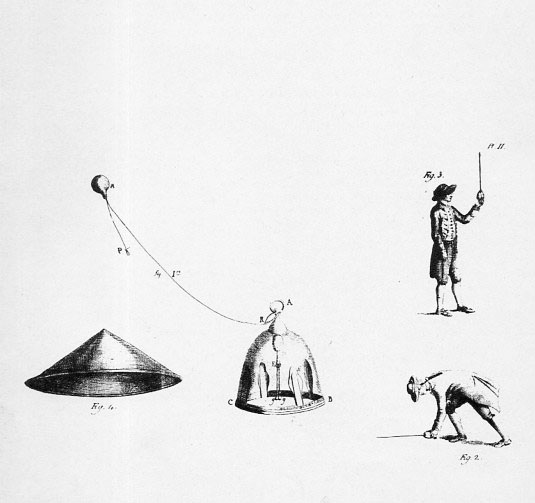
    Here is a good example of that, with unintentional Surrealist images found in the image refernce pages of Horace Benedict de Saussure’s Voyages dans les Alpes….(published in Neuchatel in 1803):
    Unintentional surreal766
    [There are a number of other examples that I’ve written about on this blog:  here, for example, in “On the Paper Sculpting of Nothing”.]

    And then there are examples like Vanderpoel, where the entire image from one sheet is the pre-modernist image in question–to my experience this is the more uncommon occurrence. 

    Which brings us to today’s installment:  the infographic displays found in  Francis Walker’s  Statistical atlas of the United States based on the results of the ninth census 1870 with contributions from many eminent men of science and several departments of the government, which is the atlas of data to accompany the 9th Census of the United States, published in 1874.  This is a beautiful work, and a pioneering challenge.  Walker was one of the earliest to produce a statistical atlas, and was perhaps the earliest to display this huge and broad amount of data in so many different ways–it must have seemed a semi-miracle to see the information displayed so, like going froma  black & white television to color, or color to infared, and so on.  It may well have represented anentirely new way of looking at data.

     The first image (above) in this post is from the illustration showing proportions of the white/non-white population, and the following image shows a detail of that, offset against Mark Rothko’s 1959 Black on Maroon.

    Francis Walker’s statistical mapping, above, 1873; Mark Rotko,

    1959, below:  


     mark-rothko-black-on-maroon-1959

    [Black on Maroon (1959) by Mark Rothko, part of the Seagram mural series, via Tate Modern.]

    The first and third images are details from this full-page illustration:

    It is easy to see the similarities between the data display and the Rothko, though it would really not be within anyone’s power to identify the Walker diagrams as “art” in the modern sense for another five decades.  But it certainly seemed there, ready to be of influence and service, though I’m not aware offhand of artists being influence by these images as they were with, say etienne Marey’s photographs. I’m not sure that these statistics images ever came into the service of art in the beginning of the modern era.  And maybe that’s the biggest question here. 

    Sources:

    1. Guide to National Atlases: here.
    2. The Walker atlas for the 1870 census from the LC site: here.
    3. And an improvement on the Library of Congress presentation, by HandsomeAtlas (Brooklyn Brainery): here.


  • Henry Darger and Campbell Soups Kids Playtime Schoolroom, 1955

    JF Ptak Science Books  Continuing Post 1081 from 2010

    Somewhere in the past I got the idea that the defining icon and supremely outsider-y artist, Henry Darger1, lived  his life twice.  One life he
    spent with the other people in his job as a quiet janitor; the other life he spent re-enacting his day in  miniature, a
    diorama of his workplace and his own
    apartment, reviewing his conversations real and supposed, revisiting shared-or-not visual clues, altering the day as it progressed with the possibilities of the actions-not-taken.

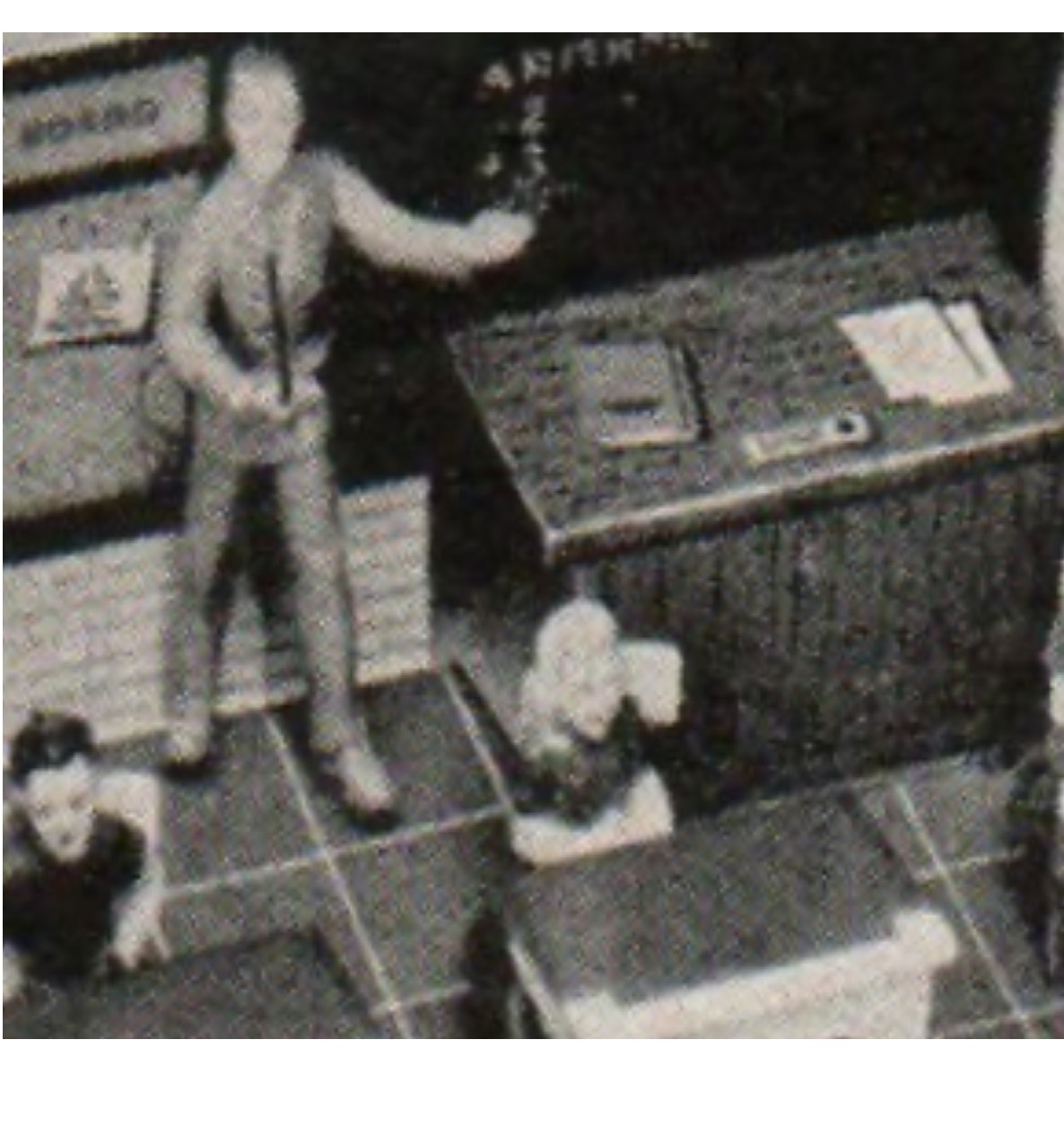
    Campbell det
    Maybe it is just this unshakable self-created image that colors the association of the Campbell Kids’ Miniature Play School Room that makes it  seem so dark and dangerous, especially since we now what is going to happen to the little girls in Darger’s red-tinged lexi-necessary art world. Here’s a molecular-level example of Darger’s fantastic output, featuring his Vivian Girls:

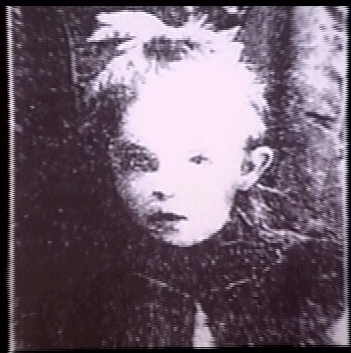
    Darger elsie(The picture at the lef is Miss Elsie Paroubek, a  5-year-old girl murdered in Chicago in 1911 and who may have been the sympathetic  impetus for Darger’s life work.)

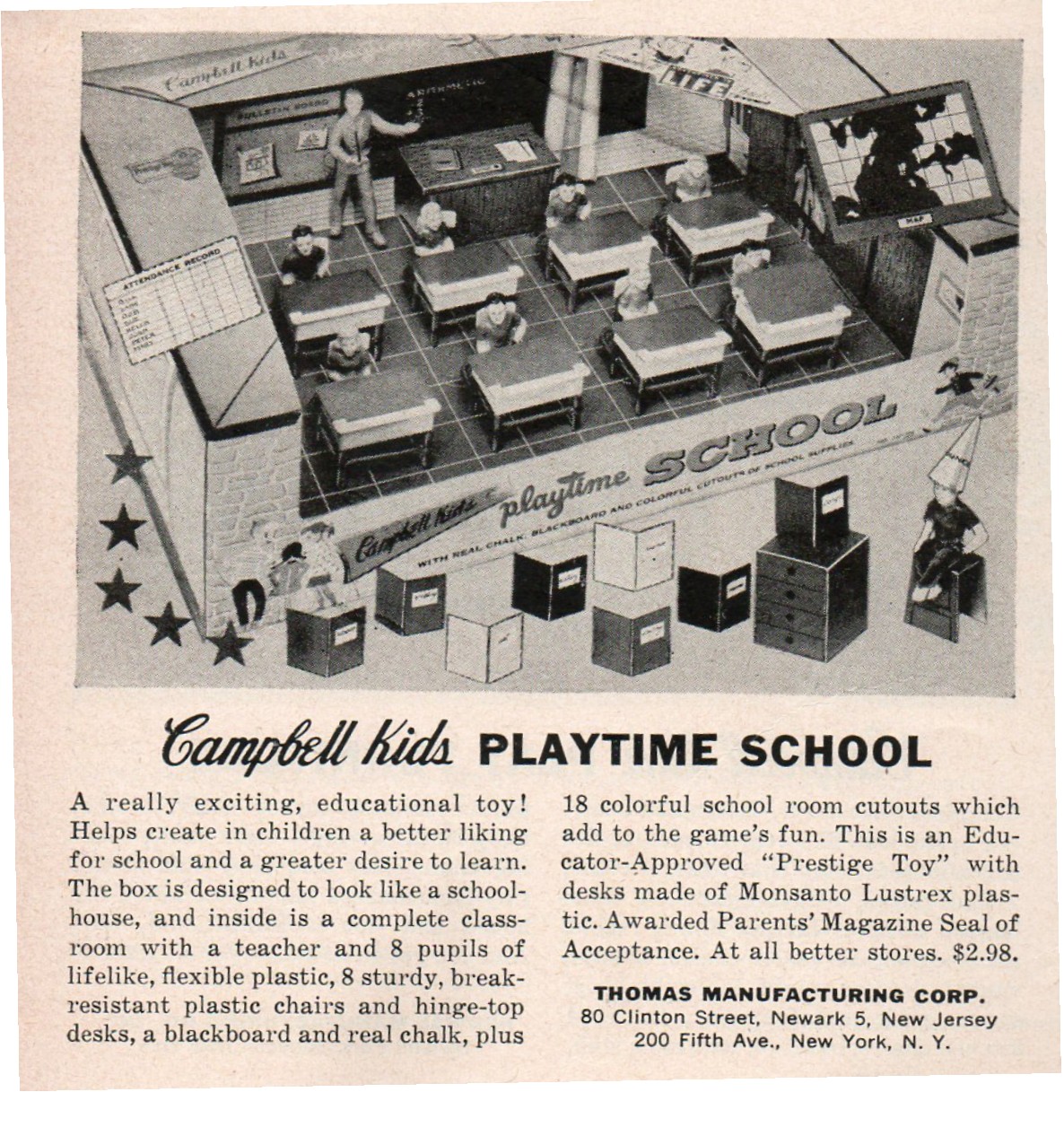
    And this is really just a child’s toy–a delightful one, too, filled with details of the school day:  movable desks, toy books, bouncey pony tails, and a teacher speaking at the back of the heads of the kids.  (He’s also carrying a stick by the way; maybe its just a pointer.)

    I suspect that the disturbed nature of this toy lives just in my head with its created Darger visions or repetitive living. Or maybe not–it does looked inescapably creepy, complete with a child in dunce’s hat.

    Campbell school169

    Notes:

    Darger 1. Henry Darger, 1892-1973, living form the Chicago World’s Fair to Watergate,  posthumously became perhaps the recognized standard model for outsider art, his magnum opus a 15,000 page and hyper-illustrated  work The Story of the Vivian Girls, in What is known as the Realms of the
    Unreal, of the Glandeco-Angelinnian War Storm, Caused by the Child
    Slave Rebellion
    being the base of the interest.  It has its own magnificence to be sure, and I can instantly recognize the enormous effort and creativity, but I always come back to the redded-up girl’s sexual organ additions, which are naturally upsetting, making the whole of the affair feel like a  monstrous mental health porn. And for as long as I’ve known about him, and which is also wholly
    unsupported by fact or reasonable supposition, I pictured Darger returning to his rooms at
    night after a day of cleaning, mopping, scrubbing, taking abuse for
    spills not cleaned, and then reliving the entire day at night in
    miniature.  In my own story, Darger created small figurines and puppets
    through which he re-enacted his day, complete with sets of the rooms in
    which he worked.  Perhaps he lost himself in these moments, finding a
    vindication in miniature stages in his second-story walk-up that he
    couldn’t in his daily life, allowing his creative, 20-million-word
    nighttime imagination to open up. Anyway, I’m pretty sure I made this imaginary life up.


  • On the Visual History of Silence, Chapter 17: Mapping the Silence of Housework in 1925

    JF Ptak Science Books  Post 1888 [An entry in the Museum of Impossible and Imaginary Things series.]

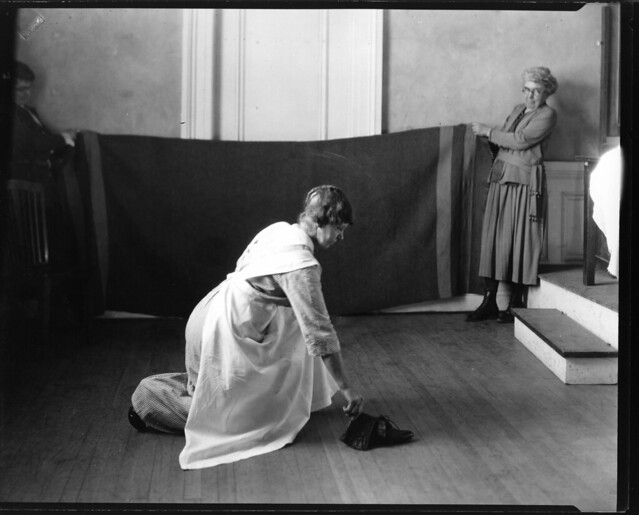
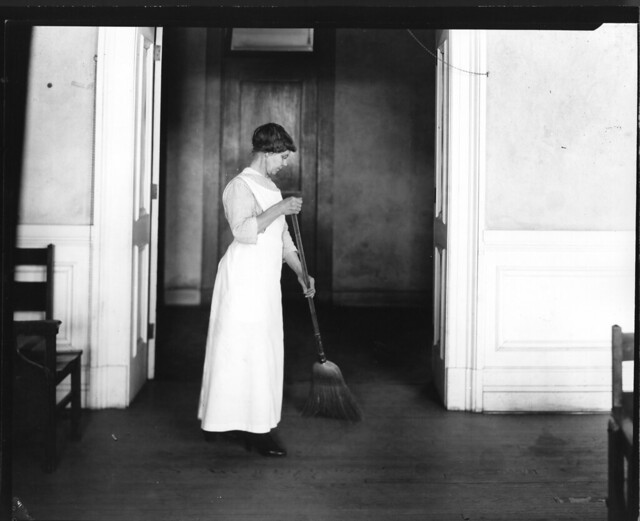
    I found this lovely series of images at the fantastic Public Domain Review blog–I was very and instantly taken by them, as they immediately suggested themselves to repurposing. (They were truly meant to illustrate the proper posture of the domestic worker; but now of course they are open to vast interpretation, creative speculation, and mild fantasy.)  To this observer their original insistence is gone, even at an historical micro-level (except for a history of housework):  they aren’t so much an illustration of housework and the postures by which a person would conduct them, but as a map of the silences encountered in the daily cleaning of a house.  It is all fiction of course, but the photographs do have an overwhelming sense of beckoning silence to them, even in their depiction of motion–even though they are a series on dealing with proper movement, they all seem strangely static, like marble.

    And so they become a geography of house-bound silence, made by silent geographers, capturing moments of silence in moments of near-silent work.  And if I was the one compiling these geographic interests (and I might as well be), I would want to position the five greatest house-silences so that they could be found once again.  And so:


    Location 60: back stairs, beyond kitchen.

    Sounds and silence: olympic kneeling done in pursuit of dusting invisible pollens from floor. A very quiet Shaker step waits in the background. It is mostly the silence of the whitewashed stair that commands this image, and not the diligence of the dust.


    Location 32: kitchen entry/semi-hall.

    Sounds and silence: Old uncovered wooden floor and oak-handled broom, well-polished leather boots with new heals.  The silence is that which comes after the light sweeping is finished is the elusive “great grandmother sound” of satisfied work being completed.