A Daily History of Holes, Dots, Lines, Science, History, Math, Physics, Art, the Unintentional Absurd, Architecture, Maps, Data Visualization, Blank and Missing Things, and so on. |1.6 million words, 7500 images, 4.9 million hits| Press & appearances in The Times, Le Figaro, Mensa, The Economist, The Guardian, Discovery News, Slate, Le Monde, Sci American Blogs, Le Pont, and many other places… 5000+ total posts since 2008.

Author: JF Ptak

  • The Car as the Dominating “Life” Form in the U.S.: Finding Places to Rest the Populating Automobile, 1930

    JF Ptak Science Books LLC  Post 481
    0 blog jan 07 car future364

    If I was an alien (of the outer-space variety) looking at the United
    States, I’d find it difficult not to assume
    that the biological units scurrying around the place were not put there to
    service the automobile.  Cars get born,
    then put on display, then selected and driven to their new home.  They get washed, and fed, and sometimes have
    their own places to sleep at night in their very own structure with their
    caretakers housed nearby.  They get taken
    out for airs in the morning and evening, resting while the humans labor all day
    to make enough money for their care and maintenance and feeding.  In the evening, they get brought back home
    and allowed to rest further.  They
    respond directly to inputs only and give no unsolicited response:  sort of like cats.  Fantastically large allowances are made for
    cars, humans going so far as to remove life- and atmospheric-sustaining biological
    units such as trees and good dirt so that the car can be taken virtually
    anywhere in the country on a path made specifically for them.  These pathways, which are padded and smooth,
    have ancillary bits attached to them so that the humans may walk beside them—houses
    and such are all connected to these paths to more easily enable the people to
    have access and maintain the car.  And,
    at the end of the day, humans breathe in the very excrement and excretia
    produced by the cars.  Placed under a
    microscope, the whole thing might resemble a biological unit, the cars being
    its very blood, everything else present to contain and move it.
     

    0 blog jan 222 car bfuture398

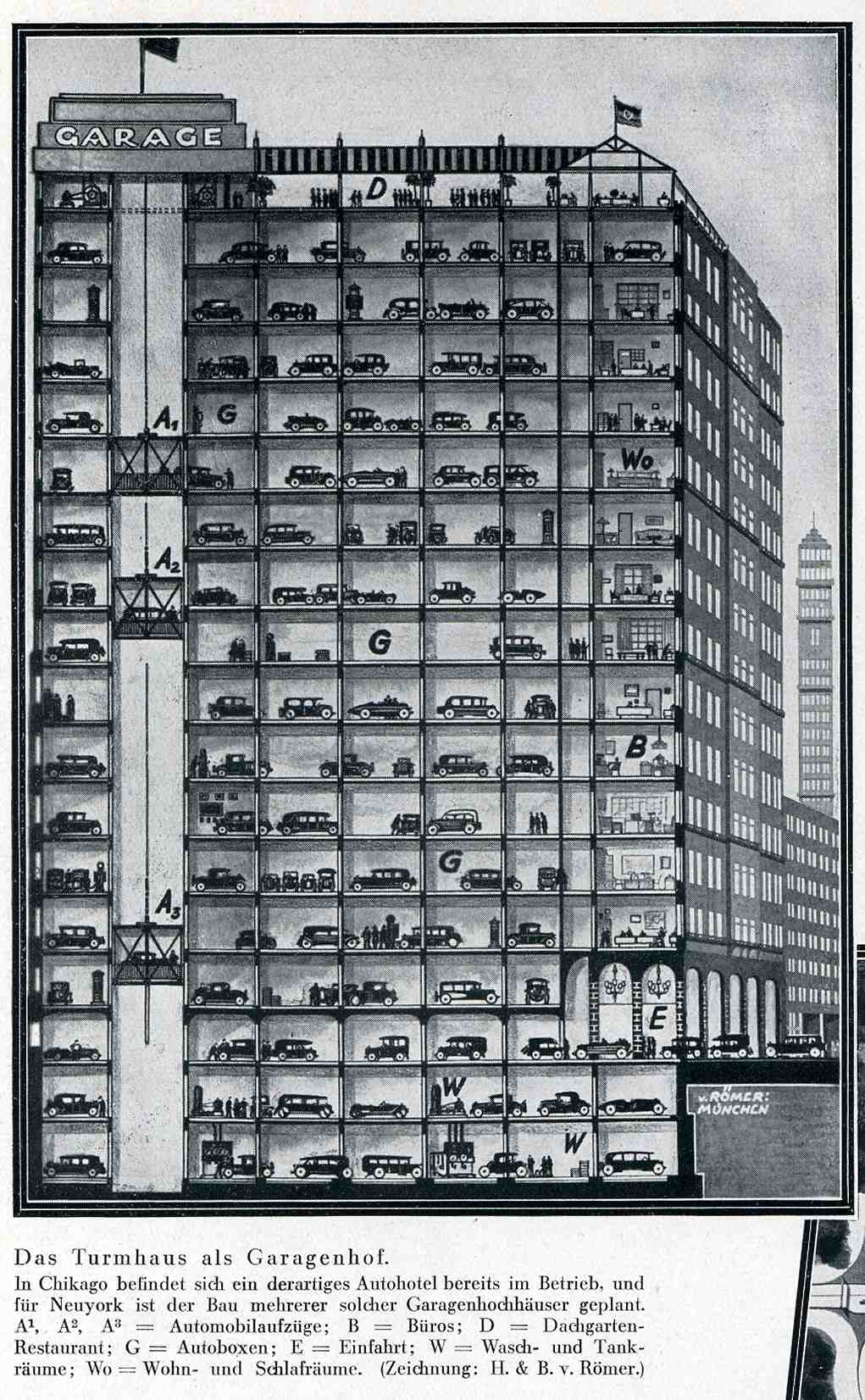
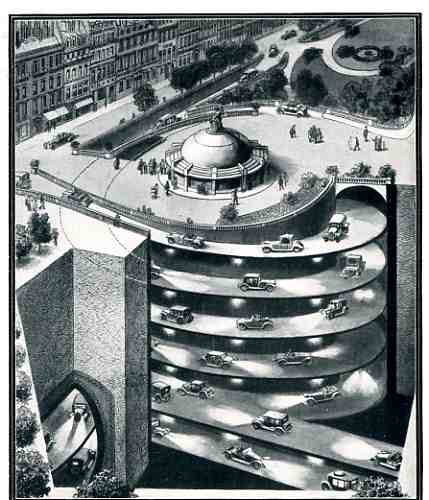
    These images from the Illustriete Zeitung (Leipzig, issue
    4484, pp 239-240) for November 1930 speak to the exact issue of how to care for
    the now ever-present automobile. 
    Entitled “Wie Bringe Ich Meinen Kraftwagen Unter?”, the short article
    (by the engineer Botho von Romer of Munchen) addresses the need of what to do
    with cars at bedtime—where do we put them? 
    One answer was this spectacular carpark (“Garagenhof”) high rise—seventeen
    floors of parking (with two more underground), serviced by a variety of
    elevators, pointing out that varieties of this structure already existed in Chicago and New York

    There was also the possibility of vast masses of sunken
    garages, their entrance way screwed into the earth leading to tunnels and
    networked warehouses where the cars could be safely deposited and removed from
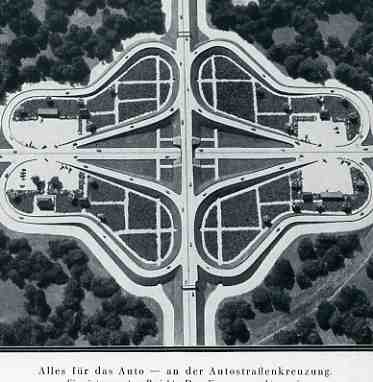
    city streets.  There were also these two
    versions of the simple above-ground garages and parking lots:  the apartment block gives over the entire
    interior area to individual parking and garages (doing away with any
    greenspace), while the massive semi-cloverleaf design is made for nothing else
    in mind than to park the cars in the four semi-centers.
     

    0 blog jan 222 car bfuture399

    By 1930 the production of the automobile had been revolutionized
    to such an extent that virtually anyone with a job and less than five kids
    could actually afford a car.  It is
    interesting to note that at the average price of say 30 cents a gallon for
    gasoline (in the U.S.A.)
    that folks 80 years ago were paying pretty more per gallon (adjusted via CPI)
    than we are paying now at $1.87/gallon (in my mountain city at the far end of
    the pipeline). 

  • Institutionalized Racism and the Sale of Toys and Music and Frivolities

    JF Ptak Science Books LLC Post 479

    0 blog jan 21 negro393

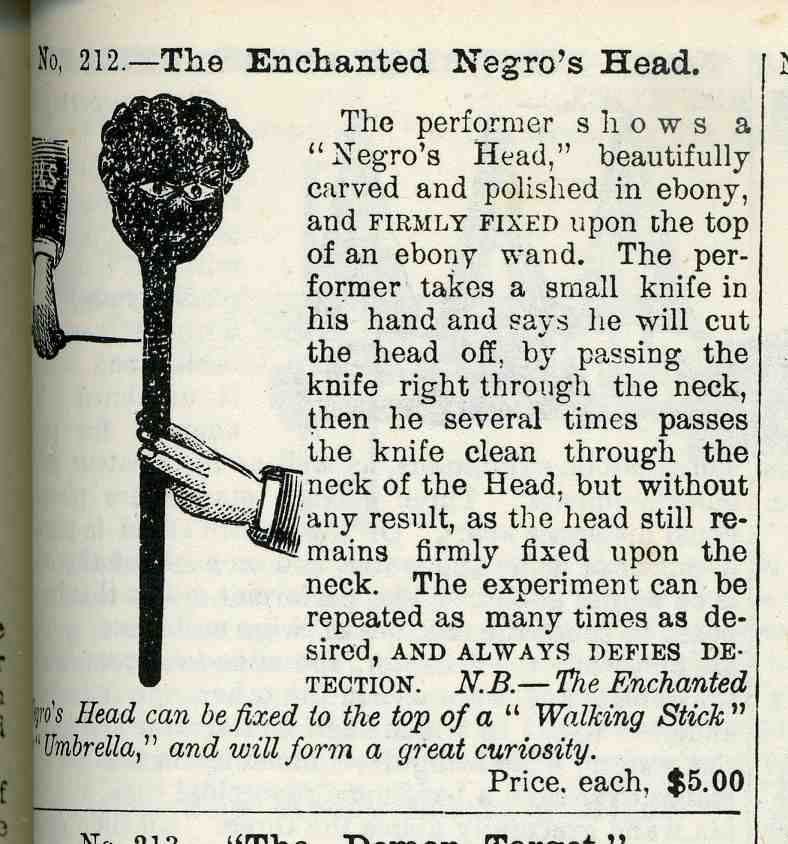
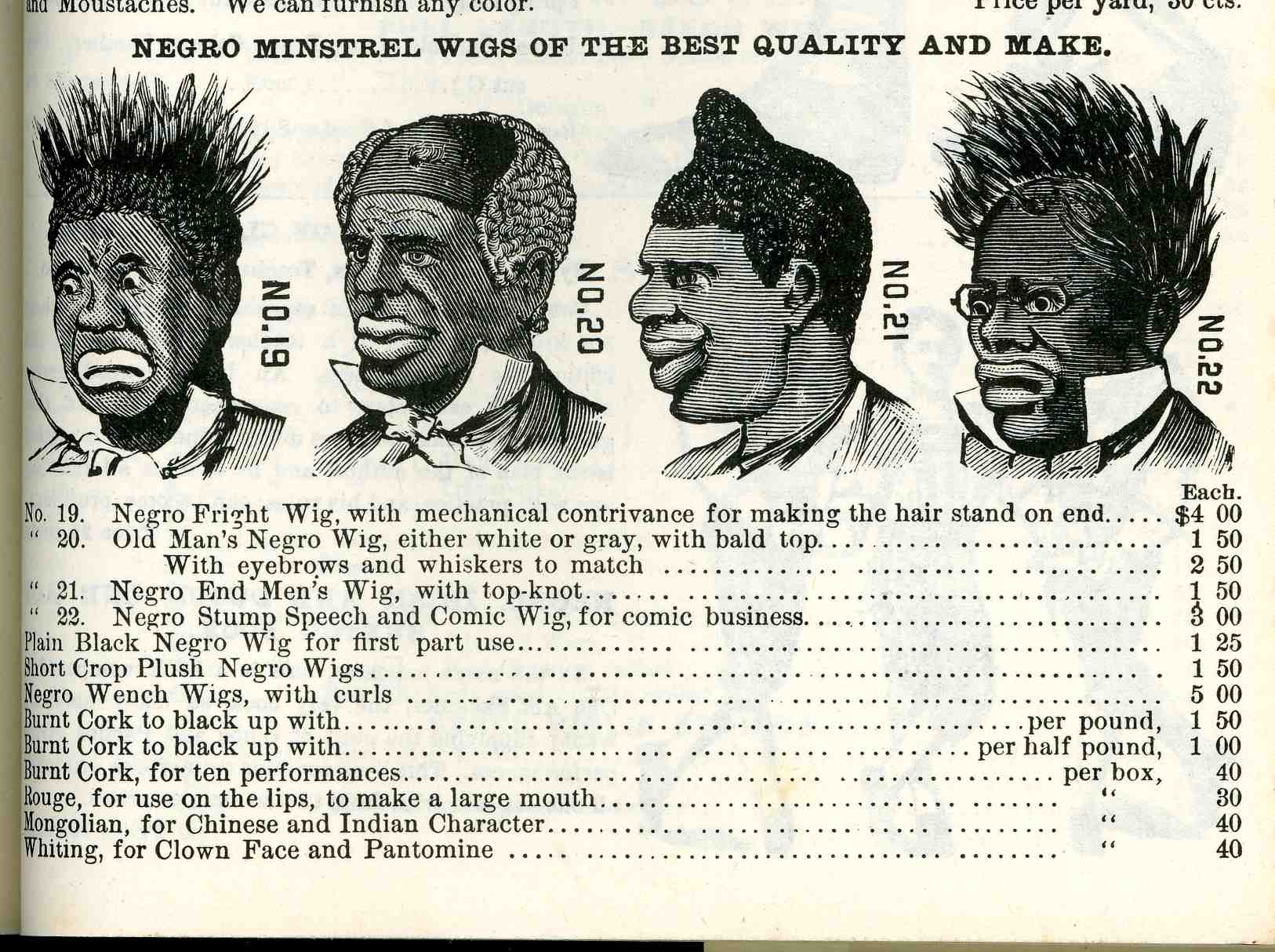
    Leafing my way through a reprint of the Peck & Snyder Out & Indoor Sports and Pastimes Catalog for 1888, looking for baseball equipment and giant bagatelles, I found this stunning advertisement.  I knew of the tragic and long history of this form of “entertainment”, as does everyone, but I must say I never considered the costume end of it.  And here it was.

    The minstrel show, or minstrelsy, appeared as an American invention in the 1830’s–much more so by the early 1840’s.  It depicted  blacks in only the worst possible ways, as shiftless, lazy, buffoonish, stupid, flawed in almost every way, an idiotic race with a musical advantage, relayed in predictable units, accompanied by a developing genre of American music.  The ad here is for the accoutrement of the performers, layers of red rouge and carbon to build on white faces one of the lowest forms of racial archetypes that this country has produced. 

    0 blog jan 21 negro394
    The astonishing thing is that it is just a simple ad in the middle of
    the page of the middle of a catalog for entertainment and sports
    bits–nothing special at all, nothing remarkable to distinguish this
    gaping hole of morality from the games and exercise equipment that
    surrounds it.  And that’s the deep horror of stuff like this, this sort
    of stereotyping that was so lethal and filled with hate, and not making
    a ripple in the awareness of anyone’s sense of correctness: the
    creation of this racial image was so complete that even its most base
    element could appear as an insignificant trifle in a sporting catalog. 

    Even more extraordinary is this ad that appears just a few dozen pages
    later.  “The Enchanted Negro’s Head” was a prop in a magic trick that
    involved drawing a knife across the neck of the black head. “The
    performer takes a small knife and says he will cut the head off”–I can
    imagine the sort of conversation between performer and audience before
    his action is undertaken, getting the audience ready to kill the “Negro
    Head”.  It would not have been pretty.  And that’s not all–once you were done with the “trick” part of cutting off the head, it “(could) be fixed to the top of a walking stick or umbrella….(to) form a great curiosity”.

    These characterizations appeared in uncountable forms in virtually every aspect of social life in this country, finding its insidious way even into something as seemingly innocent as a magic trick. It is the very vast smallness of this racism that make it so terrifically convincing and lethal. Looking at something like this makes me feel the enormous weight of the all that went into the attempted assassination of this race. 

    **My friend Joy Holland–chief of the Brooklyn Room at the Brooklyn Public Library at the Grand Army Plaza in the heart of Brooklyn USA–recently started a wonderful history blog at the library called Brooklynology.  A recent post there talks about a minstrel-related find in their ephemera collection–it is quite interesting; take a look. 


  • Alaska Calls: the Comma King Heads for the Hills. Naive Surreal Collection, Part 9.

    JF Ptak Science Books LLC  Post 478
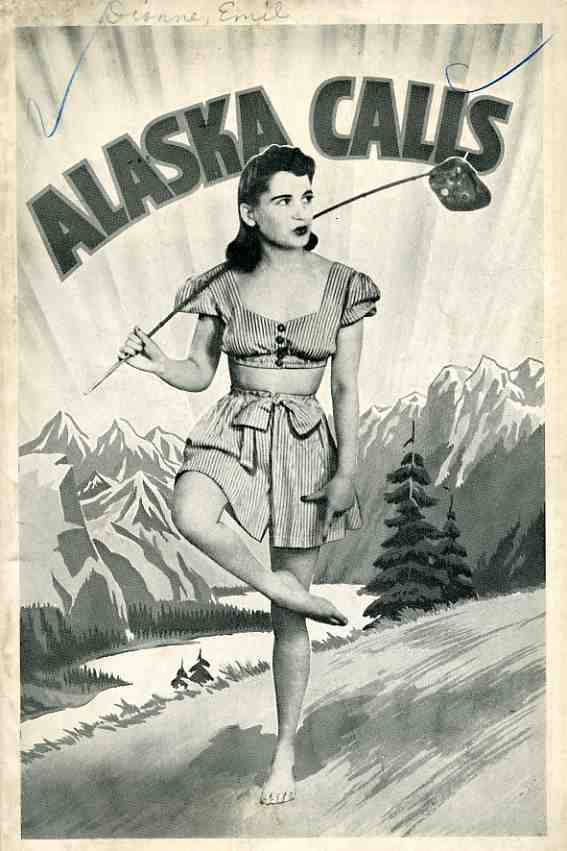
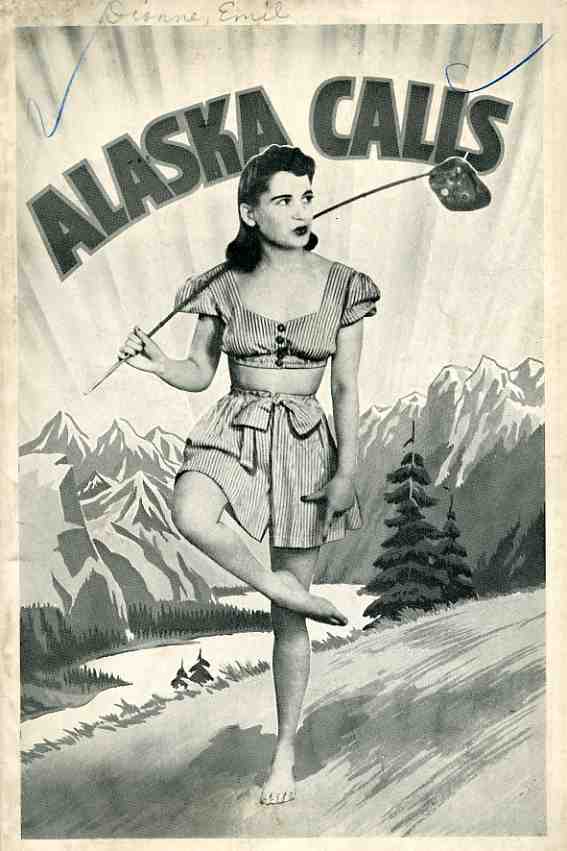
    0 blog jan 20 alaska calls392 So.  I really couldn’t tell what was going to happen in this pamphlet, a fine example from my Naive Surreal collection.  Unfortunately, it is a bit of only a lonely hearts tale, in spite of the monumentally-odd cover of the southern girl with hairy legs and a hobo switch and no shoes and a bare midriff in the wilds of Alaska.  The only thing that the text has going for it in the oddness department–with the exception of being badly written–is the enormous,use,of,the,comma.  I don’t know what the record is for the badly-employed use of the comma might be, but, well, this little story must be making quite a run for it.  In the dedication, for example, which is ten lines and 100 words long, there are 18 commas.  More follow.  Many more. 

    The cover must stand on its own–and it does. 


  • Is Dance Dangerous? The Naive Surreal Collection, Part 8.

    JF Ptak Science Books LLC  Post 477
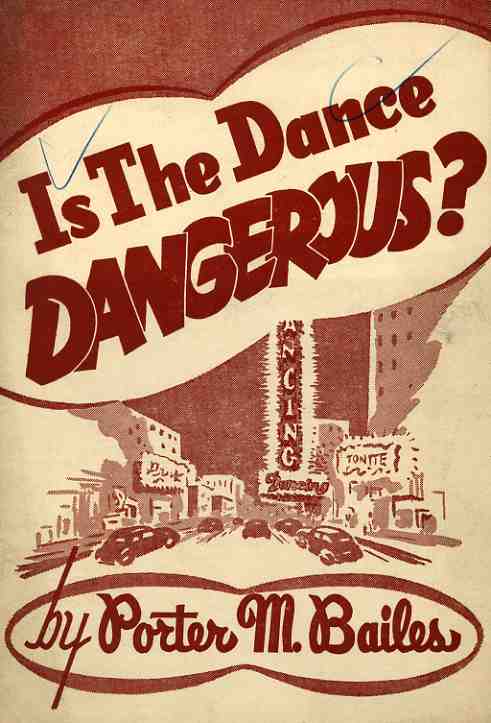
    0 blog jan 20 dance danger391 In the history of questions, this  (“Is the dance dangerous?”) certainly must rank in the bottom tenth percentile.  Or at least I hope it does.  The question is the title of this small pamphlet, written by Porter Bailes (of the First Baptist Church of Tyler, Texas) in 1947, a work which is part of my Naive Surreal collection.  “If it’s doubtful, it’s dirty” is the major maxim that floats it way through this work, and proceeds to attacks it subject of “the”dance on its unholy, immoral, unnatural, imprudent, prayer-defeating nature. 

    “Can any one stretch the imagination as to think of Jesus as being congenial and at ease in the atmosphere that the dance creates? No! Dancing is not to the glory of god. It never made anyone feel the nearness of god.  It robs us of the desire to pray. A dancing foot and a praying knee are not found long on the same limb.”

    And also:

    “There are many fine people who dance.  They are fine not because they dance, but in spite of the dance.”

    And:

    “The dance does not involve any moral requirements.  The more lewd the people are, the more proficient they may become. The gestures of the dance demand lewdness.” 

    Lastly:  “the tine of the dance makes it dangerous. Its hours are unearthly and abnormal”

    And lastly last:  ” The position of the dance make it dangerous.  For two normal people to place their bodies in the close personal contact that the modern dance demands and not have impure thoughts and unholy emotions stirred, would be very unnatural.  In truth, it is against all the known laws of human nature.”

    This is last just for my examples:  there are 20 pages of this.  It is remarkable that, in this highly restrictive and judgmental work,  the paper is allowed to bend. 

    And not to be outdone, the author tells us that 97% of professional gamblers “attribute their habit to the practice of playing cards at home”.  “The risk is too great, young people” Pastor Bailes tells us, “for you to start gambling–even at home”.  He began to warm to this subject but I guess was saving this subject for later.


  • Peasant Utopias and Dreamlands: Medieval Hopes to Big Rock Candy Mountain

    JF Ptak Science Books LLC  476

    800px-Pieter_Bruegel_the_Elder_-_The_Land_of_Cockaigne

    The concept of terrestrial, not-Heaven-bound, un-restricted
    non-religious happiness for working folks not viewed as an abomination by
    Christian churches is a relatively new idea.  
    Fun for the rabbleous masses, stuff happening to the far west of the
    east-entrenched Eden*
    (as in the Steinbeck novel), was generally a no-go so far as institutions such
    as the Catholic church was concerned. 
    Medieval geography of imaginary places where happiness dwells included
    the Land of Cockaigne and the Isle of the Blest, places that represented both wish fulfillment and resentment at the
    strictures of asceticism and dearth.

     The peasantry existed in a state of semi-amicable slavery
    under the  thought- and emotional-control
    of the aristocracy and the church, living in fear of their immortal souls
    dancing in the ring of fire for thinking heathenous thoughts, or persecuted by
    the legal entity for being too immodest. 
    “Fun” was a very expensive commodity, and was seen by The Church as
    being too expensive and rare to share. 
    Fun represented a departure from the routine, an affront to the
    teachings of scripture, a lessening of the control enjoyed by all ruling
    classes.  And so Medieval legends such as
    the Land of Cockaigne, with its promises of unbridled eating and gluttony and
    sexual liberty and disobedience was a direct charge against the established
    distribution of power and wealth, and could not be tolerated.  Fun was kept for someone else.

    0 blog jan 20 thomas more390

    Cockaigne—of Middle French derivation, pays de cocaign,”Land
    of Plenty”—
    was an imaginary
    location and a dream, somewhere that was a total relief to the long grind of
    the peasant life.  It was a place “where
    the
    houses were made of barley sugar and cakes, the streets were paved with pastry,
    and the shops supplied goods for nothing” according to Specimens of Early
    English Poets
    (1790), whose author, George Ellis, reprinted a 13th
    century French poem.  In the Land of
    Cockaigne “roasted pigs wander about with knives in their backs to make carving
    easy, where grilled geese fly directly into one’s mouth, where cooked fish jump
    out of the water and land at one’s feet…The weather is always mild, the wine
    flows freely, sex is readily available, and all people enjoy eternal youth…”
    according to Herman Pleij’s Dreaming of Cockaigne (2001).  Another source determines that  “you must eat your way through a mountain of
    porridge to reach the land of Cockaigne

    …where the
    fences are made of sausages, the geese lie ready-grilled on the plates…” 

    Atlantis and El Dorado might’ve been fancy sounding places
    to a lot of poor people, but Cockaigne must’ve sounded better by leaps and
    bounds—no piles of gold, no great extravagances, just rewards of plenty to eat
    and drink, and sleep, and some sex.  All
    of these promises existed so far beyond the pale of the Church that even
    thinking about a crust’s-worth of such anti-biblical carnage would send you
    straight to hell.  Which sounds
    terrifically strange to me now because the actions here, in Cockaigne, are
    largely passive (though of course hedonistic), and aren’t vengeful, hurtful,
    spiteful.  It is mainly, well, lazy, full
    of sleep-inducing foods. Bittersweet dreams like this formed for themselves a
    basis of pure hate within the church, mainly because it was taken as a threat
    to the core fundamentals of religions at the time.  It should be said that many of the tellings
    of this legend do have their fair share of anti-clerical runs, nun-hunting and
    monk bashings.  Oopsie!

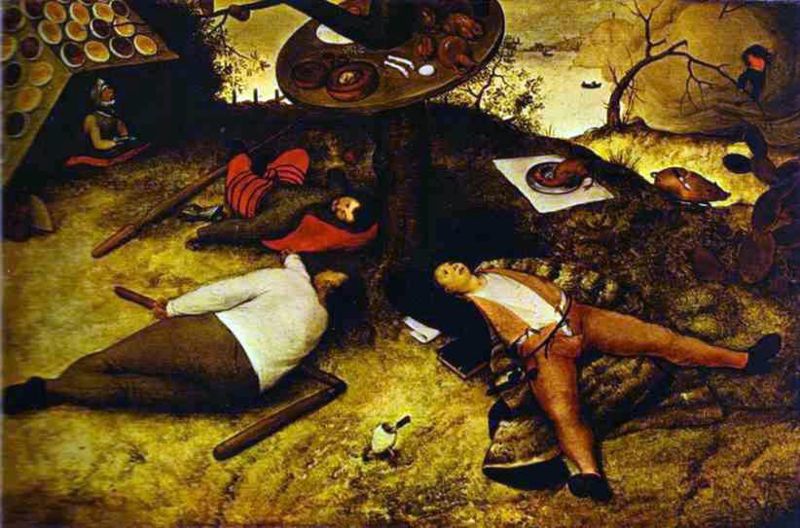
    The Land of  Cockaigne is
    beautifully painted in 1567 by the peasant-dominated mind of Pieter Brueghel the Elder or Bruegel (c.1525 – September 9,
    1569) the
    fabulous  Netherlandish
    Renaissance
    painter.  (In many ways he discovered the common/peasant
    in much the same way as Dickens discovered the working poor of London; of course Brueghel made his discovery
    300 years earlier.  He was also in his
    way a Dickensian for detail:  many of his
    paintings are terrific mélanges of children’s games and folk tales, often
    accurately identifying hundreds of objects of interest in a single work)  He incorporates many of these legends in the
    painting, in addition showing stewed geese flying into open mouths and a
    house-roof made of meat pies.

    The promise of eatable houses and lazy meals and sleeping
    all day to produce evermore profits are many times bounded by rivers of red and
    wine wines, of milk, and of honey. 

    0 blog jan 20 atlantis389

    These are concepts that have existed for hundreds of years
    in different sorts of peasant paradises, not the least of which is the 20th
    century’s contribution of “Big Rock Candy Mountain”, a song composed by Harry
    McClintock (1882-1957). In many ways this song contains the most simple, most
    heartbreaking of the simple wishes of the American hobo of the Great Depression
    era.  The 26 (or so) wants are spectacular
    in their smallnesses and simpleness (see below for full lyrics of the song):

    (1) a land that’s fair and bright (2) handouts grow on
    bushes (3)sleep out every night
    (4) boxcars are all empty  (5) the sun
    shines every day (6) cigarette trees (7) lemonade springs  (8) bluebird sings (9) all the cops have
    wooden legs (10) bulldogs all have rubber teeth (11) hens lay soft boiled eggs (12)
    farmer’s trees are full of fruit (13) barns are full of hay (14) ain’t no snow (15)
    rain don’t fall  (16) the wind don’t blow
    (17) never change your socks (18)little streams of alcohol come a-trickling
    down the rocks (19) brakemen have to tip their hats  (20) railroad bulls are blind (21) lake of
    stew and of whiskey  (22) jails are made
    of tin (you can walk right out again as soon as you are in) (23) no short
    handled shovels,  (24) no axes saws or
    picks (25) you sleep all day (26) they hung the jerk that invented work.

    These wishes are gathered together as follows:

    Food: Cigarettes, lemonade, soft boiled eggs, fruit trees,
    streams of alcohol, land of stew and whiskey

    Geography:  land fair
    and bright, sleep out every night, sunshine, bluebirds, no snow, no rain, no
    wind.

    Social:  handouts grow on bushes, cops have
    wooden legs, bulldogs have rubber teeth, (railroad) brakemen (who would
    normally throw hobos from the trains) have to tip their hats to the hobos;
    railroad bulls (the railroad cops who would be um pro-active and brutal in
    getting rid of the ‘hobo problem” from the trains);  revolving door jails are made of tin; no axes, saws or picks; and finally, no short-handled
    shovels. 

    Personal:  sleeping all day, sleeping out at night, and not changing your socks.  (Not even a whiff of carnal anything.)

    And of course the hanging of the man who invented the whole
    concept of work.

    I think that in all of these simple dreams, the “short-handled
    shovels” one is the most tremendous, and most heart-breaking.  The short-handled shovel is a backbreaker,
    made for working in stubborn, small holes or tight places.  If you needed to use a shovel on something,
    you’d want to use a long-handled one.  Keep
    in mind that the song didn’t call for no shovels—just a decent one that you
    could work with humanely. 

    The song is beautiful and stands for a wide majority of
    thought in the U.S.
    in the troubled 1930’s.  It is also in
    many ways related to the classic peasant utopias and dreamlands—perhaps it is
    just like Cockaigne, just removed 500 years.


  • America’s Greatest Social Export: “We Shall Overcome” and the Importance of Guy Carawan

    JF Ptak Science Books LLC Post 474

    We shall
    Thinking about (really) high explosives for yesterday’s post led me to the American export of arms.  This in  turn led me to
    consider the non-lethal aspects of American exports–specifically, great,
    large-scale  American contributions to
    global society, and about what our greatest non-technical export might be.  (So far as the tech side goes, the most
    important of our exports over the last hundred years or so I would be, I guess,
    the computer—it is basically an American innovation, Charles Babbage and Konrad
    Zuse and a few others notwithstanding. I can’t imagine anything more superior;
    on the other hand, something like “fast food” might be considered, though it is
    ultimately an horrendous blight more than anything else, worldwide phenomenon
    and moneymaker or not.) 

    My candidate for
    this honor of Great American Export is a song:  “We Shall Overcome”. It is  a meme, really, understandable by anyone, anywhere; it meaning universally understood, and it power for gathering people together to fight for the  common good  is  powerful and undeniable.  It  is  a remarkable song, standing for the hope and dreams and  accomplishments of the Civil Rights movement and the vision of Martin Luther King.

    The other candidates that come to
    mind don’t come close to the power, crushing visibility and instantly-attaining
    recognition of WSO.  Free enterprise has
    been mentioned by lots of folks for this honor, but I honestly don’t see how it
    is an American invention—the Brits and Austrians were all over the concept in
    the mid 19th century, so I’m not so sure it can apply.  Perhaps these folks are talking about “virulent
    capitalism”
    , which may be American, and which may again rank quite high on this
    list, but not necessarily so proudly. 
    American Constitutionalism is another idea, as is the concept of image
    and (Martin Amis’) the cool.  Equally significant
    is debt accumulation, which is as interesting as a rash, and the insidious
    post-9/11 Fear, where all of our dreams’ life spans are color coded in segments
    away from oblivion.   Happier and more filling ideas are feminism
    and women’s rights (American only in the last 5- or 75 years or so), which leads to the general appearance of Civil Rights, which gets us right back to where we started, with WSO. In doing a quick mental accounting, WSO trumps all-comers. 

    Guy and candie
    The song’s creation is credited to
    the preacher and songwriter Charles Tindley (1851-1933), the son of a slave, who
    wrote I Shall Over-Come in 1901. The song came to greater life in 1945 as a
    result of a strike against the American Tobacco Company by the Tobacco Workers
    Union. Lucille Simmons, who was a striker, began singing the song at the end of
    the day’s striking activities—it came to the attention of the union’s
    organizer, Zilphia Horton, who was also at the time the musical director (and
    co-founder, with her husband Frank Horton) of the Highlander Folk School (of
    Monteagle, Tennessee. Highlander was started
    in the 1930’s as a place to instruct people how to organize and strike, and evolved
    over time into an extraordinary place of learning (and which was also “stolen”
    and seized by the U.S. 
    government in 1960, but that’s another story). 
    In the hands of Ms. Horton (who tragically died in 1956 at the age of
    46) the song was introduced to Pete Seeger, who published it in
     Bulletin No. 3 (Sept., 1948), #8, in
    1948 in People’s Songs. (Photo at above/right is of Guy Carawan and Cnadie Carawan.)

    Guy-carawan-mlk--1962
    It would take another four years before the song made its first recorded
    appearance. “We Shall Overcome” (changing the “will” to “shall” as in the
    Seeger version) by Laura Duncan and the Jewish Youth Singers (Hootenany
    records).  In 1953 the song was critically
    introduced to Frank Hamilton from Zilphia Horton, and from there to Hamilton’s friend and
    south-swing travelling companion Guy Carawan. (Carawan is seen at left with MLK in 1962.)

    It is in Carawan’s hands that the song , I think, received its most
    important treatment.  Carawan became the
    music director at Highlander in 1959 and re-introduced the song there, the school
    now being principally concerned with civil rights and student activism.  What makes Carawan so supremely important is
    that he traveled with the song and taught it to many groups of the important Student
    Noviolent Coordinating Committee (SNCC); the members of these groups in turn
    taught it to other groups, and so on and so on. 
    Carawan in fact taught the song at the initial meeting of SNCC in Raleigh in 1960, and has
    been credited with his importance by Julian Bond, Pete Seeger and many
    others.  The song is now perhaps the most recognized modern creation in existence, and may very well hold more significance than any other song in recent memory.  It is an anthem of belief, and of hope, and stands for what can be accomplished; it also stands for all of those who have given so much for their beliefs and for the betterment of society–a holy inspiration.
    (Thanks to Jeff Donlan for pointing me to the Mahalia clip on Youtube.)

    [My wife, Patti Digh, and I traveled to interview Guy and Candie
    Carawan a few days ago to talk to them about their lives in social
    awareness and about the song “We Shall Overcome”. To read her article on this experience, visit her blog at 37days.com.]


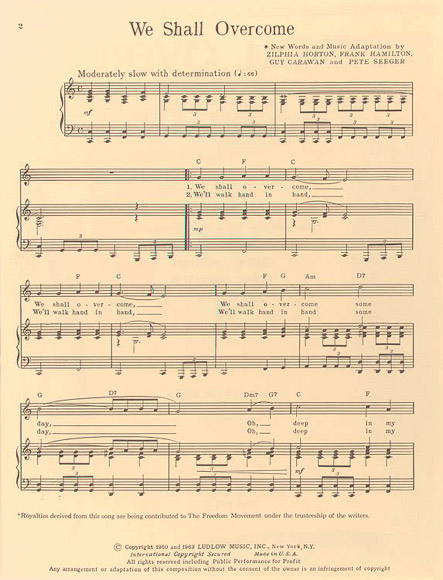
    Note on the WSO sheet music:  the fine print reads as follows:  (copyrighted) by “Horton,
    Silphia; Frank Hamilton; Guy Carawan; and Pete Seeger.. “We Shall
    Overcome.” Ludlow Music, Inc., 1963. Music Division, Library of Congress, Courtesy of
    Ludlow Music, Inc.

    ·Posted by :

    ·in:


  • Really Big Bangs: On Massive Explosions and Billion-Mile-Long Trains Filled with High Explosives

    JF Ptak Science Books LLC  Post 473

    The largest, greatest explosion of all time as time itself, being the Big Bang, as explosion of immeasurable, incomprehensible magnitude.  Among the sub-infinite explosions in deep space, the largest “observed” explosion  was 120 star mass supernova 240 million light years away through the veil of Perseus.

    Nuclear explosions are of course the largest man-made terrestrial explosions, the largest of these being the 50 megaton “Tsar Bomb” exploded over Noveya Zemlga by the Soviet Union—this is known as the Father of all Bombs.  (The Soviets were making these enormous bombs to make up in destructive capacity and real estate damage for what they lacked in missile control—they couldn’t match the accuracy of the American weapons, so they developed bombs big enough so that the accuracy factor fizzled away by sheer nuclear tonnage.)

    I guess though that the largest explosion is yet to come, not in the Rapture but in the Rupture:  the possibility that a meteor will at some time strike the earth.  A massive mass 30 kilometers across, say, hitting at the wrong place at a high speed could cause a Pacific-ocean sized disruption in the surface of the planet, the result being something like 150 trillion tons of explosive.  I’m not sure how to illustrate this sort of tonnage, except that it might be something on the order of filling up the Manhattan skyline with TNT and blowing it up.

    [ NOTE:  I just found the memory that produced that last statement.  In The Loom of God, Mathematical Tapestries at the Edge of Time, published by Plenum Trade in 1997), author Clifford Pickover thinks about craters and impacts of asteroids and such, calculating that an asteroid with a diameter of 20 km arriving at Earth at 40 km/sec would leave a crater size of 439 km (!) and have the equivalent power of 140 billion Hiroshima bombs, which would be about 20 of these bombs per person for everyone on the planet.  The hole would be about the width of New Mexico, and have the equivalent firepower, as Pickover points out, of a coal train filled with high explosives that was 1.4 billion miles long.]

    The more non-nuclear terrestrial explosions:

    In 2005 the Hertfordshire Oil Storage Terminal fire resulted in the explosion of 60,000,000 imperial gallons;

    In 1985, the Defense Military Agency introduced the   Minor Scale and Misty Picture explosions, which used 4744 and 4,685 short tons of ANFO, with a yield of about 4 kiltotons of TNT.

    Texas City, Texas just about exploded in 1947 when the SS Grandcamp, loaded with 8,500 short tons (7,700 t) of ammonium nitrate (the equivalent roughly of 2.7 kilotons of energy) exploded in port (killing  581 and injuring over  5,000).

    Also in 1947 was the Heligoland explosion, a 3.2 kilotons explosion of 4,000 long tons of WWII surplus ammo.

     A 2.9 kt TNT explosion resulted from the collision of the SS Imo and the SS Mont Blanc in the harbor of Hallifax; the Mont Blanc carried 2,653 tons of explosives, including picric acid, killing 2000.

    A miserable social tragedy took place in 1944 in Chicago (at the Port Chicago Naval Magazine) where questionable procedures of offloading munitions from a  naval ship resulted in an explosion equivalent to about 1.8 kt, killing 320 sailors and civilians, most of the sailors being African Americans performing a task that was probably all screwed up.  Just a month later a similar procedure was being undertaken, the Black sailors, this time refusing to participate and carry out what they saw as needlessly dangerous order, the result being the court martial of the 50 sailors (Port Chicago 50).

    Some Bits in the Chronology of the Detonations of Nuclear Weapons (of the 2000 or so that have been used or tested in the last 54 years):

    1945-07-16 Trinity, (USA) First fission device test, first plutonium implosion detonation

    1945-08-06 Little Boy 15 kt (USA) Bombing of Hiroshima, Japan, first detonation of an enriched uranium gun-type device

    1945-08-09 Fat Man 21 kt  (USA) Bombing of Nagasaki, Japan

    1949-08-29  RDS-1 22 kt (USSR) First fission weapon test by the USSR

    1952-10-03 Hurricane 25 kt (UK) First fission weapon test by the UK, Montebello Islands, Western Australia

    1952-11-01 Ivy Mike 10,400 kt (USA) First “staged” thermonuclear device test, not meant to be a deployable weapon

    1953-08-12 Joe 4 400 kt (USSR) First fusion weapon test by the USSR (not “staged”, but deployable)

    1954-03-01 Castle Bravo 15,000 kt(USA) First deployable “staged” thermonuclear weapon using dry fusion fuel; fallout accident

     1955-11-22 RDS-37 1,600 kt (USSR) First “staged” thermonuclear weapon test by the USSR (deployable)

     1957-11-08 Grapple X 1,800 kt (UK) First (successful) “staged” thermonuclear weapon test by the UK

     1960-02-13 Gerboise Bleue 70 kt  (France) first fission weapon test by France

     1961-10-31 Tsar Bomba 50,000 kt USSR Largest thermonuclear weapon ever tested.

     1964-10-16 596 22 kt (PR China) First fission weapon test by the People’s Republic of China

     1967-06-17 Test No. 6 3,300 kt  (PR China) First “staged” thermonuclear weapon test by the People’s Republic of China

     1968-08-24 Canopus 2,600 kt (France) First “staged” thermonuclear test by France

     1974-05-18 Smiling Buddha 12kt  (India) First fission nuclear explosive test by India

     1998-05-11 Shakti I 45 kt  (India) First potential fusion/boosted weapon test by India 

     1998-05-11 Shakti II 12 kt (India) First deployable fission weapon test by India

     1998-05-28 Chagai-I 9–12kt (Pakistan) First fission weapon test by Pakistan


    ·Posted by :

    ·in:


  • Portraits within Portraits: Found sub-Images in WWI Photography

    JF Ptak Science Books LLC

    0 blog jan 12baker374

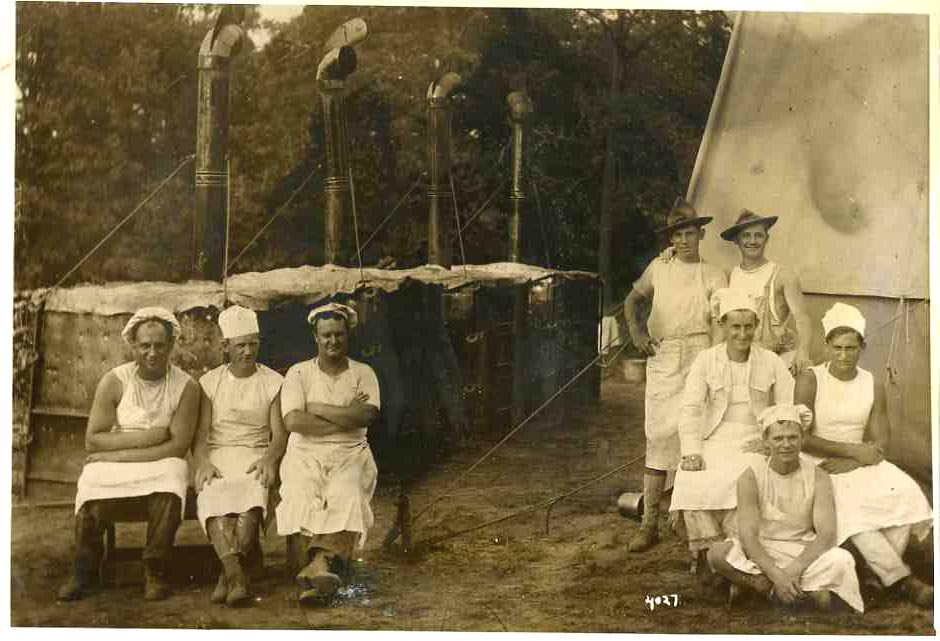
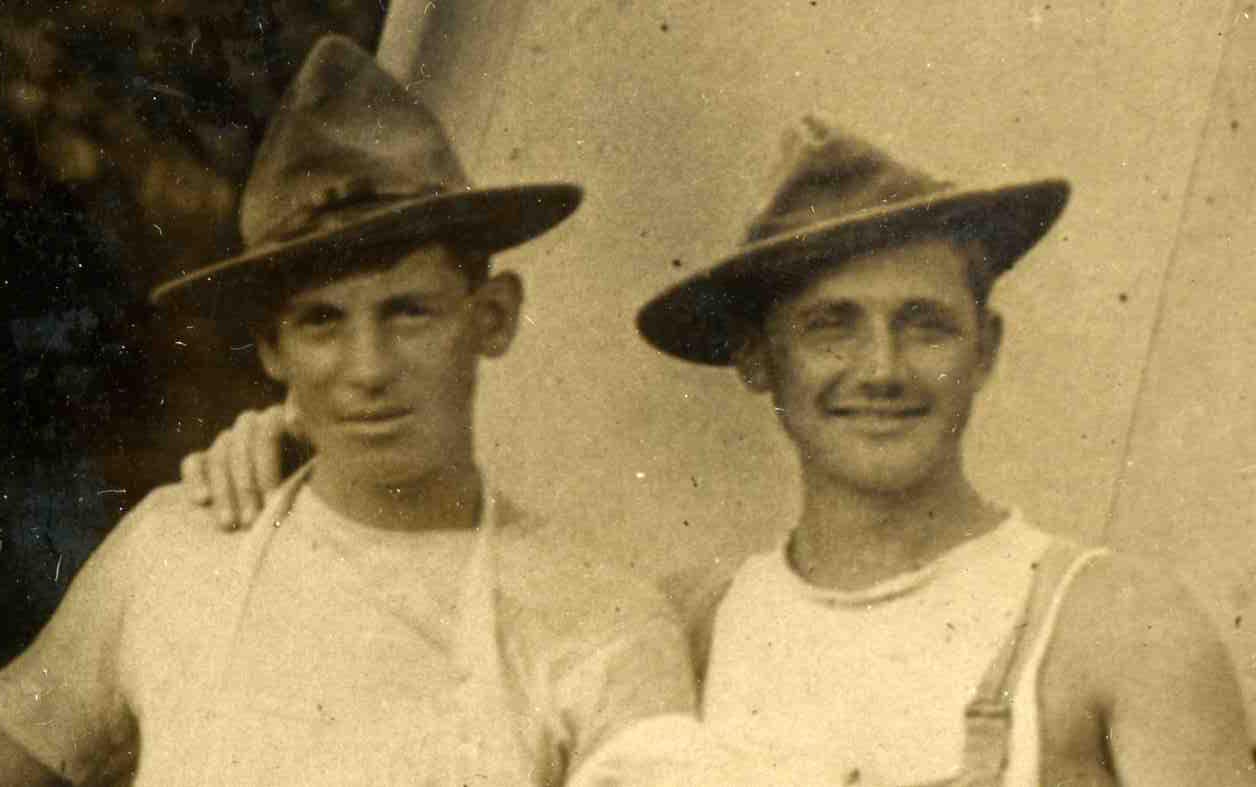
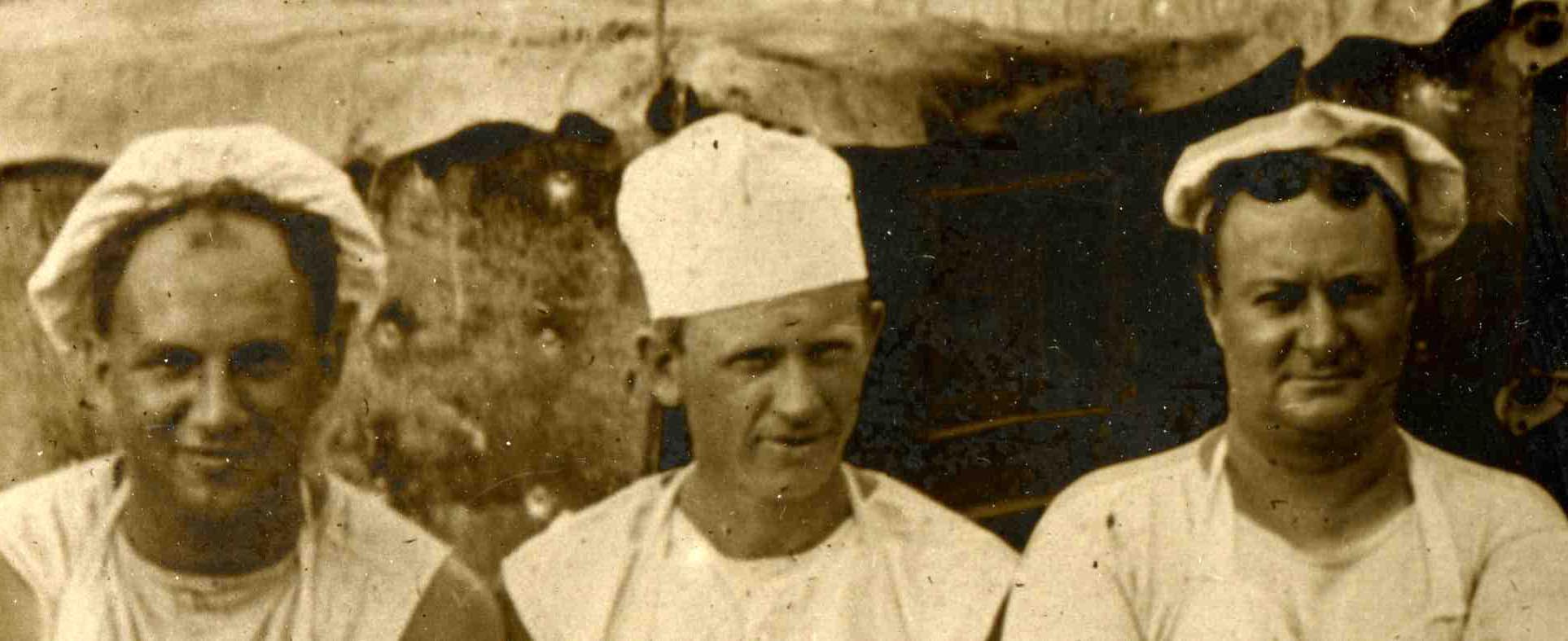
    In my collection of WWI News Photo Service Agency photographs I would say that half or so of them show  scenes like this–semi-informal group portraits of military support groups.  500 portraits like this seem to be a lot, and I’m not sure why these images are so well represented. Except of course that there weren’t that many images (overall) of active-battle scenes. 

    These bakers, working at a front-line support station, from my read were probably taking a break, and the photographer took the opportunity to draw them together for the portrait.  I don’t know why they’re separated so, but they do look as though they have a real camaraderie–it is just a wonderful picture, full of friendship and loyalty, and I’m sure it has never been published before.  

    0 blog jan 12baker375

    0 blog jan 12baker376


  • Great and Unbuildable Department: Floating a Missing Manhattan (1975)

    JF Ptak Science Books LLC  Post 470

    “Heard melodies are sweet, but those unheard
    Are sweeter…” John Keats,
    “Ode on a Grecian Urn”

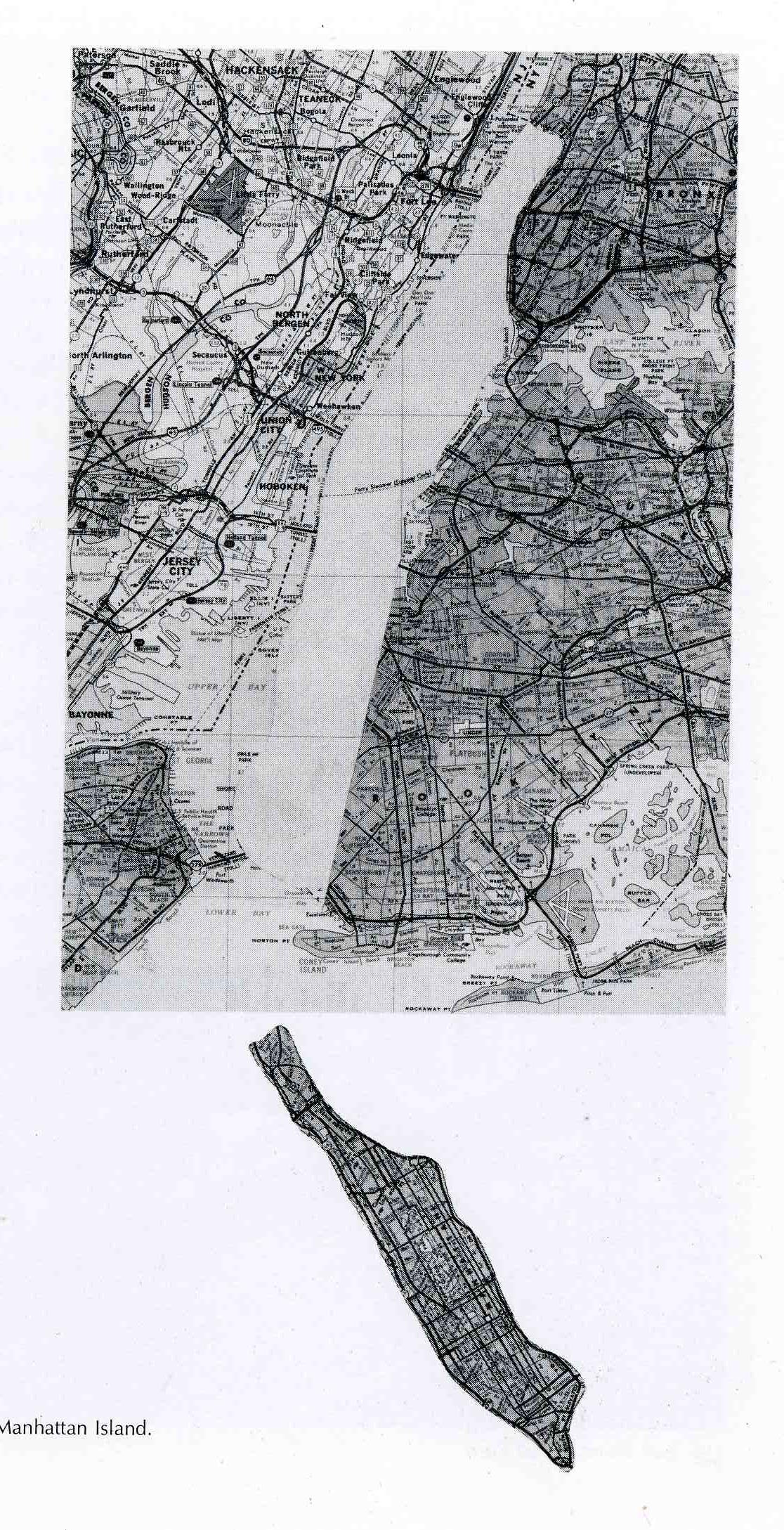
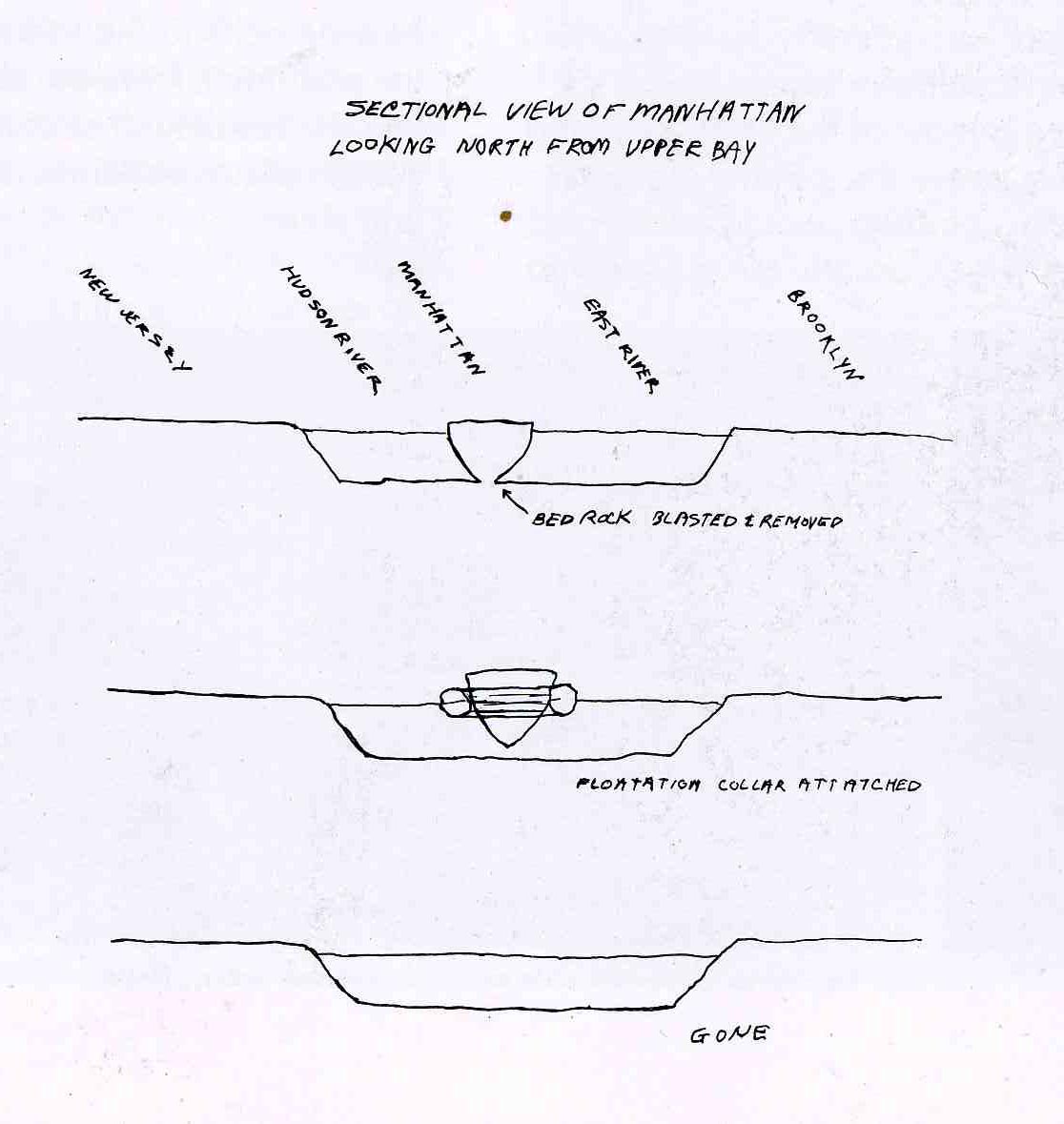
    0 blog jan 16 manhattan386 Agreeing with Mr. Keats or not, Robert Grosvenor had a delectable and memorable idea for a project in 1975:  testing the sea-worthiness of Manhattan island.  Grosvenor (b. 1937) was a well-known kinetic sculptor in Manhattan by the time of his detaching-Manhattan idea.  I found the summary of his project in Unbuilt America, by Alison Sky and Michelle Stone, of SITE, Inc. (seventh in a series called ON SITE), and published in 1976.  The book is a treasure trove of the unbuilt and the unbuildable, or the undoable, or the unnecessarily unattainable, though Grosvenor’s part in this book is clearly one of the very few who did not (really) take his/her project seriously.  I do though like the simplicity of the presentation of the project, right down to the “Step 2” of preparation, which was the umbilical snipping of the bedrock of Manhattan and the attachment of the “flotation collar”, which, I guess, would allow it to be moved around so long as flotation devices were attached. 

    I’m not sure, but I don’t think that Manhattan ever learned how to swim.  I’m also not so sure about where Manhattan would “go”,exactly; but what would it matter, since the people living in Manhattan were already where they wanted to be?

    0 blog jan 16 manhattan387


  • The Thin White Line: Concrete Ribbons as the Answer to the Air Raid Problems of London (1938)

    JF Ptak Science Books LLC   Post 469

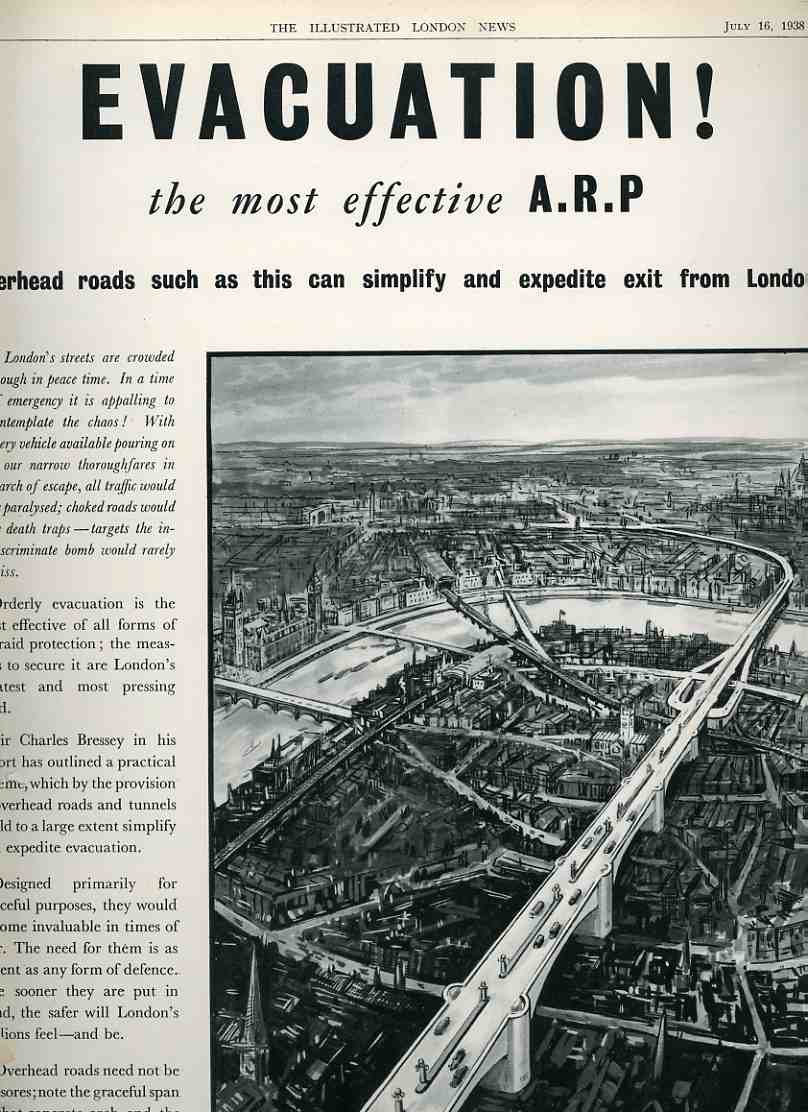
    0 blog jan 07 evacuate london365The Illustrated London News for 16 July 1938 was screaming at its readers–14 months away from the British involvement in WWII–that the MOST EFFECTIVE form of ARP (air-raid protection) was via the evacuation of London.  And of course what the “article” meant was the orderly evacuation of London, as decentralized evac during a crisis (i.e. bombing) would be an “appalling” and chaotic mess.  

    The answer was elevated highways. 

    The reader was told that “the cost of such roads will necessarily be high”, but the high ticket price wouldn’t be quite as bad as tearing down buildings and widening streets through central London.  The tearing/widening idea is so original and so shockingly bad I don’t know what to say, if there was actually anything to say at all.  But then it is second only to the idea of building elevated roadways for evacuation purposes–road that look from the picture like they were four lanes wide.  These roads would have “the additional merit that under them the traditional appearance of London can be maintained unimpaired”.  Stress that part about the appearance “underneath”.  Not only that, the heartbeat of London evacuation=, these elevated roads, were evidently immune from bombs themselves; or at the very least nothing is mentioned about these roads being targets in themselves.  One bomb, one hit, one severed artery. (Looking back through the Bad Ideas Department I see Buckminster Fuller’s tragically goofy idea for building a mile-high dome over midtown Manhattan that was “radiation proof”…he didn’t say anything about it being impervious to actually being the direct target of a nuclear weapon, though.)

    Generally when ideas are this terrificly bad there is usually a reason for it, a reason that transcends logic and honest coherent thought.  And that reason in this case was money. 

    At a time when Nazi Germany was bursting at the seams for more people to fight and for  nations to devour, when there was a true and real fear of London being a target of German bombs, this simple and weak and strategically indefensible solution was proposed by one large and interested party.

    The “article” is signed by the Cement and Concrete Association of Grosvenor Gardens, London.  And thus all is clear.