A Daily History of Holes, Dots, Lines, Science, History, Math, Physics, Art, the Unintentional Absurd, Architecture, Maps, Data Visualization, Blank and Missing Things, and so on. |1.6 million words, 7500 images, 4.9 million hits| Press & appearances in The Times, Le Figaro, Mensa, The Economist, The Guardian, Discovery News, Slate, Le Monde, Sci American Blogs, Le Pont, and many other places… 5000+ total posts since 2008.

Author: JF Ptak

  • Steampunk InnerNaughts of the 19th Century

    JF Ptak Science Books   Post 1743

     These creations weren’t so much about exploring the innerEarth than they were about surviving in the outermost, shallowest bits of its depth.  Survival gear for The Great Unpleasantness in disastrous adventures at sea was relatively scant for hundreds of years, although the nineteenth century did offer a number of new, Victorian technolust attempts for survival-at-sea.  

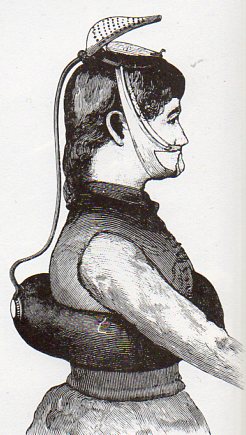
    I know that this first contrivance in some of its particular parts looks enormously compromised, but really the stuff attached to the woman’s head just allowed her to breathe about 10 inches higher than her mouth, though it seems to me that this air-catcher might catch more water than anything else.  Still, it was an interesting attempt at keeping people floating above the water when in peril.
    Innernaughts340In general though it seems to me that most of the big adventures in wearable life saving devices were big indeed, big and heavy–if there was just a little more room for a small engine, wed’ be in the Steampunk realm, as can be seen in this magnificent attempt by T. Beck in his 14 March 1876 patent:

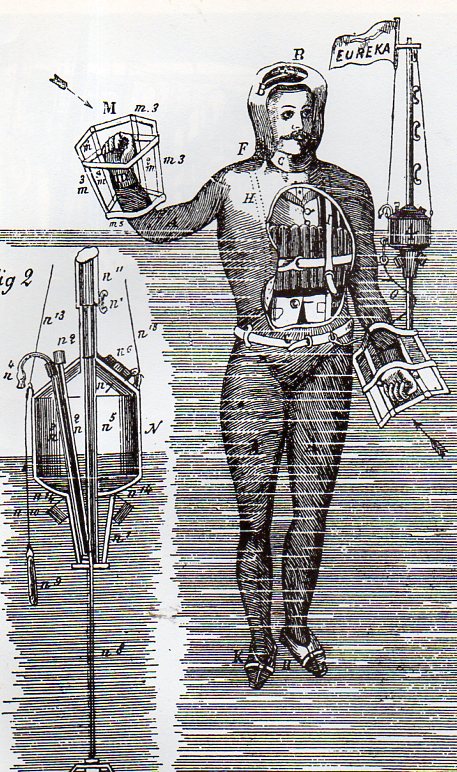
    This was somehow an improvement over a more complicated but still more sensible device that appeared earlier in 1869, the work of Captain John  Stoner.  He exhibited his creation in NYC off the piers in the East River as demonstration of the suit’s effectiveness, the whole of which was big news, appearing in the July 17, 1869 issue of Scientific American.  The suit was made of rubber, and was insulated and was equipped with a personal buoy which carried a “Eureka” flag and had a compartment filled with food, water, lighting materials, cigars, and of course reading material to help pass the time.  The hand-flippers on the other hand look like a very good idea. 
    Innernaughts339

    A more streamlined idea of the Stoner suit appeared in F. Weck’s patent application of 24 October 1876, again using a rubber suit, but this time the safety device was far less cumbersome, and equipped with little more than an interesting-looking breathing apparatus connected to a towed buoy which of course flew the American flag.

    Since I mentioned the possibility of cigars in the above-mentioned case, I should also point out that it took several decades for someone to patent a waterproof case for swimming with cigarettes, “in case the swimmer wanted to swim out to some rocks and then relax with a cigarette”.

    G. & C. Palmer came forward with another unusual idea in their 11 November 1873 patent, using chess-like figures to pus their idea of an expanding/collapsing life preserver vest, which would move in rhythm with ocean waves and theoretically protect the wearer from being overcome by bad swells.  I have my extended doubts about this one.

    Most of the patent applications that I’ve looked at tonight seem to lake one critical element–locomotion. Of course they’re assuming that the life vest is doing little more than keeping the wearer from drowning (though sometimes comforted with cigars and flags). A. McDonald went a little further with his invention (patented 17 January 1882) by putting a screw propeller on the belly of his life vest. It all looks very heavy and sinkable.

    F. Vaughan continued on the idea of a big, heavy wetsuit preserver by making his even bigger and heavier.  This 1879 creation looks to have about 10 inches (or more) or rubber in the suit, which means that if the thing wasn’t water-tight, and that if even a very slight leak developed, the wearer would no doubt sink like a stone. 

    A. Traub (in 1875) created something that was much less bulky and more accessible, a sort of unfolding life vest, that seems really not to do much of anything, but which was at least light:

    E.H. Brown (in 1884) had a somewhat different approach to the “life-saving” idea, turning the survival bit into a bucolic if ungainly adventure/romp device for the vacationer on the coast–the “hammock canoe”:

    \

    Though as cumbersome as this device seems it is quite in step with its contemporaries, at least so far as in being not-very-usable goes:

    And somewhere in all of this was the occasional good-looking idea that evidently got caught in the undertow of the heavier/punkier outfits–but in them you can see the beginning of the idea that would eventually work:


  • Early & Satirical Poetry on Evolution–1862

    JF Ptak Science Books   Quick Post

    “The Gorillas Dilemma”, 1862.

    This poem, which appeared in the London Punch in October 1862, three years after the first edition of Darwin’s On the Origin of Species,  addresses the confrontation between Richard Owen and Thomas Huxley (and by extension, of course, Charles Darwin).  Owen had earlier attacked the Origin in an anonymous review in the Edinburgh Review (volume 111, page 521, 1860), and Thomas Huxley, of course, who was one of the earliest and who became the greatest of Darwin’s “disciples” (and known as “Darwin’s Bulldog”).

    Owen wrote with a very heavy and dark pen, in 1860:

    “To him, indeed, who may deem himself devoid of soul and as the brute that perisheth, any speculation, pointing, with the smallest feasibility, to an intelligible notion of the way of coming in of a lower organised species, may be sufficient, and he need concern himself no further about his own relations to a Creator. But when the members of the Royal Institution of Great Britain are taught by their evening lecturer that such a limited or inadequate view and treatment of the great problem exemplifies that application of science to which England owes her greatness, we take leave to remind the managers that it more truly parallels the abuse of science to which a neighbouring nation, some seventy years since, owed its temporary degradation. By their fruits may the promoters of true and false philosophy be known.”

    Tough stuff.  And Darwin took it personally and seriously, absorbing the blows against himself (and his supporters, especially Huxley and Hooker), as well as the spurious and ethically-challenged mistaken assertions that Owen tricked out in his piece.  “It is painful to be hated in the intense depth with which Owen hates me” Darwin wrote a few months later  (Darwin Correspondence, volume 8, April 1860, page 154.)

    Huxley and Owen would have it out over the years (though Darwin himself would not partake due to illness and such, preferring to respond through written help to Huxley and others).

    And so the poem:

    ” (To Professor Owen & Huxley)

    SAY am I a man and a brother,
          Of only an anthropoid ape?
    Your judgment, be ‘t one way or ‘tother,

    ·Posted by :

    ·in:

    —

  • Blank, Empty and Missing Things: Stone and Wood

    JF Ptak Science Books   Post 1742  [Part of the series on Blank, Empty and Missing Things.]

    Ogardus335
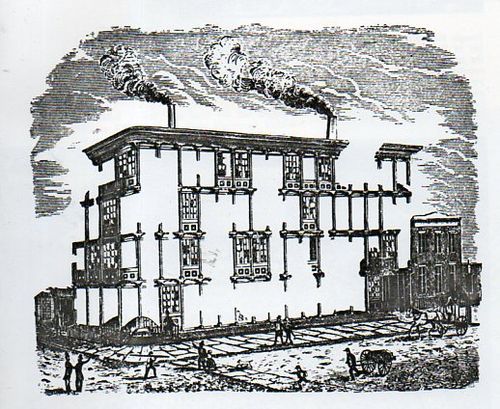
    This short post is about this remarkable illustration from a 16-page pamphlet by the inventor, architect and cast tion pioneer James Bogardus (1800-1874, Cast Iron Buildings, their Construction and Advantages, 1856 and 1858 second edition). 

    But before I get to that, I started to wonder about why it was that NYC developed up rather than out, vertically rather than horizontally? There was plenty of room for outward growth–and in mid-1850’s, the period that this post addresses, most of the city had already been laid out, or at least up to 96th street.  But in the city of about 900,000 people, there were few people living that far north (and not that many structure), with half of the population living below 42nd street.  So, the largely flat, largely unoccupied island could well have been developed northward rather than skyward.  My feeling is that the reason for vertical development was “running”.  That in the pre-telephone days and the earliest days of electrical telegraphy, that in order to conduct business rapidly messengers were used to take documents and communication back and forth. And so for the sake of speed of business, rather than have messengers traveling for 20 or 40  or 80 minutes to a more-removed uptown location, that it made more business sense to keep businesses together; and to do that on limited land, one needed to go up.  Not out.  I’ve never thought about this, ever, but this seems to make sense to me…

    Now, getting back to the Bogardus illustration: what was missing was the building, or the pieces of the building that had previously been thought of as being absolutely essential for a structure of this size to maintain itself.  But what Bogardus had done was to figure out a way of using cast iron rather than other building materials–a building tool that was stronger and with greater engineering chops than anything else that had been previously seen, which meant that there were different forces at play in structures using it, and which meant therefore that even though there were large pieces of the building’s shell that were “missing”, that this structure could and would still stand.  It was a fabulous way of communicating a new idea. 

    What happened with the Boagardus idea is that it developed into the use of steel-framed buildings, which made for very light, very strong structures, which led to skyscrapers, which led to modernity.

    The Harper Brothers building (built in 1854 at 331 Pearl Street) was an iron-facade building that was engineered by Bogardus (with the architect John B. Corlies) and was built in response–and partially as a safe, fire-proof building–following the devastating fire (and enormous liability payout) in the previous Harper building.  One thing that was certainly different in the face of this building–owing to the efficiency of the cast iron, there could be plenty of windows in place of where there used to be building materials.  And there was certainly plenty of glass in the Harper building.

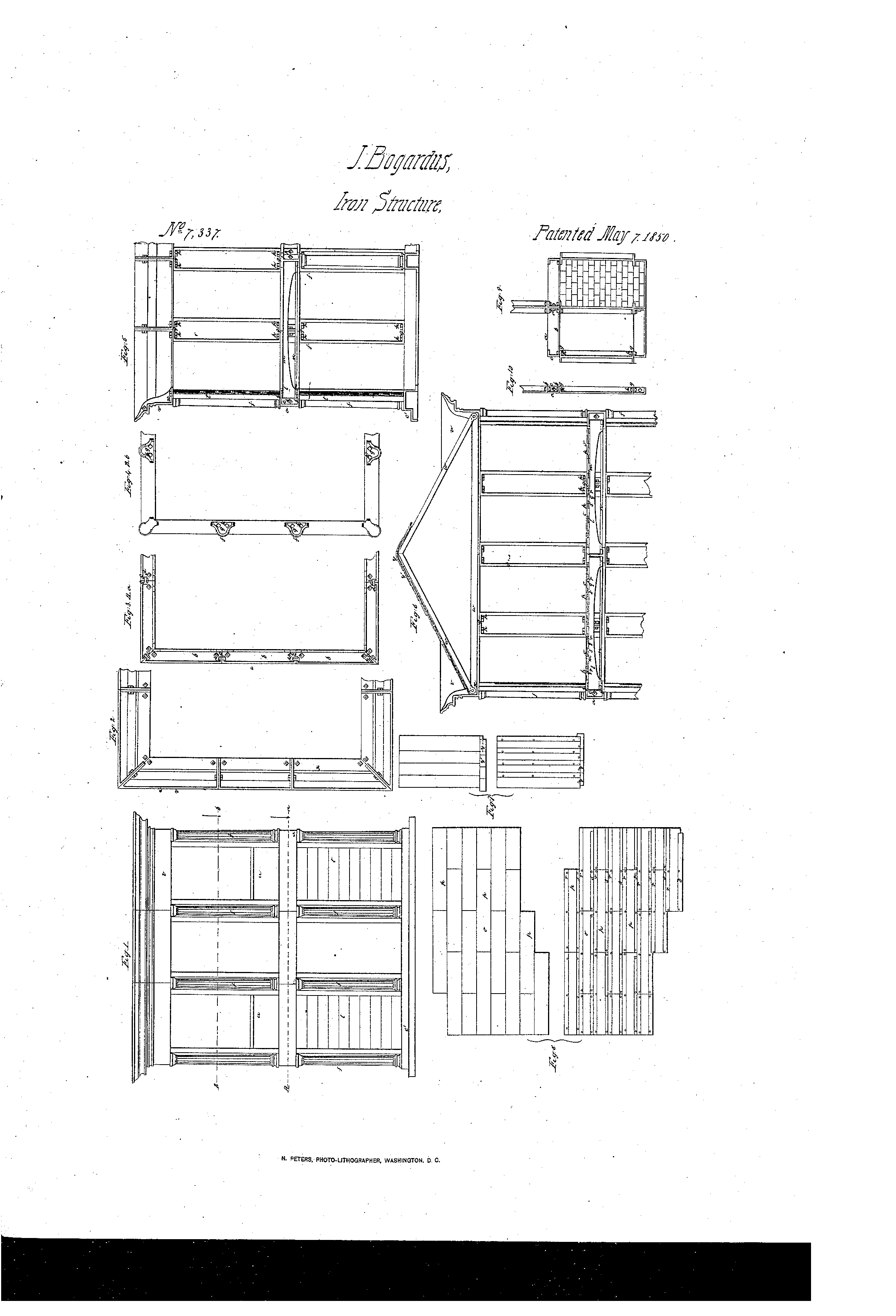
    Bogardus patent

    [Patent source: the very easily usable Google Patents, much more nimble than the UST&PO, somehow.]

    The trip to modernity didn’t necessarily start here with Bogardus of course, but he was a considerable and significant chunk in the engineering developments necessary for the construction of tall buildings…and here it is interesting to note that another big piece of that development that came into being at nearly the same time (1854) as the publication of Bogardus’ pamphlet and the construction of the Harper building was the installation of Otis’ safety elevator int eh Haughtwout (five storey) store. And of course the elevator was necessary for the creation of tall buildings, just as the invention of the braking systems was essential for the creation of the elevator. And on the story goes. 

    The Bogardus achievement (patented May 7, 1850) was certainly an important step–it was pragmatic, efficient, and strong, and also led to the possibility of mass production and pre-fabricated structural elements.  And for the mid-1850’s, this was certainly a big deal.

    One of the few remaining Bogardus structures, at 254 Canal Street, today:

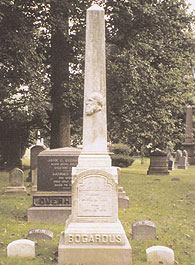
    And the Bogardus monument in the famous Green-Wood Cemetery, in Brooklyn:


  • The Underground Memory Vaults of Harper & Brothers, 1855

    JF Ptak Science Books   Quick Post  [Part of the History of Memory series.]

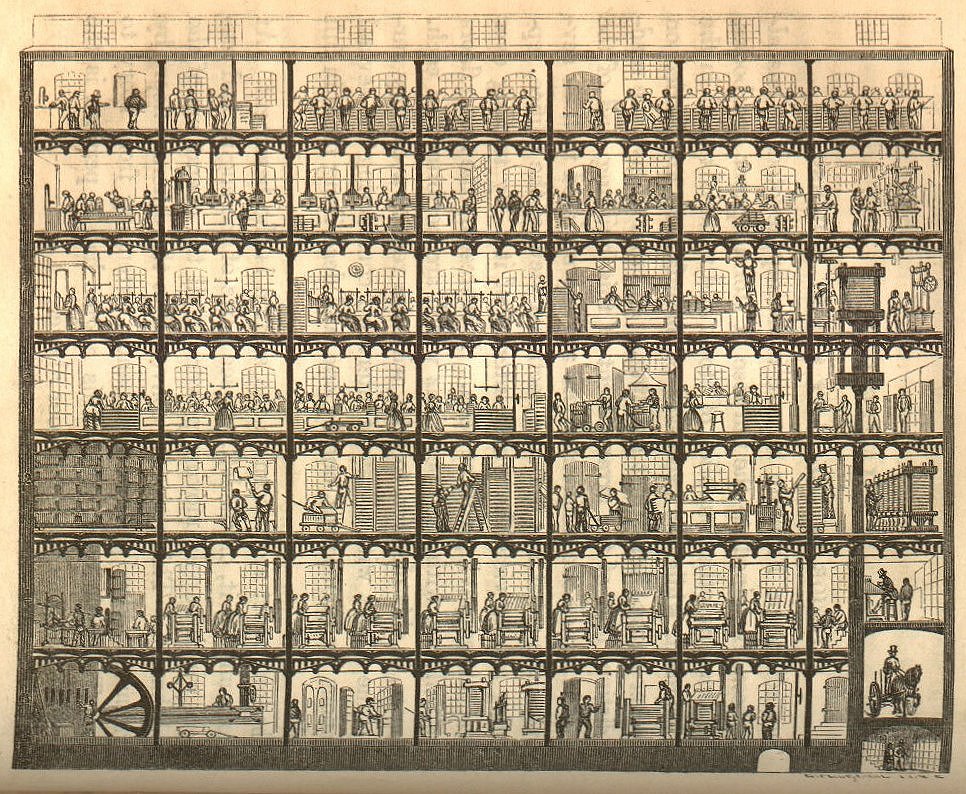
    I found this fantastic cross-section of the Harper & Brothers publishing house in Jacob Abbott’s The Harper Establishment, or, How the Story Books are Made, published of course and thankfully by Harper in 1855, and found in its entirety here

    Sectional view of the Cliff Street building.The whole of the enterprise is explained on pp 43-49 (here).  I’d really like to return to this image at some point, because there are more detailed engravings in the book to match every section of the building, and to me it looks like this image could be turned into a 19th Century Printing and Publishing Board Game.

    What I was interested in right now was the box on the extreme bottom-right, which turns out to be The Vaults–this is the central memory core of this publisher, a 200-foot-long, 8×8′ corridor lined with the original plates for all of the publications of the firm.  The plates for their single-volume version of Herman Melville’s Moby-Dick would’ve been put down there just a few years ago. 

    Interior of the Vaults.

    “The plates are stored in subterranean vaults built under the streets that surround the building. The entrance to these vaults has already been shown in the sectional view of the Cliff Street building, on page 42. A more enlarged view is shown on the preceding page. The vaults extend under ground for two hundred feet in length, and in dimensions are eight feet wide by eight feet high. They are shelved on both sides, and the shelves are loaded with plates–stereotype or electrotype–representing all the works published in the establishment. There is one plate for every page of every one of the many hundreds of volumes which the house publishes, making from fifty to seventy tons in all.”

    “When a new edition of any book is required, the plates are brought out from these vaults and put upon the presses. When the work is finished, they are taken back again to the vaults.”


  • Battlebots of the First Mobile Computers: 20 Tons of Fun

    JF Ptak Science  Books      Post 1741

    Well, perhaps not “fun”, unless that was an acronym for “fabulously understated nomenclature”.   The first mobile computers–as science fiction-y

    The Mobile Digital Computer was intended to be a transistorized van-mounted computer used to store and route data as part of the U.S. Army’s Fieldata system.  The machine was indeed built and deployed by 1959–as were the MOBIDIC A,B,C,D,E and 7a by the early 1960’s–and it was a successful component, even though the overall network was not successful.  Fieldata was supposed to integrate all manner of information and distribute it to battlefield recipients. My friend (Dr.)  Carl Hammer (1914-1904), who I knew from being in the neighborhood in Georgetown, was a delightful man who had long and significant history in the development of the modern computer.  He told me one afternoon–stopping in to visit on his constitutional–in his sly and amusing way about working on the MOBIDIC while he was at Sylvania. (He had just finished heading up Remington Rand’s UNIVAC European Division before going to Sylvania.) Anyway he started his story about the MOBIDIC by telling me that it was the world’s first portable computer (sitting in a 42-foot-long semitrailer) and that it had gun racks.  The reason for the gun racks was simple–if something was made by the U.S. Army, and it had wheels, then it had to have a gun rack.  Case closed.

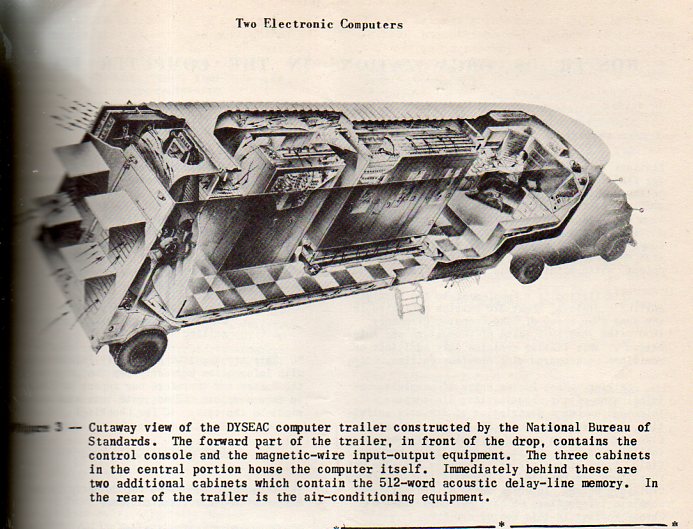
    Now, to the contender, the “other” first mobile computer, the DYSEAC on its computer trailer.   Most of what I have read places the MOBIDIC with priority, but others clearly place the machine in operation in 1954, years before the MOBIDIC became operational.  In any event the DYSEAC was the Second Standards Electronic Automatic Computer, a first generation National Bureau of Standards computer built for the U.S. Army Signal Corps. Here’s the cross-section cutaway for it:

    Dyseac334

    And so on to the battle between the two, outfitting them perhaps with crunching and sawing devices, metal biting bits, and so on, I wonder which might be the one to come out on top?  I think I’d like to claim the MOBIDIC, if for no other reason than it was armed.  And the name, of course.

    ·Posted by :

    ·in:


  • Flying Mountains of the Diseased Dead: Offensive Weapons and the Black Death

    JF Ptak Science Books   Post 1740

    It is generally conceded that the introduction of the Plague1 into Europe in 1348 had its very terroristic beginning in the Genoese trade and port city of Caffa, the result of a series of various sieges and bad blood between them and their Mongol hosts.

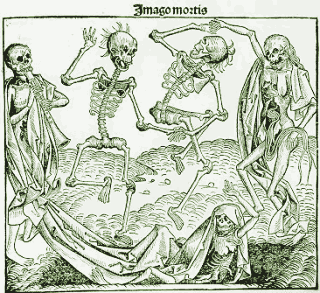
    Holbein-death


    The background to this confrontation is pretty extensive, with sieges laid to Caffa several times over a hundred year period.  The Genoese established themselves at Caffa (which today is the city of Feodosija, Ukraine) via and agreement with the Kahn of the Golden Horde (the remnants of the Mongol Empire of Genghis Khan), which was a seaside link that reached across Russia and into the Far East.  The city was besieged in 1308 due to diplomatic/trade/ethnic etc. unpleasantnesses, and the Genoese wound up firing and evacuating the city, only to be invited back again in 1312 with the acceptance f a new Khan.  A major city developed which by 1343 consisted of two concentric rings of fortress protecting a diverse population of 20,000.  But it was in this year that the second siege began, lasting four years, with the Genoese (having access to the sea and supplies and new military input) finding themselves with a string of victories against the Mongols.
     

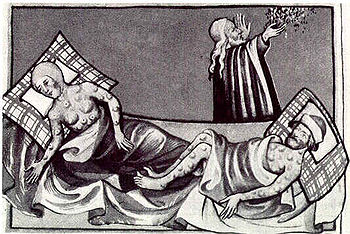
    The Mongols at this time were also laid low with what turned out to be the Black Plague. Anxious to share this disaster with the Genoese, they catapulted their fallen, diseased soldiers over the siege walls and into the Caffa, with devastating effect. The scene was recorded by the contemporary Gabrielem de Mussis  (the account found in Mark Wheelis’(U  Cal Davis) CDC article “Biological Warfare at the 1346 Siege of Caffa”), which begins “In the name of God, Amen. Here begins an account of the disease or mortality which occurred in 1348, put together by Gabrielem de Mussis of Piacenza” and continues: Black death

    “The dying Tartars, stunned and stupefied by the immensity of the disaster brought about by the disease, and realizing that they had no hope of escape, lost interest in the siege. But they ordered corpses to be placed in catapults and lobbed into the city in the hope that the intolerable stench would kill everyone inside. What seemed like mountains of dead were thrown into the city, and the Christians could not hide or flee or escape from them, although they dumped as many of the bodies as they could in the sea. And soon the rotting corpses tainted the air and poisoned the water supply, and the stench was so overwhelming that hardly one in several thousand was in a position to flee the remains of the Tartar army. Moreover one infected man could carry the poison to others, and infect people and places with the disease by look alone. No one knew, or could discover, a means of defense.

    “Thus almost everyone who had been in the East, or in the regions to the south and north, fell victim to sudden death after contracting this pestilential disease, as if struck by a lethal arrow which raised a tumor on their bodies. The scale of the mortality and the form which it took persuaded those who lived, weeping and lamenting, through the bitter events of 1346 to 1348—the Chinese, Indians, Persians, Medes, Kurds, Armenians, Cilicians, Georgians, Mesopotamians, Nubians, Ethiopians, Turks, Egyptians, Arabs, Saracens and Greeks (for almost all the East has been affected)—that the last judgment had come.

    “…As it happened, among those who escaped from Caffa by boat were a few sailors who had been infected with the poisonous disease. Some boats were bound for Genoa, others went to Venice and to other Christian areas. When the sailors reached these places and mixed with the people there, it was as if they had brought evil spirits with them: every city, every settlement, every place was poisoned by the contagious pestilence, and their inhabitants, both men and women, died suddenly. And when one person had contracted the illness, he poisoned his whole family even as he fell and died, so that those preparing to bury his body were seized by death in the same way. Thus death entered through the windows, and as cities and towns were depopulated their inhabitants mourned their dead neighbours.”

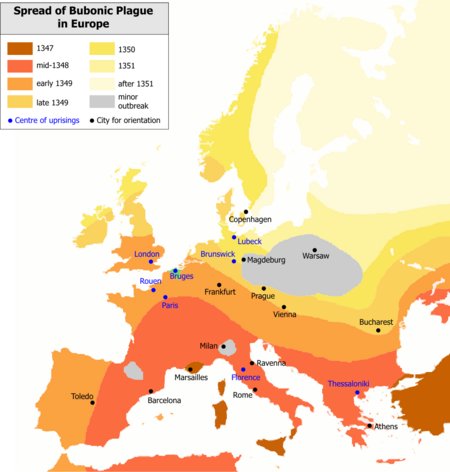
    The end result of the mountains of dead flying plague-ridden corpses was the retreat of the Genoese, who also brought back the disease to (at the very least) southern Europe, with spectacularly bad results, killing millions and millions of people. 

    Black plage map

    1) “The catastrophic pandemic has, generally been considered to have been plague, a zoonotic disease caused by the gram-negative bacterium Yersinia pestis, the principal reservoir for which is wild rodent.”–Wheelis

    Fuller quote, below, in continued reading:


  • On the Souls of Toys–1892. The Memories of Toys.

    JF Ptak Science Books   Post 1738   [Part of the series on the History of Memory.]

    Fact:  toys have souls.  Or, if we can establish that in this case a “fact” can be so identified, then a “fact” this must be.

    Toys 6 det325
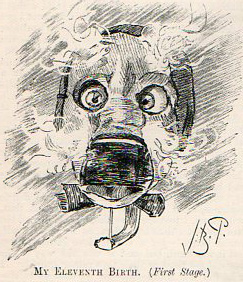
    I’ve stumbled onto a remarkable short story in Punch’s Almanack for 1892 (as part of Punch, or the London Charivari) called “The Evolution of a Toy Soul, or Nursery Karma”.  This piece establishes that toys have souls, that they have an inner, thinking, emotional existence which is capable of Karma and reincarnation, a life of their own–lives of their own. Cognizant, penetrative, analytical.  And a toy.

    The story is told partially in the first person, in the voice of a toy who recounts its long series of births and rebirths–eleven (so far) in all–and its (his or her’s) long experiences.  And this all more than a hundred years before Toy Story.  I don’t know this literature very well, not really, but so far I have not found other “toys have souls” stories, nor have I been able to find out anything about this particular toy story, with searches done in JSTOR and Google and a host of other repositories turning up nothing at all.  Its a puzzling thing, really, because it is a wonderful story.

    In a brief summary, our toy soul starts out it life (“my first birth”) as a rubber ball (“the body in which I first became conscious of my existence”).  The toy soul figures too that it must be its first body, because there is no lower entry point in toydom, except, as is noted, for a brick, which happens to be not-really-a-toy. 

    “My Second Birth” find the toy soul returned to the nursery as a Ninepin, a Ninepin King, who lives part of its life in the hands of a (“quite mad”) human child who dresses the Ninepin in dolls clothes and fabric.

    “My Third Birth”:  “the law of Karma has mysteries which are hid even from the initiated, and I am still at a loss to explain how it came about that I was next incorporated in an Organ Top”, which was basically a spinning top that produced a melody of some sort.

    “My Fourth Birth”:  “I was advanced at a bound” in Karmic hierarchy by being held in the form of a fur monkey with bead teeth and glass eyes.  Here our toy soul has a recollection of its earlier self as a musical top, as it leaves with the monkey a “chronic melancholy”, who takes care (as it were) of a sick girl for a long period of time, and then in the end is given over to a careless boy, and ends up burning in a fireplace.

    ·Posted by :

    ·in:


  • Placing London in Venice, 1892.

    JF Ptak Science Books  Quick Post

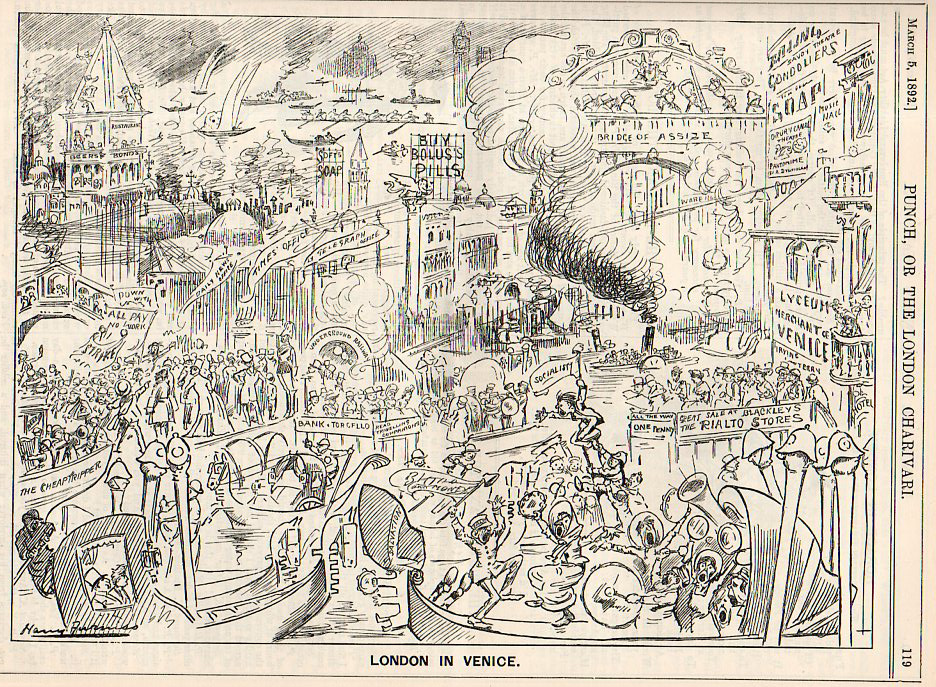
    This is a funny, unexpected and semi-absurd image, especially I think for 1893.  It occurs in the 5 March 1892 issue of Punch, or the London Charivari and seems quite literally to place bits and pieces of London on top of Venice, as if to show what that city would look like it it had some sort of urban renewal involving the removal of another city entirely to that place.  Its quite a neat idea, really, to put one city’s buildings on the topography of another city–it would be an interesting exercise, say, to place Manhattan in Savannah or Rome in Cape Town.  Perhaps it would be revealing in some way, if for no other reason than to visualize buildings in another scale.

    London in venice328

    I’ve seen images of a building or two of great note from one city placed out-of-context in another city or different situation, and of course city plans of one city laid on top of another is very common; but I cannot think offhand of another situation quite like the one above, cartoon or otherwise. 


  • Travel Time in the Young Republic, 1800-1857

    JF Ptak Science Books   Post 1738    [Part of a series on the Display of Quantitative Information]

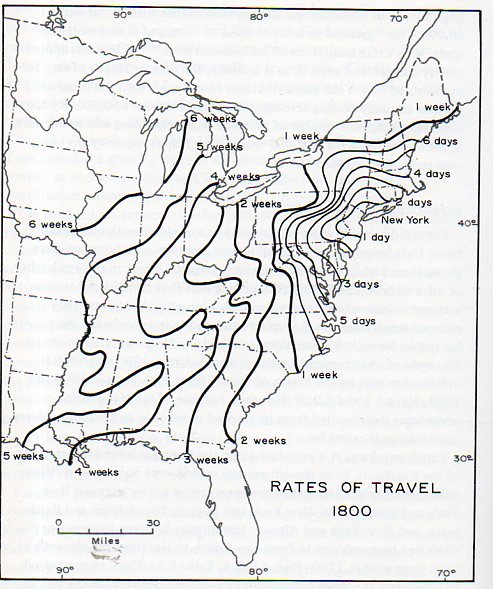
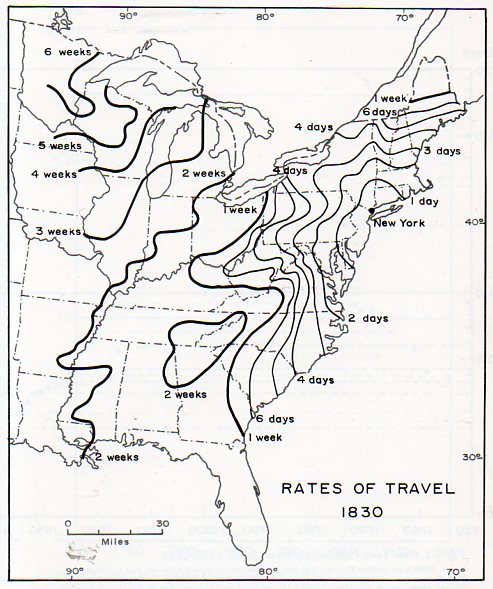
    I wanted to pass along these very interesting maps that appear in Allan R. Pred Urban Growth and the Circulation of Information, 1790-1840 (Harvard, 1973) because they give a quick and elegant view of how long it took to get to various parts of the country in the first part of the 19th century. 

    First, Rates of Travel, 1800:

    Travel time 1317
    and its complement, Rates of Travel 1830:

    Travel time 2316[Note:  all travel time based on starting  point in New York City.]

    Its interesting to see with just improvements in travel excluding the introduction of railroads and (for the most part) canals that travel time was basically cut in half in about thirty years’ time.  For example, in 1800 it would take roughly four weeks to get to New Orleans, and then six weeks to arrive in Iowa and the Upper Peninsula.  By 1830, that time was two weeks to NO, and three for the other two locations.  In 1800, it was a five day trip to the northern Outer Banks in North Carolina; that would be cut to two days by 1830.  The trip in 1800 to the vicinity of Savannah and the northern part of Florida was a two week ordeal; by 1830, that time had fallen to 6/7 days.  The Mississippi was reachable in five weeks in 1800; in 1830, that time was cut to two weeks.  This as I said would all change drastically over the next three decades, once the railroad system became slightly mature.

    And here, expanded to 1857:

    By 1857 one day’s travel time has been blasted to a ring encompassing the southern half of Maine, partially into Ohio and south into the northern part of North Carolina.  Two days of travel will get the traveller deep into Michigan and parts of Wisconsin, and half-way through North Carolina and South Carolina (excluding the mountain region in Western NC).  Three days will now get us to northern Florida, halfway through Georgia and Tennessee, and into the Midwest, past the Mississippi River. Beyond the basic reach of the railroad at this point is the rest of the country, and harder going, though one week of travel will get you deep into the central part of the country, where with some difficulty you would be able to find your way to southern California in three weeks, and the Pacific regions of Washington Territory in six weeks–basically, an entirely new world of travel and the spread of goods, service and information, not the least of which was aided by the spread of the railroads, which increased from 3,000 miles of track in 1840 to more than 30,000 in 1860.

    Again, I really just wanted to share this display of information because I have found them to be useful in the past, and the info doesn’t seem to be all that wide-spread. 

     My source for the maps has been varied from web sources, but the original work seems to have been published in Charles O. Paullin and John Wright, Atlas of the Historical Geography of the U.S., published by the Carnegie Institute of Washington, D.C. (1932), pages 138a, 138b, 138c, 138d.


  • History of Lines: Perspective with Lances

    JF Ptak Science Books  Quick Post  [Part of the History of Lines series]

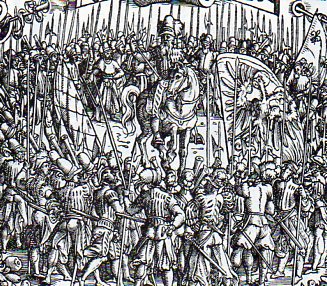
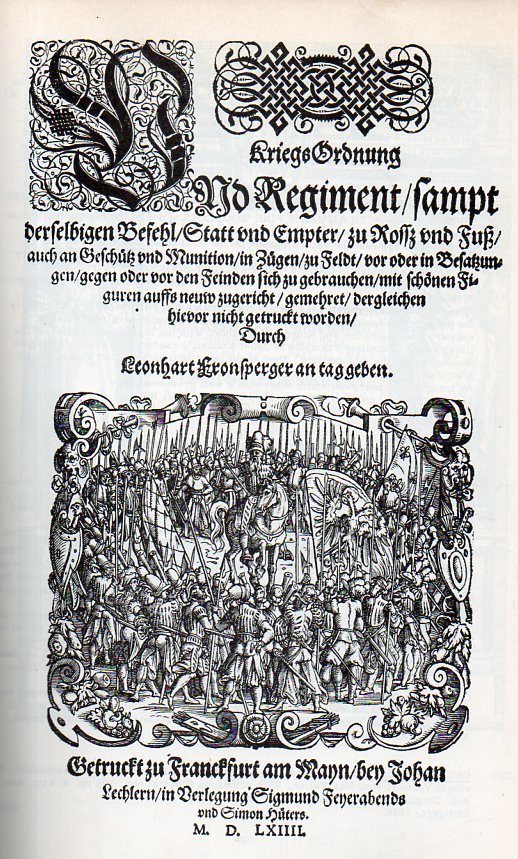
    I was quickly struck by the use of lances to establish a depth and perspective in this small woodcut on the title page of Leonhart Fronsperger’s Kriegsordung und Regiment…(1564), and how I have seen this device used many times over he years.  The artist here is the great Jobst Amman, and the book happens to be one of the most important works in military science published in the 16th century, addressing topics from troop movement to military economics to administration. (It is also one of the earliest books to address the subjects of pyrotechnics and rocketry, the later in the second chapter, “Vom Gescuetz und Feuerwerk”.) 

    Lance312
    The above is a detail from the title page:

    Lance311All that said, I’m fixed on the lances, and how they remind me somewhat of Paolo Uccello (1397-1475)–who is one of the founders of perspective–and his triptych The Battle of San Romano, with the third part of the trio in particular..  The painting was intended to be viewed together, depicting the battle (more-or-less) at morning/noon/night, the parts of which are shown below in that order.  The lances (especially in the “Counterattack”) are meant to heighten the sense of perspective–and the effect of the lances having basically no detail and being in brilliant color enhances that effect.  (In the first part of the triptych Uccello uses the alignment of dead soldiers and dropped lances to the same effect–particularly the ones beneath the hooves and in the vicinity of Niccolo de Tolentino’s spectacularly white and “solid” horse. (The business of the lack of detail in Uccello has been famously addressed in William Gaddis’ The Recognitions. I’ve written about Uccello frequently here, particularly in this note.)

    The left panel

    • Niccolò Mauruzi da Tolentino unseats Bernardino della Ciarda at the Battle of San Romano (dating uncertain, about 1435 to 1455), tempera on wood, 182 × 320 cm, Galleria degli Uffizi, Florence

    The center panel

    ·Posted by :

    ·in:

    —