A Daily History of Holes, Dots, Lines, Science, History, Math, Physics, Art, the Unintentional Absurd, Architecture, Maps, Data Visualization, Blank and Missing Things, and so on. |1.6 million words, 7500 images, 4.9 million hits| Press & appearances in The Times, Le Figaro, Mensa, The Economist, The Guardian, Discovery News, Slate, Le Monde, Sci American Blogs, Le Pont, and many other places… 5000+ total posts since 2008.

Author: JF Ptak

  • Lost German Color of 1927

    JF Ptak Science Books    Quick Post

    German color375[Part of the series on Color and its Abuses, as with an example of “When Color is Best in Black-and-White”, here.]
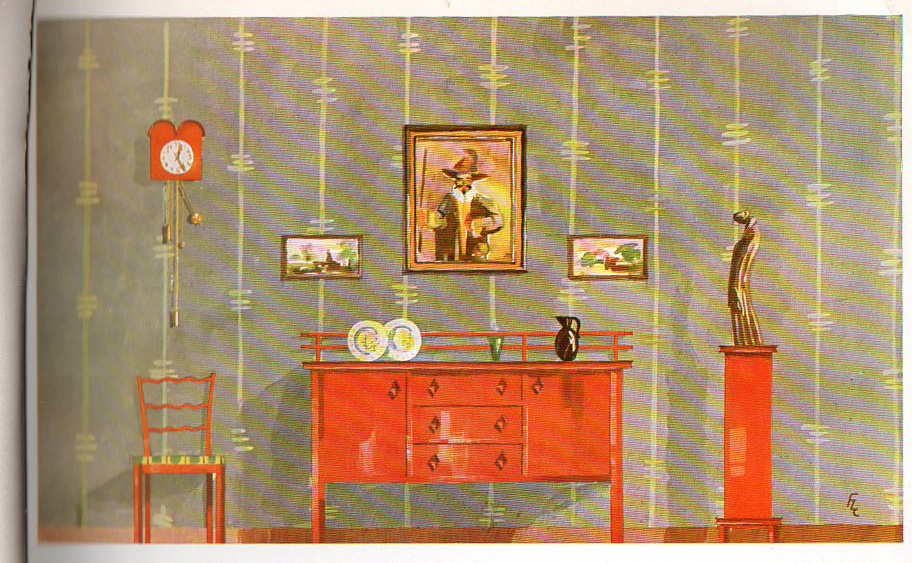
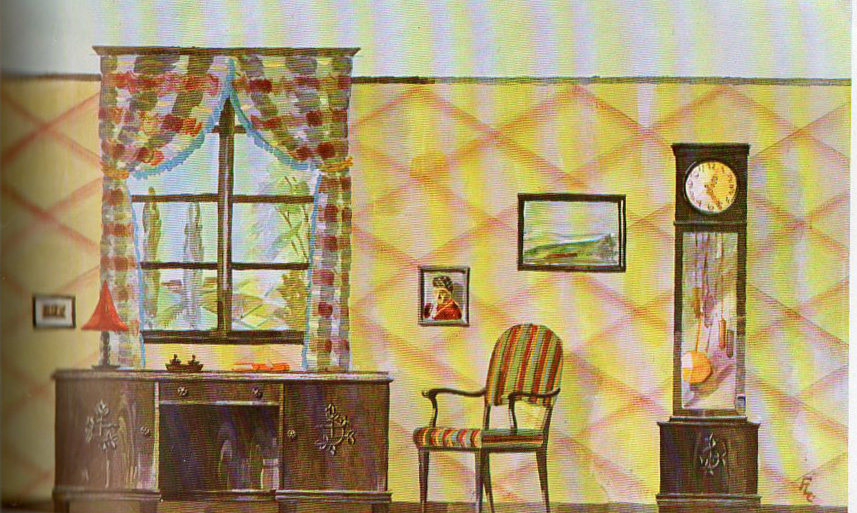
    Nothing quite says no-color as German deep noir of the mid- and late-1920’s.  These movies can be so deep and contrasted, so very black-and-white, with such stark Moon-like shadows, no dawn or dusk just night and day, that it can make you forget that outside of the photographs and movies that people were moving around in great swirls of color.  And nothing quite helps you to remember this than by having a look at a book like one below, a DIY piece printed in Berlin in 1927, the Farbige Wohraume1.

    German color377
    It is of interest here because in addition to blueprints and sections of the furniture to be built, there are associated illustrations showing the completed work placed in a decorated room.  And it just so happens that these rooms are highly, colorfully decorated–not that there’s so much in the room, per se, but there is definitely a lot of color. [This book is available from our blog bookstore, here.]

    German color371


  • Big G’s: Grim & Gross Saturn: Grandville, Goya, Galileo and the German Gnostics

    JF Ptak Science Books  Post 1752

    Blogsaturn_large
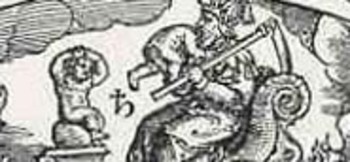
    I was getting ready with what was supposed to be the real post for today when I stumbled upon this woodcut of the Roman god Saturnus.  What makes this image so terrifically compelling is how benign it is—in its weird, mechanical, disinterested observational manner the artist conveys almost nothing about the act that we witness as the god plots his way across the sky in its celestial chariot.  Saturn (equated with the Greek Kronos, and the Titan father of Zeus, and also the name of the gaseous oblate six planet) commits acts of horror, and becomes, again and again, perhaps the greatest coward of the Roman pantheon of questionable deities. 

    It begins with Saturn being told his future:  that at some point in his life his son or sons will supplant him, catch him, replace him and kill him.  And the best thing that Saturn can think to do is to methodically eat his children, and he does manage to consume all but one—Zeus—who then fulfills the prophecy; but then again, who wouldn’t?  There is really very little like this in mythology—and, really, why should there be?
    Blogsaturn_ldetaileating

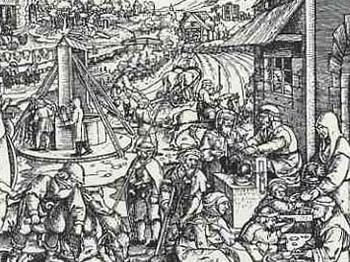
    Our artist—or engraver—is George Pencz (1500-1550), alive and dead very neatly at the century and half-century mark, and his work (“The Life of the Children of the Planet Saturn”) is illustrated in Folge der Planeten .  The image of Saturn racing along with his son’s head in his mouth looks naive compared top the rest of the illustration, which is a very lively, if quiet, depiction of the industry that his dead sons would have applied themselves to if they hadn’t been consumed by their father.  The illustration of Saturn is very disturbing to me, particularly when you notice the son-in-waiting, who is watching his father eat his brother, and in an incredibly pathetic and heart-breaking way is trying to protect himself by holding his head.  I think it is so very moving because it is a perfectly logical (from a child’s point of view) reaction to an unimaginable terror, and perhaps this is how Pencz can best deal with the vile god.
    Blogsaturn_ldetailallegory

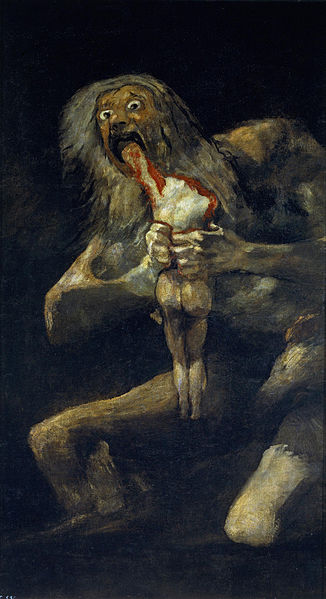
    Images of Saturn really are legion, but there are a host-and-a-half that are pretty upsetting, like the one above, and the one coming, below. I think that the one that is the test against which all others are measured is by Francisco Goya, who during his “black period” painted the truly terrifying image of Saturn devouring his child right on the wall of his house in 1824 (or thereabouts). It really is bad stuff. The scene as painted by Peter Paul Rubens isn’t much better.

    Saturn goya Saturn rubens


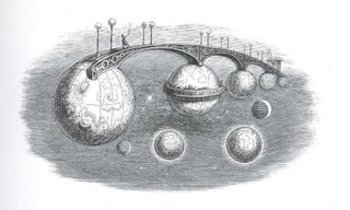
    Admittedly, J.I.I Grandville (1803-1847) didn’t conceive of this series of bridges as a plausible means of interplanetary travel and is in all probability an allegorical creation, but the image does–in an odd way–allow a dialogue on the idea of moving from planet to planet, which was still pretty solitary thinking in the mid-19th century. Although this didn’t have a direct effect on the perception of man’s place in the solar system, it did have a great and direct impact upon a vast number of illustrators and cartoonists who followed in his considerable wake.

    BlogfuturegrandvilleThis image comes from Grandville’s Un Autre Monde, published in 1844.

    In addition to an interplanetary bridge that there is another singular creation here in Grandville’s cosmos–a balcony constructed of the rings of Saturn (if indeed this was supposed to be Saturn–it is as advantageous as not to think of it in this way) and if we think of a balcony being a place to watch and observe, then we are brought instantly to W.G. Sebald’s Rings of Saturn, which is a textural masterpiece, and mostly I guess a novel about everything that Sebald observed in his walk through Suffolk.  (Another Saturn-related work of fiction is Sirens of Titan, by Kurt Vonnegut,  a very mature and insightful 1959 novel which really has nothing to do with anything here; I just needed to throw that in, what with him being a master storyteller, crank and human-caricaturist-observer and all…)  And so by 1844 it comes to pass that one French caricaturist/imaginist comes to draw an extraordinary and impossible land/space bridge between the planets only 234 years after Galileo  first glimpsed Saturn’s “handles”–give the optics of his telescope Galileo didn’t see the rings of Saturn as such, seeing rather two “extra bodies” on either side of the planet  It would take another 65 years and accumulations of observations by some of the greatest names in the history of astronomy (Galileo, Casini, Hevelius, Huygens) to show that the disk (singular) on Saturn was actually a series of rings.  (I should add that the first photograph of Saturn’s rings is not made until 1883.

    Saturn gnosis303
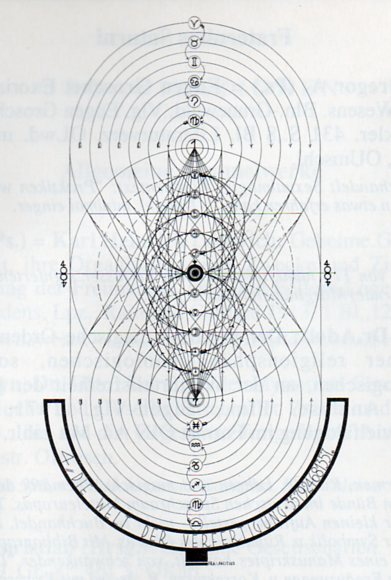
    Which somehow brings me to the troubled world of the “Saturn Gnosis”, the Fraterniti Saturni.  Actually the only place I’m getting to here is a picture (above), which I tried to understand before I realized what it was, and how much of an expanding hocus-pocus (otherwise defined as  “woo woo” in the words of James Randi) rabbit hole of diminishing returns it leads to, a dizzying history of competing complexities and nonsense.  But the image (found in a book edited by Eugen Grosche, (Offizielles Publikations-Organ der deutschen Gross-Loge Fraternitas Saturni Orient Berlin,  1929), comes from a psycho-sexual-astrological-magical group (one of a number of such associations in Germany and particularly Berlin in the 1920’s), and seems no less a part of reality as does Grandville’s Saturn.  Sameness ensues when you try to approximate the volume of limitless emptiness, or belief.

    ·Posted by :

    ·in:

    — —

  • German Decorative Painting in Biedermeier and the New Style (or Jugendstil), 1907

    JF Ptak Science Books   Quick Post

    This beautifully illustrated 1907 German book1 seems to me to be a sales catalog for a company selling flat-masks, or templates, through which desirable and somewhat complicated (or at last complex) painting may be produced.  A customer could leaf through this book of 60 designs which are arranged according to room type, and perhaps, if the fancy struck, could purchase the sheets and instructions necessary for the job to be done.  For example, plate #44 (Reggie Jackson’s number in the great summer of 1977), the “Pause mit Hilfsschablone” (its identifier in the “Preisliste” and offered at 10 Marks) is meant to decorate a wall for a stairway. 

    Jugendstihl361

    The great bulk of the designs are those for ceilings, and ceiling corners, as well as for wall designs and the small bits that run slightly above the floor and the wall (I’m sorry, but I don’t know the technical term for this).

    In any event it is a very surprising work to find–for me, at least–to see someone selling the possibilities of such advanced design motifs in a simple, order-it-from-our-catalog format.  [The catalog is available for purchase from the blog bookstore, here.]

    ·Posted by :

    ·in:

    —

  • A Temple of Texts–Steampunk Victorian Printing Cathedral

    JF Ptak Science Books  Quick Post

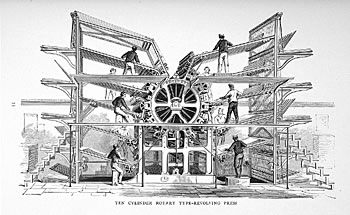
    This is what printing looked like, once upon a time, a great and giant mass, tended by works, massive sheets of paper flying this way and that, smoke from a steam engine drive (somewhere)–heavy, loud. Accurate.  A temple of texts (apologies to William Gass).  The illustration is from Robert Hoe’s A Short History of the Printing Press and of Improvements in Printing Machinery from the Time of Gutenberg up to the Present Day (1902) and exhibits a ten cylinder rotary type-revolving press

    Pritning machine[Source: Harry Ransome Center, here.]

    In addition to being a state-of-the-art (and above that, really) printing press it is in image a generator of metaphors–there’s certainly plenty to go around, even on just a surface investigation of the woodcut.  You can easily see a feeding-the-beast scenario in there–for news or for technology or steam or motion or whatever else), as well as darker interpretations, making the printing press into a spider as well; also, there’s humans being subservient to the god of technology from whom all good things come, and so on.  I’d really just like to feel one of those gigantic newspapers in my hands, fresh off the press…


  • Disinventing Human Flight–Hiram Maxim’s Steampunk Mistake

    JF Ptak Science Books   Post 1751

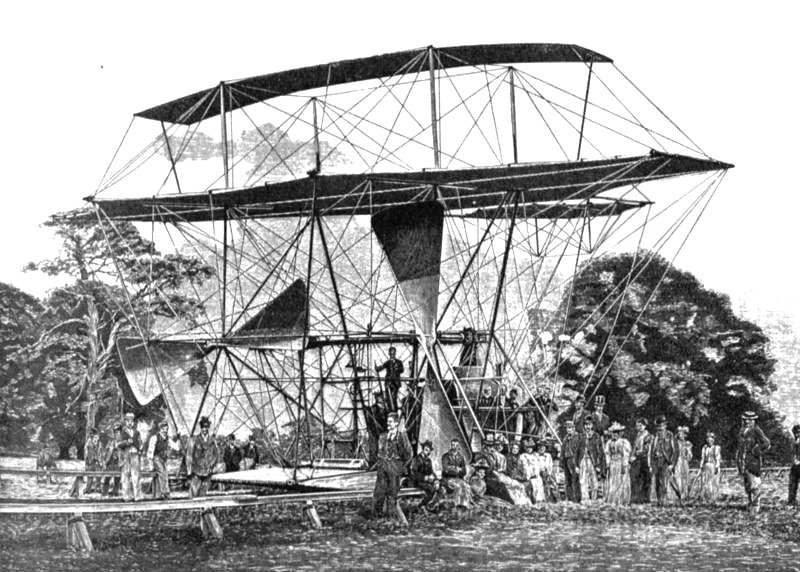
    Hiram Maxim, Sir Hiram Maxim, an ex-pat Yank and a great inventor of things other  than aircraft, certainly did not do his best on his early flying machine.  He built an enormous monument to Steampunk Aerostation, and in that 8,000 pounds of steel wheels and smoke, he completely lost the idea of making a flying machine, concentrating solely on the idea of thrust and lift, consoling himself with the notion of raising a brick from the ground.

    Hiram Maxim sitting with dignatories on support rail by his crashed aircraft, Baldwyns Park, 1894

     I’m not sure that you can disinvent many physical things, although I know that there have been many attempts to do just that , though usually in the fields of human beings doing horrible things to other human beings.  The Soviets I know disinvented untold numbers of people in the plague years of the human stain, Joseph Stalin; so to with Adolf Hitler, who tried to disinvent the Jewish people and the Soviet Union. 

    Hiram Maxim (1840-1916) tried to build a monster that would leave the ground but not actually fly, and he basically did just that, very briefly with very heavy/crashy results. His flying machine was over 100′ wide, had two 17.5′ propellers, room of multiple crew members, weighed four tons, and traveled along guiding railroad tracks on steel wheels. In 1897 it powered  down 1800′ of track before accidently breaking free of its moorings and  rizing briefly above them for a distance of about 100′, which at 40mph would’ve been about 2 seconds of  foot-tall “flight”, causing the crew to shut the engines down and causing the whole thing to crash  And that was that, the end of Maxim’s adventure. It was remembered by him in strange and wonderfully terrible ways in his memoirs, where he claimed that his truly dreadful ideas were those that were used and copied by the pioneers who followed him and who actually created successful flying machines.  That he could remember things in their imagined states with such hopeful clarity is to think of him as providing precisely the wrong blueprints at the right time. 

    http://www.wright-brothers.org/History_Wing/History_of_the_Airplane/Who_Was_First/Who_Was_First_Intro/Who_Was_First_Intro_images/1893_Maxim_Test_Rig.jpg

    In his book, Aviation, an Historical Survey from its Origins to the End of World War II (Science Museum, London, 1970), the insightful, opinionated and occasionally acerbic Charles H. Gibbs-Smith remarked on Maxim’s outlandish maxims on his enormous failure, quoting him so:

    “…the fact that practically no essential departure has been made from my original lines, indicates to my mind that I had reasoned out the best type of a machine even before I commenced a stroke of the work”  (Maxim, Natural and Artificial Flight, 1908)

    Gibbs-Smith writes: “it is hard to imagine anyone uttering more egregious nonsense”, and when you look at the Maxim machine and see its specs and the nil-time spent on what to do with the thing if it ever actually lifted off the ground, you’d be hard-pressed not to agree.  Had people followed his lead, Maxim would have been able to disinvent human flight.  There, I said it.  There’s wrong, and then there’s wrong–and then there is this.


  • Hobo Signs Map, 1870

    JF Ptak Science Books   Post 1750

    Bloghobo_b200

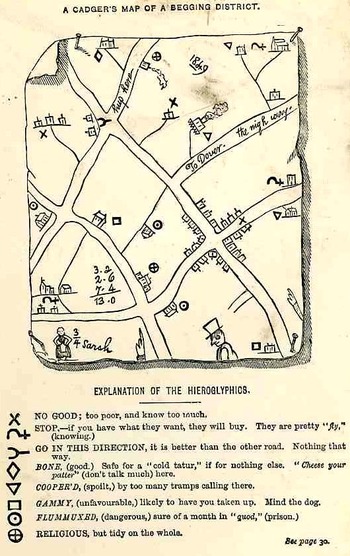
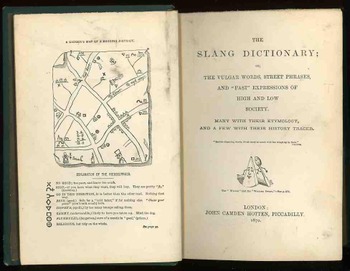
    This is the frontispiece to the delightful work with the luscious title of The Slang Dictionary; or, the Vulgar Words, Street Phrases and Fast Expression of High and Low Society… printed in London by John  Camden Hotten, in 1870.  It is a hobo or “cadger” (“a  mean or vulgar fellow who would rather live on other people than work for himself”)  map (or the map of “a tribe of vagabonds”) of Maidstone, in Kent, drawn by a “screever” (a sidewalk chalk artist who normally would draw religious images for money), and showing the various chalked and etched signs that the hoboes (“and other mendicant marks”)  would leave for one another, being a key to the town, for what was practicable, safe, dangerous, and the like.

    Recorded antiquarian hobo and tramp symbols like these are really quite rare, given their ephemeral nature to begin with; of course the need to record these obscure signs by polite society was not on a high order.  There are many indications that signs such as these existed, but not many illustrations.  For example in the book The Triumph of Wit; or, Ingenuity Display’d in its Perfection, edited by John Shirley. (1724), as well as works by Holyland and Borrow there is a description of English gypsies and their travels, and a short description of their use of boughs and sticks, set out for each other, so that a duplication of effort by different bands or families would not occur.

    (The figure of the woman, wonderfully named “3/4 Sarah”, probably connects this Sarah to a sort of popular dance.)Bloghobo_a199_2

    Hotten also published the following interesting and title-bending work in 1874:  THE ORIGINAL LISTS OF PERSONS OF QUALITY;  EMIGRANTS; RELIGIOUS EXILES; POLITICAL REBELS; SERVING MEN SOLD FOR A TERM OF YEARS; APPRENTICES; CHILDREN STOLEN; MAIDES PRESSED; AND OTHERS WHO WENT FROM GREAT BRITAIN TO THE  AMERICAN PLANTATIONS 1600-1700, WITH THEIR AGES, THE LOCALITIES WHERE THEY FORMERLY LIVED IN THE MOTHER COUNTRY, THE NAMES OF THE SHIPS IN WHICH THEY EMBARKED, AND OTHER INTERESTING PARTICULARS.


  • The Computer (mostly Ads) on TV, 1955-1986

    JF Ptak Science Books, Quick Post

    Here’s a selection of nine early television spots for computers and computing…and calculating.  The piece on the coming Internet (1969) to me is the most interesting:

    Mid-1950’s and how engineers build computers:


  • A New Miniature, TV-size Computer: the Leprechaun, 1957

    JF Ptak Science Books   Quick Post

    “Leprechaun, an Automatic Digital Computer the Size of a Television Set”  was a short article written for Computers and Automation in the July 1957 issue.  It is uncredited, by the two-pager I think was the product of the editor, Edmund Berkeley, and discussed a remarkable new computer that was as “small” as a not-by-today’s-standards small television set.  The Leprechaun used seriously fewer components than a “regular” machine (though that standard is not identified), using “only about 9,000 electrical components”, half of which were transistors).

    Leprechaun represents a significant advance in computer design, with its innards very reachable and accessible, making it a highly useful tool for testing other components for other machines. The TRADIC (for TRAnsistor DIgital Computer or TRansistorized Airborne DIgital Computer) was also the first transistorized computer in America, completed in 1954, and the godchild of  J. H. Felker of Bell Labs for the for the U.S. Air Force, and was initially designed for use aboard an aircraft or a naval vessel (making it the first airborne transistorized digital computer). The idea of the manageably-sized computer had only recently lifted itself from science fiction thoughts of it being able to fit in the trunk of a car (as envisioned somewhat earlier by Isaac Asimov) and here we see it, already in the future-made-present, miniaturized to the size of a television set.

    ·Posted by :

    ·in:


  • An Early–and Patented–“Flying Saucer”, 1898

    JF Ptak Science Books   Quick Post

    This magnificent flying thing was perhaps among the earliest of its kind, at least according to shape, which as we can see really wasn’t quite a flying saucer,, though it was a flying disk.  And a big one, at that.  From the ladder that led to the major axle we can infer that the aircraft was at least 60 feet high, which made its disk apparatus a very ferris-wheel-like 40′ or 50′ in diameter.  If nothing else, the patent drawings are quite pretty.


  • Titanic Understatement on (1) “A” Big Bang and (2) “The” Big Bang

    JF Ptak Science Books   Post 1748  (An expansion of an ealier post from 2008)

    The soft-sell of the generally recognized and understood propositions, stepping well around the main, central, controlling issue, hinting broadly along its perimeters, defining the emptiness by its shell, left to an undistinguished recognition, is what we’re hunting here.

    I have two examples of extreme examples of understatement occurring at the beginning and end of things—all things.

    The first understatement–“the” Big Bang of the title–that we will look at here belongs in the last paragraph of the seminal paper by Edwin Hubble and Milton Humason, writing an extension and refinement (and adding much more data) on the “discovery” of the Big Bang as they defined the Red Shift, which was actually a roughly proportional increase of distance traveled to red shift. They plotted a trend line for 46 galaxies and in 19291 formulated the empirical Redshift Distance Law of galaxies, which is today known as Hubble’s Law, which was consistent with the solutions of equations of GRT. (This momentous discovery was cheered by the normally non-cheering astronomy community in unusually verb-y ways, such as with the statement made by W.S. Adams, (director of the Mt. Wilson Observatory), who said that thee Hubble/Humason effort was “the most ambitious project astronomy has ever undertaken…maybe (the) research will reveal the very edge of the universe”2.
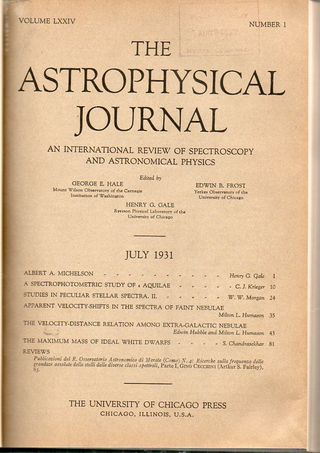
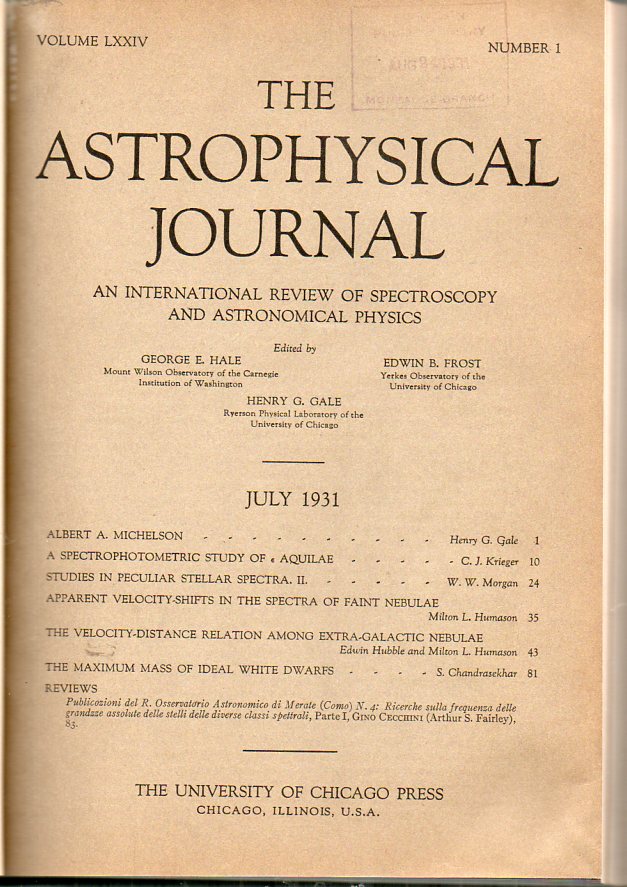
      Hubble358It is in a further report on their studies in The Velocity-Distance Relation Among Extra-Galactic Nebulae (The Astrophysical Journal, July 1931, full text here) that Hubble and Humason react to and answer questions that arose from their 1929 paper, and also incorporate much new data.  As a matter of fact, they managed to “spectacularly extend the linear relationship”3 to a speed of 20,000 kps, and also to an estimated distance of about 100 million light years, this by using many more points in the 1931 diagram.  This was the further proof needed to strengthen the existence of a linear redshift-distance relation, and it appeared in this “promised sequel”4 of the 1931 paper. 

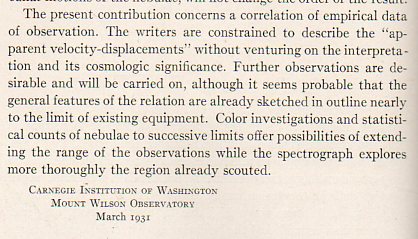
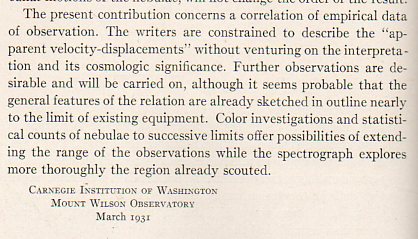
    It is in the 1931 paper that Hubble and Humason make their stupendous understatement: regarding their understanding of the phenomena and the expanding universe. They take many steps back, and say in the concluding paragraph “the writers are constrained to describe the apparent velocity-distance displacements without venturing on the interpretation and its cosmological significance”. They basically lay out the functioning of the universe and the best understanding of how we got to where we are in the cosmos (Vesto Slipher notwithstanding), and how according to their understanding that the universe is expanding and is consistent with all known laws, that they decide to not say anything, um, philosophical.
    Hubble357
    And so, in the last paragraph of this paper discussing the Great Alpha, the authors decided, in their modest and terrifically understated Bartlebian way, to not comment.

    The second example of tremendous understatement occurs in a report discussing the Great Omega, and how in the end the end might actually be avoided. Written by Joseph Coker, Chief of the National Resource Evaluation Center in the Office of Emergency Planning in Washington, D.C. in April 1965 (100 years to the month after the end of the U.S. Civil War), “NREC Programs for Gaming the Logistics of National Survival” is by its very title and appearance a startling looking and sounding document. Coker and his NREC worked within the Executive Office of the President (LBJ at the time), and his paper concentrated on a succinct appraisal of the existing gaming programs looking at survival of all aspects of the national life in the days following nuclear end-game.

     

    Blogalphaomega_2025  

    In general the document is as dry and cardinal as bagel toast—it warms quickly and invisibly, however, and that bagel toast becomes a burnt and invisible cinder via Coker’s prose.

    The document wastes no time in getting directly to vast understatement, and stays there. In chapter one “Logistics of National Survival”, the second chapter opens:

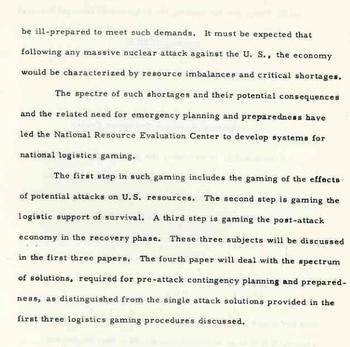
    “Because of recent changes in the technology and potential tempo of war and because of the base power of force is in being (including equipment and supplies), there is general recognition that any future war in which the United States is engaged, especially if it is an unlimited nuclear war, may be decided without significant additional military demands upon the nation’s industrial economy.” Hmm. He continues: “That is not to say, however, that the post-attack economy would not face enormous logistical support problems.” There is no human element of this equation. “The logistic requirements of survival and recovery would present very heavy demands.”
    Blogalphaomega_3_2026

    “Very heavy demands” reaches a very great height of understatement. How high is high? I don’t know. Remember: Mr. Coker was Chief of this division and working within the Executive Office. This was thinking at a very high level.

    He continues in this same paragraph: “Furthermore, the post-attack economy may be ill-prepared to meet such demands”. The paragraph ends in a tremendous horizontal soar: “It may be expected that following any massive nuclear attack against the U.S., the economy would be characterized by resource imbalances and critical shortages (italics our’s). 

    Coker’s papers meant to remedy the approaches to these “imbalances”. The NREC was up and running with ideas and computing fire—in the form of the CD 3600 computer and FORTRAN—to develop a “damage assessment system” called READY that would replace the existing programs named, with no evident imagination, JUMBO, STREAK and DART.

    Throughout this entire document there is no mention of overwhelming, catastrophic death and/or obliteration of the social structure, except that it must be implied that there must be “someone” to operate the essential industries that must be brought back on line.

    Curiously there is a discussion about the survivability of the Federal Reserve and the banking system. My guess is that in the ensuing giga-tons of holocaust of flame that paper money didn’t burn along with its human holders.

    Notes:

    1.  Hubble & Humason,  A Relation Between Distance and Radial Velocity Among Extra-Galactic Nebulae…  Mount Wilson Observatory,  1929.    Contributions from the Mount Wilson Observatory No. 427

    2.  David Harland, The Big Bang, Springer, 2003. 

    3. R.W. Smith.  “The Origins of the Velocity-Distance Relationship”, in Journal for the History of Astronomy, volume 10, p. 133, 1979. 

    4.  _____.  Page 136.
    ·Posted by :

    ·in: