A Daily History of Holes, Dots, Lines, Science, History, Math, Physics, Art, the Unintentional Absurd, Architecture, Maps, Data Visualization, Blank and Missing Things, and so on. |1.6 million words, 7500 images, 4.9 million hits| Press & appearances in The Times, Le Figaro, Mensa, The Economist, The Guardian, Discovery News, Slate, Le Monde, Sci American Blogs, Le Pont, and many other places… 5000+ total posts since 2008.

Author: JF Ptak

  • A Few Examples of “Heavy Stuff”: Patent Drawings for Flying Machines, 1877-1900

    JF Ptak Science Books  Quick Post

    This is as beautiful as it is heavy; and it is in its way very beautiful, so I guess that also means that is is very heavy…

    And speaking of heavy, this balloon doesn’t seem large enough to lift the very heavy ship-like carriage:

    Another flying boat:  I don’t see a power source to drive the “fans”/propellers on this one, though there is a tail for its “kite” body:


  • The Death Ray and Cloud Writing–Battlefield to Breakfast in a Few Short Years.

    JF Ptak Science Books  Post 1749  [Part of the Strange Things in the Sky department.]

    The Death Ray is a long-discussed idea, extending back as far to Archimedes at least–discussed, attempted, abandoned and dismissed.  But as a matter of fact, the thing was actually invented, and deployed, though not int he sense of an EM weapon, or LRAD/ultrasonic, or Teller x-ray laser, or even a Wellsian heat ray (below).

    File:Alvim-correa12.jpg

    The “Death Ray” made its appearance in the 1880’s, but not in the normal sense of what we would today think of as a “weapon”–this death ray could locate the enemy hidden miles from the front, or pick out ships at sea far from shore, and so on, removing stealth capacity, making it possible for these elements to be identified as targets, and then possibly removed, though not by the ray itself. 

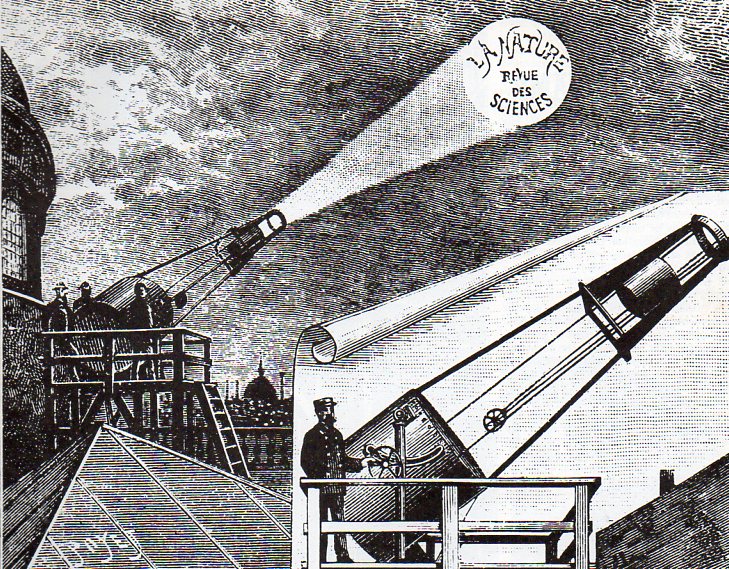
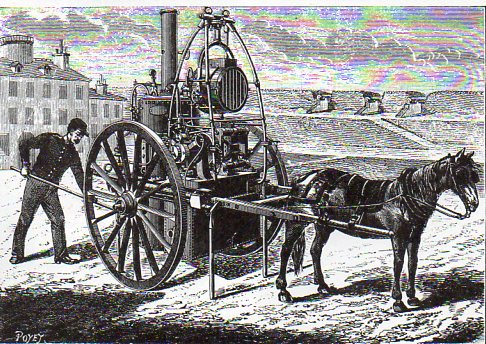
    This “death ray” was the search light.  In the 1880’s when the technology of electric lighting was still in its first practicable decade, the idea of being able to focus a beam of light from a lantern source hauled on a single-mule carriage and powered by an on-board battery, small steam engine  and Gramme dynamo was a spectacular. achievement. 

    Searchlight359
    [This image appeared in the Scientific American in 1886 and features what is probably a one-foot diameter mirror, making it capable of illuminating an object up to about a mile away.  Something with a three-foot diameter could work its magic on object up to four miles away.]

    This defensive/offensive weapon/device was very soon afterwards made into a trickle-down appliance that was placed into commercial use almost immediately.  The standard use of course would be upgrading lighthouses, but one special use was using a large mirror in a device to project an advertisement on the clouds in a city–ads in the sky.

    Searchlight360[Source, La Nature, 1894; also reprinted in Scientific American in the same year.]

    Such a device was used experimentally at the Columbian Exposition in Chicago for the World’s Fair of 1893, flashing the daily attendance on the clouds.  I’m not sure why the greater revenue-generating employment of this technology took another year to develop.  And so “The Death Ray”, from Battlefield to Breakfast Cereal in a few short years. 


  • Drop-Dead Gorgeous Flying Man/Ornithopter Patent Drawings, 1889

    JF Ptak Science Books    Post 1746

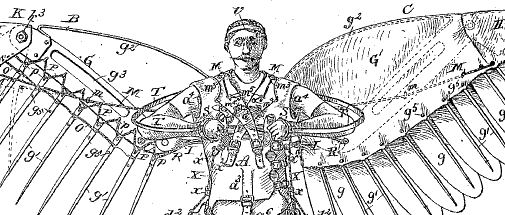
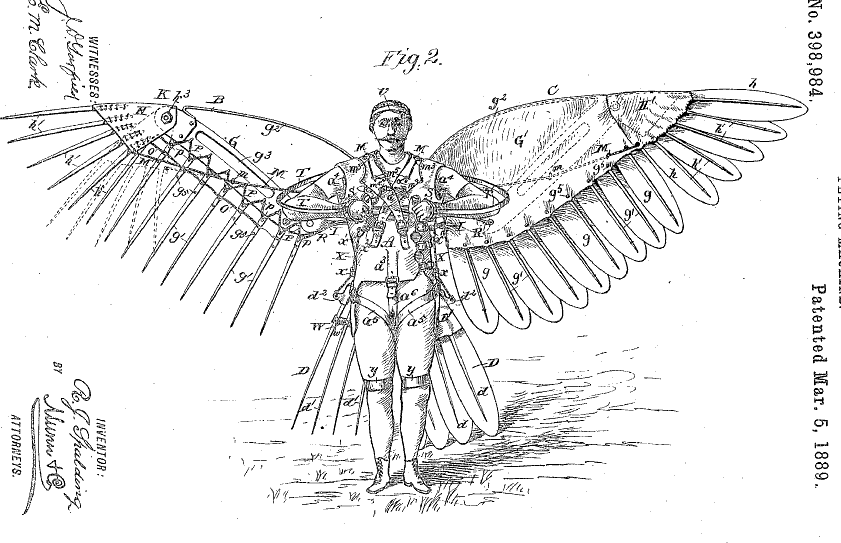
    This is one of the most appealing sets of “flying” or manned aerostation patent drawings that I have seen in the USPTO collection for the 19th century. The machine is a human-powered ornithopter, applying the structure of a human against that of a bird, and outfitting the flyer accordingly to combat their human weaknesses as adapted to bird flight.  Needless to say, and in spite of the beauty of the thought, this arrangement was destined to deep failure.  (The patentee, Reuben Jasper Spaulding, of Rosita (“Little Rose”), Colorado (south of Pueblo), may have been the same Reuben J Spaulding who made the first gold strike on the Blue River on Colorado’s Western Slope in 1859.)  Spaulding’s design is interesting also for the balloon device for getting the aero pioneer off the ground. 

    [Source:  Google Patents (and also for the extensive annotations for the images).]  I note that there was a model constructed for this patent–I’d love to see that.

    Patents--spalding flying_edited-1

    Patents--spalding flying

    And along this same vein of ornithopter-y thought is this, another American solution to the man-bird-mechanical-flight continuum, produced a dozen years earlier–it is similar, though not nearly as glorious (at least in presentation) as the later Spaulding effort: 


    The work really ins’t quite as awesome as Spalding’s beautiful Lazarusian resurrection, and not as detailed, but still quite interesting:


  • Modern Stained Glass Windows–Secular Work, 1937

    JF Ptak Science Books    Quick Post

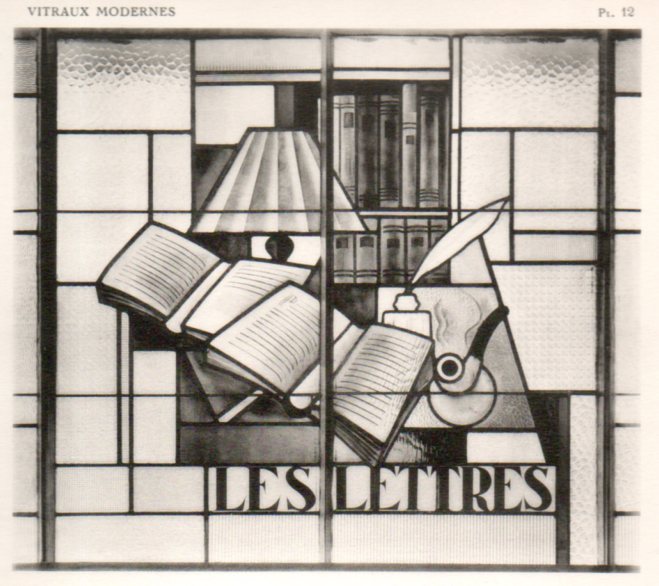
    Stained glass424

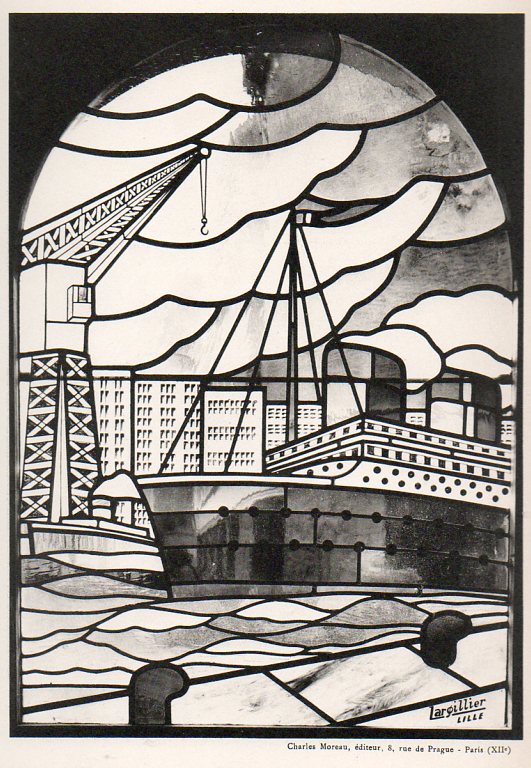
    I was browsing this very interesting book on an exposition of modern art (1937) which concnetrated on the stained glass windows.  I’ve reproduced a number of the secular images below, some of which are unexpected and remarkable:  there are images of jazz players, a portrait of Babar, steamships, laborers, racehorses, factory workers, and the like.  [The work:  MALLET-STEVENS, Robert. Exposition internationale de 1937. Vitraux modernes. Avant-propos de Paul Léon. Paris: Charles Moreau, 1937. Portefeuille in-4 (320 x 250 mm). 48 fine plates reproducing the work of  Décorchemont, Maumejean, Cingria, Robert Delaunay, and others. “L’Exposition de 1937, qui nous montre la ‘généralisation’ de l’architecture moderne, nous offre quelques vitraux de tout premier plan… Quand l’architecte voit dans l’espace des volumes bien ordonnés, le peintre verrier trace des lignes et oppose des couleurs heureuses… Je n’oserai dire que l’architecture moderne est en plein progrès, mais je puis affirmer que le vitrail ‘va très bien’!” (Robert Mallet-Stevens, Introduction).]

    The portfolio of images is available at our blog bookstore, here. 

    Stained glass414

    ·Posted by :

    ·in:

    —

  • Designs in Flowers, 1635

    JF Ptak Science Books   Quick Post

    This lovely, and short, pamphlet was published by Baltazar Moncornet in Amsterdam in 1635 as Livre de fleurs et de feuilles pour servir a l’art…Dessins de fleur pour orfeverie, with designs by Francois Lefebvre. Slender and tall, there was an engraved title followed by five plates for the entire production.  It is a very fine work, hard in detail, and worthy of close inspection.

    http://www.beauxartsparis.fr/ow2/catzarts/images/BIBMasson2911_02-60494.JPG

    ·Posted by :

    ·in:

    —

  • 1902’s Women of the Future Trading Cards

    JF Ptak Science Books   Quick Post

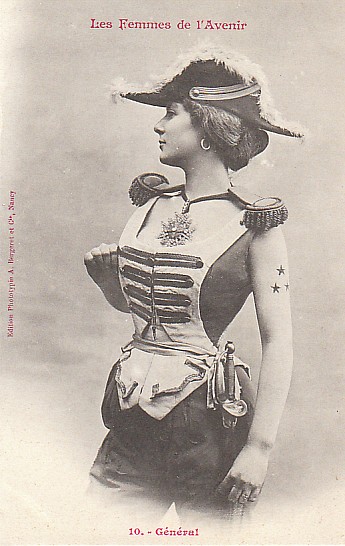
    Again from the interesting and charming La Boite Verte website I’ve found an interesting suite of French photographic postcards.  This set concentrates on the possible occupations of women in the  future (“avenir”/”future”), and printed in 1902 by A. Bergertet in Nancy, France.  The images are slightly odd, most tbeing a little on the “swimsuit issue” side, but then again not without the women exhibiting a kind of coy pride in spite of what they looked like.  In spite of the attire, the women depicted as the “general”, the firefighter (“pompier”), student (complete with a jauntily-held cigarette), and the sailor (“marin”), for example, are all taking their future positions seriously, even though their uniforms have been arranged for a 1902 man’s viewing pleasure. 

    Its interesting to see that seeing into the future of professions and callings for women didn’t habe to “see” all that far, with all of the professions being attained within the next 50-75 years. Of course the pay is largely still not same for women as it is for men, nor is women’s percentage share (for most) anywhere close to a proportional share, but it is a good start. 

    [Image Source: Le Boite Verte and Fantasies Bergeret]

    les femmes de lavenir phototypie bergeret 13 Les Femmes de lAvenir   1902


  • Tech-Quiz–What is It? (#7, 1893)

    JF Ptak Science Books   Quick Post   [Part of the Tech-Quiz series.]

    Generally with these questions I provide a detail of a patent drawing and from that the application is supposed to be derived.  Here, though, is the full drawing, and is seems pretty straightforward, I think, though the ultimate use of the contraption might not be so obvious.  Or perhaps it is?   What was the intended purpose of this object?


    Answer in the “extended reading” section, below:


  • Hydrogen Balloon Properller Pseudo-Steampunk Downton Abbey Airship, 1882.

    JF Ptak Science Books   Quick Post

    I think that there must have been a certain satisfaction for Mr. R.L. Downton when he had the idea for hydrogen-filled propellers–I mean, they must have made a lot of sense to him, sitting there in the Abbey, pondering the elegances of flight, while letting Maggie Smith walk away with all of the best lines.  Well, I’m kidding of course about Maggie Smith and the Downton Abbey remark, but I can well imagine Mr. Downton feeling as though he came to some sort of breakthrough by making the propellers for his flying machine its lifting device as well.  We can see in the first image that the “aerial ship” has side-by-side propellers and is driven by steam–the airship is still a little too refined and relatively light to fall into a classic “Steampunk” mold. 


    The second drawing shows a modification to the somewhat-large ship above, with the airship being a flying gondola, with the hydrogen-filled propeller being hand-cranked.  It wasn’t a great idea by any means, but it was very interesting, at least to me. 


  • Questionable Quidity: on Rowing Flying Boats, 1889

    JF Ptak Science Books  Quick Post

      This remarkable flying machine was patented by N.H. Borgfeldt (of Brooklyn, NYC) on 1 October 1889.  It really seems to be not that much more than the rowing-section part of a Roman galleon, except that it is in the air;  there are five “rowers” int his aircraft, plus someone to operate the rudder. And a flag.

    This certainly is not the most effective way of using human muscle, even in an odd application like this one:


  • Not-Seen-Daily: Oscar Wilde in a Soldier’s Uniform, 1892.

    JF Ptak Science Books  Post 1744  [Part of the History of Goodbye series.]
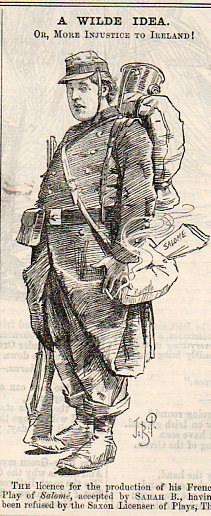
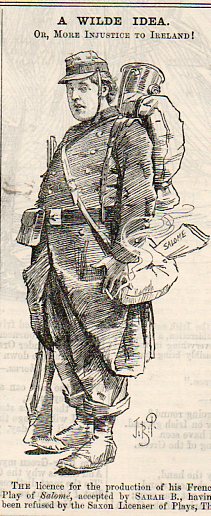
    Oscarwilde332There’s just so much in Punch magazine to pull out and have a think over.  This cartoon was poking fun at Oscar Wilde, sending him up in a French soldier’s uniform suggesting that he might have to serve if he exiled himself to France.  What had happened was that he had just written his play Salome, and in French, for production in Paris–unfortunately, there was a law in France prohibiting the portrayal of Biblical characters onstage, and so he ran into a large spot of bother..

    Wilde would wind up in France soon enough, but under tremendously changed circumstances, as the next eight years of his life would be mostly decline-and-fall, and then exploded in an exploding-hole, with nothing but Wilde-smoke remaining, and precious little of that.

    Wilde’s publishing career had started just four years earlier, really, with the appearance of The Happy Prince and Other Tales (1888).  He would enjoy major success over a period of five years, beginning in 1891 with The Picture of Dorian Gray, The Soul of Man Under Socialism, and Intentions, followed by Lady Windermere’s Fan, and Salome in 1892, A Woman of No Importancee  in 1893, the Importance of Being Earnest in 1894, and then, well, then came the beginning of the end.  After much success with his plays, everything would blow up in 1895 after Wilde decided to sue his lover’s father (the Marquis of Queensberry) for defamation received on February 18, 1895.  The suit went very badly, with Queensberry  acquitted on all counts in the course of a trial which dragged Wilde’s sexuality all the way through it.  Wilde was immediately arrested for gross indecency, was brought to trial within a month of the end of the Queensberry debacle (on April 26, 1895); he was crushed completely and found guilty on May 25, 1895, and sentenced to two years hard labor, which began immediately. 

    That was pretty much the end for Wilde., though he would write De Profundis in 1897 and The Ballad of Reading Goal in 1898. He would never see his two sons again, his mother would die while he was in prison, and his wife, too, would be dead in 1898.  Wilde was released from Reading Goal on May 19, 1897, and he would leave almost immediately for France, where he would spend the rest of his life.  A not-long life, as he would die a rather miserable death three years later, in France, on November 30, 1900. (He outlasted Queensberry, who died in January. His former lover, the Marquis’ son, Alfred Douglas, lived until 1945; he came to loathe and repudiate Wilde, rejecting their history.)

    So this cartoon was a little prescient, in a way–the near-future would find Wilde in France, though not in a France and not in a situation that Wilde could have possibly seen in 1892. 

    What lead to all of this bad business?  The Marquis was disgusted that his son was having a relationship with Wilde, and sought to put an end to it.  The end of it all came when the Marquis left his calling card addressed to an absent Wilde, “For Oscar Wilde, posing Somdomite [sic]”. And then everything for Wilde came apart, costing him his reputation and financial failure. 

    A rectangular calling card printed with "Marquess of Queensberry" in copperplate script.
    It doesn’t seem like much to hang your legal hat on, especialyl with a Marquis, but Wilde tried I guess to protect himself, and it cost him everything. Wilde won the laughs in his trial, but the prosecution won the case.

    ·Posted by :

    ·in: