A Daily History of Holes, Dots, Lines, Science, History, Math, Physics, Art, the Unintentional Absurd, Architecture, Maps, Data Visualization, Blank and Missing Things, and so on. |1.6 million words, 7500 images, 4.9 million hits| Press & appearances in The Times, Le Figaro, Mensa, The Economist, The Guardian, Discovery News, Slate, Le Monde, Sci American Blogs, Le Pont, and many other places… 5000+ total posts since 2008.

Author: JF Ptak

  • On Antique Waves and Dropping Your Hat in Them

    JF Ptak Science Books   Post 1737  (Expanding post #850, On Dropping Your Hat in the Punic Wars)

    ++ Nov 24 dropped

    There is a particular class of illustration in which, among the secondary figures of the image, there is a small happening, an everyday trifle, that has been captured by the artist and included in the overall communication for no necessary reason. (for example, see here and below1). I’ve written about this a little before on this blog in posts about finding images-within-images: the unecessaries among the unnecessaries, the bits and pieces of everyday human existence that in and of itself is not worth commentary but which nearly everyone experiences.  Small bits, they are, of a tremendous human nature, the things that are done in private, or are so universal but inconsequential that they are shocking to see when illustrated in print.

    Titus Livius (59 BCE-17 ACE), better known to the English-speaking world as Livy, was a superior among superiors of Roman historians, writing on the history of his city and country.  His work, Romische Historie…, published in Mainz by Johann Schoeffler 1450 years later in 1514, was one of the most beautifully illustrated books ever produced in that city.  This is a considerable statement, as Mainz was the birthplace/hotbed of moveable type printing, being home to Johann Gutenberg and a number of other early presses. 

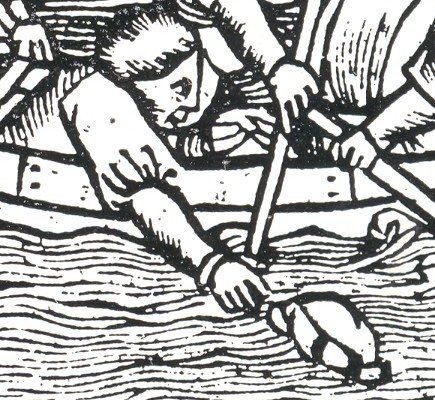
    And in looking at this fantastic work by Livy, I am a little embarrassed to find this spectacular bit of human tendency displayed in this woodcut depicting a naval engagement during the Punic Wars.  It is a beautiful thing, this scene of warfare depicted on tranquil seas and ribbony waves, determination in every face.  But what I noticed in the small boat at bottom right is a man reaching out into the water—not for a dropped oar, or to help a man overboard, or to catch his falling sword. 
    ++ Nov 24 dropped det
     He was reaching for his dropped hat. 

    I have reason to doubt that during the Punic Wars there may have been an unwritten chapter, “On the History of Dropped Hats During Warfare”.  Surely soldiers dropped their hats during the history of roman conquest, but I’d say that retrieving the headgear was more important at the Battle of the Bulge in protecting your noggin from badly splintering trees traveling at you at 180 mph and other such places than a wool cap dropped from a ship in pitched battle two hundred meters from shore. 

    I like this so because it is probably the first reaction that most of us would have—just a habit, battle raging or not—and just utterly human.  Just a little piece of back-history that doesn’t go anywhere and is lost to experience.  I’m sure that Herr Gutenberg dropped his hat at odd times, as did the unknown artist of this print.  Just an odd bit, like the first things printed on Gutenberg’s press being religious indulgences for people paying their way past Purgatory (and worse).  The fact that the indulgences preceded the great bible by several years doesn’t really matter, and neither does retrieving a dropped hat in a sea battle—but they do make interesting stories.   

    The only thing that I’d rather have the artist improve in this print were the waves–the ones on exhibit here weren’t very saucy.  Admittedly, waves were a large problem so far as depicting them goes, what with the whole vast subject of fluid dynamics so little known at the time.  THe person who would know this phenomenon best at this point–Leonardo–was thinking and working but wasn’t sharing. His “Studies of water Formations” (c. 1507-09)? and the later, magnificent “Deluge” (1513, nearly the year of publication of the above) would stay hidden for centuries, the big step forward in the West having to wait for another 120 and 140 years (respectively) for the works of Benedetto Castelli, and Evangelista Torricelli, 

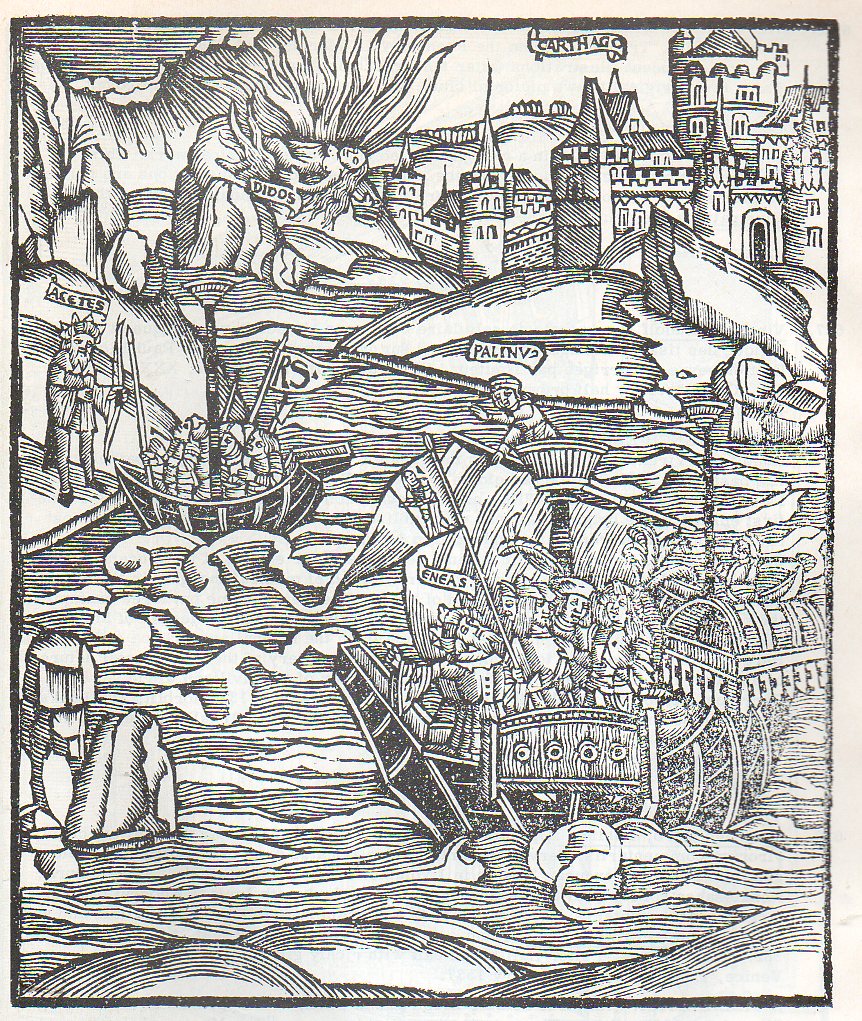
    This aside, I think that I’d rather see heavier lines in my Renaissance waves, more in line with we find in Publius Virgilius Maro Oper accuratissime castigata…, a richly illustrated (104 large woodcuts) work published in 1537, even though the artwork (evidently) appeared in an earlier edition of 1502.  No matter, “The Master of Grueninger’s Workshop” created some beautiful waves:
    Wave301
    There’s nothing “wrong” of course with the Livy waves; the Virgil though has sharper, darker, blacker and stronger contrasts in the water. Of course, the Livy has that incredibly human act of the man reaching for his fallen hat int he heat of battle, and that’s something that rarely seems to happen in prints of the Renaissance. 

    Notes:

    1.  Some other Found Images posts:

    Found Images: Penny Lane and the Inexpensive Treat, London, 1896

    Found Images of the Great Wheel, 1895

    Finding Hidden Images in Antique Prints: 18th Century Forensic Social X-Rays of Florence by Guiseppe Zocchi


  • Fantastic Cover Art: a Picture of the Future of Television

    JF Ptak Science Books   Quick PostRca300

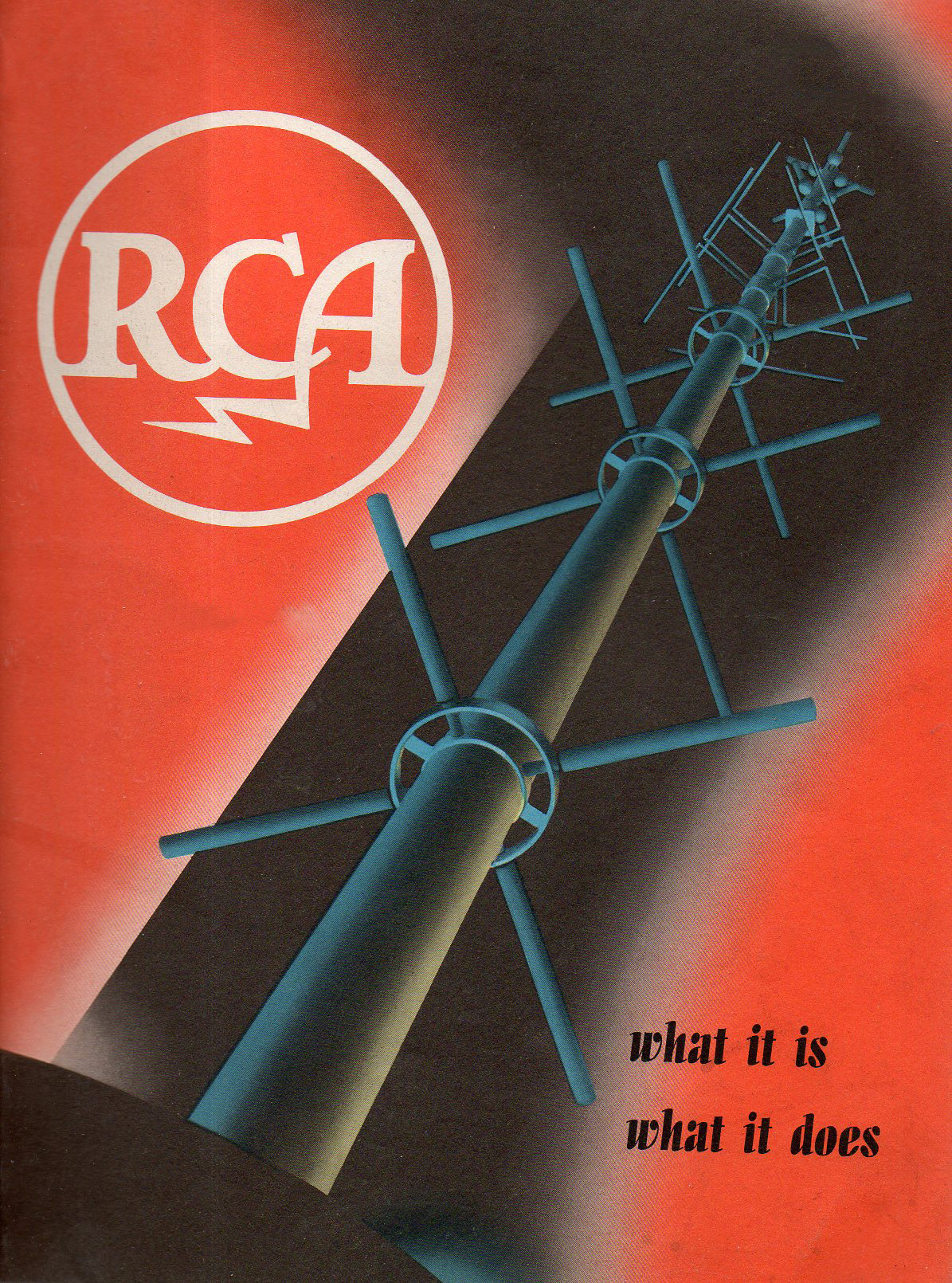
    This image is that of the television antenna of station WNBT and for many years it sat on top of the Empire State Building.  WNBT was the flagship station of NBC, which was owned by RCA (Radio Corporation of America, 1919-1986) which (according to its name) was really the first national broadcasting radio network in the United States, and which (as experimental station W2XBS) became the first to broadcast a television picture (of a papier mache Felix the Cat) in 1928.  This fantastic cover art for a 1947 promotional for the company pictured the famous antenna,  the great visual of the company’s external hardware, right there on top of the world’s tallest building. 

    This was really a picture of the future, and in 1947 the future of mass communications and entertainment (and in making money in the two) was seen in television, much more so than the formerly gargantuan radio. 

    I just really like the design of this pamphlet’s cover…A small poster-size reproduction is being sold (along with the original pamphlet) at our blog bookstore, here.

    ·Posted by :

    ·in:


  • The Movie as Morgue: the Imperialism of Technology over Memory?

    JF Ptak Science Books   Quick Post

    I was just thinking about the period of 1876-1900 or so and a few of the advancements in technology–telephone, motion picture–and how they changed the landscape of how people saw things in the present, and how they altered the very way in which memory worked. I’ve come up with a couple of questions:

    Man with Cane, plate 49

    1.  When was the first time that a person was able to see a dead person–personally known to them–appear “alive” in a motion picture?  How disorienting could that be, say, to see Uncle Henry or Mother walk past a camera at the Columbian Exposition in 1893, have Uncle or Mother die in 1894, and then see them, again, strolling, in 1899? 

    1.1  Would the dead-preserving daguerreotype have prepared people for the experience of the next step of seeing the dead people, this time in motion? 

    1.12  Daguerre’s and later photographic processes would have allowed people to clearly see the faces of the Departed even decades after death.  Certainly this was a triumph of technology and a change ways a hundred centuries old of remembering what dead people looked like.  What did this mean to the people in the first generation of humans who were able to experience this?

    1.2.  I wonder if it would have been possible to operate a business–say, in 1895–that specialized in making simple one-reel motion pictures of family members and then contracting to save the movie for decades. 

    1.2.1  The movie house would become a Morgue.  Family members or whomever could come and see these motion pictures with dead people in them.  It would be like a moving, visual cemetery.

    2. What did the invention of the telephone mean to people who now could with utmost ease communicate via voice without being face-to-face with the other person?  

    2.1  The telephone was also a great democratizer–it meant that anyone with access to a telephone could talk to anyone at the number that was dialed.  In the age of introduction and more-visible class warfare, this was a novel idea.

    3.  What was it like for the first time people were able to experience interrupted motion?  That is, for people in a cinema, or seeing a motion picture somewhere, that they could be among the first humans in the history of humans to be able to slow or stop human action as filmed in  a motion picture, to see motion frame-by-frame, or (perhaps, if not too explosive) to see that action stopped, and started, at will?


    3.1.  And what did people think when they could see such things as interrupted and suspended motion, that they could see it all backwards? And over and over again? It had to have been an overwhelming sensation of newness and the unexpected.

    3.2  It certainly meant a lot scientifically, with Marey instituting a study of locomotion; and also for the arts, as there is really no telling what impact these sorts of images would have had on people who were read/studied by those like M. Duchamp and his Nude Descending, or to the creation of alternative narratives in literature.

    How did these inventions alter the way in which we remembered things, and how we remembered them?

    If we fast forward (!) to the present, what might it mean to the way our memory works if we can commit so much of what we come into contact with to the cloudy intertubes? Obviously we today come into contact with x-orders of magnitude more data/information than ever experienced in the course of human history (and perhaps we experience more data input than the “average” person would have experienced over a period of a collective century or centuries or _________), and so I wonder about how the brain discriminates between necessary and allocated memory?

    Again, just some thinking-out-loud notes…


    ·Posted by :

    ·in:


  • The Gift that Keeps on Giving: Radium, in Powder or Suppository

    JF Ptak Science Books  Quick Post

    Radium.  It was for some short period of time a magnificent and harmless thing, soemthing with a life of its own, sort of, in the way that people used to think of electricity. 

    Adium299

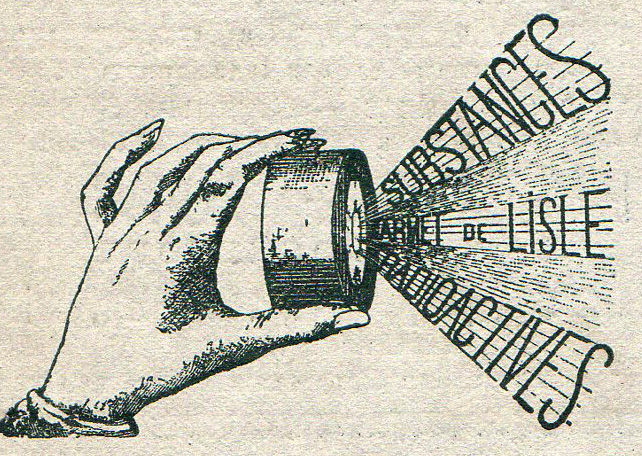
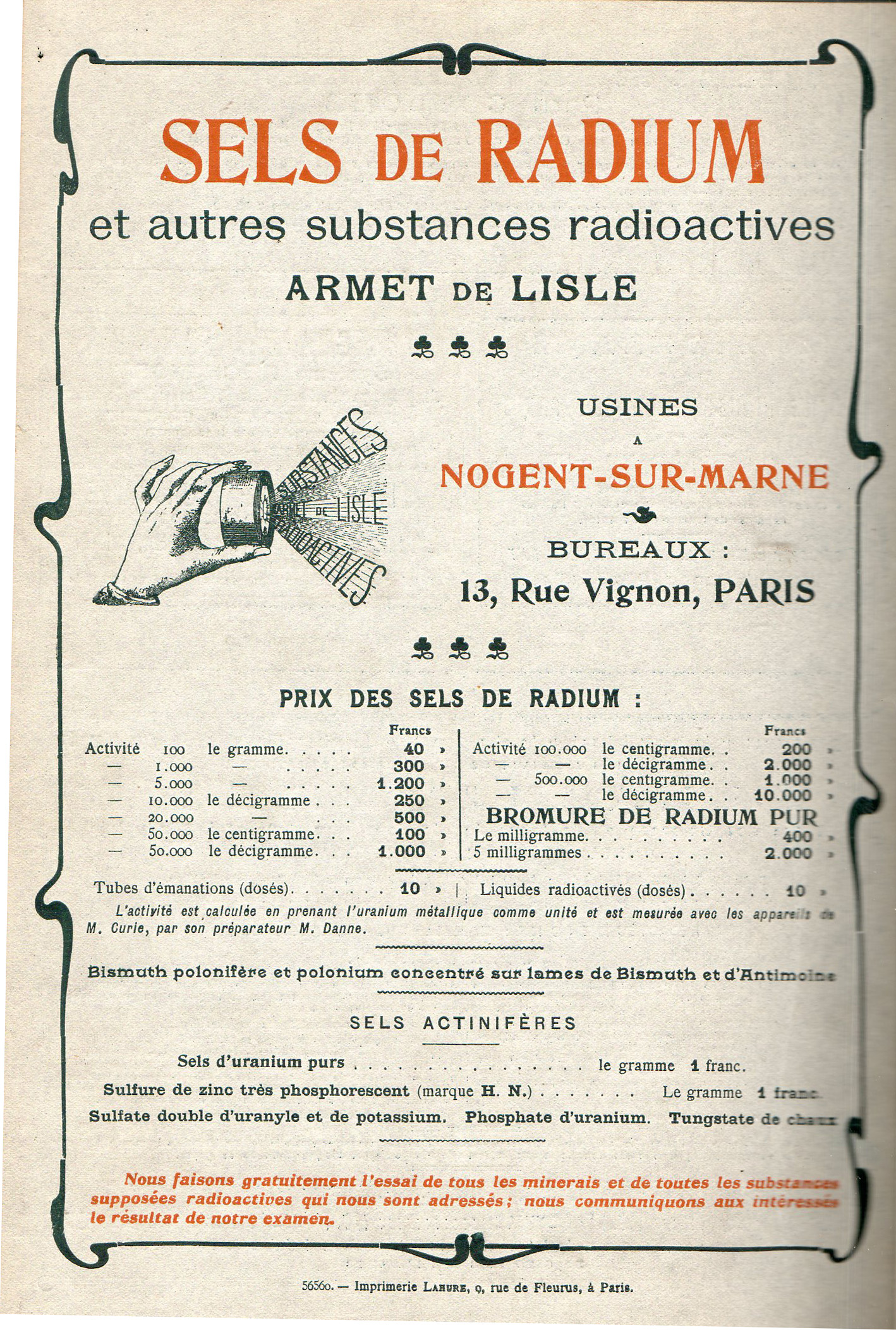
    This is a detail for an advertisement for radium salts, found in the December, 1903 issue of Le Radium.  At this point, just five years after the Curies discovered it and quick-published (in five days) their results in the Comptes Rendus…, the massive biochemical effects of human/radium interaction was not understood. And so the ads for firms like Armet de Lisle, which  was loudly selling Sels de Radium (and other radioactive substances like uranium salt  and uranium phosphate) without any real knowledge of the adverse health effects of its products.  (The Curies and Becquerel had noticed ulcertating reactions to their skin when it was left in contact to radium, and “radium dementia” had been reported beginning about 1900, but it would take quite some time for this radioactive material to be understood as lethal products.)

    Adium298Radium was used (in very small dosages) for the illuminating of instrument panels and dials (in, say, aircraft) and wrist watch faces into the 1960, though the major health factors ground themselves out in the worker who would come into contact with the radium itself. 

    Of course there were other uses for radium as a cure-all, which would have been a completely different story:

    In the early 1900s, real men used radium suppositories

    [which I wrote about here in “Radium Dance”]


  • History of Holes series: Holes in Airships (1919 and 1937)

    JF Ptak Science Books   Post 1736 [History of Holes series.]

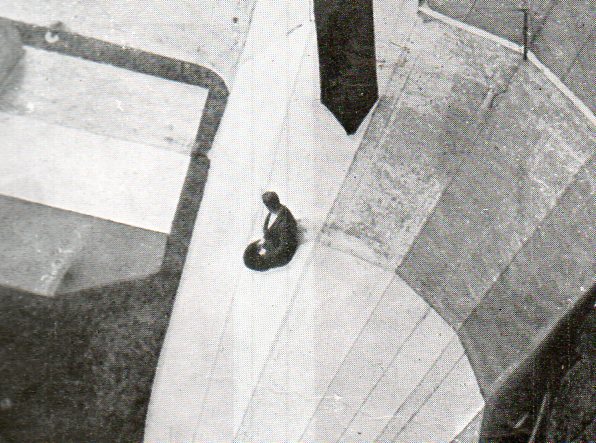
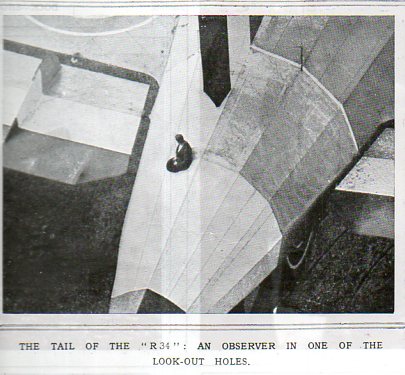
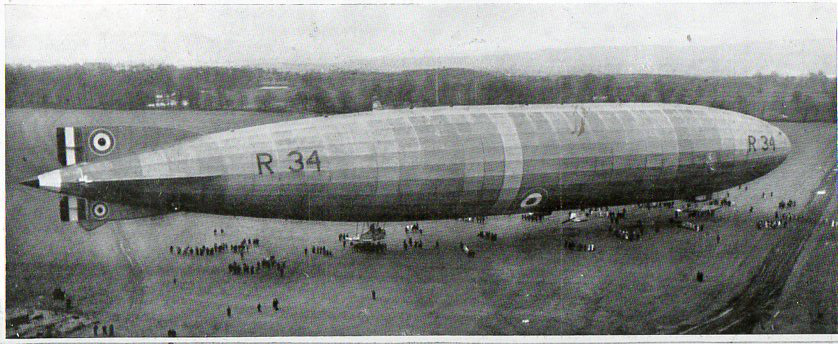
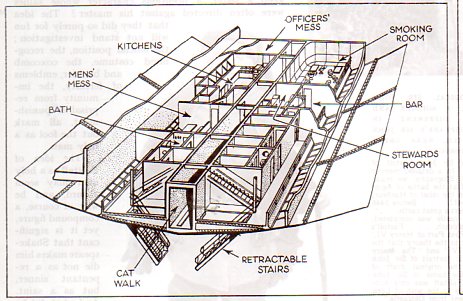
    Holes are of course everywhere–it just depends on how hard you look.  This image, though, struck me very quickly as an unexpected hole (though of course once you allow yourself a moment to think about ti the whole thing makes sense).  It is a very plain “observer’s perch” in the tail of the great British airship, the “R 34”, and appeared in the Illustrated London News in April, 1919, just before its first flight.  The aircraft was massive–643 feet long1–and on one superficial level its hard to imagine holes in its structure of any sort, let alone an unprotected observation post.  But there it is.
    Airship 297

    And this

    Airship 296

    Here’s a full view of the “R34”, successor to the “R33”:

    Airship 295
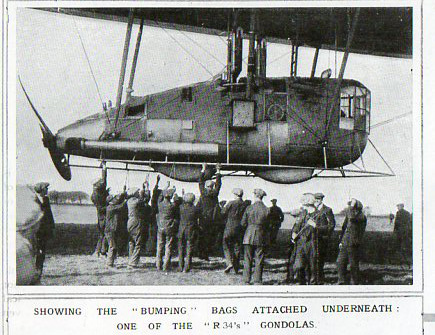
    This is an image of the (forward?) gondola of the airship, looking like it has come in for a landing, or touchdown, or whatever–there is something so very primal about this relatively small group of men reaching up for the railing on the gondola…a railing placed there specifically for that reason.  Its hard to imagine that such a seemingly small effort would be enough to control any part of the airship’s motion, though perhaps it was. 

    Airship 293And the detail, showing the man in the middle clearly off the ground–clearly he must be weighing his options:

    Airship 293_edited-1At least he seems to be wearing one glove, anyway

    Then there’s the image of the “bad” hole, the iconic image (photographic and motion picture) of the conflagration and crash of the Hindenburg, a result of a very quickly-spreading “hole” in the skin of the aircraft as it was coming in for a landing/mooring in Lakehurst, New Jersey, 1937.

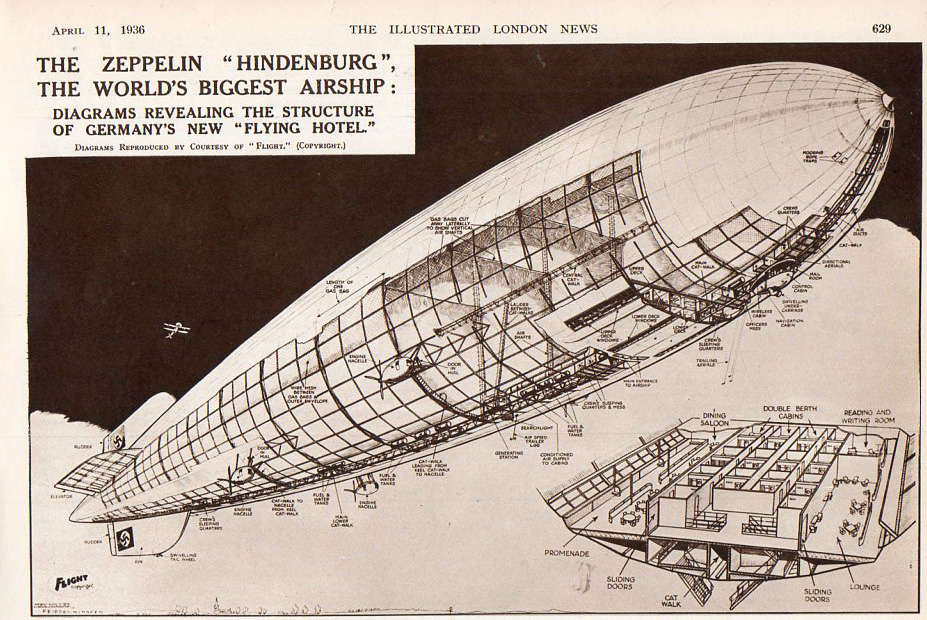
    Here’s a cross-section of the Hindenburg as it appeared in the Illustrated London News in 1936:

    Airship 289

    Airship 292

    Notes:

    Specs on the “R34”:

    • Length: 643 ft 0 in (196 m)
    • Diameter: 79 ft 0 in (24 m)
    • Volume: 1,950,000 ft3 (55,000 m3)
    • Useful lift: 58,240 lb (26,470 kg)
    • Powerplant: 5 × Sunbeam Maori, 275 hp (205 kW) each

    The Hindenburg was quite a bit larger than the R34–in fact, it was the largest thing ever to fly, at 803 feet long and 135 feet in diameter…and 200,000 m3, almost 200% larger than the mammoth R34.


  • The Obviousness of Oblivion

    JF Ptak Science Books LLC  [Post 1002 expanded from April 2010]                   

      [Another in a long series of post on atomic and nuclear weapons.]

    Perhaps nothing is obvious unless it is established or labeled so; perhaps the obviousness must be stated at least once before it can be officially, recognizably, the case.  And perhaps the greater the obviousness is, the more the need to make it officially so.  Perhaps nothing is so incredibly obvious that it can be studied and dissected and established.

    This seems to be more the case in more recent history than in time more further removed: that millions of dollars can be spent “proving” that children do not like to be separated from their mothers, or that cars will go faster downhill than up, or that people will respond to proper medication better than not, and so on, so on into the night, just seem not to need a vastly-funded proof.

    And so the case with nuclear warfare, people, and cities.

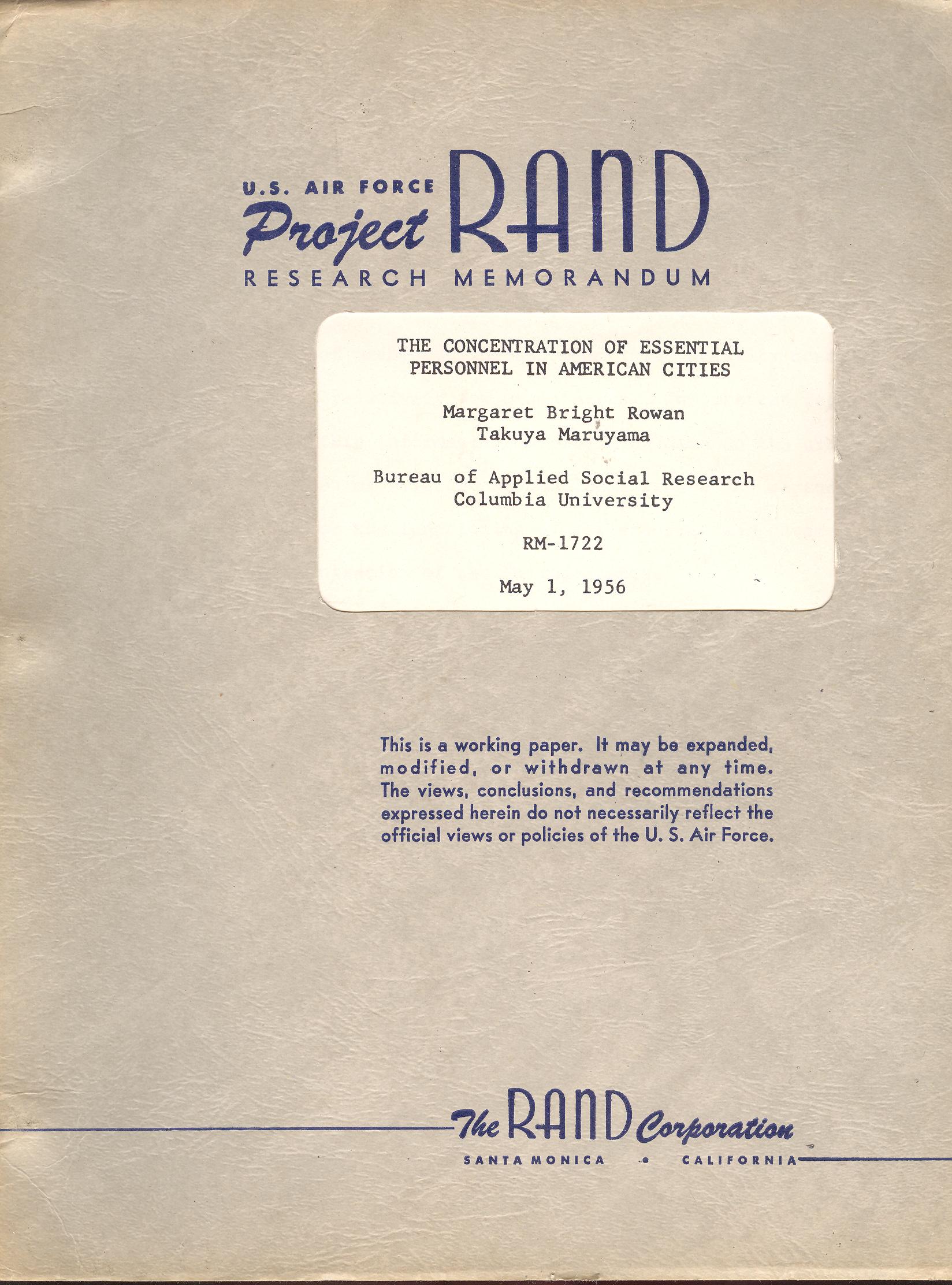
    In this RAND report from 1956, the great issue seems to be laid to rest, once and for all: the problem with nuclear weapons being exploded in/over cities is that since cities are filled with people, people will be killed.  And if those people in the cities are there because of professions that depend on city-settings, then more of those people will be killed than not.  

    Rand report

    But what this report was really about was the unfortunate aspect of the impact if nuclear warfare on leadership and working positions in significant and strategic industrial/business/government professions.  And what the report finds is this: since the vast majority of these positions are located in cities (defined as 100,000 population and above), and since cities will be the major targets in a nuclear “exchange”, the overwhelming majority of these people will be killed, thus leading to strategic human resource vacancies post-war. 

    It seems that 95% of aeronautical engineers in the U.S. would be killed in a nuclear war, which I guess would mean that it would be difficult to design new aircraft and such in the post apocalypse world.  Of course these people would be killed because it was their industrial base that was being targeted and they were collateral damage, so there wouldn’t be any industrial base to produce the components necessary to build, say, a B-52.  That part of the equation is not addressed here, though.  Nor is there any sort of recommendation presented to fix the problem.

    The RAND document just painfully points out the obvious, once and for all; no one really knew what to do with the information now that it was there, in black and white. Certain people could be evacuated, saved from the maelstrom; but saved for what?  There were other evacuation plans that were completely doomed from the beginning, sheltering plans, Dr. Strangelove arrangements, but all of that would come into their pitiful being later on.

    First, though, the bitter reality of what everyone already knew–one of the greatest of all obviousnesses–had to be make its appearance in print.  And so it did.

    ·Posted by :

    ·in:


  • Singular Placards and Perhaps a Singular Christianity?

    JF Ptak Science Books   Quick Post

    I found this rather, um, provocative pamphlet that asks, right up front on the cover of the thing, “Should the Christian Church Resign?”  The author, who I think is the man holding the placard on the cover, is Benjamin H. Dinnick (Cardiff, Wales) who published the work in the 1930’s. 

    Dinnick286
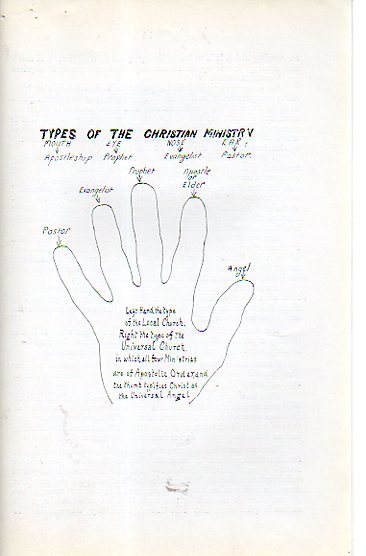
    I’m reproducing the cover and one of Mr. Dinnick’s impenetrable diagrams–I can’t really say what he was after or what he was for, but I find the images interesting. 

    Dinnick287


  • A Note on the Vast Wealth Possibilities of the Refill Business: Ink and Paper

    JF Ptak Science Books   Post 1735

    http://www.columbia.edu/cu/computinghistory/reg-card-80.gif

    [Source: Columbia University computing history site, here.]

    I guess that the only reason why HP charges for their printers is that they can.  When you buy one of these products you’re basically purchasing the need to keep the things fed with semi-proprietary HP ink–and as everyone knows, printers are notoriously thirsty creatures, and one can easily spend multiples of the cost of the printer on ink in the first year alone. 

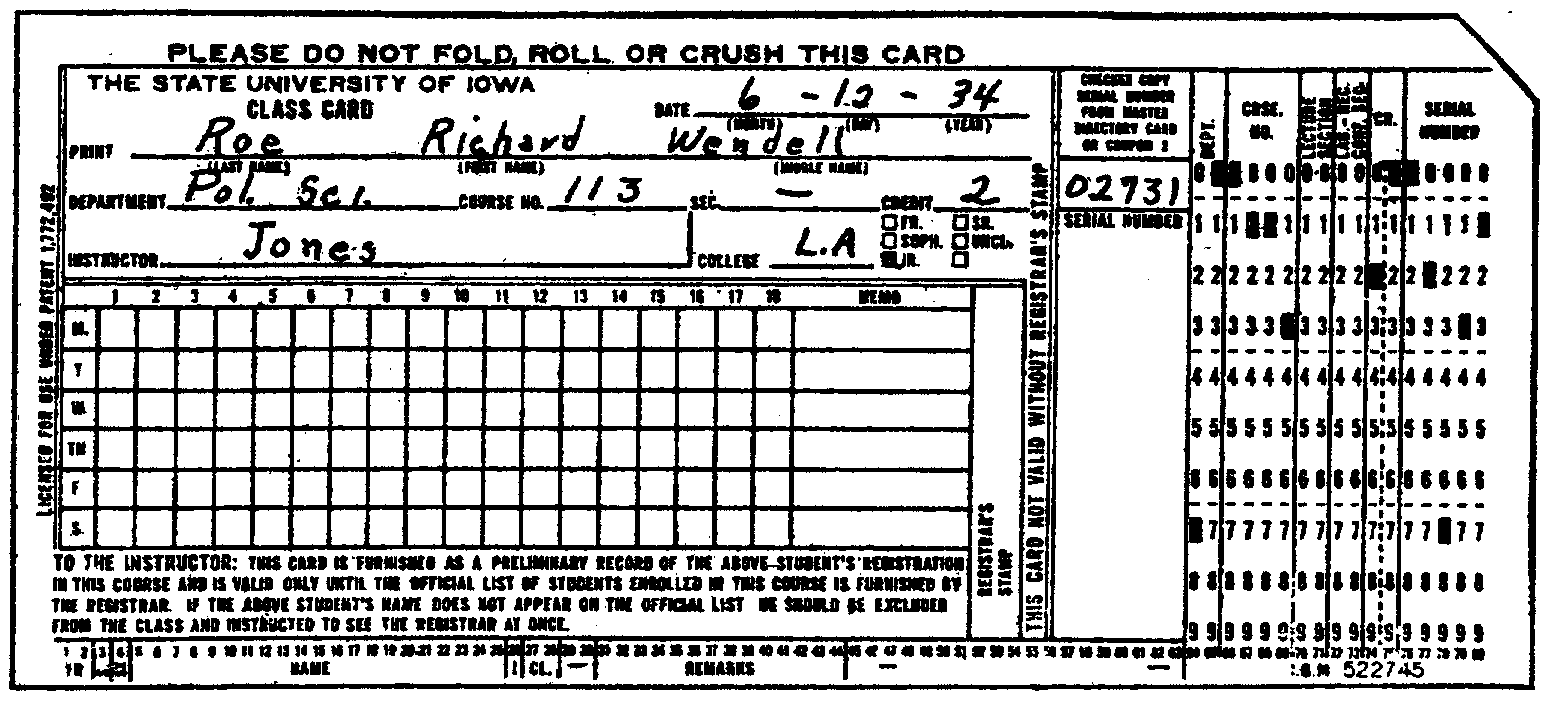
    This is a great idea so far as the manufacturer goes, but it is hardly a new one–International Business Machines counted on this sort of income for several decades, partially getting the company through the Great Depression. 

    And what was the IBM necessary-suppliable that their customers had to keep buying over and over?  It was the business machines themselves, because it was IBM practice to rent their machines out (which would pay for the initial investment and production in the machine in about two years, and most customers seemed to keep their rented mater1al for 5 or 7 or 10 years.  What IBM kept supplying their customers with was the stuff that they sent through the machines–the IBM cards.  The customer needed the cards from IBM itself, mainly because it was part of the contractual agreement for the lease of the machine, and also because the IBM product was superior to other mass-produced cards.  In the 1930’s the card business for IBM accounted to something like a few billion cards per year, which evidently would account for 30-40% of IBM’s yearly profit.  And that’s quite something. 

    The idea of the necessary refill is not IBM’s to claim for themselves–years earlier, Eastman Kodak accomplished the same deal with film for their cameras; and razor blades were supplied by Gillette to users of their razors.  And although you don’t need Ford gasoline to run a Ford automobile, in the 1930’s you did need a General-Motors spark plug to run a G-M vehicle.  Radio Corporation of America sold radios and also the necessary tubes to replace the ones in the stock radio; Thomas Edison too had a vastly controlling interest on how his light bulbs would be installed and replaced. 

    So as annoying as it might be to have to pay a fair amount of money for a small amount of ink to make your printer function, the printer-producing companies are just following an old (and highly profitable) business practice. 


  • Sawing Through the Catalonian Mountains, 1499

    JF Ptak Science Books  Quick Post

    Mountains282
    The beautifully-named Gerardus de Zutphanis wrote de spiritualibus ascensionbus, a lovely gothic-lettered work of 84 leaves, in 1499, in the fifth decade passed the Gutenberg invention.  It was published in Montserrat–in Catalonian Spain, some 4,000′ or so about the valley floor– by Joseph Luschner, in the mountain keep of the Benedictine abbey there. 

    The woodcut image reproduced here was used as a printer’s device, and in it, remarkably, are shown not only the abbey, as well as some others as indicated by the series of crucifixes, but the improbable figure of the Virgin Mary holding the Christ child with both seemingly sawing their way through a mountain.  Its a magnificent thing–I particularly enjoy the use of dots in shading the mountainsides. 

    The press–or the business, the publisher that is–that produced this work is still in business today.

    ·Posted by :

    ·in:

    —

  • Lunar “Firsts”–the First Image of the Moon using the Telephone?

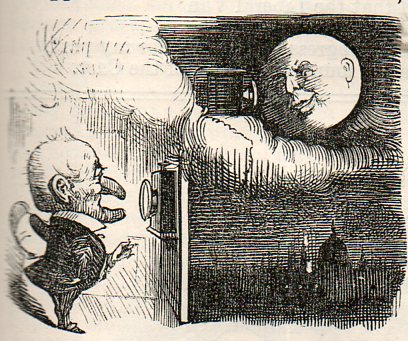
    Perhaps, or perhaps not, but what this image does seem to show is a conversation between the Moon and Mr. Punch.  It appears as a small text woodcut in a long series of short stories in Punch, or the London Charivari, called “What Mr. Punch’s Moon Saw”, 14 September 1889.

    Moon281
    Mr. Bell just barely beat a host of competitor’s for his telephone patent 13 years earlier, and the telephone didn’t really get semi-“widespread” use in London until at least the mid-1880’s, so it is really quite possible that this is the first time that the Moon is shown engaged on the ‘phone.