A Daily History of Holes, Dots, Lines, Science, History, Math, Physics, Art, the Unintentional Absurd, Architecture, Maps, Data Visualization, Blank and Missing Things, and so on. |1.6 million words, 7500 images, 4.9 million hits| Press & appearances in The Times, Le Figaro, Mensa, The Economist, The Guardian, Discovery News, Slate, Le Monde, Sci American Blogs, Le Pont, and many other places… 5000+ total posts since 2008.

Author: JF Ptak

  • Flat and Full Perspectives

    JF Ptak Science Books  Post 2602

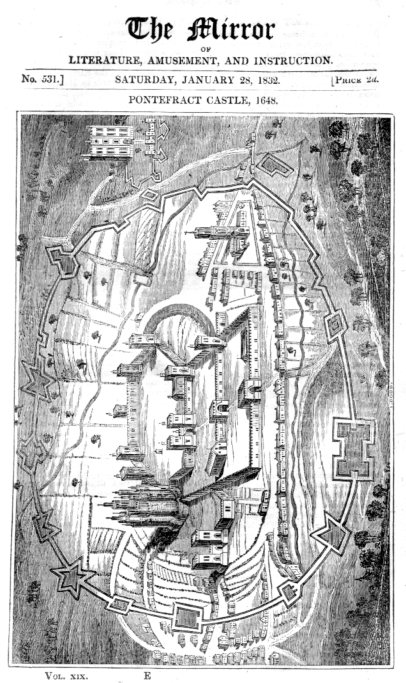
    There were two images that I came across tonight in the studio as I was chasing Pooches the Cat/Dog–they’re not quite on the opposite ends of themselves on the compass rose, but they are certainly in the neighborhood. I like it though that they came to me by chance, one after the other. One is very, very flat; the other is very “full”, and has a large sense of dimensionality.  The first is a 1832 woodcut of a 1648 rendering of Ponterfract Castle. Although perspective had been discovered (or rediscovered at 250 years earlier, the image has a Medieval taste to it, as we see both two- and three-dimensional representations together in the same image.  I think that most of that was done by design and the print was dual-purposed–first to show the plan of the castle and then secondly to show the fortifications and some buildings in elevation. The overall effect I think portrays more flatness than not.  

    Flat perspective089

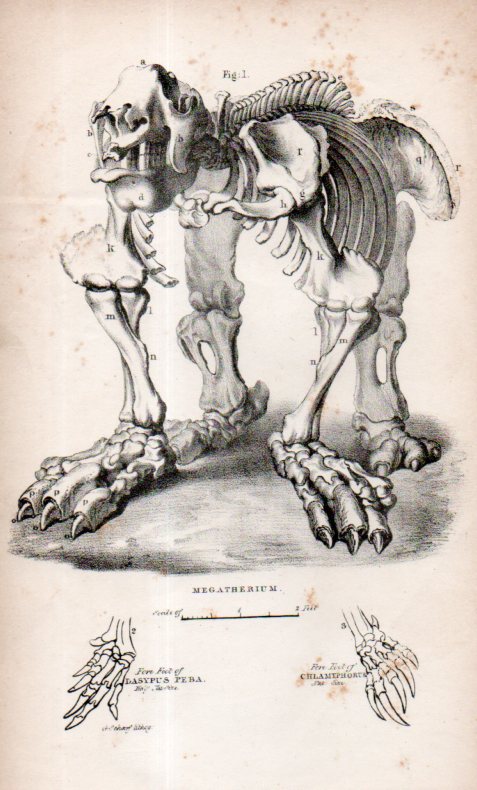
    The second perspective is something that I’ve always thought had a deep depth for a piece of paper. My copy is simply a loose engraving, bought years ago at Pageant Book Shop in Manhattan–a stray bit in a  “sciences” bin or some such, and I’ve had it ever since.  Again I’m not sure of its origin but my guess is that is is English from a popular science dictionary or geological text 1825-1850.  It just has a great perspective–plus it also looks as though we’ve just surprised it, a little.  It is a Megatherium (“giant/beast”) and was discovered first in 1788 by Manuel Torres and then assembled in the next year by Juan Bautista Bru, who evidently made the first illustrations of it.  An engraving of the magnificent mammal appeared in the second edition of Georges Cuvier’s Recherches sur les ossemens fossiles, (1812) which was a justifiably iconic image, though I like this little and odd-perspective one from above better.  

    Megathermin088


  • The History of Being Horizontal–on Lying Down and Being Flat

    JF Ptak Science Books    (Expanding an earlier effort, Post 1870)

    • See also an earlier post to this blog relatign to this topic: Post-Renaissance People-in-Bed-in-Title-Pages,  https://historyofideasblog.com/thesciencebookstore/2012/08/post-renaissance-people-in-bed-in-title-pages.html
    0--blog---Nov 24--skinny114


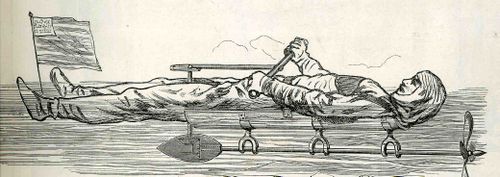
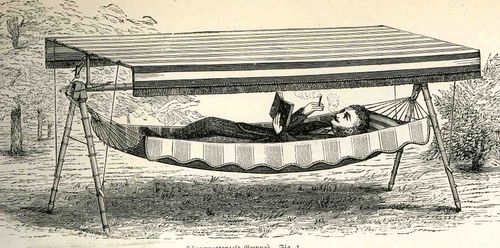
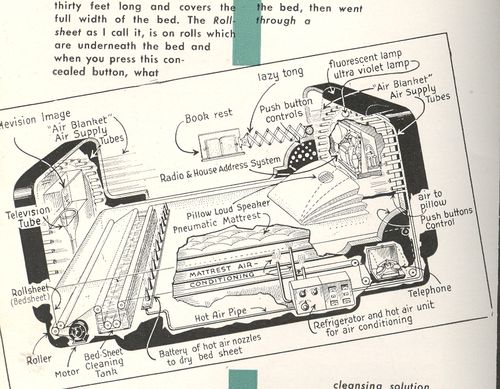
    I don’t have much to comment on in these images, just that they are striking and came to me in short order, and that they are all pretty narrow things.  They could fall easily into aSkinny category, or perhaps better still, they might slide nicely into the prototype for a series of posts on The History of Lying Down.  Or perhaps a combination of the two, or one being a sub-category of the other.  Certainly a history of humans lying down would be fairly massive, but scaling it down to late 19th century images of skinny and lying down might narrow the field a bit. 

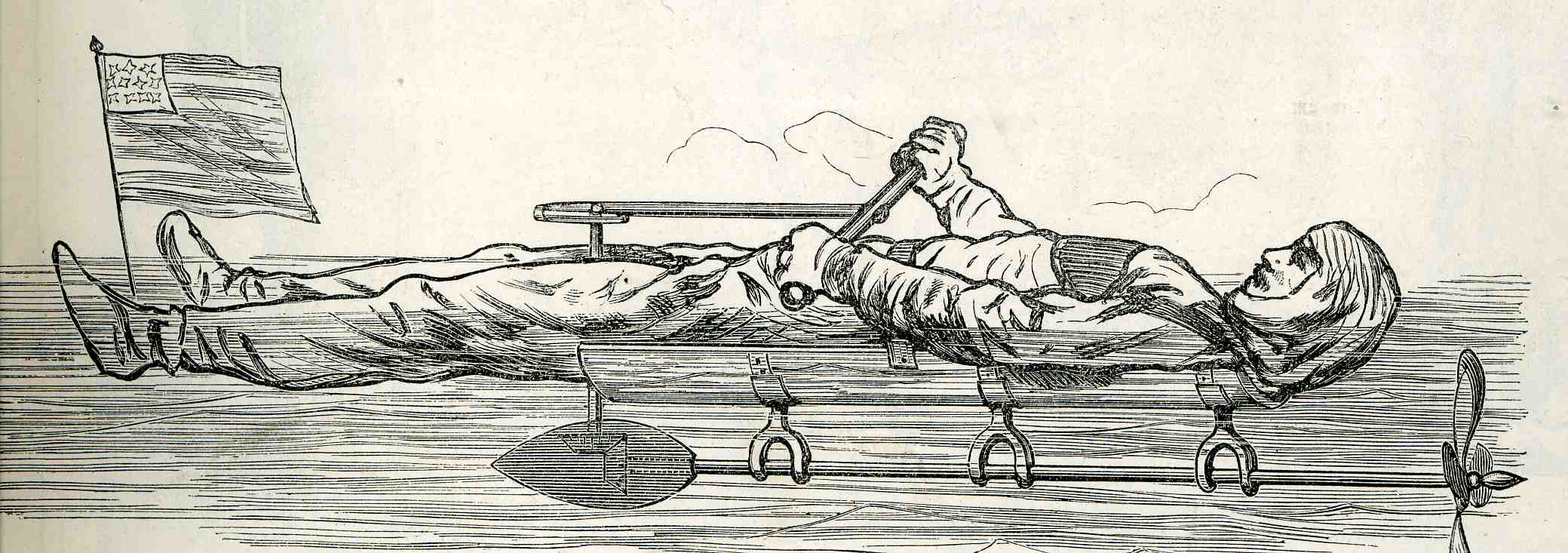
    The first, (above),  is from Illustrirte Zeitung (Leipzig), and published in 1878; it depicts an American effort at simplified swimming, though sometimes when you simplify an already-simple thing, the results are fairly complex.  I haven’t much of an idea about how this would make sense, seeing that the body’s strongest muscles are not being used at all; further, judging by the flag, this guy is moving feet-first, and the whole procedure, despite body suit, look as though it would be terrifically cumbersome and bloaty.  And with the geartrain, plus the weight of the driveshaft and propeller, I don’t know how anyone would keep afloat.  Or how someone would keep their neck in that position for any period of time. In the world of Good Ideas, this would be an Anti-Good Idea. 

    0--blog---Nov 24--skinny116

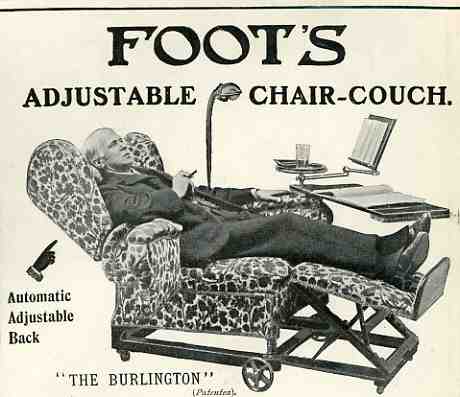
    Foot’s Adjustable Chair Couch, which I found in The Illustrated London News for September 1902, was remarkable for its cushion-y formlessness, accepting the reader to itself like a body with a goiter.  There’s just something terribly wrong with it, reminding me somehow of undeserved and needlessly- rewarded comfort–too much comfort foully a perfectly reasonable invention like The Chair. 

    Next is this skinny, low, light semi-automated shaded hammock; little, narrow, and maybe comfortable to fit a 120-pound person.  This appeared in the Illustrierte Zeitung, again, for 1892.
    0--blog---Nov 24--skinny115


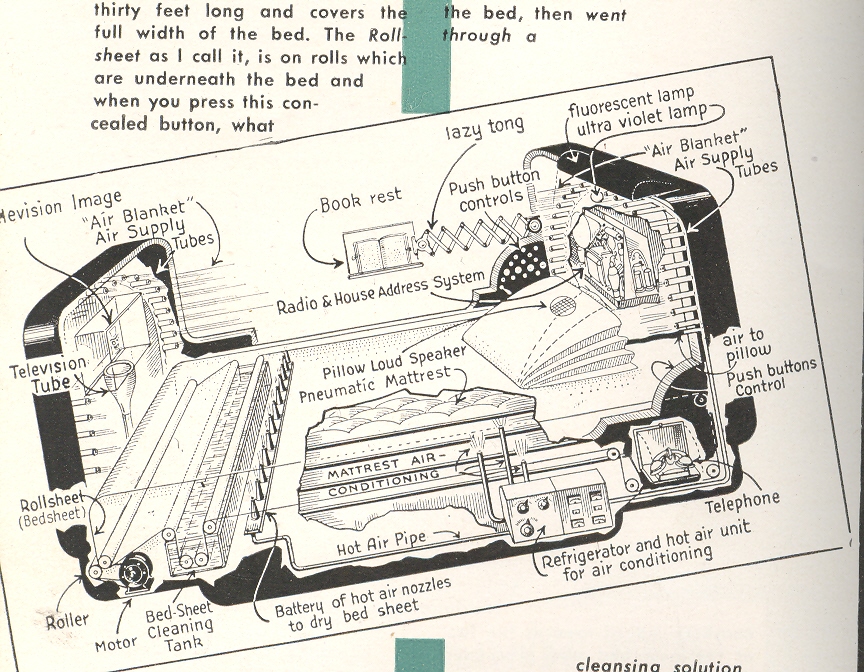
    And for the 20th century contribution, there is this overflowing fabulosity from Hugo Gernsback–this is the only-tongue-in-check effort amongst these entries.  The “electronic bed” appeared in a small 1945 pamphlet called Bizarre, and it is just that, and is certainly not hiding behind any lesser or ambiguous title.  It seems to be a parody of  small magazines and their advertising sponsors,  and copyrighted by the very far-reaching Gernsback, who in 1926 started the first magazine dedicated to the genre of science fiction (Amazing Stories) and for whom the World Science Fiction Society’s annual award for Science Fiction Achievement is named (the “Hugo”).  Gernsback evidently had a taste for cheeky parody, producing similar magazines to this called Quip, Forecast, Jolliers, Tame and Newspeep.
    Bed electronic


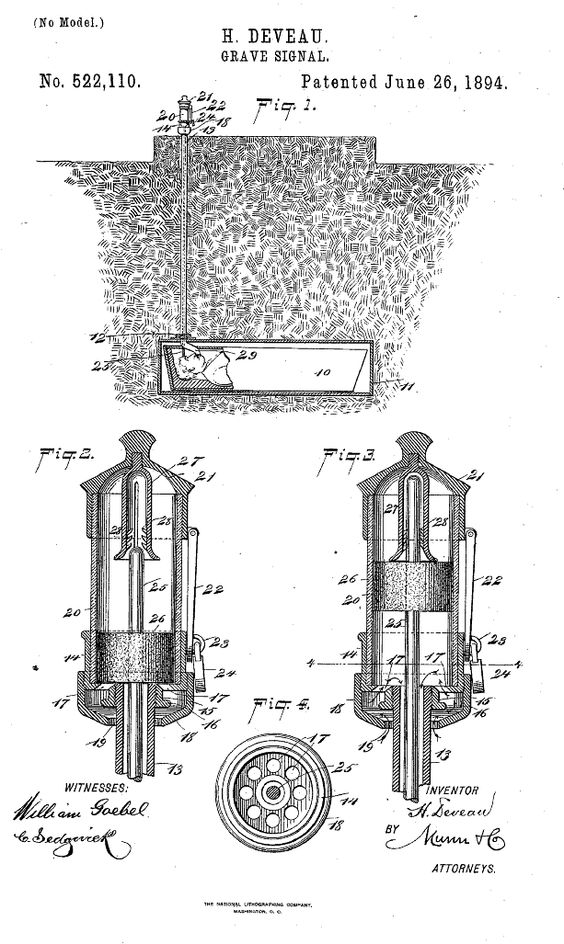
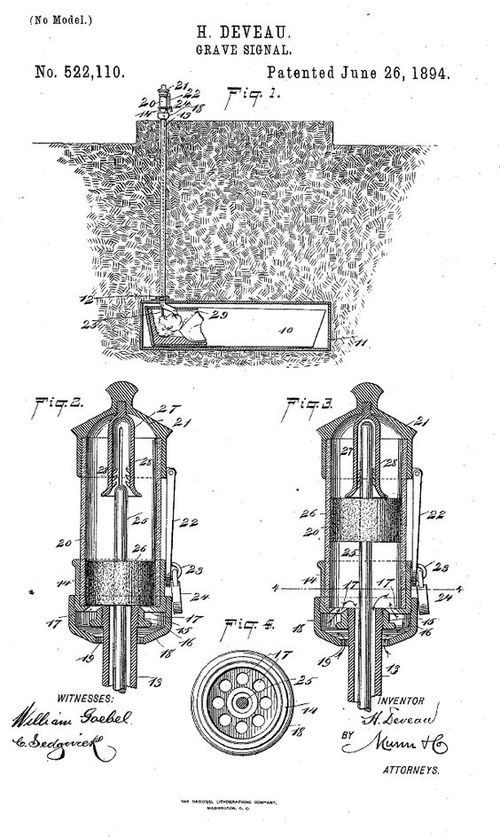
    There is good lying down, and there is “bad”–that is, the lying down that we don’t want to do, the lying down that we try all of our lives to postpone; that is, the lying down for the Big Sleep.  Since it was difficult to absolutely diagnose death in some cases before the 1950’s, there were some people who went to extreme measures to ensure that if they were buried prematurely that they would have some recourse int eh situation–for example,with the patent granted below, a buried person could activate a signal from the grave with very minor movements of the mouth, thus hopefully alerting some passerby to the fact that the dead isn’t:
    Bed coffin signal

    There are endless varieties of lying down–these are just five examples. The world is full of possibilities that are good, bad, and indifferent. Some are very bad (like the restraint beds for the institutionalized insane in the 19th century) and near-bad (the sleeping accommodations of 18th century sailors), and of course the fantastic Renaissance beds of the rich and famous, and so on.  

  • Talking Phonographs and Talking Photographs, 1877/8

    JF Ptak Science Books    [Reposting Post 2601 with an update]

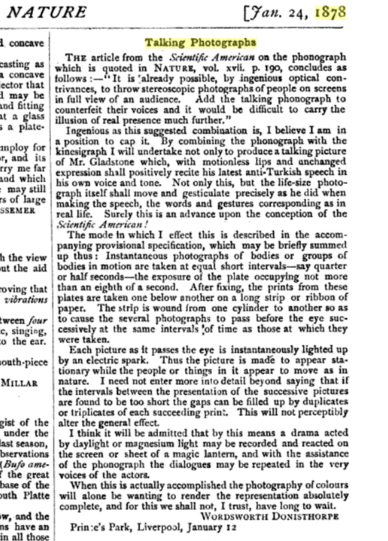
    There appeared in the wonderful pages of Nature (for 24 January 1878) a short but interesting technical communication from the probably/improbably-named Wordsworth Donisthorpe (1847-1914) about an invention that is deeply related to the early stages of motion pictures–in fact it was the first paper that coupled sound with the moving image. It appears eleven years before the first successful demonstration of a motion picture in 1889.  

    Talking photographs

     (The article is immediately preceded by another on the change of habits in toads.)

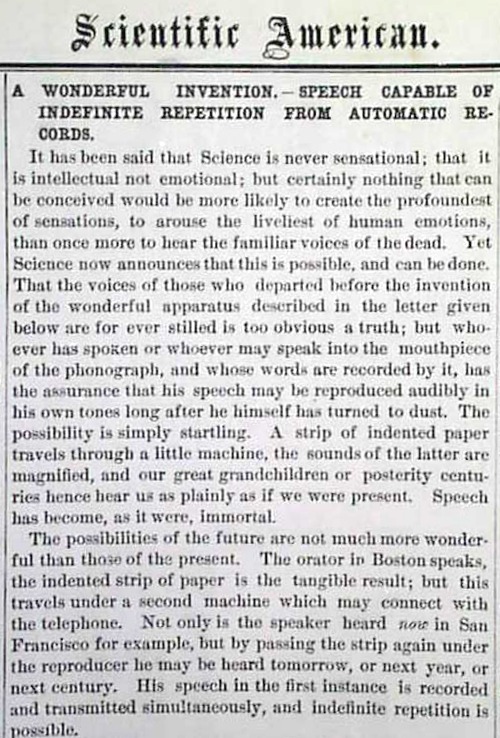
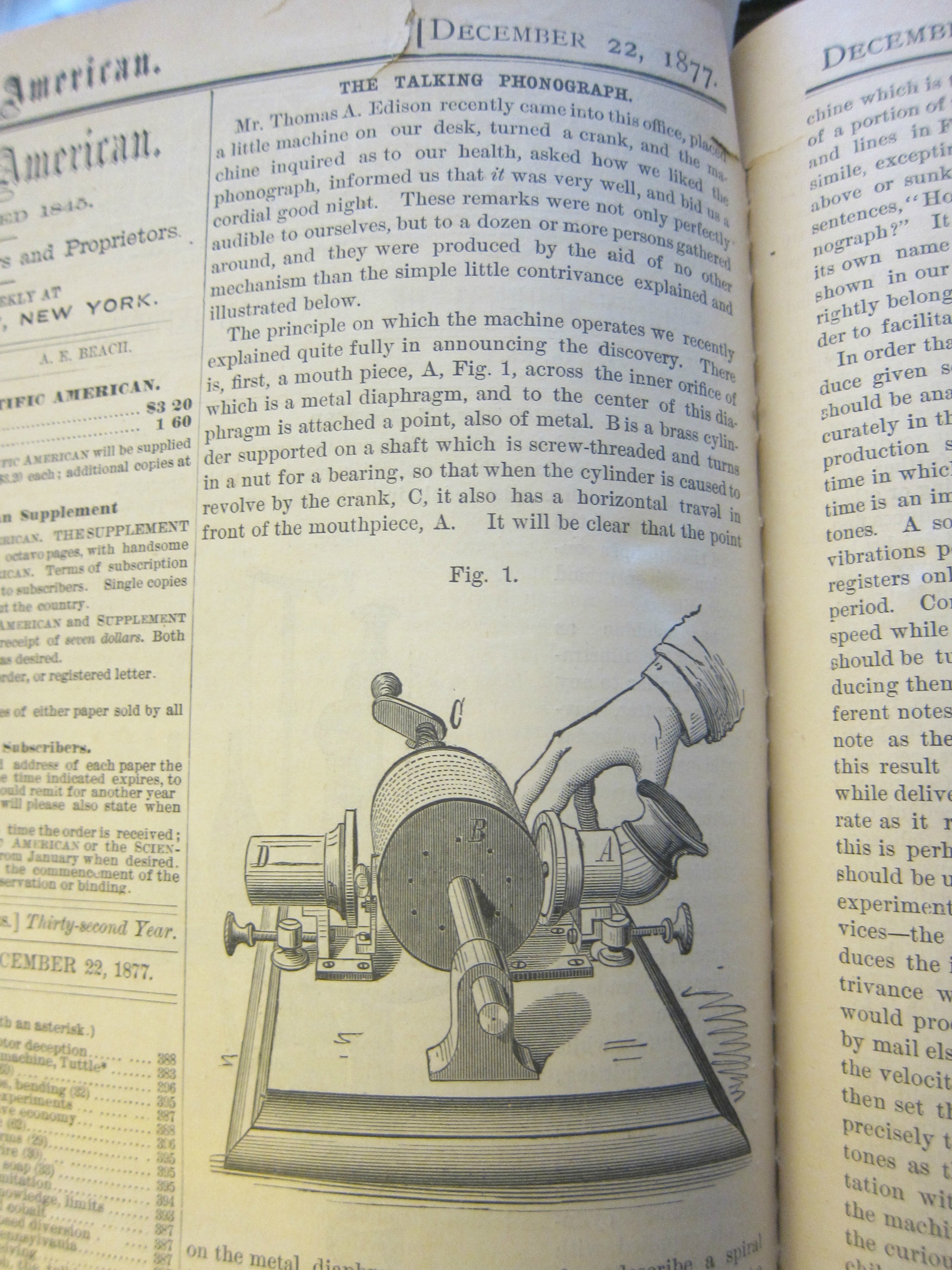
    What Mr. Donisthorpe is talking about in the pages of the Scientific American is really the back-door entry to an even bigger topic: the first announcement of Thomas Edison’s phonograph as it appeared on the back of the first  page in the last issue for the year, 29 December 1877.  “A Wonderful Invention–Speech Capable of Indefinite Repetition from Automatic records” was the aarticle by Edward Johnson on the introduction of Thomas Edison’s phonograph.It is one and a half columns long, but contains a very compact 1500 words.  

      Edison phonograph

    Edison’s name was not a popular item in the average American home before his invention of the phonograph.  It was actually some months later, after the initial announcement in 1877, that Edison became justifiably famous.  It is difficult today to place the amazement and astonishment that greeted the invention–there was nothing like it, before, ever–except for writing, of course, and then the recording telegraph.  It was a sensational piece of power, being able to record and save sound–and then play it back again.  It was the first time in human history that the auditory sense world could be audibly preserved.

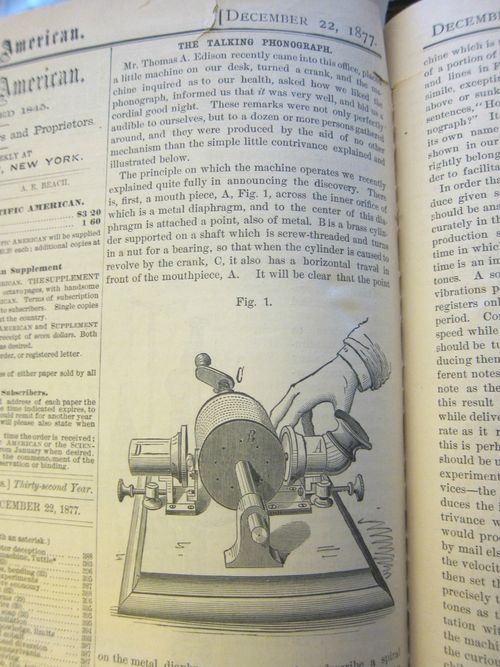
    The first announcement in Scientific American appeared slightly earlier still, in the November 17 issue for 1877.  

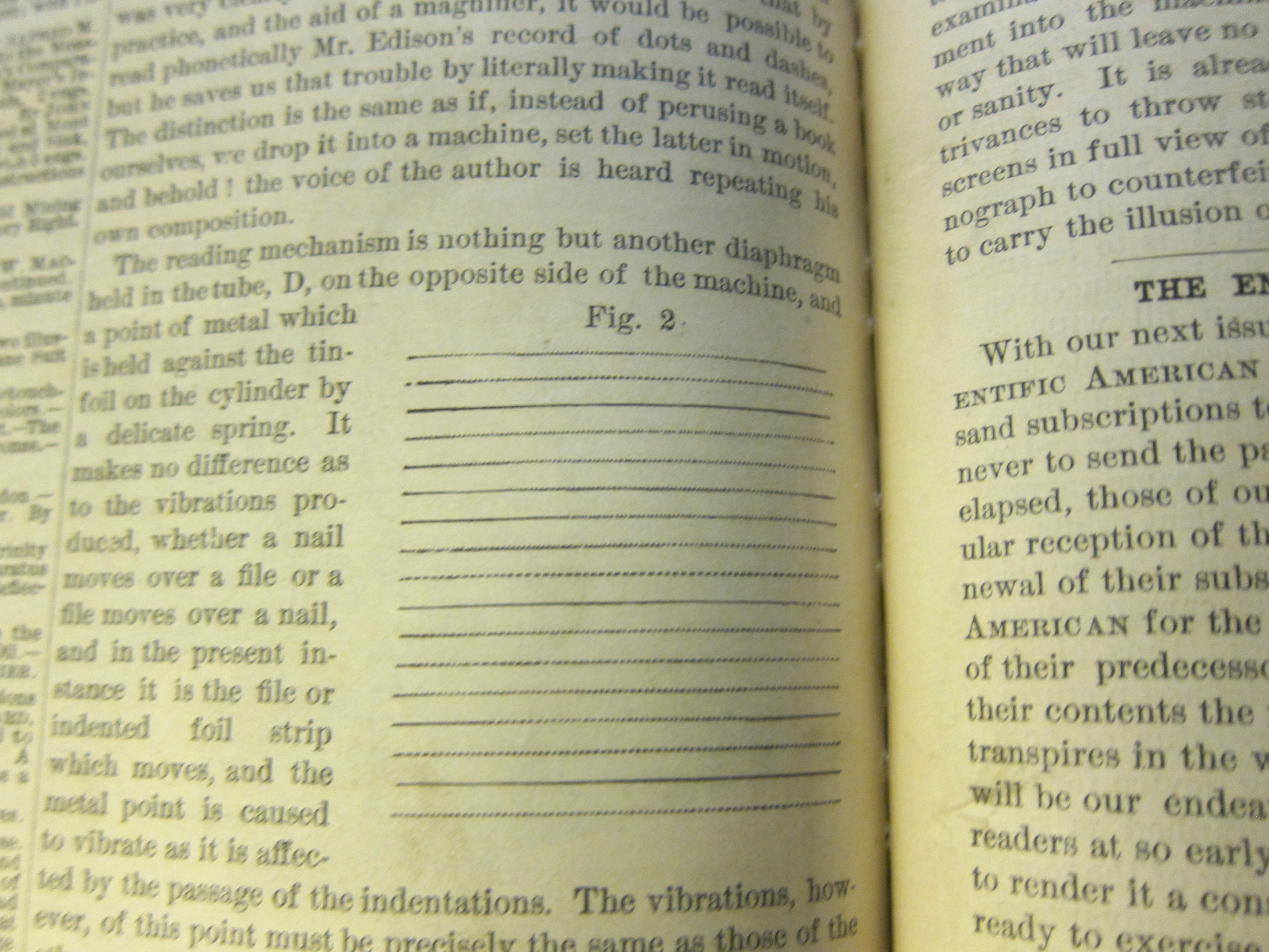
    This is a wood engraving of the impressions left on the recording cylinder–it must be the first image of a saved sound.  

    Edison 1877 phonograph


    Edison 1877 Dots

    There is also a two-page report on Edison’s visit to the offices of  Nature and his very successful demonstration of his new phonograph  machine (the patent for which is applied for December 27, 1877). The editors  record their favorable impressions of the machine and describe it in some detail–there is even a small woodcut illustration of the device. In all the  article occupies pages 190-191 of the weekly issue. (Edison,  Thomas. “The Talking Phonograph“,  London:  Nature,  January 3, 1878.)

    So it comes to pass that the idea of saving and manipulating sound and then applying that to moving images come to rest within a few dozen pages of one another in Nature–it must have been an exhilarating experience at the time.

    Notes:

    A hat tip to Cadre History http://histv2.free.fr/cadrehistory.htm a site with a LOT of material of high interest (in general) and with good references (in particular). 

    An interesting book to check out: Stephen Herbert, M. Heard.  Industry, Liberty, and a Vision: Wordsworth Donisthorpe’s Kinesigraph.


  • An Unusual Bird’s-Eye View of Manhattan, 1877

    JF Ptak Science Books    Quick Post

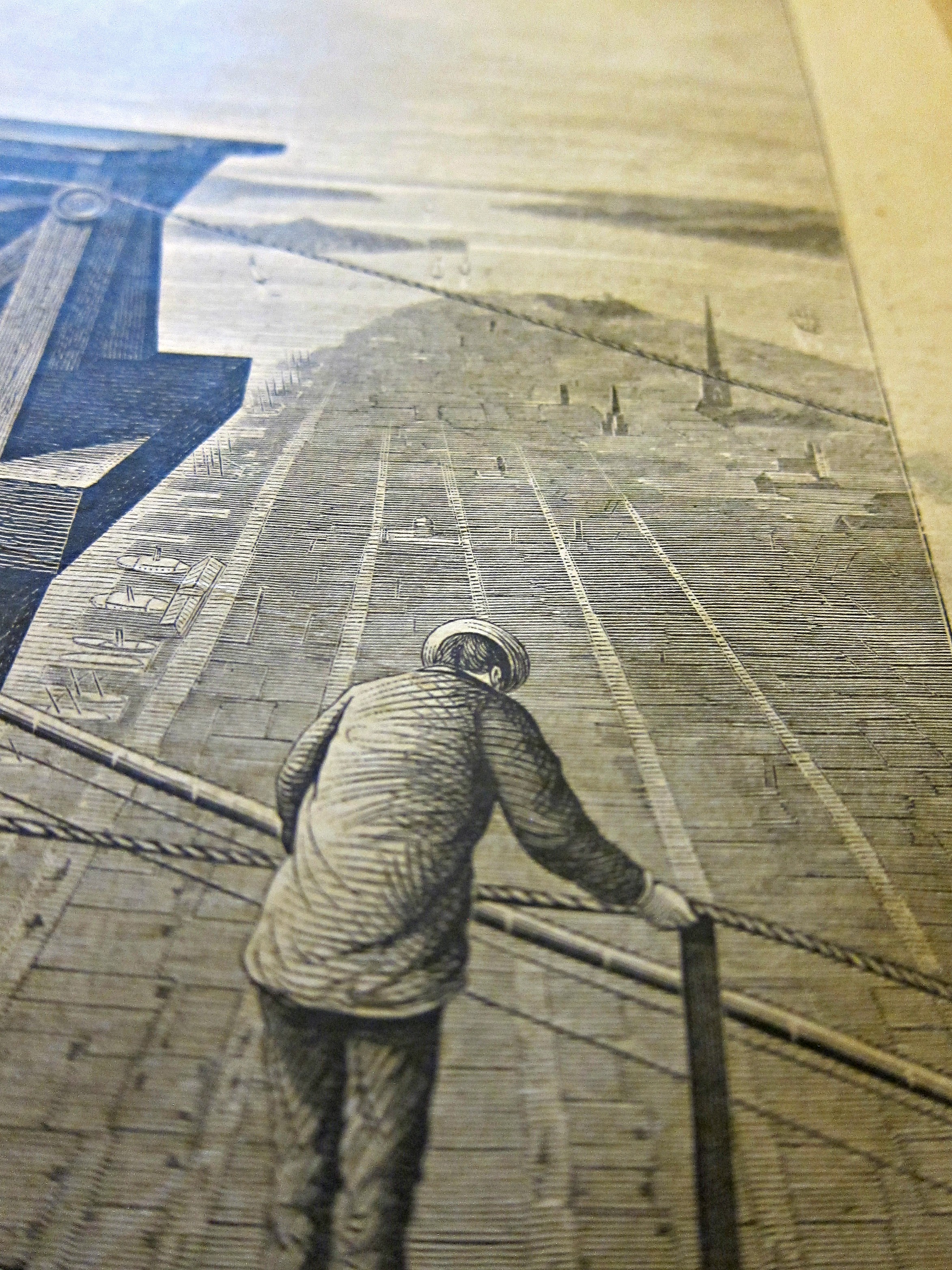
    This was about as high as one could be in a ground-based structure in Manhattan–at the top of one of the granite towers of the Brooklyn Bridge, 277′ (plus whatever wooden structure has been built on the top of the bridge, plus the height of a person). The image is found in Scientific American for August 16, 1877, and shows a bit of the bridge which was still six years away from completion, with workers looking out and down at the rest of the city. It is an unusual perspective, looking south, and seemingly far higher than what  must be Trinity Church (the present version completed in 1846)–Trinity’s sp[ire was actually seven feet taller than the finished bridge (at 284′), though from this angle it is dwarfed by the new structure. There wouldn’t be a building higher than 400′ until the very early 20th century.  In any event, I thought to share this view for its unexpected nature. 

    Sci Am brooklyn bridge view from 1877


  • The Society of Linoleum and the Loneliness of Italian International Design

    JF Ptak Science Books  Quick Post 

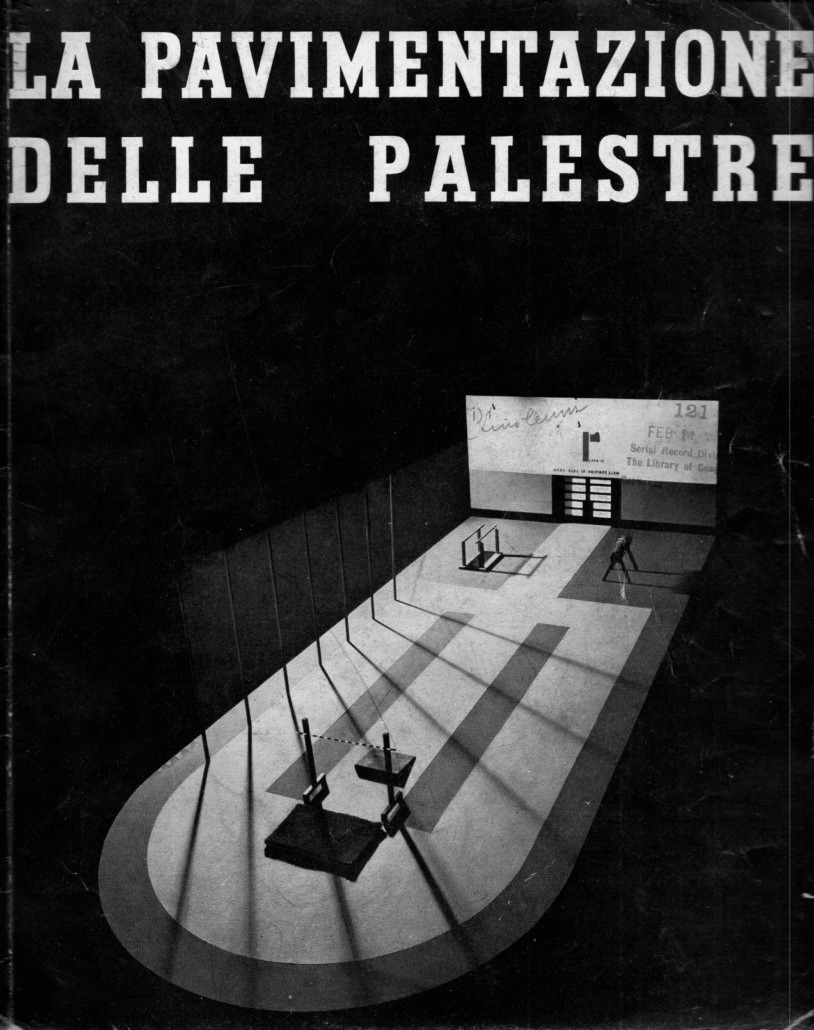
    I’ve encountered a few items like this in the massive pamphlet collection I purchased years ago–works on building and design in Fascist Italy that happen to be very, well, “lonely”. The few examples I’ve noticed have had a definite definite Rene Magritte qualities–mostly absent of people, spare human touches, and a sense of fear and foreboding.  It is hard to imagine that a pamphlet like tonight’s entry–La Paviemntazione delle Palestre (Gym Flooring/Pavement) could excite such a variety of observation and emotion, but it does.  The cover pretty much confirms this–it is striking, and dark, and maybe even a little vengeful–and all they are talking about is equipping gym floors with linoleum:

    Italian Linoleum090

    Impressionante, vero?


  • Surrendered U-Boats in England and France, 1918 and 1919

    JF Ptak Science Books   Quick Post

    According to the armistice signed on November 11, 1918 (and prior to the Treaty of Versailles which was signed 28 June 1919) in addition to much else Germany agreed to the internment of their High Seas Fleet, surrender 5,000 cannons and 25,000 machine guns and 1,700 aircraft, release all POWs, and deliver all remaining U-Boats, which is the subject of this post.

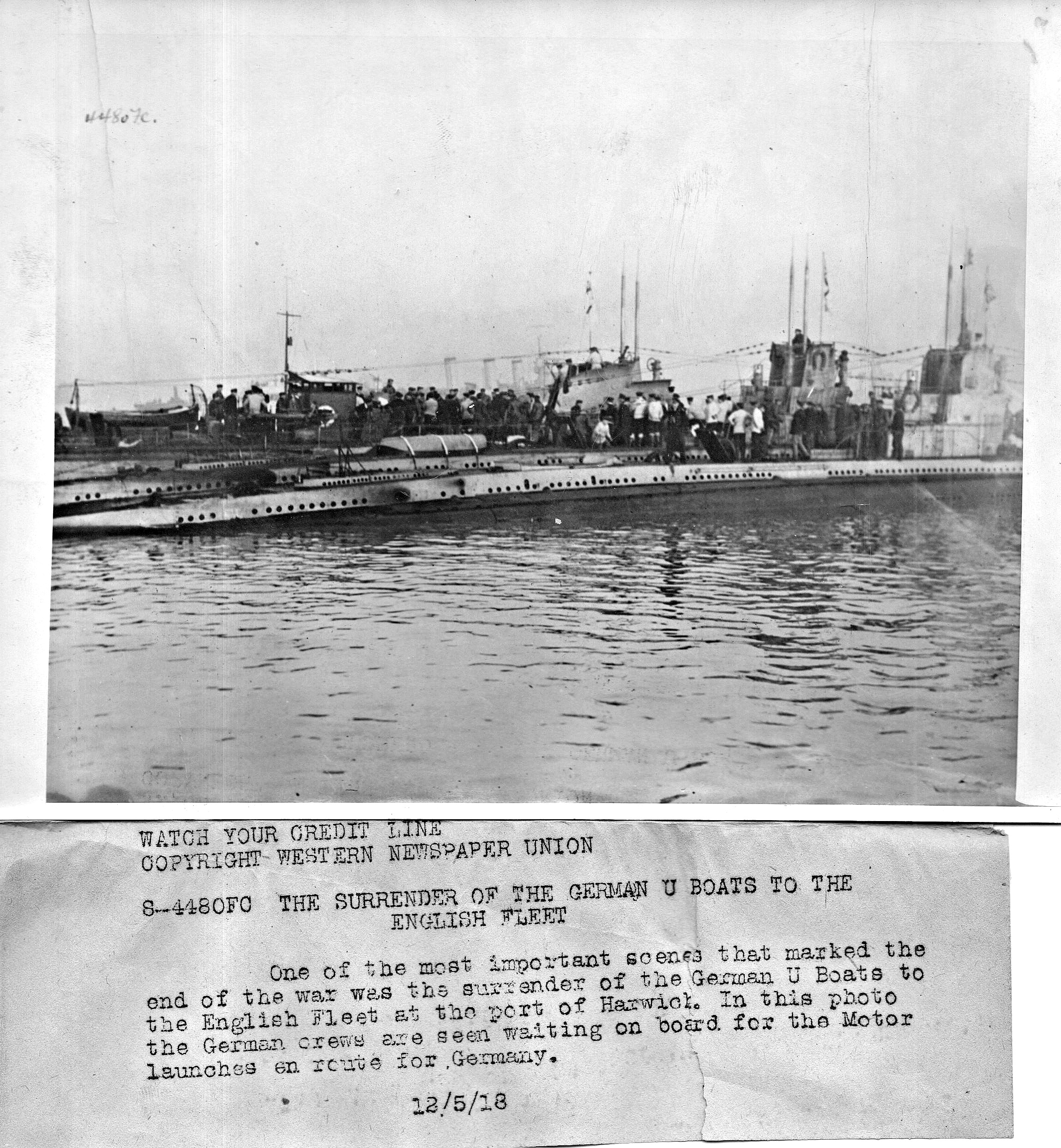
    The subs made their way across the North Sea to the coast of England, near Essex, and were met there by a British force, which then took command of the ships, delivering them to the Port of Harwich.  This began on 21 November and continued for a few weeks, resulting in the surrender of 122 subs and associated craft.  The image below (from a photo pool, this one associated with the Western Newspaper Union) was made during that time and released on 2 December 1918. It looks as though the German crews were still on board at this point, their own flags still flying prior to being replaced by a white ensign.  

    WWI Sub surrender085

    Similar scenes took place in France–here is another News Photo Service photograph showing surrendered German subs being taken in France, together with the paper slip that newspapers and other publishers were supposed to use with the image upon publication.   

    ·Posted by :

    ·in:

    — —

  • An Incomprehensible Chart of the Formation of Thought, Abraham Lincoln, Donald Trump, and the Found-Absurd

    JF Ptak Science Books  Quick Post        The Unintentional Absurd series

    I bet people haven’t seen those two names connected by the word “and” before–I haven’t. But there is a tiny connection, and then we’ll need not to associate the names ever again. 

    Tim Wallace shared today (on Twitter, @wallacetim) in the interests of the display of information this chart of the formulation and evolution of a thought–it goes from surprising, to almost-interesting, to perplexity, to “huh?”, all in very short order; at that point the chart turns into a bad alphabet soup.  It appears in the collected works of William H. Seward–the man who would become Abraham Lincoln’s Secretary of State1. (And by the way, Donald Trump should be advised that delegate numbers necessary for nomination are not “made up” by “some guy”, and that it is not “unfair” to him that others were running in the primaries, and that brokered conventions will not lead to bloodshed, and that good things come out of the brokered convention. William Seward led the delegate count for the presidential nomination for Republican candidate in 1860 but did not command a majority; the convention was brokered, and lo! and behold, Abraham Lincoln became the candidate. Same story for Woodrow Wilson.)

    In any event this is an argument from Seward’s law career shared in his collected works, and in this section he tells the story of his encounter with Dr. Thomas C. Spencer (of Geneva) and his testimony against his client, and the presentation of this chart. Seward does a pretty good job of booting Spencer through the door with his “incomprehensible” bouts of knowledge. The chart I include because of its humbug complexity and its found-Outsider nature.  

    Thanks again to Tim Wallace for sharing this.

    •  Image source:  William Henry Seward, The Works of William H. Seward,  edited by George Baker, (Volume 1), Redfield, 1853, pp 463-466. Found at Google Books, https://books.google.com/books?id=7Ov7OvmgxaAC&printsec=frontcover&source=gbs_ge_summary_r&cad=0#v=onepage&q&f=false


    And Mr. Seward’s interpretation of the chart, after which comes some rebuttal.  I think it really isn’t worth pursuing this chart any further beyond the comfort of knowing that it does exist, and that with a little color and some drawings, it would be a fine piece of Art Brut. 

    ·Posted by :

    ·in:


  • L O S T at Sea and Waiting to be Saved (1877)

    JF Ptak Science Books  Quick Post

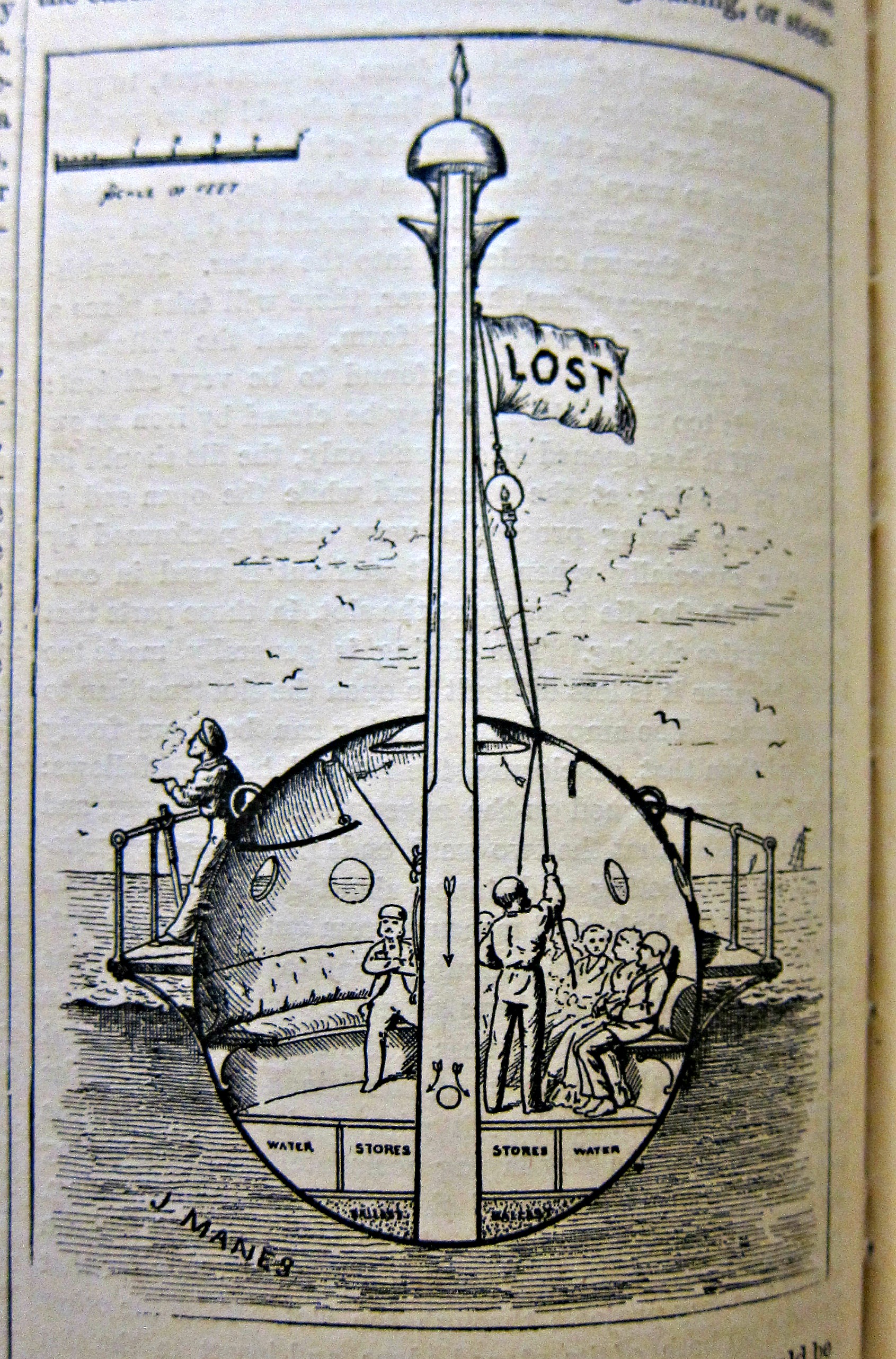
    I’ve seen a number of novel life boat/vehicles in my travels through patent office records but never really made note of them, which is too bad.  They can be pretty interesting in an oddly shared way with 19th century coffin designs and other mortuary patents–specifically the ones having to do with the dead should they find themselves fortunately/unfortunately resuscitated in their sleeping chamber underground. As a matter of fact some of the coffins were equipped with a small belled spire with a wire that went down into the coffin and wrapped around the hands of the dearly departed.  So, in the event of premature burial, the undead dead would simply need to move their hands and sound a bell or raise a flag. In any event, that is what came to mind when I saw this image in the Scientific American for August, 1877:

    Sci Am life boat lost

    This floating sphere was ballasted so that it would remain upright even in a heavy sea, and looks as though it could carry 10 or 15 people. It came complete with mast and flag, and a wrap-around walkway, and as you can see it is being used in the image by a man having a smoke.  

    The “Lost” sign seems to be a little redundant. 


  • You Are There: Dive-Bombing Pilot, 1935

    JF Ptak Science Books 

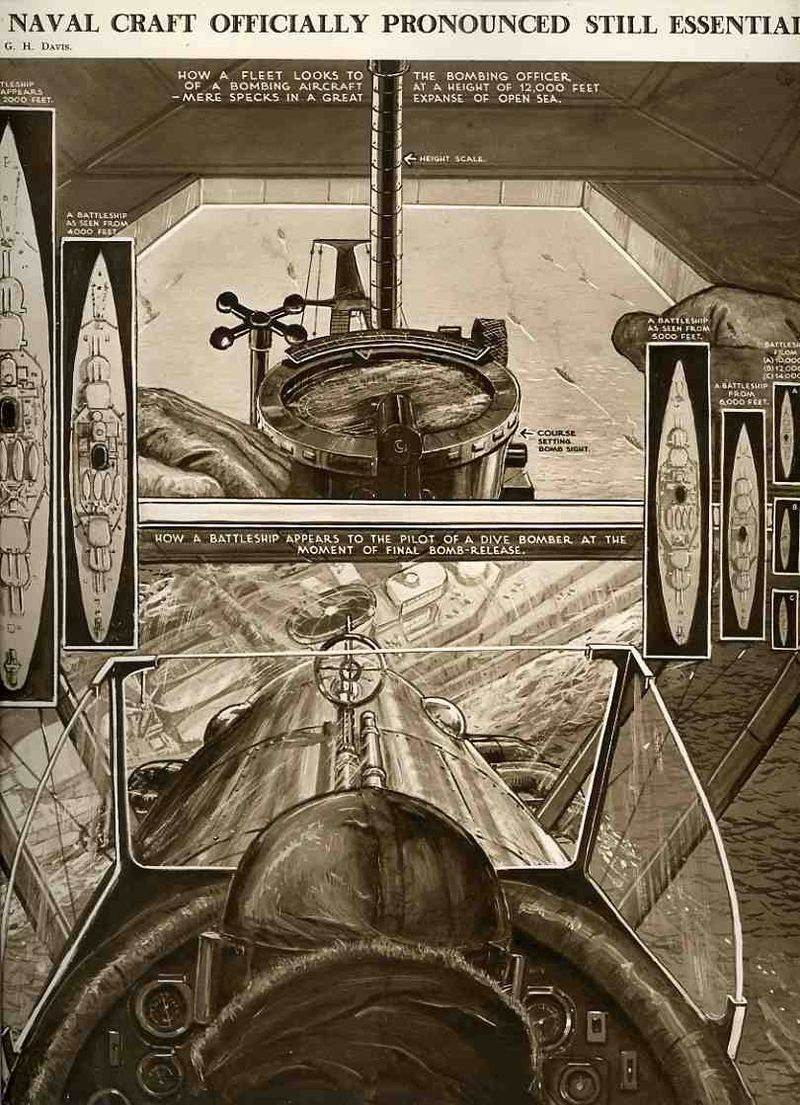
    In my experience popular images prior to WWII that put the reader inside of the picture– giving them the same view as the observing, principle member of the picture–are very uncommon.  Honestly, they just don’t happen very often, and I wish that I had paid more attention to them over the years before I realized they were as rare as they were. Such is the case with this extraordinary and action-packed picture in which the reader is hosted just behind and slightly above the head of the pilot of the aircraft dive-bombing the battleship.  It appears in The Illustrated London News for 7 November 1935, and it must have been captivating for the readers, being given the sense of closing in at great speed on the ship.  There are actually eight other smaller perspective images embedded in the image as well. The largest of these (at top) places the viewer directly inside the subject, giving them the feeling of how it looks like to the bombing officer of the aircraft as it approached the fleet. The other five images shows what the battleship looks like from different height from the inside of the aircraft.  Perhaps this doesn’t look like much to us today, but at the time, I can assure you, these images were exceptionally uncommon offerings of a personal perspective that few readers had ever experienced.

    00-blog-Oct 21--aircarft attack892


  • Symmetry, Detail, Space, and Beauty

    JF Ptak Science Books  Quick Post

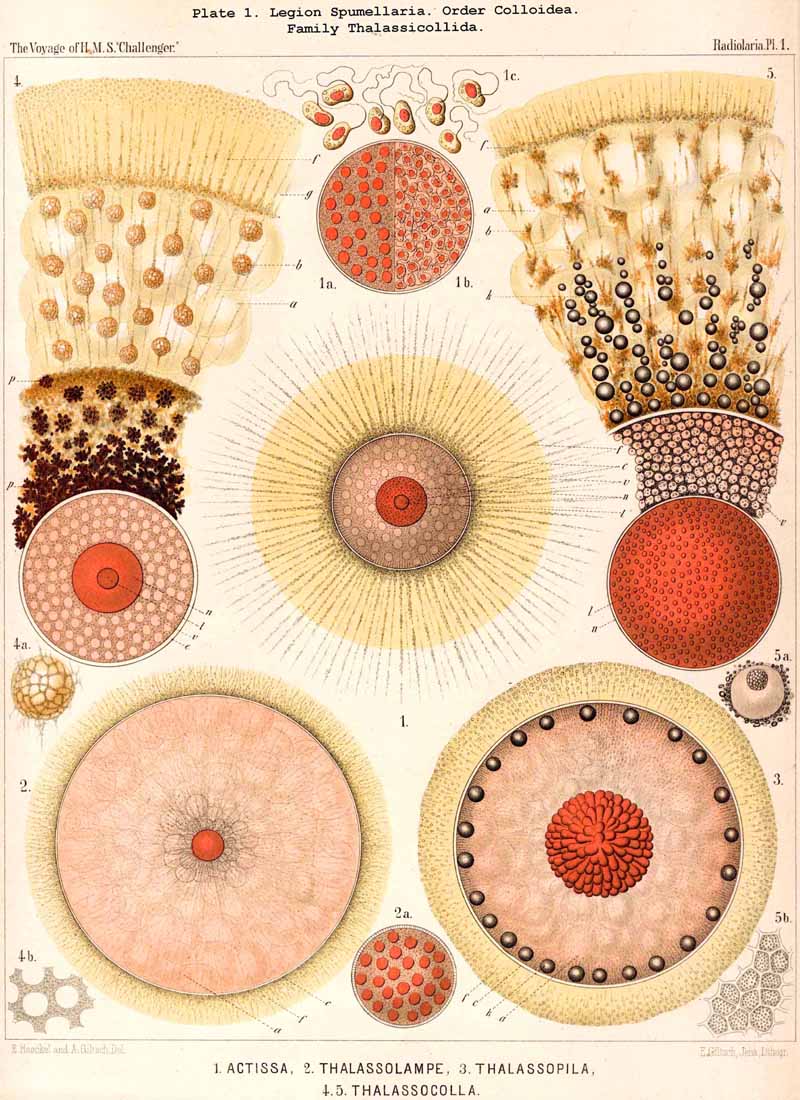
    In his long and vastly productive scientific life, Ernst Haeckel (1834-1919 ) produced extraordinary and beautiful work.  He was a busy man working over a number of specialties, writing more than 40 books and a large number of  contributions to scientific publications.  He is perhaps best remembered early on in his career for a popular defense of Darwinism, writing Natürliche Schöpfungsgeschichte, (1868, nine years after the publication of the Origin, and translated into English as The History of Creation in 1876) which was a successful attempt to get Darwin’s complex ideas into public discussion.  Next to that he is probably best remembered today for his biological work and for describing thousands of new species of life forms.  Today though he came up (again) in reference to the display of scientific images and data, which takes us to his fantastic work in the description of the radiolaria and the display of his results.  I was interested in symmetry and the filling-up-of-page-space without actually crowding the paper–in this, Haeckel was a master, his work is breathtaking.  Here are a couple of examples of his work, along with a link for more images coming from 19thCenturyScience.org:


    Haeckel 01