A Daily History of Holes, Dots, Lines, Science, History, Math, Physics, Art, the Unintentional Absurd, Architecture, Maps, Data Visualization, Blank and Missing Things, and so on. |1.6 million words, 7500 images, 4.9 million hits| Press & appearances in The Times, Le Figaro, Mensa, The Economist, The Guardian, Discovery News, Slate, Le Monde, Sci American Blogs, Le Pont, and many other places… 5000+ total posts since 2008.

Author: JF Ptak

  • Some Good Letters

    JF Ptak Science Books   Quick Post

    Eye exam

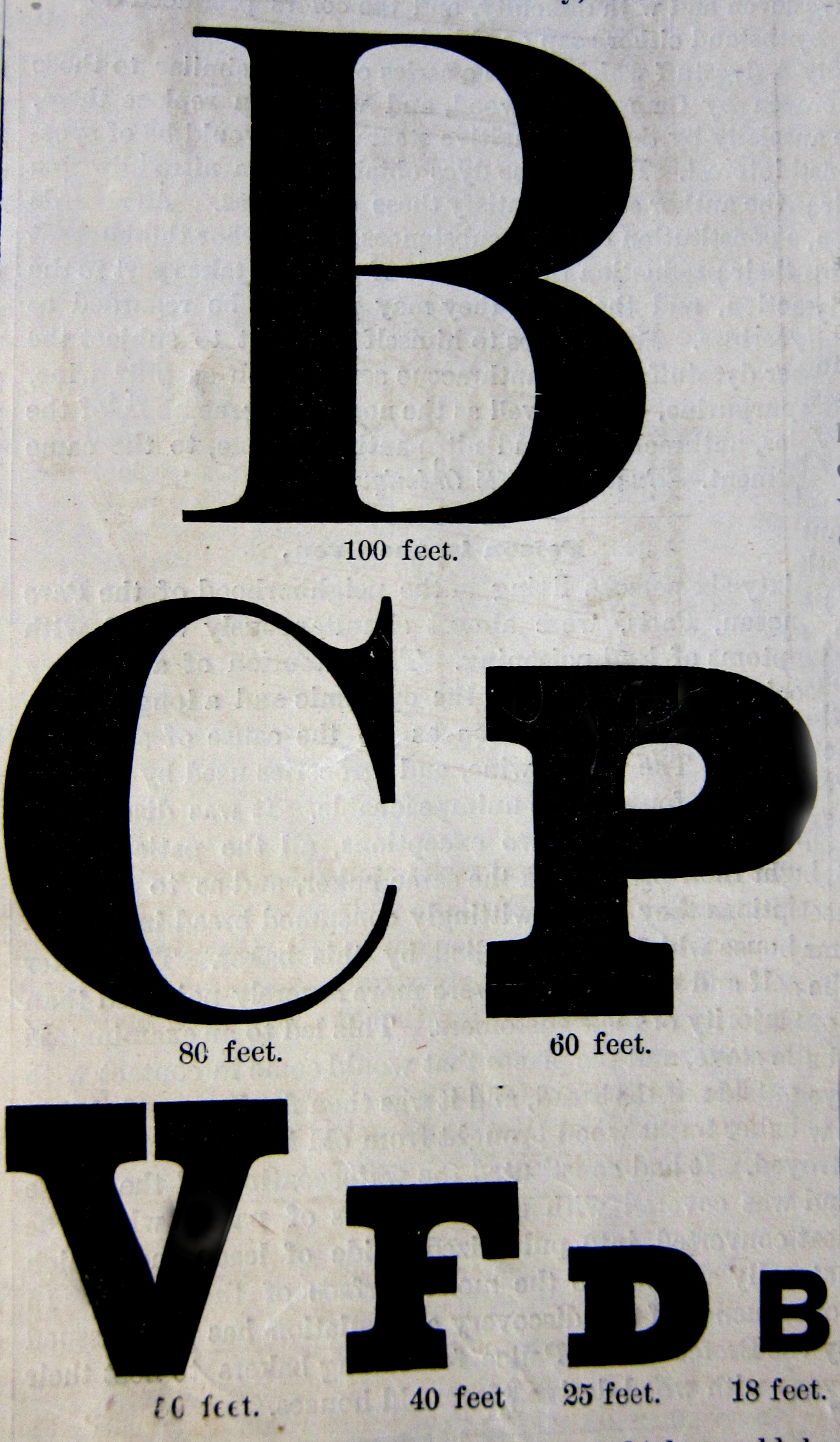
    I found a small notice in the September 18, 1877 issue of Scientific American on employing the following chart for an eye exam–and I just liked the big B and thought to share it.  (The original measures 1.5×2.5 inches.)  That’s it!

    Optical exam

    ·Posted by :

    ·in:


  • Guinness (the Grace of the Gods) and the Battle of Britain (1941)

    JF Ptak Science Books  Quick Post

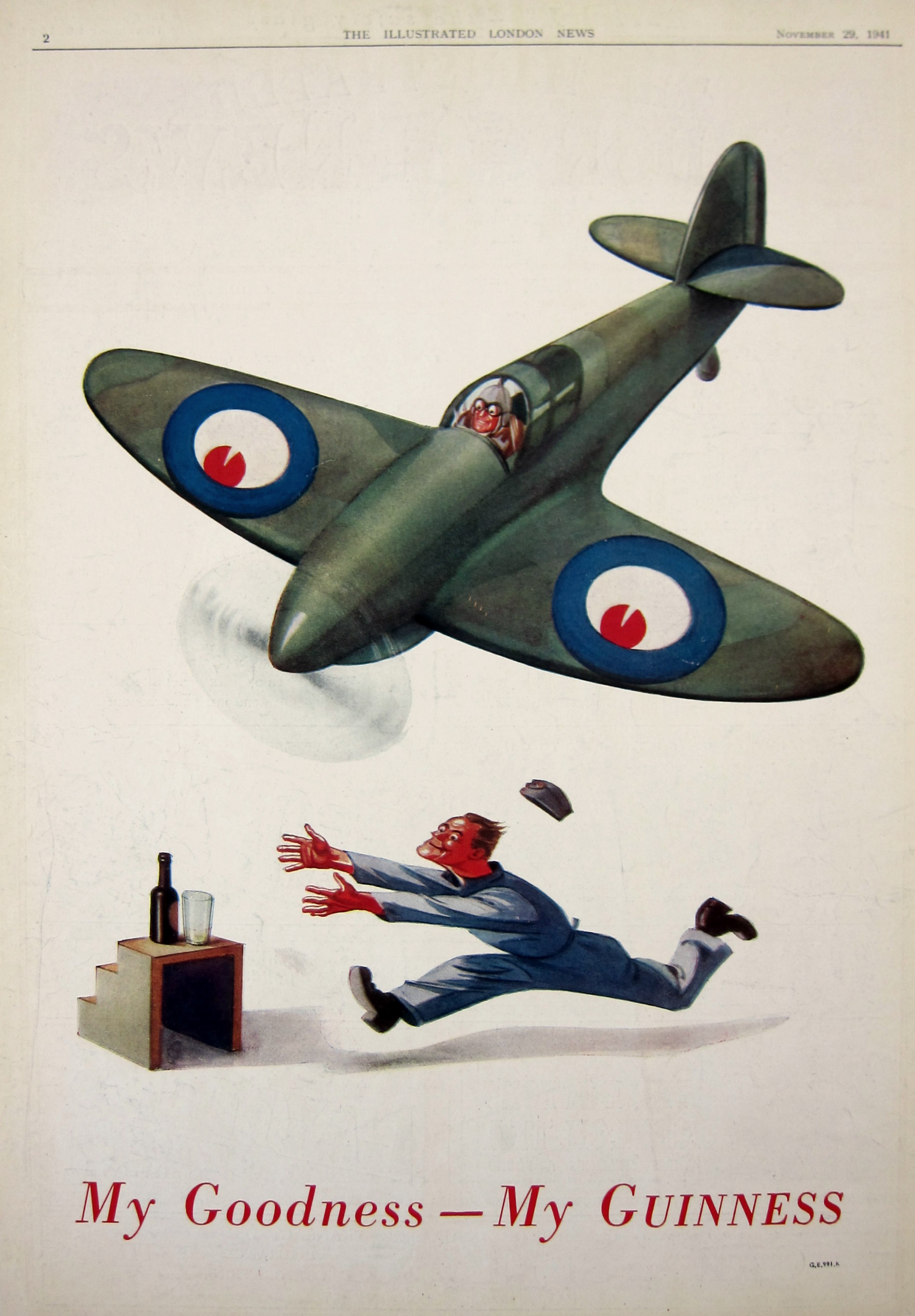
    It is interesting to see this ad for the beverage that is the grace of the gods, using the Spitfire as a comedic backdrop to the stout. The ad appeared in the Illustrated London News on November 29, 1941,  a year and a month past what is recognized as the end of the Battle of Britain (July 10, 1940-October 31, 1940).  The facts and figures on the battle read less than the actual scope of the victory by the Brits in their defense of the U.K. by the R.A.F. On the British side there were 1542 RAF killed (Fighter/Bomber/Coastal Commands) with 1547 aircraft destroyed; the Germans lost 2698 killed, 967 captured , 638 missing, with a loss of 1887 aircraft.  The civilian deaths and wounded was high: 90,000 casualties including 40,000 killed.  It was a decisive victory for the U.K. and a costly loss for the Nazis.  

    This is what Winston Churchill famous said at the beginning of the great trial:

    “What General Weygand has called The Battle of France is over. The battle of Britain is about to begin. Upon this battle depends the survival of Christian civilization. Upon it depends our own British life and the long continuity of our institutions and our Empire. The whole fury and might of the enemy must very soon be turned on us. Hitler knows that he will have to break us in this island or lose the war. If we can stand up to him, all Europe may be free and the life of the world may move forward into broad, sunlit uplands. But if we fail, then the whole world, including the United States, including all that we have known and cared for, will sink into the abyss of a new Dark Age made more sinister, and perhaps more protracted, by the lights of a perverted science. Let us therefore brace ourselves to our duties, and so bear ourselves that, if the British Empire and its Commonwealth last for a thousand years, men will still say, “This was their finest hour”.  — Winston Churchill, June 18, 1940   For the full text see: http://www.winstonchurchill.org/resources/speeches/233-1940-the-finest-hour/122-their-finest-hour

    In any event, the comfort level was high enough for the Guinness folks to use a Spitfire in their ad:

    Guinness SPitfire

    Here’s the entire (30 minute) speech–the part I quote above is the last paragraph of the speech:


    ·Posted by :

    ·in:

    —

  • A Fine and Deep Brightness in Soil and the Beauty of Yellow (1936)

    JF Ptak Science Books   Quick Post

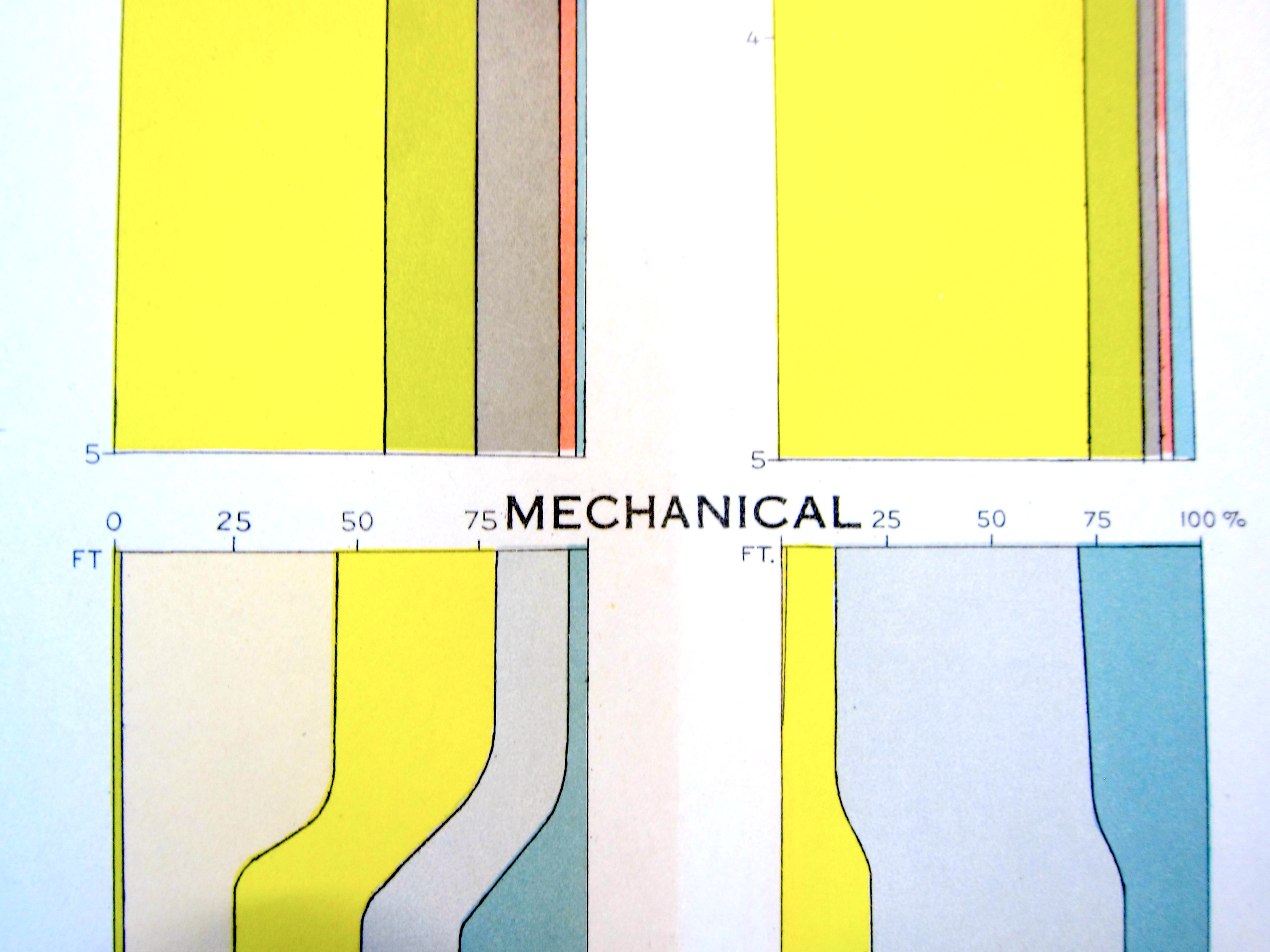
    This yellow is similar to the cover of Dr. Seuss’ One Fish, Two Fish…, the color yellow symbolizing courage/nobility in Japan, wisdom in Islam, and a deity-color in Hinduism; the color so fond of many great writers like London and Doyle, and Harte and Stevenson that they employed in in titles of the books.  The favorite color of Van Gogh1, and perhaps not-so-favorite of Shakespeare (appearing in references to bile and melancholy and falling leaves), it is usually a positive color–except that it also can signify cowardice, ego, caution, and illness (malaria, jaundice). 

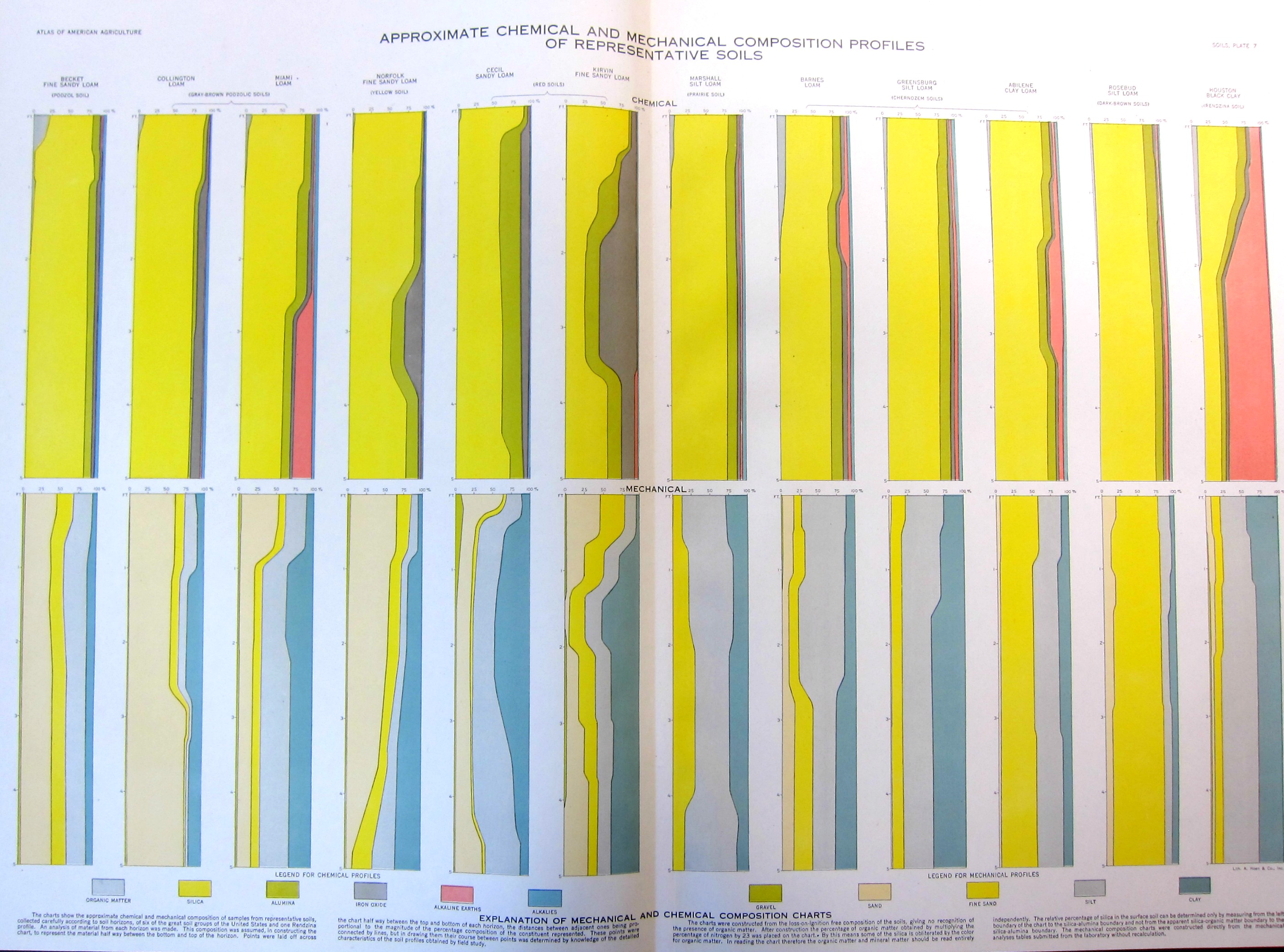
    And so, yellow. The yellow here is a color of soil, and a beautiful yellow it is, the chart a piece of found-art in itself, a found-Abstraction.  It actually was published in the Atlas of American Agriculture, lithographed by A. Hoen, and published in 1936–a particularly bad year for U.S. western soils. 


    Mechanical color b

    And a detail:

    Mechanical color


    Notes:

    1. The Van Gogh museum’s “Van Gogh Letters” is a must-visit if you are interested in his correspondence. http://vangoghletters.org/vg/  Actually the word “green” pops up about 15% more often than “yellow” as the most often mentioned color in the correspondence, though I think that the scholars say that his favorite color hands-down was yellow.  


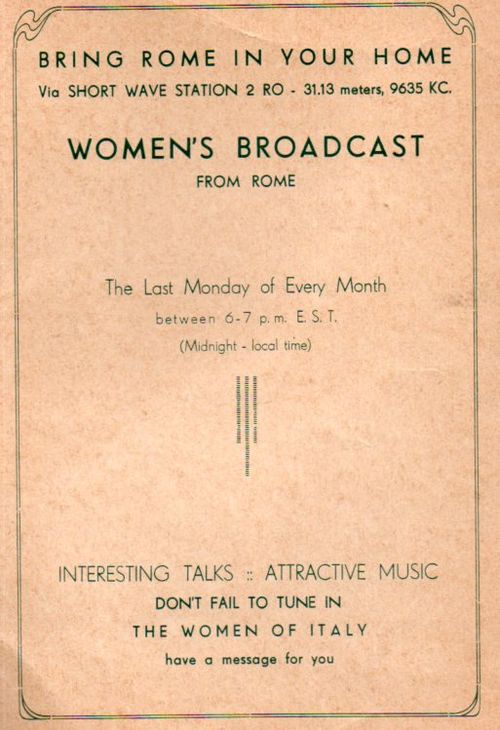
  • “Bring Rome in Your Home”–Fascist Women of Italy Radio Broadcasts, 1937

    JF Ptak Science Books   Post 2603

    Women of facism103

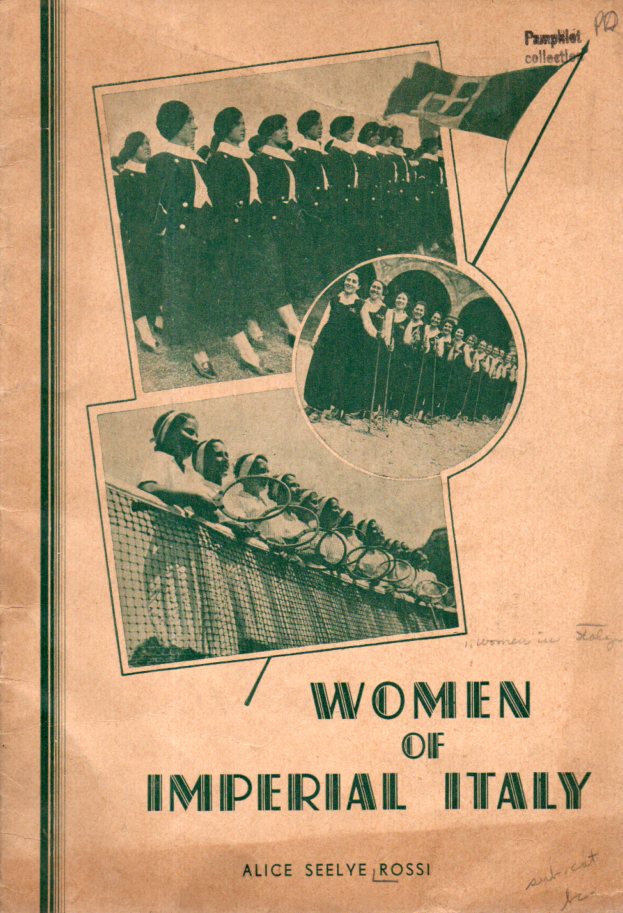
    [Source: Women of Imperial Italy, by Alice Seelye Rossi; printed in Rome, 1937.]

    Not anymore. Probably not so much in 1937, though I am sure that the picture of the “fascist” in the “fascist Woman” was prettier and rosier than what people would come to know by 1942.  In 1937, when this pamphlet was published, the “women” were broadcasting far and wide–one aspect of radio propaganda from the Fascists in Italy, a hearts-and-minds attempt at a part of the coercion of Italia imperiale that occupied the years 1935 until the end of the war. By 1937 Mussolini’s National Fascist Party (in power since 1922) had extended itself by occupying Libya and by invading Ethiopia; Albania, Greece, and Yugoslavia would come between 1939-1941, as would France, when Italy entered the war in 1940 and entered into the country at the tail-end of the German invasion. So the broadcast heard here in 1937 was the beginning of Italy looking for the “Fourth Shore”, and deep into Mussolini’s Fascist state. (Ezra Pound would also do his level best to look the part of traitor that he was, lobbying the Italians for years before being allowed to get on the air to broadcast to the Allies on his misunderstood and inscrutable economics, vicious and virulent anti-Semitism (offhandedly addressing the U.S. president as “Franklin Delano Jewfeld/Jewsevelt”), and general attempts to tell the U.S. population to not support the war effort against the Fascists and that instead they should be down on their knees praising Mussolini, who he saw as another Thomas Jefferson. And so on.)  

    I’ve shared the few pages in this brief pamphlet on the Fascist Woman as it appears in the pamphlet. For the great majority of people living in the U.S., Europe, Great Britain,  Australia, New Zealand, Canada, and many other places, the idea of the “fascist” would change dramatically in about a year, and then spin its grinding way downward until the start of the war in 1939. 


    Women of facism102


    Women of facism101


    ·Posted by :

    ·in:

    — —

  • The Found-Abstract Art of Comets, 1867

    JF Ptak Science Books    Quick Post

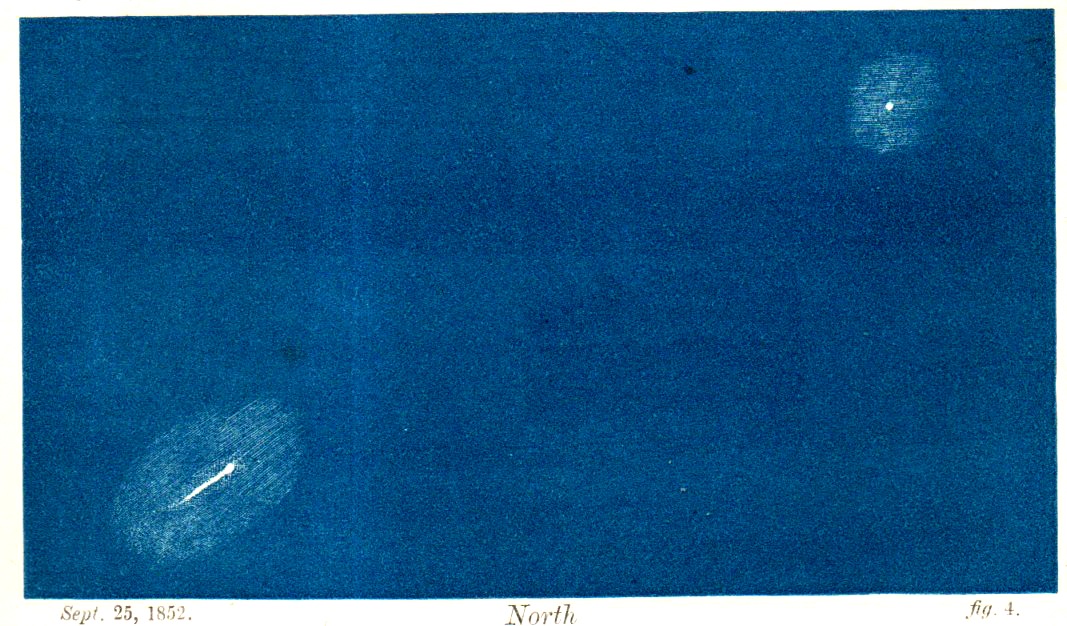
    Some of the most interesting Found-Art images in the history of science belong to astronomy, and within that, some of the most expressive and least-populated images of great appeal and haunting beauty are for early images of comets.  And so it goes for this (“tinted”) engraving of Biela’s Comet, which illustrated an article by London-born W.T. Lynn (at the time with the Royal Observatory, Greenwich) which was published in the April, 1867 issue of The Intellectual Observer.  The comet was named for Wilhelm von Biela who discovered the periodic nature of the comet (6.6 years, it had been identified as early as 1772), and had disappeared by the 1850’s, but not before breaking up into at least two large pieces, which is what we are looking at below:

    Bielas comet100

    And the full image:


  • Before-and-After on the Mean Streets of NYC (1893-6)

    JF Ptak Science Books   Quick Post

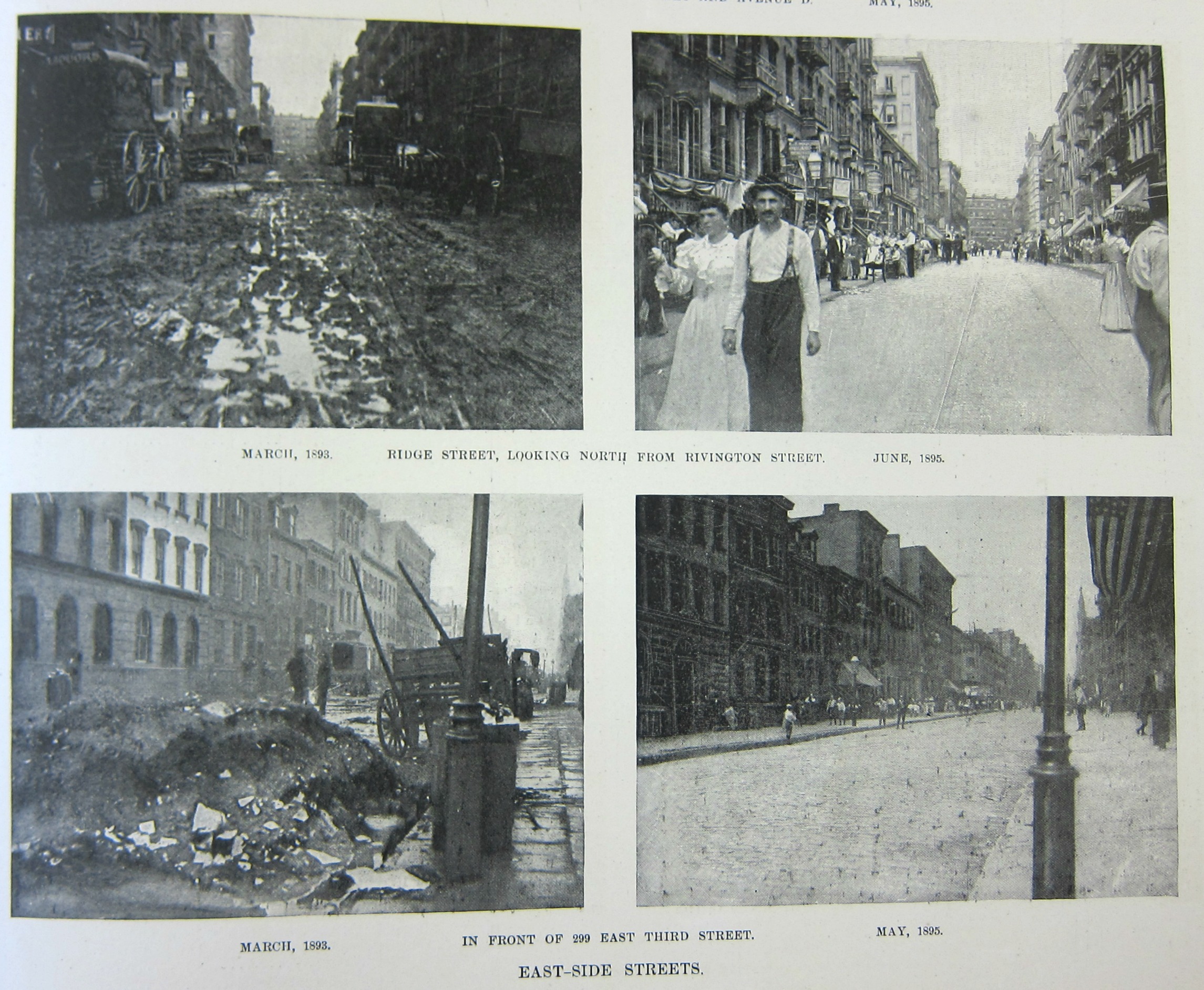
    NYC Street before and after 1 of 4


    This is one of four images from the May 25, 1895 issue of Harper’s Weekly, and they show eight different views of before-and-after photos of filthy city street cleaned up and maintained by the Civil War vet Colonel George E. Waring. Waring (1833-1898) was also an engineer and a sewer pioneer, and was responsible for instituting a real department of sanitation in New York City. To that end he hired some 2000 men and put them in white uniforms to perform their functions–the uniforms gave the workforce a dignity and also made the population at large aware that there was a serious and dedicated effort to clean the city–it was a brilliant success.

    This story is told in the six pages (located below) from the great social observational/photo-documentarian Jacob Riis’  The Battle with the Slum (1902) describing Col. Waring’s efforts to clean the streets of Lower Manhattan. Riis is vicious with his treatment of the Tammany political machine for not undertaking any real effort to reduce the amount of street waste/filth, and heaped much praise on Waring, who he declared as the first to open the slums up to the light. That is just about right, and probably understates the case somewhat, as he was responsible through these efforts in saving the lives of thousands of people and improving the living condition for most of the city, in general.

    Evidently the photos from Harper’s are sometimes credited to Riis, though evidently it seems that the experts say he only used these images made by someone else for his 1902 book. No matter–Riis did much else.  


  • 1000-Year Panorama of British Naval History (1942)

    JF Ptak Science Books   Quick Post

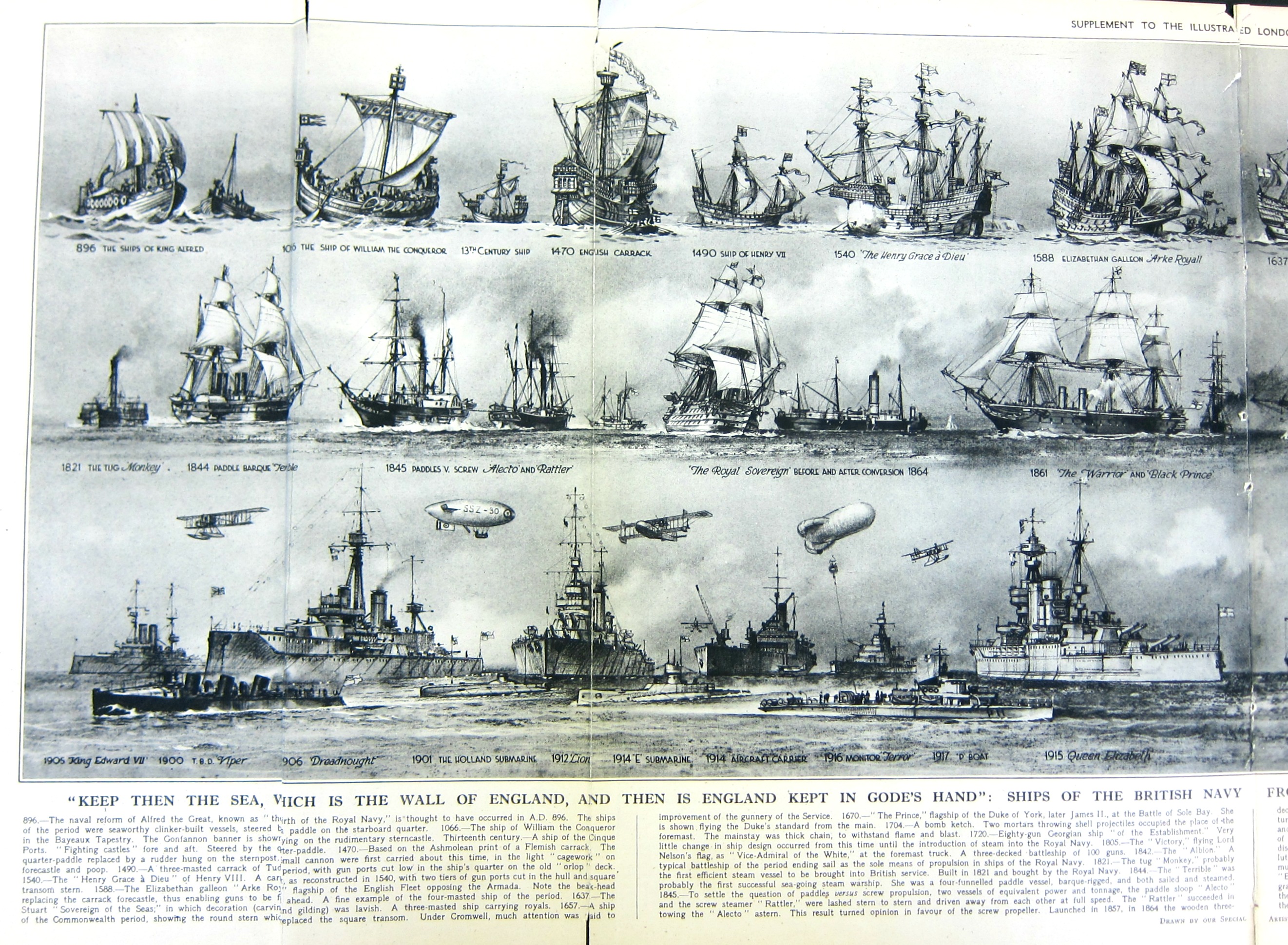
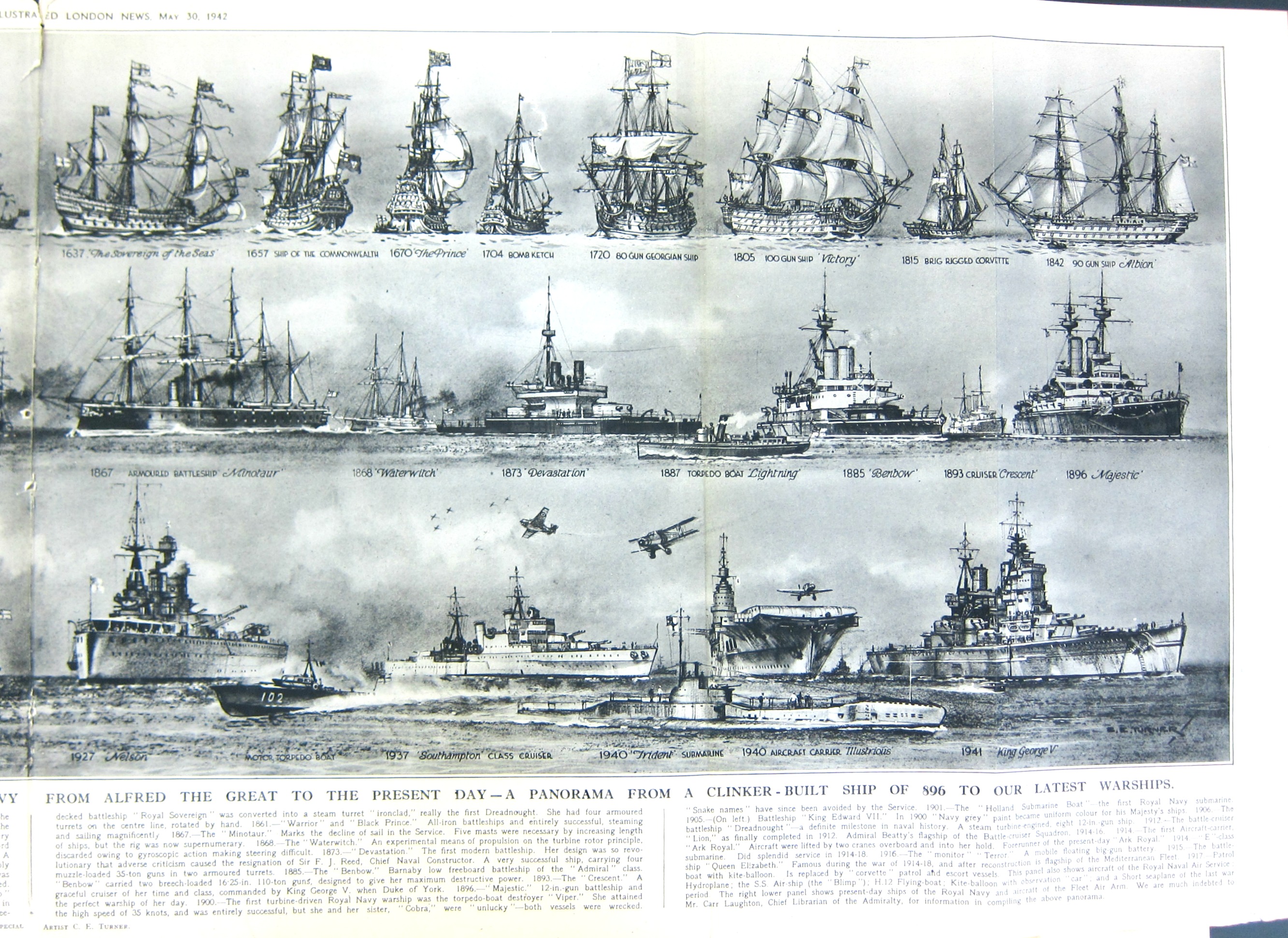
    “Keep then the sea which is the wall of England, and then is England kept in Gode’s Hand, so that fore anything that is without, England were at peace withouten doubt.”

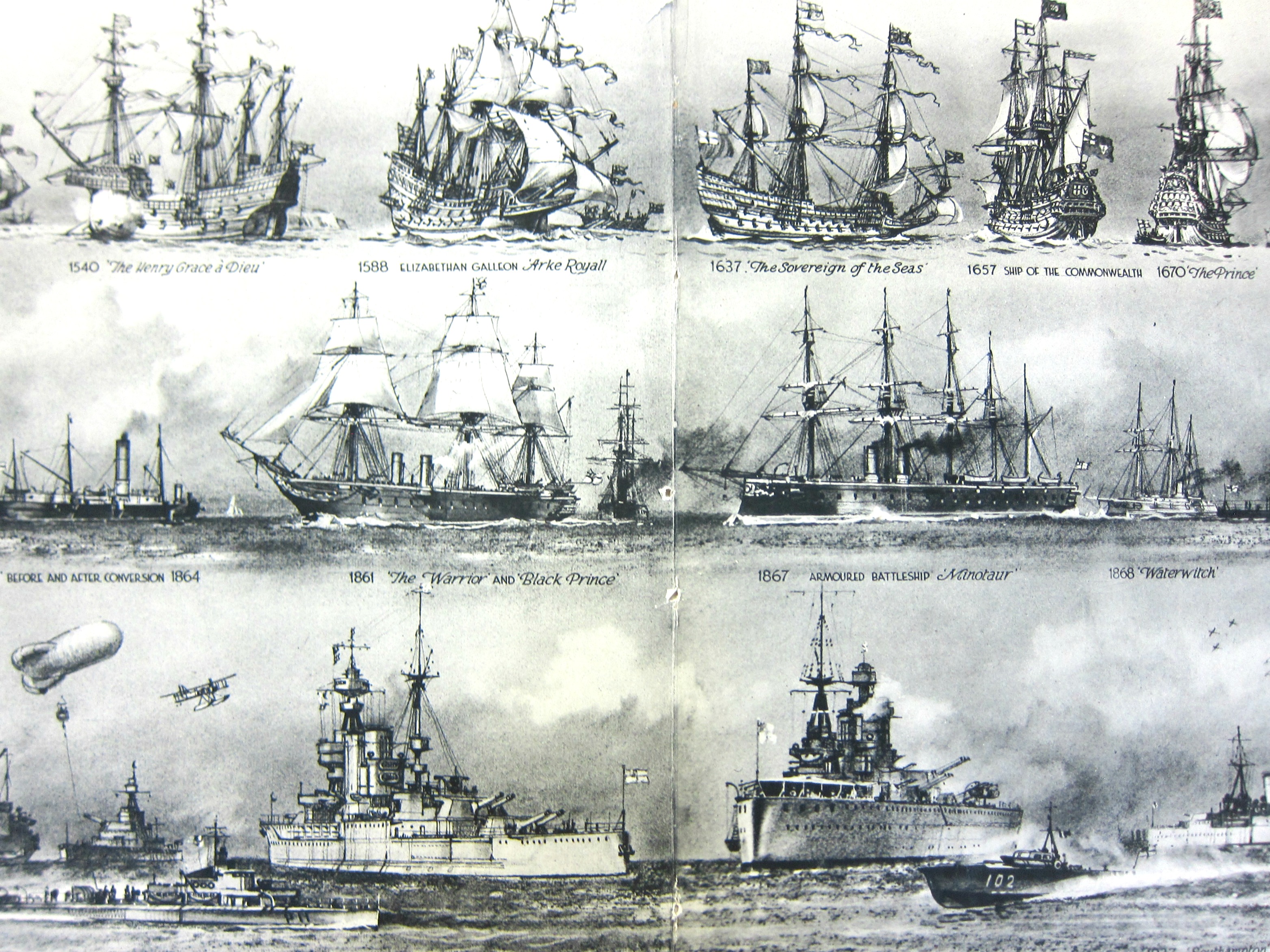
    This fantastic three-foot-long panorama was published as a folding centerfold for the Illustrated London News Supplement of May 30, 1942.  By the middle of 1942 I think it was pretty clear that Germany could not hope to compete with the U.K. in the production of ships, and especially in the area of submarines, where the Luftwaffe demanded and received the lion’s share of resources necessary for construction. The Battle of the Atlantic was being won, the blockade was working and intact, and the U.S. had entered the war militarily. No doubt it was a good thing for the reader’s of this popular magazine to be reminded of their stellar naval history at this point of the war. There are 45 ships and boats on this panorama, ranging from the times of Alfred the Great to the King George V.

    The following images are very expandable:

    ILN HMS History left panel

    ILN HMS history right panel


    The center section:


    ILN long chart HMS


  • Flat and Full Perspectives

    JF Ptak Science Books  Post 2602

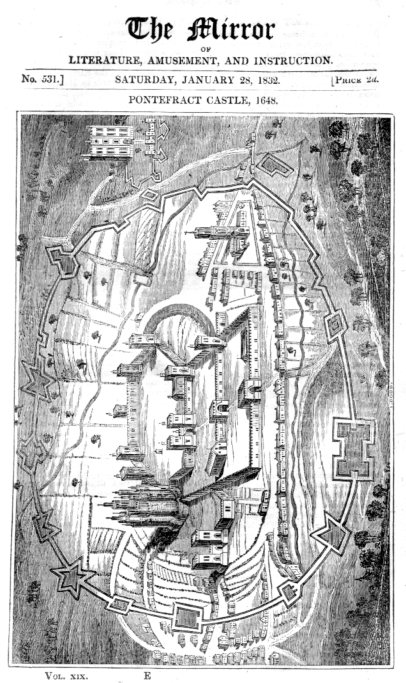
    There were two images that I came across tonight in the studio as I was chasing Pooches the Cat/Dog–they’re not quite on the opposite ends of themselves on the compass rose, but they are certainly in the neighborhood. I like it though that they came to me by chance, one after the other. One is very, very flat; the other is very “full”, and has a large sense of dimensionality.  The first is a 1832 woodcut of a 1648 rendering of Ponterfract Castle. Although perspective had been discovered (or rediscovered at 250 years earlier, the image has a Medieval taste to it, as we see both two- and three-dimensional representations together in the same image.  I think that most of that was done by design and the print was dual-purposed–first to show the plan of the castle and then secondly to show the fortifications and some buildings in elevation. The overall effect I think portrays more flatness than not.  

    Flat perspective089

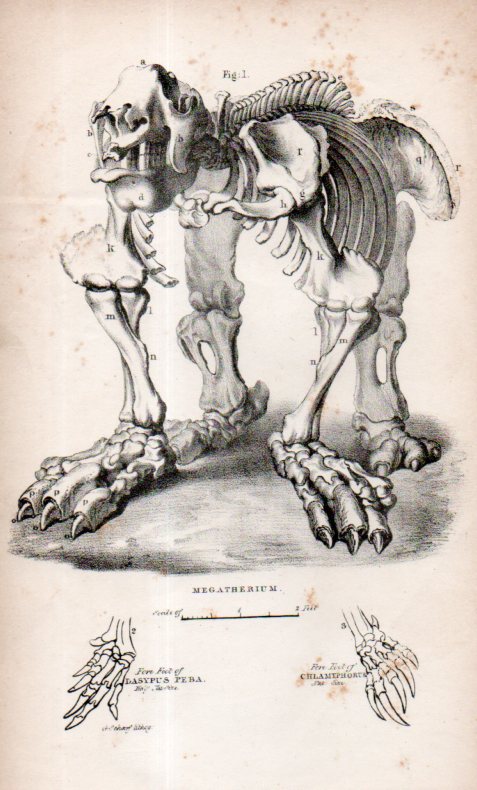
    The second perspective is something that I’ve always thought had a deep depth for a piece of paper. My copy is simply a loose engraving, bought years ago at Pageant Book Shop in Manhattan–a stray bit in a  “sciences” bin or some such, and I’ve had it ever since.  Again I’m not sure of its origin but my guess is that is is English from a popular science dictionary or geological text 1825-1850.  It just has a great perspective–plus it also looks as though we’ve just surprised it, a little.  It is a Megatherium (“giant/beast”) and was discovered first in 1788 by Manuel Torres and then assembled in the next year by Juan Bautista Bru, who evidently made the first illustrations of it.  An engraving of the magnificent mammal appeared in the second edition of Georges Cuvier’s Recherches sur les ossemens fossiles, (1812) which was a justifiably iconic image, though I like this little and odd-perspective one from above better.  

    Megathermin088


  • Talking Phonographs and Talking Photographs, 1877/8

    JF Ptak Science Books    [Reposting Post 2601 with an update]

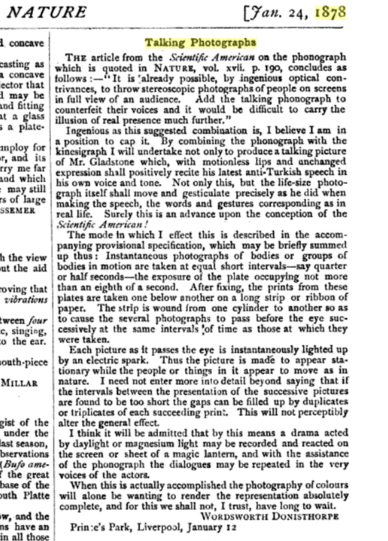
    There appeared in the wonderful pages of Nature (for 24 January 1878) a short but interesting technical communication from the probably/improbably-named Wordsworth Donisthorpe (1847-1914) about an invention that is deeply related to the early stages of motion pictures–in fact it was the first paper that coupled sound with the moving image. It appears eleven years before the first successful demonstration of a motion picture in 1889.  
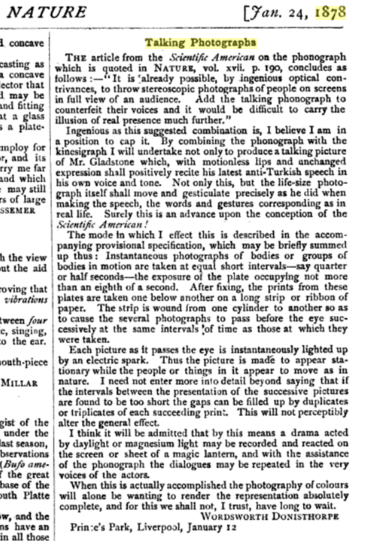
    Talking photographs

     (The article is immediately preceded by another on the change of habits in toads.)

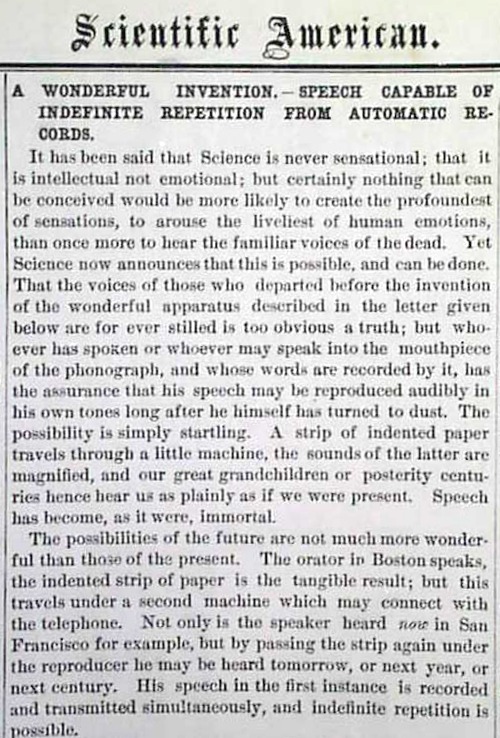
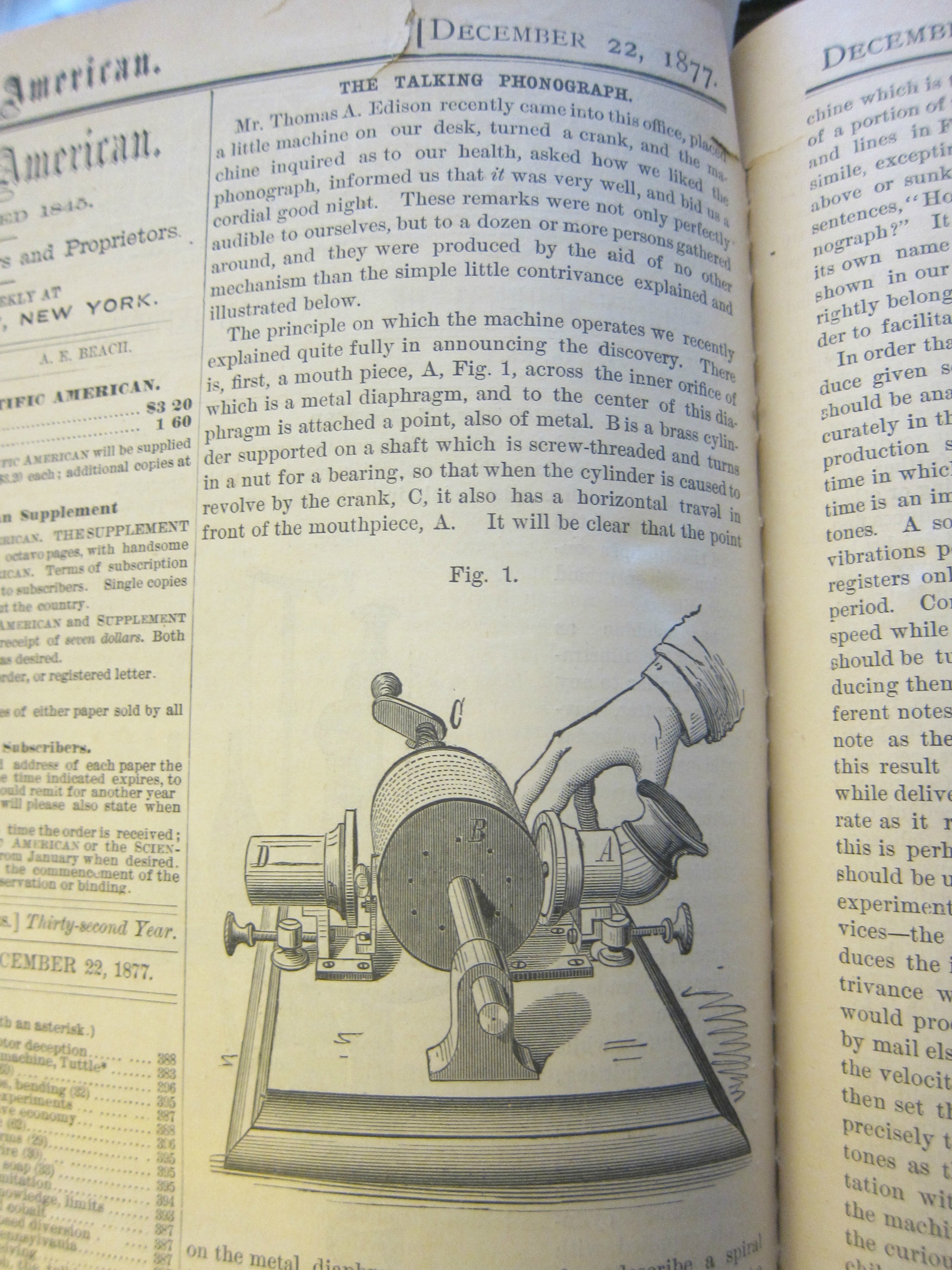
    What Mr. Donisthorpe is talking about in the pages of the Scientific American is really the back-door entry to an even bigger topic: the first announcement of Thomas Edison’s phonograph as it appeared on the back of the first  page in the last issue for the year, 29 December 1877.  “A Wonderful Invention–Speech Capable of Indefinite Repetition from Automatic records” was the aarticle by Edward Johnson on the introduction of Thomas Edison’s phonograph.It is one and a half columns long, but contains a very compact 1500 words.  
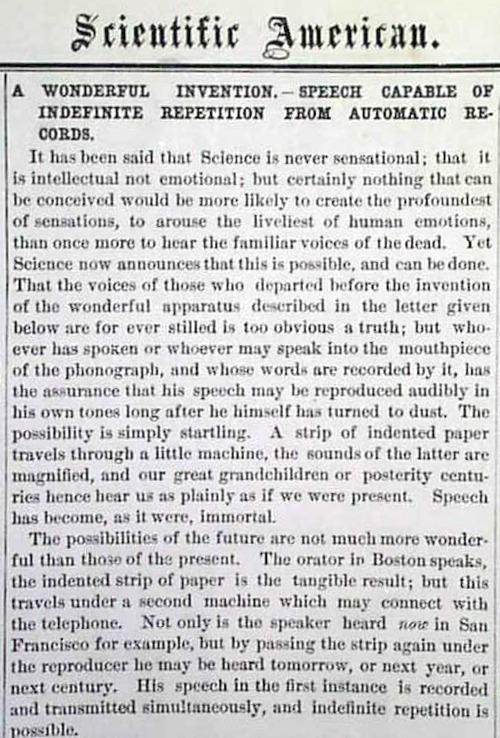
      Edison phonograph

    Edison’s name was not a popular item in the average American home before his invention of the phonograph.  It was actually some months later, after the initial announcement in 1877, that Edison became justifiably famous.  It is difficult today to place the amazement and astonishment that greeted the invention–there was nothing like it, before, ever–except for writing, of course, and then the recording telegraph.  It was a sensational piece of power, being able to record and save sound–and then play it back again.  It was the first time in human history that the auditory sense world could be audibly preserved.

    The first announcement in Scientific American appeared slightly earlier still, in the November 17 issue for 1877.  

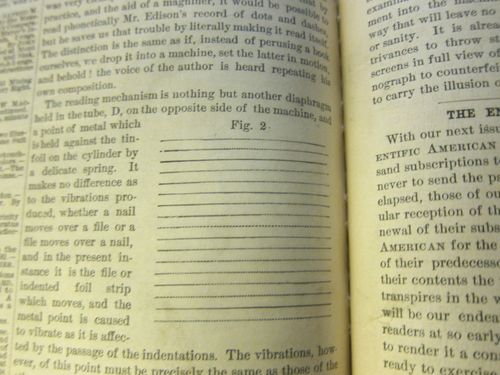
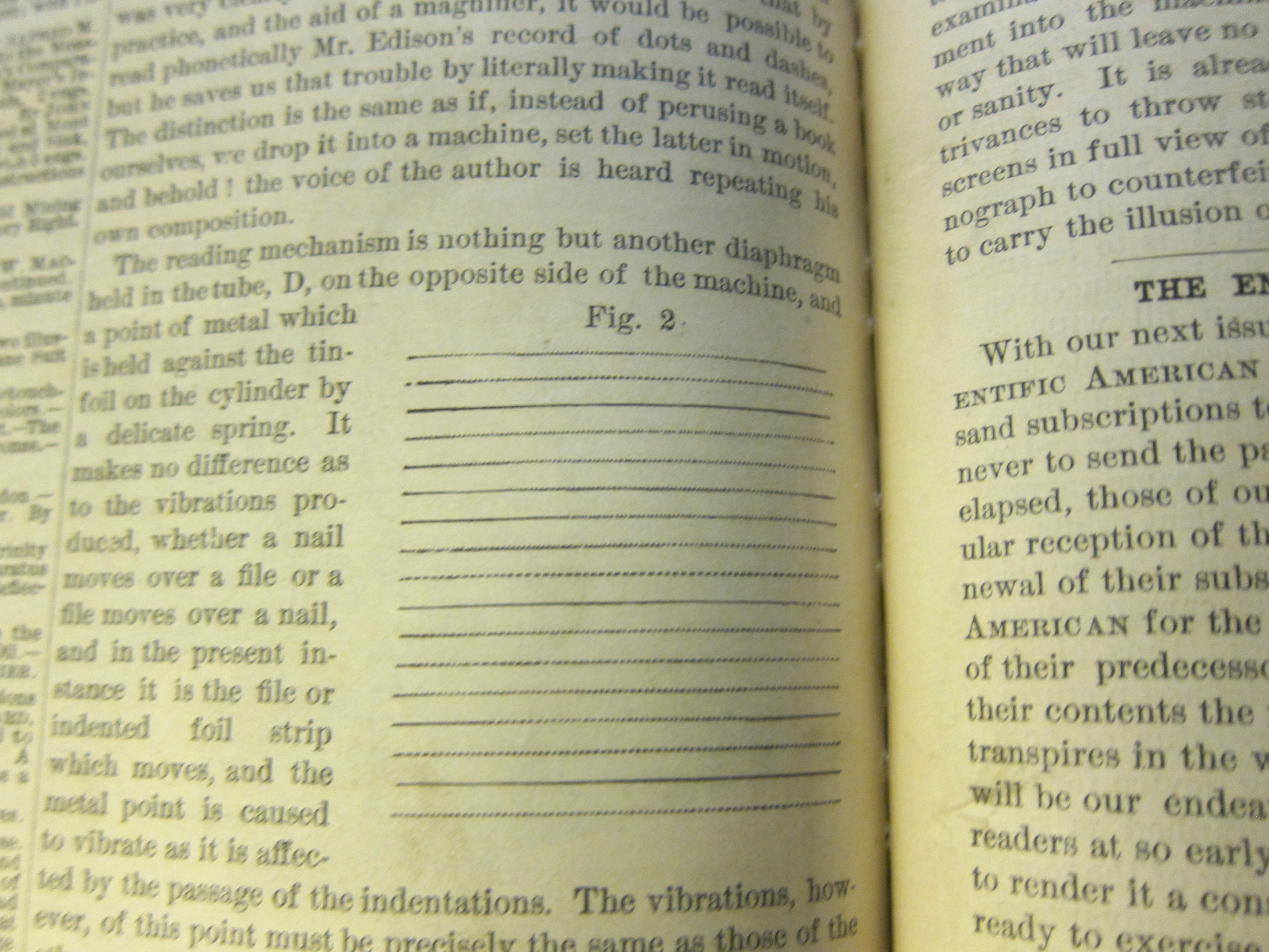
    This is a wood engraving of the impressions left on the recording cylinder–it must be the first image of a saved sound.  
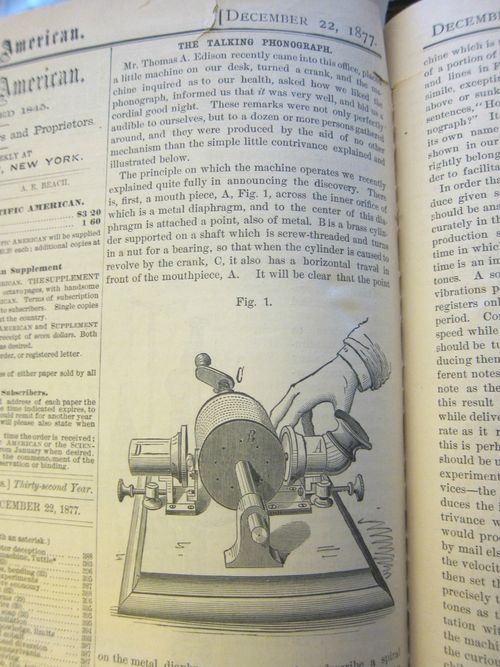
    Edison 1877 phonograph


    Edison 1877 Dots

    There is also a two-page report on Edison’s visit to the offices of  Nature and his very successful demonstration of his new phonograph  machine (the patent for which is applied for December 27, 1877). The editors  record their favorable impressions of the machine and describe it in some detail–there is even a small woodcut illustration of the device. In all the  article occupies pages 190-191 of the weekly issue. (Edison,  Thomas. “The Talking Phonograph“,  London:  Nature,  January 3, 1878.)

    So it comes to pass that the idea of saving and manipulating sound and then applying that to moving images come to rest within a few dozen pages of one another in Nature–it must have been an exhilarating experience at the time.

    Notes:

    A hat tip to Cadre History http://histv2.free.fr/cadrehistory.htm a site with a LOT of material of high interest (in general) and with good references (in particular). 

    An interesting book to check out: Stephen Herbert, M. Heard.  Industry, Liberty, and a Vision: Wordsworth Donisthorpe’s Kinesigraph.


  • An Unusual Bird’s-Eye View of Manhattan, 1877

    JF Ptak Science Books    Quick Post

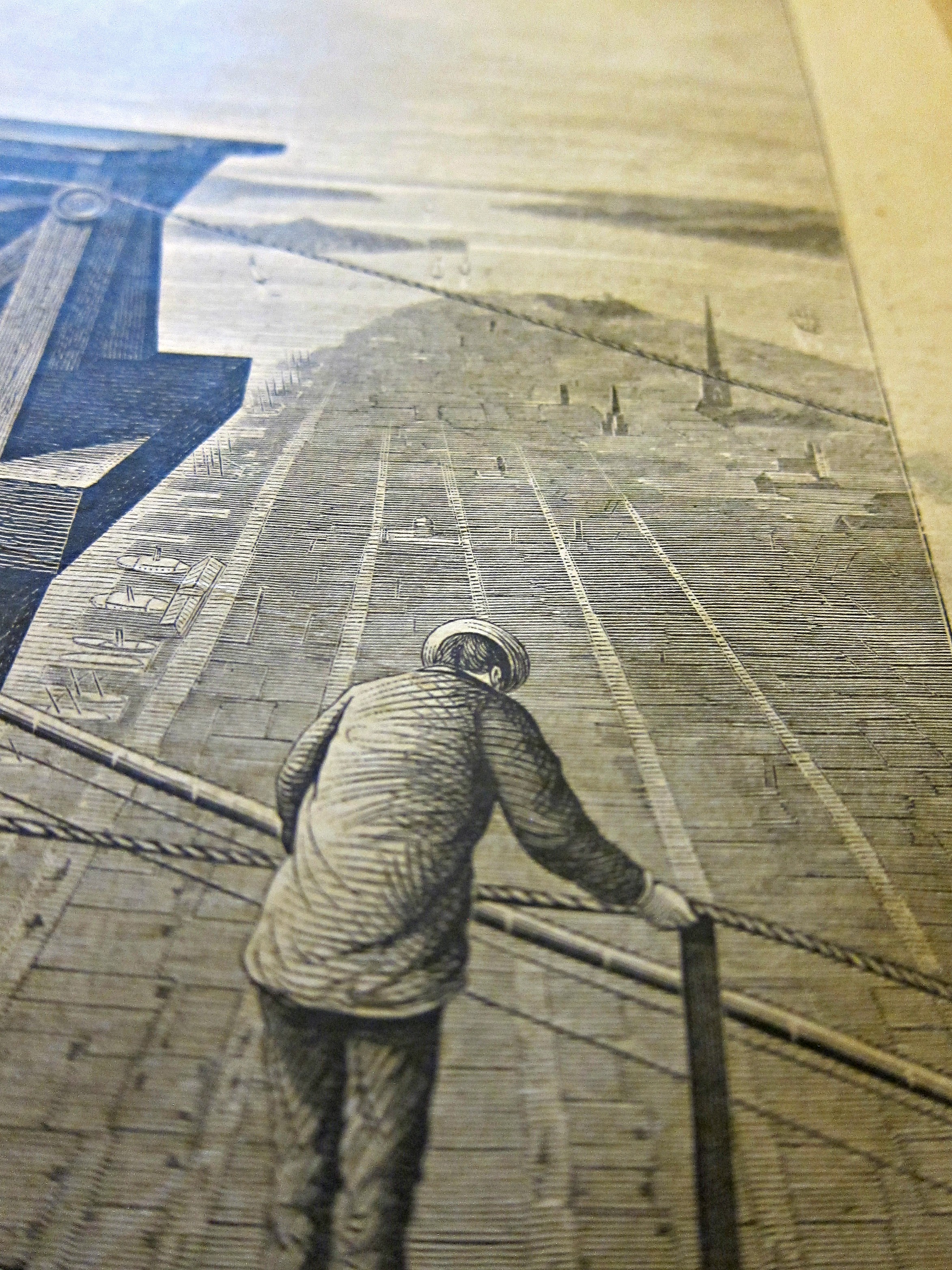
    This was about as high as one could be in a ground-based structure in Manhattan–at the top of one of the granite towers of the Brooklyn Bridge, 277′ (plus whatever wooden structure has been built on the top of the bridge, plus the height of a person). The image is found in Scientific American for August 16, 1877, and shows a bit of the bridge which was still six years away from completion, with workers looking out and down at the rest of the city. It is an unusual perspective, looking south, and seemingly far higher than what  must be Trinity Church (the present version completed in 1846)–Trinity’s sp[ire was actually seven feet taller than the finished bridge (at 284′), though from this angle it is dwarfed by the new structure. There wouldn’t be a building higher than 400′ until the very early 20th century.  In any event, I thought to share this view for its unexpected nature. 

    Sci Am brooklyn bridge view from 1877