A Daily History of Holes, Dots, Lines, Science, History, Math, Physics, Art, the Unintentional Absurd, Architecture, Maps, Data Visualization, Blank and Missing Things, and so on. |1.6 million words, 7500 images, 4.9 million hits| Press & appearances in The Times, Le Figaro, Mensa, The Economist, The Guardian, Discovery News, Slate, Le Monde, Sci American Blogs, Le Pont, and many other places… 5000+ total posts since 2008.

Category: Militaria

  • Propaganda Maps: Potential Nazi Supporters, 1938

    JF Ptak Science Books LLC   Post 956

    In
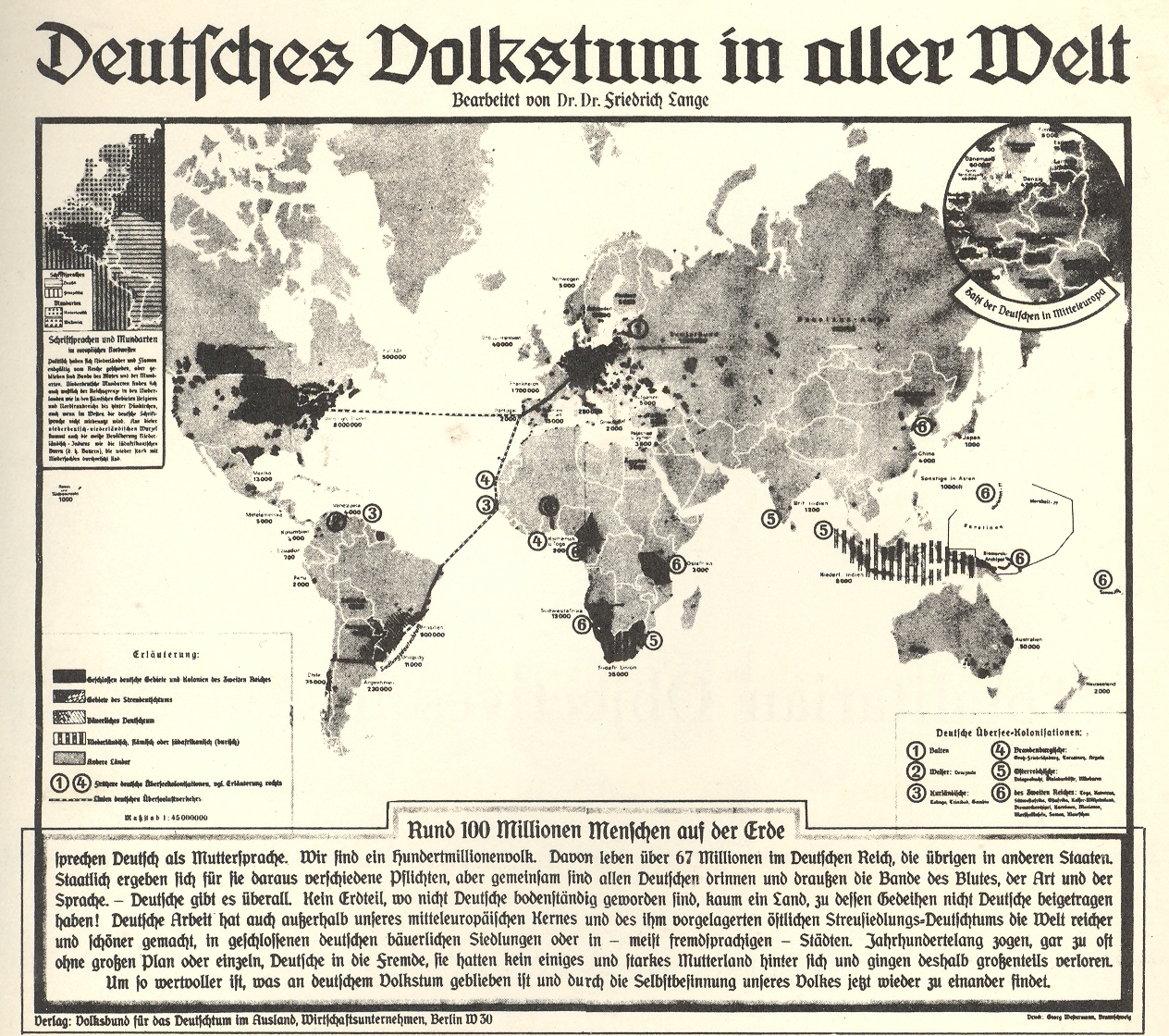
    an audacious move Adolf Hitler attempted to unite German-heritage people
    throughout the world to come to the aid of the Nazi Socialists; it was a
    vicious piece of propaganda attempting to inflate the number of possible-Nazis
    into the hundreds of millions, showing a sub rosa infiltration of Nazism
    throughout the world. 
    00=nazi america

    This
    map appeared originally in Deutsches
    Volkstum in aller Welt
    (Berlin,
    1938) and purported to document far-flung German descendants—the map alone was
    perhaps statement enough to many, striking a deep fear thinking about the
    20,000,000 Americans alone whose roots could be traced back to the
    Vaterland.  As a terror and influence
    tactic that cost little money, it must have caused the anti-propaganda folks a
    good deal of worry.  The German/Vaterland
    (German American Bund, or Deutsch-Amerikanischer Volksbund) movement never
    really gained much popular ground in the U.S., though there was some
    significant compliance in business and trade going on at higher levels of
    industry and banking. 

    (I’ve
    written about the Nazi-American connections in numerous posts on this blog; all
    you need to do is do a site google under “Nazi” and you’ll find plenty. For the
    moment I’ll just concentrate on the Henry Ford example.  The man was a monstrous moral figure without
    an ounce of historical understanding who blamed much of the world’s troubles on
    the “Jewish Dictatorship”, which Ford Henry Ford receives nazi medal somehow, in his mind, spawned WWI.  Long story short, Ford received the Grand
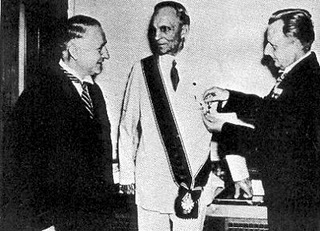
    Cross of the Supreme Order of the German Eagle for his friendship and services
    to the Nazi state—this friendship extended in form of money and many thousands
    of military vehicles, and so on.  His was
    a treacherous business, his Nazi interests folding very nicely in with his
    astounding anti-Semitism. Ford, by the way, received his medal months after the
    invasion of Austria,
    when he really should’ve known better. 
    I’m not sure if he gave the thing back or not after the war ended.)

    But
    among the masses, the sentiment never grew into strength, though it wasn’t for
    trying.  The movement had been present in
    the US
    since the 1920’s in the form of the National Socialist Party and the Teutonia
    Society, though the real start of the American Bund seems to have been with
    Friends of New Germany (1933). Right-Wing groups such as America First were
    strong sympathizers of Hitler, though they abandoned him once the war
    began.  (Not so true for Chase Bank, Ford
    and many others.)  The German American
    Bund never topped 100,000 members, though it did fill up Madison Square
    Garden
    for a meeting in
    1939. (One of the main speakers was Avery Brundage, International Olympic
    Committee Chair. Brundage survived in this role until Munich in ’72, when he ordered the Olympic
    games to continue, unabated, after the 11 Israeli athletes were murdered by
    elements of Yasser Arafat’s organizations.)

    Amyway,
    this map was more a propaganda tool than one of true expectation, and I’m sure
    it did its fair share of damage. 

  • Graphic Display of Quantitative Data: German Military Flatline in Persepctive, 1934

    JF Ptak Science Books LLC  Post 955

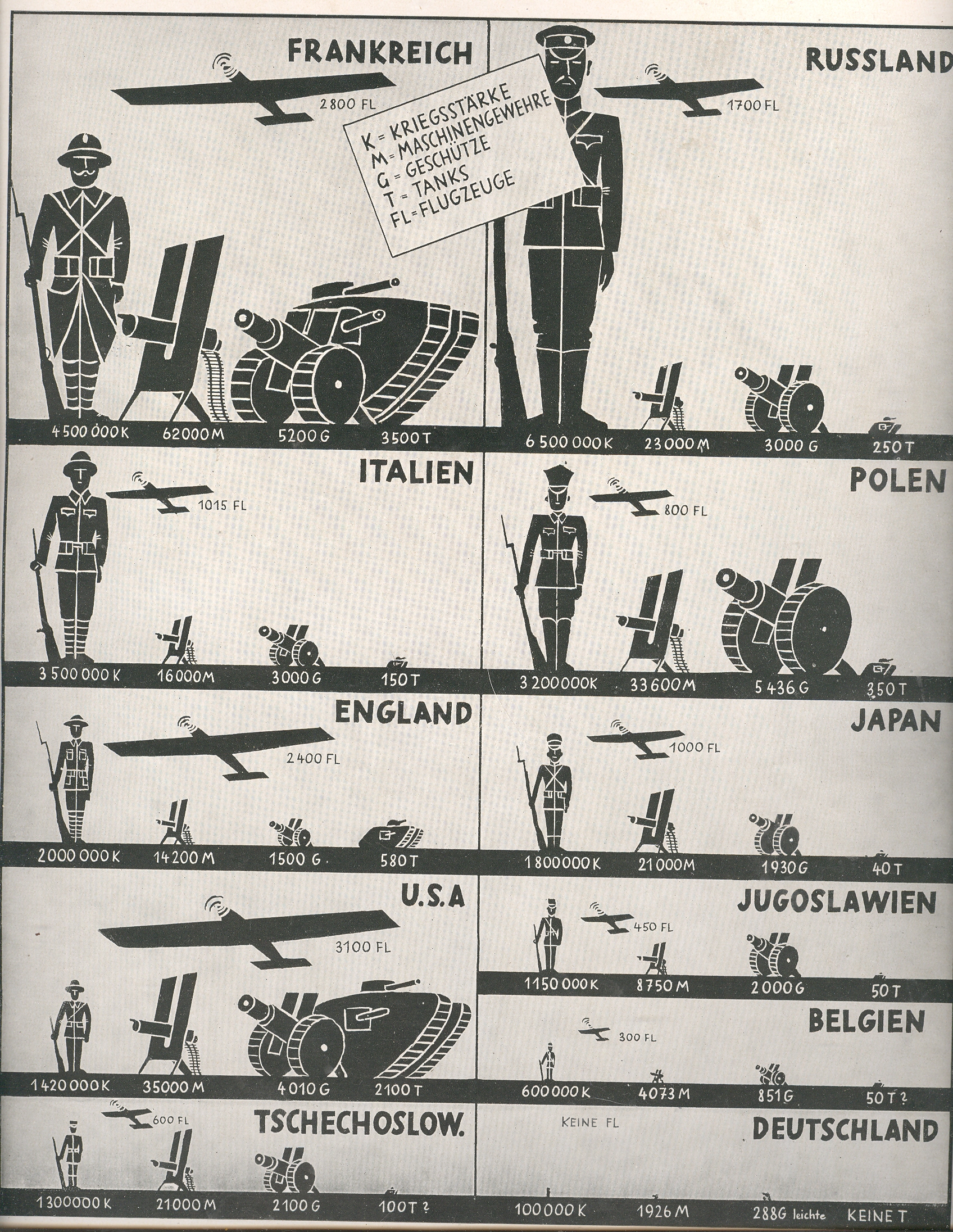
    This terrific 1933 pictorial display of quantitative data1
    showing the comparative military capacities of eleven countries—it will become progressively
    and aggressively more wrong in each passing year to the start of WWII.  In 1933 the military giant was, basically, France—the same country that would be quickly
    and completely overrun just seven years later by the country at the bottom of
    this display with the micro graphs, Germany.

     00=pict army

    The German military forces underwent staggering change after
    the end of WWI.  The Imperial Forces were
    completely done at the end of the war, limited to 100,000 men, left with no air
    force and no tanks.  There were wide
    changes during the Weimar
    Republic
    , the army seeing
    three iterations (not to mention the hundreds of Freikorps that were
    established with some of the disbanded remnant of the standing army) that
    ultimate resulted in the formation of the Reichswehr (in 1921) and which in
    turn would evolve into the Wehrmacht in 1935. 

    Germany
    barely registers, barely forms bumps in the flatlines of measurements in
    1934.  By 1939, six years after the
    election of Hitler, and fanned by xenophobic revenge and greedily speedy full-throttled
    hate, Nazi Germany  rushed at record
    speeds towards the rape of the future. The German Wehrmacht stood at 4.7 men.in 1939 
    (6.6 million in 1940; 8.1 in 1941; 9.5 in 1942; 11.2 in 1943, 12 in 1944, and 9
    in 1945), while the Luftwaffe was at 400,000 (growing to 1.7 million by 1943)  and had enormous growths in quantity and quality
    of armaments.   It was all astonishing, and almost all gone again in another six years. 

    This is an exclusive graphic of German nothingness, an accurate graphic in 1934 and again in 1945, but in the middle, it was totally incorrect.  Twelve years from nothing to nothing, with the disgust of Hell to pay in between.

    It is simply extraordinary to see the disparities of the
    Nazis displayed so

    Notes:

    1. Printed in Die Illustriete Zeitung, 1934.


  • The Care and Feeding of Missile Systems–1950’s Ads

    JF Ptak Science Books LLC  Post 948

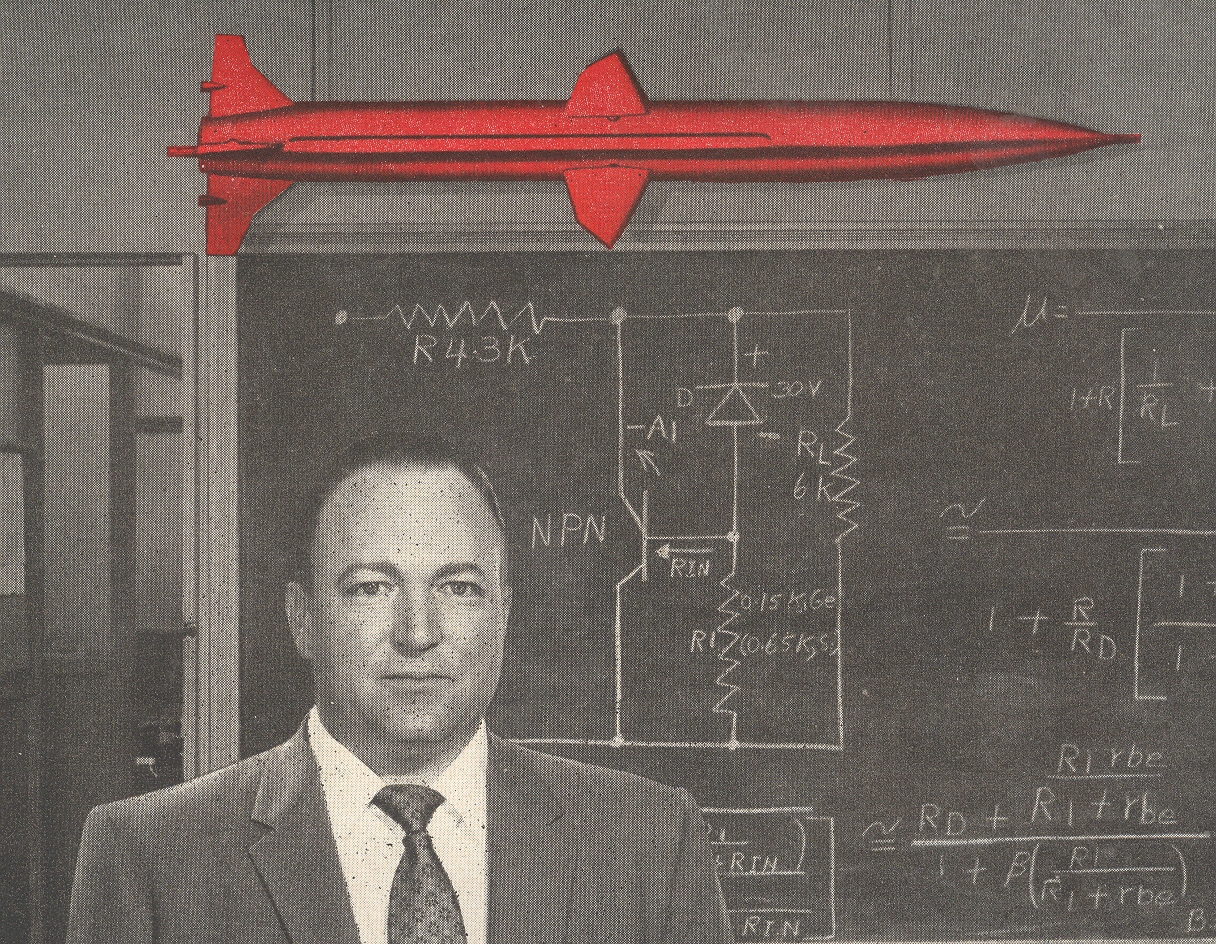
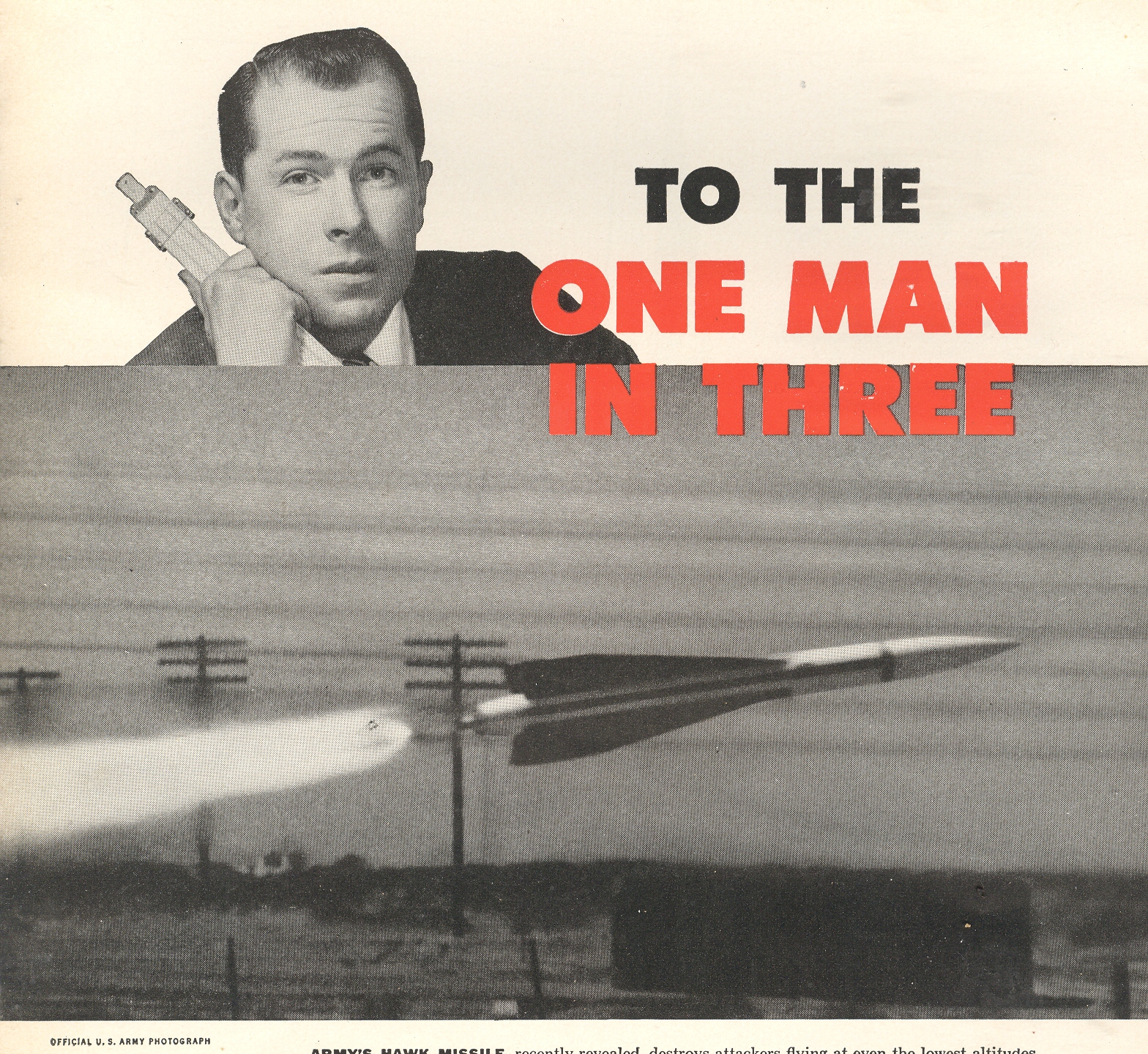
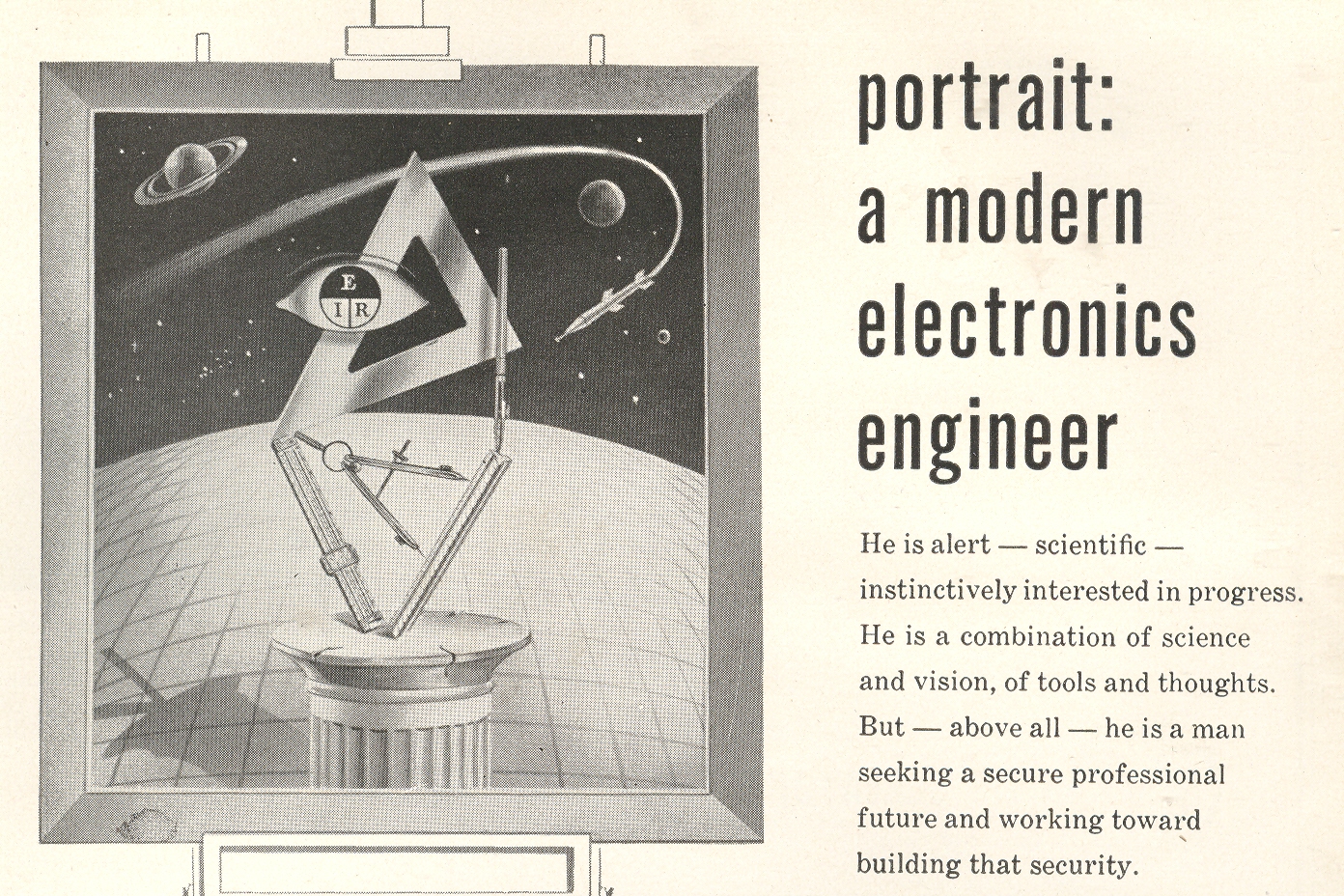
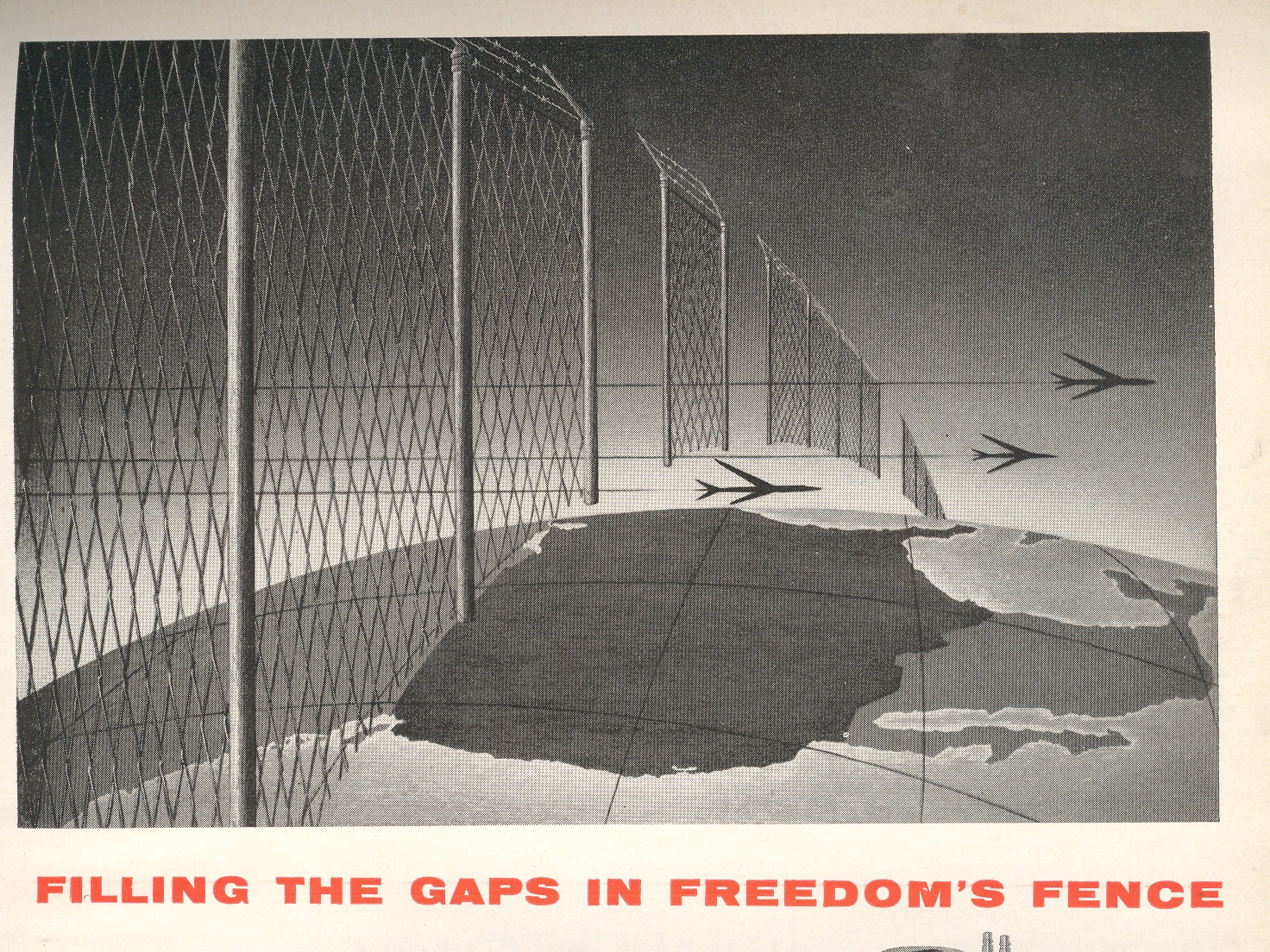
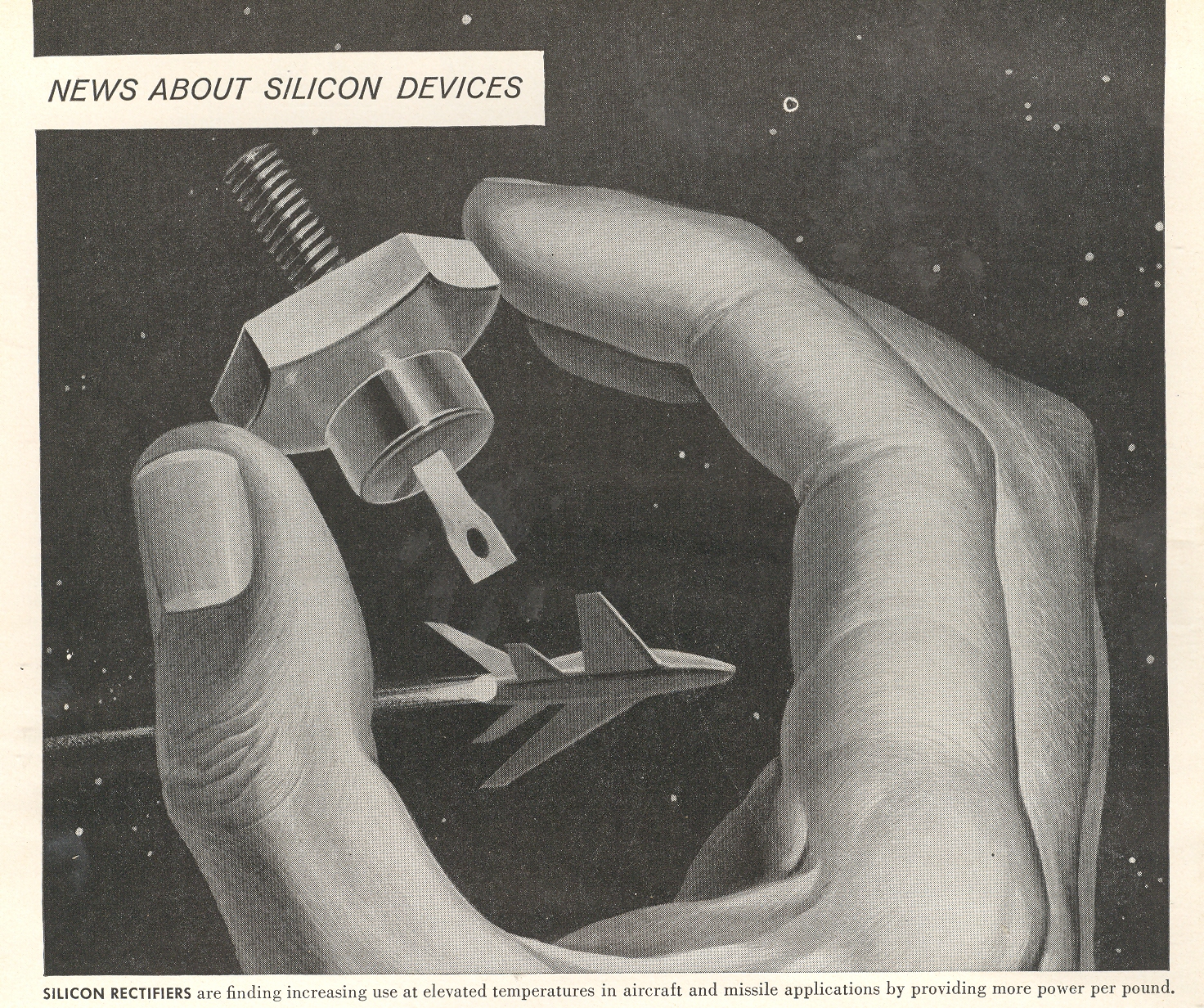
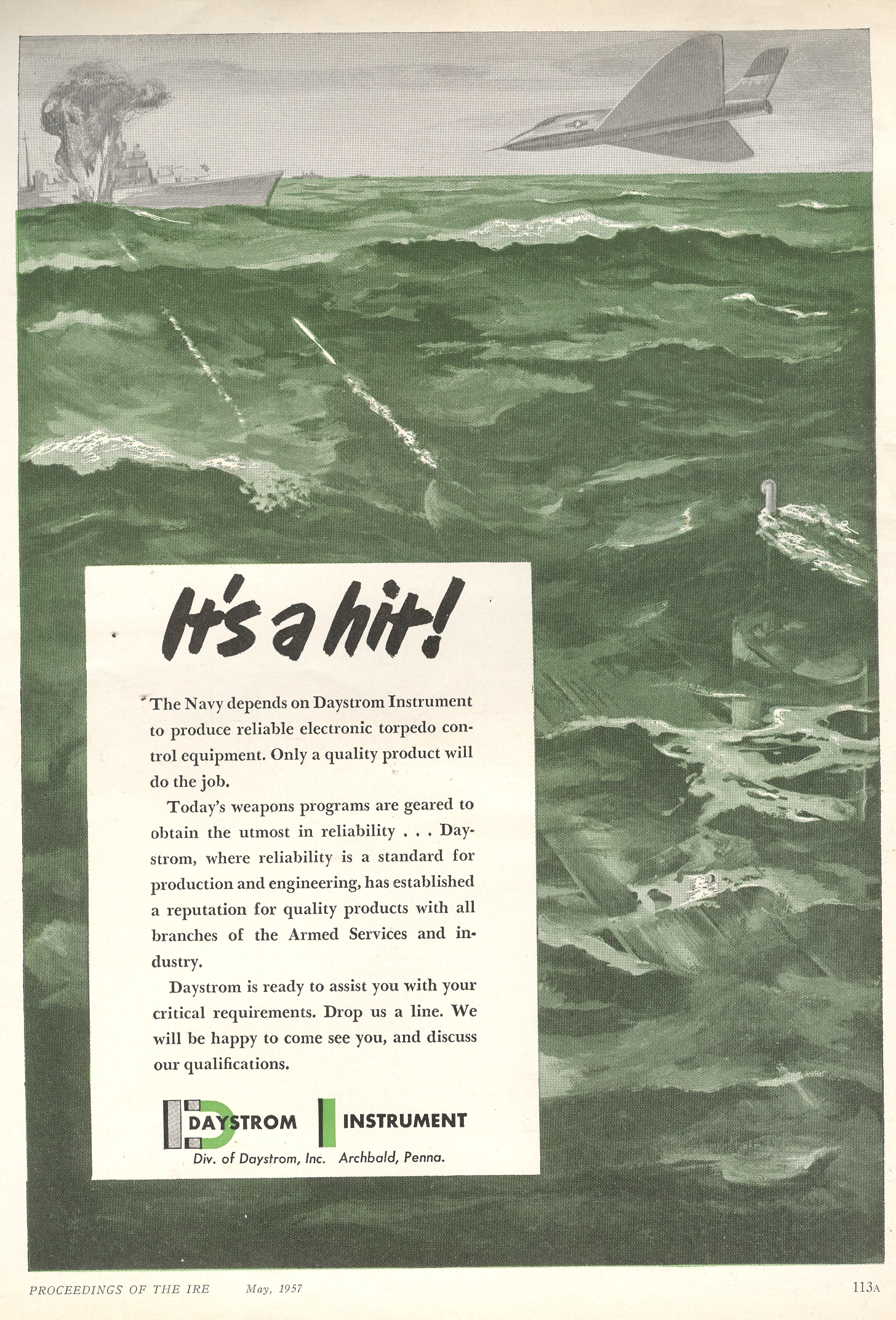
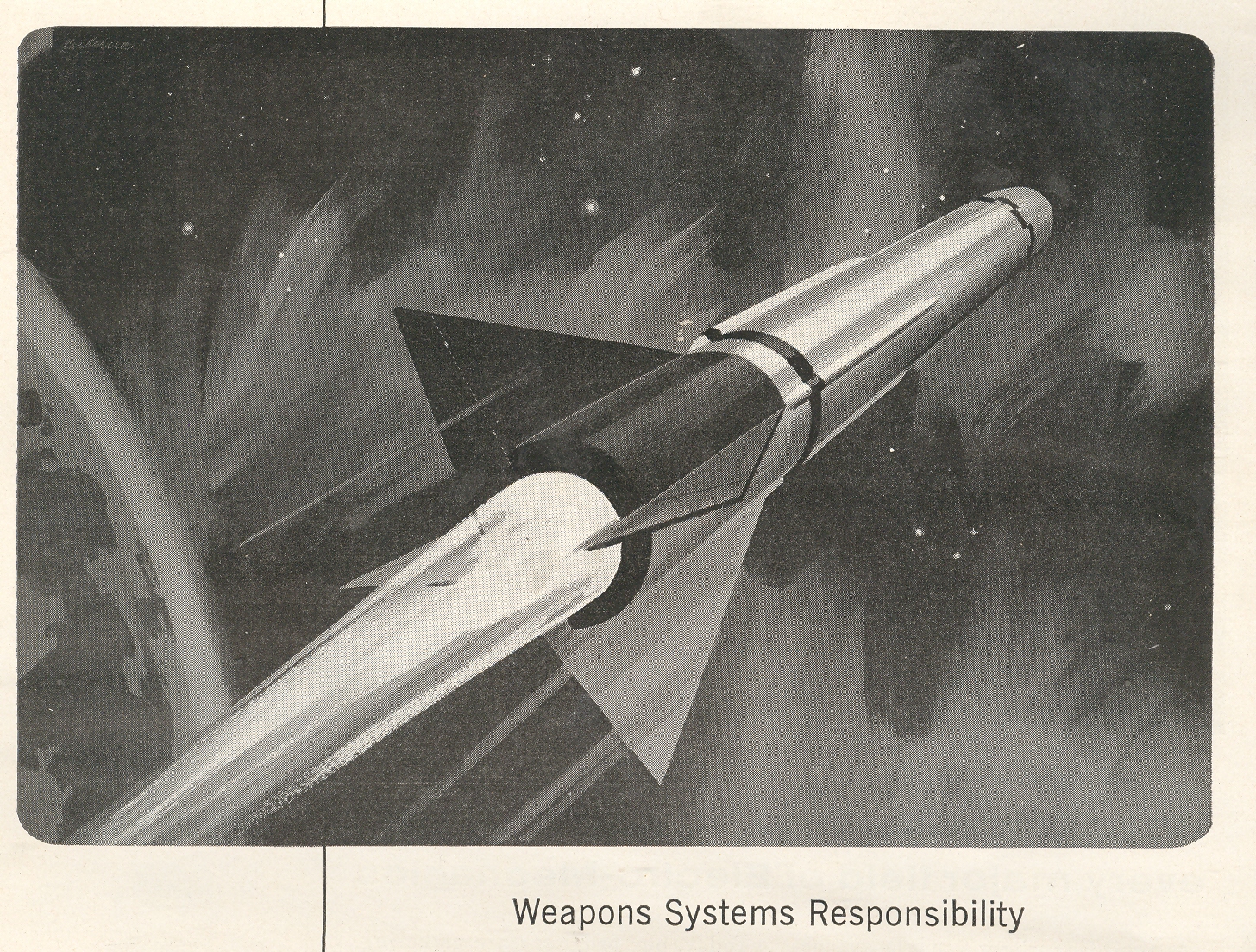
    The following illustrations are all taken gloriously out of context from ads appearing in the Proceedings of the Institute of Radio Engineers, published in 1957-1958. 

    1--feeding missile

    1--red missile
    1--one man in three

    1--portrait
     

    1--fence

    1--fbig hand

    1--missile its a hit

    1--weapon system respons 

    1--big red


  • Bad Sounds Department: the V-1, 1944

    I remember seeing a film (with sound) many years ago, when I was little, back in the mid 1960’s, of a V-1 in flight.  The flying bomb issued a terrifically awful sound, punctuated by the silence when its engine  turned off and it fell to its target in silence. It sounds like death.

    [The V-1, or Vergeltungswaffe 1, (“retaliation”, or “vengeance” weapon), or Fieseler
    Fi 103, or Buzz Bomb, or Doodlebug, was a flying bomb (on the order of a very primitive
    cruise missile guided by a gyroscope autopilot) launched against population centers
    in England by the Nazis during the June 1944-January 1945 period.  The bomb was about 27’ long and 17’ wide,
    weighed 4,700 pounds, and reached 400 mph with an 1,800 pound warhead.  Its 8,000+ sorties killed more than 6,000
    people.]

    http://www.youtube.com/watch?v=Q1qsBGTkVSk&feature=related

    And again:

    And again, here:


  • Blank and Missing Things: German Submarine Importance in Graphical Comparison, 1912.

    JF Ptak Science Books  Post 937

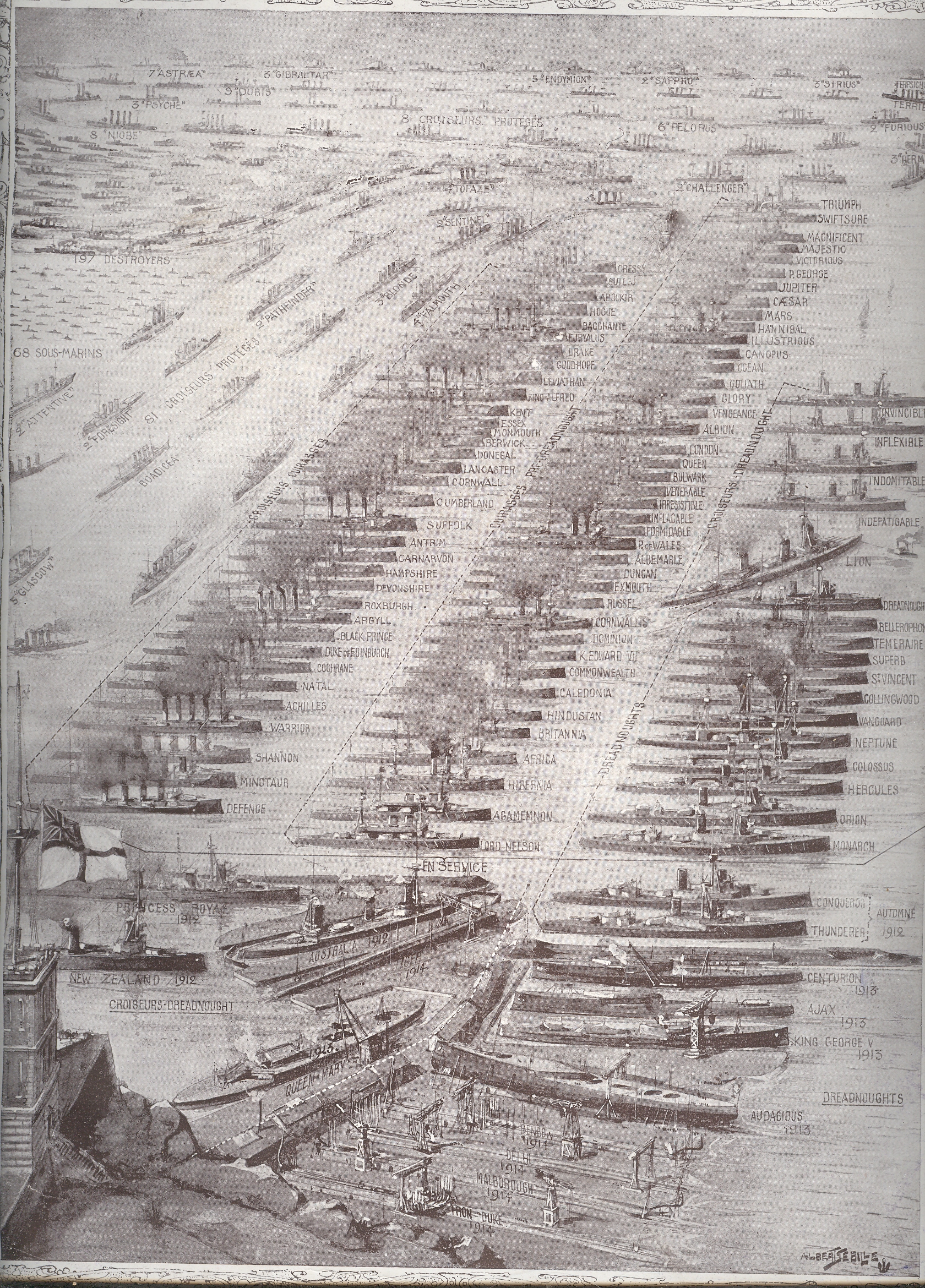
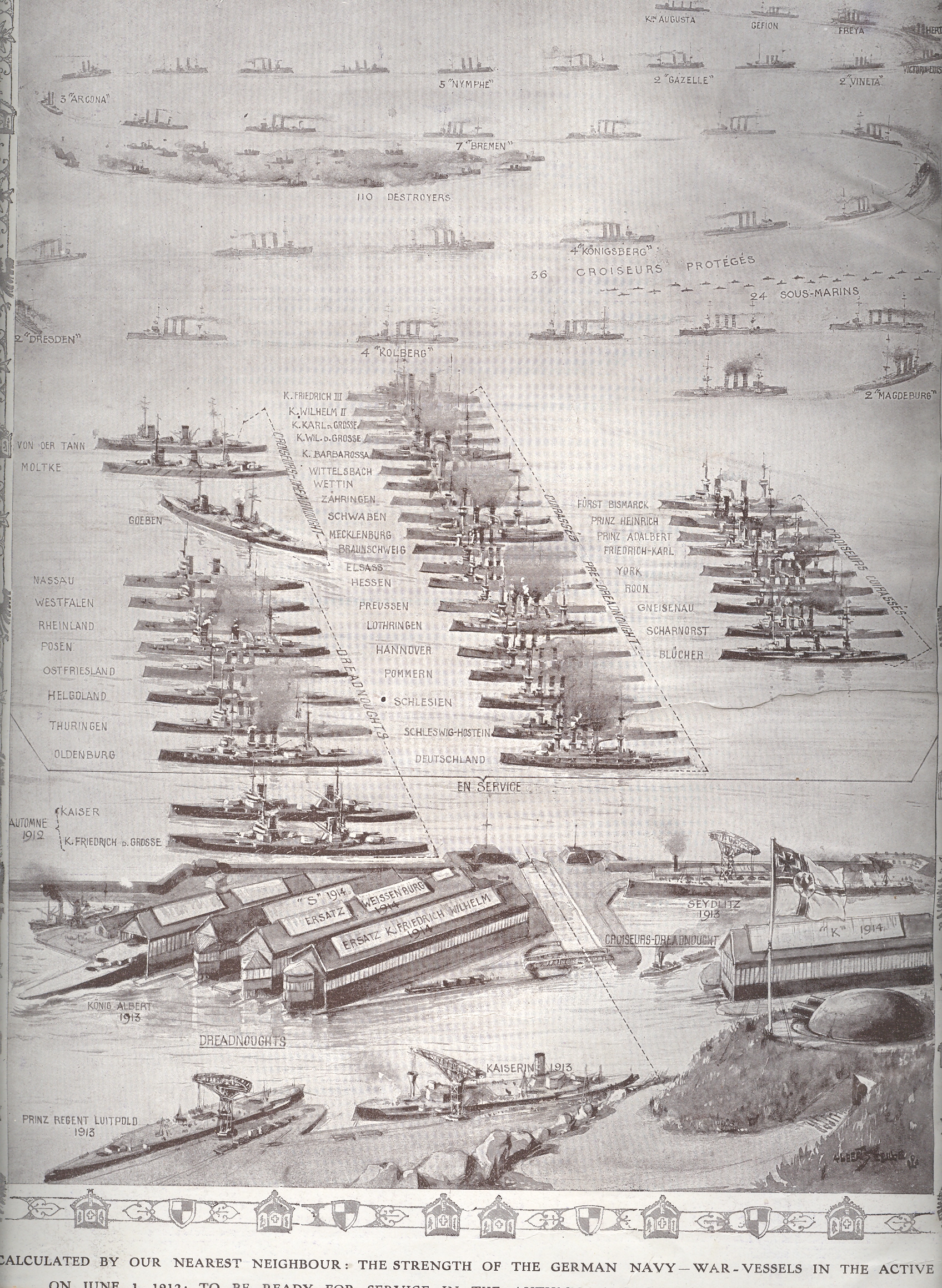
    In the midst of a massive building campaign by Germany and a building-response by England the French journal L’Illustration published these two side-by-side pictorial comparisons of their two navies, which wound up being reprinted in the Illustrated London News soon afterwards in June 1912.  [Royal Navy, left; German Navy right]

    2--brit navy big 2--brit navy germany


    2--brit navy big

    Germany began a rebuilding campaign in 1902 which by 1908/9 was seen by the British Admiralty as a “stab at the heart” of England’s military supremacy, and so the construction wars were undertaken.  It’s a complicated period and a complex race, which I just can’t get into in a short post, so let’s just say that the Brits wound up the winners of the competition  when these images were printed in June 1912.  

    The hidden element of some great importance, a trump card that would  played in just 750 days, would be the small dot-like drawings  labeled “sous marins”. These would be the submarines, and it would be the subs that would be perhaps the most significant aspect of the entire German navy.

    2--brit navy germany

    This was true in spite of what looks like an overwhelming preponderance of subs in favor of the Royal; Navy, where the count was 68 to Germany’s 24.  It was really a question the type of sub, and as it turns out there were only 8 or 9 of the English count that could’ve been considered for blue water ops.

    Germany began the war with 24 submarines in 1914; they recognized the ship’s importance and by war’s end ramped up production, winding up with 351 in total production and with 178 in action in 1918 alone. Of that overall number fully half (178) had been destroyed in combat, with another 11% sunk via other means.  There were more than 12 million tons of Allied shipping destroyed by the German sub forces from 1914-1918 (half of that in 1917). 

    So these two illustrations do portray an overwhelming Royal Navy, but they certainly do not give any hit whatsoever to the coming importance of the German submarine fleet.


  • Things They Took To War, 1915

    JF Ptak Science Books Post 923

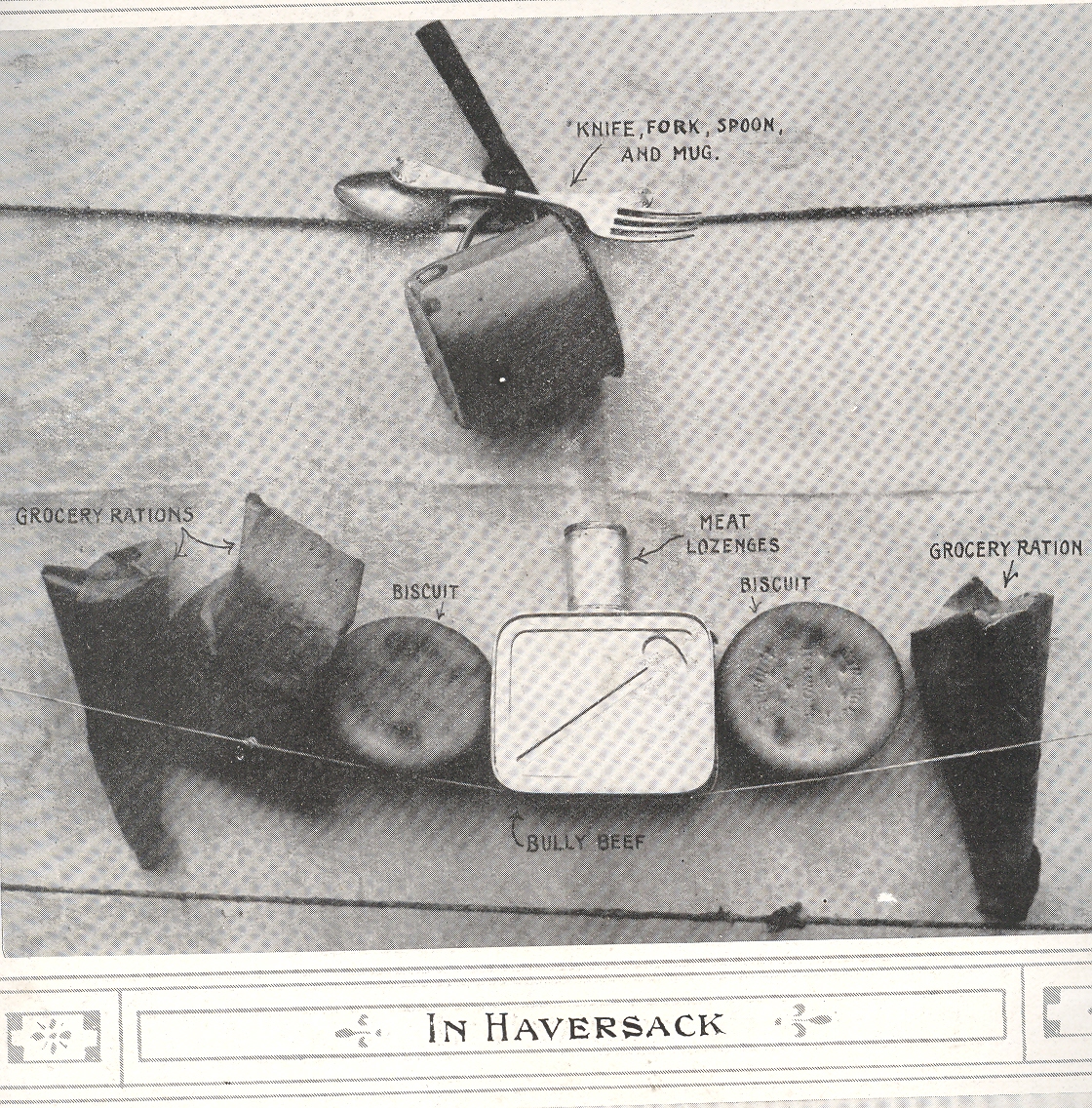
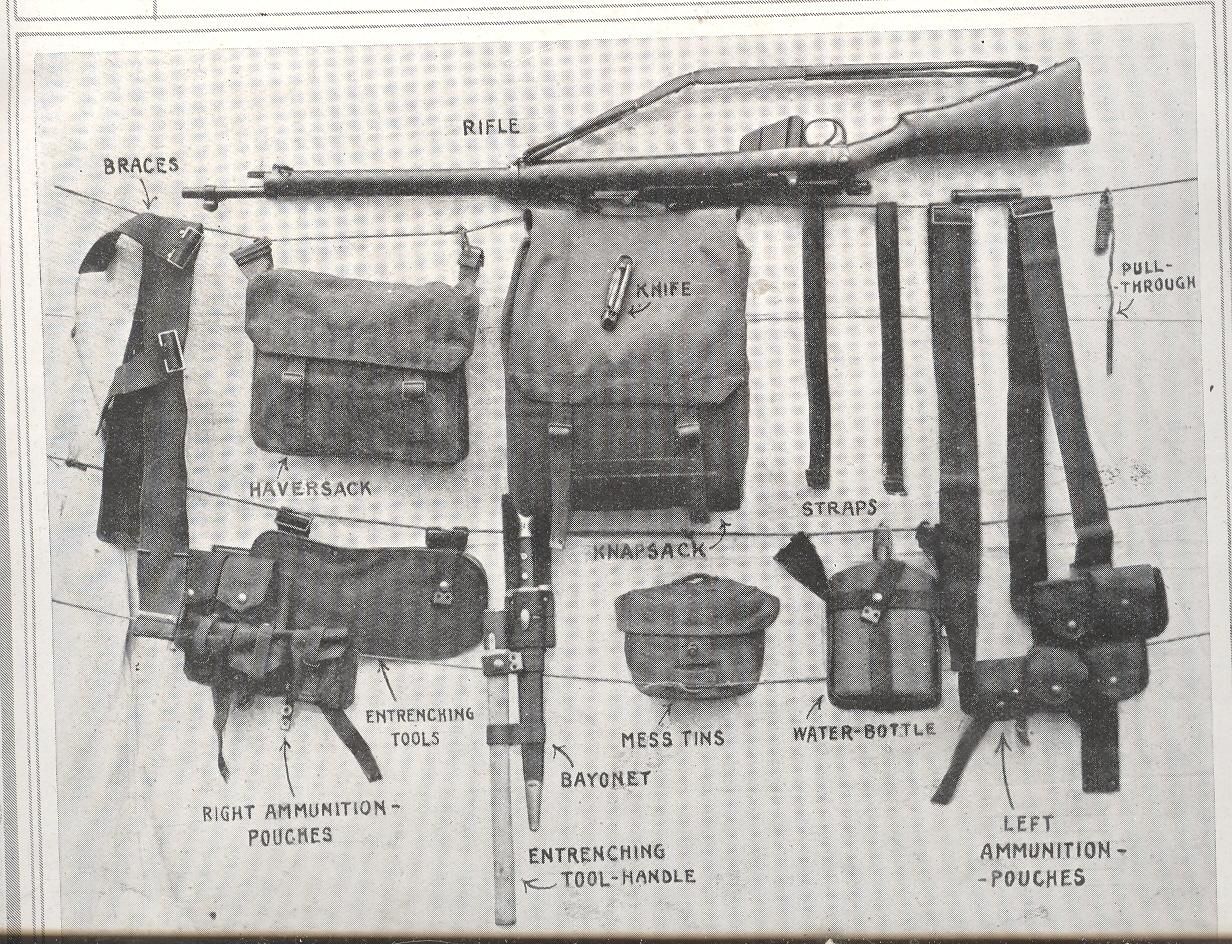
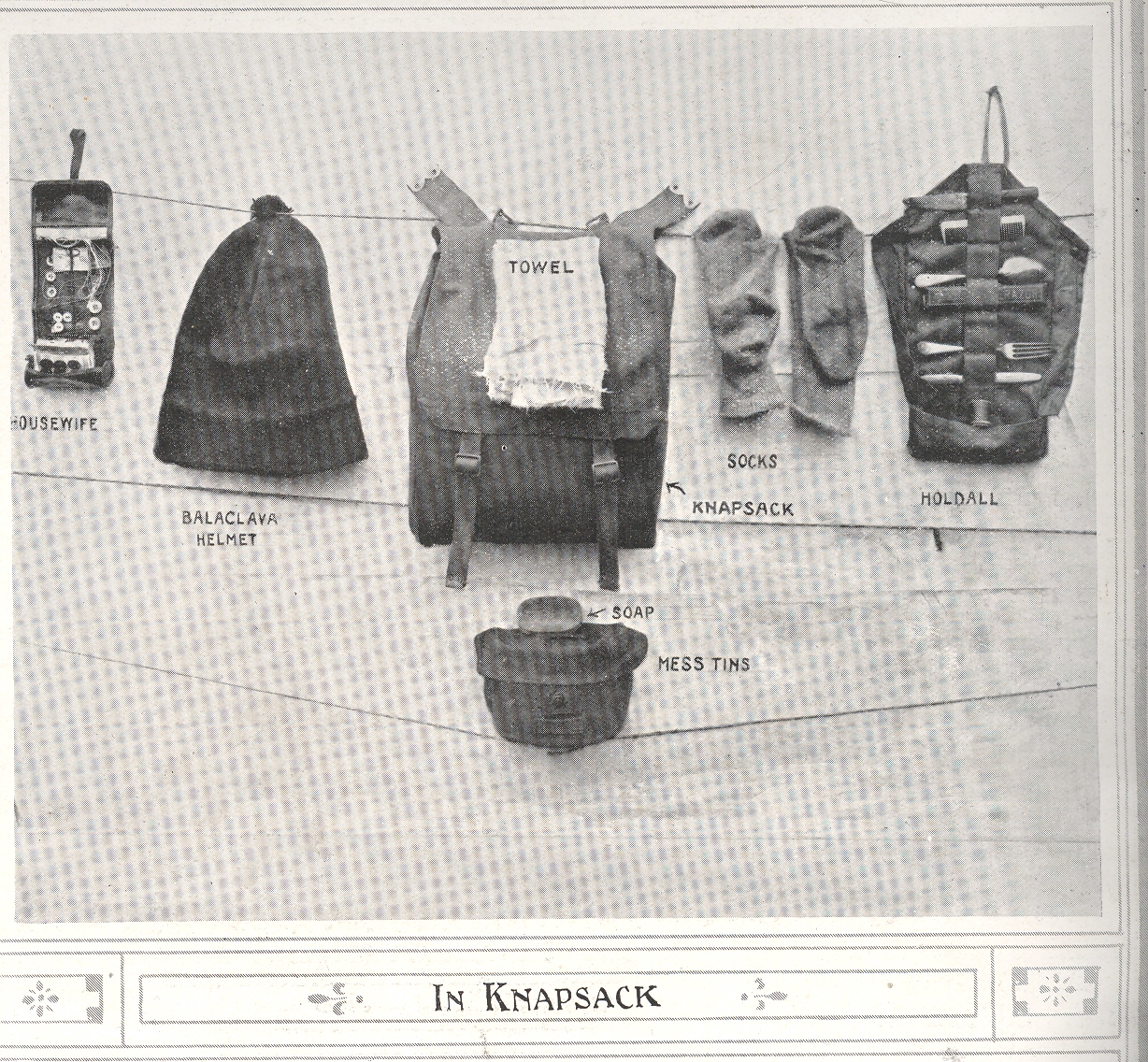
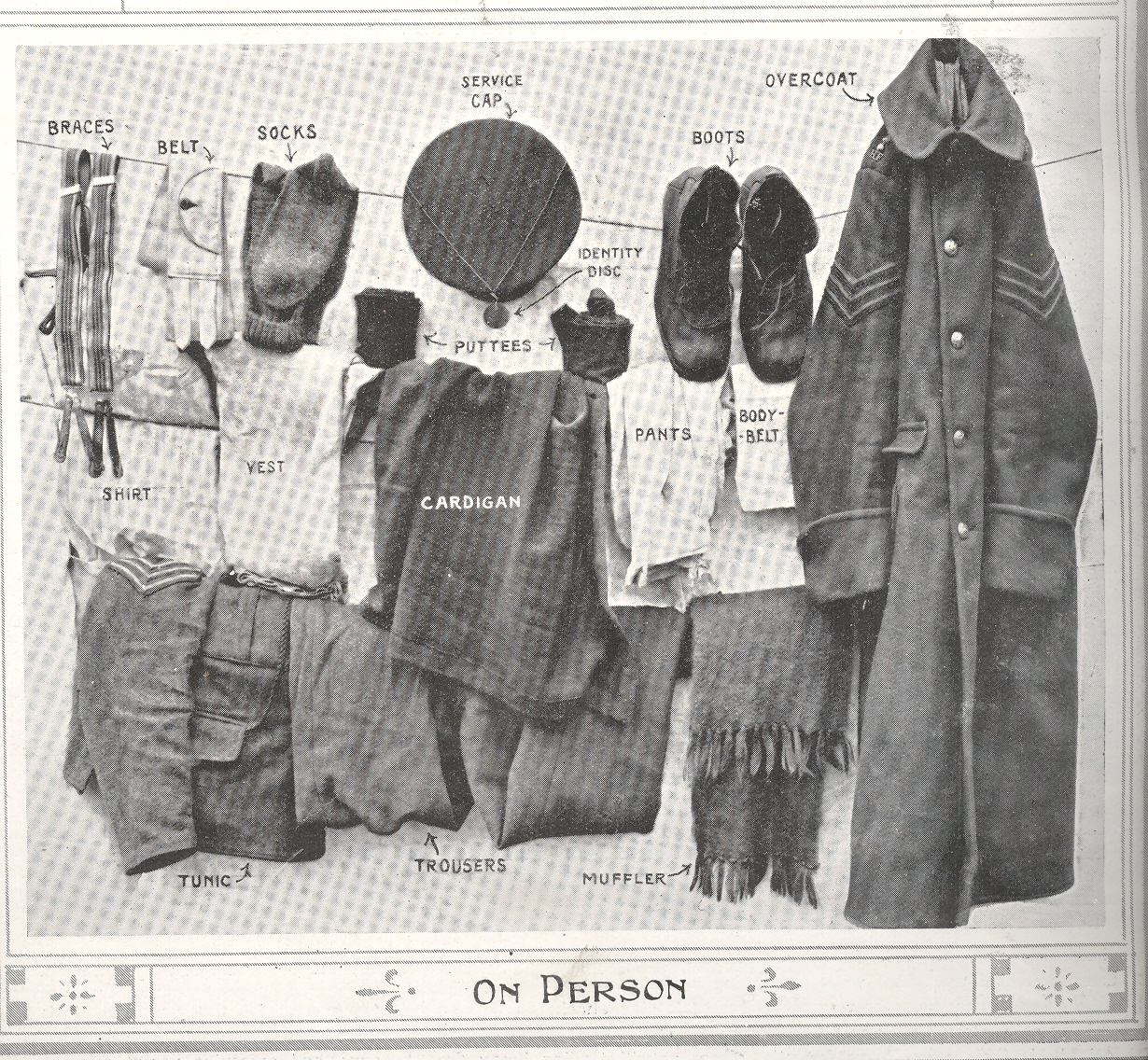
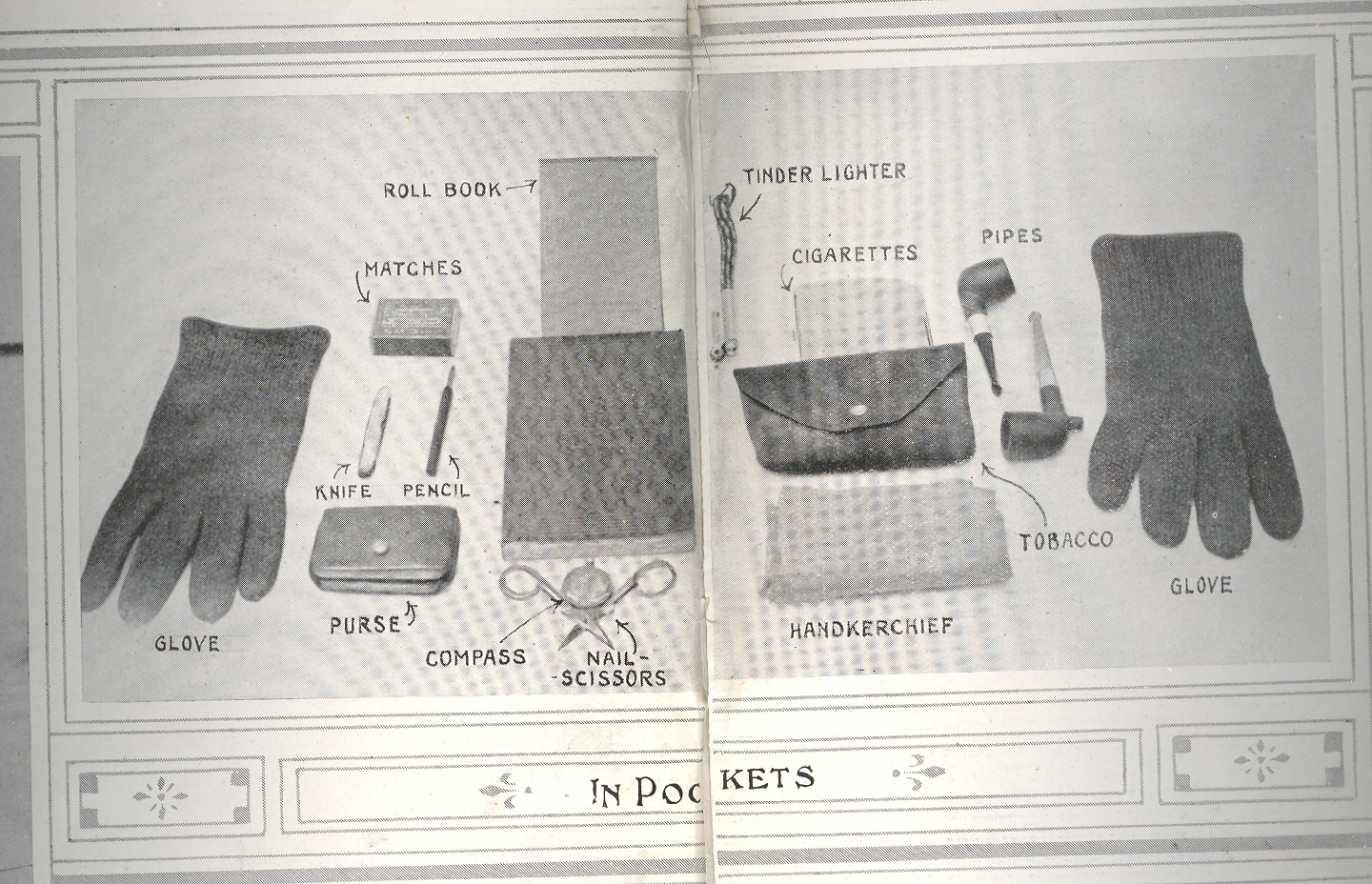
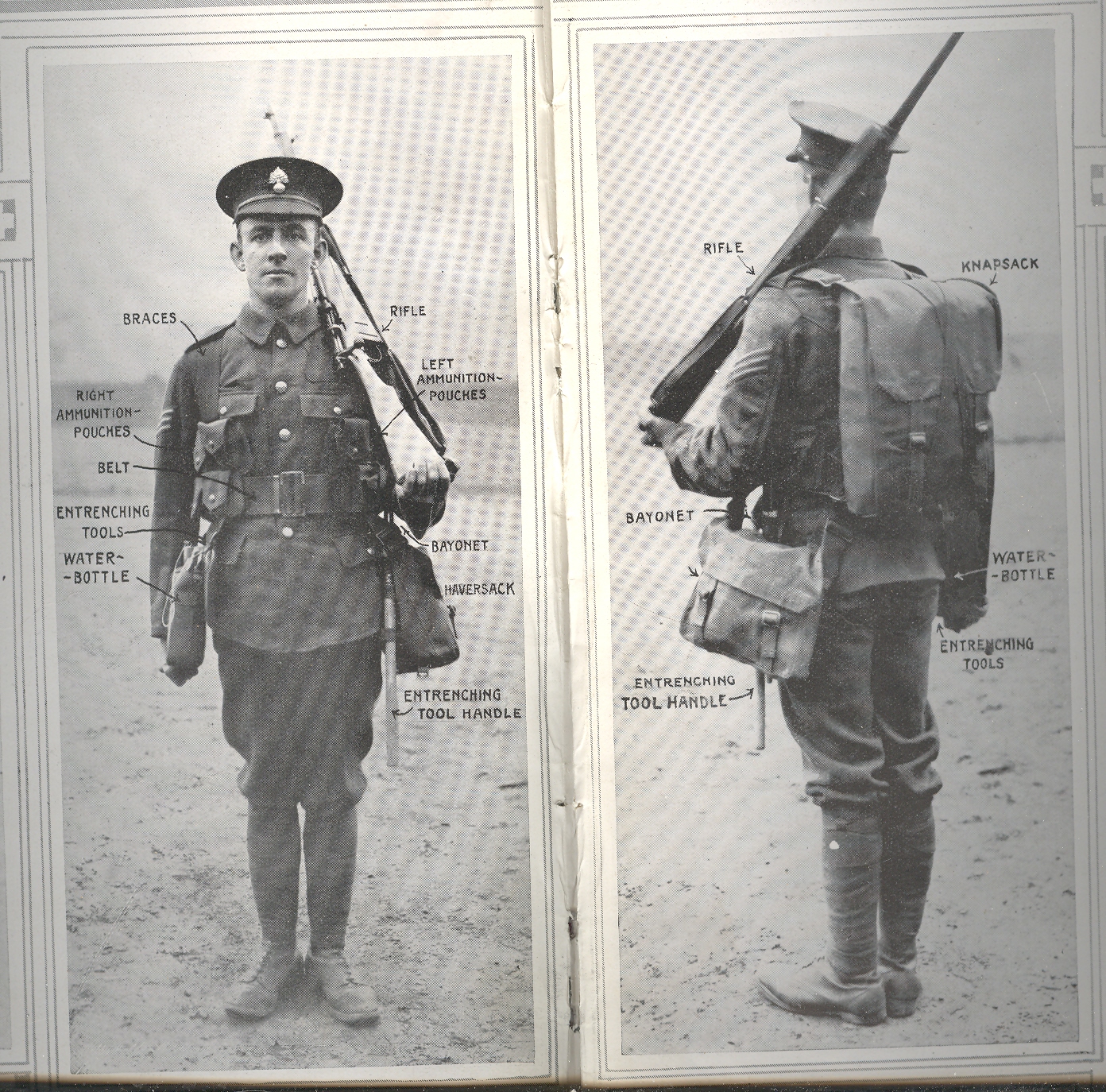
    The 27 Feb 1915 issue of The Illustrated London News is remarkable.  Yesterday’s post was generated by an image appearing in it of sappers mining under a battlefield to create an underground attack on the enemy’s trench lines.  A few pages into the issue shows a series of pictures describing the regulation issue for an enlisted man headed into combat—simple, scary, and heartrending. And of course a true measure of the courage and fortitude of these millions of men who marched to the Front with all what today looks to be  not-adequate material.  It is hard for me to imagine going off to conquer your enemy and your own fear with these sorts of supplies, marching along with all of these slight bits jangling and clanging to each of my steps.

    [All of the images are expandable.]

    Blog jan 30 infantry top left

    The images themselves are, I think, unintentionally spectacular for their design and arrangement, not the least of which is the fact that all of the materiel is suspended from rope or wire. 

    Blog jan 30 infantry btm left

    There is no way for me to know what of this material was instantly discarded (if any), or what was thrown into ditches because they didn’t make sense or were too heavy or cumbersome or got in the way.  Or what of these supplies were actually carried into battle.  Given the nature of the fighting, perhaps all of it was carried in and out. 

    Blog jan 30 infantry right top

    Basically though the pictures just make me uneasy, nervous; so many things look so slight and needy.  The canteen looks tiny; there’s only two pair of socks (!?) but two pipes; the “grocery ration” looks inadequate; the ammunition pouches look stingy. But the “housewife” looks useful, and its always good to have scissors, and a handkerchief.  I’m not so sure about the purse.

    Blog jan 30 infantry right btm

    It just seems to me an amazing display of the stuff that the British soldier was given to haul into the future with him. 

    Blog jan 30 infantry center top 

    Blog jan 30 infantry center btm


  • Missing Things Making Holes: Soviet Bread-not-Bombs in Finland, 1940

    JF Ptak Science Books LLC   Post 917

    [This post is a hybrid category bridging “Blank and Empty
    Things” and “A History of Holes”—it is really an entry for blank and missing
    things making holes]

    1.  The Soviet Union’s foreign minister Molotov1 wanted to make it very clear
    to the rest of the world that his country was not bombing civilian targets in Finland during
    the winter war of 1939/1940.

    Blog jan 23 bomb

    2.  Molotov insisted that targets that were being bombed near
    Finnish cities were actually airbases.

    2.1   Also, since the
    complaining FDR was over 4000 miles away there was no way that he could “see”
    what was being bombed.

    3.  If there were civilian targets that looked as though they
    were being bombed, then

        3.1   they weren’t being bombed; and

        3.2   if anything at all was going on the Union of
    Soviet Socialist Republics was  dropping
    bread on the town’s/city’s starving inhabitants.

    4.   So far as
    undefended, non-military targets were concerned, the Soviet
    Union
    redefined “bomb” as “bread”.

    5.   Therefore, what
    we’re seeing in this image above are not bombs, but bread; that, or the houses
    were airbases, which would turn the bread back into bombs.

    Molotov insisted that no civilians were direct targets of
    Soviet bombing campaigns in Finland.  Also, if there were people being killed in
    these bombing raids they would necessarily and by definition be aircraft
    workers or air bases support staff or other military personnel.  

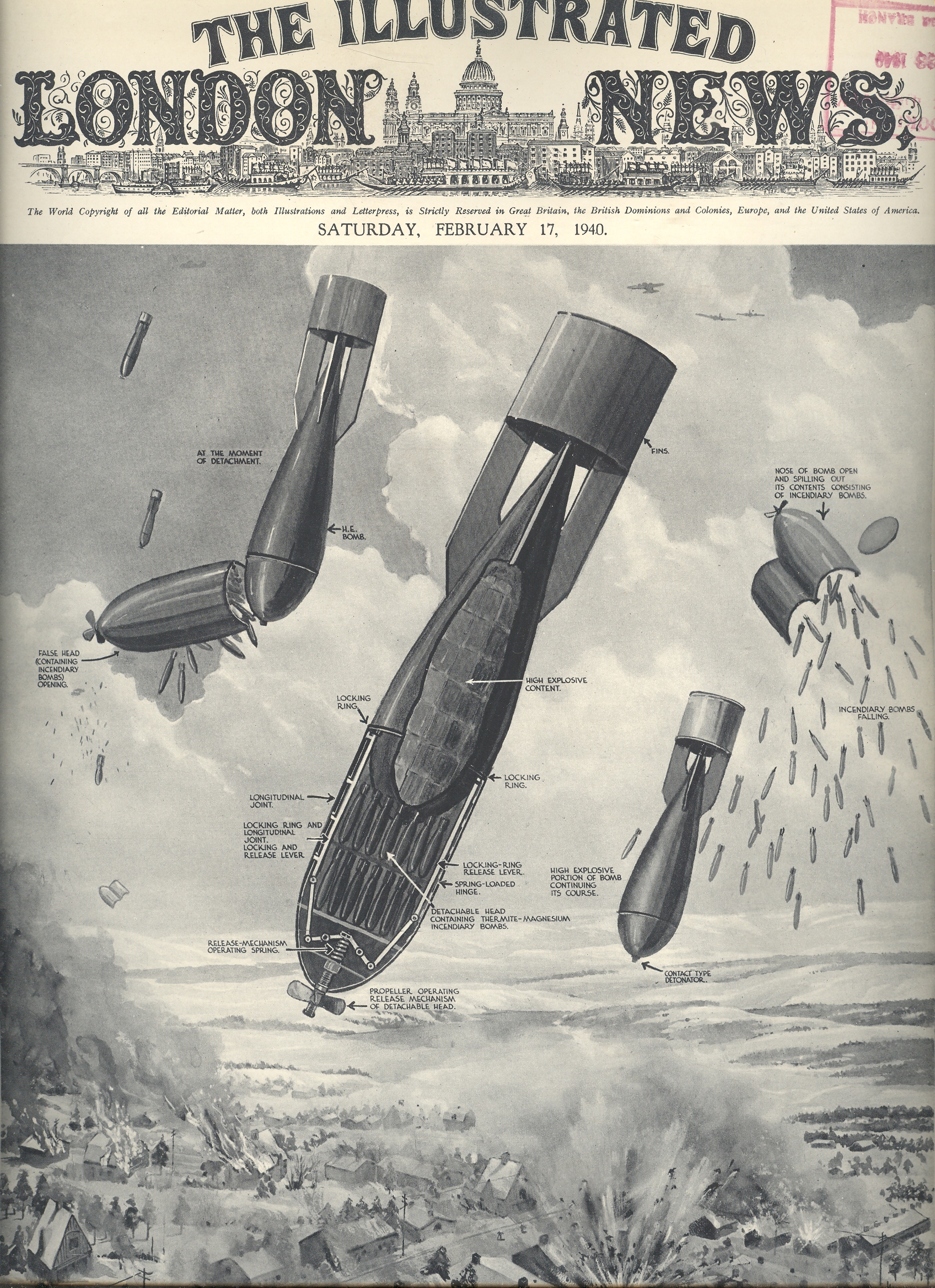
    This strikingly designed image is from the 17 February 1940
    issue of The Illustrated London News;
    the design is by G.H. Davies, the phenomenal ILN draftsman, and elegantly (and forcefully) depicts the innards
    of the bomb and its effect on its target.

    It is a spectacular and brilliant presentation of the
    new(ish) Soviet hybrid terror bomb that was being used in the non-existent
    attacks on Finnish cities.  [The 5’ bomb
    was made to be deployed in two sections: 
    the front end of the bomb inside the false nose cone contains dozens of
    incendiary bombs, released by a revolutions-generated cap propeller, which fall
    away from the main section of the bomb, which contains a high explosive.]

    Since the non-existent bombs that were not being used against
    non-military installations and were actually bread, the Finns gave the weapons
    the nickname of “Molotov’s Breadbaskets”.

    This was just a down-right nasty bomb, and the illustration
    shows it falling on and destroying a quiet town with no visible military
    advantage. The town not being bombed was called Sortavala, which—after numerous Soviet
    attacks in December 1939—was in actuality destroyed by Soviet air power on 2
    February 1940.

    The man ultimately responsible for this campaign and the
    murder of millions of his own countrymen through means of induced starvation,
    disappearances and ruthless killings—Joseph Stalin—was post mortem dispatched
    in much the same manner as the reasoning listed above.  Stalin was ignored to the point of
    non-existence, de-Stalinized and  left
    entirely out of the 50-volume second edition of the Great Soviet Encyclopedia2  published just a few years after his 1953
    death. Stalin executed his brutal and long-time political compatriot Lavrentii Beria, (1899 – 1953)
    right before his own death, ordering that people who owned the GSE to physically cut out the
    Beria entry
    . It is unfortunate that Stalin could not have been denied his
    existence 30 years earlier.

    Molotov, on the other hand, in spite of his enormous sins
    against humanity (as principle architect of the Great Terror, the extermination
    of millions of Ukranians, and etc.) was finally removed from government
    following Khrushchev’s de-Stalinization campaigns (i.e. by 1962)  and managed to live out the rest of his life
    alive, not dying until 1986 at the age of 96.

    (The “Molotov Cocktail” by the way was not named for him by
    Soviet soldiers or freedom fighters or whatever fighting for the USSR—it was
    named for the petrol bomb used by Finnish soldiers and civilians fighting
    against the Soviets invading their country  in 1939/11940 and again in 1943/4)

    Notes

    1. In 1940 Molotov was the foreign minister of the Soviet Union, and had just completed negotiating the
    Non-Aggression pact with Nazi Germany. 
    This gave the USSR free range for its relations (read “occupy/annex”)
    Estonia, Bessarabia, Latvia and the Ukranian/Belorussian-occupied section of
    Poland (to the Curzon Line), and to also conduct its war with Finland.  The fierce Finns never lost their
    independence, though they did lose a part of their country. 

    2. The GSE had a somewhat complicated publishing history,
    winding up with 65 volumes over its two editions, constructed with very
    questionable state-controlled X-Ray communist vision spectacles. There is so much in these volumes that is wrong/sanitized/fiction that I have no idea how a non-specialist might be able to use the thing.


  • What 1.5 Billion Pounds Bought the Military in 1938: Finding a Gem Inside a Great Graphic

    JF Ptak Science Books LLC  Post 916Blog jan 22 Brit Mil overview

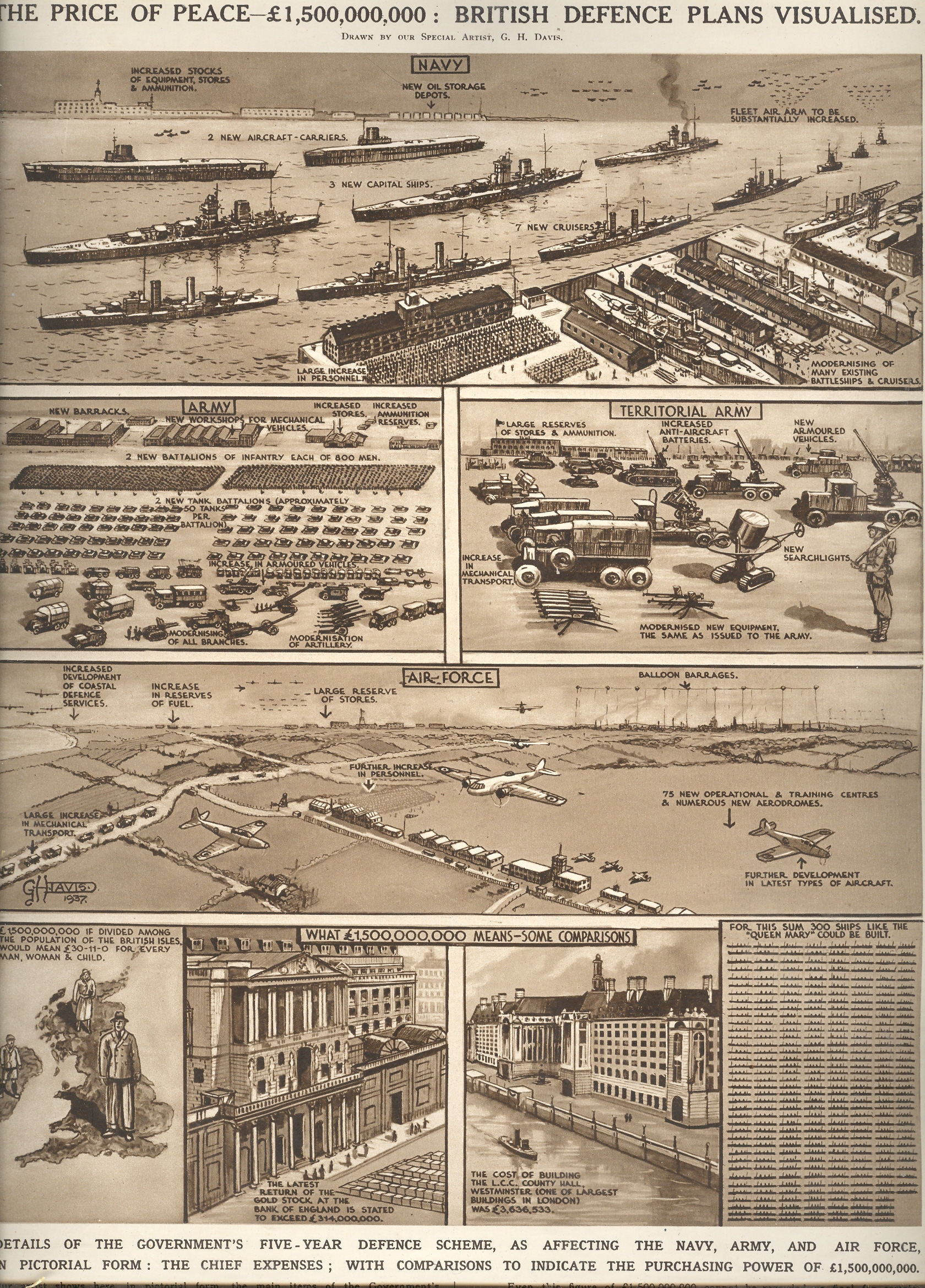
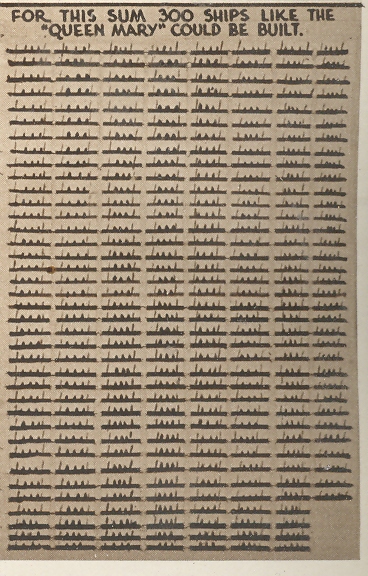
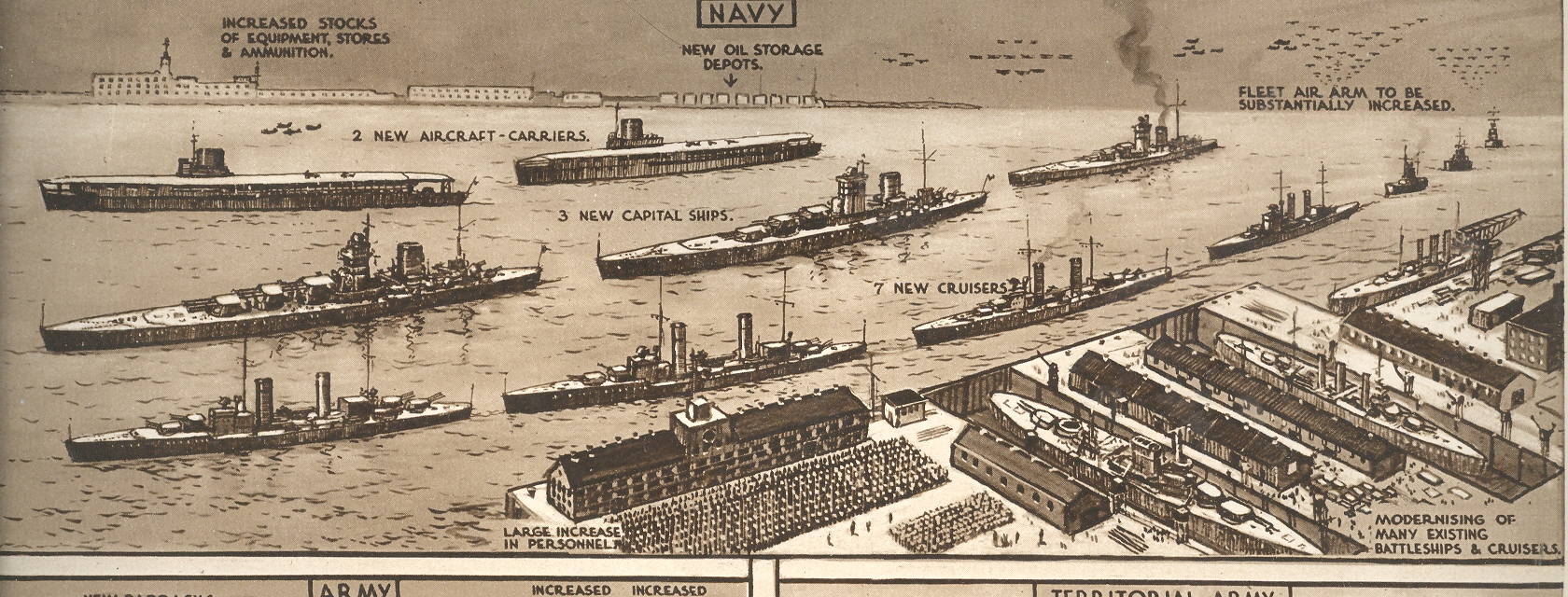
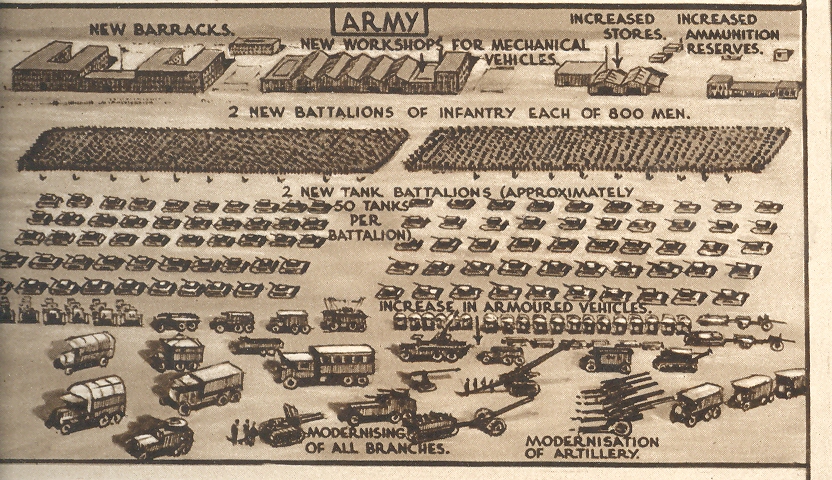
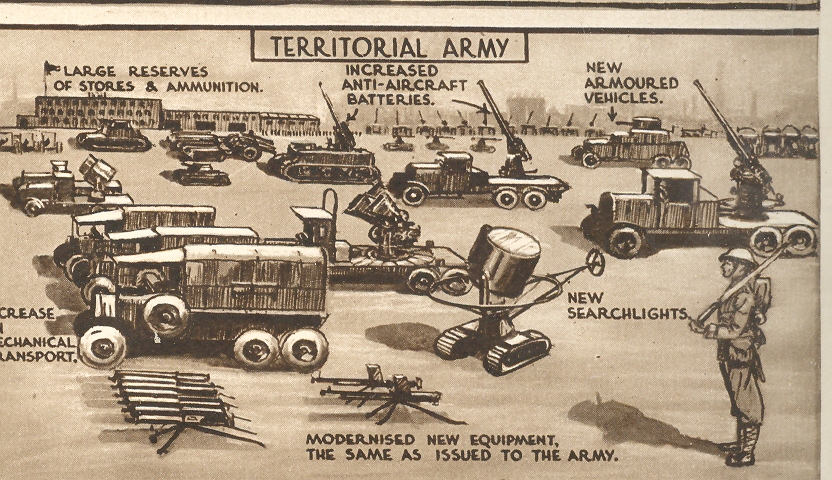
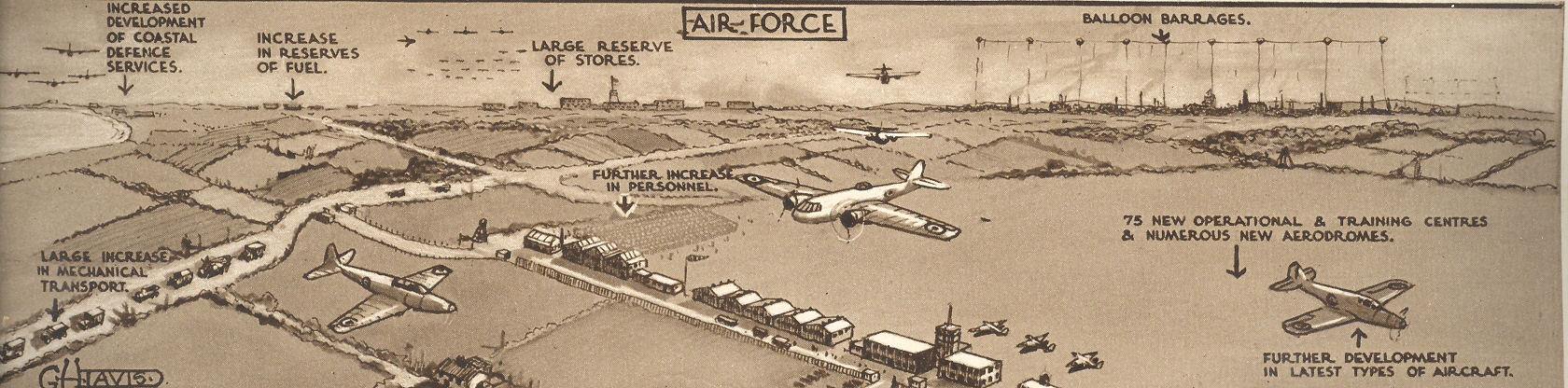
    The Illustrated London News for 27 February 1937 hosted a brilliantly designed graphic illustrating the ways in  which the British War department could/should spend 1.5 billion pounds (or about $100 billion in 2009 dollars, sort of) over a five-year period as the price of keeping the peace.  Of course they wouldn’t make it but a quarter of that distance as Austria fell to Czechoslovakia which fell to Poland and the end.  The full-page pictorial effort is to the right:

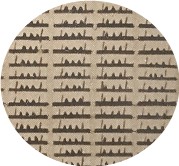
    Nestled in the corner of this page–at about 2×1 inches–is this lovely little graphic, showing that 1.5 bil could purchase 300 Queen Marys, which this delightful little design showed to great effect, and a hidden gem inside of a gem. First is a detail of this detail,

    Blog jan 22 Brit Mil bot right det 

    Followed by the full smidgen of the overall page of comparisons and analogies:

    Blog jan 22 Brit Mil bot right

    Then there’s the semi-standard presentation of what the Navy could purchase:

    Blog jan 22 Brit Mil top

    And then the Army:

    Blog jan 22 Brit Mil middle l

    And of course the Territorial Army:

    Blog jan 22 Brit Mil middle r

    And the Air Force (which if you look closely includes a balloon barrage  facility at upper right):

    Blog jan 22 Brit Mil middle bot

    By far the most interesting to me is the hidden gemoid of Queen Marys, all produced by the fabulous G.H. Davies, who did many hundreds of such images and sectional cutaways and plans and technical drawings for the ILN over a 25-year period.  M.r Davies may well be my favorite technical artist of this period.


  • When Civilians Aren’t Civilians: Blowing Up Bomb-Proof Cities, 1927-1934.

    JF Ptak Science Books LLC  Post 915

    We’re a few days past the 95th anniversary of the
    first aerial bombing of a city, the first in the long and unhappy calculus of
    eliminating things and people in civilized settings  by dropping high explosives (and etc.) on them
    from the air. 19 January 1915 saw the first bombs dropped from an airship
    during WWI, two German Zeppelins lighting up Great Yarmouth, Sheringham and
    King’s Lynn in the U.K.—the
    physical and strategic outcomes were minimal; the psychological and
    intellectual aspects were not.

    Blog jan 21 bomb rproof 1927 attack The effectiveness and temerity of bombing escalated
    exponentially–virally by the end of WWII. Aerial bombing’s future
    effectiveness and devastating potential was recognized by the early 1920’s, particularly
     in the form of the Hague Conference
    (1924), where the bombing of cities and civilians was theoretically controlled,
    if not outlawed.  Blog jan 21 bomb rproof 1927 attack det

    Of course the definitions of “bombing” and “cities” and “civilians”
    and “non-combatants” were very loosely writ and were completely open to
    (completely) wide interpretation in practice, and were especially liable to
    racist necessities. I should also add that the concepts of “defended” and “undefended”
    cities were—somehow—nebulous. Blog jan 21 bomb rproof 1927 gas cleaner

    An encyclopedia could no doubt be written on nothing but the
    these awful bits of bombing.  And for another example of this I turn to
    the French, who can supply more than their share, per capita, pound-for-pound,
    to this equation. No, not the French return to Indochina in 1945 (after having
    done business with the occupying Japanese forces for the entire war) and their
    resurgent colonialism as practiced against the Vietnamese, or the heinous
    practices against the Algerians just prior to that country’s
    independence:  it is their bombing practices in Damascus. Not the Syrian bombings of 1945
    (which also included many other places like Aleppo,
    Hama and etc.) but the French civilian bombings
    of Damascus in
    1925.  For it was in that year that the League of Nations found that the
    French really weren’t bombing and killing civilians indiscriminately when they
    were doing so; they were, ironically, bombing themselves, and so their actions
    were not illegal.  (It was problematic, identifying “civilians”, as the
    League didn’t necessarily grant the same sort of “humanness” to all human,
    finding categories for barbarians and savages.  It was acceptable to bomb
    those later two categories, but not the first.) So the French sought to subdue
    a rebellion against their oppressive rule in that country, identifying the
    Muslim population centers in Damascus
    as probable hotbeds of activities for the “bandits” that were causing them
    their problems.  October 18, 1925 is when this particular outrage
    occurred; the Syrians protested, and the League considered.

    Blog jan 21 bomb rproof 1935

    And that was
    about the size of the story for the Syrians, because as it turns out, the
    French were just maintaining an order that for them was a simple police action;
    civilians populations could not be bombed in the eyes of international law, if
    the bombing was being done to a foreign people; since the French were there and
    occupying the country, they were conducting a police action, and in a sense
    were merely bombing themselves, loosening them from the barriers of whatever
    international law could be applied to their actions by the League of Nations. 

     Blog jan 21 bomb rproof 1935 detail

    These are just a few examples from the French; there are
    plenty more for other countries for every decade, every year.  (The Brits in Teheran in 1924, the Italians
    at Harar in 1935, Franco/Luftwaffe in Guernica
    in 1937, the Japanese against Shanghai/Beijing/Tianjin (etc.) in 1937, and on
    and on.)

     Blog jan 21 bomb rproof 1927 pt 2

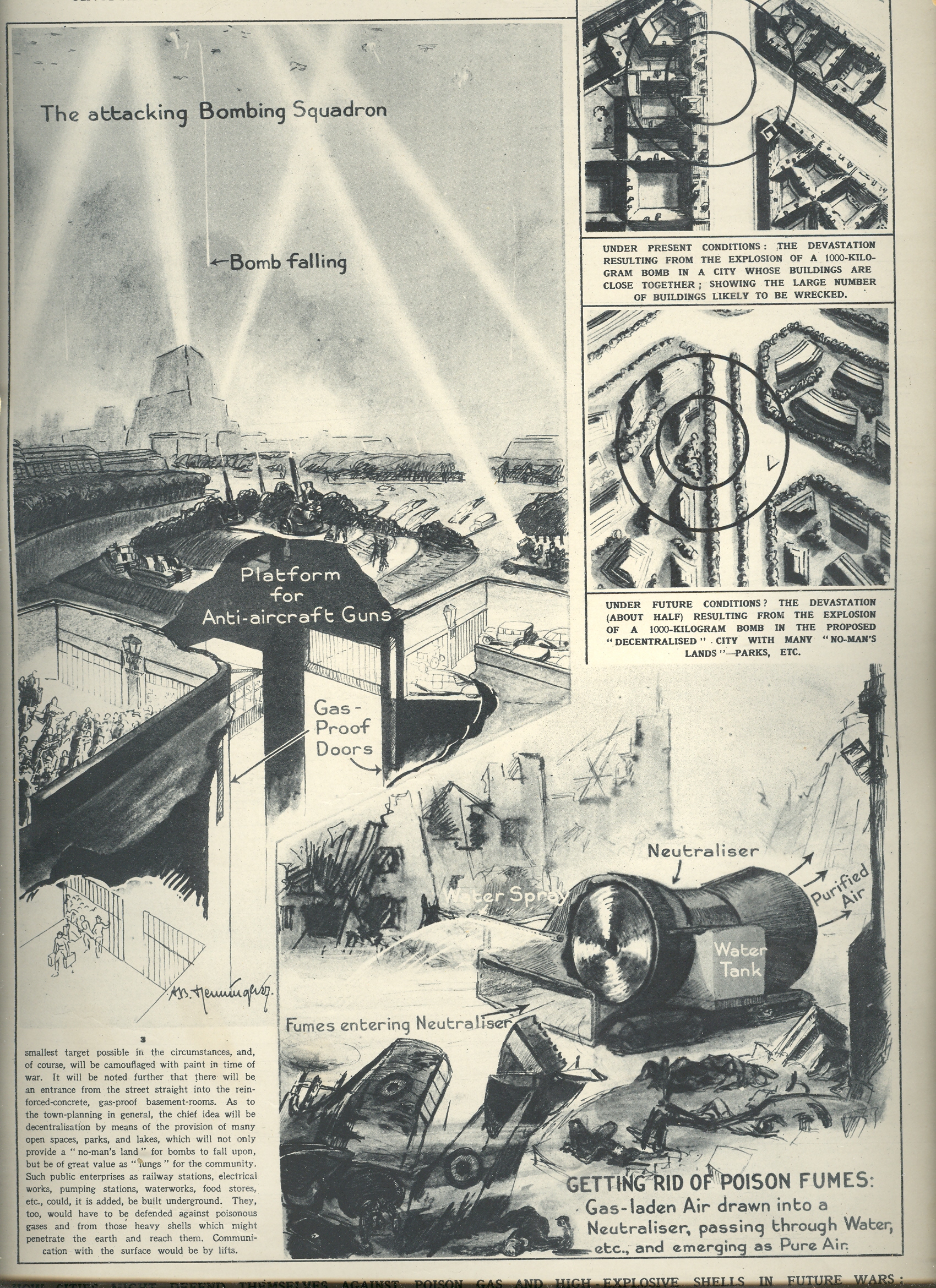
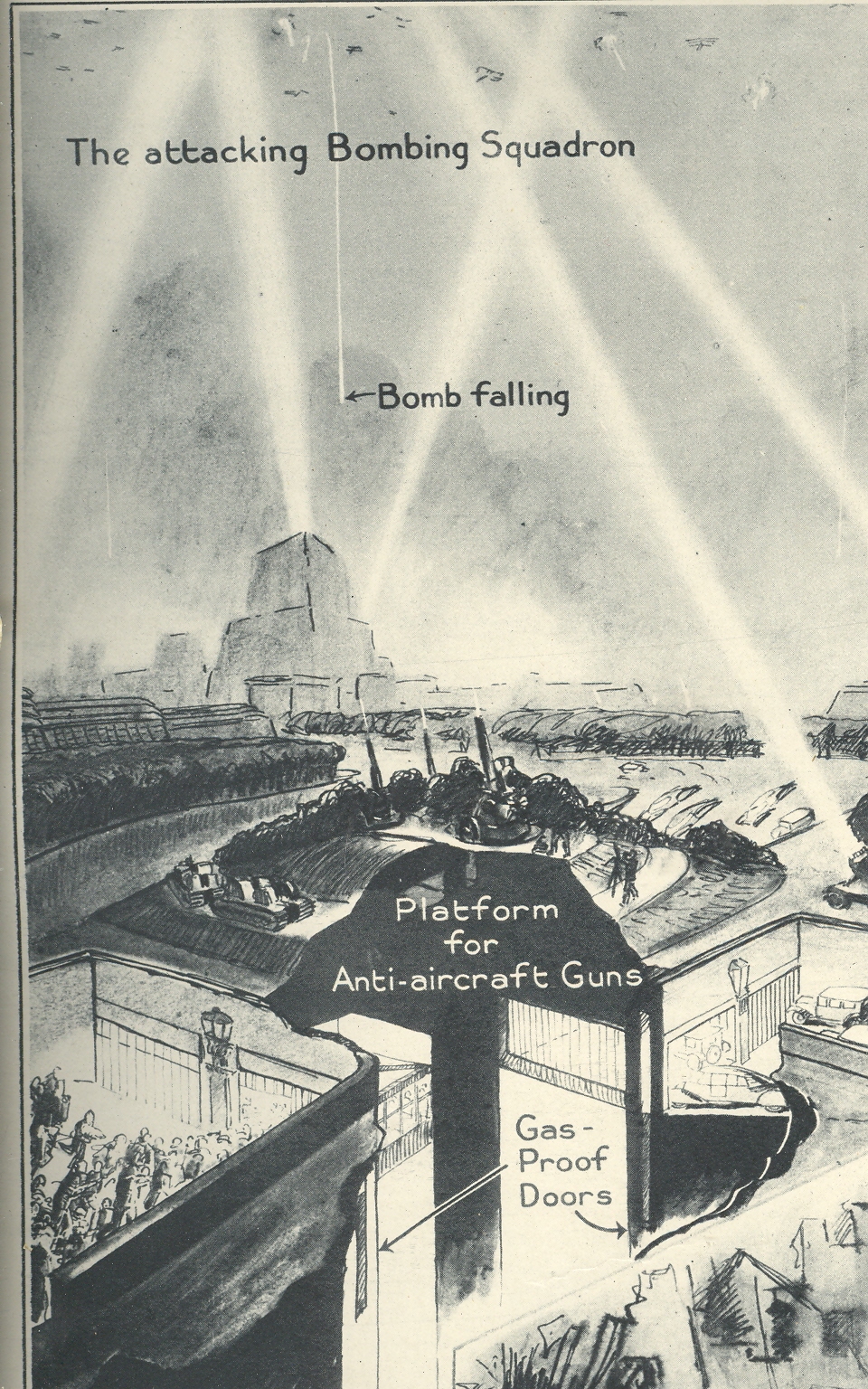
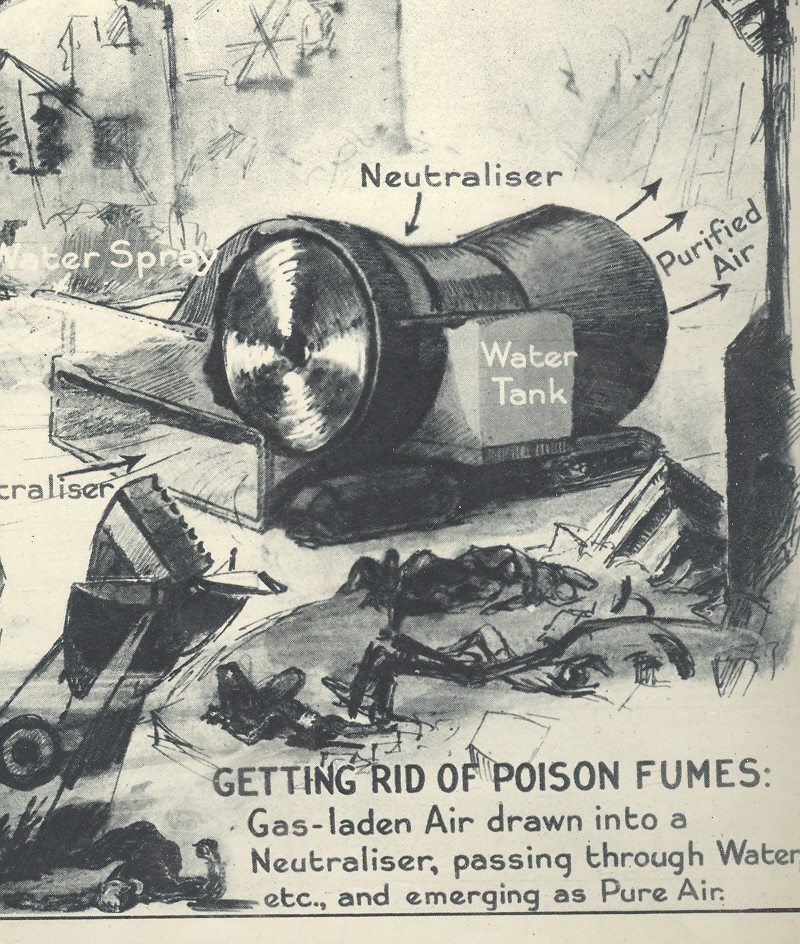
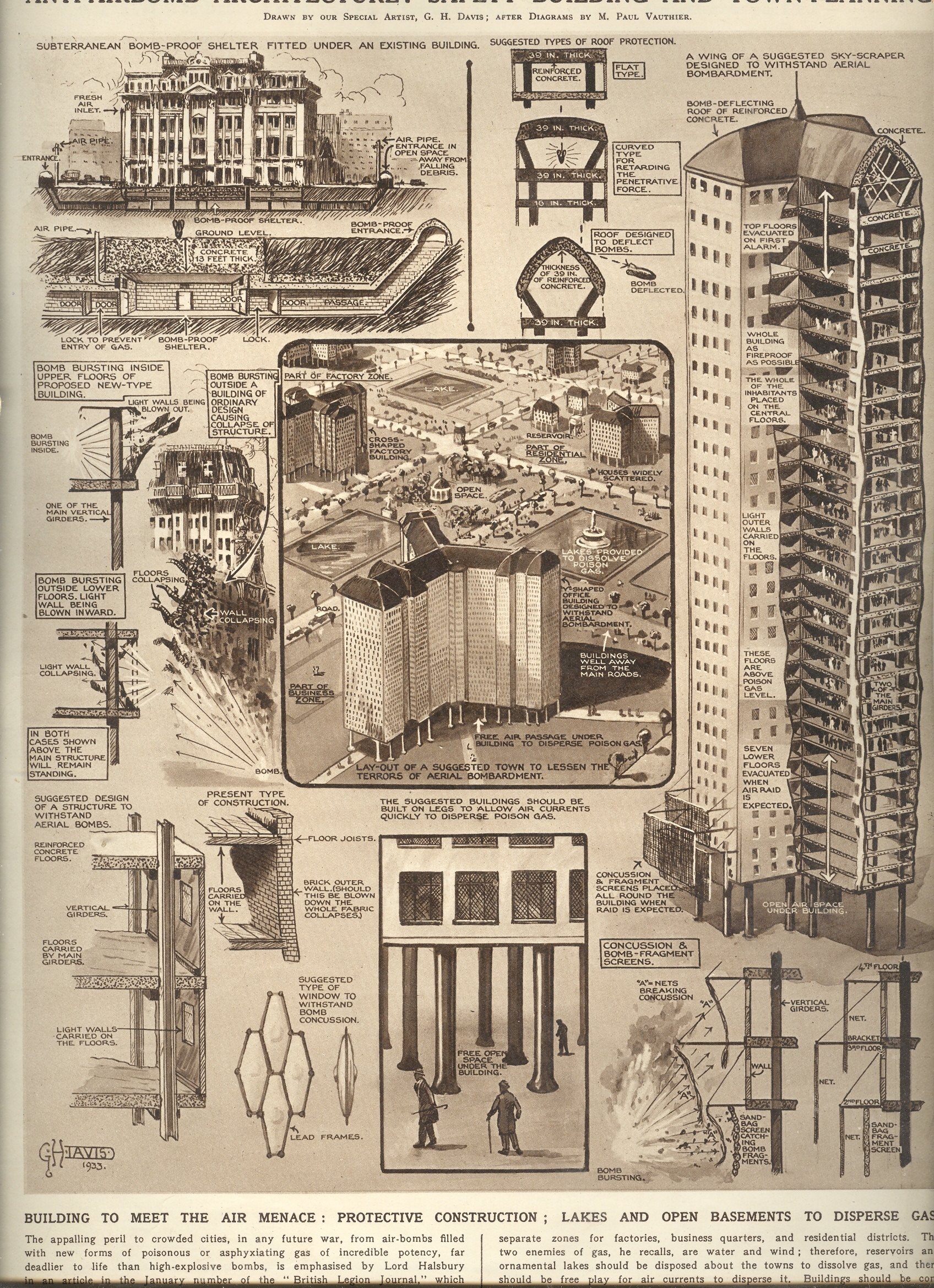
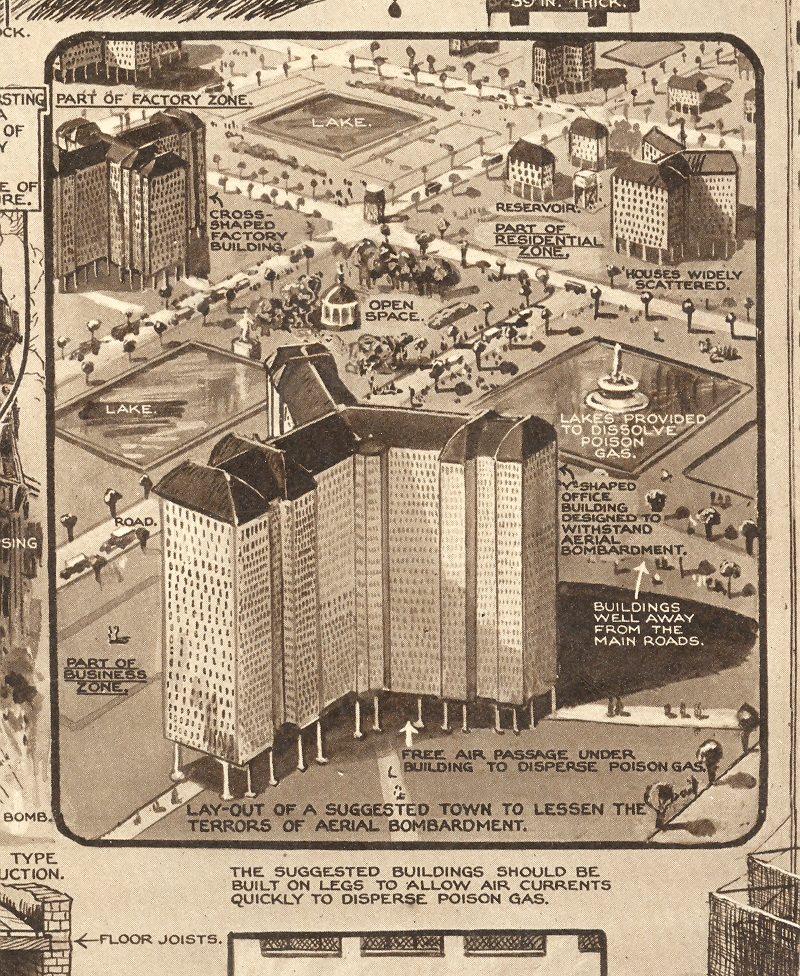
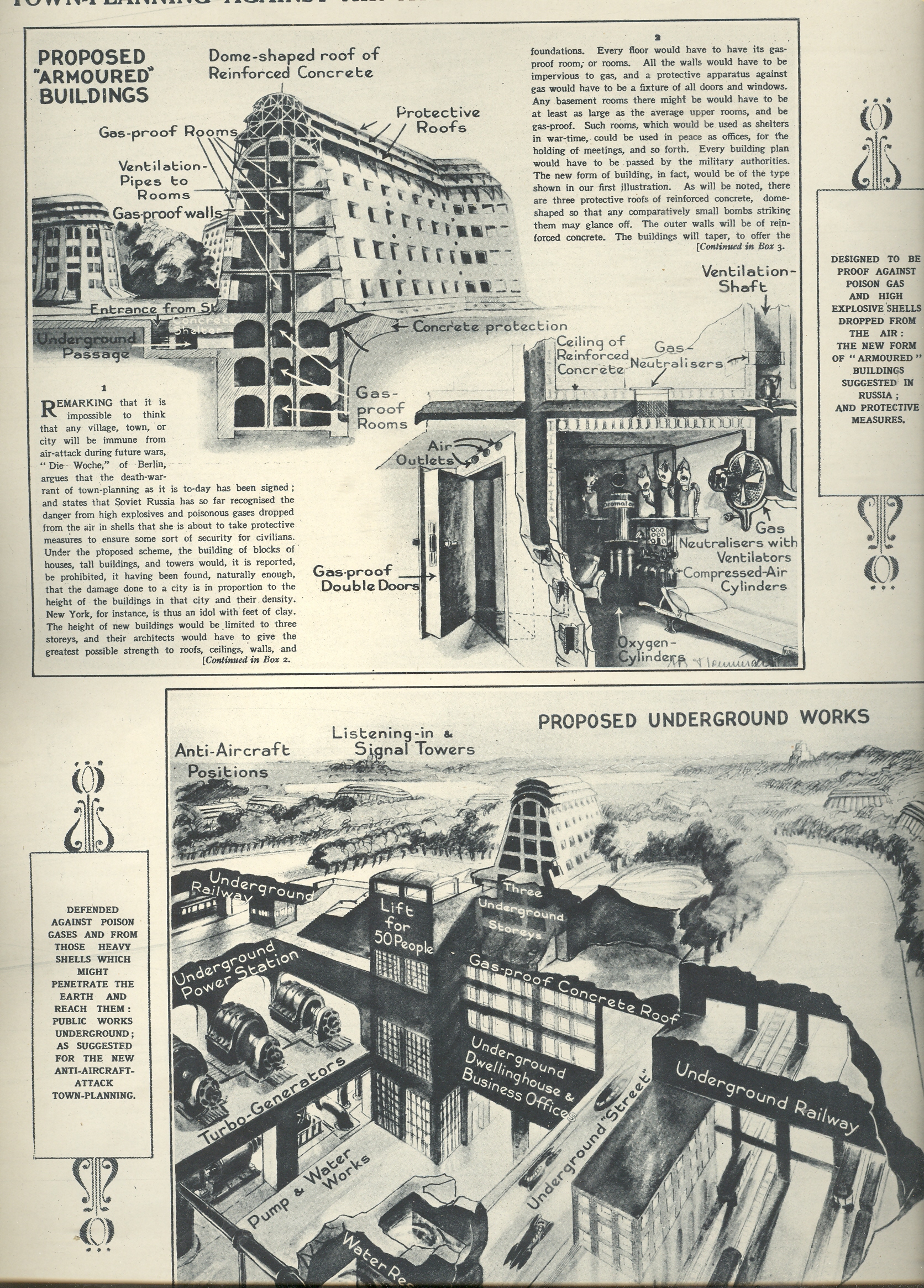
    The Big Fear of bombing from the air and the need to protect
    the populations of cities led to all sorts of anti-bomb/bomb-proof
    architectural plans, most not very good and not very practical.  Such is the price of trying to make your
    people happy.  I happen to have

    a few in
    my files, which are seen above  and below. (The top images were printed in the Illustrated London News in 134; the bottom in 1927.) The results of the plans were no doubt intended to pursue a common belief that cities could be constructed to be bomb-proof, that the future that national leaders were dragging their subjects into wasn’t necessarily as dire as the possibilities of aerial bombings hinted things might be.  Of course the resulting buildings would be massive and impossibly expensive; the prospect for underground cities (and roads!) was just a non-starter.  And these future-views would all be obsolete in less than 15 years what with the development of enormous firepower.  And I’m not talking atomic.  


  • On Not Mentioning the Jews in Nazi/Polish/Holocaust Literature: “Spring Held No Hope”, 1942

    JF Ptak Science Books LLC  Post 902Blog jan 8 spring has no hope

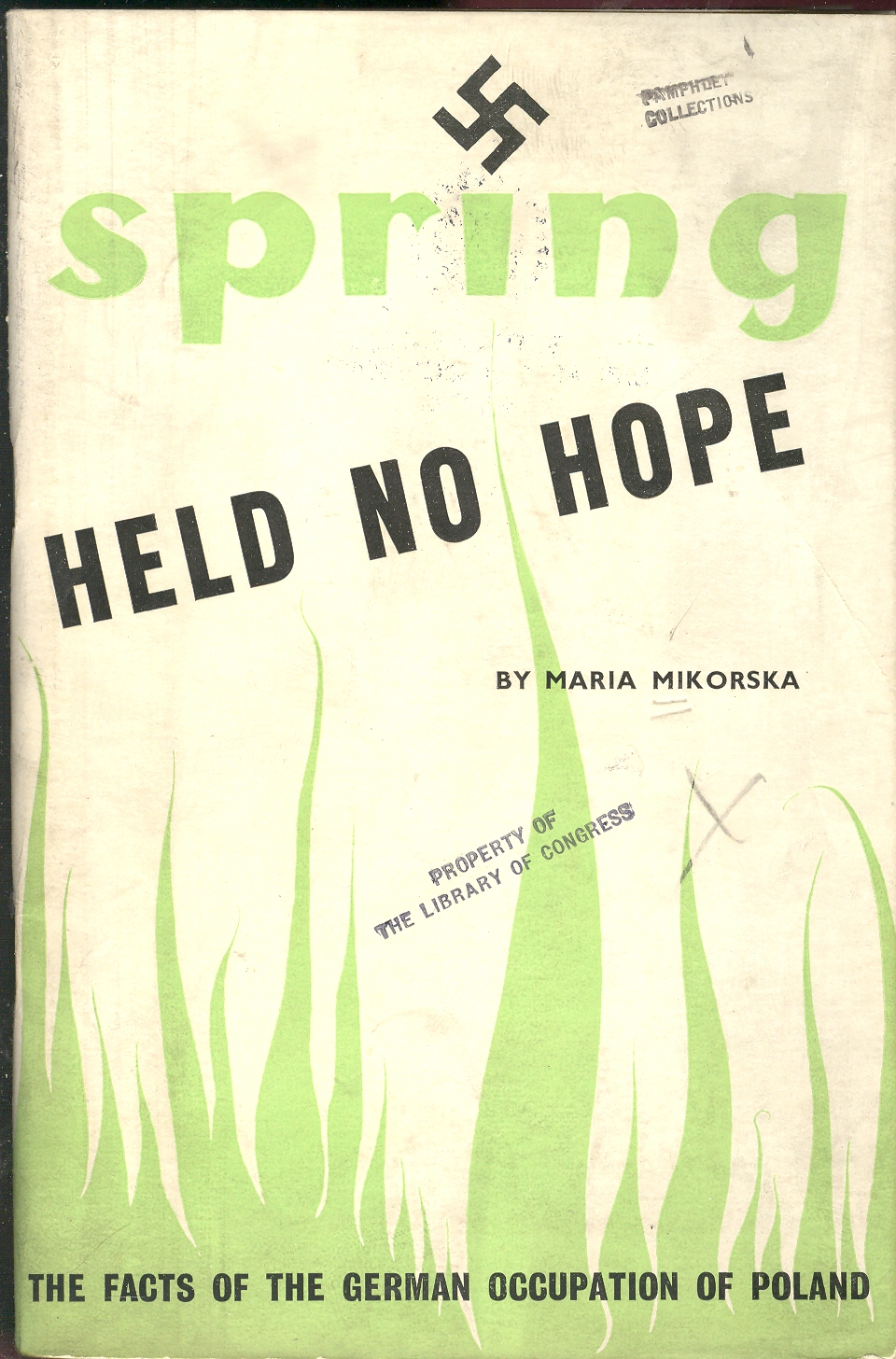
    Maria
    Mikorska’s Spring Held No Hope,
    published in London
    in June 1941 is a difficult, hard, emotional read, even in the genre of
    Holocaust literature.  It quickly paints
    a documentary history of bestial behavior of the Nazis in Poland.  I wonder though what happened to the
    mentioning of the Jewish issue in all of this reportage of inhuman
    transportation and treatment of humans, as the reference almost never
    occurs.  

    Reading
    though this 52-page pamphlet of terror and horror, I wondered what exactly
    happened to the missing reportage of the hunting and killing of the Jews as a
    group.. The period of 1939-1941 saw the beginning of the Endlösung der
    Judenfrage
    1 (“The Final
    Solution of the Jewish Problem”) in which 90+% of the 3.5 million Polish Jews
    alive in the Polish Second Republic were killed and exterminated, the primary
    victims of the Nazi Holocaust.  At this
    point in the war the Nazis were removing Jews from their cities and
    establishing regional ghettoes.  Once the
    Jews were collected in this manner it was easier for the administration of
    their extermination.

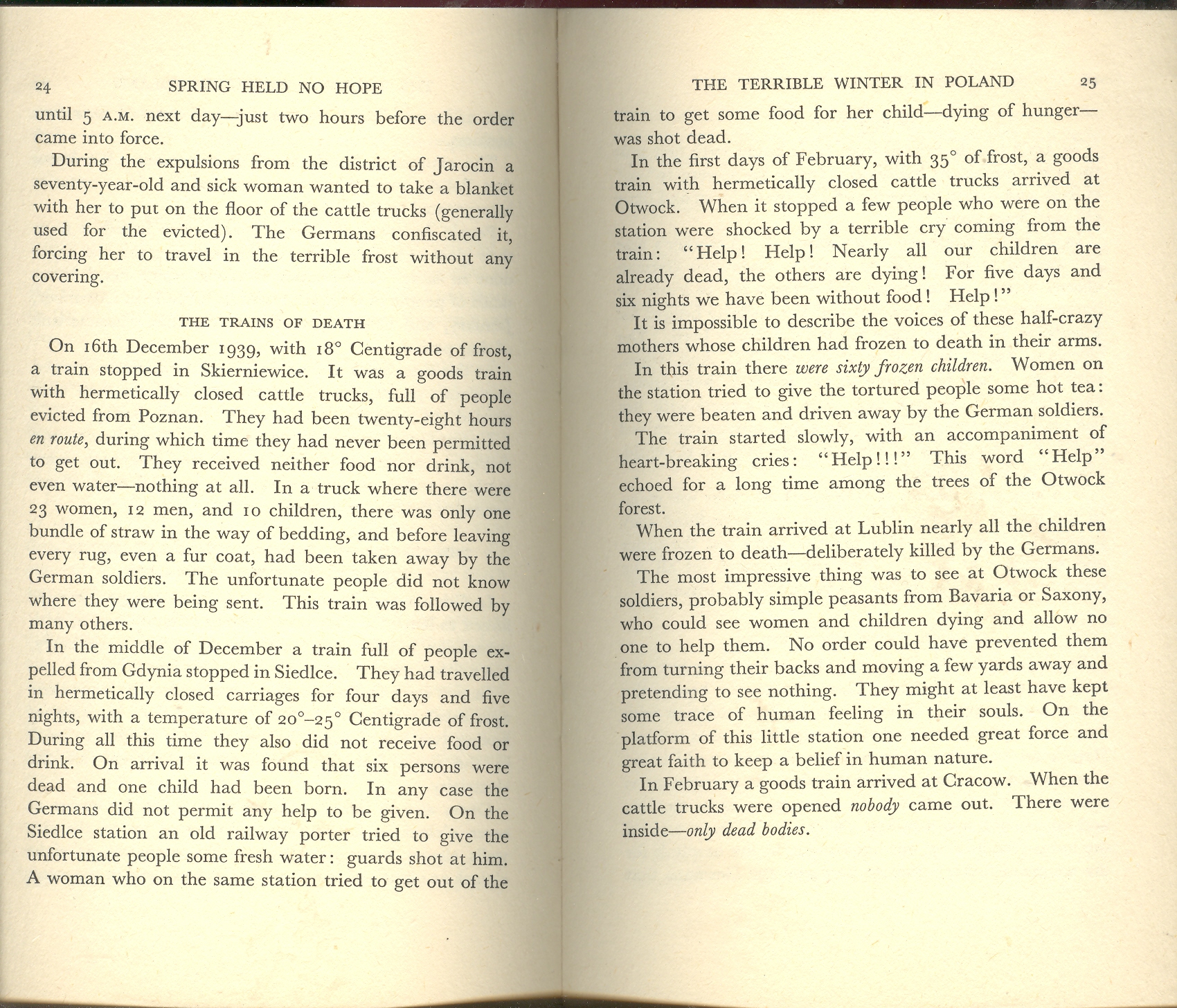
    Getting
    back to Spring Held No Hope and the lack of identification of the Jews as a
    persecuted group I turn to pp 24 and 25 (illustrated below and clickable).  

    Blog jan 8 spring has no hope 2pp

    The examples of inhuman transport and the
    direct extermination of men, women and children by starvation and hypothermia
    mention the cities Jarocin, Gdynia, Siedlice, Skierniewice, Lublin and
    Otwock:  all of which had large centers
    of Jewish populations that were removed by the Germans directly after the
    invasion and removed to ghettoes though this fact is not mentioned in this
    pamphlet. Ostensibly the collection of Jews was not in an effort to seize
    property (as the majority of the Jews in Poland at this time had little
    wealth) but rather to supply labor (being a group with the potential for
    hundreds of thousands, if not millions, of humans capable of performing slave
    labor).  The Jews in Gdynia (for example)
    were sent to Siedlice to establish a larger Ghetto immediately after the
    invasion; by 1942 the tens of thousands of occupants were either shot and
    killed or sent to Treblinka; 2,000 or so remained after this, though most of
    them were also soon sent to Treblinka; those remaining were all executed when
    the ghetto was completely liquidated on 14 April 1943. 

    I
    am in no way saying that it the murder of Poles during the Nazi occupation was
    limited to Jews—the 3.5 million Polish Jews represented 10% of the Polish
    population; of the remaining 90%, or 32 million or so Gentile Poles, some 3
    million were killed by the Nazis, or about 10% of that population.

    These
    are horrible stories told by Mikorska—but I’m bothered by the lack of the
    recognition of the Jews as the major, featured target in all of this and wonder
    if the author suffered an enormous sin of omission. This is far from being  a singular event–even the important and highly significant Eisenhower report on the concentration camps of May 1945 does not signify the Jewish people as anything out of the ordinary–and may well be indicative of the general practice of dealing with the Jewish aspect of the Nazi exterminations.

    Notes

    1.
    The name and practiced of the Final Solution was infamously adopted at the
    Wannsee conference on 20 January 1942, liquidating the ghettoes and sending the
    occupants to the six major concentration camps of Auschwitz, Belzec, Chełmno, Majdanek, Sobibór and Treblinka.

    I’ve written elsewhere in this blog on the Holocaust; for more, search “Holocaust” in the Google blogsearch in the left column.