A Daily History of Holes, Dots, Lines, Science, History, Math, Physics, Art, the Unintentional Absurd, Architecture, Maps, Data Visualization, Blank and Missing Things, and so on. |1.6 million words, 7500 images, 4.9 million hits| Press & appearances in The Times, Le Figaro, Mensa, The Economist, The Guardian, Discovery News, Slate, Le Monde, Sci American Blogs, Le Pont, and many other places… 5000+ total posts since 2008.

Category: Militaria

  • Portraits Within Portraits: Images of Exhaustion, Defeat and Old Youth

    JF Ptak Science Books LLC  Post 806  Blog Bookstore

    + blog 10.24

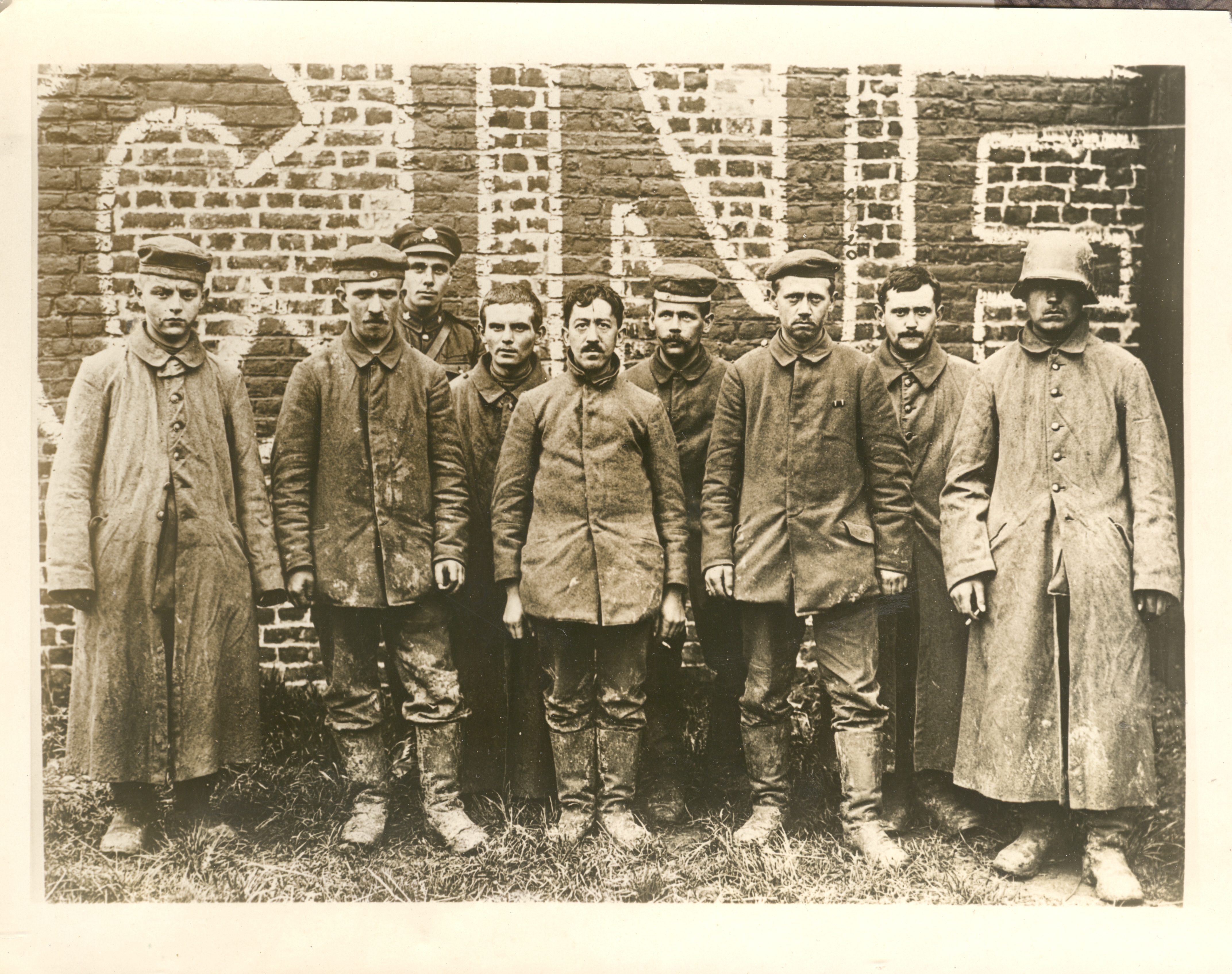
    Earlier today I made a post on some of the images in my collection of WWI News Service Photographs. (These were photos that were sold by an image agency to newspapers and journals which looked for stock photos of, well, whatever, and after paying a use fee would include the photo in the story they were reporting.)  This photo is one of three in a series that show German POWs being marched around a town in France and stopped here and there for a photo.  The picture was taken deep into 1918, within a month or two of the end of the war,.when the Germans were already defeated.  From the look of things, these soldiers were done: tired, mostly beaten, dirty. They at least had most of their buttons on their coats (which is actually a very big deal, keeping your overcoat closed in cold weather to keep warm and alive), their boots looked warn but intact, and they looked not terrible undernourished (though I doubt anyone in the group weighed more than 150 pounds).  

    + blog 10.24 boy left

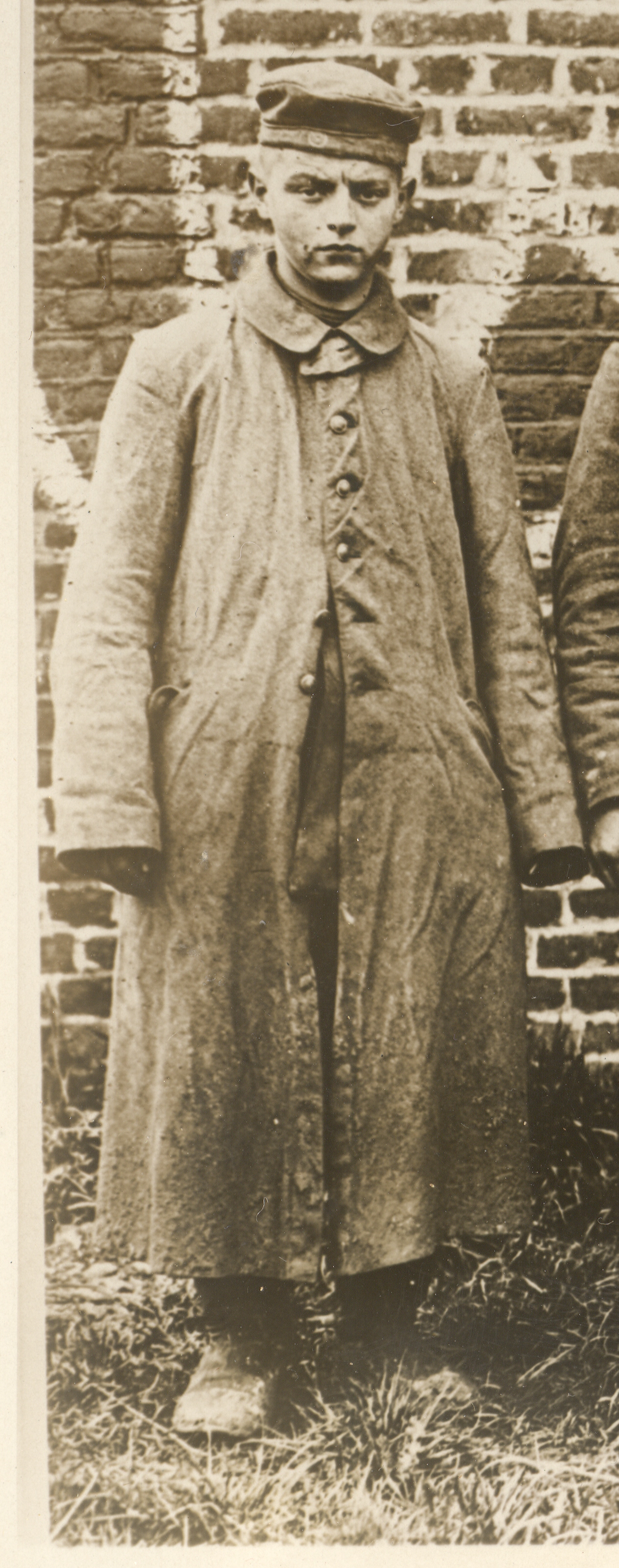
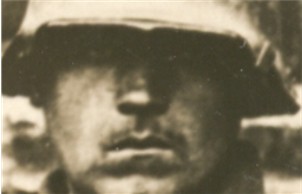
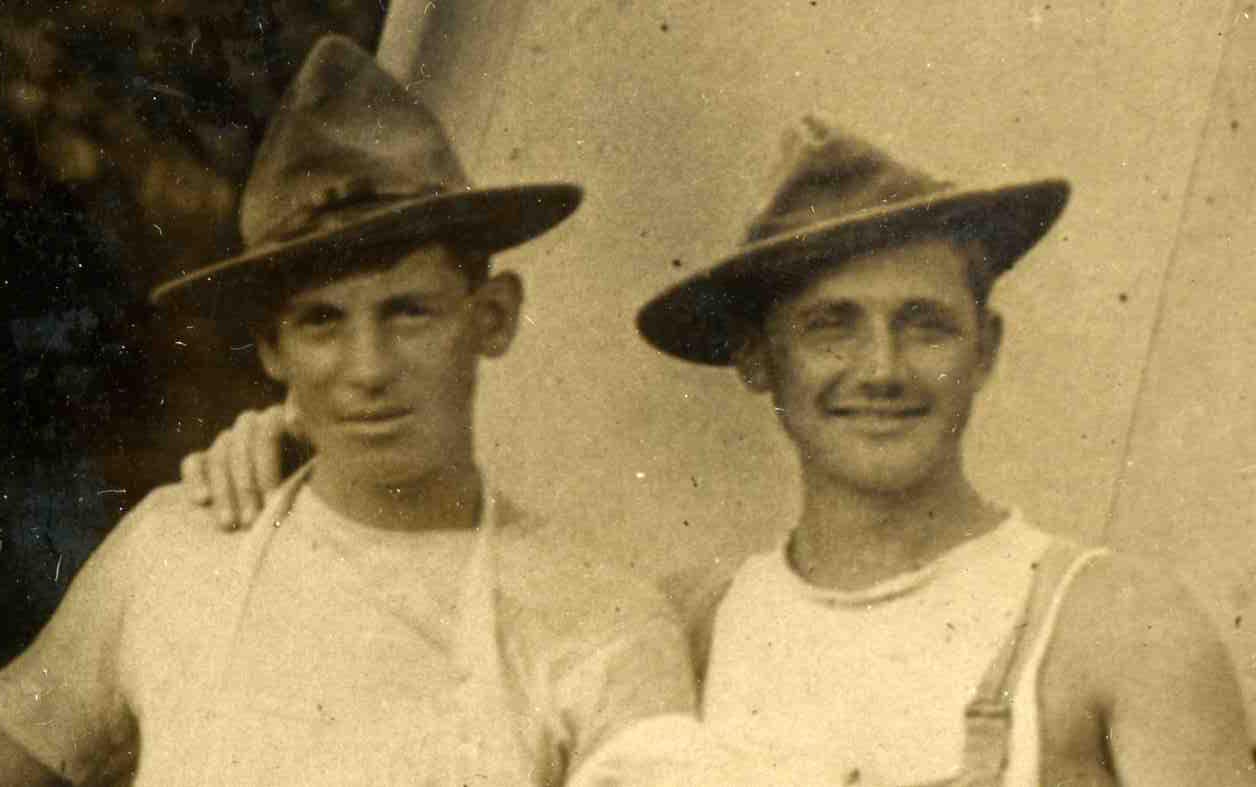
    The group is bookended by two remarkable figures:  the soldier on the left looks not 16 or so, but with a not-new ground in toughness.  He’s all smooth face and baby fat, though he has at least survived the grueling fighting.  The soldier on the right could be the prototype for any number of propaganda posters that popped up in Berlin in the early 1930’s advocating the sold-out but not defeated German soldier of the Great War whose fate must be avenged. 

    + blog 10.24 eyes

     Almost everyone was cupping a ciggy.

    Lastly, the guy third from the left seems to be a Canadian guard, not that this group was going to try to escape.


  • Portraits Within Portraits: Found Images in WWI Photographs

    JF Ptak Science Books LLC  Post 805  Blog Bookstore

    0 blog jan 12baker374

    In
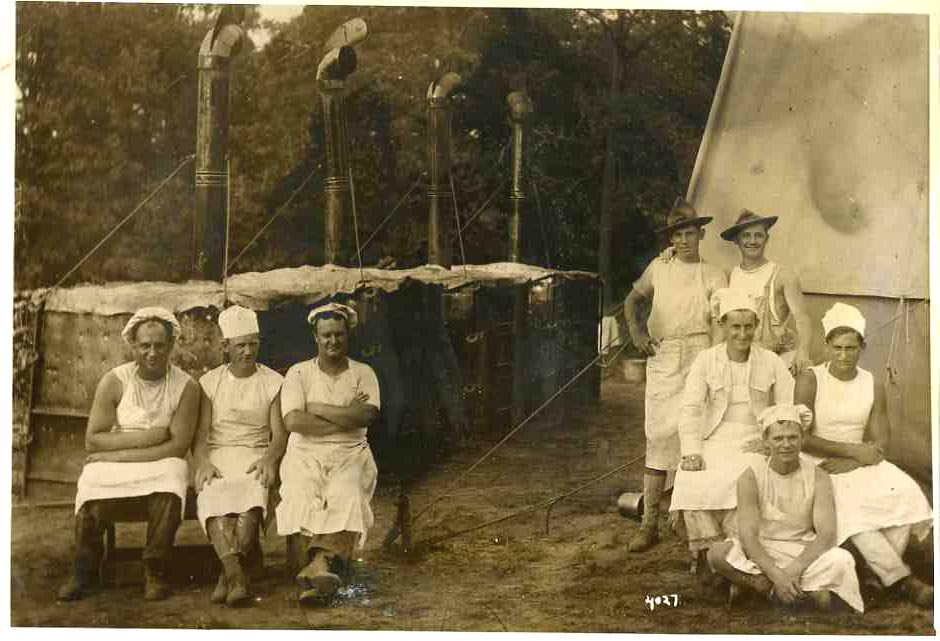
    my collection of WWI News Photo Service Agency photographs I would say
    that half or so of them show  scenes like this–semi-informal group
    portraits of military support groups.  500 portraits like this seem to
    be a lot, and I’m not sure why these images are so well represented.
    Except of course that there weren’t that many images (overall) of
    active-battle scenes. 

    These bakers, working at a front-line
    support station, from my read were probably taking a break, and the
    photographer took the opportunity to draw them together for the
    portrait.  I don’t know why they’re separated so, but they do look as
    though they have a real camaraderie–it is just a wonderful picture,
    full of friendship and loyalty, and I’m sure it has never been
    published before.  

    0 blog jan 12baker375


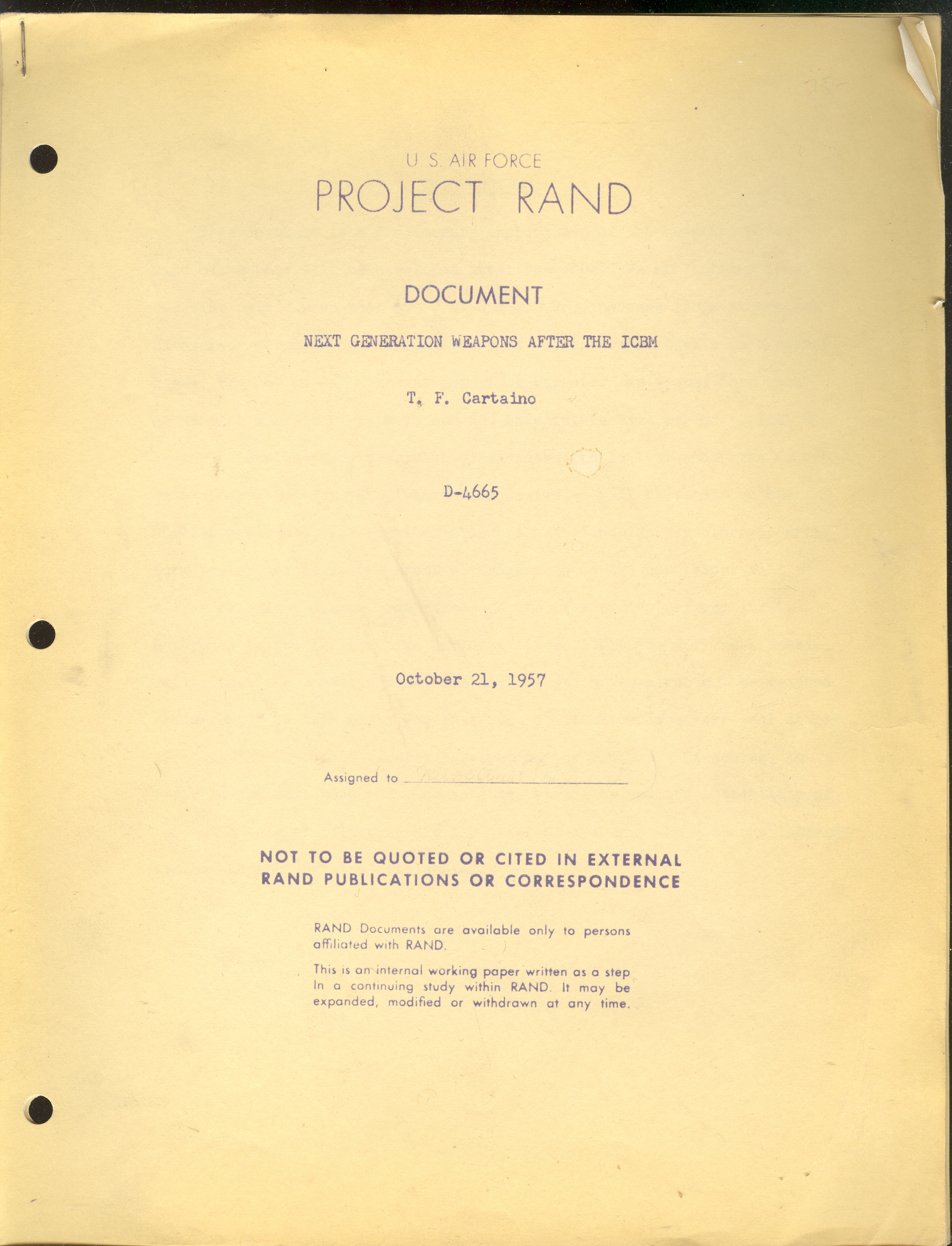
  • RAND Report on Post-ICBM Weaponry: the “Non-Violent” War, 1957

    JF Ptak Science Books LLC  Post 750  Blog Bookstore

    +()+ebay icbm The
    RAND Corporation (Research And Development) is a think tank
    originally formed in 1946 by the US Army Air Force as part of a contract to the
    Douglas Aircraft Company.  After 1948
    RAND Corp was funded by a number of different sources, private and
    governmental, and left the sphere of being a direct arm of the
    U.S. military. (Maybe.)  It still did enormous
    amounts of work on behalf of the military, and seems to have
    been their chief  theoreticians during
    this period.  It was also the time that
    the policy of Mutually Assured Destruction (MAD) was formulated at , partially under the direction of we’ll-see-him-again-down-the-road
    Robert McNamara.  And of course much
    else. 

    This
    publication is an internal RAND document, not
    meant for the eyes of the outside world, at least in 1957.  I own a number of these reports, and I must
    say that this one is odd—it is rather flippant, sometimes oddly and darkly
    (dare I say it?) funny.  It is also short
    (four pages) and gets to the very meaty part of the issue immediately.  The author(s) assume that the US and the USSR
    will have achieved a point of stasis such that it would make absolutely no
    sense for either actor to actually employ their arsenal (and excluding “the
    possibility of the button pusher ‘flipping his lid’ “.  The paper attempts then (“let’s jump right in
    and assume we find ourselves in this stalemated period”) to envision the next
    kind of war in which the ICBM would not be an active factor. “We therefore
    postulate here that the kind of war we will be engaged in…in the period of
    nuclear stalemate of the non-violent war, the opening phase of which has been
    called the cold war.”


    +()+ebay icbm2

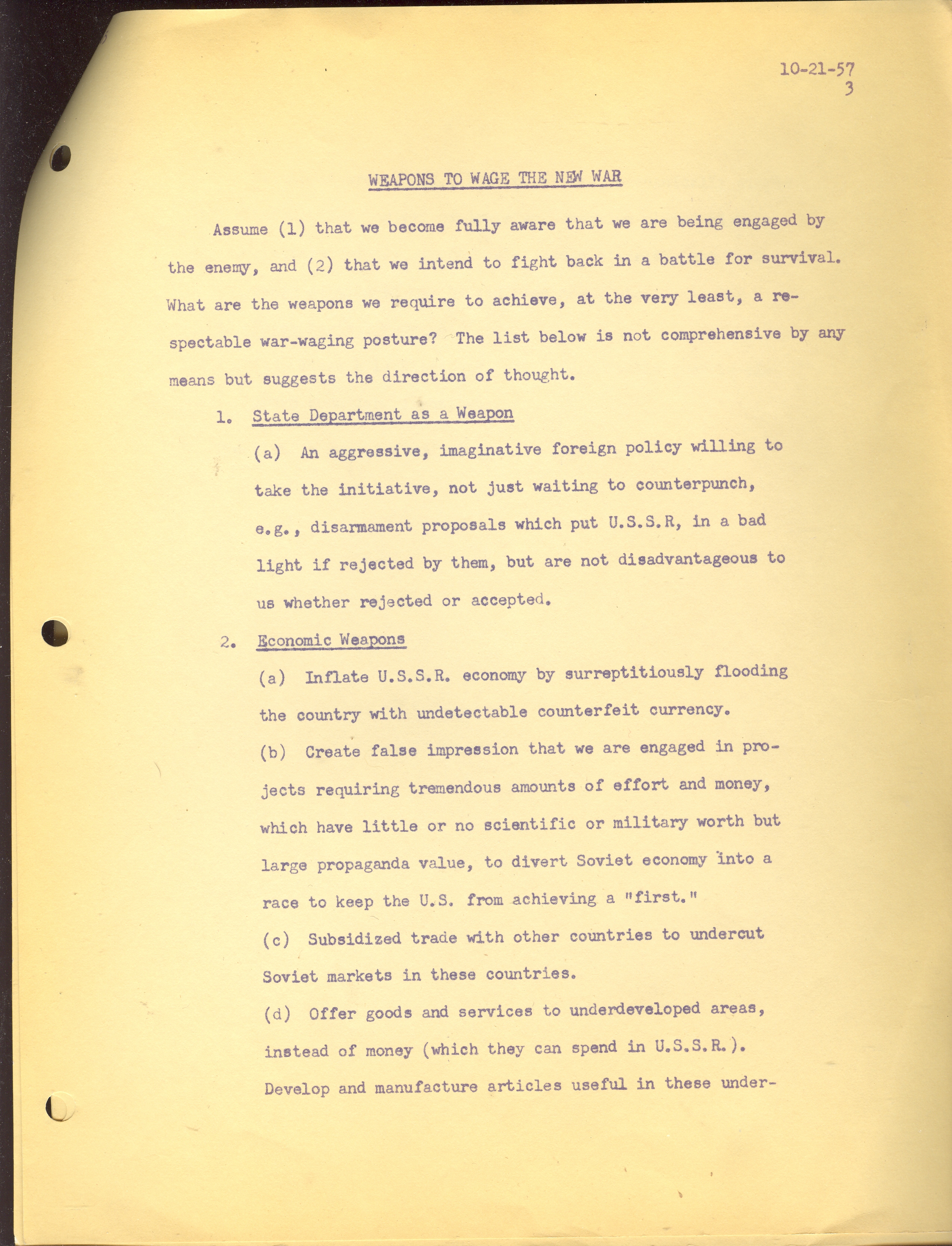
    The tools of war in this non-violent war, the report
    speculates, included: (1) the State Department as a Weapon, issuing “an
    aggressive, imaginative foreign policy”. (2) Economic Weapons, which
    interestingly included “inflate USSR economy by surreptitiously flooding the country with undetectable counterfeit
    currency”.  (I remember that the late
    Sen. John Moynihan suggested in the first Iraq
    war, televise don the floor of the U.S. Senate in the final debate on
    engagement, that we do this exact thing in Iraq…especially
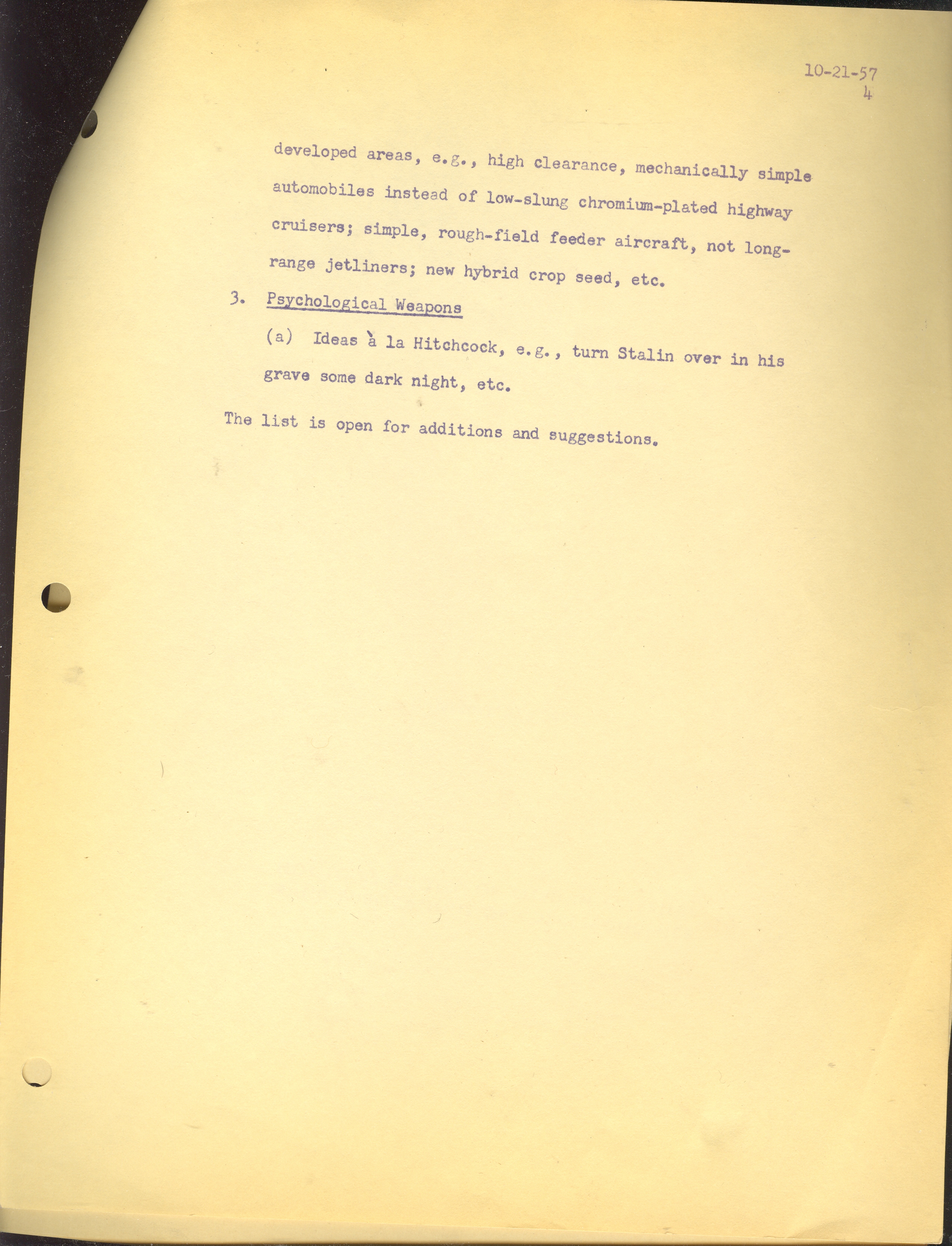
    since the Iraqi dinar was being printed in London.) The third section was “Psychological
    Weapons”, and was very tongue-in-cheek short (?), suggesting “ideas a la
    Hitchcock, e.g., turn Stalin [dead in 1953] over in his grave some dark night,
    etc.” I’m not sure what to make of that, especially as the paper finishes on
    this line: “This list is open for additions and suggestion.”  Indeed.  Out of all of the internal reports that I’ve read from RAND this is the only one that approached its topic with such dark familiarity and removed humor. 

    +()+ebay icbm3


  • A Big Sea of Planes: Quantitative Display of World War II Bombers

    JF Ptak Science Books  Post 748  Blog Bookstore

    (See also the new post on picturing massive numbers here.)

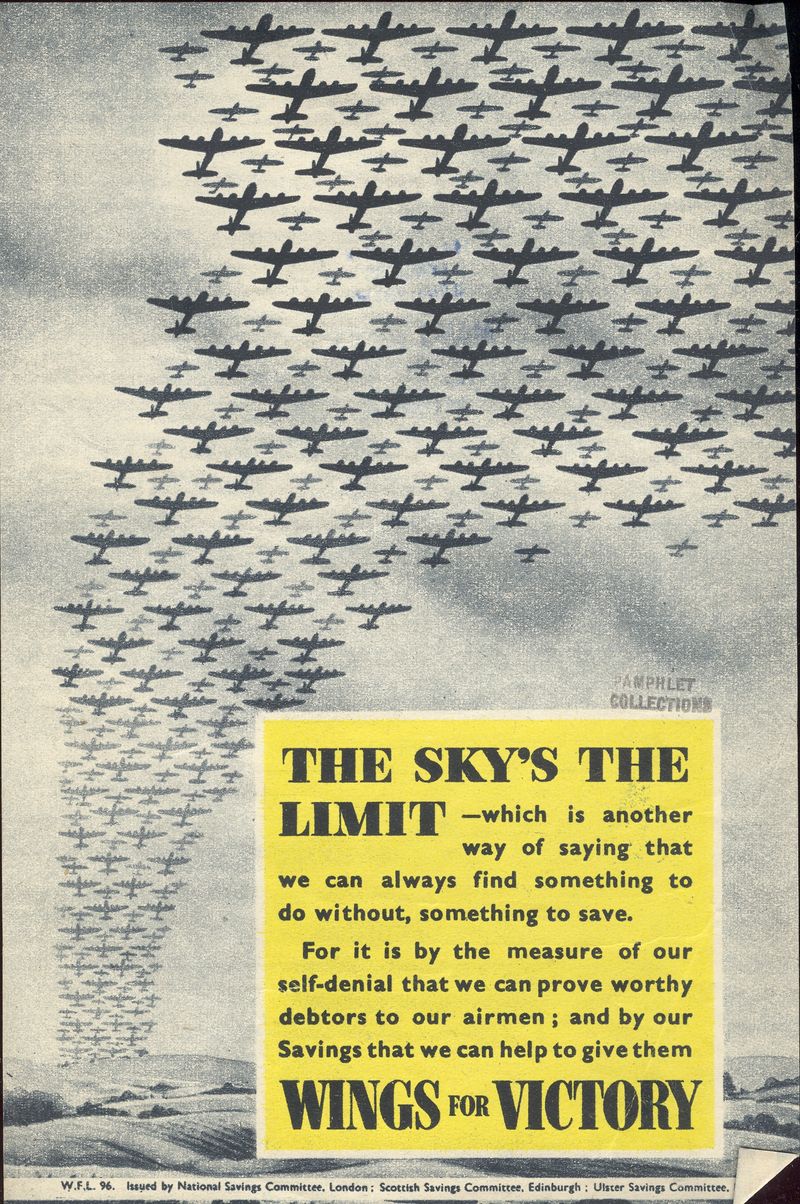
    I’ve written four or five posts on glorious quantitative visual displays of massive amounts of WWII bombers, most of which I’ve gathered together below. This subject came up today when I found another of these images in a small hand-out broadside published by the National Savings Committee of Great Britain, urging people to save money and be thrifty, keeping money in the banks, in an effort to control prices and have money available to the government for war production.  The legend states: “For it is by the measure of our self-denial that we can prove worthy debtors to our airmen; and by our Savings that we can help to give them wings for victory”.  The point is driven home by a now-familiar representation of hundreds of bombers rising from the horizon–a remarkable vision, especially if you tried to visualize the real thing. 

    +_+ planes WWII


    Here are a few other similar images:

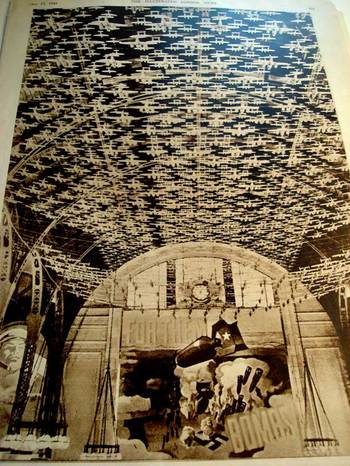
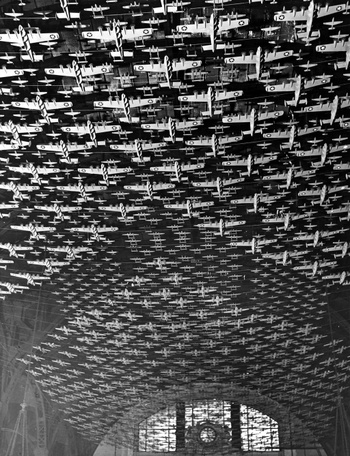
    (A) This widely circulated and published photo appeared in 1942 (particularly in LIFE Magazine in 17 September 1942 and the Illustrated London News in the next month), and showed 4,500 aircraft models suspended from the ceiling of Chicago’s Union Station   It is the result of an inspiration derived from President Franklin Roosevelt’s assertion that America would produce 185,000 war-focused aircraft in 1942 and 1943. 

    Blogwwiiplanes

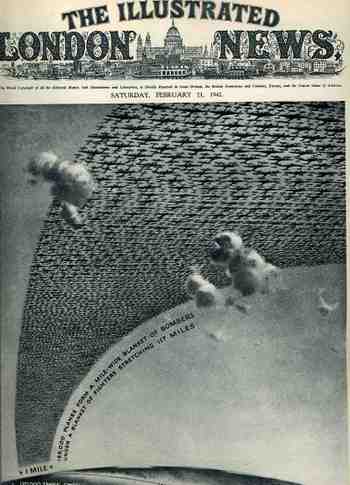
    The planes in this photo were hanging 60-feet above the floor of the station, with wing spans between one foot and four feet (for the bombers).  It was a fantastic, blustery, iconic effort to show what it meant to look at 4500 planes—and these paled in comparison to a drawing (which I unfortunately do not have) that appeared in the Illustrated London News on 21 February 1941, showing the entire production fleet of 185,000 aircraft—a column of planes one mile wide and 117 miles long.

    1ebay_sept_30185000_planes695

    Blogworld_war_ii_airplanes_delano

    Using this photo then to interpolate that full production figure of 185k, you’d have to piece 48 of these photos together to show full production, or a version of this photo that was 8 inches wide and 32 feet long.  (The second image of Union Station and the planes is by FSA photographer Jack Delano.)

    1ebay_sept_30185000_planes_detail69

    (B) This arresting cover image for The Illustrated London News of 21 February 1942 illustrates the (new) American production program for planes and tanks for 1942 and 1943 (It reminds me too of an earlier post I did with a similar cover for LIFE magazine here.) The caption reads: “185,000 planes form a mile-wide blanket of bombers under a blanket of fighters stretching 117 miles” which is actually a double blanket of planes–if they were thinned out to form one layer it would stretch one mile wide from Washington D.C. to New York City, which is quite an unimaginable ribbon.


    The reality of the situation was greater than this:  by 1945 over 300,000 planes were produced, 275,000 of them after Pearl Harbor.  And this from a combined aviation industry which before 1939 had produced fewer than 6,000 planes a year.  The war effort increased this by orders of magnitude, and by war’s end there were 81 production facilities with a combined area of 175 million feet, all bumped up within four years.   I’ve never read about it, but I have no doubt that one of the key ingredients to this sort of hyper-successful undertaking was organization–the oversight and control for this process must’ve been fast and decisive, with little room for mid-level anything.  I think that this is the only way the whole thing could’ve worked so well.

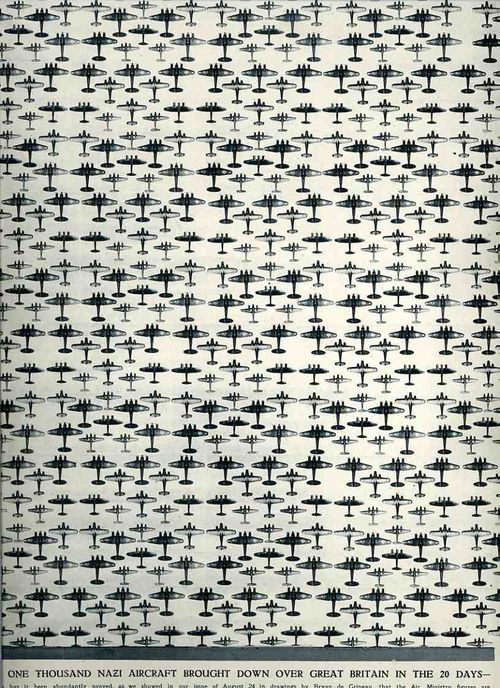
    (C)  This tremendous display is half of a double-page spread that appeared in The Illustrated London News for 7 September 1940.  It was meant to bolster the civilian population of Britain during the time of the German attacks, shoping that “Over one thousand Nazi aircraft (were) brought down over Great Britain in …20 Days…” The artwork, drawn by Bryan de Grineau, actually depicts 1000 planes, and accurately depicted ones at that.   What the graphic doesn’t tally though are the airmen losses, which would be considerably more thanb the 1000 aircraft:  for example, of the aircraft involved in the sustain air-invasion of England, the  Dornier 215’s had a crew of four, Dornier 17’s three, Heinkel 111’s four, Messerschmitt 110’s two, and Junkers 88’s three.  Thus  there were thousands more airmen lost, a commodity that the Nazis could little afford. 

      (This continues a thread on The Battle of Britain and also a post on “What 185,000 Planes Looks Like”).
     The results of the battle (and if you take a look at this earlier post for the full narrative), in terms of aircraft and humans,
    were,  for England: 1,023 fighters: 376 bombers, 148 coastal command aircraft  for a total of 1,547 aircraft and  544 pilots and aircrew killed.  There were also 27,450
    civilians killed and 32,138 wounded.  The Germans lost 873 fighters and 1,014
    bombers for a total of 1,887 aircraft and  2,500 pilots

    I find this visual display of quantitative data beautiful and compelling–and overwhelming in its way.

    The Battle of Britain was fought primarily from 10 July to 31 October 1940, so by the time this image was published the Brits had been able to turn the tide of Hitler’s plan.  (The air strikes wouldn’t really end until the Nazis turned their attention to the Soviet Union in Operation Barbarossa in May 1941.)  And that plan, named Luftschlacht um England, was to overtake and destroy the British capacity in the air, for as long as the English had command of the airspace there would be no way that the Nazis could force an invasion by land/sea (at least in the minds of the Oberkommando der Wehrmacht  and Hitler).  And so the Nazis failed–it was their first major defeat, and, especially, with the turning of attention east, it was a pivotal point of the war. 

    00-blog--Oct 29 battle britain Nazi planes952

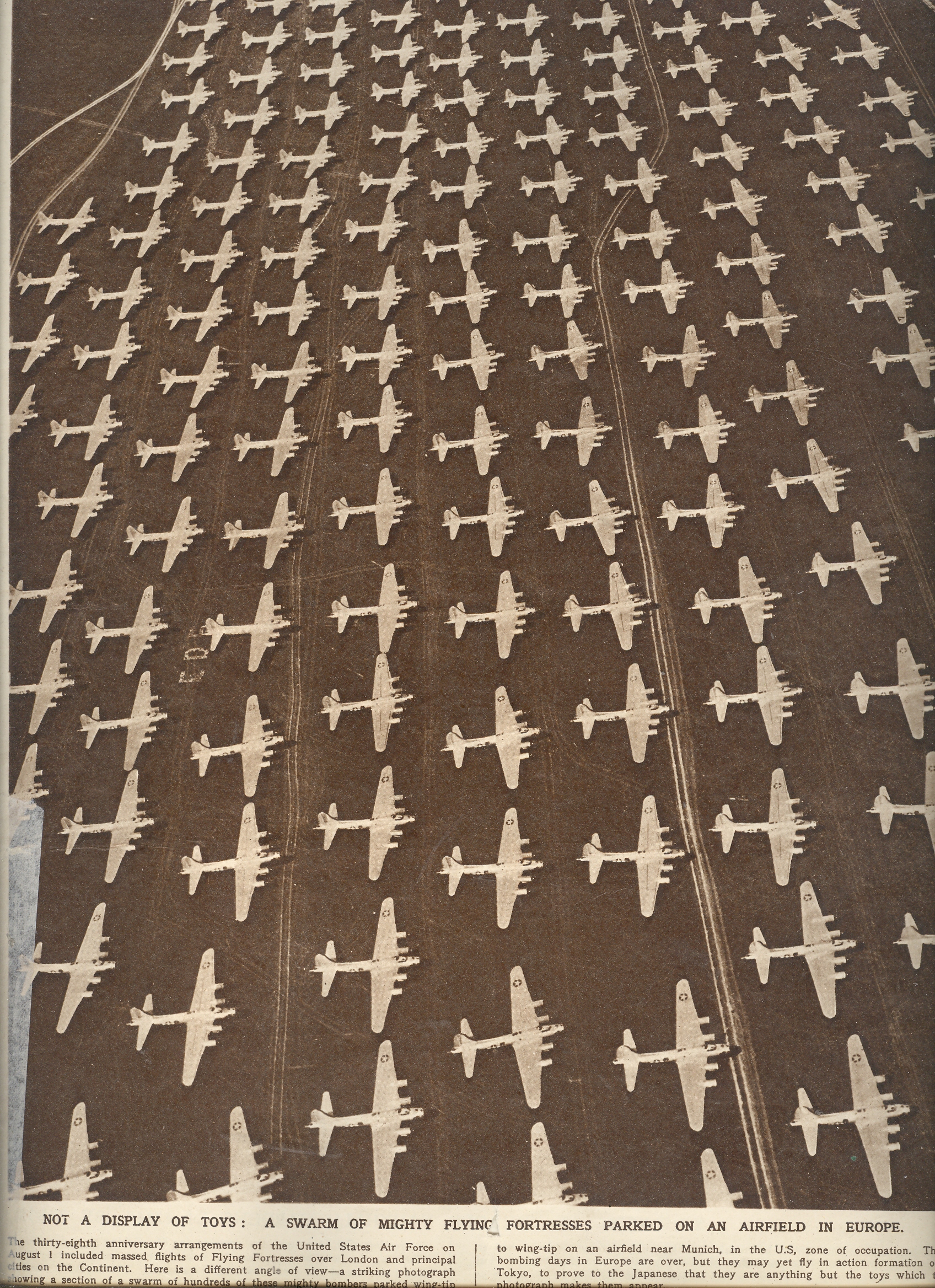
    (D) This last image is a “Not a Display of Toys”, shows only one section of a large airfield “in Europe” (actually in U.S.-administered Munich).  There’s about 300 B-17’s (e?) parked wingtip to wingtip, off duty now from the fight in Europe, but (as the caption says) prepared for a fight in Japan.  I don’t think anyone in high command had any doubt that these planes had seen their last action.  The atom bomb worked, and would work again (and again, and more so if necessary), and the fear that these planes would make their way East was not a real concern. This photo represents about 7% of the highest number of B-17’s in service in Europe at any given time.


    Blog--may 8--vrowds


  • Propaganda in Maps: the Polish “Corridor”, 1939

    JF Ptak Science Books LLC  Post 739  Blog Bookstore
    +++korridor 2
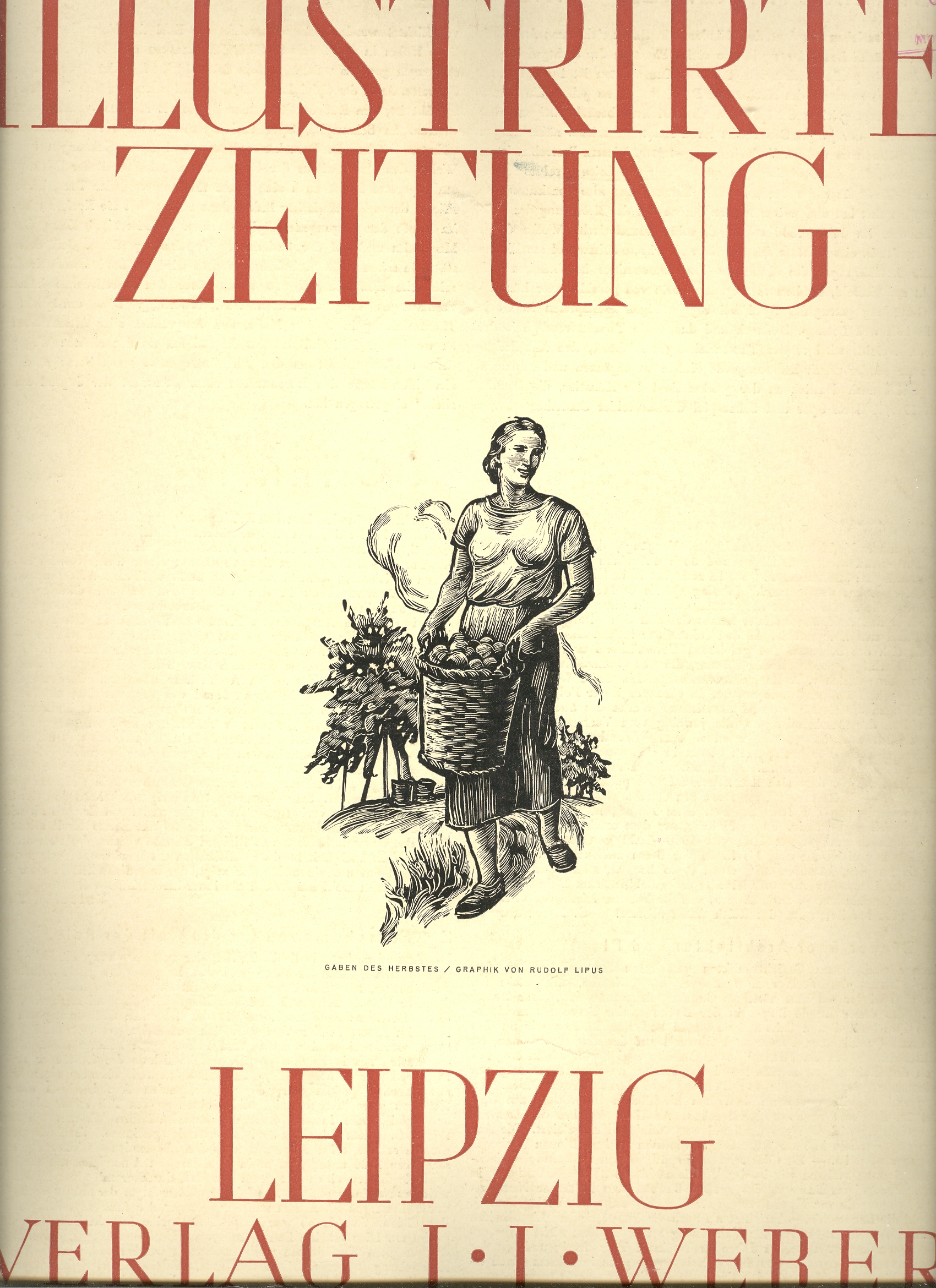
    There’s a war on?  Really?  You wouldn’t know it from the cover page of the most popular magazine in Germany, the (Leipzig) Illustrirte Zeitung, published 7 September 1939. The odd thing is that for months, years, previously there was a huge and occasionally overwhelming militaria scent to this magazine (a sort of LIFE magazine-like affair in its way), paving the way for the reading population (which I’m sure must’ve been in the millions) for the stuff to come.  I’ve looked at every issue of this magazine from 1933 to 1939, and there is simply no mistaking the under- and over-current of the war preparation.  It was just relentless.  And so to finally come to the real fighting part of the beginning of the war it is a little odd to see the cover of the mag decorated with Mother Earth in the herb garden.  The contents of the issue is not what I expected either–not much dedicated to fighting outside of happy and relieved Gdanskers saluting their warm welcome to the advancing Nazi machine, images of the “mongrels” who were living in the places that had once been occupied by Germans, and an “apology” of sorts as to why all of this was necessary.All of which was bluster and diatribe–its hard to imagine, really, how someone living in Leipzig reading this thing over breakfast could’ve nodded their head in logical consent with the magazine’s specious arguments.

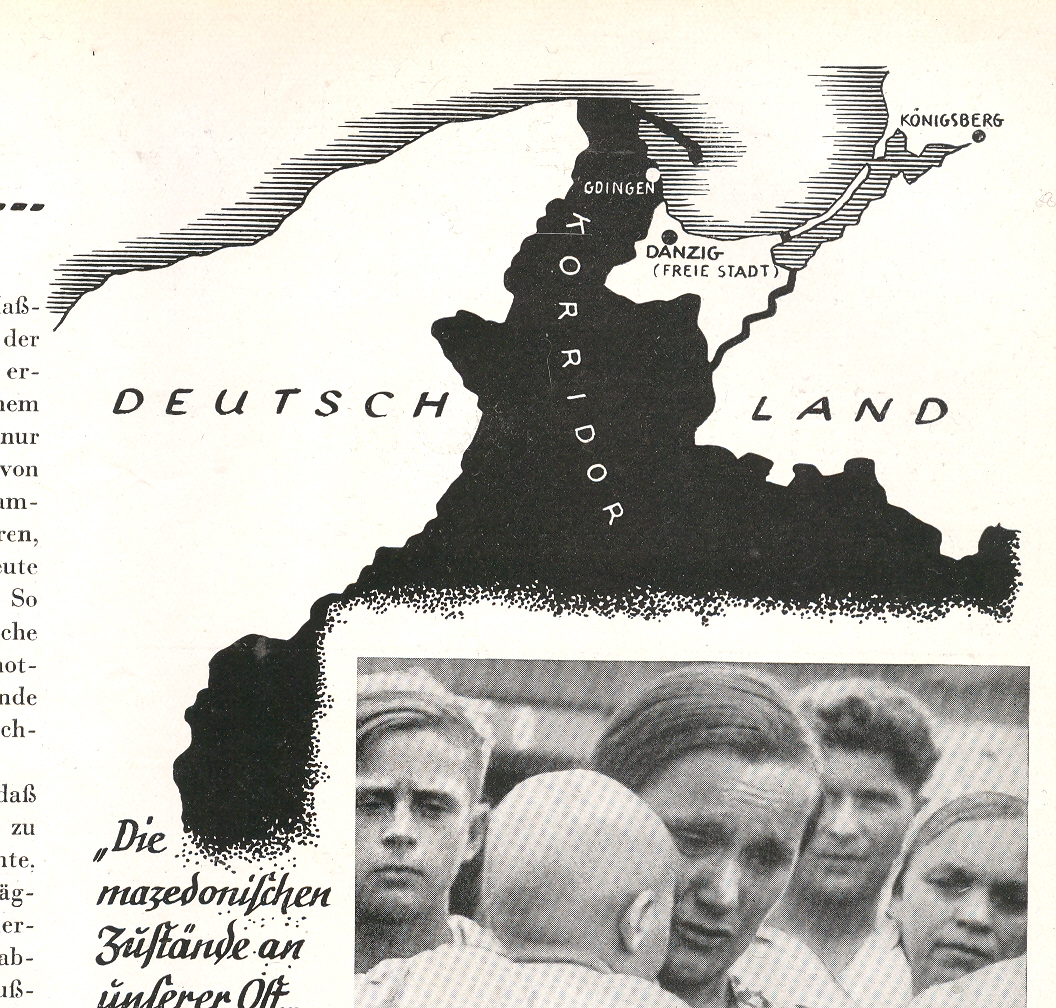
    Which brings us to the small inset map depicting what was one of the major “problems” for  Germany with Poland–the northern stretch of Polish land that touched the Baltic, the so-called Polish “Corridor“.  This polemical affair shows exactly what the Germans thought of the territory, a piece of Germany now in enemy hands, a dagger struck through the heart of Prussia.  

    +++korridor Poland of course didn’t think of the land in terms of a “corridor”, and as a matter of fact the term was an offensive one.  It was simply a part of Poland, one which was returned to the Poles with the rest of the country (which had been disappeared, absorbed, with the Treaty of Vienna in 1815) in 1920.  It was essential with repatriation that this land be included, giving Poland a natural access to the Baltic, and an ability to follows it major river (the Vistula) all the way to the sea.  Without access to the Baltic, Poland’s economy would have been strangled, the country simply wouldn’t have had a good stake to survival.  It was a return of land that had been connected to the Polish Crown from 1466-1772.

    The ethnicity issues are long and deep, and something I can’t get into right here. But Germany certainly made the claim that there were huge German populations in the corridor who needed to be rescued, and who suffered under the control of the inferior Polish people. But as I said, this is a complex issue–the population in the area was probably around 45% in 1920, and this before the huge repatriation efforts to bring those German people home.  There may have been so many Germans in that area because of a massive Germanization of the area in the 19th century…and on and on.

    The Polish government did sign a Non-Aggression Pact with Germany in 1934, after which everything got on the slow boat to hell.  In the months before the Germans attacked, through the summer, there was much frenzied back-and-forth, an awful lot of negotiations that were so much meaningless talk as a mask for the inevitable.  Whatever was agreed upon and signed, Germany was going to attack, anyway, come what may.  And so they did.

    [I should point out in closing that, just a few days ago, the Airminded.org site reminded us all of H.G. Wells’ 1933 The Shape of Things to Come, and his prediction on the start (or re-start) of the next great war, right there at the Polish “corridor”, and right soon.] 


  • Liverpool, the Battle of Britain, and Alois Hitler, 1940-1942

    JF Ptak Science Books LLC  Post 711 Blog Bookstore

    ===blog==aug 10--crowd

    It is ironic that the last day of blitz bombing against Liverpoolin WWII claimed the house at 102 Upper Stanhope Street, the home of
    Alois Hitler (Jr.) (1882-1956), Adolf’s brother.  Alois and family survived because they were at the delivering end of this effort–Berlin–during the war,  Alois serving beer throughout the course of the conflict to happily favored
    stormtroopers.  But at one time before
    WWI the Hitlers lived there at #102 until abandoning England for the Vaterland.  There is a long and unsubstantiated rumor
    that Adolf lived there too in 1912/13 attempting to avoid Austrian conscription,
    but that claim seems entirely unsupported to historians, though it has proved fertile imaging ground for the theater..  Alois Jr. seems to have been a violence-prone
    washout, and unwanted and unacknowledged by his half-brother, winding up with far
    right wing proclivities post-war. When those plans fizzled, he signed photos of
    his brother for tourists for a few dollars each, providing a bit of his own surrealist-concrete theater. He did contribute a son—Heinz Hitler–to the war effort.  Heinz, Hitler’s nephew, was taken prisoner in
    Operation Barbarossa and sent to Moscow’s 17th-century Butyrka prison, a truly evil place, which was
    once home to 20,000 “political” prisoners taken during the Great Purge, among
    much else.  Heinz melted into the stone
    after months of interrogation, which must’ve turned into sport after the first
    few days.===blog==aug 10--cover

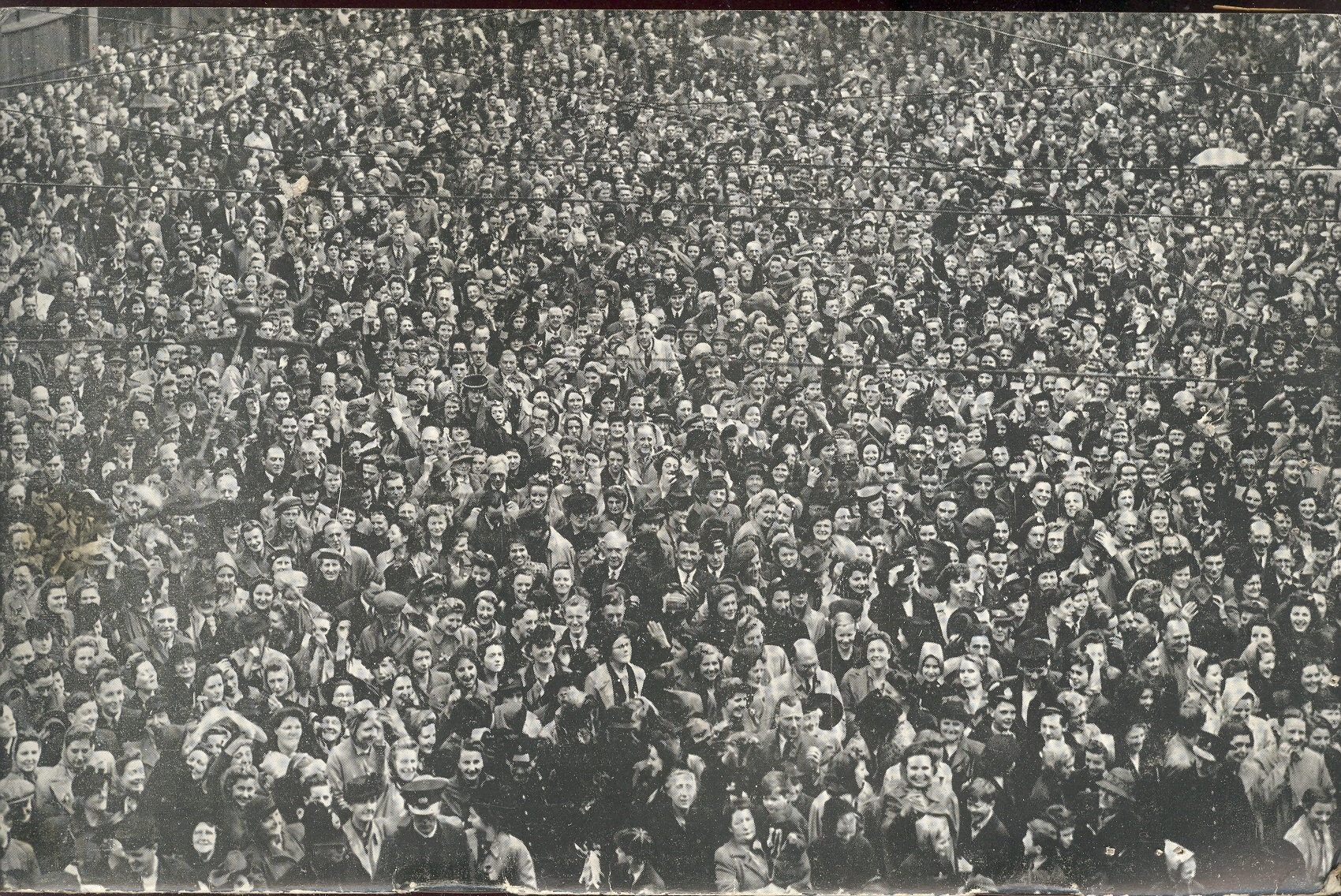
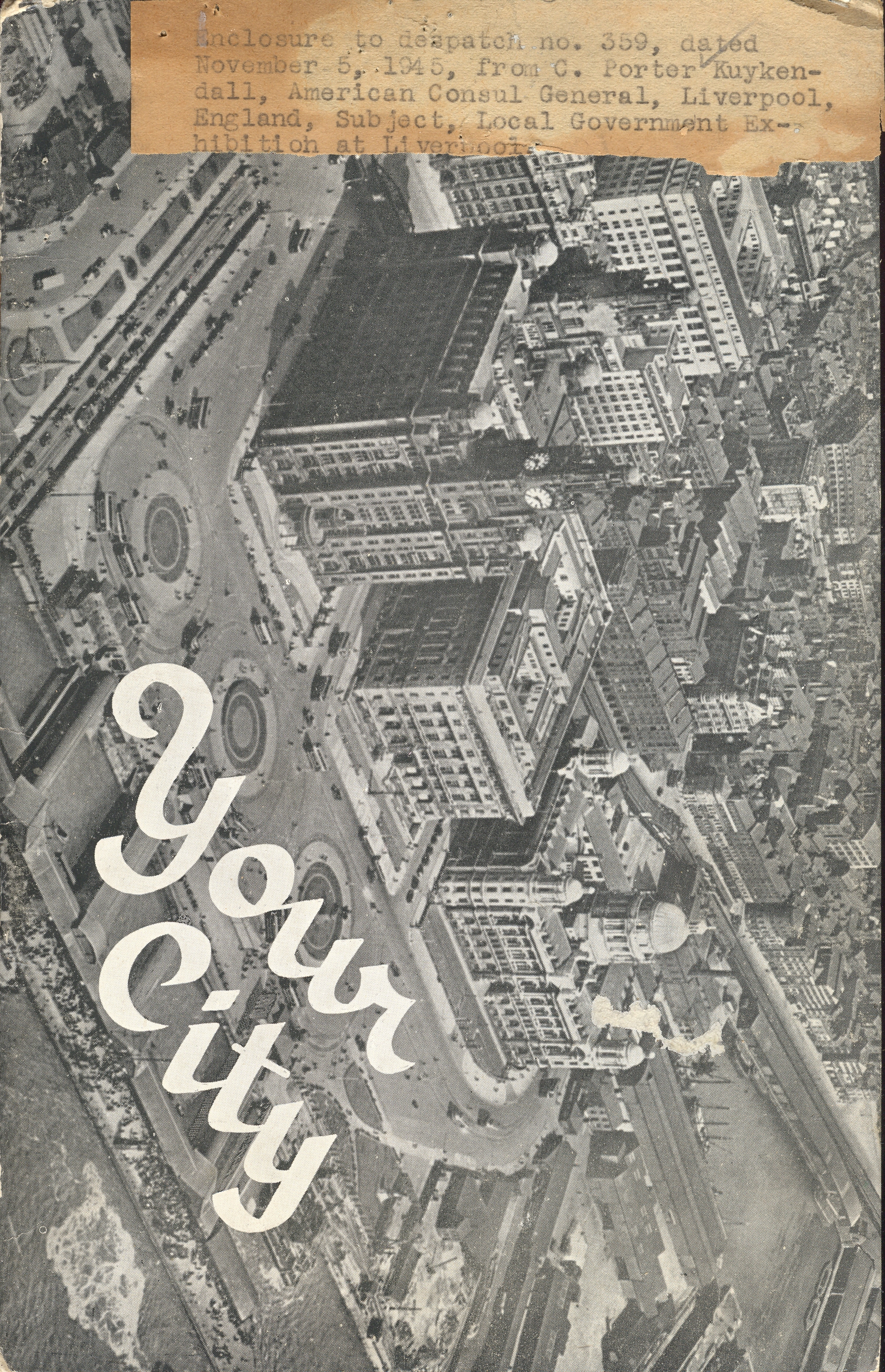
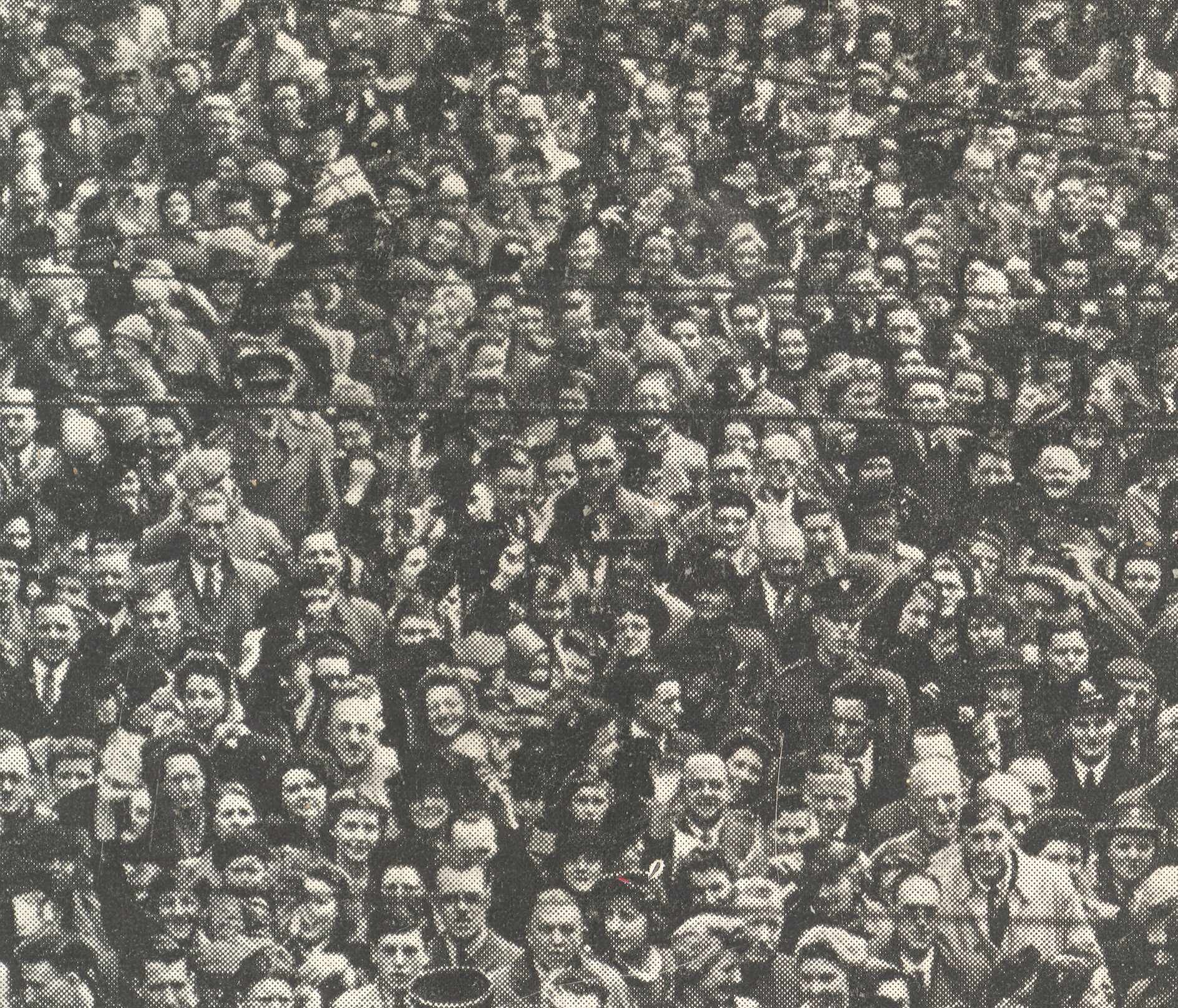
    That’s not what I wanted to write about here, though.  It is the image of the crowd on the back
    cover of this pamphlet, Your City, a citizen’s guide to Liverpool,
    published in October 1945.  It seems to
    me that the crowd scene here numbers about 4000 people, which is representative
    of the number of Liverpudians killed between 1940-1942 in the German air
    attacks on the city.  Liverpool was the
    second-most lethal city to be in during the war for air attack (following London’s losses of better
    than 30,000), due to its importance in the production of war-necessary goods.

    ===blog==aug 10--crowd det

    In a true stiff upper lip, deeply old-school, and very highly admirable fashion, there is no mention of the
    war, no mention of damage from air raids, no mention of anything untoward.  No photos of anything bombed out.  Nothing. 
    This was also pretty much in line with the official reporting on the
    bombing, which for obvious reasons was greatly downplayed in the press.  (There is no need to provide free reporting
    on the effectiveness of your enemy’s bombing campaign to the enemy.) This was a simple vision of the future, and a call for all citizens to register a concern with the proper functioning of their city.

    The large crowd scene struck me as a very quiet memorial to
    those killed in these terror attacks.


  • Anti-Nazi Propaganda and the Triumph of Nazism in the U.S., 1943

    JF Ptak Science Books LLC  Post 706 

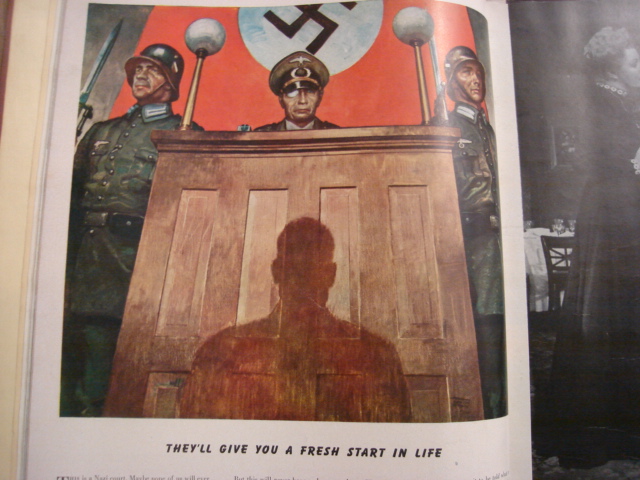
    This striking image appeared in LIFE  magazine for 4 January 1943 as an appeal from American Locomotive for the American people to be aware of what might be expected of them in the very near future if the war did not go as planned.  It is doubtful that this ever could have happened, even if the tide of combat had not turned against the Germans by this point–the enormous sucking sound began in the war in the East as 90,000+ German soldiers surrendered at Stalingrad at about this

    Crowds 004 time in January, the fate of the Nazi regime had been decided at Potsdam, the war in the Pacific (Guadalcanal, Midway) was going the way of the Allies, and the invasion of North Africa was well underway, the noose beg

    inning to tighten on Axis Europe.  This is a little fast-and-loose on the history of the war, but I think it generally accurate to say that no Nazi flags would be displayed in American courtrooms.  The other, last nail in this coffin was the beginn

    ing of the Manhattan Project in June 1942, an undertaking which would lead to ultimate domination.  I think it safe to say too that there was no way that any other country (or alliance) could have produced the necessary (and terrific) amounts of energy, plus large manpower, plus expertise, plus the ability to maintain the massive project (all in s

    ecret)–it was all simply too much. Had the Nazis been more successful in Europe and less adventurous in the East, and was somehow able to conquer it all (and this removing the U.S. from the equation), well perhaps then it could have been possible for Germany to develop the bomb.  on the third hand, given the rest of the development in the American war as dynamic, the U.S. would’ve bombed Germany (and etc.) with atomic weapons before they could have developed anything on their own.  all of this is trivial rumblings to be sure–I just wanted to survey the possibility of the Nazi overthrow of America.  The U.S. would’ve been too terribly much for anyone, especially given the experiment in the desert. 

    ·Posted by :

    ·in:

    —

  • Fundamentals of Irony in Bombing: Tybee Island, 1862 and the French in Damascus, 1925

    JF Ptak Science Books LLC  Post 704  Blog Bookstore

    [on vacation, Tybee Island, Georgia]

     I have a hard time remembering the correct version of this twisty tale—are we in a post-irony age or the post-ironic irony age?  Is a double-irony an irony at all?  Actually I think that instead of our society having moved into a post-irony stage, it seems that the apparent lack of irony seems only so because all we have is irony, which of course is ironic.  Which may be an illustrative answer to my second question;  a double-irony is indeed a bigger irony, not a smaller (or null) one.  

    This came to mind vacationing with my family; actually, it came while building a sand castle at the lip of the advancing tide, building it up as the water tore it down.  That’s the fun of it, even with my six-year old: watching things get made and watching them get unmade, as the getting-unmade part will tell you a whole heck of a lot about the successes and failures of what went into the thing’s making.

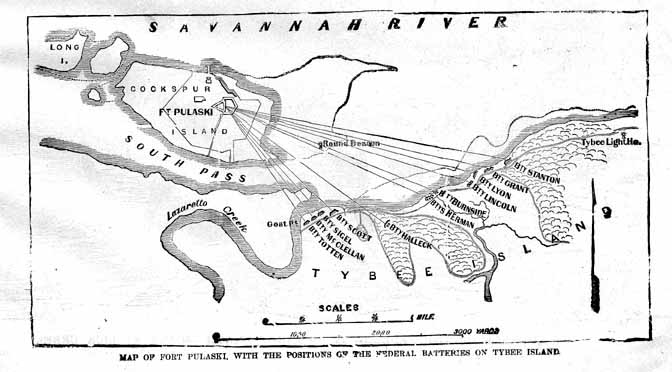
    Watching the walls of the fort tumble reminded me of the real-life version of this event, something that happened about two miles away and 147 years ago.   For Pulaski  was built on the Savannah River to protect the approaches to Savannah and Charleston from the angry reaches of the Spanish and British; in 1862, it was in the hands of the Confederates, and was being used to protect Savannah from the very government that built it.    

    ==blog==august 2==tybee

    Even while under the direct commander of General R.E. Lee, thing did not go well for Fort Pulaski and the garrison within.  At the end of 1861, the CSA was getting ready for an extended siege of the fort as the Union forces found victories north and south of it.  They withdrew their forces from Tybee and threw them into the fort, leaving the Union army a free and insatiable hand to get their hand ready on the other side of the Savannah pass.  That said, that’s what pretty much happened:  Union forces dragged their cannons through the surf and across the sand, getting them in place around newly-built batteries.  This all happened at night so that the Confederates in the fort couldn’t see what was going on, what with all of the evening’s doings camouflaged once the sun came up.  (This was still possible at t he time, to keep a secret like this in almost plain view, only a mile away from where the opposing cannons were aimed. The guys in the fort were pretty much cut off from everyone and everything, with only the occasional courier being able to make it through.  The garrison was, after all, equipped with enough provisions to last through a siege of 8 months or so.)   What happened, finally, was that with the Union cannon in place, the assault began.  And instead of a siege lasting for two seasons, it ran about two days.  The difference was in the new cannons that were being used the boys in blue—the rifled cannon was brought to play against the massive walls of the fort, and the masonry didn’t stand a chance against the new technology, which as it turns out was first displayed to the world in this battle.  And so the ironies:  a fort that was built to protect the United States from foreign invaders was used to protect the Confederate States from the United States; and the fort fell not to a sea-based barrage but a land-based one.  And after all of this, even though the Pulaski fell in April 1862, Savannah wasn’t captured by the union until December 1864.  

    An encyclopedia could no doubt be written on nothing but the ironies of bombing.  And for another example of this I turn to the French, who can supply more than their share, per capita, pound-for-pound, and percentage of GDP, whatever.  No, not the French return to Indochina in 1945 (after having done business with the occupying Japanese forces for the entire war) and their resurgent colonialism as practiced against the Vietnamese, or the heinous practices against the Algerians just prior to that country’s independence:  it is their bombing practices in Damascus. Not the Syrian bombings of 1945 (which also included many other places like Aleppo, Hama and etc.) but the French civilian bombings of Damascus in 1925.  For it was in that year that the League of Nations found that the French really weren’t bombing and killing civilians indiscriminately when they were doing so; they were, ironically, bombing themselves, and so their actions were not illegal.  (It was problematic, identifying “civilians”, as the League didn’t necessarily grant the same sort of “humanness” to all human, finding categories for barbarians and savages.  It was acceptable to bomb those later two categories, but not the first.) So the French sought to subdue a rebellion against their oppressive rule in that country, identifying the Muslim population centers in Damascus as probable hotbeds of activities for the “bandits” that were causing them their problems.  October 18, 1925 is when this particular outrage occurred; the Syrians protested, and the League considered.  And that was about the size of the story for the Syrians, because as it turns out, the French were just maintaining an order that for them was a simple police action; civilians populations could not be bombed in the eyes of international law, if the bombing was being done to a foreign people; since the French were there and occupying the country, they were conducting a police action, and in a sense were merely bombing themselves, loosening them from the barriers of whatever international law could be applied to their actions by the League of Nations. 

    So there is hardly any shortage of bombing ironies, as we can see here with the null-irony of the French bombing themselves while killing Muslim civilians.  When you start looking for irony, sometimes that’s all you can see. 

    ·Posted by :

    ·in:

    —

  • Trinity + 64 Years: the Explosion of the World’s First Atomic Bomb, Alamogordo, New Mexico, 1945

    JF Ptak Science Books LLC  Post 686  Blog Bookstore

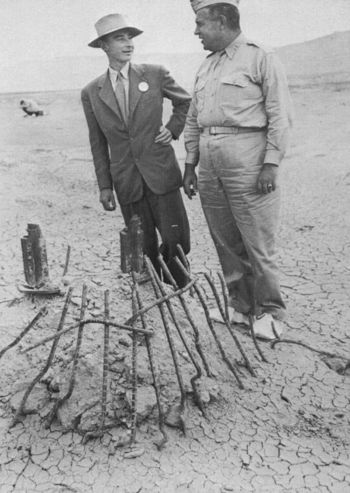
    Today is the 64th anniversary of the explosion of the first atomic bomb in the pre-dawn New Mexico desert. I’ve made a number of posts about that event, as well as the decision to use the bomb along with its consequences and subsequent control.  Mostly the posts can be found here.  I’ve reposted parts of the beginnings of two of those posts relating to 16 July below.  [That’s Oppenheimer and Groves standing at the remnants of the base of the tower that held the suspended weapon on 16 July, everything pretty much gone.]

    Oppenheimer_groves_090945 Trinity at 63: the Explosion of the First Atomic Bomb, 16 July 1945

    Now we are all sons of bitches—Kenneth Bainbridge, Trinity
    Director.

    There were many profound thoughts in many profound heads there in the
    desert, at the reaches of the Jornarda del Muerto (“The Dead
    Man’s Walk”, a formerly nearly-impenetrable stretch of desert in  the
    Llano Estacado) at the Trinity Test Site, Alamogordo, New Mexico, on
    16 July 1945 for the successful testing of the first atomic bomb.  Robert
    Oppenheimer famously cited the Gita (“Now I am Become Death, the Destroyer of
    Worlds…”): Enrico Fermi was so busy with his little and excruciatingly
    wonderful experiment with strips of paper calculating the effect of the blast
    (he reckoned a very-close 10,000 tons) that he didn’t actually hear the
    explosion; Edward Teller thought Tellerian thoughts, and so on.  Actually
    the observation points (like S-10000 and Campania Hill)were crowded with big
    brains:  in addition to Oppenheimer, Teller and Fermi were people like
    Hans Bethe, James Chadwick (whose discovery of the neutron sort of started the
    whole thing), Richard Feynman, George Kistiakowsky, Phil Morrison, Robert
    Serber, Vannevar Bush, James Conant, and many others.  The were all
    thinking pretty big things (except for the occasional if-you-can-believe-it
    stuff like that which maybe came from Feynman’s mouth, which was “hot
    dog!”).  I think that Bainbridge’s statement was the best, and truest,
    summation of the morning’s activities…

    [Continue reading via link above]


    The Decision to Use the Bomb:  Trinity +1

    July 17, 1945 (Trinity +1 or Hiroshima -20), the day after the Trinity test
    of the first atomic weapon, was the first day in which very concerted, very
    real discussions ensued about what to do with the bomb and where to us
    it.  Actually the discussions were mostly on the “where” than on the
    “whether”.  (As it turns out part of a minor segment of the “whether” part
    was Leo Szilard’s petition
    to President Truman not to use the bomb and which was signed by 155
    Manhattan Project scientists, and which had reached its final version on this
    day.)

    The truth of the matter was that it was a very complex issue, an easily
    misunderstood tapestry of circumstance and consequence. The major issue of
    course was that the Japanese would not surrender, and that there would be
    “fanatical resistance” once the invasion of the Japanese islands had
    begun.    The battle of Okinawa had just been fought—it was a
    horrible confrontation taking 12,5000 American lives and more than 1000,000
    Japanese , demonstrating that even in impossible circumstances that the
    Japanese simply would not surrender (unconditionally).   This is just
    one instance—there are many others, not the least of which was t he recent
    firebombing of Tokyo,
    taking 150,000 lives.  Air strikes in general seemed to not make a
    difference in the will of Japan to fight—as was demonstrated again and again in
    the British and American bombing of Germany—as was further demonstrated in
    General Curtis LeMay’s and General Hap Arnold’s  60-city attack in the
    May-August span.  The thought was that if there was an invasion that it
    could well cost the U.S.
    1000,000+ casualties and would be completely…

    [Continue reading via link above]


  • Nazi Designers of Current Corporate Logos: Franziskaner Beer’s Nazi Connection

    JF Ptak Science Books  LLC  Post 670  Blog Bookstore

    [An associated post on the long lives of liberated Nazi concentration camp doctors can be seen HERE.]

    Do you have movable Nazi-designed art in the streets of your
    town?  I do!  And probably so do you.

    It was a cloudless, perfect day in my mountain city when I
    first noticed the 10-foot tall Nazi-designed art tooling down the street on three sides
    of the beer truck.  I‘d seen the design
    many times, but it wasn’t until I was stuck in traffic behind the truck that I
    noticed the artist’s stylized signature beside the logo.  The light changed, and I watched it—while I
    was stalled and stopped by recognition—make its way into the world, merrily
    selling its product, Franziskaner Beer. 

    Franziskaner_logo

    You’ve seen the truck—a smiling Franciscan monk nestled in a
    green oval, holding a liter-like mug of his product, content in his
    experience.  The artist, Ludwig Hohlwein*,
    is listed in many places as a “graphic design from Munich”,
    and the “prince of posters”, and was an enormously gifted artist—he was also
    the leading designer of Nazi propaganda posters from 1933 to 1945. 

    I wondered how this could be, how a corporate logo and
    identity designed by a Nazi –in 1935–could still be in use?  In a series of emails with the parent company
    of Franziskaner, Spaten, N.A.  (which was
    actually Spaten-Lowenbrau, which was in turn purchased by InterBev), I never really
    did get my answer.  Spaten N.A. (a
    personal name was never used in the correspondence) went from an semi-apologetic
    attitude of not knowing who or what the artist was, to a highly defensive
    posture , somehow huddling down with the American bombing of Dresden and Tokyo
    in a questionable semi-logic justifying their use of Hohlwein.  The result was not surprising, but the means
    and the arguments certainly were—I am aware of course that Spaten has invested
    untold millions in establishing their iconic image; but, at the end of the day,
    their artist is still a Nazi, and a bad one at that.  Franziskaner_logo

    Why is this so bothersome? 
    The history of firms doing business with the Nazis during the war and
    former Nazi concerns successfully surviving the war (in one form or another)
    that continued to do business is a long, complex story.  My guess is that if all of these companies were to magically disappear in a pretty gedankenexperiment that there would be huge gaping holes in our economic landscape. Do we think of Auschwitz when we seek headache relief?  Probably
    not,  though the maker of zyklon-b and
    one of the principle reasons for Auschwitz, the enormous
    and powerful conglomerate firm of I.G. Farben, escaped the war’s end by being broken into
    companies such as BASF, Bayer and Hoescht (much to the dismay of people like General Patton, who thought that dismantling the company was supposed to actually dismember it, not rationally cleave it into its constituent and self-sustaining elements.  Also the folks who went to prison for their war crimes at I.G were all pretty much back and in the boardroom(s) within a few years.) 
    Or for that matter do we think of
    gas chambers when filling up at Exxon? 
    Exxon had been Standard Oil (New Jersey),
    which shipped fuel to the Nazis during the war and was one of the largest
    stockholders in Farben, and happily made money with the Nazis during the course
    of the war. 

    There are just a few examples of many,
    many cases of, what, what do we call it? Business?  That’s what Prescott Bush must’ve called it.  One of his wartime activities was being responsible for the UBC  (Union Banking  Corporation) which was involved with laundering/banking Nazi funds (including some big numbers for Fritz Thyssen of Thyssen steel, monolithic-backer of Hitler in the ’20’s and ’30’s).  There was nothing necessarily illegal with that until it became illegal–UBC and the pater familias of the Bush dynasty continued their practices into mid-1942, when the federal government caught up with them and slammed UBC and Brown Brothers Harriman under the Trading with the Enemy Act, as they were in fact helping out the Nazi cause.

    It seems that in a world
    of questionable origins of popular goods it might seem best to have little
    sense of history and  a forgetful one at
    that.

    Is this Nazi-drawn art any less repellent, say, than seeing
    R.E. Lee and Stonewall Jackson in stained glass at the National Cathedral, or
    driving down the Jefferson Davis Highway in Virginia, or cheering for the
    unredeemably-named Washington DC National Football League team?  Mitsubishi and BMW made aircraft that
    supported heinous regimes and shot down American men; on the other hand, the
    isolationist publisher and proselytizer of the brazenly stupid Protocols of the Elders of Zion
    and trader with Nazis, Henry Ford, still makes a good truck.  I have two of them. (GM was there too.)  Monsanto produced Agent Orange which defoliated large swaths of Vietnam while filling up American soldiers with dioxins; Dow Chemical produced napalm for effective and horrible use in the same war–does this matter when we buy the food produced by their chemical additives?

    It is a potentially endless list of supposedly benign
    betrayals—a surface scratched revealing a torturous and bloody past.  But in an age where (as it says on the
    National Archives) it is not longer true that “the past is prologue”, the past
    is not even the past, so, I guess, we get a fresh start whenever we need
    one.  It’s like a convenient memory
    lapse, like berating President Hugo Chavez while filling up at the Citgo stations selling
    his oil. (Citgo is also a NASCAR sponsor) 

    Maybe in some minds the Spaten folks were right after
    all—transgressions are excusable in the face of the transgressions of the
    accuser, which would be a free pass to moral leniency.  The United
    States did firebomb Dresden and Tokyo, and we consume all
    manner of food an energy beyond the rest of the world while billions of people
    suffer invisibly (to us).  The weight of
    this history can bring you quickly to silence. 
    Perhaps it is just exhaustion that lets us necessarily forget these
    unpleasant pasts—perhaps with their memory nothing would get done.

     

    VW

    On the other hand, well, there goes that truck and the happy
    Monk.  I’m not so sure why it bothers me so endlessly–perhaps it is the utterly trivial nature of it all, something that could’ve been so easily rectified as folks were dusting themselves off in May 1945.  Why not just get rid of that image and replace it by something similar (or whatever) that was executed by a Not-a-Bad-Nazi and start afresh? But it looks like Spaten NA is content with their artist–he might be a Nazi, but he’s their Nazi, and it is a conceit and a contentment to let sleeping Nazis lie.  

    Volkswagen certainly does. The “VW” logo was designed by Nikolai Borg under the direction of “Nazi designer” Fritz Todt (!)–Borg is still alive and is currently suing to be officially recognized as it designer.  The cog part of the wheel surrounding the VW letters–which is a design commonly seen encircling the Nazi swastika–was ordered to be removed by the occupying British forces just after the war, softening up the image a little.  Hohlwein remains intact and un-de-nazified..

     *It is interesting to note that Hohlwein’s post-WWI history frequently escapes the mention of stores selling his posters.  I’ve noticed too that his death date is often conveniently listed as 1939, though he survived the war.