A Daily History of Holes, Dots, Lines, Science, History, Math, Physics, Art, the Unintentional Absurd, Architecture, Maps, Data Visualization, Blank and Missing Things, and so on. |1.6 million words, 7500 images, 4.9 million hits| Press & appearances in The Times, Le Figaro, Mensa, The Economist, The Guardian, Discovery News, Slate, Le Monde, Sci American Blogs, Le Pont, and many other places… 5000+ total posts since 2008.

Category: Militaria

  • Damaging the Gentle Nature of Nazism: German anti-British Propaganda. 1940

    JF Ptak Science Books LLC Post 650  Blog Bookstore

    Virtue itself scapes not calumnious strokes. Hamlet
    Prince of
    Denmark (Laertes at I, III)

    A man calumniated is doubly injured – first
    by him who utters the calumny, and then by him who believes it.

    Herodotus
     

    Blog--jun 14--calumny

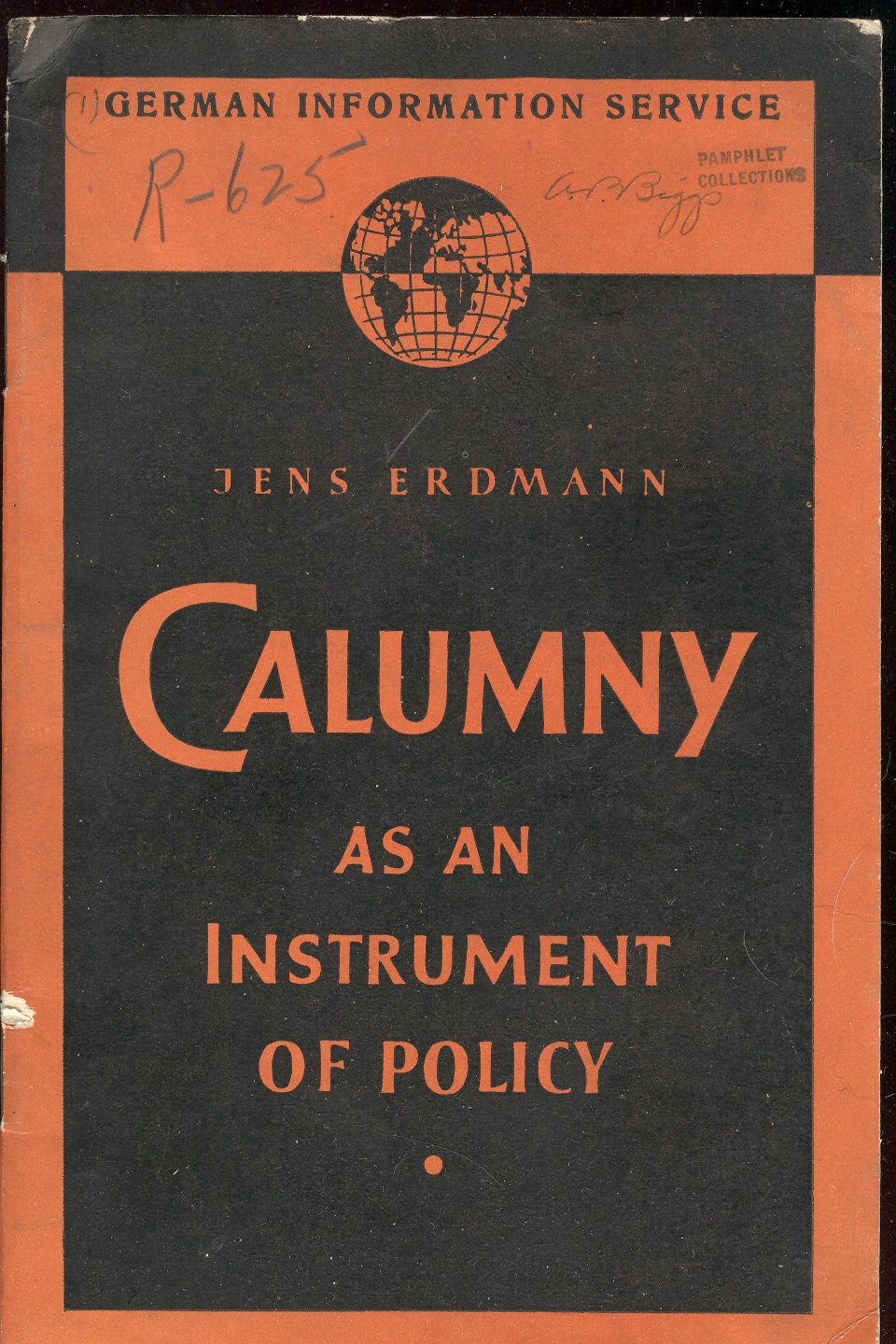
    This small
    pamphlet, written by the German Information Office (“
    Deutschen
    Informationsstelle”)  in 1940, wraps the good name of Nazi Germany in
    a double cloth of virtue, protecting itself against  the maligning and shriveling propaganda of the
    British Ruling Class.  At least that’s what
    Josef Goebbels & Co. would have you think. 
    The pamphlet was printed in English by Wilhelm Greve in
    Berlin, and in its 28 pages outlined the history of
    British “terror” propaganda in general, and of the recent “total defamations”
    against Germany
    in particular.

    Erdmann and etc.
    write:  “It is no mere chance that the British,
    who lag rather far behind the older artistic peoples such as the Italians,
    Germans and French in regard to the fine arts, nevertheless are conceded to
    excel them all in one form of portrayal—namely malicious political caricature.
    Presently the pamphlet was concerned with the general attack against the Nazi government
    overall, but took great offense in the British attack on the “Hausfrau”, a “shameless
    attack on the reputation of the women in the enemy camp…”

    The pamphlet does make
    its way around to “the atrocity lie”, which “so thoroughly ruins the good name
    of the enemy that all possibilities of companionship with him are paralyzed”.  The German propaganda office takes a very
    high and imaginary high road on this one,. Claiming that it is impossible for
    Germany to commit acts of violence and cruelty
    against innocent and defenseless people. 
    By the time this pamphlet was being distributed in 1940, the systemic
    extermination of the Jews had begun.  As
    had the war. 

    But the Nazis were
    concerned with the capacity for friendship after the war—or at least that is
    what Erdmann wrote—but that was now being made impossible by members of the “campaign
    of total defamation” which was mainly comprised of the members of the British
    ruling class, not the least of which was Winston Churchill. 

    “It is impossible”
    Erdmann writes of the imaginary damage done to the good name of the Nazis, “here
    to form an even approximate estimate of the extent to which all the European peoples
    have been poisoned by British propagandas…”

    Its hard to say for whom this pamphlet was intended–perhaps everyone.  The main intention was to separate the British ruling class (“caste”) from the rest of the British government–there is no mention whatsoever of the British people.  Now there were pro-fascist groups alive and well in Britain (the British Union of Fascists, The Link*,  and the Anglo-German Fellowship to name just a few).  Of course America was far from immune to pro-Nazi feelings and political parties. (I’ve written earlier here about Henry Ford and his Nazism, and there was also no end to American-Nazi business arrangements through 1944…but that’s a different story for another time.) But the main need of the Nazis in this pamphlet was to deny all of the calumny toosed its way by the rest of the world.  They just said, simply, “no”.

    The pamphlet ends with a plea for decency for teh world at large following the end of the present war:  “In the interest of political decency in Europe, it is hoped that the end of the present war will bring with it the possibility of such measures as will induce the ruling class in Britain to abandon once and for all their tradition of calumny.  That is an essential condition for the peace and the for the political and spiritual health of Europe”.

    The Nazis intended that this business of peace would be easier once the war was over, what with their elimination of the Jewish people, and tearing apart and murder of millions of Russians and Poles, and the subjugation of everyone else.  At that point they would write the history, and the British calumny would simply disappear.

    * “The Link boasted two dukes, the 11th Duke of Bedford, and the 2nd Duke of
    Westminster. Members of the Anglo-German Fellowship included 16 peers of the
    realm and the Governor of the Bank of England, Frank C. Tiarks. Many members
    were also former MPs. Lord Stamp was a director of the Bank of England. Another
    Fellowship member, Lord McGowan, was chairman of ICI, Britain’s
    trading partner with IG Farben. Lord Nuffield, chairman of Morris Motors Ltd,
    was a member of both the Link and the Anglo-German Fellowship. Perhaps the most
    disturbing name among the fellowship’s members was that of Sir William Strang,
    Chief Political Adviser to the Foreign Office.”
     

    ·Posted by :

    ·in:

    —

  • History of Normalcy, Part 1: “Girls”

    JF Ptak Science Books LLC  Post 625   Blog Bookstore

    My wife, Patti Digh, and I have long talked about the
    history of normalcy—a history of what looks to be “normal”, or standard, or
    acceptable at one time that became not so over the course of time.  Buying and selling human beings, women and
    their children being property of her spouse, Chinese immigrants not have (any)
    legal rights, are three good candidates (among thousands) for this history.  It is an interesting proposition to think
    about—what things around you, or better yet, what thing you think or say or do,
    that look good and acceptable today might look Blog--May 24--girlembarrassing and unacceptable thirty
    years hence.  In 1935 one issue might’ve
    been accepting the codified behavior of treating women as less than equal of
    men, deserving less in the workplace (if they were in the workplace), less
    rights in the courts, less deserving of equality in general; by 1965, this
    viewpoint may have well been in the minority; by 1995 it begins to look
    fossilized; by 2025 it might well be unbelievable.  What are the issues of 2009 that could be the
    equivalent of the 1935 issue?

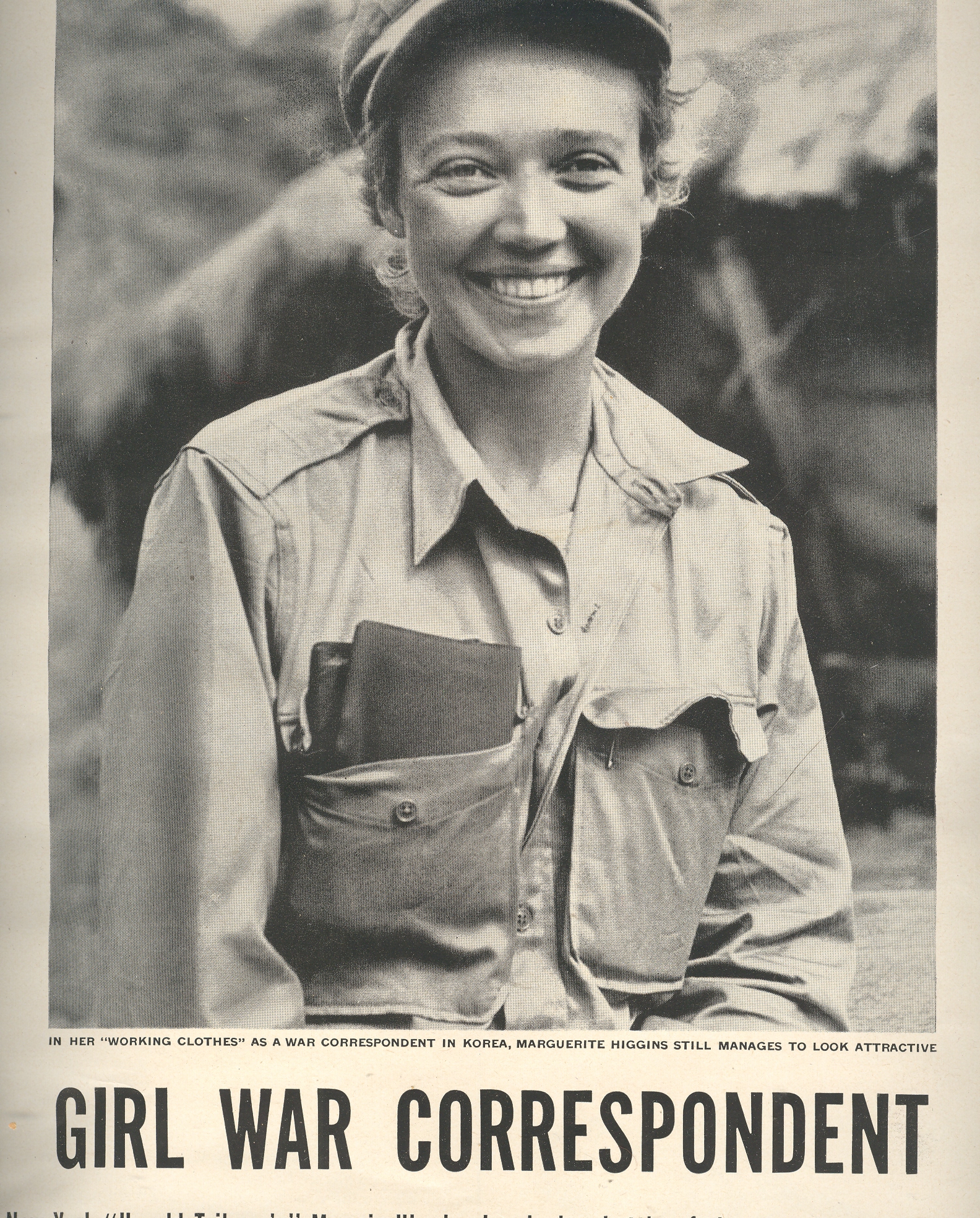
    And so the first in th is series:  the October 1951 issue of Life magazine’s article
    by Carl Mydans (the great and esteemed war and documentary photographer), “Girl
    War Correspondent”.  It is a sympathetic
    look at a sharp minority in the American newspaper business:  the female war correspondent.  Or, in this case, the “girl” correspondent.
    One would hardly refer to Edward Murrow as “the male correspondent Edward R.
    Murrow”, or “Edward R. Murrow, Boy Correspondent”.  The “girl” in this case was Miss Marguerite
    Higgins (1920-1966), aged 30.  She was a
    correspondent for the New York Herald Tribune, and covered the war,
    boots on the ground, covering the war in Korea.  Mydans gives a creditable review of Higgins very active and
    dangerous participation in the war effort. 
    It was not the intention of the article though to look at where Higgins
    had been before Korea;
    particularly, what she had been doing in 1944 and 1945.  AS a matter of fact Higgins was a
    correspondent for the Herald Tribune in Paris and London in 1944/5, and later sent to Germany in
    March 1945.  She received a combat ribbon
    for helping in securing the surrender of SS guards when she witnessed the
    liberation of Dachau.. Afterward she covered the Nuremberg
    trials and the Soviet blockade of Berlin.

    In spite of all that she was banned from covering the war in Korea.  If not for the personal appeal/demand of
    Douglas MacArthur (who telegraphed Higgins’superiors at the Herald Tribune “BAN ON WOMEN
    CORRESPONDENTS IN KOREA HAS BEEN LIFTED. MARGUERITE HIGGINS IS HELD IN HIGHEST
    PROFESSIONAL ESTEEM BY EVERYONE”) she and all other female correspondents would’ve
    been kept out of the war. She was the first woman to win the Pulitzer Prize for
    international reporting (in 1951, for Korea),
    and would go on to cover international affairs, winding up in Vietnam for
    Newsday in 1963.  As a result of her
    years of experience she wrote, in 1965 (!), Vietnam U.S. Our  Nightmare: The story of involvement in the Vietnamese tragedy, with
    thoughts on a future policy
    New York (Harper and Row).

    In spite of it all,
    given her experience in WWII and her developing coverage in Korea , she was,
    in October 1951, still a girl. 

    ·Posted by :

    ·in:


  • Nazi Propaganda and the Battle for Europe, 1941: the War at Sea

    JF Ptak Science Books  Post 624   Blog Bookstore 

    Propaganda Series #  14  (See listing below)
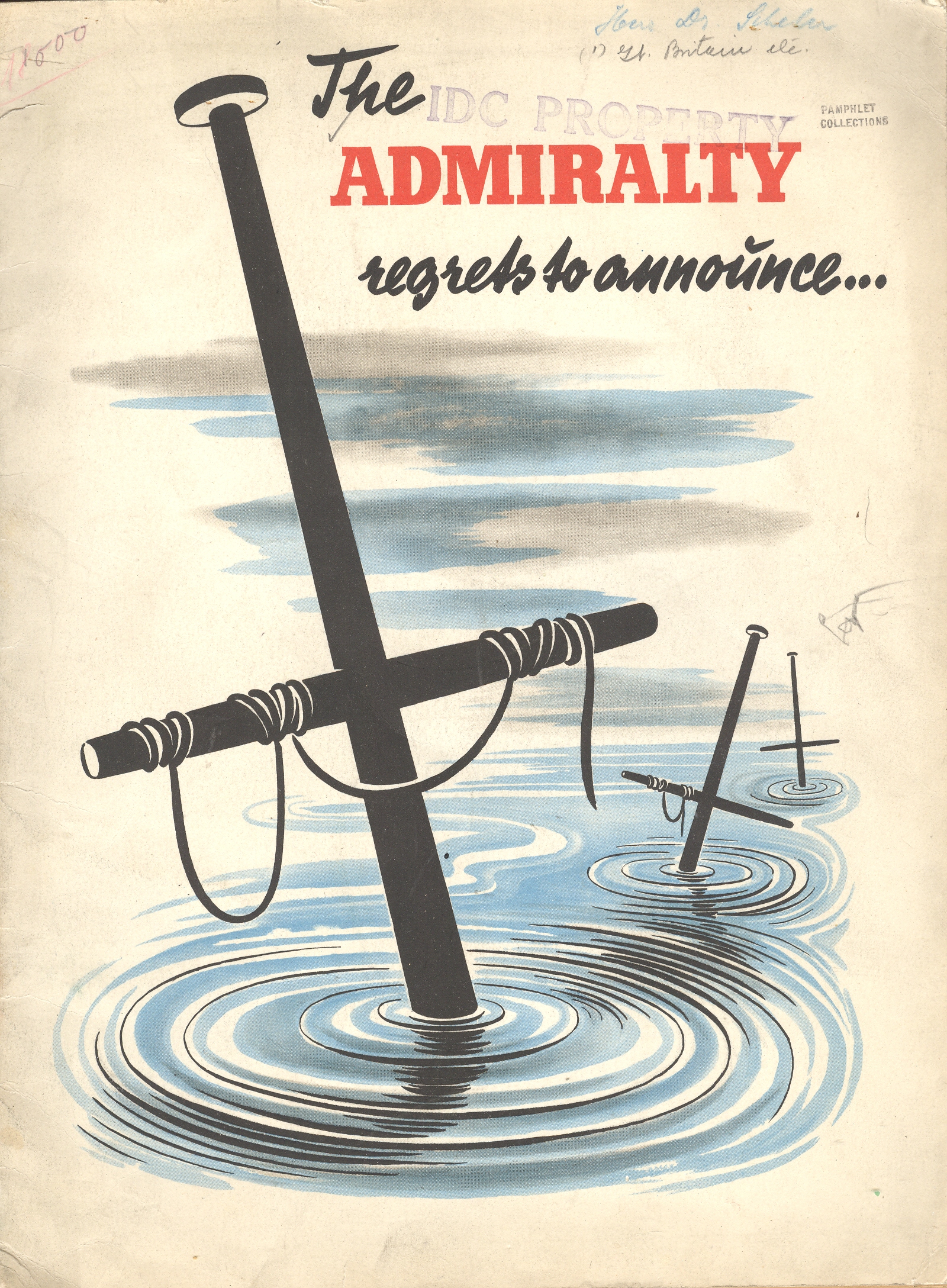
    Blog--May 24--regrets The Admiralty Regrets to Announce… was for years the standard beginning to an official British announcement concerning the loss of ships and sailors.  The phrase is used as the title to this work (by an unattributed writer known only as “an expert”) to immediately introduce the reader to the failings of the British navy.  It is of course a piece of Nazi propaganda, issued some time in 1941. (My copy is he U.S. copyright deposit copy and is stamped with a transfer date of September 1942; the pamphlets reads to me as though the U.S. had not yet entered the war.)  The great strengths of the German air force and navy are extolled and the failings of the British mercantile elaborated at great—and sometimes greatly imagined—lengths.  The booklet was published in French (except for the title) and answers its own repetitive question: “quelle est donc la situation relle de la marine commerciale anglais?”

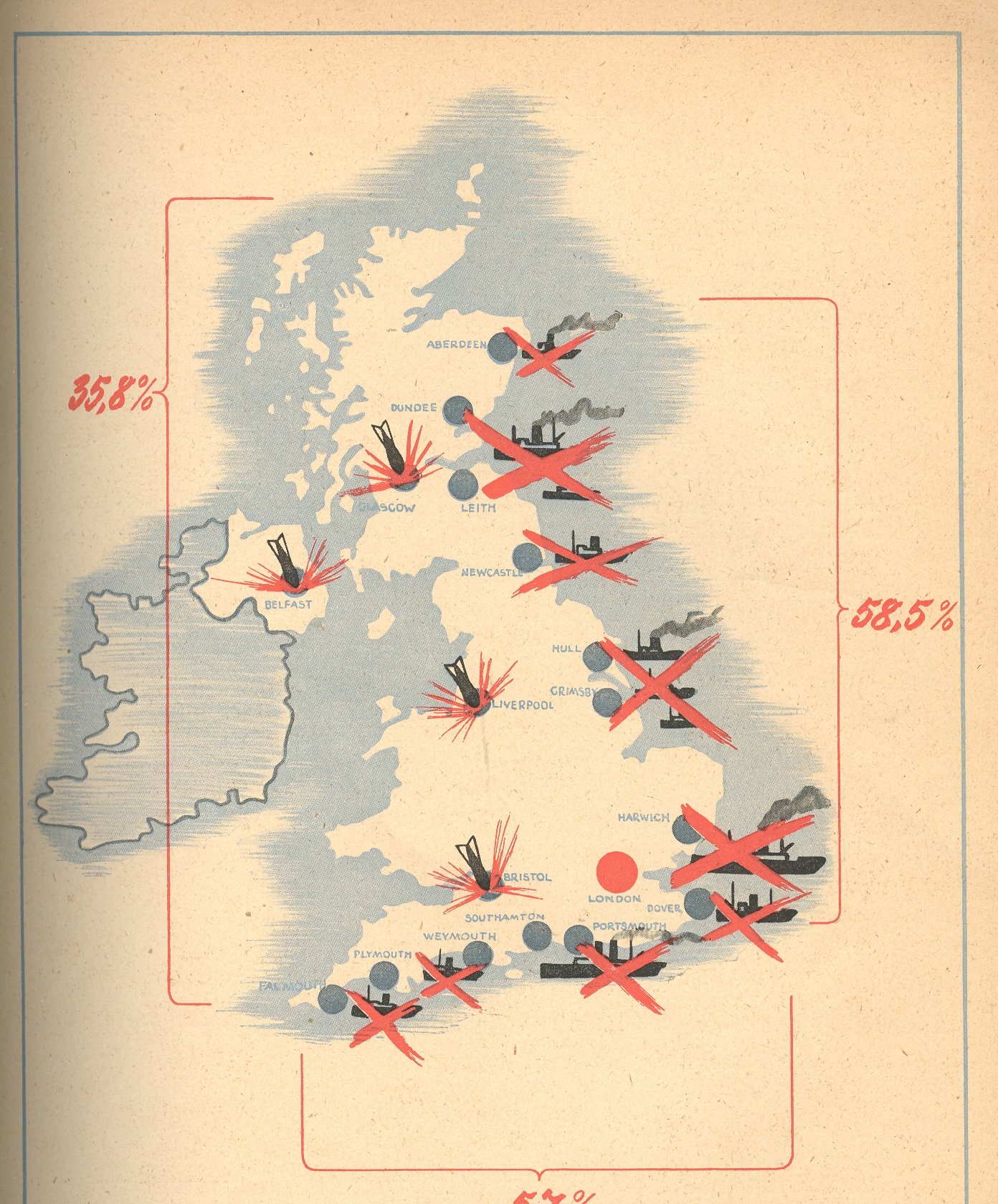
     The pamphlet’s 32 pages (illustrated with 2Blog--May 24--map14 photographs of various blow-ups and bombings, plus one graph and three maps) are dedicated to winning the French hearts and minds, trying to convince the conquered population that there really wasn’t any help coming, and that the British could not even supply themselves with the necessaries to run a country, let alone a war.

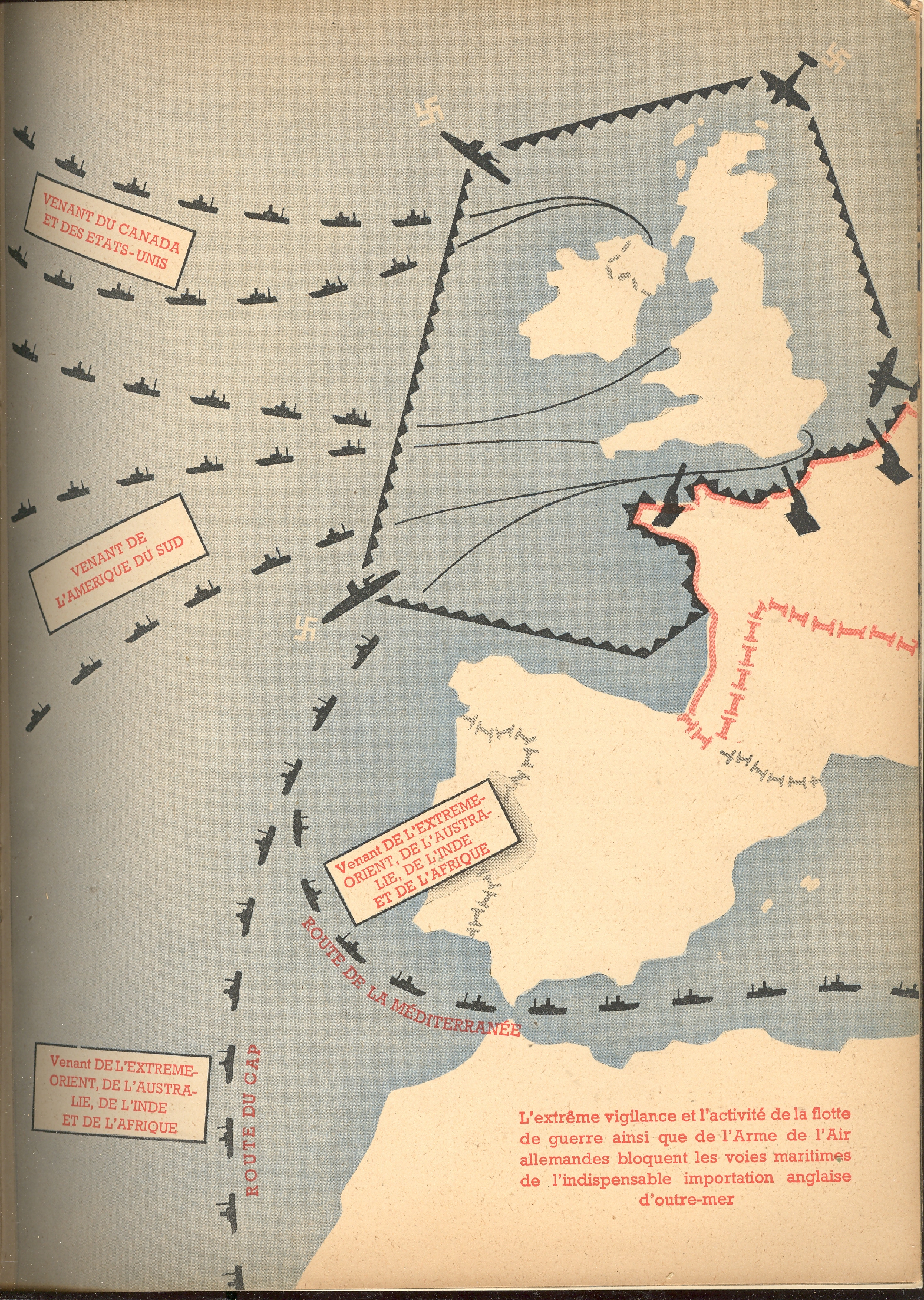
    In the map at right we see the  ports and shipping centers that were bombed by the Luftwaffe (with London located by a big red dot).  Another map shows the stockade-like presence of the Nazi navy securing its impregnable wall against the arrival of foreign trade and supplies to Britain.  

    Blog--May 24--map2

    This post is one of a series on propaganda maps which occasionally appear in this blog.   Like Thomas Nast political cartoons and war photography, a map can instantly and overwhelmingly display not only data but sentiment as well. The maps published in this pamphlet by the Nazis are were certainly immediately understandable to just about anyone, French-reading or not, literate or not–the images needed no words, especially when surrounded in the text by vicious images of German military might.  OvBlog--May 24--map2 001errun or not, Petain-ized as it was, France was still offering aid to its allies and resistance to the Germans–the more minds that could be won over with propaganda of this sort meant one less to have to worry about as an active enemy.

    A Listing of Some our the Propaganda-related posts in this Blog

    Nazi Propaganda: Scaring the Will-to-War, 1935

    Maps as Propaganda: the Nazi’s Use of Maps in the Hearts and Minds Campaign in Occupied and Holland and France, 1943


    The Propaganda of Restricting Infomration: Dorothea Lange’s Photos at the Japanese “Relocation” Camp, Manzanar, 1942

    Psychological Warfare--Aerial Propaganda Leaflets and Surrender Tickets, WWII.

    Maps as Propaganda: the Turning of the Tide, January 1943


    Humanitarian Propaganda–Hope for those at Home, September 1944.

    Nazi Propaganda: Scare Tactics in a Hearts and Minds Campaign, 1940

    A Propaganda Effort Equating the New Deal and Nazism, 1935: the Power of Willful Forgetting

    The Atomic Bomb: 6 August 1945. Propaganda Leaflet Dropped on Japanese Cities

    The Polish “Threat” to Germany, 1939:   Nazi Propaganda on the Perceived Polish “Invasion”


    Propaganda Maps #2: the Nazis. the Big Lie, and Cartography


    Graphical Display of Data: the R.A.F. and Luftwaffe Present Their Cases, 1938-1940


  • Crowds: Servicemen and B-17s at the End of WWII

    JF Ptak Science Books Post 608 

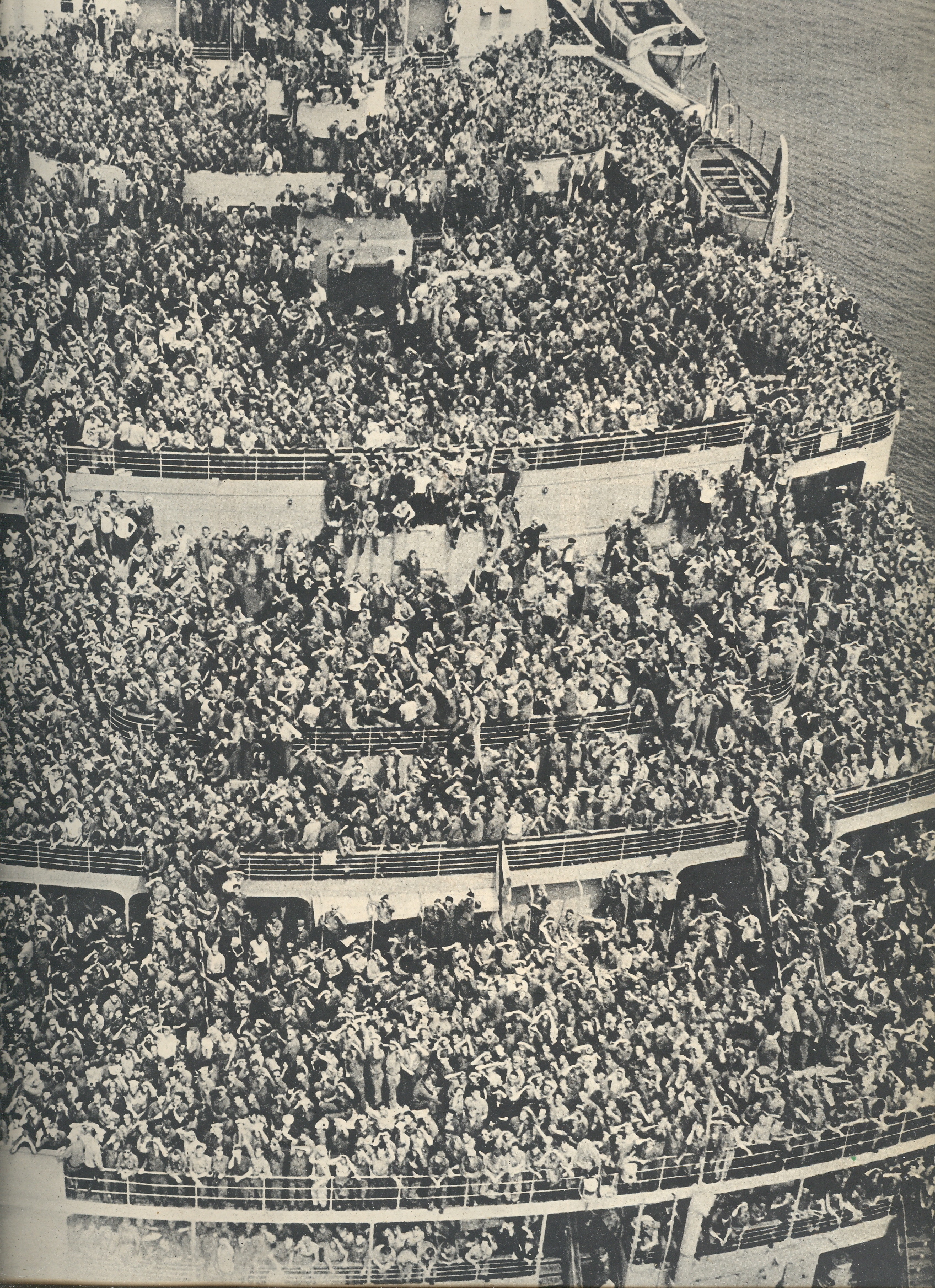
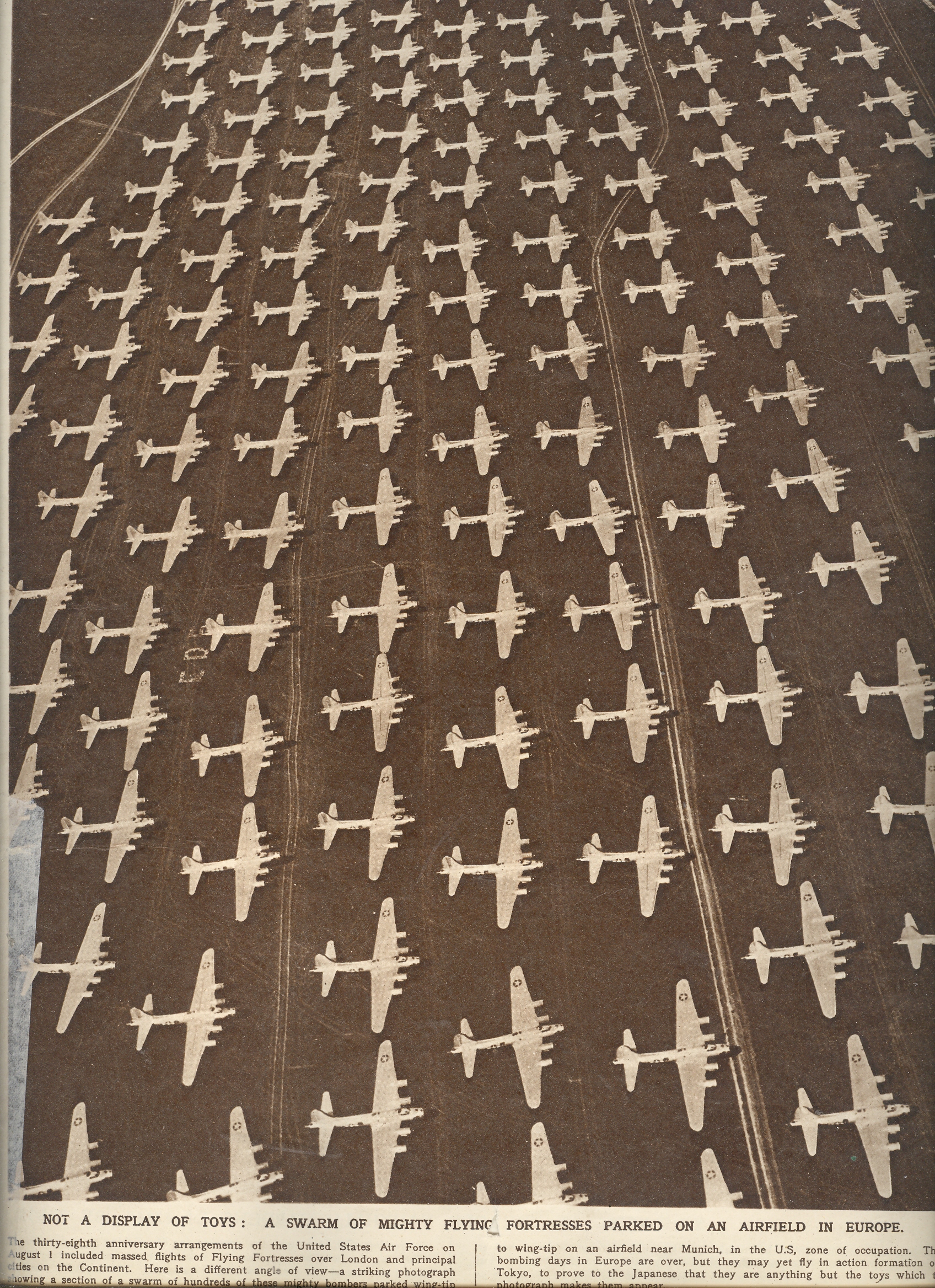
    These two images of crowds come in the same remarkable issue of The Illustrated London News for 4 August 1945—the war in Europe  was over, and the war in the Pacific, for all intents and purposes, would be over in days.

    Blog--may 8--vrowds QE


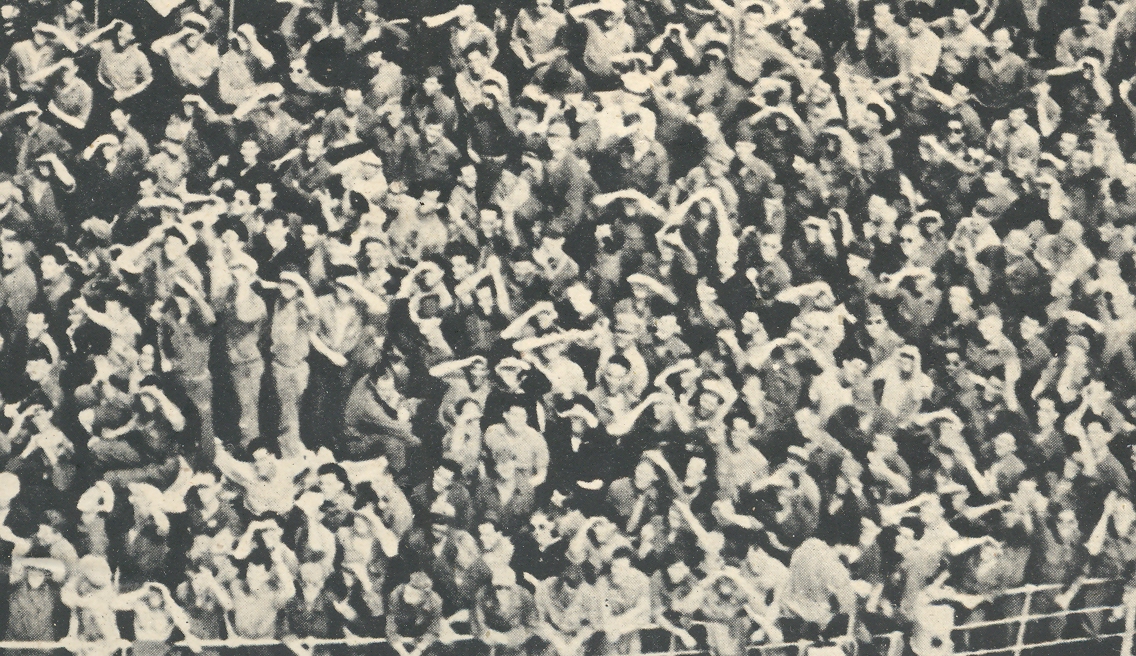
    The first image shows  passengers on board the “Queen Elizabeth”—a contingent of 14,000 American soldiers beginning their journey home following the defeat of Hitler.  It is a raucous, joyful image, with nearly everyone waving, happy to have arms to wave, happy to be alive to wave their arms, happy to be going home.Blog--may 8--vrowds QE det  


    The second, “Not a Display of Toys”, shows only one section of a large airfield “in Europe” (actually in U.S.-administered Munich).  There’s about 300B-17 (e?) parked wingtip to wingtip, off duty now from the fight in Europe, but (as the caption says) prepared for a fight in Japan. I don’t think anyone in high command had any doubt that these planes had seen their last action.  The atom bomb worked, and would work again (and again, and more so if necessary), and the fear that these planes would make their way East was not a real concern. This photo represents about 7% of the highest number of B-17’s in service in Europe at any given time. 

    Blog--may 8--vrowds


  • “Enemy Aliens” and the Invisible Japanese, 1941

    JF Ptak Science Books LLC   Post 590    Blog Bookstore
    Blog--laguardia
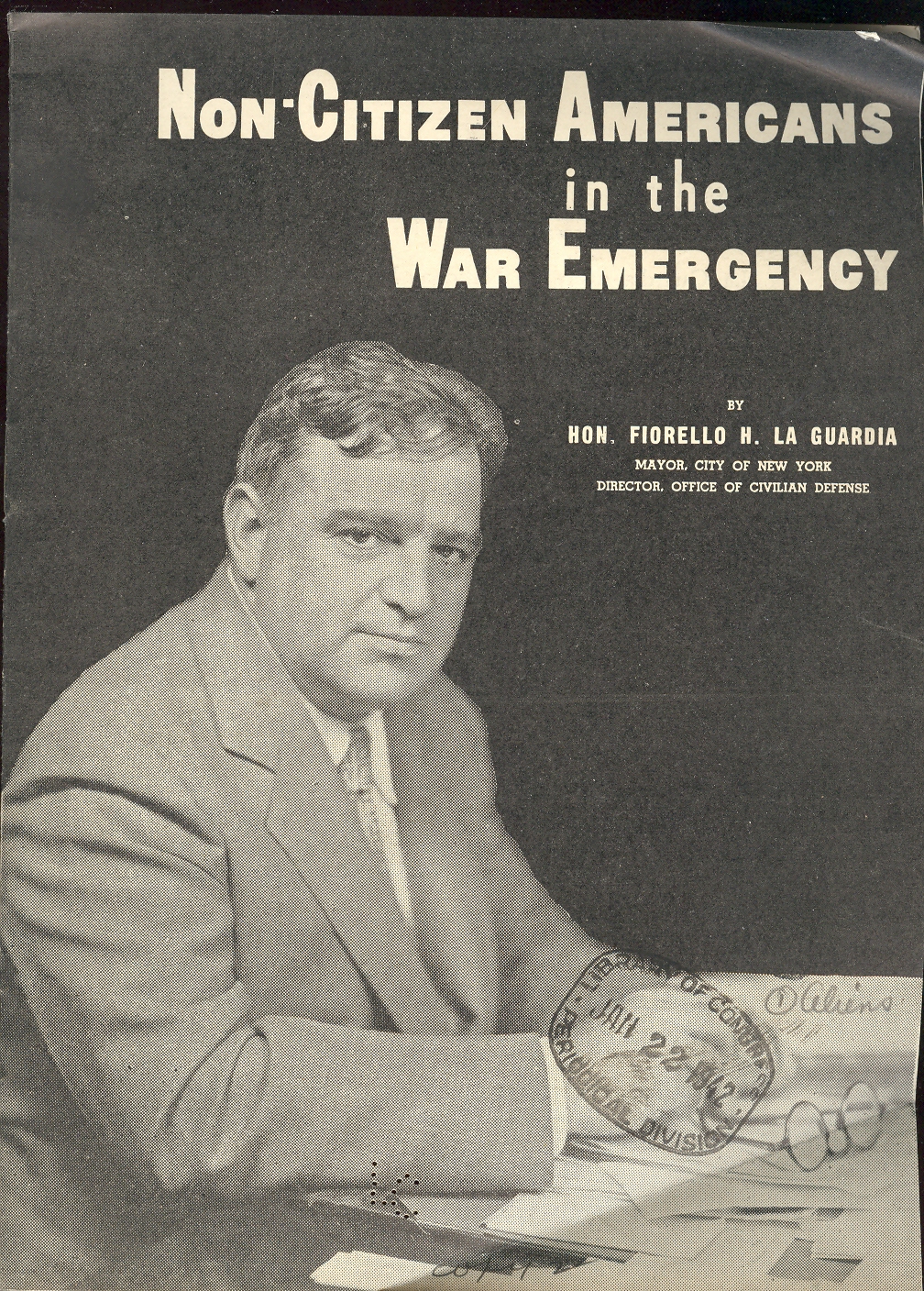
    The Little Flower was publicly coming to grips with “enemy aliens” in this small pamphlet, published in the last days of December 1941.  Laguardia–a Republican Congressman defeated for re-election in the Roosevelt landslide of 1932 and elected Mayor of NYC in 1933–was an outspoken critic of the Nazis and Hitler from his first day in Gracie Mansion.  In addition to being the first Italian-American elected to the U.S. Congress, Laguardia was also Jewish, and was a superb and constant speaker* against the monster in Germany. 

    In this pamphlet Laguardia outlined the legal implications of war and the non-citizen  German or Italian immigrant, and possibilities and consequences of their being declared enemy aliens, resulting in “arrest” and detainment.  (This applied to all “…natives, citizens, denizens or subjects…” of any foreign
    nation or government with which the United States is at war, and who could be “…
    liable to be apprehended, restrained, secured and removed as alien
    enemies….”.)  Attorney General Francis M. Biddle cited Department of Justice figures: “Of the 1,100,000 (sic) enemy aliens in the United States, 92,000 were Japanese, 315,000 were German, and 695,000 were Italian. In all, 2,972 had been arrested and held, mostly Japanese and Germans. Only 231 Italians had been arrested**”  (by 1943).  By the end of the war, there were fewer than 3,000 Germans and Italians who had been impounded (the Italians being released by October 1943 following Italy’s surrender). 

    There were upwards of 100,000 Japanese-Americans impounded, half of whom were American citizens.  For some reason there was not a single mention of the Japanese population in this pamphlet. 

    *In 1933, the year of Hitler’s major seating, Laguardia said: “Part of [Hitler’s] program is the complete
    annihilation of the Jews in Germany”, an uncommon and of course prescient point of view.

    **This authority was based on Executive Order 9066 (issued February 19, 1942) and Executive Order 9102 (issued March 18, 1942). These orders authorized the “removal from designated areas of persons whose removal is necessary in the interests of national security”.

    ·Posted by :

    ·in:

    —

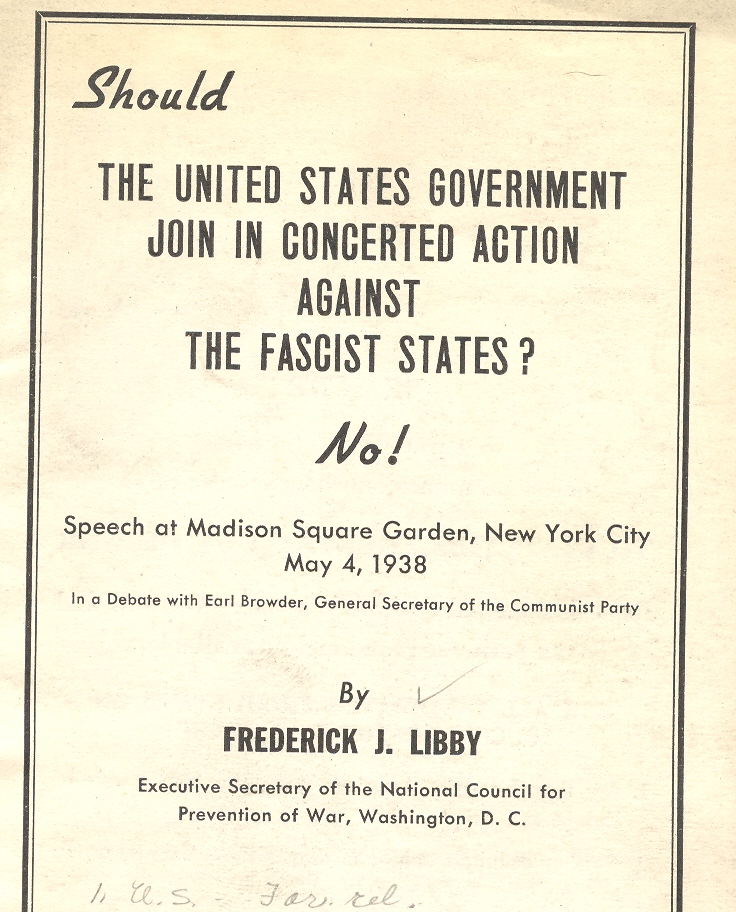
  • When Bad Ideas Were “Good”: Just Say “No” to Fighting Fascists, 1938

    JF Ptak Science Books LLC  Post 589    Blog Bookstore

    Blog--fascist Sometimes the screaming done in pamphlet titles like this example are odd and outrageous and entertainingly naive and are often taken out of context.  This one isn’t.  It isn’t odd and it isn’t entertaining and it isn’t naive (at least in the outsider sense).  It is the effort of Frederick J. Libby (1874-1970) to convince Americans that it was against their morality and their best interest to engage in any war to stop fascist aggression in Europe or Japan.  The world was well on its way to total war–Japan had already been savaging China for five years at this point and Europe was sinking into the Styx.  (Just two months before Libby’s May 4th speech Hitler “annexed” Austria and in April had signed a pact with Franco. In the short months following the speech Hitler would mobilize the German army, sign the Munich agreement with the failed Chamberlain, occupy the Sudetenland, and initiate Krystal Nacht.)  The speech was given at Madison Square Garden, which in another years would see have an audience of 20,000 supporting the German American Bund, one of the limp pro-Nazi organizations which sought an anxious fifth-column foothold in the U.S.) 

    The biographical bits I’ve found on Libby support him as a a decent pacifist.  His National Council for Prevention of War–which hosted his speech at the Garden–was evidently his great achievement, though his subject matter was not.  Now it isn’t as though there was a spearhead movement to get the suffering U.S. involved in European activities in 1938–and remember it took 27 months  after the invasion of Poland to get the U.S. into WWII, and that took a massive attack by a non-European entity.  So Libby’s “No!” was really playing to the strengths of the majority.  The U.S. was still in the grip of the Depression–and had just suffered another fresh setback in that year–so there wasn’t much public concerted support for stopping the very visible spread of Fascism around the world.  So as eyebrow-raising as his immodest title might seem, it did reflect the answer that most people in the U.S would have given to that question in the spring of 1938.

    ·Posted by :

    ·in:

    —

  • The Wartime U.S. Soldier as Advertising Commodity: Ads in LIFE, WWII

    JF Ptak Science Books LLC  Post 569

    4-1 prop meat 001
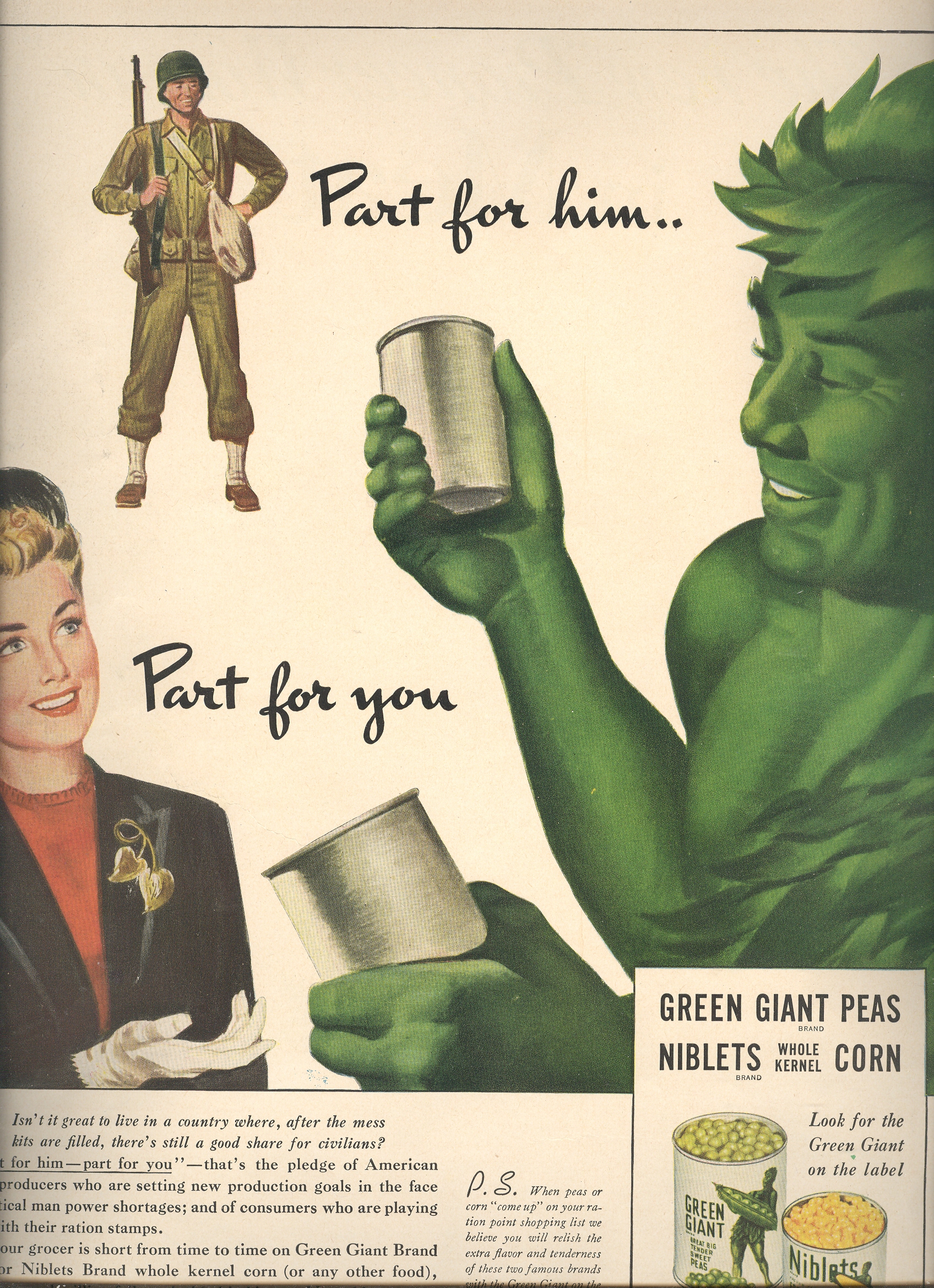
    I was making my way through LIFE magazine for 1943 and was struck by the ratio of the number of advertisements using the war as a backdrop (and American soldiers as convenient props) for sales against the actual space dedicated to war reporting.  Concentrating on just two randomly selected  weekly issues (November 1 and November 15 1943) I was surprised to find  28 ads (most of which were full-page); there was no war reporting in November 1 and just half a story (on the history of the Prussian General staff) in November 15.  Most of the ads were directly war-related, the companies mostly relegated to vast production of war goods, like General Motors, Cadillac and Boeing. The others were less clear, like the ad pictured here for Green Giant peas and corn.  This company was informing the home front that if there were shortages of their product it was because they were selling it to the Army or Navy–others were more adventurous for their spirited attempt at patriotism. I’m not sure that Wembly Ties really needed to include a GI in their ad, nor did I like the use of American soldiers to sell Interwoven socks. 

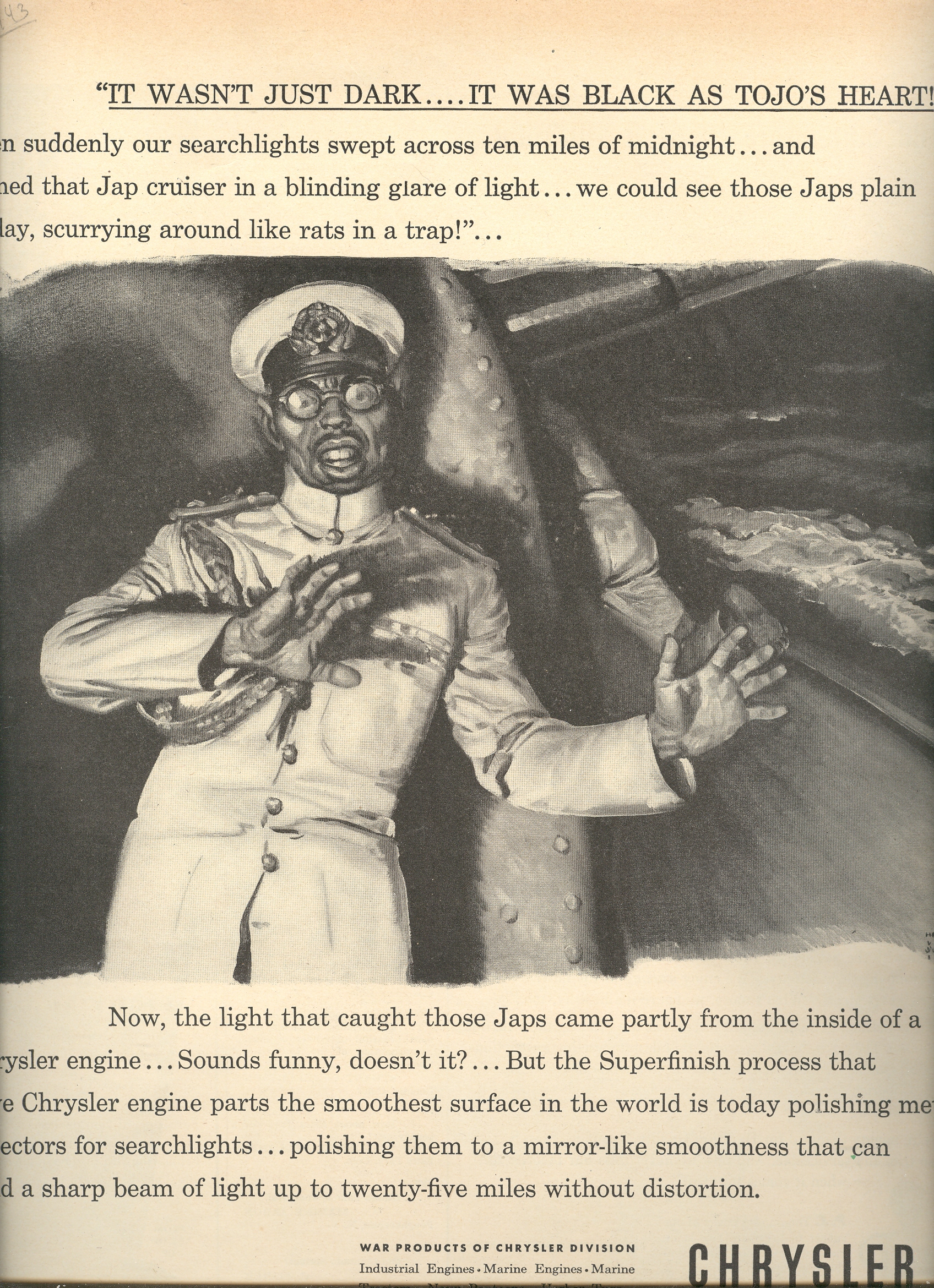
    There was a growing sense of sordidness to me, this use of images of wartime American soldiers, who were dying by the tens of thousands, being used to sell socks, ties and corn. This was particularly ironic since the magazine wasn’t finding anything to “report” in its full pages for the war for those two weeks–which is bizarre, because by that time in late 1943 there was a global FUBAR shitstorm happening to the east of NYC and to the east of San Francisco.  

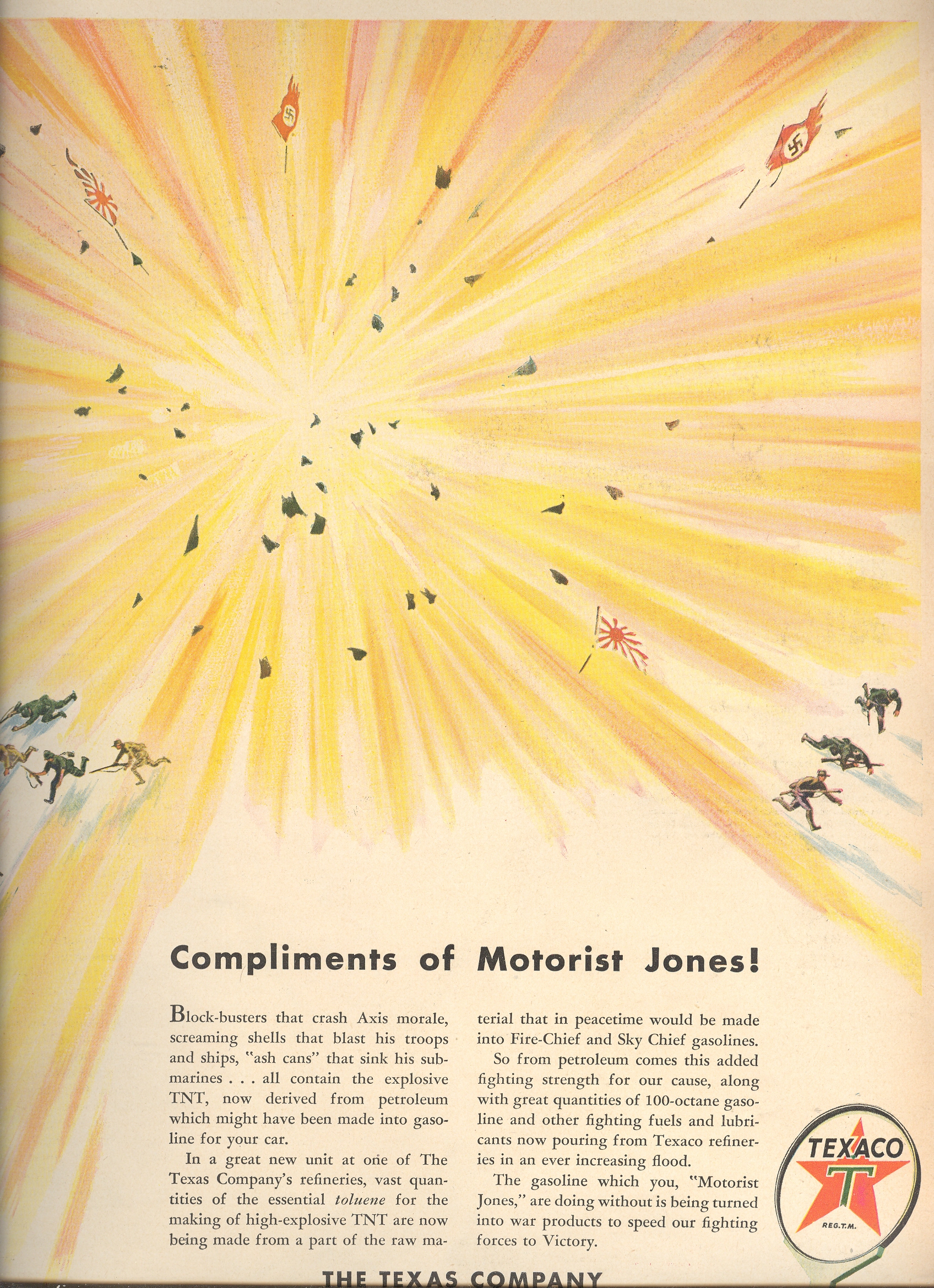
    Some ads did have high propaganda value and were related to the general winning of the war.  The vast majority though were singling out their product for purchase.  4-1 prop blow up

    Just for the record, the advertisers employing an American soldier to help sell their product  for these two weekly issues included Goodyear, Cadillac, Alcoa, Scotch Tape (for sealing boxes of tank parts), Sperry, Old Gold cigarettes, Lockheed, Schaeffer pens, Victory Airpower, Excide batteries, Camel cigarettes, Electric Power and Light companies, Oldsmobile, Cashmere Bouquet, ANSCO color film, Pontiac, Willys JEEP, Vinco (foodstuffs), Cavalier Whisky, Interwoven socks,Texaco, Eversharp pen, Wembly ties, Boeing, Black and White whisky, Ray-o-Vac, and Coke.  Seems like a lot for two weeks, no?  I’m not doing content analysis on this, just a passing interest, really, but when you look at similar issues for The Illustrated London News there’s very little of this sort of thing going on; even less so for the Illustrirte Zeitung (Lepizig).  

    I’m curious now to check out popular magazines for WWI.  It seems to me that there was a bit of this going on then, too.  Outside of cigarette and whisky ads, a lot of this sort of advertisement drops off during Korea; and by the time of Vietnam, these sorts of images have all but disappeared. 

    4-1 prop Jap

    ·Posted by :

    ·in:

    —

  • Common Views of the Uncommon–Non-Combatant Photography in WWI

    JF Ptak Science Books LLC   Post 600    Blog Bookstore

    There are many histories of photography in wartime:  early images show cavalry standing at the
    ready, troops marching, piles of munitions, heaps of food; later on (as late as
    WWI) come actual scenes during the course of battle.  War photography changes forever beginning in
    the Spanish Civil War, and then of course WWII. 

    Korea, Vietnam,
    and then into the more recent past elevates the camera to being a third-person
    and fifth column.

    Blog april 29 trench Looking through the WWI years in the Illustrated
    London News
    I experienced a creeping realization of a different sort of
    perspective in war photography:  turning
    the camera to look behind the battle. 

    Turning the camera exactly around, away from the action, hasn’t a good
    history in itself.  There are some great
    examples:  when the Golden Spike was
    driven at Promontory Point in 1869 someone had the foresight to look the other
    way and make a photo—it shows a vast plain, a long double ribbon of rail, a
    long series of telephone poles receding into the horizon, and one man. It is
    also a scene that looks pretty much the same today, if you took away the small
    dedication center that is there.  That
    was the reality of the day, not all of those RR workers gathered around the two
    hot locomotives, the cleanest of them toasting each other and the camera. (If
    you look closely you can find some Chinese laborers in among the crowd and also
    occasional bits of Confederate uniforms.)  
    Elsewhere in this blog I told the story of Ed Clark, the LIFE
    magazine photographer who wheeled his camera away from where the hundreds of
    other cameras were recording the removal of Franklin Roosevelt’s casket from Hot Springs and made
    perhaps the greatest photograph of the FDR years. 

    But it is a different sort of turn-around that struck me for WWI.  These are the photographs of the liminal
    spaces after the fight, the clean up, the gathering of spent ammo, the cleaning
    of the clothing, the care of the soldiers, the rehabilitation. And I’m not talking
    about the Matthew Brady after-battle battlefield photograph style.  What I’m referring to is all of the “little”
    things that happen when the battles aren’t being fought and the troops weren’t
    on the move. There some images for thing that appeared in Harper’s Weekly and
    Frank Leslie and so on during the U.S. Civil War, but so far as I can tell the
    vast majority of them are drawings. 
    Having looked through popular illustrated magazines that covered the
    Franco-Prussian War, the Spanish American War and all of the conflicts
    in-between, I just don’t have much of a sense at all that this life was
    recorded very well photographically.

    I can understand this—there’s not that mBlog april 29 trench 2uch glory in sandbagging Red Cross
    stations, or hauling away dead horses by the thousands, or cooking thousands of
    loaves of bread in primitive conditions; they certainly aren’t a good case for
    a hearts-and-minds campaign.  The camera
    has enough power to go ‘round, giving and taking, usually at the same
    time. 

    But to my brain these photographs really come into being in the second half
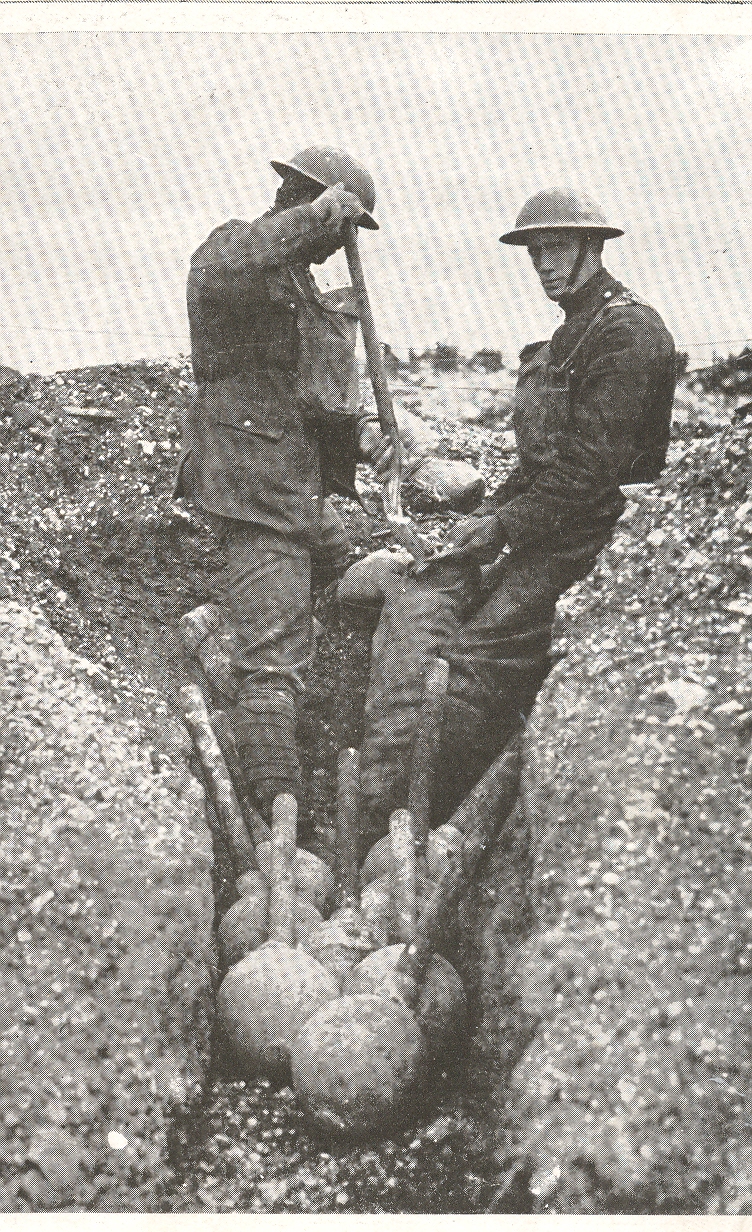
    of WWI., and they tell an other, integral, more human story of that same war.  The first image (above) shows two soldiers
    cleaning up cartridge cases after a fight—when you look closely at the photo
    you see that the place is littered with those cases.  I suspect that there were hundreds of
    millions of these cases ejected from rifles. 
    Billions, probably.  I wonder how
    long it would take a thousand soldiers to shovel a billion shells into canvas
    bags?  The picture reveals a very deep
    image of the ways of war at the most basic level. Blog april 29 trench 3

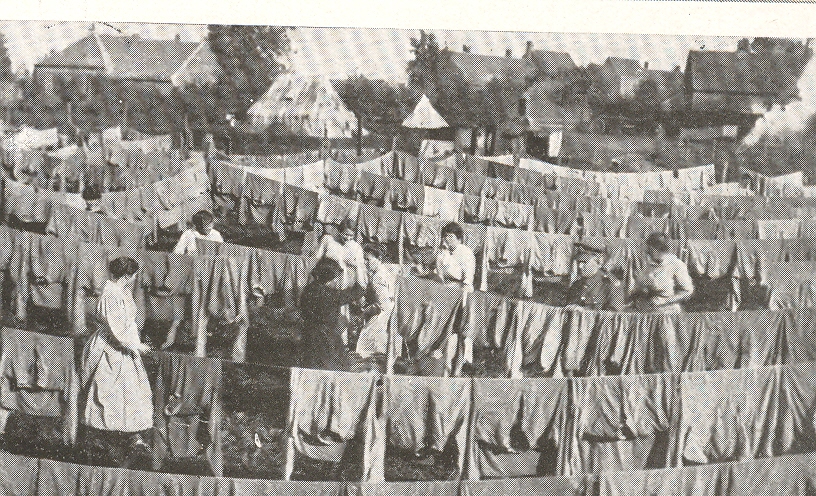
    The next photo is a “simple” image of clothing out for a dry—except of
    course that the clothing lines go on and on, railroad tracks into the sun,
    tended by hundreds of women, getting the shirts ready for the “men in the trenches”,  many of whom won’t need those shirts by the
    end of the month. 

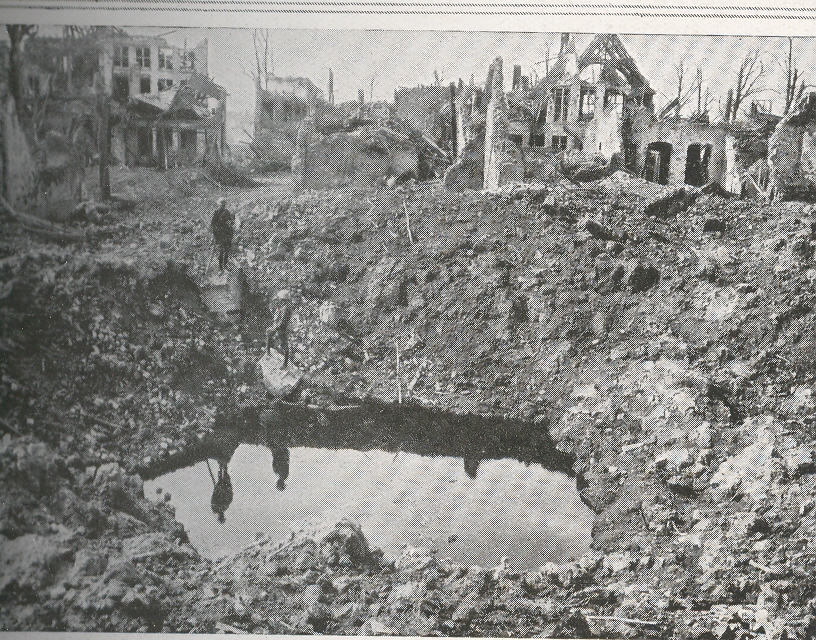
    Many of these men and women wound up being consumed–this photo at right shows one of the ways how that happened. It is an extraordinary crater some 75 yards in circumference created by a massive shell.  It is a massive image–brutal, lonely, and speaking the quiet of the end.  And it was a different sort of image that people were used to seeing in war reporting. 

    These three photos appeared on only three successive pages of the 15 October 1917 issue of the Illustrated London News.

    ·Posted by :

    ·in:

    —

  • An Unusual View: Looking into the Past and the Future–St. Quentin, 1917

      JF Ptak Science Books LLC  Post 593       Blog Bookstore

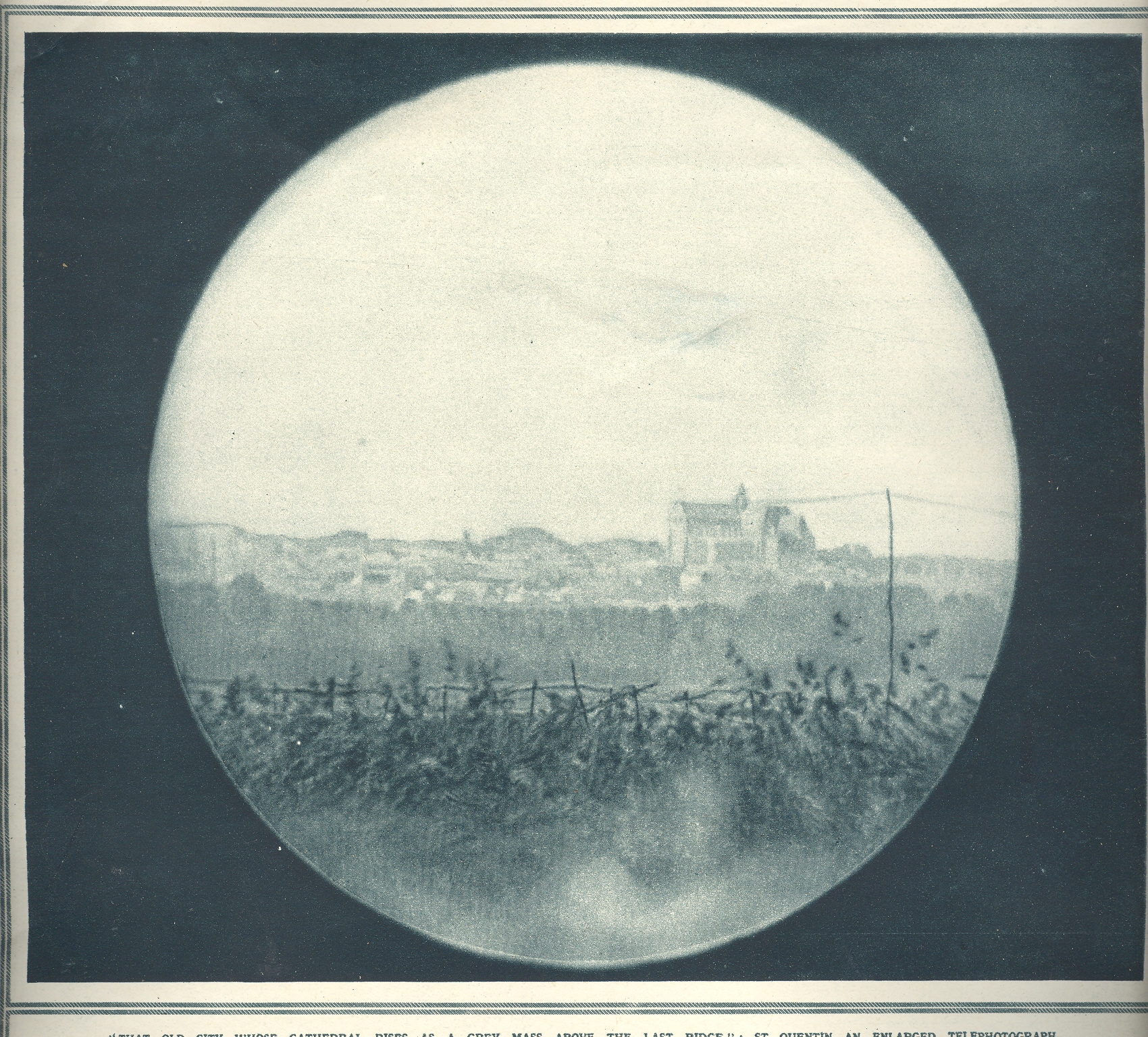
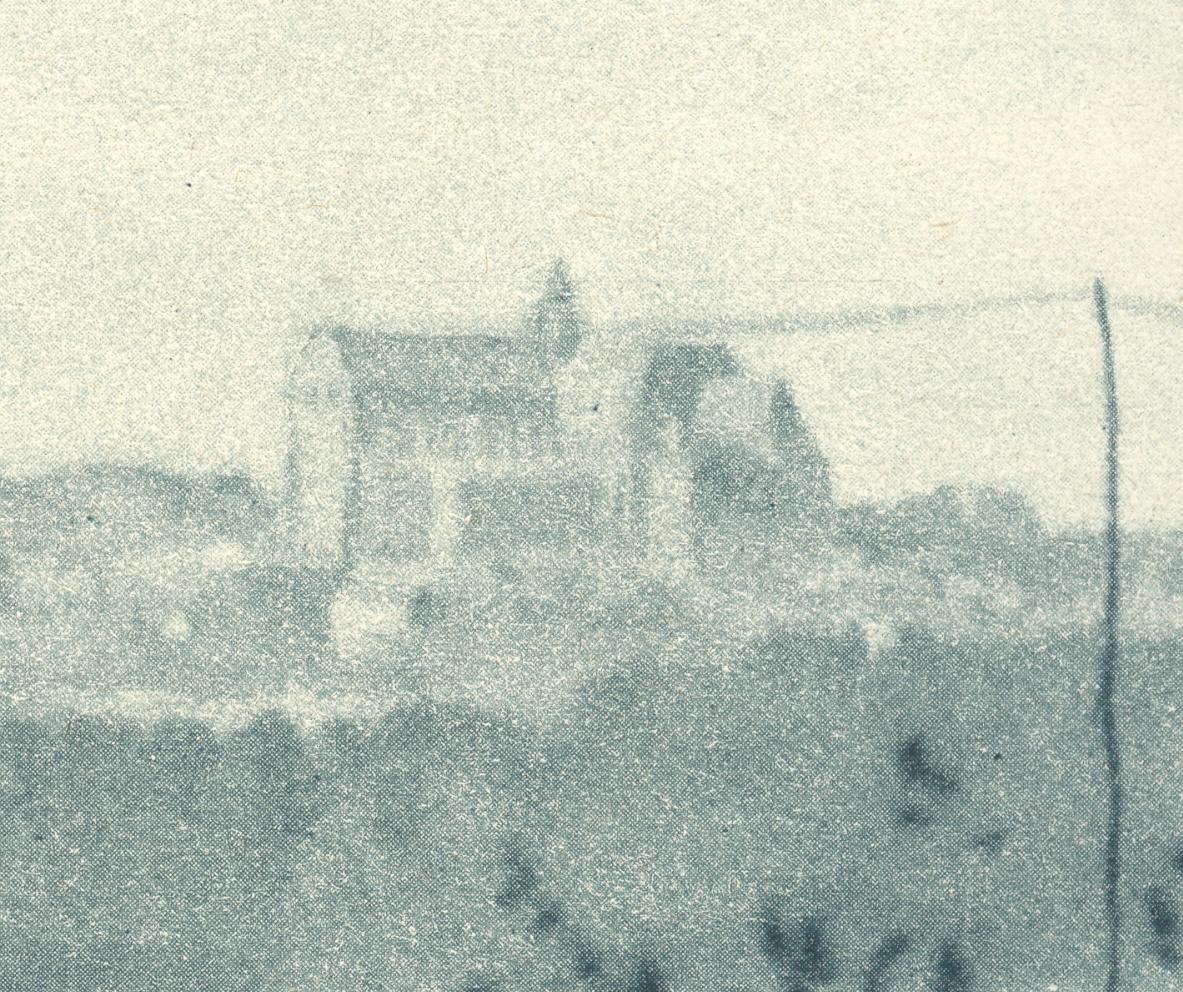
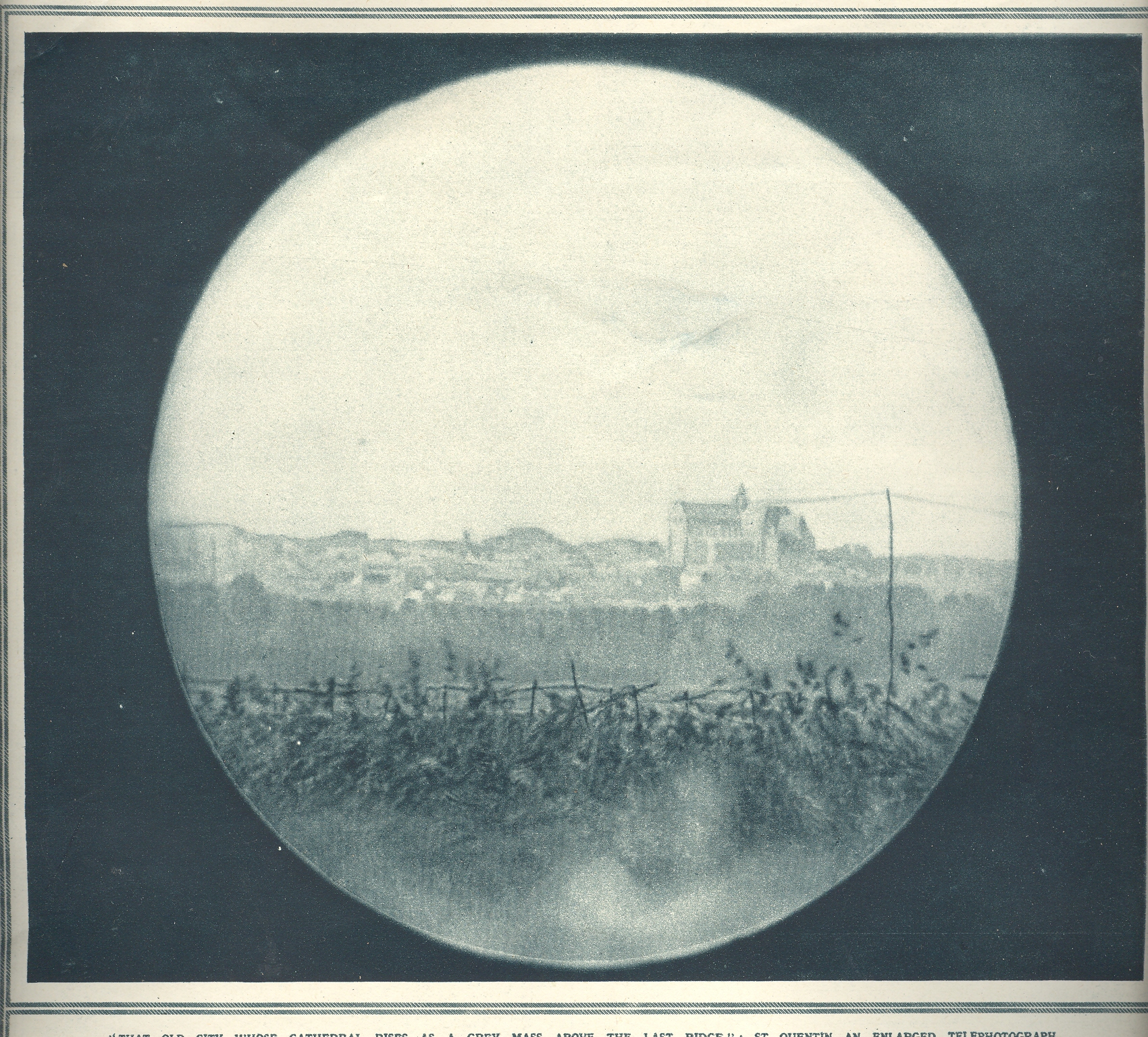
    Blog--WWI--st. quentin This lovely, seemingly antique daguerreian view is what the American Expeditionary Force (AEF) commander General JJ Pershing saw at the front lines of St. Quentin in July 1917.  The U.S. had entered the war, finally, on April 2 1917, nearly three years after the war began, landing in France 13  June 1917 and entering almost immediately into battle at Chateau-Thierry.  On 2 July Pershing estimated that the U.S. would need a million fighting men; the day that this photo was published in The Illustrated London News, he revised that estimate to three million.  The view he was seeing here was more than of a town about to be pounded by thousands of artillery shells–the magazine was sharing a view of what the European and Empire countries had been seeing for 31 months, and what the Americans would now be sharing for another 17 months. 

    Blog--WWI--st. quentin det
    It is a beautiful and deadly view, seen through French field binoculars at the tip of the front for the battle.  The large building to the right is the town’s Gothic cathedral/collegiate masterpiece:  it was old and large, with a 370-foot-long and 130-foot-high nave.  It was a highpoint for that part of France, and was the burying place for St. Quentin and St. Victorious–their graves would be covered by the rubble of the cathedral’s collapsed roof very soon after this picture was taken.  The building was shelled and burned all night long–the French blaming the Germans and vice versa. 

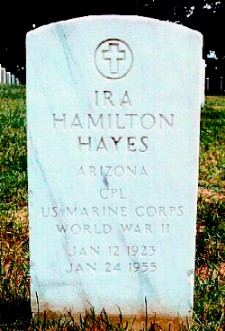
    If Pershing had really good sight he might’ve been able to see the 116,000 American soldiers wIraHayesArlingtonho would be killed in battle, though I suspect he had a pretty good idea of what was to come, thinking as he did that he need 3 million soldiers.  To be utterly fair I don’t think that he could’ve possibly  seen in his imagination  what 9 million dead soldiers looked like, or what 16 million dead soldiers and civilians looked like, or what 37 million dead and wound soldiers and civilians looked like, all the casualties of this war, all done in 4 years. 

    I’ve found it odd in a way that I’ve not really been able to explain that Pershing is buried so very close to Ira Hamilton Hayes at Arlington.  I used to leave a good twig on Jackson’s headstone on Memorial Day, and then get that unusual, uncomfortable emotion on seeing the large Pershing monument just a few hundred feet away. 


  • War After the Peace: American, Philippine and Japanese Guerrillas, September 1945

    JF Ptak Science Books     Post 566

    Several years ago I purchased part of an archive of David Katcher*, who was the founding editor of the journal Physics Today. Before that, several years before that, in 1945, David Katcher was Lt. Katcher, serving as a correspondent/writer in the public relations office of the U.S. Army Headquarters of the Western Pacific (GHQ USAFPAC). There’s a 6-inch stack of paper here with what seems to be his (and associated) mimeographed offprints of the daily grind of running the PR department of the Army in the Philippines, which, taken as a whole, is pretty interesting, showing the concerns and trials of the Army in reestablishing the government and infrastructure of the country.  Some of the individual reports/publications are stand-alone, straight-up fabulously interesting things, and so far as I can determine, have not been published anywhere else.  These two examples are both related to the subduing of the last remnants of the Japanese Army still fighting in the dense nether lands of northern Luzon, the Philippines, fighting after the surrender had been made (14 August 1945) and  signed (formally, on the USS Missouri, 2 September) , fighting after the war had ended. 

    There’s much more than can be written about fighting after  peace treaties ending wars–I know that the Germans were running around in Africa following WWI–but that’s a very big story, and not for here.


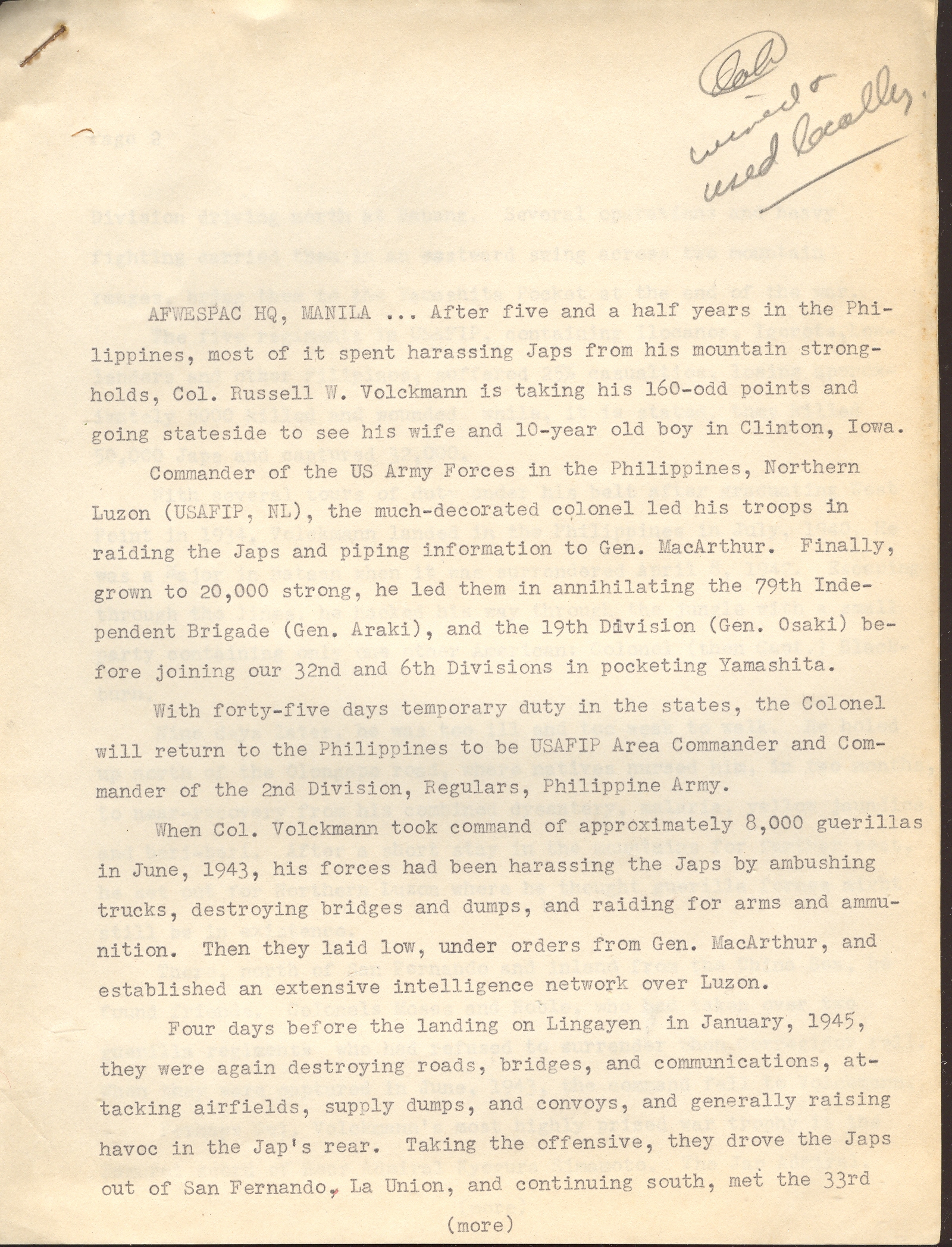
    DOCUMENT 1      (Issued 28 September 1945)

    The first document relates the extraordinary story of Col. Russell W. Volckmann who from 1942 led a force of thousands of guerrillas against the Japanese and who, by September 1945, led a force of 20,000 in routing the last elements of the Japanese army.    (The entire text of his memoir written in 1954 as We Remained Behind: Three Years Behind the Enemy Lines in the Philippines  can be found here.)                                                                                                 
    Volckmann1

    (see Continued Reading section, below, for the rest of this document)

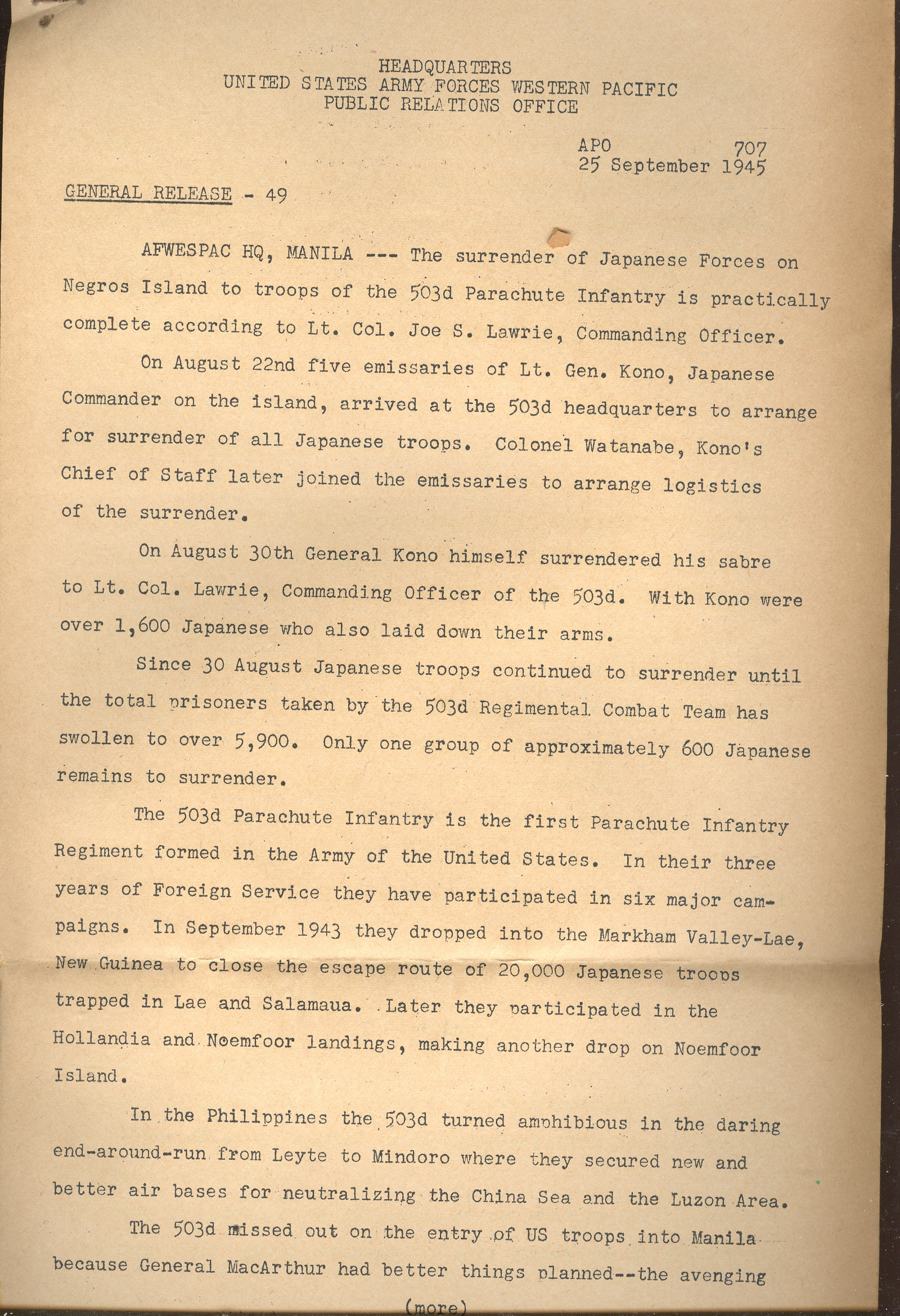
    DOCUMENT 2  (Issued 25 September 1945)

    This short document relates the story of the capture of the last of the Japanese forces in Luzon, including the capture of some 40,000 troops, including General Yamashita (“The Tiger of Malaya”) and soon-to-be-executed war criminal and beast of Manila.

    I’ll let the documents speak for themselves.

    Volckmann4

    (Read more, below)

    *from the Washington Post, 2 June 2002, the following obituary of David Katcher:

    “David Katcher, 87, who retired in 1979 as special assistant in science and technology to the undersecretary of state for security assistance, science and technology, died of cancer May 31 at his Chevy Chase home.

    Mr. Katcher was also senior policy analyst in the White House Office of Science and Technology policy during the Carter administration. He was the 1947 founding editor of Physics Today monthly magazine, published by the American Physics Association, and he edited the journal for four years.

    He had been an editor at the Naval Ordnance Laboratory before World War II and later executive secretary of a theoretical physics division of the Institute for Defense Analysis.”

    ·Posted by :

    ·in: